Conceptual and socio-cognitive support for collaborative
learning in videoconferencing environments
Bernhard Ertl
a,*, Frank Fischer
b, Heinz Mandl
aa
Ludwig-Maximilian-University Munich, Leopoldstr.13, 80802 Munich, Germany b
Knowledge Media Research Center, and University Tuebingen, Konrad-Adenauer-Str. 40, 72072 Tu¨bingen, Germany Received 21 April 2004; accepted 20 October 2004
Abstract
Studies have shown that videoconferencing is an effective medium for facilitating communication between parties who are separated by distance, particularly when learners are engaged in complex collab-orative learning tasks. However, as in face-to-face communication, learners benefit most when they receive additional support for such learning tasks. This article provides an overview of three empirical studies to illustrate more general insights about how to support collaborative learning with videoconferencing. The focus is on conceptual support, such as structural visualization and socio-cognitive support, such as scripts. Based on the results of the three studies, conclusions can be drawn about the conceptual and socio-cogni-tive support measures that promote learning. Conclusions can also be reached about the need for employ-ing both conceptual and socio-cognitive support to provide learners with the most benefit.
2004 Elsevier Ltd. All rights reserved.
Keywords: Computer-mediated communication; Cooperative/collaborative learning; Distributed learning environ-ments; Human-computer interface; Teaching/learning strategies
0360-1315/$ - see front matter 2004 Elsevier Ltd. All rights reserved. doi:10.1016/j.compedu.2004.11.001
*
Corresponding author. Fax: +49 89 2180 5002.
E-mail addresses:[email protected](B. Ertl),f.fi[email protected](F. Fischer),mandl@edupsy. uni-muenchen.de (H. Mandl).
1. Introduction
Videoconferencing provides an environment that is well suited to collaborative distance learning. This assumption is reflected in a number of different learning scenarios that use
vid-eoconferencing, ranging from sharing lectures between remote classrooms (cf. Imhoff, Spaniol,
Linnhoff-Popien, & Garschhammer, 2000; Storck & Sproull, 1995) to coaching a partner in a
medical surgery (e.g., Gagliardi, Smith, Goel, & DePetrillo, 2003). Early studies indicate that
collaborative learning in small groups using videoconferencing is a promising approach (cf. Ertl, Reiserer, & Mandl, 2002; Rummel, Ertl, Ha¨rder, & Spada, 2003). In these scenarios, the synchronous communication between learners is instrumental for learning success: Through synchronous interaction and particularly with the use of shared applications, learners
solve highly complex tasks, e.g., using collaborative problem solving (cf. Kirkwood & Joyner,
2002). However, due to the complexity of many collaborative learning tasks, there are several support methods available, which have already proven to be beneficial in face-to-face
situa-tions (e.g., Cohen & Lotan, 1995; Johnson & Johnson, 1992; Lou, Abrami, & dÕApollonia,
2001; Slavin, 1995). In comparison to face-to-face learning environments, videoconferencing
can offer new ways to support learnersÕ construction of knowledge. This is mainly possible
through the feature of application sharing, which allows all dispersed learners to share one
common computer screen.
Over the past few years, we have conducted a series of empirical studies to investigate the po-tential for using specific types of support for collaborative learning in videoconferencing environ-ments. In the sections that follow, we will provide an overview of three empirical studies conducted by our research group and use them to reach more general conclusions about how to support collaborative learning in videoconferencing.
2. Characteristics of collaboration via videoconferencing
Particular characteristics of the videoconference may constrain the process of collaborative learning in some specific ways. A broad range of studies on the effectiveness of collaboration
in videoconferencing was conducted during the last decade (e.g., Bruce, 1996; Finn, Sellen, &
Wilbur, 1997; OÕConaill, Whittaker, & Wilbur, 1993). The results point to one crucial factor:
the quality of the audio transmission (cf. Finn et al., 1997; OÕConaill et al., 1993). If the audio
transmission is not reliable, for example, if sound bytes are lost or if audio delays of more than 500ms occur, than collaborative scenarios may fail – no matter how sophisticated the
design of the collaborative environment is (cf. Anderson et al., 1997; OÕConaill et al.,
1993). Furthermore, some communication cues, such as facial expressions and gestures may
not be fully transmitted in videoconferencing (cf. Langton, OÕMalley, & Bruce, 1996). On
the other hand, these studies also show that the differences in the communication process
do not affect collaboration outcomes or the collaborative task solution (cf. Anderson et al.,
1997; Bruhn, 2000; Fischer, Bruhn, Gra¨sel, & Mandl, 2000; OÕConaill et al., 1993; Paechter,
2003). Provided that the transmission of audio is reliable, learning outcomes are also of a comparable quality to the outcomes of face-to-face communication (Bruhn, 2000; Fischer et al., 2000; Fischer & Mandl, 2003; Paechter, 2003). This then raises the issue of which support
methods known for supporting collaboration in face-to-face settings may also prove beneficial in videoconferencing and if there are support methods that are particularly suitable for videoconferencing.
3. Collaborative learning in videoconferencing
Collaborative learning in small groups means that groups act relatively independent of a
teacher with the goal of acquiring knowledge or skills (cf. Cohen, 1994; Dillenbourg, 1999).
One major goal of collaborative learning is to support social interaction and encourage the
learnerÕs cognitive processes. In this context, learnersÕ elaborations are seen to play a crucial
role (cf. Webb, 1989; Webb & Palincsar, 1996) for expressing their knowledge, ideas and
be-liefs to their partners (cf. OÕDonnell & King, 1999; Palincsar & Brown, 1984; Rosenshine &
Meister, 1994). In this way, learners work to co-construct knowledge collaboratively (cf. Bruhn, 2000; Fischer et al., 2000; Roschelle & Teasley, 1995). Furthermore, learners also
externalize and elaborate on learning material when taking notes (cf. Gould, 1980;
Molitor-Lu¨bbert, 1989), e.g., in a shared application. In collaborative learning environments, learners
often create such written representations collaboratively (cf. Baker & Lund, 1997; Dillenbourg
& Traum, 1999; Klein, 1999; Suthers, 2001). During this process, they create a shared external representation of the subject matter, which can be helpful for collaborative knowledge con-struction (Ertl, 2003; Fischer, Bruhn, Gra¨sel, & Mandl, 2002). When constructing a shared external representation, learners must externalize their knowledge, that is, they must elaborate
on and comprehensibly explain their knowledge to the learning partner (cf. Hayes & Flower,
1980; Peper & Mayer, 1986). Furthermore, creating shared external representations can encourage learners to solve conceptual or structural problems they may have with the subject
matter (cf. Fischer & Mandl, 2002; Gould, 1980; Molitor-Lu¨bbert, 1989) and influence the
co-construction of knowledge (cf. Eigler, Jechle, Merziger, & Winter, 1990; Fischer & Mandl,
2002). According to Hertz-Lazarowitz, Kirkus, and Miller (1992), the product of this
collab-orative construction process can be considered ‘‘group knowledge’’ or as a collabcollab-orative learn-ing outcome. When deallearn-ing with group learnlearn-ing, it is therefore important to analyze both
collaborative and individual learning outcomes (cf. Salomon & Perkins, 1998). In
videoconfer-encing, shared applications play a prominent role in such externalization processes: The shared applications offer a shared externalization forum, which is common to all the dispersed learn-ing partners (Dillenbourg & Traum, 1999). In computer-supported learnlearn-ing environments,
shared applications are often built as tools for the learners (cf. Spitulnik, Bouillion, Rummel,
Clark, & Fischer, 2003; Suthers & Hundhausen, 2001). Such tools support the active
represen-tation of knowledge and can support learners domain-specifically (cf. Dillenbourg & Traum,
1999; Roschelle & Pea, 1997), reduce consensus illusions and foster the integration of prior
knowledge (cf. Fischer et al., 2002). However, studies show that it is not enough to simply
provide a collaborative learning environment (cf. Johnson & Johnson, 1992; Lou et al.,
2001; Rosenshine & Meister, 1994; Salomon & Globerson, 1989; Slavin, 1995). The collabora-tive learning process and outcomes can be improved greatly when appropriate additional sup-port is provided.
4. Supporting collaborative learning in videoconferencing
Collaborative learning in computer-based environments can be viewed from two
perspec-tives: The first perspective involves the content of the task. This support is domain-specific
and highly related to concepts within the learning material. Thus, we will call it conceptual
support. Conceptual support helps learners to organize and structure content and provides them with strategies for dealing with that content. The other perspective is related to the
col-laborative learning process: Methods known to be beneficial for supporting collaborative
learning process are implemented within computer-based learning environments. Most of these methods aim to improve social, cognitive or meta-cognitive learning activities. Therefore, this
type of support will be referred to as socio-cognitive support. In the sections that follow, both
support approaches will be described in detail.
4.1. Conceptual support
Conceptual support is directly related to the subject matter. Central characteristics and structures of the learning material are represented and visualized for the learners. According
to Zhang and Norman (1994), the representation of a task greatly influences the learnerÕs
ability to solve the task. Thus, when the representation of a task is modified, the learnersÕ
subjective representation of this task also can change. Until now, most research studied
the influence of representations within the context of individual problem solving (cf.
Kotov-sky & Fallside, 1989; KotovKotov-sky, Hayes, & Simon, 1985; Larkin, 1989; Zhang & Norman, 1994). However, very little is known about how to use this representational influence in col-laborative learning environments. Thus, the question arises as to how conceptual representa-tion tools should be constructed to be most useful for the learners. In videoconferencing, using shared applications can provide different kinds of conceptual support. Due to the key role that shared applications play in videoconferencing, support mechanisms implemented as shared applications are presumed to lead to better results than those implemented in
face-to-face settings. Looking at the broad variety of conceptual structures (cf. Lo¨hner & van
Joo-lingen, 2001), there are differences regarding the degrees of freedom users have and the dif-ferent degrees of conceptual support learners receive. When using a plain whiteboard, users have all the degrees of freedom the tool offers, but do not have any conceptual support. Learners must construct their shared representations independently. In graphical tools, such
as concept mapping (cf. Jonassen, Beissner, & Yacci, 1993) or other kinds of structural
visu-alization (cf. Fischer et al., 2002), learners receive a pre-structured shared application, which
constrains the degrees of freedom. However, through the structure, learners are able to focus their attention on different conceptual layers, e.g., theoretical concepts and evidence in case-based learning environments. Shared representations of a fixed nature, such as tables of a
content scheme, greatly restrict learnersÕ degrees of freedom. However, this mechanism allows
learners to focus closer attention on particular contents. Furthermore, missing content and relationships become salient when there are empty cells within the table. Thus, it makes sense to investigate which kind of conceptual support will be the most beneficial for a specific task
4.2. Socio-cognitive support
In contrast to conceptual support, socio-cognitive support focuses on the collaboration pro-cess. Script collaboration is an example of one implementation of socio-cognitive support
(e.g., OÕDonnell & King, 1999). In this approach, learners are given a kind of script to
col-laborate on, which mainly structures the subtasks and roles of the learners. However, these activities and roles are aimed at evoking cognitive and meta-cognitive activities. Socio-cogni-tive support is well researched in the field of collaboraSocio-cogni-tive learning and reading
comprehen-sion, for example, using methods, such as cooperative teaching (OÕDonnell & Dansereau,
2000), reciprocal teaching (Palincsar & Brown, 1984) or scripted cooperation (OÕDonnell &
Dansereau, 1992). All of these approaches have one common aspect: that the learners assume different roles during the collaboration process. Each role has different learning activities as-signed to it, which vary with each step of the collaboration process. The scripted cooperation
method (OÕDonnell & Dansereau, 1992), for example, sequences steps for individual text
read-ing, recall from memory, peer-feedback and elaboration. Many studies have shown the posi-tive effects of socio-cogniposi-tive support on learning processes as well as on individual learning
outcomes in face-to-face settings (cf. OÕDonnell & Dansereau, 1992; OÕDonnell & King, 1999;
Palincsar & Brown, 1984; Rosenshine & Meister, 1994). In contrast, very little research has been conducted on socio-cognitive support in videoconferencing. One approach is to train
learners before collaboration and another is to sequence important sub-tasks during
collabo-ration (cf. Rummel et al., 2003). Initial studies have indicated positive effects of both
ap-proaches on collaborative problem solving and individual learning outcomes. However, more research and detailed process analysis is necessary for drawing conclusions about how to use socio-cognitive support in videoconferencing. This article can be considered as a step in this direction.
5. Research questions
Our main aim is to design effective conceptual and socio-cognitive support methods for col-laborative learning in videoconferencing environments. Our main research questions focus on manipulations of the design in order to facilitate that aim. With respect to conceptual support,
Table 1
Participants, task, content and support measures of the three studies
Part. Task Content Conceptual support Socio-cognitive support
Study 1 24 Problem solving Motivational aspects of instructional design
Structural visualization (with vs. without)
–
Study 2 86 Cooperative teaching Theory of genotype environment effects
Content scheme (with vs. without)
Collaboration script (with vs. without) Study 3 159 Problem solving Attribution theory Content scheme
(with vs. without)
Collaboration script (with vs. without)
the type of representation was varied using structural visualization and content schemes. With respect to socio-cognitive support, different types of scripts were used. Furthermore, we focused on the effects of combining conceptual and socio-cognitive support. When reviewing the effec-tiveness of the support method, both collaborative and individual learning outcomes were
con-sidered (cf. Table 1).
To briefly provide an overview of three studies: study 1 investigated the effects of structural visualization on collaborative problem solving (Fischer et al., 2000), study 2 analyzed the effects of a collaboration script and a content scheme on cooperative teaching (Ertl et al., 2002), study 3 investigated the effects of a collaboration script and a content scheme on a collaborative problem-solving scenario (Kopp, Ertl, & Mandl, 2004).
We will describe the three studies and answer the following research questions:
1. To what extent does conceptual support affect collaborative and individual learning outcomes in videoconferencing (study 1–3)?
2. To what extent does socio-cognitive support affect collaborative and individual learning out-comes in videoconferencing (study 2 and 3)?
3. To what extent do conceptual and socio-cognitive support interact with respect to collabora-tive and individual learning outcomes in videoconferencing (study 2 and 3)?
Then we will compare the results of the three studies with respect to the influence of the different types of support on learning processes and outcomes.
6. Study 1
The specific goal of study 1 was to investigate the extent to which using structural visualization as conceptual support facilitates learning through collaborative problem-solving in videoconfer-encing environments. In the following, key features of this study are described. A comprehensive
description of methods and outcomes of this study can be found inBruhn (2000) and Fischer et al.
(2000). In the study, the effects of conceptual support were analyzed (cf.Table 2).
6.1. Method
In thelearning environment, learners worked collaboratively in dyads on three complex learning
tasks (cases) in written form. The cases dealt with the design of learning environments from the viewpoint of motivation theories. Learners were specifically asked to solve a case about the design of a class lesson based on concepts derived from motivational theories. For this purpose, they were provided with a theory text that explained key concepts. More specifically, they were asked to evaluate a proposed lecture plan by using theoretical concepts (e.g., from the theory text or Table 2
Design of study 1
Conceptual support Without N= 12 (6 Dyads)
from their prior studies). Both learners received a printout of the case material and were asked to analyze the case and reach a consensus. Moreover, they were asked to use the graphical tool to represent their solution and – in doing this – prepare a final oral evaluation.
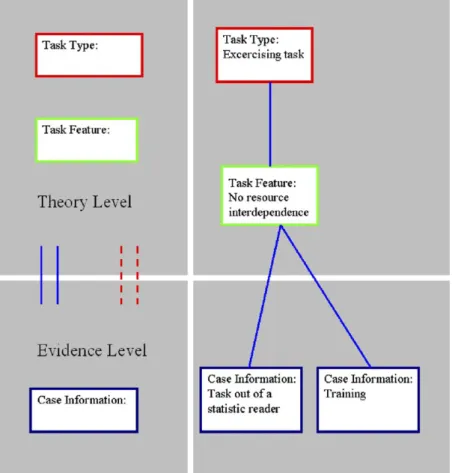
For conceptual support, a computer-based structural visualization technique called the ‘‘CoStructure-Tool’’ was specially developed. The tool presented key elements of the task struc-ture: the graphical user interface was divided into two conceptual levels labeled ‘‘theoretical’’
and ‘‘evidence’’. In thetheoretical leveltwo types of cards were available: one onto which
partic-ipants could enter the theoretical concept being considered (Fig. 1); and one which contained the
specific defining aspects of the theoretical concept. Theevidence levelcontained boxes into which
learners could enter information from the case that seemed relevant. In addition to the boxes, two
types of relationswere provided for positive and negative connections between concepts. Boxes of any type could be connected to one another. Theory boxes, for example, could be connected with one another as well as with case information. The size and position of the boxes and their relations could be manipulated on the screen.
Learners without conceptual support used a graphical editor that is widely used as a shared whiteboard in computer environments. The functionality of this tool is made available by using
a toolbar and includes a text-editor, the ability to create rectangles, circles and lines, and also en-ables freehand drawing with the mouse. All objects could be freely moved and filled with a color
of choice. As with the content-specific tool, all of the toolÕs functionality was accessible by directly
manipulating the objects on the screen.
Data sources and analysis. Individual learning outcome was assessed on the basis of the learnerÕs case solution. This involved theoretical concepts in contrast to naı¨ve beliefs. To analyze learning
outcomes, the learnersÕ case solution was compared with an expert solution. Learners received
scores for using theory concepts and relating them to one another appropriately. This means that concepts and relations had to be part of the expert solution. Furthermore, they had to substan-tiate each concept or relation with case information or other justification. Thus, the assessment
determined the number of concepts, which were applied appropriately to the case (M= 3.09;
SD = 2.40; empirical max.: 8).
6.2. Results and discussion
Results showed that learners improved their knowledge in the collaborative learning
environ-ment. However, the use of conceptual support made no difference with respect to an individualÕs
knowledge acquisition.
A study using CoStructure tool in face-to-face environments (cf.Fischer et al., 2002) showed
positive effects of conceptual support for the learning process and for the collaborative learning outcome. However, in the study using videoconferencing, learners were not able to benefit with respect to their individual learning outcomes. For this reason, we conducted study 2 in order to gain further insights on how conceptual support could be designed to facilitate both collabo-rative and individual learning outcomes.
7. Study 2
The specific aim of study 2 was to investigate the degree to which using a content scheme as
conceptual support and a collaboration script as socio-cognitive support could foster learnersÕ
knowledge acquisition in a cooperative teaching videoconference scenario (Fig. 2). In the follow-ing, only key features of this study are described. A comprehensive description of methods and
outcomes of this study can be found inErtl (2003) and Ertl et al. (2002).
Fig. 2. In the cooperative teaching scenario of this study, two learners collaborated via videoconferencing. They had a shared application in the computer at their disposal.
7.1. Method
Thelearning environmentwas made up of an individual and a collaborative learning unit. One per-son from each pair worked on the individual learning unit. This was comprised of a text on the theory of Genotype Environment Effects (Scarr, 1989), which contained both theoretical concepts and evi-dence. The person learning from the text functioned as the tutor during the collaborative learning unit. The second person assumed the role of learner during the collaboration. In the collaborative learning unit, the learners were asked (1) to study the most important aspects of the theory text, both the theoretical concepts and the evidence and (2) to discuss their own reflections, ideas and comments on the subject. In order for this to happen, the tutor had to explain the theory text to the learner. Through the use of a shared application (text editor), the learners had the opportunity to work to-gether to create external representations of theoretical concepts, evidence and personal elaborations, such as the consequences of the theory or a personal opinion. Following the collaborative learning unit, domain-specific knowledge was assessed on an individual basis. Aspects of both socio-cognitive support and conceptual support were used during the collaborative learning unit. The socio-cogni-tive support was realized as a script while the conceptual support was implemented through the
structure of the shared application (cf.Table 3for the design of the study).
Usingconceptual support, learners had a content scheme at their disposal during the
collabora-tive learning unit. The content scheme had the following categories:theoretical concepts,evidence,
consequencesandpersonal opinion. The learnerÕs task was to describe basic theoretical concepts in
the category entitledtheoretical conceptsand then to present the studies that supported the theory
in the category entitled evidence. For personal elaborations on the usefulness and limitations of
the theory, learners used the category entitledconsequences. The category entitledpersonal opinion
was used to present a personal evaluation of the theory and assessment. The content scheme there-by helped learners differentiate between theoretical concepts and evidence and supported their personal elaborations. The fairly abstract categories of the content scheme were made more
con-crete by the questions contained in each category (see Table 4).
Socio-cognitive supportwas realized as a script, which structured the collaborative learning unit in two different respects: it provided the learner with different phases in which to communicate the contents of the text and it also provided specific activities within each phase to be undertaken by
the learners in both the tutor and learner role. Thefirstphase of the script served to facilitate the
communication of the text by the tutor. The task of the learner in the tutor role was to explain the contents of the text. The partner in the learner role was asked to listen and to query the
informa-tion as soon as anything was unclear. In thesecondphase, the learners deepened their
comprehen-sion of the text. To this end, they worked together on a written external representation of the text in the shared text editor. The partner in the learner role had the task of summarizing the contents
and important points in the text editor; the tutor was given the task of supporting the learnersÕ
Table 3
Design of study 2
Socio-cognitive support
Without With
Conceptual support Without N= 24 (12 Dyads) N= 22 (11 Dyads)
activity. In thethirdphase of the script, both learning partners reflected individually on the topic.
In the fourth phase included the discussion of the text document and individual reflection. The
partner in the learner role was given the task of capturing important notes from the discussion in the shared external representation.
When learners were supported by socio-cognitive and conceptual support, the script and the content scheme were combined: In the first phase, learners had only the key questions on theoret-ical concepts and evidence available in the pre-structured document. However, learners did not have the opportunity to add to this document. During the second phase, the learners entered units
of meaning on the topics oftheoretical conceptsandevidenceinto the shared text document. The
third phase was carried out individually. In this phase, key questions onconsequencesand on
per-sonal opinionwere made visible on the screen. In the fourth phase, learners discussed these ques-tions and recorded them as shared external representaques-tions.
Data Sources and analysis.In order to measure collaborativelearning outcomes, the concepts written down in the shared application were analyzed with respect to theoretical concepts,
evi-dence and personal elaborations. For this purpose, we identified units of meaning in the theory
text. A unit of meaning was defined as a core concept of the theory, e.g., ‘‘the genotype is the indi-vidual genetic information’’. Two coding schemes were built, one containing units of meaning concerning theoretical concepts and one containing units of meaning concerning evidence. According to each coding scheme, all appropriately used units of meaning in the shared document
were summed together (theoretical concepts:M= 13.6; SD = 4.18; empirical max.: 21; evidence:
M= 7.40; SD = 3.27; empirical max.: 11). Personal elaborations were indefinite, as they could
contain prior personal experiences, e.g., ‘‘in school, more attention should be paid to active geno-type-environment effects’’. Thus, only the number of appropriate units of meaning was counted
(M= 3.33; SD = 1.55; empirical max.: 11).
Theindividuallearning outcome was measured by free recall; learners were asked to write down the most important contents of the theory text from memory. This test was analyzed with respect to theoretical concepts. In a manner similar to the analysis of the collaborative learning outcome, units of meaning were identified in the individual test according to the coding scheme described
above. Again, a score was given with respect to theoretical concepts (M= 7.74; SD = 3.70;
empir-ical max.: 18).
For ensuring inter-rater reliability of the analysis, 10% of each test was marked by two different
evaluators. The consistency between the evaluations for each sub-area of the tests was r> .94.
Table 4
The structure of the content scheme including the four categories with guiding questions
Theoretical concepts Empirical findings
What are the most important concepts of the theory? How was the theory examined? What are the most important ideas of the theory? Which findings did the theory support?
Consequences Personal opinion
Which pedagogical support mechanisms can be derived from the theory?
What do we like about the theory? What do we dislike? Which limits of pedagogical support mechanisms
can be derived from the theory?
Which of our own experiences confirm the theory? Which of your own experiences contradict the theory?
7.2. Results and discussion
The collaborative learning outcomes reflect the sub-areas of theoretical concepts, evidence and personal elaborations. In the area of theoretical concepts, there were effects of both independent variables. Socio-cognitive support led learners to capture more units of meaning in this area, while conceptual support led learners to capture less units of meaning. Regarding evidence, there were no significant differences. With respect to written elaborations, results showed a clear effect of con-ceptual support: learners with concon-ceptual support externalized more elaborations than learners without conceptual support. Regarding the sum of all sub-areas, learners in all conditions wrote down nearly the same amount. Thus, the script focused learners on theory concepts while the con-tent scheme focused learners on personal elaborations at the cost of neglecting theory concepts. In addition to these main effects, an interaction occurred between the two factors of conceptual and socio-cognitive support with respect to the category of personal elaborations. This indicates that the combination of both support methods resulted in the most adequate solution of the task by drawing equal attention to theory concepts, evidence and personal elaborations in contrast to each support measure being used on its own.
For individual learning outcome, only the results of the learners in the learner role were
con-sidered, because they reflected the results of the collaborative learning unit. LearnersÕknowledge
improved substantially during collaborative learning in all conditions. However, with respect to the individual post-tests, there were no significant effects relating to socio-cognitive and concep-tual support. The question arises as to why the strong effects of the interventions in collaborative learning outcomes did not transfer to the individual learning outcomes. This may be a specific characteristic of cooperative teaching: in cooperative teaching, learners acquire knowledge about the contents taught only during collaboration. Therefore, stable characteristics of the individual learner (traits) can specifically influence the knowledge acquisition process. This may negate the effects of the interventions. Furthermore, both support measures were aimed at the teaching pro-cess. Our assumption was that an improved teaching process would also result in increased indi-vidual learning outcomes. Yet, an improved teaching process may not consequently lead to a higher quantity of knowledge acquired individually, but may possibly lead to a higher quality, e.g., more sustainable knowledge structures.
8. Study 3
The aim of study 3 was to investigate the effects of a content scheme as conceptual support and
a collaboration script as socio-cognitive support on acollaborative problem-solvingactivity
involv-ing videoconferencinvolv-ing triads (Fig. 3). A more comprehensive description of this study can be
found at Kopp et al. (2004).
8.1. Method
The learning environment consisted of an individual and a collaborative learning unit. At the beginning, learners worked individually on a text about an attribution theory, which contained
collab-orative learning unit, all three learners were given case material, which contained slightly different
information for each learner. The learnersÕ task was to discuss the case in consideration of the
attribution theory and to find evidence from the case material. At the end of the discussion, the learners were asked to formulate a solution in the shared application.
Both conceptual and socio-cognitive support was used during the collaborative learning unit in
a 2·2-factorial design (cf. Table 5). In a manner similar to study 2, conceptual support was
implemented as a structure within the shared application, while socio-cognitive support was pro-vided in the form of a script. However, both means of support were adapted to the task.
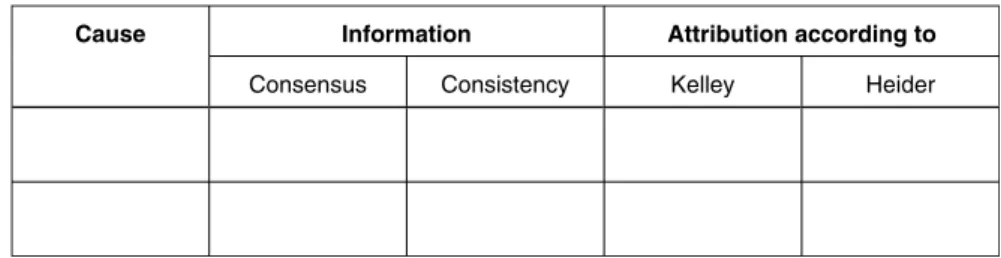
The participants using conceptual support received a content scheme that pre-structured the
shared application. The content scheme was realized as a table, which was divided into three main
categories (cf.Fig. 4):Cause, for identifying possible causes for the problem described in the case,
Informationfor case information and for giving evidence for the causes andAttributionfor
iden-tifying the correct attribution of the cause. The categoriesInformationandAttribution each
con-tained two subcategories:Informationwas divided in columns forConsensusand Consistencyfor
making these two aspects of attribution theory salient.Attribution was divided into two sections
according to the theories ofKelley (1973) and Heider (1958)to help learners attribute each cause
to the relevant source. Using this content scheme, learners were to formulate complete attribu-tions according to Kelley and Heider with causes and case information about consensus and consistency.
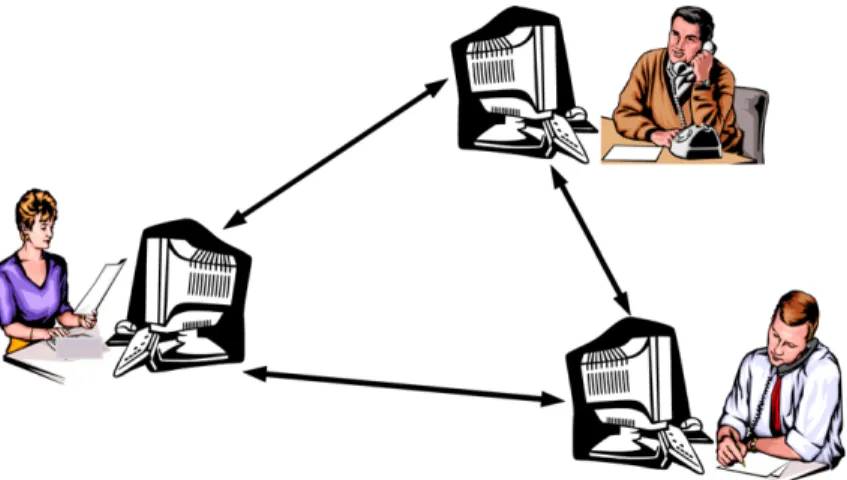
Fig. 3. Collaborative problem-solving scenario: three learners collaborate synchronously in a videoconferencing environment.
Table 5
Design of study 3
Socio-cognitive support
Without With
Conceptual support Without N= 42 (14 Triads) N= 39 (13 Triads)
Socio-cognitive support was realized as a script. The script structured the collaborative unit
into four phases. In the first phase, learners had to read case material and extract important
information on an individual basis. In the second phase, learners had to exchange information
and resolve comprehension questions collaboratively. They used the shared application for
writing down concepts that were important for the case solution. In the third phase, learners
had to reflect individually and in the fourth phase, learners had to develop the case solution
collaboratively.
In a further condition, the content scheme and script were combined. In the first phase, learners had to individually complete the content scheme with a paper and pencil. In the second phase, the main tasks included the exchange of information and a collaborative collection of complete attri-butions in the shared application. In the reflection phase, learners compared their own notes with the content, which had been collected. In the last phase, learners were asked to develop the solu-tion and to write a collaborative case solusolu-tion in the shared applicasolu-tion.
Data sources and analysis. For measuring collaborative learning outcomes, the contents of the shared application were analyzed. According to the different categories of the Attribution Theory, a coding system was developed, in which all causes, information and attributions were listed in an identifiable way without any overlap. Case information and theoretical classifications were
as-sessed and the frequency of each category was determined (Case:M= 16.98; SD = 5.17; empirical
max.: 28; Theory:M= 16.40; SD = 6.28; empirical max.: 24). For the measurement of individual
learning outcomes, a short case was used. The analysis of this case was similar to that used for the collaboratively solved case: Scores were given for case information and theoretical concepts. The
points for each category were summed together into a single score (Case: M= 6.70; SD = 2.70;
empirical max.: 12; Theory: M= 7.04; SD = 2.41; empirical max.: 10). For ensuring inter-rater
reliability of data, two evaluators marked analysis 10% of each test. The consistency between
these evaluations was high regarding all subscales (r> .87 for collaborative learning outcome
and jw> .90 regarding individual learning outcomes).
8.2. Results and discussion
With respect to the collaborative learning outcome, the content scheme had a large effect.
Learners with content scheme applied nearly twice the number of theory concepts than learners without content scheme. Regarding socio-cognitive support, there were no effects.
Individually, learners in all conditions benefited greatly from collaboration. Conceptual support also proved to be effective for individual learning outcomes. Learners with the content scheme scored higher in the category of theory concepts. The socio-cognitive support provided by the script
Cause Information Attribution according to
Consensus Consistency Kelley Heider
had a small positive effect on the application of case information. However, taking into account all outcome measures, learners with both socio-cognitive and conceptual support scored best.
Summarizing the results, we can state that conceptual support is highly influential for collab-orative and individual knowledge acquisition, particularly in the category of theoretical concepts. This may be attributed to the salience of relevant categories: Learners may have internalized these categories better and applied them individually. Socio-cognitive support showed a small effect. Our interpretation is that socio-cognitive support is much more effective when used in combina-tion with conceptual support.
9. Conclusion
This article shows how conceptual and socio-cognitive support can be effectively used for col-laborative learning in videoconferencing environments and summarizes the effects of different types of conceptual and socio-cognitive support.
For conceptual support, there were heterogeneous results in the three studies: In study 1 there was no effect on learning outcomes, in study 2 there were effects on collaborative learning out-comes and in study 3 there were effects on both individual and collaborative outout-comes. A com-parison of the three types of external representation may reveal the reasons for these
differences: the method of intervention in study 1 was astructural visualization. Learners were
pro-vided with visualizations of three conceptual categories and were told that these were related. However, learners may have neglected to use this visualization as a means for solving the learning
case. In contrast, in study 2 learners worked with a rather strict conceptual categorization. This
categorization was influential to the learning process and resulted in a higher collaborative learn-ing outcome. Learners seemed not to internalize this kind of support and, as shown, did not use it while working on the tests for individual learning outcome. This effect may be attributed to the aspect that learners were not able to transfer support strategies of the learning unit to the test.
In study 3, support was provided in the form of visualizing a strategy for solving the case (strategy
visualization). Learners seemed to apply this strategy during collaborative problem solving, inter-nalize it and benefit from it during individual post-tests.
Relating these results to the concept of salience and the representational context (Suthers &
Hundhausen, 2001), we can state that salience is an important aspect for focusing learnerÕs
atten-tion during learning process. However, salience during the learning process does not necessarily
mean that learners also benefit after collaboration. In contrast, according toZhang and Norman
(1994), it is likely that theconceptual categorizationof study 2 modified learnersÕinterpretation of
important aspects of the task of teaching a theory, whilestrategy visualizationof study 3 changed
the learnersÕinterpretation of the problem-solving task. Thus, the learners worked on the
individ-ual case solution in a manner similar to their collaborative efforts. Consequently, there seem to be two levels of conceptual support. The basic level is the representational context, which focuses
learnersÕattention during collaboration. Under certain circumstances, this representational
con-text may reach an advanced level, which results in a changed interpretation of the task and which is permanent.
When focusing on socio-cognitive support, results showed rather indirect effects. It seems that
were more general and, in contrast to conceptual support, not specific to particular contents.
When comparing our implementation with other kinds of socio-cognitive support (e.g.,OÕDonnell
& King, 1999; Palincsar & Brown, 1984; Rosenshine & Meister, 1994), we can guess that learners
may need more trainingbeforecollaboration to benefit further from socio-cognitive support (cf.
Rummel, Spada, Herman, Caspar, & Schornstein, 2002). However, Rosenshine and Meister
(1994)report that around 20 instructional sessions are needed for training socio-cognitive support
measures. Such extensive trainings may be neither feasible nor necessary in net-based learning environments. Therefore, the issue becomes how to tailor socio-cognitive support for net-based learning environments. In comparison to text-based computer supported learning environments,
some learners may just need less degree of freedom of collaboration scripts (cf.Dillenbourg, 2002;
Weinberger, 2003).
One step in this direction is thecombination of conceptual and socio-cognitive support. By
com-bining both measures, learners benefit from both conceptual and socio-cognitive support. Fur-thermore, we observed interactions between conceptual and socio-cognitive support: Learners need conceptual anchors for the reflective activities of socio-cognitive support.
10. Implications
Through these studies, we found that collaborative learning in videoconferencing could be quite beneficial for learners. Moreover, we found that support measures have a great potential for improving learning processes and outcomes in videoconferencing. The support measures that were investigated had beneficial effects, particularly when using conceptual support, such as strategy visualization combined with socio-cognitive support. Based on these results, it is necessary to conduct further research regarding learning processes. This research should con-sider spoken discourse to obtain more in-depth knowledge about the particular effects of sup-port measures. Goal-driven improvement of supsup-port measures can only happen if there is a better understanding of collaborative learning processes in technology-supported settings. Fur-thermore, process analysis could give hints about relevant issues of group-to-individual
knowl-edge transfer. As results show (cf. also Lou et al., 2001), increased collaborative learning
outcomes do not necessarily indicate better individual learning outcomes. Therefore, further research is necessary on support characteristics, which foster both collaborative and individual learning outcomes in technology-supported learning environments. Another area of research should investigate these support methods in long-term learning scenarios. This research should especially consider the degree to which learners internalize support measures in the manner of a modified interpretation of the task so that support mechanisms are effective even as the
sup-port is ‘‘fading’’ (cf. Collins, Brown, & Newman, 1989).
Acknowledgement
This research has been funded by DFG (German Research Foundation; Projects MA 978/6-3, MA 978/13-1 and MA 978/13-3).
References
Anderson, A. H., OÕMalley, C., Doherty Sneddon, G., Langton, S., Newlands, A., & Mullin, J., et al. (1997). The impact of VMC on collaborative problem solving: an analysis of task performance, communicative process, and user satisfaction. In K. E. Finn, A. J. Sellen, & S. Wilbur (Eds.),Video mediated communication (pp. 133–155). Mahwah, NJ: Erlbaum.
Baker, M., & Lund, K. (1997). Promoting reflective interactions in a CSCL environment.Journal of Computer Assisted Learning, 13, 175–193.
Bruce, V. (1996). The role of the face in communication: implications for videophone design. Interacting with Computers, 8, 166–176.
Bruhn, J. (2000). Fo¨rderung des kooperativen Lernens u¨ber Computernetze. Prozess und Lernerfolg beim dyadischen Lernen mit Desktop-Videokonferenzen. [Fostering cooperative learning in computer networks: process and learning outcome in dyadic learning in dektop-videoconferencing]. Frankfurt am Main: Peter Lang.
Cohen, E. G. (1994). Restructuring the classroom: conditions for productive small groups. Review of Educational Research, 64, 1–35.
Cohen, E. G., & Lotan, R. A. (1995). Producing equal-status interaction in the heterogeneous classroom.American Educational Research Journal, 32, 99–120.
Collins, A., Brown, J. S., & Newman, S. E. (1989). Cognitive apprenticeship: teaching the crafts of reading, writing, and mathematics. In L. B. Resnick (Ed.),Knowing, learning, and instruction: Essays in honor of Robert Glaser (pp. 453–494). Hillsdale, NJ: Erlbaum.
Dillenbourg, P. (1999). What do you mean byÔcollaborative learningÕ?. In P. Dillenbourg (Ed.),Collaborative-learning: Cognitive and computational approaches (pp. 1–19). Oxford: Elsevier.
Dillenbourg, P. (2002). Over-scripting CSCL: the risks of blending collaborative learning with instructional design. In P. A. Kirschner (Ed.),Three worlds of CSCL: Can we support CSCL? (pp. 61–91). Heerlen: Open Universiteit Nederland.
Dillenbourg, P., & Traum, D. (1999, January).Does a shared screen make a shared solution?Paper presented at the Conference on Computer Support for Collaborative Learning (CSCL), Stanford.
Dobson, M. (1999). Information enforcement and learning with interactive graphical systems.Learning and Instruction, 9, 365–390.
Eigler, G., Jechle, T., Merziger, G., & Winter, A. (1990). Knowledge and text production. In H. Mandl, E. De Corte, N. Bennett, & H. F. Friedrich (Eds.),Learning and instruction: European research in an international context. Analysis of complex skills and complex knowledge domains (pp. 295–397). Elmsford, NY: Pergamon Press Inc.
Ertl, B. (2003).Kooperatives Lernen in Videokonferenzen. Fo¨rderung von individuellem und gemeinsamem Lernerfolg durch external repra¨sentierte Strukturangebote [Cooperative learning in videoconferencing. Support of individual and cooperative learning outcomes by representational aids]. [Dissertation, Ludwig-Maximilians-Universita¨t Mu¨nchen]. Online:http://edoc.ub.uni-muenchen.de/archive/00001227/01/Ertl_Bernhard_M.pdf.
Ertl, B., Reiserer, M., & Mandl, H. (2002). Kooperatives Lernen in Videokonferenzen [Cooperative learning in videoconferencing].Unterrichtswissenschaft, 30, 339–356.
Finn, K. E., Sellen, A. J., & Wilbur, S. B. (Eds.). (1997).Video-mediated communication. Mahwah, NJ: Erlbaum. Fischer, F., Bruhn, J., Gra¨sel, C., & Mandl, H. (2000). Kooperatives Lernen mit Videokonferenzen: Gemeinsame
Wissenskonstruktion und individueller Lernerfolg [Collaborative knowledge construction. Analysis and facilitation in computer-supported collaborative scenarios].Kognitionswissenschaft, 9, 5–16.
Fischer, F., Bruhn, J., Gra¨sel, C., & Mandl, H. (2002). Fostering collaborative knowledge construction with visualization tools.Learning and Instruction, 12, 213–232.
Fischer, F., & Mandl, H. (2002). Facilitating knowledge convergence in videoconferencing environment: the role of external representation tools. In G. Stahl (Ed.),Computer support for collaborative learning: Foundations for a CSCL community. Proceedings of the conference on computer support for collaborative learning (CSCL) 2002, Boulder, CO
(pp. 623–624). Hillsdale, NJ: Erlbaum.
Fischer, F., & Mandl, H. (2003). Being there or being where? Videoconferencing and cooperative learning. In H. v. Oostendorp (Ed.),Cognition in a digital world (pp. 205–223). Mahwah, NJ: Erlbaum.
Gagliardi, A., Smith, A., Goel, V., & DePetrillo, D. (2003). Feasibility study of multidisciplinary oncology rounds by videoconference for surgeons in remote locales [Research article]. BioMed Central Ltd. Retrieved 2004-01-08, 2004, from the World Wide Web:http://www.biomedcentral.com/1472-6947/3/7.
Gould, J. D. (1980). Experiments on composing letters: some facts, some myths, and some observations. In L. W. Gregg, & E. R. Steinberg (Eds.),Cognitive processes in writing (pp. 97–127). Hillsdale, NJ: Erlbaum.
Hayes, J. R., & Flower, L. S. (1980). Identifying the organization of writing process. In L. W. Gregg, & E. R. Steinberg (Eds.),Cognitive processes in writing (pp. 3–30). Hillsdale, NJ: Erlbaum.
Heider, F. (1958).The psychology of interpersonal relations. New York: Wiley.
Hertz-Lazarowitz, R., Kirkus, V. B., & Miller, N. (1992). Implications of current research on cooperative interaction for classroom application. In R. Hertz-Lazarowitz (Ed.),Interaction in cooperative groups: The theoretical anatomy of group learning (pp. 253–280). New York, NY: Cambridge University Press.
Imhoff, F., Spaniol, O., Linnhoff-Popien, C., & Garschhammer, M. (2000). Aachen-Mu¨nchener teleteaching unter best-effort-bedingungen.PIK, 23, 156–163.
Johnson, D. W., & Johnson, R. T. (1992). Positive interdependence: key to effective cooperation. In R. Hertz-Lazarowitz (Ed.),Interaction in cooperative groups: The theoretical anatomy of group learning (pp. 174–199). New York: Cambridge University Press.
Jonassen, D. H., Beissner, K., & Yacci, M. (1993).Structural knowledge: Techniques for representing, conveying, and acquiring structural knowledge. Hillsdale, NJ: Erlbaum.
Kelley, H. H. (1973). The processes of causal attribution.American Psychologist, 28, 107–128.
Kirkwood, A., & Joyner, C. (2002). Selecting and using media in teacher education. In B. Robinson, & C. Latchem (Eds.),Teacher education through open and distance learning (pp. 149–170). London: RoutledgeFalmer Press. Klein, P. D. (1999). Reopening inquiry into cognitive processes in writing-to-learn.Educational Psychology Review, 11,
203–270.
Kopp, B., Ertl, B., & Mandl, H. (2004). Fostering cooperative case-based learning in videoconferencing: effects of content schemes and cooperation scripts. In P. Gerjets, P. Kirschner, J. Elen, & R. Joiner (Eds.),Instructional design for effective and enjoyable computer-supported learning. Proceedings of the first joint meeting of the EARLI SIGs instructional design and learning and instruction with computers [CD-ROM] (pp. 29–36). Tuebingen: Knowledge Media Research Center.
Kotovsky, K., & Fallside, D. (1989). Representation and transfer in problem solving. In D. Klahr, & K. Kotovsky (Eds.),Complex information processing: The impact of Herbert A. Simon (pp. 69–108). Hillsdale, NJ: Erlbaum. Kotovsky, K., Hayes, J. R., & Simon, H. A. (1985). Why are some problems hard? Evidence from Tower of Hanoi.
Cognitive Psychology, 17, 248–294.
Langton, S. R. H., OÕMalley, C., & Bruce, V. (1996). Actions speak no louder than words: Symmetrical cross-modal interference effects in the processing of verbal and gestural information.Journal of Experimental Psychology: Human Perception and Performance, 22, 1357–1375.
Larkin, J. H. (1989). Display-based problem solving. In D. Klahr, & K. Kotovsky (Eds.), Complex information processing: The impact of Herbert A. Simon (pp. 319–341). Hillsdale, NJ: Erlbaum.
Lo¨hner, S., & van Joolingen, W. (2001). Representations for model construction in collaborative inquiry environments. In P. Dillenbourg, A. Eurelings, & K. Hakkarainen (Eds.),Proceedings of the first European conference on computer-supported collaborative learning (euroCSCL) (pp. 577–584). Maastricht: McLuhan Institute.
Lou, Y., Abrami, P. C., & dÕApollonia, S. (2001). Small group and individual learning with technology: a meta-analysis. Review of Educational Research, 71, 449–521.
Molitor-Lu¨bbert, S. (1989). Schreiben und Kognition. In G. Antos, & H.-P. Krings (Hrsg.) (Eds.),Textproduktion: Ein interdisziplina¨rer Forschungsu¨berblick [Text production: An interdisciplinary research review] (pp. 278–296) Tu¨bingen: Niemeyer.
OÕConaill, B., Whittaker, S., & Wilbur, S. (1993). Conversations over video conferences: an evaluation of the spoken aspects of video-mediated communication.Human Computer Interaction, 8, 389–428.
OÕDonnell, A. M., & Dansereau, D. F. (1992). Scripted cooperation in student dyads: a method for analyzing and enhancing academic learning and performance. In R. Hertz-Lazarowitz, & N. Miller (Eds.), Interactions in cooperative groups. The theoretical anatomy of group learning (pp. 120–141). New York: Cambridge University Press.
OÕDonnell, A. M., & Dansereau, D. F. (2000). Interactive effects of prior knowledge and material format on cooperative teaching.Journal of Experimental Education, 68, 101–118.
OÕDonnell, A. M., & King, A. (Eds.). (1999).Cognitive perspectives on peer learning. Mahwah, NJ: Erlbaum. Paechter, M. (2003).Wissenskommunikation, Kooperation und Lernen in virtuellen Gruppen [Knowledge communication,
cooperation and learning in virtual groups]. Lengerich: Pabst.
Palincsar, A. S., & Brown, A. L. (1984). Reciprocal teaching of fostering and comprehension-monitoring activities.Cognition and Instruction, 1, 117–175.
Peper, R. J., & Mayer, R. E. (1986). Generative effects of note-taking during science lectures.Journal of Educational Psychology, 78, 34–38.
Roschelle, J., & Pea, R. D. (1997). Trajectories from todayÕs www to a powerful educational infrastructure.Educational Researcher, 26, 1–16.
Roschelle, J., & Teasley, S. D. (1995). The construction of shared knowledge in collaborative problem solving. In C. OÕMalley (Ed.),Computer supported collaborative learning (pp. 69–97). Berlin: Springer.
Rosenshine, B., & Meister, C. (1994). Reciprocal teaching: a review of the research.Review of Educational Research, 64, 479–530.
Rummel, N., Spada, H., Hermann, F., Caspar, F., & Schornstein, K. (2002). Promoting the coordination of computer-mediated interdisciplinary collaboration. In G. Stahl (Ed.),Computer support for collaborative learning: Foundations for a CSCL community (pp. 558–559). Hillsdale, NJ: Erlbaum.
Rummel, N., Ertl, B., Ha¨rder, J., & Spada, H. (2003). Supporting collaborative learning and problem-solving in desktop-videoconferencing settings.International Journal of Educational Policy, Research and Practice, 4, 83–115. Salomon, G., & Globerson, T. (1989). When teams do not function the way they ought to.International Journal of
Educational Research, 13, 89–99.
Salomon, G., & Perkins, D. N. (1998). Individual and social aspects of learning.Review of Research in Education, 23, 1–24.
Scarr, S. (1989). Protecting general intelligence: constructs and consequences for interventions. In R. L. Lynn (Ed.), Intelligence. Measurement, theory, and public policy (pp. 74–118). Urbana: University of Illinois Press.
Slavin, R. E. (1995).Cooperative learning: Theory, research and practice. Needham Heights, MA: Allyn & Bacon. Spitulnik, M., Bouillion, L., Rummel, N., Clark, D., & Fischer, F. (2003). Collaborative online environments for
lifelong learning: design issues from a situated learning perspective. International Journal of Educational Policy Research and Practice, 4, 17–53.
Storck, J., & Sproull, L. (1995). Through a glass darkly: What do people learn in videoconferences?. Human Communication Research, 22, 197–219.
Suthers, D. (2001). Towards a systematic study of representational guidance for collaborative learning discourse. Journal of Universal Computer Science, 7, 254–277.
Suthers, D. D., & Hundhausen, C. D. (2001). Learning by constructing collaborative representations: an empirical comparison of three alternatives. In P. Dillenbourg, A. Eurelings, & K. Hakkarainen (Eds.),Procedings of the first European conference on computer-supported collaborative learning (euroCSCL) (pp. 577–584). Maastricht: McLuhan Institute.
Webb, N. M. (1989). Peer interaction and learning in small groups.International Journal of Educational Research, 13, 21–39.
Webb, N. M., & Palincsar, A. S. (1996). Group processes in the classroom. In D. C. Berliner (Ed.), Handbook of educational psychology (pp. 841–873). New York: Macmillan.
Weinberger, A. (2003). Scripts for computer-supported collaborative learning. [Dissertation, Ludwig-Maximilian-University Munich]. Online:http://edoc.ub.uni-muenchen.de/archive/00001120/01/Weinberger_Armin.pdf.