Thinking about Organised Crime
Structure and Threat
Michael Levi
In The RUSI Journal 159 (1), pp. 6-14. DOI: 10.1080/03071847.2014.895253
ABSTRACT
‘Organised crime’ is a term that sounds more coherent than it is, and carries with it major threat imagery which is useful for some purposes but counter-productive for others. Some components are a threat to national security but most affect human security at a sub-national level. This article critically examines some economic, physical and perception features of the harms and threats, and discusses their implications for strategic and tactical interventions.
INTRODUCTION
Organised crime is a curious concept. Ask English-speaking people in the street, and they are
most likely to think of fictional representations in film or television – the Godfather, Goodfellas
or The Sopranos (plus Underbelly if they are Australian). Other languages and cultures have
their fictional equivalents. If the crimes and their apparent organisation do not fit this gestalt
of cunning, trafficking and violence, then most would think that there was not a problem of
‘organised crime’. On the other hand, the UN Convention Against Transnational Organized
Crime agreed in Palermo in 2000 sets a far lower standard for the label, to the extent that ‘organised crime’ can be fulfilled by three burglars and a window cleaning service – a handy front for money laundering unless a banker or accountant wonders how feasible it really is for
such a small outfit to earn £100,000 a year each when their costs are so modest.1 Although
there may be nothing disorganised about their conduct, such a business is far from the popular or even the police image of organised crime: this is made all the more ironic when one thinks that, had Bernard Madoff acted alone or just with his brother in criminal intent, merely using the ‘unseeing’ services of his accountants and other staff in the global Ponzi scheme that has
generated some $17.5 billion in losses, he would not have been an ‘organised criminal’ in the
Palermo sense.2 The term ‘organised crime’ is therefore conceptually inadequate: this author
has attempted to modify the lexicon by introducing the phrase ‘The Organisation of Serious Crimes for Gain’, which tries to capture the complexities better, just as the UK and Europol
have made ‘serious’ an alternative or supplement to ‘organised’ as a basis for intervention.3
Such attempts notwithstanding, however, ‘organised crime’ is not easily dispensed with as a term, not just because it is the antithesis of “opportunistic-individual” crime but also precisely because of its evocative connotations of interpersonal and social threat; and membership of a criminal organisation (however tricky to define operationally) triggers greater investigative powers and tougher sentences in many countries, particularly in the EU. This article seeks to tease out the nature and extent of harms associated with organised crime, and concludes with the implications for control.
The question here is what it means to regard ‘organised crime’ as a human or national security
threat. Military strategists are familiar with having to regard, say, Russia or the mujahedeen as
some level constitute a ‘threat’ to human security, there is something about ‘organised’ crime that increases the risk that it becomes a threat to national security. After all, counter-terrorism experts are familiar enough with the need to think of asymmetric threats and are well aware that networks, such as Al-Qa’ida, can be more difficult to combat than armies. One difference between organised crime and terrorism is that a small number of people (unless they are corporate executives) can seldom generate the economies of scale in crime for financial gain
that parallels the devastation that a few terrorists (or even one ‘lone wolf’, vide Anders Breivik
or Pavlo Lapshyn) can in undertaking a bomb attack or than someone without political goals, such as Derrick Bird, can in spree or serial killings. This applies whether one considers predatory crimes (like fraud and robbery, which have direct victims) or market crimes (supplying desired services such as drugs, sex and pornography, where those ‘supplied’ and those ‘using’ may or may not see themselves as victims). To assess plausible future threats
from organised crime, we need to know what resources – both from ‘conscious opponents’4
and from unknowing and/or wilfully blind intermediaries – are required and are likely to
become available to enhance the capacity to raise substantially the level of harm. This may
vary depending on the type of crime and the contextual support services available, which modern Information and Communications Technology and global financial services provision have brought ever nearer.
However, the advent of modern ICT does not obliterate the existing criminal landscape. While Silk Road and such like illicit e-markets could become the criminal equivalent of Amazon or eBay, delivering by post or (when viewing is enough) by the web illicit pleasures and crime-enabling products, it is doubtful that this could actually replace buying stolen gear or drugs from friends or neighbourhood dope peddlers, when drug taking is in many ways a collective, social activity. Also questionable is how likely ICT is to affect illicit migration, which requires clandestine services that are difficult to formalise, and are greatly influenced by trust and
interpersonal relationships that cannot be taken for granted. Most predatory crimes require
local relationships. Meanwhile, market offences usually involve the transnational transport of commodities or people, except in the cases of the production of illegal drugs, domestic trafficking of people and child exploitation, and local racketeering extortion. The significant movements of people across borders in recent decades, accelerating since the collapse of the Soviet Union and the expansion of the EU, has created more diasporas with easier cross-border networks of trust and extended family ‘pressure’, making the idea of ‘national’ organised crime
rather outmoded, though traffickers and fraudsters still have to borrow others’ identities.5
Costs, Harms and Threats
When analysing and combating organised crime, one of the main difficulties is that it is seldom clear who or, indeed, what the ‘enemy’ is: whether the target is a broad range of acts (such as the full range of crimes that ‘organised criminals’ may be involved in committing) or (as in
terrorism, properly construed) a particular set of actors who constitute a threat and their witting
and unwitting facilitators. Unfortunately for analytical clarity, the scale of damage is not as obvious as in terrorism, nor is it always easy to know how much of that damage is caused by any particular set of actors. Hence the importance of thinking through the economic and social costs of crimes and the extent to which they are attributable to ‘organised crime’, however defined, to probe the plausibility of what is sometimes termed ‘shroud-waving’ on the part of those advocating greater resources.
Perceptions of Organised Crime
Perceptions of threat are distinct from evidence about actual risks and costs, though (as with surveillance powers generally) perceptions are important to the legitimacy of powers and resources, and in themselves constitute social costs to a sense of wellbeing and security. For
this reason it is fruitful to examine recent Scottish data on perceptions of organised crime.6
Although not discussed by the report’s authors, it is intriguing that when asked which crimes they associate with ‘organised crime’, the three crimes highlighted by respondents were drugs (use and selling) (72 per cent), money laundering (20 per cent) and people trafficking (18 per cent). Only 8 per cent mentioned theft and robbery, and 11 per cent counterfeiting. Yet of the 10 per cent who stated that they had been affected by organised crime in Scotland in the past three years, theft and burglary ranked relatively high, while drugs (12 per cent of those saying they had been affected) and credit and debit card fraud (8 per cent) were the only crimes that
featured in the perceptions list above. Although over two-thirds did not consider it to be a
serious problem in their neighbourhood, the majority of Scots (84 per cent) consider organised crime to be a serious issue ‘in Scotland’, with women (87 per cent), those aged over fifty-five (88 per cent) and those living in the most deprived areas (90 per cent) most likely to regard it as a problem. People believe the main impacts of organised crime in Scotland to be ‘fear in the community’ (21 per cent), ‘drugs/drug abuse’ (17 per cent) and – somewhat curiously – ‘less
money being available for public services’ (12 per cent).7 So alongside other studies conducted
in Northern Ireland,8 as well as in England and Wales,9 this survey suggests that the
government and police have not convinced many of the public that organised crime affects them personally, though they may accept that, in abstract terms, organised crime is a threat to the nation. Perhaps this shows that where people do not see or believe that there is a highly organised Mafia (like in the movies), they find difficulty accepting that there is ‘organised crime’ where they live.
Costs of Organised Crime
It has become conventional to express all social issues through the common metric of money.
However, while it is not always obvious what is achieved analyticallyby doing this, it is clear
that judgments about priorities should be constrained by a reasoning process rather than being the products of whim. In principle, therefore having to assign a value – like ‘willingness to pay
to prevent harm x’ – is one way of doing so. Crucial to this process, however, is the basis for
assigning particular economic values to misconduct, and this is an area that would benefit from scholarly development. The risk is that one assigns a value which simply reflects the priority that one wishes the conduct to be given, in which case economic costs are largely a way of
evading explicit value judgments about the harm that is actually caused.
It is important to emphasise that estimating the costs and harms of particular issues is different from estimating what criminals make from crime and how much of those proceeds they are laundering. The harms from crime may be far greater than the benefits to offenders: toxic waste dumping, the financing and smuggling of WMD, and reckless ‘rogue trading’ in the hope of generating a profit or offsetting a loss are cases in point. Conversely, it is arguable that some crimes cause little net harm because, though prohibited, they are consensual: in such cases, the
illicit gains may be greater than the social costs.10 Much crime – even as part of ‘organised
crime activities’ – might better be described as ‘offend to spend’ rather than ‘offend to save
and legitimise’.11 In short, estimates of the cost of organised crime and of laundering must be
looked at with a sceptical eye and can even be counterproductive given that the gap between the proceeds of crime confiscation (worldwide, maximum $2 billion annually) and the estimated proceeds of crime, which is thought to be in the trillions or – more conservatively –
multi-billions of dollars. Realistically, such a gap cannot be bridged. The most pressing question, therefore, is what the practical implications of this gap are for strategies and tactics. Research in this field is still at an early stage and – as with eyewitness testimony – there is no correlation between confidence and accuracy of judgments. A recent study for the European Parliament identified minimum total costs of organised-crime activities in the European Union to be €126.3 billion; €1.2 billion for identified budget enforcement costs (excluding most
national agencies); and €34 billion for costs related to drug treatment.12 It further noted that:
In a number of areas, suitable data to prepare informed estimates of cost are lacking wholly, or in part, due to figures being produced via methodologies that render them unreliable. However, this does not mean that social harms cannot be identified, without producing eye-catching numbers that have little reasonable basis but attract attention to social problems. For example, there are the human costs of collapsed bridges, buildings and roads due to bad construction combined with corrupt construction contracts. The economic and social costs of these far exceed the profits made, to which we should add the social anxieties and the destruction of entrepreneurial drive that such criminal monopoly creates.
There are at least two ways of defining ‘organised crime’…. The first is to focus on Mafia-type associations – the image that most graphically captures what many people think of when they use the term. The second is a looser set of networks with far less stability or hierarchy whose participants supply markets with illicit goods and services: this represents the reality of “organised crime” in most areas of most EU Member States. The Mafia-type associations have activities in MS outside their home countries, but we cannot easily identify a particular sets of costs attached to it, except in Italy and up to a point in Bulgaria. Therefore we have chosen to look primarily at the costs arising from the looser networked ‘organised crime’.
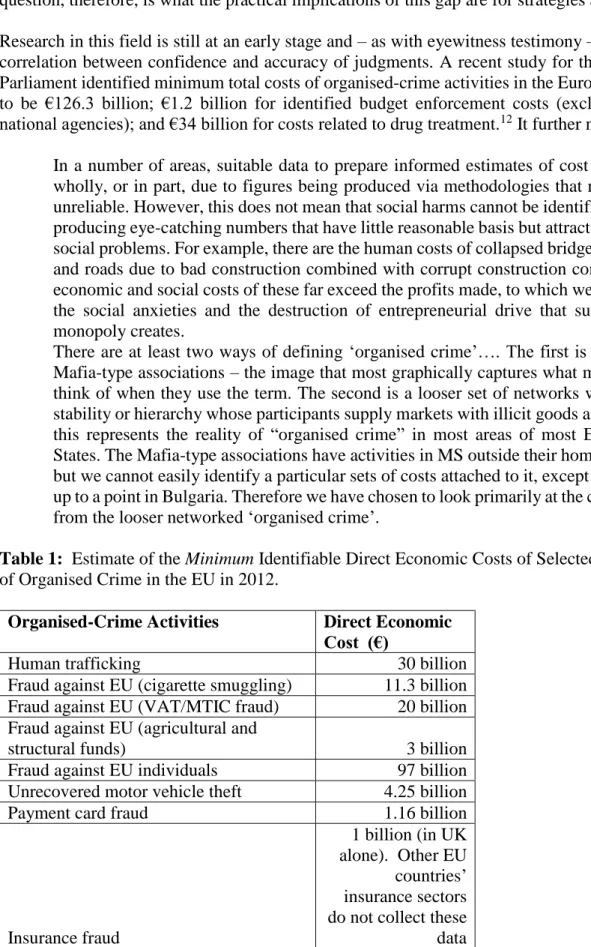
Table 1: Estimateof the Minimum Identifiable Direct Economic Costs of Selected Activities of Organised Crime in the EU in 2012.
Organised-Crime Activities Direct Economic Cost (€)
Human trafficking 30 billion
Fraud against EU (cigarette smuggling) 11.3 billion
Fraud against EU (VAT/MTIC fraud) 20 billion
Fraud against EU (agricultural and
structural funds) 3 billion
Fraud against EU individuals 97 billion
Unrecovered motor vehicle theft 4.25 billion
Payment card fraud 1.16 billion
Insurance fraud
1 billion (in UK alone). Other EU countries’ insurance sectors do not collect these data
Table 1 shows the estimated direct economic costs of some organised-crime activities within the EU. There are other areas of harm, however, that are more problematic to attribute to organised crime and to assess in economic terms. The social and economic costs of organised crime were estimated by a recent Home Office study at £24 billion for the UK: ‘drugs supply (£10.7 billion), organised fraud (£8.9 billion) and organised immigration crime types (£1.0 billion) have major impacts on the UK, and other less visible crimes also cause substantial
harm’.13 This study, like its predecessors, attributes all of the consequences of drug misuse to
organised crime, implicitly on the grounds that without organised crime there would be little
or no illegal drugs available.14 Thus, for example, deaths from illegal drug use and their
economic consequences – notwithstanding the low economic productivity of many drug users – are attributed to organised crime. The European Parliament report – developed in parallel - rejects this general approach: the harms from illegal drug taking are significantly affected by how one treats the commodity and its suppliers and users, and the study deemed it a mistake to lump them all into the category of ‘organised crime costs’. Ironically, the recklessness of many drug suppliers is more likely to generate fatalities if successes in the reduction of supply lead to more inconsistent and toxic ‘cutting’ of products whose purity is not standardised. So although one could argue for the inclusion of accidental drug deaths in the costs of organised crime as ‘collateral damage’, no economically rational drug dealer would kill off his or her market of purchasers; and killing off criminal rivals attracts too much media and police ‘heat’ unless the group is strong enough to threaten or resist the state, as sometimes happens in Italy, some Southeast and East European countries, Mexico and several Central and South American countries.
In fact, relatively small benefits to criminals may generate huge collateral damage, and those who argue that some aspects of drugs and other crime policies are iatrogenic would contend that the money that is spent or lost due to drug enforcement, imprisonment and post-prison loss of productivity (as a result of disadvantages in the job market) exceeds the harm that would
result if drugs were consumed in a more regulated market.15 Indeed, they would argue this even
though many people who take drugs have other addiction, crime and health problems that are costly both to themselves and to society.
Human trafficking is another area of organised-crime activity for which it is difficult to estimate the economic cost, level of social harm and threat to national security. The main legal differences between trafficking and smuggling are that migrants usually pay to be smuggled, but traffickers generate money from the ongoing exploitation of their victims, even when originally paid to smuggle them voluntarily. Smugglers only generate money from the movement and illegal entry phases, and smuggling must involve illegally crossing a border, whereas trafficking can also occur within a country. The tragic loss of lives off the coast of Lampedusa in 2013 – and accompanying evidence about the frequency of similar journeys and payments – has highlighted the huge market in smuggled people, for whom large investments in search of a better life or flight from an imperilled life constitute a rational choice. The costs and benefits of people smuggling accrue in different places: some may see harms to the UK labour market, for example, but businesspeople and illegal migrants may see this as enthusiastic and cheap labour. There would be a much smaller market for illegal emigration if those extended families who raised funds to pay the smugglers were not usually repaid by the migrants afterwards: otherwise it would be irrational for the families to invest such
(proportionately vast) sums in their collective futures. Even many of those trafficked send some
funds back to their families. It is unknown whether the better communication of risks to people living in developing countries would have much impact – an aspect that remains underexplored.
Human trafficking is a different matter, as it can entail rape and slavery (often after voluntary
migration), and its socio-economic costs have been estimated to be high in all studies.16
However, the very real issues inherent in people trafficking notwithstanding, it is not clear in what sense the 1,186 victims who were referred to the authorities in 2012 (an increase from the 946 victims in 2011) constitute a national security threat to the UK, as opposed to a human security threat to those badly exploited individuals. People who illicitly find their way into the country from overseas with the initial or later-developed intent to do serious harm to people or infrastructure may be national security threats, but such individuals are more likely to have been voluntarily smuggled than to have been trafficked against their will. Nor is this threat component conceptually clarified by the otherwise thoughtful inter-departmental ministerial report released in 2013 by the UK government, which correctly notes that many of those suspected of human-trafficking cases are prosecuted for other offences (in which respect it resembles money laundering). The apparent rise in numbers of persons defined as ‘trafficked’ may reflect more active identification efforts rather than a real rise in trafficking or the related ‘threat’. Much of the human-trafficking debate is over highly contested estimates – especially over the numbers of people trafficked to various parts of the world – which have become a
political football between NGOs, religious groups and other interested parties.17
It must also be considered that while most criminal activities are threatening – which is, after all, why the acts were criminalised in the first place – the harmfulness of the crimes themselves varies widely by social group and by region. Of course, if an unauthorised immigrant were to use a false identity to carry out a terrorist attack or other major crimes, then the collateral costs to the UK would indeed be huge. However, that would also be true of ‘home-grown criminals’ committing the same acts. It would therefore generally be a mistake to focus on individual incidents, though some ‘signal crimes’ can have a symbolic effect in transforming political assessments of harm which, in turn, motivates action at the political level and in society more
widely.18 Instead, decision-makers must determine at what frequency and level of seriousness
organised-crime acts become a threat to national security or to some other important interest (be it social values or economic interests). Thus, for some Scandinavian countries, ‘biker gangs’ are seen as an existential threat, not just because they may prominently deal in drugs and intimidate people, but also because they serve as a visible symbol of state weakness and of public incivility.
Organising Crimes
Undoubtedly, a high level of organisation within a criminal group gives economies of scale: it reduces the time needed to search for co-offenders and integrates, both horizontally and vertically, all of the functional elements in crimes. There is also a reputational benefit in controlling competitors and credibility gained from having a fearsome reputation, so that criminal actors do not have to use violence often in extortion or in seeing off rivals. However, the disadvantages of such a reputation – of being a recognised ‘criminal organisation’ – include both the likelihood of attracting more counter-measures from those more capable states that are
determined to confront it as a threat, and the difficulty of transplanting operations elsewhere.19
Two other factors that impede or facilitate the rate of growth of particular forms of crime
collectively performed by the group or network are ‘conscious opponents’ and existing levels of crime networks and organisations. Most of the tasks that need to be performed to commit serious crimes over a long period can be as easily accomplished at a local level as transnationally, except where it may be necessary to import required goods or assets (as in
non-hydroponic or synthetic drugs or illicit labour) or it is desirable that they are imported (as with prostitutes from particular regions or some counterfeit or genuine but smuggled products). These tasks are:
to obtain finance for crime; to find people willing and technically or socially competent to commit crimes (though this may not always be necessary); to obtain the equipment and transportation necessary to commit the crimes; to convert, where necessary, products of crime into money or other usable assets; to find people willing to store proceeds (and perhaps conceal their origin); and to neutralise law enforcement by technical skill, by corruption or legal arbitrage, using legal obstacles to enforcement operations and prosecutions, which vary between states.
Through analysis of the dynamics of particular crimes and criminal careers, these procedural elements can be broken down further into much more concrete steps or ‘scripts’, which can be viewed as an attribute both of individuals and of networks and groups.
Although it is a difficult task to map ‘organised crime’ – due to the definitional ambiguity outlined above – the recent Home Office national data derived from the Organised Crime Group Mapping exercise is illuminating about variations in organised crime within the UK, though where suspected organised criminals live and primarily operate does not limit the
areas that are affected by their actions.20
The second body of evidence from which conclusions about the prevalence and reach of organised crime can be drawn relates to violence. In southern Italy, homicides and threats by organised criminals might be commonplace (though, as in Colombia, rates can vary substantially over time). Meanwhile, a British study concluded that about 6 per cent of criminal
the 696 cases reviewed, fifty-four were likely linked to the activities of organised criminal groups, and of these, seventeen were directly caused by groups with a distinct organisational structure. Those cases with such links were far more likely to remain ‘undetected’ by police in comparison with homicides overall. Of note, the aggregate level of criminal homicide has declined significantly in recent years across most European countries. This raises further interesting questions about whether such decline means that violence associated with serious organised crime has been declining too, at least in terms of the number of actual fatalities rather than threats; or whether organised-crime homicides are proving more resistant to reduction, and hence form a greater proportion of those cases that do happen.
Among the EU member states, Italy, Belgium and Bulgaria top the figures for per capita
homicides by firearm, with Italy also ranked highest in terms of the absolute number. England and Wales has one of the lowest per capita rates of gun-related homicide in Europe, but the
absence of studies on organised crime related gun homicides elsewhere should induce caution:
guns are also used in family homicides. Taking its figure of 6 per cent of homicides being linked to organised crime as an average rate for Europe, and using EU homicide data for 2010, this would imply conservatively some 500 organised-crime-related homicides in the EU. However, because such violence is unevenly distributed, the rates in some jurisdictions are
significantly higher (and conversely lower in others).22 The professional consensus is that
criminal markets give rise, to far less actual violence than people generally believe, and that homicide and other serious violence is normally a result of unstable personalities and market incursions by outsiders. Outside Italy, Mafia-type large scale organised crime is rare in the EU: looser SME-type affiliations are far more widespread.
Intervening Against Organised Crimes
One unfortunate unintended effect of using the term ‘organised crime’ is to freeze the activities and the set of people carrying them out within a somewhat static framework, when a proper
risk analysis would emphasise the dynamics of crime opportunities and inter-offender
relationships. The credibility and value of organised-crime ‘assessments’ is not improved by the tendency of reports always to speak of globalisation making things worse by smoothing the diversification of crime networks. In fact, it can become more difficult to successfully commit crimes (such as payment card fraud after the introduction of Chip and PIN, or the ‘heroin drought’ in relatively isolated Australia) and, indeed, the value of criminal investments can
also go down (as with legitimate investments).23 This complexity – and the mixed fortunes of
organised-crime groups – should be borne in mind when seeking to put a stop to organised criminal activity.
It is true that some ‘rogue’ or ‘collapsed’ states are too weak or corrupted to deal with crime entrepreneurs and political rebels in their midst, while some corrupt strong politicians (caudillos) positively embrace organised criminals (including fraudsters like the now de-knighted Sir Allen Stanford) provided that they get what they consider to be an appropriate
‘cut’.24 Technically, then, they become part of an organised crime group/racketeering
conspiracy – but who in their jurisdiction will prosecute them?
Meanwhile, with regard to those countries that are willing and able to try to counter the proliferation of such groups and actors, anti-crime measures may be subordinated to wider foreign and economic policy interests, reducing intervention opportunities as a result. However, a number of approaches are possible to mitigate the problems caused by organised-crime groups and networks. Private electronic communications between non-terrorist offenders
may be intercepted by the intelligence agencies, although the resources (and sometimes the motivation) to act on such intelligence are limited and it may be too problematic to protect intelligence sources in the criminal-justice arena, thereby discouraging their use for prosecution. In addition, political factors may influence preferences for action. The formation in the UK of the Serious Organised Crime Agency (SOCA) in 2006 was a brave attempt to turn away from the action-orientation approach adopted in most countries, in creating a body that was focused more on intelligence collection and strategic intervention, predicated on greater thought than is usual for such bodies about the prospective impacts of both criminal and civil/administrative interventions by police and non-police agencies on the organisation and
levels of crime.25 This was, and remains, a transformational concept, but critics – including
those in government – contend that SOCA failed to communicate intervention impacts on levels of harm adequately and that its activities failed to generate headlines frequently enough. There are lessons to be learned from the experiences of SOCA, before its closure in 2013, about ‘satisficing’ a broad range of stakeholders and about the difficulties of sustaining long-term timescales in a shorter-term political environment.
The diversity of means available to governments in attempting to reduce the impact of organised impacts is nicely exemplified in the ‘4 Ps model’. There is undoubtedly some overlap in goals between ‘Prepare’, ‘Protect’, ‘Prevent’ and ‘Pursue’: even Pursue is intended to have a preventative effect as well as achieving better justice. In an era when – as a RAND Europe study put it – ‘criminal organisations operate as “polymorphous criminal networks”, responding to changes in their markets by looking for alternative – licit and illicit – ways to
secure their position and income’,26 the risks arising from siloed approaches to intervention
based on a narrow range of illicit activities are clear. It may often be appropriate to prosecute a target for a fraud or money-laundering offence rather than for drugs, violence or human trafficking; and it may often be appropriate to intervene through non-criminal-justice methods such as refusing licensing as ‘a fit and proper person’ in order to the reduce market power of particularly dangerous groups, even where such interventions may have little identifiable effect on drugs availability, price and purity. (Though care needs to be taken lest the intervention
leads to reduced purity/higher toxicity or to more violence as other groups jockey to replace
the disrupted/imprisoned ones.) In general, whatever their symbolic value for motivation and for headlines, Mr Big or Kingpin strategies of going after the imputed Head of an Organised Crime Group have not proven to be very effective in reducing illegal markets anywhere in the world, but one needs a mix of approaches for different crimes and for different forms of organisation. Furthermore, when choosing a strategy appropriate to the nature of the group and crime involved, it should also be remembered that localised ‘gang crime’ can produce major harms locally, without having the sort of regional or greater reach that would normally attract the attention of the National Crime Agency in the UK, for example. Furthermore, even small local groups can often require extensive and invasive policing operations to “take them on”: often a local response is not qualified to undertake these responses. The provision of an undercover officer can be outside the capability of many forces, and almost certainly most local command units.
Final Thoughts
This article has showed the complexity and variegation of harm and threat judgments, without disputing that organised crimes and the networks involved are a threat to economic interests and to human security in the UK and, indeed, in many other countries. Deconstructed, few individual elements of organised crime constitute a national-security threat; the extent to which
national security also remains contested. Yet one must consider the counterfactual scenarios – that is, if no or different controls were in place. Furthermore, the actual range and impact of criminal activities are influenced by their organisational context and contacts, motivation, skills and by the situational opportunities offered by both the private and public sectors. Meanwhile, some groups of criminal actors have national and even international ambitions; others have plans only for local activity and would not wish to move outside of their comfort zones either geographically or in terms of types of crime; others still transition in their ambitions, as their criminal careers and contacts develop. Indeed, it is important to note that except where mafias are already in place, nearly all ‘serious players’ were once minor ‘criminal upcomers’ who, if their potential was accurately identified, might be subjected to interventions. In short, local and regional intimidation can and does occur; criminal activities (including fraud) occur both nationally and transnationally; and countermeasures are needed to monitor and to inhibit their growth.
The UK government’s new Serious and Organised Crime Strategy, published in October 2013, offers some fresh perspectives, but key challenges include how to assess effectiveness – differentiated from efficiency – and how to translate strategy into practice at the local and regional as well as at the international level. Inter-agency and public–private partnerships hold the key, but it is also important to clarify what the outputs and outcomes are for different criminal sectors. In the UK, the dialogue between and within the public and private sectors – a formal policy mechanism – rests upon a high level of inter-sectoral trust and data-sharing provisions for the prevention of crime, but this may not be easy to transfer elsewhere for both cultural and legal reasons. Even in the UK, co-operation to reduce the prevalence and impact of organised crime is inhibited by differences in formal performance objectives, culture and even personalities, regardless of the formal cooperation structures in place. Inter-sectoral competition for scarce resources would occur even if egos and personal interests did not get in the way. Measuring (if only roughly) the diverse set of harms and threats, working out the relationship between the resources (both public and private) available, and assessing the likely impacts of those resources is – and will – remain a huge challenge around the globe. Managing the problems down is an important security objective.
Michael Levi is professor of criminology at the School of Social Sciences, Cardiff University. He has been conducting international research into the control of white-collar and organised crime, corruption and money laundering since 1972, and has published widely on these subjects. He is a member of the European Commission's Group of Experts on Corruption, the World Economic Forum's Illicit Trade and Organised Crime Council and the US National Academy of Sciences Committee on the Illicit Tobacco Market; is an Associate Fellow of RUSI; and is Senior Research Fellow, RAND Europe. He has served as an adviser to the prime minister's Strategy Unit on organised crime and money-laundering issues. He is an Academician of the Academy of Social Sciences and a Fellow of the Learned Society of Wales.
Notes
1 If the money does not pass through their accounts, then it might be questioned whether it has been laundered
rather than just hidden: criminal law might consider the two options to be the same, but the term ‘laundering’ usually confers a sense of formalised process, as in the somewhat outdated, three-part placement-laundering-integration cycle that viewed in international circles as a core model of money laundering. By contrast, an income that is liable to tax and is not declared to tax authorities, for example, has not been laundered – that is, it has not been made to appear ‘clean’. ‘Money laundering’ can encompass behaviour as low-level as storing the proceeds of one’s own crime in one’s own name in a bank, or even putting it in a concealed wall safe or deposit box. So it makes a huge difference whether ‘laundering’ is understood to mean simply an activity that conceals the proceeds of crime or to be something much more complicated, and whether we see ‘launderers’ as third-party professionals or as businesspeople, and whether ‘self-laundering’ is also included in the definition.
2 By November 2013, there had been two convictions in the case – with an average sentence of eighty years –
though several others have been charged.
3Mike Maguire, Rod Morgan and Robert Reiner (eds), The Oxford Handbook of Criminology, 5th ed. (Oxford:
Oxford University Press, 2012).
4 Malcolm K. Sparrow,The Character of Harms: Operational Challenges in Control (Cambridge, MA: Harvard
University Press, 2008).
5 It would be an advantage to stop using the term ‘identity theft’. Normally, theft involves someone losing
property which is, in turn, gained by someone else. However, here – perhaps more problematically – the person whose identity is unlawfully copied is stuck with responsibility for the harms caused by his or her impersonator.
6 Ipsos MORI Scotland, ‘Public Attitudes to Organised Crime in Scotland’, Scottish Governmental Social Research,
2013,
<http://www.ipsos-mori.com/Assets/Docs/Scotland/Scotland_SPOM_Organised_Crime_Report_190913.pdf>, accessed 27 January 2014.
7 It is not obvious whether this reflects an association of organised crime with corrupt politicians and
administrators, or that a large ‘hidden economy’ as well as VAT fraud means that less tax is paid.
8 P Campbell and R Freel, ‘Perceptions of Policing, Justice and Organised Crime: Findings from the 2010/11
Northern Ireland Crime Survey’, Department of Justice Research and Statistical Bulletin 2/2012, November 2012. The majority (68 per cent) of respondents to the 2010–11 survey felt that organised crime overall generates a minimal level of harm in their local area, while only 6 per cent considered it to cause a great level of harm. Of the types of organised crime examined, drug trafficking (either the selling or buying of illegal drugs) was believed to promote the greatest level of harm (15 per cent). The main negative consequence as a result of organised crime in Northern Ireland is considered to be ‘fear in the community’ (35 per cent); ‘violence in the community’ (16 per cent); and ‘legitimate businesses lose trade’ (11 per cent).
9 Karen Bullock, Rezina Chowdhury and Polly Hollings, ‘Public Concerns about Organised Crime’, Home Office
Research Report No. 16, July 2009. Some forms of crime were considered to be more ‘organised’ than others: in particular, drug dealing, people smuggling, credit card fraud, extortion, protection rackets, counterfeiting, prostitution and paedophile rings. Over two-thirds agreed that organised crime was extremely or very serious. Some crimes which were considered to be organised – especially selling counterfeit goods, types of fraud, and people smuggling and trafficking – did not elicit the same levels of concern for individuals as crimes such as burglary or vehicle crime. There was little recognition that money generated by sales of pirate and counterfeit goods can flow into the criminal economy, and can be used to fund other types of – more directly harmful – organised crime.
10 The UK is culturally fortunate in being less prone to prohibit consensual activities, with the exception of the
consumption of drugs. This should not be mistaken as an argument for total decriminalisation, but in principle,
both costs and benefits from consensual behaviour should be considered. See, for a sophisticated discussion, Frank Madsen, ‘International Narcotics Law Enforcement: A Study in Irrationality’, Journal of International Affairs (Vol. 66, No. 1, Fall/Winter 2012), pp. 123–41.
11 Michael Levi, ‘Drug Law Enforcement and Financial Investigation Strategies’, Modernising Drug Law
Enforcement Report No. 5, International Drug Policy Consortium, September 2013.
12 Michael Levi, Martin Innes, Peter Reuter and Rajeev V Gundur, ‘The Economic, Financial and Social Impacts of
Organised Crime in the European Union’, PE 493.018, European Parliament, 2013.
13 Ibid., p. 2. Of course, one can have a broader discussion of the net social costs of immigration and of drug use,
which take benefits into account.
14 Hannah Mills, Sara Skodbo and Peter Blyth, ‘Understanding Organised Crime: Estimating the Scale and the
Social and Economic Costs’, Home Office Research Report No. 73, October 2013, p. 20.
15 See, for example, The Alternative World Drug Report (London: Transform, 2012).
16 Ibid.; HM Government, Department of Justice and Scottish Government, Second Report of the
Inter-Departmental Ministerial Group on Human Trafficking, Cm 8731 (London: The Stationery Office, October 2013). Note, however, that the broader the definition of ‘trafficking’, the lower the average costs which are influenced by brutalisation and by the very low legitimate earning power of those exploited.
17 See, generally, Peter Andreas and Kelly M Greenhill (eds), Sex, Drugs, and Body Counts (Ithaca, NY: Cornell
University Press, 2010).
18One example of a single incident that provoked strong reactions against organised crime is the death of
twenty-one Chinese cockle pickers in the sands at Morecambe Bay in 2004. Gangmaster Lin Liang Ren was convicted of twenty-one counts of manslaughter, facilitating illegal immigration and perverting the course of justice. Having paid a Snakehead gang the equivalent of £14,000 to be smuggled to England, one witness against him feared repercussions and was put on the witness-protection programme with his wife and children, and became a businessman. In 2011, confiscation orders worth £1.4 million were made against three people convicted of money laundering in connection with this case and others.
A second example is the fifty-eight Chinese illegal immigrants found dead in the back of a truck at Dover in 2000, having been transported from Continental Europe (clearly this was an unintentional set of deaths, since it was not in the interests of the smugglers that they should come to such a bad end and generate so much ‘heat’ for their operation). A third is the mistaken drive-by shooting of teenagers Charlene Ellis and Letisha Shakespeare in Birmingham in 2003: the intended target was standing next to them. A fourth was Aamir Siddiqi, aged seventeen, who was stabbed to death on the doorstep of his Cardiff home in April 2010 by low-level ‘contract killers’ who had selected the wrong address for their intended target.
19 Federico Varese, Mafias on the Move: How Organized Crime Conquers New Territories (Princeton, NJ:
Princeton University Press, 2011). This might have been more accurately subtitled ‘How Organised Crime Conquers (and Fails to Conquer) New Territories’, since its valuable, fine-grained empirical work shows the limitations of expansionism. As with Misha Glenny’s McMafia (London: Vintage, 2009) it is regrettable that a clear master-narrative heading unintentionally produces a false picture of the ease with which transnational crime is committed and sustained.
20 HM Government, Serious and Organised Crime Strategy, Cm 8715 (London: The Stationery Office, October
2013). The author is grateful to the Home Office for permission to reproduce this map. For an effort to assess the global convergence between illicit markets, see Michael Miklaucic and Jacqueline Brewer (eds.), Convergence: Illicit Markets and National Security in the Age of Globalization (Washington, DC: National Defense University Press, 2013), though there is strong scholarly dispute over the extent of this convergence.
21 Matt Hopkins, Nick Tilley and Kate Gibson, ’Homicide and Organized Crime in England’. Homicide Studies (Vol.
22 For further discussion of issues relating to violent crime, see Levi, Innes, Reuter and Gundur, ‘The Economic,
Financial and Social Impacts of Organised Crime in the European Union’. For greater detail, see United Nations Office on Drugs and Crime, ‘Global Study on Homicide’, 2011, <http://www.unodc.org/unodc/en/data-and-analysis/statistics/crime/global-study-on-homicide-2011.html>, accessed 27 January 2014.
23 If one knew who the beneficial owners were, it might be fruitful to look at Spanish property vendors before
the financial crash to test if criminals were more far-sighted than others. Unsubstantiated claims about the proceeds of covert organised crime keeping EU banks afloat during the financial crisis might be doubted on the basis that it is not necessarily sensible to sink capital into loss-making firms, as well as on the basis that no evidence has ever been produced.
24 Michael Levi, ‘Transnational Organized Crime: States, Frauds, and the Threat of Transnational Organized
Crime’, Journal of International Affairs (Vol. 66, No. 1, Fall/Winter 2012), pp. 37–48.
25 For some background, see Michael Levi and Mike Maguire, ‘Reducing and Preventing Organised Crime: An
Evidence-Based Critique’, Crime, Law and Social Change (Vol. 41, No. 5, 2004), pp. 397–469.
26 Jennifer Rubin, Mafalda Pardal, Peter McGee and Deirdre Culley, ‘“Polymorphous Criminal Networks”:
Considering Criminal Groups’ Engagement Across Markets’, in Franz Trautmann, Beau Kilmer and Paul Turnbull (eds), Further Insights into Aspects of the EU Illicit Drugs Market, (Brussels: European Commission – Directorate-General for Justice, 2013).