Automatic detection of hate speech in
text: an overview of the topic and
dataset annotation with
hierarchical classes
Paula Fortuna
Mestrado Integrado em Engenharia Informática e Computação Supervisor: Sérgio Nunes
the topic and dataset annotation with
hierarchical classes
Paula Fortuna
Mestrado Integrado em Engenharia Informática e Computação
The use of the internet and social networks, in particular for communication, has significantly increased in recent years. This growth has also resulted in the adoption of more aggressive com-munication. Therefore it is important that governments and social network platforms have tools to detect this type of communication, because it can be harmful to its targets. In this thesis we investigate the problem of detecting hate speech posted online.
The first goal of our work was to make a complete overview on the topic, focusing on the per-spective of computer science and engineering. We adopted an exhaustive and methodical approach that we called Systematic Literature Review. As a result, we critically summarized different per-spectives on the hate speech concept and complemented our definition with rules, examples, and a comparison with other related concepts, such as cyberbullying and abusive language. Regarding the past work in the topic, we observed that the majority of the studies tackles this problem as a machine learning classification task and the studies use either general text mining features (e.g. n-grams, word2vec), or hate speech specific features (e.g. othering discourse). In the majority of these studies new datasets are collected, but those remain private, which makes more difficult to compare results across different works. We concluded also that this field is still in an early stage, with several open research opportunities.
As we found no research on the topic in Portuguese, the second goal of this work was to anno-tate a dataset for this language and to make it available as well. Regarding the dataset annotation, we built a classification system using a hierarchical structure. The main advantage of this strategy is that it allows to better consider nuances in the hate speech concept, such as the existence and in-tersectionality of the subtypes of hate speech. Our data was collected from Twitter, and manually annotated by following a set of rules, that are also a valuable product of our work.
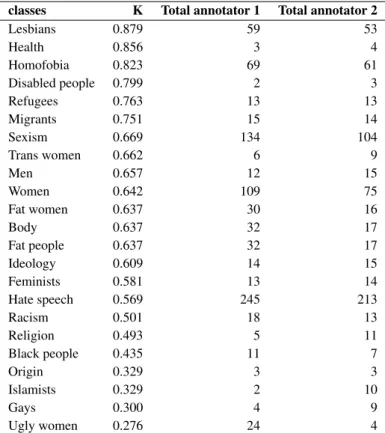
We annotated a dataset with 5,668 messages from 1,156 distinct users, where 85 distinct classes of hate speech were considered. From the total 5,668 messages, around 22% contain some type of hate speech. Regarding the annotators agreement, using the hierarchical approach allowed us to improve results, however this was still an issue in identifying hate speech. Further analysis pointed out that the several types of hate speech present different characteristics (e.g. distinct number of messages, time occurrences, vocabulary size, distinct n-grams and POS).
A final goal of our thesis was to investigate the potential advantages of using hierarchical classes to annotate a dataset. For this, we used the dataset annotated for Portuguese and we conducted an experiment with training, validation and test phases. In this experiment we compare two different approaches: we called unimodel to the model using only the hate speech class; and multimodel to the model using the several hierarchical classes. The main conclusion of our experiment was that the performance of the multimodel seemed to be slightly better than the unimodel in the F1 metric, and additionally, our method helped to identify a larger number of hate speech messages. This is the case because it has a better recall, in detriment of the precision.
Finally, we think that in the future this experiment can be extended in order to better identify hate speech and the respective subtypes.
A internet e as redes sociais têm vindo a ser cada vez mais utilizadas como ferramentas de comuni-cação. Esta utilização, resultou também no crescimento da comunicação agressiva, e uma vez que esta pode ter consequências negativas para os seus alvos, é importante que tanto as autoridades como as plataformas que gerem redes sociais tenham forma de a detetar. No âmbito desta tese investiga-se em particular a deteção automática de discurso de ódio em texto publicado online.
Em primeiro, conduziu-se uma revisão de literatura sobre o tópico, focando-se principalmente na perpetiva da ciência dos computadores e engenharia. Foi adoptado um método sitemático e ex-austivo para recolha de documentos. Como resultado, obteve-se uma definição sumária de discurso de ódio, que foi complementada com regras, exemplos e comparada com outros conceitos rela-cionados (e.g.CyberbyllyingeAbusive language). Relativamente aos trabalhos na área, observou-se que a maioria considera o problema como uma tarefa de classificação, utilizando aprendizagem automática. Os estudos, usam tanto caraterísticas comuns detext mining(e.g.n-grams,word2vec), como também específicas da deteção de discurso de ódio (e.g. othering discourse). Para além disso, na maioria dos estudos os dados utilizados não são disponibilizados posterioremente, o que dificulta a comparação de resultados entre as várias abordagens. Concluiu-se ainda que esta área se encontra ainda numa fase preliminar, com diversas questões de investigação em aberto.
Na revisão de literatura realizada, não foram encontrados estudos em português. Assim, o segundo objetivo deste trabalho foi anotar um dataset para esta língua. Para isso utilizou-se uma estrutura hierárquica de classes, o que tem como vantagem permitir que melhor se considerem as nuances do conceito de discurso de ódio, tais como a interseção dos vários subtipos. As mensagens foram recolhidas no Twitter e manualmente anotadas, seguindo um conjunto de regras, que é também um produto deste trabalho de investigação. Odatasetrecolhido contém 5668 mensagens de 1156 utilizadores diferentes. Foram consideradas 85 subclasses de discurso de ódio, e cerca de 22% das mensagens revelou conter pelo menos uma destas classes. Relativamente ao acordo entre anotadores, usando a abordagem hierárquica foi possível melhorar resultados. Contudo, o acordo continua a ser difícil na identificação de discurso de ódio. Uma análise do conjunto de dados permitiu ainda concluir que os subtipos de discurso de ódio apresentam caraterísticas diferentes (e.g. diferentes número de mensagens, distribuição no tempo, vocabulário,n-gramse POStags).
Por fim, investigaram-se as vantagens de se utilizar uma classificação hierárquica na deteção de discurso de ódio. Para isso, conduziu-se uma experiência (com fase de treino, validação e teste) com o conjunto de dados anotado em português. Nesta experiência compararam-se duas abordagens diferentes: unimodel, onde o modelo considera apenas a classe discurso de ódio; e multimodel, onde o modelo considera diversas classes organizadas hierarquicamente. Conclui-se que a performance domultimodel (F1) parece supererar a do unimodel. Adicionalmente, o multimodelpermite identificar um maior número de mensagens com discurso de ódio, uma vez que tem melhores valores da taxa de recuperação, em detrimento da precisão.
Finalmente, no futuro esta experiência poderá ser extendida, para uma melhor identificação automática de discurso de ódio e respetivos subtipos.
I would like to express my gratitude to all the people that supported my research in this topic... To my family for the love!
To the friends for the adventures and good caring words!
To the Infolab colleagues that always provided me an excellent work environment! To prof. Sérgio for the trust and supervision.
To all the researchers that make their work freely available to others.
To all the people that have the courage to don’t accept all the norms, and keep dreaming and fighting against oppression.
And finally, to all activists that write pedagogical and inspirational texts!
1 Introduction 1
1.1 Goals of the work . . . 1
1.2 Outline of the thesis . . . 2
1.3 Language concerns . . . 2
2 Automatic detection of hate speech in text: an overview 3 2.1 What is hate speech? . . . 3
2.1.1 Definitions from several sources . . . 4
2.1.2 Our definition of hate speech . . . 6
2.1.3 Particular cases and examples of hate speech . . . 6
2.1.4 Hate speech and other related concepts . . . 9
2.2 Why to study hate speech automatic detection? . . . 9
2.3 What has been done so far in automatic hate speech detection research? . . . 11
2.3.1 Systematic Literature Review . . . 11
2.3.2 Documents focusing on descriptives statistics about hate speech detection 17 2.3.3 Documents focusing on algorithms for hate speech detection . . . 20
2.3.4 Text mining approaches in automatic hate speech detection . . . 21
2.3.5 Main conclusions from the Systematic Literature Review . . . 28
2.4 Data useful for hate speech classification . . . 30
2.5 Open source projects for hate speech automatic detection . . . 30
2.5.1 The type of approach . . . 30
2.5.2 Datasets used in the GitHub projects . . . 30
2.6 Difficulties in detecting hate speech . . . 32
2.7 Opportunities in the field of automatic hate speech detection . . . 32
2.8 Conclusions from the overview on hate speech automatic detection . . . 33
3 Hate Speech Dataset Annotation for Portuguese 35 3.1 Hate speech classification as a problem with hierarchical classes . . . 36
3.2 Hierarchical classification . . . 36
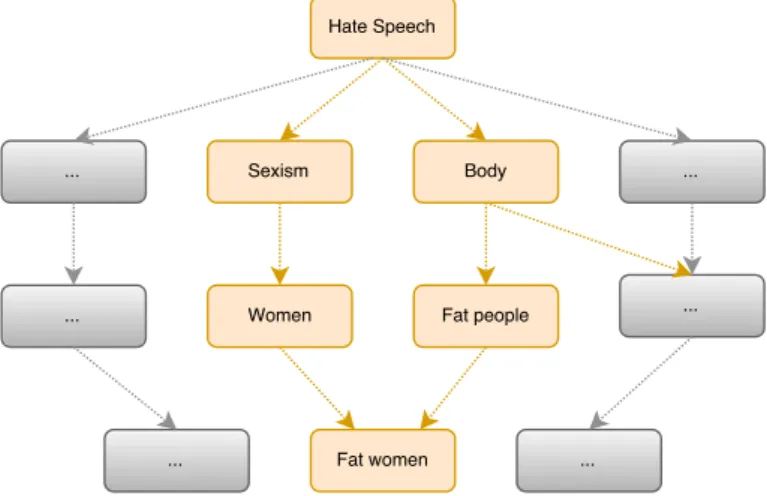
3.2.1 Hate speech classes representation . . . 37
3.3 Methodologies presented in other studies . . . 39
3.3.1 Hate speech in Twitter dataset . . . 39
3.3.2 Yahoo Webscope abusive language dataset . . . 40
3.3.3 Hate speech against refugees in German dataset . . . 41
3.3.4 CrowdFlower Hate Speech identification . . . 42
3.3.5 Summary of the annotated datasets . . . 42
3.4 Dataset Annotation in Portuguese . . . 44
3.4.2 Phase 2 - Messages annotation . . . 46
3.4.3 Annotation results . . . 47
3.5 Part-of-speech analysis . . . 57
3.5.1 POS Procedure . . . 57
3.6 Annotation conclusions . . . 58
4 Comparison of models using the annotated hate speech dataset 61 4.1 Methodology . . . 61
4.1.1 Sampling and dataset division in train and test set . . . 63
4.1.2 Train and validation phases . . . 63
4.1.3 Test . . . 65
4.2 Results and discussion . . . 65
4.3 Conclusions of the comparison between the two models . . . 68
5 Conclusions and Future work 69 5.1 Goals of the work . . . 69
5.2 Future work . . . 71
References 73
A Graph of classes 81
B List of search instances 83
C Annotation instructions 85
2.1 Methodology for document collection. . . 11
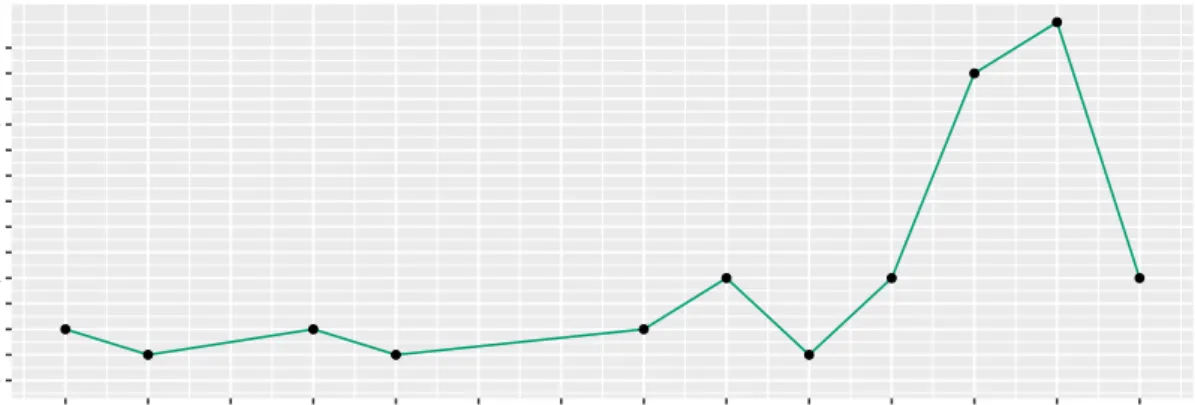
2.2 Evolution of the number of publications per year from the “Computer Science and Engineering” set (N = 44). . . 13
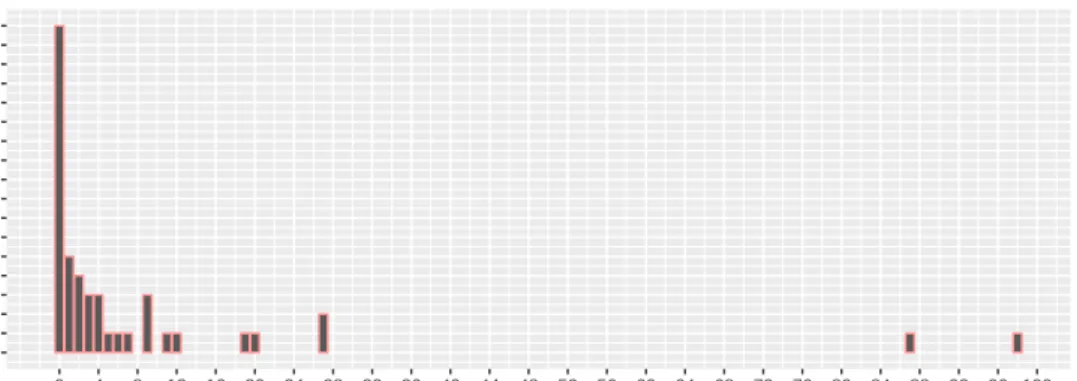
2.3 Number of citations of the papers from “Computer Science and Engineering”. . . 14
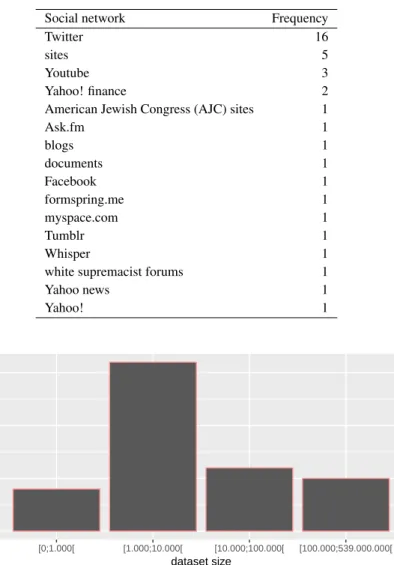
2.4 Dataset sizes used in the papers from “Computer Science and Engineering”. . . . 16
2.5 Type of papers from “Computer Science and Engineering”. . . 18
2.6 Percentage for each type over all hate crimes in USA. . . 19
2.7 Dataset availability in the documents with “algorithms about hate speech”. . . 20
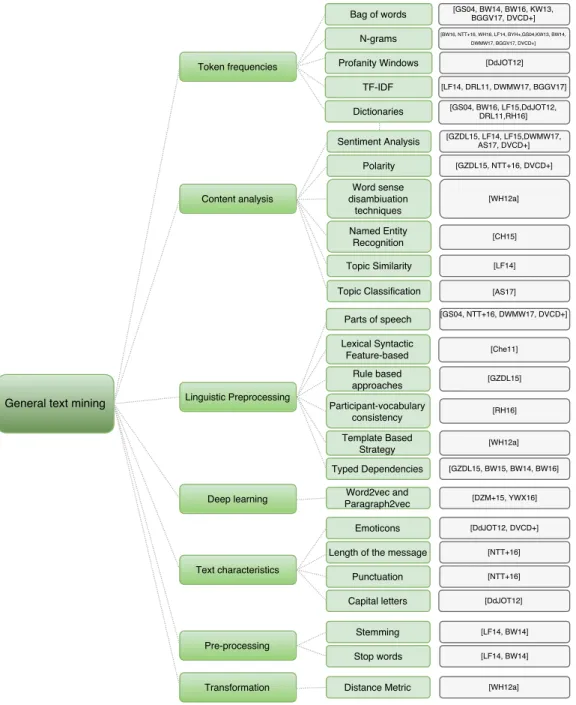
2.8 Papers using generic text mining features. . . 29
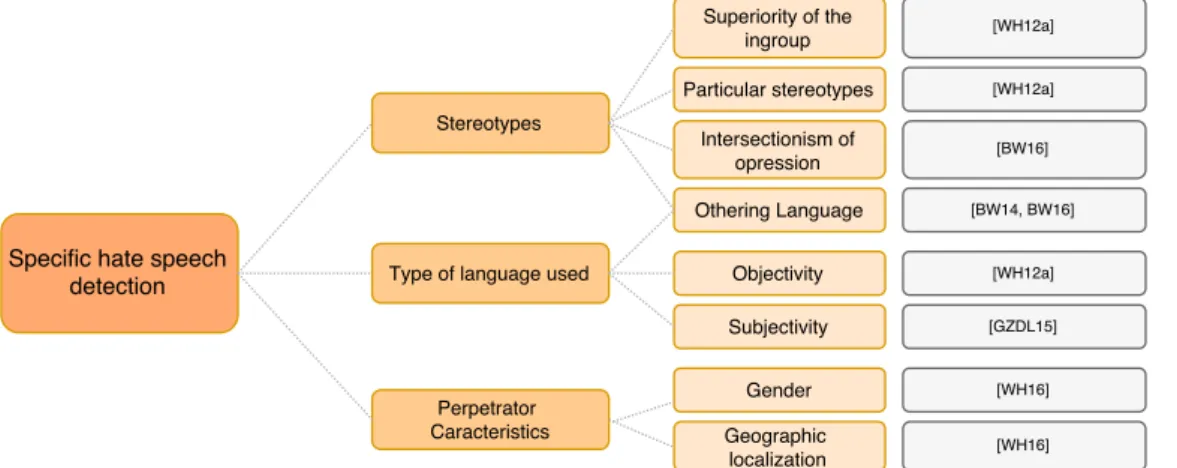
2.9 Papers using specific hate speech detection features . . . 30
2.10 Approaches used in open source projects about hate speech. . . 31
3.1 An example of Binary Hierarchical Classifier architecture which consists ofN -1 classifiers arranged as a binary tree (Image from [HCT07]). . . 37
3.2 An example of DAGSVM architecture which uses a rooted binary directed acyclic graph withn(n- 1)/2 internal nodes andnleaves (Image from [HCT07]) . . . 37
3.3 Hate speech classes represented with a directed acyclic category graph structure. 39 3.4 Method for messages collection. . . 44
3.5 Temporal distribution of the collected messages. . . 47
3.6 Types of hate frequencies in the dataset order by frequency. . . 49
3.7 Relative frequencies of each type of hate by the day hour. . . 50
3.8 Relative frequencies of each type of hate by the week day. . . 51
3.9 Beanplot of the number of words per message for each type of hate speech. . . . 52
3.10 Number of hashtags, mentions, retweets, URLs per message for each type of hate speech and messages with “None”. . . 53
3.11 Number of distinct n-grams per message by hate type. . . 54
3.12 Types of hate frequencies in the dataset, plotted by frequency. . . 55
4.1 Pipeline used for model comparison using the Portuguese hate speech detection dataset. . . 62
4.2 Graphical comparison of the confusion matrix metrics between unimodel and mul-timodel. . . 66
4.3 Graphical comparison of metrics, between unimodel and multimodel. . . 67
2.1 Hate speech example definitions. . . 4
2.2 Hate speech definitions content analysis. . . 5
2.3 Text messages classified by Facebook (Table from [KG16]). . . 7
2.4 Comparison between hate speech definition and related concepts. . . 9
2.5 Types of hate speech and examples (Table from [SMC+16]). . . 10
2.6 Most used platforms for publication of documents from “Computer Science and Engineering”. . . 13
2.7 Conferences related to hate speech detection, respective area of conference and reference. . . 14
2.8 Most cited papers from the “Computer Science and Engineering” set. . . 15
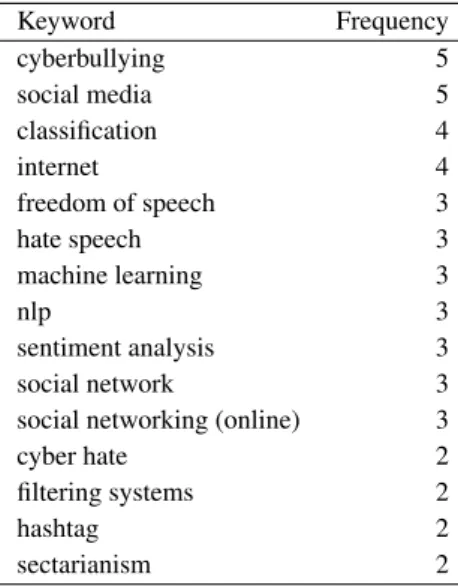
2.9 Keywords of the papers from “Computer Science and Engineering”. . . 15
2.10 Social networks used in the papers from “Computer Science and Engineering”. . 16
2.11 Type of hate speech analysed in the papers from “Computer Science and Engi-neering”. . . 17
2.12 Algorithms used in the papers from “Computer Science and Engineering”. . . 17
2.13 List of the author in the papers with “algorithms about hate speech”. . . 21
2.14 Results evaluation of the papers in the metrics Accuracy (Acc), Precision (P), Recall (R), F-measure (F) and AUC, respective features and algorithms used. . . 22
2.15 Datasets and corpus for hate speech detection. . . 31
3.1 Subtypes of hate speech definition. . . 38
3.2 Hate speech example. . . 38
3.3 Summary of the annotated datasets presented in literature. . . 43
3.4 Agreement evaluation for each class, with the total positive messages for each class for each annotator. . . 48
3.5 Text lenght statistics of the messages classified as “Hate speech” or “None”. . . . 52
3.6 Top-10 unigrams more common in the classes “Hate speech”, “None”, “Health”, “Homophobia”, “Ideology”, “Origin”, “Racism”, “Religion”, “Sexism” and “Other-lifestyle”. The original results in Portuguese can be found in AppendixD. . . 57
3.7 Top-10 POS more common in the classes “Hate speech”, “None”, “Health”, “Ho-mophobia”, “Ideology”, “Origin”, “Racism”, “Religion”, “Sexism” and “Other-lifestyle”. . . 58
3.8 Collected dataset in Portuguese Summary . . . 58
4.1 Positive class frequencies in train and test sets used in the conducted experiment. 63 4.2 Main differences between the two compared methods. . . 65
4.3 Confusion matrix metrics summarized for both methods and different algorithms. 66 4.4 Performance metrics summarized for both methods and different algorithms . . . 67
B.1 List of profiles and words used for the messages search. . . 83
C.1 Rules for annotation with examples and classification. . . 86
C.2 More examples of hate speech classification . . . 87
D.1 Top-10 n-grams more common in the classes “Hate speech”, “None”, “Health”, “Homophobia”, “Ideology”, “Origin”, “Racism”, “Religion”, “Sexism” and “Other-lifestyle”, in Portuguese. . . 89
Abbreviations
AAAI Association for the Advancement of Artificial Intelligence ACM Association for Computing Machinery
Acc Accuracy
AJC American Jewish Committee API Application programming interface AUC Area Under Curve
BOW Bag Of Words
DAG Directed Acyclic Graph
DAGSVM Directed Acyclic Graph-Support Vector Machine
DFTPN Difference between Frequencies of Token in the Positive and Negative mes-sages from the class
EU European Union F F-measure
FBI Federal Bureau of Investigation FN False Negatives
FP False Positives HQEH Homem que é homem HTML Hypertext Markup Language
ILGA International Lesbian and Gay Association KDIR Knowledge Discovery and Information Retrieval LGBTI Lesbian, gay, bisexual, transgender and intersex LogReg Jogistic Regression
MLP Multilayer Perceptron NER Named-entity recognition NLP Natural Language Processing P Precision
PNR Partido Nacional Renovador POS Part-of-speech
R Recall
RF Random Forest
RFTSM Relative Frequency of a Token in a Set of Messages Rpart Recursive partitioning
RT Retweet
SMOTE Synthetic Minority Over-sampling Technique SVM Support Vector Machine
TF-IDF Term frequency–inverse document frequency TN True Negatives
TP True Positives
URL Uniform Resource Locator USA United States of America
Introduction
Nowadays people are using more and more social networks to communicate their opinions, share information and search for experiences. The internet allows people to protect themselves behind the screen and interact with each other in a more anonymous environment. Therefore, in social networks, people can have more easily the feeling of being de-individualized and can incur more in aggressive communication [BW15]. In this context, it is important that governments and social network platforms have tools to detect aggressive behavior in general, and hate speech in partic-ular, because it can have negative consequences to its targets. In the scope of this thesis we have several goals. Generally, we aim to enrich this field of research and contribute for solutions to the problem of automatic detection of hate speech online. We analyse the goals of our work more in detail.
1.1
Goals of the work
In the scope of this work we have three different main goals. The first goal of this thesis is to understand what has been done so far in this field. There is little previous literature on identifying hate speech [WH12a] and describing the state of the art in this area is not simple. First, hate speech detection in text is a sub-area within text mining, that intersects with other sub areas (e.g. sentiment analysis). Besides, it is important to distinguish hate speech from other concepts also studied (e.g. cyberbullying). We should also consider that hate speech is object of analysis in other different areas of knowledge, as social sciences and law. However, when we focus on a computer science and engineering point of view, the number of studies in the area is more limited. With the purpose of having an overview of the area and with all these challenges in mind, our review is distinct: we intend it to be exhaustive, methodical and also useful for researchers starting in the topic. We conducted a Systematic Literature Review.
A second goal of our work is to collect a dataset for Portuguese, for the hate speech automatic detection classification task and make it publicly available. This is an important contribution because Portuguese is one of the most spoken languages in the world, and also on social networks
hate speech. We consider this classification task as a hierarchical class problem as we present in our third chapter.
A final goal of our thesis is to investigate the potential advantages of using hierarchical classes to annotate a dataset. We use our dataset annotated for Portuguese and we conduct an experiment where we use the information about the subtypes of hate as features in order to understand if these can help in predicting and classifying messages as hate speech.
In order to achieve these goals we divided the thesis in different sections, that we present here briefly.
1.2
Outline of the thesis
Regarding the outline of our work, we dedicate our first chapter to introduce our goals and ap-proach.
In a second chapter we present an overview on the topic of automatic detection of hate speech in text, and we spot some opportunities in this field. One of these opportunities is the lack of research for Portuguese, and therefore we annotate a hate speech dataset for this language, which is presented in the third chapter.
In the subsequent chapter we investigate the advantages of our annotation procedure, that uses a hierarchical structure, and we try to predict hate speech in Portuguese.
In the last chapter we evaluate the achieved goals of our thesis and the future work.
1.3
Language concerns
Finally, it is important to point out that some examples in this thesis use hate speech and also profanity language. These are used just for better understanding of concepts and do not express the point of view of the author.
Automatic detection of hate speech in
text: an overview
This section aims to present the work conducted so far in hate speech automatic detection in text. We provide a systematic approach, that presents not only theoretical aspects, but also practical resources, such as datasets or other projects in the field. We found other articles that already describe key areas explored to automatically detect hate speech using natural language processing (e.g. [SW17]). However, with our systematic research we want to give a complementary analysis, providing more articles, and also practical resources in the field.
In the first subsection “What is Hate Speech?” we analyse the more theoretical aspects of studying this topic: we distinguish amongst different definitions of the concept, analyse particular cases of hate speech, relate hate speech with other close concepts, see how hate speech online has been evolving and who are the main targets of it. After, we also consider “Why to Study Hate Speech Automatic Detection?” which brings attention to the motivation for studying this field.
In order to answer to our third question “What Has Been Done So Far In Automatic Hate Speech Detection Research?”, we conducted a Systematic Literature Review, whose method and results are also presented in this section. We try to summarize both quantitative data (e.g. evo-lution of the number of publications by year, main conferences) and qualitative data (e.g. feature extraction conducted in the field).
In a final part of this section we present the available datasets, projects and conferences. We take into consideration possible difficulties, what to do after detecting hate speech online, and finally we spot some opportunities in the area, as well. We start this section by clarifying concepts, which is a very important task because hate speech is not a clear concept and it is studied in several disciplines.
2.1
What is hate speech?
In this section we present the definitions that are important to clarify in the problem of hate speech automatic detection. We analyse here different perspectives on the hate speech definition and also
other related concepts.
2.1.1 Definitions from several sources
Deciding if a portion of text has hate speech is not linear, even for humans. Thus, if we want machines to identify hate speech, it is important to clearly define this concept in order to make this task easier [RRC+17]. Different sources define hate speech and in this sub-section we try to collect these definitions. We aim to check if there is consensus in the diverse perspectives (Table
2.1and Table2.2).
Table 2.1: Hate speech example definitions.
Source Definition
Code of conduct,
between EU and companies [Her16]
“All conduct publicly inciting to violence or hatred directed against a group of persons or a member of such a group defined by reference to race, colour, religion, descent or national or ethnic” [Her16]
ILGA
“Hate speech is public expressions which spread, incite, promote or justify hatred, discrimination or hostility towards a specific group. They contribute to a general climate of intolerance which in turn
makes attacks more probable against those given groups.” [ILG16]
Scientific paper
“Language which attacks or demeans a group based on race, ethnic origin, religion, disability, gender, age, disability, or sexual orientation/gender identity.” [NTT+16]
“Content that attacks people based on their actual or perceived race, ethnicity, national origin, religion, sex, gender or gender identity, sexual orientation, disability or disease is not allowed. We do, however, allow clear attempts at humor or satire that might otherwise be considered a possible threat or attack. This includes content that many people may find to be in bad taste (ex: jokes,
stand-up comedy, popular song lyrics, etc.).” [Fac13]
Youtube
“We encourage free speech and try to defend your right to express unpopular points of view, but we don’t permit hate speech. Hate speech refers to content that promotes violence or hatred against individuals or groups based on certain attributes, such as race or ethnic origin, religion, disability, gender, age, veteran status and sexual orientation/gender identity. There is a fine line between what is and what is not considered to be hate speech. For instance, it is generally okay to criticize a nation-state, but not okay to post malicious hateful comments about a group of people solely based on their ethnicity.”[You17]
“Hateful conduct: You may not promote violence against or directly attack or threaten other people on the basis of race, ethnicity, national origin, sexual orientation, gender, gender identity, religious affiliation, age, disability, or disease. We also do not allow accounts whose primary purpose is inciting harm towards others on the basis of these categories.” [Twi17]
In what concerns to the sources of the definitions (Table2.1), we collected them from a wide range of origins for several reasons:
• European Union Commission (source Code of conduct on Table2.1), because they regulate other institutions.
• International minorities associations (source ILGA), because they aim to protect people that are usually targets of hate speech.
• Scientific papers, to include also a perspective from the scientific community.
• Social networks conditions and terms (definitions from Facebook, Youtube and Twitter), because these are some of the main social networks and in these platforms hate speech occurs regularly.
In order to better understand the definitions found, in Table2.2we have different columns: the source of the definition (shared with Table2.1); and four dimensions in which the definitions can be compared (“Hate speech has specific targets”, “Hate speech is to incite violence or hate”, “Hate speech is to attack or diminish”, “Humour has a specific status”).
Table 2.2: Hate speech definitions content analysis.
Source Hate speech is
to incite violence or hate
Hate speech is to attack or diminish
Hate speech has specific targets
Humour has a specific status
Code of conduct Yes Not referenced Yes Not referenced
ILGA Yes Not referenced Yes Not referenced
Scientific paper Not referenced Yes Yes Not referenced
Facebook Not referenced Yes Yes Yes
Youtube Yes Not referenced Yes Not referenced
Twitter Yes Yes Yes Not referenced
These columns are the result of a manual analysis of the definitions, within a method similar to content analysis [Kri04]. We explain better and analyse these four dimensions in the next paragraphs.
• Hate speech has specific targets- All the definitions point out that hate speech has specific targets and it is based on specific characteristics of groups, like ethnic origin, religion or other.
• Hate speech is to incite violence or hate - The several definitions use slightly different terms to describe when hate speech occurs. The majority of the definitions point out that hate speech is to incite violence or hate towards a minority (definitions from Code of conduct, ILGA, Youtube, Twitter).
• Hate speech is to attack or diminish- Additionally, some other definitions state that hate speech is to use language that attacks or diminishes these groups (definitions from Facebook, Youtube, Twitter).
• Humour has a specific status- On the other hand, Facebook points out that some offensive and humorous content is allowed (definition from Facebook). The exceptional status of
humour makes the boundaries about what is forbidden in the platform more difficult to identify.
After the conclusions we presented previously, we use these four dimensions of analysis to define what is hate speech in the scope of this thesis. We present this definition in the next sub-section.
2.1.2 Our definition of hate speech
Based on the content analysis presented in the previous sub-section, we define hate speech in the scope of this thesis as:
Hate speech is language that attacks or diminishes, that incites violence or hate against groups, based on specific characteristics such as physical appearance, religion, de-scent, national or ethnic origin, sexual orientation, gender identity or other, and it can occur with different linguistic styles, even in subtle forms or when humour is used.
To make it even more clear, this definition aims to join the different perspectives presented previously. However, we should also point out that if, on one hand, violence can occur physically and explicitly, on the other hand it can also be subtle. This is the case when stereotypes are rein-forced, giving a justification to discrimination and negative bias towards these groups. Therefore, we consider that all subtle forms of discrimination, even jokes, must be marked as hate speech. This is the case because this type of jokes reflect relations between the groups of the jokers and the groups targeted by the jokes, racial relations and stereotypes [KvdE16]. Moreover, repeating these jokes can become a way of reinforcing racist attitudes [Kom16] and, although they are considered harmless, they also have negative psychological effects for some people [DMEY16].
In the next sub-section we clarify the notion of hate speech and analyse some particular cases and examples.
2.1.3 Particular cases and examples of hate speech
In order to better understand how the definition of hate speech can be applied in hate speech automatic detection in text, we should consider some examples and issues. It is important to present a clear definition of the concept to make the task of automatic hate speech detection easier [RRC+17]. One article [KG16] reveals some definitions and cases that Facebook uses to train its workers in the process of handling messages tagged as spam for hate speech. According to Facebook, a message has hate speech when two conditions are met:
• a verbal attack occurs.
• the target of the attack is from a “protected category” (religious affiliation, national origin, etc.).
• members of religious groups are protected, religion itself is not.
• speaking badly about countries (e.g. France or Germany) is allowed in general, however condemning people on the basis of their nationality is not.
• a protected category combined with another protected category results in yet another pro-tected category (e.g. if someone writes “Irish women are dumb,” they would be breaking the rules and their post would be deleted, because “national origins” and “sex” categories apply).
• combining a protected category with an unprotected category, however results in an unpro-tected category. For this reason, the sentence “Irish teenagers are dumb” does not need to be deleted because the term teenager does not enjoy special protection.
• saying “fucking Muslims” is not allowed, as religious affiliation is a protected category.
• However, the sentence “fucking migrants” is allowed, as migrants are only a “quasi pro-tected category” – a special form that was introduced after complaints were made. This rule states that promoting hate against migrants is allowed under certain circumstances: state-ments such as “migrants are dirty” are allowed, while “migrants are dirt” is not.
According to this article, some sentences are used to exemplify what should be marked as hate speech (Table2.3). The examples marked as “violating” should be deleted by the workers, whereas the examples marked as “non-violating” should be ignored.
Table 2.3: Text messages classified by Facebook (Table from [KG16]).
Message Evaluation
Don’t trust boys! violating - delete
Refugees should face the figuring squad! violating - delete
Fucking Muslims! violating - delete
Fucking migrants! non-violating - Ignore
Migrants are filthy cockroaches that will infect our country violating - delete
I’m such a faggot people call me diva! non-violating - Ignore
The French are alcoholics violating - delete
All English people are dirty! violating - delete
Don’t try to explain - Irish Catholics are just idiots violating - delete
Migrants are scum! violating - delete
People should stop to use the word nigger. non-violating - Ignore
I hate migrants! non-violating - Ignore
Don’t trust boys who say they love you! non-violating - Ignore
Tall girls are just freaks! non-violating - Ignore
American shitheads! violating - delete
Migrants are so filthy! non-violating - Ignore
Refugees! More like rape-fugees! violating - delete
Asylum seekers out! violating - delete
Group for blacks only! non-violating - Ignore
The rules presented by Facebook are arguable. From our point of view there is no reason to restrain hate speech to specific “protected categories”. First, because new targets of hate speech
can appear, and in this case these are undetectable unless we redefine these “protected categories”. Besides, prejudice can occur even when protected categories are not specifically implied. For instance, boys and men receive at an early age confining and stereotypical messages, that come from family, peers or media, telling them how to behave and feel, relate to each other girls and women. Some of these messages are harmful and have short and long-term consequences for themselves, women, their families, their community and society as a whole [Lea15].
Based on other sources we consider the following rules as a guide for the classification:
• First, usage of disparaging terms and racial epithets with the intent to harm must be consid-ered hate speech.
• However, in a discussion of the words themselves such expressions might be acceptable
[WH12b].
• Sometimes these words are used by a speaker who belongs to the targeted group, in order to show pride for belonging to the group. For our purpose, and if there is no contextual clue about it, such terms are categorized as hateful [WH12b].
• Also, references to an organization associated with hate crimes does not by itself constitute hate speech. For instance the name “Ku Klux Klan” is not hateful, as it may appear in historical articles or other legitimate communication [WH12b].
• However, while the endorsement of organizations that promote hate speech does not con-stitute a verbal attack on another group, in the scope of this work we define that this must be marked as hate speech. In this point, we oppose to the perspective of some other authors
[WH12b].
• Besides, calling attention to the fact that an individual belongs to a group and invoking a well known and disparaging stereotype about that group is also hate speech [WH12b].
• Making generalized negative statements about minority groups as in “the refugees will live off our money” is hate speech, due to the incitation of a negative bias towards the group. However, some authors [RRC+17] were unsure about this example as being hate speech.
• We can say that if a text “uses a sexist or racial slur” it contains hate speech [RRC+17].
• However it is also important to point out that the use of some words like “black”, “white”, “filthy”, or other, is marked as hate speech only in some circumstances. Outside of context, these words bear no racial undertones of their own [KW13].
• Speaking badly about countries or religions (e.g. France, Portugal, Catholicism, Islam) is allowed in general, but discrimination is not allowed based on these categories.
• Finally, hate speech can also occur when the statement about the superiority of the in-group are made. This rule was extracted from the Facebook set, discussed in this section.
The presented rules point out that we aim to have a more inclusive and general definition about hate speech than some other perspectives found in literature. This is the case because we want to be able to better describe subtle forms of discrimination amongst the internet and social networks.
2.1.4 Hate speech and other related concepts
Several concepts related with hate speech have been found in the literature: hate [Tar16], cyberbul-lying [Che11], abusive language [NTT+16], discrimination [Tho16a], profanity [Dic17], toxicity
[Jig17] and flaming [GHH07]. In this sub-section we distinguish between these concepts and hate
speech (Table2.4).
Table 2.4: Comparison between hate speech definition and related concepts.
Concept Definition Distinction from hate speech
Hate Expression of hostility without any
stated explanation for it [Tar16].
Hate speech is not general hate, it focus towards stereotypes.
Cyberbullying
Aggressive and intentional act carried out by a group or individual, using electronic forms of contact, repeatedly and over time, against a victim who can
not easily defend him or herself [Che11].
Hate speech is more general and
not necessarily focused on a specific person.
Discrimination
Process through which a difference is identified and then used as the basis of unfair treatment [Tho16a].
Hate speech is a way of
discriminating through verbal means.
Flaming
Flaming are hostile, profane and intimidating comments that can
disrupt participation in a community [GHH07]
Hate speech can occur in any content, whereas flaming is aimed towards a participant in the specific context of a discussion.
Abusive language
The term abusive language was used to refer to hurtful language and includes hate speech, derogatory language and also profanity [NTT+16].
Hate speech is a type of abusive language.
Profanity Offensive or obscene word or phrase [Dic17]. Hate speech can use profanity,
but not necessarily. Toxic language
or comment
Toxic is defined as rude, disrespectful or unreasonable comments that are likely to make a person to leave a discussion [Jig17].
Not all toxic comments contain hate speech. Also some hate speech can make people discuss more.
Besides, it is also important to clarify each type of hate speech that we found in literature (Table2.5).
The concepts presented in this section are distinct from hate speech, however they are re-lated. Therefore, literature and empirical studies focusing on them can give insight about how to automatically detect hate speech.
2.2
Why to study hate speech automatic detection?
Hate speech has become a popular concept over the past few years. There are several reasons to study hate speech automatic detection, which we present in this section.
Table 2.5: Types of hate speech and examples (Table from [SMC+16]).
Categories Example of possible targets
Race nigga, black people, white people
Behavior insecure people, sensitive people
Physical obese people, beautiful people
Sexual orientation gay people, straight people
Class ghetto people, rich people
Gender pregnant people, cunt, sexist people
Ethnicity chinese people, indian people, paki
Disability retard, bipolar people
Religion religious people, jewish people
Other drunk people, shallow people
• European Union Commission directives - In the last years, different programs are be-ing developed towards the fight against hate speech (e.g. No Hate Speech Movement by the Council of Europe [17]). Recently, the EU Commission pressured Facebook, Youtube, Twitter and Microsoft to sign an EU hate speech code [Her16]. This includes the require-ment to review the majority of valid notifications for removal of illegal hate speech in less than 24 hours [Her16,RRC+17].
• Automatic techniques not available- automated techniques aim to programmatically clas-sify text as hate speech, making its detection easier for the ones that have the responsibility to protect the public [BW16, RRC+17]. These techniques can be used in order to give a response in less than 24 hours, as demanded for some social networks (citation on this topic in the bullet European Union Commission directives). Some studies have been conducted about hate speech automatic detection, but they did not provide tools.
• Lack of data about hate speech- There is a general lack of systematic monitoring, docu-mentation and data collection of hate and violence, namely against LGBTI people [ILG16]. Nevertheless, detecting hate speech is a very important task because it is connected with actual hate crimes [WH16, ILG16, RRC+17] and automatic hate speech detection in text makes it possible to search for it on the internet.
• Hate Speech Removal- Some companies and platforms might be interested in hate speech detection and removal [Wen15]. For instance, some newspapers, or even Twitter, need to attract advertisers and therefore cannot risk becoming known as platforms for hate speech
[HTB16].
• Quality of service[OC14] - Social media companies provide a service: they ease the com-munication between its users. They profit from this service and therefore they can assume public obligations with respect to the contents transmitted. In this case, quality of service would be: take steps to discourage online hate and remove hate speech within reasonable time. Both can be measured and compared to a standard imposed through legislation.
In addition to all the motivations presented, hate speech automatic detection in text is a topic where some research opportunities exist, as we will see in the next section.
2.3
What has been done so far in automatic hate speech detection
research?
In order to describe the state of the art in this field we conducted a Systematic Literature Review. We decided to take a systematic approach because of the lack of summarized information on the topic. In this section, we describe this method and achieved results in detail. We use the term document as a synonym for papers, thesis or any other sort of text document.
2.3.1 Systematic Literature Review
The goal of this Literature Review is to collect the largest possible number of documents in the area of hate speech automatic detection in text. In order to achieve this result we developed a method that we present in the next section.
2.3.1.1 Method description
The method is structured in four phases that are presented and summarized in Figure2.1.
Figure 2.1: Methodology for document collection.
We also present the different phases with more detail in the next paragraphs.
• Keyword selectionThe first phase conducted was the keywords selection. We bear in mind that hate speech is a concept that became more popular recently. Therefore some other related concepts could have been used in the past by the scientific community. We consid-ered terms referring to particular types of hate speech (sexism, racism and homophobia). Besides, we also considered search for “hate speech” in other languages (Portuguese and Spanish).
• Search for documentsWe searched documents in different databases, aiming to gather the largest possible number in the areas of computer science and engineering. Databases from other scientific areas were not considered.
• Recursive searchWe used Google Scholar to get both the references and documents that cite the original work. We check on these two sets and search for the expression “hate speech” on the titles of the candidate documents. We repeated the recursive search with the new documents found.
• FilteringAn initial step of filtering was conducted. Documents from social sciences and law were immediately deleted.
2.3.1.2 Documents collection and annotation
The process of collecting documents was conducted from September 1st, 2016 to May 18th, 2017. We ended up with a total of 127 documents that we described using the following metrics:
• Name.
• Area of knowledge (we created the categories: “Law and Social Sciences” and “Computer Science and Engineering”).
• Conference or journal name.
• Keywords in the document.
• Particular hate (while some articles focus generally in hate speech, others focus in particular types, such as racism).
• Social network (refers to the network used to get samples of text).
• Number of instances used (refers to the size of the dataset used in the work).
• Algorithms used.
• Type of document (we created the categories: “algorithms about hate speech”, “algorithms but not about hate speech”, “descriptive statistics about hate speech”, “descriptives statistics but but not about hate speech” and “theoretical”).
• Year of the document.
2.3.1.3 Area of knowledge
We classified each document as “Law and Social Sciences” or “Computer Science and Engineer-ing”. We concluded that the majority of the works we found is from the first category (N = 76), whereas only few articles are more related with “Computer Science and Engineering” (N = 44). In the scope of this work we are only interested in analyse the papers from the set “Computer Science and Engineering”. In the following sections we only focus on this group.
2.3.1.4 Year of the document
As we can see in Figure2.2, before 2014 the number of documents related with hate speech, from the type “Computer Science and Engineering”, was very low. However, after 2014 this number has been increasing.
● ● ● ● ● ● ● ● ● ● ● 0 1 2 3 4 5 6 7 8 9 10 11 12 13 2004 2005 2006 2007 2008 2009 2010 2011 2012 2013 2014 2015 2016 2017 year n umber of pub lications
Figure 2.2: Evolution of the number of publications per year from the “Computer Science and Engineering” set (N = 44).
Regarding the decrement of articles in 2017, we should bear in mind that the collection of new documents stopped in May, 2017.
2.3.1.5 Documents publication
From the total of 49 documents in the set of “Computer Science and Engineering” we found 37 different venues. The publication platforms with more than one occurrence in our collection are presented in the Table2.6.
Table 2.6: Most used platforms for publication of documents from “Computer Science and Engi-neering”.
Platform for publication n
ArXiv 6
International Conference on World Wide Web 2
ArXiv is an open-access repository of electronic preprints, and it is the more common platform for publication of hate speech. One factor that can be contributing for this, is that hate speech detection is a recent area with work conducted autonomously.
Besides, the results in this subsection point out that the documents found are not presented in venues specific for hate speech. However we try to find if such platforms exist (e.g. journals or conferences). We discovered some conferences more related with hate speech automatic detection (table2.7), that seem to be in an early stage.
Table 2.7: Conferences related to hate speech detection, respective area of conference and refer-ence.
Conferences related to hate speech detection Area Ref
ALW1: 1st Workshop on Abusive Language Online Computer science [ACL17]
Workshop on Online Harassment Computer science [CHI17]
Text Analytics for Cybersecurity and Online Safety Computer science [20117]
Hate speech Conference Social Sciences [Hat17]
UNAOC #SpreadNoHate Social Sciences [oCU17]
Interdisciplinary conference on Hate Speech Humanities [CON17]
2.3.1.6 Number of citations
We computed the number of citations for each document in Google Scholar and concluded that the majority of the works is cited less than four times (Figure2.3). The top five papers with more citation in our sample are presented in Table2.8.
0 1 2 3 4 5 6 7 8 9 10 11 12 13 14 15 16 17 0 4 8 12 16 20 24 28 32 36 40 44 48 52 56 60 64 68 72 76 80 84 88 92 96 100 number of citations frequency
Figure 2.3: Number of citations of the papers from “Computer Science and Engineering”.
2.3.1.7 Keywords in the document
All the keywords referred in the documents from the area “Computer Science and Engineering” were grouped and analysed for absolute frequencies (Table2.9). We can infer that these documents study hate speech when it is related with:
Table 2.8: Most cited papers from the “Computer Science and Engineering” set.
Paper Citations Reference
Modelling the Detection of Textual Cyberbullying 87 [DRL11]
Perverts and sodomites: Homophobia as hate speech in Africa 63 [Red02]
Classifying racist texts using a support vector machine 27 [GS04]
Improved Cyberbullying Detection Using Gender Information 27 [DdJOT12]
Detecting Hate Speech on the World Wide Web 20 [WH12a]
• “machine learning”(classification, sentiment analysis, filtering systems and machine learn-ing).
• “social media”(internet, social media, social network, social networking and hashtag).
Table 2.9: Keywords of the papers from “Computer Science and Engineering”.
Keyword Frequency cyberbullying 5 social media 5 classification 4 internet 4 freedom of speech 3 hate speech 3 machine learning 3 nlp 3 sentiment analysis 3 social network 3
social networking (online) 3
cyber hate 2
filtering systems 2
hashtag 2
sectarianism 2
2.3.1.8 Social networks
Several articles found usually analyse datasets with messages that were collected from social net-works. Twitter is the most commonly used source, followed by general sites, Youtube and Yahoo! (Table2.10).
2.3.1.9 Number of used instances
Regarding the number of instances per dataset, this number has a wide range of magnitudes (Figure
2.4). Nevertheless, we can conclude that the majority of papers use between 1.000 and 10.000 instances.
Table 2.10: Social networks used in the papers from “Computer Science and Engineering”.
Social network Frequency
Twitter 16
sites 5
Youtube 3
Yahoo! finance 2
American Jewish Congress (AJC) sites 1
Ask.fm 1 blogs 1 documents 1 Facebook 1 formspring.me 1 myspace.com 1 Tumblr 1 Whisper 1
white supremacist forums 1
Yahoo news 1 Yahoo! 1 0 5 10 15 [0;1.000[ [1.000;10.000[ [10.000;100.000[ [100.000;539.000.000[ dataset size count
Figure 2.4: Dataset sizes used in the papers from “Computer Science and Engineering”.
2.3.1.10 General or particular hate speech
This subsection aims to analyse if the documents we found focus in general hate speech or in more particular types of hate. The majority (N = 26) considers general hate speech (Table2.11), however, there is a large number of papers (N = 18) that focus particularly on racism.
2.3.1.11 Algorithms used
The most common approach found is our Systematic Literature Review consists in building a Machine Learning model for hate speech classification. We also found that the most common algorithms used are SVM, Random Forests and Decision Trees (Table2.12).
Table 2.11: Type of hate speech analysed in the papers from “Computer Science and Engineering”.
Hate type Frequency
general hate speech 26
racism 18 sexism 6 religion 4 anti-semitism 1 nationality 1 other 1 physical/mental handicap 1 politics 1 sectarianism 1 socio-economical status 1
Table 2.12: Algorithms used in the papers from “Computer Science and Engineering”.
Algorithms Frequencies SVM 10 Random forests 5 Decision trees 4 Logistic regression 4 Naive bayes 3 Deep learning 1 DNN 1 ensemble 1 GBDT 1 LSTM 1 non supervisioned 1 one-class classifiers 1 skip-bigram model 1
2.3.1.12 Type of approach in the document
In order to understand how hate speech is being studied in the “Computer Science and Engi-neering” articles, we classified the approach of the documents in one the following categories: “algorithms for hate speech”, “algorithms but not for hate speech”, “descriptive statistics about hate speech”, “descriptives statistics but not about hate speech” and “theoretical”. In Figure2.5
we can see that the most common types are “algorithms for hate speech” and “algorithms but not for hate speech”. On the other hand, the category “descriptives statistics but not about hate speech” only has one paper about hashtags usage as a way of monitoring discourse [GL15].
In the next subsection we focus on the “algorithms for hate speech” (N = 17) and “descriptives statistics about hate speech” (N = 9) papers, because we want to develop our research in this particular field of hate speech automatic detection.
2.3.2 Documents focusing on descriptives statistics about hate speech detection In the previous sections we already saw that according to the definitions of hate speech its targets are groups or individuals based on theirs specific attributes, such as ethnic origin, religion,
disabil-descriptive statistics but not about hate speech descriptive statistics about hate speech theoretical algorithms but not about hate speech algorithms about hate speech
0 5 10 15
frequency
type of document
Figure 2.5: Type of papers from “Computer Science and Engineering”.
ity, gender identity, age, veteran status, sexual orientation or other. Studies have been conducted in order to describe hate speech online and which groups are more threatened. This section presents the main conclusions found in these articles, that we label as having a more descriptive approach in the problem of hate speech detection. We found descriptive articles about Racism, Sexism, Prejudice towards refugees, Homophobia and General hate speech.
Racism In one study [KW13], the authors tried to understand when hate speech occurs and why messages in social networks are catalogued as racism. They concluded that in the majority of the cases (86%) this is because of the “presence of offensive words”. Other motives are “references to painful historical contexts” and “presence of stereotypes or threatening”. In order to describe racism across the United States, in another study [Zoo12] the authors try to understand the geo-graphic distribution of racist tweets. They used the information gathered in Twitter to describe the frequencies of tweets in the several states using the geographic reference of the messages [Zoo12].
Sexism In a very simplistic approach, tweets using offensive words towards woman were col-lected using the Twitter search API. Approximately 5,500 tweets were gathered and coded by one researcher, using a simple binary model. Despite the limitations of the study (e.g. many of the tweets were repeating the title or lyrics from popular songs, with the searched offensive words), it was still relevant for understanding that offensive communication towards woman is a reality in Twitter [HTB16]. A second study also describes misogynistic language on Twitter [BNP+14]. The main conclusions from this study is that 100,000 instances of the word rape used in UK-based Twitter accounts were found, from which around 12% appeared to be threatening. Moreover, ap-proximately 29% of the rape tweets appeared to use the term in a casual or metaphorical way. On the other hand, this study also points out that women are as almost as likely as men to use offensive
terms against women on Twitter. They also found out that the offensive terms are used in a casual or metaphorical way.
Prejudice towards refugees Other study was focused on the annotation of a dataset in German, for hate speech against refugees [RRC+17]. The main goal of this study was to point out the difficulties and challenges when annotating a dataset.
Homophobia Some other study, with an ethnographic methodology, was conducted in Africa
[Red02]. Data was collected from several sources (e.g. newspapers, sites). The study
con-cluded that homophobic discourses were using arguments related with Abnormality, Xenopho-bia, Racism, Barbarism, Immorality, Unpatriotism, Heterosexism, AntiChristianity, UnAfrican, Animalistic behaviour, Inhumane, Criminality, Pathology and Satanism.
General hate speech Finally, other studies take into consideration several types of hate speech at same time. In one particular case [SMC+16] social networks (Twitter and Whisper) were crawled with expressions that follow a rigid pattern:
• I < intensity >< userintent >< hatetarget >
One message following this pattern would be “I really hate people”. After collecting the messages, the researchers tried to infer the target of hate in the tweets. With this method they concluded that “race”, “behavior” and “physical” were the most hated categories. Finally, in another study an analysis of data recorded by the FBI in 2015 [FBI15] for victims in the USA of single-bias hate crime incidents, showed that the offender’s bias was towards different targets in different proportions (Figure2.6).
gender disability gender−identity sexual orientation religion race/ethnicity/ancestry 0 20 40 60 percentage
type of hate speech
2.3.3 Documents focusing on algorithms for hate speech detection
From our collection of documents, the papers focusing on “algorithms for hate speech detection” are the most important in our study. This is the case because we aim to research in this specific topic. First, in what concerns to the methodology followed in these papers, the researchers used machine learning for hate speech classification. Additionally, in the majority of the works the used language is English. However there were some exceptions. In these cases the considered languages were Dutch [THL+16], German [RRC+17], or Italian [DVCD+17]. In the next sections we present with more detail how these studies obtain datasets, the main authors from the papers and we make a comparison in the performances of the different approaches.
2.3.3.1 Datasets used in the papers
In the majority of the 17 papers focusing in “algorithms for hate speech”, new different data was collected and annotated. However in only a few studies data is made available for other researchers (“own, available”), and in only one case an already published dataset is used (“published dataset”) (Figure2.7). In these circumstances it is more difficult to compare the approaches in the different works.
published dataset own, available own, not available
0 5 10
frequency
dataset
Figure 2.7: Dataset availability in the documents with “algorithms about hate speech”.
The datasets available in the area are described in the subsection2.4. We also focus in the procedure for data collection and annotation in subsection3.3.
2.3.3.2 Main authors
We could also conclude that we have a high number of distinct authors from these papers (Table
2.13).
2.3.3.3 Achieved performances
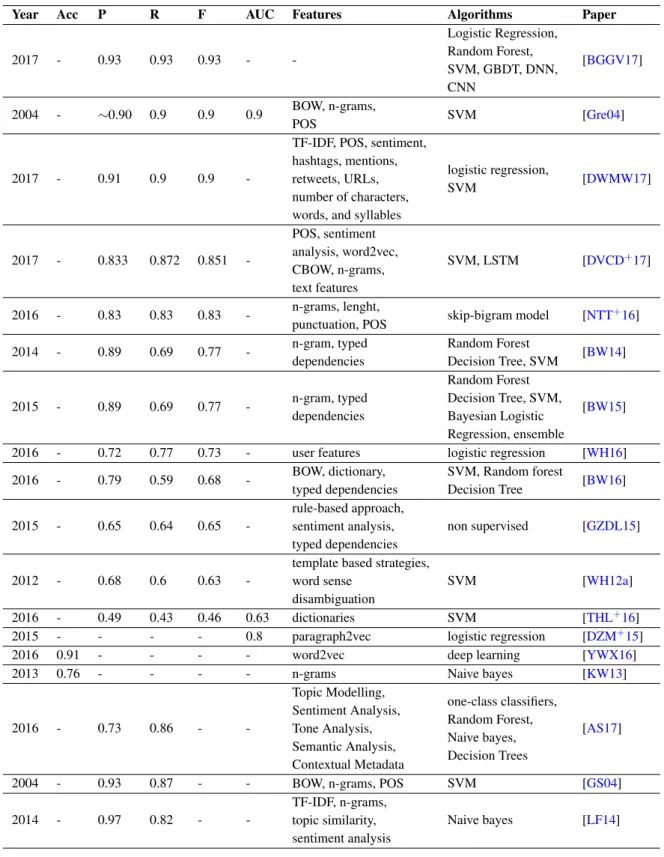
In the collected papers, several metrics were computed in order to estimate the performance of the models. Precision, Recall and F-measure were the most common metrics and in some other studies Accuracy and AUC (Area Under Curve) were also considered. In Table 2.14, the results of the studies are presented in descending order of the F-measure value. These results should be analysed with some caution, because in the several papers different configurations, datasets, and definitions were compared and we try to summarize here the best results for each paper.
Table 2.13: List of the author in the papers with “algorithms about hate speech”. Author Frequency Pete Burnap 3 Edel Greevy 2 Matthew L. Williams 3 Alan f. Smeaton 1 Ben Verhoeven 1 Chikashi Nobata 1 Dirk Hovy 1 Elise Lodewyckx 1 Heng Xu 1 Irene Kwok 1 Jing Zhou 1 Joel Tetreault 1 Julia Hirschberg 1 Lisa Hilte 1
We concluded that it is not clear to understand which approaches perform better. On one hand, the best results were achieved when deep learning was used. However, this was not a consistent result, because in some other studies the performance of deep learning was much worse. In the following sections we focus in the usage of text mining for hate speech or related concepts detection.
2.3.4 Text mining approaches in automatic hate speech detection
The study of automatic hate speech detection has been growing only in the few last years. How-ever some studies have already been conducted as we presented previously. Papers focusing in algorithms for hate speech detection, and also other studies focusing on related concepts (e.g. Cyberbullying), can give us insight about which features to use in this classification task.
Finding the right features to tackle a problem can be one of the more demanding tasks when using machine learning. Therefore we allocate this specific section to describe the features al-ready used by other authors. We divide the features into two categories: general features used in text mining, that are common in other text mining fields; and the specific hate speech detection features, that we find only in the hate speech detection task and are intrinsically related with the characteristics of this problem. We present our analysis in this section.
2.3.4.1 General features used in text mining
The majority of the papers we found try to adapt strategies already known in text mining to the specific problem of automatic hate speech detection. We define general features as the features commonly used in text mining. We start by the most simplistic approaches, that use dictionaries and lexicons.
Dictionaries One strategy in text mining is the use of dictionaries. This approach consists in making a list of words (the dictionary) that are searched and counted in the text. These frequencies
Table 2.14: Results evaluation of the papers in the metrics Accuracy (Acc), Precision (P), Recall (R), F-measure (F) and AUC, respective features and algorithms used.
Year Acc P R F AUC Features Algorithms Paper
2017 - 0.93 0.93 0.93 - -Logistic Regression, Random Forest, SVM, GBDT, DNN, CNN [BGGV17] 2004 - ∼0.90 0.9 0.9 0.9 BOW, n-grams, POS SVM [Gre04] 2017 - 0.91 0.9 0.9
-TF-IDF, POS, sentiment, hashtags, mentions, retweets, URLs, number of characters, words, and syllables
logistic regression, SVM [DWMW17] 2017 - 0.833 0.872 0.851 -POS, sentiment analysis, word2vec, CBOW, n-grams, text features SVM, LSTM [DVCD+17] 2016 - 0.83 0.83 0.83 - n-grams, lenght,
punctuation, POS skip-bigram model [NTT
+16] 2014 - 0.89 0.69 0.77 - n-gram, typed dependencies Random Forest Decision Tree, SVM [BW14] 2015 - 0.89 0.69 0.77 - n-gram, typed dependencies Random Forest Decision Tree, SVM, Bayesian Logistic Regression, ensemble [BW15]
2016 - 0.72 0.77 0.73 - user features logistic regression [WH16]
2016 - 0.79 0.59 0.68 - BOW, dictionary, typed dependencies SVM, Random forest Decision Tree [BW16] 2015 - 0.65 0.64 0.65 -rule-based approach, sentiment analysis, typed dependencies non supervised [GZDL15] 2012 - 0.68 0.6 0.63
-template based strategies, word sense
disambiguation
SVM [WH12a]
2016 - 0.49 0.43 0.46 0.63 dictionaries SVM [THL+16]
2015 - - - - 0.8 paragraph2vec logistic regression [DZM+15]
2016 0.91 - - - - word2vec deep learning [YWX16]
2013 0.76 - - - - n-grams Naive bayes [KW13]
2016 - 0.73 0.86 - -Topic Modelling, Sentiment Analysis, Tone Analysis, Semantic Analysis, Contextual Metadata one-class classifiers, Random Forest, Naive bayes, Decision Trees [AS17]
2004 - 0.93 0.87 - - BOW, n-grams, POS SVM [GS04]
2014 - 0.97 0.82 -
-TF-IDF, n-grams, topic similarity, sentiment analysis
Naive bayes [LF14]
can be used directly as features or to compute scores. In the case of hate speech detection this has been conducted using:
• Content words (such as insult and swear words, reaction words, personal pronouns) col-lected from www.noswearing.com [LF15].
• Number of profane words in the text, with a dictionary that consists of 414 words including acronyms and abbreviations, where the majority is adjectives and nouns [DdJOT12].
• Label Specific Features which consisted in using frequently used forms of verbal abuse as well as widely used stereotypical utterances [DRL11].
• Ortony Lexicon was also used for negative affect detection; the Ortony lexicon contains a list of words denoting a negative connotation and can be useful because not every rude comment necessarily contains profanity and can be equally harmful [DRL11].
This methodology can be used with an additional step of normalization, by the total number of words in the comment [DdJOT12]. Besides, it is also possible to use this kind of approach with regular expressions [Mal14].
Distance Metric Some studies have pointed out that in the offensive text messages it is possi-ble that the offensive words are obscured with an intentional misspelling, often a single character substitution [WH12a]. Examples of this terms are "@ss", "sh1t" [NTT+16], “nagger”, or homo-phones, such as “joo” [WH12a]. The Levenshtein distance can be used with this purpose, and it is defined as the minimum number of edits necessary to transform one string into the other [NS15]. The distance metric can be used to complement dictionary-based approaches.
Bag-of-words (BOW) Another model similar to dictionaries is the use of bag-of-words [BW16,
KW13] [GS04]. In this case, a corpus is created based on the words that are in the training data, instead of a pre-defined set of words, as in the dictionaries. After collecting all the words, the frequency of each one is used as a feature for training a classifier. The disadvantages of this kind of approaches is that the word sequence is ignored, and also its syntactic and semantic content. Therefore, it can lead to misclassification if the words are used in different contexts. To overcome this limitation n-grams were implemented.
N-grams n-grams are one of the most used techniques in hate speech automatic detection and related tasks [BW16,NTT+16, WH16,LF14, BYH+, GS04,DWMW17,BGGV17]. The most common n-grams approach consists in combining sequential words into lists with sizeN. In this case, the goal is to enumerate all the expressions of sizeNand count the occurrences of them. This allows to improve classifiers’ performance because it incorporates at some degree the context of each word. Instead of using words it is also possible to use n-grams with characters or syllables. This approach is not so susceptible to spelling variations as when words are used. In a study character n-gram features proved to be more predictive than token n-gram features, for the specific problem of abusive language detection [MT16].
However, n-grams also have disadvantages. One disadvantage is that related words can have a high distance in a sentence [BW16] and a solution for this problem, such as increasing theN value, slows down the processing speed [Che11]. Also, studies point out that higherNvalues (5) perform better than lower values (unigrams and trigrams) [LF14]. In a survey [SW17], researchers report that n-grams features are often reported to be highly predictive in the problem of hate speech automatic detection, but perform better when combined with others.
Profanity Windows Profanity windows are a mixture of a dictionary approach with n-gram. The goal is to check if a second person pronoun is followed by a profane word within the size of a window and then create a boolean feature with this information [DdJOT12].
TF-IDF The TF-IDF (term frequency-inverse document frequency) was also used in this kind of classification problems [DRL11]. TF-IDF is a measure of the importance of a word in a document within a corpus and increases in proportion to the number of times that a word appears in the document. However, it is distinct from a bag of words, or n-gram, because the frequency of the term is off-setted by the frequency of the word in the corpus, which compensates the fact that some words appear more frequently in general (e.g. stop words).
Part-of-speech Part-of-speech (POS) approaches make it possible to improve the importance of the context and detect the role of the word in the context of a sentence. These approaches consist in detecting the category of the word, for instance, personal pronoun (PRP), Verb non-3rd person singular present form (VBP), Adjectives (JJ), Determiners (DT), Verb base forms (VB). Part-of-speech has also been used in hate Part-of-speech detection problem [GS04]. With these features it was possible to identify frequent bigram pairs, namely PRP_VBP, JJ_DT and VB_PRP, which would map as “you are” [DRL11]. It was also used to detect sentences such as “send them home”, “get them out” or “should be hung” [BW14]. However, POS proved to cause confusion in the classes identification [BW14], when used as features.
Lexical Syntactic Feature-based (LSF) In a study [Che11], the natural language process parser, proposed by Stanford Natural Language Processing Group [Gro17], was used to capture the grammatical dependencies within a sentence. The features obtained are pair of words in the form “(governor, dependent)”, where the dependent is an appositional of the governor (e.g. “You, by any means, an idiot.” means that “idiot”, the dependent, is a modifier of the pronoun “you,” the governor). These features are also being used in hate speech detection [Che11].
Rule based approaches Some rule-based approaches have been used in the context of text min-ing. A class association rule-based approach, more than frequencies, is enriched by linguistic knowledge. Rule-based methods do not involve learning and typically rely on a pre-compiled list or dictionary of subjectivity clues [HL14]. For instance, rule-based approaches were used to clas-sify antagonistic and tense content on Twitter and they used associational terms as features. They
also included accusational and attributional terms targeted at only one or several persons following a socially disruptive event as features, in an effort to capture the context of the terms used.
Participant-vocabulary consistency (PVC) In a study about cyberbullying [RH16], this method is used to characterize the tendency of each user to harass or to be harassed, and the tendency of a key phrase to be indicative of harassment. For applying this method it is necessary a set of messages for the same user. In this problem for each user, it is assigned a bully score (b) and a victim score (v). For each feature (e.g. n-grams) a feature-indicator score (w) is used. It represents how much the feature is an indicator of a bullying interaction. Learning is then an optimization problem over parameters b, v, and w.
Template Based Strategy The basic idea of this strategy is to build a corpus of words, and for each word in the corpus, collectKwords that occurring around [Pow11]. This information can be used as context.
This strategy has been used for feature extraction in the problem of hate speech detection as well [WH12a]. In this case a corpus of words and a template for each word was listed, as in:
• template literal ”W-1:go W+0:back W+1:to”
This is an example of a template for a two word window on the word “back”.
Word Sense Disambiguation Techniques This problem consists in identifying the sense of a word in the context of a sentence, when it can have multiple meanings [Yar94]. In a study, the stereotyped sense of the words was took into consideration, in order to understand if the text is anti-semitic or not [WH12a].
Typed Dependencies Typed dependencies were also used in hate speech related studies. First, to understand the type of features that we can obtain with this, the Stanford typed dependencies representation provi