01
\
Evaluation Tools for
Adoption of Cloud
Evaluation Tools for Adoption of
Cloud Hosting Services
July 2013
Take Home Message
•
Knowledge Impact Strategies found no existing full-service tools for evaluating adoption
factors for cloud computing hosting services
•
Most tools are centered around the costs of adopting cloud hosting services
•
Tools that focus on calculating costs vary from one another in:
o
What they calculate (e.g., hardware costs, operational costs)
o
What factors they involve (e.g., storage space, number of servers)
o
The time period they comprise (e.g., quarterly, yearly)
•
Tools focusing on Infrastructure as a Service (IaaS) assume that customers:
o
Have detailed knowledge of their IT requirements
o
Understand how needs translate into cloud services
•
Only two tools, both assessing costs, directly weighed the differences amongst cloud
computing services:
o
One compared private hosting versus in-house cloud computing facilities
o
The other compared public hosting versus in-house cloud computing facilities
Overview
Knowledge Impact Strategies was asked by an IT consulting firm to determine whether tools are
available to help organizations determine the best source of cloud hosting services for their
individual corporate needs.
We found 29 tools using two resources.
•
We scanned the Internet for online tools using DEVONagent. Four queries ran for 6
hours. Sixteen online tools were found using this method.
•
We searched for recent (2011-2013) peer-reviewed research articles using the Scopus
and Engineering Village databases. In total we found and examined 175 articles. Of
those, 104 were not applicable to the topic. One article was not available for review. Of
the remaining 70 articles, 57 provided coherent arguments, concepts, and consideration
of the need for cloud services decision-making resources. Only 13 research articles
described actual tools.
175
research articles
found & reviewed
70
13 described tools
relevant articles;
16 tools on websites +
13 articles =
29 tools
Each tool was examined and its features were catalogued in a spreadsheet. Features included:
•
Category
(type of assessment(s) that the tool provides)
•
Source
(tool provider or article citation)
•
Structure
(such as calculator, questionnaire)
•
Purpose
(overall intention for creating the tool)
•
How
(method of using the tool)
•
Output
(what the tool provides to the user)
Highlights of the resources are presented below. The highlights indicate the current
state-of-the-art overview in tool development that serves decision-making in the adoption of cloud computing
services. The characteristics of each tool can be examined in further detail in the spreadsheet.
Landscapes of Resources
55%
45%
Source of Tools
Online
Research
48%
35%
10%
7%
Structure of Tools
Calculator
Questionnaire
Others
Framework
Highlights of Results
Tools from Online Sources:
•
All of the tools found online are free. Some tools require users to register an account in
order to access them
•
Tools can be found on cloud vendors or consulting company websites
•
From the tools found online, tools most frequently address cost assessment
•
Tools provide results that are typically only guidelines or general observations
•
Users of tools have the option of booking appointments to:
o
Explore tool results in more detail
o
Design a strategy
o
This feature does not apply to tools found in research articles
Tools from Research Sources:
•
Research suggests that Small and Medium Enterprises (SMEs) are the main market for
cloud computing services
•
Research studies primarily address cost assessments and savings
•
One researcher has proposed to develop a multi-dimensional assessment for cloud
migration (Hosseini et al., 2011 and Hosseini et al., 2012)
Tools Overview:
•
Tools come in a variety of forms, such as online tools, spreadsheets, documents, and
even applications
•
There were no full-service tools for evaluating cloud-computing migrations. Full service
would include: cost, energy consumption, corporate user impact, technology, and
corporate responsibility
•
Instead, existing tools evaluate:
o
Cost:
including hardware, software and operational costs
o
Readiness:
to adopt a cloud computing system
o
Vendor Selection:
the match between the vendor’s services and user’s profile
and needs
o
Strategy:
cloud feature options based on user priorities
40%
36%
17%
7%
Categories of Tools
Cost
Readiness
Vendor Selection
Strategy
Category Source Structure Purpose How Output Cost 2nd Watch
(http://tco.2ndwatch.com) Calculator To compare Amazon Web services cost using a 7-point criteria. Users indicate deployment needs online using sliders. Categorized cost report
Cost Cloud Service Market
(http://www.cloudservicemarket.inf o/tools/tco.aspx)
Questionnaire To support decision making in order to understand the costs associated with cloud. Provides costs organized by type and includes examples of cost factors.
Users complete an online multiple choice questionnaire regarding cost factors, also providing total costs for each.
Online report
Cost Cloudorado
(http://www.cloudorado.com) Calculator To calculate cloud server prices and make custom IaaS cloud computing provider cost comparisons. Provides an advanced mode with a deeper level of detail to support the decision making process.
Users indicate deployment needs
online using sliders. Online cost report per vendor
Cost Evolve IP
(http://pages.evolveip.net/virtualiza tion-tco-calculator.html)
Calculator To determine hardware, software and operational costs. Users input cost information into an
Excel spreadsheet. Excel results
Cost Gocipher Web Services
(http://cloudpricecalculator.com) Calculator To calculate an index called Cloud Price Normalization (CPN) based on some parameters. Index can be compared with a list of IaaS vendors.
Users complete an online form requiring information on cloud parameters.
Index
Cost Meri Talk
(http://www.meritalk.com/savings-calculator-register.php)
Calculator To explore cost savings through a six category analysis using
industry and government metrics. Users input current IT environment information. Cost results using tables and graphs
Cost Right Scale
(http://www.planforcloud.com) Calculator To forecast the customer's cloud deployment strategy, define usage scenarios, and update forecast when prices change using Amazon, Azure, Rackspace and Google.
Users complete an online form. Graphic analysis of deployment
Cost Solar Winds
(http://www.solarwinds.com/produc
ts/freetools/vm-to-cloud-calculator.aspx)
Calculator To compare cost estimates of moving virtual machines to the cloud using public cloud providers (Amazon, Azure,
Rackspace). Can also report costs per hour, month, quarter or year.
Users run software to assess existing
virtual machines. Cost report
Tools from Online Sources
Category Source Structure Purpose How Output Readiness Info ~ Tech Research Group
(http://www.infotech.com/research/ ss/it-develop-a-cloud-testing- strategy-for-todays-apps/it-cloud-testing-readiness-assessment-tool)
Questionnaire To evaluate readiness considering people, process and technology silos. Provides recommendations on areas of improvement.
Users complete questionnaire. Online report and scenarios
Readiness Microsoft
(http://www.cloudassessmenttool.c om)
Questionnaire To evaluate priorities and barriers, existing infrastructure, and
processes. Provides recommendations based on the answers. Users complete an online questionnaire using sliders. Online report and PDF
Readiness Rackspace
(http://www.rackspace.com/cloud/s elf_assessment/)
Questionnaire To analyze business and technology factors such as strategy, infrastructure, and technical requirements to determine the readiness level for migrating services to the cloud.
Users complete questionnaire. Evaluation (low to high) per dimension
Readiness The Armanda Group
(http://www.assessmentgenerator2 .com/sys/?module=assessment&as sessment_id=686)
Questionnaire To evaluate whether or not companies are effectively planning
for using cloud computing. Users complete an online multiple choice questionnaire. Score and position on readiness scale
Readiness/ Vendor selection Bell (http://www.bell.ca/enterprise/portle ts/enterprise/documentform/core_c ontent_downloads.jsp?FormId=Re adinessCloud&language=en)
Questionnaire To provide insights on whether or not a business model is prepared for cloud, what requirements are needed before migrating, and how to find if the cloud offering matches the business' needs.
Users complete a non-interactive
questionnaire. None
Strategy Accenture
(http://www.accenture.com/Microsit es/cloudstrategy/Pages/home.aspx #/screen-0)
Questionnaire To assess four dimensions (strategy, applications, platforms, infrastructure) and provides a score and feedback for each dimension.
Users complete an online
questionnaire. Online assessment report
Strategy The Cloud Calculator
(http://www.thecloudcalculator.com /calculators/cloud-build-vs-buy.html)
Calculator To compare the cost of hosting with public vendors or deploying
on the internal network cloud services. Users indicate deployment needs online using sliders. Online and PDF cost comparison
Vendor
selection ACCA (https://accacat.herokuapp.com) Questionnaire To evaluate critical capabilities required to migrate applications to the cloud. Users indicate deployment needs. Online report
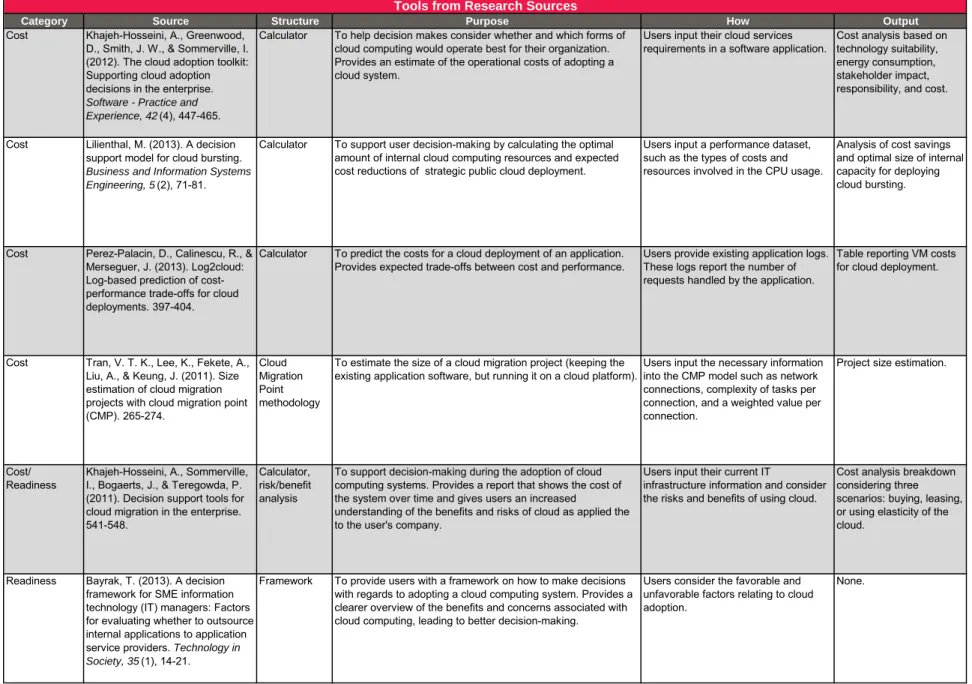
Category Source Structure Purpose How Output Cost Khajeh-Hosseini, A., Greenwood,
D., Smith, J. W., & Sommerville, I. (2012). The cloud adoption toolkit: Supporting cloud adoption decisions in the enterprise. Software - Practice and Experience, 42(4), 447-465.
Calculator To help decision makes consider whether and which forms of cloud computing would operate best for their organization. Provides an estimate of the operational costs of adopting a cloud system.
Users input their cloud services
requirements in a software application. Cost analysis based on technology suitability, energy consumption, stakeholder impact, responsibility, and cost.
Cost Lilienthal, M. (2013). A decision support model for cloud bursting. Business and Information Systems Engineering, 5(2), 71-81.
Calculator To support user decision-making by calculating the optimal amount of internal cloud computing resources and expected cost reductions of strategic public cloud deployment.
Users input a performance dataset, such as the types of costs and resources involved in the CPU usage.
Analysis of cost savings and optimal size of internal capacity for deploying cloud bursting.
Cost Perez-Palacin, D., Calinescu, R., & Merseguer, J. (2013). Log2cloud: Log-based prediction of cost-performance trade-offs for cloud deployments. 397-404.
Calculator To predict the costs for a cloud deployment of an application.
Provides expected trade-offs between cost and performance. Users provide existing application logs. These logs report the number of requests handled by the application.
Table reporting VM costs for cloud deployment.
Cost Tran, V. T. K., Lee, K., Fekete, A., Liu, A., & Keung, J. (2011). Size estimation of cloud migration projects with cloud migration point (CMP). 265-274.
Cloud Migration Point methodology
To estimate the size of a cloud migration project (keeping the
existing application software, but running it on a cloud platform). Users input the necessary information into the CMP model such as network connections, complexity of tasks per connection, and a weighted value per connection.
Project size estimation.
Cost/
Readiness Khajeh-Hosseini, A., Sommerville, I., Bogaerts, J., & Teregowda, P. (2011). Decision support tools for cloud migration in the enterprise. 541-548.
Calculator, risk/benefit analysis
To support decision-making during the adoption of cloud computing systems. Provides a report that shows the cost of the system over time and gives users an increased
understanding of the benefits and risks of cloud as applied the to the user's company.
Users input their current IT
infrastructure information and consider the risks and benefits of using cloud.
Cost analysis breakdown considering three scenarios: buying, leasing, or using elasticity of the cloud.
Readiness Bayrak, T. (2013). A decision framework for SME information technology (IT) managers: Factors for evaluating whether to outsource internal applications to application service providers. Technology in Society, 35(1), 14-21.
Framework To provide users with a framework on how to make decisions with regards to adopting a cloud computing system. Provides a clearer overview of the benefits and concerns associated with cloud computing, leading to better decision-making.
Users consider the favorable and unfavorable factors relating to cloud adoption.
None.
Tools from Research Sources
Category Source Structure Purpose How Output Readiness Christoforou, A., & Andreou, A. S.
(2013). A Cloud Adoption Decision Support Model Based on Fuzzy Cognitive Maps. Product-Focused Software Process Improvement, 7983, 240-252. Certainty Neuron Fuzzy Cognitive Maps (CNFCM) methodology
To support users in the cloud adoption decision-making process by modeling a number of parameters such as cost/pricing which may influence the decision.
Users input the necessary information into the CNFCM model by ranking each parameter on a scale of 'negatively very high' to 'positively very high.'
A numerical value which suggests a positive or negative adoption decision based on the input values for each parameter.
Readiness Gash, D., Ariyachandra, T., & Frolick, M. (2012). Looking to the clouds for business intelligence. Journal of Internet Commerce, 10(4), 261-9.
Framework To guide users through the process of implementing a cloud system.Provides users with an increased understanding of how the move to cloud computing can ideally be implemented in the user's individual situation.
Users consider a number of questions and factors which will affect their ideal cloud implementation.
None.
Readiness Misra, S. C., & Mondal, A. (2011). Identification of a company's suitability for the adoption of cloud computing and modelling its corresponding return on investment. Mathematical and Computer Modelling, 53(3-4), 504-521.
Calculator To help companies determine their favourability in adopting a cloud computing system. Provides a numerical value that measures whether a company is suitable for the adoption of a cloud system.
Users fill out a tabulation sheet and calculate a score based on the given formula. Users also calculate the company's return on investment.
Suitability index that indicates whether or not a company should adopt cloud computing services and save money.
Readiness Tan, C., Liu, K., & Sun, L. (2013). A design of evaluation method for SaaS in cloud computing. Journal of Industrial Engineering and Management, 6(1), 50-72.
Questionnaire To assess an organization's readiness to adopt a cloud computing system. Provides a summary that provides a recommendation of whether an organization should adopt a cloud computing system based on level of readiness and cost comparison.
Users answer questions and consider a variety of factors that will affect their existing IT landscape.
Evaluation report of SaaS adoption including a general assessment, risk assessment, and cost.
Vendor
selection Menzel, M., Schönherr, M., & Tai, S.(MC2)2: Criteria, requirements and a software prototype for cloud infrastructure decisions. Software - Practice and Experience,
Questionnaire To help potential users determine which cloud infrastructure best suits their needs. Provides a recommendation regarding a specific cloud computing provider.
Users enter information regarding the components of their IT environment, their computing needs, and their preferences regarding factors such cost and quality.
Cost calculation based on a list of proposed categories.
Vendor
selection Rehman, Z. U., Hussain, F. K., & Hussain, O. K. (2011). Towards multi-criteria cloud service selection. 44-48.
Algorithm To help users determine which cloud service vendors they should pick. Provides a numerical measure that indicates which cloud service vendor best matches the user's requirements.
The work presented in this study is under development, and takes only the form of a mathematical decision matrix.
Cloud service selection among different options that are similar in specification but different in performance.
Vendor
Selection Shawky, D. M., & Ali, A. F. (2012). Defining a measure of cloud computing elasticity.
Calculator To provide users with an evaluation of a cloud computing system's performance. It provides a measurement of a cloud computing system's ability to expand and contract in response to users' demand.
By calculating the ratio of required
resources and allocated resources. Measure of elasticity in cloud computing (IaaS).
Acknowledgements
This work was conducted by Knowledge Impact Strategies Consulting Ltd with support from the
Social Sciences and Humanities Research Council of Canada through a Partnership
Development Grant: “Building Systems for Sustainable Knowledge Mobilization” (K. Bloom,
Principal Investigator). The research review team included Kathleen Bloom, PhD, Rodrigo Eng,
MSCI, MBET, CSE, Natalie Chan (Candidate for BKI Joint Honours Knowledge Integration and
Psychology, University of Waterloo) and AJ Orena, BA (Candidate for PhD Communication
Sciences, McGill University).
Disclaimer
Every attempt was made to produce a systematic review of the highest quality relative to time
and our professional judgment. This work is not necessarily definitive, authoritative,
comprehensive, or current. It represents the findings, views, opinions, and conclusions of the
reviewers, and is provided as is without warranties of any kind. Knowledge Impact Strategies
Consulting Ltd including its directors, officers, employees and agents, accept no responsibility
for this work.
Citation
Knowledge Impact Strategies Consulting Ltd (2013, July). Evaluation tools for adoption of cloud
hosting services. Waterloo, ON. Author.
Contact
Knowledge Impact Strategies provides reviews of information and research findings to industry,
governments, health and social services. Our reviews assist evidence-informed policy and
program development.
For more information and quotes, please contact: