Detecting Biomedical Relations using
Distant Supervision
Roland Roller
Faculty of Engineering
University of Sheffield
A thesis submitted for the degree of
Doctor of Philosophy
Acknowledgements
First of all, I would like to thank Dr. Mark Stevenson for offering me a scholarship and for supervising my PhD. I am very happy that he intro-duced me to biomedical information extraction. I am grateful for all his patience, his support and his valuable advice to guide me through the PhD. I learnt so much from him. Furthermore, I highly appreciate all the time he took for me, such as our weekly meetings and the many times I just came around and knocked at his door.
I am very grateful to my PhD panel committee members Prof. Robert Gaizauskas and Dr. Dirk Sudholt for their constructive comments and their help to improve my thesis.
Next, I would like to thank Dr. Ahmet Aker and Dr. Frederic Blain for proofreading parts of my thesis. This was very helpful. I highly appreciate the support of Frederic and other colleagues in the final stage of my PhD (‘You are nearly there, Roland!’). Special thanks to all colleagues for the highly valuable feedback during (and outside) the NLP group meetings. I would like to thank all current and former colleagues at the University of Sheffield for the amazing time. I very much enjoyed the common lunches, coffee breaks in the kitchen and after-work drinks. In particular, I would like to thank everybody in room G35. I also would like to thank everybody of the IXA research group in the Basque Country for the fantastic time in Donostia and for ‘Pintxo Pote’. In particular, I would like to thank Dr. Eneko Agirre and Dr. Aitor Soroa. I learnt much from our collaboration. Many thanks to my partner Eletta Giusto for supporting me in every pos-sible way and making my life much happier. I also would like to thank my family for their unreserved support and love.
Abstract
This work concerns the detection of relationships between key information in biomedical publications, such as treatments for diseases or side-effects of drugs. Given a sentence containing some medical concepts the goal is to determine their relationship to each other.
Supervised machine learning methods are a very popular way to address this problem and often provide reliable results. Those methods require manually labelled examples to extract characteristics of particular relation-ships in order to detect similar information in unlabelled data. However, manually labelled data is not always available and its generation is time consuming and expensive.
The main objective of this thesis is the exploration of distant supervision, a method which generates those labelled examples automatically using prior knowledge to detect relationships between key facts.
First, relation extraction using a limited amount of training data is ex-plored to detect adverse-drug effects in natural language. Then, work fo-cuses on automatically labelling data using a large biomedical knowledge base, the Unified Medical Language System (UMLS). The effectiveness of a popular evaluation method that does not require manually labelled data is examined in more detail. The main goal is the investigation of whether UMLS is suitable to be used to label data automatically so as to detect similar information in natural language. Finally, a method to reduce falsely labelled instances in the automatically generated data is presented and found to improve the detection of relationships.
Contents
Contents 4 List of Figures 7 List of Tables 9 Nomenclature 12 1 Introduction 13 1.1 Contribution . . . 16 1.2 Published Material . . . 16 1.3 Thesis Overview . . . 172 Related Work and Background 20 2.1 Relation Extraction . . . 20
2.1.1 Biomedical Supervised Relation Extraction . . . 22
2.1.2 Distant Supervision . . . 23
2.1.3 Mixed Classification Models . . . 30
2.2 Evaluating Relation Extraction Systems . . . 31
2.2.1 Evaluation Levels . . . 32 2.2.2 Evaluation Metrics . . . 34 2.3 Resources . . . 35 2.3.1 Medline repository . . . 36 2.3.2 UMLS . . . 36 2.3.3 MetaMap . . . 40 2.4 Summary . . . 42
CONTENTS
3 Bootstrapping Limited Training Data 44
3.1 ADE Data . . . 45
3.1.1 Corpus overview . . . 45
3.2 Automatic Generation of Additional Training Data . . . 47
3.3 Relation Extraction System . . . 51
3.4 Experiment . . . 52
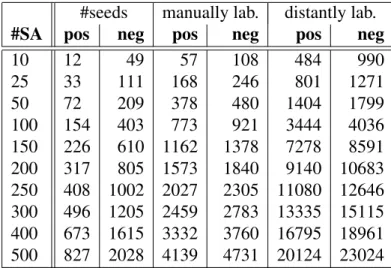
3.4.1 Analysis of Generated Data . . . 52
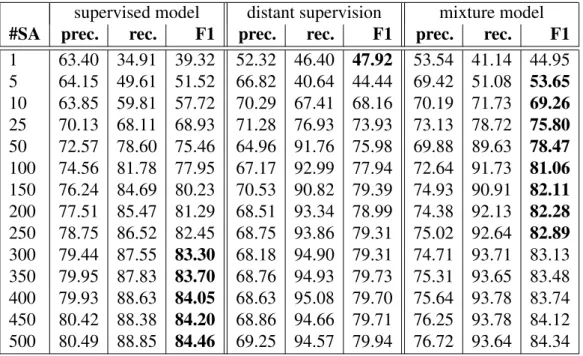
3.4.2 Results . . . 54
3.5 Conclusion . . . 55
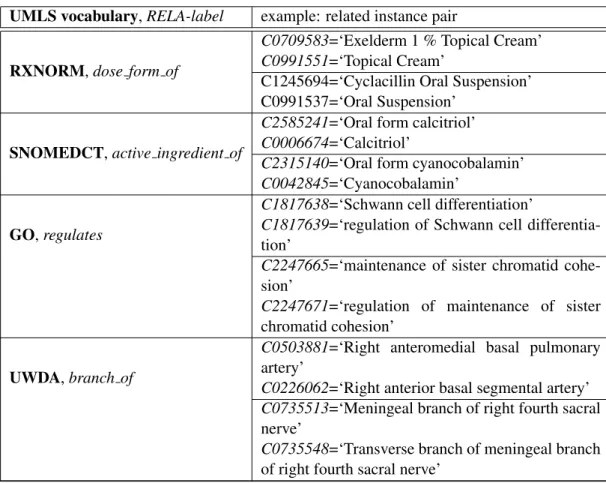
4 Detecting relations from the UMLS Metathesaurus in Medline abstracts 57 4.1 Selection of UMLS Metathesaurus relations . . . 58
4.2 Data Generation . . . 62
4.3 Corpus Statistics . . . 64
4.4 Further filtering steps . . . 66
4.5 MultiR - Relation Extraction . . . 68
4.6 Experiment . . . 70
4.6.1 Setup . . . 71
4.6.2 Held-Out Evaluation . . . 73
4.6.3 Manual Evaluation . . . 75
4.7 Summary . . . 76
5 Comparison of Evaluation Strategies for Distantly Supervised Relation Extraction 77 5.1 Data Generation . . . 78
5.1.1 Distant labelling . . . 78
5.1.2 Manually labelled Test Data . . . 79
5.2 Label Comparison . . . 81
5.2.1 Sentence Level Labels . . . 81
5.2.2 Entity Level Labels . . . 82
5.3 Experiment . . . 84
5.3.1 Experimental Setup and Overview . . . 84
CONTENTS
5.3.3 Sentence level evaluation . . . 87
5.4 Conclusion . . . 89
6 Reduction of Falsely Labelled Data 91 6.1 Motivation . . . 91
6.2 PRA-Reduction . . . 94
6.2.1 Removing False Negative Instances . . . 95
6.3 Experimental Setup . . . 96
6.3.1 Training Data Sets . . . 96
6.3.2 Evaluation . . . 97
6.4 Results . . . 98
6.4.1 Held-out data . . . 98
6.4.2 Manually labelled . . . 100
6.5 Data Analysis . . . 101
6.5.1 Examination of PRA-reduced data . . . 101
6.5.2 Pattern Analysis . . . 102 6.6 Conclusions . . . 103 7 Conclusions 105 7.1 Summary of thesis . . . 105 7.2 Future directions . . . 106 References 110 Appendix 1 129 Appendix 2 131
List of Figures
1.1 Sentence mentions a possible treatment for depression. . . 14
2.1 Example of the relationPREVENT . . . 21
2.2 Correctly labelled sentence using distant supervision. . . 24
2.3 Falsely labelled sentence using distant supervision. . . 24
2.4 Held-Out Evaluation . . . 31
2.5 Correctly predicted adverse drug effect between target entities. . . 33
2.6 Incorrectly predicted adverse drug effect between target entities. . . . 33
2.7 MetaMap-segmented sentence . . . 41
2.8 MetaMap annotation of UMLS-CUIs . . . 42
3.1 Example of a drug-related adverse effect . . . 46
3.2 Mapping UMLS annotations to a sentence using MetaMap . . . 47
3.3 Replacing UMLS-CUIs with semantic types . . . 47
3.4 Keep entities that match to semantic groups . . . 48
3.5 Automatic generation of training data for ADE relations . . . 48
3.6 Positive ADE sentence (top) and its MetaMap annotation (below) . . 49
3.7 Example of an insufficient entity normalisation . . . 50
3.8 Automatically labelled positive example . . . 50
4.1 Group of CUIs might cause false negatives . . . 67
4.2 Using non-nouns for distant supervision might cause errors . . . 67
4.3 Adjusting bias of training data (Held-Out Setup) . . . 73
4.4 Precision/Recall Curve for Held-out data . . . 74
LIST OF FIGURES
6.2 Using more relations to reduce false negatives (example 2) . . . 94
6.3 Bias adjustment . . . 97
6.4 Precision/Recall Curve for Held-out data using PRA . . . 100
6.5 PRA-reduced example 1 . . . 102
6.6 PRA-reduced example 2 . . . 102
7.1 Example sentence of a positively predicted, but unknown entity pair . 107 7.2 False named entity recognition . . . 108
List of Tables
2.1 Confusion Matrix: Predicting instances . . . 34
2.2 Excerpt of MRCONSO . . . 38
2.3 Excerpt of MRREL . . . 38
2.4 CUI candidate list (including semantic types) provided by MetaMap . 41 3.1 Data input for classifier of a positive sentence from publication PMID 10048291, taken from ADE data set. . . 51
3.2 ADE training data size (mean across five runs) . . . 53
3.3 Effect of varying size of training data set . . . 54
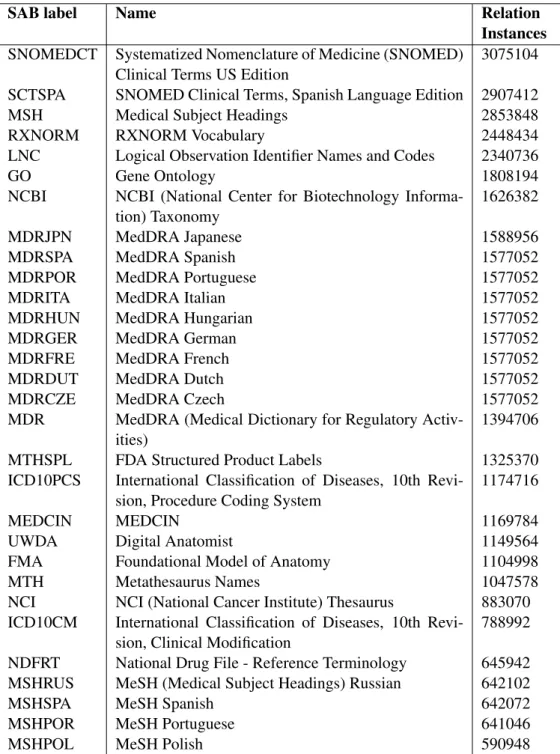
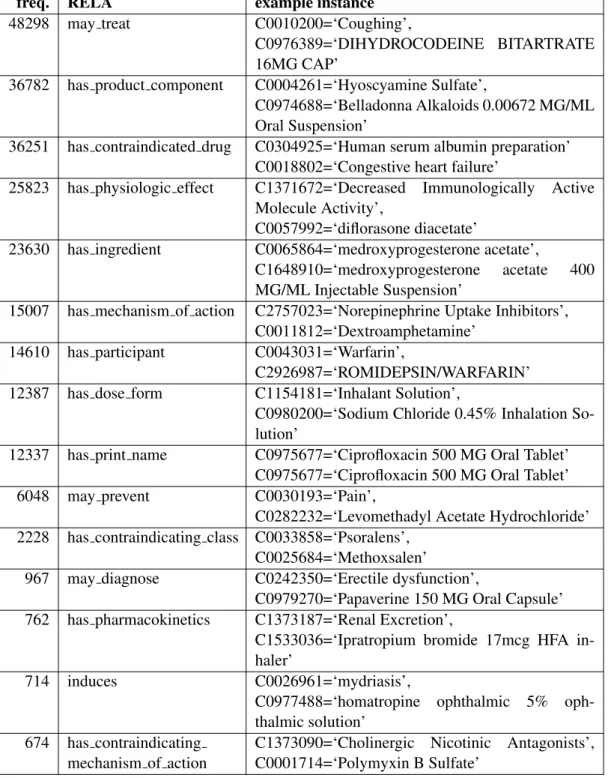
4.1 Relation frequencies in the UMLS Metathesaurus . . . 59
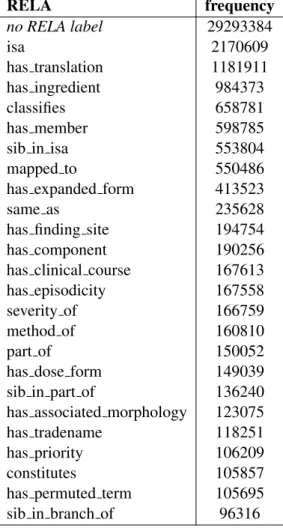
4.2 UMLS Metathesaurus relation examples . . . 60
4.3 Top-30 vocabularies of the UMLS Metathesaurus based on relation instances . . . 61
4.4 NDF-RT relations . . . 63
4.5 Amount of CUI pairs for the generation of the baseline data (all); #given: amount of CUI pairs in MRREL, #pos: amount of positive CUI pairs, #neg (g): amount of negative CUI pairs generated from the positive pairs, #u-pos: unique positive pairs, #u-neg: unique negative pairs . . . 65
4.6 Selection of features used for distant supervision . . . 70
4.7 Best results using held-out . . . 74
4.8 Evaluation of distantly labelled classifier using manually labelled data 76 5.1 Comparison of manual and distantly labelled annotations . . . 81
LIST OF TABLES
5.2 Comparison of manual and distantly labelled annotations at entity level 83 5.3 Results for relation extraction system evaluated against DL and ML
data sets (may-prevent) . . . 86 5.4 Results for relation extraction system evaluated against DL and ML
data sets (may-treat) . . . 86 5.5 Results for relation extraction system evaluated against DL and ML
data sets (Overall) . . . 87 5.6 Sentence-level results for relation extraction system evaluated against
DL and ML data sets (may-prevent) . . . 88 5.7 Sentence-level results for relation extraction system evaluated against
DL and ML data sets (may-treat) . . . 88 5.8 Sentence-level results for relation extraction system evaluated against
DL and ML data sets (Overall) . . . 89 6.1 Example PRA-induced paths and weights for the NCI relation
biological-process-involves-gene-product. . . 95 6.2 Example PRA-induced paths and weights for the NDF-RT relation
contraindicating-class-of. . . 95 6.3 Evaluation using held-out data . . . 99 6.4 Evaluation using manually labelled data . . . 101 6.5 Example PRA-induced paths and weights for the NCI relation
biological-process-involves-gene-product. . . 103 6.6 Example PRA-induced paths and weights for the NCI relation
may-prevent. . . 104 1 Relationship definitions of MRREL . . . 129 2 Semantic groups according to Bodenreider and McCray [2003]. . . . 130
Nomenclature
ADE Adverse Drug Effect BB Bacteria Biotopes
CDR Chemical Disease Relation CG Cancer Genetics
CRF Conditional Random Field
CTD Comparative Toxicogenomics Database CUI Concept Unique Identifier
DDI Drug Drug Interaction DL Distantly Labelled DS Distant Supervision GE Genia Event
GO Gene Ontology
JSRE Java Simple Relation Extraction KB Knowledge Base
LIST OF TABLES
MIL Multi-Instance Learning ML Manually Labelled
NCI National Cancer Institute Thesaurus
NDF-RT National Drug File Repository Thesaurus NE Named Entity
NER Named Entity Recognition NLM National Library of Medicine NLP Natural Language Processing PDB Protein Data Bank
PET Path-Enclosed Tree
PID Pathway Interaction Database PMID PubMed-Id
POS Part of Speech
PPI Protein-Protein Interaction PRA Path Ranking Algorithm REL Relation Label of MRREL
RELA Relation Attribute Label of MRREL SA seed abstracts
SAB Source Abbreviation SL Shallow Linguistic STY Semantic Type
SVM Support Vector Machine YPD Yeast Protein Database
Chapter 1
Introduction
Every day people produce textual data containing information related to the life sci-ences. Data is generated for various purposes and published using different channels such as news-pages, scientific papers, clinical records or forums. PubMed1 for in-stance, is a large repository for scientific papers from the biomedical domain. Each year hundreds of thousands of new publications are added to the repository2 [Zheng and Blake, 2015]. Valuable information, experimental outcomes and new discoveries, which are relevant for pharmacological laboratories or doctors might be published in papers but disappear in the large amount of data. This information is described in natu-ral language, and therefore, difficult to access by computer programs. It is not possible for humans to read all documents available to find informations of interest.
For instance, a search request on PubMed to find new or alternative treatments for depression might provide a large number of documents. Searching for a term such as “depression”, PubMed returns 333,955 documents3. A more fine-grained search request such as “pharmacological treatment of depression” decreases the list down to 71,900. PubMed offers numerous search filters to narrow down the list of relevant in-formation [Ebbert et al., 2003; Lindsey and Olin, 2013], such as a restriction per year, per journal or by Medical Subject Headings (MeSH4). In PubMed MeSH terms are used by medical experts to index publications which provide a categorisation.
Addi-1https://www.ncbi.nlm.nih.gov/pubmed/
2https://www.nlm.nih.gov/bsd/medline_cit_counts_yr_pub.html, 19th of
September 2015
3according to a search request on 22th of September 2015
tionally, PubMed offers document ranking by year or relevance. However, it might be helpful using a program that is able to detect all different mentions of pharmacologi-cal treatments for depression. Firstly, this could improve the search by selecting only those publications that are really relevant for the treatment. Secondly, pharmacological treatments could be extracted in order to select only publications with a treatment of interest. Moreover, such a program could be used to detect new treatments that are not known by any database. The example in Figure 1.1 shows a sentence expressing a treatment for depression. The sentence is taken from a publication with the PubMed-Id=11092117 (PMID) and mentions the usage of the drugamitriptylineas treatment. How can those connections between medical concepts (entities) successfully be de-tected to improve information access?
She had been taking [DRUG:amitriptyline] 75 mg at night for
[DISEASE:depression] for four months before her admission. (PMID=11092117)
Figure 1.1: Sentence mentions a possible treatment for depression.
Relation extraction addresses the task of detecting relationships between entities in natural language, such as in the previous example. In this context a relation in a sentence can express, for instance, that a drug has a particular side effect or that a drug can be used to treat a disease5.
Relations expressed in natural language can be detected in different ways (see Chapter 2). Currently, machine learning techniques such as supervised learning have been proven the most effective for detecting relations in natural language, as shown in different shared tasks and challenges (see e.g. [Kim et al., 2011; N´edellec et al., 2013; Segura-Bedmar et al., 2013]).
Classifiers often provide better results when more training data is available6 (see e.g. in [Banko and Brill, 2001; Brants et al., 2007]). Nevertheless, training data is not available in all cases. The generation of manually labelled training data is,
unfortu-5Relations are described as binary relations between two entities in this work.
6This statement can be very controversial, because more data does not necessarily lead always to
further improvements, without paying attention to the method [Curran and Osborne, 2002]. However, using a training data set with a few thousand instances might lead to better results than using only a hundred training instances, as seen in Thomas et al. [2011] for instance.
nately, a time consuming and expensive process. Time is usually precious for people, such as doctors, who might be suitable to carry out a biomedical annotation. This makes supervised learning methods not ideal for all situations even though the results are very efficient.
An alternative approach to address relation extraction is distant supervision (DS; also known as self-supervision or weak supervision). The technique generates training data automatically using a set of known facts for a relation (e.g. may-treat(‘aspirin’, ‘pain’)). A sentence is labelled as positive if it contains a positively related fact and as negative if it contains a negative fact. Negative facts are often generated following the closed-world assumption: If an information is not known to be positive it is assumed to be negative. Obviously, the assumption of distant supervision is not always correct. The words aspirinand pain can occur together in a sentence without expressing the may-treatrelation. Contrariwise, a sentence might be labelled as negative even though the sentences expresses the relation of interest. This situation might occur if the set of known facts is not complete. Thus, training data generated by distant supervision may contain noisy (e.g. falsely labelled) examples but, despite this, classification results are often reasonable (although not as good as using manually labelled data).
This thesis focuses on distantly supervised relation extraction from biomedical ab-stracts. It aims to address the following research problems:
• The Unified Medical Language System (UMLS) (see Chapter 2.3.2) is a large medical knowledge base (KB) which contains millions of medical concepts and relations between them. This thesis examines whether UMLS is a useful knowl-edge source for distant supervision.
• Distant supervision is typically used if no manually labelled training data exists. This means that often also no evaluation data is available. Consequently, this work analyses the efficiency of existing evaluation techniques related to distant supervision. In particular, a commonly used evaluation technique held-out is examined to determine whether it is useful to estimate the quality of a classifier.
• Distant supervision labels training data automatically using given facts. How-ever, distantly labelled data may contain false annotations. This work examines a method to reduce the amount of false labels.
• In general supervised learning methods using manually labelled training data provide more reliable results than using much larger amounts of (noisy) dis-tantly labelled training data. This work investigates under which circumstances distantly labelled data can support supervised learning methods to reduce the amount of required manually labelled data.
1.1
Contribution
This thesis makes the following research contributions:
• The thesis explores the utility of the UMLS Metathesaurus for relation extraction and shows that UMLS is a useful knowledge source for distant supervision.
• Various evaluation methods related to distant supervision are explored. In this context the following contributions and findings are made:
– held-out evaluation provides reasonable results, in particular for entity-level evaluation
– system optimisation against held-out data does not necessarily improve system performance against a gold standard data
• This work introduces a novel method to reduce false negatives in distantly la-belled data using inference learning.
• The thesis explores the advantage of using distantly labelled data when only a limited amount of training data is available.
1.2
Published Material
Parts of in this thesis have been published in a range of peer reviewed conferences and workshops:
• Roller and Stevenson [2015a] explore methods to support supervised learning with a limited amount of training data using distantly labelled data. The content of the paper is included in Chapter 3.
• In Roller and Stevenson [2014a], held-out evaluation results are presented for a range of UMLS relations. The work described in Chapter 4 is partially based on this paper.
• Chapter 5 compares evaluation strategies for distantly supervised relation ex-traction against distantly and manually labelled data. Parts of the results of this chapter are published in Roller and Stevenson [2015b].
• Roller et al. [2015] explore the usage of inference learning to detect potentially false negatives in distantly labelled data. The work is presented in Chapter 6.
• Roller and Stevenson [2014b] describe the first attempt to use UMLS for distant supervision. The publication unveiled the difficulties of evaluating a distantly supervised classifier without gold standard data. The systems serves as baseline for Chapter 4. Furthermore, it triggered the experiment described in Chapter 5.
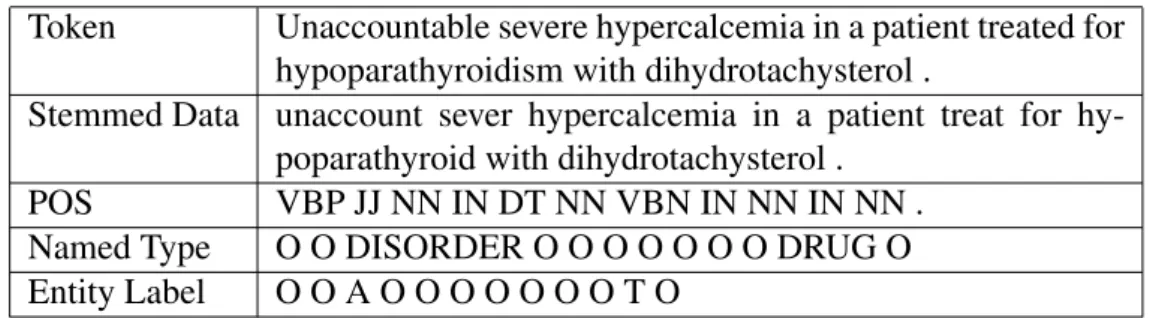
• Parts of the system architecture, including the processing of natural language (e.g. stemming, dependency parsing) have been developed in Roller and Steven-son [2013] to detecting genia events and are used, with slight modifications, throughout the thesis (in particular Chapter 3 and Chapter 4).
1.3
Thesis Overview
The remainder of this thesis is structured as follows:
Chapter 2 (Related Work and Background) describes related work on relation extrac-tion. The chapter starts with a brief overview of the history of relation extraction and reports different supervised methods in a biomedical context. Then the chapter presents related work in the context of distantly supervised relation extraction from in and outside the biomedical domain, followed by an overview of evaluation methods for distant supervision. Finally, a range of relevant resources are presented, including UMLS and MetaMap.
Chapter 3 (Bootstrapping Limited Training Data) explores relation extraction using a limited amount of manually labelled training data. In the context of adverse-drug
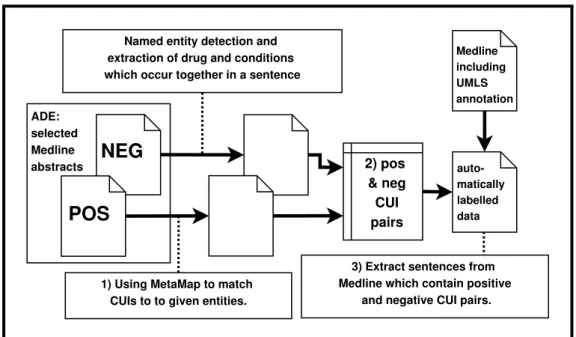
effects a small set of instances is used to train a supervised classifier. The chapter in-vestigates whether it is possible to improve classification results by using a large set of automatically labelled training instances. The new training data is generated from facts provided by the small set of manually labelled training instances.
Chapter 4 (Detecting relations from the UMLS Metathesaurus in Medline abstracts) introduces the relations from the UMLS Metathesaurus used in this thesis. It describes how distantly labelled data from sentences of PubMed abstracts is generated. It also describes a range of different filtering techniques that are applied in order to provide a good quality of distantly labelled data. Furthermore, the chapter presents distantly supervised classification results for a range of different UMLS Metathesaurus relations from two different vocabularies (NDF-RT and NCI). The results are evaluated using the held-out approach and a small gold standard of two different UMLS relations. The chapter supports the assumption that UMLS is a useful knowledge source for distantly supervised relation extraction.
Chapter 5 (Comparison of Evaluation Strategies for Distantly Supervised Relation Ex-traction) examines the efficiency using held-out evaluation for distantly supervised re-lation extraction in more detail. The question that is explored in this chapter is whether held-out is a useful method to evaluate distant supervision and what the results mean. To ensure reliable results distantly labelled data is manually re-annotated to generate a new gold standard. Then a classifier is trained and evaluated on the evaluation subset; once using the distant labels and once using the manual labels.
Chapter 6 (Reduction of Falsely Labelled Data) explores a technique to remove po-tential false negatives from the distantly labelled data to improve classification results. The proposed approach uses an inference learning method implemented in the path ranking algorithm (PRA) [Lao and Cohen, 2010; Lao et al., 2011]. Using the same set of relations from Chapter 4, this chapter shows that the proposed method significantly improves the classification results.
Chapter 7 (Conclusions) finishes this thesis with a summarisation and a conclusion. Moreover, the final chapter provides an overview of possible future directions for the
Chapter 2
Related Work and Background
This chapter presents literature and resources related to this thesis. First, an overview of different relation extraction approaches is provided, in particular supervised and distantly supervised relation extraction. Then, different techniques are presented to evaluate distant supervision. Finally, an overview about some relevant resources is provided.
2.1
Relation Extraction
Relation extraction is an important topic in natural language processing (NLP) [Zeng et al., 2015] and focuses on the detection of relationships between entities (concepts, things) from natural language. Given a sentence with some key entities, the task is to determine their relationship to each other. In the biomedical domain a relationship can be described, for instance, between a drug and its contraindicating effect, proteins which interact with each other or a disease and a drug which prevents it. Figure 2.1 shows an example of the relationPREVENT (PREV) taken from the Rosario & Hearst [Rosario and Hearst, 2004] data set. The sentence describes a prevention of swine enzootic pneumoniaby using avaccination.
Relation extraction can be defined in various ways and be addressed using dif-ferent methods. Relations can be extracted with information across documents [Yao et al., 2010], across sentence boarders [Roberts et al., 2008; Swampillai and Steven-son, 2011] or combined using co-reference resolution [Chowdhury and Zweigenbaum,
A field study was carried out to evaluate the effect of [vaccination] against [swine enzootic pneumonia] in different production systems. (PMID=11129801)
Figure 2.1: Example of the relationPREVENT
2013; Xu et al., 2008], a method that is able to detect pronouns of target entities. In some cases relation extraction includes the detection of entities beforehand (named en-tity recognition; also called NER) [Bj¨orne and Salakoski, 2013; Kang et al., 2014] and in some other cases those entities are already provided [Chowdhury and Lavelli, 2012; Liu et al., 2013; Rosario and Hearst, 2004]. This thesis focuses on the task of detecting relations between given entities in single sentences. NER can be a challenging task, in particular in the biomedical domain due to nomenclature, abbreviations and ambiguity [Kim et al., 2004; Zhu and Shen, 2012]. For this reason relation extraction is carried out by MetaMap (see Section 2.3.3), a widely used tool to annotate UMLS concepts to natural language [Simpson and Demner-Fushman, 2012].
According to Angeli et al. [2014] relation extraction can be divided into one of four approaches: supervised relation extraction [Bj¨orne and Salakoski, 2013; Gurulingappa et al., 2012a], distant supervision [Abad and Moschitti, 2014; Nunes and Schwabe, 2014; Yao et al., 2010], rule-based systems [Riloff, 1993; Soderland et al., 1995] and open information extraction [Banko et al., 2007; Wu and Weld, 2010], which ac-quires related information without prior knowledge and without training data. Another method that could be included in this list is minimal supervised learning1or bootstrap-ping (such as [Agichtein and Gravano, 2000; Batista et al., 2015; Brin, 1999; Riloff and Jones, 1999; Yangarber et al., 2000]) which uses a small set of given instances (examples of related information, called seeds), or patterns to acquire further exam-ples from a large corpus by applying an iterative process. While this approach does not require labelled training data it often suffers from low precision or semantic drift [Mintz et al., 2009]. However, grouping systems into one to those categories can be sometimes difficult; approaches might combine techniques across different categories. For this work supervised relation extraction and, in particular, distant supervision are
of interest with a focus on the biomedical domain.
2.1.1
Biomedical Supervised Relation Extraction
In the last decade machine learning techniques became very popular for relation ex-traction (such as [Culotta, 2004; Giuliano et al., 2006; Zelenko et al., 2003; Zhou et al., 2005]), in particular supervised learning. Supervised relation extraction is a method that requires training data, usually consisting of positive and negative training examples to traina classifier. There are different methods and techniques to address supervised relation extraction. In the biomedical domain various shared tasks have been developed for different relations and use cases. These challenges often provide a good overview about efficient approaches to solve different problems such as relation extraction. Some relevant competitions include the following:
• BioNLP Shared Task [Kim et al., 2011; N´edellec et al., 2013], including many sub-challenges such as Genia Event (GE) [Kim et al., 2013], Cancer genetics (CG) [Pyysalo et al., 2013] or Bacteria Biotopes (BB) [Bossy et al., 2013]
• Drug-Drug Interaction (DDI) challenge [Segura-Bedmar et al., 2011b, 2013]
• Chemical Disease Relation (CDR) task [Wei et al., 2015]
Some other challenges address a range of further problems related to clinical data, such as:
• i2b2 challenge [Uzuner et al., 2011]
• CLEF eHealth Evaluation Lab [Goeuriot et al., 2015]
Competitions such as BioNLP or DDI are more relevant for this work, since both aim at relation extraction from biomedical publications as in this work. A short overview about successful methods is now provided.
An analysis of the BioNLP GE task (the task with the most participants) shows, that the majority of the participating systems rely on machine learning methods to detect events and relations [Bj¨orne and Salakoski, 2013; Hakala et al., 2013; Li et al., 2013]. The two most successful systems EVEX [Hakala et al., 2013] and TEES [Bj¨orne and
Salakoski, 2013] rely on a support vector machine (SVM) [Joachims, 1999] with a large set of different features (e.g. token features, sentence features, dependency chains) [Bjorne et al., 2012]. Some other approaches in the challenge use rule-based methods [Bui et al., 2013; Tran et al., 2013]. The BioSEM system of Bui et al. [2013] for instance is ranked third and uses a rule-based approach by generating patterns for each event (e.g. binding, regulation).
The situation within the DDI 2013 challenge is similar. The best systems here (FBK-irst [Chowdhury and Lavelli, 2013a], WBI [Thomas et al., 2013] and UTurku [Bj¨orne et al., 2013]) also rely on machine learning methods using a SVM. The win-ning system, FBK-irst, combines a range of different kernel methods such as a feature based kernel [Chowdhury and Lavelli, 2013b], shallow linguistic (SL) kernel [Giu-liano et al., 2006] and path-enclosed tree (PET) kernel [Moschitti, 2004]. Moreover, the authors introduced a technique to reduce less informative candidate sentences in the training data.
Supervised machine learning techniques are very efficient to detect relations in nat-ural language, but require annotated data (positively and negatively labelled sentences) to train the classifier. Machine learning methods tend to provide better classification results the more training data is available (see e.g. [Banko and Brill, 2001; Brants et al., 2007]). Unfortunately data is not always available for all different tasks. Moreover, the generation of an annotated data set for training can be time consuming [Kim et al., 2008] and expensive [Angeli et al., 2014]. In particular in the biomedical domain often expert knowledge is required to annotate medical data (such as in [Kim et al., 2008; van Mulligen et al., 2012]). For this reason, distantly supervised relation extraction has become a popular alternative to supervised learning and is introduced in the following subsection.
2.1.2
Distant Supervision
Distant supervision (also known as self-supervision or weak supervision)2 is a widely applied technique for training relation extraction systems [Krause et al., 2012; Nunes
2Depending on the literature there might be different names for the same method, but also various
interpretations of the different terms. However, in this work the three terms (distant supervision, self-supervised learningandweak supervision) are considered to be equivalent according to Riedel et al. [2010].
and Schwabe, 2014; Ritter et al., 2013; Roth and Klakow, 2013; Vlachos and Clark, 2014] that avoids the need for annotated training data. In particular in the last 5-7 year the technique gained popularity. According to Mintz et al. [2009] distant supervision is defined as follows:
“The distant supervision assumption is that if two entities participate in a relation, any sentence that contain those two entities might express that relation.”.
Hence, training examples are annotated automatically using known facts (usually from a knowledge base, for example [Ellendorff et al., 2014; Pershina et al., 2014; Poon et al., 2015]). These facts are matched against text and used as training examples. For example, a knowledge base may assert that the entity pair (“hair loss”,“paroxetine”) is an instance of the relationshipadverse-drug effect. Distant supervision approaches normally assume that sentences containing both entities assert the relation between them and, consequently, the sentence in Figure 2.2 would be used as a positive exam-ple of theadverse-drug effectrelation.
Findings on discontinuation and rechallenge supported the assumption that the hair loss was a side effect of the
paroxetine. (PMID=10442258)
Figure 2.2: Correctly labelled sentence using distant supervision.
However, this assumption does not always hold which can lead to sentences con-taining entity pairs being mistakenly identified as asserting a particular relation be-tween them. For example, the sentence in Figure 2.3 contains the same entity pair but does not assert theadverse-drug effectrelation.
There are a few case reports on hair loss associated with tricyclic antidepressants and serotonin selective reuptake inhibitors (SSRIs), but none deal specifically with paroxetine. (PMID=10442258)
Distantly supervised relation extraction normally requires positive and negative training examples. Negative data can be generated in different ways. Ling et al. [2013] for instance produce negative data for the relation has-part in a controlled way. Ex-amples are generated by reverse pairs (ife1 has-parte2, then e2 NOT-has-parte1) and
transitive characteristics of existing negative instances. Nonetheless, this technique cannot be applied for all target relations. Thomas et al. [2011] focus on protein-protein interactions and use Negatome [Smialowski et al., 2010] to generate negative data, a knowledge base that contains protein pairs which are known to not interact with each other. Nevertheless, in most of the cases knowledge bases do not contain negative relations. For this reason negative data is often generated following a closed world assumption (such as Nguyen and Moschitti [2011a]; Takamatsu et al. [2012]). If an entity pair is not known as instance of a relation, the entity pair is considered to be negative. Those negative entity pairs can be generated by creating new combinations between existing entities of a relation. However knowledge bases are often incomplete, thus this process might lead to false negative training data.
Data annotated using distant supervision is noisy and unlikely to be of as high qual-ity as manually labelled data (see e.g. analysis in [Riedel et al., 2010]). Despite this, distantly supervised relation extraction provides reasonable results compared to those based on supervised learning (see e.g. in [Thomas et al., 2011]). Furthermore, dis-tant supervision has the advantage that large amounts of training data can be generated without the need for manual annotation.
In context of distant supervision, many approaches exist with similar techniques but use a different terminology. Contrarily, some of those terms are also used in a dif-ferent context. To provide a clear definition, in this thesis distantly supervised relation extraction is defined as follows:
1. Training data is labelled according to prior knowledge (knowledge base, seeds). 2. The distantly labelled data is used as input to train a machine learning classifier. 3. Training data is generated only once; that means, no iterative process is involved to gather more data (such as usually used in bootstrapping approaches). In other words, no iterative process is used to increase training data in order to iteratively increase the amount of distantly labelled data.
Introducing History of Distant Supervision
The term ‘distant supervision’ was introduced by Mintz et al. [2009] in the context of relation extraction. The authors use Freebase [Bollacker et al., 2008], a large semantic knowledge base, and label sentences of Wikipedia for training. However, Craven and Kumlien [1999], Wu and Weld [2007] and Bunescu and Mooney [2007] are considered as the first approaches applying distant supervision.
Craven and Kumlien3 introduced the technique of distantly labelling data using prior knowledge. The authors used the Yeast Protein Database (YPD) [Hodges et al., 1998] to label training data from Medline abstracts (see Section 2.3.1) for subcellar-localisation relations. Their relation extraction approach uses bag-of-word features with a Naive-Bayes classifier.
Some years later Wu and Weld [2007] and Bunescu and Mooney [2007] introduced a technique using a set of positive and negative seed instances to generate training ex-amples from a web corpus. The approaches have similarities to bootstrapping methods, without the need of an iterative knowledge acquisition, but with techniques from ma-chine learning. Wu and Weld apply a technique where info-boxes of Wikipedia are used to label training data from Wikipedia articles. Classifiers are trained using a con-ditional random field (CRF).
The interesting aspect of the work of Bunescu and Mooney is the introduction of multi-instance learning (MIL) into the use case of noisy labels. MIL is a tech-nique which deals with incomplete knowledge about labels of training data. The ap-proach was originally introduced by Dietterich et al. [1997] in context of detecting drug molecules which bind to a target protein. While some known molecules bind very well to proteins, other known ones do not bind well. Proteins may have different shapes but it is not clear which shapes make the molecule bind well. The authors pro-pose a technique to detect useful shapes of binding molecules, in which each molecule is modelled as ‘bag’ containing its different shapes. A bag with different shapes of a molecule that is known to bind well is labelled as positive bag. Conversely, a bag with the different shapes of a molecule known to bind not well is labelled as negative. The paper shows that the new method outperforms other approaches which do not take this
3Note, the authors use the terminology ‘weak supervision’, but according to different publications
(e.g. [Riedel et al., 2010; Surdeanu et al., 2012]) the work is considered as the first approach using distant supervision.
multi-instance characteristic into account [Dietterich et al., 1997].
Distantly labelled training data has a similar characteristic. Known facts provide information about which pair of entities express a target relation. Conversely, it is not known which sentences explicitly express the relation and which not. Hence, sen-tences containing a positive entity pair can be considered as a bag of examples with an unknown number of sentences expressing the target relation. Bunescu and Mooney use an extended relation extraction approach using a SVM to handle MIL in context of corporate acquisitions and person-birthplace relations. Multi-instance learning became a very popular and successful technique for distant supervision (such as in [Liu et al., 2014b; Ritter et al., 2013; Surdeanu et al., 2012]).
Riedel et al. [2010] improve multi-instance learning. Authors such as Craven and Kumlien or Mintz et al. model the distantly supervised problem as single-instance single-label supervised learning [Surdeanu et al., 2012]. However, Riedel et al. intro-duced a novel graphical model that assumes that at least one sentence expresses the target relation, if a (multi-instance) bag is labelled as positive. The model is able to predict relations between entities, but also sentences which express the relations. This setup is different to the previous approaches using distant supervision. Hoffmann et al. [2011] extends the models of Riedel et al. to a multi-instance multi-label problem, by taking into account that entity pairs can occur in different relations at once (over-lapping relations) (e.g. a person might be the CEO and the founder of a company). The system developed is called MultiR and is publicly available4, easily adjustable for different knowledge bases and used for the experiments in this thesis (see Section 4.5). A range of different publications focussed on further improvements of the MIL method (such as [Ling et al., 2013; Min et al., 2013; Ritter et al., 2013; Surdeanu et al., 2012]). However, other machine learning methods have been used in context of distant supervision, such as multi-class logistic regression classifier [Augenstein et al., 2014; Mintz et al., 2009], SVM (Bobic et al. [2012]; Nguyen and Moschitti [2011a]) or Neural Networks ([Zeng et al., 2015]) for instance.
An overview of distantly supervised relation extraction from out and inside the biomedical domain is now provided. Finally, some mixture models (supervised and distantly supervised) are presented.
Non-Biomedical Distant Supervision
Distant supervision was introduced in biomedical context [Craven and Kumlien, 1999]. Nonetheless, the technique first found popularity outside of the biomedical domain (see e.g. Bunescu and Mooney [2007]; Mintz et al. [2009]; Wu and Weld [2007]). Mintz et al. introduced the use of Freebase, which became a very popular use case for many different approaches working with distantly supervised relation extraction (such as [Abad and Moschitti, 2014; Min et al., 2013; Takamatsu et al., 2012; Yao et al., 2010; Zhang et al., 2013]). Some other approaches use Wikipedia’s info-boxes (such as [Hoffmann et al., 2010; Wu and Weld, 2007]), YAGO [Suchanek et al., 2007], a knowledge base derived from WordNet and Wikipedia (such as Nguyen and Moschitti [2011a]) or DBPedia [Auer et al., 2007] (such as Aprosio et al. [2013]).
Within the last few years many approaches focussed on further improvements on distant supervision in the non-biomedical domain. A large range of methods aim at the reduction of noise (such as Intxaurrondo et al. [2013]; Nguyen and Moschitti [2011a]; Ritter et al. [2013]; Roth et al. [2013]; Takamatsu et al. [2012] for instance) or the reduction of false negatives (such as [Min et al., 2013; Xu et al., 2013] for instance). Takamatsu et al. [2012] for example work on the reduction of incorrect annotations or Xu et al. [2013] face the problem of knowledge base gaps. Some other approaches focus directly on the noise in the data: Intxaurrondo et al. [2013] use a range of heuris-tics to remove noise in the distantly labelled data and Augenstein et al. [2014] apply techniques to detect highly ambiguous entity pairs and discard them from their labelled training set.
Biomedical Distant Supervision
In recent years there has been also an increasing interest on distant supervision in the biomedical domain. Rather than focussing mainly on one source (such as Freebase) a wide range of different knowledge sources have been explored. This might be con-nected to the fact that Freebase contains a large amount of information from outside of the biomedical domain. On the other hand, there is a large range of different biomedi-cal topics and domains that are spread across different knowledge bases.
Craven and Kumlien [1999] introduced the idea of distantly supervised relation ex-traction using YPD (Yeast Protein Database). For many years the technique did not
attract any attention in the life sciences. Thomas et al. [2011] started using distant su-pervision in context of protein-protein interactions (PPI) using IntAct and Negatome. Bobic et al. [2012] extended the approach of Thomas et al. by exchanging the knowl-edge base to Kansas Proteomics Service (KUPS) database [Chen et al., 2011], which unifies several PPI knowledge sources. Furthermore, the authors use the database DrugBank [Knox et al., 2011] to detect drug-drug interactions as well. Ravikumar et al. [2011] proposed a method to find protein-residue associations using the Protein Data Bank (PDB) [Berman et al., 2000], Ling et al. [2013] detect meronyms (such as has-part), Ellendorff et al. [2014] use the Comparative Toxicogenomics Database (CTD) [Davis et al., 2009] to detect interactions between genes and chemicals and Poon et al. [2015] the Pathway Interaction Database (PID) [Schaefer et al., 2009] for the extraction of cancer pathway. As the overview shows, there is a wide range of different biomedical knowledge bases and, therefore, distant supervision can be used for different biological and medical fields.
Various approaches have used UMLS (see Section 2.3.2 for more information), as a knowledge source. Nikolova and Angelova [2011] applied distant supervision tois a relations of the UMLS Metathesaurus, as well as the relationaffectof the UMLS Se-mantic Network. Liu et al. [2014b] detect genes in brain regions (location-of) from literature using the UMLS Semantic Network. Finally, the work of Tymoshenko et al. [2012] focussed on a method to mine relations of the National Drug File Repository Thesaurus (NDF-RT or NDFRT) a subset of UMLS Metathesaurus. Their technique relies on entity-level semantics and uses hierarchical information of UMLS to extract relation from text. As comparison to their proposed technique, the authors present a distantly supervised model using some relations of NDF-RT. However, their main fo-cus is entity-level semantics with UMLS taxonomy and (Wikipedia) link features and not distant supervision. Furthermore, their setup for the distantly supervised classifier appears to be unrealistic with a bias5 1:1. Usually the amount of positive and nega-tive instances are highly unbalanced towards neganega-tive data which makes classification much more challenging.
Many different knowledge bases have been tested and used for distant supervision. The UMLS Metathesaurus is a large medical knowledge base which has been used for many different NLP tasks. However, the Metathesaurus has not been examined in
detail whether it is a useful source for distantly supervised relation extraction. This issue will be explored in this thesis.
2.1.3
Mixed Classification Models
Supervised relation extraction often provides reliable results but requires a sufficient amount of manually labelled training data. Unfortunately, a sufficient number of this data is not always available and its generation can be time consuming and expensive. Conversely, distantly supervised relation extraction is able to produce large amount of data, but of a varying quality, thereby reducing the classification results. Some ap-proaches make use of both techniques using machine learning in order to achieve fur-ther improvements. Different terminologies are used for the combination of manually labelled and automatically labelled data. One frequently used term is semi-supervised learning, which addresses this task by ‘using large amount of unlabeled data, together with the labeled data, to build better classifiers’ [Zhu, 2006].
Nguyen and Moschitti [2011b], Pershina et al. [2014] and Angeli et al. [2014] focus on improving distant supervision by including manually labelled data. Nguyen and Moschitti [2011b] use a SVM and combine the supervised and the distantly supervised classifier with a linear combination. Pershina et al. [2014] and Angeli et al. [2014] integrate the manually labelled data directly within their distantly supervised multi-instance learning approach.
Kordjamshidi et al. [2015] instead focus on improving supervised learning by using distantly labelled data. The authors argue that: ‘The main issue of a fully supervised system is the difficulty to generalise towards unseen patterns. This problem is more apparent the sparser the data, and the richer the representation.’. Their technique is tested in biomedical context (Gene Regulation Network).
Chapter 3 presents the use of manually and distantly labelled data in order to im-prove classification results. In contrast to previous approaches, Chapter 3 explores the impact of distantly labelled data in combination with an increasing number of manu-ally labelled training instances. The presented approach is tested in context of adverse drug effects.
2.2
Evaluating Relation Extraction Systems
This section discusses how distant supervision can be evaluated. Usually distant su-pervision is applied when no annotated training data is available. However, this often means that also no data is available for the evaluation, which raises the issue of how such a system can be evaluated. Some previous approaches have made use of existing labelled data sets (with annotations similar to the related information in the knowl-edge base) to evaluate approaches based on distant supervision, such as Thomas et al. [2011] and Bobic et al. [2012]. Other approaches such as Craven and Kumlien [1999] generate their own gold standard to annotate relevant relations of their knowledge base. But the effort required to generate manually labelled evaluation data somewhat negates the benefit of distant supervision reducing development time. Unfortunately for many relations no annotated data set is available, thereby different evaluation techniques are required, apart from gold standard evaluation.
Figure 2.4: Held-Out Evaluation
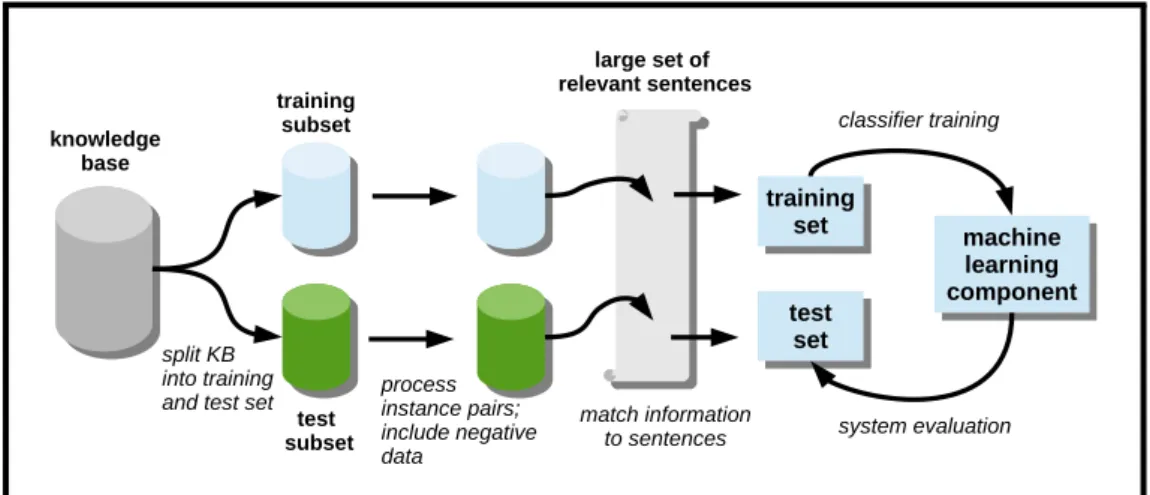
An alternative approach, which does not require any labelled data, is held-out (also sometimes called hold-out) evaluation. This approach splits facts from the knowledge base into two parts: one to generate distantly supervised training data and the other to generate distantly supervised evaluation data (such as in [Hoffmann et al., 2010; Mintz et al., 2009; Riedel et al., 2010]). Consequently the system is both, trained and evaluated on/with noisy data. Held-out evaluation usually means, that the system is evaluated against the knowledge base (Is it possible to detect the known facts of
held-out knowledge base?). Held-held-out evaluation is visualised in Figure 2.4.
This approach is often combined with a manual evaluation in which a subset of the predictions is selected to be examined in more detail. For example, Riedel et al. [2010] supplemented the held-out evaluation of their distant supervision approach for Freebase by selecting the top 1000 facts and evaluating them manually. Others such as Surdeanu et al. [2012] and Intxaurrondo et al. [2013] work with the same knowledge base and are able to re-use the manually labelled data generated by Riedel et al. [2010]. However, this data is only available for some Freebase relations and evaluation data has to be generated for each new relation. Approaches such as Takamatsu et al. [2012], Zhang et al. [2013] and Augenstein et al. [2014] combine a held-out evaluation with a manual evaluation of a randomly chosen subset or the top-k predictions. This technique is a more reliable evaluation method but requires more effort including (potentially) domain knowledge and needs to be repeated for each version of the classifier.
Held-out evaluation is also used in this work. Held-out evaluation using distantly labelled data is a simple and quick technique for estimating the accuracy of distantly supervised relation extraction systems. Nonetheless, this evaluation data is noisy and it is unclear what effect this has on the accuracy of performance estimates. Chapter 5 examines evaluation on held-out data in comparison to a manually labelled version of the same data, in order to examine its advantages and drawbacks.
2.2.1
Evaluation Levels
In this work two evaluation approaches will be used: sentence level evaluation and entity level evaluation. Sentence level evaluation means that an entity pair will be considered as correct if the two entities express the relation of interest in the sentence they occur. Each single prediction (each sentence with the given entity pair) will be examined and influences the evalution results. Sentence level evaluation can be useful to find documents and in particular sentences that express relevant information in large data sets.
Entity level evaluation instead, is evaluated based on the fact whether the extracted entity pair represents the target relation (evaluation against KB) or not. Predicted sen-tences are reduced to a set of entity pairs. A prediction is considered as correct if either a (known) related entity pair is predicted as positive in at least one of the sentences or
if an entity pair which is not known to be related, is never predicted as positive. In this context it is not necessarily important, how often an entity pair occurs within a set of given sentences. Correct and incorrect predictions dependent only on the overall prediction of an entity entity pair.
Findings on discontinuation and rechallenge supported the assumption that the hair loss was a side effect of the
paroxetine. (PMID=10442258)
Figure 2.5: Correctly predicted adverse drug effect between target entities.
There are a few case reports on hair loss associated with tricyclic antidepressants and serotonin selective reuptake inhibitors (SSRIs), but none deal specifically with paroxetine. (PMID=10442258)
Figure 2.6: Incorrectly predicted adverse drug effect between target entities. The given example in Figure 2.5 and Figure 2.6 exemplifies both evaluation levels, assuming a classifier predicts an adverse drug effect betweenhair lossandparoxetine in both sentences. On sentence level each prediction is examined and evaluated based on the information provided in the sentence. It means, that the classifier predicts the first sentences correct and the second one incorrect. The incorrect prediction reduces the quality of the classifier according the metrics presented in the following subsection. On entity level evaluation only one prediction is considered for the evaluation of the classifier (for the given example). Assuming thathair lossis a known adverse effect of paroxetine, at least once the entity pair (hair loss, paroxetine) has to be predicted as an adverse drug effect. If the entity pair is predicted at least once as positive, the prediction is counted as a true positive prediction, otherwise as false negative. The ‘false’ prediction of the second sentence does not matter on entity level evaluation since the context where the information occurs does not matter, only whether an positive (correct) entity pair can be detected as instance of the relation.
2.2.2
Evaluation Metrics
Precision, Recall and F1-Score (often just called F-Score or F1) are very common measures of performance for a classification task, such as relation extraction. The measures base on the correlation between ‘true’ labels and predicted labels presented in Table 2.1. In the following the different measures are explained in detail.
annotated (gold standard) labels positive negative predicted labels positive true-positives false-positives
negative false-negatives true-negatives Table 2.1: Confusion Matrix: Predicting instances
post is defined as the amount of positively predicted relations that are predicted correctly (true-positive) and posf the amount of positively predicted relations pre-dicted incorrectly (false positive). negtis the amount of negative predictions that are correctly predicted as negatives (true-negative) andnegf the amount of negative pre-dictions that are incorrectly predicted as negatives (false negative). ThenPrecision, RecallandF1-Scoreare defined in the following way:
Precision:
Precision defines the proportion of correctly predicted relations in comparison to all entity pairs predicted as positive.
P recision= post (post+posf)
Recall:
Recall defines the proportion of correctly predicted relations in comparison with all existing relations in the test set.
Recall = post (post+negf)
F1-Score:
The F1-Score is the harmonic mean between Precision and Recall. The F1-Score is the most frequently used F-Measure. However, variations of the F1-Score exist which emphasisePrecisionoverRecall(F0.5-Score) or vice versa (F2-Score). The F1-Score
is defined as follows:
F1 = 2∗ P recision∗Recall
(P recision+Recall)
Micro average F1-Score:
The Micro average F1-Score is a technique to deal with the prediction and evaluation of multiple classes at the same time. It takes under consideration that some classes involve instances with a higher frequency than other ones. Assuming for example a classification task with two classes (class A with 10,000 instances and class B with 100 instances) and a classifier which is able to predict class A with an F1-Score of 20 and class B with a F1-Score of 80. In the given example the low F1-Score of the class A has a stronger impact on the overall results (micro avg. F1) due to the fact that it contains more instances.
The Micro average F1-Score is calculated by using the harmonic mean of the Micro avg. Precision (MiPrecision) and the Micro avg. Recall. (MiRecall). MiPrecision and MiRecall are generated using the true-positives and false-positives of each different class (c∈C), whereaspostc defines the amount of true-positives of classcandposfc the amount of false-positives of classc:
M iP recision= P c∈Cpostc P c∈C(postc +posfc) M iRecall = P c∈Cpostc P c∈C(postc+negfc)
2.3
Resources
2.3.1
Medline repository
Medline is a large repository containing abstracts and links to complete publications from life science and biomedical domain. The data is made freely available on the In-ternet by the United States National Library of Medicine (NLM) and can be accessed and searched by the search engine PubMed6. Medline contains selected publications from generally 1946 to present7(with some older material) and is a permanently grow-ing data base. Every day approximately 2,000-4,0007completed references have been added since 2005. Currently Medline contains more than 22 million references7 of biomedical publications. Sentences extracted from Medline abstracts are used to con-duct the experiments in this work. Many examples given in this thesis are provided with a PMID (PubMed-ID), which can be used to find the abstract on PubMed the sentence was extracted from.
2.3.2
UMLS
The Unified Medical Language System8(UMLS) is a large biomedical knowledge base containing millions of medical terms and relations between them, and will be used to train distantly supervised classifiers in this work. Overall UMLS can be divided into three different parts: the Metathesaurus, the Semantic Network and the SPECIALIST Lexicon. The SPECIALIST Lexicon provides lexical information about medical terms, for instance it defines words as nouns or adjectives. For this work only the UMLS Metathesaurus and parts of the Semantic Network are relevant.
The Metathesaurus is the core of UMLS and unifies existing biomedical knowledge bases (vocabularies), such as the Gene Ontology (GO) or the National Drug File -Reference Terminology (NDFRT). Currently UMLS contains more than 120 different vocabularies. The vocabularies that include the largest number of medical concepts are SNOMED-CT, NCBI and MSH.
Medical concepts can be described in different ways with different spellings, dif-ferent abbreviations and also in difdif-ferent languages. UMLS unifies those variations us-ing the Concept Unique Identifier (CUI). The two most important parts of the UMLS
6https://www.ncbi.nlm.nih.gov/pubmed/
7http://www.nlm.nih.gov/pubs/factsheets/medline.html, date: 26th of
September 2015
Metathesaurus for this work are the subsets MRCONSO and MRREL. Both subsets can be seen as two large tables.
MRCONSO - UMLS Metathesaurus
MRCONSO contains concepts, concept names and their identifiers. It maps medical terms across the different vocabularies to a CUI. It contains information about differ-ent vocabularies and languages. For instance, the version used in this work9 contains six different entries in MRCONSO for the string (in lower case) ‘headache’ involv-ing two different CUIs (C0018681andC2096315) across five different vocabularies. Conversely, 268 MRCONSO entries are found for CUI=C0018681. These are defined within 51 different vocabularies across 17 different languages. For English alone it is possible to find 51 different strings such as ‘Headache’, ‘headache’, ‘Pain head’, ‘Cranial Pains’ or ‘cephalalgia’. An excerpt of MRCONSO for the CUIC0018681is given in Figure 2.2. In the example the most relevant information for this thesis are highlighted (CUI, source vocabulary and string).
MRREL - UMLS Metathesaurus
MRREL defines binary relations between medical concepts. Each relation instance is defined by a pair of CUIs. MRREL contains a range of different information for each entry. However, the most important information beside the two related CUIs are the relation label (REL), the relation attribute label (RELA) and the source abbreviation (SAB), which refers to its source vocabulary. REL can be assigned to one of 12 different labels (see Table 1 in Appendix 110) and defines a more general concept of a relation. The RELA labels are very useful for this thesis and provide a more detailed name for each relation, such as has tradename, associated morphology of orpart of. If an MRREL instance does not contain any RELA label it is not always apparent which relation is described between the two CUIs.
For CUIC0018681 (‘headache’) the MRREL table contains 2809 entries across 47 different vocabularies. The same CUI pair (relation) can be defined within different
9Version 2013AA.
10Data extracted from https://www.nlm.nih.gov/research/umls/
C0018681|ENG|P|L0018681|VO|S1640551|Y|A1601383|||10019211| MDR|LT|10019218| Headache NOS|3|N|1024| C0018681|ENG|S|L0277277|PF|S11844481|Y|A18684548|0000019413|0000005820|| CHV|SY|0000005820| ache head|0|N|1792| C0018681|ENG|S|L0277277|VW|S11895648|Y|A18628891|0000019419|0000005820|| CHV|SY|0000005820| head ache|0|N|1536| C0018681|ENG|S|L0290361|PF|S0475640|N|A2957274|41993017|25064002|| SNOMEDCT|SY|25064002| Cepha lal gia|9|N|3840| C0018681|ENG|S|L0306029|PF|S1688029|N|A18014038||N0000001418|| ND FRT|SY|N0000001418| Head Pain|0|N|1792| C0018681|ENG|S|L0306029|PF|S1688029|Y|A1648998||M0009824|D006261| MSH|EN|D006261| Head Pain|0|N|1792| C0018681|ENG|S|L0306029|VCW|S1916340|Y|A1860955|||| ICPC2P|PT|N01004| Pain;head|3|N|| C0018681|ENG|S|L0306029|VC|S6653130|N|A18573077|0000019420|0000005820|| CHV|SY|0000005820| head pain|0|N|1536| C0018681|ENG|S|L0306029|VO|S0982847|Y|A8364407|||784.0| MTHICD9|ET|784.0| Pain in head NOS|0|N|1536| C0018681|ENG|S|L1406212|PF|S1680378|N|A17990267||N0000001418|| ND FRT|SY|N0000001418| Cra nial Pain|0|N|1792| C0018681|ENG|S|L1406212|PF|S1680378|Y|A1641923||M0009824|D006261| MSH|EN|D006261| Cra nial Pain|0|N|1792| C0018681|ENG|S|L1406212|VW|S1680380|Y|A1641925||M0009824|D006261| MSH|PM|D006261| Pain, Cra nial|0|N|1792| C0018681|ENG|S|L7659919|PF|S8880524|Y|A18037960||N0000001418|| ND FRT|FN|N0000001418| Headache [Dis ease/ Find ing]|0|N|1536| T able 2.2: Excerpt of MRCONSO 1) C0000052|A0016535|SDUI| SIB| C0017915|A0064131|SDUI| |R71296977|| MSH|MSH|||N|| 2) C0000163|A0016691|SDUI| CHD| C0020268|A0070119|SDUI| |R71355474|| MSH|MSH|||N|| 3) C0000039|A0016515|SDUI| AQ| C0005768|A3879709|SDUI| |R120502291|| MSH|MSH|||N|| 4) C0000618|A17996759|AUI| RO| C1177390|A18008188|AUI| has active metabolites|R115950896|| ND FRT|NDFRT|||N|| 5) C0000039|A0016514|AUI| SY| C0000039|A1317707|AUI| per muted term of|R28482431|| MSH|MSH|||N|| 6) C0032951|A20635134|SCUI| RN| C1382748|A10666793|SCUI| isa|R130186526|| RXNORM|RXNORM|||N|| 7) C1382748|A10666793|SCUI| RB| C0032951|A20635134|SCUI| in verse isa|R130162179|| RXNORM|RXNORM|||N|| T able 2.3: Excerpt of MRREL
vocabularies, which means that only 1046 of those CUI pairs are unique. Moreover, a large amount of CUI pairs do not assign a RELA label. However, CUI C0018681 occurs within 28 different relations (with RELA labels), includingisa,may-treat, has-expanded-form,inducesordisease-may-have-finding.
Figure 2.3 presents some example instances of MRREL. Slot 1 and Slot 5 con-tain the related CUI pair, Slot 4 the REL label, Slot 8 RELA label and Slot 11 SAB (mentioned positions are highlighted). Example 1) contains a sibling (SIB) relation be-tween the the CUIs (C0000052, C0017915) (‘1,4-alpha-Glucan Branching Enzyme’, ‘Transfer-Glucosidase’). The instance does not specify a value in the field RELA and it is defined within the source vocabulary MSH (Medical Subject Headings; MeSH). Ex-ample 2) presents a parent-child relation between two CUIs (C0000163, C0017915) (‘17-Hydroxycorticosteroids’, ‘Hydrocortisone’). Example 3) defines a vaguely de-fined relation (C0000039, C0005768) (‘1,2-Dipalmitoyl-Glycerophosphocholine’, ‘blood’). The instance does not contain any RELA label which specifies the relationship in more detail. Moreover, the label REL is defined as AQ (allowed qualifier), which is very general and possibly not useful for distant supervision. Example 4) instead contains a relation of NDFRT and is defined ashas active metabolites(C0000618, C1177390) (‘6-Thiohypoxanthine’, ‘Azathioprine 75 MG Oral Tablet’).
Usually relations are directed and defined in both directions (see Table 2.3, Ex-ample 6) and ExEx-ample 7)): For exEx-ample MRREL contains the relation disease-may-have-finding for the CUI-pair (C0018681,C0025149) (‘Headache’, ‘Glioblastoma’). Thus, MRREL contains also the reverse CUI-pair (C0025149, C0018681) for the rela-tionmay-be-finding-of-disease. To reduce redundancy reverse relations of UMLS are ignored for this work.
Semantic Network
The Semantic Network assigns semantic types (STY) to each medical concept and defines semantic relations between the different semantic types. CUI C0018681 for instance, refers to the semantic type ‘Sign or Symptom’, whereas ‘Sign or Symptom’ can be involved in 68 different relations of the Semantic Network, such as isa(‘Sign or Symptom’, ‘Finding’), diagnoses(‘Sign or Symptom’, ‘Injury or Poisoning’) and treats(‘Drug Delivery Device’, ‘Sign or Symptom’). Relations in the Semantic
Net-work are more general than those in the UMLS Metathesaurus. Obviously, not every CUI that is assigned to ‘Drug Delivery Device’ can treat a headache.
2.3.3
MetaMap
MetaMap [Aronson and Lang, 2010] is a system to map UMLS concepts to text doc-uments and can be used to carry out a named entity recognition. In order to generate distantly labelled data in this work, sentences containing medical concepts related in UMLS have to be selected for further processing. However, UMLS defines relations as CUI pairs. For this reason it is essential to ‘annotate’ (map) UMLS-CUIs in text, such as medical abstracts from the Medline repository. These annotations are provided by MetaMap.
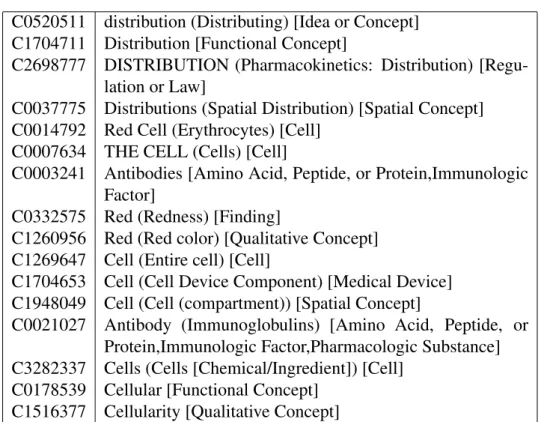
In order to map CUIs to sentences of the medical domain, MetaMap applies a range of different lexical and syntactic processing steps [Aronson and Lang, 2010]. First, MetaMap runs a tokenisation, sentence boundary detection and acronym/abbreviation identification, followed by a part-of-speech tagging. Next, it applies a lexical lookup of input words using the UMLS SPECIALIST Lexicon. Finally, phrases and their syn-tactic heads are identified using a shallow parse. Each phrase is then further examined in the following way: First, variants of the phrase words are generated (normally us-ing a lookup table), succeeded by an identification of possible UMLS Metathesaurus concepts mapping to words in the phrase. This resulting list of candidates are mea-sured based on how well the input string is matched. In a next step different mappings (combinations) of MetaMap candidates of the given phrase are generated. Finally, a Word Sense Disambiguation (WSD) can be applied in order to find its favoured map-ping of Metathesaurus concepts. MetaMap is highly configurable which influences the candidate mapping, the selection of the most appropriate concepts and also the output. An MetaMap example of the sentence ‘AIMS : To study the distribution of clinically important red cell antibodies in pregnancy, and the associated fetal and neonatal mor-bidity and mortality.’ (PMID=9536844) is provided in the following. Figure 2.7 shows how MetaMap segments the sentence into different phrases (phrases are separated by ‘—’). Next, MetaMap searches for possible CUIs for each phrase. Table 2.4 depicts the list of CUI candidates for the fifth phrase ‘the distribution of clinically important red cell antibodies’. Figure 2.8 presents the final UMLS-CUIs mapping according to
the highest ranked mapping results.
AIMS | : | To | study | the distribution of clinically important red cell antibodies | in pregnancy, | and |
the associated fetal | and | neonatal morbidity | and |
mortality.
Figure 2.7: MetaMap-segmented sentence
C0520511 distribution (Distributing) [Idea or Concept] C1704711 Distribution [Functional Concept]
C2698777 DISTRIBUTION (Pharmacokinetics: Distribution) [Regu-lation or Law]
C0037775 Distributions (Spatial Distribution) [Spatial Concept] C0014792 Red Cell (Erythrocytes) [Cell]
C0007634 THE CELL (Cells) [Cell]
C0003241 Antibodies [Amino Acid, Peptide, or Protein,Immunologic Factor]
C0332575 Red (Redness) [Finding]
C1260956 Red (Red color) [Qualitative Concept] C1269647 Cell (Entire cell) [Cell]
C1704653 Cell (Cell Device Component) [Medical Device] C1948049 Cell (Cell (compartment)) [Spatial Concept]
C0021027 Antibody (Immunoglobulins) [Amino Acid, Peptide, or Protein,Immunologic Factor,Pharmacologic Substance] C3282337 Cells (Cells [Chemical/Ingredient]) [Cell]
C0178539 Cellular [Functional Concept] C1516377 Cellularity [Qualitative Concept]
Table 2.4: CUI candidate list (including semantic types) provided by MetaMap
According to Aronson and Lang [2010] one of the weaknesses of MetaMap is its focus on English text. Another drawback of the system is its slow processing time (not appropriate for real-time use) and its reduced accuracy in context of ambiguous concepts. In the example in Figure 2.8, CUI C0332575 connected to the colour red refers to the semantic type ‘Finding’ and has the following definition: ‘Coloration of the skin; sign of inflammation’. This does not seem to be appropriate for the given
[C1947946:AIMS]: To [C0008976:study] the [C0520511: distri-bution] of clinically important [C0332575:red] [C0007634:cell] [C0003241:antibodies] in [C0032961:pregnancy], and the
[C0332281:associated] [C0015965:fetal] and [C1552240:neonatal] [C0026538:morbidity] and [C0026565:mortality].
Figure 2.8: MetaMap annotation of UMLS-CUIs
context. Moreover, Oellrich et al. [2015] shows that tools such as the NCBO Anno-tator [Jonquet et al., 2009] and the clinical Text Analysis and Knowledge Extraction System (cTakes) [Savova et al., 2010] often provide better results (in terms of F-Score) compared to MetaMap.
However, MetaMap has been used for this thesis due to a range of positive aspects. First, MetaMap is freely available11, widely used [Simpson and Demner-Fushman, 2012] and a popular tool to annotate UMLS concepts to natural language (used e.g. by Hanauer et al. [2014]; Liu et al. [2014a]; Preiss et al. [2015]). In this work one million Medline abstracts are used