IMT School for Advanced Studies Lucca
Lucca, Italy
Mixed-Integer Quadratic Programming
Algorithms for Embedded Control and
Estimation
PhD Program in Control Systems
XXX Cycle
By
Vihangkumar Vinaykumar Naik
2018
The dissertation of Vihangkumar Vinaykumar Naik is
approved.
Program Coordinator: Prof. Alberto Bemporad, IMT School for Advanced Studies Lucca, Italy
Supervisor: Prof. Alberto Bemporad,
IMT School for Advanced Studies Lucca, Italy
The dissertation of Vihangkumar Vinaykumar Naik has been reviewed by:
Assoc. Prof. Michal Kvasnica,
Slovak University of Technology in Bratislava, Slovakia
Assoc. Prof. Daniel Axehill, Link ¨oping University, Sweden
IMT School for Advanced Studies Lucca
2018
To my family,
Contents
List of Figures xi
List of Tables xiv
Acknowledgements xvi
Vita xviii
Publications xix
Abstract xxi
1 Introduction 1
1.1 Mixed-Integer Quadratic Programming . . . 2
1.2 Mixed-Integer Programming for Control of Hybrid Dy-namical Systems . . . 4
1.2.1 Mixed Logical Dynamical Systems . . . 5
1.2.2 Hybrid Model Predictive Control . . . 5
1.3 Mixed-Integer Programming for Estimation . . . 7
1.4 MIQP problem solving techniques . . . 9
1.4.1 Optimal solution methods for MIQP . . . 11
1.4.2 Suboptimal solution methods for MIQP . . . 12
1.5 Branch and Bound Method . . . 12
1.5.1 Branching . . . 13
1.5.2 Tree exploration/Node selection . . . 14
1.6 Notation . . . 18
1.7 Contributions and thesis outline . . . 18
2 Embedded Mixed-Integer Quadratic Optimization using Accel-erated Dual Gradient Projection 23 2.1 Introduction . . . 23
2.1.1 Motivation . . . 24
2.1.2 Contributions . . . 24
2.1.3 Outline . . . 25
2.2 Accelerated dual gradient projection . . . 26
2.2.1 Stopping criteria . . . 28
2.2.2 Preconditioning . . . 28
2.2.3 Restart . . . 28
2.2.4 Infeasibility detection . . . 29
2.2.5 Early stopping criterion for the objective function . 30 2.3 Branch and Bound MIQP Algorithm . . . 31
2.3.1 Exploiting the fixed structure of dual QP relaxations 32 2.3.2 Warm-starting the QP subproblems . . . 33
2.4 Heuristic methods for suboptimal binary-feasible MIQP solutions . . . 34
2.4.1 Heuristic approach without using B&B . . . 35
2.4.2 Mid-way Heuristic approach . . . 36
2.5 ADMM based MIQP solver . . . 37
2.5.1 OSQP-based MIQP solver . . . 40
2.6 Numerical results . . . 42
2.6.1 Heuristic approach-Hybrid vehicle example . . . . 42
2.6.2 Branch and Bound-random MIQPs . . . 44
2.6.3 Branch and Bound-PieceWise Affine (PWA) regres-sion . . . 47
2.6.4 Mid-way heuristic approach-random MIQPs . . . . 48
2.6.5 ARX model segmentation - Heuristic, Mid-way heuristic approach . . . 48
3 A Numerically Robust Mixed-Integer Quadratic Programming
Solver based on Nonnegative Least Squares 58
3.1 Introduction . . . 58 3.1.1 Motivation . . . 59 3.1.2 Contributions . . . 60 3.1.3 Outline . . . 60 3.2 Problem formulation . . . 61 3.3 Solution of QP relaxations . . . 62
3.3.1 Outer proximal-point iterations . . . 63
3.3.2 Inner active-set solver . . . 63
3.3.3 Warm-starting . . . 66
3.3.4 Parameter selection and scaling . . . 67
3.3.5 Stopping criteria and optimality . . . 68
3.4 MIQP solver . . . 68
3.5 Warm-starting binary variables . . . 70
3.5.1 Using mid-way approach to warm-start binary variables . . . 75
3.6 Numerical results . . . 77
3.6.1 Hybrid MPC problem . . . 77
3.7 Conclusions . . . 77
4 Regularized moving-horizon PWA regression using mixed-integer quadratic programming 79 4.1 Introduction . . . 79
4.1.1 Motivation . . . 80
4.1.2 Contribution . . . 81
4.1.3 Outline . . . 82
4.2 Problem Formulation . . . 82
4.3 PWA Regression Algorithm . . . 83
4.3.1 Recursive clustering and parameter estimation . . . 84
4.3.2 Construction of the state partition . . . 91
4.3.3 Regularized Moving-Horizon PWA Regression for LPV System Identification . . . 93
4.4 Simulation Examples . . . 94
4.4.2 Identification of MIMO PWARX system . . . 96
4.4.3 Identification of SISO LPV system . . . 97
4.5 Conclusion . . . 100
5 Energy Disaggregation using Embedded Binary Quadratic Pro-gramming 101 5.1 Introduction . . . 101 5.1.1 Motivation . . . 102 5.1.2 Contribution . . . 104 5.1.3 Outline . . . 105 5.2 Problem setting . . . 105
5.2.1 Single appliance modelling . . . 105
5.2.2 Energy disaggregation problem . . . 106
5.3 Disaggregation Algorithms . . . 107
5.3.1 ApproachA1: Binary Quadratic Programming . . . 107
5.3.2 ApproachA2: Regularized Binary Quadratic Pro-gramming . . . 108
5.3.3 Approach A3: Binary Quadratic Programming with S-AR models . . . 109
5.4 Solving BQP problems using GPAD-based Branch and Bound . . . 110
5.4.1 Solving relaxed QP problems . . . 112
5.4.2 Branch and Bound for BQP problems . . . 115
5.5 Experimental case study . . . 118
5.5.1 Performance Evaluation measures . . . 119
5.5.2 Numerical Results . . . 120
5.6 Conclusion . . . 124
6 Conclusions and outlook 129 6.1 Conclusions . . . 129
6.2 Outlook of possible future directions . . . 131
A Proof of Theorem1 133
List of Figures
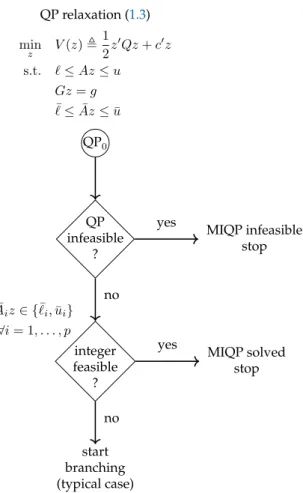
1 Typical flow of solving QP relaxation of MIQP problem at the root node. . . 14
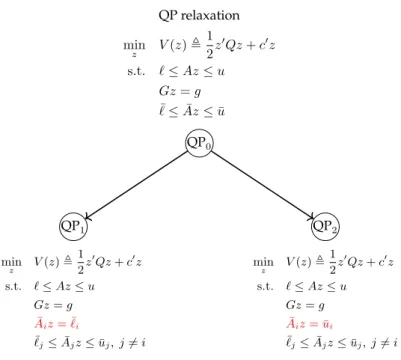
2 Branching operation at the root node. . . 15
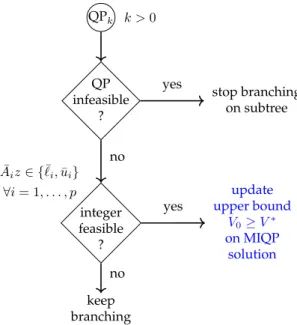
3 Upon solving the relaxed QP subproblem (other than root-node), checking for infeasibility and integer feasibility re-spectively. . . 17
4 Additional bounding criteria when (finite) upper bound on cost is available. . . 17
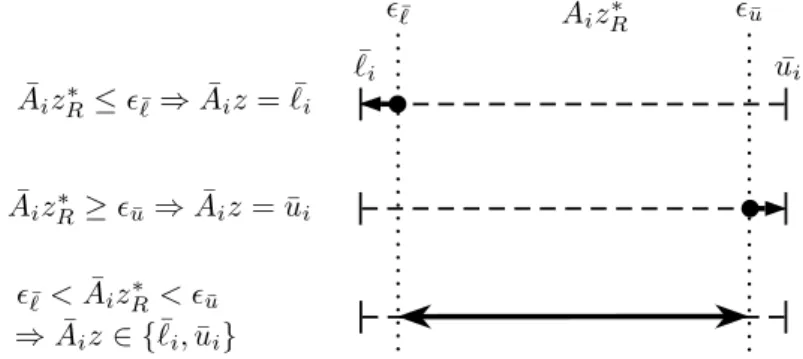
5 Conditions for the binary variablesA¯izR∗ w.r.t`¯andu¯for
i = 1, . . . , p. Only`¯ < A¯iz∗R < u¯ are considered to be
solved with B&B, while the others are set to equality as shown. . . 36
6 Battery energy, battery power, engine power and engine on/off signals versus time: GUROBI (solid blue line),
miqpGPAD-H (dash-dotted red line), and miqpADMM-H
(dashed black line). . . 44
7 Number of binary variables and error plots for MIQP problems with 60 vars, 60 ineq. constraints, 8 equality con-straints, 50 binary constraints. . . 49
8 Number of binary variables and error plots for MIQP problems with 90 vars, 80 ineq. constraints, 8 equality con-straints, 70 binary constraints. . . 50
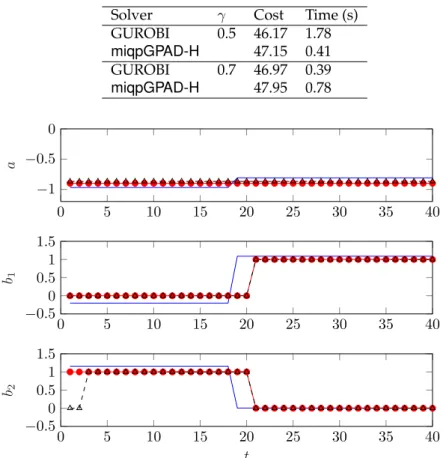
9 Performance comparison for ARX model segmentation problemiddemo6m.mat: true value, segment,
GUROBI. . . 54
10 Performance comparison for ARX model segmentation problem iddemo6m.matwith γ = 0.7 : true value,
segment, miqpGPAD-H. . . 55
11 Performance comparison for ARX model segmentation problemiddemo6m.matwithγ = 0.7, = 0.2: true value, segment, miqpGPAD-mH. . . 56
12 Illustration example with 3 binary variables and (1,0, ?) as a binary warm-start. The numbers indicate the order in which the QP relaxations are solved, dashed nodes corres-pond to QP subproblems that are ignored. . . 73
13 Illustration example with 3 binary variables and (0,0, ?) as a binary warm-start. The numbers denote the order in which the QP relaxations are solved, dashed nodes corres-pond to QP subproblems that are ignored. . . 74
14 Illustration example with 3 binary variables and z∗
H =
(0,0,1) as solution of heuristic approach, considered as a binary warm-start, the best know integer feasible solu-tion so far V0 is initialized as V0 ← VH∗, K`¯ = ∅, Ku¯ =
{3}, H={1,2}. The numbers denote the order in which the QP relaxations are solved, dashed nodes correspond to QP subproblems that are ignored. . . 76
15 BFR vsNp: nq = 1, nq = 2, nq = 3. . . 96
16 Validation results for identification of MIMO-PWARX sys-tem, Output channel-1. . . 97
17 Validation results for identification of MIMO-PWARX sys-tem, Output channel-2. . . 98
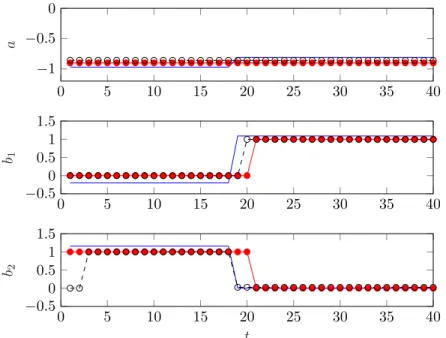
18 Trends of disaggregated cloth dryer power with Approach A2 for 2-modes (top panel), 3-modes (middle panel), and A3 (bottom panel), where estimated values are calculated usingbqpGPAD. . . 125
19 Trends of disaggregated fridge power with Approach A2 for 2-modes (top panel)), 3-modes (middle panel), and A3 (bottom panel), where estimated values are calculated us-ingbqpGPAD. . . 126
20 Trends of disaggregated dish washer power with Ap-proach A2 for 2-modes (top panel)), 3-modes (middle panel), and A3 (bottom panel), where estimated values are calculated usingbqpGPAD. . . 127
21 Trends of disaggregated heat pump power with Approach A2 for 2-modes (top panel)), 3-modes (middle panel), and A3 (bottom panel), where estimated values are calculated usingbqpGPAD. . . 128
List of Tables
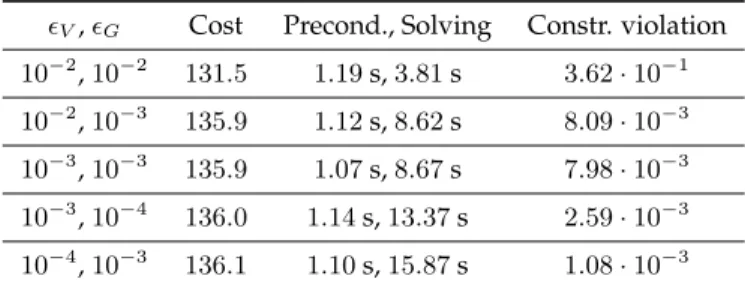
1 Performance comparison with different values of V, G
formiqpGPAD-H. . . 43
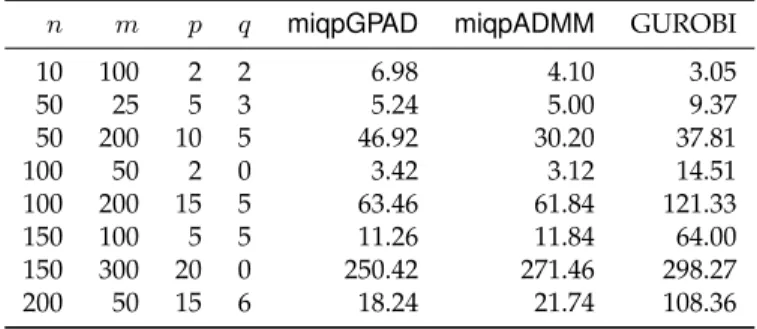
2 Average CPU time (ms) on random MIQP problems over 50 instances for each combination ofn,m,p,q. . . 45
3 Average CPU time (ms) on random MIQP problems over 50 instances for each combination ofn,m,p,q. . . 45
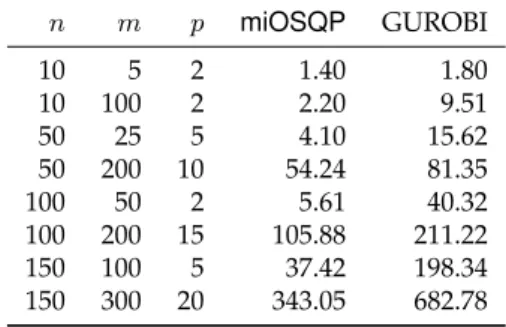
4 Average CPU time (ms) on random MIQP problems over 10 instances for each combination ofn,m,p. . . 46
5 Average CPU time for training sample N=1000. . . 48
6 Performance comparison for ARX model segmentation problem using heuristic approach without using B&B. . . . 54
7 Performance comparison for ARX model segmentation problem using the “mid-way” heuristic approach, repor-ted timings are for heuristic and B&B stages respectively. . 55
8 Hybrid MPC problem: CPU time (ms) per sampling step for different prediction horizonsN. . . 78
9 Best Fit Rate on the validation dataset for SISO PWARX system. . . 95
10 Best Fit Rates on the validation dataset for MIMO PWARX system (4.21). . . 98
11 Average CPU time for training samples N=1000. . . 99
13 Actual Energy Fraction Indices hi and Estimated Energy
Fraction Indicesˆhiobtained by ApproachA1andA2
us-ing2-mode models. . . 121
14 Actual Energy Fraction Indices hi and Estimated Energy
Fraction Indicesˆhiobtained by ApproachA1,A2, andA3
using3-mode models, LASSO approach is fromPiga et al. (2016). . . 121
15 RSEiandRi2coefficients obtained by ApproachA1andA2
using2-mode models. . . 123
16 RSEi and R2i coefficients obtained by Approach A1,
A2 and A3 using 3-mode models, LASSO approach is fromPiga et al.(2016). . . 123
17 Average and maximum CPU time (in milliseconds) taken to solve the disaggregation problem for a given window sizeT. . . 123
Acknowledgements
I would first like to express my sincere gratitude to my ad-visor, Prof. Alberto Bemporad, for giving me this opportun-ity to be a part of his research group. This thesis would not have been possible without his guidance, motivation and en-couragement. His passion for research, vast knowledge and research experience has been an inspiration to me and has helped me to grow personally and intellectually. I am in-debted to him for his constant support, keen interest in my work and for providing learning opportunities throughout. It is an honour and a privilege to work closely with him. I am also extremely grateful to Dr. Dario Piga for his help and guidance. I cannot thank him enough for his support. I am thankful to Prof. Panagiotis Patrinos for hosting me at KU Leuven. Working with him has been a great learning ex-perience and a true pleasure for me. I thank Andreas for host-ing me at his apartment in Leuven and for many brainstorm-ing discussions. I also thank Puya, Giovanna, Domagoj and Pantelis for a wonderful time in Leuven. I would like to thank Prof. Miroslav Fikar and Assoc. Prof. Michal Kvasnica for hosting me and giving me an opportunity to collaborate with Deepak at the Slovak University of Technology in Bratislava, Slovakia. I am grateful to Shrutika for the warm hospitality in Bratislava. I want to thank Bartolomeo for our interest-ing collaboration and a wonderful company durinterest-ing his visit to Lucca. I would like to thank the review committee mem-bers for taking out their time to review my thesis and for their constructive feedback.
Many thanks to my friends who became family members Manas, Soumali, Armando, Elena, Valentina, Anita, Vitaly,
Lucia, Paolo, Valerio C, Valerio G, Vigneswaran, Xu, Aless-andro, Mika, Vincenzo, Daria, Ajay, Ilkay, Davide, Yehia, Laurence, Emi, Marina, Arthur, Abhishek, Pakhee, Nilay, Niraj, Surya, Sampath, Laura, Rosaria, Mirko, Evgenia for such wonderful memories at IMT. I am grateful to Divyesh, Suchakra, Tanushri, Kalyani, Dr. Sonawane and Prof. Phadke for their encouragement and support.
Finally and most importantly, I would like to thank my grandparents Madhuben and Dolatrai for their blessings, my parents Urvashi and Vinay, my sister-in-law Kajal, my brother Jay and my nephew Dhyey for their constant love, care and encouragement, and for standing by me at all times.
Vita
Dec. 06, 1987 Born, Bilimora, India2005 – 2009 B.E. in Instrumentation & Control Final mark: First Class with Distinction
Sarvajanik College of Engineering & Technology Veer Narmad South Gujarat University
Surat, Gujarat, India
2010 – 2012 M. Tech in Instrumentation & Control (Process Instru.) Final mark: CGPA 8.94/10 1stRank
College of Engineering, Pune
University of Pune, Maharashtra, India
2012 – 2013 Assistant Project Engineer Virtual Lab Project
College of Engineering, Pune, Maharashtra, India
2013 – 2015 Engineer
Embedded Systems Center of Excellence Eaton Technologies Private Limited Pune, Maharashtra, India
2015 – 2018 PhD in Control Systems
IMT School for Advanced Studies Lucca, Italy
08/2017 – 10/2017 Visiting student
ESAT – Department of Electrical Engineering KU Leuven, Belgium
Publications
1. V. V. Naik, M. Mejari, D. Piga, and A. Bemporad. Energy disaggregation using embedded binary quadratic programming. Submitted for publica-tion, 2018.
2. V. V. Naik and A. Bemporad. Mixed-integer quadratic optimization based on accelerated dual gradient projection for embedded applications. Tech-nical report, 2018.
3. M. Mejari, V. V. Naik, D. Piga, and A. Bemporad. Energy disaggregation using piecewise affine regression and binary quadratic programming. In
Proc. 57th IEEE Conference on Decision and Control, Miami Beach, FL, USA, 2018a.
4. A. Bemporad and V. V. Naik. A numerically robust mixed-integer quadratic programming solver for embedded hybrid model predict-ive control. In Proc. 6th IFAC Conference on Nonlinear Model Pre-dictive Control, pages 412–417, Madison, Wisconsin, USA, 2018. DOI: 10.1016/j.ifacol.2018.11.068
5. B. Stellato, V. V. Naik, A. Bemporad, P. Goulart, and S. Boyd. Embed-ded mixed-integer quadratic optimization using the OSQP solver. In
Proc. European Control Conference, pages 1536–1541, Limassol, Cyprus, 2018.
DOI: 10.23919/ECC.2018.8550136
6. M. Mejari, V. V. Naik, D. Piga, and A. Bemporad. Regularized moving-horizon PWA regression for LPV system identification. InProc. 18th IFAC Symposium on System Identification, pages 1092–1097, Stockholm, Sweden, 2018b.DOI: 10.1016/j.ifacol.2018.09.048
7. V. V. Naik and A. Bemporad. Embedded mixed-integer quadratic op-timization using accelerated dual gradient projection. In Proc. 20th IFAC World Congress, pages 10723–10728, Toulouse, France, 2017. DOI: 10.1016/j.ifacol.2017.08.2235
8. V. V. Naik, M. Mejari, D. Piga, and A. Bemporad. Regularized moving-horizon piecewise affine regression using mixed-integer quadratic programming. In Proc. 25th Mediterranean Conference on Control and Automation, pages 1349–1354, Valletta, Malta, 2017. DOI: 10.1109/MED.2017.7984306
9. V. V. Naik, D. N. Sonawane, D. D. Ingole, and D. Ginoya. Model predictive control of DC servomotor using active set method. InProc. IEEE Interna-tional Conference on Control Applications, pages 820–825, Aug 2013b. DOI: 10.1109/CCA.2013.6662851
10. V. V. Naik, D. Sonawane, D. D. Ingole, D. L. Ginoya, and V. V. Patki. Design and implementation of proportional integral observer based linear model predictive controller.International Journal on Control System and Instrument-ation, 4(1):23–30, 2013a.https://tinyurl.com/ijcsi13-pio-mpc
11. D. D. Ingole, D. N. Sonawane, V. V. Naik, D. L. Ginoya, and V. V. Patki. Linear model predictive controller for closed-loop control of intravenous anesthesia with time delay. International Journal on Control System and In-strumentation, 4(1):8–15, 2013b.https://tinyurl.com/ijcsi13-bis-td
12. V. V. Naik, D. N. Sonawane, D. D. Ingole, D. L. Ginoya, and N. S. Girme. Design and implementation of interior-point method based linear mo-del predictive controller. InMobile Communication and Power Engineering, pages 255–261, Berlin, Heidelberg, 2013c. Springer Berlin Heidelberg.DOI: 10.1007/978-3-642-35864-7 36 (Best paper award)
13. D. D. Ingole, D. N. Sonawane, V. V. Naik, D. L. Ginoya, and V. Patki. Im-plementation of model predictive control for closed loop control of an-esthesia. InMobile Communication and Power Engineering, pages 242–248, Berlin, Heidelberg, 2013a. Springer Berlin HeidelbergDOI: 10.1007/978-3-642-35864-7 34
Presentations
14. V. V. Naik and A. Bemporad. Embedded mixed-integer quadratic optim-ization using first-order methods. InProc. 4th European Conference on Com-putational Optimization, Leuven, Belgium, 2016.
Abstract
The class of optimization problems involving both continu-ous and discrete variables is known as mixed-integer pro-gramming (MIP), which emerges in many fields of applic-ations. Due to their inherent combinatorial nature, solving such a class of problems in real-time poses a major challenge, especially in embedded applications where computational and memory resources are limited. This thesis mainly focuses on novel solution methods tailored to small-scale Mixed-Integer Quadratic Programming (MIQP) problems, such as those that typically arise in embedded hybrid Model Predict-ive Control (MPC) and estimation problems. With an em-phasis on algorithm simplicity, efficient solution techniques to solve MIQP problems are developed in the thesis based on first-order methods, specialized to find both exact and ap-proximate solutions. In addition, a numerically robust al-gorithm is proposed in order to tackle MIQP problem with positive semidefinite Hessian matrices, often encountered in hybrid MPC formulations. The proposed techniques, be-ing library-free and relatively simple to code, are specific-ally tailored to real-time embedded applications. Such tech-niques are also employed in a novel algorithm for the MIP-based PieceWise Affine (PWA) regression, as well as in new approaches for energy disaggregation using binary quadratic programming that are particularly suitable for smart energy meters.
Chapter 1
Introduction
Making the best/optimal choice from a set of possible decisions using a mathematical formulation is referred to as solving anoptimization prob-lem. Particularly, the optimal decision is made by taking into consider-ation theconstraintswhich represent specified limits on the possible de-cisions that can be taken, deriving from the process or system that is op-timized. In particular, for an efficient operation of any given system, the optimal decision making mechanism is at the core of it. An optimization problem containing integer decision variables is calledinteger program-mingproblem. When some decision variables can take integer values and the others can take real values, the problem is referred to as Mixed-Integer Programming(MIP) problem.
A wide range of practical applications utilize optimization-based de-cision making mechanisms by employing iterative algorithms in order to compute the solution of the optimization problem in real-time. Solv-ing optimization problems periodically at every time instance poses the challenge of requiring efficient solution methods as well as a powerful computing platform which can handle the computational burden im-posed upon. Consequently, one often employs optimization algorithms on desktop computers running software packages, or uses optimization only in tasks which allow sufficiently long computation time. However, over the past few years, with considerable advancements in the field
of optimization as well as embedded computing systems, a significant paradigm of embedded optimizationhas attracted a lot of attention both from the academic community and industries. This progress widens the spectrum of the optimization methods beyond “desktop” computers, and makes it possible to apply optimization algorithms to applications such as automotive, aerospace, robotics, and power electronics. Optim-ization solvers used for embedded applications are generally imposed with restrictions on factors such as memory, computational resources and/or execution time. Due to such restrictions the solver is desired to be library free and simple to implement, and numerically robust for implementation using reduced precision arithmetic.
A large number of solution approaches for solvingQuadratic Program-ming(QP) problems have been recently proposed for embedded applic-ations. QP is a specific type of optimization problem with quadratic ob-jective function and linear constraints having continuous decision vari-ables. However, for problems arising in control and identification of hy-brid dynamical systems simple QP solutions do not suffice, and MIP is required instead. The MIP problems belong to the class of NP-hard prob-lems, and hence it poses even greater challenges for solving the problem in an embedded application.
In this thesis we deal with Mixed-Integer Quadratic Programming (MIQP) problems, which is a special case of mixed-integer nonlinear programming. Specifically, we mainly focus on novel solution methods tailored to small-scale MIQP problems, such as those that arise in em-bedded hybrid Model Predictive Control (MPC) and hybrid estimation problems.
1.1
Mixed-Integer Quadratic Programming
Mixed-Integer Quadratic Programming (MIQP) is a class of optimiza-tion problem involving both continuous and discrete decision variables, having a quadratic objective function subject to linear constraints (Balas, 1969; Lazimy, 1985; Fletcher and Leyffer, 1998; Axehill and Hansson,
2006). We consider the MIQP problem of the general form min z V(z), 1 2z 0Qz+c0z (1.1a) s.t. `≤Az≤u (1.1b) Gz=g (1.1c) ¯ Aiz∈ {`¯i,u¯i}, i= 1, . . . , p (1.1d)
wherez ∈ Rn is the vector of decision variables,Q ∈Rn×nis the sym-metric positive definite Hessian matrix,c ∈ Rn,A ∈ Rm×n,`, u ∈ Rm, ` ≤ u, represents linear inequality constraints, G ∈ Rq×n, g ∈ Rq scribes linear equality constraints and the integrality constraints are de-scribed byA¯ ∈ Rp×n,`,¯u¯ ∈ Rp,`¯≤ u, and¯ p ≤ m. The usual binary constraintszi ∈ {0,1}are a special case of (1.1d) having`¯i = 0,u¯i = 1,
andA¯ithei-th row of the identity matrix (such problem is also referred
to as a mixed-binary quadratic programming (MBQP) problem). When the integrality constraint (1.1d) is relaxed as
¯
`i≤A¯iz≤u¯i, i= 1, . . . , p (1.2)
the following QP problem
min z V(z), 1 2z 0Qz+c0z (1.3a) s.t. `≤Az≤u (1.3b) Gz=g (1.3c) ¯ `≤Az¯ ≤u¯ (1.3d)
is termed as “QP relaxation” of the MIQP problem (1.1). This general form of MIQP problem (1.1) with strictly convex QP relaxations is built upon extensively throughout this thesis.
MIQP problems arise in diverse application areas including hy-brid model predictive control (Bemporad and Morari,1999a), moving-horizon estimation (Bemporad et al.,1999a;Ferrari-Trecate et al.,2002), piecewise affine regression (Bemporad et al.,2001;Roll et al.,2004), tra-jectory generation (Mellinger et al.,2012), economic dispatch ( Papageor-giou and Fraga, 2007), planning and design (Propato and Uber, 2004;
Yang et al., 2007), scheduling (Catal˜ao et al., 2010), network topology identification (Tian et al.,2016). In MIQP problems the worst-case com-putational complexity grows exponentially with the number of binary (or integer) decision variables. This inherent characteristic restricts solv-ing large-scale problems ussolv-ing “desktop” computers, for which efficient commercial software packages (IBM, Inc., 2014; Gurobi Optimization, Inc.,2014;Fair Isaac Corporation,2015;MOSEK ApS,2015) are available. However, the possibility of solvingsmall-scaleMIQP problems on an embedded platform has attracted considerable attention from the sci-entific community in recent years, as motivated in the next section.
1.2
Mixed-Integer Programming for Control of
Hybrid Dynamical Systems
A wide class of practical systems has interactions between continuous dynamics and discrete components, which are known ashybrid systems. One of the initial papers on hybrid systems dates back to the late 1960s byWitsenhausen(1966), thereafter several modelling frameworks have been proposed (Antsaklis,2000; Cassandras et al., 2001; Goebel et al., 2009). As compared to the continuous-time hybrid systems (Lincoln and Rantzer,2001;Xu and Antsaklis,2003;Borrelli et al.,2005), the optimal control of discrete-time hybrid systems are easy to formulate and to solve numerically. We focus on discrete-time hybrid systems hereafter.
Since its introduction almost two decades ago byBemporad and Mor-ari(1999a), hybrid Model Predictive Control (MPC) has attracted a lot of attention both from academia and industry. The reason for such popular-ity is mainly due to the fact that hybrid systems can model a very large spectrum of real-world systems where physical processes with switch-ing dynamics, discrete actuators, logic rules, and constraints on system variables coexist, and that MPC provides an optimal way of controlling them.
1.2.1
Mixed Logical Dynamical Systems
Hybrid systems can efficiently be modeled using the following Mixed Logical Dynamical (MLD) framework (Bemporad and Morari,1999a),
xk+1=Axk+B1vk+B2δk+B3ζk+B5 (1.4a)
yk =Cxk+D1vk+D2δk+D3ζk+D5 (1.4b)
E2δk+E3ζk ≤E1vk+E4xk+E5, (1.4c)
wherek∈Nis the time index,xkis the state vector,ykis the output
vec-tor,vk is the input vector,ζkandδk are the vectors of auxiliary variables
which are real-valued and binary respectively. The vectorsxk, vk, ykcan
have both real and binary components,A,Bi,C,DiandEiare the
con-stant matrices describing the behavior of the hybrid dynamical system. The tool HYSDEL (hybrid systems description language) (Torrisi and Be-mporad,2004) allows one to describe a hybrid dynamical model and get the equivalent MLD transformation (1.4).
Under certain assumptions, MLD systems are equivalent to other classes of hybrid systems, such asPiecewise Affine(PWA) and linear com-plementarity systems (Heemels et al.,2001;Bemporad et al.,2000;Herceg et al.,2013), and the MLD representation allows to systematically formu-late control/estimation objective into an optimization problem.
1.2.2
Hybrid Model Predictive Control
Model Predictive Control (MPC) is an advanced control technique which is very popular in the process industry. MPC is a feedback, optimal control strategy based on numerical optimization. At each sampling in-stance, MPC solves an optimization problem online, and computes the sequence of optimal current and future control inputs by minimizing the difference between set-points and future outputs predicted by a given plant model over a finite time horizon in forward time. Then, only the current optimal input is applied to the plant. The updated plant informa-tion is used to formulate and solve a new optimal control problem at the next sampling instance. This procedure is repeated at every sampling
instance, hence called asreceding horizon control(RHC). Model predict-ive control has recepredict-ived attention largely due to its ability to handle hard constraints (Wright,1997;Rao et al.,1998;Bemporad and Morari,1999b; Mayne et al.,2000). However, the need to solve an optimization prob-lem at every sampling instance, typically via iterative optimization al-gorithms, imposes a large computational load.
Receding horizon control of mixed logical dynamical (MLD) systems, also referred to as hybrid model predictive control (hybrid MPC) ( Bem-porad and Morari,1999a) has enticed notable attention from researchers in various fields. Based on the MLD model (1.4), a possible hybrid MPC problem formulation is the following
min {vk,δk,ζk}Nk=0−1 N−1 X k=0 kLx(xk−rxk)k22+kLv(vk−rkv)k22+ (1.5a) kLδ(δk−rδk)k22+kLζ(ζk−rζk)k22 s.t. MLD model (1.4) (1.5b) x0=x(t).
where N is the length of horizon, and objective (1.5a) minimizes the (weighted squared) norm of the difference between set-points and de-cision variables. Problem (1.5) can be recast as an MIQP problem of the form (1.1) by defining then-dimensional optimization vector
z= [v0 0... v 0 N−1δ 0 0... δ 0 N−1ζ 0 0... ζ 0 N−1]0.
On-line implementation of hybrid model predictive control (MPC) re-quires the solution of a Mixed-Integer Quadratic Programming (MIQP) problem at every sampling instance (Bemporad and Morari, 1999a). The only exceptional cases are hybrid MPC problems for small systems having few binary variables that can be solved off line using multi-parametric programming (Bemporad et al., 2002; Borrelli et al., 2005; Alessio and Bemporad,2009;Bemporad,2015a). Mature software tools for multi-parametric programming are available (Bemporad,2003; Kvas-nica et al.,2004;L ¨ofberg,2004;Herceg et al.,2013) to facilitate a develop-ment environdevelop-ment for modeling, analysis, and control.
Implementation of hybrid MPC on personal computers are in prac-tice thanks to the mature software tools such as HYSDEL (Torrisi and Be-mporad,2004) for designing MLD models; Hybrid Toolbox (Bemporad, 2003) for modelling, analysis and controller design for hybrid systems; MPT toolbox (Kvasnica et al.,2004; Herceg et al., 2013) for modeling, control, analysis, and deployment of constrained optimal controllers; YALMIP (L ¨ofberg, 2004) for prototyping and solver interface; mixed-integer optimization commercial solvers CPLEX (IBM, Inc.,2014), GUR-OBI (Gurobi Optimization, Inc.,2014), FICO Xpress (Fair Isaac Corpor-ation,2015) and, MOSEK (MOSEK ApS,2015). However, such existing MIQP solvers are not tailored to be implemented on resource constrained embedded platforms. This limits the applicability of hybrid MPC and possesses major challenge in the area of real-time hybrid MPC imple-mentation for fast dynamic systems.
Motivated by this fact, in this thesis solution approaches for solving MIQP problems in an embedded control setting have been investigated. While “desktop” applications utilize a numerical package to solve (some-times large-scale) MIQPs with large memory and computing resources available and no stringent limits on execution time, in embedded applic-ations, severe restrictions on CPU/memory/time resources are imposed, the number of variables (especially binary variables) should be small, the code must be simple and library-free, the algorithm must be numeric-ally robust, and shall render a solution within specified tolerance limits also when executed in reduced precision arithmetic. The MIQP solution methods described in this thesis are driven by such requirements.
1.3
Mixed-Integer Programming for Estimation
The availability of a system model is essential for control and analysis of hybrid dynamical systems. In some cases, deriving a mathematical model of the system from first-principle laws can be a costly and time consuming task. In these cases, model parameters need to be estimated using experimental data. Such a data-driven modelling approach is gen-erally referred to assystem identification.
Among various approaches available in the literature for the identi-fication of hybrid and switching systems (see the survey papers (Garulli et al.,2012;Paoletti et al.,2007)), we focus particularly onPieceWise Affine (PWA) regression algorithms using mixed-integer programming. PWA models are simple and flexible model structures having universal ap-proximation properties such that any nonlinear function can be mod-elled with arbitrary accuracy by a PWA map (Breiman,1993). Due to the equivalence between PWA models and several classes of hybrid mod-els (Heemels et al.,2001;Bemporad,2004), available tools for control and analysis of hybrid systems are also applicable for PWA systems ( Bem-porad and Morari,1999a;Bemporad et al.,2000).
Mixed-integer programming was proposed to solve PWA regression problems in the identification of hybrid systems in (Roll et al.,2004; Be-mporad et al., 2001). In these approaches, the estimation of hinging-hyperplane ARX models and piecewise affine Wiener models is formu-lated as a mixed-integer linear or quadratic programming problem, and then solved through a branch and bound algorithm. The computation complexity of such problems grows proportional with the number of lin-ear sub-models (or “modes”) defining the PWA models and with the size of the training dataset, as the number of integer variables directly de-pends on both these parameters. Hence, these approaches are limited to problems with a moderate number of integer variables, for example cases in which comparatively fewer number of data points are available (e.g., when it is very costly to obtain data). Although computationally expens-ive, these approaches give a global optimal solution. In this thesis, we propose novel MIQP based algorithm for the PWA regression problems. Furthermore, in this thesis we employ MIQP and hybrid system iden-tification for an estimation problem from the energy sector. Specifically, we consider an estimation problem of non-intrusive load monitoring (NILM) also known as Energy Disaggregation or non-intrusive appliance load monitoring (NIALM). The NILM approach calculates the estimates of energy consumption of the individual appliance based only on the ag-gregate/total energy consumption measured at a single point in a whole building/premise (Hart,1992).
We focus particularly on the NILM techniques based on integer pro-gramming. An integer programming based approach is presented in ( Su-zuki et al.,2008) for small-scale problems, and for the cases where some appliance has multiple modes. One of the challenges for such appro-aches is to distinguish between appliances with similar or overlapping load signature. The aided linear integer programming (ALIP) based ap-proach presented in (Bhotto et al.,2017) is with correction based on a state diagram, median filtering, and linear-programming-based refine-ment. The mixed-integer linear programming (MILP) based NILM ap-proach presented in (Wittmann et al.,2018) introduces a new set of in-teger linear constraints.
As discussed in Section1.2.2, similar to control approaches, the estim-ation methods based on integer and mixed-integer programming avail-able in literature rely on the desktop computer packages, and the em-bedded implementation of such approaches is still a very recent research area.
1.4
MIQP problem solving techniques
A large variety of approaches have been proposed over the last few dec-ades for solving mixed-integer programming problems including Gener-alized Benders decomposition method (Geoffrion,1972;Lazimy,1985), cutting plane methods (Gomory,1958,1963), branch and bound (Land and Doig, 1960; Gupta and Ravindran, 1985), branch and cut ( Bien-stock, 1996; Stubbs and Mehrotra, 1999) and outer approximation al-gorithms (Duran and Grossmann,1986;Fletcher and Leyffer,1994). Re-view of methods for solving mixed-integer programming problems can be found in (Schrijver,1986;Sherali and Driscoll,2000;Grossmann,2002). Among these methods, the branch and bound (B&B) algorithm is the most widely adapted method (Fletcher and Leyffer,1998;Linderoth and Savelsbergh,1999;Bemporad and Morari,1999a;Axehill and Hansson, 2006;Morrison et al.,2016) for finding the global solution.
In 1960, Land and Doig (1960) pioneered the branch and bound algorithm for solving mixed-integer linear programs, which has been
widely adapted for general integer programming problems. Dakin (1965) proposed a branching dichotomy and the elaborations to B&B were proposed byBeale and Small (1965);Little et al. (1963). A thor-ough treatment of B&B technique can be found in survey papers (Lawler and Wood,1966;Linderoth and Savelsbergh,1999;Morrison et al.,2016). Over almost last five decades with significant improvements in com-puting platforms, mathematical algorithms and efficient software imple-mentation, led to the evolution of integer programming which has been summarized in (Bixby,2010;J ¨unger et al.,2010).
A combinatorial problem can be in principle solved by enumerating all possible combinations of the integer variables, and finding the com-bination which makes the objective function the smallest. This procedure is known as “exhaustive enumeration” or “exhaustive search”. How-ever, this technique becomes impractical as the number of integer vari-ables grow, due to the exponential growth of the potential problems to be solved. The branch and bound algorithm provides a structured meth-odology to possibly avoid such an exhaustive search. This algorithm in a basic form relies on sequentially partitioning the integer feasible solution space into small subsets or subregions, which is proceeded by construct-ing a tree structure to search the space of all feasible solutions. An op-timization problem is required to be solved corresponding to each sub-region. By using the bounds on the optimal value available so far, the algorithm avoids exhaustive search by possibly eliminating certain sec-tions of the tree. Overall, the relative efficiency of the B&B algorithm primarily relies on possibly eliminating large subsets of the solution space, and on an efficient solution of the corresponding optimization problems. Employing a branch and bound algorithm for mixed-integer quadratic programming (MIQP) problems relies on efficient solution of the quadratic programming (QP) problems obtained from relaxation of integer constraints.
A number of embedded optimization solution techniques for solv-ing QP problems have been presented includsolv-ing the active-set method qpOASES (Ferreau et al.,2014), nonnegative least squares (NNLS) ( Be-mporad, 2016, 2018); the interior-point method CVXGEN (Mattingley
and Boyd, 2012), FORCES (Domahidi et al., 2012); the first order method FiOrdOs (Ullmann,2011), accelerated dual gradient projection (GPAD) (Patrinos and Bemporad, 2014), operator splitting quadratic program (OSQP) (Stellato et al., 2017); commercial solvers FORCES PRO (Domahidi and Jerez,2014), ODYS QP (Cimini et al.,2017). For a de-tailed summary see the survey paper on embedded optimization meth-ods (Ferreau et al.,2017). However, the challenge still remains open for MIQP solvers tailored to embedded applications, which are described in the following section.
1.4.1
Optimal solution methods for MIQP
For finding the optimal solution of MIQP problems, various approaches have been presented using the well-known branch and bound (B&B) al-gorithm (Floudas,1995), which rely on the solution of QP relaxations of the form (1.3). A B&B based approach to solve MIQPs tailored for MPC is proposed byAxehill and Hansson(2006). The method uses a dual QP formulation and employs warm-starting. However, this implementation does not exploit dual lower bounds on the optimal cost, that is very use-ful to terminate the relaxed QP solver prematurely (Fletcher and Leyffer, 1998;Axehill and Hansson,2008).
Recently Bemporad (2015b) and Frick et al.(2015) have developed new algorithms for solving MIQPs which are tailored for embedded sys-tems. In (Frick et al., 2015) an embedded interior-point based convex programming solver is extended and is combined with a B&B setting. The authors investigated relaxations of MPC problems with long hori-zons, and provided the trade-off computation time against closed-loop performance. They solved hybrid MPC problems with a significant num-ber of binary variables in acceptable time frames for implementation on embedded systems. Bemporad(2015b) proposed an approach combin-ing B&B with an active-set method based on nonnegative least squares (NNLS) to solve QP relaxations (Bemporad,2016). This approach was particularly tailored to solving small-scale MIQPs such as those typically arising in embedded hybrid MPC applications.
1.4.2
Suboptimal solution methods for MIQP
Due to its combinatorial nature, solving an MIQP to optimality may be impractical in fast applications. For this reason, efforts have been made recently for solving MIQPsapproximatelyin a very quick manner. Heur-istic methods were proposed which lead to a suboptimal solution of the MIQP while taking considerably less computation time than finding the optimal solution. Fischetti et al. (2005) proposed a heuristic method for finding a feasible solution of a generic MIP, known as the feasibil-ity pump (FP).Bertacco et al.(2007) extended this approach for binary and general-integer variables and the subsequent extension is shown in (Achterberg and Berthold,2007). Recently,Takapoui et al.(2016) presen-ted a heuristic with alternating direction method of multipliers (ADMM) to find an approximate solution of MIQP problem, within very short time. An approach based on operator splitting method for finding sub-optimal solution, with guaranteed local convergence results under cer-tain assumptions was presented in (Frick et al.,2016).
1.5
Branch and Bound Method
The B&B algorithm proceeds as a tree search, where each node of the tree represents a unique relaxed QP subproblem. The tree is initialized by re-laxing all the integrality constraints (1.1d) into the form (1.2), by allowing the binary expressionsA¯iz to take any continuous value in the interval ¯
`i,u¯i. Therefore, the relaxed QP problem (1.3) is represented by theroot
node of the tree, which is a unique origin node. The tree evolves by the branchingoperation where twochildrencandidate nodes are created from eachparentor ancestor node. Specifically, branching picks one relaxed integer variable (of form`¯i ≤ A¯iz ≤ u¯i) from the parent problem and
creates two children problems by fixing the selected integer variable to either bounds,A¯iz= ¯`iandA¯iz = ¯ui. Nodes with all the integers fixed
either to`¯ioru¯i, or in other words nodes with no children, are calledleaf
nodes orleavesof the tree.
Bem-porad,2015b). If at the root node, the QP relaxation (1.3) is found infeas-ible, then the given MIQP problem (1.1) is declared infeasible. If the QP relaxation is feasible, this is followed by checking for integer feasibility. Specifically, this checks if the integrality constraint (1.1d) is satisfied, i.e., if alli ={1, . . . , p}integer variablesA¯izare either equal to`¯ioru¯ithen
the corresponding solution is considered to be aninteger feasible solution. If the QP relaxation at the root node is integer feasible then the MIQP problem (1.1) is solved. If any of the integer variablesA¯izhasfractional value, then the tree further evolves by the branching operation.
1.5.1
Branching
The branching operation picks a variableA¯iz (with an indexi) having
fractional value between`¯i and u¯i, and transforms the corresponding
relaxed inequality`¯i≤A¯iz≤u¯iinto two equalitiesA¯iz= ¯`iandA¯iz=
¯
ui, thus creating two children nodes (i.e., two new subproblems). This
operation is graphically represented in Figure2. This is continued until all the integer variablesA¯iz, withi = {1, . . . , p}, are branched upon in
same fashion.
Thus during the branching process, an integer variable needs to be se-lected for branching. This is done by the branching rule which selects the next variable to be branched upon. Some of the commonly used branch-ing rules are,
• Maximum fractional part:picks up indexisuch thatA¯izis closest
to`¯i+¯ui
2
• First free variable: selects the variable with smallest indexifrom the set of relaxed integer variables
This operation results in two new children QP subproblems QP1and QP2
from the root node QP0, as shown in Figure2. The indices corresponding
to these two children subproblems are stored on alistor astack, which holds the indices of the remaining/pending nodes to be explored.
QP0 min z V(z), 1 2z 0Qz+c0z s.t. `≤Az≤u Gz=g ¯ `≤Az¯ ≤u¯ QP relaxation (1.3) QP infeasible ? MIQP infeasible stop integer feasible ? ¯ Aiz∈ {`¯i,u¯i} ∀i= 1, . . . , p MIQP solved stop start branching (typical case) yes no yes no
Figure 1:Typical flow of solving QP relaxation of MIQP problem at the root node.
1.5.2
Tree exploration/Node selection
Once the branching variable is selected and two subproblems are stored on the stack, the order of solving the relaxed QP subproblems is determ-ined using the tree exploration rule or node selection rule. The tree ex-ploration strategies used in practice are,
ex-QP0 min z V(z), 1 2z 0Qz+c0z s.t. `≤Az≤u Gz=g ¯ `≤Az¯ ≤u¯ QP relaxation QP1 min z V(z), 1 2z 0Qz+c0z s.t. `≤Az≤u Gz=g ¯ Aiz= ¯`i ¯ `j≤A¯jz≤u¯j, j6=i QP2 min z V(z), 1 2z 0Qz+c0z s.t. `≤Az≤u Gz=g ¯ Aiz= ¯ui ¯ `j≤A¯jz≤u¯j, j6=i
Figure 2:Branching operation at the root node.
pands a binary tree horizontally by prioritizing the nodes at the same level (starting from the root, the row of nodes till leaves is called a levels and they are characterized by the cardinality of the set of the integers).
• Depth first search: this is a last-in, first-out (LIFO) strategy, ex-pands a binary tree vertically by selecting one of the children nodes.
• Best first search/ best bound search:this selects the node with low-est bound.
Thus, one of two nodes are selected using one of these strategies and the corresponding relaxed subproblem is solved. Each of these rule res-ults in a different enumeration of the binary tree, and consequently
af-fects the number of nodes explored, computation time of the overall B&B algorithm. The overall idea of the B&B scheme is to continue the tree search until each leaf is explored.
1.5.3
Pruning Rules
A set of checks are used to possibly avoid the complete enumeration, which are the key element of efficient B&B implementation. Bounding rules are employed which enables tofathomorprunea node i.e., a section of a tree that can be eliminated from the exploration process. Pruning rules are employed such as pruning by
• infeasibility:if a subproblem is infeasible;
• integer feasibility:if a subproblem returns an integer feasible solu-tion;
• optimality/bound: if the optimal cost of a subproblem is worse than the best known integer feasible solution found so far.
Figure3describes the flow of these checks for nodes other than the root node, whereV0denotes the best known integer feasible solution found
so far (also known as anincumbent).
The best known integer feasible solutionV0is initialized with infinity
and updated as soon the solution of a subproblem is integer feasible, as shown in Figure3.
Note that the latter pruning rule avoids further branching, as chil-dren subproblems would provide higher costs only, see Figure4. Hence, a good initial integer feasible solution helps to possibly prune subsec-tions of a tree, which is essential for an efficient execution of the B&B algorithm.
The tree search/exploration process continues until no pending nodes (problems) remain to be explored.
QPk k >0 QP infeasible ? stop branching on subtree integer feasible ? ¯ Aiz∈ {`¯i,u¯i} ∀i= 1, . . . , p keep branching update upper bound V0≥V∗ on MIQP solution yes no no yes
Figure 3: Upon solving the relaxed QP subproblem (other than root-node), checking for infeasibility and integer feasibility respectively.
QPk k >0 V∗≥V0 ? keep branching stop branching ! (adding further equality constraints can only increase the optimal cost)
upper bound
V0on MIQP
is available
no
yes
Figure 4:Additional bounding criteria when (finite) upper bound on cost is available.
1.6
Notation
The following notation will be used throughout the thesis. LetRn de-note the set of real vector of dimensionn;Rm×nis the set of real matrices withmrows andncolumns,Nis the set of natural integers, and{0,1}p isp-tuples of binary variables. For a vectora ∈ Rn,aidenotes thei-th
component ofa, the conditiona >0is equivalent toai>0,∀i= 1, . . . , n
(and similarly for≥,≤,<). A square diagonal matrix inRn×n formed with the components of a vector a ∈ Rn on the main diagonal is de-noted by diag(a). For a matrixA ∈ Rm×n,Ai denotes itsi-th row, A0
its transpose,λmax(A)its maximum eigenvalue, and its Frobenius norm
bykAkF. For a square matrixA ∈ Rn×n, its inverse is denoted byA−1 (if it exists). MatrixA# ∈
Rm×n denotes the pseudoinverse matrix of A,A# , (A0A)−1A0 ifA is full column rank. A 0denotes that Ais
positive definite, and similarly,≺, anddenote positive semidefinite-ness, negative definitesemidefinite-ness, and negative semidefinitesemidefinite-ness, respectively. LetI ⊂Nbe a finite subset, we denote byaIthe subvector obtained by
collecting all the componentsaifor alli ∈ I, and similarly the
submat-rixAIis obtained by collecting all the rowsAi. The number of elements
(cardinality) of a discrete setI is denoted by card(I). The Euclidean norm ofais denoted bykak2, the1-norm ofabykak1 =Pni=1|ai|, and
its infinite-norm bykak∞. MatrixIn denotes then×nidentity matrix, 1n and0nrepresents vector of ones and zeros, respectively, withn ele-ments. Dimension subscriptnis dropped whenever it is clear from the context. The symboldenotes the element-wise multiplication between two matrices, and⊗the Kronecker product.
1.7
Contributions and thesis outline
Chapter 2
: Embedded Mixed-Integer Quadratic
Optimiz-ation using Accelerated Dual Gradient Projection
The Mixed-Integer Quadratic Programing (MIQP) problem is a combin-atorial problem. It poses a major challenge to solve such a class of prob-lems on resource and memory constrained computing environments. To
address this issue, with an emphasis on algorithmic simplicity, in this chapter we propose Accelerated Dual Gradient Projection (GPAD) based approaches tailored to solve small-scale MIQP problems such as those that typically arise in embedded applications.
In particular, an existing GPAD algorithm is devised with additional specializations for the efficient solution of Quadratic Programming (QP) relaxations that arise during Branch and Bound (B&B) while solving the MIQP to optimality. Moreover, in order to find an integer feasible com-bination of the binary variables, two heuristic approaches are presen-ted: (i) without using B&B, and (ii) using B&B with significantly reduced number of QP relaxations referred to as “mid-way” heuristic approach. In addition, the proposed idea of keeping a fixed QP matrix structure throughout the execution of B&B is extended to MIQP solving appro-aches using the Alternating Direction Method of Multipliers (ADMM) algorithm and the Operator Splitting Quadratic Program (OSQP) solver. The presented algorithms are very simple to code and require only basic arithmetic operations to be performed online, which makes them well suited for an embedded implementation.
The work presented in this chapter led to the following contributions:
• V. V. Naik and A. Bemporad. Embedded mixed-integer quadratic optimization using accelerated dual gradient projection. In Proc. 20th IFAC World Congress, pages 10723–10728, Toulouse, France, 2017.
• V. V. Naik and A. Bemporad. Mixed-integer quadratic optimiza-tion based on accelerated dual gradient projecoptimiza-tion for embedded applications. Technical report, 2018.
• B. Stellato, V. V. Naik, A. Bemporad, P. Goulart, and S. Boyd. Embedded mixed-integer quadratic optimization using the OSQP solver. InProc. European Control Conference, pages 1536–1541, Li-massol, Cyprus, 2018.
Presentation
• V. V. Naik and A. Bemporad. Embedded mixed-integer quadratic optimization using first-order methods. InProc. 4th European Con-ference on Computational Optimization, Leuven, Belgium, 2016.
Chapter 3
: A Numerically Robust Mixed-Integer
Quad-ratic Programming Solver based on Nonnegative Least
Squares
The deployment of hybrid Model Predictive Control (MPC) in practical applications requires primarily an efficient and robust on-line Mixed-Integer Quadratic Programming (MIQP) solver that runs in real-time. However, hybrid MPC formulations often result in positive semidefin-ite Hessian matrices, due to some variables having zero weight in the MPC cost function. The MIQP solution approach using Accelerated Dual Gradient Projection (GPAD) and Alternating Direction Method of Multi-pliers (ADMM) presented inChapter 2requires a strictly convex object-ive function, and numerical performance of the such solvers deteriorates with the condition number of the Hessian matrices. While regularizing the cost function would improve numerical robustness, it would bias the solution from optimality.
A new approach is proposed in this chapter to tackle such problems which uses a numerically robust QP solver based on an active-set method for solving nonnegative least squares (NNLS) and proximal-point itera-tions combined with branch and bound (B&B), which handles positive semidefinite Hessian matrices. The B&B algorithm is further equipped with a generic framework to warm-start the binary variables, which provides a way to exploit the knowledge of the system/process/problem under consideration. It is especially useful in the case of hybrid MPC and moving-horizon estimation where a good initial guess for the binary variables is available by shifting the optimal solution computed at the previous sample step. This idea is further utilized for the PieceWise Af-fine (PWA) regression algorithm proposed in the following chapter. The “mid-way” heuristic approach presented inChapter 2 is also
demon-strated as a special case of the proposed binary warm-starting frame-work.
The work presented in this chapter resulted in the following publica-tion:
• A. Bemporad and V. V. Naik. A numerically robust mixed-integer quadratic programming solver for embedded hybrid model pre-dictive control. InProc. 6th IFAC Conference on Nonlinear Model Pre-dictive Control, pages 412–417, Madison, Wisconsin, USA, 2018.
Chapter 4
: Regularized moving-horizon PWA regression
using mixed-integer quadratic programming
In this chapter, we present a novel regularized moving-horizon al-gorithm for PieceWise Affine (PWA) regression. At each iteration, an MIQP problem is formulated (and solved utilizing the GPAD-based MIQP solver presented inChapter 2) to find the model parameters and active linear sub-model, which best match the training data within a re-latively short time window in the past. The training samples are pro-cessed iteratively. The presented framework is properly adapted for the identification of Linear Parameter-Varying (LPV) systems. In addition, we exploit the binary warm-starting framework presented inChapter 3
for efficient solution of the formulated MIQP problems.
The work presented in this chapter appears in the following publica-tions:
• V. V. Naik, M. Mejari, D. Piga, and A. Bemporad. Regularized moving-horizon piecewise affine regression using mixed-integer quadratic programming. InProc. 25th Mediterranean Conference on Control and Automation, pages 1349–1354, Valletta, Malta, 2017.
• M. Mejari, V. V. Naik, D. Piga, and A. Bemporad. Regularized moving-horizon PWA regression for LPV system identification. In Proc. 18th IFAC Symposium on System Identification, pages 1092–1097, Stockholm, Sweden, 2018b.
Chapter 5
: Energy Disaggregation using Embedded
Bin-ary Quadratic Programming
In this chapter, we consider an estimation problem commonly referred in the literature asenergy disaggregation problemor non-intrusive load monit-oring (NILM), which amounts to estimating the power consumption pro-files of individual household appliances using only aggregated power measurements, essential to devise energy saving strategies.
Specifically, this chapter presents novel NILM methods using Bin-ary Quadratic Programming (BQP) tailored for embedded implement-ation inside commercial smart energy meters, for a typical household where the number of appliances are moderate. The BQP solver used in this work is a special case of the Accelerated Dual Gradient Pro-jection (GPAD) based branch and bound (B&B) approach presented in
Chapter 2. Furthermore, we employ the regularized moving-horizon PieceWise Affine (PWA) regression algorithm proposed inChapter 4in order to identify the dynamic model for each appliance. The perform-ance of the proposed approaches has been demonstrated using a house-hold energy consumption benchmark dataset available in the literature.
The work described in this chapter led to the following contributions:
• V. V. Naik, M. Mejari, D. Piga, and A. Bemporad. Energy disaggreg-ation using embedded binary quadratic programming. Submitted for publication, 2018.
• M. Mejari, V. V. Naik, D. Piga, and A. Bemporad. Energy disag-gregation using piecewise affine regression and binary quadratic programming. InProc. 57th IEEE Conference on Decision and Control, Miami Beach, FL, USA, 2018a.
The concluding remarks and an outline of possible future directions are contained inChapter 6.
Chapter 2
Embedded Mixed-Integer
Quadratic Optimization
using Accelerated Dual
Gradient Projection
2.1
Introduction
Solving an NP-hard problem like Mixed-Integer Quadratic Program-ming (MIQP) problem on an embedded platform poses a major challenge due to limited number of memory and computation resources. To ad-dress this issue, we propose to use branch and bound (B&B) algorithm combined with first-order methods to solve the relaxed Quadratic Pro-gramming (QP) subproblems. In this chapter we also introduce the ap-proaches to find a suboptimal integer feasible solution of the MIQP prob-lem: (i) without using B&B, and (ii) using B&B with significantly reduced number of QP relaxations. The suggested approaches need only basic arithmetic operations which makes them particularly well suited for em-bedded implementation.
2.1.1
Motivation
Nesterov’s fast gradient method (Nesterov,1983,2004) has recently re-ceived great attention among the QP solving methods utilized for em-bedded applications by the emem-bedded control community (Richter et al., 2011;K ¨ogel and Findeisen,2011;Patrinos and Bemporad,2014; Gisels-son,2014). The primary reasons for this are its simplicity, relatively good performance, and good bounds on the worst-case number of iterations. These characteristics make the method favorable for real-time embedded applications. Jerez et al.(2013) demonstrated Field-Programmable Gate Array (FPGA) implementation of fast gradient method for embedded Model Predictive Control (MPC). FPGA implementation of Nesterov’s fast gradient method and of the Alternating Direction Method of Mul-tipliers (ADMM) for embedded MPC, and an analysis for reduced pre-cision fixed-point arithmetic was provided in (Jerez et al.,2014). Patri-nos and Bemporad(2014) presented an accelerated gradient projection method applied to solve the dual QP problem (Accelerated Dual Gradi-ent Projection, GPAD). An analysis of dual gradiGradi-ent projection algorithm for fixed-point implementation (Patrinos et al.,2013) and FPGA imple-mentation was presented in (Rubagotti et al.,2016). Thus, these methods have been demonstrated to be suitable for embedded implementation.
2.1.2
Contributions
This chapter introduces three new approaches for solving embedded MIQPs using theAccelerated Dual Gradient Projection(GPAD) method: (i) usingbranch and bound(B&B) to find the optimal solution, (ii) without B&B to find a suboptimal integer feasible solution, (iii) combining heur-istic and B&B to find a suboptimal integer feasible solution. The first approach exploits the fact that the same matrix structure is used in all QP relaxations, so that preconditioning and factorization is only required at the root node; subsequent QP relaxations require simply the removal of sign restrictions on some of the dual variables. In addition, the basic GPAD algorithm ofPatrinos and Bemporad(2014) is extended to include restart, infeasibility detection, and early termination based on dual cost
to enhance the overall performance of the proposed scheme.
Furthermore, two heuristic approaches are presented with an object-ive of initializing the B&B algorithm with an upper bound on the op-timal cost. The first heuristic is a simple modification in the GPAD algorithm which avoids using the branch and bound algorithm. The second method exploits the possibility of heuristic approach to pick the binary variables to be solved using branch and bound by fixing the re-maining binaries to either of the bounds. Though there is no guarantee of convergence for the heuristic methods, in practice when it converges turns out to be quite effective in solving MIQPs approximately, in most cases very close to the optimal solution. In addition, the ideas presented for combining GPAD with B&B algorithm are extended for MIQP solv-ing approaches ussolv-ingAlternating Direction Method of Multipliers(ADMM) algorithm (Boyd et al.,2011) and ADMM based on theOperator Splitting Quadratic Program(OSQP) solver (Stellato et al.,2017). The advantage of OSQP based MIQP solver is, it does not require strict convexity of the objective function. The effectiveness of the proposed approaches have been demonstrated using the numerical examples.
2.1.3
Outline
The organization of this chapter is as follows. In Section2.2, the basic GPAD algorithm ofPatrinos and Bemporad(2014) is extended to include some specific features to complement the requirements of QP subprob-lems arising within the B&B framework, which is presented in the sub-sequent Section2.3. The two heuristic approaches to find suboptimal integer feasible solution are introduced in Section2.4. Specifically, Sec-tion2.4.1describes the heuristic approach without B&B, and the “mid-way” approach combining the heuristic approach with B&B is described in Section2.4.2. MIQP solving approaches based on ADMM are presen-ted in Section2.5. The numerical results of the proposed approaches are reported in Section2.6. Finally, the concluding remarks are given in Sec-tion2.7.
2.2
Accelerated dual gradient projection
We recall the Mixed-Integer Quadratic Programming (MIQP) problem introduced inChapter 1, which is
min z V(z), 1 2z 0Qz+c0z (2.1a) s.t. `≤Az≤u (2.1b) Gz=g (2.1c) ¯ Aiz∈ {`¯i,u¯i}, i= 1, . . . , p, (2.1d)
whereQ ∈ Rn×n is the Hessian matrix, Q = Q0 0, z ∈ Rn is the optimization vector,c∈Rn,A∈Rm×n,A¯∈Rp×n andG∈Rq×n,`, u∈ Rm,`,¯u¯∈Rpandg∈Rq,`≤u,`¯≤u, and¯ p≤m. Binary constraintszi∈
{0,1}are a special case of (2.1d) in whichA¯iis thei-th row of the identity
matrix and the corresponding`, u values are`¯i = 0and u¯i = 1. The
QP relaxation of problem (2.1) is obtained by replacing the integrality constraint (2.1d) with
¯
`i≤A¯iz≤u¯i, i= 1, . . . , p. (2.2)
which leads to the following relaxed QP problem
min z V(z), 1 2z 0Qz+c0z (2.3a) s.t. `≤Az≤u (2.3b) Gz=g (2.3c) ¯ `≤Az¯ ≤u¯ (2.3d)
which is termed as QP relaxation of the MIQP problem (2.1). The dual QP of problem (2.3) is also convex and has the form
max λ,ν Ψ(λ, ν),− 1 2[ λ ν] 0 AQ−1 A0[λ ν]−d0[λν]− 1 2c 0Q−1c s.t. λ≥0, νfree (2.4a) where A= A −A ¯ A −A¯ G , B= "u −` ¯ u −`¯ g # , d= du d` d¯u d¯` f =B+AQ− 1c (2.4b)
andλ= "λu λ` λ¯u λ`¯ # ,λu, λ`, du, d`∈Rm,λu¯, λ`¯, du¯, d`¯∈Rp,ν, f ∈Rq.
Algorithm 1 extends the formulation of Nesterov’s fast gradient method proposed byPatrinos and Bemporad(2014) on the dual QP prob-lem of the form (2.4) in order to solve QP problem (2.3).
Algorithm 1Accelerated dual gradient projection method to solve QP problem of the form (2.3)
Input: matricesQ,A,G,A, and vectors¯ c,`,u,g,`,¯ ¯u;
1: H ← AQ−1A0,L← kHkF orL←λmax(H), AL← L1A,BL← L1B; 2: λ0, λ−1←0,ν←0; 3: k←0; 4: repeat 5: βk←max n k−1 k+2,0 o ; 6: [ wk weq,k]← λk νk +βk λνkk −λk−1 νk−1 ; 7: zk ← −Q−1A0[wweq,kk ]−Q− 1c; 8: [seq,ksk ]←(ALzk− BL) ; 9: λk+1←max{wk+sk,0}; 10: νk+1←weq,k+seq,k; 11: untilconvergence; 12: z∗←zk,λ∗←wk,ν∗←weq,k; 13: a∗← A0λ∗ ν∗ ,V∗← −1 2(a∗)0Q−1a∗−B0 λ∗ ν∗ −(Q−1c)0(a∗+1 2c) = Ψ∗.
OutputPrimal solutionz∗, optimal costV∗, dual solution(λ∗, ν∗).
Note that the only difference between inequality constraints (Step9) and equality constraints (Step10) in Algorithm1 is simply the sign re-striction of the corresponding dual variables. This simple observation will be exploited in the B&B approach described in Section2.3when fix-ing binary constraints durfix-ing branchfix-ing.
2.2.1
Stopping criteria
The iterations of Algorithm 1 are stopped when the primal feasibility criterion
sjk ≤L1G, ∀j= 1, . . . ,2(m+p)
|sjeq,k| ≤ L1G, ∀j= 1, . . . , q (2.5)
and the optimality criterion
−[ wk weq,k] 0 [ sk seq,k]≤ 1 LV (2.6)
are satisfied, whereG > 0 is the feasibility tolerance and V ≥ 0 the
optimality tolerance (Patrinos and Bemporad,2014). Condition (2.6) de-rives from the duality gap calculationV(zk)−V∗≤V(zk)−Ψ([wweq,kk ]) = −[ wk weq,k] 0[ sk seq,k]≤ 1 LV.
2.2.2
Preconditioning
It is well known that in first-order optimization methods the number of iterations strongly depends on how the problem matrices are scaled. Preconditioning the problem by appropriate scaling is usually adopted for (often largely) improving performance. In this work we adopt the Jacobi diagonal scaling (Bertsekas,2009) of the dual Hessian matrixH = AQ−1 A0: θj, q 1 AjQ−1A0j (2.7a) Aj←θjAj, Bj ←θjBj (2.7b) j= 1, . . . ,2(m+p) +q.
2.2.3
Restart
Accelerated gradient methods do not guarantee that the objective func-tion decreases monotonically during iterafunc-tions, and indeed ripples in the
sequence of function values are often observed. Restarting the sequence of scalarsβk in Step5 of Algorithm1 can largely improve the
conver-gence property of the method. We use the gradient-based adaptive re-start idea of (O’ Donoghue and Cand`es,2015;Giselsson and Boyd,2014) for the dual problem (2.4) by checking the following condition
− ∇Ψ ([ wk weq,k]) 0 λk+1 νk+1 −λk νk >0. (2.8)
Thus, whenever condition (2.8) is satisfied, the value of scalark be-comesk ← 0, this in turn resets the momentum termβk to zero. The
advantage of the gradient-based restart condition (2.8) is that it can be immediately computed by available quantities.
2.2.4
Infeasibility detection
Infeasibility detection of first-order methods was investigated in (Raghunathan and Di Cairano,2014;O’ Donoghue et al.,2016). The QP problem (2.3) may be infeasible, a case that frequently occurs during a B&B procedure. In this case the dual costΨ(λk, νk)tends to+∞. The
fol-lowing Lemma1characterizes the asymptotic behavior of Algorithm1
in case of QP infeasibility.
Lemma 1 Let the QP problem (2.3) be infeasible. Then limk→∞A0[wweq,kk ]/k[
wk
weq,k]k∞= 0.
Proof. Letηk = [wweq,kk ]. SinceH =AQ−
1
A0 0, forΨ(w
k, weq,k) →
+∞ it must occur that d0η
k → −∞, and therefore some
compon-ents ηk,i must tend to +∞ for corresponding negative entries in
vec-tor d. Assume now by contradiction that the quantity A0 ηk
kηkk∞ does not go to zero for k → ∞. In this case there would exist a sub-sequenceηr such that kA0kηrηrk∞k2 ≥ for some > 0. In this case,
Ψ(λr, νr) = −12ηr0AQ−1A0ηr−d0ηr ≤ −2λmax1(Q)kA 0η rk22+kdk2kηrk2 ≤ − 2 2λmax(Q)kηrk 2 ∞ + kdk2 p
2(m+p) +qkηrk∞, where λmax(Q) is the
largest eigenvalue ofQ. Since some components ofηr diverge, kηrk∞
diverges as well, and thereforeΨ(wr, weq,r) ≤0forrsufficiently large.
This contradicts the fact thatΨ(wk, weq,k)→+∞, and thereforeA0kηηkkk∞
Motivated by Lemma1, we propose the infeasibility detection criterion summarized in Algorithm2, whereI >0is a given infeasibility
detec-tion tolerance. By lettingµk =kηwkkk∞,πk= kwηkeq,kk∞,µk∈R2(m+p),πk∈Rq the criterion in Step2 of Algorithm 2amounts to verify the following condition A0[µk πk]≈0 B0[µk πk]<0 µk ≥0. (2.9)
According to Farkas Lemma (Rockafellar,1970, p. 201), condition (2.9) is equivalent to an indication of the infeasibility of the QP (2.3). Moreover whenA0[µk
πk] = 0, the conditionB0[ µk
πk]<0can be equivalently replaced byd0[µk
πk]<0.
Algorithm 2Infeasibility detection
1: αk ← k[wweq,kk ]k∞;
2: ifkA0[ wk
weq,k]k∞≤Iαkandd0[ wk
weq,k]<−Iαkthen 3: stop(problem is infeasible)
4: end if
2.2.5
Early stopping criterion for the objective function
Assume that we want to stop the QP algorithm if we are not interested in getting a solution whose objective is greater than a given valueV0. Inthis case, sinceV(zk)≥�