Problems Concerning External Data Incorporation in Data Warehouses
(HS-IKI-MD-04-104)
Markus Niklasson ([email protected]) Institutionen för kommunikation och information
Högskolan i Skövde, Box 408 S-54128 Skövde, SWEDEN Magisterarbete vårterminen 2004.
M.Sc., in the School of Humanities and Informatics.
[2004-06-11]
I certify that all material in this dissertation which is not my own work has been identified and that no material is included for which a degree has previously been conferred on me.
Problems Concerning External Data Incorporation in Data Warehouses Markus Niklasson ([email protected])
Abstract
Data warehouses (DWs) have become one of the largest investments in the past years for organisations, and incorporating external data into a DW can give organisations huge possibilities. Organisations that successfully manage to incorporate external data into a DW have an advantage over those who do not, but there are problems with incorporating data acquired from outside the organisation, and there is a lack of research aimed at these problems. The comprehensive aim of this dissertation is to characterise and categorise problems with incorporating external data. The available literature was scanned to find problems and an interview study was conducted to validate the problems found in the literature. Respondents from five well-known organisations in Sweden participated and the result is a list of problems backed up by both literature and empirical findings.
There are several persons that I would like to thank for the support throughout the work. First and foremost I would like to thank the five respondents that took part in the interviews. I also would like to thank my supervisor Mattias Strand for his valuable feedback, his guidance and his engagement in my work. I also would like to thank Henrik Engström and Mikael
Berndtsson for valuable comments on my report. Last, but not least, I would like to thank my family and my girlfriend for their support. Without all of you, this would not have been possible.
Table of contents
1 Introduction... 1
1.1 Problem area ...1
1.2 Aim and objectives ...2
1.3 Research process...3 1.4 Main contributions ...5
2 Background ... 6
2.1 Data warehouse...6 2.2 External data ...6 2.2.1 Definition ...72.2.2 External data types ...7
2.2.3 External data sources and suppliers...8
2.2.4 External data incorporation...8
3 The literature study... 10
3.1 Finding literature... 10
3.2 Handling the results from the literature study ...10
4 Analysis of the literature study... 11
4.1 Identification... 11
4.2 Acquisition ...11
4.3 Integration ... 13
4.4 Usage... 15
4.5 The resulting categorisation ... 17
5 The interview study ... 19
5.1 Setting up the interviews ... 19
5.2 Interview questions ... 19
5.3 Conducting the interviews... 19
5.4 The respondents ... 20
6 Analysis of the interview study ... 21
6.1 Identification... 21
6.2 Acquisition ...22
6.3 Integration ... 24
6.4 Usage... 27
7 Conclusions and reflections ... 31
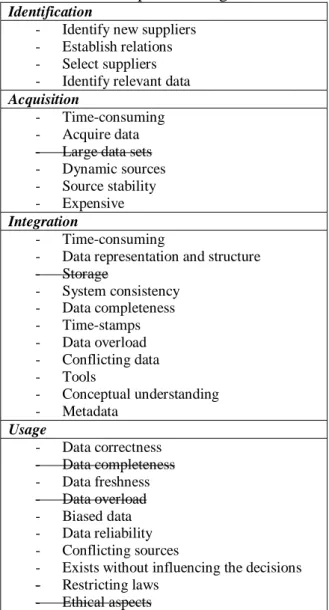
7.1 The updated categorisation...31
7.2 General reflections ... 32
8 Discussion ... 33
8.1 Reflections on the project...33
8.2 The dissertation in a wider context ...33
1 Introduction
Organisations today experience a tougher climate and a more global market than before. Boundaries between countries and continents are fading away as new technology, like the Internet, makes physical distances less an issue for organisations willing to expand their market share. This means that organisations must not only be aware of the competitors in their own country or region, but must widen their perspective beyond borders to see the complete picture. Not only do organisations have to be conscious about their competitors, but also the customers that currently is gradually adapting to the new global market. Obviously, this all means that organisations must put a lot of work into observing the environment, and adapt to changes that occur. To take external factors into the decision making process are therefore more important than ever, and is a necessity to avoid making decisions that will put the company in an unwanted situation.
To make all this possible, organisations must somehow acquire data from outside the organisation, data that is here referred to as external data. In addition to that, organisations must also know how to use the external data, and how to incorporate the external data into the organisation. To be able to make the most of the external data, it also has to be integrated alongside the internal data. Damato (1999, p.5) describes external data as “wild and untamed”, and to incorporate external data is not a trivial task; external data is by definition something that the organisation does not have control of, and there are cases when organisations avoid incorporating external data simply because there are too many problems associated with the task. However, as Kelly (1996, p. 32-33) explains: “external data is the difference between operational and strategic decision making”, and by that clearly states that external data is of critical importance for strategic and top-level decision-making. Even if the several problems associated with incorporating external data can be hard to handle, organisations that manage to incorporate external data into the organisation experience a huge advantage over those organisations that, for some reason, choose not to incorporate external data.
This work is aimed at characterising and categorising problems associated with incorporating external data that are aimed to be used for decision support and integrated into a data
warehouse. The problems described in the literature will be the base for the categorisation and characterisation, which then will be used as a base for an interview study that will be
conducted among some of the largest companies in Sweden, in order to validate the problems. The findings from the interview study will then be used to improve the categorisation and characterisation of the problems. The results will shed some light into this rather undeveloped area, enhancing the understanding for the problems organisations have to deal with
concerning incorporating external data into data warehouses.
1.1 Problem area
Organisations today need to be aware of the whereabouts in their surroundings to be able to handle an increased competition that many industry sectors experience. To be able to cope with this, organisations need to acquire data from outside the organisation to achieve a wider perspective of their surroundings and their own performance. This data, referred to as external data, is used by organisations to compare themselves with other organisations, or to attain information that the organisation could not get from solely internal data. Evidently, external data are increasingly incorporated into organisations and different systems. Salmeron (2002) recognises that the external data is increasingly being used in executive information systems (EIS), and he further believes that the usage will increase even more in the future. However,
1 Introduction
even though external data contributes in many positive ways, there are problems that have to be dealt with concerning the incorporation of external data.
Bischoff (1997) claims that the quality of the external data may be questionable, and a study made by the The Data Warehousing Institute showed that 34% of the data quality issues could be referred to external sources (Eckerson, 2002). In addition to that, Damato (1999) explains that organisations do not, by definition have any control over the content, consistency, completeness or correctness for the external data. Strand, Wangler and Olsson (2003) acknowledge that the integration of external data with internal data can be a problem both in terms of technical aspects as conceptual aspects. However, external data is of critical
importance and Zhu and Buchmann (2002) explain that some external data may be as
important for the organisation that data quality issues have to be neglected. Clearly there are a lot of different problem associated with the incorporation of external data and sometimes, in the worst cases, these problems may cause the organisations to avoid incorporating external data and by that missing out on the advantages that the external data gives.
A problem in the area is that literature covering external data problems in data warehouses is rather fragmented, problems are mentioned in various types of articles but there are no article aimed at gathering various types of problems associated with the external data incorporation. Another problem with the literature is that some problems are mentioned at a very basic level and some are discussed more in-depth. For example, there has been a rather in-depth study when it comes to Swedish financial organisations covered in Strand, Wangler and Lauren (2004a) and Strand, Wangler and Niklasson (2004b). In that study, several different problems came up and it is probable that these problems, even though they were mentioned by financial organisations, are valid for other industries as well. There is clearly a need for a study that is aimed at finding problems of various types and setting up a framework for problems that are associated with the external data incorporation in DWs. This need is supported in Strand and Wangler (2004) where it is claimed that organisations need some kind of support to be able to fully exploit the external data.
There is however another problem, how can one make sure that the problems mentioned in the literature really are valid for organisations today? Some literature may be a few years old and the problems may be out of date; some problems might only be valid or more significant for specific countries (e.g. United States). A large amount of the literature in the area is based on the situation in the United States, and the US is not only ahead of most countries when it comes to data warehouse technology, but also has a different setting when it comes to geographical and demographical issues. It is also reasonable to think that companies in the United States have larger data warehouses compared to other countries. In other words, it is important that the problems found in the literature go through a validation process. The study will be aimed at the Swedish market and it will be interesting to see which problems that are valid in this setting.
1.2 Aim and objectives
The aim is to categorise, characterise and validate problems concerning the incorporation of external data into data warehouses (DWs), with a particular focus on quantitative data.
The aim is divided into these objectives:
- To categorise problems concerning the incorporation of external data into DWs. - To characterise problems concerning the incorporation of external data into DWs.
- To validate problems concerning the incorporation of external data into DWs.
The first two objectives will be met through a literature study, while the third objective will be met through conducting an interview study. Since the first two objectives will be handled the same way, these will jointly be discussed in the following section.
Objectives 1 and 2 – Characterise and categorise external data problems
The first two objectives are aimed at finding already known problems that are documented in various types of literature. The external data problems will be characterised and categorised to provide a better view of the different types of external data problems and the categorisation means that the different problems can be grouped and related to each other in a better way. The results from objective 1 and 2 will be a list of characterised and categorised problems with external data, and could be seen as a helpful guide on the problems that organisations may have to deal with when incorporating external data into a data warehouse. The
categorisation will be based on the external data incorporation process developed by Strand and Wangler (2004).
Objective 3 – Validate the external data problems
In objective 3, the external data problems recognised by the literature will undergo a validation process with the help of an interview study. This validation process will give answer to whether these problems are problems in organisations as well. If the problems found in the literature are acknowledged by the organisations covered in the interview study, the problems can be said to be valid. If the problems are not acknowledged by the
organisations participating in the study, it has to be analysed to see if there are any reasons behind this. During the interview study, problems that the literature has not mentioned may be brought up, which could mean that these problems are very specific for the organisations in the study or that the problems have not been mentioned in the literature because no one encountered and documented these problems before. Whatever results the interview study may bring, it will enhance the overall understanding of external data in data warehouses.
1.3 Research process
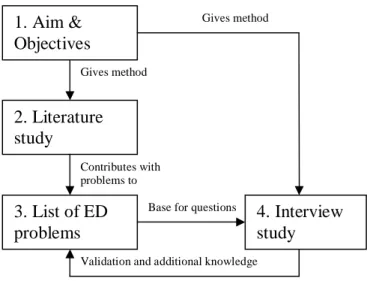
This section gives a presentation of how the study will be conducted. Figure 1 gives an overview of the process.
Figure 1 The research process
Base for questions
Validation and additional knowledge Contributes with problems to Gives method Gives method 1. Aim & Objectives 2. Literature study 4. Interview study 3. List of ED problems
1 Introduction
The aim and objectives (phase 1) will guide the rest of the process and give a help with choosing appropriate methods that can be used to fulfil the objectives.
The literature study (phase 2) gives a base to meet the first two objectives and will mostly be based on literature found in on-line databases. Data warehouse is a relatively new research area and most of the literature is believed to be found in articles. These various databases will be searched with specific keywords in order to systematically go through the literature. Articles are believed to be the most relevant for this project, whereas books usually do not cover the area of external data in data warehouses in a comprehensive way. There are also some web sites directed towards data warehouse researchers and practitioners, and these websites could be valuable sources for the study. According to Berndtsson, Hansson, Olsson and Lundell (2002) it is a problem to know when enough material is gathered for the literature study, and when to stop collecting new material. This will obviously be an issue during the project; however, the literature covering external data in data warehouses is not
overwhelmingly huge which is indicated in Strand et al. (2004b). The articles that go deep into this particular issue are easy to count and a problem is that articles mention problems with external data at the same time as discussing a related issue. However, it is reasonable to believe that the problems mentioned in these articles are not very well described, on a rather high-level, and probably covered already in a more comprehensive way in other articles.
The results from the literature study will be presented as a categorisation and each problem will be characterised with the help of the literature (phase 3). The result will therefore be a list of characterised problems categorised in different categories. This categorisation and
characterisation will then be the base for the questions used in the interview study.
The interview study (phase 4) will be aimed at the third objective and to reach the objective a number of respondents from different Swedish industries have to be found that agree to take part in the study. The companies in the study should be from different industry sectors as it is assumed that one organisation from a specific industry sector will be an indicator of what types of problems that are valid for organisations in that industry sector. The organisations should also be relatively big in their sector since it is reasonable to think that larger
organisations use larger data warehouses and incorporate more external data. The respondents that agree to take part of the study will receive an introducing e-mail with information
regarding the interview process and the project in general. The interviews will then be carried out over telephone and notes will be taken during the interviews. Directly after each interview a summary will be written containing the most important that was said during that interview. These summaries will be sent back to the respondents in order for them to approve them and to give them a chance to make any corrections or additions that they may find necessary. The interview study is primarily aimed at validating the problems in the literature, but also at enhancing the understanding of the nature of the problems. This means that the interview study will be a way to enhance the list of problems especially when it comes to the characterisation. There might be some contributions to the categorisation if the interview study shows that there are other problems than those described in literature. In either case, the categorisation and characterisation will be enhanced with empirical results after the interview study is conducted. This way the final version of the categorisation and characterisation will contain material from both the literature and the empirical study.
1.4 Main contributions
There will be several contributions from this project. First of all the resulting list of problems regarding the external data incorporation can be used by organisations to be better prepared when it comes to initiating new data warehouse projects or expanding a data warehouse by acquiring additional external data. Knowing what kind of problems that may arise during the data warehouse project would allow the organisations to be better prepared to handle these problems. Since there has not been found any other study focusing on problems with incorporating external data into DWs, this study will act as a summary of the fragmented literature in the area, with additional material from the interviews. The validation of the problems mentioned in the literature will also point out problems that for some reason are not actual problems in organisations today. The study will expand the over-all understanding of the area, especially since the study will be based on both empirical results and literature.
2 Background
2 Background
This section is dedicated to describing important concepts that the work is based on. Both data warehouse and external data are defined and described.
2.1 Data warehouse
There are a few definitions of data warehouse in the literature, but the most frequently used is the one stated by Inmon (1996). His definition focus on the characteristics of the data that is located in the data warehouse. The characteristics Inmon (1996) mentions are subject-oriented, integrated, time-variant and non-volatile.
Subject-oriented means that data in a DW is focused on the main subjects of the organisation (e.g. customers, products, sales etc.). This implies that the data is not focused on functions or applications.
Integrated means that all data in a DW is integrated and unified, making all data a part of one big consistent data source. Data that is integrated into a DW includes summarized data, derived data, and historical data acquired from both external and internal sources.
Time-variant implies that the data in a DW is related to a specific time. Every record in the DW can be seen as a snapshot of the current state of the organisation for that specific time. Thereby a DW can be seen as a large collection of snapshots.
Non-volatile is an important characteristic for data in a DW. It gives that data stored in a DW is read-only and is not to be deleted or updated. This characteristic is important because if the data in the DW is updated as soon as something occurs in the organisation, it would mean that there would not be any historical data in the DW. As a substitute for updating the records, new records containing the new values are instead inserted as the DW are updated, and the old data is by that kept as historical data.
Even though Inmon’s definition is the most well-known and widely used, it is also worth mentioning the definition set by Singh (1998, p.14):
“A data warehouse supports business analysis and decision making by creating an integrated database of consistent, subject-oriented, historical information. It integrates data from
multiple, incompatible systems into one consolidated database. By transforming data into meaningful information, a data warehouse allows business managers to perform more substantive, accurate, and consistent analysis.”
While Inmon concentrates mostly on the data in the DW, Singh have clearly more of an organisational focus in his definition. The focus is on the role of the DW in organisations, and explains that the main task for the DW is to support the decision makers to perform business analysis. These two definitions by Inmon (1996), and Singh (1998), together provide a decent base for understanding the DW, and the role that a data warehouse plays in an organisation.
2.2 External data
This section describes the definition of external data, the different types of external data, what sources it can be acquired from and the process of incorporating external data.
2.2.1 Definition
There are a few definitions of external data that can be found in literature. One of them that is often used and suits the aim of this work is the definition made by Devlin (1997, p.135):
“Business data (and its associated metadata), originating from one business, that may be used as part of either the operational or the informational processes of another business.” Kelly (1996, p.33) has a slightly different view of what external data is:
“External data is captured outside the enterprise and is, most often, made available at a cost by specialist information providers.”
Kelly (1996) and Devlin (1997) both have the standpoint that external data is data acquired from outside the organisation. What is slightly different is that Kelly (1996) claims that organisations mostly have to pay for the data, something that also is in line with the definition from Kimball (1996) where he refers to “syndicate data”, data that is bought from data
suppliers. However, the definitions by Kimball (1996) and Kelly (1996) are too narrow for this project, and as Devlin’s definition is more general, his definition will be adopted.
2.2.2 External data types
Data acquired from external sources can be of many types and may be used in various ways. Oglesby (1999) has found four rather broad categories of data that organisations may be able to acquire externally. The four categories are:
- Consumer demographics/psychographics - Business profiles
- Address/phone verification - Industry specific
Consumer demographics are according to Oglesby (1999), basic data about people such as age, income, education, marital status and so forth. Psychographics are what individuals like to do, such as hobbies. Various types of marketing information companies may provide these types of data, and according to Damato (1999) is consumer demographic data something that organisations often tend to use for decision-making. Kelly (1996) recognises what he refers to as econometric data as something organisations may incorporate into data warehouses. This type of data contains information about customers’ income groups and consuming behaviour. Acxiom (2000) also recognises that companies selling to consumers, called business-to-consumer (B2C) companies, often use these types of data.
Business profiles are in some ways the same as consumer demographics, but with the modification that it is data about companies instead of individuals. Oglesby (1999) explains that this type of data could contain information such as number of employees, year established, annual revenue, description of the business, and different industry classification codes.
Acxiom (2000) chose to call this type of data “firmographics”, and Acxiom (2000) further indicates that this type of data could be used for organisations selling to other businesses, something that usually is referred to as business-to-business (B2B) companies.
Address and phone verification data is data that contains addresses and telephone numbers. It is often used by organisations to clean and update their data warehouses to make sure that the addresses and telephone numbers are valid. Often when people enter information like
2 Background
addresses in, for example, an ordering form on the Internet, they may make mistakes and enter incorrect information. Oglesby (1999) claims that people mistype information almost 10 percent of the time. This means that it is important to assure that the information is correct and organisations need to verify the information by acquiring address information from external sources. If addresses are not verified and updated, it will potentially harm the costumers’ good will against the organisation, even though it actually might have been the customers fault in the first place.
Industry specific data is data that more or less varies from different industry sectors. An example: Strand and Olsson (2003) found in a study that industry codes are frequently incorporated into data warehouses in organisations. These codes make it possible for organisations to see what type of business a specific organisation is, and they can be a good way for B2B companies to categorise their customers. This specific example is related to business profiles, which points to the fact that some industry specific data also is related to other types of data.
2.2.3 External data sources and suppliers
According to Strand et al. (2003), there are a number of different types of organisations that can supply data to other organisations. These will be briefly described in this section. The different types of sources according to Strand et al. (2003) are:
- Statistics institutes: Organisations that are able to distribute various types of statistical data about individuals, organisations and so forth.
- Syndicate data suppliers: Organisations that provide economical company data that helps companies reducing credit risks, finding customers that are profitable, and manage vendors. - Industry organisations: Information about specific industries can be acquired from these organisations.
- County councils and municipalities: Statistics regarding population, demographics and so on might be available without charge from these organisations.
- The Internet: The Internet is a rather enormous data source, but there is a problem in sorting out relevant data. Organisations can by scanning the web, for example, find out what
competitors offer and to which prices.
- Business partners: Data from other businesses can give organisations a better overview of the business climate and their surroundings.
- Bi-product data suppliers: Organisations that have other core business activities but also sell some of their data to other organisations.
2.2.4 External data incorporation
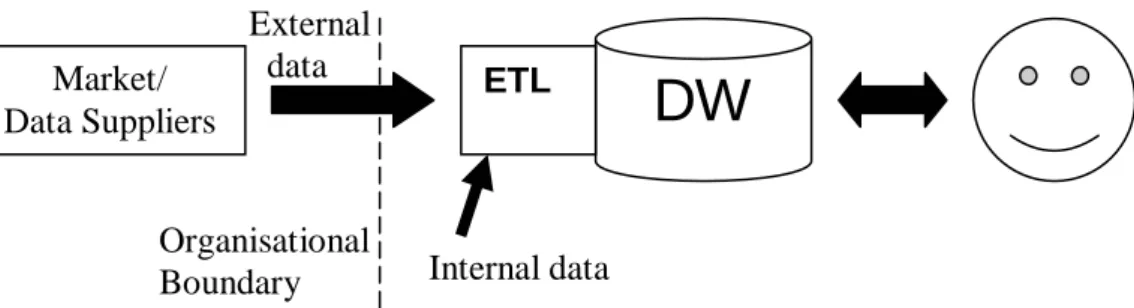
Figure 2 The external data incorporation process (based on Strand and Wangler, 2004, p.4).
The external data incorporation process consists of four phases according to Strand and Wangler (2004):
Identification
Identification is according to Strand and Wangler (2004) the activities that include finding and evaluating sources from where organisations can acquire data. This phase is important since some external data suppliers might be able to tailor data so that it becomes custom-made for acquiring organisations, making the later phases less problematic. This is something the organisations have to find out before they choose supplier. The reputation of data suppliers can also infect the willingness of organisations to acquire external data according to Strand and Wangler (2004).
Acquisition
Acquisition is according to Strand and Wangler (2004) the process of retrieving external data from a source, and distribute it to various internal systems. This is where the external data passes the organisational boundary. There are several different approaches that can be used to transfer data between organisations, and examples are compact discs, DVD-ROMs, magnetic tapes, or with the help of Internet (e.g. FTP). Strand and Wangler (2004) explain that if data is acquired in an appropriate way it can contribute to a less problematic integration.
Integration
Strand and Wangler (2004) clarify that the integration involves how the data is stored, how it is modelled and how the data is integrated into the data warehouse. According to the study by Strand and Wangler (2004), the integration phase is problematic for organisations in several ways. It is also important, they say, to acknowledge that the choice of integration approach depends on how the data is about to be used.
Usage
The usage phase includes, according to Strand and Wangler (2004), aspects such as how data is interpreted and the purpose of the data. The human involvement in the usage phase makes the usage problems difficult to solve. Strand and Wangler (2004) acknowledge that many of the usage problems can be solved in earlier phases.
Organisational Boundary External data Market/ Data Suppliers
DW
ETLIdentification Acquisition Integration Usage
3 The literature study
3 The literature study
This section presents how the literature study was conducted.
3.1 Finding literature
When the aim and objectives (phase 1) were set up, the literature study (phase 2) was initiated. The first impression was that the literature is segmented when it comes to problems with external data. Not a single article focused on external data problems; instead, these problems often were found when discussing other aspects, such as application areas. To find relevant literature to support the study mostly articles were searched for, since articles are the most up-front and usually focus on a more narrowed area. Books in the data warehouse area usually do not mention external data in such a comprehensive way that they can be considered as an important source for this project. Internet was used to locate different article databases such as Springer Link, Science Direct, INSPEC, Cite Seer, and ESBCOHost Research Databases. Words used for searching included: “external data”, “data warehouse”, “data warehouses”, “problems”, and “issues”. These words were combined in different ways to make the search as efficient as possible. However, there are authors that do not use the exact phrase “external data” but instead something like “environmental data” or similar. However, the literature study was only aimed at finding articles that referred to “external data” or else the literature study would be an overwhelming process. Searches were also made at www.google.com even though results from such a search had to be treated with care and the source would sometimes not to be considered as high-quality or trustable. Lists of references located in the articles found were also a way to find more interesting articles in the area. However, these were often very hard to locate and it is hard to understand what the article really is about since only the title is known. This is not the first time I conduct a literature study in the area and the experience is that these articles are of lesser importance for a study like this. So actually not many new findings were made through looking in lists of references, but they were a good way to get a view of the literature in the area. Another useful source was two websites
focusing on data warehouse technology, www.datawarehouse.com and www.dmreview.com.
A problem that arose during the literature study was that authors have different opinions on what external data is. Sometimes authors referred to external data as all data that is in the organisation but not integrated into the data warehouse. This was the case especially in more technical-oriented articles as opposed to organisation-oriented articles where external data mostly meant that the data was external for the organisation.
3.2 Handling the results from the literature study
The problems were written down with a description as they were found, and when the same problem was mentioned in another article the description of the problem was enhanced. When no new articles covering new problems were found in the area, the result was an unstructured list of several problems covering different aspects. The task was now to make categories to be able to place the different problems in the appropriate category. As a base for the
categorisation, the external data incorporation process developed by Strand and Wangler (2004) was used. This process contains four steps (as can be seen in Figure 2, p.9);
identification, acquisition, integration and usage, and these four steps are the main categories for the categorisation. The result became a list of characterised and categorised problems (phase 3) that mainly will be used in order to produce appropriate questions for the interview study (phase 4).
4 Analysis of the literature study
This section presents the external data incorporation problems that were found during the literature study, phase 2 in the research process (see 1.3). The problems are categorised to provide a structure and the problems are characterised to give a better understanding for each problem. The categorisation is based on the external data incorporation process developed by Strand and Wangler (2004). Worth mentioning is that some problems might seem irrelevant due to, for example, old literature sources. However, these problems were still taken into consideration during the literature study. If problems are found to be outdated according to the interview study, they will be left out in the final categorisation.
4.1 Identification
In this section, the problems that can be referred to the identification phase are presented.
Identify new suppliers
Strand et al. (2004b) acknowledge that it is a problem with identifying new external data suppliers that just entered the scene. They further state that there is a lack of formal routines that can be used for identifying external data suppliers, both new and old ones.
Establish relations
According to Oglesby (1999), it is time-consuming to establish relationships with external data suppliers. This is especially a problem for mid-size companies. Oglesby (1999) is not very clear when it comes to describing what he means by establishing relationships, but the assumption is that it includes activities that take place after a supplier is identified and before data is acquired from the supplier. Examples of activities could be agreeing on prices, setting up contracts, deciding how the data should be transferred to the organisation, and so forth.
Select suppliers
Strand et al. (2004b) identify that it is a problem to select the most appropriate suppliers for external data. There are often several suppliers that can provide external data that
organisations need.
Identify relevant external data
Zhu and Buchmann (2002) claim that it is hard to identify relevant external data on the web. Web sites that e.g. are belonging to a competitor can contain data that is relevant for
organisations, but to find the external data that can be relevant is difficult.
4.2 Acquisition
This section presents the problems that can be referred to the acquisition phase.
Time-consuming
Acxiom (2000) states that the process of updating internal data, with the help of external data is a problem mainly due to the transportation of the data, which is time-consuming. Acxiom (2000) gives an example concerning an organisation that updates addresses in the United States. Data is prepared and shipped to services outside the organisation, and the data is stored on tapes. When the data comes back, the reports created by the suppliers have to be studied. Obviously, this causes more problems such as the fact that the data is shipped means that the data will be old whenever it returns to the organisations. It also could be an economic problem since this shipping probably is quite expensive.
4 Analysis of the literature study
Acquire data
Strand et al. (2003) acknowledge the fact that it is hard to acquire external data from industry organisations. This is even more complicated if organisations try to acquire data from industry organisations that are functioning in another industry sector. Strand et al. (2003) got the impression that some industries do not share the internal industry data to external organisations due to some kind of agreement in the industry.
Large data sets
Oglesby (1999) indicates that large data sets may be a problem, because some data sets are too large to fit onto a compact disc, which is a common way for external data suppliers to deliver external data to organisations according to Oglesby (1999). However, Strand et al. (2004a) show in a study that 88% of the organisations use FTP for transferring data and acknowledge that DVD-ROMs can be a substitute for CDs. Oglesby (1999) further
acknowledges that this issue regarding acquiring large data sets will become less important when Internet connections get faster.
Dynamic sources
Some types of sources may be very dynamic; this is specifically a problem for web sites. Data on the web is often updated frequently, new potential sources are brought in all the time, and some sources may disappear or undergo a drastic change either content-wise or
representation-wise. Reasons for a change can be new upcoming developments, but some providers also would like to hinder other organisations from automatically extract their data and therefore change the representation frequently to cause problems for the companies that extract their data. All this makes a data warehouse based on web data more complex than a conventional data warehouse (Zhu, 1999; Zhu, Bornhövd, Sautner & Buchmann, 2000).
Source stability
Source stability is mainly an issue dealing with web sites. Zhu and Buchmann (2002) identify some characteristics that can be an issue concerning the stability:
• Availability; is the source up and running, is the response times good enough, is the links working.
• Accessibility; sometimes registration and passwords are required to access certain information, which makes the automatic extraction more complex.
• Durability; how long is the data available. If the source is updated often and the old data is removed in the process, there is a need to regularly extract the data to guarantee that nothing is missed. Often web sites do not keep historical data, which can be a problem.
Even though Zhu and Buchmann (2002) discuss this issue regarding web sites it is possible that this also is a problem for transactions by FTP.
Expensive
External data is rather expensive to acquire, especially from syndicate data suppliers (Strand et al., 2004a; Strand et al., 2004b). This is even more of a problem if the organisation needs to acquire the data on-demand in relation to acquiring it via subscriptions (Strand et al., 2004b). Oglesby (1999) however claims that the external data can be reasonably priced if the
organisation has a large data warehouse and by that can overcome the minimum-order size that some external data suppliers apparently are using. However, Oglesby (1999)
4.3 Integration
This section discusses problems associated with the integration of external data. The
integration of external data with internal data is problematic in several ways; Damato (1999, p.5) refers to external data as “wild and untamed” and this implies that there is a problem to integrate external data with internal data. In a study conducted by Strand and Olsson (2003), they found that 60% of the companies experienced problems when mapping external and internal data. Strand et al. (2003) also claim that there are two aspects of the integration, a technical and a conceptual.
Time-consuming
To integrate external data into a data warehouse is very difficult and time-consuming according to Adelman (1998) and explains that it is because there are problems with the external data such as the data representation. Strand et al. (2004a) recognise the
transformation process as very time-consuming and costly. This problem is related to all other integration problems really, since the more problems organisations have with different
integration aspects the more time-consuming it will be.
Data representation and structure
External data is most likely not represented in an ideal way for the acquiring organisation and Adelman (1998) explains that external data usually does not follow the standards that the acquiring organisation has. Strand et al. (2004a) claim that the differences in data structure between the internal and external data are the most common problem when incorporating external data. Data warehouses are mostly based on either relational or multi-dimensional data models, which clearly can be referred to as structured data. However, external data, especially the data available on the web is mostly unstructured or semi-structured, which would cause problems according to Zhu et al. (2000). Zhu and Buchmann (2002) explain that to be able to use automatic extraction of data from the web only structured or semi-structured data is useful, semi-structured data on the web could for example be available as XML. However, HTML is currently the most used on the web and HTML is unstructured according to Zhu and
Buchmann (2002). There are also, they say, other types of unstructured data and information available on the web in formats as pdf, ps, doc, or other formats that support documents, pictures or audio. To integrate unstructured data would have to be done manually according to Zhu and Buchmann (2002), and this is not only very time-consuming but there is also a high risk for transcription errors. Bischoff (1997) explains that there are a large amount of different data formats that are used and further explains that the external data format can change
frequently which makes the integration process even more complex. Zhu et al. (2000) acknowledge that data providers on the web can drastically change the representation and content of their data. Changes can be made because of new developments, or to make automatic extraction of their data more complex.
Storage
Collett (2002) explains that external data, or basically data in general, consumes disc space, and of course this may be a problem even though storage devices nowadays are less expensive and can hold more data.
System consistency
Strand et al. (2004b) acknowledge a problem with assuring that all the systems in an
organisation are updated when new external data is acquired. This may lead to inconsistency between the different systems as some systems are updated and some are not.
4 Analysis of the literature study
Data completeness
If organisations are unable to acquire all important data, problems arise in the integration process. If, for example, customer identifiers are not provided from the external data source, this cause significantly more work to make sure that the external customer data is accurately integrated with the internal customer data (Adelman, 1998). Strand et al. (2004b) also
recognise that it is hard to match internal and external data due to incomplete data. This could result in additional problems when the data is to be used. Strand et al. (2004a) explain that organisations are not allowed to get all data about individuals that are not customers for the company, which makes this problem even tougher to deal with. Zhu et al. (2000) explain that default-values may be a possible solution to some of these problems. However, identifiers can not be replaced by default-values for obvious reasons.
Time-stamps
Damato (1999) claims that it is important to ensure that external data is valid at the same time as the related internal data. To make that possible the external data must contain time-stamps. However, problems arise as external data sometimes lacks time-stamps, something that Zhu and Buchmann (2002) mention is a problem with web data. Strand et al. (2004a) recognise another problem related to time-stamps; the data may have been time-stamped from an integration perspective and not from a real time perspective. Real-time time-stamped data is what organisations need to be able to map external data with internal data from the same time. Strand et al. (2004a) further explain that this is especially a problem when the source of the data is unknown.
Data overload
Collett (2002) explains that data overload causes many problems for organisations. To acquire too much external data means that it can become an overwhelming process to integrate the data. A lot of work and time is required to pick and integrate the data into the DW, and to clean up files that contain irrelevant data.
Conflicting data
Damato (1999) acknowledges the fact that using several different external sources may lead to a problem with conflicting data. This means that there is a problem when external data is integrating with internal data. Organisations must then figure out which source that is to be considered as the most reliable, and then integrate data from that source into the data warehouse.
Tools
The literature describes various problems concerning tool support for extracting, transforming and loading (ETL). First of all Strand et al. (2004a) mention that investing in a commercially developed ETL-tool is a large investment, which may be a problem for especially smaller organisations, and could force organisations into develop their ETL-tools themselves. Strand et al. (2004a) further point out that these commercial ETL-tools work like black-boxes. The external data is entered and mixed up with the internal data without any control of the data quality. This further indicates that in-house developed ETL-tools may be worth while. Damato (1999) also experiences a lack of support concerning extraction software used for extracting data from electronic on-line databases. To work around this problem, Damato explains that the external data could first be loaded into tables that the extraction software supports. He also adds that the technology keeps getting better and more efficient, but
to internal data. This type of problem is relevant for both the acquisition and integration; however, it seems that the problems mostly occur during the integration.
Conceptual understanding
Strand et al. (2004a) explain that the conceptual meaning of the external data can be difficult to interpret. Damato (1999) explains that this may cause external data to be interpreted in an unintended way. Damato (1999) also states that it is difficult to know where the external data fits into the model that the data warehouse relies on. Zhu et al. (2000) claim that it is
important to make sure that there is a semantic homogeneity among the internal and external sources before the data is loaded into the warehouse. This they say is important for web data; on the other hand, this could be a possible problem for all types of data. Zhu (1999) also clarifies that these semantic inconsistencies do not only exist between the external web data and the internal data, but also between different web data acquired from different sources. The problems concerning conceptual understanding are heavily dependent on the human ability. However, other things such as lack of metadata make the problems even more complex.
Metadata
In order to be able to understand all kinds of data, metadata is important. Especially for external data, since not much will be known about it otherwise. The lack of metadata for external data can become a problem according to Damato (1999). Sometimes the external data is stored somewhere without any existing metadata that describes the data and explains the relationships to other data located in other sources. Adelman (1998) recognises that external data often is not well documented. Zhu and Buchmann (2002) indicate that the lack of metadata may be a problem concerning external data from web sites, Zhu (1999) also claim that there could be problems with interpreting related metadata for external data acquired from the web. Even though these interpretation problems are mentioned in relation to web data it is reasonable to think that these problems also can be an issue concerning external data from other sources, even though the problems most likely are biggest dealing with web data. Adelman (1998) further explains that if the external data has been modelled it will be
significantly easier to understand. However, Adelman (1998) realises that external data suppliers are unlikely to provide a model for the external data.
4.4 Usage
This section contains characterised problems from an end-user perspective.
Data correctness
Strand et al. (2004a) explain that if the external data is not correct, important decisions will be made on incorrect data or facts. Zhu and Buchmann (2002) also identify that correctness is important when it comes to external data. They further explain that data taken from web sites may not be as carefully reviewed or filtered as regularly information sources, and that there exist a lot of incorrect information on the web.
Data completeness
If data is missing or incomplete it will bring added complexity into decision making. Strand et al. (2004b) explain that because there sometimes are problems with matching external and internal data it will cause problems for organisations to, for example, see which people that already are customers. This is caused by the fact that they can not acquire all the data they need and that organisations might send out information to people that already are customers, causing the customers to get a negative impression of the organisation. Zhu and Buchmann (2002) explain that there exist a lot of incomplete facts on the Internet. They also
4 Analysis of the literature study
acknowledge that lack of units may be a problem with data acquired from the web. Some data completeness problems are according to Strand et al. (2004b) caused by regulating laws that hinder the organisations in acquiring certain data externally.
Data freshness
Data acquired from external sources may be old according to Strand et al. (2004a), which would mean that decisions are made on old data. However, Strand et al. (2004b) acknowledge the fact that external data can never be minute-fresh and data such as statistical data only is valid for a short time meaning that such data soon is to be old. Oglesby (1999) explains that the data on a CD is out of date the day after it is pressed. Bischoff (1997) explains that the external data must be documented and deployed as quickly as possible to reduce these problems. There is however also a cost issue involved. Zhu and Buchmann (2002) give an example of this; stock quotations have a price if an organisation needs to acquire it
immediately, but are free to acquire if an organisation can cope with 15 minutes old data.
Data overload
Collett (2002) explains that if there is too much external data available, much of it may be left unanalysed. This problem can also be related to the cost issue, if an organisation acquires too much external data from e.g. a syndicate data supplier it also means that the organisation pays for a lot of data that in the end is not even used. Another problem with this might be that it could be hard to know for decision makers what specific data the decisions should be based on. In case the decision makers have to figure this out for themselves, it can cause problems and an increased workload for the decision makers.
Biased data
Zhu and Buchmann (2002) explain that external data may be biased which is an unwanted situation. They further explain that biased information could mean that some information has been left out (e.g. information that favour a competitor), and in that case the problem of biased data is also a problem of incomplete data since some parts have been left out. Zhu et al. (2000) further explain that the external data can be abnormal because of different assumptions that the organisation made, or different political and cultural contexts. They also mean that different intentions that an organisation have for the data can lead to biased data. Sadly Zhu et al. (2000) do not give any examples of different intensions that can influence the data.
Data reliability
According to Zhu and Buchmann (2002), the origin of the data may contribute to how reliable the data is perceived in the company. Strand et al. (2004a) agree and explain that if the origin of the data is unknown it is difficult to rely on.
Conflicting sources
According to Damato (1999), it may be a problem to use several different external sources, which may lead to conflicting data. This would mean that the end-user has to choose which data they trust the most, and base the decisions on the data they find most trustworthy and accurate. However, these situations require the users to have the knowledge and ability to estimate data quality, and different users may make different assumptions.
Exists without influencing the decisions
If external data exists in a company in some form, but is not integrated into the data
warehouse it could mean that it will not be taken into consideration when it comes to making decisions (Damato, 1999).
Restricting laws
Strand et al. (2004b) recognise that companies are restricted by laws when it comes to what they are allowed to do with the external data. It is also an issue that laws can be rather vague when it comes to what organisations are allowed to do with the data. It is very important that the organisations take the time to understand the laws to make sure that they do not use the data in an illegal way.
Ethical aspects
To use the external data in certain ways may conflict with the ethical views that exist in e.g. an organisation (Strand et al., 2004b). People generally have their own ethical principles, and it is probable that their ethical views are influencing their work and decision-making.
4.5 The resulting categorisation
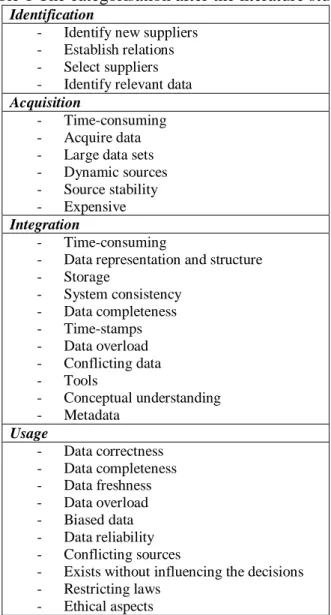
Presented in Table 1 is an overview of the problems that were found during the literature study.
Table 1 The categorisation after the literature study. Identification
- Identify new suppliers - Establish relations - Select suppliers - Identify relevant data Acquisition
- Time-consuming - Acquire data - Large data sets - Dynamic sources - Source stability - Expensive Integration
- Time-consuming
- Data representation and structure - Storage - System consistency - Data completeness - Time-stamps - Data overload - Conflicting data - Tools - Conceptual understanding - Metadata Usage - Data correctness - Data completeness - Data freshness - Data overload - Biased data - Data reliability - Conflicting sources
- Exists without influencing the decisions - Restricting laws
- Ethical aspects
Worth mentioning regarding the problems that are brought up in this chapter, is that most of them are not exclusive for external data but are also issues for internal data. External data
4 Analysis of the literature study
however brings another dimension and makes the problems more complex compared to the related problems with the internal data. Some problems also arise in the mixing of external and internal data. Problems mentioned in identification and acquisition, are more valid for external data and probably not problems at all for internal data. This can be related to the definition of external data that is given in 2.2.1, since what is specific for external data is that it is taken from outside the organisation. Strand and Wangler (2004) explain that the
organisational boundary lies in the acquisition phase. This means that the two first phases are the most specific for external data and the problems encountered in those phases can therefore be seen as rather specific for external data. The integration and usage problems on the other hand are probably issues for internal as well as external data.
5 The interview study
This section first describes how the process of conducting the interview study (phase 4 in the research process in 1.3) was carried out, and then the five respondents that took part of the study are described.
5.1 Setting up the interviews
The interview study began with identifying organisations that would be suitable for the study. To find suitable companies I brainstormed and wrote down what I considered to be the most well-known companies in Sweden. Other people were also asked the question and contributed with ideas on organisations that could be appropriate for the study. The yellow pages were also scanned to get any further ideas on appropriate organisations. Organisations were contacted by telephone and the project was initially introduced and the organisation was checked to see whether the organisation met the demands (having a data warehouse with external data) or not. If the organisation used a data warehouse and external data, the aim was to find the person who was responsible for that part in the organisation. Often the person that was first spoken to could direct me to a person that worked with the data warehouse. When I finally arrived at the appropriate person, the person was asked if he or she could take part of an interview study and was given a brief description of how the interview would be conducted. Needless to say, there were a lot of companies that were contacted that did not have a data warehouse or incorporated external data. Worth mentioning is also that one organisation had to refuse because the organisation’s policies were saying that they were not allowed to speak about their data warehouse, which indicates that the data warehouse area is quite secretive and full of company secrets. Five persons agreed on participating in the interview study, and a time for the interview was scheduled for each participant. All of the participating persons then received an introducing e-mail where the project and the interview study were described. This introducing e-mail can be seen in Appendix 1.
5.2 Interview questions
The interview questions can be found in Appendix 2 and were mostly based on the
categorisation in Chapter 4; every problem in the categorisation got a corresponding question in the interview. However, first of all there were some introducing questions with the
intension of making a smooth start in the interviews and also to make the respondent think about the area in terms of what external sources they acquire data from, and what type of data they acquire from these sources. Lastly, the respondent was asked if there were any other problems regarding external data that he or she had experienced in the organisation, a question aimed at enhancing the list of problems. For each problem, there were a number of questions aimed at enhancing the characterisation of the problem. These were not always explicitly asked but rather a guide for asking follow-up questions when the respondent did not already cover these areas in the discussion.
5.3 Conducting the interviews
The five interviews were conducted over telephone, and notes were taken during the interviews. The interviews lasted for approximately 30-60 minutes each. The notes taken during the interviews were then the base for summaries that were written for each interview. The summaries were then sent back to the respondents in order for them to approve what has been written, and a chance for them to make corrections, additions or other changes. The final versions of the summaries can be found in Appendix 3. The summaries were then used to improve and enhance the original categorisation and characterisation, and together with some
5 The interview study
ideas and analysis from the author a new improved categorisation and characterisation emerged which are to be seen in section 6. Note that sometimes the respondent gave an answer to a question regarding a specific problem that is more suitable as an answer to another problem, most often a similar problem but in another phase of the external data incorporation process. In these cases the answers were still presented in the summaries under the problem that was discussed at the time and then in the analysis these issues are discussed where it is found most appropriate.
5.4 The respondents
This section gives a brief description of the five respondents that took part of the interview study. The information regarding the organisations has been gathered from the organisations’ web sites.
Respondent 1
The first respondent is responsible for the development of Göteborgs-Posten’s data warehouse (or customer database as the respondent sometimes refer to it). Göteborgs-Posten (GP) is the second largest morning paper in Sweden and the largest morning paper in Western Sweden.
Respondent 2
The second respondent is a system developer and involved in projects concerning business intelligence and data warehousing for Volvo IT in Skövde. Volvo is one of the most well-known car manufacturers not only in Sweden but also world-wide.
Respondent 3
The third respondent has the role “Manager IT Retail Sweden” for ICA AB. ICA AB is the largest retail trade organisation in the Nordic countries, and the main focus is groceries.
Respondent 4
The fourth respondent works as a database administrator for Preem. Preem is not only Sweden’s largest oil manufacturer with two oil refineries, but the company also has petrol stations all around Sweden. Approximately half of the production goes on export, making Preem one of the biggest exporters in Sweden.
Respondent 5
The fifth respondent works for Astra Zeneca and is responsible for the business intelligence capability in the IS operation and business service section. Astra Zeneca is a world leading organisation in the pharmaceutical industry.
6 Analysis of the interview study
In this section each problem found in the literature study are analysed based on the findings in the interview study. The section focuses on the characterisation of the problems and
connections to the previous results in the literature study are only discussed when it is considered to be interesting. Sometimes the organisations’ names are used instead of the respondents’ names. However, what is presented in this section are from the individual respondents’ point of view, and is not necessarily a view that is shared in the entire organisation.
6.1 Identification
This section presents the findings from the interview study regarding the identification phase.
Identify new suppliers
During the interviews it was found that some organisations tend to have some problems with finding new suppliers. A big problem in the area, which both Astra Zeneca and ICA AB mentioned is that some data suppliers are in a monopoly situation which makes it hard for new suppliers to come up and compete against these big suppliers. Astra Zeneca mentioned that they are constantly looking for other possible solutions and that there are some other suppliers available, even though most suppliers can not deliver as fully-covered data as the organisation need. Volvo has some problems with finding the sub-contractors that are the most suitable for delivering the data Volvo needs. The respondent explained that it might be hard to know which sub-contractors that can deliver the appropriate data.
There are also companies that do not actively look for new suppliers, Preem explained that the organisation has the data they need for the moment and they know where to turn to acquire the data they need. However, Preem also acknowledge that there might be suppliers out there that can provide the data they need for a lower cost, but the respondent has not seen any advertisings or any direct marketing attempts from any other supplier. The same goes for Göteborgs-Posten who did not actively look for new suppliers.
Establish relations
Only one of the respondents, Volvo, experiences problems with establishing relations with suppliers, and it has to do with the fact that their sub-contractors not are as technological advanced as Volvo. The respondent said that Volvo has to have high demands on their sub-contractors but also said that they can not require that the sub-sub-contractors have as high
standards as Volvo. Volvo differs from the other organisations in the study since they acquire data from sub-contractors while the others mostly acquire data from syndicate data suppliers. It is reasonable to think that these syndicate data suppliers, who have a main focus in
delivering data to organisations, have been working a lot with establishing relations and by that making it easier for the acquiring organisation as well. Since selling data is the syndicate data suppliers main focus, they have to be good at this, otherwise organisations would most likely change to another supplier, since there often is a selection of suppliers around. Astra Zeneca said that they experience some cultural differences since their supplier is based in United States, but Astra Zeneca does not see this as a problem. The main thing is that their supplier knows that they are in a monopoly situation and that they sometimes take advantage of this. Oglesby (1999) acknowledges that establishing relations is especially problematic for mid-size companies and the organisations in the study are rather large which might explain the result.
6 Analysis of the interview study
Select suppliers
Astra Zeneca and ICA AB both acquire data from a supplier in a monopoly situation and do not have any problems with selecting suppliers, since it is obvious that there are no other options. Only one organisation experiences problems regarding selecting suppliers and it is Volvo. Volvo requires the data and the supplier to uphold a certain quality and sometimes when the suppliers do not reach up to the required level Volvo has to change supplier. The respondent also said that the sub-contractors have to be of a certain size to be able to handle data deliveries to Volvo. Volvo wants suppliers that can deliver as fully-covering data as possible. Too small sub-contractors are more likely to not being able to cope with the data deliveries.
Most of the organisations do find it easy to select suppliers, and this is quite surprising. There are a lot of suppliers that are able to deliver the data the organisations need according to Strand et al. (2004b), but still when looking at the organisations acquiring data from syndicate data suppliers they do not think that selecting suppliers is a problem. A reason for this might be that some of these companies have a very product-oriented focus in their data warehouse. Groceries, oil and medicines are rather specific areas and there might not be as many
suppliers in those areas, as for example suppliers that focus on data about individuals.
Identify relevant external data
Two out of the five respondents experience a problem with identifying relevant external data, Volvo and ICA AB. Volvo has to work out which data that they need that the suppliers can give them, and they have to screen out data that are not wanted. ICA AB said that this is a question about quality; they need to be confident that the quality is assured. The respondent at ICA also believes that this will become a bigger problem in the future.
Zhu and Buchmann (2002) acknowledge this problem and focus on the difficulties with identifying data on the web, but this study shows that there also can be problems to identify relevant data when it comes to other sources as well.
6.2 Acquisition
This section presents the findings from the interview study that can be referred to problems in the acquisition phase.
Time-consuming
Only two of the five respondents acknowledge that the acquisition is time-consuming, most of the organisations have methods that automatically acquire the data from the supplier. Volvo experiences some problems, and it was mainly due to the high security standards adapted by Volvo. Their sub-contractors might have to adapt to Volvo’s standards and methods to be able to communicate safely, which is a time-consuming task. ICA AB has some problems
occasionally and it is because there are some changes in the flow on occasions.
Acxiom (2000) acknowledges the problem and explain that this is an issue if organisations have to ship e.g. tapes or compact discs between the supplier and the organisation. However, this is not how it is done these days; all of the organisations that took part of the interview study acquire data through FTP. ICA AB did receive the data on compact discs earlier and explained that this was more of a problem back then. Therefore, it is safe to say that this problem will be less important the more technology advances.
Acquire data
None of the respondents does really have any problems concerning acquiring data from specific types of organisations. Strand et al. (2003) claim that there can be problems to acquire data from industry organisations, but none of the organisations in the study have experienced these problems since no one has tried to acquire data from industry organisations. However, the respondent from Astra Zeneca said that acquiring statistical data from an
industry organisation is probably better than purchasing it from a statistical data supplier. However, the respondent explained that it is a matter of maturity in the industry and he also believes that industry organisations have a better functionality on a national level than on an international level. Sometimes, as in Astra Zeneca’s case there are no large industry
organisations on a national level since the industry is not large enough in that specific country.
What did come up during the study was that there also can be a problem to acquire a certain type of external data. ICA AB experiences a problem with acquiring good statistical data regarding sales of meat products. This particular problem may be seen as very specific for ICA’s business area but still shows that there are certain types of data that are difficult to acquire.
A problem that GP has is that they find it hard to acquire data from their customers. Some customers log in to GP’s web site and add some information, and some customers may call them on the telephone, but most customers do not have any contact with GP at all which makes it hard for GP to find patterns within their customer registry. According to the
definition by Devlin (1997) data directly from the customers can not be seen as external data so this problem is not completely aligned with the aim of the work. It is still interesting and worth mentioning, since it shows that there are problems with other types of data that are somewhere between internal and external data.
Large data sets
Only Volvo has some problems with large data sets, but these problems are more related to the integration process and not the actual acquisition. Oglesby (1999) explains that this was a problem since some data sets are too big to fit onto a compact disc. On the other hand
compact discs are no longer a common way to transport data. Today most organisations use FTP, which is supported in the study by Strand et al. (2004a). Using FTP means that there is no size limit in that sense, making the problem less of an issue, and it is probable that this becomes even less of an issue in the future, as Internet connections become faster, something that Oglesby (1999) also acknowledges.
Dynamic sources
Dynamic sources can sometimes be a problem according to the respondents in the interview study. It is mainly on occasions when the source changes the representation and format of the data. Volvo experiences some problems concerning acquiring industrial data from machines. Sometimes these machines change their output and then all the systems using this data have to change as well. Some respondents did work closely together with the supplier to make sure that the data the organisation receives are in the appropriate format and sometimes even custom-made for the organisation. The suppliers have to be aware of the fact that if they are dynamic, e.g. changing format or representation of the data on a frequent basis, all the organisations and systems that use this data have to adapt to the changes, which are a lot of work for the organisations. It is therefore important that there is some kind of agreement between the parts on how the data shall be structured. Astra Zeneca explained that there are
6 Analysis of the interview study
standards set by the United Nations controlling the format for this in the pharmaceutical industry, something that obviously makes it easier.
Zhu (1999