Dublin Institute of Technology
ARROW@DIT
Dissertations School of Computing
2009-07-01
Knowledge transfer within a software development
team
Geraldine Conway
Dublin Institute of Technology, [email protected]
Follow this and additional works at:http://arrow.dit.ie/scschcomdis Part of theComputer Engineering Commons
This Dissertation is brought to you for free and open access by the School of Computing at ARROW@DIT. It has been accepted for inclusion in Dissertations by an authorized administrator of ARROW@DIT. For more information, please [email protected], [email protected]. Recommended Citation
Conway, Geraldine, "Knowledge transfer within a software development team" (2009).Dissertations.Paper 24.
Knowledge Transfer within a Software
Development Team
Geraldine Conway
A dissertation submitted in partial fulfilment of the requirements of
Dublin Institute of Technology for the degree of
M.Sc. in Computing (Knowledge Management)
I certify that this dissertation, which I now submit for examination for the award of MSc in Computing (Knowledge Management), is entirely my own work and has not been taken from the work of others save and to the extent that such work has been cited and acknowledged within the test of my work.
This dissertation was prepared according to the regulations for postgraduate study of the Dublin Institute of Technology and has not been submitted in whole or part for an award in any other Institute or University.
The work reported on in this dissertation conforms to the principles and requirements of the Institute’s guidelines for ethics in research.
Signed: _________________________________
ABSTRACT
Knowledge in a software company is the blood of the company, not surviving without the valuable knowledge running through its veins. Knowledge is no longer seen as an object of competitive advantage but is the core of how an organisation operates.
The transfer of tacit knowledge into a format that is usable and can be transmitted to other individuals is a challenge in any organisation due to the nature of this knowledge. Tacit knowledge is a challenge to convert into an explicit form as it is hard to contextualise this knowledge in order for it to be reusable for others. Investigation is carried out into whether explicit and tacit knowledge that has been documented throughout a software project can be recorded and easily transferred to someone outside of the original project team.
The research demonstrated how a Wiki, if used in the correct way, is a sufficient and effective tool for managing important tacit and explicit knowledge within a software team. 1 Knowledge exists in a spiral and grows and matures as it moves though this circle of communication. The people and the technology using it need to be able to deal with its ever-changing nature. The first issue highlighted as the main barrier to knowledge transfer was ensuring that knowledge is in a context that is going to be understood by users who had no previous experience with it. The second issue is regarding the addressing of factors that might result in the contributor of tacit knowledge not participating in the knowledge transfer process.
The transfer of project knowledge is possible to users outside of a project team, but only if the issue of user contribution and the contextual knowledge issue are addressed.
Key words: knowledge transfer, spiral of knowledge, Wiki, Semantic Wiki, software projects, knowledge management project.
1
A Wiki is a new technology that supports“conversational” knowledge creation and sharing. A Wiki is a collaboratively created and iteratively improved set of web pages,
ACKNOWLEDGEMENTS
I would like to express my sincere thanks to Ciarán O’Leary who has provided great guidance and help throughout the entire time of the dissertation. I would also like to thank those within my organisation who assisted with the knowledge management project and provided support throughout the project. I would also like to thank Patrick Kiernan, Ronan O Hicidhe, Michael Cunningham and all of family who provided great support through out the research period.
TABLE OF CONTENTS
1 INTRODUCTION...1 1.1 INTRODUCTION...1 1.2 BACKGROUND...5 1.3 RESEARCH PROBLEM...8 1.4 INTELLECTUAL CHALLENGE...8 1.5 RESEARCH OBJECTIVES...9 1.6 RESEARCH METHODOLOGY...10 1.7 RESOURCES...121.8 ORGANISATION OF THE DISSERTATION...14
2 KNOWLEDGE MANAGEMENT ...17
2.1 INTRODUCTION...17
2.2 WHAT IS KNOWLEDGE MANAGEMENT? ...17
2.3 TYPES OF KNOWLEDGE...20
2.3.1 Explicit Knowledge... 20
2.3.2 Tacit Knowledge... 20
2.3.3 The Spiral of Knowledge ... 20
2.3.4 The issues regarding Knowledge Transfer in the Spiral of Knowledge22 2.4 CONCLUSION...25
3 KNOWLEDGE TRANSFER ...27
3.1 INTRODUCTION...27
3.2 KNOWLEDGE GENERATION...27
3.3 KNOWLEDGE SORTING AND CLASSIFICATION...28
3.3.1 Email ... 29 3.3.2 Instant Messaging... 33 3.3.3 Face to Face ... 36 3.4 KNOWLEDGE TRANSFER...37 3.5 KNOWLEDGE RE-USE...38 3.6 CONCLUSION...39
4.1 INTRODUCTION...42
4.2 STANDARD SOFTWARE LIFECYCLE...42
4.3 SPIRAL LIFECYCLE...43
4.4 KNOWLEDGE LOSS IN STANDARD SOFTWARE LIFECYCLES...44
4.5 METHODOLOGIES TO ASSIST KNOWLEDGE TRANSFER IN A SOFTWARE PROJECT48 4.5.1 Extreme Programming ... 49
4.5.2 SCRUM... 50
4.6 CONCLUSION...50
5 KNOWLEDGE TRANSFER TOOLS ...52
5.1 INTRODUCTION...52 5.2 SOCIAL SOFTWARE...52 5.3 WIKI OVERVIEW...53 5.4 WIKI PRODUCTS...55 5.5 FUNCTIONALITY OF A WIKI...57 5.5.1 Articles... 57
5.5.2 Categories and Linking ... 58
5.5.3 Searching... 59
5.5.4 Discussion Forums/Talk Pages ... 59
5.6 ADVANCED FUNCTIONALITY OF WIKIS...60
5.6.1 Wiki Mind Maps ... 61
5.6.2 Document Templates ... 61
5.7 PEOPLE ISSUES...62
5.8 WIKI AND KNOWLEDGE TRANSFER...63
5.8.1 Semantic Wikis ... 64 5.8.2 Annotations... 65 5.8.3 Predictive Annotations ... 66 5.8.4 Knowledge Wikis ... 66 5.9 TAG CLOUDS...68 5.10 CONCLUSION...70
6 RELATED CASE STUDIES...72
6.1 CASE STUDY REVIEW 1 ...72
6.3 CASE STUDY REVIEW 3 ... 75
6.4 CASE STUDY REVIEW 4 ... 76
6.5 CASE STUDY REVIEW 5 ... 78
6.6 CASE STUDY REVIEW 6 ... 79
6.7 CASE STUDY REVIEW 7 ... 81
6.9 CONCLUSION... 83
6.9.1 Process... 84
6.9.2 People ... 85
6.9.3 Technology... 87
7 EXPERIMENTATION & EVALUATION ... 88
7.1 INTRODUCTION... 88
7.2 THE APPROACH... 88
7.2.1 The organisational culture ... 89
7.2.2 Requirements of the Organisation ... 90
7.2.3 Management Buy In... 92
7.2.4 Team Presentation and Brainstorming... 92
7.2.5 Lessons Learned Documentation and User Feedback ... 92
7.2.6 Surveying the Team... 93
7.2.7 Requirements Definition and Solution Design Document ... 93
7.2.8 Communication Strategy ... 94
7.2.9 Implementation Approach ... 94
7.2.10 Rollout All Tools ... 95
7.2.11 Match of requirements against Existing ... 96
7.3 APPROACH ON UPLOAD OF EXISTING INFORMATION... 98
7.4.1 Tagging ... 100
7.4.2 Tag Cloud results... 100
7.4.3 Categories in Media Wiki ... 101
7.4.4 Semantic Wikis... 101
7.4.5 Document Templates ... 102
7.4.6 Communication... 103
7.4.7 Integration of other systems ... 103
7.5.1 Questionnaire Analysis... 105
7.5.2 Questionnaire Goals... 105
7.5.3 Target Audience... 105
7.5.4 Project Team Questionnaire... 106
7.5.5 Pre Project Survey Results ... 107
7.5.6 Post Implementation Survey ... 110
7.6 CONCLUSION... 118
8 CONCLUSION ... 120
8.1 INTRODUCTION... 120
8.2 RESEARCH DEFINITION &RESEARCH OVERVIEW... 120
8.3 CONTRIBUTIONS TO THE BODY OF KNOWLEDGE... 123
8.4 EXPERIMENTATION,EVALUATION AND LIMITATION... 127
8.5 FUTURE WORK &RESEARCH... 128
8.6 CONCLUSION... 130 BIBLIOGRAPHY... 133 APPENDIX A... 144 APPENDIX B ... 146 APPENDIX C... 152 APPENDIX D... 161 APPENDIX E ... 163 APPENDIX F ... 165 APPENDIX G ... 166 APPENDIX H ... 167
TABLE OF FIGURES
FIGURE 1-1WATERFALL METHODOLOGY (KASSER 2002) ... 3
FIGURE 2-1 EXAMPLES OF TACT AND EXPLICIT KNOWLEDGE IN THE SOFTWARE LIFECYCLE... 18
FIGURE 2-2SPIRAL OF KNOWLEDGE (GIRARD 2006)... 21
FIGURE 2-3–SOFTWARE TRANSFER PROJECT WITH NO KNOWLEDGE TRANSFER ISSUES 23 FIGURE 2-4 – ISSUE OF TACIT TO TACIT COMMUNICATION OUTSIDE THE SPIRAL OF KNOWLEDGE... 24
FIGURE 3-1TACIT TO EXPLICIT KNOWLEDGE CONVERSION (TALISAYON 2008) ... 29
FIGURE 3-2EMAIL CLASSIFICATION -OUTLOOK RULES... 31
FIGURE 3-3FORMAL AND INFORMAL KNOWLEDGE... 32
FIGURE 3-4EMAIL TO FEATURE –MEDIA WIKI... 33
FIGURE 3-5TYPES OF CONVERSATIONAL KNOWLEDGE... 35
FIGURE 3-6EXPLICIT TO TACIT TRANSFER TALISAYON (2008) ... 38
FIGURE 4-1ROYCE WATERFALL MODEL (BOEHM 2006) ... 43
FIGURE 4-2KNOWLEDGE LOSS IN THE WATERFALL LIFECYCLE... 46
FIGURE 5-1HOW TO CREATE A WIKI PAGE... 57
FIGURE 5-2REVISION HISTORY -WIKIPEDIA... 58
FIGURE 5-3KNOWLEDGE REFINING (WIKIS) ... 60
FIGURE 5-4WIKI MINDMAP.ORG... 61
FIGURE 7-1COMPANY B-2-BWIKI HOMEPAGE... 98
FIGURE 7-2RESULTS OF TAG CLOUDS PROCESS ON EMAIL FOLDER... 100
FIGURE 7-3VIEW OF WIKI ARTICLES CREATED... 100
TABLE OF TABLES
TABLE 1-1ISSUES PREVENTING EFFICIENT KNOWLEDGE TRANSFER... 5
TABLE 5-1WIKI TOOL COMPARISON... 56
TABLE 7-1COMPANY REQUIREMENTS V'S MEDIAWIKI FUNCTIONALITY... 97
TABLE 7-2PRE PROJECT IMPLEMENTATION QUESTIONNAIRE RESULTS... 108
TABLE 7-3POST PROJECT IMPLIMENTATION QUESTIONNAIRE RESULTS... 111
1
INTRODUCTION
1.1 Introduction
As highlighted by Turk (2008) a person who graduated yesterday and stops studying today is uneducated tomorrow. Individuals need to continually learn to ensure that they are operating with up to date information. If individuals make decisions on information that is out of date, the rippling effect can have a commercial and detrimental effect to your software business (Goodman 2003). An example of this would be spending time fixing a bug in the system for a customer that was already fixed in a previous release but never distributed at the time of fixing. The results of this mistake would be time spent redoing something already implemented.
The goal of this research is to investigate if a knowledge management tool can successfully capture tacit and explicit knowledge relating to a software project and if this knowledge can be reused and merged with knowledge of others, inside and outside of the project team.
Many modern software engineering projects suffer because of a lack of understanding of what another team member knows or what was achieved previously in a project, resulting in repeat incorrect behaviours (Charette n.d). Ruhe (2000) highlights that members of a project team are not always aware of knowledge held by other team members and in other areas of the team and, therefore are often required to reinvent the wheel. The Standish Report (1995) showed after a study was completed on 8000 software projects in 352 companies that 32% of the projects failed. The remaining 70% failed to deliver what was expected. In another study by Jones (1991) it was highlighted that 35% of requirements change throughout the software lifecycle. It is important to realise that if project team members can not effectively communicate what they know, requirements will be elicited without key information, developers will develop without the correct knowledge and as a result customers will not get what they asked for. It will then prove a real challenge to transfer this undocumented knowledge to users who were not a part of the project team. The goal of the research is to review how tacit knowledge
can be transmitted from project team members to users who were not part of the original project team.
Following a study over a three month period of a software project, which took place in a small Software Development organisation specialising in Learning (Company E-Learn), the issues regarding the tacit knowledge transfer process were investigated. A knowledge management initiative and a knowledge management technology were put into place to try to overcome these issues. A Wiki tool was put in place to create a record of all project knowledge of both a tacit and explicit nature for one particular customer, Company B-2-B. 2 This Wiki technology was intended to serve as a record of all project knowledge in order to facilitate users outside of the project team who needed easy access to this knowledge without asking individuals that were involved in the project. Examples of these users were new employees within the organisation or users that were allocated to different customers within the organisation.
Knowledge within a software project is ever changing due to requirements shifting and designs changing due to the requirements being altered. Only some changes are reflected in documents and some changes are discussed via face-to-face communication. As a result of poor communication of tacit knowledge at the time of execution of a software project, little documentation or record is taken from face to face interactions. As a result of this, knowledge can never be fully transmitted to others outside of the project team.
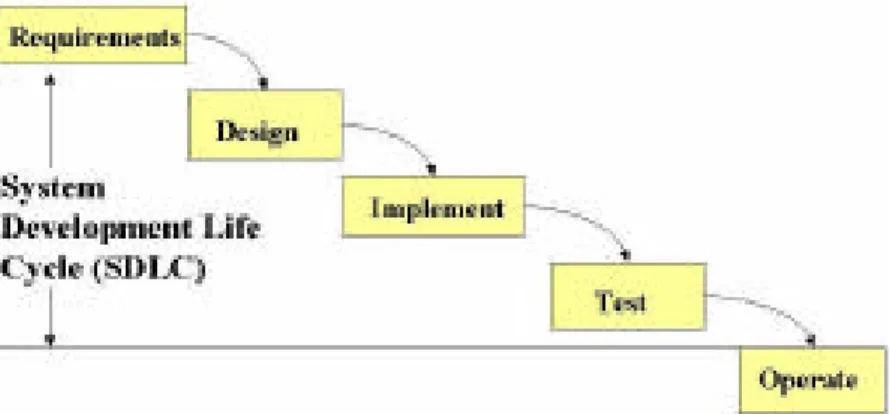
As highlighted by Cloutier (2004) software projects had been traditionally implemented using the well-known software methodology, the Waterfall Methodology. The Waterfall Methodology involves taking customer requirements, documenting these in a design document and the development team implementing these requirements to produce the required solution. Upon development of the
2
Company B-2-B is a Global organisation that contracted Company E-learn to build a Learning Management system for their employees. Company E-Learn tried to store Company B-2-B’s tacit and explicit knowledge in a tool that was available to all users inside Company E-Learn.
requirements, testing takes place after development and once tested the solution is delivered to the customer (Khalifa & Verner 2000).
The Waterfall Methodology is an approach to software development in a sequential matter, i.e. phases happen one after another. Jones (2001) highlighted in Applied
Software Measurement that 63% of projects failed in 1993 that used the Waterfall
Methodology. Within Company E-Learn, the Waterfall Methodology was used for all projects, which meant that knowledge was transferred from one phase to another in a sequential manner. As face-to-face conversations were had throughout the project lifecycle, less and less was documented as time moved on. As a result of this methodology, any tacit knowledge that was not recorded did not reflect the format at which it was created.
Figure 1-1 Waterfall Methodology (Kasser 2002) The research within this paper examines:
• What are the goals and aims of knowledge transfer within a software team?
• Why tacit knowledge is difficult to transfer to an explicit format?
• Can a tool, a Wiki tool, manage the tacit knowledge of a project?
• What are the main barriers to knowledge management project and knowledge transfer?
• Can tacit knowledge be transferred to individuals who were not a member of the original project team?
The following approach was taken to try to transmit the project knowledge of Project B-2-B to an explicit format for reuse by users outside of the project team.
1) Review of past implementations of similar scope was undertaken.
2) An approach in terms of a plan to organise, collect and disseminate project knowledge was undertaken which involved the following:
a. Every phase within the software lifecycle was reviewed and the
knowledge that might exist was classified into either tacit or explicit knowledge.
b. Communication media for the transfer of tacit knowledge was identified. c. Tacit knowledge that existed in the different communication media was
classified depending on its content into categories of knowledge.
d. Both the explicit and tacit knowledge was transferred into a project Wiki for all users to access.
e. Experiments were carried out with users inside and outside of the project team in order to analyse the success of knowledge transfer.
It was proven that knowledge transfer of both tacit and explicit knowledge is possible but certain barriers such as organisational culture, environment for transfer and processes for transfer have to be addressed.
As proven from the implementation in Company E-Learn and other knowledge management projects such as highlighted by Madden (2008) and McMahon (2008), there are barriers to the transfer of tacit knowledge such as resistance by users to share, technology to support knowledge sharing activities and an overall communication of what is expected in terms of the outcomes of sharing. As highlighted by Collison & Parcel (2001) the main issues fall under certain categories of organisational issues. Collison and Parcel highlighted that issues relating to knowledge management can be broken down into 70% of issues relating to people, 20% relating to process issues and 10% relating to technology issues. As highlighted below, each component of success for knowledge management does not exist on its own and each component needs to work in unison with each other to contribute to overall successful knowledge management. Knowledge transfer to others outside of the project team is achievable via a Wiki technology if all barriers, people, process and technology are addressed.
Examples of these barriers relating to people, process and technology, are highlighted below and discussed in the evaluation chapter of this research.
People Processes Technology
Knowledgeable individuals not sharing knowledge
Process of sharing tacit
knowledge with others not being defined
Technology to support storage of Tacit Knowledge not existing
Individuals not wanting to learn Process of converting tacit knowledge to explicit knowledge not being defined
Technology to support communication not existing
Knowledge Project Managers not knowing what should be shared
Process of merging old and new explicit knowledge together to form something new not being defined
Technology to support Collaboration not existing
Knowledge Marketing individuals not selling the initiative internally
Process of translating explicit knowledge into the practical doing of what has been documented not being defined
Technology to support Searching not existing
Senior Management not providing buy in for the project
Technology to support Changing Knowledge not existing
People outside the team not wanting to learn what happened on the project
Technology to support dispersed users not existing
Technology to support different
version of knowledge not existing
Table 1-1 Issues preventing efficient knowledge transfer
1.2 Background
Company E-Learn is a small E-Learning software company consisting of twenty-seven staff. Most projects teams vary from 5-6 team members from various disciplines, including Project Managers, developers and solution architects. The organisation sells an off-the-shelf Learning Management System. Projects normally range from three to four months in duration depending on the customer requirements. There are a diverse set of customers from domains such as financial services, oil refineries and domestic appliance producers.
A Wiki had been used in the company before this knowledge management project but was only used on occasion by 2-3 people in the organisation. Other users did not use the Wiki as they were unaware of the current uses and knowledge that was stored on this Wiki. The more knowledgeable workers were users who had been in the company for the longest duration and experienced the most project implementations. Users with less experience opted to obtain this knowledge through face-to-face conversation rather than searching on the Wiki.
A Waterfall Methodology was used for all projects within the organisation. This methodology meant that knowledge was being passed on at every stage of the lifecycle in a series of phases. The sequential approachnormally started with a business analyst defining the requirements, passing these requirements onto the solution architect ending with the developers developing the proposed solution for the client. Depending on the individuals themselves, different communication media were used to transfer knowledge, which included email, face to face to instant messaging. It was often the case that knowledge was lost in emails that was not updated in a document or transferred to the developer. Lessons learned and brain-storming meetings proved on several occasions that documents were not being correctly reflected. Knowledge exchanges in other media such as email and instant messaging were not being reflected in project documentation.
As every stage of the lifecycle from requirements to design involved interaction and conversations about the customer’s requirements both with the client and internally, many pieces of important knowledge were lost along the way. A previous phase of a project for customer B-2-B had showed that requirements conversations had gone undocumented and, as a result, when the project went to delivery, the customer was unsatisfied that they had received all of the functionality.
Coughlin (2002) highlighted that when discussing issues regarding requirements elicitation, knowledge acquisition and sharing can only be achieved through effective communication between the various stakeholders.
If users were not directly involved in communication in the project, users were unaware of certain agreements if they were not discussed at a project meeting. The requirements phase is only an example of how key knowledge learned from one
experience could be lost as different team members become involved. As highlighted by Bontis (2001), it is hard to really quantify loss in terms of statistics and financial loss as a result of knowledge loss due to its intangible nature but it can be proven on a less tangible scale. From a previous implementation of a project for Company B-2-B, knowledge loss from a requirements perspective resulted in an unhappy customer, which, as a result, could lead to a financial loss as the customer will not return for more business if unhappy with the service.
It is important to understand that new people provide new ways of doing things and are always required throughout a software project implementation and after its delivery from a support perspective. Users outside of the project team are beneficial in times of crisis, when certain users are not in the office and a problem needs to be solved. These users review documentation and compare with other implementations so designs are not documented with biased opinions. Users from a support team know exactly what happens at every phase of the project so that they can answer support questions without having to repeatedly contact the person who was on the project.
The focus is on the communication between the old and the new, and the creation of something usable from a combination of both. It is not only important to share this knowledge with other users outside of the project team to get opinions but to reduce risk. For example, if a company had to reduce costs and offer redundancy, often the highest paid workers are those who have the most knowledge. If valuable resources leave a company, this competitive knowledge is lost.
The challenge is the reliance on individuals to ensure that this knowledge is passed on and reused and does not become out of date and to specify what element of this management can be carried out by a tool.
The term knowledge transferral is potentially misleading, as it suggests that knowledge is moved from one location to another resulting in its removal from the original location. In reality, it should more accurately be viewed as knowledge reuse and renewal, encompassing new and old knowledge, and tacit and explicit knowledge. This is the knowledge that puts us ahead of our competitors as we are reusing what has
is to ensure that this knowledge is firstly shared, i.e. that users inside and outside the team come together and share this knowledge but to also create a place for sharing. There must be a tool that will allow the communication and collaboration of this tacit to tacit relationship. This tool must support the merging of this tacit knowledge with the already existing explicit knowledge, to create something new.
1.3 Research problem
The research problem involved identifying tacit and explicit knowledge for Company E-learn and ensuring that this knowledge existed in a place that was available for reuse for users that existed both in the project team and for users outside of the project team. This knowledge needed to be made available so that it was available to everyone, updated and merged with new experiences and once again reused by everyone.
Tacit and explicit knowledge existed at every stage of the software lifecycle. The challenge involved identifying both types of knowledge and who were the largest owners of this knowledge and in what format that this knowledge existed in. Tacit knowledge existed in many conversational formats including email, face-to-face and instant messaging.
In order to have one place for project knowledge, all knowledge had to be transferred to a technology that could manage this ever-changing project knowledge. The real challenge was not managing the explicit knowledge, as this was less changeable in nature, but the management of this changeable tacit knowledge.
This research attempted to maintain a record of this project knowledge (both explicit and tacit) for future references for all employees within the organisation, for those who existed in the team and those who were outside of the core project team.
1.4 Intellectual challenge
The overall goal of the knowledge management exercise was to ensure that both tacit and explicit knowledge gained initially and at all stages throughout a software development lifecycle for Company B-2-B was retained in one place and reused by those within and outside the project team.
The intellectual challenge was to:
1. Highlight and expose tacit knowledge at all phases of the software lifecycle. 2. Collect the tacit knowledge and explicit knowledge and place in a central
location.
3. Ensure that the central location can manage the changeable nature of the tacit knowledge.
4. Ensure that the tacit knowledge and explicit knowledge are clearly merged and visible.
5. Ensure that all users within the project team know how to contribute, where to contribute, when to contribute and what to contribute.
6. Ensure all users outside of the project team can clearly see and obtain all project knowledge at any time during and after the project implementation.
There is also a challenge to overcome any of the barriers that may exist to the transfer of knowledge, which may include people barriers in terms of using or not wanting to share or contribute to the knowledge management project people. There may be challenges about devoting time and resources to such a project.
There also may be limitations in terms of what the technology can do in terms of supporting the knowledge transfer process, i.e. not being able to correctly represent the knowledge that exits within users or not being able to show users when knowledge has changed or has been updated.
1.5 Research objectives
The focus of the research objective is to prove whether there is an appropriate way to manage the transfer of project knowledge in a software development project, so that this knowledge is available to all users within the organization. This project knowledge needs to be documented in such a way that it is easily referenced for those who were and were not involved in the original implementation. The goal of the research is to prove that this transfer of project knowledge into a central area for distribution is
ongoing communication of project knowledge, even when the project has been implemented. If one can prove that all project knowledge, both explicit and tacit, can be easily referenced, then results of this successful implementation have to be reviewed.
In summary, the research investigates the following:
1. Investigation was carried out to see if Company E-Learn was able to share tacit knowledge inside and outside the project team. The research investigates the issues regarding knowledge loss through the software lifecycle and reviews at what stage the knowledge loss is at the highest point.
2. What new processes and technology addressed knowledge loss at certain phases of the software development lifecycle?
3. What barriers existed to challenge the research objective? 4. How these barriers to knowledge transfer were overcome?
5. As a result of the findings of the research, what future recommendations could be made regarding the knowledge transfer process within the organisation?
1.6 Research methodology
In order to evaluate hypothesis regarding reasons for lack of knowledge transferral in the past and to decide on an approach moving forward, several different techniques were taken on board. As highlighted below, the entire knowledge transfer project was split into requirements, design, implementation and review. The tasks and approach for each phase is highlighted below.
Requirements
The requirements of the knowledge transfer process were decided by the Project Manager of the knowledge transfer process and agreed by Senior Management. Requirements were gathered by reviewing lessons learned from previous software project implementations and reviewing where the largest knowledge loss within the project was and who was responsible for this loss. Questionnaires were filled allowing team members to voice their opinions on what they thought the issues were. Meetings were held when the requirements of the knowledge transfer project were defined and a
solution had to be designed to propose how to address the knowledge transfer issues within the project team.
Design
Upon review of other implementations and review of documentation on the subject of knowledge transfer, an analysis of technologies to cater for knowledge transfer was taken on. The requirements were mapped to each technology and a suitability matrix allowed a tool to be chosen based on the most amount of requirements fulfilled.
A design document was put in place to highlight how the knowledge transfer project in terms of a new technology and a new process were going to be implemented.
Implementation
A wiki technology called Mediawiki was used as the tool to record all explicit and tacit knowledge for the project. Knowledge that existed from a previous phase was uploaded to the wiki, and the wiki was supposed to be the place for new knowledge moving forward, including knowledge gained post implementation.3
Review
Upon implementation of the wiki, a review in terms of usage of the tool was carried out. Questionnaires were filled out by team members asking questions about the knowledge tool and the knowledge sharing process. Open Interviews with team members allowed individuals to discuss why the project was or was not a success and to highlight barriers to the knowledge sharing process. Test scenarios were set up which asked users who were and were not members of the project team to extract knowledge from the wiki. Several tests were carried out over a period of time, reviewing user’s experiences as the quality of the knowledge improved over time.
A review of the success of the knowledge transfer process was carried out by comparing the original requirements with the solution that was implemented and how it was accepted by the team members.
3
MediaWiki is a free wiki technology developed using the scripting language PHP. MediaWiki is a type of technology that allows users to easily add content to a internet
1.7 Resources
Before the dissertation commenced, an overall approach was decided on, regarding a flow of tasks and prerequisites before implementation of the overall knowledge management project. Both primary and secondary research was taken on at various stages to assist in the preparation for the project.
At the initial stages of the project secondary research was carried out post analysis of the initial high-level requirements. Secondary research involved reading websites, and communities of practice, other dissertations and journals to see if other companies and individuals had recognized a similar problem.
Without review of the same problems within other organisations, opinions of the overall issue would be quite narrow. Reading other experiences allowed for expansion of thoughts on the implications of existing issues.
Primary research was also carried out before the implementation by creating questionnaires to obtain peoples opinions on the existing issues before any changes were made. Interviews were carried out with key project members that existed within the project team and outside of the project to get an overall picture of the success of the knowledge transfer process. Reviews were carried out with the Project Sponsor intermittently throughout the project. Questionnaires and interviews were carried out at the end of the implementation when the project had been in use for a period to obtain feedback on the success and failures of the system.
A usability test was carried out with members who were outside of the project team to ensure knowledge was transferable to new project members. When certain knowledge was not clearly taken on by users outside of the project team, changes were made to the Wiki and several regression tests were carried out to ensure that the knowledge was effectively passed on.
Technical Resources
Access was needed to the knowledge management technology that was already in place within the organisation. Assistance from the individuals who originally implemented the existing tool was required.
Access to various online resources was required for literature review regarding previous implementations or research on similar topics.
Internet access was required at all times for research and also for back-up of documentation.
All Microsoft packages, such as Excel (statistics), Word (documentation of results), PowerPoint (internal and final presentations), and Visio (flow of information in experiment) were used as a part of the research project.
Human Resources
Access to a Project Sponsor within Company E-Learn on an ad hoc basis was required to verify at the early stages that the requirements that were documented were correct and in line with what was necessary.
Time was required at the development and testing of the new knowledge management solution to ensure that the functionality had not wavered from the requirements in any way.
Time from a technical representative was also required to assist with any issues that may have arisen in terms of issues with a database, user interface, development or server connectivity etc.
Access to users for a period of time in terms of feedback before, during and after the implementation was required.
Access to users who had documented and implemented similar projects was also required to compare thoughts and implementations.
Scope and limitations
As part of the research, a concrete decision on what was achievable in the time period had to be decided upon. The overall objectives were clear but a decision on what could be achieved in the time period had to be agreed. The decision was made to focus on one client, in terms of creating a knowledge-sharing tool that would manage the tacit and explicit knowledge of a project but the analysis was mainly on the tacit to tacit and
tacit to explicit process. It was not feasible to include all of the organisation’s knowledge as a part of the scope of work as the time it would take to sort, upload and disseminate this information would be too large in the scope of time given. The existing Wiki architecture that was already in place was used but was re-branded and customised in one area for the chosen client.
Rolling the new process and knowledge management tool out to anyone outside the defined project team, giving the client access and rolling out the knowledge management tool to any other projects within the company was out of scope for this project.
The three and a half month time period only allowed research in open source tools, which meant that the functionality in terms of what it could provide were quite limited as there was no cost allowed for the implementation.
As the project did not have a budget there were no possibilities to implement a tool that had any support of licensing costs, which again resulted in risks in terms of implementing something that could result in issues and a lack of support being provided.
1.8 Organisation of the dissertation
The research is broken down into the following chapters.
Chapter 2 provides an overview of knowledge management, the different types of knowledge that exist in a software project, both explicit and tacit knowledge.
An overview of how knowledge is managed throughout its life as it passes through the spiral of knowledge is provided.
This chapter highlights how explicit and tacit knowledge is passed through the spiral of knowledge and issues regarding tacit knowledge at the socialisation process are investigated. Investigation into how this knowledge is effectively represented for organisational use is carried out.
Chapter 3 addresses the issue of knowledge transfer in a software project to users inside and outside of the project team. Chapter 3 highlights how knowledge passes through the different corners of the spiral of knowledge and where the main issues of
transfer occur. Chapter 3 also addresses the different media at which knowledge transfer can occur and how to clearly represent this knowledge when it comes together.
Chapter 4 discusses the main areas of knowledge loss in the knowledge transfer process in a software project. Analysis in term of loss of knowledge in a traditional lifecycle methodology such as the Waterfall Methodology is compared against newer agile methodologies such as XP and SCRUM. Investigation into the possibilities of introducing an agile method to improve the knowledge loss in a software project is discussed.
Chapter 5 examines the various technologies that can assist in the transfer of knowledge in a software project. This chapter focuses on Wikis as a tool to manage project tacit and explicit knowledge. This chapter highlights how Wikis can address the issues of making tacit knowledge explicit in a software project.
Chapter 6 explores the previous implementations of knowledge management tools that tried to overcome the transfer of tacit knowledge within a software project. Case studies of Wiki implementations, Semantic Wikis and Knowledge Management Projects were reviewed and discussed.
This analysis contributed to the approach taken at the experimentation stage.
Chapter 7 looks at the implementation of a Wiki as the knowledge management tool to manage the project’s tacit knowledge. Discussion about the approach, how requirements were defined and how the implementation of the tool was carried out is also documented. Chapter 7 focuses on the results of analysis taken after the project was released the team, and carries out tests to review the success of the Knowledge Management Project.
Chapters 8 focuses on the evaluation on the goals of the knowledge tool and highlights the lessons learned from the implementation. Overall evaluation in terms of the aims set out at the start of the project is evaluated and the conclusion on the best way to manage the transfer of tacit knowledge in a software project is provided. Future work in terms of what was out of scope but would be of interest to investigate further
2
KNOWLEDGE MANAGEMENT
2.1 Introduction
As the CEO of Pepsi once said the soft stuff is always harder than the hard stuff
(Enrico 1995).
It is always going to be a challenge to represent knowledge that has not been codified and does not exist in an explicit format. As a result, pockets of knowledge exist around the organisation and are not easily spread amongst others. This chapter investigates what knowledge management is, how knowledge is managed throughout its lifecycle and the issues regarding transferring knowledge to others and keeping this knowledge up to date. This chapter identifies how and where knowledge is lost throughout the software development lifecycle and will attempt to answer the question, how can knowledge be shared and reused?
2.2 What is Knowledge Management?
As highlighted by Young (2005) Knowledge Management is the discipline of enabling individuals, teams and entire organisations to collectively and systematically create, share and apply knowledge, to better achieve their objectives.
As Young highlights, knowledge management is about individuals, teams and organisations collectively sharing knowledge. Within the software development lifecycle, a vast amount of knowledge is created and reused, such as approaches on version control, coding reuse and software project management methods.
Depending on the approach and methodologies of the environment and company cultures where the software is being developed, this knowledge may be passed on to others or lost, updated or become out of date or incorrectly translated. Knowledge may exist within an individual and never be shared because someone might never know it existed. This tacit knowledge is informal knowledge not documented in a physical format (Polanyi 1967). As discussed by Nonaka (1995) explicit knowledge is knowledge that is saved in a document or has been recorded in some physical format
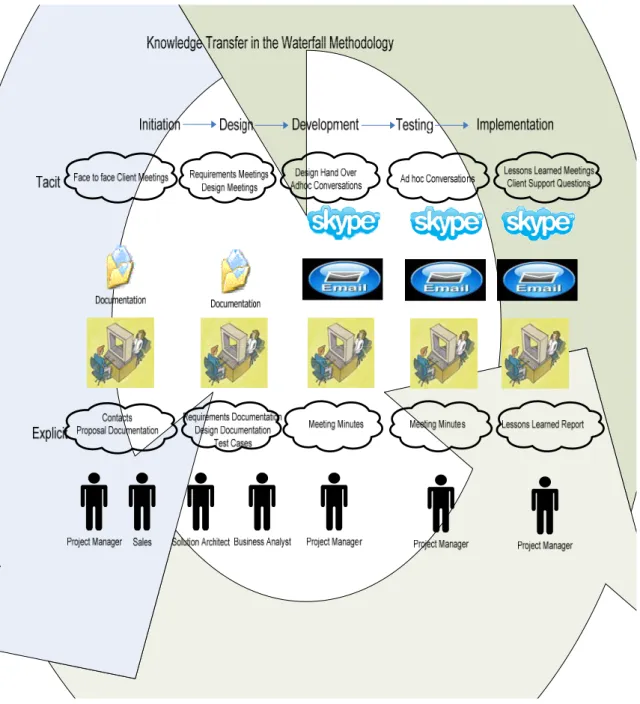
In a software development team, there is a large amount of knowledge transmitted via emails, instant messaging software and in documentation. As shown in the diagram below, knowledge becomes less formal, and of a more tacit nature as a software project progresses from requirements through to development.
Figure 2-1 Examples of Tact and Explicit Knowledge in the Software Lifecycle Knowledge is stored in both an explicit and tacit format at every stage of the project lifecycle. Knowledge is created at the start of a software project with customer requirements and passed onto different team members as it passes through the
development, testing and release phase. Knowledge changes format and is manipulated and lost depending on how well it is managed.
The challenge is to collect all of the project information, both explicit and tacit, and ensure that it is converted into a format that is usable for the entire organisation. The knowledge in this central location is not stored once and never reviewed by all but it is stored in such a way that it is self-maintaining. It should be used as the place for ongoing project collaboration and storage during and after implementation. Users should never be in a position to have to check if the data is up to date and correct.
Plato once said the learning and knowledge that we have, is, at the most, but little compared with that of which we are ignorant.
If we examine this statement closely, one realises that there is always the potential to never know what we don’t know exists, therefore being ignorant to what we could know. Our challenge is to expose knowledge that exists without actually searching for this knowledge or being aware it even exists.
The main challenge investigated in this research is the transfer of knowledge from one source or media to another. Investigation into the issues regarding knowledge transfer of the knowledge that exists in a tacit format to those who were not directly involved in the project has been carried out. Investigation as to whether this knowledge management tool can effectively manage this ever-changing knowledge has been carried out.
If something is not communicated or communicated ineffectively then, the cost to the software project is huge by the time is gets to the end of the software lifecycle as it does not clearly represent what the original picture looked like.
As highlighted by Nonaka & Takeuchi (1995), in an economy where the only certainty is uncertainty, the one source of lasting competitive advantage is knowledge.
The issue under research involves bringing together all project information from the various media and classifying this knowledge in order to allocate it a topic for searching and reuse. Within a software development lifecycle, knowledge should be accessible from a central location. Knowledge should be kept up to date with minimum effort from the software development team. Re-use within software development
projects is crucial to profit and success as there is the risk of continually re-inventing the wheel. As Benjamin Franklin once said time is money (Franklin 1748).
2.3 Types of Knowledge 2.3.1 Explicit Knowledge
Explicit Knowledge is knowledge that can be articulated and is visible to others. As highlighted by Sanchez (2000) this type of knowledge can be disseminated to others in many formats.
Explicit knowledge could be seen as easier to transfer to others as it exists in a physical format and can be easily passed on. Explicit knowledge also has the same issues that are highlighted in the spiral of knowledge with tacit knowledge, in that it needs to be kept up to date and when it is used by others so that it evolves into new knowledge. Examples of explicit knowledge in a software projects are design documents or test plans.
2.3.2 Tacit Knowledge
Tacit Knowledge is knowledge that is not codified or made explicit. It is knowledge that exists in minds of individuals through experience or learning. . Tacit Knowledge is a mix of experiences and is a build on information as it contains this mix of experiences and skills (Polanyi 1967).
Tacit Knowledge within a software development cycle is particularly difficult to codify as knowledge passes through many cycles and phases and changes over time and never exists in one format. It is a real challenge to pass knowledge onto others that is continually changing. As Nonaka (2000) said, the word “manage” highlights control, but can one ever control an ever-changing tacit environment? Bringing knowledge carriers together is the first step in the knowledge management process (Sanchez 2000).
2.3.3 The Spiral of Knowledge
Knowledge exists in both an explicit and tacit format. Knowledge does not stay in one place or never change but moves through many stages of communication and changes in state as it passes through.
The spiral of knowledge created by Nonaka and Takeuchi (1995) highlights that tacit and explicit knowledge circle and reconnect in a spiral motion.
There are 4 processes or exchanges at which knowledge is transferred, communicated or changed.
• Socialisation is the exchanging of tacit to tacit knowledge. An example of this would be a conversation between a solution architect and a developer on how to set up labels in the version control tool clear case.
• Externalisation is making this tacit knowledge explicit; for example,
documenting how to set up the labels in a procedure document.
• Combination involves merging this explicit knowledge with other explicit knowledge. In our example, this would be using this procedure document with a detailed design document to understand how to develop a piece of functionality.
• Internalisation is the changing of the explicit knowledge back to tacit knowledge by the practical implementation of doing what was specified in the explicit form.
Figure 2-2 Spiral of Knowledge (Girard 2006)
As highlighted in the Spiral of Knowledge, the process does not stop after the internalisation phase but begins again at the socialisation phase. The knowledge becomes more refined as it moves through the knowledge spiral. For example in the context of a software development environment, documentation is completed, reviewed with others and the solution is developed as per the requirements. If the documentation
solution will be more in line with what was required, as the knowledge will have moved through each stage of the spiral of knowledge several times.
In the Spiral of Knowledge, Nonaka looks at how from sharing and discussion, knowledge is created at the socialisation process. Nonaka believed that knowledge appears in both a tacit and explicit format. Knowledge is then translated into a format where it is externalized or made available to others. Though various techniques, and merging with other knowledge, knowledge is combined to become new knowledge and in the last step is reused and internalised by others (Nonaka et al 2000).
2.3.4 The issues regarding Knowledge Transfer in the Spiral of Knowledge
Although the knowledge is passed through the spiral of knowledge there exist many issues or potential issues at the different stages of its lifecycle.
The processes involved in Company E-Learn example are similar to the components of the spiral of knowledge in that knowledge is created at the socialisation stage, externalised and then issues arise at the stage of internalisation of reuse as the knowledge has not been clearly represented (Nonaka & Takeuchi 1995).
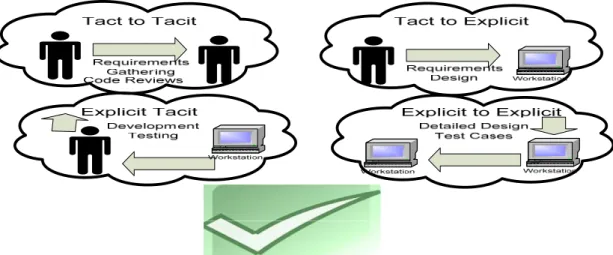
Within a software development project, knowledge is created at the initiation phase with face-to-face requirements gathering. Knowledge is then translated into an explicit format when it is translated into a requirements document and subsequently a design document. After the design stage, developers work on the implementation of the solution. At this point the system is tested and then delivered to the customer. Conversations regarding requirements normally happen outside of documentation as, when requirements are translated into design, clarifications and questions arise. When developers then go to develop the solution, there is further clarification from the business analyst or from the customer. The goal of this research is to try and successfully translate this tacit knowledge into an explicit format and merge this with existing explicit knowledge. Another issue that exists is post implementation of the project when decisions regarding functionality or changes are made to the system. In order to have a clear picture at any time of where the project is and what functionality is has, this tacit knowledge needs to be clearly documented and added to the already existing project knowledge. You will see from the picture below that in an ideal world
all requirements would be clarified at the requirements stage, everything needed in the design stage would be documented in a design document and everything would be developed as per what the customer wanted.
Figure 2-3 – Software transfer project with no knowledge transfer issues
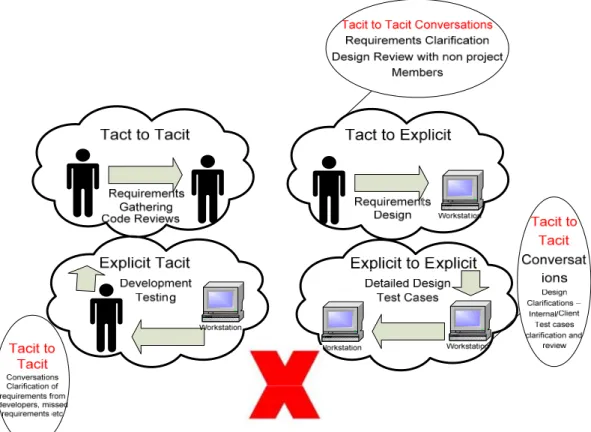
In reality, conversations do happen outside the normal documented process, and do not get clearly reflected in the explicit format that is required for all users to gain benefit from this knowledge. As you can see below, conversations do take place outside of the documented project knowledge. If this knowledge is not documented, users outside of the project team will never be able to understand exactly what was delivered and are operating on out-of-date knowledge.
Figure 2-4 – Issue of tacit to tacit communication outside the spiral of Knowledge In order to overcome this loss of tacit knowledge, from either one-to-one conversations with clients or internally within the group, firstly this tacit knowledge needs to be made global and secondly it needs to be converted into an explicit format and merged with existing explicit project knowledge. This tacit knowledge needs to be made expressible in a format that is comprehendible by others not involved in the original acquisition of the knowledge (Neef et al 1998).
Also, depending on the environment, there are certain other factors that limit the success of the spiral of knowledge. Nonaka (1997) highlights 5 enablers for knowledge management which are vision, strategy, structure, system and staff.
Vision is about creating the goals without any limitations. This is creating a global atmosphere for sharing without inhibitions. The strategy is about managing this vision and putting a plan in place to manage this vision and identifying the keys ways to make your knowledge rise to the top. Structure means keeping the goals of the project on track without inhibiting the knowledge management initiative itself. The system highlights how to do it, i.e. if it is a system itself or a new process and finally the staff are all the people involved in the entire knowledge management project. In a software
environment, knowledge will not be effectively expressed or transferred if all of these factors are not considered. The knowledge management initiative needs to be thought of as a project in itself with a strategy to manage itself, a system or process to manage the knowledge and to also identify the key players.
2.4 Conclusion
Some opinions are that to have knowledge about something is to experience it and so it is really nothing new but rather a build-up over time of something that has happened already either to you or to others. It is important that others who have not experienced something can also be as enriched with this knowledge without actually experiencing it. As Nonaka (2005) said, knowledge management is nothing new, the difference is that people who pass on knowledge and accept knowledge gain out of passing on and receiving this knowledge.
It is important to realise that you can not always make people accept knowledge or use the processes or tools put in place, but you can only try and make things better for people and make things as automated and make knowledge as accessible as possible. For something to be a success, no matter how complex it is or what you are trying to do, it needs to be easy to use and accept from a user’s point of view.
This involves making the environmental factors more in tune with the initiative, i.e. ensuring the system is in line with what needs to be done and the organisational culture is in tune with the requirements.
Davenport and Prusak (1998) provide three reasons why organisations implement
knowledge management systems: “”To enhance visibility of knowledge in
organisations, to build a knowledge-sharing culture, to develop a knowledge infrastructure, not confined solely to technology, but to create an environment that permits collaborative work.
As Davenport and Prusak highlight, you can only try to expose the knowledge where it exists and create avenues of open and shared communication. After this point, the rest is up to the users themselves.
Knowledge or the technologies are not the key factors to a successful knowledge management project. As Collison and Parcel (2001) highlighted, the largest percentage of the success of a knowledge management is about the people. As highlighted below people, process and technology do not sit out alone but are all closely linked. In essence it is the people who push the process and build the technology and use the technology and so without their involvement, knowledge transfer would never take place.
The main concern of this research is regarding the tacit to tacit relationship, also called the socialisation process of the spiral of knowledge. Losses or misunderstanding in the software development lifecycle tend to be where conversations have not been recorded or translated into explicit knowledge. There exist many media and many categories of tacit knowledge that need to be classified and sorted before merging together at the internalisation process. In terms of risk and greatest loss, this socialisation process proves the most difficult to manage.
Knowledge has to be expressed in a format that is understandable by others. In reality this tacit knowledge that is expressed and not codified anywhere needs to be codified and categorised and merged with what is already there. In Chapter 3, investigation into the different types of tacit knowledge generated through out the software lifecycle is investigated. The different media of transfer are also investigated, and ways around classifying this knowledge are reviewed. Knowledge is generated through tacit to tacit interactions, sorted and classified via technologies such as rules or manual sorting. Knowledge becomes less explicit the more it moves through the spiral and the further down the software development lifecycle.
This is why the need for one tool to possibly remove all of the communication media where knowledge is being classified and have one tool for sharing, collaboration of project knowledge. Even if it is not possible to remove the communication mechanisms, the investigation of transferring all of this tacit and explicit knowledge to one place is the next focus of the research.
3
KNOWLEDGE TRANSFER
3.1 Introduction
As Nonaka and Takeuchi (1997) highlighted, knowledge differs from information as it adds the human interpretation and reasoning to it. They describe it as a flux mix of framed experiences, values, contextual information and expert insight that provides a
framework for evaluating and incorporating new experiences and information.
Knowledge is the incorporation and merging of new and old experiences to provide new knowledge. Knowledge rarely stays in the same state or is understood in the same context. Knowledge passes through the spiral of knowledge and gains weight over time or in some cases losses weight. In a software project, knowledge starts at the beginning of a cycle and flows through each cycle of the waterfall changing from tacit to explicit back to tacit before resulting in an explicit format this is deliverable to a customer. This chapter investigates the types of knowledge that exists in each phase of the waterfall lifecycle and investigates the issues regarding the transfer of tacit knowledge. Analysis is completed on the four areas of the spiral of knowledge and at what area the knowledge is generated, updated, changed and reused.
3.2 Knowledge generation
Knowledge is created by using information obtained previously and putting this knowledge into practical experience. Tacit knowledge in its purest form is knowledge gained by an individual due to a mixture of information and organisational experience. In a software project, knowledge is created by past experiences of other projects and practical experience of processes from other companies. When this knowledge is shared with other individuals in a social matter, it is enhanced and merged and refined to create new knowledge. This stage of the spiral of knowledge is called the socialisation stage. Knowledge at this point is of a tacit nature and proves the most difficult to translate to others and put in an explicit format.
There are different types of knowledge that are relevant to a software project, which can be categorised into personal knowledge and organisational knowledge. Personal knowledge within the organisationalcontext is knowledge that users use to do their job
but is of little benefit to others within the organisation. An example of this would be procedural knowledge, such as creating a project plan from a project management perspective. Organisational knowledge is as it suggests, is knowledge obtained by a users regarding the organisation. This organisational knowledge would be of little use to a user if they left the company (Neef 1998).
There is much research on the differences between knowledge and data. Realistically one would not have knowledge without data, as knowledge is what one draws experiences and conclusions from. One must think that knowledge is created at the generation stage from tacit conversations and then converted to an explicit format. In a software project, there are face-to-face conversations with clients, which result in the challenge of trying to codify this tacit knowledge and put it in an explicit format. This document is then discussed and amended depending on outcomes of discussions. The issue is building all of these conversations into a big picture of what has been said or agreed outside of a document. In order for this tacit knowledge to be used, it needs to be sorted or classified into a format that can be easily understood. Every stage within the spiral of knowledge has an input and an output. The input at this stage is tacit knowledge about a subject, shared with another to produce a new piece of knowledge.
3.3 Knowledge Sorting and Classification
Before making something explicit, structure or format has to be applied to it. Intentionally or unintentionally, one creates headings in documents or folders on servers to classify our knowledge. Classification or association is not something that is new or something that has been created due to knowledge management. Classification is to class or categorise something. A type of classification originally invented in 1945 was called hyper linking. Hyper linking was invented by Vannervar Bush (1945). He first highlighted the idea of hyper linking as a way of an associative index.
Before hyper linking, classification started with the 'Dewey Decimal System', developed in1876 by Melvil Dewey. This was a paper card based classification system. As discussed by Gupta (1997) after several decades this form of classification itself was too large for a person to use.
Both attempts at classification sought to make things easier for those searching through an abundance of knowledge. At the time, the Dewey decimal system served a purpose
as its aim was to sort a certain amount of knowledge. The difficulties arose when the knowledge increased as the classification task itself became too big a task to manage. As with the Dewey Decimal system, in software development teams, the amount of knowledge to store, manage and share is becoming unmanageable.
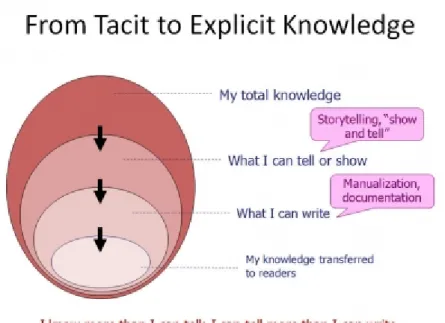
Figure 3-1 Tacit to Explicit Knowledge Conversion (Talisayon 2008)
Before investigation into the classification of knowledge, investigation into the tacit to tacit conversations within a software development project has to be carried out. The media, from which the knowledge comes, has to be reviewed. Within most software projects and within Company E-Learn, the main sources of communication are email communication, face to face and instant messaging.
3.3.1 Email
As highlighted by Pelfry (2002) when Tomillson invented email in 1971, he was not thinking of how, in 20 years time, knowledge would be sorted and reused at a later stage. Most types of project data in a software development team are communicated via email, from project release information to project schedules to lessons learned documentation.
Information communicated on, originally lies in project folders on a shared folder on server and some information resides with individuals and is discussed over email. In order to find something that has been sent to someone, a person has to be a part of the communication and also know what you are looking for and who sent it.
This highlights the issue of occasions in which one doesn’t always know what they’re looking for and one’s search is limited to what they do know. It also presents the issue that if someone outside of the project team is looking for a piece of project data; this is stored in one person’s email database and is not in a central location. This knowledge needs to be made public so all company members can be enriched with this knowledge.
Before this knowledge is made public and transferred to a central location, it needs to be sorted into an index of terms so that it is easily referenced and searched.
A good example of classification of email is highlighted by Kassim et al (2008). Kassim suggests that it is hard without large amounts of time spent searching to find an outcome of an issue discussed via communication. Kassim et al highlights how categorisation of emails using metadata helps in what is called a semantic email system. Here, the focus is on using the email system as the knowledge base rather than categorising the knowledge so that it can be exported somewhere else.
The study focuses on the use of semantics through back end logic looking for key words in email text and grouping based on certain words.
A piece of functionality that is of benefit, which was undertaken, was the rating of emails in order of importance. Without any type of technical advances to what is already there, users could rate information 1- 3 in order of importance and if there was a large amount of emails, these could be sorted in order of importance.
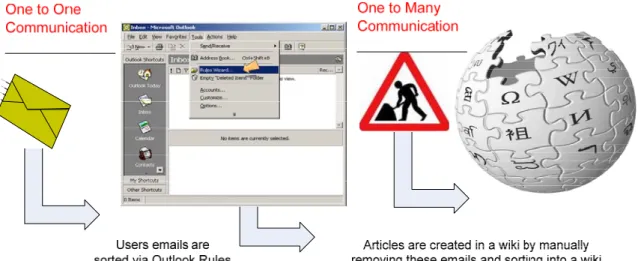
Within Outlook, there are also features that allow users to set up rules based on the information received. You can set up folders based on key words in the subject when emails are received. It important to clearly define your ontology first; it is hard within a standard email inbox to define ontology’s as it becomes more an index of terms without real relationships between each other. Ontology is more of a web on interconnected relationships linking concepts based on metadata (Grubber 1993).
Aery & Chakravarthy (2005) highlighted 3 high level categories of how to classify knowledge, Rule based classification to classify emails into folder, Information Retrieval based classification and Machine Learning based classification techniques – e.g. Naive Bayes for training.
As the focus of this research is on a small sized software development team, the need for changes to the email architecture to add algorithms based on frequency of words etc. is not required. The case study is only focused on a subsection of the company, where knowledge may be created daily but not so much that it is not sort-able without some preparation using rules in the email application itself.
Although the capabilities of the rules functionality within Microsoft Outlook may be quite extensive, the assumption is that one person gets all emails, and sorts this knowledge using the rules technique. The assumption cannot be made that the communication and transferral of knowledge is a many-to-many relationship. The knowledge manager needs to always be copied on every email, which is not always going to be the case.
As highlighted by Wagner (2004), e-mail is more of a one-to-one or one-to-many conversation tool without the central knowledge repository
Figure 3-2 Email Classification - Outlook Rules
An email software tool will never exist as a knowledge management tool because there needs to be areas for real time group collaboration and discussion, and all discussions need to be made public for its users to gain value out of the knowledge.
not going to be distributed to a client. If a tool is used to sort this knowledge or even ask someone to manually sort through emails to classify, the amount of effort normally outweighs the gain.
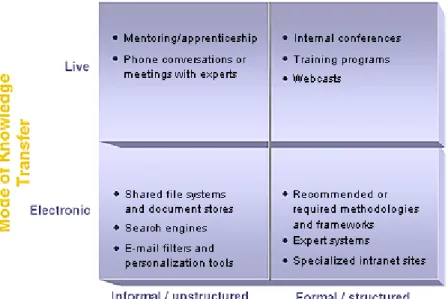
Figure 3-3 Formal and Informal Knowledge
As highlighted in Figure 3-3, in terms of formality, knowledge that appears in email databases and in folders on servers is unstructured and uncategorised. Due to the conversational nature of the knowledge shared, a large amount of conclusions on a topic are not something that can be immediately seen. Users who are participating in this knowledge need to be aware that this contribution is going to be reused and put this knowledge in a format that can be easily reused. A clear process in terms of user contribution needs to be highlighted. It is a real challenge to ask users to share a conversation after it has been completed due to privacy issues and sometimes depending on the content of the email.
The best approach is to dedicate or ask someone to document an outcome of a situation. This person could then email a central area directly, so that it is put in a place that can be seen by all and has a defined structure.
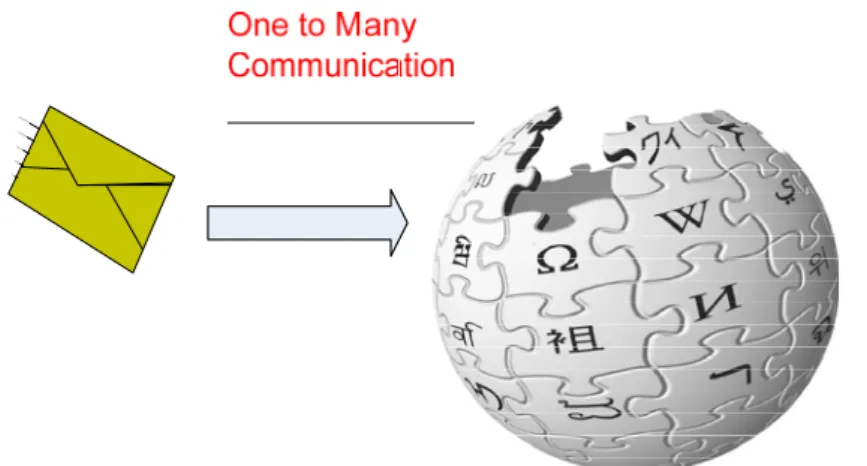
Another feature that removes the need for classification in an email inbox is a feature within the technology MediaWiki called emailtoWiki. This allows a user to email a Wiki article already existing in a Wiki or else create a new Wiki article.
This removes issues regarding one-way communication. The data may not be classified correctly on the Wiki itself, but investigation into the classification techniques within the knowledge tool itself are investigated later.
Figure 3-4 Email to Feature – Media Wiki
It has been proven that it is possible to classify knowledge in an email inbox based on rules. The next focus should be on transferring this classified information in the email inbox to a central location.
3.3.2 Instant Messaging
As the software development lifecycle progresses, requirements have been clarified and design documents have been delivered, conversations and communication become less formal and organised. Questions and clarification tend to be posed over communication media such as instant messaging tools like MSN or Skype.4
A large amount of valid knowledge is lost as conversations are carried out on a one-to-one basis. Some of these communication tools do have the multi-user capability but tend not to be used.
Even if this functionality is used, it is rarely passed onto any other media for distribution to others. The type of knowledge discussed over instant messaging is
4
Instant Messaging Software offers real time communication between people. Instant Messaging are sent by users typing text into a command box and the message being