
Applying Ensembles of Multilinear Classifiers in the Frequency Domain
Christian Bauckhage
Deutsche Telekom Laboratories
10587 Berlin, Germany
http://www.deutsche-telekom-laboratories.de
Thomas K¨aster and John K. Tsotsos
Centre for Vision Research, York University
Toronto, ON, M3J1P3, Canada
http://www.cs.yorku.ca/LAAV/Abstract
Ensemble methods such as bootstrap, bagging or boost-ing have had a considerable impact on recent developments in machine learning, pattern recognition and computer vi-sion. Theoretical and practical results alike have estab-lished that, in terms of accuracy, ensembles of weak clas-sifiers generally outperform monolithic solutions. How-ever, this comes at the cost of an extensive training pro-cess. The work presented in this paper results from projects on advanced human machine interaction. In scenarios like ours, online learning is a major requirement, and lengthy training is prohibitive. We therefore propose a different ap-proach to ensemble learning. Instead of a set of weak clas-sifiers, we combine strong, separable, multilinear discrim-inant functions. These are especially suited for computer vision: they train very quickly and allow for rapid classi-fication of image content. Training different classifiers for different contexts or on semantically organized data pro-vides ensembles of experts. We collapse a set of experts into a single multilinear function and thus achieve the same runtime for arbitrarily many classifiers as for a single one. Moreover, carrying out the classification in the frequency domain results in faster framerates. Experiments with im-age sequences recorded in typical home environments show that our ensemble training schemes yield high accuracy on unconstrained and cluttered data.
1. Introduction
In recent years, there have been many proposals for com-bining several cues or classifiers for improved performance in computer vision. For visual object learning, detection and recognition, classifier ensembles and probabilistic fea-ture selection techniques have led to stunning results (cf. e.g. [1, 6, 10, 19]). Theoretical findings in statistics and machine learning reveal that this success is rooted in statis-tical principles [5, 9, 15]. However, as robust as they are, the statistical nature of ensemble techniques necessitates huge amounts of training data or manifests in extensive training
times due to reiterated training steps. This hampers their use for applications where online learning is of critical im-portance.
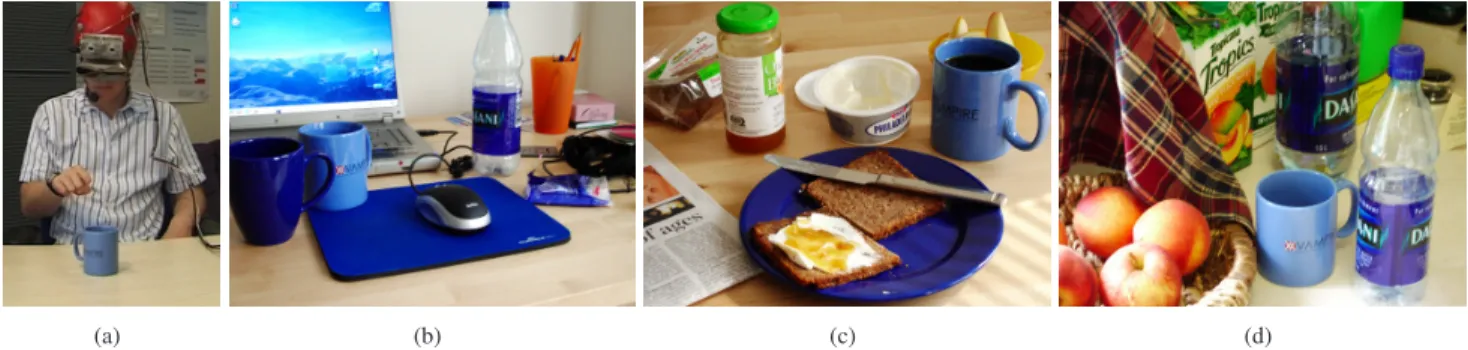
The approach presented in this paper aims at solving a problem we encountered in different projects on assis-tive technologies for the home environment. For exam-ple, Fig. 1(a) shows an experiment with a prototype of a pair ofmemory spectacles[3, 20]. Wearing a mobile, head mounted device with a microphone, two cameras and a dis-play, the user perceives the environment augmented with information generated by the system. Using speech or ges-tures, the system can be instructed to retrieve data or it can be taught about its environment. By displaying status mes-sages and prompts, it can communicate with its user. This closes the perception-action cycle; asking for manipulations of the environment in order to study their effects can accom-plish interactive object learning.
Due to the interactive nature of such scenarios, data ac-quisition and annotation can be done online. In order for the user to not experience ennui and frustration, the data has to be processed quickly and models have to be learned rapidly. Moreover, as these technologies are intended for use in nat-ural, unconstrained environments (see Fig. 1(b)–1(d)), we are in need of methods that perform robustly under a vari-ety of illumination conditions, view directions and cluttered backgrounds.
Recently, multilinear techniques have been shown to provide an efficient and robust approach to image coding and analysis [4, 16, 18, 21]. In this paper, we investigate their use for application in interactive scenarios. In partic-ular, we present three extensions of our earlier work in [4]. (i) We extend the alternating least squares approach to ten-sor discriminant analysis to third order tenten-sors so that effi-cient object detection in color images becomes possible. (ii) We apply the resulting classifiers in the 3D frequency do-main and thus obtain very high framerates. (iii) We consider two different ensemble training schemes for improved per-formance. Although they are everything but weak, tensor-based classifiers are well suited for application in an en-semble framework. Due to their multilinear nature, a whole
(a) (b) (c) (d)
Figure 1. 1(a) Advanced human-machine interaction using a prototype of a pair of memory spectacles. 1(b)–1(d) Examples of views as seen by the user when acting in unconstrained home environments.
committee can be summed into a single classifier. In terms of runtime, it therefore makes no difference whether we ap-ply a single classifier or literally hundreds of classifiers to an image. Experimental results presented in section 4 show that the proposed approaches are well suited for object de-tection in everyday home environments.
2. Tensor Discriminant Classification
The approach to tensor discriminant analysis presented in this section applies to real- and complex-valued ten-sors of arbitrary order. However, our practical applica-tion is concerned with color image analysis. Therefore, since color images can be interpreted as third-order tensors
I ∈ Rm1×m2×m3 where m1 and m2 denote the x- and y-resolution and m3 counts the number of color channels (e.g.m3 = 3for RGB images), we restrict our discussion to third-order tensors.
2.1. Training Tensor Discriminant Classifiers
Theinner productof two third-order tensorsAandBis defined as:A,B= i,j,k
AijkBijk. (1) Using Einstein’s summation convention, we may also write A,B = AijkBijk. Given a training set T of pairs {(Xl, yl)|l= 1, . . . , L}, where theXl∈Rm1×m2×m3are tensors sampled from two classes and the yl ∈ {−1,+1} denote class membership, tensor discriminant analysis seeks a projectionW,Xlof the samples that maximizes the inter-class distance of the resulting scalars. Assuming the data to be of zero mean, this can be cast as a regression problem W = argmin ˜ W L l=1 yl− W˜ ,Xl2. (2) If the projection tensorW is constrained to be decom-posable intoRtensors ofrank 1, it can be computed very
efficiently. We than have
W =R r=1
ur⊗vr⊗wr, (3)
where ⊗ denotes the outer product of vectors, and the problem in (2) reduces to a series of simpler optimizations within an alternating least squares scheme.
For the elementary case where R = 1, the procedure consists of the following steps. First, given a random guess for the vectorsu∈Rm1 andv∈Rm2, compute thetensor contractions
xl
i3 =Xi1i2i3l ui1 vi2, l= 1, . . . , L. (4) Stacking the resulting vectorsxl∈Rm3 into a sample ma-trixXyields the familiar least squares solution forw:
w=XTX−1XTy. (5)
Second, givenw, the training set is contracted overuandw in order to update the estimate ofv. Third, a new estimate ofucan be computed from the estimates ofvandw.
Since the procedure starts with arbitrary vectorsuand
v, it must be iterated until a suitable convergence criterion is met. Note that the magnitudes ofuandvcan be factored intow. In each iterationt,uandvcan thus be normalized to unit length and the sequences{u(t)}t∈Nand{v(t)}t∈N come to lie on the unit balls inRm1 andRm2, respectively. As this renders the problem a sequential optimization prob-lem over convex sets, convergence is guaranteed. Moreover, it provides convenient convergence criteria; for instance, the algorithm may stop, ifu(t)−u(t−1) ≤. Practical ex-perience shows that this usually converges in less than 10 iterations.
As seen in Fig. 2, it is straightforward to extend the alter-nating least squares scheme to the derivation of anR-term rank-1 decomposed solution for the projection tensorW. If
W =kr=1ur⊗vr⊗wris akterm solution for the pro-jection tensor, a next triplet of vectors(uk+1,vk+1,wk+1)
Input:a training set{Xl, yl}l=1,...,Lof image patches
Xl∈Rm1×m2×m3with class labelsyl∈ {−1,+1} Output:a rank-Rsolution of a third-order
projection tensorW =rur⊗vr⊗wr forr= 1, . . . , R t= 0 randomly initializeur(t) orthonormalizeur(t)w.r.t.{u1, . . . ,ur−1} randomly initializevr(t) orthonormalizevr(t)w.r.t.{v1, . . . ,vr−1} repeat t←t+ 1 contractxli3=Xi1i2i3l ui1r(t)vri2(t) computewr(t) =XTX−1XTy orthogonalizewr(t)w.r.t.{w1, . . . ,wr−1} similarly computevr(t) similarly computeur(t) untilur(t)−ur(t−1) ≤ ∨ t > tmax endfor
Figure 2. Alternating least squares scheme to compute a separa-ble third-order tensor classifierW given as a sum of completely orthogonal basis tensorsur⊗vr⊗wr.
can be found using the same procedure. Redundancy is avoided by requiring that the newly found rank-1 tensor
uk+1⊗vk+1⊗wk+1iscompletely orthogonalto its
prede-cessors [11]. We can therefore apply the (modified) Gram-Schmidt procedure with respect to the sets of vectors{ur}, {vr},{wr}, r≤k.
With respect to training effort, the alternating least squares approach to tensor discriminant analysis has sev-eral favorable characteristics. First, in contrast to tensor de-composition techniques, our method derives the projection tensor directly from the data and does not require a pre-ceeding computation of an unconstrainedW. Second, due to the rank-1 constraint, multilinear discriminant classifiers train quickly. If multivariate data of sizem1×m2×m3 were vectorized, conventional linear discriminant analysis (LDA) would require the inversion of matrices of sizes
m1m2m3×m1m2m3. Even for moderate choices ofm1
andm2, this may become infeasible. However, since the matrix inverses that appear in our algorithm are of consid-erably reduced sizes m3×m3,m2×m2 andm1×m1, our technique significantly shortens training. In practice, we found that, compared to LDA on very high dimensional
vector spaces, it reduces training times by several orders of magnitude. Finally, the algorithm does not suffer from small sample sizes. In conventional LDA, the within-class scatter matrix may be singular because the number of train-ing samples is much smaller than the dimension of the em-bedding space. In contrast, the matrices that appear in the above algorithm are small. Consequently, small training sets will not hamper tensor discriminant analysis.
2.2. Applying Tensor Discriminant Classifiers
In addition to their fast training behavior, decompos-able tensor discriminant classifiers also provide fast run-time. Note that classifying the content of a color imageI using a projection tensorWis essentially a 3D convolutionI∗W. IfW is a sum of rank-1 tensors, this reduces to a sequence of one-dimensional convolutions
I∗W = r I∗ur⊗vr⊗wr = r I∗ur∗vr∗wr. (6) This requiresO(R·(m1+m2+m3))operations per pixel and therefore already enables fast object detection. How-ever, for most useful mask sizesm1×m2×m3, there is an even faster option. Considerable speedup can be gained by applying the classifier in the frequency domain
F(I∗W) =F(I)F(W) (7) using a fast Fourier transformation. In our implementa-tion, we apply the FFTW [7], which has a runtime of
O(3MNlog(3MN))for color images ofM ×N pixels. Even for large images, one will thus havelog(3MN)
R·(m1+m2+m3)if the spatial extensionm1×m2of the classifier exceeds a few pixels.
Also, using zero mean data for training does not notice-ably decrease the speed of the resulting classifier. With
ˆ
X denoting the mean of the training samples, we have the identity
X−Xˆ,W=X,W − Xˆ,W. (8) Therefore, during runtime, shifting the data to zero mean requires only a single operation per pixel, since the scalar constantXˆ,Wcan be computed beforehand.
2.3. Performance of Tensor Discriminant Classifiers
The reduced number of free parameters in tensor-based discriminant classification is beneficial, not only in terms of training time, but also with respect to performance. For tasks of moderate visual complexity, tensor-based clas-sifiers were demonstrated to achieve high success rates0.5 0.6 0.7 0.8 0.9 1 0 0.1 0.2 0.3 0.4 0.5 0.6 0.7 0.8 recall 1 - precision cows cups
Figure 3. Detection results and precision-recall curve obtained on the ETHZ database of cows [12]. Confronted with different pos-tures, patterns of mottling and backgrounds, a single tensor dis-criminant classifier achieves an equal error rate of 96%. However, a similarly parameterized classifier for cup detection in the more complex scenes of our application (see Fig. 1) yields only 66%.
[4, 21]. Figure 3 exemplifies this by means of a stan-dard dataset. It shows exemplary detection results and a precision-recall characteristic obtained on the ETHZ database of cows [12]. The underlying third-order ten-sor discriminant classifier was trained on 1150 color image patches of size161×105×3, which, on a standard PC, took only 22 seconds.
Although the intended objects (viz the cows) notably vary in shape and texture, the detector yields an equal er-ror rate of 96%. Therefore, given the appropriate classifi-cation threshold, this simple, convolution-based approach is as accurate as the more involved part-based method in [12]. An empirical study on reasons for this performance revealed that rank-1 decomposable projection tensors cap-ture aspects of form and color alike and are less prone to noise and minor variations. At least compared to conven-tional linear discriminant classifiers, the fewer free parame-ters of tensor classifiers particularly adapt to predominant visual structures and thus allow for better generalization than vector-based approaches [2].
However, Fig. 3 also depicts the precision-recall charac-teristic of a tensor classifier intended to detect the blue cup that reappears in Figs. 1 and 7. Trained with a similar num-ber of positive and negative examples, this classifier only reaches an equal error rate of 66%. Clutter, inhomogeneous illumination, varying perspectives and the presence of vi-sually similar objects so typical for domestic settings can
hence overextend the capabilities of a single tensor clas-sifier. If we do not want to forgo the favorable training behavior of tensor discriminant classifiers, our application therefore requires an ensemble scheme that copes with the fact that even the less reliable members arestrongclassifiers with accuracies well above 50%.
3. Ensembles of Tensor Classifiers
Ensemble methods that combine several, typicallyweak, classifiers (e.g. decision tree stumps) are powerful tech-niques for high performance in classification and pattern recognition. If an ensemble {h1, h2, . . . , hI} is applied to a newly observed pattern x, the individual hypotheses
hi(x)are fused into an overall predictionH(x). For two-class problems, this usually results from a weighted major-ity vote: H(x) = sgn I i=1 αihi(x) . (9)
Many empirical studies have shown that ensemble classi-fiers resulting from algorithms such as bagging [5, 9] or boosting [9, 15] often generalize better than single, mono-lithic predictors. However, the strong performance contrasts with the effort required for training an ensemble. Since the committee members are weak and training includes re-peated processing of the samples, attention must be paid to feature selection and training time may be long.
On the other hand, multilinear classification algorithms like that in section 2 train rapidly and do not require too much care in the selection of features. However, as we saw in the examples above, they might be too strong to be of use in the context of ensemble learning. In fact, an exhaus-tive study by Skurichina and Duin [17] indicates that there are only a few cases where linear discriminant techniques may be applied within an ensemble framework. A com-bination of linear discriminant classifiers based on a bag-ging process, for instance, is useful only if the individual classifiers are weak and unstable. Boosting of linear dis-criminant classifiers was found to be useful only if the in-dividual classifiers perform poorly on large training sam-ple sizes. Therefore, since tensor-based discriminant classi-fiers generally outperform traditional LDA approaches even and especially if sample sizes are small, none of the criteria identified by Skurichina and Duin applies to our approach. Nevertheless, multilinear classifiers may of course still suf-fer from the tacit assumption of a bimodal data distribution whose limitations are exemplified in Fig. 4.
To overcome these limitations, we propose to combine context-specific or semantically specialized classifiers into committees. A single element of such an ensemble is ei-ther trained for a certain image context or with regard to se-mantically organized classes of background patterns. This
Figure 4. Didactic example of the limitations of linear classifiers. Applying traditional Fisher LDA to datasets with several modes yields poor separations as on the left. The improved separation on the right results from an ensemble of two LDA predictors. Each classifier was trained with the same set of positive (+) but different sets of negative (◦) samples.
yields committees of experts whose combined performance exceeds that of a single predictor.
3.1. Training Sets of Experts
In an ensemble of context specific classifiers, we train each single predictor for a different environment. Assume there areIcontexts (for instance, different scenes observed in different rooms), then classifierWiis trained with a set of positive and negative samples recorded in the ith envi-ronment: Tpos i = Ki ki=1 Xpos ki and T neg i = Li li=1 Xneg li . (10)
The resulting ensembleEW ={W1,W2, . . . ,WI} con-sists ofIcontext experts.
A second approach to obtain a useful ensemble of mul-tilinear classifiers is to organize the training samples into semantic classes. Here, the positive samplesXposk and the negative patchesXnegl gathered from different contexts are combined into unified training sets
Tpos= K k=1 Xpos k and Tneg= L l=1 Xneg l . (11) For the positive training set, each element represents a view of the object of interest from different contexts. The training set of negative samples consists of counterexamples which may belong to semantically different background objects or scenes. Since a monolithic multilinear classifier trained on such a variety of samples may not account for different modes possibly contained in the data, we organize the neg-ative training examples into semantic classes. This is done by clustering the dataset into groups of similar elements. Consequently, the training setTneg is partitioned into
sev-eral disjoint subsetsTineg:
Tneg= I i=1 Tneg i . (12)
In this case, I corresponds to the number of training sets of negative examples. Similar to the context-specific ap-proach, each individual classifierWiof the ensembleEW is trained with a training setTi, with
Ti=Tpos∪Tineg. (13) This results in I predictors, each of which is specialized in separating the class of interest from a different semantic class. Although each single classifier is trained to solve a two class problem, the whole ensemble now solves a1 to manyclassification problem.
3.2. Applying Ensemble Classifiers
In a na¨ıve approach to analyzing the content of an im-ageI, each tensor discriminant predictor of an ensemble could be successively applied. This would lead to individ-ual classifier responses which had to be summed to the over-all response. However, although a single tensor discrimi-nant classifier is very fast, running a whole set will be too time consuming for the real-time requirements in human-machine interaction. Here, the multilinear nature of the in-dividual experts reveals its potential for application in en-semble frameworks. In contrast to techniques such as clas-sification trees or other weak learners usually encountered in committee methods, an ensemble of multilinear classi-fiers can be collapsed into a single predictor using the dis-tributive property
EW(I) =I∗W1+I∗W2+· · ·+I∗WI =I∗(W1+W2+· · ·+WI)
=I∗W. (14)
Collapsed into a single multilinear function
WX= I i=1 X,Wi=X, I i=1 Wi (15) a whole ensemble thus achieves the same runtime as a monolithic classifier. Consequently, using large ensembles of multilinear classifiers only affects the training step and has no negative effect on the runtime.
4. Experimental Results
The proposed ensemble schemes for tensor-based dis-criminant classifiers were tested on a collection of images recorded in four different home environments. In each ex-periment, the task was to detect a blue, cylindrical cup in
Figure 5. Exemplary training data used for training an ensemble of tensor discriminant classifiers with respect to semantic classes. The first row shows a subset of the positive training samples shared by all the experts. The other rows depict negative training samples; each row represents elements belonging to one cluster. Overall, 40000 image patches were clustered into 500 groups using 22 di-mensional fuzzy color histograms in the HSI color space.
scenes cluttered with different objects. For each of the dif-ferent context classes, the amount of clutter, the illumina-tion condiillumina-tions and the view angle vary considerably.
The evaluation set consists of 100 manually annotated color images of size320×240of a publicly available dataset [22]. 10 images of each environment are used for training and the remaining 60 images constitute the test set. Our test compared both proposed ensemble schemes with the single, monolithic multilinear classifier we already briefly discussed in section 2. All methods are trained with unpre-processed RGB color image patches of size82×102×3 and the experiments were run on a 3GHz Xeon PC.
For the ensemble of four context dependent classifiers, each expert was trained with 200 positive and 500 negative image patches from the specific context. Training the whole ensemble took an average of 37 seconds.
In order to train the ensemble of semantic classifiers, 80 positives and 40000 negative patches were extracted from the 40 training images. Grouping of the negative exam-ples should not be too time-consuming in a human-machine interaction application. To this end, we applied the k -means algorithm [14] to cluster the negative samples into
0.5 0.6 0.7 0.8 0.9 1 0 0.1 0.2 0.3 0.4 0.5 0.6 0.7 0.8 recall 1 - precision semantic ensemble context ensemble monolithic classifier
Figure 6. Precision-recall curves for the proposed ensemble meth-ods and for a single monolithic tensor discriminant classifier. The test set consists of 60 different scenes with different illumination conditions and cluttered background. Under these conditions, the ensemble of semantic experts reaches an equal error rate of 93%.
method EER ttrain # classifiersttrain semantic ensemble 93% 1388s 7s
context ensemble 87% 37s 9s monolithic classifier 66% 16s 16s
Table 1. Summary of classifier characteristics.
500 groups, because it processes the training set only once. Since the amount of training data is large, the resulting clus-ters are comparable to the ones produced by enhanced but slower versions of this algorithm [8, 13]. Clustering was based on fuzzy color histograms computed from the image patches. For the subsequent training step, clusters contain-ing less than 80 examples were discarded. From each of the remaining 179 clusters (see Fig. 5), 80 examples were ran-domly drawn to form the set of negative examples. The set of positives examples was shared by all the experts. Group-ing the negative image patches into clusters took 8 seconds on average. Training the ensemble of 179 classifiers re-quired an average of about 1380 seconds.
The monolithic classifier was considered for baseline comparison. To avoid overfitting, it was trained with 20 positive and 40 negative image patches per training image. Training with the overall amount of 2400 patches took 16 seconds on average.
Figure 6 shows precision-recall curves for each classifier resulting from varying the classification thresholdθ. Note that, since both ensemble classifiers were summed to a sin-gle function, they could be evaluated as if they were a mono-lithic classifier. Also, since the ensembles were collapsed into single classifiers, each of the tested approaches had the
same runtime behavior and processed 12 images per sec-ond. However, with respect to detection accuracy there are considerable differences.
Obviously, the classification boundary learned by the monolithic classifier does not generalize from the training to the test set. Although, in earlier experiments on smaller test sets, we found individual multilinear classifiers to per-form robustly, the variations in the set considered here ex-ceed the capabilities of a single classifier. The ensemble of four context experts reached an equal error rate of 87%; with the ensemble of 179 semantic experts, we obtained an equal error rate of 93%. Figure 7 shows qualitative results produced by the semantic ensemble; Tab. 1 summarizes our quantitative findings.
Although the semantic ensemble provides a relative im-provement of 6% over the ensemble of context experts, the latter still seems appropriate for interactive scenarios. Since the committee consists of multilinear functions, the context-based approach can be iteratively extended to new situa-tions. All that is required is to provide further sets of posi-tive and negaposi-tive training examples and to add the resulting classifiers to the one learned thus far. The degree to which such ensembles can be extended without decreasing the per-formance is a topic of ongoing research. However, since the semantically specialized ensemble yielded the best per-formance in our test, we are also investigating methods for improving training time.
5. Summary
This paper presented an approach to fast visual learn-ing for assistive technologies. Since, in advanced human-machine interaction, the bottleneck for learning is not the acquisition and annotation of data but the training process itself, methods are required that learn rapidly but that also perform reliably. Tensor-based methods for image analy-sis have recently been shown to provide this quality. They perform robustly and enable online learning.
Aiming at robust color image analysis, we described an alternating least squares approach to tensor discrimi-nant analysis on third-order tensors. We proposed apply-ing the resultapply-ing decomposable tensor classifiers in the 3D frequency domain and considered two different ensemble schemes for improved robustness in object detection. Due to the distributive property of multilinear predictors, an en-semble can be summed to form a single decision function. Therefore, in terms of runtime, it makes no difference if an image is analyzed by one or several predictors. Experimen-tal results obtained on scenes of various illuminations, view directions and cluttered backgrounds show that ensembles of multilinear classifiers perform robustly in environments typically encountered in application scenarios for assistive technologies.
Currently, we are exploring parallelization techniques
for the training process. To this end, we investigate, if the individual experts can be obtained from combiningR= 1 -term rank-1 solutions for the discriminant projection which are computed in parallel.
Acknowledgements
During his stay as a visiting scientist at the Centre for Vision Research in Toronto, Thomas K¨aster was generously supported by a scholarship from the Applied Computer Sci-ence Group at Bielefeld University, Germany. We want to thank Gerhard Sagerer, who is heading the group, for sup-porting this work by providing these grants.
References
[1] S. Agarwal, A. Awan, and D. Roth. Learning to Detect Objects in Images via a Sparse, Part-based Representation.
IEEE Trans. Pattern Anal. Machine Intelli., 26(11):1475– 1490, 2004.
[2] C. Bauckhage. Benefits of Tensor-Based Discrimiant Classi-fication for Object Detection. Technical Report TR2006-01, Deutsche Telekom Laboratories, 2006.
[3] C. Bauckhage, M. Hanheide, S. Wrede, and G. Sagerer. A Cognitive Vision System for Action Recognition in Office Environments. InProc. CVPR, volume II, pages 827–833, 2004.
[4] C. Bauckhage and J. Tsotsos. Separable Linear Classifiers for Online Learning in Appearance Based Object Detec-tion. InProc. CAIP, volume 3691 ofLNCS, pages 347–354. Springer, 2005.
[5] L. Breiman. Bagging Predictors. Machine Learning, 24(2):123–140, 1996.
[6] R. Fergus, P. Perona, and A. Zisserman. Object Class Recog-nition by Unsupervised Scale-Invariant Learning. InProc. CVPR, volume II, pages 264–272, 2003.
[7] M. Frigo and S. Johnson. The Design and Implementation of FFTW3.Proc. of the IEEE, 93(2):216–231, 2005. [8] K. Fukunaga.Introduction to Statistical Pattern Recognition.
Academic Press, 1990.
[9] T. Hastie, R. Tibshirani, and J. Friedman. The Elements of Statistical Learning. Springer, 2001.
[10] J. Kittler and A. Ahmadyfard. Multiple Classifier System Approach to Model Pruning in Object Recognition. InProc. ECCV, pages 342–353, 2004.
[11] T. Kolda. Orthogonal Tensor Decompositions.SIAM J. Ma-trix Anal. Appl., 23(1):243–255, 2001.
[12] B. Leibe, A. Leonardis, and B. Schiele. Combined Ob-ject Categorization and Segmentation with an Implicit Shape Model. In Proc. ECCV Workshop Statistical Learning in Computer Vision, Prague, May 2004.
[13] S. Lloyd. Least Squares Quantization in PCM. IEEE Trans. Inform. Theory, 28(2):129–137, 1982.
[14] J. MacQueen. Some Methods for Classification and Analy-sis of Multivariate Observations. In L. L. Cam and J. Ney-man, editors,Proc. 5th Berkeley Symp. Mathematical Statis-tics and Probability, volume 1, pages 281–296, 1967.
Figure 7. Detection examples produced by the semantically trained ensemble of multilinear classifiers. Each row corresponds to one of the four context classes contained in the evaluation set. Due to different light source directions and changing view angles, the target object varies in color and size. Also, there are several objects of similar color and form. Nevertheless, the ensemble of tensor classifiers performs robustly under these conditions.
[15] R. Schapire. The Strength of Weak Learnability. Machine Learning, 5(2):197–227, 1990.
[16] A. Shashua and A. Levin. Linear Image Coding for Regres-sion and Classification using the Tensor-rank Principle. In
Proc. CVPR, volume I, pages 42–40, 2001.
[17] M. Skurichina and P. Duin. Bagging, Boosting and the Ran-dom Subspace Method for Linear Classifiers. Pattern Anal. Appl., 2002(5):121–135, 2002.
[18] M. Vasilescu and D. Terzopoulos. Multilinear Image Analy-sis for Facial Recognition. InProc. CVPR, volume II, pages 511–514, 2003.
[19] P. Viola and M. J. Jones. Robust Real-Time Face Detection.
Int. J. Comput. Vision, 57(2):137–154, 2004.
[20] S. Wrede, M. Hanheide, S. Wachsmuth, and G. Sagerer. In-tegration and Coordination in a Cognitive Vision System. In
Proc. ICVS, pages 1–8, 2006.
[21] S. Yan, D. Xu, L. Zhang, X. Tang, and H.-J. Zhang. Discrim-inant Analysis with Tensor Representation. InProc. CVPR, volume I, pages 526–532, 2005.
[22] YorkU Collection of Home Environment Pictures 2005. www.cs.yorku.ca/LAAV/projects/cup/index en.html.

![Figure 3. Detection results and precision-recall curve obtained on the ETHZ database of cows [12]](https://thumb-us.123doks.com/thumbv2/123dok_us/781951.2598895/4.918.83.419.105.432/figure-detection-results-precision-recall-curve-obtained-database.webp)


