March 2008, Volume 25, Issue 4. http://www.jstatsoft.org/
clValid
: An
R
Package for Cluster Validation
Guy Brock Universtiy of Louisville Vasyl Pihur Universtiy of Louisville Susmita Datta Universtiy of Louisville Somnath Datta Universtiy of Louisville Abstract
The R package clValid contains functions for validating the results of a clustering analysis. There are three main types of cluster validation measures available, “inter-nal”, “stability”, and “biological”. The user can choose from nine clustering algorithms in existing R packages, including hierarchical, K-means, self-organizing maps (SOM), and model-based clustering. In addition, we provide a function to perform the self-organizing tree algorithm (SOTA) method of clustering. Any combination of validation measures and clustering methods can be requested in a single function call. This allows the user to si-multaneously evaluate several clustering algorithms while varying the number of clusters, to help determine the most appropriate method and number of clusters for the dataset of interest. Additionally, the package can automatically make use of the biological informa-tion contained in the Gene Ontology (GO) database to calculate the biological validainforma-tion measures, via the annotation packages available in Bioconductor. The function returns an object of S4class “clValid”, which has summary, plot, print, and additional methods which allow the user to display the optimal validation scores and extract clustering results. Keywords: clustering, validation, R package, stability measures, biological annotation, func-tional categories.
1. Introduction
Clustering is an unsupervised technique used to group together objects which are “close” to one another in a multidimensional feature space, usually for the purpose of uncovering some inherent structure which the data possesses. Clustering is commonly used in the analysis of high-throughput genomic data, with the aim of grouping together genes or proteins which have similar expression patterns and possibly share common biological pathways (DeRisiet al.
1997;Chu et al.1998;Eisen et al.1998;Bhattacherjee et al.2007). A plethora of clustering algorithms currently exist, many of which have shown some promise in the analysis of genomic data (Herreroet al.2001;McLachlanet al.2002;Dembele and Kastner 2003;Fu and Medico 2007). Deciding which clustering method to use can therefore be a daunting task for the researcher conducting the experiment. An additional, related problem is determining the number of clusters that are most appropriate for the data. Ideally, the resulting clusters should not only have good statistical properties (compact, well-separated, connected, and stable), but also give results that are biologically relevant.
A variety of measures aimed at validating the results of a clustering analysis and determining which clustering algorithm performs the best for a particular experiment have been proposed
(Kerr and Churchill 2001;Yeunget al.2001;Datta and Datta 2003). This validation can be
based solely on the internal properties of the data or on some external reference, and on the expression data alone or in conjunction with relevant biological information (Gibbons and
Roth 2002;Gat-Vikset al. 2003;Bolshakovaet al. 2005;Datta and Datta 2006). The article
by Handl et al. (2005), in particular, gives an excellent overview of cluster validation with
post-genomic data and provides a synopsis of many of the available validation measures. In this paper, we present an R package clValid which contains a variety of methods for validating the results from a cluster analysis. The main function is clValid(), and the available validation measures fall into the three general categories of “internal”, “stability”, and “biological”. The user can simultaneously select multiple clustering algorithms, vali-dation measures, and numbers of clusters in a single function call, to determine the most appropriate method and an optimal number of clusters for the dataset. Additionally, the
clValid package makes use of the biological information contained in the Gene Ontology (GO, http://www.geneontology.org/) database via the annotation packages in Bioconduc-tor (http://www.bioconductor.org/) in order to automate the calculation of the biolog-ical validation measures. The package also contains a function for implementing the self-organizing tree algorithm (SOTA Dopazo and Carazo 1997), which to our knowledge has not been previously available in R packages on the Comprehensive R Archive Network (CRAN,
http://CRAN.R-project.org). The function returns an object of S4 class “clValid”, which has a variety of methods available to plot and summarize the validation measures, display the optimal scores along with the corresponding cluster method and number of clusters, and extract the clustering results for a particular algorithm.
The rest of this paper is organized as follows. Section2contains a detailed description of the validation measures that are available. Section 3 describes the clustering algorithms which are available to use with theclValidpackage. Section4contain an example using mouse gene expression data fromBhattacherjeeet al.(2007) that illustrates the use of theclValidpackage functions and objects. Finally, Section 5discusses some additional validation software which is available, and some of the benefits our software provides in comparison.
2. Validation measures
The clValid package offers three types of cluster validation, “internal”, “stability”, and “bio-logical”. Internal validation measures take only the dataset and the clustering partition as input and use intrinsic information in the data to assess the quality of the clustering. The stability measures are a special version of internal measures. They evaluate the consistency of
a clustering result by comparing it with the clusters obtained after each column is removed, one at a time. Biological validation evaluates the ability of a clustering algorithm to pro-duce biologically meaningful clusters. We have measures to investigate both the biological homogeneity and stability of the clustering results.
2.1. Internal measures
For internal validation, we selected measures that reflect the compactness, connectedness, and separation of the cluster partitions. Connectedness relates to what extent observations are placed in the same cluster as their nearest neighbors in the data space, and is here measured by the connectivity (Handlet al.2005). Compactness assesses cluster homogeneity, usually by looking at the intra-cluster variance, while separation quantifies the degree of separation between clusters (usually by measuring the distance between cluster centroids). Since compactness and separation demonstrate opposing trends (compactness increases with the number of clusters but separation decreases), popular methods combine the two measures into a single score. The Dunn index (Dunn 1974) and silhouette width (Rousseeuw 1987) are both examples of non-linear combinations of the compactness and separation, and with the connectivity comprise the three internal measures available in clValid. The details of each measure are given below, and for a good overview of internal measures in general see Handl et al. (2005).
Connectivity
Define nni(j) as the jth nearest neighbor of observation i, and let xi,nni(j) be zero if i and
nni(j) are in the same cluster and 1/j otherwise. Then, for a particular clustering partition C={C1, . . . , CK} of theN observations into K disjoint clusters, the connectivity is defined
as Conn(C) = N X i=1 L X j=1 xi,nni(j) ,
where L is a parameter that determines the number of neighbors that contribute to the connectivity measure. The connectivity has a value between zero and ∞ and should be minimized.
Silhouette width
The silhouette width is the average of each observation’s silhouette value. The silhouette value measures the degree of confidence in the clustering assignment of a particular observation, with well-clustered observations having values near 1 and poorly clustered observations having values near−1. For observationi, it is defined as
S(i) = bi−ai max(bi, ai)
,
whereai is the average distance betweeniand all other observations in the same cluster, and
bi is the average distance betweeniand the observations in the “nearest neighboring cluster”,
i.e. ai = 1 n(C(i)) X j∈C(i) dist(i, j), bi = min Ck∈C\C(i) X j∈Ck dist(i, j) n(Ck) ,
where C(i) is the cluster containing observation i, dist(i, j) is the distance (e.g. Euclidean, Manhattan) between observations i and j, and n(C) is the cardinality of cluster C. The silhouette width thus lies in the interval [−1,1], and should be maximized. For more informa-tion, see the help page for the silhouette() function in package cluster (Rousseeuw et al.
2007).
Dunn index
The Dunn index is the ratio of the smallest distance between observations not in the same cluster to the largest intra-cluster distance. It is computed as
D(C) = min Ck,Cl∈C, Ck6=Cl min i∈Ck, j∈Cl dist(i, j) max Cm∈Cdiam(Cm) ,
where diam(Cm) is the maximum distance between observations in cluster Cm. The Dunn
index has a value between zero and ∞, and should be maximized.
2.2. Stability measures
LetN denote the total number of observations (rows) in a dataset and M denote the total number of columns, which are assumed to be numeric (e.g., a collection of samples, time points, etc.). The stability measures compare the results from clustering based on the full data to clustering based on removing each column, one at a time (Datta and Datta 2003;
Yeung et al. 2001). These measures work especially well if the data are highly correlated,
which is often the case in high-throughput genomic data. The included measures are the average proportion of non-overlap (APN), the average distance (AD), the average distance between means (ADM), and the figure of merit (FOM). In all cases the average is taken over all the deleted columns, and all measures should be minimized.
Average proportion of non-overlap (APN)
The APN measures the average proportion of observations not placed in the same cluster by clustering based on the full data and clustering based on the data with a single column removed. Let Ci,0 represent the cluster containing observation iusing the original clustering (based on all available data), and Ci,` represent the cluster containing observation i where the clustering is based on the dataset with column ` removed. Then, the APN measure is defined as AP N(C) = 1 M N N X i=1 M X `=1 1−n(C i,`∩Ci,0) n(Ci,0) .
The APN is in the interval [0,1], with values close to zero corresponding with highly consistent clustering results.
Average distance (AD)
The AD measure computes the average distance between observations placed in the same cluster by clustering based on the full data and clustering based on the data with a single
column removed. It is defined as AD(C) = 1 M N N X i=1 M X `=1 1 n(Ci,0)n(Ci,`) X i∈Ci,0,j∈Ci,` dist(i, j) .
The AD has a value between zero and∞, and smaller values are preferred.
Average distance between means (ADM)
The ADM measure computes the average distance between cluster centers for observations placed in the same cluster by clustering based on the full data and clustering based on the data with a single column removed. It is defined as
ADM(C) = 1 M N N X i=1 M X `=1
dist(¯xCi,`,x¯Ci,0),
where ¯xCi,0 is the mean of the observations in the cluster which contain observation i, when
clustering is based on the full data, and ¯xCi,` is similarly defined. Currently, ADM only uses
the Euclidean distance. It also has a value between zero and∞, and again smaller values are prefered.
Figure of merit (FOM)
The FOM measures the average intra-cluster variance of the observations in the deleted col-umn, where the clustering is based on the remaining (undeleted) samples. This estimates the mean error using predictions based on the cluster averages. For a particular left-out column `, the FOM is F OM(`,C) = v u u t 1 N K X k=1 X i∈Ck(`) dist(xi,`,x¯Ck(`)),
where xi,` is the value of the ith observation in the `th column, and ¯xCk(`) is the average
of cluster Ck(`). Currently, the only distance available for FOM is Euclidean. The FOM
is multiplied by an adjustment factor
q
N
N−K, to alleviate the tendency to decrease as the
number of clusters increases. The final score is averaged over all the removed columns, and has a value between zero and ∞, with smaller values equaling better performance.
2.3. Biological measures
Biological validation evaluates the ability of a clustering algorithm to produce biologically meaningful clusters. A typical application of biological validation is in microarray data, where observations correspond to genes (where “genes” could be open reading frames (ORFs), express sequence tags (ESTs), serial analysis of gene expression (SAGE) tags, etc.). There are two measures available, the biological homogeneity index (BHI) and biological stability index (BSI), both originally presented in Datta and Datta (2006).
Biological homogeneity index (BHI)
As its name implies, the BHI measures how homogeneous the clusters are biologically. Let
the functional class containing genei(with possibly more than one functional class containing i). Similarly, we define B(j) as the function class containing genej, and assign the indicator functionI(B(i) =B(j)) the value 1 ifB(i) andB(j) match (any one match is sufficient in the case of membership to multiple functional classes), and 0 otherwise. Intuitively, we hope that genes placed in the same statistical cluster also belong to the same functional classes. Then, for a given statistical clustering partition C = {C1, . . . , CK} and set of biological classes B,
the BHI is defined as
BHI(C,B) = 1 K K X k=1 1 nk(nk−1) X i6=j∈Ck I(B(i) =B(j)).
Herenk=n(Ck∩B) is the number of annotated genes in statistical clusterCk. The BHI is in
the range [0,1], with larger values corresponding to more biologically homogeneous clusters. Biological stability index (BSI)
The BSI is similar to the other stability measures, and inspects the consistency of clustering for genes with similar biological functionality. Each sample is removed one at a time, and the cluster membership for genes with similar functional annotation is compared with the cluster membership using all available samples. The BSI is defined as
BSI(C,B) = 1 F F X k=1 1 n(Bk)(n(Bk)−1)M M X `=1 X i6=j∈Bk n(Ci,0∩Cj,`) n(Ci,0) ,
where F is the total number of functional classes, Ci,0 is the statistical cluster containing observation ibased on all the data, and Cj,` is the statistical cluster containing observation j when column `is removed. The BSI is in the range [0,1], with larger values corresponding to more stable clusters of the functionally annotated genes.
3. Clustering algorithms
TheR statistical computing project (RDevelopment Core Team 2007) has a wide variety of clustering algorithms available in the base distribution and various add-on packages. We make use of nine algorithms from the base distribution and add-on packages cluster (Rousseeuw et al. 2007; Kaufman and Rousseeuw 1990), kohonen (Wehrens 2007), and mclust (Fraley
and Raftery 2007; Fraley and A. E. Raftery 2003), and in addition provide a function for
implementing SOTA (Dopazo and Carazo 1997) in the clValid package. A brief description of each clustering method and its availability is given below.
Hierarchical
Hierarchical clustering is an agglomerative clustering algorithm that yields a dendrogram which can be cut at a chosen height to produce the desired number of clusters (Kaufman and
Rousseeuw 1990). Each observation is initially placed in its own cluster, and the clusters are
successively joined together in order of their “closeness”. The closeness of any two clusters is determined by a dissimilarity matrix, and can be based on a variety of agglomeration methods. Hierarchical clustering is included with the base distribution of Rin functionhclust(), and is also implemented in theagnes()function in packagecluster.
K-means
K-means is an iterative method which minimizes the within-class sum of squares for a given number of clusters (Hartigan and Wong 1979). The algorithm starts with an initial guess for the cluster centers, and each observation is placed in the cluster to which it is closest. The cluster centers are then updated, and the entire process is repeated until the cluster centers no longer move. Often another clustering algorithm (e.g., hierarchical) is run initially to determine starting points for the cluster centers. K-means is implemented in the function kmeans(), included with the base distribution of R.
DIANA
DIANA is a divisive hierarchical algorithm that initially starts with all observations in a single cluster, and successively divides the clusters until each cluster contains a single observation. Along with SOTA, DIANA is one of a few representatives of the divisive hierarchical approach to clustering. DIANA is available in functiondiana()in packagecluster.
PAM
Partitioning around medoids (PAM) is similar to K-means, but is considered more robust because it admits the use of other dissimilarities besides Euclidean distance. LikeK-means, the number of clusters is fixed in advance, and an initial set of cluster centers is required to start the algorithm. PAM is available in thecluster package as functionpam().
CLARA
CLARA is a sampling-based algorithm which implements PAM on a number of sub-datasets
(Kaufman and Rousseeuw 1990). This allows for faster running times when a number of
ob-servations is relatively large. CLARA is also available in packageclusteras functionclara(). FANNY
This algorithm performs fuzzy clustering, where each observation can have partial membership in each cluster (Kaufman and Rousseeuw 1990). Thus, each observation has a vector which gives the partial membership to each of the clusters. A hard cluster can be produced by assigning each observation to the cluster where it has the highest membership. FANNY is available in thecluster package (functionfanny()).
SOM
Self-organizing maps (Kohonen 1997) is an unsupervised learning technique that is popular among computational biologists and machine learning researchers. SOM is based on neural networks, and is highly regarded for its ability to map and visualize high-dimensional data in two dimensions. SOM is available as the som()function in packagekohonen.
Model-based clustering
Under this approach, a statistical model consisting of a finite mixture of Gaussian distribu-tions is fit to the data (Fraley and Raftery 2001). Each mixture component represents a cluster, and the mixture components and group memberships are estimated using maximum
likelihood (EM algorithm). The function Mclust() in package mclust implements model based clustering.
SOTA
Self-organizing tree algorithm (SOTA) is an unsupervised network with a divisive hierarchical binary tree structure. It was originally proposed by Dopazo and Carazo (1997) for phyloge-netic reconstruction, and later applied to cluster microarray gene expression data in (Herrero et al. 2001). It uses a fast algorithm and hence is suitable for clustering a large number of objects. SOTA is included with the clValidpackage as functionsota().
4. Example: Mouse mesenchymal cells
To illustrate the cluster validation measures in packageclValid, we use data from an Affymetrix microarray experiment comparing gene expression of mesenchymal cells from two distinct lineages, neural crest and mesoderm-derived. The dataset consists of 147 genes and ESTs which were determined to be significantly differentially expressed between the two cell lin-eages, with at least a 1.5 fold increase or decrease in expression. There are three samples for each of the neural crest and mesoderm-derived cells, so the expression matrix has dimen-sion 147×6. In addition, the genes were grouped into the functional classes according to their biological description, with categories ECM/receptors (16), growth/differentiation (16), kinases/phosphatases (7), metabolism (8), stress-induced (6), transcription factors (28), and miscellaneous (25). The biological functions of 10 genes were unknown, and 31 of the “genes” were ESTs. For further description of the dataset and the experiments the reader is referred
toBhattacherjee et al. (2007).
We begin by loading the package, then loading the dataset. R> library("clValid")
R> data("mouse")
This dataset has the typical format found in microarray data, with the rows as genes (vari-ables) and the columns as the samples. Although this is a transposition of the data structure used for more conventional statistics (rows are samples, columns are variables), in both cases the typical goal is to cluster the rows based on the columns (although, in microarray data analysis the samples are also sometimes clustered). Hence, the clValid function assumes that the rows of the input matrix are the intended items to be clustered.
We want to evaluate the results from a clustering analysis, using all the available clustering algorithms. Since the genes fall into one of two groups, up or down-regulated in the neural crest vs. mesoderm-derived tissue, the numbers of clusters is varied from 2 to 6. The dis-tance metric (both for the applicable clustering methods and validation measures) is set to “euclidean”; other available options are “correlation” and “manhattan”. The agglomeration method for hierarchical clustering is set to “average”. We illustrate each category of valida-tion measure separately, but it should be noted that the user can request all three types of validation measures at once (which would also be more computationally efficient).
Internal validation
neighborhood size for the connectivity is set to 10 by default, theneighbSizeargument can be used to change this. Note that the clustering method “agnes” was omitted, since this also performs hierarchical clustering and would be redundant with the “hierarchical” method. R> express <- mouse[, c("M1", "M2", "M3", "NC1", "NC2", "NC3")]
R> rownames(express) <- mouse$ID
R> intern <- clValid(express, 2:6, clMethods = c("hierarchical", + "kmeans", "diana", "fanny", "som", "pam", "sota", "clara", + "model"), validation = "internal")
To view the results of the analysis, print, plot, and summary methods are available for the clValidobject intern. The summary statement will display all the validation measures in a table, and also give the clustering method and number of clusters corresponding to the optimal score for each measure.
R> summary(intern)
Clustering Methods:
hierarchical kmeans diana fanny som pam sota clara model Cluster sizes: 2 3 4 5 6 Validation Measures: 2 3 4 5 6 hierarchical Connectivity 5.3270 14.2528 20.7520 27.0726 30.6194 Dunn 0.1291 0.0788 0.0857 0.0899 0.0899 Silhouette 0.5133 0.4195 0.3700 0.3343 0.3233 kmeans Connectivity 13.2548 17.6651 37.3980 43.2655 50.6095 Dunn 0.0464 0.0873 0.0777 0.0815 0.0703 Silhouette 0.4571 0.4182 0.3615 0.3367 0.3207 diana Connectivity 18.7552 25.1187 38.1242 38.8143 45.1349 Dunn 0.0315 0.0358 0.0492 0.0577 0.0646 Silhouette 0.4601 0.3705 0.3538 0.3378 0.3316 fanny Connectivity 19.8925 32.7579 42.7421 42.7992 55.6552 Dunn 0.0401 0.0430 0.0623 0.0700 0.0632 Silhouette 0.4332 0.3401 0.2877 0.2765 0.3624 som Connectivity 13.2548 27.5270 40.7056 44.8294 35.8317 Dunn 0.0464 0.0664 0.0554 0.0612 0.0816 Silhouette 0.4571 0.4097 0.3529 0.3210 0.3968 pam Connectivity 18.7917 27.9651 30.9302 44.9671 32.9667 Dunn 0.0391 0.0597 0.0510 0.0761 0.0816 Silhouette 0.4271 0.3489 0.3563 0.3530 0.4152 sota Connectivity 22.7690 30.1794 32.6333 41.8321 47.7548 Dunn 0.0351 0.0446 0.0459 0.0459 0.0509 Silhouette 0.4395 0.3682 0.3169 0.2887 0.3236
clara Connectivity 18.7028 27.9651 44.8234 35.5159 26.1238 Dunn 0.0287 0.0597 0.0660 0.0761 0.0857 Silhouette 0.4257 0.3489 0.3304 0.3636 0.3836 model Connectivity 23.7373 121.6671 89.2726 111.0246 96.4258 Dunn 0.0240 0.0304 0.0232 0.0332 0.0231 Silhouette 0.3291 0.2131 -0.0106 0.0902 0.0694 Optimal Scores:
Score Method Clusters Connectivity 5.3270 hierarchical 2
Dunn 0.1291 hierarchical 2 Silhouette 0.5133 hierarchical 2
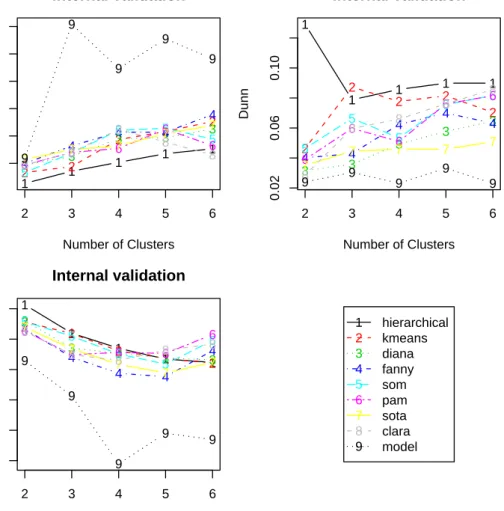
Hierarchical clustering with two clusters performs the best in each case. The validation measures can also be displayed graphically using the plot() method. Plots for individual measures can be requested using the measures argument. A legend is also included with each plot. The default location of the legend is the top right corner of each plot, this can be changed using the legendLocargument. Here, we combine all three plots into a single figure and so suppress the legends in each individual plot.
R> op <- par(no.readonly = TRUE)
R> par(mfrow = c(2, 2), mar = c(4, 4, 3, 1)) R> plot(intern, legend = FALSE)
R> plot(nClusters(intern), measures(intern, "Dunn")[, , 1], type = "n", + axes = F, xlab = "", ylab = "")
R> legend("center", clusterMethods(intern), col = 1:9, lty = 1:9, + pch = paste(1:9))
R> par(op)
The plots of the connectivity, Dunn index, and silhouette width are given in Figure1. Recall that the connectivity should be minimized, while both the Dunn index and the silhouette width should be maximized. Thus, it appears that hierarchical clustering outperforms the other clustering algorithms under each validation measure, for nearly every number of clusters evaluated. Somewhat surprisingly, model-based clustering does not perform well on any of the measures. Regardless of the clustering algorithm, the optimal number of clusters seems to be two using the connectivity and silhouette width. For the Dunn index the best choice for the number of clusters is less clear.
Stability validation
The stability measures include the APN, AD, ADM, and FOM. The measures should be minimized in each case. Stability validation requires more time than internal validation, since clustering needs to be redone for each of the datasets with a single column removed.
R> stab <- clValid(express, 2:6, clMethods = c("hierarchical", "kmeans", + "diana", "fanny", "som", "pam", "sota", "clara", "model"),
1 1 1 1 1 20 40 60 80 120 Internal validation Number of Clusters Connectivity 2 2 2 2 2 3 3 3 3 3 4 4 4 4 4 5 5 5 5 5 6 6 6 6 6 7 7 7 7 7 8 8 8 8 8 9 9 9 9 9 2 3 4 5 6 1 1 1 1 1 0.02 0.06 0.10 Internal validation Number of Clusters Dunn 2 2 2 2 2 3 3 3 3 3 4 4 4 4 4 5 5 5 5 5 6 6 6 6 6 7 7 7 7 7 8 8 8 8 8 9 9 9 9 9 2 3 4 5 6 1 1 1 1 1 0.0 0.1 0.2 0.3 0.4 0.5 Internal validation Number of Clusters Silhouette 2 2 2 2 2 3 3 3 3 3 4 4 4 4 4 5 5 5 5 5 6 6 6 6 6 7 7 7 7 7 8 8 8 8 8 9 9 9 9 9 2 3 4 5 6 1 2 3 4 5 6 7 8 9 hierarchical kmeans diana fanny som pam sota clara model
Figure 1: Plots of the connectivity measure, the Dunn index, and the silhouette width.
Instead of viewing all the validation measures via thesummary()method, we can instead just view the optimal values using theoptimalScores()method.
R> optimalScores(stab)
Score Method Clusters APN 0.04781010 hierarchical 2
AD 1.52717887 pam 6
ADM 0.14007952 pam 6
FOM 0.51580323 pam 6
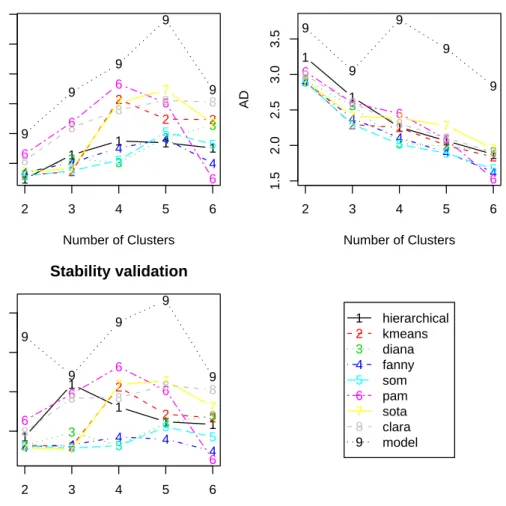
For the APN measures, hierarchical clustering with two clusters again gives the best score. However, for the other three measures PAM with six clusters has the best score. It is illustra-tive to graphically visualize each of the validation measures. The plot of the FOM measure is very similar to the AD measure, so we have omitted it from the figure.
1 1 1 1 1 0.1 0.2 0.3 0.4 0.5 0.6 Stability validation Number of Clusters APN 2 2 2 2 2 3 3 3 3 3 4 4 4 4 4 5 5 5 5 5 6 6 6 6 6 7 7 7 7 7 8 8 8 8 8 9 9 9 9 9 2 3 4 5 6 1 1 1 1 1 1.5 2.0 2.5 3.0 3.5 Stability validation Number of Clusters AD 2 2 2 2 2 3 3 3 3 3 4 4 4 4 4 5 5 5 5 5 6 6 6 6 6 7 7 7 7 7 8 8 8 8 8 9 9 9 9 9 2 3 4 5 6 1 1 1 1 1 0.5 1.0 1.5 2.0 Stability validation Number of Clusters ADM 2 2 2 2 2 3 3 3 3 3 4 4 4 4 4 5 5 5 5 5 6 6 6 6 6 7 7 7 7 7 8 8 8 8 8 9 9 9 9 9 2 3 4 5 6 1 2 3 4 5 6 7 8 9 hierarchical kmeans diana fanny som pam sota clara model
Figure 2: Plot of the APN, AD, and APN measures.
R> par(mfrow = c(2, 2), mar = c(4, 4, 3, 1))
R> plot(stab, measure = c("APN", "AD", "ADM"), legend = FALSE) R> plot(nClusters(stab), measures(stab, "APN")[, , 1], type = "n", + axes = F, xlab = "", ylab = "")
R> legend("center", clusterMethods(stab), col = 1:9, lty = 1:9, + pch = paste(1:9))
R> par(op)
The plots of the APN, AD, and ADM are given in Figure 2. The APN measure shows an interesting trend for many of the clustering methods, in that it initially increases from two to four clusters but subsequently decreases. Though hierarchical clustering with two clusters has the best score, PAM with six clusters is a close second. The AD and FOM measures tend to decrease as the number of clusters increases. PAM with six clusters has the best overall score, but over the entire range of clusters evaluated SOM,K-means, and DIANA have better overall performance. Similarly, for the ADM measure SOTA has a more stable and better
overall performance when compared to PAM over the entire range for the number of clusters. Biological validation
There are two options for biological validation using the BHI and BSI measures. The first option is to explicitly specify the functional clustering of the genes. This requires the user to predetermine the functional classes of the genes, e.g. using an annotation software package likeFatiGO (Al-Shahrouret al. 2004) or FunCat(Rueppet al.2004).
The functional categorization of the genes in the datasetmouse were previously determined
in Bhattacherjeeet al. (2007), so these will be used initially to define the functional classes.
R> fc <- tapply(rownames(express), mouse$FC, c) R> fc <- fc[!names(fc) %in% c("EST", "Unknown")]
R> bio <- clValid(express, 2:6, clMethods = c("hierarchical", "kmeans", + "diana", "fanny", "som", "pam", "sota", "clara", "model"),
+ validation = "biological", annotation = fc)
Recall that both the BHI and BSI should be maximized. The optimal values for each measure are given below.
R> optimalScores(bio)
Score Method Clusters BHI 0.2533592 model 6 BSI 0.6755826 hierarchical 2
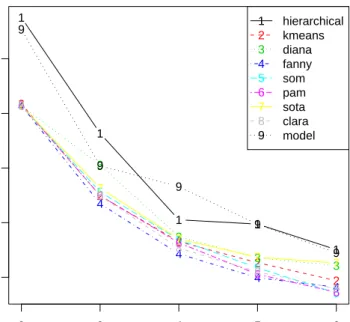
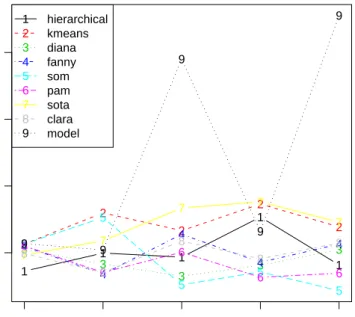
Model-based clustering with six clusters has the best value of the BHI, while for the BSI hierarchical clustering with two clusters again does well. Plots of the measures are given in Figures 3and 4.
R> plot(bio, measure = "BHI", legendLoc = "topleft") R> plot(bio, measure = "BSI")
Model-based clustering appears to have the best BHI score over the range for the number of clusters, while hierarchical clustering is slightly better than model-based overall for the BSI scores.
The other option for biological validation is to use the annotation packages available in Bio-conductor (http://www.bioconductor.org/, Gentlemanet al. 2004). This option uses the annotation packages to map the genes to their corresponding GO terms. There are three main ontologies, cellular component (“CC”), biological process (“BP”), and molecular func-tion (“MF”), which can be selected via the GOcategoryargument. The user must download, at a minimum, the Biobase (Gentleman et al. 2007), annotate (Gentleman 2007), and GO
(Liuet al. 2007a) packages from Bioconductor, then load them during the Rsession. In ad-dition, any specific annotation packages that are required will need to be downloaded (e.g., experiments using the Affymetrix GeneChip hgu95av2 would require the hgu95av2 package
1 1 1 1 1 0.16 0.18 0.20 0.22 0.24 Biological validation Number of Clusters BHI 2 2 2 2 2 3 3 3 3 3 4 4 4 4 4 5 5 5 5 5 6 6 6 6 6 7 7 7 7 7 8 8 8 8 8 9 9 9 9 9 2 3 4 5 6 1 2 3 4 5 6 7 8 9 hierarchical kmeans diana fanny som pam sota clara model
Figure 3: Plot of the BHI measure, using predetermined functional classes.
1 1 1 1 1 0.2 0.3 0.4 0.5 0.6 Biological validation Number of Clusters BSI 2 2 2 2 2 3 3 3 3 3 4 4 4 4 4 5 5 5 5 5 6 6 6 6 6 7 7 7 7 7 8 8 8 8 8 9 9 9 9 9 2 3 4 5 6 1 2 3 4 5 6 7 8 9 hierarchical kmeans diana fanny som pam sota clara model
specified in the function call via the annotation argument. The goTermFreq argument is used to select a threshold, so that only GO terms with a frequency in the dataset above the threshold are used to determine the functional classes.
To illustrate, the identifiers in the dataset mouse are from the Affymetrix Murine Genome 430a GeneChip Array, with corresponding annotation package moe430a (Liu et al. 2007c) available from Bioconductor. We leave thegoTermFreqargument at its default level of 0.05, and use all available GO categories (GOcategory="all") for annotation.
R> library("Biobase") R> library("annotate") R> library("GO")
R> library("moe430a")
R> bio2 <- clValid(express, 2:6, clMethods = c("hierarchical", "kmeans", + "diana", "fanny", "som", "pam", "sota", "clara", "model"),
+ validation = "biological", annotation = "moe430a", GOcategory = "all")
R> optimalScores(bio2)
Score Method Clusters BHI 0.1655374 model 6 BSI 0.7938518 hierarchical 2
The optimal method and number of clusters for the two measures agree with those found using the predetermined functional classes, and the plots of the measures given in Figures 5
and 6are also very similar to the previous plots. Notice again that hierarchical clustering has the best performance on the BSI measurement over the range for the number of clusters, but generally does poorly under the BHI validation measure.
R> plot(bio2, measure = "BHI", legendLoc = "topleft") R> plot(bio2, measure = "BSI")
Further analysis
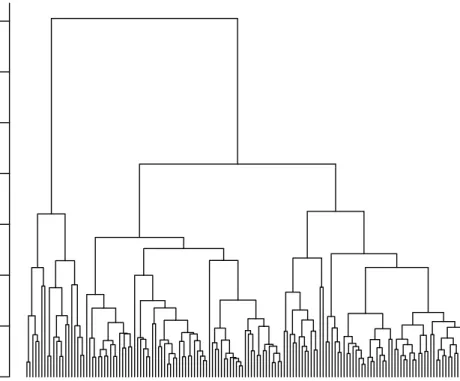
Hierarchical clustering consistently performs well for many of the validation measures. The clustering results from any method can be extracted from a clValidobject for further anal-ysis, using theclusters()method. Here, we extract the results from hierarchical clustering, to plot the dendrogram and view the observations that are grouped together at the various levels of the topology. The dendrogram is plotted in Figure 7, with the genes belonging to the “Growth/Differentiation” (GD) and “Transcription factor” (TF) functional classes labeled. The genes belonging to the top two clusters are cross-classified with their functional anno-tation given in the dataset. Of potential interest, the second cluster contains no genes in the “EST” or “Miscellaneous” categories. Further inspection of the results is left to a subject matter expert.
1 1 1 1 1 0.13 0.14 0.15 0.16 Biological validation Number of Clusters BHI 2 2 2 2 2 3 3 3 3 3 4 4 4 4 4 5 5 5 5 5 6 6 6 6 6 7 7 7 7 7 8 8 8 8 8 9 9 9 9 9 2 3 4 5 6 1 2 3 4 5 6 7 8 9 hierarchical kmeans diana fanny som pam sota clara model
Figure 5: Plot of the BHI measure, using annotation packagemoe430a in Bioconductor.
1 1 1 1 1 0.2 0.3 0.4 0.5 0.6 0.7 0.8 Biological validation Number of Clusters BSI 2 2 2 2 2 3 3 3 3 3 4 4 4 4 4 5 5 5 5 5 6 6 6 6 6 7 7 7 7 7 8 8 8 8 8 9 9 9 9 9 2 3 4 5 6 1 2 3 4 5 6 7 8 9 hierarchical kmeans diana fanny som pam sota clara model
TF TF GD TF GD TF TF GD GD TF TF TF TF GD GD TF TF TF TF TF TF TF TF GD TF TF GD GD GD TF TF GD GD TF TF GD TF GD GD TF TF TF TF GD 0 1 2 3 4 5 6 7
Mouse Cluster Dendrogram
hclust (*, "average") Dist
Height
Figure 7: Plot of the dendrogram for hierarchical clustering. Growth/Differentiation (GD) and transcription factor (TF) genes are labeled.
R> mfc <- factor(mouse$FC, labels = c("Re", "EST", "GD", "KP", "Met", + "Mis", "St", "TF", "U"))
R> tf.gd <- ifelse(mfc %in% c("GD", "TF"), levels(mfc)[mfc], "")
R> plot(hc, labels = tf.gd, cex = 0.7, hang = -1, main = "Mouse Cluster Dendrogram")
R> two <- cutree(hc, 2) R> xtabs(~mouse$FC + two)
two
mouse$FC 1 2
EST 31 0 Growth/Differentiation 12 4 Kinases/Phosphatases 4 3 Metabolism 7 1 Miscellaneous 25 0 Stress-induced 4 2 Transcription factor 23 5 Unknown 9 1
5. Discussion
We have developed an Rpackage,clValid, which contains measures for validating the results from a clustering procedure. We categorize the measures into three distinct types, “internal”, “stability”, and “biological”, and provide plot, summary, and additional methods for viewing and summarizing the validation scores and extracting the clustering results for further anal-ysis. In addition to the object-oriented nature of the language, implementing the validation measures within the Rstatistical programming framework provides the additional advantage in that it can interface with numerous clustering algorithms in existing Rpackages, and ac-commodate further algorithms as they are developed and coded into R libraries. Currently, clValid()accepts up to ten different clustering methods. This permits the user to simulta-neously vary the number of clusters and the clustering algorithms to decide how best to group the observations in her/his dataset. Lastly, the package makes use of the annotation pack-ages available in Bioconductor (http://www.bioconductor.org/) to calculate the biological validation measures, so that the information contained in the GO database can be used to assist in the cluster validation process.
The illustration for theclValidpackage we have given here focuses on clustering genes, but it is common in microarray analysis to cluster both genes and samples to create a “heatmap”. Though the “biological” validation measures are specifically designed for validation of cluster-ing genes, the other measures could also be used with clustercluster-ing of samples in a microarray experiment. Also, for microarray data, it is a good idea to limit the number of genes being clustered to a small subset (100 ∼ 600) of the thousands of expression measures routinely available on a microarray, both for computational and visualization purposes. Typically, some initial pre-selection of the genes based on t-statistics, p-values, or expression ratios is performed.
There are severalRpackages that also perform cluster validation and are available from CRAN (http://CRAN.R-project.org/) or Bioconductor (http://www.bioconductor.org/). Ex-amples include theclustIndex()function in packagecclust (Dimitriadou 2007), which per-forms 14 different validation measures in three classes,cluster.stats()andclusterboot() in packagefpc(Hennig 2007), the clusterRepro(Kapp and Tibshirani 2006) and clusterSim
(Walesiak and Dudek 2007) packages, and the clusterStab (MacDonald et al. 2007) package
from Bioconductor. The cl_validity() function in package clue (Hornik 2005) does vali-dation for both paritioning methods (“dissimilarity accounted for”) and hierarchical methods (“variance accounted for”), and functionfclustIndex() in packagee1071(Dimitriadouet al. 2007) has several fuzzy cluster validation measures. However, to our knowledge none of these packages offers biological validation or the unique stability measures which we present here.
Handlet al.(2005) providesC++code for the validation measures which they discuss, and the Caattool available in theGEPAS(http://gepas.bioinfo.cipf.es/) software suite offers a web-based interface for visualizing and validating (using the silhouette width) cluster results. However, neither of these two tools are as flexible for interfacing with the variety of clustering algorithms that are available in theR language, or can automatically access the annotation information which is available in Bioconductor. Hence, the clValid package is a valuable addition to the growing collection of cluster validation software available for researchers.
Acknowledgments
The authors would like to thank Dr. Bhattacherjee and his lab for sharing their data, and the editor, an associate editor, and two anonymous reviewers for their comments which helped improve the quality of this manuscript. This research was supported in part by NIH grant 1P30ES014443 (Guy Brock and Susmita Datta), NSF grants MCB-0517135 (Susmita Datta) and DMS-0706965 (Somnath Datta), and NSA grant H98230-06-1-0062 (Somnath Datta).
References
Al-Shahrour F, Diaz-Uriarte R, Dopazo J (2004). “FatiGO: A Web Tool for Finding Significant Associations of Gene Ontology Terms with Groups of Genes.”Bioinformatics,20(4), 578– 80.
Bhattacherjee V, Mukhopadhyay P, Singh S, Johnson C, Philipose JT, Warner CP, Greene RM, Pisano MM (2007). “Neural Crest and Mesoderm Lineage-Dependent Gene Expression in Orofacial Development.”Differentiation,75(5), 463–477.
Bolshakova N, Azuaje F, Cunningham P (2005). “A Knowledge-Driven Approach to Cluster Validity Assessment.”Bioinformatics,21(10), 2546–7.
Chu S, DeRisi J, Eisen M, Mulholland J, Botstein D, Brown PO, Herskowitz I (1998). “The Transcriptional Program of Sporulation in Budding Yeast.”Science,282(5389), 699–705. Datta S, Datta S (2003). “Comparisons and Validation of Statistical Clustering Techniques
for Microarray Gene Expression Data.”Bioinformatics,19(4), 459–66.
Datta S, Datta S (2006). “Methods for Evaluating Clustering Algorithms for Gene Expression Data using a Reference Set of Functional Classes.”BMC Bioinformatics,7, 397.
Dembele D, Kastner P (2003). “Fuzzy C-Means Method for Clustering Microarray Data.”
Bioinformatics,19(8), 973–80.
DeRisi JL, Iyer VR, Brown PO (1997). “Exploring the Metabolic and Genetic Control of Gene Expression on a Genomic Scale.”Science,278(5338), 680–6.
Dimitriadou E (2007).cclust: Convex Clustering Methods and Clustering Indexes.Rpackage version 0.6-14, URLhttp://CRAN.R-project.org/package=cclust.
Dimitriadou E, Hornik K, Leisch F, Meyer D, Weingessel A (2007). e1071: Misc Functions of the Department of Statistics (e1071), TU Wien. Rpackage version 1.5-17, URL http: //CRAN.R-project.org/package=e1071.
Dopazo J, Carazo JM (1997). “Phylogenetic Reconstruction using a Growing Neural Network that Adopts the Topology of a Phylogenetic Tree.” Journal of Molecular Evolution, pp. 226–233.
Dunn JC (1974). “Well Separated Clusters and Fuzzy Partitions.”Journal on Cybernetics,4, 95–104.
Eisen MB, Spellman PT, Brown PO, Botstein D (1998). “Cluster Analysis and Display of Genome-Wide Expression Patterns.” Proceedings of the National Academy of Sciences of the United States of America,95(25), 14863–8.
Fraley C, A E Raftery AE (2003). “Enhanced Model-based Clustering, Density Estimation, and Discriminant Analysis Software: MCLUST.”Journal of Classification,20(2), 263–286. Fraley C, Raftery AE (2001). “Model-based Clustering, Discriminant Analysis, and Density
Estimation.”Journal of the American Statistical Association,17, 126–136.
Fraley C, Raftery AE (2007). mclust: Model-based Clustering / Normal Mixture Modeling.
Rpackage version 3.1-2, URL http://CRAN.R-project.org/package=mclust.
Fu L, Medico E (2007). “FLAME, a Novel Fuzzy Clustering Method for the Analysis of DNA Microarray Data.”BMC Bioinformatics,8, 3.
Gat-Viks I, Sharan R, Shamir R (2003). “Scoring Clustering Solutions by their Biological Relevance.”Bioinformatics,19(18), 2381–9.
Gentleman R (2007). annotate: Using R Enviroments for Annotation. R package ver-sion 1.16.1, URLhttp://www.bioconductor.org/.
Gentleman R, Carey V, Morgan M, Falcon S (2007). Biobase: Base functions for Biocon-ductor. Rpackage version 1.16.3, URLhttp://www.bioconductor.org/.
Gentleman RC, Carey VJ, Bates DM, Bolstad B, Dettling M, Dudoit S, Ellis B, Gautier L, Ge Y, Gentry J, Hornik K, Hothorn T, Huber W, Iacus S, Irizarry R, Li FLC, Maechler M, Rossini AJ, Sawitzki G, Smith C, Smyth G, Tierney L, Yang JYH, Zhang J (2004). “Bio-conductor: Open Software Development for Computational Biology and Bioinformatics.”
Genome Biology,5, R80. URLhttp://genomebiology.com/2004/5/10/R80.
Gibbons FD, Roth FP (2002). “Judging the Quality of Gene Expression-based Clustering Methods using Gene Annotation.”Genome Research,12(10), 1574–81.
Handl J, Knowles J, Kell DB (2005). “Computational Cluster Validation in Post-Genomic Data Analysis.” Bioinformatics,21(15), 3201–12.
Hartigan JA, Wong MA (1979). “A K-means Clustering Algorithm.” Applied Statistics, 28, 100–108.
Hennig C (2007). fpc: Fixed Point Clusters, Clusterwise Regression and Discriminant Plots.
Herrero J, Valencia A, Dopazo J (2001). “A Hierarchical Unsupervised Growing Neural Net-work for Clustering Gene Expression Patterns.”Bioinformatics,17(2), 126–36.
Hornik K (2005). “A CLUE for CLUster Ensembles.”Journal of Statistical Software,14(12). URLhttp://www.jstatsoft.org/v14/i12/.
Kapp A, Tibshirani R (2006). clusterRepro: Reproducibility of Gene Expression Clusters.
Rpackage version 0.5-1, URL http://CRAN.R-project.org/package=clusterRepro. Kaufman L, Rousseeuw PJ (1990). Finding Groups in Data: An Introduction to Cluster
Analysis. Wiley, New York.
Kerr MK, Churchill GA (2001). “Bootstrapping Cluster Analysis: Assessing the Reliability of Conclusions from Microarray Experiments.” Proceedings of the National Academy of Sciences of the United States of America,98(16), 8961–5.
Kohonen T (1997). Self-Organizing Maps. Springer-Verlag, second edition.
Liu TY, Lin C, Falcon S, Zhang J, MacDonald JW (2007a). GO: A Data Package Containing Annotation Data for GO. Rpackage version 2.0.1, URLhttp://www.bioconductor.org/. Liu TY, Lin C, Falcon S, Zhang J, MacDonald JW (2007b). hgu95av2: Affymetrix Hu-man Genome U95 Set Annotation Data. R package version 2.0.1, URL http://www. bioconductor.org/.
Liu TY, Lin C, Falcon S, Zhang J, MacDonald JW (2007c). moe430a: Affymetrix Mouse Expression Set 430 Annotation Data. R package version 2.0.1, URL http://www. bioconductor.org/.
MacDonald J, Ghosh D, Smolkin M (2007). clusterStab: Compute Cluster Stability Scores for Microarray Data. R package version 1.10.0, URL http://CRAN.R-project.org/ package=clusterStab.
McLachlan GJ, Bean RW, Peel D (2002). “A Mixture Model-based Approach to the Clustering of Microarray Expression Data.”Bioinformatics,18(3), 413–22.
RDevelopment Core Team (2007).R: A Language and Environment for Statistical Computing.
RFoundation for Statistical Computing, Vienna, Austria. ISBN 3-900051-07-0, URLhttp: //www.R-project.org.
Rousseeuw P, Struyf A, Hubert M, Maechler M (2007). cluster: Cluster Analysis Extended Rousseeuw et al. Rpackage version 1.11.9, URL http://CRAN.R-project.org/package= cluster.
Rousseeuw PJ (1987). “Silhouettes: A Graphical Aid to the Interpretation and Validation of Cluster Analysis.”Journal of Computational and Applied Mathematics,20, 53–65.
Ruepp A, Zollner A, Maier D, Albermann K, Hani J, Mokrejs M, Tetko I, Guldener U, Mannhaupt G, Munsterkotter M, Mewes HW (2004). “TheFunCat, a Functional Annota-tion Scheme for Systematic ClassificaAnnota-tion of Proteins from Whole Genomes.”Nucleic Acids Research,32(18), 5539–45.
Walesiak M, Dudek A (2007). clusterSim: Searching for Optimal Clustering Procedure for a Data Set. R package version 0.33-1, URL http://CRAN.R-project.org/package= clusterSim.
Wehrens R (2007). kohonen: Supervised and Unsupervised Self-Organising Maps. Rpackage version 2.0.2, URLhttp://CRAN.R-project.org/package=kohonen.
Yeung KY, Haynor DR, Ruzzo WL (2001). “Validating Clustering for Gene Expression Data.”
Bioinformatics,17(4), 309–18.
Affiliation: Guy Brock
Department of Bioinformatics and Biostatistics School of Public Health and Information Sciences University of Louisville
555 S Floyd St.
Louisville, KY 40292, United States of America E-mail: [email protected]
URL: http://louisville.edu/~g0broc01/
Journal of Statistical Software
http://www.jstatsoft.org/published by the American Statistical Association http://www.amstat.org/
Volume 25, Issue 4 Submitted: 2007-04-03