Northumbria Research Link
Citation: Jiao, Lihong, Yu, Yonghong, Zhou, Ningning, Zhang, Li and Yin, Hongzhi (2020) Neural Pairwise Ranking Factorization Machine for Item Recommendation. In: Database Systems for Advanced Applications: 25th International Conference, DASFAA 2020, Jeju, South Korea, September 24–27, 2020, Proceedings, Part I. Lecture Notes in Computer Science (12112). Springer, Cham, pp. 680-688. ISBN 9783030594091, 9783030594107
Published by: Springer
URL: https://doi.org/10.1007/978-3-030-59410-7_46 <https://doi.org/10.1007/978-3-030-59410-7_46>
This version was downloaded from Northumbria Research Link:
http://nrl.northumbria.ac.uk/id/eprint/44485/
Northumbria University has developed Northumbria Research Link (NRL) to enable users to access the University’s research output. Copyright © and moral rights for items on NRL are retained by the individual author(s) and/or other copyright owners. Single copies of full items can be reproduced, displayed or performed, and given to third parties in any format or medium for personal research or study, educational, or not-for-profit purposes without prior permission or charge, provided the authors, title and full bibliographic details are given, as well as a hyperlink and/or URL to the original metadata page. The content must not be changed in any way. Full items must not be sold commercially in any format or medium without formal permission of the copyright holder. The full policy is available online: http://nrl.northumbria.ac.uk/pol i cies.html
This document may differ from the final, published version of the research and has been made available online in accordance with publisher policies. To read and/or cite from the published version of the research, please visit the publisher’s website (a subscription may be required.)
Neural Pairwise Ranking Factorization Machine
for Item Recommendation
Lihong Jiao1, Yonghong Yu2, Ningning Zhou1, Li Zhang3, and Hongzhi Yin4
1
School of Computer Science, Nanjing University of Posts and Telecommunications, Nanjing, [email protected]
2
Tongda College, Nanjing University of Posts and Telecommunications, Nanjing, [email protected]
3
Department of Computer and Information Sciences, Northumbria University, Newcastle, [email protected]
4
School of Information Technology and Electrical Engineering, The University of Queensland, [email protected]
Abstract. The factorization machine models attract significant atten-tion from academia and industry because they can model the context information and improve the performance of recommendation. However, traditional factorization machine models generally adopt the point-wise learning method to learn the model parameters as well as only model the linear interactions between features. They fail to capture the complex in-teractions among features, which degrades the performance of factoriza-tion machine models. In this paper, we propose a neural pairwise rank-ing factorization machine for item recommendation, which integrates the multi-layer perceptual neural networks into the pairwise ranking factor-ization machine model. Specifically, to capture the high-order and nonlin-ear interactions among features, we stack a multi-layer perceptual neural network over the bi-interaction layer, which encodes the second-order in-teractions between features. Moreover, the pair-wise ranking model is adopted to learn the relative preferences of users rather than predict the absolute scores. Experimental results on real world datasets show that our proposed neural pairwise ranking factorization machine outperforms the traditional factorization machine models.
Keywords: Recommendation Algorithm, Factorization Machine, Neu-ral Networks
1
Introduction
With the development of information technology, a variety of network appli-cations have accumulated a huge amount of data. Although the massive data provides users with rich information, it leads to the problem of “information overload”. The recommendation systems [1] can greatly alleviate the problem of information overload. They infer users latent preferences by analyzing their past activities and provide users with personalized recommendation services. Factor-ization machine (FM) [2] model is very popular in the field of recommendation
2 Lihong Jiao et al.
systems, which is a general predictor that can be adopted for the prediction tasks working with any real valued feature vector.
Recently, deep learning techniques have shown great potential in the field of recommendation systems, some researchers also have utilized deep learning techniques to improve the classic factorization machine models. Typical deep learning based factorization machine models include NFM [3], AFM [4], and CFM [5]. Neural Factorization Machine (NFM) [3] seamlessly unifies the ad-vantages of neural networks and factorization machine. It not only captures the linear interactions between feature representations of variables, but also models nonlinear high-order interactions. However, both FM and NFM adopt a point-wise method to learn their model parameters. They fit the user’s scores rather than learn the user’s relative preferences for item pairs. In fact, common users usually care about the ranking of item pairs rather than the absolute rating on each item. Pairwise ranking factorization machine (PRFM) [6, 7] makes use of the bayesian personalized ranking (BPR) [8] and FM to learn the relative prefer-ences of users over item pairs. Similar to FM, PRFM can only model the linear interactions among features.
In this paper, we propose the Neural Pairwise Ranking Factorization Machine (NPRFM) model, which integrates the multi-layer perceptual neural networks into the PRFM model to boost the recommendation performance. Specifically, to capture the high-order and nonlinear interactions among features, we stack a multi-layer perceptual neural network over the bi-interaction layer, which is a pooling layer that encodes the seconde-order interactions between features. Moreover, the bayesian personalized ranking criterion is adopted to learn the relative preferences of users, which makes non-observed feedback contribute to the inference of model parameters. Experimental results on real world datasets show that our proposed neural pairwise ranking factorization machine model outperforms the traditional recommendation algorithms.
2
Preliminaries
Factorization Machine is able to model the interactions among different features by using a factorization model. Usually, the model equation of FM is defined as follows: ˆ y(x) =w0+ n X i=1 wixi+ n X i=1 n X j=i+1 hvi,vjixixj (1) where ˆy(x) is the predicted value, andx∈ Rn denotes the input vector of the model equation. xi represents thei-th element of x.w0 ∈R is the global bias,
w∈Rnindicates the weight vector of the input vectorx.V∈Rn×kis the latent feature matrix, whose vi represents the feature vector of xi.hvi,vji is the dot product of two feature vectors, which is used to model the interaction between
Neural Pairwise Ranking Factorization Machine for Item Recommendation 3
3
Neural Pairwise Ranking Factorization Machine
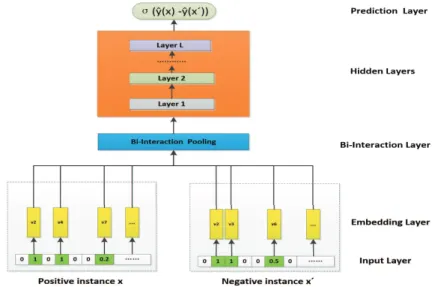
To model the high-order interaction behaviors among features as well as learn the relatively preferences of user over item pairs, we propose the neural pairwise ranking factorization machine (NPRFM) model, whose underlying components are NFM and PRFM. Fig. 1 presents the framework of our proposed neural pair-wise ranking factorization machine, which consists of four layers, i.e. embedding layer, Bi-interaction layer, hidden layer and prediction layer.
Fig. 1.The framework of neural pairwise ranking factorization machine
The input of NPRFM includes positive and negative instances. Both positive or negative instance contain user, item and context information. By using one-hot encoding, the positive and negative instances are converted into sparse feature vectorsx∈Rn orx0 ∈Rn, respectively.
3.1 Embedding Layer
After one-hot encoding, we use the embedding table lookup operation to ob-tain the embedded representations of features included in the input instance. Formally, the embedded representation ofxis,
Vx=V.onehot(x) (2)
whereVxis a set of embedding vectors, i.e.,Vx={x1v1, ..., xnvn}, andvi∈Rk is the embedded representation of thei-th feature.
4 Lihong Jiao et al.
3.2 Bi-Interaction Layer
The Bi-Interaction layer is a pooling operation, which converts the set of em-bedding vectorsVxto one vectorfBI(Vx):
fBI(Vx) = n X i=1 n X j=i+1 xivixjvj (3)
whererepresents the element-wise product of two vectors. As shown in Eq.(3), the Bi-interaction layer captures the pair-wise interactions among the low dimen-sional representations of features. In other words, the Bi-Interaction pooling only encodes the second-order interactions among features.
3.3 Hidden Layers and Prediction Layer
Since the Bi-interaction layer only captures the second-order interactions among features, and can not model the complexity interactive patterns among features, we utilize the multi-layer perceptron (MLP) to learn the interaction relationships among features, which endows our proposed model with the ability of capturing the high-order interactions. Specifically, in the hidden layers, we stack multiple fully connected hidden layers over the Bi-interaction layer, where the output of a hidden layer is fed into the following hidden layer that makes use of the weighted matrix and non-linear activation function, such as sigmoid, tanh and ReLU, to nonlinearly transform this output. Formally, the MLP is defined as,
z1=σ1(W1fBI(Vx) +b1),
z2=σ2(W2z1+b2), ...
zL=σL(WLzL−1+bL)
(4)
whereLdenotes the number of hidden layers,Wl,blandσlrepresent the weight matrix, bias vector and activation function for thel-th layer, respectively.
The prediction layer is connected to the last hidden layer, and is used to predict the score ˆy(x) for the instancex, where x can be positive or negative instances. Formally,
ˆ
y(x) =hTzL (5)
wherehis the weight vector of the prediction layer. Combining the Eq. (4) and (5), the model equation of NPFFM is reformulated as:
ˆ y(x) = n X i=1 wixi+hTσL(WL(...σ1(W1fBI(Vx) +b1)...) +bL) (6)
Neural Pairwise Ranking Factorization Machine for Item Recommendation 5
3.4 Model Learning
We adopt a ranking criterion, i.e. the Bayesian personalized ranking, to optimize the model parameters of NPRFM. Formally, the objective function of NPRFM is defined as: LN P RF M = X (x,x0)∈χ −lnσ(ˆy(x)−yˆ(x0)) +λ 2(kΘk 2 F) (7)
where σ(.) is the logistic sigmoid function. And Θ = {wi,Wl,bl,vi,h} , i ∈ (1...n) ,l ∈ (1...L) denotes the model parameters.χ is the set of positive and negative instances. We adopt the Adagrad [9] optimizer to update model pa-rameter because the Adagrad optimizer utilizes the information of the sparse gradient and gains an adaptive learning rate, which is suitable for the scenarios of data sparse.
4
Experiments
4.1 DataSets and Evaluation Metrics
In our experiments, we choose two real-world implicit feedback datasets: Frappe5 and Last.fm6, to evaluate the effectiveness of our proposed model.
TheFrappecontains 96,203 application usage logs with different contexts. Besides the user ID and application ID, each log contains eight contexts, such as weather, city and country and so on. We use one-hot encoding to convert each log into one feature vector, resulting in 5382 features.
The Last.fm was collected by Xin et al. [5]. The contexts of user consist of the user ID and the last music ID listened by the specific user within 90 minutes. The contexts of item include the music ID and artist ID. This dataset contains 214,574 music listening logs. After transforming each log by using one-hot encoding, we get 37,358 features.
We adopt the leave-one-out validation to evaluate the performance of all compared methods, which has been widely used in the literature [4, 5, 10]. In addition, we utilize two widely used ranking based metrics, i.e., the Hit Ratio (HR) and Normalized Discounted Cumulative Gain (N DCG), to evaluate the performance of all comparisons.
4.2 Experimental Settings
In order to evaluate the effectiveness of our proposed algorithm, we choose FM, NFM, PRFM as baselines.
– FM : FM [2, 11] is a strong competitor in the field of context-aware recom-mendation, and captures the interactions between different features by using a factorization model.
5 http://baltrunas.info/research-menu/frappe 6
6 Lihong Jiao et al.
– NFM : NFM [10] seamlessly integrates neural networks into factorization machine model. Based on the neural networks, NFM can model nonlinear and high-order interactions between latent representations of features.
– PRFM: PRFM [7] applies the BPR standard to optimize its model param-eters. Different from FM and NFM, PRFM focuses on the ranking task that learns the relative preferences of users for item pairs rather than predicts the absolute ratings.
For all compared methods, we set dimension of the hidden feature vector
k = 64. In addition, for FM, we set the regularization term λ= 0.01 and the learning rate η= 0.001. For NFM, we set the number of hidden layers is 1, the regularization termλ= 0.01 and the learning rateη= 0.001. For PRFM, we set the regularization termλ= 0.001 and the learning rateη = 0.1. For NPRFM, we set the regularization termλ= 0.001, the learning rateη= 0.1, and the number of hidden layers L= 1. In addition, we initialize the latent feature matrix V of NPRFM with the embedded representations learned by PRFM.
4.3 Performance Comparison
We set the length of recommendation listn= 3,5,7 to evaluate the performance of all compared methods. The experimental results on the two datasets are shown in Tables 1 and 2.
Table 1.Performance comparison on the Frappe dataset (k=64) Recommendation n=3 n=5 n=7 Algorithm HR NDCG HR NDCG HR NDCG FM 0.2445 0.1795 0.3050 0.2107 0.3422 0.2216 NFM 0.2510 0.1797 0.3702 0.2199 0.4686 0.2504 PRFM 0.4650 0.3868 0.5654 0.4280 0.6383 0.4533 NPRFM 0.4786 0.3962 0.5751 0.4358 0.6469 0.4607
Table 2.Performance comparison on the Last.fm dataset (k=64) Recommendation n=3 n=5 n=7 Algorithm HR NDCG HR NDCG HR NDCG FM 0.0770 0.0584 0.1064 0.0706 0.1344 0.0803 NFM 0.0972 0.0723 0.1372 0.0886 0.1702 0.1000 PRFM 0.1828 0.1374 0.2545 0.1667 0.3094 0.1857 NPRFM 0.1855 0.1402 0.2624 0.1715 0.3219 0.1921
From Tables 1 and 2, we have the following observations: (1) On both dataset-s, FM performs the worst among all the compared methods. The reason is that FM learns its model parameters by adopting a point-wise learning scheme, which usually suffers from data sparsity. (2) NFM is superior to FM with regards to all
Neural Pairwise Ranking Factorization Machine for Item Recommendation 7
evaluation metrics. One reason is that the non-linear and high-order interactions among representations of features are captured by utilizing the neural network-s, resulting in the improvement of recommendation performance. (3) On both datasets, PRFM achieves better performance than those of FM and NFM. This is because PRFM learns its model parameters by applying the BPR criterion, in which the pair-wise learning method is used to infer the latent representations of users and items. To some extent, the pair-wise learning scheme is able to allevi-ate the problem of data sparsity by making non-observed feedback contribute to the learning of model parameters. (4) Our proposed NPRFM model consistently outperforms other compared methods, which demonstrates the effectiveness of the proposed strategies. When n= 3, NPRFM improves the HRof PRFM by 2.9% and 1.5% on Frappe and Last.fm, respectively. In terms ofN DCG, the im-provements of NPRFM over PRFM are 2.4% and 2.0% on Frappe and Last.fm, respectively.
4.4 Sensitivity Analysis
Impact of the depth of neural networks In this section, we conduct a group of experiments to investigate the impact of the depth of neural networks on the recommendation quality. We set n = 5, k = 64, and vary the depth of neural networks from 1 to 3.
In Table 3, NPRFM-idenotes that NPRFM model withihidden layers, es-pecially, NPRFM-0 is equal to PRFM. We only present the experimental results on HR@5 in Table 3 and the experimental results on N DCG@5 show similar trends.
Table 3.Impact ofL
Methods Frappe Lastfm NPRFM-0 0.5654 0.2545 NPRFM-1 0.5751 0.2624 NPRFM-2 0.5592 0.2572 NPRFM-3 0.5654 0.2077 Table 4.Impact ofk k Frappe Lastfm 16 0.4650 0.1641 32 0.5515 0.2027 64 0.5751 0.2624 128 0.5692 0.2514
From Table 3, we observe that NPRFM has the best performance when the number of the hidden layer is equal to one, and the performance of NPRFM degrades when the number of the hidden layer increases. This is because the available training data is not sufficient for NPRFM to accurately learn its model parameters when the number of hidden layers is relatively large. By contrast, if the number of layers is small, NPRFM has limited ability of modeling the complex interactions among embedded representations of features, resulting in the sub-optimal recommendation performance.
Impact of k In this section, we conduct another group of experiments to in-vestigate the impact of the dimension of embedded representations of featuresk
on the recommendation quality.
As shown in Table 4, our proposed NPRFM model is sensitive to the di-mension of embedded representation of feature. We find that the performance of
8 Lihong Jiao et al.
NPFFM is optimal when the dimension of embedded representation of feature is equal to 64. A possible reason is that the proposed model already has enough expressiveness to describe the latent preferences of user and characteristics of items whenk= 64.
5
Conclusion
In this paper, we propose the neural pairwsie ranking factorization machine mod-el, which integrates the multi-layer perceptual neural networks into the PRFM model to boost the recommendation performance of factorization model. Exper-imental results on real world datasets show that our proposed neural pairwise ranking factorization machine model outperforms the traditional recommenda-tion algorithms.
Acknowledgments. This work is supported in part by the Natural Science Foundation of the Higher Education Institutions of Jiangsu Province (Grant No. 17KJB520028 ), NUPTSF (Grant No. NY217114), Tongda College of Nanjing University of Posts and Telecommunications (Grant No. XK203XZ18002) and Qing Lan Project of Jiangsu Province.
References
1. Gediminas Adomavicius and Alexander Tuzhilin. Toward the next generation of recommender systems: A survey of the state-of-the-art and possible extensions.
TKDE, 17(6):734–749, 2005.
2. Steffen Rendle. Factorization machines. InICDM, pages 995–1000. IEEE, 2010. 3. Xiangnan He and Tat-Seng Chua. Neural factorization machines for sparse
pre-dictive analytics. InSIGIR, pages 355–364. ACM, 2017.
4. Jun Xiao, Hao Ye, Xiangnan He, Hanwang Zhang, Fei Wu, and Tat-Seng Chua. Attentional factorization machines: Learning the weight of feature interactions via attention networks. arXiv preprint arXiv:1708.04617, 2017.
5. Xin Xin, Bo Chen, Xiangnan He, Dong Wang, Yue Ding, and Joemon Jose. Cfm: convolutional factorization machines for context-aware recommendation. InIJCAI, pages 3926–3932. AAAI Press, 2019.
6. Fajie Yuan, Guibing Guo, Joemon M Jose, Long Chen, Haitao Yu, and Weinan Zhang. Lambdafm: learning optimal ranking with factorization machines using lambda surrogates. InCIKM, pages 227–236. ACM, 2016.
7. Weiyu Guo, Shu Wu, Liang Wang, and Tieniu Tan. Personalized ranking with pairwise factorization machines. Neurocomputing, 214:191–200, 2016.
8. Steffen Rendle, Christoph Freudenthaler, Zeno Gantner, and Lars Schmidt-Thieme. Bpr: Bayesian personalized ranking from implicit feedback. InUAI, pages 452–461. AUAI Press, 2009.
9. You Lu, Jeffrey Lund, and Jordan Boyd-Graber. Why adagrad fails for online topic modeling. InEMNLP, pages 446–451, 2017.
10. Xiangnan He, Lizi Liao, Hanwang Zhang, Liqiang Nie, Xia Hu, and Tat-Seng Chua. Neural collaborative filtering. InWWW, pages 173–182, 2017.