Nurse Practitioner Coding Practices in Primary Care:
A Retrospective Chart Review
Kymberly R. Allen, MS, RN Caroline B. Reinke, MS, RN Joanne M. Pohl, Ph D, RN, CS, FAAN Kristy K. Mar tyn, Ph D, RN, CS, CPNP Elaine P. McIntosh, RN, CS, FNP
RESEARCH
INTRODUCTION
While the quality of care provided by nurse practitioners (NPs) has been well established in the literature (Mundinger et al., 2000; Neale, 1999; Safriet, 1992), limited data exist regarding how they “code” for the healthcare that they provide. Coding refers to the utilization of the Healthcare Financing Administration’s (HCFA) (currently referred to as The Center for Medicare and Medicaid Services) guidelines to document the level of service for a client encounter for the purpose of billing for ser-vices. The codes established for this purpose were meant to diferentiate the complexity of care and reflect relative work values in the provision of ser-vices. Currently, the majority of relative work values are based on data pro-vided from physicians.
The lack of information on NP coding practices is a consequence of reimbursement guidelines that existed prior to the Balanced Budget Act of 1997. Before the Balanced Budget Act of 1997, NPs provided and coded for healthcare services but were required to bill under a physician’s reim-bursement number (HCFA, 1998). Therefore, the services provided by NPs were hidden and embedded in the physicians’ services in national practitioner databases. This “bundling” of services for reimbursement made it difficult to accurately distinguish which healthcare providers were providing which services (Rapsilber & Anderson, 2000). Consequently, difficulty existed in differentiating NP coding practices from those of other healthcare providers.
The passage of the Balanced Budget Act of 1997 established new billing guidelines that allowed NPs to bill directly to and receive reimbursement from Medicaid, Medicare Part B, and some participating commercial insur-ances for primary care services within the limits of each state’s laws (HCFA, 1998). The implementation of the Balanced Budget Act of 1997 has created a setting in which the healthcare services provided by NPs can be more accu-rately reflected (Rapsilber & Anderson, 2000). This information can now be used in healthcare research and policy to impact the future of NPs as providers of primary healthcare.
The Balanced Budget Act of 1997 offers NPs the opportunity to establish themselves as independent providers of primary healthcare. Thus, it is imper-ative that NPs have advanced knowledge of HCFA’s guidelines related to cod-ing and documentation for billcod-ing purposes. The relevance of codcod-ing correct-ly for healthcare services includes the generation of an accurate practice pro-file in national databases, the receipt of proper reimbursement, and a decreased risk of lawsuits (Buppert, 2001b).
As a result of the billing regulations prior to the Balanced Budget Act of 1997, limited data exist surrounding coding behaviors of NPs as individual providers. This article describes the coding and documentation practices of NPs when using the evaluation and management (E & M) codes in an acad-emic primary care center.
Purpose
To describe the coding and documentation practices of nurse practitioners (NPs) when using evaluation and management (E & M) codes in an academic primary care center.
Data Sources
A randomized retrospective review of ten charts from a nurse-managed primary care clinic affiliated with a midwestern research-intensive university.
Conclusuion
The findings demonstrate that the documenta-tion in the chart for six of the ten client encounters did not support the E & M codes assigned by the clinicís NPs. Four of these six client encounters were overcoded; the remain-ing two encounters were undercoded.
Implications for Practice
Findings of this study support the need for additional education of NPs in the areas of coding and documentation.
Key Words
Coding; billing; nurse practitioner; reimburse-ment; legal issues; advanced practice nursing.
Authors
Kymberly R. Allen, MS, RN, was formerly a graduate student at the University of Michigan. Caroline B. Reinke, MS, RN, was formerly a graduate student at the University of Michigan. Joanne M. Pohl, Ph D, RN, CS, FAAN, is an Associate Professor and Associate Dean, Office of Community Partnerships, Kristy K. Martyn, Ph D, RN, CS, CPNP, is an Assistant Professor, and Elaine P. McIntosh, RN, CS, FNP, is the Director of Nurse Managed Centers at the University of Michigan School of Nursing, Ann Arbor, MI. Contact Ms. Allen by email at [email protected]
REVIEW OF LITERATURE
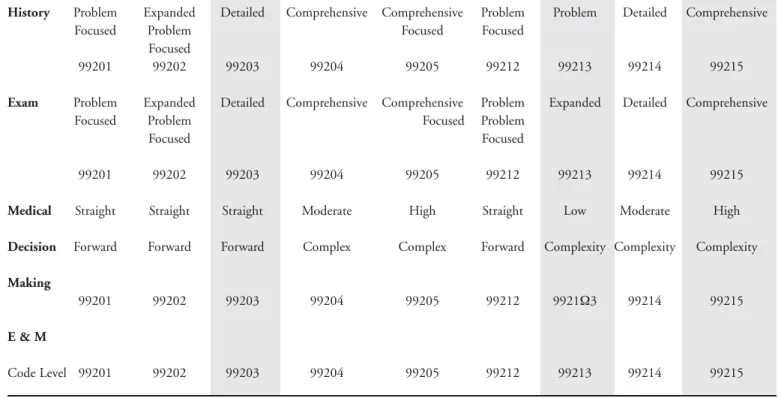
A study by Sullivan-Marx and Maislin (2000) compared rel-ative work values between NPs and family physicians for levels of service for three specific ambulatory E & M codes. This pilot study examined the practicality of using NP data to determine relative work values in the Medicare Fee Schedule for three selected E & M codes (99203, 99213, and 99215) (see Table 1). The results indicated no significant differences between NPs and family physicians in estimations of relative work values for each of the three levels of E & M codes.
A second study by Horner, Paris, Purvis, and Lawler (1991) compared the accuracy of billing and coding of faculty physi-cians, residents, family nurse practitioners (FNPs), and regis-tered nurses (RNs). The purpose of this study was to determine billing codes for the level of service, diagnosis, and procedures by reviewing the progress notes in a client’s chart. The reviewers were blinded to the actual billing forms. The results indicated that FNPs were comparable to the residents and faculty physi-cians in their accuracy of billing information. In addition, the results of the study suggested that all practitioners in this study were consistently undercoding. The recommendations of this study highlighted the need for additional instruction for all healthcare professionals involved in coding and billing.
Relevant findings from the above studies indicate that NPs have familiarity with relative work values and have undercoded
for primary healthcare services. While these studies compared the coding and billing practices of different types of primary care providers, the purpose of this study evaluated the coding and documentation practices of NPs in a midwestern university affil-iated nurse-managed center.
METHODS
Approval for the project was obtained from the Institutional Review Board of the associated university. Two NP graduate stu-dents completed the review. To prepare for the project, the inves-tigators attended a two-hour seminar on documentation, cod-ing, and billing and reviewed two leading publications that described HCFA’s coding guidelines (Buppert, 1999; MedLearn, 2000). In addition, advanced practice nursing faculty with expertise in coding served as consultants.
The project consisted of a retrospective review of 10 ran-domly selected charts from a convenience sample of the clinic’s charts. The inclusion criteria consisted of the following: 1) the presence of a signed consent form in the clinic which explained that information from the chart may be used for research pur-poses; 2) the encounters must have taken place at the clinic between January 1999 and December 1999; and 3) only charts of clients over 18, mentally competent, and nonpregnant were reviewed.
Table 1.Key to Determining E & M Code Level for Client Encounter
Clients Established Clients
Require all three components within column Require two components within column
History Problem Expanded Detailed Comprehensive Comprehensive Problem Problem Detailed Comprehensive
Focused Problem Focused Focused
Focused
99201 99202 99203 99204 99205 99212 99213 99214 99215
Exam Problem Expanded Detailed Comprehensive Comprehensive Problem Expanded Detailed Comprehensive
Focused Problem Focused Problem
Focused Focused
99201 99202 99203 99204 99205 99212 99213 99214 99215
Medical Straight Straight Straight Moderate High Straight Low Moderate High
Decision Forward Forward Forward Complex Complex Forward Complexity Complexity Complexity
Making
99201 99202 99203 99204 99205 99212 9921Ω3 99214 99215
E & M
Code Level 99201 99202 99203 99204 99205 99212 99213 99214 99215
During the selection and review process, the investigators were blinded to the original E & M codes assigned by the clin-ic’s NPs. To standardize the data collection process, audit tools based on The1997 Current Procedural Terminology were created by the investigators and used to conduct the reviews (see Table 2). The data collection involved recording each element of the participant encounter into the corresponding section of the appropriate audit tool. The investigators reviewed each partici-pant encounter twice. Differences of opinion were resolved by consulting the documentation and coding references (Buppert, 1999; MedLearn, 2000). There were no differences of opinion that could not be clarified by a review of the guidelines. Next, a level of service was assigned to the encounter by utilizing the
Documentation Guidelines for Evaluation and Management for
new and established clients in ambulatory settings (HCFA, 1998). Finally, following the review and determination of level of service for each participant encounter, the codes assigned by the investigators and the NPs were compared.
FINDINGS
Three FNPs provided the healthcare services for the 10 study participants. In accordance with state requirements, the NPs were Master’s prepared and board certified. Their average expe-rience as NPs was 14 years. The investigators and NPs assigned
Table 2. Ambulator y E&M Audit Tool
Client ID#: Sex: M F
Date of Birth: Date of Encounter: Investigator Code:
# Visits/Year # Chronic Meds: Clinician ID#:
Consent Form: YN Type of Insurance: Marital Status:
HISTORY:
HPI: ROS: PFSH:
Location Constitutional Integument Past Hx
Quality Eyes Neurological illness, operations, injuries
Severity ENMT Psychiatric treatments
Duration Cardiovascular Endocrine Family Hx
Timing Respiratory Hematologic/Lymphatic hereditary diseases
Context GI Allergic/Immunologic Social Hx
Modifying Factors GU age appropriate review of past
Associated S/Sx's Musculoskeletal and current activities
EXAM:
Body Areas: Organ System:
Head/Face Constitutional/VS/GA Musculoskeletal
Neck Eyes Skin
Chest/Breast/Axilla ENMT Neuro
Abdomen Card/Vasc Psych
Genitals/Groin Respiratory Hem/Lymph
Back/Spine GI
Extremities GU
MEDICAL DECISION MAKING:
# Dx or Tx Options (may choose 1 or more) Amount & Complexity of Data (may choose 1 or more)
Self-limited or minor Review &/or order of clinical lab tests
Est. problem to examiner; stable, improved Review &/or order of tests in radiology section of CPT
Est. problem to examiner; worsening Review&/or order of tests in Medicine section of CPT
New Problem to examiner; no workup planned Discussion of test results with performing MD
New Problem to examiner; workup planned Decision to obtain old records &/or obtain HX from someone
other than pt.
Review & Summarization of old records &/or obtain HX from someone other than pt. &/or discussion of case with another healthcare provider
the identical E & M code to four of the ten participant encoun-ters (40%). Six participant encounencoun-ters were assigned different E & M codes (60%) (See Table 3).
Of the encounters that were coded differently, the NPs coded four at a higher level than investigators. Three of the encounters coded at a higher level by the NPs were for new client visits, while one was for an established client visit. The remaining two encounters that were coded differently were coded using only preventive medicine codes when both an E & M code and a pre-ventive medicine code were warranted. Therefore, these two encounters were considered undercoded.
The NPs coded three new client encounters (participants 1, 2, and 3) at higher levels of service than was indicated during the chart review. One of these encounters (participant 3) was docu-mented on a pre-printed physical exam checklist. The NP’s doc-umentation of the encounter of an established client (participant 7), met the requirements for an expanded problem focused level encounter (99213) rather than a detailed level encounter (99214). All aspects of the encounter (history, exam, and med-ical decision-making) were at an expanded problem focused level (99213). Thus, additional elements in at least two sections of the encounter would be needed for the encounter to meet the crite-ria of the next higher level of service that was assigned by the NP. Finally, the NPs assigned the encounters (participants 8 and 9) preventive medicine codes (99385 and 99396). In each case,
a chronic condition was addressed during the encounter, thus an E & M code along with a preventive medicine code should have also been assigned. The preexisting conditions for these two clients included multiple sclerosis, osteoporosis, menopause, and recurrent vaginitis. In addition, the code assigned to participant 8 was a new client preventive medicine code rather than an established client preventive medicine code. This particular par-ticipant had visited the clinic approximately seven times during the study period.
DISCUSSION
The findings from this preliminary study highlight four issues that merit consideration during the coding and documentation of ambulatory client encounters. First, three new client encoun-ters were coded at higher levels of service than the review of doc-umentation warranted. According to billing and coding experts, this is not an uncommon error (personal conversation, A. Alflen, Healthcare and Business Consultant for Grand Management Group, 3/20/01). Per HCFA guidelines, new client encounters require more documentation than established client encounters to qualify for the same levels of service (Buppert, 1999). Specifically, all three key components of a new client encounter (history, physical exam, and medical decision-making) must be
Table 3. E & M Coding of Encounters by Nurse Practitioners and Investigators
Participant History Exam Decision- Investigator’s NP’s
Encounter Making Code Code
1 99201 99205 99204 99201 99203 2 99202 99202 99204 99202 99203 3 99202 99202 99204 99202 99203 4 99213 99212 99213 99213 99213 5 99214 99213 99213 99213 99213 6 99213 99213 99213 99213 99213 7 99213 99213 99213 99213 99214 8 99214 99214 99214 99214 99385 +99395 9 99214 99214 99215 99214 99396 + 99396 10 99214 99214 99214 99214 99214
at the same level in order to achieve a certain E & M code. If components are not documented at the same level, then the low-est level of the documented components must be assigned (MedLearn, 2000). For instance, the documentation in the chart (participant 1), met the requirements for a problem focused encounter (99201) rather than a detailed encounter (99203). The review of documentation for this encounter found that the exam was comprehensive (99205) and medical-decision making was moderately complex (99204), while the history portion was problem focused (99201). In order for this new client encounter to meet the criteria for the assigned code, the NP needed to doc-ument more elements of the history. For the purpose of discus-sion, it should be noted that if the participant had been an estab-lished patient at this clinic the documentation would have met the criteria for the level of code assigned by the NP.
Second, an established client was assigned a new client code. According to the HCFA guidelines summarized by Buppert (2001b), a new client is defined as one who has not had an encounter with the practice within the past three years; all other clients are considered established. This type of error can occur if the NP is rushed and simply checks off the incorrect box on the encounter form. It is also critical for office staff to pick up these sorts of unintentional errors. The insurer may well have rejected this claim. Paying close attention to encounter form details can eliminate this type of common error.
Third, two encounters were coded using preventive medicine codes when they also required an E & M code. Preventive med-icine codes alone are not appropriate:
“if an abnormality/ies is encountered or a preexisting condition is addressed in the process of performing a gen-eral preventive medicine evaluation, and if the problem/abnormality is significant enough to require additional work to perform the key components of a prob-lem-oriented E/M service, then the appropriate Office/Outpatient code 99201-99215 should be reported in addition to the preventive medicine.” (MedLearn, 2000), p. 84).
In each of the two encounters, a preexisting condition was addressed and thus an appropriate E & M code should have been included. Reviewers therefore considered these encounters to be undercoded. This is a frequently misunderstood requirement of preventive medicine codes among healthcare practitioners (per-sonal conversation, A. Alflen, Healthcare and Business Consultant for Grand Management Group, 3/20/01). Thus, the NP should have assigned a preventive medicine code and an E & M code for these two encounters.
Finally, one client encounter was documented on a pre-print-ed physical examination checklist. In order to meet the coding guidelines of the examination portion of an encounter, two ele-ments from a body system must be documented. For example, the placement of a check next to the cardiac assessment to indi-cate a normal cardiac exam does not contribute to the overall level of the exam; however, the documentation of two specific findings, such as no murmur or regular rate, does contribute to the overall level of the exam (MedLearn, 2000). Thus, in this case all the NP needed to do was write out the findings and the
encounter would have met the requirements for the assigned E & M code.
LIMITATIONS
Although the findings from this study have limited generaliz-ablilty due to the small sample size and setting, they do point out common and frequent coding errors. Future replication of this or similar studies with larger sample sizes is recommended. Secondly, the study setting was part of an academic center and may not be reflective of other settings such as an individual provider or a small group practice.
CONCLUSION
The findings support the need for additional preparation in the areas of documentation and coding for NPs. The investiga-tors suggest that practicing NPs and NP students participate in documentation, billing, and coding educational programs. Additionally, NPs should have access to and be familiar with recent HCFA reference materials such as MedLearn or
Documentation Guidelines for Evaluation and Management. These
references clarify the documentation needed to establish an encounter’s level of service. Moreover, most commercial payers adopt Medicare guidelines; therefore, NPs should arrange to receive the Medicare newsletter that provides updates on rules and regulations (Buppert, 2001a; Buppert 2001b).
The establishment of quality assurance programs for coding and billing within practices is recommended to self-monitor compliance with federal healthcare guidelines. One resource that can be used to establish compliance programs is Compliance
Programs for Individual and Small Group Practices, published in
2000 by the Office of Inspector General. In the case of this pri-mary care setting, NPs and their students received added content on coding following the conclusion of this project. A profes-sional audit was then completed which supported a high level of accuracy in coding.
The use of documentation forms that reflect the current HCFA guidelines would be helpful in ensuring documentation of essential components of the history and exam. The use of such forms facilitates comprehensive and concise documentation that meets both established clinical guidelines and E & M code level criteria (Towers, Gillett, & Goldblum, 2000). Examples of such forms can be found at The Nurse Practitioner website http://www.tnpj.com/documentation. If the adoption of new forms is not an option, a pocketsize reference titled
Outpatient/Office Medical Billing Tool can be purchased from the
NP Shoppe at [email protected]. This reference lists the compo-nents necessary for each level of service.
In conclusion, it is imperative for NPs to distinguish their contributions to healthcare. The distinction of the services NPs provide is crucial so that NPs are no longer invisible providers of primary care (Neale, 1999; Pearson, 1999). The Balanced Budget Act of 1997 provides NPs the opportunity to
differenti-ate the healthcare services they provide by allowing for indepen-dent billing. Appropriate knowledge and application of the HCFA guidelines can assist NPs in the establishment of accurate productivity profiles in national databases, the receipt of proper reimbursement for their services, and a decreased risk of legal consequences (Rapsilber & Anderson, 2000).
In order to improve understanding of NP documentation and coding practices, future research is needed. The qualitative evaluation of documentation can provide insight into the coding behaviors of NPs. In addition, the development of user-friendly documentation and coding audit tools is important for the stan-dardization of data collection during research. Moreover, the documentation, coding, and billing education within NP pro-grams should be enhanced with the addition of courses on healthcare systems, policy, and finance to ensure that NPs are receiving adequate preparation for future practice.
References
Buppert, C. (1999). Nurse practitioner’s business practice & legal guide. Annapolis, MD: Aspen Publishers.
Buppert, C. (2001a). Avoiding Medicare fraud, part 1.The Nurse Practitioner, 26 (1), 70-5.
Buppert, C. (2001b). Avoiding Medicare fraud, part 2.The Nurse Practitioner, 26 (2), 34, 36-38, 41.
Health Care Financing Administration (HCFA). (1998).Increased Medicare
pay-ment and billing requirepay-ments for nurse practitioners (NPs), physician assistants (PAs) and clinical nurse specialist (CNSs)-Balanced Budget Act of 1997(DHHS publication No. AB-98-15). Washington, DC: U.S. Government Printing Office.
Horner, R.D., Paris, J.A., Purvis, JR., & Lawler, F.H. (1991). Accuracy of the patient encounter and billing information in ambulatory care.The Journal of Family Practice, 33 (6), 593-98.
MedLearn (2000).Nurse practitioners guide to evaluation and management coding: A reimbursement guide. St. Paul, MN: Medical Learning.
Mundinger, M. O., Kane, R. L., Lenz, E. R., Totten, T. M., Wei-Yann, T., Cleary, P. D., et al. (2000). Primary care outcomes in patients treated by nurse practitioners or physicians.Journal of the American Medical Association, 283 (1), 59-68. Neale, J. (1999).Nurse practitioners and physicians: A collaborative practice.
Clinical Nurse Specialist, 13(5), 252-58.
Pearson, L.J (1999). Annual update of how each state stands on legislative issues affecting advanced nursing practice.The Nurse Practitioner, 24 (1), 16-24, 46. Rapsilber, L., & Anderson, E. (2000). Understanding the reimbursement process.
The Nurse Practitioner, 25(5), 36, 43,46,51-52, 54-56.
Safriet, B. F. (1992). Health care dollars and regulatory sense: The role of advanced practice nursing.Yale Journal of Regulation, 9(2), 417-488. Sullivan-Marx, E.M., & Maislin, G. (2000). Comparison of nurse practitioner and
family physician relative work values.Journal of Nursing Scholarship, 32 (1), 71-76.
Towers, J., Gillet, P., & Goldblum, K. (2000). Forms facilitating primary care doc-umentation.The Nurse Practitioner, 25(11), 40-44, 49.