Human activity recognition
using a wearable camera
by
Girmaw Abebe Tadesse
ADVERTIMENT La consulta d’aquesta tesi queda condicionada a l’acceptació de les següents condicions d'ús: La difusió d’aquesta tesi per mitjà del r e p o s i t o r i i n s t i t u c i o n a l UPCommons (http://upcommons.upc.edu/tesis) i el repositori cooperatiu TDX ( h t t p : / / w w w . t d x . c a t / ) ha estat autoritzada pels titulars dels drets de propietat intel·lectual únicament per a usos privats emmarcats en activitats d’investigació i docència. No s’autoritza la seva reproducció amb finalitats de lucre ni la seva difusió i posada a disposició des d’un lloc aliè al servei UPCommons o TDX. No s’autoritza la presentació del seu contingut en una finestra o marc aliè a UPCommons (framing). Aquesta reserva de drets afecta tant al resum de presentació de la tesi com als seus continguts. En la utilització o cita de parts de la tesi és obligat indicar el nom de la persona autora.
ADVERTENCIA La consulta de esta tesis queda condicionada a la aceptación de las siguientes condiciones de uso: La difusión de esta tesis por medio del repositorio institucional UPCommons (http://upcommons.upc.edu/tesis) y el repositorio cooperativo TDR (http://www.tdx.cat/?locale- attribute=es) ha sido autorizada por los titulares de los derechos de propiedad intelectual únicamente para usos privados enmarcados en actividades de investigación y docencia. No se autoriza su reproducción con finalidades de lucro ni su difusión y puesta a disposición desde un sitio ajeno al servicio UPCommons No se autoriza la presentación de su contenido en una ventana o marco ajeno a UPCommons (framing). Esta reserva de derechos afecta tanto al resumen de presentación de la tesis como a sus contenidos. En la utilización o cita de partes de la tesis es obligado indicar el nombre de la persona autora.
WARNING On having consulted this thesis you’re accepting the following use conditions: Spreading this thesis by the i n s t i t u t i o n a l r e p o s i t o r y UPCommons (http://upcommons.upc.edu/tesis) and the cooperative repository TDX (http://www.tdx.cat/?locale- attribute=en) has been authorized by the titular of the intellectual property rights only for private uses placed in investigation and teaching activities. Reproduction with lucrative aims is not authorized neither its spreading nor availability from a site foreign to the UPCommons service. Introducing its content in a window or frame foreign to the UPCommons service is not authorized (framing). These rights affect to the presentation summary of the thesis as well as to its contents. In the using or citation of parts of the thesis it’s obliged to indicate the name of the author.
using a wearable camera
by
Girmaw Abebe Tadesse
Bachelor of Science (Electrical Engineering) (Distinction) 2007
Master of Science (Telecommunications Engineering) 2012 A dissertation submitted to
The School of Electronic Engineering and Computer Science in partial fulfilment of the requirements for the Degree of
Doctor of Philosophy in the subject of
Interactive and Cognitive Environments
Queen Mary University of London Mile End Road
E1 4NS, London, UK
Acknowledgments
This PhD Thesis has been developed in the framework of, and according to, the rules of the Erasmus Mundus Joint Doctorate on Interactive and Cognitive Environments EMJD ICE [FPA n° 2010-0012] with the cooperation of the following Universities:
Alpen-Adria-Universität Klagenfurt – AAU
Queen Mary, University of London – QMUL
Technische Universiteit Eindhoven – TU/e
Università degli Studi di Genova – UNIGE
Universitat Politècnica de Catalunya – UPC
According to ICE regulations, the Italian PhD title has also been awarded by the Università degli Studi di Genova.
First, I thank my supervisor Professor Andrea Cavallaro whose guidance has been the backbone of this thesis and I learned a lot from his continuous suggestions. I also appreciate the support of Professor Andreu Catala and Professor Xavier Parra. I would also thank my independent assessor Dr. Miles Hansard for his comments during the various stages of my PhD. I am lucky to meet many wonderful colleagues in the span of four years, and our discussions have been truly beneficial and I really enjoyed our social activities.
I am also very grateful for having a family that supports me in every step of my life. My father, Mr. Abebe Tadesse, to whom this PhD is dedicated to, has been a great role model in life and played a significant role to become the person I am today. Many thanks to my friends whose advices I value dearly.
A very special thanks goes to my wife and best friend, Nafkote, whose affection has always been my source of courage and happiness. Very lucky to have you in this journey. Afekrshalew!
material is also acknowledged below.
I attest that I have exercised reasonable care to ensure that the work is original, and does not to the best of my knowledge break any UK law, infringe any third party’s copyright or other Intellectual Property Right, or contain any confidential material.
I accept that the College has the right to use plagiarism detection software to check the elec-tronic version of the thesis.
I confirm that this thesis has not been previously submitted for the award of a degree by this or any other university.
The copyright of this thesis rests with the author and no quotation from it or information derived from it may be published without the prior written consent of the author.
Signature: Girmaw Abebe Tadesse Date: 07 November 2017
Professor Andrea Cavallaro Professor Andreu Catala Girmaw Abebe Tadesse
Human activity recognition using a wearable camera
Abstract
Advances in wearable technologies are facilitating the understanding of human activities us-ing first-person vision (FPV) for a wide range of assistive applications. In this thesis, we propose robust multiple motion features for human activity recognition from first-person videos. The proposed features encode discriminant characteristics from magnitude, direction and dynamics of motion estimated using optical flow. Moreover, we design novel virtual-inertial features from video, without using the actual inertial sensor, from the movement of intensity centroid across frames. Results on multiple datasets demonstrate that centroid-based inertial features improve the recognition performance of grid-based features.
Moreover, we propose a multi-layer modelling framework that encodes hierarchical and tem-poral relationships among activities. The first layer operates on groups of features that effectively encode motion dynamics and temporal variations of intra-frame appearance descriptors of activ-ities with a hierarchical topology. The second layer exploits the temporal context by weighting the outputs of the hierarchy during modelling. In addition, a post-decoding smoothing technique utilises decisions on past samples based on the confidence of the current sample. We validate the proposed framework with several classifiers, and the temporal modelling is shown to improve recognition performance.
We also investigate the use of deep networks to simplify the feature engineering from first-person videos. We propose a stacking of spectrograms to represent short-term global motions that contains a frequency-time representation of multiple motion components. This enables us to apply 2D convolutions to extract/learn motion features. We employ long short-term memory recurrent network to encode long-term temporal dependency among activities. Furthermore, we apply cross-domain knowledge transfer between inertial-based and vision-based approaches for egocentric activity recognition. We propose sparsity weighted combination of information from different motion modalities and/or streams. Results show that the proposed approach performs competitively with existing deep frameworks, moreover, with reduced complexity.
Contents
Acknowledgements iii
Abstract v
Published work ix
Abbreviations and symbols x
1 Introduction 1
1.1 Motivation . . . 1
1.2 Challenges . . . 3
1.3 Problem formulation . . . 4
1.4 Contributions . . . 4
1.5 Organization of the thesis . . . 5
2 State of the art 7 2.1 Introduction . . . 7
2.2 Capturing proprioceptive activities . . . 8
2.3 Feature Extraction and Fusion . . . 12
2.3.1 Optical flow . . . 12
2.3.2 Keypoint displacement . . . 14
2.3.3 Learned features . . . 15
2.3.4 Filtering and feature-level fusion . . . 16
2.4 Classification and post-processing . . . 17
2.4.1 Classifiers . . . 17
2.4.2 Temporal context exploitation . . . 19
2.4.3 Decision-level fusion . . . 20
2.5 Summary . . . 22
3 Multiple motion features from first-person videos 25 3.1 Introduction . . . 25
3.2 Grid optical flow-based features . . . 28
3.3 Vision-based inertial features . . . 34
3.4 Complexity analysis . . . 37
3.5 Experimental set-up . . . 37
3.5.1 Parameter setting . . . 37
3.5.2 Datasets . . . 40
3.6 Results and discussions . . . 44
3.7 Summary . . . 54
4 Hierarchical modelling and temporal continutiy exploitation 55 4.1 Introduction . . . 55
4.2 Hierarchical modelling . . . 56
4.3 Low-level features . . . 57
4.4 Temporal continuity exploitation . . . 60
4.4.1 Model-level temporal continuity exploitation . . . 60
4.4.2 Decision-level temporal continuity exploitation . . . 62
4.5 Complexity Analysis . . . 63
4.6 Experimental set-up . . . 64
4.6.1 Parameter setting . . . 64
4.6.2 Datasets . . . 65
4.7 Results and discussion . . . 67
4.7.1 Comparison with alternative methods . . . 67
4.7.2 Evaluation of the feature groups . . . 68
4.7.3 Temporal context . . . 71
4.7.4 Pooling . . . 74
4.7.5 Classifiers . . . 75
4.7.6 Weighted performance . . . 76
4.8 Summary . . . 77
5 Multi-layer temporal encoding using deep frameworks 79 5.1 Introduction . . . 79
5.2 Intra-sample temporal encoding . . . 81
5.3 CNN-based high-level motion feature extraction . . . 83
5.4 Inter-sample temporal encoding . . . 83
5.5 Cross-domain knowledge transfer in a multi-modal setting . . . 85
5.6 Sparsity weighted combination . . . 86
5.7 Complexity analysis . . . 87
5.8 Experimental set-up . . . 88
5.8.1 Parameter setting for the visual component . . . 88
5.8.2 Parameter setting for the inertial component . . . 89
5.8.3 Datasets . . . 90
5.9 Results and discussion . . . 91
5.9.1 Intra-sample and inter-sample temporal encoding . . . 91
5.9.2 Cross-domain knowledge transfer in a multi-modal setting . . . 94
5.10 Summary . . . 97
6 Conclusions 100 6.1 Summary of achievements . . . 100
6.2 Future directions . . . 102
Journal papers
[J1] Girmaw Abebe and Andrea Cavallaro. Hierarchical modeling for first-person vision ac-tivity recognition.Neurocomputing, 267:362–377, December 2017.
[J2] Girmaw Abebe, Andrea Cavallaro, and Xavier Parra. Robust multi-dimensional motion features for first-person vision activity recognition. Computer Vision and Image
Under-standing (CVIU), 149:229–248, 2016.
Conference papers
[C1] Girmaw Abebe and Andrea Cavallaro. Inertial-vision: cross-domain knowledge transfer for wearable sensors. InProc. of International Conference on Computer Vision Workshops
(ICCVW), pages 1392–1400, Venice, Italy, October 2017.
[C2] Girmaw Abebe and Andrea Cavallaro. A long short-term memory convolutional neural network for first-person vision activity recognition. In Proc. of International Conference
on Computer Vision Workshops (ICCVW), pages 1339–1346, Venice, Italy, October 2017.
Abbreviations and symbols
List of Abbreviations
AP Average pooling, page 12BAR Basketball activity recognition dataset, page 5 CNN Convolutional neural network, page 15 DogC Dogcentric datasets, page 39
DTCE Decision-level temporal context exploitation, page 20 FFT Fast Fourier transform, page 29
FMDF Fourier transform of motion direction across frames, page 28 FMMF Fourier transform of motion magnitude across frames, page 57 FMPF Fourier transform of grid motion per frame, page 28
FN False negative, page 21 FP False positive, page 21 FPV First-person vision, page 1 GF Grid features, page 57
GOFF Grid optical flow-based features, page 26 HMM Hidden Markov model, page 18
IAR Indoor ambulatory activity recognition dataset, page 5 JPL Jet propulsion laboratory, page 26
KNN K-nearest neighbour, page 18 LR Logistic regression, page 56
LSTM Long short-term memory, page 6 MBH Motion-based histogram, page 40
MDHF Motion direction histogram feature, page 28
MDHSF Motion direction histogram standard deviation feature, page 28 MMHF Motion magnitude histogram feature, page 28
MTCE Model-level temporal context exploitation, page 20 OVA One-vs.-all, page 17
OVO One-vs.-one, page 17
RANSAC Random sample and consensus, page 13 RMF Robust motion feature, page 25
RNN Recurrent neural networks, page 6 SURF Speeded up robust features, page 40 SVM Support vector machine, page 18 TCE Temporal context exploitation, page 20 TN True negative, page 21
TP True positive, page 21 TPV Third-person vision, page 1
VIF Vision-based inertial features, page 26
List of symbols
tsum(·) temporal sum, page 30
(·)t time elapsed for computing the argument, page 37 βd number of direction bins, page 31
βm number of magnitude bins, page 30
fff1n a set of grid features, page 30
fff1nj jthelement of fff1n, page 30
VVV video sequence, page 4 ¨
W virtual acceleration, page 35 ¨
Wk acceleration at thekthframe, page 35 ˙
W virtual velocity, page 35 ˙
Wk velocity at thekthframe, page 35
Γn magnitude of ˙W and ¨Wcomponents combined withϒn, page 35 Λn cascade of time domain inertial features ofϒn, page 36
A Accuracy, page 40
C set of egocentric activities, page 4 F F-score, page 40
P Precision, page 21 R Recall, page 21 S Specificity, page 40
ν overlapping percentage betweenVnandVn+1, page 29 ωx maximum horizontal projection displacement, page 39 ωy maximum vertical projection displacement, page 39 Ωxk horizontal projection ofFk, page 39
Ωyk vertical projection ofFk, page 39
Φ set of hierarchical model parameters, page 56 Φk kthelement ofΦ, page 56
φιe model parameters corresponding toιthfeature group atMe, page 56 Ψn low frequency component ofUn, page 34
Vtrain set of training video sequences, page 56
Θ set of high-level activity model parameters, page 56 θ direction component, page 12
Θn cascade of frequency domain features fromϒn, page 36 ˜
On f norm(·)ofOn, page 30
ϒn virtual-inertial equivalent ofVn, page 35
Ξn zero-crossing of non-magnitude vectors inϒn, page 36
Bk grid representation ofEk, page 28
Bgk
x horizontal component of theg
thgrid inB
k, page 29
Bgk
y vertical component of theg
thgrid inB
k, page 29
Bkn grid optical flow of thekthframe inVn, page 29
binom(·) binomial operation, page 57
C width ofFiin pixels, page 28
cA sampled indices ofC, page 28
cj jthclass inC, page 4
concat(·) concatenation of argument vector, page 34
Ek dense optical flow between framesFkand theFk+1, page 28
Fk thekthframe inVVV, page 4
fι ιthlow-level feature group, page 56
G number of grid inBk, page 28
In magnitude equivalent ofBn, page 30
Jn direction equivalent ofBn, page 31
Kn Fourier response ofPn, page 31
L number of frames in a sampleVn, page 29
Me ethnode in the hierarchy, page 56
Nc number of activities inC, page 4
Nf number of frequency bands inTn, page 32
Ng length of grid-based feature (GOFF), page 34
Ni dimension of virtual-inertial feature (fff2n), page 36
Nl number of low frequency coefficients inΘn, page 36
Ns number of low frequency coefficients inΨn, page 34
Nv number of frames inVVV, page 4
On histogram ofInusingβmbins, page 30
Pn direction histogram ofBn, page 31
R height of frameFkin pixels, page 28
rA sampled indices ofR, page 28
Tn Kngrouped into non-overlapping bands, page 32
Un Fourier response ofBnper frame, page 34
Vn nthwindow (sample) inVVV, page 4
W intensity centroid, page 35
Wk intensity centroid of thekthframe, page 35
Xkb horizontal baseline projection velocity, page 40
Ykb vertical baseline projection acceleration, page 40
Zk combines ˙Wk and ¨Wk, page 35
Rj jthrecording of the IAR dataset, page 43 Sj jthsubject of the BAR dataset, page 43
Introduction
1.1 Motivation
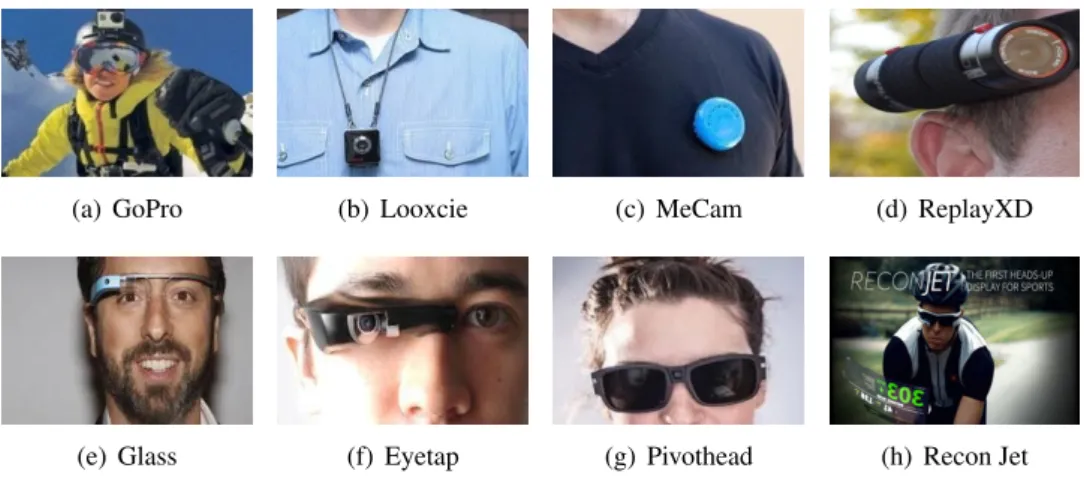
Due to the emergence of pervasive computing as well as the development of small, efficient and low power sensing devices, the use of wearable sensors becomes a common practice across dif-ferent research domains. Among these devices, wearable visual sensors, i.e. wearable cameras, are getting more attention from both the industry and academic communities (Fig. 1.1).
Computer vision research has been traditionally focused on analysing video content recorded from third-person point-of-view, i.e. third-person vision (TPV). However, wearable cameras bring a new computer vision research, i.e. first-person vision (FPV) that provides egocentric information of a subject, i.e. records almost what the subject sees, and results in rich and contin-uous data while the privacy is partially protected as the subject is not directly seen in the recorded videos.
Wearable camera systems can be categorized according to their applications as lifelogging, activity recording and eye tracking. Lifelogging is a digital capture of life experiences typically through mobile sensors [10, 21, 22, 28, 40, 41]. It can also be considered as an automated biography [20]. Lifelogging oriented wearable cameras, such as SenseCam, Autographer and Memoto, are characterized by their tendency to make automatic snapshots in FPV whenever they are triggered. Although most lifelogging devices are equipped with other built-in sensors, they do not have a video recording feature. Activity recorders refer to wearable vision sensors, such as GoPro, Looxcie, and Google Glass, which have been used to record high-quality egocentric
(a) GoPro (b) Looxcie (c) MeCam (d) ReplayXD
(e) Glass (f) Eyetap (g) Pivothead (h) Recon Jet
Figure 1.1: Activity recording cameras (©Google).
videos, e.g. in sports and augmented reality systems [4, 71, 81, 104, 108]. Eye trackers are different from activity recorders with their additional feature to collect user’s attention in a scene, which will be valuable for human activity recognition and behaviour understanding [13, 30].
Human activities can be motion-oriented individual proprioceptive activities, e.g.Walk[25, 50, 64, 103, 104, 106, 108, 109], or interaction-based activities such as person-to-object interac-tive daily activities, e.g.Cook, Read, WriteandWeb browse[30, 66, 69]; and person-to-person interactions, e.g. Handshake, Hug andPunch [65, 80]. In particular, proprioceptive activities involve a full-body motion caused by the movement of muscles and joints (Fig. 1.2) and are of interest in a range of tasks from (self-) monitoring of the elderly to performance analysis of ath-letes. Some of the proprioceptive activities particularly involve upper-body motion, e.g.Bowand
Waist-turn[108]. These activities can also be more specific sport activities, e.g.Dribble, Defend, Sprint, PivotandShoot[4].
(a)
(b)
Figure 1.2: Some of the proprioceptive activities considered in this work; (a): activities viewed from an external camera; (b) frames from the first-person vision acquired by a wearable camera while a user performs the corresponding activity in the top row. The activities in order areBow, Sit-Stand, Left-right turn, Walk, Jog, Run, Sprint, Pivot, Shoot, DribbleandDefend.
(a) (b) (c) (d)
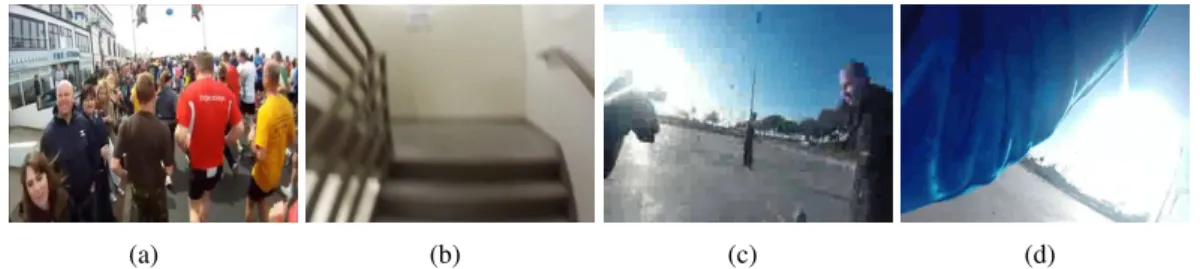
Figure 1.3: Sample frames showing some of the challenges in proprioceptive activity recognition in first-person vision: (a) outlier motions; (b) illumination changes; (c) motion blur; and (d) self-occlusions.
1.2 Challenges
The main challenges for the accurate and robust analysis of activities from FPV include occlu-sions, motion blur, illumination changes and local motions that do not reflect the activity being performed (e.g. other people captured by the camera) (Fig. 1.3). In addition to this, the specific mounting position of the camera makes the problem more difficult because of self-occlusions [94] (especially for chest-mounted cameras) and spurious motions [71, 104] (especially for head-mounted cameras). Other sensors, such as inertial sensors, could be used to complement the video acquisition in order to address these challenges [64, 104]; however, the signals generated by these additional sensors would require synchronization with the video stream.
Proprioceptive activities are characterized by full-body (global) motion [4], hence, it is nec-essary to extract features that encode magnitude, direction and dynamics of the global motion while smoothing the noisy local motions [70, 81, 104, 108]. In addition, effective integration of multiple features is required that exploits the discriminative characteristics of each feature group. Besides the motion dynamics inside a short video segment, it is crucial to encode the long term motion dynamics that reflect the temporal dependency among activities, which is often im-plemented with complex modelling frameworks [50, 104]. In addition to temporal relationships, the exploitation of their hierarchical relationship also provides plausible classification of the ac-tivities.
The lack of validation datasets is another challenge in the proprioceptive activity recognition in FPV. This is partly because FPV-based research is relatively at its early stage compared to tra-ditional (third-person) vision research. Particularly, the lack of data makes it difficult to explore the recent advances of deep neural architectures in the field.
1.3 Problem formulation
LetVVV=(Fk)Nk=v1 be a video sequence captured from FPV and it contains Nf frames. Let C = {cj}Nj=c1denote a set ofNc ego-centric activities (classes). VVV might contain one or more activi-ties that are not overlapped, hence, a windowed segment,Vn, corresponds to only a single activity
cj∈ C. The main aim of the thesis is to exploit the short- and long-term motion dynamics in order to recognise the activity label corresponding toVn. In addition to the temporal encoding, hier-archical relationships among activities, environment (appearance) and multi-modal information can be utilised. While allowing local motions due to occlusions, we assume that a global motion is dominant over the majority of the frames inVn.
1.4 Contributions
The main contributions of the thesis are the following:
• To design multiple motion features in FPV that encode the dynamics, direction and magni-tude of optical flow data both in time and frequency domains. In addition, we propose novel virtual-inertial features from video without using the actual inertial sensor, which comple-ment the grid-based inertial features [1, 4]. Extensive expericomple-ments that include sensitivity to parameter values and robustness to noise demonstrate the goodness of the method. • To propose a framework that encodes the hierarchical relationships among activities and
exploits the temporal continuity during modelling and decision [1]. The outputs of the hierarchy from previous samples are temporally weighted and confidence-based decision smoothing is applied during classification. In addition to grid-based and centroid-based low-level features, we employ pooled frame-level appearance features in the pipeline that has been demonstrated to improve the performance. To address the class imbalance prob-lem, we propose a balancing strategy that undersamples data-rich activities and oversamples data-scarce activities.
• We propose a novel global motion representation that contains a stack of spectrograms of different axial motion components [3]. The stacking helps us to employ 2D convolutions rather than 3D to extract/learn high-level short-term temporal information, which also ex-ploits the intrinsic relationships between motion components and reduces the amount of training data necessary and therefore the complexity. The LSTM is shown to improve the recognition performance by encoding the long-temporal dependency.
• We apply a cross-domain knowledge transfer between virtual and inertial data [2]. Partic-ularly, by stacking the spectrograms of different components of inertial data, we employ existing image-based deep convolutional networks to encode motion features rather than designing a dedicated deep framework on the inertial data and train it from scratch. In addition, we propose a sparsity weighted combination of multiple features from different modalities, e.g. inertial and visual streams. To the best of our knowledge, this is the first work that takes into account deep features extracted form egocentric inertial and FPV data. • Two datasets are collected and made publicly available to facilitate others to research. The datasets include indoor activity recognition (IAR) and basketball activity recognition (BAR) .
1.5 Organization of the thesis
The thesis is organized as follows.Chapter 2reviews the existing methods in FPV-based propri-oceptive activity recognition related with data capture, extraction of multiple features, classifiers, temporal context exploitation, feature fusion and performance evaluation.
Chapter 3 presents the extraction of multiple motion features that encode the direction, magnitude and dynamics of optical flow motion data, both in time and frequency domains. The extraction of novel virtual-inertial features from the movement of intensity centroid is also pre-sented. Existing hand-crafted features are compared against the concatenation of the proposed motion features and validated on multiple datasets.
Chapter 4introduces a multi-layered modelling framework that contains both hierarchical and temporal modelling of activities. The hierarchy is designed manually in order to encode the natural hierarchical relationships among activities, whereas the temporal relationship is encoded both during modelling and decision stages. Features from multiple motion sources are weighted by their temporal distance from a current sample and a confidence-based decision is applied later. New temporal pooling operations are presented on frame-level appearance features. The framework is validated on the largest FPV datasets of proprioceptive activities and compared against the state-of-the-art methods.
Chapter 5 focuses on the use of high-level motion features extracted using existing deep neural networks. This contains an intra-sample encoding, i.e. a novel stacked spectrogram rep-resentation of short-term global motion information that enables us to employ 2D convolutions
rather than the more complex 3D convolutions. This also helps to exploit existing convolutional models trained on large image datasets. Hence, high-level motion features are extracted from the spectrograms of optical flow and centroid movement without training a dedicated deep con-volutional neural networks. Inter-sample temporal encoding is performed using long short-term memory (LSTM) recurrent neural network (RNN) , which encodes the long-term temporal de-pendency among activities. The proposed CNN features in FPV are compared with existing video representations. We also present cross-domain knowledge transfer between vision-and inertial-based recognition of egocentric human activities. Sparsity-weighted combination of multi-modal information is presented that weight the information based on its discriminative characteristics. The sparsity weighting is validated on multiple inertial and visual datasets.
Chapter 6concludes the thesis and outlines future research directions on FPV-based propri-oceptive activity recognition.
State of the art
2.1 Introduction
In this chapter, we describe the state-of-the-art proprioceptive activity recognition in FPV. We provide an in-depth description of the main stages, namely data capture, feature extraction and classification (see Fig. 2.1). Data capture represents the collection of first-person videos us-ing wearable cameras that may have different specifications and can be mounted at different parts of the human body. Feature extractionrefers to the encoding of robust features that help to distinguish activities. The features can be manually designed using task-specific knowledge (handcrafted) or learned from data. Efficient fusion of features is necessary to integrate informa-tion from multiple streams or modalities.Classificationincludes the recognition of activities by exploiting the discriminative characteristics of the features using activity modelling procedures. Moreover, we discuss key components of the recognition pipeline such as temporal context ex-ploitation, which encodes the temporal relationships among activities and improves the recog-nition performance. Existing solutions that address FPV challenges, such as self-occlusion and motion blur, are also discussed across the stages in the pipeline.
This chapter is organized as follows. Section 2.2 describes data capture modes using wear-able cameras and publicly availwear-able datasets for validation. Section 2.3 presents state-of-the-art motion encoding and filtering techniques followed by feature extraction, learning and fusion. Section 2.4 discusses classifiers, temporal context exploitation techniques and decision-level fu-sion of different feature groups. Multiple recognition performance metrics and decomposition
Figure 2.1: A unified pipeline for a generic proprioceptive activity recognition system that uses data from a wearable camera. The switches account for alternative state-of-the-art methods.
strategies of available data to train and test sets are also described in-detail. Finally, Section 2.5 concludes the review and outlines future directions.
2.2 Capturing proprioceptive activities
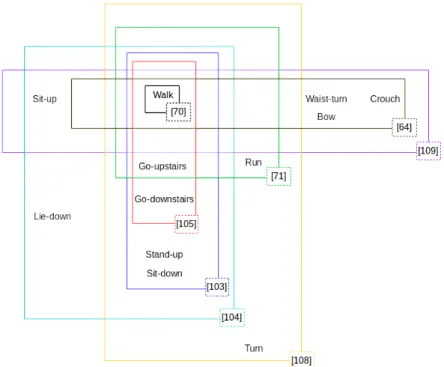
Commonly studied proprioceptive activities (see Fig. 2.2) involve full-body motion, e.g.Walk,
Run, Go-upstairs, Go-downstairs, Sit-downandStand-upor upper-body motion, e.g.Bow and
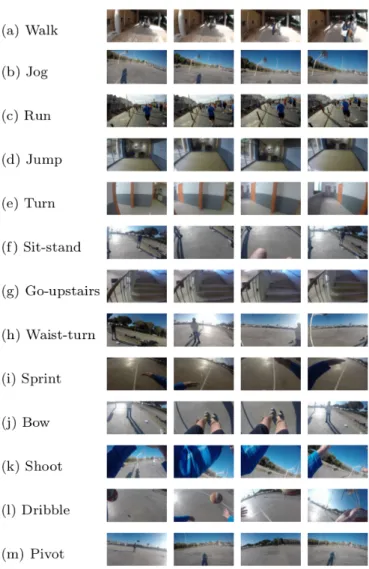
Waist-turn[71, 106, 108]. Examples of key frames for some of the activities are shown in Fig. 2.3. Stationary states, such asSit, Stand and Lie, might contain motion while the user is stationary [71].
Figure 2.2: Venn diagram showing the relationship between different proprioceptive activities and related work (bottom right corner of each box).
Figure 2.3: Sample key frames from first-person videos of different activities.
Data capture for proprioceptive activities often employs either chest- or head-mounting of wearable cameras.Chest-mountcapture provides stable videos, but it might contain self-occlusions, particularly due to user’s hands (see Fig. 2.3 (k)) [64, 108, 109].Head-mountis subject to large-scale and noisy head-motion though it provides more FPV characteristics, i.e. both the subject and the camera tend to share similar field of view [50, 71]. A camera can also be embedded on eyeglasses that achieve a more natural positioning to record what the user sees [103, 104, 105, 106]. Beyond the proprioceptive activity framework, other mounting positions such aswrist[60] can be employed to record objects that are manipulated by a user’s hands. Recent trends show that ahead-mount is often preferred over achest-mountfor data capture (see Table 2.1) as the former possesses better FPV characteristics.
Proprioceptive activity recognition from first-person videos is an emerging field that does not have a standard validation dataset yet. The few existing datasets are often affected by the class
imbalance problem, which is the disproportional representation of activities in a dataset [70, 71]. To facilitate the improvement of the state of the art, we list publicly available datasets that can be used for validation in Table 2.1.
2: State of the art 11
Table 2.1: Summary of public datasets that can be used for the validation of proprioceptive activity recognition frameworks. #: number; I: indoor; O: outdoor; IO: indoor/outdoor; C: chest; H: head; E: eyeglasses; Res/Fr: resolution and frame rate; D: contains different resolutions and frame rates; IMU: inertial measurement unit; Mic.: microphone; ET: eye tracker; TPV: third-person vision; NS: not specified; *: only 4 out of 10 videos are publicly available.
Dataset Reference En vironment Mount Acti vities Res/Fr Duration (hrs) V ideos (#) Subjects (#) Other source
IAR [4] I C Walk, Run, Sit down, Stand up, Jump, Go-upstairs/downstairs, Turn 1080p60 0.67 394 1
BAR [4] O C Bow, Defend, Dribble, Jog, Left-right turn, Shoot, Sit-stand, Sprint,
Walk 720p30 1.20 331 4
HUJI [70, 71] IO H Walk, Sit, Ride bus, Drive, Static, Stand, Cycle, Run, Go-upstairs, Ski,
Horseback ride, Sail, Box, Cook D 82 122 NS
LENA [89] IO H
Watch videos, Read, Browse internet, Walk, Run, Eat, Go-upstairs/downstairs, Phone talk, Talk people, Write, Drink, Housework
960p30 2 260 10
MMD [90] IO H Walk, Ride elevator/escalator up/down, Sit, PC activities, Eat, Drink,
Phone text, Make phone calls, Run, Push-ups, Sit-ups, Cycle 720p30 1.50 200 NS IMU
UEC Park [50] O H Different ego actions (29) in a park, e.g. Jog and Walk 480p60 0.50 2 1
FPSI [31] IO H Individual activities (e.g. Walk) and social interactions
(e.g. Discussion) 720p30 42 113 8
ADL [69] I C Daily indoor activities (18), e.g. Brush teeth 960p30 10 20 20
UTE [53] IO H Lifelog of activities such as Eat, Attend lecture, Drive and Cook 320p15 17 10* 4
CMU-MMAC [91] I H Cook five different recipes: brownies, pizza, sandwich, salad and
scrambled eggs 600p30 17 185 39
Mic., IMU GTEA [33] I H Make hotdog sandwich, instant coffee, peanut butter sandwich, jam
sandwich, sweet tea, cheese sandwich and coffee with honey 720p30 0.50 28 4 GTEA Gaze [32] I E Make American breakfast, Turkey sandwich, cheese burger, Greek
salad, pizza, pasta, salad and afternoon snack 480p30 1 17 14 ET
GTEA Gaze+ [32] I E Similar to GTEA Gaze activities above but more complex 960p24 5 30 10 ET
NUSFPID [65] I H Human-human (e.g. wave), human-object (e.g. Type),
human-object-human interactions (e.g. Pass object) 720p30 0.25 260 NS TPV
UTokyo [66] I E Read book, Watch video, Copy text on screen, Write and Browse
internet 960p30 2 60 5 ET
Note that while some of these datasets might be originally designed for the validation of in-teractive activities (e.g. social interactions [31] and cooking activities [91]); they can be utilised for proprioceptive activity validation by applying appropriate reannotation, e.g. relabelling the majority ofCookactivities toStand. This provides diverse representation of proprioceptive ac-tivities in different settings. We also provide important characteristics of the datasets, such as environment type, frame rate, resolution, number of subjects and duration. After the first-person videos are collected, the video data are often resized and resampled into smaller values in order to improve the processing speed [71, 105].
2.3 Feature Extraction and Fusion
This section discusses how apparent motion is estimated in first-person videos of proprioceptive activities. The motion is often dominated by a global motion due to the user’s full- or upper-body motion, and it can be encoded as optical flow or displacement of keypoints. Handcrafted features that encode salient characteristics of the motion are extracted. Handcrafting refers to the manual designing of the features tailored to solve a specific problem. We also describe the learning of features from data using deep neural networks and the feature-level fusion of multiple feature groups. The summary is given in Table 2.2.
2.3.1 Optical flow
Optical flow is the main source of motion features (see Fig. 2.4) for proprioceptive activity recognition [70, 71, 104]. It can be derived using a direct motion estimation technique [45] that achieves subpixel accuracy. A grid representation of the optical flow is often preferred to a dense representation in order to avoid redundancy in the assumption of global motion domi-nation [70, 104, 108]. According to the level of complexity employed, we can categorize op-tical flow-based features into three groups: raw grid, direction and magnitude histogram and frequency-domain features.
Raw grid features are obtained from the optical flow data with minimum processing. This
includes average pooling (AP) [103, 104, 105, 106], which concatenates horizontal and vertical grid components across frames. Poleg et al. [70] used the radial projection responseof grid optical flow vectors to discriminatemovingfromstationary. Similarly, hard-coded rules on grid vector direction (θ) were employed to classify activities, e.g.Left-turnsatisfies 0◦<θ <90◦ or
Table 2.2: Summary of the state-of-the-art feature extraction, motion filtering and feature-level fusion of multiple feature groups. RANSAC: random sample consensus.
[81] [71] [70] [104] [103] [106] [50] [108] [64] [105] [109]
Features
Optical flow
Raw grid feature 3 3 3 3 3 3
Grid direction histogram 3 3
Grid magnitude histogram 3
Grid gradient histogram 3
Grid frequency feature 3
Keypoint displacement Direction histogram 3 3
Learned features Pooled deep-appearance feature 3
Deep motion feature 3
Filtering Thresholding 3 3 3 RANSAC-based filtering 3 3 3 3 Gaussian smoothing 3 Average pooling 3 3 3 3 Feature-level fusion 3 3 3 3
270◦<θ <360◦ in [64]. The discriminating capability of raw grid featuresis limited since specific motion characteristics such as magnitude and direction are not exploited enough in order to achieve a robust and compact motion feature representation.
Direction (see Fig. 2.4 (b)) and magnitude(see Fig. 2.4 (c)) histograms of the flow vector provide more discriminant features [50]. Motion magnitude and direction components are gen-erally exploited separately to increase the discrimination. For example, Sit-downandStand-up
can be distinguished by exploiting their motion directions, whereas magnitude information helps differentiateWalkandSprint. The histogram provides a compact representation of the direction and/or magnitude components of the grid flow data [50, 81]. The histogram might be applied using joint spatial and direction bins [81], or joint magnitude, direction and magnitude variance bins [50]. The inclusion of spatial bins [81] is comparatively less effective since multiple pro-prioceptive activities can be performed in a similar environment. In addition, Ryoo et al. [81] employed motion boundary histogram as one of the multiple motion features from optical flow data that compensates the camera motion, and it is obtained by applying a spatial derivative on the horizontal and vertical optical flow components separately, followed by a magnitude-weighted histogram of motion direction [99].
Frequency-domain features encode temporal characteristics in the frequency-domain, and
they improve discrimination using frequency-domain analysis. The standard deviation of mag-nitude and direction components in time-domain can only encode the high-level motion dynam-ics. However, frequency-domain analysis exploits the low-level motion dynamics and helps dis-tinguish similar activities, e.g. Sprintand Run (see Fig. 2.4 (c)) as Run involves less frequent changes in motion dynamics [4]. Kitani et al. [50] extracted frequency-domain features from the horizontal and vertical grid components independently. The frequency-domain features can be represented by selecting the low-frequency coefficients that are robust to noise, but the
represen-(a) Key frames
(b) Direction histogram
(c) Magnitude histogram
(d) Direction spectrogram
Figure 2.4: Examples of features derived from the optical flow to encode different motion char-acteristics ofWalk,RunandSprint. (a) Key frames of the activity in the corresponding column; (b) direction histogram representations; (c), (d) the activities can be easily discriminated using the magnitude histogram and the frequency-domain analysis of the direction information, respec-tively.
tation does not include the full spectrum characteristics. Similarly to the number of magnitude and direction bins for the histogram representations, the numbers of frequency bands and low frequency coefficients need to be carefully set to avoid under/over-quantization.
2.3.2 Keypoint displacement
Spatial change of keypoints across frames can also be used to infer apparent motion, which in-volves detection, description and matching of interest points. The detection of the interest points can be either blob-based orcorner-based based on their spatial structure. Examples of
blob-based detectors include scale-invariant feature transform [56], speeded-up robust features [12] and center surround extremas [5]. Examples of corner-based detectors include features from ac-celerated segment test [78], adaptive and generic corner detection based on the acac-celerated seg-ment test [61] and binary robust invariant scalable keypoints [54]. After a keypoint is detected, its neighbourhood is described fulfilling robust characteristics, such as invariant to rotation, us-ing a binaryornon-binary descriptor [36, 82, 95]. Using a binary descriptor makes matching computationally easier since Euclidean distance can be replaced by a Hamming distance that can be calculated using a bitwise XOR operation [6, 54, 79].
Zhang et al. [109] proposed a keypoint-based feature, inspired by the earlier work of Shi and Tomasi [85]. The matching output of the descriptors was refined by uniqueness (one-to-one correspondence) and epipolar constraints [39]. The frame motion was estimated as a set of displacement vectors between matched descriptor pairs. The direction of each displacement vector that satisfied a magnitude threshold was quantized using a histogram representation. The work was later upgraded to achieve multi-resolution detection of interest points in [108]. Average standard deviation [109] and combined standard deviation [108] of the histogram representation were employed to encode the temporal characteristics that improved the classification accuracy.
Since Zhang et al. [108, 109] did not exploit the magnitude information and encode the dy-namics in-detail, their recognition performance is inferior to more advanced features that exploit those characteristics [50]. Generally, keypoint-based methods are computationally efficient and can handle large displacements. However, they are less effective in poorly textured first-person videos, which are often blurred due to high egomotion.
2.3.3 Learned features
Convolutional neural networks (CNNs) have been successfully applied to learn high-level fea-tures from data [47, 83, 71]. Similarly, FPV feafea-tures can also be learned from egocentric videos using deep neural networks. Motion features can be directly learned [58, 71, 88, 107] or derived from the temporal pooling of deep appearance features [81].
Poleg et al. [71] proposed a compact CNN taking a sparse grid volume as input and learned motion features that are demonstrated to outperform the handcrafted features in their previous work [70]. The network was derived from the temporal component of an existing two-stream network [86], and it was designed with a 3D convolutional layer followed by a 3D pooling to handle the 3D input data [96]. 2D convolution layers were applied afterwards, which suppress
the long-term temporal dependency too early in the network. Though the deep motion features are shown to be transferable across datasets of similar nature [71], the interpretation of the knowl-edge learned at different layers requires further study.
On the other hand, motion can be inferred from the variation of per-frame appearance de-scriptors, which are learned from data, using temporal pooling operations. Ryoo et al. [81] proposed different pooling strategies that treat each descriptor element across frames as time-series data. The summation and maximum pooling of the appearance features are not effective to encode multi-resolution temporal variations. But time-series gradientpooling achieves en-coding of short and long temporal variations by applying first-order temporal derivative on each descriptor element [81]. The summation and histogram of positive and negative gradients pro-vide two-stream variation encoding. Comparatively, the histogram representation describes the short-term variation more effectively since its score depends only on the sign of the gradients. This technique could also be applied to handcrafted appearance descriptors such as the histogram of oriented gradients [81].
The discriminative capacity of the feature space can be further improved by encoding a more detailed temporal characteristics in the frequency domain. In addition to the temporal variation of the appearance, static appearance information can also be useful when activities are correlated with certain environmental settings, e.g.Going upstairsinvolves staircases [81, 99].
2.3.4 Filtering and feature-level fusion
A variety of filtering approaches are applied to discard noise in the apparent motion or falsely matched descriptors [104, 106, 109, 108]. Common filtering techniques include threshold-ing[70, 108, 109],random sample consensus (RANSAC) based filtering[35, 50, 105, 108, 109],
Gaussian smoothing[70] andtemporal averaging [103, 104, 105, 106]. In thresholding, motion vectors with magnitude values less than a threshold are removed [70, 108, 109]. RANSAC [35] can be employed to discard outliers among optical flow vectors [50, 105] or falsely matched de-scriptors [108, 109]. Gaussian smoothing can also be applied where there is a high variance of motion data [70]. Average pooling of temporally adjacent grid vectors is also reported to improve the recognition performance [103, 104, 105, 106]. Thresholding and average pooling are simple filtering techniques; however, thresholding might completely remove useful motion information whereas average pooling is less efficient to overcome local motion. Gaussian smoothing and RANSAC-based filtering impose the egomotion domination for proprioceptive activity
recogni-tion.
Egocentric proprioceptive activity recognition often involves multiple discriminative features since it is difficult to discriminate the activities using a single feature type [50, 70, 108, 109]. Moreover, some methods employ additional modalities, e.g. inertial sensors, to complement vi-sual features [64, 103, 104].
Feature-level fusion can be applied to integrate feature groups into a single feature vector prior to the classification [50, 70, 81, 105]. Feature-level fusion needs to be carefully applied on multiple feature groups with equivalent scales and dimensions. Otherwise the discriminative characteristics of lower-dimensional and small-scale feature groups could be suppressed as the result of the feature-level fusion, which often employs concatenation.
2.4 Classification and post-processing
In this section, we review different types of classifiers and post-processing techniques that in-clude the exploitation of temporal context and the decision-level fusion of multi-modal/stream information. We also present performance metrics and train-test decomposition strategies used for validation (see Table 2.3). The modelling of an activity can be performed in either a one-vs.-one(OVO) orone-vs.-all(OVA) approach in a multi-class classification problem. The OVO approach employs a model for each possible class pairs, and during testing the winning class is assumed to be dominant across the majority of the binary classifications. The OVA, also referred as one-vs.-remaining, approach uses a single model for each class that differentiates it against all the remaining classes. The OVA training strategy is often preferred due to the high number of models required in the OVO modelling, particularly when the classification involves more than three classes.
2.4.1 Classifiers
The classifiers employed for proprioceptive activity recognition can be discriminative or gener-ative. Support vector machine (SVM) is the most commonly employed discriminative classifier in the state of the art due to its high margin decision boundary. The majority of existing works in Table 2.3 employed SVM in their pipelines. Polynomial and Gaussian kernels are often preferred to map the original feature space into a high-dimensional space [103, 104]. In addition, multi-channel Chi-square kernels are also used to integrate multiple visual features [81]. K-nearest
Table 2.3: Summary of the state-of-the-art classifiers and post-processing techniques for propri-oceptive activity recognition. OVO: one-vs.-one; OVA: one-vs.-all; -: not applicable.
[81] [71] [70] [104] [103] [106] [50] [108] [64] [105] [109]
Modelling OVO 3 3 3
-OVA 3
-Classifiers
Support vector machine 3 3 3 3 3 3 3 3 3
K-nearest neighbor 3 3 3
Logitboost 3 3 3 3
Naive Bayes 3 3
Hidden Markov model 3 3 3 3
Dirichlet mixture model 3
Conditional random field 3 3
Convolutional neural network 3
Supervision Supervised 3 3 3 3 3 3 3 3 3
Unsupervised 3
Temporal encoding Model-level 3 3 3 3 3
Decision-level 3
Decision-level fusion 3 3 3
neighbour (KNN) is often used as a reference to evaluate the performance of a main classifier (e.g. SVM) [4, 50, 106, 108]. Logitboost is an advanced version of adaboost [37] that exploits weak classifiers via cascading [103, 104, 105, 106]. Naive Bayes classifiers are simple proba-bilistic classifiers that can be employed for proprioceptive activity classification [50, 92, 108].
Hidden Markov models (HMM) are basic sequential generative models [15, 72, 92] that are often applied to smooth the decision outputs of main classifiers [104, 105, 106]. Another generative model, the Dirichlet mixture model [16], is used for unsupervised segmentation of sport actions [50]. Conditional random field is a discriminative classifier, and it also offers graphical modelling characteristics [92] that enable structure learning across multiple temporal scales [103, 104].
Generative models are generally outperformed by discriminative ones due to the bigger data requirements of generative models to encode the relationships among feature elements. However, they might be preferred in the following cases: i) when the observation values are missing, ii) when the observation model has a useful smoothing effect on the label prediction or iii) when there is a need to predict both the observation and the label [15, 48, 92, 98].
In summary, while SVM-based classification has been successful to date, the use of deep networks is growing in proprioceptive activity recognition [58, 71, 81, 88, 107] and it is fa-cilitated by the transferability of deeply learned features across different activity sets [71] or architectures [107]. In addition to spatial and temporal streams [58, 107], deep frameworks can be extended to have an egocentric stream that encodes FPV characteristics [88]. Poleg et al. [71] proposed a CNN that is trained end-to-end to learn motion features from a volume of grid optical flow data using 3D convolutions. However, the complexity increases significantly with respect to image-based (2D) networks [47, 83]. Apart from [50], existing classifiers employ the ground
Figure 2.5: Temporal relationships among basic proprioceptive activities. The arrows indicate higher subsequent-occurrence likelihood between the corresponding activities. Activities inside the dashed boxes also possess high subsequent-occurrence likelihood. Color codes – Red and Magenta: activities involving the full- and upper-body motions, respectively; Green: the user may be stationary; Blue: transition activities.
truth data for supervision.
2.4.2 Temporal context exploitation
The proprioceptive activity classification is generally performed on a clip that lasts for two [50, 81], three [103, 104] or four [71] seconds. The duration of the clip can increase (e.g. up to 17 seconds) for long-term activities [70]. The clips are commonly 50% overlapped [71, 103, 104]. Zhang et al. [108] adopted different temporal durations for different activities, e.g. five seconds forSit-upandSit, six seconds forBow, eight seconds forCrouchand twelve seconds for Waist-turn.
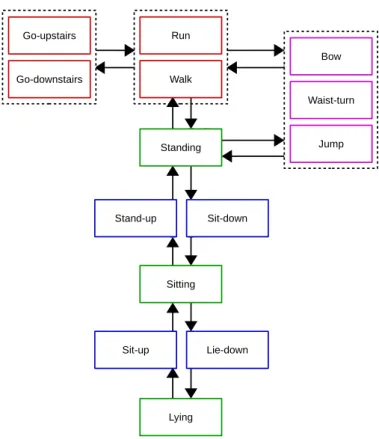
Temporal context exploitation (TCE) refers to the encoding of long-term temporal relation-ships (see Fig. 2.5) among subsequent clips [50, 71, 103, 104, 106]. TCE aims at utilising contin-uous occurrence of an activity and subsequent occurrences of activities.Continuous-occurrence
exploitation assumes that the activity is more likely to continue if it has been performed for some time.Subsequent-occurrenceencoding involves the exploitation of different transition likelihood
of activities from one to the other, e.g. Sit is more likely to transit fromStand than from Run. TCE can be performed at model-level or at decision-level.
Model-level temporal context encoding (MTCE) involves iteratively modelling of the tempo-ral information encoded between previous and current samples. Examples include: multi-scale conditional random fields, where each node represents a different time index [103, 104]; Dirichlet mixture models, designed to maximize the posterior distribution of a current sample given the la-belling of the previous samples [50]; and modelling of the SVM outputs using HMM [105, 106]. Model-level encoding has a high degree of flexibility to exploit complex temporal relationships among activities.
Decision-level temporal context encoding (DTCE) refines the final classification output of the current sample towards the outputs of the previous samples without an iterative modelling. This can be implemented using a simple smoothing such as accumulative weighting [71]. Decision-level encoding might result in a rough smoothing of current information with limited capability to exploit subsequent-occurrence likelihoods.
Generally, temporal relationships need to be encoded at different temporal scales to effec-tively recognize proprioceptive activities. Recurrent neural networks (RNNs) are specific classes of deep neural networks designed to achieve MTCE [29, 59, 87]. Particularly, long short-term memory (LSTM) networks are specific types of RNNs that are effective to learn long-term tem-poral dependency usinginput,outputandforgetgates that act as switches to solve the vanishing and exploding gradient problems in the vanilla RNN.
2.4.3 Decision-level fusion
Decision-level fusion utilises different feature groups by post-processing their classification out-puts, e.g. averaging. Decision-level fusion resembles DTCE discussed above. The difference is that DTCE works across samples at different temporal indices whereas the decision-level fu-sion does across samples from different feature groups at a given temporal index [64, 103, 104]. Though feature-level fusion is easier to combine multiple visual features, decision-level fusion is preferred for multi-modal features since independent local classification is often performed primarily for each modality [64, 104]. The local classification outputs are later exploited for the final decision (e.g. majority vote) [64]. In addition, decision-level fusion is preferred when the feature groups involve different dimensions and scales.
Table 2.4: Summary of train-test decomposition strategies used for the validation of propriocep-tive activity recognition.
[81] [71] [70] [104] [103] [106] [108] [64] [105] [109]
Decomposition per subject data 3 3
Decomposition per activity data 3 3 3 3 3
Leave-one-subject-out 3 3 3
Leave-one-data-group-out 3 3 3 3
Fixed train samples per activity 3 3
e.g. when multiple features are extracted from each modality in a multi-modal sensing. As a result, a feature-level fusion is applied on the same modality features, and a decision-level fusion is applied on the separate classification outputs of different modalities. Another situation is when multiple features are extracted from different feature sources in a single-modal sensing. Examples of these feature sources include optical flow, keypoint displacement and variation of intra-frame appearance in FPV. Therefore, features from similar source are first combined at feature-level, and then classification outputs of different sources are integrated at decision-level.
2.4.4 Performance measures and decomposition strategies
In addition to computational complexity [108], precision (P) and recall (R) are the commonly employed performance metrics, which quantifytrue positive (TP)with respect tofalse positive (FP)and tofalse negative (FN), respectively [50, 71, 103, 104].F-score is the harmonic mean of precision and recall as 2∗ P ∗ R/(P+R), and it performs well in highly-biased datasets since it is independent of the class distribution. However, specificity, which evaluatestrue negative (TN)
tofalse positive (FP), is not very informative of the recognition performance in the commonly employed OVA modelling strategy. This is because the OVA results in a highly disproportional
TN compared toTP. As a result, all activities tend to achieve high specificity, which does not reflect theTP.
A supervised proprioceptive activity recognition can employ different strategies for decom-posing a dataset into train and test sets (see Table 2.4). The strategies may vary according to the type and ratio of the decomposition. The type of decomposition is often either per-subject [103, 104] orper-activity [108, 81, 106, 64, 109]. Decomposition per-subject data in-volves grouping the data collected by each subject into train and test sets [103, 104]. On the other hand, per-activity decomposition uses a subset of videos collected by all subjects for each activ-ity as the train set, and the remaining videos are included in the test set [64, 81, 106, 108, 109]. Different ratios of train to test data are reported in the state of the art [71, 104].
data from a single subject both in train and test sets, which increases the resemblance of the two sets. Leave-one-subject-out validation avoids the resemblance by using the data from a single subject for testing, while the data from all the remaining subjects is used for training [104]. Data from more subjects can be left out rather than just one subject. In addition, the available data can be categorized into plausible groups, andleave-one-data-group-outvalidation can be applied to test the transferability of knowledge across different groups. An example can be the grouping of patients’ data according to their disabilities [104].
Generally, train-test decomposition strategy should aim to avoid the similarity of the train and test sets, i.e. test set should contain future observations that are unseen during the training stage. As a result, when there are multiple subjects in a dataset, one-subject-out and subject-based leave-one-data-group-out validations reduce the resemblance between the train and test sets. On the other hand, similar videos from a single subject might appear in both sets during per-activity train-test decomposition. The majority of the train-test decomposition schemes mentioned above can also be affected by the class imbalance problem existing in many datasets, which represents unbalanced amount of data among activities and/or subjects. Using a fixed amount of training data for all activities can address this problem [70, 71].
2.5 Summary
We reviewed proprioceptive activity recognition in FPV and critically discussed its key compo-nents. In order to discriminate different proprioceptive activities, the features are designed to ex-ploit available motion peculiarities, such as magnitude, direction and dynamics. Comparatively, optical flow-based techniques are robust as they are able to estimate motion in the presence of challenges, such as weak texture and motion blur. We proposevirtual-inertialfeatures extracted from first-person videos in order to complement optical flow features without using the actual inertial sensor (see Chapter 3) [4]. In addition to multiple motion feature groups, we propose to exploit hierarchical relationships among activities and temporal contexts at modelling and decision stages of the recognition pipeline (see Chapter 4).
With the growing size of publicly available datasets and the success of deep networks across different application domains, high-level learned features are expected to outperform handcrafted features. The learning can be implemented to provide: i) frame-level appearance and motion descriptors using 2D convolutions followed by temporal pooling operations or ii) spatio-temporal
features using 3D convolutions. As a result, the direct learning of motion features involves high computational complexity. We propose a stacked spectrogram representation of the global motion in FPV (see Chapter 5), which enables learning of motion features using 2D convolutions and hence reduces the complexity [3]. It also provides transfer learning capability from large image datasets. Existing methods do not encode temporal information beyond a few seconds. Hence, we employ long short-term memory (LSTM) recurrent neural networks (RNNs) to exploit the long-term temporal dependency among activities [3, 2].
Existing FPV-based proprioceptive activity datasets are separately collected for different re-search problems, with limited cross-dataset validations. To facilitate the progression in the field, it is necessary to have an all-inclusive and challenging dataset similarly to ActivityNet [?] - a large-scale benchmark dataset for human activity understanding in third-person vision.
Wearable camera systems may contain additional built-in sensors (e.g. microphones and ac-celerometers). As a result, it is necessary to have a seamless integration of the multi-modal data without posing acquisition complexity and obtrusiveness. We also propose a cross-domain knowledge transfer that can enhance performance while weighting different modalities or streams of data accordingly to their merits [2]. This is particularly important when there is a scarcity of data to train a dedicated deep network from scratch.
Decomposition per-subject and per-activity in a multi-subject dataset might result in having data from a single subject both in train and test sets, which increases the resemblance of the two sets. Leave-one-subject-out validation avoids the resemblance by using the data from a single subject for testing, while the data from all the remaining subjects is used for training [104]. Data from more subjects can be left out rather than just one subject. In addition, the available data can be categorized into plausible groups, andleave-one-data-group-outvalidation can be applied to test the transferability of knowledge across different groups. An example can be the grouping of patients’ data according to their disabilities [104].
Generally, train-test decomposition strategy should aim to avoid the similarity of the train and test sets, i.e. test set should contain future observations that are unseen during the training stage. As a result, when there are multiple subjects in a dataset, one-subject-out and subject-based leave-one-data-group-out validations reduce the resemblance between the train and test sets. On the other hand, similar videos from a single subject might appear in both sets during per-activity train-test decomposition. The majority of the train-test decomposition schemes mentioned above
can also be affected by the class imbalance problem existing in many datasets, which represents unbalanced amount of data among activities and/or subjects. Using a fixed amount of training data for all activities can address this problem [70, 71].
Multiple motion features from first-person videos
3.1 Introduction
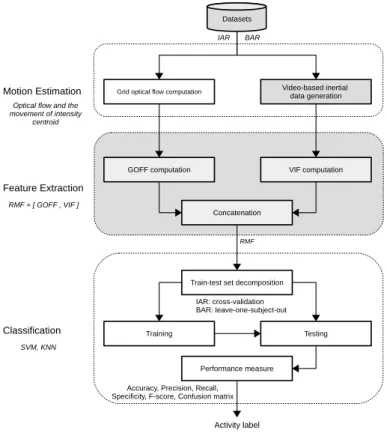
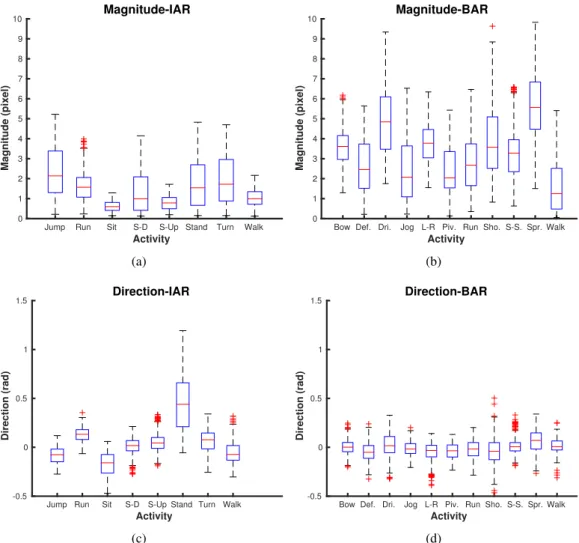
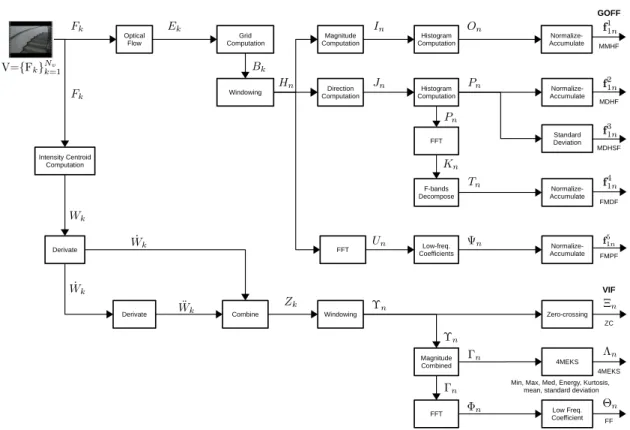
In this chapter, we propose a robust motion-feature (RMF) that combines grid optical flow-based features and video-based inertial features (Fig. 3.1). The types of extracted features are moti-vated by the nature of variations among activities (Fig. 3.2 and 3.3). Activities such asSit-down
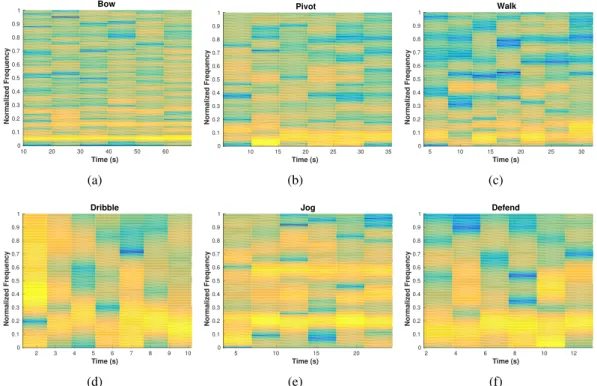
andStand-upvary in their direction components (Fig. 3.2(c)) while they possess similar magni-tude values (Fig. 3.2(a)). Activities such asSprintandWalk have similar direction information (Fig. 3.2(d)) but significantly different in their magnitude patterns (Fig. 3.2(b)). In addition to this, spectrograms of motion direction in Fig. 3.3 show that discriminative features can also be extracted in the frequency domain.
We develop RMF from the optical flow and virtual inertial data by exploiting direction, mag-nitude and dynamics of motion in first-person videos (Fig. 3.4). We extract virtual inertial data from the movement of intensity centroid across frames in a video without physically using in-ertial sensors. Intensity centroid [77] is analogue to a center of mass in physics where a rigid body experiences a zero-sum of weighted relative location of its distributed mass. The centroid is computed from weighted averages of intensity values, i.e. image moments [26, 79].
The proposed RMF is generic and can be employed with any classifier. In particular, for validation we use support vector machines (SVM) and k-nearest neighbours (KNN) to test the proposed RMF and compare its performance with state-of-the-art motion features, experimented across different datasets. In order to facilitate the research, we collect two datasets that are
made publicly available. The first dataset is used to experiment indoor ambulatory recognition (IAR) task of eight activities and the second is related to basketball activity recognition (BAR) of eleven activities recorded in an outdoor court. To the best of our knowledge, BAR dataset is the first dataset that contains basketball activities in FPV1. In addition to IAR and BAR, we also validate the experiments on two publicly available datasets: JPL-interaction dataset [80] of seven activities and DogCentric [46] dataset of ten activities.
Figure 3.1: The overview of the proposed proprioceptive activity recognition system in which highlighted blocks show our contributions. IAR: indoor ambulatory recognition dataset; BAR: basketball activity recognition dataset; GOFF: grid optical flow-based features; VIF: vision-based inertial features; RMF: robust motion feature; SVM: support vector machine; KNN: k-nearest neighbourhood.
The organisation of the Chapter is as follows. Section 3.2 presents features extracted from optical flow. Section 3.3 describes features extracted from the movement of intensity centroid in a video. Complexity analysis of the proposed framework is presented in Section 3.4. Section 3.5 presents the parameter setup and datasets used for validation. Section 3.6 describes the result and discussion. Section 3.7 concludes the chapter.
1The datasets and the annotations are available at
http://www.eecs.qmul.ac.uk/˜andrea/ FPV.html
Activity
Jump Run Sit S-D S-Up Stand Turn Walk
Magnitude (pixel) 0 1 2 3 4 5 6 7 8 9 10 Magnitude-IAR (a) Activity
Bow Def. Dri. Jog L-R Piv. Run Sho. S-S. Spr. Walk
Magnitude (pixel) 0 1 2 3 4 5 6 7 8 9 10 Magnitude-BAR (b) Activity
Jump Run Sit S-D S-Up Stand Turn Walk
Direction (rad) -0.5 0 0.5 1 1.5 Direction-IAR (c) Activity
Bow Def. Dri. Jog L-R Piv. Run Sho. S-S. Spr. Walk
Direction (rad) -0.5 0 0.5 1 1.5 Direction-BAR (d)
Figure 3.2: Average magnitude and direction values for activities in (a,c) IAR and (b, d) BAR datasets. Comparatively, average magnitude of BAR activities is higher and more variant (3.35± 1.16 pixels) than that of IAR (1.42±0.58 pixels). From direction point of view, IAR activities show higher average variation (0.05±0.19 rad) while BAR directions are restricted in−0.01± 0.03 rad. S-D:Stair-down; S-Up: Stair-up; Def.: Defend; Dri.: Dribble; L-R: Left-right turn; Piv.:Pivot; Sho.:Shoot; S-S:Sit-standand Spr.:Sprint.
Time (s) 10 20 30 40 50 60 Normalized Frequency 0 0.1 0.2 0.3 0.4 0.5 0.6 0.7 0.8 0.9 1 Bow (a) Time (s) 10 15 20 25 30 35 Normalized Frequency 0 0.1 0.2 0.3 0.4 0.5 0.6 0.7 0.8 0.9 1 Pivot (b) Time (s) 5 10 15 20 25 30 Normalized Frequency 0 0.1 0.2 0.3 0.4 0.5 0.6 0.7 0.8 0.9 1 Walk (c) Time (s) 2 3 4 5 6 7 8 9 10 Normalized Frequency 0 0.1 0.2 0.3 0.4 0.5 0.6 0.7 0.8 0.9 1 Dribble (d) Time (s) 5 10 15 20 Normalized Frequency 0 0.1 0.2 0.3 0.4 0.5 0.6 0.7 0.8 0.9 1 Jog (e) Time (s) 2 4 6 8 10 12 Normalized Frequency 0 0.1 0.2 0.3 0.4 0.5 0.6 0.7 0.8 0.9 1 Defend (f)
Figure 3.3: Motion-direction spectrograms that reveal the discriminating characteristics of frequency-based features. (a): low frequency activities (Bow, Pivot andWalk); (b): high fre-quency components (Dribble,JogandDefend).
3.2 Grid optical flow-based features
The proposed motion-features (Fig. 3.4) exploit optical flow data more effectively than existing optical flow-based features [50, 64, 104, 106]. In order to encode the variation in motion mag-nitude, direction and dynamics among activities, we extract a set of feature subgroups, namely Motion magnitude histogram feature (MMHF), Motion direction histogram feature (MDHF), Motion direction histogram standard-deviation feature (MDHSF), Fourier transform of motion direction across frame (FMDF) and Fourier transform of grid motion per frame (FMPF).
Given a video sequenceVVV ={Fk}kN=v1where each frame[Fk]R×Chas a height ofRpixels and a width ofCpixels, we compute the Horn-Schunk optical flow [42] for each subsequent pair of frames. We select the Horn-Schunk method, rather than the Lucas-Kanade approach [57], be-cause of its global smoothness assumption which is preferred in our scenario where a global mo-tion is assumed to be dominant and reflects the ego-momo-tion of a user wearing the camera. Because a dense optical flow representation of a frame[Ek]R×Ccontains redundancy of motion information under the assumption of a dominant global motion, we apply a grid representation[Bk]G×G, where
Grefers to the number of grids in each dimension (Sec. 3.5.1 for the analysis part). We build the grid representation asBk=Ek(rA,cA), whererAandcAareG-dimensional row and column
vec-Figure 3.4: Detailed block diagram of the extraction of the proposed multi-dimension motion features. GOFF: grid optical flow-based features; VIF: vision-based inertial features; FFT: fast Fourier transform; MMHF: motion magnitude histogram feature; MDHF: motion direction his-togram feature; MDHSF: motion direction hishis-togram standard deviation feature; FMDF: Fourier transform of motion direction across frames; FMPF: Fourier transform of grid motion per frame; ZC: zero-crossing; 4MEKS: minimum, maximum, median, mean, energy, kurtosis and standard deviation; FF: Frequency-based feature.
tors sampled asrA = (1,1+R/G,1+2R/G, ...,R)andcA= (1,1+C/G,1+2C/G, ...,C). The sampling inrAandcAis conducted periodically after everyR/GandC/Gpixels, respectively, so thatBkcontains sample motions from all regions in a frame. A vectorised representation of grid-optical flow of a frame includes horizontal and vertical components, i.e. Bk= (B
g kx+jB g ky) G2 g=1 . We reduce the dimension of motion-vector fromR×CinEk toG2 inBk by applying a grid representation.
We consider the grid motion-vectors of a set ofL-frames as an activity sample that is assumed to contain adequate motion data to be classified as one of the activities inC.Lrepresents the win-dow length or temporal duration (in number of frames) to be found experimentally (Sec. 3.5.1). The nth activity sample of a video sequenceVVV is formulated asVn ={Bkn}Lk=1. The number of activity samples inVdepends on its temporal duration,Nv, the window length,L, and over-lapping percentage, ν, between a pair of consecutive windows. For example, a video segment withNv=160 frames,L=100 frames andν=50% has approximately three activity samples.