FREAK: Fast Retina Keypoint
Alexandre Alahi, Raphael Ortiz, Pierre Vandergheynst
Ecole Polytechnique F´ed´erale de Lausanne (EPFL), Switzerland
Abstract
A large number of vision applications rely on match-ing keypoints across images. The last decade featured an arms-race towards faster and more robust keypoints and association algorithms: Scale Invariant Feature
Trans-form (SIFT)[17], Speed-up Robust Feature (SURF)[4], and
more recently Binary Robust Invariant Scalable Keypoints
(BRISK)[16] to name a few. These days, the deployment
of vision algorithms on smart phones and embedded de-vices with low memory and computation complexity has even upped the ante: the goal is to make descriptors faster to compute, more compact while remaining robust to scale, rotation and noise.
To best address the current requirements, we propose a novel keypoint descriptor inspired by the human visual sys-tem and more precisely the retina, coined Fast Retina Key-point (FREAK). A cascade of binary strings is computed by efficiently comparing image intensities over a retinal sam-pling pattern. Our experiments show that FREAKs are in general faster to compute with lower memory load and also more robust than SIFT, SURF or BRISK. They are thus com-petitive alternatives to existing keypoints in particular for embedded applications.
1. Introduction
Visual correspondence, object matching, and many other vision applications rely on representing images with sparse number of keypoints. A real challenge is to efficiently de-scribe keypoints, i.e. image patches, with stable, compact and robust representations invariant to scale, rotation, affine transformation, and noise. The past decades witnessed key players to efficiently describe keypoints and match them.
The most popular descriptor is the histogram of oriented gradient proposed by Lowe [17] to describe the Scale In-variant Feature Transform (SIFT) keypoints. Most of the efforts in the last years was to perform as good as SIFT [14] with lower computational complexity. The Speeded up Ro-bust Feature (SURF) by Bayet al. [4] is a good example. It has similar matching rates with much faster performance
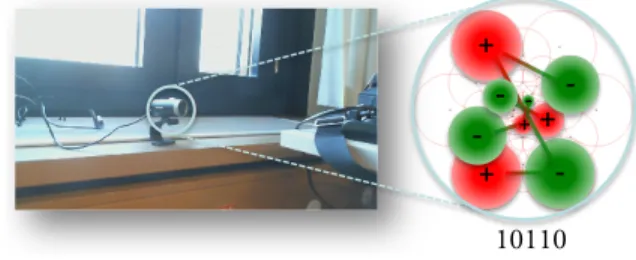
+ - - - + + - - + 10110
Figure 1:llustration of our FREAK descriptor. A series of Difference of Gaussians (DoG) over a retinal pattern are 1 bit quantized.
by describing keypoints with the responses of few Haar-like filters. In general, Alahiet al. show in [2] that a grid of de-scriptors, similar to SIFT and SURF, is better than a single one to match an image region. Typically, a grid of covari-ance matrices [30] attains high detection rate but remains computationally too expensive for real-time applications.
The deployment of cameras on every phone coupled with the growing computing power of mobile devices has en-abled a new trend: vision algorithms need to run on mo-bile devices with low computing power and memory ca-pacity. Images obtained by smart phones can be used to perform structure from motion [27], image retrieval [22], or object recognition [15]. As a result, new algorithms are needed where fixed-point operations and low memory load are preferred. The Binary Robust Independent Ele-mentary Feature (BRIEF) [5], the Oriented Fast and Ro-tated BRIEF (ORB)[26], and the Binary Robust Invariant Scalable Keypoints[16] (BRISK) are good examples. In the next section, we will briefly present these descriptors. Their stimulating contribution is that a binary string obtained by simply comparing pairs of image intensities can efficiently describe a keypoint,i.e. an image patch. However, several problems remain: how to efficiently select the ideal pairs within an image patch? How to match them? Interestingly, such trend is inline with the models of the nature to describe complex observations with simple rules. We propose to ad-dress such unknowns by designing a descriptor inspired by the Human Visual System, and more precisely the retina. We propose the Fast Retina Keypoint (FREAK) as a fast, 1
compact and robust keypoint descriptor. A cascade of bi-nary strings is computed by efficiently comparing pairs of image intensities over a retinal sampling pattern. Interest-ingly, selecting pairs to reduce the dimensionality of the de-scriptor yields a highly structured pattern that mimics the saccadic search of the human eyes.
2. Related work
Keypoint descriptors are often coupled with their detec-tion. Tuytelaaret al. in [29] and Gauglitzet al. in [11] pre-sented a detailed survey. We briefly present state-of-the-art detectors and mainly focus on descriptors.
2.1. Keypoint detectors
A first solution is to consider corners as keypoints. Har-ris and Stephen in [12] proposed the Harris corner detector. Mikolajczyk and Schmid made it scale invariant in [20]. Another solution is to use local extrema of the responses of certain filters as potential keypoints. Lowe in [17] fil-tered the image with differences of Gaussians. Bayet al. in [4] used a Fast Hessian detector. Agrawalet al. in [1] proposed simplified center-surround filters to approximate the Laplacian.. Ebrahimi and Mayol-Cuevas in [7] accel-erated the process by skipping the computation of the filter response if the response for the previous pixel is very low. Rostenand and Drummond proposed in [25] the FAST cri-terion for corner detection, improved by Mairet al. in [18] with their AGAST detector. The latter is a fast algorithm to locate keypoints. The detector used in BRISK by
Leuteneg-geret al. in [16] is a multi-scale AGAST. They search for
maxima in scale-space using the FAST score as a measure of saliency. We use the same detector for our evaluation of FREAK.
2.2. SIFT-like descriptors
Once keypoints are located, we are interested in describ-ing the image patch with a robust feature vector. The most well-known descriptor is SIFT [17]. A 128-dimensional vector is obtained from a grid of histograms of oriented gra-dient. Its high descriptive power and robustness to illumina-tion change have ranked it as the reference keypoint descrip-tor for the past decade. A family of SIFT-like descripdescrip-tor has emerged in the past years. The PCA-SIFT [14] reduces the description vector from 128 to 36 dimension using principal component analysis. The matching time is reduced, but the time to build the descriptor is increased leading to a small gain in speed and a loss of distinctiveness. The GLOH de-scriptor [21] is an extension of the SIFT descriptor that is more distinctive, but also more expensive to compute. The robustness to change of viewpoint is improved in [31] by simulating multiple deformations to the descriptive patch. Good compromises between performances and the number of simulated patches lead to an algorithm twice slower than
SIFT. Ambai and Yoshida proposed a Compact And Real-time Descriptors (CARD) in [3] to extract the histogram of oriented gradient from the grid binning of SIFT or the log-polar binning of GLOH. The computation of the histograms is simplified by using lookup tables.
One of the widely used keypoints at the moment is clearly SURF [4]. It has similar matching performances as SIFT but is much faster. It also relies on local gradient his-tograms. The Haar-wavelet responses are efficiently com-puted with integral images leading to 64 or 128-dimensional vectors. However, the dimensionality of the feature vector is still too high for large-scale applications such as image retrieval or 3D reconstruction. Often, Principal Component Analysis (PCA), or hashing functions are used to reduce the dimensionality of the descriptors [24]. Such steps involve time-consuming computation and hence affect the real-time performance.
2.3. Binary descriptors
Calonderet al. in [5] showed that it is possible to short-cut the dimensionality reduction step by directly building a short binary descriptor in which each bits are indepen-dent, called BRIEF. A clear advantage of binary descrip-tors is that the Hamming distance (bitwise XOR followed by a bit count) can replace the usual Euclidean distance. The descriptor vector is obtained by comparing the intensity of 512 pairs of pixels after applying a Gaussian smoothing to reduce the noise sensitivity. The positions of the pix-els are pre-selected randomly according to a Gaussian dis-tribution around the patch center. The obtained descriptor is not invariant to scale and rotation changes unless cou-pled with detector providing it. Calonderet al. also high-lighted in their work that usually orientation detection re-duces the recognition rate and should therefore be avoided when it is not required by the target application. Rubleeet al. in [26] proposed the Oriented Fast and Rotated BRIEF (ORB) descriptor. Their binary descriptor is invariant to rotation and robust to noise. Similarly, Leutenegger et al. in [16] proposed a binary descriptor invariant to scale and rotation called BRISK. To build the descriptor bit-stream, a limited number of points in a specific sampling pattern is used. Each point contributes to many pairs. The pairs are divided in short-distance and long-distance subsets. The long-distance subset is used to estimate the direction of the keypoint while the short-distance subset is used to build bi-nary descriptor after rotating the sampling pattern.
In Section 5, we compare our proposed FREAK de-scriptor with the above presented dede-scriptors. But first, we present a possible intuition on why these trendy binary de-scriptors can work based on the study of the human retina.
! " #$"" ! " #%"" ! " #&"" ! " #'"" (" )" ! " #*"" ! " #+"" ! " #,"" (" )" - $.$$..$" /0121345462137" /894:7" ;<=>:81="?4::7" @5A1="6124=A<:7" B8=<3C"7238=>" ?4::7" D8=4<3" E1=-:8=4<3" FGH<="" 34A=<" ?1H6G243" I8781="
Figure 2:From human retina to computer vision: the biological pathways leading to action potentials is emulated by simple binary tests over pixel regions. [Upper part of the image is a courtesy of the book Avian Visual Cognition by R: Cook].
3. Human retina
3.1. Motivations
In the presented literature, we have seen that recent progress in image representation has shown that simple in-tensity comparison of several pairs of pixels can be good enough to describe and match image patches [5, 26, 16]. However, there exist some open interrogations on the ideal selection of pairs. How should we sample them and com-pare them? How to be robust to noise? Should we smooth with a single Gaussian kernel? In this work, we show how to gain performance by selecting a solution inspired by the human retina, while enforcing low computational complex-ity.
Neuroscience has made lots of progress in understand-ing the visual system and how images are transmitted to the brain [8]. It is believed that the human retina extracts de-tails from images using Difference of Gaussians (DoG) of various sizes and encodes such differences with action po-tentials. The topology of the retina plays an important role. We propose to mimic the same strategy to design our image descriptor.
3.2. Analogy: from retinal photoreceptors to pixels
The topology and spatial encoding of the retina is quite fascinating. First, several photoreceptors influence a gan-glion cell. The region where light influences the response of a ganglion cell is the receptive field. Its size and den-dritic field increases with radial distance from the foveola (Figure3). The spatial distribution of ganglion cells reduces exponentially with the distance to the foveal. They are seg-mented into four areas: foveal, fovea, parafoveal, and peri-foveal. Each area plays an interesting role in the process of detecting and recognizing objects since higher resolution is(a) Density of ganglion cells over the retina [10].
(b) Retina areas [13]
Figure 3:Illustration of the distribution of ganglion cells over the retina. The density is clustered into four areas: (a) the foveola, (b) fovea, (c) parafoveal, and (d) perifoveal.
captured in the fovea whereas a low acuity image is formed in the perifoveal. One can interpret the decrease of resolu-tion as a body resource optimizaresolu-tion. Let us now turn these insights into an actual keypoint descriptor. Figure2presents the proposed analogy.
4. FREAK
4.1. Retinal sampling pattern
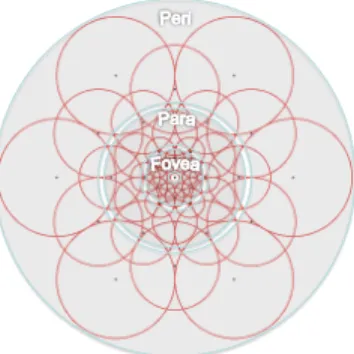
Many sampling grids are possible to compare pairs of pixel intensities. BRIEF and ORB use random pairs. BRISK uses a circular pattern where points are equally spaced on circles concentric, similar to DAISY [28]. We propose to use the retinal sampling grid which is also cir-cular with the difference of having higher density of points near the center. The density of points drops exponentially as can be seen in Figure3. .
Each sample point needs to be smoothed to be less sen-sitive to noise. BRIEF and ORB use the same kernel for all points in the patch. To match the retina model, we use different kernels size for every sample points similar to BRISK. The difference with BRISK is the exponential change in size and the overlapping receptive fields. Figure 4illustrates the topology of the receptive fields. Each circle represents the standard deviations of the Gaussian kernels applied to the corresponding sampling points.
We have experimentally observed that changing the size of the Gaussian kernels with respect to the log-polar retinal pattern leads to better performance. In addition, overlap-ping the receptive fields also increases the performance. A possible reason is that with the presented overlap in Figure 4, more information is captured. We add redundancy that brings more discriminative power. Let’s consider the inten-sitiesIimeasured at the receptive fieldsA, B, andCwhere:
IA> IB,IB> IC, andIA> IC. (1) If the fields do not have overlap, then the last testIA >
Figure 4:Illustration of the FREAK sampling pattern similar to the retinal ganglion cells distribution with their corresponding receptive fields. Each circle represents a receptive field where the image is smoothed with its corresponding Gaussian kernel.
if the fields overlap, partially new information can be en-coded. In general, adding redundancy allow us to use less receptive fields which is a known strategy employed in com-pressed sensing or dictionary learning [6]. According to Ol-shausen and Field in [23], such redundancy also exists in the receptive fields of the retina.
4.2. Coarse-to-fine descriptor
We construct our binary descriptorFby thresholding the difference between pairs of receptive fields with their cor-responding Gaussian kernel. In other words,F is a binary string formed by a sequence of one-bit Difference of Gaus-sians (DoG):
F = X
0≤a<N
2aT(Pa), (2) wherePa is a pair of receptive fields,Nis the desired size of the descriptor, and
T(Pa) = 1 if(I(Pr1 a )−I(Par2)>0, 0 otherwise, withI(Pr1
a )is the smoothed intensity of the first recep-tive field of the pairPa.
With few dozen of receptive fields, thousands of pairs are possible leading to a large descriptor. However, many of the pairs might not be useful to efficiently describe an image. A possible strategy can be to select pairs given their spatial distance similar to BRISK. However, the selected pairs can be highly correlated and not discriminant. Consequently, we run an algorithm similar to ORB [26] to learn the best pairs from training data:
1. We create a matrixDof nearly fifty thousands of ex-tracted keypoints. Each row corresponds to a keypoint represented with its large descriptor made of all pos-sible pairs in the retina sampling pattern illustrated in
Figure4. We use 43 receptive fields leading to approx-imately one thousand pairs.
2. We compute the mean of each column. In order to have a discriminant feature, high variance is desired. A mean of 0.5 leads to the highest variance of a binary distribution.
3. We order the columns with respect to the highest vari-ance.
4. We keep the best column (mean of 0.5) and iteratively add remaining columns having low correlation with the selected columns.
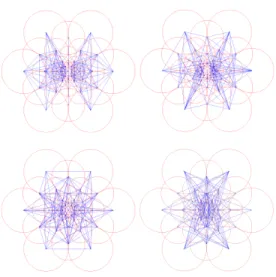
Strikingly, there is a structure in the selected pairs. A coarse-to-fine ordering of the difference of Gaussians (the pairs) is automatically prefered. Figure 5 illustrates the pairs selected by grouping them into four clusters (128 pairs per group). We experimentally observed that the first 512 pairs are the most relevant and adding more pairs is not in-creasing the performance. A symmetric scheme is captured due to the orientation of the pattern along the global gradi-ent. Interestingly, the first cluster involves mainly periph-eral receptive fields whereas the last ones implicates highly centered fields. It appears to be reminiscent of the behavior of the human eye. We first use the perifoveal receptive fields to estimate the location of an object of interest. Then, the validation is performed with the more densely distributed receptive fields in the fovea area. Although the used fea-ture selection algorithm is a heuristic, it seems to match our understanding of the model of the human retina. Our matching step takes advantage of the coarse-to-fine struc-tured of FREAK descriptor. Note that in the last decades, coarse-to-fine strategy has often been explored in detecting and matching objects [9,2].
4.3. Saccadic search
Humans do not look at a scene in fixed steadiness. Their eyes move around with discontinuous individual move-ments called saccades. The presented cells topology in the retina is one reason for such movements. As explained previously, the fovea captures high-resolution information thanks to its high-density photoreceptors. Hence, it plays a critical role in recognizing and matching objects. The perifoveal area captures less detailed information,i.e. low-frequency observation. Consequently, they are used to com-pile first estimates of the locations of our objects of interest. We propose to mimic the saccadic search by parsing our descriptor in several steps. We start by searching with the first 16 bytes of the FREAK descriptor representing coarse information. If the distance is smaller than a threshold, we further continue the comparison with the next bytes to an-alyze finer information. As a result, a cascade of compar-isons is performed accelerating even further the matching
(a) An object of interest
de-scribed by 1 FREAK (b) Best matches after
1st
cascade (c) Distance map with firstcascade (in color jet) (d) Distance map with lastcascade (in color jet) (e) Matched objects after lastcascade
Figure 6:Illustration of the cascade approach.
Figure 5:Illustration of the coarse-to-fine analysis. The first cluster in-volves mainly perifoveal receptive fields and the last ones fovea.
step. More than 90% of the candidates are discarded with the first 16 bytes of our FREAK descriptor. Note that we have chosen 16 bytes for the first cascade to match hard-ware requirements. To compare 1 byte or 16 bytes is al-most equivalent with Single Instruction and Multiple Data (SIMD) instructions on Intel processors since operations are performed in parallel.
We illustrate the saccadic search in Figure6. For visu-alization purposes, we describe an object of interest with a single FREAK descriptor of the size of its bounding circle (Figure 6 (a)). Then, we search for the same object in a new image. All candidate image regions are also described with a single descriptor of the size of the candidate region. The first cascade (first 16 bytes) discards many candidates and select very few of them to compare with the remaining bytes. In Figure6(e), the last cascade has correctly selected the locations of our object of interest despite the changes of illuminations and viewpoints.
4.4. Orientation
In order to estimate the rotation of our keypoint, we sum the estimated local gradients over selected pairs similar to BRISK [16]. The latter is using long pairs to compute the global orientation whereas we mainly select pairs with sym-metric receptive fields with respect to the center (see Figure 7.
CHAPTER 4. INTEREST POINT DESCRIPTOR
We illustrate the saccadic search in Figure 4.6. For visualization purposes, we de-scribe an object of interest with a single FREAK descriptor of the size of its bounding circle (Figure 4.6 (a)). Then, we search for the same object in a new image. All candi-date image regions (a regular grid of key-points at 3 different scales) are also described with a single descriptor of the size of the candidate region. The first cascade (first 16 bytes) discards many candidates and select very few of them to compare with the re-maining bytes. In Figure 4.6 (e), the last cascade has correctly selected the locations of our object of interest despite the changes of illuminations and viewpoints.
4.3.3 Orientation assignment
In most detector/descriptor frameworks, to achieve invariance to rotation, an orien-tation is assigned to each image patch at an intermediate stage between the detection and description steps. In our case, the orientation can be estimated from the FREAK pattern. The orientation is determined by the local gradients estimated similarly to BRISK [2] from a selection of pairs.
G=N1 ∑
0≤i,j<N(I(prj,σj)−I(pri,σi))
prj−pri
�prj−pri�
, (4.3) whereNis the number of pairs andpriis the 2D vector of the spatial coordinates of
the center of receptive fieldri. The key for good orientation estimation is the rotational symmetry of the pattern and a wise choice of pairs. Mainly pairs of points symmetric with respect to the center of the pattern are selected. This condition has to be particu-larly enforced when the distance between the points is short. In the case of BRISK, the pattern is not perfectly symmetric and only long pairs are used. Those “defects” are coped by using a considerable number of pairs. BRISK is using about 870 pairs while in FREAK, the orientation is estimated from 45 quality pairs as depicted on Figure 4.7.
Figure 4.7: Illustration of the pairs used to estimate the orientation with the FREAK pattern
In addition, our retinal pattern has larger receptive fields in the perifoveal area than
35/64
Figure 7:Illustration of the pairs selected to computed the orientation. LetGbe the set of all the pairs used to compute the local
gradients: O= 1 M X Po∈G (I(Pr1 o )−I(P r2 o )) Pr1 o −Por2 kPr1 o −Por2k , (3)
whereM is the number of pairs inG andPri
o is the 2D vector of the spatial coordinates of the center of receptive field.
We select 45 pairs as opposed to the few hundreds pairs of BRISK. In addition, our retinal pattern has larger re-ceptive fields in the perifoveal area than BRISK allowing more error in the orientation estimation. We therefore dis-cretize the space of orientations in much bigger steps lead-ing to more than 5 times smaller memory load (about 7 MB against 40 MB).
5. Performance evaluation
The evaluation of keypoints has been exhaustively stud-ied in the literature. Two testing environments are used: first, the well-known dataset introduced by Mikolajczyk and Schmid [21]. We present the recall (number of correct matches / number of correspondences) vs 1-precision curve
Time per keypoint SIFT SURF BRISK FREAK Description in [ms] 2.5 1.4 0.031 0.018 Matching time in [ns] 1014 566 36 25
Table 1:Computation time on 800x600 images where approximately 1500 keypoints are detected per image. The computation times correspond to the description and matching of all keypoints.
(number of false matches / number of matches). We also evaluate FREAK on a more task specific framework simi-lar to the one proposed on-line1. The ”graf1” image from
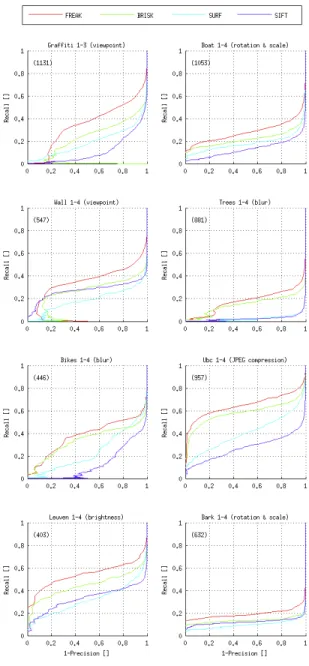
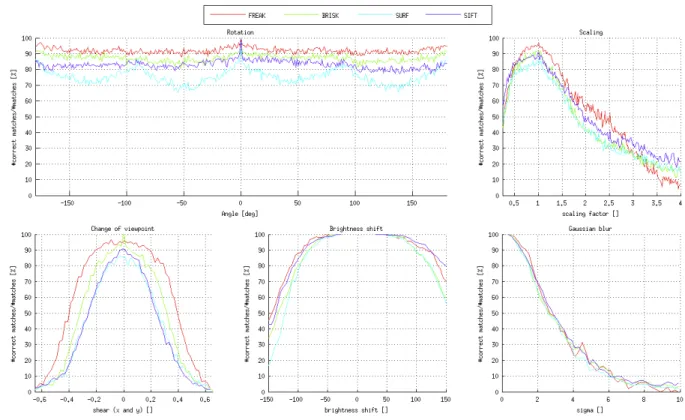
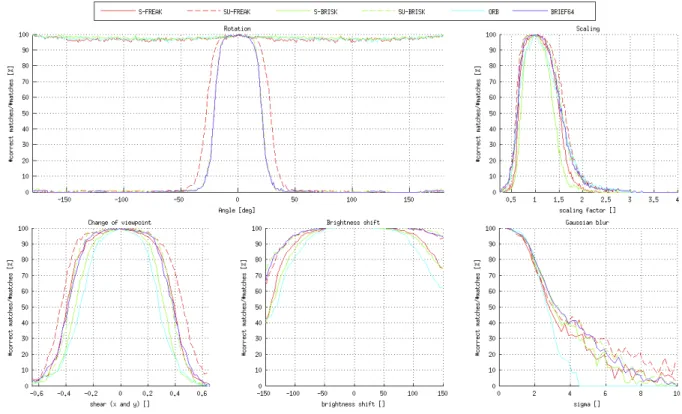
the previous dataset is transformed to precisely evaluate the rotation, change of scale, change of viewpoint, blur (gaus-sian), and brightness change. We can continuously measure the impact of an image deformation, which is less visible in the first testing environment. Figures8to10present the quantitative results.
The performances of the descriptors are highly related to the combination detector/descriptor. Some descriptors are more discriminant for blobs than corners. Nevertheless, we noticed that the global ranking of their matching per-formance remain the same regardless of the selected detec-tor. As a result, we present our tests using the multi-scale AGAST detector introduced by BRISK.
Both testing environments rank FREAK as the most ro-bust to all the tested image deformation. Surprisingly, SIFT is the worst descriptor in the first testing environment (8) similar to what has been shown in BRISK [16]. SIFT ex-tracts several descriptors when the estimated orientation has multiple good candidates. Therefore, the number of possi-ble correspondences is over estimated. Nevertheless, the second testing environment (9) is not affected by the addi-tional descriptors created with SIFT. Consequently, SIFT is more competitive and often ranks second. Figure10present the performance of descriptors that are not invariant to ro-tation and scale invariant. We compare FREAK while dis-abling its scale and orientation invariance. It is either as good as other descriptor or slightly better.
Table1compares the computation time of the scale and rotation invariant descriptors. All algorithms are running on an Intel Duo core of 2.2 GHZ using a single core. FREAK is even faster than BRISK although the latter is two orders of magnitude faster than SIFT and SURF.
6. Conclusions
We have presented a retina-inspired keypoint descriptor to enhance the performance of current image descriptors. It outperforms recent state-of-the-art keypoint descriptors while remaining simple (faster with lower memory load). We do not claim any biological significance but find it re-markable that the used learning stage to identify the most
1http://computer-vision-talks.com/2011/08/ feature-descriptor-comparison-report/
Figure 8: Performance evaluation on the dataset introduced by Mikola-jczyk and Schmid [21].
relevant Difference of Gaussians could match one possible understanding of the resource optimization of the human visual system. In fact, as a future work, we want to inves-tigate more on the selection of such relevant pairs for high level applications such as object recognition.
References
[1] M. Agrawal, K. Konolige, and M. Blas. Censure: Center sur-round extremas for realtime feature detection and matching.
Computer Vision–ECCV 2008, pages 102–115, 2008.2
[2] A. Alahi, P. Vandergheynst, M. Bierlaire, and M. Kunt. Cas-cade of descriptors to detect and track objects across any
net-Figure 9:Global evaluation on the second testing environment. The view point changes are simulated by an affine matrix transformation where the shear parameter goes from -0.65 to 0.65 in both x and y directions.
work of cameras. Computer Vision and Image Understand-ing, 114(6):624–640, 2010.1,4
[3] M. Ambai and Y. Yoshida. Card: Compact and real-time de-scriptors. InComputer Vision, 2011 IEEE Computer Society Conference on. IEEE, 2011.2
[4] H. Bay, T. Tuytelaars, and L. Van Gool. Surf: Speeded up robust features. Computer Vision–ECCV 2006, pages 404– 417, 2006.1,2
[5] M. Calonder, V. Lepetit, C. Strecha, and P. Fua. Brief: Binary robust independent elementary features. Computer Vision– ECCV 2010, pages 778–792, 2010.1,2,3
[6] E. Candes, Y. Eldar, D. Needell, and P. Randall. Compressed sensing with coherent and redundant dictionaries. Applied and Computational Harmonic Analysis, 31(1):59–73, 2011.
4
[7] M. Ebrahimi and W. Mayol-Cuevas. Susure: Speeded up surround extrema feature detector and descriptor for realtime applications. 2009.2
[8] G. Field, J. Gauthier, A. Sher, M. Greschner, T. Machado, L. Jepson, J. Shlens, D. Gunning, K. Mathieson, W. Dabrowski, et al. Functional connectivity in the retina at the resolution of photoreceptors.Nature, 467(7316):673– 677, 2010.3
[9] F. Fleuret and D. Geman. Coarse-to-fine face detection.
International Journal of Computer Vision, 41(1):85–107, 2001.4
[10] D. Garway-Heath, J. Caprioli, F. Fitzke, and R. Hitchings. Scaling the hill of vision: the physiological relationship be-tween light sensitivity and ganglion cell numbers. Inves-tigative Ophthalmology & Visual Science, 41(7):1774–1782, 2000.3
[11] S. Gauglitz, T. H¨ollerer, and M. Turk. Evaluation of interest point detectors and feature descriptors for visual tracking.
International Journal of Computer Vision, pages 1–26, 2011.
2
[12] C. Harris and M. Stephens. A combined corner and edge detector. InAlvey vision conference, volume 15, page 50. Manchester, UK, 1988.2
[13] M. Hogan and J. JA Weddell. Histology of the human eye: an atlas and textbook. 1971.3
[14] Y. Ke and R. Sukthankar. Pca-sift: A more distinctive repre-sentation for local image descriptors. 2004.1,2
[15] S. Lazebnik, C. Schmid, and J. Ponce. Beyond bags of features: Spatial pyramid matching for recognizing natural scene categories. InComputer Vision and Pattern Recogni-tion, 2006 IEEE Computer Society Conference on, volume 2, pages 2169–2178. Ieee, 2006.1
[16] S. Leutenegger, M. Chli, and R. Siegwart. Brisk: Binary robust invariant scalable keypoints. 2011.1,2,3,5,6
[17] D. Lowe. Object recognition from local scale-invariant fea-tures. InComputer Vision, 1999. The Proceedings of the Seventh IEEE International Conference on, volume 2, pages 1150–1157. Ieee, 1999.1,2
Figure 10:Global evaluation on the second testing environment: (S: single scale; U: unrotated) BRIEF64, S-BRISK, SU-BRISK, S-FREAK, SU-FREAK descriptors are extracted on keypoints detected by FAST.
[18] E. Mair, G. Hager, D. Burschka, M. Suppa, and G. Hirzinger. Adaptive and generic corner detection based on the accel-erated segment test. Computer Vision–ECCV 2010, pages 183–196, 2010.2
[19] E. Marc and H. Stuart. Lateral information processing by spiking neurons: A theoretical model of the neural correlate of consciousness. Computational Intelligence and Neuro-science, 2011, 2011.
[20] K. Mikolajczyk and C. Schmid. Indexing based on scale invariant interest points. 2001.2
[21] K. Mikolajczyk and C. Schmid. A performance evaluation of local descriptors. IEEE transactions on pattern analysis and machine intelligence, pages 1615–1630, 2005.2,5,6
[22] D. Nister and H. Stewenius. Scalable recognition with a vocabulary tree. InComputer Vision and Pattern Recogni-tion, 2006 IEEE Computer Society Conference on, volume 2, pages 2161–2168. IEEE, 2006.1
[23] B. Olshausen and D. Field. What is the other 85% of v1 doing. Problems in Systems Neuroscience, pages 182–211, 2004.4
[24] J. Philbin, O. Chum, M. Isard, J. Sivic, and A. Zisser-man. Object retrieval with large vocabularies and fast spatial
matching. In2007 IEEE Conference on Computer Vision
and Pattern Recognition, pages 1–8. IEEE, 2007.2
[25] E. Rosten and T. Drummond. Machine learning for high-speed corner detection.Computer Vision–ECCV 2006, pages 430–443, 2006.2
[26] E. Rublee, V. Rabaud, K. Konolige, and G. Bradski. Orb: an efficient alternative to sift or surf. 2011.1,2,3,4
[27] N. Snavely, S. Seitz, and R. Szeliski. Photo tourism: ex-ploring photo collections in 3d. InACM Transactions on Graphics (TOG), volume 25, pages 835–846. ACM, 2006.1
[28] E. Tola, V. Lepetit, and P. Fua. Daisy: An efficient dense descriptor applied to wide-baseline stereo. Pattern Analysis and Machine Intelligence, IEEE Transactions on, 32(5):815– 830, 2010.3
[29] T. Tuytelaars and K. Mikolajczyk. Local invariant feature detectors: a survey. Foundations and Trends in Computer Graphics and Vision, 3(3):177–280, 2008.2
[30] O. Tuzel, F. Porikli, and P. Meer. Region covariance: A fast descriptor for detection and classification.Computer Vision– ECCV 2006, pages 589–600, 2006.1
[31] G. Yu and J. Morel. A fully affine invariant image com-parison method. InAcoustics, Speech and Signal Process-ing, 2009. ICASSP 2009. IEEE International Conference on, pages 1597–1600. IEEE, 2009.2