
C
RANFIELDU
NIVERSITYComputational Air Traffic Management
Marc Anthony Azzopardi
School of Aerospace, Transport and Manufacturing (SATM)
PhD Thesis
i
C
RANFIELDU
NIVERSITYS
CHOOL OFA
EROSPACE,
T
RANSPORT ANDM
ANUFACTURING(SATM)
PhD T
HESISMarc Anthony Azzopardi
Computational Air Traffic Management
Supervisor: Dr J.F. Whidborne
April 2015
©Cranfield University 2015. All rights reserved. No part of this publication may be reproduced without the written permission of the copyright owner.
ii ABSTRACT
World air transport has been on a steady exponential rise since the 1940’s and the trend has shown remarkable resilience to external shocks. The level of air traffic has greatly exceeded the wildest expectations of the air traffic management pioneers that originally defined the basic precepts ATM that persist till today.
This has stretched ATM to a point where it is starting to show signs of ineffectiveness in the face of ever increasing congestion. Delays are on the rise, costs are ballooning, flights are being elongated unnecessarily, the system is becoming increasingly susceptible to disruption, and the high environmental impact of aviation is being compounded by the inability of air traffic controllers to optimise ATM operation in real-time. If these trends are not reversed, ATM could eventually face instability. The conservative, self-preserving outlook of the ATM community has confined progress to relatively minor tweaks of a tired human-centric paradigm. However, the diverging gap between ATM performance and fundamental requirements indicates the need for a step change.
In this work, the traditionally incremental approach to ATM research was broken to favour a more exploratory mindset. As a result, a new discipline called Computational Air Traffic Management has been defined to address the unique set of challenges presented by the ATM problem, by taking a more objective scientific approach.
A specific embodiment of a CATM system was designed, constructed, simulated and tested and shown to be a significant step towards demonstrating the feasibility of a fully autonomous multi-agent-based air transportation system based on optimisation principles. The system offers unique advantages in terms of resilience to disruption, efficiency and future scalability. The traffic density using such a system can be realistically increased many times higher than current levels while significantly improving on the current levels of safety, operating cost, environmental impact and flight delays. This work advances the field of ATM as well as the fields of Computational Intelligence and Dynamic Optimisation of High Dimensionality Non-Convex Search Spaces.
iii
D
EDICATIONSTo my brother Carl,
iv
Acknowledgements
I would like to thank all the people who have supported me during this lengthy journey that has seen the highest highs and the lowest lows. I knew from the outset that it was going to be a technically challenging journey, but I did not know just how much until I was neck deep in a subject that has kept me fascinated for many years.
First and foremost, I would like to give a hearty thanks to my supervisor, Dr. James Whidborne who has offered his indispensable knowledge whenever I needed some insight. He has been a great motivator and has supported my unconventional approach to tackle a field that has dissuaded many.
I would also like to thank Dr John Betts, Dean of the Faculty of Engineering at the University of Malta for his unwavering support that kept me going when the obstacles looked too great. Similar gratitude goes to my previous head of department Prof. Carmel Pulé and Pro-Rector Prof. Richard Muscat.
Last but not least, I would like to thank my parents, siblings and fiancée for putting up with this roller coaster for far too long.
v
TABLE OF CONTENTS
Page
PREFACE ... 1
I. THE RESEARCH CONTEXT ... 2
II. THESIS SCOPE,OBJECTIVES AND LIMITATIONS ... 4
III. THESIS OUTLINE AND CONTRIBUTIONS ... 4
A. Research Questions ... 4
B. Methodology ... 5
C. Contributions ... 5
D. Organization of the Dissertation ... 7
IV. PUBLICATIONS ARISING FROM THIS WORK ... 8
A. Published ... 8
B. In Press ... 8
C. In preparation ... 8
CHAPTER 1 - INTRODUCTION ... 9
1.1 THE MOTIVATION ... 9
1.1.1 The Problem Background ... 10
1.1.2 The Cost of Human ATM ... 11
1.1.3 Future Trends in Demand ... 12
1.2 RESEARCH IN ATM ... 13
1.2.1 SESAR and NextGen ... 14
1.2.2 Full Autonomy? ... 15
1.3 THE NATURE OF THE ATM-ATCPROBLEM ... 15
1.4 CHARACTERISTICS OF AN IDEAL ATMSYSTEM ... 18
1.5 THE SCIENCE OF ATM ... 22
1.6 JOINING THE DOTS…THE EMERGENCE OF CATM ... 23
1.6.1 Free flight ... 25
1.6.2 The Role of the Human ATCo ... 26
1.6.3 ASAS and Workload Sharing ... 27
1.6.4 Distributed Control ... 27
1.7 THE EXPECTED EVOLUTION OF ATCAUTOMATION ... 28
1.8 THE IMPLEMENTATION OF COMPUTATIONAL ATM ... 33
1.9 THE TRANSITION TO CATMSYSTEMS ... 34
1.10 THE OUTLOOK... 35
vi
CHAPTER 2 - COMPUTATIONAL AIR TRAFFIC MANAGEMENT ... 41
2.1 ANEW CONCEPT FOR ATM ... 41
2.1.1 Computational Complexity Considerations ... 43
2.1.2 Relaxing Optimality Requirement to Address Complexity ... 44
2.1.3 Nested Optimisation ... 44
2.1.4 The benefits of Dynamic Re-Convergence ... 45
2.1.5 Constraint modelling in CATM ... 46
2.1.6 Decentralised CATM ... 47
2.1.7 Offline vs. Online CATM ... 47
2.1.8 Airborne CATM ... 48
2.1.9 CATM and the Role of the Pilot in an Autonomous system ... 49
2.1.10 High Performance Grid-Avionics and CATM ... 49
2.1.11 Heterogeneous Computing and Fault Tolerance ... 51
2.1.12 Clustering and Information Flow in CATM ... 52
2.1.13 Communication Infrastructure ... 53
2.1.14 Sensor Networks ... 56
2.1.15 CATM & Flight Data Recorders ... 56
2.1.16 CATM Trajectory Descriptors ... 56
2.1.17 Security and Collaborative CATM ... 57
2.1.18 The Way Forward ... 58
2.2 REFERENCES ... 59
CHAPTER 3 - MODELLING CATM ... 62
3.1 CONTEMPORARY ATC ... 62
3.2 THE PROPOSED AIR TRAFFIC SYSTEM MODEL ... 64
3.2.1 The Agent Model of CATM ... 65
3.2.2 The Flight Agent Lifecycle ... 65
3.2.3 ATS Top Structure ... 66
3.3 FLIGHT GENESIS –THE 4DBUSINESS TRAJECTORY ... 72
3.3.1 The Strategic Offline Phase ... 73
3.3.2 Long-Term Sequential Coupling of Constraints ... 75
3.3.3 The Tactical Online Phase ... 78
3.4 MODELLING FOR CATMSIMULATION ... 80
3.5 ATMOSPHERIC MODELLING FOR ATM ... 81
3.5.1 The International Standard Atmosphere ... 81
3.6 AIRCRAFT MODELLING FOR ATM ... 84
3.6.1 Coordinate-System and Other Definitions ... 84
3.6.2 The EUROCONTROL Base of Aircraft DAta, (BADA) ... 85
3.6.3 A Non-Holonomic, Kinematic Model for a Fixed-Wing Aircraft ... 86
3.6.4 3D Point Mass Model for a Fixed Wing Aircraft ... 87
3.6.5 4D Point Mass Model for a Fixed Wing Aircraft ... 96
3.6.6 The Virtual Time Parameter (τ) ... 97
3.6.7 A Discrete Time Model ... 99
3.6.8 Discrete Aspects of a Fixed-Wing Aircraft Model ... 101
vii
3.7 AIRSPACE MODELLING FOR CATM ... 103
3.7.1 Classified Airspace ... 103
3.7.2 Special Zone Constraints ... 104
3.7.3 Obstacle Modelling ... 105
3.7.4 Aerodromes ... 106
3.8 TRAFFIC MODELLING FOR ATM ... 107
3.8.1 Intra-Continental 24-Hour Flight Data Samples ... 107
3.8.2 A Probabilistic Traffic Model ... 111
3.8.3 Traffic Density ... 112
3.9 WEATHER MODELLING FOR ATM ... 114
3.9.1 CFD Weather Simulation ... 114
3.9.2 Synthetic Wind Patterns ... 116
3.9.3 Generating Clouds and Weather cells ... 116
3.9.4 A Self-excited Circular Weather Domain ... 117
3.10 ENVIRONMENTAL IMPACT MODELLING FOR ATM ... 118
3.10.1 Carbon Footprint and CO2 ... 118
3.10.2 Noise Mitigation ... 119
3.10.3 Other Pollutants and ATM ... 119
3.11 AIRPORT -OPERATIONS MODELLING FOR ATM ... 121
3.12 REFERENCES ... 122
CHAPTER 4 - COMPUTATIONAL INTELLIGENCE IN CATM ... 124
4.1 CATMPROBLEM FORMULATION ... 124
4.1.1 Single Flight Problem ... 124
4.1.2 Combined Multiple Flight Problem ... 126
4.1.3 Receding Horizon Problem ... 127
4.1.4 The CATM Architecture ... 129
4.1.5 Searching the Control Space vs Output Space ... 131
4.1.6 Dynamic Inversion and Differential flatness ... 131
4.2 CATM:THE MATHEMATICAL NATURE OF THE SEARCH SPACE ... 132
4.2.1 The Global Optimisation Problem (Non-Convexity) ... 132
4.2.2 The Local Optimisation Problem (Local-Convexity) ... 133
4.2.3 The Disconnected Feasible Search Space Problem ... 134
4.2.4 The Dynamic Optimisation Problem ... 135
4.2.5 The Time-Linked Dynamic Optimisation Problem ... 136
4.2.6 The Constrained Optimisation Problem ... 136
4.2.7 The Multi-objective Optimisation Problem ... 138
4.2.8 The System Wide Objective Function ... 139
4.2.9 The Non-Separable High Dimensionality Optimisation Problem ... 140
4.2.10 Flight Interaction with Finite Resolution Trajectories ... 145
4.3 GLOBAL OPTIMISATION PHASE ... 148
4.3.1 Search Techniques ... 148
4.4 DYNAMIC PROGRAMMING ... 149
4.4.1 Bellman’s Principle of Optimality ... 149
4.4.2 Structured Dynamic Programming ... 150
4.4.3 Iterative Dynamic Routing ... 151
4.4.4 Counteracting Collapse ... 152
viii
4.5 EVOLUTIONARY ALGORITHMS ... 156
4.5.1 Genetic Algorithms and Evolutionary Programming ... 156
4.5.2 The Fitness Function ... 156
4.5.3 Chromosome Encoding ... 156 4.5.4 Selection ... 158 4.5.5 Crossover ... 160 4.5.6 Mutation ... 161 4.5.7 Speciation ... 162 4.5.8 Coevolution ... 162 4.5.9 Clustering ... 163
4.5.10 Diversity and Dynamic Behaviour of GAs ... 165
4.5.11 Crossover Scheme Effects ... 166
4.5.12 Population Size Effects ... 167
4.5.13 Elitism and Idealism effects ... 168
4.6 SWARM INTELLIGENCE ... 169
4.6.1 Particle Swarm Optimization (PSO) ... 171
4.6.2 Stability and PSO Constriction ... 172
4.6.3 Ideal Attractors (GPSO) ... 173
4.6.4 Particle Initialisation ... 174
4.6.5 Upgrading PSO for Dynamic Behaviour (GPSO-D) ... 174
4.6.6 Upgrading PSO for High dimensionality (CCGPSO-D) ... 175
4.6.7 Fine Grained Clustering (C-CCGPSO-D) ... 175
4.6.8 Multi-Swarms, Stagnation and Population Diversity Collapse ... 176
4.6.9 A Hybrid: Iterative Dynamic Evolutionary Programming ... 176
4.7 HIERARCHICAL OPTIMISATION FOR CATM ... 177
4.7.1 Meta-Heuristics: Exploration and Exploitation ... 177
4.7.2 Cascaded Optimisation ... 177
4.7.3 Nested Optimization ... 178
4.7.4 Cooperative Local and Global Optimization ... 178
4.8 LOCAL OPTIMISATION PHASE ... 179
4.8.1 A Simple Point Mass Model ... 179
4.8.2 Direct Collocation ... 180
4.9 IN SUMMARY ... 182
ix
CHAPTER 5 - SIMULATION, RESULTS AND DISCUSSION ... 188
5.1 THE SIMULATION PARADIGM ... 188
5.1.1 Scaling-up to the Continental CATM Problem ... 189
5.1.2 Multi -Threaded Approach ... 189
5.1.3 The Shared Almanac ... 190
5.1.4 Transmission Filtering ... 190
5.1.5 Software Architecture ... 190
5.2 CONSTRUCTION OF A CATMSIMULATION RIG ... 191
5.3 CATM:PSOC++IMPLEMENTATION ... 192
5.3.1 Fast Random Number Generators ... 193
5.3.2 Single Instruction Multiple Data (SIMD) Acceleration ... 194
5.4 CATM:C-CCGPSO-DSIMULATION RESULTS ... 195
5.5 QUALITATIVE RESULTS ... 196
5.5.1 Cooperative Coevolution in Pathological Cases ... 196
5.5.2 Visualisation of Swarm Collapse ... 197
5.5.3 Visualisation of Convergence in large scale traffic scenarios ... 198
5.5.4 Visualisation of Convergence with obstacle constraints ... 199
5.5.5 Visualisation of Dynamic Optimisation ... 200
5.6 QUANTITATIVE RESULTS ... 203
5.6.1 Demonstrating Scalability ... 203
5.6.2 Communication Overheads ... 205
5.6.3 The Effect of Transmission filtering ... 206
5.6.4 Clustering Efficacy ... 206
5.6.5 Swarm Size effects ... 208
5.6.6 Constriction effects ... 210
5.6.7 Delay Distribution ... 211
5.7 REFERENCES ... 215
CHAPTER 6 - CONCLUSIONS AND FUTURE WORK ... 216
6.1 SUMMARY ... 216
6.2 CONCLUSIONS ... 217
6.2.1 Key Contributions ... 218
x
LIST OF FIGURES
Fig 1.1.1: Structured Airspace over Central Mediterranean, and Central Europe ... 10
Fig 1.1.2: Eurocontrol: ATM accounts for a high proportion of Flight Delay ... 10
Fig 1.1.3: Current and Projected Delay Distribution due to Increased Congestion ... 11
Fig 1.1.4: Growth Trend Spanning 65 years in Aviation Industry (Source: ICAO) ... 12
Fig 1.4.1: Layering of Performance Concepts ... 18
Fig 1.5.1: High update rate leads to much better prediction ... 23
Fig 1.6.1: An Underlying Convergence? ... 25
Fig 1.7.1: The Staged Evolution of CATM... 28
Fig 1.8.1: Top Level Architecture of CATM ... 33
Fig 2.1.1: Nested Optimization - Best of both worlds ... 44
Fig 2.1.2: The Continuous Nature of CATM ... 45
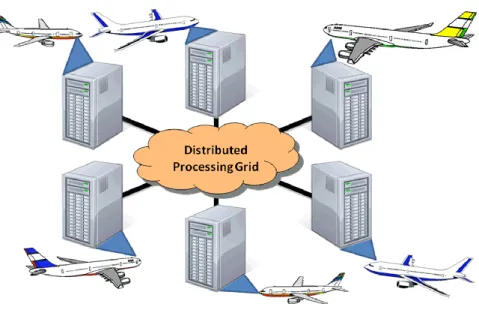
Fig 2.1.3: Distributed Processing = Grid-Avionics ... 48
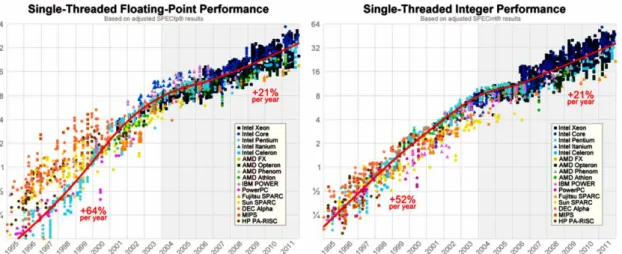
Fig 2.1.4: The Historical Exponential Growth in Computing Performance ... 50
Fig 2.1.5: Triple Rank Heterogeneous Computing ... 51
Fig 2.1.6: Overlapping Clusters in CATM ... 52
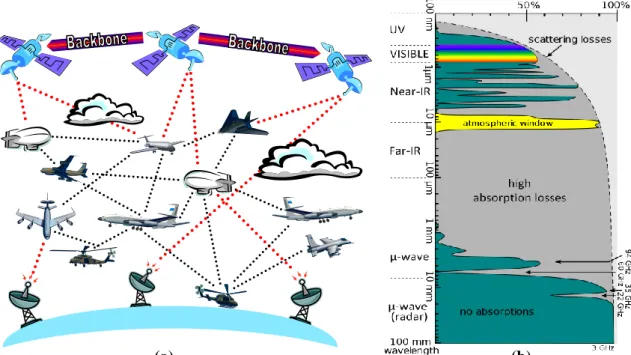
Fig 2.1.7: The Optically and Radio Networked Airspace ... 54
Fig 2.1.8: NURBS and polytopes negotiating obstacles ... 57
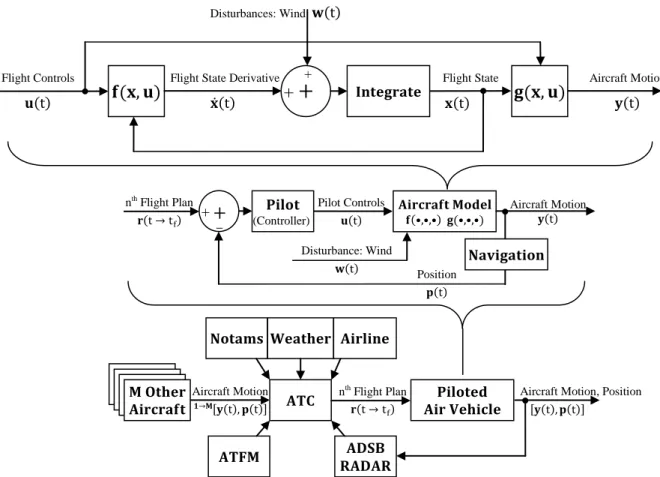
Fig 3.1.1: Model of the Current Air Traffic System ... 63
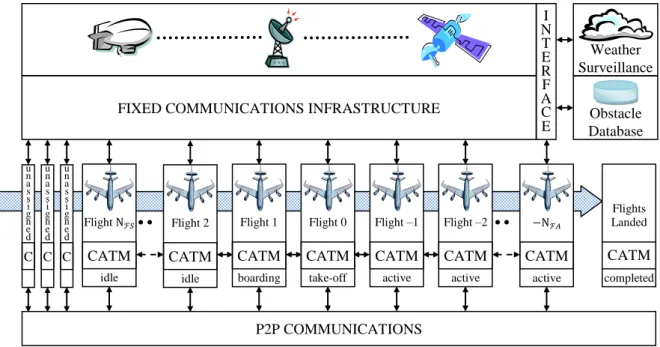
Fig 3.2.1: The CATM System Conveyor Belt, The Flights Life Cycle ... 64
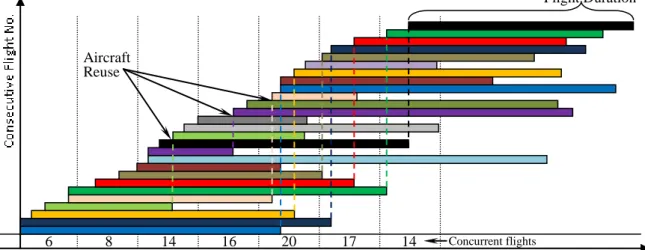
Fig 3.3.1: Concurrent and Sequential Flight Dependencies ... 76
Fig 3.3.2: Diurnal Cycle in Traffic Density and Constraint Propagation ... 77
Fig 3.5.1: The International Standard Atmosphere (ISA) ... 83
Fig 3.6.1: An aircraft shown flying northwards with Earth-referenced attitude ... 84
Fig 3.6.2: Aircraft forces during steady level flight ... 87
Fig 3.6.3: The balance of forces during a turn ... 88
Fig 3.6.4: The balance of forces during ascent ... 89
Fig 3.6.5: A virtual time parameter ‘τ’ ... 97
Fig 3.6.6: Typical Airliner State Transition Diagram ... 101
Fig 3.6.7: Take-off and Initial Climb ... 101
Fig 3.6.8: Take-off, Climb, and Cruise ... 102
xi
Fig 3.6.10: Take-off, Climb, Hold, Cruise, Hold, Descend, Approach, Land... 102
Fig 3.7.1: Traffic Restrictions in European Airspace ... 104
Fig 3.7.2: Location of Europe’s Operational Airports ... 106
Fig 3.8.1: Europe – 24 hours of flights above 30,000 feet (Source: EuroControl) ... 107
Fig 3.8.2: Europe’s Busiest Airports: Circle size indicates aircraft movements ... 108
Fig 3.8.3: Flight Distribution by Aircraft Type ... 108
Fig 3.8.4: Diurnal Cycles in European Traffic, and Changes in Efficiency ... 110
Fig 3.8.5: Seasonal Variation in European IFR Traffic (Source: Eurocontrol) ... 111
Fig 3.8.6: Most heavily used interconnections from Europe’s busiest airports ... 111
Fig 3.8.7: Roulette Selection ... 112
Fig 3.8.8: European Traffic Density by location and time: ... 113
Fig 3.8.9: Density at 10:58am ... 113
Fig 3.9.1: 2D Wind vector field generated with random distributed forces ... 116
Fig 3.9.2: Cloud Advection in the Weather Simulator ... 116
Fig 3.9.3: Icelandic Volcanic Dust Cloud Advection in April 2010 (Eumetsat) ... 117
Fig 3.10.1: Bridging the aviation CO2 emissions Gap ... 118
Fig 3.10.2: Sample INM noise contours generated with the FAA application ... 119
Fig 3.10.3: Aircraft Emissions and their effect on climate change ... 120
Fig 4.1.1: The CATM Receding Horizon of Flights ... 127
Fig 4.1.2: Receding Horizon Control for a Single Flight, with Horizon = ... 128
Fig 4.1.3: Receding Horizon Control for entire ATS, with Horizon = ... 129
Fig 4.1.4: The CATM System Hierarchy within a Single Aircraft ... 130
Fig 4.2.1: Trajectories Trapped in Local Minima ... 132
Fig 4.2.2: Some locally optimal trajectories through a fixed obstacle field ... 133
Fig 4.2.3: Local Convexity assists convergence ... 134
Fig 4.2.4: Disconnected Trajectory Search Spaces ... 135
Fig 4.2.5: Dynamic Changes to Local Convexity ... 136
Fig 4.2.6: A Typical Bi-Objective Pareto Front ... 138
Fig 4.2.7: Rubidium Standard ... 143
Fig 4.2.8: Inter Sample-Point Conflict ... 146
Fig 4.2.9: Worst case scenario θ 180° ... 146
Fig 4.2.10: Octahedral and Spherical Buffer Zones Surrounding Aircraft ... 147
Fig 4.3.1: Algorithms considered for CATM global search ... 148
xii
Fig 4.4.2: Structured Output Search Space with Obstacles ... 150
Fig 4.4.3: First Pass of a structured ITR problem ... 151
Fig 4.4.4: Second pass: Search Space Contracts by a constant factor γ ... 151
Fig 4.4.5: IDR Path Planning progress in 2D with static obstacle ... 152
Fig 4.4.6: Countering Collapse in IDR ... 153
Fig 4.4.7: IDR Path Planning, in 2D with a dynamic obstacle ... 153
Fig 4.4.8: ROIDR Path Planning progress with 3 or 5 interacting flights in 2D ... 154
Fig 4.5.1: Cooperative Fitness Function ... 163
Fig 4.5.2: Demonstration of Clustering Effectiveness with Dynamic Behaviour ... 164
Fig 4.5.3: GA Optimisation of Pathological Non-Convex case with Obstacles ... 166
Fig 4.5.4: The effect of Genetic Pool Size on convergence Time and Outcome ... 167
Fig 4.5.5: The effect of idealism ... 168
Fig 4.6.1: Argentine Ant Experiment ... 169
Fig 4.6.2: Damped SHM in PSO ... 171
Fig 4.7.1: Cascaded Optimization ... 177
Fig 4.7.2: Embedded Local Optimization ... 178
Fig 4.8.1: Trajectory of a Newtonian Point Mass ... 179
Fig 4.8.2: Locally Optimized Trajectory of a Newtonian Point Mass ... 181
Fig 5.1.1: The CATM Simulation System Architecture ... 188
Fig 5.1.2: The CATM System Hierarchy within a Single Flight Cluster ... 189
Fig 5.2.1: CATM Simulation Rig Configuration ... 191
Fig 5.2.2: CATM Simulation Rig ... 191
Fig 5.3.1: SSE4 Code excerpt showing the MWC1616 Algorithm ... 194
Fig 5.5.1: Convergence of CCGPSO with a 14-way choke-point scenario ... 196
Fig 5.5.2: Convergence Charts of CCGPSO with a 14-way choke-point scenario ... 197
Fig 5.5.3: Visualization of Swarm collapse a 14-way choke-point scenario ... 197
Fig 5.5.4: After 2,000 iterations ... 198
Fig 5.5.4: After 40,000 iterations ... 198
Fig 5.5.4: After 1,000,000 Iterations ... 198
Fig 5.5.5: After 5,000,000 Iterations ... 200
Fig 5.5.6: Effects of an object collision with a dynamically converged solution ... 200
Fig 5.5.7: Transient caused by an object collision during convergence ... 201
Fig 5.5.8: Transient due to a sudden object collision showing dynamic behaviour ... 202
xiii
Fig 5.6.2: Reliable Convergence with Variable Problem Sizes ... 205
Fig 5.6.3: Performance of C-CCGPSO-D with Variable Cluster Sizes ... 206
Fig.5.6.4: Reliable Convergence with Variable Cluster Sizes ... 207
Fig.5.6.5: Performance of C-CCGPSO-D with Variable Swarm Sizes ... 209
Fig.5.6.6: Reliable Convergence with Variable Swarm Sizes ... 209
Fig.5.6.7: Performance of C-CCGPSO-D with Variable Constriction ... 210
Fig.5.6.8: Delay distribution of flights after 10,000 iterations ... 211
Fig 5.6.9: Delay distribution of flights after 100,000 iterations ... 212
Fig.5.6.10: Delay distribution of flights after 1,000,000 iterations ... 212
Fig.5.6.11: Delay distribution of flights after 5,000,000 iterations, (20 trials) ... 213
Fig.5.6.12: Delay distribution in the June 2009 flight sample analysed ... 213
xiv
LIST OF TABLES
Table 1.6.1: Tools developed to assist human pilots and controllers ... 24
Table 3.5.1: Atmospheric Layers as defined by temperature gradients ... 82
Table 3.6.1: BADA Drag Coefficient Definitions for Airbus A300-B4-622 ... 90
Table 3.6.2: Interpretation of the BADA Energy share factor ... 95
Table 3.7.1: ICAO Classification of Airspace ... 103
Table 3.8.1: Flights Breakdown in 24h Sample ... 107
Table 3.8.2: Interconnection Matrix between Europe’s 20 Busiest Airports ... 109
Table 3.8.3: Stratified Efficiency for All flights > 250km ... 110
Table 3.8.4: European traffic density over various areas ... 113
Table 4.5.1: Crossover Techniques Applicable to Real Coded Genetic Algorithms ... 160
Table 4.5.2: Mutation Techniques Applicable to Real Coded Genetic Algorithms ... 161
Table 4.5.3: Mutation Schedule ... 161
Table 4.5.4: Effect of Multipoint Crossover and multiple sexes ... 167
Table 4.5.5: Effects of Elitism and Idealism ... 168
Table 4.6.1: Constricted PSO Attraction Coefficients ... 173
Table 4.9.1: Comparison between some Global Search Techniques ... 182
Table 5.2.1: CATM Simulation Rig Configuration ... 192
Table 5.6.1: Scalability Tests over 8 octaves ... 203
Table 5.6.2: Communication Overheads ... 205
Table 5.6.3: The Effect of Swarm Size ... 208
Table 5.6.4: Swarm Constriction Effects ... 210
xv
LIST OF ABBREVIATIONS
2D - Bi-dimensional
3D - Tri-dimensional
4D - Four-dimensional
4D-BT - Four-dimensional Business Trajectories ABC - Artificial Bee Colony
ACARS - Aircraft Communication Addressing and Reporting System ACO - Ant Colony Optimisation
ADS-B - Automatic Dependant Surveillance-Broadcast AFAP - As Far As Practicable
AI - Artificial Intelligence AIS - Artificial Immune Systems AMAN - Arrival Manager
ANSP - Air Navigation Service Provider ARA - Air-to-Air Refuelling Areas ARTCC - Air Route Traffic Control Centres ASAS - Air Separation Assurance System ASIC - Application Specific Integrated Circuit ATA - Aerial Tactical Areas
ATC - Air Traffic Control ATCo - Air Traffic Controller ATCT - Aviation Training Centre ATM - Air Traffic Management ATFM - Air Traffic Flow Management
ATFCM - Air Traffic Flow and Capacity Management ATS - Air Traffic System
ATSP - Air Traffic Service Provider ATZ - Aerodrome Traffic Zone
AWDAP - Airborne Wind-shear Detection and Avoidance Program
BA - Bat Algorithm
BADA - Base of Aircraft Data
BCGA - Binary Coded Genetic Algorithms CAMU - Central Airspace Management Unit
CARATS - Collaborative Actions for Renovation of Air Traffic Systems (Japan) CATM - Computational Air Traffic Management
CC - Cooperative Co-evolution
C-CCPSO - Clustered Cooperative Coevolution Particle Swarm Optimisation C-CCPSO-D - Clustered Cooperative Coevolution PSO with Dynamic behaviour CCGA - Cooperative Co-evolutionary Genetic Algorithm
CCPSO - Cooperative Coevolution Particle Swarm Optimisation
CCGPSO-D - Cooperatively Co-evolving Guided PSO for Dynamic problems C-CCGPSO-D Clustered Cooperatively Co-evolving GPSO for Dynamic problems CD - Conflict Detection
CDA - Continuous Descent Approach CD&R - Conflict Detection & Resolution
xvi CFD - Computational Fluid Dynamics CFMU - Central Flow Management Unit CM1 - Connection Machine 1
CNS - Communication, Navigation and Surveillance CPDLC - Controller-Pilot Data Link Communications CPU - Central Processing Unit
CR - Conflict Resolution
CRDA - Converging Runway Display Aid CSCC - CATM Super-Computing Centre CUDA - Compute Unified Device Architecture DMAN - Departure Manager
DoF - Degree of Freedom
DP - Dynamic Programming
DTM - Deterministic Turing computing Machine EA - Evolutionary Algorithms
ECC - Error Control Code
EDA - Efficient / En-route Descent Advisor EP - Evolutionary Programming
ETA - Estimated Time of Arrival FA - Firefly Algorithm
FAA - Federal Aviation Administration
FADEC - Full Authority Digital Engine Control System FANS - Future Air Navigation System
FDR - Flight Data Recorder FIR - Flight Information Region FIS - Flight Information Service FPGA - Field Programmable Gate Array FMS - Flight Management System FSO - Free Space Optics
GA - Genetic Algorithm
GIS - Geographical Information System GMT - Greenwich Mean Time
GPGPU - General Purpose Graphics Processing Unit GPS - Global Positioning System
GPSO - Guided Particle Swarm Optimisation
GPSO-D - Guided Particle Swarm Optimisation for dynamic problems GPU - Graphics Processing Unit
GSO - Glow-worm Swarm Optimization GWPS - Ground Proximity Warning System HLH - High Level relay Hybrids
HMR - Helicopters Main Routes HPZ - Helicopters Protected Zones HTH - High-level Teamwork Hybrid
IATA - International Air Transport Association ICAO - International Civil Aviation Organization
ICAS - International Council of the Aeronautical Sciences Congress IDP - Iterative Dynamic Programming
xvii IFR - Instrument Flying Rules
IMA - Integrated Modular Architecture INM - Integrated Noise Model
ISA - International Standard Atmosphere ISBT - Initial Shared Business Trajectory ISO - International Standards Organisation KB2D - A 3D distributed CD&R algorithm KB3D - A 2D distributed CD&R algorithm
KE - Kinetic Energy
KKT - Karush-Kuhn-Tucker KPA - Key Performance Area
LCG - Linear Congruential Generators
LE - Lost Energy
LTH - Low-level Teamwork Hybrid
LLCD - Lunar Laser Communications Demonstrator MAC - Media Access Control
MATZ - Military Aerodrome Traffic Zone MIMO - Multiple-Input Multiple-Output MONA - Monitoring Aids
MOOP - Multiple-Objective Optimisation Problem MRP - Multi-Resolution Programming
MSBT - Mature Shared Business Trajectory MSAW - Minimum Safe Altitude Warning MTA - Military Training Areas
MTCD - Medium Term Collision Detection MTOW - Maximum Takeoff Weight
MWC - Multiply With Carry NAVAIDS - Navigation Aids
NE - New Energy
NEU - North East Up Convention
NextGen - Next Generation Air Transportation System (USA) NLP - Non-Linear Programming
NOTAM - Notice to Airmen / Notification to Airmen NP - Non-deterministic in Polynomial time
NSGA - Non-Dominated Search Genetic Algorithm (I/II) NTM - Non-deterministic Turing Machine
NURB - Non-Uniform Rational B-Spline OAM - Orbital Amplitude Modulation ODE - Ordinary Differential Equation OSI - Open Systems Interconnection P2P - Peer-to-Peer
PAV - Personal Air Vehicles PE - Potential Energy PMM - Point Mass Model
PMP - Pontryagin's Minimum Principle PPM - Pulse Position Modulation
PRAFSO - Parallel Relay Assisted Free Space Optics PRNG - Pseudorandom Random Number Generator
xviii PSO - Particle Swarm Optimisation QAM - Quadrature Amplitude Modulation R&D - Research & Development
RBT - Reference Business Trajectory
RCAF - Runway Collision Avoidance Function RCGA - Real Coded Genetic Algorithms RFD - River Formation Dynamics
RNAV - Area Navigation, (also Random Navigation) ROIDR - Reduced Order Iterative Dynamic Routing RPM - Revenue Passenger Miles
SES - Single European Sky
SESAR - Single European Sky ATM Research (EU) SHM - Simple Harmonic Motion
SIMD - Single Instruction Multiple Data SMAN - Surface Manager
SPO - Strategic Phase Optimisation
SPSO - Standard Particle Swarm Optimisation SQP - Sequential Quadratic Programming STCA - Short Term Collision Alert
SWIM - System Wide Information Management SYSCO - System Supported Coordination
TAS - True Airspeed
TCAS - Traffic alerting tool and Collision Avoidance System TMA - Terminal Area / Terminal Manoeuvring Area
TMI - Traffic Management Initiatives TOPM - Take-Off Performance Monitoring TPO - Tactical Phase Optimisation TRACons - Terminal Radar Approach Control
TW - Target Window
UAV - Unmanned Air Vehicles URET - User Request Evaluation Tool UTC - Coordinated Universal Time
VDLM2 - Very High Frequency Digital Link - Mode 2 VFR - Visual Flying Rules
VHF - Very High Frequency (Radio Communications) VTOL - Vertical Take-off Aircraft
1
Preface
Computational Air Traffic Management (CATM) traces its roots to an idea born out of a pressing need. This is a long term study in fully airborne, decentralised, autonomy for ATM and it all started with a focussed study we undertook on the optimisation of continuous descent approaches (CDA) in the presence of air traffic, to reduce fuel consumption, noise and emissions by gliding aircraft down to destination aerodromes with their engines on low thrust settings. However, it soon became apparent that efforts to optimise this phase of flight in isolation would be largely negated by constraints imposed, on or by, incoming traffic from the enroute phase. It was hoped at first that one could combine and collectively optimise the trailing end of enroute with CDAs. However, the problem arose again and again, until it was clear that any serious attempts at minimizing the system’s total fuel consumption would have to look at all phases of flight... of all aircraft.
This is essentially the ATM problem, and it highly impinges on most aspects of aviation to the extent that it is no longer possible to sideline this major contributor to air transport inefficiency and cost, when the rest of the industry spends tens of billions of Euros to achieve low single digit improvements elsewhere. ATM is unfortunately a rather suboptimal, labour intensive affair, and yet there exists no concerted, in-built mechanism to collectively optimise air transport. A closer look at the nature of ATM reveals why: Complexity and Legacy.
PREFACE 2
I.
T
HER
ESEARCHC
ONTEXTThe majority of research in ATM/ATC is carried out by the ATC supply chain, and national / supranational organisations of air traffic controllers (ATCo), (eg: Eurcontrol, FAA, NATS etc.) and is by its very nature quite close to the current market. On the other hand, it is the author’s perception that a large proportion of unbridled
fundamental research in the ATM community is conducted by “visiting” researchers
(such as mathematicians, computer scientists and engineers) that happen to temporarily wander-off from adjacent fields to tackle some aspect of ATM... and then leave.
This distinction in approach is manifested in the trichotomy of research products that seems to exist. This influx of researchers is objectively beneficial to the community and cross-fertilizes ideas. They enter the field without many pre-conceived ideas and are able to look at the problem more broadly. For many years, the absence of a perennial critical mass of dedicated fundamental ATM researchers, meant that a steady reservoir of knowledge took long to be created and many worthwhile ideas grew old on the shelf, without ever being brought to fruition. This seems to be changing. The air traffic research effort that has taken place during the past couple of decades can therefore be broadly classified into three clear categories:
Type I Research: The first type works within the framework of the current ATM paradigm. It therefore feeds the relentless demand for new tools to assist air navigation service providers (ANSPs) with running their day-to-day task of ensuring the harmonious flow and separation of aircraft. These tools automate specific portions of the job. Some assist controllers with maximizing productivity, while others attempt to reduce operating costs which may coincide with lessening the environmental impact. Still other tools are intended as safety-nets and are developed in response to accidents or observed failure modes of the system. Minimizing the environmental burden is however further down on the ANSP priority list. Thus, in general, these tools aim to mitigate only some of the numerous shortcomings of ATC for just the short to medium term.
This research category includes a long list of technologies, some of which have actually found their way into many cockpits and control towers. Such tools play an important psychological role as they gradually wean-off ANSPs from tactical traffic micro-management while rendering them more acquiescent towards higher levels of automation. In fact, the operational philosophy of such tools has gradually shifted beyond the mere provision of enhanced usability and ergonomics (eg: electronic flight strips) and is now moving to supplant some of the core decision-making that was traditionally the prerogative of the human controller (eg: sequencing). The current deployments of the AMAN and DMAN are good examples of such a trend.
However, by their very nature, such technologies remain stop-gap solutions for extending the lifespan of a human-centric ATC system which traces its roots to the late-1920s. Their downside is that such a piece-wise addition of new layers of automation tends to introduce new complexity, unforeseen interactions and new system states. Some information ends up lost in translation with the result that the ultimate human decision maker is deprived from full situational awareness, which when coupled with a poor understanding of the underlying automation, can generate new failure modes and confuses issues of liability in the case of accidents (refer to EU project ALIAS).
PREFACE 3 Type II Research: It has been generally accepted that the ATM system is well past its prime and is long overdue for a major overhaul. To this effect, type II research has been established. It is best exemplified by Europe’s SESAR, USA’s NextGen and Japan’s CARATS. Over two decades, these large public-private partnerships plan to inject the aging infrastructure with new life, add capacity and reduce costs.
The hallmark feature of such research is the process of unification of concepts through higher automation to reduce the level of fragmentation that currently exists. System Wide Information Management (SWIM) and 4D Trajectory-based operations are excellent examples. The adoption of better streamlined but far reaching, broadly applicable concepts multiplies ATM effectiveness while dividing its complexity.
Although, it was initially hoped that these projects would have fundamentally challenged the status quo, in hindsight they seem rather watered-down, and turn out to be still producing significant quantities of Type-I research. A considerable number of highly-specific crew-support tools are being developed around the incumbent human-centric paradigm. For instance SESAR proposes dynamic sectorisation, time based separation, and virtual control towers as an incremental means of adding capacity and reducing costs. These add complexity. The oft-declared a-priori objective of keeping the human ATCo in the loop is hampering progress. It partly explains why these projects stop short of any truly radical changes to the principles of ATM/ATC.
Type III Research: On the other hand, at the far end of the scale, there exists a third type of research activity which involves rethinking the very foundations of the ATM problem and some of this is taking place under SESAR’s Work-Package E. This type of research looks beyond current technological, social and political constraints and considers instead various “what-if” scenarios that strategically overlook individual non-fundamental challenges to see past the technological horizon. It is often a matter of time for many of these challenges to be addressed, so it appears wise to study in advance the possibilities that could be unlocked in that event. It is also possible that what appears to be a stumbling block today, might become largely irrelevant in a different context. This approach not only broadens the research space, but provides a renewed impetus to addressing any extant challenges, once the rewards are so clearly described.
This kind of research will complete the unification process initiated by SESAR and NextGen. The objective here is to devise and verify new overarching operational paradigms that are intrinsically more robust, notwithstanding higher traffic densities, whilst guaranteeing equivalent or improved levels of safety, fewer delays, less fuel consumption and environmental impact – usually through a far higher degree of autonomy and near total reliance on technology. The intention is to develop and evaluate a cache of viable alternative paradigms that could eventually displace the current system, which is appearing increasingly inadequate to handle much higher traffic densities, as envisaged over the longer term.
However, radical as it may be, the outcome of any Type III research cannot overlook the realities of mixed equipage, operational constraints and the need for a smooth transition between old and new paradigms, but these matters will become research areas in their own right and are given somewhat subsidiary importance in relation to the initial development of idealised target concepts.
PREFACE 4
II.
T
HESISS
COPE,
O
BJECTIVES ANDL
IMITATIONSThis thesis aims to address Type III research questions. It appears that too little is being done to rethink ATM at its very roots. We will therefore attempt to reconsider the ATM problem in the light of all available modern engineering and mathematical tools in order to establish whether a coherent concept can be put together and be realistically implemented using current or expected forthcoming technology. We will not however, restrict ourselves to any of the limitations imposed by the current ATM paradigm.
The project is exploratory and will therefore not attempt to develop complete finished systems. That is a role that can be filled with diligent engineering spanning many years. We will rather focus on the feasibility aspects of the problem by looking at the major show-stoppers. The most important thing at this stage, is to establish a way forward for all the primary, critical subsystems. The proposed solution can serve as guide to steer future ATM research and development efforts.
III.
T
HESISO
UTLINE ANDC
ONTRIBUTIONSThis dissertation follows a precise format that first establishes the research questions, then the methodology for addressing them, followed by some experimental data to substantiate the chosen methodology. It finally provides a list of contributions and recommendations for future work.
A. Research Questions
The key research question is of course whether a fully autonomous ATM system will ever be feasible. The corollary of that question is the method with which it could be implemented. The final question is how to plan the changeover between the current ATM paradigm and the proposed new system. Throughout this dissertation, the first two questions will be addressed while the last question will be only briefly discussed.
Of course, attempting to answer these basic questions will raise many others of a more technical nature, and therefore, more specifically, the following open questions will be also addressed and/or discussed:
Is there a science underpinning ATM?
What structure does a practical autonomous air transport system take?
ATM is a large non-convex optimisation problem, how can it be handled in real-time?
Is the ATM problem computationally tractable?
If tractable, what algorithms and conventional computing platforms can be used?
Can sufficient computational resources be afforded in an airborne system?
Is an airborne CATM system more vulnerable to failures?
Is an airborne distributed trajectory optimisation algorithm feasible?
If yes, how will the many aircraft converge to one solution for the airspace?
How will the multitude of autonomous aircraft communicate?
PREFACE 5
How can the system be made to adapt to weather and other disturbances?
How can optimisation speed be improved?
How can the system be simulated offline?
B. Methodology
The problem being considered is way too large for implementation by any single person. Therefore, the methodology appropriate for this kind of research project is to first understand the current ATM system, and then define the fundamentals, and finally move on to suggest and test some partial solutions. We therefore embark on a project that will:
1) Explore the nature of the problem. 2) Identify the main requirements.
3) Study and establish its defining features. 4) Give the problem some formal structure. 5) Propose a conceptual solution.
6) Propose a plan for implementation and simulation of CATM systems. 7) Construct suitable place-holder models for the various sub-systems. 8) Identify the most challenging sub-systems and sub-problems. 9) Identify and study the most promising avenues for a breakthrough. 10) Implement a number of candidate solutions with improvements.
11) Test the most promising implementation with repeatable test scenarios. 12) Compare results with current ATM systems.
13) Draw conclusions on the feasibility of Computational Air Traffic Management.
C. Contributions
There are a number of novel contributions of various magnitudes that are described in this dissertation. The most important of these are highly conceptual. SESAR and NextGen began the process of merging various pieces of automation into more powerful tools to assist the human pilot and controller. CATM proposes to take this process to the limit and considers the total unification of all blocks of automation into a single powerful concept that elegantly deals with the entire problem holistically and autonomously, thereby obviating the need of humans in the loop. However, in addition to the primary contribution to the ATM domain (which is of a conceptual nature), a number of other secondary contributions are offered as supporting evidence in favour of the central concepts. The following specific contributions to the fields of distributed computational intelligence, optimisation science and ATM were made:
1) A fundamental rethink of the broad ATM problem from basic requirements. 2) Defined a novel unifying concept for the entire Air Traffic System (ATS).
a. Replaces fragmented automation with unified overarching autonomy. b. Network-Centric Communications, Navigation and Surveillance (CNS). c. Network-Centric real-time Air Space Management (ASM).
PREFACE 6
3) Proposed a new framework and architecture for making ATM Airborne. a. Fully distributed, fully autonomous Air Traffic Management.
b. Grid Avionics was proposed as possible CATM implementation. c. Grid avionics was shown to be a feasible CATM implementation.
4) Posed CATM as a collective optimisation problem and explored the implications.
5) Studied the relationship between the strategic and tactical elements of CATM. 6) Studied the suitability of various classic global optimisation techniques and
variations to ATM problem.
7) Empirically evaluated a novel multi-resolution Iterative Dynamic Routing (IDR) technique, by extending ideas taken from iterative dynamic programming (IDP). a. Proposed the use of a structured grid for reducing IDR dimensionality b. Developed techniques against grid collapse for good dynamic behaviour 8) Studied suitability of various swarm intelligence and evolutionary approaches 9) Explored methods for distributing computational intelligence symmetrically
among aircraft such that the computing power of the machines remains additive. 10) A Coevolutionary version of Particle Swarm Optimisation (PSO) was adapted to
cater for dynamic environments using GBest and PBest online re-evaluation. 11) Ideal attractors were introduced as a technique for speeding up Genetic
Algorithms and Particle Swarm Optimisation for problems with approximately-known globally optimum solutions. (such is the case in ATM).
12) Developed a methodology to address problems of scalability through clustering 13) Evaluated the suitability of various complexity reduction techniques, such as
continuous optimisation, receding horizon control, B-Spline interpolation etc... 14) Empirically demonstrated the linear scalability and unconditional convergence of
the proposed algorithm.
15) Studied the requirements for an airborne computational hardware platform. 16) Implemented and tested a distributed computing hardware and software
simulation platform for testing CATM ideas.
17) Gave indications on the communications overhead and bandwidth required 18) Tested, validated and characterised algorithms on the developed platform. 19) Enumerated a number of open questions that merit further exploration.
20) Prepared a number of place holder models for atmospheric effects, aircraft, weather, wind, airspace obstacles, traffic, environmental impact and ground delays.
PREFACE 7
D. Organization of the Dissertation
The arguments in this dissertation are developed over six chapters. The following provides a brief summary on the purpose and objectives attained in each chapter in turn. Chapter 1 - Introduction
This introduction discusses the problem background and presents a compelling argument for ATM reform. The principles of ATM are outlined together with the idealised behaviour expected from such a system. This chapter proceeds to discuss the historical development of the ideas that were developed into the CATM concept. The science applicable to of ATM is discussed followed by a three stage probable progression towards full CATM automation. The chapter concludes by providing an outline tentative plan for the changeover from conventional ATM to autonomous CATM-based paradigm.
Chapter 2 - Computational Air Traffic Management (CATM)
In this chapter specific detail is given about the CATM concept and its ancillary requirements. Complexity considerations about the ATM problem are discussed together with the benefits of approximate optimisation, decentralisation, nested optimisation and continuous re-convergence. Grid avionics concepts are presented together with essential aspects like fast optical communication, security, redundancy, sensor networks, flight monitoring, fault tolerance and computing platforms. The clustering concept based on the locality principle and sharing of trajectory descriptions are also introduced.
Chapter 3 - Modelling CATM
Chapter three focuses on the modelling aspects of CATM and the system it needs to interact with. These are needed for both operation and simulation. The completely revised Air Traffic System Model is presented in a formally structured manner that can be extended in future to introduce further detail. The process of flight genesis is discussed, starting from planning, inception, through to execution and completion. The chapter concludes by describing a number of system models that are suitable for CATM simulation including: atmospheric models, aircraft models, traffic models, weather models, environmental impact models and ground operations models.
Chapter 4 - Computational Intelligence in CATM
A detailed study of the various computational techniques available to optimise CATM trajectories is discussed, after providing a detailed topological analysis on the exact nature of the ATM problem. Three global optimisers are discussed; one based on dynamic programming and two other evolutionary and swarm intelligence metaheuristics. A simple collocation technique was outlined as a way of performing local search following global search. The chapter finishes by tabulating the salient point regarding some of the various global optimisation techniques available together with their overall suitability for CATM.
PREFACE 8
Chapter 5 - Simulated Test Scenarios, Results and Discussion
The testing methodology and the implementation aspects of the test setup are discussed in chapter five. Both qualitative and quantitative tests were conducted in order to show symmetric distributed particle swarm optimisation in difficult cases, large scale traffic handling, dynamic optimisation and the handling of obstacles constraints. Scalability was proved empirically as well as the effectiveness of clustering. Communications overheads were quantified with and without transmission filtering. The effects of particle swarm size and constriction were also quantified and the final delay distribution of the converged output was analysed and compared to typical traffic. Chapter 6 - Conclusions and Further Work
The final Chapter concludes the dissertation by summarising the achievements and by providing answers to the research questions laid out in the preface. Avenues for further research are also outlined.
IV.
P
UBLICATIONS ARISING FROM THIS WORKA number of publications arose from this work, one published at a leading IEEE conference, another one accepted for publication in the AESS magazine, another pending review, and two more papers are in preparation for submission to international journals.
A.Published
[1.1] M.A. Azzopardi and J.F.Whidborne, "Computational Air Traffic Management",
Proceedings of the 30th AIAA/IEEE Digital Avionics Systems Conference (DASC2011),
IEEE/AIAA, Seattle, WA, USA, 2011, Oct 16-20, pp. 1.B.5-1. Best Paper of session.
B.In Press
[1.2] M.A. Azzopardi and J.F.Whidborne, "The case for Computational Air Traffic Management", Aerospace and Electronic Systems Magazine, IEEE, Seattle, WA, USA, Accepted, 2015
[1.3] M.A. Azzopardi and J.F.Whidborne, "Grid Avionics and CATM", Aerospace and Electronic Systems Magazine, IEEE, Seattle, WA, USA, Pending review, 2015.
C.In preparation
[1.4] M.A. Azzopardi and J.F.Whidborne, "Symmetric Distributed PSO for a CATM Grid Avionics System",In preparation for submission to an international journal.
[1.5] M.A. Azzopardi and J.F.Whidborne, "On the linear scalability of Computational Air Traffic Management",In preparation for submission to an international journal.
9
Chapter 1
Introduction
This chapter proposes the notion of Computational Air Traffic Management (CATM) as the discipline, that is focussed on establishing ways of mathematically posing the ATM problem, that subsequently leads to computationally tractable solutions that can form the basis for an ideal ATM system. The features of an ideal ATM system are first discussed and developed objectively in contrast to current systems. A high level top-down approach is then adopted to define the requirements of such a system, while also looking at the time-proven characteristics that have allowed present-day ATM to maintain its enviable safety record. However, the shortcomings of the current ATM paradigm are also enumerated and discussed and the case is made for a new autonomous traffic management methodology that relies far more on distributed computational intelligence, inter-aircraft communication and surveillance, than present, to holistically address the scalability problems faced by ATM today, while minimizing any negative environmental or societal impact of air transport.
Closer analysis reveals CATM as the natural convergence of the seemingly disparate, air traffic technologies that have been evolving over the past two decades. An inventory of interesting unanswered research questions in the overall CATM picture is gradually drawn-up along the discussion to indicate promising research directions leading towards CATM.
1.1
T
HEM
OTIVATIONAir Traffic Management (ATM) is the all encompassing term for a worldwide distributed system tasked with keeping global air transport organised, interoperable, reliable, efficient, and safe. To this list we could add: secure, cost-effective and environmentally sustainable. ATM‘s remarkable history dates to the early 20th
century [1.1], conceived out of necessity following the popularisation of powered flight during WW1 for military purposes, but it was not until after WW2 that the International Civil Aviation Organization (ICAO) was set up, in 1944 at the Chicago Convention, to organise the advent of commercial aviation. The ATM system was very successful at reaching its primary objectives and as of 2013 boasted of a sterling safety record of less than one hull loss accident in 5 million hours flown on western-built aircraft [1.2]. This should be taken in the context of 5.7 trillion annual revenue passenger miles (RPM) on a fleet of 26,600 airliners making around 100,000 flights daily. However, if air traffic continues to increase, as it has for the past 65 years, many things will have to change in order to maintain these levels of safety and reliability. Efficiency and reliability are already starting to falter [1.3] and the environmental impact is worrying [1.4].
10 INTRODUCTION
1.1.1 The Problem Background
For many decades, structured airspace has been used [1.5]. This discretized the airspace into flight levels and airways between fixed navigation aids, (NAVAIDS) (Fig. 1.1.1) respecting the early limitations in navigation instrument accuracy [1.6]. However, it also transformed ATM into a combinatorial problem that makes it easier for human controllers to tackle conflict resolution at short notice. As traffic density grew, recursive sectorisation further divided the problem into manageable portions assigned to individual controllers. This also facilitated some VHF radio channel reuse [1.7].
Figure 1.1.1: Structured Airspace over Central Mediterranean, and Central Europe [1.8] However, subdivision of the airspace cannot go on indefinitely as it adds to the complexity, leads to instability and generates numerous handover requests between sectors, which is bounded by the limited number of non-interfering VHF radio channels that can be accommodated in a given area. When coupled with aircraft separation minima, structured airspace also brought with it a significant restriction in traffic capacity as well as significant elongation of routes. The shift to area navigation (RNAV) [1.9], and more recently, satellite-based RNAV [1.10], eased this problem by exploiting better accuracy of navigation equipment, allowing intermediate ephemeral waypoints to be defined as necessary (Fig. 1.1.1). This allowed more direct routes and airways to be established, but it was not long before congestion caught up with these advantages.
INTRODUCTION 11
The effects of congestion are well known (Fig 1.1.2), and typically translate in delays and higher costs for the travelling public [1.3], [1.11]. Efficient wind-optimised (eg: jet-stream) or minimum length great-circle routes have to be forfeited around zones of high traffic density, resulting in higher fuel burn, CO2 emissions and delays. There is
a point, in the not too distant future, where the current ATM paradigm will meet stiff challenges, and it may no longer be possible to incrementally adjust, as we have been doing so far, without significant impact on performance (Fig 1.1.3).
Figure 1.1.3: Current and Projected Delay Distribution due to Increased Congestion [1.3]
Flexibility, efficiency and capacity is ostensibly maximised with the 1995 concept
of free-flight [1.12]-[1.15],that proposed to do away with centralised separation control.
However, studies have shown that reactive conflict detection and resolution (CD&R) strategies, considered necessary for pilot-driven free-flight, result in a domino effect at high traffic densities, where resolving one traffic conflict creates new conflicts further down the line [1.16]-[1.18], which suggests that more sophisticated alternatives will be needed before the free-flight scenario can be taken further.
1.1.2 The Cost of Human ATM
Air Traffic Management is a very expensive enterprise weighing-in on a very cost sensitive industry, that is critically important to the world economy. With 195,000 Air Traffic Controllers (ATCo‘s) and executives, ATC costs the world around €25 billion annually to operate. It costs €579 in the EU, and €438 in the USA per IFR flight hour [1.19], [1.20]. Then there are the costs of ATM inefficiency. The industry estimates that in 2012, in Europe, delays cost €4.5 billion to airlines and €6.7 billion to passengers [1.20]. To that one must then add the ripple effect through the economy. Similar figures are found in the US. In 2012, air transport generated or induced €2 trillion (or 3.4%) of the world‘s economic activity, keeping 58.1 million people in employment [1.21]. This must be put in the perspective of the €600 billion in revenues for an airline industry, that in 2014 generated a meagre €16 billion in collective net profit for a 2.65% profit margin [1.22]. Airlines generated just €4.8 of net profit for every passenger carried.
Airline pilots are also a very expensive component of ATM, costing a conservative €120,000 to train and another €150,000 per annum in salaries and benefits,
12 INTRODUCTION
per pilot. It is therefore estimated that over the 25 year life span (90,000 hours) of a large wide-bodied airliner such as the Airbus A380-800, an airline will incur some €40-€50 million in ATC costs, some €64 million in pilot salaries and about 2 million in training assuming an average of 17 employed crew per long haul aircraft [1.23]. To this, one must add the regular training in simulators and the significant cost of the cockpit and the crew-support avionics hardware that is found within. All this must finally be compared to the 2015 list price of the vehicle, at €350 (USD $428) million.
Therefore, there is an opportunity cost of over €100 million per aircraft that could potentially be better spent on an alternative, possibly autonomous, ATM system.
1.1.3 Future Trends in Demand
Figure 1.1.4: Growth Trend Spanning 65 years in Aviation Industry (Source: ICAO)[1.24]
If past trends are anything to go by, we can expect a continued exponential growth in air traffic for the foreseeable future. For the past 15 years, RPM has increased at a compounded 5% average annual rate, as the world economy increased by 2.8% per annum [1.24]. This growth trend is highly robust seems unfazed even by major security and economic world events. Just when growth appears to falter, it is soon followed by a renewed surge that resumes the steady exponential trajectory (Fig 1.1.4).
A rough, but conservative, back-of-the-envelope calculation based on currently available data, [1.25][1.26], quickly shows that even if the world population stays static, the potential for growth in air traffic is enormous. If China, India and Indonesia alone reach the same average level of RPM, per year, per capita to just match the average United States citizen, today, we can expect a tenfold increase in commercial air traffic volumes. This assumes (quite unrealistically) that the rest of the world stays put and that demographics do not change from 2014 levels. Eastern European countries are also on the path of rapid expansion in air travel rates [1.27]. In their case, the added effect compounds an already heavily congested region. The airframers predict 29,220 new airliners and 498,000 new pilots by 2032 [1.23]. Major growth spurts are also expected with the democratization of personal aviation and commercial unmanned flight.
INTRODUCTION 13
1.2
R
ESEARCH INATM
Research in most aspects of air transport is vibrant and highly mature, particularly in respect of vehicle design, propulsion and avionics. These are fields with a solid scientific basis, which makes setting and reaching targets, a very structured affair. However, the same cannot yet be said of ATM, where the research community seems somewhat fragmented with numerous newcomers providing a plethora of disconnected, often contradictory, contributions from many adjacent fields. ATM still lacks a unifying theoretical framework, which researchers can use to make sense of the bigger picture [1.28]. This indicates that the ATM research community is still lagging behind current needs, with the bulk of the work surrounding an ATC paradigm that has not changed substantially since the 1920s [1.1]: That of human controllers on the ground issuing voice instructions to pilots in the air, or on the runway, to maintain orderly flow and separation of traffic. This is not meant to belittle the immense progress and increases in capacity over the decades, but the improvements were incremental, and for good reasons. However, alterative paradigms were never explored in earnest, and hence, all improvements remained largely peripheral to the entrenched main activity of the ATCo.
However, this leaves us with a system that has some fundamental shortcomings. As congestion increases, the ability to recover from disruption seems to decrease [1.3] and the rate of human ATCo error increases [1.29]. Given the world economy‘s dependence on air transport, this is disconcerting, particularly after witnessing the vulnerability of the sector to a single volcanic event, which shaved off up to 29% of global traffic for the best part of a week, leaving 10 million passengers stranded and €4 billion in economic losses [1.30].
Recent high profile aviation incidents and accidents have also highlighted the helplessness that the currently centralised ATM system faces. A computer disk failure at the NATS Swanwick ATC Centre in December 2013 caused severe disruption in the UK airspace with 300 cancelled flights and hundreds more delayed [1.31]. A rather similar incident at the same centre in December 2014 caused another global ripple effect after just 35 minutes of downtime [1.32].
When the relatively weak communication and surveillance links between ATC and aircraft are severed, bad things have happened. In both the 2009 Air France Flight 447 [1.33] and the 2014 Malaysian Airlines Flight 370 [1.34], loss of radar contact, ADS-B, ACARS, and pilot communication left ATC clueless for weeks on the fate and final trajectory of the aircraft. In such reasonably rare cases, any potential rescue response is sterilised, fatalities often reach 100%, and the authorities may spend years piecing together the puzzle of what could have happened – and only if the flight recorders are finally retrieved. It still surprises many that this continues to happen despite 21st century communications technology. The fact is, we can practically eliminate this information vacuum, if inter-aircraft networked communication is established and cooperation is enhanced.
A major overhaul of ATM will eventually be needed, but it would appear that the long term goal of ATM research rests undefined and there is still a general lack of
14 INTRODUCTION
direction in the community's research efforts. This may be exemplified by research programmes on the Air Separation Assurance System (ASAS) for en-route self separation [1.35][1.36], which partly contradicts rigid 4D Contracts proposed in IFATS [1.37], or the more flexible 3½D Contract of Objectives (CoO) (also Target Windows) of Eurocontrol‘s CATS project [1.38] which is in turn incompatible with the tube-based traffic control considered by NASA [1.39] and many other variations, leading to a proliferation of inconsistent separation concepts. The same can be said about the
free-flight proposals [1.14][1.15], which run counter to automated airspace concepts
[1.40][1.41]. Integrating military aircraft, general aviation, unmanned (UAV) and personal (PAV) air vehicles, into the airspace is also problematic if each party abides by a different rule set, thus necessitating further segregation. Interoperability demands coherence in the air traffic system and yet there is wide incongruence on basic principles, and then there is the increasingly vestigial role of the pilot, in an age where an aircraft equipped with 4D-FMS is technically capable, or contractually required to follow a pre-planned 4D business trajectory with high accuracy.
1.2.1 SESAR and NextGen
The practising Air Navigation Service Provider (ANSP) community is a long-established and rather traditional community, which has nonetheless been living in the shadow of an overhaul for some time. The last decade has witnessed the emergence of two large multi-billion-dollar research and deployment initiatives, one on each side of the Atlantic: NextGen (USA) [1.42] and SESAR (EU) [1.43]. These programmes enjoy the political backing necessary to challenge the status-quo and aim to collaboratively bring the benefits of increased automation and modern information technology to the aging ATC infrastructure [1.44]. The stated goals of both SESAR and NextGen do not differ by much, mostly as a result of the strong political and practical effort to harmonize the developments on both sides of the Atlantic, [1.44]. In essence, both aim to reduce (but not remove) the need for human tactical intervention by emphasizing on strategic de-confliction.
Underlying these projects is the notion of aircraft explicitly sharing their intent with ANSPs in the form of detailed 4D business trajectories (4D-BT), as opposed to the current model of merely extrapolating future motion of aircraft from past radar trails. This necessitates a new breed of communication infrastructure that is built around net-centric principles using peer-to-peer data-links and a System Wide Information
Management (SWIM) system [1.45]. The timely distribution of weather information
also takes a very central role in these projects, because an accurate and coherent continental weather-picture goes a long way in reducing system uncertainty.
Despite the fairly long timescales of these programmes (10-15 years), their conservative nature is evident. They begin the research effort with the pre-condition of keeping the human in the inner control loop – with ultimate responsibility for separation assurance. The natural consequence of this decision is the introduction of a number of tools to facilitate the human‘s cumbersome role in the system and add to the ever expanding list of installed or proposed decision support tools, situational awareness aids, or safety net functions (see Table 1.6.1) Some re-partitioning of the tasks
INTRODUCTION 15
traditionally associated with the controller and pilot is envisaged. Thus, neither NextGen nor SESAR are poised to undertake a complete overhaul.
However, the rate of change, was catalysed. Digital communications is leveraged with the SWIM system and will carry flight data, weather information and airspace restriction updates. Automatic dependant surveillance-broadcast (ADS-B) provides regular updates to and from surrounding traffic about GPS position, and other flight status. A number of different separation modes are introduced depending on context. One of these is the 4D-BT, that ―contractually‖ binds each flight [1.38] to traverse specific way points at pre-determined times. Self separation through ASAS [1.36] is also contemplated in some circumstances.
If we join the dots, starting with the earliest emergence of fundamental concepts such as free-flight and distributed control, through to collision detection and resolution (CD&R) schemes, and following by the increased reliance on automation proposed by SESAR and NextGen such as fast-time air traffic simulation, flow/capacity management and trajectory based operations, it all seems to pave the way towards a consolidation of approach towards the ATM problem. This can be seen as the emergence of a new unifying ATC paradigm immersed in automation, and perhaps autonomy.
1.2.2 Full Autonomy?
This chapter attempts to rationalise the recent developments by putting them in the context of the overarching direction that the field has been taking. Many researchers and their contributions have been tacitly assuming that full automation of air transport is the way forward [1.46]-[1.49]. However, few in the current operational environment are willing to accept this kind of future, and are even less willing to present a clear roadmap. We therefore undertake the task of charting the basis of this new ATM paradigm. We call it "Computational Air Traffic Management" (CATM) to emphasize our expectation that numerical processing and computational emulation will grow to underpin all decision-making in these gradually emerging ATC systems [1.50]. Higher fidelity on-line modelling of traffic patterns, weather, aircraft and airports, provide the opportunity to generate quasi-deterministic, fuel-efficient and conflict-free trajectories for entire fleets. So a question that seems worth answering is: What will succeed SESAR and NextGen?
1.3
T
HEN
ATURE OF THEATM-ATC
P
ROBLEMIn order to analyse the complexities of ATM we begin by having a look at the role of two of its main subsystems, and the type of problem they seek to address. Oftentimes, ATM and ATC tend to be used interchangeably in the literature. However, as per ICAO
![Figure 1.1.2: Measured by Eurocontrol, ATM accounts for a high proportion of Flight Delay [1.11]](https://thumb-us.123doks.com/thumbv2/123dok_us/807673.2602129/29.892.247.669.808.1098/figure-measured-eurocontrol-atm-accounts-proportion-flight-delay.webp)
![Figure 1.1.3: Current and Projected Delay Distribution due to Increased Congestion [1.3]](https://thumb-us.123doks.com/thumbv2/123dok_us/807673.2602129/30.892.141.764.314.590/figure-current-projected-delay-distribution-increased-congestion.webp)

![Fig 3.5.1: The International Standard Atmosphere (ISA) [3.8]](https://thumb-us.123doks.com/thumbv2/123dok_us/807673.2602129/102.892.130.789.144.641/fig-international-standard-atmosphere-isa.webp)
