The Measurement
of Well-being:
the Contribution of
Longitudinal Studies
Report by Longview, July 2012
Tom Schuller, Michael Wadsworth,
John Bynner, Harvey Goldstein
The preparation of this report was funded by the UK Office for
National Statistics. The views expressed in this report are those
of the authors and not those of the Office for National Statistics.
A National Statistics publication Copyright and reproduction
National Statistics are produced to high professional © Crown copyright 2011 standards set out in the Code of Practice for Official
You may re-use this information (not including logos) Statistics. They are produced free from political
free of charge in any format or medium, under the terms influence.
of the Open Government Licence.
About us
To view this licence, go to:
The Office for National Statistics www.nationalarchives.gov.uk/doc/open-government-licence/
The Office for National Statistics (ONS) is the executive
office of the UK Statistics Authority, a non-ministerial or write to the Information Policy Team, The National department which reports directly to Parliament. ONS Archives, Kew, London TW9 4DU
is the UK government’s single largest statistical email: [email protected] producer. It compiles information about the UK’s
society and economy, and provides the evidence-base Any enquiries regarding this publication should be sent for policy and decision-making, the allocation of to: [email protected]
resources, and public accountability. The
Director-General of ONS reports directly to the National This publication is available for download at: Statistician who is the Authority's Chief Executive and www.ons.gov.uk
the Head of the Government Statistical Service.
The Government Statistical Service
The Government Statistical Service (GSS) is a network of professional statisticians and their staff operating both within the Office for National Statistics and across more than 30 other government departments and agencies.
Contacts This publication
For information about the content of this publication, Email: [email protected]
Other customer enquiries
ONS Customer Contact Centre Tel: 0845 601 3034
International: +44 (0)845 601 3034 Minicom: 01633 815044
Email: [email protected] Fax: 01633 652747
Post: Room 1.101, Government Buildings, Cardiff Road, Newport, South Wales NP10 8XG www.ons.gov.uk
Media enquiries
Tel: 0845 604 1858
CONTENTS
EXECUTIVE SUMMARY ... v
Introduction and background ... v
Longitudinal studies and policy relevance... vi
The UK longitudinal data for exploring well-being ... vi
The four ONS subjective well-being questions ... vii
Individual well-being and the ONS domains ... vii
Methodological and technical issues ... viii
Recommendations ... viii
Chapter 1 Introduction to the review: background and policy relevance ... 1
1.1 Background ... 1
1.1.1 Structure of this report ... 3
1.2 Longitudinal studies and policy relevance ... 4
1.3 Cross-cohort studies ... 5
1.4 Cross-national longitudinal studies ... 7
1.5 Inter-generational studies ... 7
1.5.1 Children’s well-being ... 9
1.6 The complementarity of longitudinal studies with other research ... 9
1.7 Summary ... 10
Chapter 2 UK longitudinal data for exploring subjective well-being ... 11
2.1 Introduction and background ... 11
2.1.1 Criteria for inclusion in the review ... 11
2.1.2 Research methods ... 11
2.1.3 Definition of terms ... 12
2.1.4 Meeting the study objectives ... 12
2.2 Overview of the studies included in the review ... 13
2.2.1 Birth cohort studies ... 13
2.2.2 Household panel surveys ... 13
2.2.3 Individual longitudinal studies beginning after childhood ... 13
2.2.4 Census-linked studies ... 13
2.3 The period covered by the longitudinal data reviewed ... 17
2.4 Longitudinal data on individual subjective well-being ... 17
2.5 Summary ... 19
Chapter 3 Longitudinal data for measuring the ONS well-being domains ... 27
3.1 Introduction and background ... 27
3.2 Our relationships: longitudinal data on satisfaction with personal relationships and social life ... 27
3.2.1 Data on satisfaction with partner relationships ... 28
3.2.2 Data on relationships between parents and children ... 28
3.2.3 Data on satisfaction with the neighbourhood ... 29
3.3 Health: longitudinal data on physical and cognitive development, physical and mental health, and disability ... 30
3.3 What we do: longitudinal data on work and leisure time ... 34
3.4 Where we live: longitudinal data on accommodation and neighbourhood ... 35
3.5 Personal finance: longitudinal data on personal and household income and personal assets ... 37
3.6 Education and skills: longitudinal data on education, attainment, skills and qualifications ... 38
3.7 Summary ... 39
3.8 Conclusions ... 39
Chapter 4 Methodological and technical issues ... 40
4.1 Introduction ... 40
4.2 Key issues of multi-dimensionality, interaction and validity ... 40
4.2.1 Diverse approaches to the measurement of well-being ... 40
4.2.2 Developing appropriate questions to assess well-being ... 40
4.2.3 Refining the measures over time ... 41
4.2.4 Implications of multi-dimensionality for sampling and analysis ... 41
4.3 Comparability across time and generations ... 42
4.3.1 Panel conditioning ... 43
4.3.2 Understanding findings on age versus generation ... 43
4.4 Technical issues for longitudinal data: missing data, reliability and stability ... 43
4.4.1 Missing data ... 43
4.4.2 Reliability ... 43
4.4.3 Stability of measures over time ... 44
4.4.4 Inter-generational measurement of well being ... 44
4.5 Levels of measurement and aggregation ... 44
4.6 Analysis and presentation of well-being data ... 45
4.7 Summary ... 45
Chapter 5 Overview and recommendations ... 46
5.1 Overview ... 46
5. 3 Availability of data relevant to ONS domains on individual well-being ... 49
5.4 Technical and methodological issues in the measurement of well-being ... 49
5.5 Conclusions ... 49
5.6 Recommendations ... 50
5.7 Concluding comment ... 52
EXECUTIVE SUMMARY
Introduction and background
This report deals with the part longitudinal studies can play in shaping our understanding of well-being. It was commissioned by the Office for National Statistics (ONS) as part of their programme on the Measurement of National Well-being (MNW). The specific aims of this scoping study are to provide expert guidance and recommendations on:
• UK longitudinal datasets which currently contain questions of relevance to key well-being domains;
• longitudinal surveys which may be best placed to serve as vehicles for well-being questions in future;
• longitudinal data relevant to well-being which is available from the census-linked studies; and
• administrative, educational or health records which could be used to provide longitudinal evidence of well-being.
This executive summary:
• outlines the specific contribution longitudinal studies can make to the measurement of national well-being, including cross-cohort, cross-national and inter-generational studies;
• summarises the report’s coverage of eighteen major longitudinal studies in terms of data relevant to the four ONS subjective well-being questions1 and the domains identified by ONS as directly affecting individual well-being2
• highlights key technical and methodological considerations in the measurement of well-being; and ;
• provides a set of recommendations for future directions.
The context for this report is one of a growing international interest in the measurement of well-being, and recognition of the limitations of traditional measures of societal progress such as Gross Domestic Product (GDP). The Measuring National Well-being Programme at ONS is headed by the National Statistician and aims to deliver independent and trusted measures of national well-being. This work pre-dates the recent political interest in well-being by the UK government and reflects an ongoing commitment to promoting the use of trusted measures of well-being in the development and evaluation of policy. This report is part of a set of reviews and consultations on how best to take this forward and deliver accepted and trusted measures of national well-being.
1 Overall how satisfied are you with your life today? Overall how happy did you feel yesterday? Overall how anxious
did you feel yesterday? Overall to what extent do you feel the things you do in your life are worthwhile?
2 Our relationships; Health; What we do; Where we live; Personal finance; Education and skills. The full set of ten
domains proposed by ONS for measuring national well-being also includes individual well-being and three contextual domains, the economy, the natural environment and governance.
Longitudinal studies and policy relevance
Chapter 1 sets out the main features of longitudinal studies. Longitudinal studies track stability and change across time in the lives of the same individuals. When repeated across time, or when covering all age groups, such as in a household panel study, they can be used to study stability and change in society over time. They provide information of unique value for the development and evaluation of policies focused on well-being including:
• the extent of stability and change in well-being over time with indications of the direction and extent of changes over time in the national picture;
• how being changes with age for particular population sub-groups and the prevalence of well-being, inequalities in its distribution and social mobility for these groups; and
• how policies impact on subjective and objective well-being, including how groups with different exposure to specific policies may be affected by them in different ways.
The UK longitudinal data for exploring well-being
Chapters 2 and 3 describe the main longitudinal research resources that are included in this review. Eighteen longitudinal datasets were selected for review because of their large sample size, their long period of data collection and their inclusion of relevant information for the study of well-being. They were grouped as follows:
• The major birth cohort studies, which follow the lives of the same people from birth onwards and include the cohorts of 1946 (NSHD), 1958 (NCDS), 1970 (BCS70), 1990 (ALSPAC) and 2000 (MCS);
• Household panel surveys, which regularly follow-up all members (over a specified age) of a sample of households and include the British Household Panel Study (BHPS), Understanding Society (USoc), Families and Children Study (FACs), and the Wealth and Assets Survey (WAS).
• Longitudinal studies of individuals, which begin in adolescence or adulthood and include the Longitudinal Study of Young People in England (LYSPE), the 2007 West of Scotland Survey (WoS), the West of Scotland Teenage Health Study (WoS, 11-16), the English Longitudinal Study of Ageing (ELSA), the Life Opportunities Survey (LOS), the Whitehall2 Study, and the UK Biobank Study.
• Census-linked studies, which follow the lives of a sample of individuals via linkage of census records, health and vital events data and include the ONS Longitudinal Study covering England and Wales (ONS LS), the Scottish Longitudinal Study (SLS) and the Northern Ireland Longitudinal Study (NILS).
The review involved contacting each longitudinal study team for information. We received responses from 15 of the study teams, and further information about the studies was obtained from relevant websites. For three studies, only data from websites was used. Three of the studies are now discontinued.
This report concentrates primarily on the measurement of subjective well-being. However, the longitudinal studies contain an enormous amount of actual and potential information for the measurement of objective well-being as well.
The four ONS subjective well-being questions
ONS has included four experimental subjective well-being questions in its household surveys since
April 2011 as set out in the ONS consultative document (
Measuring national well-being,
Measuring what matters, ONS, 2011
). These are:
•
“Overall how satisfied are you with your life today?”
• “Overall how happy did you feel yesterday?”
• “Overall how anxious did you feel yesterday?”; and
• “Overall to what extent do you feel the things you do in your life are worthwhile?”
Data collected in the studies reviewed here in relation to these four questions is summarised in
Figure 5.1, at the end of this report. It is important to note that although all the studies except the
three census-linked studies have relevant data on subjective well-being, they do not necessarily
use identical questions or collect the data in the same way as ONS. The older birth cohort studies
have consistent data on this topic which covers the life course from early adulthood to the early
sixties. The most recent birth cohort (2000-01) has data for the first ten years of life. Collectively,
the studies of individuals or households reviewed here cover the whole life course.
The most consistent longitudinal data relevant to the ONS subjective well-being questions can be
found in the three oldest birth cohorts, Whitehall2, the English Longitudinal Study of Ageing and
the British Household Panel Study/Understanding Society. The Wealth and Assets Survey has
included the four questions since mid 2011 (wave 3) and ELSA will include the ONS questions at
the next wave. The UK Biobank study also has strong potential given the inclusion of well-being
questions in the baseline data.
Individual well-being and the ONS domains
In Chapters 2 and 3, we summarise the longitudinal data available in the domains identified by ONS as directly affecting individual well-being. A brief overview is provided below for each domain area.
• Individual well-being: Data on subjective well-being began to be collected regularly in the birth cohort studies from the early 1990s and in ELSA. The continuing household panel studies (BHPS and USoc) also provide data for consistent measurement of the components of well-being in the areas covered by the four ONS subjective well-being questions.
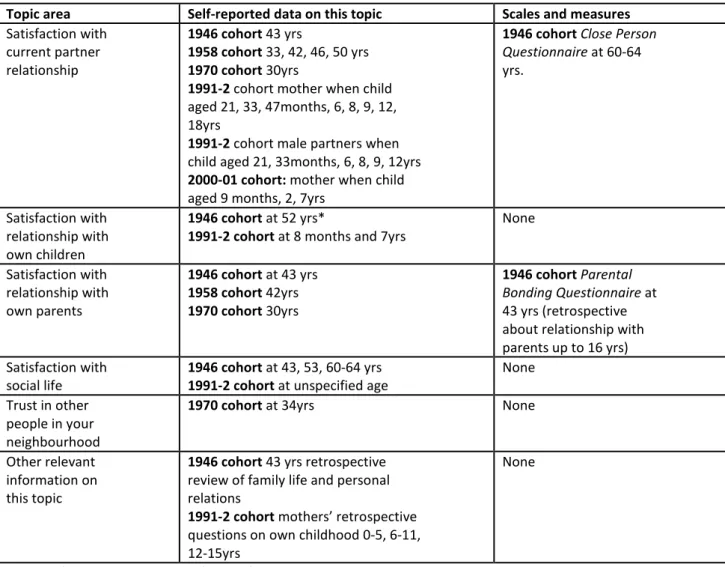
• Our relationships: Each of the older birth cohort studies has extensive data about partnerships, social life, and neighbourhood. ELSA has similar data. BHPS and USoc have data on partner relationships, and BHPS also has data on satisfaction with social life.
• Health: The birth cohort studies all have extensive objective data on growth, physical and mental health, illness and disability, but less data on satisfaction with these areas. The household panel studies cover satisfaction with health and mental health, from 1991 to the present.
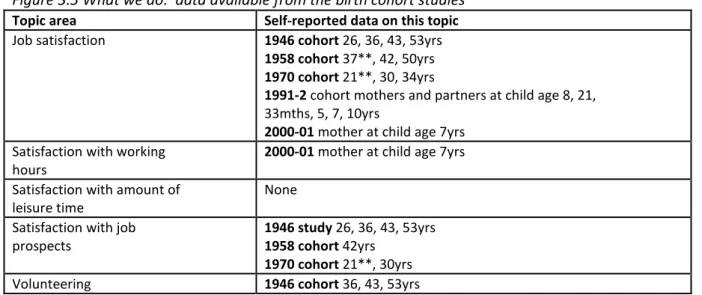
• What we do: All the birth cohorts have some data on satisfaction with occupation, and prospects. The other studies cover satisfaction with work, leisure time and income, and volunteering.
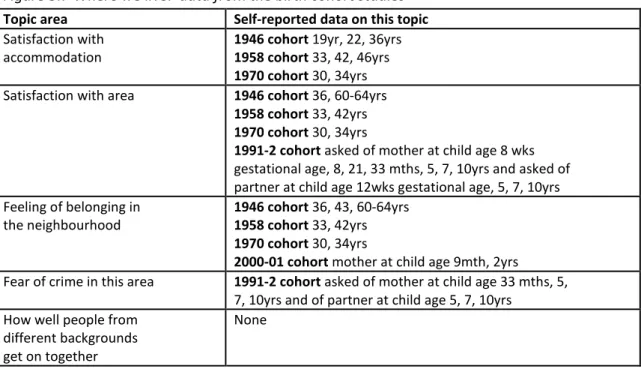
• Where we live: The birth cohort studies have data on satisfaction with accommodation. The other studies cover area of residence, and the 2007 Study also has data on fear of crime.
• Personal finance: Although all the studies have much data on income, there is relatively little data on satisfaction with personal income and with household income.
• Education and skills: The birth cohort studies and the household panel studies have a mass of data about education and skills, and longitudinal data on most aspects of satisfaction with these.
Methodological and technical issues
In Chapter 4 we identify a number of technical and methodological issues to be dealt with in the process of developing measures of national well-being. Prime amongst these are:
• recognising the ways in which different dimensions of well-being may interact with each other, and the need for regular updating of instruments to ensure continuing validity;
• ensuring comparability across time and generations;
• understanding the implications of missing data;
• ensuring ongoing reliability and stability of the measures used; and
• developing the capacity to use multi-level modelling, especially to measure inequalities at different levels.
These issues present challenges, but in many cases there are established methods for addressing them.
Recommendations
1. We suggest that the ONS Technical Advisory Group (TAG) is the appropriate body to assume principal responsibility for taking forward the conclusions of this report. They could consider setting up a sub-group specifically on longitudinal data, and/or could co-opt additional expertise for this purpose. In particular the group should:
a. keep under review progress in the measurement of well-being and the development of new measures with specific reference to the role longitudinal studies can play in this, including linkage of administrative and health record data;
b. discuss with existing major longitudinal study teams the development and maintenance of well-being measurement in their studies;
c. liaise with the forthcoming Cohort Resources Facility, the UK Longitudinal Studies Centre at the University of Essex, and the Centre for Longitudinal Studies at the Institute of Education over support for the ONS well-being measurement strategy;
d. facilitate harmonisation of measurement across studies while maintaining a planned variety of approaches;
e. steer the development of new measures and methodological research programmes; and f. promote secondary analysis of existing longitudinal data to support the ONS programme.
2. To reflect the importance and central role of the Understanding Society study (USoc) and the national birth cohort studies in supporting the measurement of well-being agenda, ONS should seek to ensure the continuation of well-being measurement in the studies as data collection in them continues.
3. ONS should seek to develop further the longitudinal resource by the addition of questions on well-being in younger people in the Longitudinal Study of Young People in England, the Millennium Cohort Study, Avon Longitudinal Study of Parents and Children and the new national birth cohort study due to begin in 2012. Similarly it would be valuable to add subjective well-being questions to the longitudinal studies concerned with later life. The English Longitudinal Study of Ageing will include the four questions from wave 6 (2012), but the new Northern Ireland Cohort for the Longitudinal Study of Ageing (NICOLA) could also include them as could the prospective Health and Ageing in Scotland study (HAGIS). It would also be helpful if the UK Biobank Study, and the 1958 and 1946 national birth cohort studies included the questions. The Wealth and Assets Survey already includes the ONS subjective well-being questions and has potential to throw new light on well-being particularly in relation to the personal finance domain.
4. ONS, in liaison with the Research Councils, should encourage further follow-up (e.g. directly through questions to parents or indirectly through administrative data sources) of the already studied and now adult offspring of the 1946 and 1958 cohort members. This would provide a unique opportunity to study inter-generational transfer of well-being. The scope for extending such research to the children of the 1970 cohort study members, Understanding Society and other longitudinal studies should also be investigated.
5. ONS and the Research Councils should support a programme of secondary analysis of existing longitudinal data to enhance understanding of the origins and outcomes of well-being. This could comprise:
a. a literature review to identify existing gaps;
b. analysis of the relationships between the subjective and objective measures of well-being to make clear the processes through which well-being is gained or lost;
c. analysis of well-being at different life course stages – childhood, adolescence, adulthood, old age;
d. comparison across cohorts to investigate how societal changes may affect well-being; and e. investigation of national differences in well-being through the use of integrated
international datasets (e.g., the Survey of Health, Ageing and Retirement in Europe (SHARE) and the Cross National Equivalent File (CNEF comprising household studies in eight countries including the US and Russia)).
6. A programme of methodological investigations should be undertaken by ONS in collaboration with the UK Research Councils to include:
a. validation of existing measures possibly as part of the ESRC’s secondary data analysis initiative to include analysis of the dimensions of well-being, identification of the relationships between the dimensions and with other variables, and assessment of changes in the validity of well-being measures over time to identify whether and how they should be refined;
b. analysis of short and long-term stability and reliability of well-being measures; and
c. measurement of inequality in well-being and factors that affect well-being at different levels of aggregation such as local communities and in institutions like workplaces.
7. ONS in liaison with the Measuring National Well-being Technical Advisory Group should examine the case for expanding the scope of well-being measurement to include social and civic activity. Analysis of existing longitudinal data to explore how well-being relates to active citizenship would be a first step.
Chapter 1 Introduction to the review: background and policy relevance
1.1 Background
Concern with measuring well-being is part of a broader movement to expand the criteria used for assessing the effects of socio-economic change on individuals. Clearly such a broad ambition requires a wide range of indicators. The highly authoritative report to former President Sarkozy, on Measuring Economic Performance and Social Progress3, conceptualises well-being as multi-dimensional, comprising: material
living standards; subjective features such as personal affect; health; education; personal activities; political voice; social connections; and economic and physical (in)security. The OECD publication, A Framework to Measure the Progress of Societies, includes a similar set of dimensions of progress. Significantly, one of the two ‘final goal’ dimensions is ‘Human Well-being’. This covers physical and mental health, knowledge and understanding, work, material well-being, freedom and self-determination, and interpersonal relationships. Clearly we are at a turning point in the measurement of progress, with well-being at the heart of it.4
In the UK, the Office for National Statistics has taken up the issue through a series of consultations and discussion papers. In the recent (Oct 2011) publication,Measuring National Well-being (MNW) - Discussion paper on domains and measures - the domains are outlined as follows:
• Individual well-being
Factors directly affecting individual well-being:
• Our relationships
• Health
• What we do
• Where we live
• Personal finance
• Education and skills
More contextual domains:
• Governance
• The economy
• The natural environment
Cross cutting issues are identified as:
3Stiglitz, Joseph, Amartya Sen & Jean-Paul Fitoussi (2009) Measuring Economic Performance and Social Progress,
report to the President of France, Paris
4 See also:
• Equality and fairness
• Sustainability
The focus of this contribution from Longview is on the part longitudinal studies can play in shaping our understanding of the dimensions of well-being reflected in these domains. Britain not only has extensive indicator data on socio-economic and health outcomes, but also information on many aspects of well-being in longitudinal sample studies of individuals and households. In particular, the British Household Panel Survey (BHPS) established in 1991 and its successor Understanding Society (USoc), are major sources of longitudinal data on how components of well-being have changed within households. The five large-scale birth cohort studies have longitudinal data on components of well-being in individuals over the 66 year period since 1946 when the first cohort study was launched. Other longitudinal data sources considered here include the following:
• English Longitudinal Study of Ageing (ELSA);
• Life Opportunities Survey (LOS);
• Wealth and Assets Survey (WAS);
• Longitudinal Study of Young People in England (LSYPE);
• Families and Children Study (FACS, now completed);
• West of Scotland Teenage Health Study (WoS 11-16, now completed);
• 2007 West of Scotland Study (WoS 2007 study, now completed);
• Whitehall2 Study
• ONS Longitudinal Study (ONS LS);
• Scottish Longitudinal Study (SLS);
• Northern Ireland Longitudinal Study (NILS); and
• UK Biobank Study
The specific aims of this scoping study are to provide expert guidance and recommendations on the following:
• UK longitudinal datasets which contain questions of relevance to the domains identified by ONS as directly affecting individual well-being;
• longitudinal surveys which are best placed to serve as vehicles for subjective well-being questions;
• longitudinal data relevant to well-being which is available from the census-linked studies; and
• administrative, educational and health records which could be used to provide longitudinal evidence relating to well-being.
1.1.1 Structure of this report
Next in this introduction we lay out the general policy relevance of longitudinal studies and establish their actual and potential value.
Chapters 2 and 3 deal with the present position, drawing on data gathered from our colleagues who work on longitudinal studies. In response to a consultative questionnaire, they furnished details of the information relevant to well-being gathered in their studies5
As noted, the studies reviewed here include the census-linked longitudinal studies and those linking together administrative data from government departments and other sources. Although such datasets contain little if any direct measurement of subjective well-being, their relevance lies in the objective information they contain about social, economic and health status and the effects of these on well-being. The typical scope of such data is exemplified by the Work and Pensions Longitudinal Study (see Box 1).
. Chapter 2 provides a note on historical context and then focuses on the longitudinal data available in relation to the four ONS subjective well-being questions. In each case, we separate out the data available from the birth cohort studies and data available from other longitudinal datasets. Chapter 3 adopts the same approach for data relating to the ONS domains directly affecting individual well-being. We provide an overview of the information supplied, and illustrate how it could be used in greater depth to shape the measurement of well-being.
Box 1: Work and Pensions Longitudinal Study (WPLS)
Introduced in January 2004 and enhanced in October 2005, this dataset links welfare benefits and programme participation data information held by the Department for Work and Pensions (DWP) with employment records from HMRC. The study’s aims are to provide data relevant to child poverty reduction, welfare to work, and retirement income planning. The survey comprises a 100% sample of all DWP clients and provides, for every person:
• benefits or pension first claimed and any subsequent ones;
• any help or interventions received from Jobcentre Plus;
• leaving benefit and entry into employment;
• return to benefit;
• information about income;
• key personal details; and
• Housing/Council Tax Benefit and Tax Credits receipt
Chapter 4 contains an overview of technical and methodological issues, including discussion of key challenges in the use of longitudinal data for the measurement of well-being.
Chapter 5 concludes with a summary of the relevant longitudinal data available for the measurement of well-being, followed by conclusions and recommendations.
5We are grateful to the colleagues who responded. They are not responsible for the use we have made of the
material, and we have not had time to consult them on the conclusions we have drawn. Indeed, one of our recommendations is that these conclusions and the ONS response to them should be the basis of a wider debate or
1.2 Longitudinal studies and policy relevance
Longitudinal studies track stability and change in the lives of the same individuals over time. When they comprise multiple sample cohorts such as the household panel studies or when they are repeated across many years, they can be particularly useful in studying stability and change in society as a whole. The large-scale multi-purpose longitudinal studies in the UK can also draw upon a wide range of variables to explain the changes observed and to predict later outcomes in economic, family, community, educational and health domains. They can therefore contribute to the debate on the measurement of national well-being in number of areas such as:
• the extent of stability and change in well-being over time with indications of the direction and extent of changes over time in the national picture;
• how being changes with age for particular population sub-groups and the prevalence of well-being, inequalities in its distribution and social mobility for these groups; and
• how policies impact on subjective and objective well-being, including how groups with different exposure to specific policies may be affected by them in different ways.
More generally, data accumulated at regular intervals throughout the life course, at a number of levels (e.g., individual, family and community) and from a number of sources (e.g., personal interview and administrative records) can provide a particularly valuable tool in the search for explanations of what enhances or diminishes well-being6
The scientific potential offered by longitudinal studies is complemented by their value to the formulation, implementation and evaluation of policy
.
7. Longitudinal studies offer the potential to model cause and effect. This enables us to assess the effects of policies and the likely effects of implementing different policy options. Longitudinal data can help us to understand the factors that have an effect on well-being as well as how changes in well-being affect people’s lives in different ways. Boxes 2 and 3 give illustrative examples from longitudinal studies of how early life experiences impact on long-term mental health outcomes and how adult learning impacts on subjective well-being among older people8
Box 2: Early language difficulties and adult mental health
Secondary analysis of data collected from birth to age 34 in the 1970 birth cohort study demonstrates the lasting negative effects of language difficulties as measured at age 5 on adult mental health as measured at age 34. The family background in which the child grew up, such as mother’s psychological distress during cohort member’s childhood, and poor family circumstances, were also implicated in child development and in long-term mental health outcomes. These findings suggest areas for policy intervention.
.
6 Robins, L. and Rutter M. (1990) Straight and Devious Pathways from Childhood to Adulthood. Cambridge: Cambridge
University Press.
7 Bynner, J. and Joshi, H. (2007) ‘Building the Evidence Base from Longitudinal Data: The Aims, Content and.
Achievements of the British Birth Cohort studies,’ Innovation: the European Journal of Social Science Research, 20, (2) 159-179.
8Schoon I., Parsons, S., Rush R. and Law, J. (2010) Children’s Language Ability and Psychosocial Development: A 29-Year Follow-up
Study, Pediatrics, 126, e73-e80; Jenkins, A. (2011) Participation in Learning and Wellbeing among older adults, International Journal of Lifelong Learning, 30, 405-420.
Specific policy interventions to boost well-being - especially when phased in over a period of time or implemented only in selected geographical areas - can draw on longitudinal data collected in household panels or cohort studies to assist evaluation of their effectiveness. The longer the studies are continued, the richer potentially the data for analysis of well-being effects become.
Long-term longitudinal studies can be usefully extended in three ways of particular value to policy-makers and researchers:
•cross-cohort studies (comparing well-being data collected from cohort studies started at different times) to assess the effects of societal change on well-being and its relationship to other variables;
•cross-national studies to assess the effectiveness of policies to enhance well-being in different countries taking account of institutional and cultural differences; and
•inter-generational studies, involving data collection from cohort members’ children to assess the transfer of well-being between generations.
It is also important to note that longitudinal data can include information collected using either qualitative or quantitative research methods or both. However, the emphasis here is on large-scale quantitative studies.
1.3 Cross-cohort studies
The policy value of birth cohort studies is enhanced by the opportunities they offer to compare two or more cohorts born at different times, as in the nationally representative British birth cohort studies series. This includes the cohorts of: 1946 (NSHD), 1958 (NCDS), 1970 (BCS70), 1991-2 (ALSPAC)9, and 2000 (MCS). Data collected from individuals in a longitudinal study reflect three types of ‘extrinsic’ influence on well-being at any point in time: the age effect, the period effect, and the cohort effect10. Inter-cohort analysis enables us to: analyse responses of cohort members at the same age/stage of life but in different socio-historical contexts, or to analyse those at different ages within the same socio-socio-historical context11
These different approaches are illustrated in two texts. The first, called Changing Britain: Changing Lives,
compares 30 year-olds born in 1946, 1958 and 1970, demonstrating the effects of 24 years of societal .
9Area level study based on the population of Avon.
10 This reflects the age of the respondent (A); the period (date) when the data were collected (P); and the cohort
(date) in which the respondent was born (C). C+A = P - hence any two of the three effects is confounded with the third.
11 Bynner, J. (2005) ‘Longitudinal Cohort Designs’ in Kempf–Leonard, K. (ed.) Encyclopaedia of Social Measurement,
Vol 2, 591-599.
Box 3 : Adult learning and well-being
Data from the first three waves of the English Longitudinal Study of Ageing (ELSA) showed the effects of participation in different kinds of adult learning classes on older (50+) adults’ self-assessed well-being. Music, arts and evening classes were significantly related to improvements in subjective well-being. By contrast, formal courses (e.g. work-related) and exercise classes were not related to improvements in self-assessed well-being.
change on the life chances and well-being of those in their early thirties. The second text, A Companion for Life Course Studies, supplies historical accounts of the changing socio-historical and policy context in the areas of citizenship, family, education, economics, labour market participation and skills, health and health care and leisure across the period before and since the end of World War II, when the first British birth cohort study began12. Box 4 gives an example of how changing socio-economic circumstances have
impacted on the physical development of children in the 1946, 1958 and 1970 cohorts13. Box 5 provides an example of how experiences of depression and unemployment are related over time among those in the 1958 and 1970 cohorts14.
Box 4: Changing impacts of socio-economic circumstances on development
Improved child health was associated with increases in average adult height across the 1946, 1958 and 1970 birth cohorts. Comparing the cohorts, there was a reduction in the extent to which adult height was related to socio-economic circumstances. This suggests a levelling out over time of the differences that family social and economic circumstances make on children’s health and development
.
Box 5: Depression and unemployment
In the 1958 cohort, social class and educational attainment were key factors in the amount of time spent unemployed. By contrast, a much more complex range of factors were linked to unemployment in the 1970 cohort. This included: social class, parents’ education, educational attainment, leaving school early, and depression. There were also signs of a vicious circle in the 1970 cohort in which depression and poor self-esteem resulted from unemployment and made future employment less likely.
12 Ferri, E., Bynner, J. and Wadsworth, M. (eds) (2003), Changing Britain, changing lives: three generations at the end
of the century, London: Institute of Education; Wadsworth, M. E.J. and Bynner, J. (eds.) (2011); A Companion to Life
Course Studies. The social and historical context of the British birth cohort studies, London: Routledge.
13 Wadsworth M et al (2003) in E Ferri, J. Bynner & M. Wadsworth Changing Britain, changing lives pp219-224,
Institute of Education Press, London); Li L et al (2008) ‘Child-to-adult body mass index and height trajectories: a comparison of two British birth cohort studies’ American Journal of Epidemiology, 168, 1008-1015
14 Bynner, J. (1998) ‘Education and family components of identity in the transition from school to work’, International
1.4 Cross-national longitudinal studies
Longitudinal studies within a single country usually measure individual change within a common policy and implementation context. They can examine the effects of variations in different types of institution, such as different types of school or hospital, on well-being outcomes, but cannot assess the effects of societal factors as a whole. In order to measure this, longitudinal studies starting in the same period and replicated cross-nationally are required.
The major challenge for cross-national research is achieving comparability of data, recognizing the limitations imposed by language and cultural differences as well as possible variations in sampling methods. There are a variety of different types of cross-national longitudinal studies. For example, one approach is to mount a study in several countries with a standardised questionnaire, as was done with the European Community Household Panel (ECHP), which ran from 1994 to 2001. Another variant is a close collaboration of researchers in different countries conducting highly similar studies, as is the case with the Survey of Health, Ageing, and Retirement in Europe (SHARE). This started in 2004 and, like ELSA, is modelled on the US Health and Retirement Survey.
Another approach is to harmonise the data from a set of similar studies so that they can be analysed jointly. Examples of this type include the Cross-National Equivalent File (CNEF) 1980-2010 embracing currently the British Household Panel Study (BHPS), the Household Income and Labour Dynamics in Australia (HILDA), the Korea Labor and Income Panel Study (KLIPS), the US Panel Study of Income Dynamics (PSID), the Russian Longitudinal Monitoring Survey (RLMS-HSE), the Swiss Household Panel (SHP), the Canadian Survey of Labour and Income Dynamics (SLID), and the German Socio-Economic Panel (SOEP)15
Each UK birth cohort study has taken steps to develop a comparative research component often with one other country. The European Child Cohort Network (EUCCONET) based in INED in Paris involves eight European countries engaged in new birth cohort studies for exchange of information and advice.
.
All these collaborative frameworks – especially SHARE and CNEF – offer potential opportunities to extend longitudinal research on well-being cross-nationally.
1.5 Inter-generational studies
The scope for inter-generational study exists particularly within each of the earlier birth cohort studies, depending on the range of data collected retrospectively about the histories of the cohort members’ parents before the birth16 of the cohort child. Thus self-assessed well-being or its negative counterparts (e.g. depression) can be traced from parent to child at comparable ages (e.g. 16) and the inter-generational transmission of well-being can be assessed, taking account of changing family circumstances and experiences. An example in the economic sphere is shown in Box 617
15 Burkhauser RV and Lillard DR. (2007) The Expanded Cross-National Equivalent File: HILDA Joins Its International
Peers
.
40, 208-215.
16 The household panel studies are also limited by this requirement and at least in the case of BHPS with 15 years of
annual data collections children (aged 11- 16) do not have sufficient numbers to do the analysis effectively.
17 Gregg, P., and Machin, S. (1998). Childhood disadvantage and success or failure in the youth labour market, Centre
Box 6: Transmission of economic well-being from cohort members’ parents to cohort members
Analysis of data from the 1958 birth cohort study shows how growing up in a low income household can lead to negative longer term outcomes such as joblessness and participation in crime. Having parents with low income or earnings during the years of growing up is a strong disadvantage in terms of labour market success and can contribute importantly to outcomes like adult joblessness and participation in crime. These negative outcomes can persist long into adult life and can spill over to the next generation.
A much richer inter-generational enhancement is possible via the extension of data collection from cohort members to their children18. This offers the opportunity to investigate inter-generational continuities and discontinuities in family circumstances, physical and mental development, education and health, and to assess the effect on well-being of ‘transmitted deprivation’19 or escape from it20. Data collected from cohort members’ children has added significant value to the 1958 (NCDS) and 1970 (BCS70) birth cohort studies datasets21. Box 7 gives an example of how such inter-generational data has been used in a comparative way to test whether maternal employment has adverse effects on children’s cognitive and behavioural development22
Box 7: Impacts of mothers’ employment on children’s cognitive and behavioural outcomes
Using data from the second generation of two cohort studies, the 1970 British Birth Cohort Study (BCS70) and the US 1979 National Longitudinal Study of Youth, the cognitive and behavioural development of school aged children was analysed in relation to maternal employment before the child’s first birthday. Only two out of five US estimates of maternal employment in the child’s first year had a significant effect on child development. Maternal employment was negatively related to reading comprehension but positively related to freedom from problem behaviours.
By contrast, none of the estimates were significant for four child outcomes modelled in Britain, suggesting that there is little if any harm apparent among school age children from maternal employment during a child's infancy. The reason for the lack of negative impact in the UK may be related to the greater extent of part-time employment of mothers in the UK than the US and longer allocations of maternity leave in the UK.
.
18 Fox, J. and Fogelman, K. (1989) ‘New Possibilities for Longitudinal Studies of Intergenerational Factors in Child
Health and Development’, in Magnusson, D. and Bergman, L. R. (1990) Data Quality in Longitudinal Research, Cambridge: Cambridge University Press.
19Cycles of Disadvantage, Michael Rutter and Nicola Madge. Heinemann. Educational Books Limited, 1976.
20 Pilling, D. (1990) Escape from Disadvantage, London: The Falmer Press.
21 The sample of children is still limited by the fact that female cohort members’ child bearing at the times of the child
surveys had yet to be completed and for some it had not yet begun. Such censoring biases the sample towards younger mothers but sample-based estimates can be adjusted to compensate for this.
22 Cooksey, E., Joshi, H. & Verropoulou, G. (2000) Does mothers’ employment affect children’s development? Evidence
from the children of the British 1970 Birth Cohort and the American NLSY79. Longitudinal and Life Course Studies, 1, 95-115
Inter-generational assessment of this kind creates three-generation datasets involving cohort members, their parents and their children. Inclusion of grandparents extends the set to four generations, though for the earlier birth cohort studies (1946, 1958 and 1970), the data for grandparents is quite limited.
Follow-up of cohort members’ children was first undertaken in the 1946 cohort study. This involved three data collections on 2,205 firstborn children of cohort members who were then aged 20-25 years. Data has also been collected on the children of the 1958 cohort study members. In this case, a random sample of one third of cohort members (at age 33) and their children were surveyed. This included 4,800 children in all. Similarly, in the 1970 cohort, data was collected from half of the cohort members at age 34 and their 5,200 children. Self-completion questionnaires were completed by children aged 10 or more and these included questions relevant to their well-being. These datasets offer rich opportunities for both longitudinal and cross-sectional inter-generational analysis of well-being.
1.5.1 Children’s well-being
As we have seen, a number of different approaches have been taken to measuring children’s well-being among the cohort studies. This includes asking children directly using self-completion surveys or obtaining indirect reports of the child’s well-being from parents or teachers. Another valuable source of longitudinal data on children is educational records. For example, data from the National Pupil Database (NPD) could be linked to longitudinal studies to augment the information available about children. Box 8 considers such linkage and the potential uses of information from the National Pupil Database (NPD).
1.6 The complementarity of longitudinal studies with other research
Finally, it should be emphasised that whilst large-scale longitudinal surveys have a particular contribution to make to the understanding of individual well-being, they may be most valuable when used in conjunction with other forms of data collection. Repeated cross-sectional general population surveys such as the Annual Population Survey will be the key means of monitoring changes in well-being across the population. However, qualitative case studies would also be valuable in illuminating in more detail the processes by which well-being is gained or lost. Qualitative methods are also very useful for the development and ongoing refinement of survey questions. The goal here is not to promote longitudinal surveys at the expense of other forms of research, but to urge that they are used alongside and in combination with other
Box 8: Use of the NPD to augment data on children’s well-being
Much of the research on well-being has so far focused on adults. However, it is also important to understand the well-being of children and young people. Existing datasets such as the National Pupil Database (NPD) in England could help with this. The NPD allows a sample of primary and secondary school pupils with known characteristics to be drawn and studied further. The existing educational data from the NPD could be augmented by the collection of data from students about their well-being. This could be analysed along with numerous contextual measures that are already available in the database, such as educational performance results and free school meal eligibility. The ability to readily follow-up students over one or more years would be very valuable for measures of long term change. The Department for Education are giving thought to ways in which the NPD could be augmented such as this.
appropriate research methods. This inevitably makes for a more complex picture, but a mixed-method approach is especially important early on in the process of constructing a set of well-being indicators.
1.7 Summary
The chapter introduces the case for much greater use of the wide range of longitudinal data sets available in the UK. We suggest ways in which they might be used both to gain a better understanding of how well-being develops and is maintained or lost over time as well as how it can best be measured. The main emphasis is on subjective well-being, while recognising that all the studies contain a wealth of objective information about context and socio-economic status to aid analysis.
Eighteen longitudinal studies are reviewed, including all the major UK longitudinal studies. They cover a period of 66 years since the first birth cohort study was launched in 1946.
The relevance of longitudinal data with respect to the well-being policy agenda lies in its unique ability to enable investigation of:
• the extent of stability and change in well-being over time with indications of the direction and extent of changes over time in the national picture;
• how being changes with age for particular population sub-groups and the prevalence of well-being, inequalities in its distribution and social mobility for these groups; and
• how policies impact on subjective and objective well-being, including how groups with different exposure to specific policies may be affected by them in different ways.
The main research designs that can extend the analytic potential of longitudinal data further are:
• cross-cohort studies that compare two or more cohorts of the same age but in different eras;
• cross-national studies using comparable longitudinal datasets; and
• inter-generational studies extending data collection to cohort members’ children23
The first two of these offer opportunities for enhancing our understanding of well-being through the exploitation of existing data. The third will require either new data collection among cohort members’ children, or linkage of existing data on cohort members’ children (e.g., from educational, health records, etc) to the cohort datasets
.
.
23 The intergenerational studies referred to in this section need to be distinguished from the macro-level
intergenerational accounting done by ONS
Chapter 2 UK longitudinal data for exploring subjective well-being
This chapter focuses on the data that is currently available from the longitudinal studies reviewed on the four ONS subjective well-being questions. We also include a brief note on the context in which the UK longitudinal data has been collected, since part of the longitudinal perspective is to enable us to understand how well-being is shaped by broader historical trends.
2.1 Introduction and background
In this section, we provide background information about the research methods, criteria for selection of studies in the review, definition of terms, and how we have met the study objectives.
2.1.1 Criteria for inclusion in the review
We selected for inclusion in the review the eighteen longitudinal studies noted in Chapter 1 and described below. The criteria for inclusion were that they should:
• have a large sample;
• cover a long time period; and
• contain relevant information for the study of well-being.
The studies selected and reviewed include:
• five birth cohort studies;
• four large-scale household panel studies;
• six studies of individuals begun in adolescence or later; and
• three census-linked longitudinal studies. 2.1.2 Research methods
We circulated a grid to researchers responsible for the eighteen studies, structured to reflect the domains identified by ONS as directly affecting individual well-being. For each study, we asked the following questions:
• Has your study collected data on this area?
• What wording and scales were used?
• What ages were the individuals to whom the questions were asked?24
We also invited researchers to make any further comments they wished on the issue of well-being measurement.
24 The grid template is provided in the Appendix. A full set of their responses is provided in Annex 1 as a separate file
We are grateful to the colleagues who responded. They are not responsible for how we have used the material nor for the conclusions drawn. Indeed, one of our recommendations is that these conclusions and the ONS response to them should be the basis of a wider debate or consultation.
The overview provided here is neither comprehensive (in the sense of covering all possible relevant longitudinal datasets) nor exhaustive (in the sense of analysing to the full the material supplied in the questionnaire returns). Nevertheless it provides a good starting point for illustrating the actual and potential value of the main UK longitudinal studies for the measurement of well-being.
2.1.3 Definition of terms
In categorising the longitudinal data available on well-being, we have distinguished between: data that relate directly to each of the four ONS subjective well-being questions and data with indirect salience to each. We have taken the same approach to data of relevance to each of the domains identified by ONS as directly affecting individual well-being.
For example, items categorised as directly relating to the ONS well-being domains use specific terms in a sufficiently close way to match the ONS domain. Also included here are cases where there may not be an explicit match between the question and the domain, but we believe that something very similar is being measured.
In other cases there is no straightforward link between the question and the domain as specified, but there is indirect salience. For example, with some further restructuring of the data, measures could be constructed which would be relevant to the domain in question.
Inevitably we have drawn more heavily on particular longitudinal studies in order to provide strong illustration of their potential. However, other longitudinal studies could also be mined extensively in this way.
2.1.4 Meeting the study objectives
This approach directly addresses three of the four aims specified for the scoping study and listed in Chapter 1. It covers the current state of play in respect of longitudinal datasets, including census-linked studies and reference is also made to the use of administrative records. The second aim, identifying longitudinal studies which might in the future act as vehicles for well-being data, is dealt with in the recommendations in the final chapter.
In addition, the information collected either in our questionnaire or through reviews of relevant websites, offers the following ways forward:
• It is a bespoke resource for those at ONS and elsewhere who seek to use longitudinal datasets for investigating well-being. The relevant items in the main datasets are identified and categorised with reference to the individual well-being domains developed by ONS, making it relatively straightforward for longitudinal information to be fed in. We present here the information we collected in summarised form. A separate appendix containing the full responses to the questionnaire is available directly from Longview (a
• In addition to the identification and classification of relevant questions, we also comment on how the data from these longitudinal studies can be applied to the study of well-being. The examples provided here could be built up into a valuable bank of material for the study of well-being, and we recommend that should happen.
2.2 Overview of the studies included in the review
There are four kinds of longitudinal data reviewed here. These include:• birth cohort studies which follow up a sample of individuals from birth;
• household panel surveys which regularly follow-up some or all household members (over a specified age);
• longitudinal studies of individuals which begin in adolescence or adulthood; and
• census-linked studies which link key life events data and census data from a sample of individuals over time.
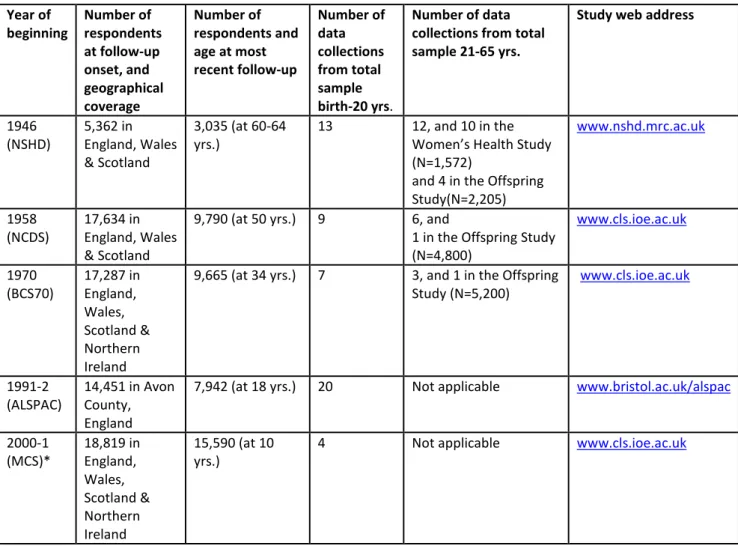
Figures 2.1 and 2.2 provide an overview of the studies included in this review. 2.2.1 Birth cohort studies
The large-scale birth cohort studies offer a very important source of longitudinal data on well-being as summarised in Figure 2.1. All of the birth cohort studies have information on cohort members’ parents, as well as information on grandparents which includes, at the least, grandparents’ educational attainment and recent or last occupation. The three older studies also have data on the offspring of the cohort members. In addition each study has made extensive use of data linkage to collect administrative information, for example about schools attended and deaths of sample members. Additionally, the new national birth cohort study currently under development will provide a further source of longitudinal cohort data on well-being in the future.
2.2.2 Household panel surveys
As shown in section a of Figure 2.2, the ongoing large national longitudinal household panel surveys are represented here by the British Household Panel Survey and its successor Understanding Society, as well as by the Wealth and Assets Survey and the now completed Families and Children Study.
2.2.3 Individual longitudinal studies beginning after childhood
The next type of longitudinal study shown in section b of Figure 2.2 is concerned with individuals and data collection that begins after childhood. This type is represented here by five ongoing studies: the English Longitudinal Study of Ageing; the Life Opportunities Survey; the Longitudinal Study of Young People in England; the Whitehall2 Study; and UK Biobank. Two further studies which are now completed are also included here- the 2007 West of Scotland Study, and the West of Scotland Teenage Health Study.
2.2.4 Census-linked studies
The third type of longitudinal study (see section c in Figure 2.2), uses census-linked administrative records combined with vital events data. Included here are the ONS Longitudinal Study covering England and Wales, the Scottish Longitudinal Study and the Northern Ireland Longitudinal Study.
Figure 2.1 Overview of the birth cohort studies included in the review Year of beginning Number of respondents at follow-up onset, and geographical coverage Number of respondents and age at most recent follow-up Number of data collections from total sample birth-20 yrs. Number of data collections from total sample 21-65 yrs.
Study web address
1946 (NSHD) 5,362 in England, Wales & Scotland 3,035 (at 60-64 yrs.) 13 12, and 10 in the Women’s Health Study (N=1,572)
and 4 in the Offspring Study(N=2,205) 1958 (NCDS) 17,634 in England, Wales & Scotland
9,790 (at 50 yrs.) 9 6, and
1 in the Offspring Study (N=4,800) 1970 (BCS70) 17,287 in England, Wales, Scotland & Northern Ireland
9,665 (at 34 yrs.) 7 3, and 1 in the Offspring Study (N=5,200) 1991-2 (ALSPAC) 14,451 in Avon County, England
7,942 (at 18 yrs.) 20 Not applicable 2000-1 (MCS)* 18,819 in England, Wales, Scotland & Northern Ireland 15,590 (at 10 yrs.) 4 Not applicable
Figure 2.2. Overview of household panels, studies of individuals and census- linked studies included in the review Study name and identification
used in this report
Initial number. and age of respondents unless otherwise specified
Number of data collections Study type and geographical coverage Relevant website
a. Household panel studies
British Household Panel Study (BHPS)
Understanding Society (USoc)*
5,500 households, 10,300 individuals aged 16 yrs and over.
40,000 households, 100,000 individuals aged 10 yrs and over
Annual waves 1 (1991) to 18 (2008)
Annual waves beginning in 2009
Household panel in England Wales, Scotland & N. Ireland
Household panel in England, Wales, Scotland & N. Ireland
Wealth and Assets Survey (WAS) 30,595 households 3, the first in 2006-2008 Household panel in England, Wales & Scotland Families and Children Study
(FACS)
5,888 at final wave of data collection in 2008
10, the first in 1999 Household panel in England, Wales & Scotland
b. Studies of individuals beginning in adolescence or adulthood
English Longitudinal Study of Ageing (ELSA)*
12,100 individuals aged 50 and over
6 bi-annual data collections beginning in 2002
Longitudinal study of individuals in England Life Opportunities Survey (LOS) 31,161 adults (16+yrs) and
2,910 children (11-15yrs)
2, the first in 2009 with a third planned for 2012
Longitudinal study of individuals within households in England, Wales & Scotland
Whitehall2 Study 10,380 non-industrial London based civil servants aged 35-55yrs
9 from recruitment in 1985-88 to 2012-13: data available for waves 1 to 8
Longitudinal study of individuals working in London
UK Biobank 500,000 individuals Initial health examination beginning in 2006-10 and follow-up through postal/e-mail questionnaires and medical records
Longitudinal study of individuals recruited at ages 40-69yrs in England, Wales & Scotland
Longitudinal Study of Young People in England (LSYPE)*
15,770 individuals at age 13-14yrs
7 waves annually from 2004 to 2011, ages 17-18yrs
Longitudinal study of young people in England* WoS 2007 Study Three cohorts aged at outset:
15 yrs (N=2,539) 35 yrs (N=2,518) 55 yrs (N=3,209) 5 from 1987 to 2007 5 from 1987 to 2007 5 from 1987 to 2007
Longitudinal study of individuals in West of Scotland
WoS Teenage Health Study 2,586 at outset
Adolescent cohort begun at 11-16 yrs and completed at 18-20 yrs
4 from 1994 to 2004 Longitudinal study of individuals in West of Scotland
c. Census-linked studies
ONS Longitudinal Study - England & Wales
529,764 individuals 4 from 1971 to 2001 and from continuous administrative and medical data sources
Longitudinal study of individuals and their households
In England & Wales
The Scottish Longitudinal Study 265,321 individuals 2 from 1991 and from
continuous administrative and medical data sources
Longitudinal study of individuals and their households in Scotland
The Northern Ireland Longitudinal Study
448,949 individuals 1 from 2001 and from
continuous administrative and medical data sources
Longitudinal study of individuals and their households in N. Ireland
2.3 The period covered by the longitudinal data reviewed
The studies reviewed here collectively cover all but the first year of the 66-year post-war period (1946 to the present). Additionally, information on the grandparents of oldest birth cohort members extends back to the first half of the twentieth century.
To set the context for this longitudinal data, the post-war period was a time of fundamental social and economic change and policy innovation, including the introduction of the National Health Service (1948), the 1944 Education Act and many aspects of the welfare state. It began as a time of austerity and deep inequalities across a wide range of areas, including occupation, income, housing, education and health. It was also a time of social mobility as science and technology changed the nature of work. What followed was a period of relative affluence as the national economic position improved, and purchasing power, material circumstances, and opportunities to participate in further and higher education increased. However, this picture was reversed somewhat in the late 1970s when inequalities in these same areas tended to increase and social mobility decreased.25
Although there is no consistent national information available on self-assessed well-being over this period, there are nevertheless more general indications of the national mood for the early part of the post-war period. Historians comment on the prevailing optimism of the early post-war years, which were a time of practically full employment, increasing employment of women, newly assured benefits of free health care, national insurance, family and maternity allowances, new and free opportunities for higher education and social mobility, increasing purchasing power, and improvements in housing
.
26Later in the post-war period, as inequalities increased, there began to be information on subjective well-being in cross-sectional studies of representative samples, such as the British Social Attitudes Survey which began in 1983. The five large scale birth cohort studies and the key national household panel survey (which began as the British Household Panel Survey in 1991 and continues now as Understanding Society) also have individual well-being data in increasing quantities from then onwards, and information on components of well-being from earlier times.
2.4 Longitudinal data on individual subjective well-being
Having set the historical context covered by the longitudinal studies in the review, we turn now to consider the data available from these studies on the ONS subjective well-being questions. Although we have not gone into great detail about the comparability of questions, in this section we provide the wording used.
25 Atkinson AB. & Salverda W. (2005) ‘Top incomes in the Netherlands and the United Kingdom over the 20th century’,
Journal of the European Economic Association, 3, 883-913. Bukodi E. & Goldthorpe J. (2011) ‘Social class returns to
higher education: chances of access to the professional and managerial salariat for men in three British birth cohort studies.’ Longitudinal and Life Course Studies, 2, 185-201. Dorling D. (1997) Death in Great Britain: how local mortality
rates have changed 1950s-1990s. York: Joseph Rowntree Foundation. McCulloch G. (2011) ‘Education, policy and
practice’, in M. Wadsworth & J. Bynner (eds.) A companion to life course studies: the social and historical context of
the British birth cohort studies, pp. 69-90, London: Routledge. Wilkinson RG. & Pickett K. The spirit level: why equality
is better for everyone. London: Penguin.
26 Pinto-Duschinsky (1970) ‘Bread and circuses?’ in V. Bogdanor & R. Skidelsky (eds.) The age of affluence, 1951-1964.
London: Macmillan. Thomson D. (1981) England in the twentieth century, London: Penguin. Marwick A. (1982) British society since 1940. London: Penguin.