A STUDY OF INFERENCE PROBLEMS IN
DISTRIBUTED DATABASES
LiWu Chang&IraS.Moskowitz
Naval Research Laboratory | 5540, Washington DC, USA
Abstract We analyze the inference problem for distributed databases.
Keywords: database inference, multiple databases, Bayesian networks,
collabora-tive environment
1.
Introduction
Often, database managers must decide which non-sensitive data to release. This is referred to as data sanitization or data downgrading. Issues surrounding downgrading are of particular importance to net-work architectures which utilize a multiple single level [14]approach for keeping sensitive data away from the generic user. In a distributed envi-ronment, data may be distributed among dierent data sites (e.g., [22]). Therefore, before data is downgraded, database managers must take into account other data that users may have access to.
Let us call the authorized users who either manage the entire database (e.g., database managers), or who are allowed access to the entirety of the data High, and the generic user, for whom access is restricted Low. Of course we are tacitly assuming that there are two types of data: low data which is available to all, and sensitive data to which only High users are allowed access. Thus, High data (High's data) may have both sensitive and non-sensitive components. High's concern is to keep the sensitive information away from Low. Therefore, High is allowed to downgrade the non-sensitive parts to Low.
For information sharing needs, High decides which data to release to Low. Obviously, High will not release sensitive data. However, database inferenceoccurs when Low is able to infer the sensitive information from the data that is released. To prevent database inference, non-sensitive
data which is related to sensitive data must be examined and perhaps modied, thus requiring further data sanitization. The problem of pre-venting database inference in a stand-alone database is quite challenging and has recently been under intensive study from diverse aspects (e.g., [2] [3][5][6][7][8][9][11][13][15][16][17][18][19][29][30]). Database inference in distributed databases is an area in which very little work has been done. In [11], the authors showed that sensitive information can be revealed if users link information from several databases in a deterministic man-ner. However, the deterministic approach does not concern itself with the equally important problem of probabilistic relationships embedded in the data. We analyze the inference problem under a probabilistic framework.
Let us consider the following scenario which we will use throughout the paper. Given a databaseD consisting of categorical attributes, the
most common technique for mitigating inference is that of modifying the non-sensitive data (i.e., values of attributes) in the database. How-ever, even with appropriate data modication, sensitive data can still be compromised when data from other databases is incorporated. For instance, an AIDS diagnosis is often considered sensitive and is not dis-closed. Given a second database containing information related to drug abuse, however, one may discover from the two databases that drug abusers' intravenous injections may cause these individuals to contract AIDS. Therefore, knowing a patient's history of drug injection could allow one to infer that the patient has a higher chance of contracting AIDS than does the general population, even if the diagnosis has not been revealed. Information about patients' drug abuse should therefore be treated as sensitive. As another example, the occurrence of non-Hodgkin lymphomas (NHL) is higher in AIDS patients than it is in the general population. Hence, the diagnosis of NHL should also be treated as sensitive, since there is a high correlation between AIDS and NHL. On the other hand, while, an AIDS patient may show signs of mental depression, depression is a common symptom of many diseases, such as low thyroid function. Thus, the symptom of mental depression may not be indicative of an AIDS diagnosis. Of concern, however, is that fact that, in a distributed environment, Low may obtain additional attribute data as discussed above which may allow Low to infer sensitive data|in this case, a diagnosis of AIDS.
2.
Conceptual Model
We proposed a stand-alone model, the Rational Downgrader [20], for downgrading (sanitization) using inferential analysis. In a distributed
environment, the conceptual model of the Rational Downgrader must be modied to include \knowledge" from both external data items and their rules.
Because external data items and their rules were not in the original model, the Rational Downgrader is composed of three components: the GUARD, the Decision Maker, and the Parsimonious Downgrader (or Filter). Initially, High inputs its candidate for the data that it would like to release to Low. The Decision Maker generates rules from the available data set, and uses the external data items and their associated rules, to form its output rules. The GUARD determines whether there is inference, and if it is \excessive" based on the Decision Maker's rules. If the inference is excessive, then the Parsimonious Downgrader will im-plement a protection plan to lessen the inference (i.e., decides to modify by deleting certain data from the database). The inference mechanism is based on a decision theoretical framework (e.g., [10][21][23][27][28]). It is the Bayesian network framework that will be used for our inference analysis in this paper. The output of the Rational Downgrader is the database to be released to Low. Our goal is to make modications as parsimoniously as possible and thus avoid imposing unnecessary changes which lessen functionality.
A Bayesian network describes the probabilistic dependency relation-ships among the attributes of a database. A Bayesian network B may be generated from empirical data or can be constructed from a priori knowledge.
In a distributed system, it is misleading to evaluate downgrading in one database only. Publicly released data from one database may cause the inference of sensitive data in another database. If to-be-released data causes additional inference concerns due to another database, the Parsimonious Downgrader will incorporate the new requirements into its protection plan. As a result, only a mutually agreed upon data set will be released.
3.
Database Inference
We consider the case for which sensitive data is associated with one particular attribute. In a medical database, AIDS diagnoses are the sen-sitive information. We use High database and Low database to indicate, respectively, the portion of a database viewed by a database manager (the High user) and a generic (Low) user. We are interested in study-ing probabilistic inuences on the sensitive information from attributes that are related to the medical diagnosis only. (See, e.g., [1][3]) for disclosure protection of background attributes (e.g., age, address).) A
sample of those relevant attributes is given in Table 1. Table 1 is the medical database for AIDS diagnoses which contains 20 data records (i.e., patients), which are uniquely identied by their key, and four at-tributes (excluding the key) (i.e., \hepatitis," \depression," \AIDS" and \transfusion") where each attribute has two values: a `y' indicating the occurrence of the (diagnosis) result and an `n' otherwise. In addition, Table 1 shows the High view (denoted here as DH) in our discussion.
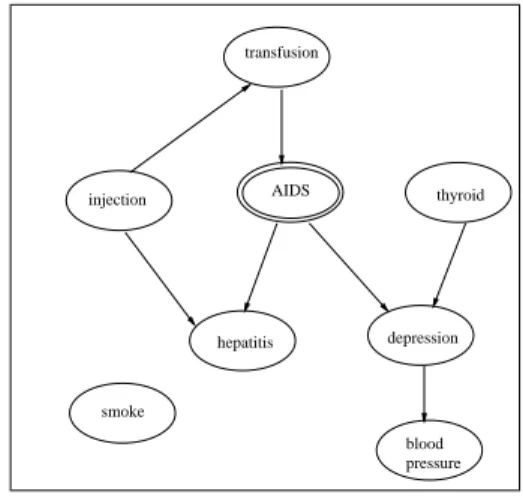
The diagnosis of one disease (e.g., \AIDS") often causes the occurrence of another physical disorder (e.g., \mental depression"). Consequently, knowing the diagnosis of a physical disorder may lead to the inference of sensitive information (i.e., AIDS) about a patient. Thus, to protect sensitive information about one disease may require the protection of other probabilistically-related records. In this paper, we use a Bayesian network representation to describe the probabilistic relationship. A cor-responding Bayesian network representation is given in Figure 1H1 (see [10][21]for details on how to construct a Bayesian network), which shows that \AIDS" may aect the consequence of both \hepatitis" and \mental depression" and a cause of \AIDS" is a (blood) transfusion.2
hepatitis depression AIDS transfusion
Figure1H. B-net of the High.
transfusion
depression hepatitis
Figure1L. B-net of the Low.
Table 2 shows the database after being initially downgraded (denoted here asDL). Table 2 is what High would input into the Rational
Down-grader, a patient is identied by its key. The threat with which we are concerned is that of Low inferring sensitive relations about theith data
item (or record) in the database. The dashes represent data that is con-sidered sensitive and, thus, is not downgraded. Note that Table 2 is not in the form in which it will be released; it has not yet undergone the procedure that determines whether excessive inference may exist.
A target attributeT is an attribute that has dashes (meaning missing)
in it (from Low's viewpoint). Thus,T represents sensitive information.
We wish to lessen any inference that Low may attempt to draw about the target node. Since data is not completely revealed, the correspond-ing Bayesian network structure3 for DL diers from that of DH and is
shown in Figure 1L. The challenge for Low who is attempting to discern sensitive information is to restore the missing information in Table 2.
Note that Table 2 still contains the \AIDS" attribute, even though the values are all missing. This is because we take \paranoid" view that Low knows what sensitive attribute High is concerned with, and because, in general, sensitive information may be distributed across many attributes and all the values may not be missing.
Initial downgrading may not be sucient to protect the sensitive data. Again, we take the \paranoid" view that the Low obtains the prior knowledge (from previous studies, for example) about the depen-dency relationship between AIDS and the three attributes \mental de-pression," \hepatitis," and \transfusion." (The dependency relationship is described in Figure 1H.) Certainly, it is not a surprise that Low could have the \prior" information it desires concerning an important medical condition such as AIDS. With information concerning the dependency, together with data in the Low database of Table 2, Low may be able to restore the hidden sensitive data. A sample restored Low database is shown in Table 3.
Compared with the original values in Table 1, the restored values of Table 3 dier in just four places. The probability of making a correct determination is 16=20 = 0:8. This is unacceptable. The threat of
potential restoration highlights the inadequacy of initial downgrading. We shall mitigate the inference by not downgrading certain non-sensitive information that can lead to probabilistic inferences about the sensitive information([2]).
4.
Distributed Databases
In the real world, there may be several databases ([22]) that have an impact on the sensitive information contained in the original downgraded database. The inference problem, therefore, should take into account the impact of having dierent databases.
These multiple databases may have exactly the same structure and/or they may have overlapping content. The possible interactions between two databases (in the form of relational tables, with schemesR1(a1;:::ak),
andR2(b1;:::;bl) ) are the following. R2 augments R1 with data records, R2 augments R1 with dierent attributes, or a combination.
What we consider here is when two databases are in dierent contexts (or, applications), but have attributes which overlap (i.e., the third type of interaction). Also, we assume that data records of the two databases come from the same sample population, but the attribute values of some objects may be unknown. We shall use the structure of a Bayesian network and non-sensitive micro-data in our discussion.
Data transferred from the second database may or may not have di-rect impact on the sensitive information of the rst database. High will integrate some, but not all, publicly released information from dierent databases that may cause the disclosure of sensitive data. Combinations of all data may render inference analysis an impossible task due to high volumes of data. We shall analyze the impact based on network depen-dency properties ([21]) and our practical sanitization policies with the following three databases.
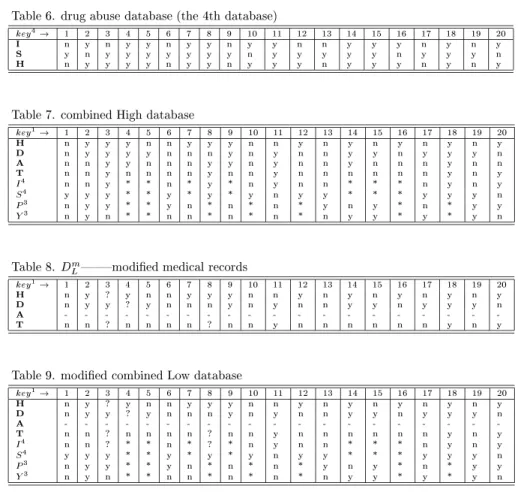
Table 4 shows the diagnosis of non-Hodgkin lymphomas (NHL) dis-ease | a NHL patient is highly likely to be a AIDS patient. Thus, data in Table 4 cannot be released4 if the database manager of the NHL database also agrees with the sanitization/downgrading principle that AIDS data must be kept private. Based on a Bayesian network model of Table 5, low thyroid function causes mental depression, which in turn causes high blood pressure. For a mentally depressed patient, information concerning the patient's low thyroid function would have a negative impact on a possible AIDS diagnosis. The degree of impact depends on the correlation between AIDS and mental depression. It can be tested with available data. However, knowing the state of men-tal depression would block the impact of information concerning blood pressure. Table 6 is an database including information about illegal drug use, which shows the frequency with which an illegal drug user either takes intravenous injections or smokes. Data indicates an individual who injects illegal drugs is likely to have hepatitis. The relationship between AIDS and drug abuse is not shown in Table 6. However, for an intravenous drug abuser, intravenous injection is basically a form of blood transfusion.5Thus, the probability that an illegal intravenous drug abuser is also an AIDS patient is high. Table 7 shows the combination of the original High data with records of illegal intravenous drug abusers and records of the thyroid function, where the \*" denotes attribute values that are unknown because data records of these databases are not completely overlapped.6 (Here, the assumption is that the database manager of the AIDS database is able to identify and select patients from the other two databases.) The dependency relationship between attributes of the combined database is given by the Bayesian network
BH of Figure 2. Note that Figure 2 resulted from composing
depen-dency relationships derived from these three databases, together with the knowledge about the relationship between intravenous injection and blood transfusion, and is not generated from combined data.7 In Figure 2, the probabilistic dependency of the inverted fork (e.g., the child node \hepatitis" and parent nodes \injection" and \AIDS") is described by the or-ing operation (i.e., either \AIDS" or \injection" causes
transfusion hepatitis depression AIDS thyroid blood pressure smoke injection
Figure2. The combined Bayesian networkB H.
tis") asPr(hepatitis=yjinjection=y,AIDS=y) =
1,Pr(hepatitis=njinjection=y)Pr(hepatitis=njAIDS=y), where Pr(hepatitis=njinjection=y) andPr(hepatitis=njAIDS=y) are obtained
respectively from the released data of the drug abuse and the AIDS databases. The probabilistic dependency between \depression," \Thy-roid" and \AIDS" will also follow the or-ing relationship. The probabilis-tic information between \depression" and \blood pressure" will remain unchanged. The relationship between \injection" and \transfusion" is of the form is a. It is known that the generation of a reliable complex net-work model, in general, demands large volumes of data. Here, we assume that the dependency relationship derived from each individual database is preserved in the combined database. For our current example, this assumption (referred to as dependency inheritance under combination) seems to be valid. It is useful in handling the combination of multiple large databases, yet its validity has not been formally proved.
5.
Information Reduction
Recall that we showed the inadequacy of initial downgrading, because in our example 80% of the sensitive data was restored. The inference problem worsens if Low gleans information that is causally correlated to sensitive data from other publicly-released databases. This result suggests that High must adopt strategies for mitigating the inference problem based on data of the combined database. Therefore, since cer-tain non-sensitive information can lead to probabilistic inferences about
the sensitive information, we approach the problem of lessening inference by not downgrading all of the distributed non-sensitive information.
We modify non-sensitive data by \blocking," i.e., replacing an at-tribute value with a \?," indicating no knowledge about the atat-tribute value.8 Given a databaseD, we letDmdenoteDafter at least one of its
non-sensitive entries has been blocked. Instead of sendingDL to Low,
High blocks some of the non-sensitive information, and sends DmL to
Low.
Shannon mathematically formalized the idea of secrecy ([25]) in cryp-tography. We use the similar denition of perfect noninference ([20]) for database inference:
DEF: If the a priori probability distribution of sensitive High data does
not change in the presence of Low data, then we have perfect noninfer-ence.
The ideal downgrading policy for distributed databases is one that ensures perfect noninference. The condition of perfect noninference is unlikely to be achieved in practice because of performance issues. Our pragmatic policy of lessening inference states that modication of non-sensitive information should lessen the inference of non-sensitive information, while, at the same time, minimizing the loss of functionality.
For a given database, we measure the eect of modication,, based
on the probabilistic term Pr(DjB), which describes the sample
proba-bility, given the probabilistic dependency representationB. In essence, is a measure of the loss of functionality of a downgraded database.
is a metric of the Low view and is measured by High.
def= jlogPr(DLjBL),logPr(DmLjBL)j jlogPr(DLjBL)j
;
where Pr(DmLjBL) is computed by averaging over instantiations of the
modied values. We evaluate the AIDS database only because we may not have control over other databases. The tolerance provides a margin
within which the information protection strategies operate. Thus, we often associate an upper bound U to , so that U. measures
the percentage of change in a sample probability. can be viewed as a
sensitivity metric which estimates the rate of change in the output of a model with respect to changes in model inputs ([12]). Our emphasis is on the magnitude of the change in probability. The log-scale measure (base 10) is used in this criterion to reect the fact that the sample probability is a small number as a result of multiplication of the probabilities of each individual data record. Therefore a logarithmic approach somewhat normalizes the probabilities.
What criterion is used for High to select non-sensitive attribute values for modication (blocking)? Such a selection criterion is not unique. We present two selection criteria that are based on a Bayesian network framework.
SC(1) maximum dierence:
Intuitively, attribute values which maximally change the probability of target values, T = ti, in terms of the probabilistic model BH (as
shown in Figure 2), should be selected. (The set of attribute values is associated with non-sensitive information, or, in the current example, the non-target attribute.) SinceBH best interprets the dataDH from which
it is derived and since the quality of modied database is expected to deteriorate, we want to select the set of attribute values that maximally decreasePr(DHjBH). This selection criterion is based on:
V1 def= (logPr(DmHjBH),logPr(DHjBH) ); (1)
For a given set of attribute values, N, (ranging from 0 to the number
of all available attribute values except sensitive data,) to be modied,
Pr(DmHjBH) is the average of all possible instantiation of this set of
values. We use averaging because the value of N in our experiment is
small. In case of large N, the value for modication (i.e., \?") may
be viewed as a new symbol because instantiation could induce large variation when computing the sample probability and also be very time consuming. Note that we discard those values of
Pr(DmHjBH) that are greater thanPr(DHjBH). We do not think
that situation will arise due to our (unproven) observation that modi-cation results in decreasing the likelihood measure. We shall show the result of modication based on this criterion after we present the second selection criterion.
SC(2) non-informative state: We do not discuss this method due to pale limits. However, we will consider it in future work.
As discussed, lets us measure how the functionality of the database
for the Low user, after blocking modications, has changed with respect to Low. With the denitions of SC(1) in mind, our optimization goal is to MaximizeV1, while keeping U, ifV1 is chosen.
For modication, our approach is to evaluate attribute values of the AIDS database and analyze the potential impact from combined data. Let N denote the total number of non-targeted attribute values to be
modied. Assume that N = 4, U = 5%. Now we use the selection
criterion SC(1) for our example. Consider the original Low database of Table 2. The modied Low database set is given in Table 8 by using SC(1). The choice that maximizesV1 is that of blocking the \hepatitis"
items three and eight from\transfusion." Modication is restricted to attribute values of the original Low database. From Figure 2, it can be seen that inference occurs if Low obtains information about injection. This information can be used to restore the modied values of \trans-fusion," if the relationship between blood transfusion and injection is known a priori. This result will render sanitization a failure.
To remedy this, we consider two cases: that of downgrading in a cooperativeenvironment, and in a non-cooperative environment. In a co-operative environment, an eective approach is to mutually examine the data sets to be released. In our example, the to-be-released data from the AIDS site is sent to the drug abuse site for examination. (Of course, one party needs to initiate the move.) Based on the received data, the drug abuse database manager makes modications to its own data in order to ensure the safety of those values that have been modied from the AIDS database. The result is then sent back to the AIDS database. In our example, the modied combined database is given in Table 9, where values of \injection" are replaced by \?" in the third and the eighth data records, because \injection" causally aects \transfusion" as described in Figure 2. Note that since \hepatitis" is also causally cor-related with \injection", modication of \injection" in the third record also minimizes restoration of a \?" with respect to \hepatitis" of the same record. Attributes that are causally related to \depression" are \thyroid" and \blood pressure." Since both values of \thyroid" and \blood pressure" of the fourth record are unknown, no further modi-cation is needed. Table 9 is the downgraded Low database. (One may choose to replace symbols \-", \?" and \*" with a blank space and the outcome of the replacement is the Low database of Table 10.) Of course, in a non-cooperative environment, if the drug abuse database manager has already released his or her data, the manager of the AIDS database may take the defensive measure of increasingN. Such
modi-cation will, of course, occur at the expense of lowering the performance of the released database.
We do not impose a denite limit on the amount of data to be mod-ied. The rule of thumb is that the process of modication stops when the modied database can no longer support the Bayesian network struc-ture of the original database. (See also ([4]) for the estimation of lower bound.) The change usually undermines legitimate usage of a database.
6.
Conclusion
The database inference problem with respect to distributed databases is essentially a new research area. In this paper, we analyzed the
infer-ence problem arising from distributed databases and we presented our approach which is based on the framework of Bayesian networks.
Notes
1. Figure 1H is a Bayesian Network for HighBH. An attribute is denoted by a node. An
arrow indicates the probabilistic dependency between two attributes. A double circle denotes that the attribute is sensitive.
2. Our sample database is more representative of data taken at the beginning of the AIDS epidemic, rather than today.
3. There are many ways to construct a Bayesian net. Figures 1H and Figure 1L are constructed as in ([2]) by using a greedy model search.
4. The AIDS and the NHL databases can certainly exchange data through a special channel. But, again, the NHL database may not be released to Low and it is not considered part of the distributed data.
5. Clearly, \drug injection" is not identied with blood transfusion in either database. Nonetheless, it is not a secret that intravenous injection of a drug involves the drawing of blood and drug abusers often share needles.
6. The position of a data item in either thyroid or drug database (the 1st number) and its corresponding position in the combined table (the second number) are as follows: thyroid: 1-1, 2-2 3-3 4-6 5-7 7-9 9-11 11-13 12-14 13-15 15-17 17-19 18-20
drug: 1-1 3-2 4-3 6-6 8-8 9-10 12-12 13-13 17-17 18-18 19-19 20-20
7. If the combined network is generated from the combined data, the unknown mark \*" can be treated as a new value.
8. We do not use perturbation (i.e., replacing an attribute value with another dierent value), which introduces erroneous data, because of the negative performance side eects.
References
[1] Bethlehem, J. Keller, W. & Pannekoek, J. (1990) \Disclosure Control of Micro-data," J. of the American Statistical Association, Vol. 85, pp. 38-45.
[2] Chang, L. & Moskowitz, I. S. (1998) \Bayesian Methods Applied to the Database Inference Problem," Database Security XII (ed. S. Jajodia), Kluwer, IFIP WG11.3, Greece, pp. 237-251.
[3] Chang, L & Moskowitz, I. S. (2000) \An Integrated Framework for Database In-ference and Privacy Protection,"Data And Applications Security, (eds. Thurais-ingham, van de Riet, Dittrich & Tari), Kluwer, IFIP WG11.3, The Netherlands, pp. 161-172.
[4] Clifton, C. (1999) \Protecting Against Data Mining through Samples,"Advances in Database And Information Systems Security, (eds. Atluri & Hale), Kluwer, IFIP WG 11.3, pp. 193-207.
[5] Cox, L. (1987) \A Constructive Procedure for Unbiased Controlled Rounding," J. of the American Statistical Association, 82, pp. 520-524.
[6] Denning, D. (1980) \Secure Statistical Database with Random Sample Queries," ACMTransaction on Database Systems, 5(3), pp. 291-315.
[7] Dobra, A. & Fienberg, S.E. (2000). "Bounds for cell entries in contingency tables given marginal totals and decomposable graphs," Proc. NAS/97/22, 11885-11892. [8] Duncan, G. & Roehrig (2002) \Cyclic Perturbation: Protecting Condentiality
[9] Hale, J. & Shenoi, S. (1996) "Analyzing FD Inference in Relational Databases", Data and Knowledge Engineering Journal, vol. 18, pp. 167-183.
[10] Heckerman, D. (1996) \Bayesian Networks for Knowledge Discovery," Advances in Knowledge Discovery and Data Mining, AAAI Press/MIT Press, pp. 273-305. [11] Hinke, T., Delugach, H. & Wolf, R. (1997) \Protecting Databases from Inference
Attack," Computers & Security, Vol. 16, No. 8, pp. 687-708.
[12] Isukapalli, S. (1999) \Uncertainty Analysis of Transport-Transformation Mod-els," Ph.D. dissertation, Dept. of CCI, State Univ. of New Jersey at Rutgers. [13] Johnsten, T. & Raghavan, V. (1999) \Impact of Decision-Region Based
Classi-cation Mining Algorithms on Database Security," IFIP WG 11.3, pp. 177-191. [14] Kang, M.H., Froscher, J.N., & I.S. Moskowitz (1997) \An Architecture for
Mul-tilevel Secure Interoperability," Proc. 13th ACSAC Conference, San Diego, CA. [15] Lin, T. Y. (1993) \Rough Patterns in Data-Rough Sets and Intrusion Detection
Systems," J. of Foundation of Computer Science and Decision Support, Vol. 18, No. 3-4, pp. 225-241.
[16] Marks, D. (1996) \Inference in MLS Database Systems," IEEE Trans. Knowledge and Data Engineering, Vol 8, No. 1, pp. 46-55.
[17] Matlo, N. (1988) \Inference Control Via Query Restriction Vs. Data Modica-tion: A Perspective," Database Security: Status and Prospects, IFIP pp. 159-166. [18] Morgenstern, M. (1988) \Controlling Logical Inference in Multilevel Database
Systems," Proc. IEEE Symp. on Security and Privacy, pp. 245-255.
[19] Moskowitz, I. S. & Chang, L. (2000) "An Entropy-Based Framework for Database Inference," LNCS 1768 (ed. A. Ptzmann), IH'99, Springer, pp. 405-418. [20] Moskowitz, I. S. & Chang, L. (2000) \A Computational Intelligence Approach
to the Database Inference Problem,"Advances in Intelligent Systems:Theory and Applications(ed. M. Mohammadian) IOS Press, pp. 377-387.
[21] Pearl, J. (2000)Causality, Cambridge.
[22] Prodromidis, A., Chan, P. & Stolfo, S. (2000) \Meta-learning in distributed data mining systems: Issues and approaches," Advances in Distributed and Parallel Knowledge Discovery, (eds.) Kargupta, H. and Chan, P., Chapter 3, AAAI/MIT. [23] Quinlan, R. (1992)C4.5, Morgan Kaufmann.
[24] Saygin, Y., Verykios, V. & Clifton, C. (2001) \Using Unknowns to Prevent Dis-covery of Association Rules." SIGMOD Record 30(4): pp. 45-54.
[25] Shannon, C. (1949) \Communication Theory of Secrecy Systems,"Bell Systems Technical Journal, Vol. 28, Oct. 1949, pp. 656-715.
[26] Spiegelhalter, D. & Lauritzen, S. (1990) \Sequential updating of conditional probabilities on directed graphical structures," Networks, 20, pp. 579-605. [27] Spirtes, P., Glymour, C. and Scheines, R. (1993) Causation, Prediction, and
Search. Springer-Verlag, NY.
[28] Thuraisingham, B. (1998)Data Mining: Technologies, Tools and Trends, CRC. [29] Yip, R. & Levitt, K. \The Design and Implementation of a Data Level Database
Inference Detection System,"Database Security XIIpp. 253-266.
[30] Zayatz, L. & Rowland, S. (1999) \Disclosure Limitation for American Factnder," Census Bureau report (manuscript).
A short-handed notation is used for each attribute of each table.
H: hepatitis; D: depression; A: AIDS; T: blood transfusion; N: NHL cancer; P: blood pressure; Y: low thyroid; I: intravenous injection; S: smoke
Table 1.D
H | sample medical records (the 1st databse)
(The superscriptiof the key refers to data records that come from theith database.
In this table, the superscriptiis 1.)
k ey 1 ! 1 2 3 4 5 6 7 8 9 10 11 12 13 14 15 16 17 18 19 20 H n y y y n n y y y n n y n y n y n y n y D n y y y y n n n y n y n n y y n y y y n A n n y y n n n y y n y n n y n n n y n n T n n y n n n n y n n y n n n n n n y n y Table 2. D
L| medical records of Low database
k ey 1 ! 1 2 3 4 5 6 7 8 9 10 11 12 13 14 15 16 17 18 19 20 H n y y y n n y y y n n y n y n y n y n y D n y y y y n n n y n y n n y y n y y y n A - - - -T n n y n n n n y n n y n n n n n n y n y
Table 3. a restored Low database
k ey 1 ! 1 2 3 4 5 6 7 8 9 10 11 12 13 14 15 16 17 18 19 20 H n y y y n n y y y n n y n y n y n y n y D n y y y y n n n y n y n n y y n y y y n A n n y N n n n y N n y n n N n n n y n Y T n n y n n n n y n n y n n n n n n y n y
Table 4. NHL cancer database (the 2nd database)
k ey 2
! 1 2 3 4 5 6 7 8 9 10 11 12 13 14 15 16 17 18 19
N n n y y y n y y n y y y n n y y n y n
A n n y y n n y y y y y y n y y y n y n
Table 5. thyroid database (the 3rd database)
k ey 3 ! 1 2 3 4 5 6 7 8 9 10 11 12 13 14 15 16 17 18 P n y y y n n n n n y y n y y n n y y D n y y n n y y y y y n y y y y n y n Y n y n n n y n y n y n y y n y n y n
Table 6. drug abuse database (the 4th database) key4 ! 1 2 3 4 5 6 7 8 9 10 11 12 13 14 15 16 17 18 19 20 I n y n y y n y y n y y n n y y y n y n y S y n y y y y y y y n y y y y y n y y y n H n y y y y n y y n y y y n y y y n y n y
Table 7. combined High database
key1 ! 1 2 3 4 5 6 7 8 9 10 11 12 13 14 15 16 17 18 19 20 H n y y y n n y y y n n y n y n y n y n y D n y y y y n n n y n y n n y y n y y y n A n n y y n n n y y n y n n y n n n y n n T n n y n n n n y n n y n n n n n n y n y I4 n n y * * n * y * n y n n * * * n y n y S4 y y y * * y * y * y n y y * * * y y y n P3 n y y * * y n * n * n * y n y * n * y y Y3 n y n * * n n * n * n * n y y * y * y n
Table 8. DmL||{modied medical records
key1 ! 1 2 3 4 5 6 7 8 9 10 11 12 13 14 15 16 17 18 19 20 H n y ? y n n y y y n n y n y n y n y n y D n y y ? y n n n y n y n n y y n y y y n A - - - -T n n ? n n n n ? n n y n n n n n n y n y
Table 9. modied combined Low database
key1 ! 1 2 3 4 5 6 7 8 9 10 11 12 13 14 15 16 17 18 19 20 H n y ? y n n y y y n n y n y n y n y n y D n y y ? y n n n y n y n n y y n y y y n A - - - -T n n ? n n n n ? n n y n n n n n n y n y I4 n n ? * * n * ? * n y n n * * * n y n y S4 y y y * * y * y * y n y y * * * y y y n P3 n y y * * y n * n * n * y n y * n * y y Y3 n y n * * n n * n * n * n y y * y * y n
Table 10. (alternative) modied combined Low database
key1 ! 1 2 3 4 5 6 7 8 9 10 11 12 13 14 15 16 17 18 19 20 H n y y n n y y y n n y n y n y n y n y D n y y y n n n y n y n n y y n y y y n A T n n n n n n n n y n n n n n n y n y I4 n n n n y n n n y n y S4 y y y y y y n y y y y y n P3 n y y y n n n y n y n y y Y3 n y n n n n n n y y y y n