CRANFIELD UNIVERSITY
Thora Thorgeirsdottir
“Now you see them, now you don’t”
Impact of flexible work arrangements on intra-workgroup relations
School of Management
MRes dissertation
Academic Year: 2012 - 2013
Supervisor: Clare Kelliher
August 2013
CRANFIELD UNIVERSITY
School of Management
MRes Dissertation
Academic Year 2012 - 2013
Thora Thorgeirsdottir
“Now you see them, now you don’t”
Impact of flexible work arrangements on intra-workgroup relations
Supervisor: Clare Kelliher
August 2013
This thesis is submitted in partial fulfilment of the requirements for
the degree of Master of Research
© Cranfield University 2013. All rights reserved. No part of this
publication may be reproduced without the written permission of the
ABSTRACT
Interest in flexible work arrangements has proliferated in the last years, fuelled by technological advancements that allow people to work from anywhere at any time. This systematic literature review explores the impact of flexibility in time and place of work on intra-group relations and subsequent effects on group-level outcomes. Findings suggest that flexibility in place of work has positive effects on employee-supervisor relationships but negative effects on co-worker relationships. Although teleworkers remain well connected to their co-workers and overall workgroup communication does not appear to change, informal socialisation processes are affected. Knowledge sharing and creation is subsequently challenged. Furthermore, managers of mixed workgroups face issues of fairness and justice as well as challenges of creating and maintaining group cohesion when some of their employees are not always present. However, little is known of how flexibility in time of work impacts intra-group relations and group outcomes from groups containing flexible workers have not been explored. This paper therefore identifies significant gaps in the literature and presents opportunities for further research.
Keywords:
TABLE OF CONTENTS
ABSTRACT ... iii!
LIST OF FIGURES ... 7!
LIST OF TABLES ... 8!
1 INTRODUCTION ... 9!
1.1 The purpose of the review ... 9!
1.2 Structure of the paper ... 10!
2 POSITIONING THE FIELD OF ENQUIRY ... 11!
2.1 Flexible work arrangements defined ... 11!
2.1.1 Summary ... 14!
2.2 Flexible work arrangements and subsequent outcomes ... 14!
2.2.1 Employee outcomes ... 15!
2.2.2 Employer outcomes ... 16!
2.2.3 Summary ... 17!
2.3 In a context of the workplace ... 18!
2.3.1 Hierarchical work relationships ... 18!
2.3.2 Lateral work relationships ... 20!
2.3.3 Summary ... 22!
2.4 Summary of the field and review questions ... 22!
3 METHODOLOGY ... 24!
3.1 Purpose of a systematic review ... 24!
3.2 Planning the review ... 25!
3.2.1 Review panel ... 25!
3.2.2 Mapping the field ... 25!
3.3 Identifying studies ... 25! 3.3.1 Search Strategy ... 25! 3.3.2 Key words ... 26! 3.3.3 Search strings ... 26! 3.3.4 Choice of databases ... 27! 3.3.5 Cross referencing ... 28! 3.4 Evaluation of studies ... 28!
3.4.1 Primary literature search: titles and abstracts ... 28!
3.4.2 Secondary literature search: full papers ... 30!
3.4.3 Quality appraisal ... 31! 3.4.4 Final selection ... 33! 3.5 Data extraction ... 34! 3.6 Data synthesis ... 34! 4 DESCRIPTIVE FINDINGS ... 35! 4.1 Overview ... 35! 4.2 General characteristics ... 35! 4.3 Methodology characteristics ... 37!
4.4 Type of FWAs studied ... 38!
4.5 Sample characteristics ... 39!
4.6 Summary ... 41!
5 CONCEPTUAL FINDINGS ... 42!
5.1 Impact on the employee-supervisor relationship ... 42!
5.1.1 Relationship quality ... 42!
5.1.2 Maintaining control ... 43!
5.2 Impact on co-worker relationships ... 46!
5.2.1 The teleworker’s perspective ... 46!
5.2.2 The co-worker’s perspective ... 49!
5.3 Mixed workgroups ... 51! 5.3.1 Communication patterns ... 51! 5.3.2 Connectivity – a paradox ... 53! 5.3.3 Socialisation ... 57! 5.3.4 Justice perceptions ... 59! 5.3.5!Group cohesion ... 62! 5.3.6 Knowledge sharing ... 65! 5.4 Summary ... 68! 6 DISCUSSION ... 69! 6.1 Overall observations ... 69!
6.2 Has the review question been answered? ... 71!
6.3 Implications for further research ... 72!
6.4 Implications for practice ... 73!
6.5 Limitations ... 74!
6.6 Personal learning ... 74!
7 CONCLUSION ... 75!
REFERENCES ... 76!
LIST OF FIGURES
Figure 1 - Types of FWAs ... 11!
Figure 2 – Map of the field ... 23!
Figure 3 - Stages of the systematic review process ... 24!
Figure 4 - Journal disciplines of selected papers ... 35!
Figure 5 - Distribution of papers by year published ... 37!
Figure 6 - Distribution of papers by type ... 37!
Figure 7 - Empirical papers by research methodology ... 38!
Figure 8 - Types of FWAs studied ... 38!
Figure 9 - Empirical papers by sample - characteristics ... 39!
Figure 10 - Empirical papers by sample - organisation type ... 40!
Figure 11 - Empirical papers by sample - active telework program ... 40!
LIST OF TABLES
Table 1 – Review panel ... 25!
Table 2 – Key words ... 26!
Table 3 – Search strings ... 27!
Table 4 – Primary literature search - Inclusion and exclusion criteria ... 29!
Table 5 – Secondary literature search - Inclusion and exclusion criteria ... 30!
Table 6 – Quality criteria for quantitative papers ... 32!
Table 7 – Quality criteria for qualitative papers ... 32!
Table 8 – Quality criteria for conceptual papers ... 33!
Table 9 – Selection process from search strings ... 33!
Table 10 – Selection process from cross-referencing ... 34!
Table 11 – Data extraction form ... 34!
1
I
NTRODUCTION
Flexible work arrangements (FWAs) have received considerable attention in both academic and practitioner circles in the last years. This can be traced to workers increased interest in work-life balance issues, increased participation of women in the workforce and consequently an increase in dual-earner households. The interest has further been fuelled by the technological advances of the last 20 years, which allow people to work anywhere at any time. Employers have been forced to adjust their employment practices and research on various issues regarding flexibility and work-life balance practices has proliferated (Baltes, Briggs, Huff, Wright and Neuman 1999; Chang, McDonald and Burton 2010; Glass and Finley 2002).
FWAs have been associated with various beneficial outcomes such as job satisfaction (e.g. Kelliher and Anderson 2009), organisational performance (e.g. Konrad and Mangel 2000), organisational commitment (e.g. Scandura and Lankau 1997) and reduced work-life conflict (e.g. Kelly, Moen and Tranby 2011). However, FWAs are not stand-alone phenomena. They are implemented in a context of social interactions and relationships within a workplace that consists of employees and employers. This social context has been shown to be an important influence on outcomes and attitudes of flexible working employees (e.g. Kossek, Pichler, Bodner and Hammer 2011; Thompson and Prottas 2005). Similarly presence of flexible working employees in a workgroup has also been shown to have an impact on their co-workers (e.g. Golden 2007) and managers (e.g. Lautsch, Kossek and Eaton 2009).
In this paper, the goal is to explore what impact the use of FWAs has on the social environment in which flexible workers are located and how group-level outcomes may or may not be affected from implementation and use of FWAs.
1.1 The purpose of the review
The purpose of this review is to answer the primary review question and gain a better understanding of the existing knowledge of how FWAs impact interpersonal exchanges at the workplace. By reviewing the current literature in
a transparent and structured way and analysing the identified evidence, the aim is to detect gaps and identify possible research areas, some of which may be taken forwards into my PhD research.
1.2 Structure of the paper
In chapter 2 I explore the literature domains relevant to the scope of this review in order to identify review questions to take forward.
In chapter 3 I explain the process of how the systematic review was carried out together with the underlying logic for each step.
In chapter 4 I present a descriptive account of the papers identified from the systematic review process.
In chapter 5 I present a synthesis of the findings of the papers identified.
In chapter 6 I present overall observations of the findings described in chapter 4 and 5, discuss whether the aim of the review has been achieved and whether review questions have been answered. I also present possible areas for further research, implications for practice and reflect on limitations and personal learning.
2
POSITIONING THE FIELD OF ENQUIRY
2.1 Flexible work arrangements defined
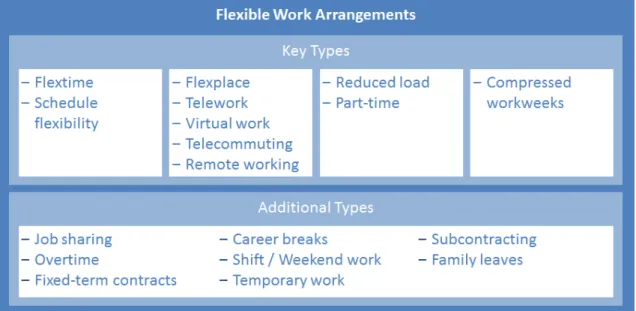
There are a number of different types of flexible work practices on the job or in the workplace that are commonly given the label of FWAs (see Figure 1 for an overview of commonly included work practices). FWAs can therefore be regarded as an umbrella term; studies conceptualise FWAs differently using different practices or bundles of them (e.g. shift-work and contract work: (Raghuram, London and Larsen 2001), compressed workweeks: (Baltes et al. 1999) and schedule flexibility: (McNall, Masuda and Nicklin 2010)). Consequently, antecedents, correlates and outcomes may vary depending on the way FWAs are conceptualised in the studies in question.
Figure 1 - Types of FWAs
The different ways of conceptualising FWAs commonly do not account for that the amount of time employees work flexibly may vary. As such, part-time work can involve working anywhere from a few hours a week to almost full time. Similarly, teleworkers may work a few hours a week from home or do it full-time and therefore never see their co-workers. It has been argued that the amount of time employees work flexibly has an impact on their experiences (e.g. Golden and Veiga 2005; de Menezes and Kelliher 2011; Virick, DaSilva and Arrington 2009).
Furthermore, the literature is generally not clear whether the FWAs discussed are formally negotiated and part of a formal program, which normally involves pre-set times of work and absence, or irregular arrangements negotiated with one’s line manager on an ad hoc basis (de Menezes and Kelliher 2011; Richman, Civian, Shannon, Jeffrey Hill and Brennan 2008; Troup and Rose 2012).
Essentially, workplace flexibility can be seen from two different angles. The first one, flexibility of employees, refers to the implementation of flexibility to first and foremost allow an organisation to adapt to changes and reduce costs, by for example reducing hours worked, implementing job rotation, introducing telecommuting to reduce real estate costs etc. Although an employee may benefit from organisational flexibility, this type of flexibility is mostly imposed on them and their interests are not a primary interest (Hill, Grzywacz, Allen, Blanchard, Matz-Costa, Shulkin and Pitt-Catsouphes 2008; de Menezes and Kelliher 2011). The second, flexibility for employees, however, refers to flexibility that is implemented to increase the ability of employees to make choices or control their work lives in particular when, where and how long they work. The goal is to provide employees with resources to better manage different spheres of their lives and by doing so organisations will indirectly benefit through improved employee outcomes (Hill et al. 2008; de Menezes and Kelliher 2011; Thompson and Prottas 2005).
The latter perspective implies that employees have some choice or control over their work schedule (e.g. Kelliher and Anderson 2009; Kossek, Barber and Winters 1999). Several studies have identified control over one’s own schedule to be a solution to balancing issues between work and private life with potential benefits in both spheres (Kelly and Moen 2007; Kelly et al. 2011) and argued that schedule control is the mechanism through which FWAs lead to beneficial employee outcomes (Berg, Appelbaum, Bailey and Kalleberg 2004; Glass and Finley 2002; Kelly et al. 2011; Thomas and Ganster 1995). By viewing FWAs through the lenses of employee choice or control the focus is brought to specific types of FWAs, in particular those that allow some form of control to the
employee, either over timing of work (flexitime) or location of work (telecommuting or telework) (column 1 and 2 in Figure 1). That said, neither flexitime nor telework necessarily mean that employees have any actual control over their work arrangement and in fact studies are rarely clear on the real choice or control available to employees (de Menezes and Kelliher 2011). However, in general both telework and flexitime allow employees to organise their own time more effectively (Gajendran and Harrison 2007; Parasuraman and Greenhaus 2002). Subsequently, the current paper focuses on flexibility over time and place of work.
The literature is generally in consensus on the definition of flexibility over time of work i.e. flexitime or flexible work schedules and defines it in terms of employees having flexibility in determining their working hours within a given range set by their organisation (Hill et al. 2008). However, the definition of telework is more ambiguous. Commonly it is defined as work conducted outside the workplace for at least a part of the workweek while contact with it is upheld using information technology (Bailey and Kurland 2002; Martin and MacDonnell 2012). This is the definition used in this paper. Nilles (1998) distinguished between telework and telecommuting, which are often used interchangeably in the literature. He defined telework as any work practice in which information technologies are used instead of work-related travel and where work is therefore moved to the worker instead of the worker moving to work. He then defined telecommuting as occasional work outside the main office or workplace for one or more days a week e.g. conducted from home (Nilles 1998). Due to how close these definitions lie, this paper will not make a distinction between telework and telecommuting and refer to them interchangeably.
However, in some cases telework is referred to as virtual work (e.g. Raghuram, Garud, Wiesenfeld and Gupta 2001; Wiesenfeld, Raghuram and Garud 2001). A distinction should be made between telework and virtual work. Virtual work usually entails working in a virtual mode full time and living in another geographical region while maintaining contact with the office via information technology. Virtual workers therefore usually do not have a desk at the office
and may very rarely or never meet with their co-workers, while teleworkers often do have a desk, often telework part-time or in the case of full time telework are called into the office on a regular basis (Golden and Fromen 2011). Furthermore, telework is also sometimes referred to as remote work, in which case employees are considered remote if they are not collocated with their managers and co-workers, which may involve simply being located in another office building (e.g. Staples 2001). Finally, the location in which teleworkers work outside the office may also differ, as they may work from home, from a satellite office or from various different places on the road (Garrett and Danziger 2007).
In addition to flexitime, this paper focuses on full or part time teleworkers, who work away from the office for various amounts of time, have regular contact with their co-workers and managers and are not geographically or temporally dispersed from them. Since the focus here is on the construct of flexibility and FWAs, I therefore assume these groups of employees have some flexibility or control over the location and timing of their work, while virtual workers or remote workers do not.
2.1.1 Summary
To summarise, FWAs is an umbrella term that includes different work practices and can be implemented to suit employer needs or employee needs. Although it is difficult to estimate whether employees have real choice or control over their work flexibility, by focusing on flexibility in time and place of work it can be assumed they have more possibilities to organise their work according to their needs.
2.2 Flexible work arrangements and subsequent outcomes
The literature on FWAs can broadly be divided in two parts: FWA adoption and FWA outcomes. The stream of literature on FWA adoption can be divided into employer versus employee adoption. Research on employer adoption of FWAs discusses organisational reasons and motivations for adopting or offering FWAs, guided in particular by institutional theory (e.g. Dulk, Peters and
Poutsma 2012; Wang and Verma 2012). Research on employee adoption of FWAs discusses individual reasons and motivations for adopting FWAs and is mainly guided by role theories (e.g. Lambert, Marler and Gueutal 2008; McNamara, Pitt-Catsouphes, Brown and Matz-Costa 2012; Shockley and Allen 2012).
The literature on outcomes from FWAs can also be divided in two parts: Employee outcomes, which focuses on work-life balance related notions and individual benefits, and employer outcomes, in which the literature on the business case of FWAs resides. I will discuss each in turn in the following sections.
2.2.1 Employee outcomes
The literature stream looking at employee outcomes focuses on the role of FWA in the interaction of the work and non-work spheres and explores potential antecedents, correlates and outcomes to work-life linkage constructs such as work-life conflict, work-life facilitation or enhancement and family-work conflict or facilitation/enhancement (Özbilgin, Beauregard, Tatli and Bell 2011). These constructs are either regarded as an outcome from FWAs or as mediating or moderating variables to other outcomes (e.g. Kelly et al. 2011; McNall et al. 2010; Thomas and Ganster 1995).
This stream of literature is characterised by the family being the point of reference in examining work and private life linkages. This prevailing assumption has been criticised by a number of scholars (Chang et al. 2010; Özbilgin et al. 2011; Parasuraman and Greenhaus 2002). The literature on work-life linkages has furthermore been predominated by a conflict perspective for the last 25 years, perhaps due to observations of employees struggling to find a balance between their work and family responsibilities and organisations that suffer from employee turnover for the same reasons (Chang et al. 2010; Eby, Casper, Lockwood, Bordeaux and Brinley 2005; Kelly, Kossek, Hammer, Durham, Bray, Chermack, Murphy and Kaskubar 2008; Parasuraman and Greenhaus 2002).
2.2.2 Employer outcomes
The literature stream on employer or organisational outcomes from FWAs is characterised by attempts to make a business case for their use. As such, studies attempt to establish links between FWAs and outcomes relevant to organisations such as job satisfaction, employee performance, turnover, absenteeism and retention (De Menezes and Kelliher 2011). Several reviews have attempted to summarise findings from research on organisational benefits from FWA implementation and use. However, they have not found evidence to support a clear business case (Beauregard and Henry 2009; Glass and Finley 2002; de Menezes and Kelliher 2011).
The problems with current research on employer benefits from FWAs are various. First, the lack of clarity in the conceptualisation of FWAs translates into mixed findings. For example, there is a tendency in the literature to group different types of FWAs together without being clear on which outcomes stem from which practice and in some cases looking only at a group effect (Glass and Finley 2002). Given the variety of different FWAs it is questionable whether they can be expected to produce similar outcomes and if they can even be compared (Beauregard and Henry 2009).
Second, measures of FWAs also vary greatly. Some studies look at how availability or perceived availability of FWAs translate into outcomes (e.g. Richman et al. 2008; Scandura and Lankau 1997) while others look at actual use or uptake (e.g. Kelliher and Anderson 2009; Pierce and Newstrom 1983). These measurement issues lead to mixed findings and difficulties in comparison of current research.
Third, methodologically the literature is dispersed especially in terms of samples and methods. A majority of studies are quantitative and cross-sectional in nature and done on professionals or knowledge workers in the US or UK. In contrast, qualitative theory-building studies are few (Beauregard and Henry 2009; Chang et al. 2010; Eby et al. 2005; de Menezes and Kelliher 2011).
Fourth, a majority of studies fail to take the impact of contextual attributes into account, such as the impact of national cultures, which have been shown to play a role in employee perceptions of FWAs (e.g. Masuda et al. 2012; Ollier-Malaterre 2009; Raghuram, London, et al. 2001). Family-supportive work environments, colleague support and supervisor support have also been shown to generate positive employee and employer outcomes (e.g. Allen 2001; Thompson and Prottas 2005).
A final observation of the current literature on employer outcomes is the level of analysis. Studies to date predominantly look at the individual level of analysis, which can be seen through a focus on individual outcomes such as employee productivity, employee performance and employee turnover. A number of studies look at the organisational level and have attempted to establish links between FWAs and organisational performance with mixed findings (Beauregard and Henry 2009). However, there appears to be limited work that looks at the level in between the organisation and the employee, i.e. the group level (e.g. Van Dyne, Kossek and Lobel 2007). The links between FWA use in work groups and subsequent outcomes such as group performance and group productivity therefore does not appear to have been established. This relates to the observation on how studies on FWAs often do not take context into account but in the case of group-level outcomes the social context will be the work group.
2.2.3 Summary
In summary, current research on employee outcomes from FWAs generally look at work-life balance constructs while current research on employer outcomes try to establish links between FWA and benefits to organisations. Overall, the literature on FWA outcomes suffers from a lack of clarity in the conceptualisation of FWAs, which translates into measurement and methodological issues. Furthermore, a majority studies fail to acknowledge contextual influences e.g. organisational, managerial and from co-workers. Since studies rarely take social context into account they also predominantly
focus on the individual as a level of analysis, which leaves group-level outcomes of FWAs under researched.
2.3 In a context of the workplace
A number of studies have flagged the importance of acknowledging how perceptions of FWAs are socially constructed and outcomes from FWAs may be dependent upon the interactions between various actors at the workplace (e.g. Allen 2001; Kossek et al. 1999; Ryan and Kossek 2008). Work relationships can be defined as patterns of exchanges and interactions in an organisational context, between individuals, groups or organisations and involve interactions that are generally aimed at the accomplishment of common objectives of the parties involved (Ferris, Liden, Munyon, Summers, Basik and Buckley 2009). The construct of work relationships outlines how choices and behaviours of individuals and groups alike are socially constructed within the context of organisations (Kossek, Baltes and Matthews 2011). Work relationships take different forms and involve different parties. They include mentoring relationships, employee-customer relationships, employee-organisation relationships, employee-supervisor relationships and employee-co-worker relationships (Ferris et al. 2009; Gooty and Yammarino 2011).
Since the most common workplace interactions are either hierarchical, involving employees and supervisors, or lateral, involving co-workers at the same level, I will delimit the focus here on these types of work relationships. Each will be reviewed in turn in the following sections.
2.3.1 Hierarchical work relationships
Hierarchical work relationships are exchange relationships at the workplace that are authority ranked (Gakovic and Tetrick 2003; Shore, Lynch, Tetrick and Barksdale 2006). They have been extensively researched within the field of human resource management, both the employee-organisation relationship (e.g. Coyle-Shapiro and Shore 2007) and the employee-supervisor relationship (e.g. Brunetto, Farr-Wharton and Shacklock 2010; Farr-Wharton, Brunetto and Shacklock 2011; Uhl-Bien and Maslyn 2003). In the context of FWAs, the body
of literature on organisation and supervisor influence on flexible workers has been growing in the last years, specifically with regards to social support (Kossek, Pichler, et al. 2011).
In order to understand the nature and functioning of hierarchical work relationships there are two key exchange theories that provide helpful insights. First, social exchange theory builds on the fact that an individual, group or organisation enter into a relationship in order to maximise their benefits (Aselage and Eisenberger 2003; Blau 1964). According to social exchange theories employment is a trade between an organisation and an individual of effort and commitment for tangible and/or social rewards and benefits (Rhoades and Eisenberger 2002). In the context of FWAs much of the work on employer outcomes can be categorised under this stream, since these studies commonly assume that organisations that allow employees to work flexible will be rewarded by positive outcomes. A few studies have even shown that employees may put forward increased effort in exchange for working flexibly (Kelliher and Anderson 2009; Konrad and Mangel 2000).
Second, organisational support theory argues that employees develop perceptions or beliefs regarding how much the organisation cares about them and values their inputs (Aselage and Eisenberger 2003; Eisenberger, Huntington, Hutchison and Sowa 1986; Rhoades and Eisenberger 2002). Perceived organisational support is then formulated based on employee perceptions of that their employers value them and are committed to them, which then leads to a reciprocation on part of the employee (Aselage and Eisenberger 2003; Eisenberger et al. 1986). A number of studies of FWAs have explored how supervisor support leads to positive employee attitudes and outcomes e.g. lower work-life conflict (e.g. Thomas and Ganster 1995; Thompson, Beauvais and Lyness 1999), better work-life balance (Greenhaus, Ziegert and Allen 2012), increased job satisfaction and a decrease in turnover intentions (Thomas and Ganster 1995; Thompson et al. 1999; Thompson and Prottas 2005).
Additionally, leader-member exchange theory (LMX) describes the quality of employee-manager relationship (Aryee, Budhwar and Chen 2002). LMX theory assumes differentiation of employees, therefore that they are not all treated in the same way, which leads to various levels of relationships (Hu and Liden 2013; Lam and Lau 2012). LMX relationships that are of high-quality are characterised by mutual support, trust and respect between employee and supervisor where employees are seen as “in group” and consequently have better access to information and support which helps them in doing their work better (Brunetto et al. 2010; Masterson, Lewis, Goldman and Taylor 2000). In contrast, low-quality LMX relationships are characterised by only the basic economic exchanges between employees and supervisors (Lam and Lau 2012).
2.3.2 Lateral work relationships
Lateral work relationships are based on the assumption that organisations are composed of individuals that rarely work in complete isolation and employee interpersonal interactions are therefore unavoidable (Six and Skinner 2010). Lateral relationships involve relationships between individuals at the same level, primarily co-workers, and therefore do not have an authority ranking. They can be dyadic, i.e. involve just two people, or be group or team based (Chiaburu and Harrison 2008).
On the whole, co-worker relationships possess similar attributes to hierarchical relationships. They involve social exchange and high-quality co-worker relationships are built on trust, mutuality and reciprocity much like in hierarchical work relationships. Team-member exchange theory is founded in LMX theory and team-member exchange quality measures the perceptions of individual workers of their relationships with the group of co-workers, as members of workgroups all engage in reciprocal interactions (Golden 2006). Moreover, since co-workers are likely to have more frequent and informal contact with each other and lack the authority, co-worker relationships can draw from a greater pool of behavioural and emotional resources (Chiaburu and Harrison 2008).
A small number of studies have drawn upon organisational support theory and shown that co-worker support to flexible workers is negatively related to job distress (Frone, Yardley and Markel 1997), has a positive association to job satisfaction and a negative association to intentions to quit and work-life conflict (Thompson and Prottas 2005). Furthermore, a number of studies have explored how co-worker relationships are affected by use of FWAs. These include relationship deterioration (Gajendran and Harrison 2007), feelings of resentment in the workgroup (Kurland and Bailey 1999) and negative effects on co-worker satisfaction, especially at high frequencies of telework (Golden 2007). Other studies have shown how co-worker use of FWAs appears to be an important antecedent to employee choice to use FWAs (Almer, Cohen and Single 2003; Kossek et al. 1999; Lambert et al. 2008).
This group of studies draw on organisational justice theories, which explain how employees make social comparisons with their peers and make estimates of the fairness and justice of their treatment. According to organisational justice theories, employees’ perceptions of fairness are traditionally divided in three different groups. The first, distributive justice, refers to the perceived fairness of received outcomes while the second one, procedural justice, refers to the perceived fairness of decision-making processes. The third one, interactional justice, refers to fairness of treatment of other people such as co-workers and is affected by personal interactions between employees and managers (Cohen-Charash and Spector 2001; Cropanzano, Li and Benson III 2011; Masterson et al. 2000).
Furthermore, since co-worker relationships often involve a group of co-workers and therefore interactions of a number of people, social exchanges become more complex and dimensions are added to perceptions of justice and support. Subsequently, FWA use may influence a greater variety of outcomes (e.g. collegiality (ten Brummelhuis, Haar and van der Lippe 2010) and knowledge sharing (Golden and Raghuram 2010)) as opposed to when the focus is on the individual level.
2.3.3 Summary
In summary, both hierarchical and lateral relationships are social exchange relationships and informed by theories like social exchange theory and organisational support theory. This is reflected in research on FWAs and hierarchical relationships, which is mainly focused on organisational or managerial support to flexible working employees and on exchange perspectives, i.e. that the employer will profit from offering FWAs. Similarly, research done on lateral relationships and FWAs focuses on co-worker support to employees FWAs or on feelings of justice or fairness between co-workers when some work flexibly. Finally, since lateral relationships can involve a number of interacting co-workers, some of which may work flexibly and others not, this may lead to a diversity of group outcomes.
2.4 Summary of the field and review questions
The literature on FWAs, as on work-life policies in general, is dispersed and suffers from a lack of conceptual clarity. This not only regards the conceptualisation of FWAs as a construct but also translates into measurement and even methodological issues. Therefore, comparison and synthesis of studies in the field of FWAs is problematic since studies are often looking at different aspects or measures of FWAs. The current paper will focus on flexibility in time and place of work. Furthermore, current research rarely addresses how outcomes from FWAs may be dependent on interactions with other people at the workplace and if they do, they commonly focus on support, although just one aspect of workplace relationships (e.g. Kossek, Baltes, et al. 2011). Interpersonal relationships at work allow employees to feel connectedness with other organisation members and allow for sharing and exchanging information, ideas and solutions to problems (Carmeli, Brueller and Dutton 2009). Such interpersonal exchanges may even lead to discovering ways to improve work outcomes and processes and may therefore contribute to better organisational performance. Better understanding is needed on how FWAs impact group-level relations especially since more organisations have team-based and flatter structures (Takeuchi, Yun and Wong 2011).
Furthermore, given that current research on outcomes from FWA is predominantly focused on the individual as level of analysis, a study of group-level relations will open up possibilities to explore group-group-level outcomes and therefore shifting the level of analysis to the group.
Figure 2 – Map of the field
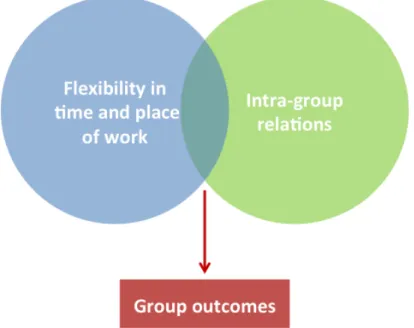
Based on the above discussion two intersecting circles were developed (see Figure 2) and the following review question will be taken forward as well as two sub-questions:
! What does the literature say about how flexibility in time and/or place of work impacts intra-group relations?
‒ What does the literature say about how the relationship between flexibility in time and/or place of work and intra-group relations impact group-level outcomes?
‒ What does the literature suggest these group-level outcomes may be?
The systematic review will focus on the intersection of the two circles through the use of relevant key words combined into search strings, in order to answer the primary review question. Furthermore, in order to answer the sub questions I will look at what the papers located within this intersect have said about group-level outcomes as well as which outcomes are being looked at.
3
METHODOLOGY
3.1 Purpose of a systematic review
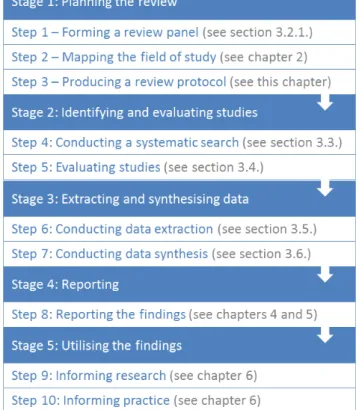
The purpose of a systematic review is to conduct a literature search in a way that is replicable, exhaustive and transparent and where bias in minimised. Working from the basis of a review question identified in a scoping of the relevant fields, the goal of the systematic review is to answer this question through searching for, identifying, interrogating and synthesising all relevant literature. In that way a researcher is able to systematically search for and assess the available evidence in order to identify gaps and specify research questions to guide future research (Tranfield, Denyer and Smart 2003). The systematic review process consists of five main stages, illustrated in Figure 3. Each stage is described in detail in the following sections.
3.2 Planning the review
3.2.1 Review panel
In order to ensure good quality and validity of the systematic review, I consulted with a number of academic experts both in my field as well as experts on the systematic review process. Table 1 provides an overview of my review panel and their roles.
Person Title Role
Professor Clare
Kelliher Professor Organisations, Cranfield School of of Work and Management
Supervisor. Will provide overall guidance on the review content, progress and relevant literature as well as give feedback.
Dr Emma Parry Principal Research Fellow,
Cranfield School of Management Systematic Review Expert. Will provide support and advice on the systematic review process.
Dr Noeleen Doherty Senior Research Fellow, Cranfield School of Management
Topic Advisor. Will provide topic guidance and support on the direction of the systematic review.
Mary Betts-Gray Business Information Specialist. Management Information and Resource Centre, Cranfield School of Management
Literature Search Advisor. Will provide assistance with the literature search.
Table 1 – Review panel
3.2.2 Mapping the field
In order to identify a review question a scoping study of the relevant fields was conducted, see chapter 2.
3.3 Identifying studies
3.3.1 Search Strategy
In order to maximise the efficiency and effectiveness of the systematic review, the search process was threefold.
An initial literature search involved identifying relevant key words and conducting preliminary searches. I modified the search strings as needed until database searches provided relevant results.
A primary literature search involved running search strings in particular databases and identifying relevant articles by reading titles and/or abstracts using the inclusion and exclusion criteria presented in Table 4.
A secondary literature search involved full-text reading or skimming of the articles and identifying their relevance to the systematic review, by making use of the inclusion/exclusion criteria outlined in Table 5. This stage also included forward searching by reviewing the list of papers citing a potential high relevance text and backward searching by reviewing the references cited within a potential high relevance text.
Then, having identified relevant articles, I proceeded to assess their quality.
3.3.2 Key words
Key words were identified based on the primary review question, which is located at the intersection of the two literature fields illustrated in chapter 2. The development of the keywords was a process of trial and error and involved looking at a number of articles in order to identify keywords commonly used in the literature. Keywords are subsequently grouped in two (see Table 2).
Review question component Keywords
Flexibility over time and/or place of work
alternative work, virtual work, remote work, flexible work, schedule control, flexible schedules, new ways of working, flextime, telecommuting, teleworking, flexplace
Intra-group relations coworkers, colleagues, peers, supervisors, manager support, management support, manager relationships, professional relationships, dyadic, social groups, intergroup relations, team, teamwork, group dynamics, group relations, group processes, group performance, work environment, social support, interpersonal relationships, work relationships, social interactions, work behaviour, interprofessional relationships.
Table 2 – Key words
3.3.3 Search strings
Based on relatedness of the keywords listed above, a decision was made to group them into four different search strings. Search string 1 was run against search strings 2, 3 and 4 (see Table 3).
Search string 1 covered words that describe flexibility over time and/or place of work and was run against:
2. Keywords relating to dyadic relationships (involving two people) between employee and supervisor or employee and co-workers.
3. Keywords relating to non-dyadic relationships (involving more than two people), in particular within teams or groups.
4. Keywords relating to the overall environment at work and overall social interactions and relations in the workplace.
The goal of running the search strings separately was to bring out different aspects of intra-group relations.
No Search string
1 “alternative work*” OR “virtual work*” OR “remote work*” OR “flexible work*” OR “schedule control” OR “flexible schedule*” OR “new ways of working” OR flextime OR flex-time OR telecommut* OR tele-commut* OR telework* OR tele-work* OR flexplace
2 coworker* OR co-worker* OR colleague* OR peer* OR supervisor* OR “manage* support” OR “manager relations*” OR “professional relations*” OR dyadic
3 “social groups” OR “intergroup relations” OR team OR teamwork OR “group dynamics” OR “group relations” OR “group process*” OR “group performance”
4 “work environment” OR “social support” OR “interpersonal relations*” OR “work relations*” OR “social interaction” OR “work behavior” OR “interprofessional relations”
Table 3 – Search strings
3.3.4 Choice of databases
I chose to search four different databases. Firstly, I searched ABI/Inform Global and EBSCO Business Source Complete but these two databases are the most comprehensive business databases and provide access to a large collection of scholarly journals in the field of business and management. I expected a degree of overlap between these two databases but deemed using both as important in order to make sure nothing would be missed, since a few journals are only covered within either one of them. Furthermore, I searched PsycInfo, which could be done within EBSCO by simply clicking PsycInfo in the databases option. Since my review question looked at human behaviour in a particular setting PsycInfo, the largest database in behavioural sciences, was expected to grasp papers from disciplines such as psychology and sociology, which the business databases missed out on. Finally, I searched Scopus in order to capture papers published by other publishers, particularly those from Science Direct, which would not appear in EBSCO or ABI/Inform. However, since Scopus also covers a great amount of literature on technical fields I limited my searches there to Social Science and Humanities. In addition to these four
databases I used Google scholar if needed to find particular papers that I could not get access to in the other databases. However, I did not search Google scholar systematically.
3.3.5 Cross referencing
In order to not miss out on important papers additional relevant literature was identified by cross-referencing of papers deemed as highly relevant to the review question. These high-relevance papers are identified with an asterisk after the authors name in the data extraction tables in Appendix A and Appendix B. Citations of as well as citations in such papers were therefore reviewed and papers identified in this manor were then subject to the same selection criteria as other papers.
3.4 Evaluation of studies
Papers brought out by the literature searches went through inclusion and exclusion criteria two times. First, titles and abstracts were scanned using the selection criteria in Table 4 (primary literature search). The papers selected from the primary review were then reviewed on their full text according to the selection criteria in Table 5 (secondary literature search). After that remaining papers moved on to quality assessment (see section 3.4.3).
3.4.1 Primary literature search: titles and abstracts
The primary literature search selection criterion was adjusted during the systematic review process in order to be able to delimit the scope of this paper. This was mainly a result of the searches providing large amounts of papers on virtual teams, which were not deemed relevant for this review due to their focus on virtual work and geographical dispersion (see chapter 2.1 for definitional issues in the field). Subsequently, the third and the fifth parts in the relevance criterion to the review question (see Table 4) were added. These allowed excluding papers focusing on virtual teams, technology and relationships outside the workplace.
Relevance
Criterion Inclusion Exclusion Rationale
Publication Academic papers, working papers less than three years old.
General press articles, conference papers and proceedings, reports, theses, web pages
The topic is a hot topic in general media and practitioner circles but claims are commonly not supported by evidence and overall quality may be low. Conference and working papers are work-in-progress and good ones are turned into articles. However, working papers younger than three years may be relevant and will not have had time to be turned into articles. Reports and theses lack reliability and information on how they got to their findings is often incomplete. Contribution Empirical and
conceptual Other than empirical and conceptual
The focus of the systematic review is to systematically map all relevant empirical academic research that has been done on the topic, their findings and limitations. However theoretical and conceptual papers will also be considered since they may provide interesting insights.
Language English All except for
English
Large majority of articles in the field are published in English.
Date of
publication After 1990 Before 1990 Due to technological advancements in the last 20 years, which are highly relevant to the topic. Relevance to review question Measurement of flexible work: Use Other measurements such as perceived availability or availability
Employee use of FWAs leads to different perceptions then e.g. perceptions of possible use. Types of flexible work in use: flextime or flexplace (some flexibility over time and/or place of work)
Other types e.g. part-time work, reduced
workweeks, shift work
The review question limits itself to flexibility in time and place of work, i.e. telecommuting, flexplace. Impact of FWAs on workplace relationships and interactions e.g. with colleagues (lateral) or line-managers (hierarchical) Relations and interactions with people outside the workplace e.g. customers, family and friends
The review question stipulates intra-group relations, therefore relationships within a work group. Focus on technology solutions (e.g. implementation of collaboration software)
The review question stipulates intra-group relations, which include a variety of types of interactions including face-to-face.
Sample: Professional workers Other occupations working in a non-office environment
In order to be able to compare studies samples need to be comparable in terms of the work attributes. Flexibility in time and/or place of work is primarily implemented in office-based work. Teams or workgroups in which one or more members work flexibly Geographically dispersed virtual teams
In general, team members in virtual teams do not make use of FWAs. Furthermore, virtual teams deal with other problems such as time and culture differences.
3.4.2 Secondary literature search: full papers
Again due to the variety of terms and definitions used in the field it was in many cases not sufficient to identify relevant papers based on only title and abstract. Full understanding of what aspects of flexible work were being looked at as well as whether the sample was relevant or not could only be gained on reading the full text. Therefore, in the secondary literature search full papers were read and identified as relevant or not primarily based on their relevance to the review question, see Table 5.
Relevance Criterion
Inclusion Exclusion Rationale
Relevance to review question Measurement of flexible work: Use Other measurements such as perceived availability or availability
Employee use of FWAs leads to different perceptions then e.g. perceptions of possible use. Types of flexible work in use: flextime or flexplace (some flexibility over time and/or place of work)
Other types e.g. part-time work, reduced
workweeks, shift work
The review question limits itself to flexibility in time and place of work, i.e. telecommuting, flexplace. Impact of FWAs on workplace relationships and interactions e.g. with colleagues (lateral) or line-managers (hierarchical) Relations and interactions with people outside the workplace e.g. customers, family and friends
The review question stipulates intra-group relations, therefore relationships within a work group. Focus on technology solutions (e.g. implementation of collaboration software)
The review question stipulates intra-group relations, which include a variety of types of interactions including face-to-face.
Sample: Professional workers Other occupations working in a non-office environment
In order to be able to compare studies samples need to be comparable in terms of the work attributes. Flexibility in time and/or place of work is primarily implemented in office-based work. Teams or workgroups in which one or more members work flexibly Geographically dispersed virtual teams
In general, team members in virtual teams do not make use of FWAs. Furthermore, virtual teams deal with other problems such as time and culture differences.
3.4.3 Quality appraisal
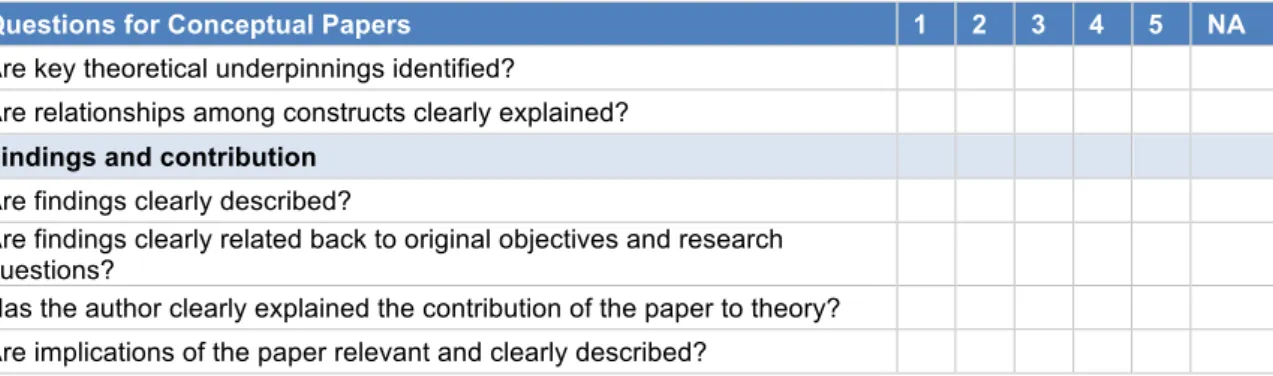
Once relevant papers had been identified their quality was assessed. Quantitative and qualitative papers were assessed using different quality criteria adapted from Huff (1999) (see Table 6 and Table 7). Conceptual papers were assessed using similar quality criteria (see Table 8). All quality criteria assessed the papers on three key elements: Literature review and development of research questions, methodology and data analysis and on results and contribution. Papers with an average of 3 or higher in each of the categories: Literature review, methodology and data analysis (empirical papers only) and results and contribution, were taken forward to data extraction. I found that although papers varied in quality in many cases they would still have a relevant contribution in terms of answering the review question. This led to a relatively low number of papers being excluded based on quality. These limitations are acknowledged, however, as the papers are reviewed in chapter 4 and 5.
Questions for Quantitative Papers 1 2 3 4 5 NA Literature review and development of hypotheses
Are the study’s propositions and hypotheses clearly articulated? Are the basic arguments of the paper relevant and interesting? Are important premises and assumptions identified?
Are key terms and constructs identified? Are key theoretical underpinnings identified? Are relationships among variables clearly explained?
Methodology and data analysis
Is the methodology of the paper clearly explained?
Is the overall methodology appropriate to the study objectives? Are the sampling strategy and sample sufficiently described? Are data collection methods sufficiently described?
Is the operationalization of the variables and constructs plausible (content validity)?
Are dependent variables identified and described? Are independent variables identified and described? Are control variables identified and described?
Are questionnaire or other measurement items identified and described? Was the discussion of the interview or questionnaire construction and response rates clear and comprehensive?
Have steps been taken to avoid data collection errors?
Is there evidence of reliability or internal consistency in the study?
Results and contribution
Are the findings sufficiently and accurately described?
Are results clearly related back to original propositions, hypotheses, research questions, and data analysis?
Questions for Quantitative Papers 1 2 3 4 5 NA
Do tables and figures provide sufficient and accurate data?
Are graphics and/or appendices used effectively to support the argument of the paper?
Is implied causality justified?
Has the author adequately considered alternative explanations for the results found?
Are implications of research relevant and clearly described?
1=Not at all; 2=Only to a limited extent; 3=At an acceptable level; 4=To a significant level; 5=Completely
Table 6 – Quality criteria for quantitative papers
Questions for Qualitative Papers 1 2 3 4 5 NA Literature review and development of research questions
Is the purpose of the research adequately established? Are the basic arguments of the paper relevant and interesting? Are important premises and assumptions identified?
Are key terms and constructs identified? Are key theoretical underpinnings identified?
Are relationships among constructs clearly explained?
Methodology and data analysis
Is the overall methodology appropriate to the study objectives? Are the choice of participants, nature of the situation and participant characteristics sufficiently described?
Are data collection methods sufficiently described? Are data analysis methods sufficiently described?
Does the writer convince the reader that he or she was able to gather information about key events from appropriate sources?
Is there evidence that participants trusted the researcher and were likely to honestly share information with the researcher?
Results and contribution
Are the findings adequately and accurately described?
Are results clearly related back to original objectives, research questions, and data analysis?
Has the author adequately considered alternative interpretations of the data presented?
Has the author adequately considered alternative explanations for the results found?
Is there evidence of systematically considering evidence that contradicts the author’s interpretations?
Are implications of research relevant and clearly described?
1=Not at all; 2=Only to a limited extent; 3=At an acceptable level; 4=To a significant level; 5=Completely
Table 7 – Quality criteria for qualitative papers
Questions for Conceptual Papers 1 2 3 4 5 NA Literature review and development of research questions
Is the purpose of the paper adequately established?
Are the basic arguments of the paper relevant and interesting? Are important premises and assumptions identified?
Questions for Conceptual Papers 1 2 3 4 5 NA
Are key theoretical underpinnings identified?
Are relationships among constructs clearly explained?
Findings and contribution
Are findings clearly described?
Are findings clearly related back to original objectives and research questions?
Has the author clearly explained the contribution of the paper to theory? Are implications of the paper relevant and clearly described?
1=Not at all; 2=Only to a limited extent; 3=At an acceptable level; 4=To a significant level; 5=Completely
Table 8 – Quality criteria for conceptual papers
3.4.4 Final selection
Table 9 shows the number of peer reviewed hits that each search string generated and how each step of the systematic review process explained above led to the removal of more and more papers. Similarly, Table 10 shows the selection process from cross-referencing. The papers identified through cross-referencing went through the same inclusion and exclusion criteria as well as quality assessment as the papers from the database searches. The final number was 40 papers, of which 31 came from the literature searchers and 9 came from cross-referencing. More details on the papers are provided in the data extraction forms in Appendix A and Appendix B.
Database Strings Initial number of hits (peer-reviewed) Number after screen on title and abstract Number after screening on full text Number after checking for duplicates Number after screening for quality
ABI/Inform Global 1 and 2 130 30 16 16 15
ABI/Inform Global 1 and 3 101 18 4 1 0
ABI/Inform Global 1 and 4 93 18 5 4 3
EBSCO 1 and 2 206 39 19 6 5 EBSCO 1 and 3 490 53 8 3 1 EBSCO 1 and 4 564 77 20 5 2 PsycINFO 1 and 2 129 25 9 2 2 PsycINFO 1 and 3 116 14 4 1 0 PsycINFO 1 and 4 216 28 11 4 3 Scopus 1 and 2 80 23 13 0 0 Scopus 1 and 3 57 7 3 1 0 Scopus 1 and 4 2 1 1 0 0 Total: 2184 333 113 43 31
Number of papers identified
through cross-referencing Number after screening on full text Number after screening for quality
41 16 9
Table 10 – Selection process from cross-referencing
3.5 Data extraction
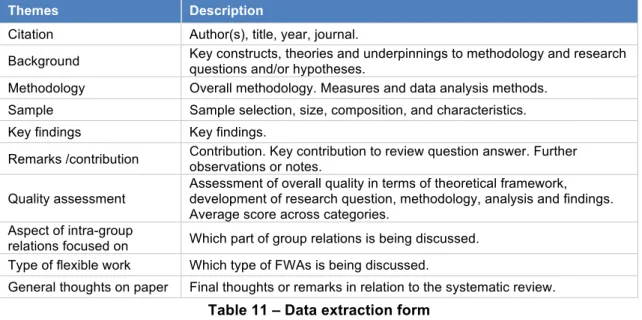
Once papers had been selected based on the quality criteria they were imported into Mendeley and relevant data was extracted from each of them into a data extraction form (see Table 11). The data extraction form was adapted during the review process in order to help in establishing a critical argument within the systematic review. The adaptation involved adding the last three parts of the table presented below.
Themes Description
Citation Author(s), title, year, journal.
Background Key constructs, theories and underpinnings to methodology and research questions and/or hypotheses.
Methodology Overall methodology. Measures and data analysis methods.
Sample Sample selection, size, composition, and characteristics.
Key findings Key findings.
Remarks /contribution Contribution. Key contribution to review question answer. Further observations or notes. Quality assessment
Assessment of overall quality in terms of theoretical framework, development of research question, methodology, analysis and findings. Average score across categories.
Aspect of intra-group
relations focused on Which part of group relations is being discussed. Type of flexible work Which type of FWAs is being discussed.
General thoughts on paper Final thoughts or remarks in relation to the systematic review.
Table 11 – Data extraction form
3.6 Data synthesis
A final step of the systematic review process is to synthesise the information and knowledge obtained from the evidence that has been identified. The synthesis was aimed at providing a comprehensive answer to the key review question. The data extraction process was used to identify key themes within each paper, which were then used to group papers together in an iterative process of trial and error in order to provide a narrative account of the existing literature. The findings from this process are presented in the following two chapters. In chapter 4 a descriptive account is given where the papers are grouped according to various categories and groupings. Chapter 5 provides a narrative account of the papers according to themes identified.
4 DESCRIPTIVE FINDINGS
4.1 Overview
This chapter provides a descriptive account of the final collection of papers identified from the systematic literature searches as well as those identified through cross-referencing. The characteristics covered here are those that were deemed to provide interesting insights into the status of current knowledge in the field and contribute to an answer to the review question. These include year of publication, type of paper, research methodology, type of FWAs studied and selected characteristics of the sample studied.
More details on each of the selected papers can be found in Appendix A and Appendix B.
4.2 General characteristics
The papers identified came from a selection of journals in a variety of fields such as human resource management, psychology, engineering and communications (see Figure 4).
Figure 4 - Journal disciplines of selected papers
7! 17%! 4! 10%! 3! 7%! 7! 17%! 1! 2%! 3! 7%! 1! 3%! 7! 18%! 1! 3%! 5! 13%! 1! 3%! Human!Resource!Management! Informa=on!Systems! Psychology! Management!(various)! Leadership! Organisa=onal!Behaviour! Industrial!Rela=ons! Communica=on! Transporta=on! Technology!/!Engineering! Nego=a=on!and!Conflict! Management!
The papers therefore provide different angles of looking at the topic, e.g. from a technology standpoint (information systems and engineering journals) and from interactional standpoints (communication journals). Although a majority of the papers came from journals ranked 3* or higher in the Cranfield School of Management journal ranking (see Table 12), journal ranking was not deemed to be an important factor in assessing the papers.
Journals Count
Human Relations (4*) 3
Information Systems Research (4*) 1
Journal of Applied Psychology (4*) 2
Journal of Management (4*) 1
Organization Science (4*) 2
Leadership Quarterly (4*) 1
Academy of Management Review (4*) 1
British Journal of Industrial Relations (3*) 1
Human Resource Management Journal (3*) 2
Information and Management (3*) 1
Journal of Management Information Systems (3*) 2
Journal of Organizational Behaviour (3*) 3
The International Journal of Human Resource Management (3*) 2
Transportation Research Part A (3*) 1
International Journal of Technology Management (3*) 1
Journal of Managerial Psychology (2*) 1
New Technology, Work and Employment (2*) 1
IEEE Transactions on Systems, Man and Cybernetics - Part C: Applications and Reviews (1*) 1
Management Revue (1*) 1
Qualitative Research in Organizations and Management: An International Journal (1*) 1
Communication Monographs 2
IEEE Transactions on Professional Communication 1
Journal of Applied Communication Research 3
Journal of Business Strategies 1
Journal of High Technology Management Research 1
Negotiation and Conflict Management Research 1
Southern Communication Journal 1
Journal of Engineering and Technology Management 1
Total 40 Table 12 – Overview of journals of selected papers
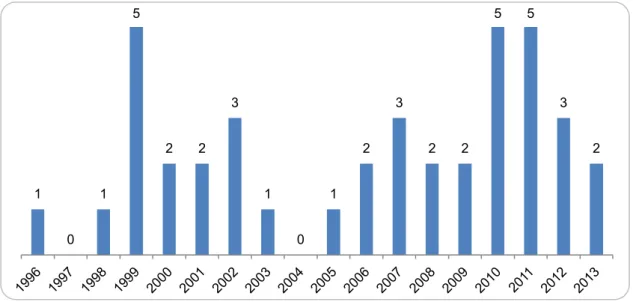
The distribution of the selected papers according to years published can be observed in Figure 5. Although the figure shows a fairly even distribution, two peeks can be observed. The first one, around 1999-2000, may be explained by an increased interest in telework in the period of the dot-com bubble. The
second peek is since 2010, which may indicate that interest in this topic is now rising again.
Figure 5 - Distribution of papers by year published
The distribution of papers by their type, i.e. whether they are empirical or conceptual can be observed in Figure 6. A majority of the papers were empirical which echoes a general trend in the literature of FWAs, where theory building work is scarce (e.g. de Menezes and Kelliher 2011).
Figure 6 - Distribution of papers by type
4.3 Methodology characteristics
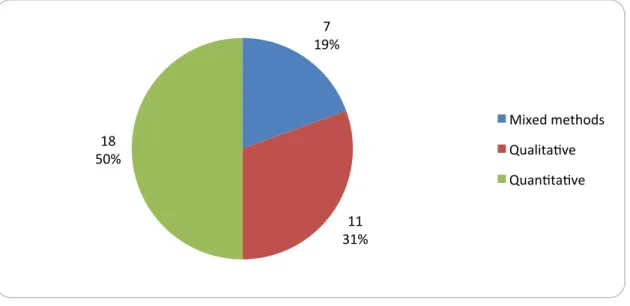
The distribution of the empirical papers according to their methodology can be observed in Figure 7. The majority of the papers were quantitative, which again
1 0 1 5 2 2 3 1 0 1 2 3 2 2 5 5 3 2 36! 90%! 4! 10%! Empirical!Papers! Conceptual!Papers!
echoes an overall trend in the literature of FWAs and human resource management (Eby et al. 2005; de Menezes and Kelliher 2011).
Figure 7 - Empirical papers by research methodology
4.4 Type of FWAs studied
The searches conducted in the databases as well as through cross-referencing looked for papers on both locational flexibility (telework or telecommuting) and temporal flexibility (flexitime). However, interestingly, they almost exclusively brought out papers on telework (see Figure 8).
Figure 8 - Types of FWAs studied
7! 19%! 11! 31%! 18! 50%! Mixed!methods! Qualita=ve! Quan=ta=ve! 38! 95%! 1! 2%!3%!1! Telework!or!telecommu=ng!! Flex=me!and!telecommu=ng! Unspecified!FWAs!
4.5 Sample characteristics
Four observations were made in terms of sample characteristics of the empirical papers. Firstly, Figure 9 depicts the participants in terms of whether they were the teleworkers, their managers, their in-office co-workers or others. It can be observed that 39% of the studies relied on the points of view of teleworkers alone, while 30% compared them to office workers through sampling both in-office workers and teleworkers. 17% of the papers had then added managers; so three different types of employees were sampled. Interestingly, only two studies sampled in-office workers alone. These observations reflect that a predominance of studies in the field focus on teleworkers and not on other actors in their social environment (e.g. Bailey and Kurland 2002).
Figure 9 - Empirical papers by sample - characteristics
Second, Figure 10 depicts the distribution of the empirical papers according to the organisations the samples were picked from. A considerable amount of papers sampled from different companies in different sectors (illustrated by Mixed, n=15), although it should be noted that some of these studies used snowball sampling. However, another observation here is the predominance of technology oriented organisations as these were used in 12 of the 36 empirical studies. One explanation for this may be that scholars assume telework is more practiced in these organisations, rather than others.
11! 30%! 2! 5%! 14! 39%! 1! 3%! 6! 17%! 1! 3%! 3%!1! Flexible!workers!and!office!workers! Office!workers! Teleworkers! Teleworkers!and!managers! Teleworkers,!office!workers!and! managers! Teleworkers,!spouses,!office!workers,! trade!union!officers!and!managers! N/A!
Figure 10 - Empirical papers by sample - organisation type
Third, Figure 11 depicts whether a formal flexible work program or telework program was in place at the organisations studied. Here a clear trend can be observed in that scholars seem to select organisations based on that a formal program is in place. Following from the previous discussion perhaps such programs are more prevalent in technology-oriented organisations than others.
Figure 11 - Empirical papers by sample - active telework program
Fourth and finally, Figure 12 depicts the geographical distribution of the samples. In a number of cases the papers did not provide explicit information on
1! 3! 1! 15! 1! 12! 3! Ed uc a= on al !in s= tu =o n! G ov er nm en t! Man uf ac tu rin g! Mi xe d! Pu bl is hi ng! Te ch no lo gy ,!fi nan ci al s! ! & !te le co m m un ic a= on s! N/ A! 24! 67%! 2! 5%! 1! 3%! 9! 25%! Ac=ve!telework!program!in! place!in!organisa=on! No!formal!telework!program!in! place! Mixed! N/A!
the geographical location of the sample used. However, in these papers in many cases indications were found throughout the papers that the sample was US based (e.g. company description, contextual descriptions etc.). An overall observation in terms of geographical distribution was that the majority of papers were based on Northern American samples, suggesting the majority of work has been done in the US and Canada.
Figure 12 - Empirical papers by sample - geography
4.6 Summary
In summary, a majority of the studies identified for this review were empirical and quantitative, which reflects a common trend in the literature on FWAs. Furthermore, the perspective of individual teleworkers was found to be a prime focus in the studies identified, as were organisations with active telework programs. Finally, there appears to be a tendency to look at technology-oriented organisations in terms of samples and most research has been conducted in North America, although this is not universal.
4! 11%! 1! 3%! 4! 11%! 12! 33%! 8! 22%! 7! 20%! Canada! Netherlands! United!Kingdom! United!States! NA!(indica=ons!of!US!based! sample)! NA!