1
The Ministry of education and science of Ukraine
Ternopil Ivan Puluj National Technical University
IRYNA KOTOVS’KA
Handbook for practical classes and self-training on discipline
HUMAN RESOURCE MANAGEMENT
for the 3rd year students
of the specialty 6.030601«Management»
2
Kotovs’ka I. V. Handbook for practical classes and self-training on discipline “Human Resource Management” for the 3rd
year students of the specialty 6.030601 “Management” (full-time study bachelors). 2nd edition, revised and enlarged.– Ternopil: TNTU, 2016. – 46 p.
Made by: Ph.D. Kotovs’ka Iryna Reviewer: Ph.D. Kuzhda Tetyana
3
CONTENTS
Introduction……… 4
Lecture 1 Why Is HRM Important to an Organization?.......5
Lecture 2 The Role Of The HR Practitioner…….………..11
Lecture 3 Human Resource Planning………...………..…………11
Lecture 4 Recruiting…………23
Lecture 5,6 Foundation Of Selection………..33
Lecture 7,8 Socializing, Orientation And Development Employee……….40
4
INTRODUCTION
The course is designed to help students gain an understanding of the importance and challenges of human resource management (HRM). It covers a range of key HRM practices including selection, training and development, rewards and performance appraisal. The course will focus on HRM’s role as an employee and organizational performance driver but it also deals with related questions of social responsibility.
Learning Objectives
On completion of this course, the student should have gained
- a basic understanding of the complex question of HRM's contribution to employee and organizational performance
- knowledge of key HRM related practices, concepts and theories
- have developed skills in identifying and arguing for the suitability of various HRM practices in specific organizational contexts.
5
Lecture 1 Why Is HRM Important to an Organization?
Questions for review
1. Contrast management, personnel, and human resource management.
2. Explain the purpose of HRM in an organization. 3. What activities are involved in the staffing function of HRM?
4.Explain the goals of the training and development function of HRM. 5.Describe the primary goals of the motivation function of HRM. 6.In what ways can HRM meet its goals of the maintenance function? 7.What role does HRM play in the strategic direction of an organization? 8.How does HRM affect all managers?
Key terms Management Leading Controlling Organizing Planning Maintenance function Management thought
Employee relations function Communications programs
Hawthorne studies Scientific management Shared services
Staffing function
Training and development functions
Motivation function
Linking concepts to practice. Discuss questions.
1. “Motivation is the primary responsibility of line managers. HRM's role in motivating organizational employees is limited to providing programs that equip line managers with means of motivating their employees”. Do you agree or disagree with the statement? Explain your position.
2. You have been offered two positions in HRM. One is a generalist position in a smaller business, and one is a recruiting position in a large corporation. Which of the
6
two jobs do you believe will give you more involvement in a variety of HRM activities? Defend your answer.
3. “Globalization had led us to the realization that workers are interchangeable between countries so long as language issues are resolved”. Do you agree or disagree with this statement? Explain your position.
4. “Employers only need to provide employees with enough information so they can effectively and efficiently get their jobs done. Beyond that, employees don't have a need to know”. Do you agree or disagree with the statement? Defend your answer.
Developing Diagnostic and Analytical Skills Case KINDERGARTEN FUN
Maybe Robert Fulghum, author of All I Really Need to Know I Learned in Kindergarten (Ballantine, 1993) has taught individuals in corporate America a thing or two. At Eze Castle Software, there's no doubt how kindergarten principles have affected the company.
Eze Castle, headquartered in Boston, Massachusetts, develops software for securities trading. This six-year-old company has grown to more than 90 employees, with annual revenues exceeding $13 million. During its first few years, the start-up venture prospered—in part due to the attention paid to every detail in managing the company. But success appeared to come at a price. Workers became complacent. Decisions were made with no regard for the "bottom line," such as paying more than $100 a month to a contractor to water the few plants in the office. Furthermore, employees began to spend their time on activities not related to work. In one case, the company's T-l Internet connection service fee soared when most employees downloaded MP3 files so they'd have music at their desk. But two major events changed this.
First, within two weeks' time, two key administrative assistants quit. No one knew what to do. Supplies were no longer available, as stock items were not replenished. Mail was not delivered—it simply stayed bagged in the mail room. Even when a few tried to handle the mail, they couldn't. They didn't know who was who in the organization. Second, while getting away from it all for a day, a company official
7
attended his daughter's kindergarten class. There he witnessed how chores were divided up among the classmates, and how serving refreshments created time for all students to socialize.
Thinking about what he had seen and what was happening at Eze, the company official identified eight separate tasks that would make work more enjoyable for employees. These included stocking the kitchen, cleaning and organizing dishes, maintaining the supply closet, sorting and distributing mail, cleaning the kitchen, overseeing the reception area, arranging snack breaks and acting as an ombudsman (the one who would oversee and coordinate the seven previous activities). These activities would be done by employees on a rotating basis—typically 3-month assigned tasks. Thus, the administrative assistants would not be replaced, saving the company the costs associated with their salary and benefits.
With cookies and milk breaks every afternoon at 2:30, employees from all parts of the company enjoyed the socializing. They began to get to know one another and understand what was happening in the organization. Meanwhile, employees used some of the saved administrative assistant salary monies to support both internal and external service activities important to them. One committee has recommended that a company gym be built, and another has been supporting Boston-area homeless shelters by conducting food drives.
Since these changes, employee morale has increased. Teams formed in the organization are once again focusing on the “good of the organization”. One team, for instance, has recommended that everyone turn off their lights and computers each evening before leaving the building. This suggestion alone is saving Eze more than $3,000 per month, reducing its electric bill by more than 75 percent.
Employees at Eze learned an important lesson from a kindergarten class: Sharing can be good, and when people share, they can be happier. At Eze Software, productivity is up, costs are down, and the employees would not think of missing their afternoon milk and cookies!
8 Questions:
1. What is your reaction to this "employee plan" implemented by Eze? Do you believe it is too simplistic? Defend your position.
2. Do you believe such employee programs as described in this case can succeed at other companies? Why or why not?
3. Do you believe special human resource management conditions have to exist for such a system to work? Explain. How do these conditions relate to motivation?
Case TEAM FUN!
Kenny and Norton own TEAM FUN!, a medium-sized company that manufactures and sells sporting goods and equipment. They are watching a CROSSKATES video about cross-country roller skates in the LOUNGE. Norton says, "I don't know. This stuff looks dangerous! What do you think? Remember that bungee-jumping thing we tried?"
Kenny responds, "Edna was out a long time with that knee problem. She sure is a good sport. Keith said we were lucky not to get sued for that. Do you think employees could sue us if they are hurt on product-test assignments?
"Let's ask Tony," Norton suggests. "That guy you hired as— what did you call him—director of human resources?"
Kenny smiles broadly, "Yep. He sure seems to be busy. He's pulled together all that paperwork for insurance and retirement that Edna used to handle and named her compensation and benefits manager."
"He wants to send Joe and Eric to a supervisor's school for work scheduling, job team assignments, and project management," Norton adds. "He started those picnics by the LAGOON for people to talk about work conditions and issues."
Kenny asks, "Do you think we should let him hire a full-time secretary? I thought Edna could do that, but Tony said she has a full plate. Did you tell him to do that employee bulletin board he tacked into the web site?"
9
"Me neither," Kenny muses. "Wonder why he did that? Guess we'd better talk to him."
Questions:
1. Which of the functional HR processes can be identified in Tony's area? 2. Identify the environmental influences important to TEAM FUN!.
3. How do its HR functional areas line up with the overall HR process? 4. Which motivation theorists has Tony applied to TEAM FUN!?
5. Does Tony need to do anything else to set up a strategic HR function? Working with the team: Making a layoff decision
Every manager, at some point in his or her career, is likely to face the difficult task of managing laying off employees. Assume that you are the human resource director of a 720-member technology company. You have been notified by top management that you must permanently reduce your staff by two individuals. Below are some data about your five employees.
Carla Carver: African-American female, age 36. Carla has been employed with your company for five years, all in HRM. Her evaluations over the past three years have been outstanding, above average, and outstanding. Carla has an MBA from a top-25 business school. She has been on short-term disability the past few weeks because of the birth of her second child and is expected to return to work in twenty weeks.
William Sapp: White male, age 49. William has been with you for four months and has eleven years of experience in the company in systems management. He has a degree in computer science and master's degrees in accounting information systems. He's also a CPA. Bill's evaluations over the past three years in the systems department have been average, but he did save the company $150,000 on a suggestion he made to use electronic time sheets.
John Melendez: Hispanic male, age 31. John has been with Ate company almost four years. His evaluations over the past three years in your department have been
10
outstanding. He is committed to getting the job done and devotes whatever it takes. He has also shown initiative by taking job assignments that no one else wanted. John has been instrumental in starting up your benefits administration intranet for employees.
Barbara Welsh: White female, age 35. Barbara has been with your company seven years. Four years ago, Barbara was in an automobile accident while traveling on business to a customer's location. As a result of the accident, she was disabled and is wheelchair-bound. Rumors have it that she is about to receive several million dollars from the insurance company of the driver who hit her. Her performance the past two years has been above average. She has a bachelor's degree in human resource management and a master's degree in human development. Barbara specializes in training, career, and organization development activities.
Keshan Jones: African-American male, age 43. Keshan just completed his joint MBA and law program and recently passed the bar exam. He has been with your department four years. His evaluations have been good to above average. Five years ago, Keshan won a lawsuit against your company for discriminating against him in a promotion to a supervisory position. Rumors have it that now, with his new degree, Keshan is actively pursuing another job outside the company.
Given these five brief descriptions, make a recommendation to your boss in which two employees will be laid off. Discuss any other options you might suggest to meet the requirement of downsizing by two employees without resorting to layoffs. Discuss what you will do to (1) assist the two individuals who have been let go and (2) assist the remaining three employees. Then, in a group of three to five students, seek consensus on the questions posed above. Be prepared to defend your actions.
11 Lecture 2 The Role Of The HR Practitioner
Questions for review
1. What is expected from HR professionals? 2. Who are the personnel professionals?
3. List the main activities carried out by HR practitioners
4. HR professionals involve taking on a number of different roles. Describe them.
5. Define service provision and innovation role. 6. Explain the internal consultancy role and monitoring role.
7. What is the main models of HR management roles 8. How To Be An Effective HR Practitioner?
9. Explain why can arise conflicts in the HR contribution Key terms
Advice Guidance
Service provision The innovation role
Conformist innovators The architect model Deviant innovators Conflict Ethical Considerations Professional conduct Competence HR competence map The reactive/proactive roles
The clerk of works model The contracts manager model
Lecture 3 Human Resource Planning
Questions for review
1. Define human resource planning. Why is it important to organizations?
2. What is involved in the human resource planning process?
12
3. How can an organization increase its human resource supply? 4. What is a job analysis?
5. Identify the advantages and disadvantages of the observation, structured questionnaire, and diary job analysis methods.
6. Explain the terms job description, job specification, and job evaluation.
7. Describe the human resource planning implications when an organization is downsizing. Key terms diary method job analysis job description job evaluation SWOT analysis human resource planning core competency job-morphing job specification mission statement weaknesses strengths observation method replacement chart
Position Analysis Questionnaire (PAQ)
structured questionnaire method technical conference method human resource information system (HRIS)
individual interview method group interview method
Linking concepts to practice. Discuss questions.
1. "More emphasis should be placed on the external supply of employees for meeting future needs because these employees bring new blood into the organization. This results in more innovative and creative ideas." Do you agree or disagree with this statement? Explain your response.
2. "Job analysis is just another burden placed on organizations through EEO legislation." Do you agree or disagree with this statement? Defend your position.
3. "Although systematic in nature, a job description is still at best a subjective process." Build arguments for and against this statement.
4. "Permanent layoffs should occur only as a last resort. Cutting staff affects morale, and ultimately the organization falters more. Organizations also have a social responsibility to their employees and owe it to them to find alternative ways to cut costs." Do you agree or disagree with the statement? Defend your position
13 Developing Diagnostic and Analytical Skills CaseFuelling the process
Kirsten Schaffner-Irvin saw opportunities in the changing world. A native of Huntington Beach, California, Schaffner- Irvin was a stay-at-home mom, but money was tight in the family, and she had to go to work. She wanted to find a job that would allow her to care for her children while producing some extra income for the household. Having grown up in a family-owned fuel business, Kirsten knew the ins and outs of the fuel-delivery industry. She didn't, however, want to work for her father. Instead, she wanted to "make it" on her own- fulfilling a lifelong dream of being her own boss, in her own company. So, with just a laptop and a telephone, she started Team Petroleum.
Having worked in the industry, Schaffner-Irvin recognized that a more efficient fuel delivery system was possible. Although the company didn't own any oil wells or even fuel trucks, Schaffner-Irvin believed her company could be successful if she could demonstrate that Team Petroleum added value for its customers. Schaffner-Irvin envisioned buying fuel from suppliers and having it delivered to her customers. But delivery alone was not sufficient enough to add value. She offered her customers a special service that her competitors didn't. She linked their fuel tanks to her computer system, which monitors the customer consumption and automatically notifies Team Petroleum's office when another delivery is needed. The result is a seamless "fuel procurement and management reporting" system that creates efficiencies in the fuel supply chain, saving clients such as Disney, Con Edison, Frito-Lay, and Toys R Us, upwards of 12 percent of their fuel budget.
For nearly 20 years, Team Petroleum has been a thriving business. The company has expanded, taken on several strategic alliances, and recently changed its name to TeamFuel. With company's revenues exceeding $60 million, the founder's dream has become a reality. She built a value-added firm, turned the management over to a new team; and now enjoys a lifestyle with her family that she always desired.
Questions:
14
2. How does TeamFuel's new delivery process effect human resource planning in the organization?
3. What role did succession planning play as Schaffner-Irvin turned her company over to a new management team? Explain.
Case TEAM FUN
Tony has been director of human resources at TEAM FUN!, a sporting goods manufacturer and retailer, for 3 months. He is constantly amazed that the company does so well, considering that everything is so loose. Nothing is documented about job roles and responsibilities. People apparently have been hired because Kenny and Norton, the owners and founders, liked them or their relatives. Tony is lunching with Mary, a friend from college who now manages the human resource function for a large financial investor. Tony tells Mary, "I don't know if I should quit or what. They both got mad at me last week when I suggested smart cards for security.
The employee handbook looks like a scrapbook from their kids' high school football days . . . no, their high school football days. No one has job descriptions. I don't get it. Everyone likes working there. The job does get done. Am I the one with the problem?"
Mary replies, "Couldn't be you! It does sound like a great place to work. Has it grown fast in the past few years?"
"Unbelievably," Tony says. "It had 25 employees 5 years ago, now we have nearly 150."
"That's probably part of it," Mary answers. "Remember how Dr. Smith said in his class that you could get by without a formal human resource structure up to about 100 employees?"
"Yeah. That was a great class! I met my wife in that class! We did lots of team exercises and projects." Tony sighs.
Mary nods. "Anyway, maybe you could start with writing your own job description. That would be a start."
15
"Then I could talk about formal job evaluation processes." Tony cheers up. "That's a great idea. Have you used QUICKHR, the new software tool?"
Mary shakes her head. "No, but a package is a good idea. What's your current HRIS like?" Tony laughs until he can't catch his breath. Mary continues, "Okay. That's another place you could start."
Questions:
1. Help Tony write his job description.
2. What techniques should he use to gather data? 3. How should he conduct the job analysis?
4. What should he say to Kenny and Norton to ensure their buy-in on this project?
5. How will job descriptions change the organization? 6. Give Tony some pointers on software packages and HRIS Working with the team: Job analysis information
Research the technical and people skills and conceptual knowledge required to perform a human resources manager's tasks effectively. Describe your findings and compare them with the results of members of your group.
You may obtain samples directly from a company's manager, with permission; interview a human resources manager; or use web sites such as www.hrq.com and www.shrm.org. Discuss what values will be important for the human resources manager to personally possess and how these will be demonstrated in that role.
Finally, based on the information you've obtained, write a brief description of the job. What challenges did you experience in reaching consensus on job responsibilities and in choosing the correct words for inclusion in the job description?
1.
How to Calculate the Average Number of Employees
Determining the average number of employees examines the number of workers you have during a certain period of time. Because it is not economical to count the number of employees each day and then find an average, companies will look at the beginning number of employees and the ending number of employees for the period and then find the average number of employees. This calculation is used in employee-turnover rates to help a company find how quickly employees leave the company.
16
o 1 Count the number of employees at the beginning of the period. A period can be any length of time, such as a week, a month or a year.
o 2 Count the number of employees you have at the end of the period.
o 3 Add the beginning number of employees to the ending number of employees, then divide by two.
For example: assume that on Jan. 1, you have 400 employees, on Dec. 31, you have 410 employees. How to calculate the average number of employees? In the example,
1) 400+ 410 = 810 employees 2) 810 ÷ 2=405 employees
So you have an average of 405 employees over a year's time.
3.1 Calculate the Average Number of Employees half yearly and annually.
Indicators
Month
Ja nu ar y Fe br ua ry M ar ch Ap ri l M ay Ju ne July Au gu st Se pt em be r O ct ob er N ov em be r D ec em be rThe number of employees 550 550 543 544 542 542 532 532 528 522 520 515
The number of separations 12 20 5 13 17 21 4 3 8 9 5 7
3.2 Calculate the Average Number of Employees half yearly and annually.
Indicators
Month
Ja nu ar y Fe br ua ry M ar ch Ap ri l M ay Ju ne Ju ly Au gu st Se pt em be r O ct ob er N ov em be r D ec em be rThe number of employees 250 248 247 247 244 244 240 239 239 235 233 228
17
2. How to Calculate Employee FTE
1. The general formula used to calculate employee FTEs is to divide the number of hours that an employee is scheduled to work by the employer's hours for a full-time workweek. An FTE is generally equal to one person working full time on a standard full-time schedule of eight hours a day, five days a week, 52 weeks a year and 2,080 hours per year. To calculate FTEs for one year, divide the total number of labor hours for the year, as determined by payroll, by 2,080.
For example: if the company's total labor hours for the year from January through December is 14,000, use the following equation:
14,000 ÷ 2080 = 6.7 FTEs
2. An alternate method is to determine number of FTEs for one month. In this case, divide the number of total hours for the month by 173.33 to get the number of FTEs for that month.
For example: if the company's total labor hours for the month of July was 4,000, use the following equation:
4,000 ÷ 173.33 = 23.08 FTEs
3. It is also possible to calculate the number of labor hours required in one day. To determine FTEs for a day, divide the day's total number of labor hours by eight.
For example: if the company's total labor hours for the day involved eight people working seven hours, plus one person working four hours, use the following equation:
(8
people x 7 hours) + (1 person x 4 hours) = 60 hours
60 ÷ 8 = 7.5 FTEs
18
3.3 The company's total labor hours for the year from January through December are writing in the following table and are equal every month. Persons are working full time on a standard full-time schedule. Calculate FTEs for year, for one month.
Indicators Year 2008 2009 2010 2011 2012 2013 2014 The company's total labor hours for the year 48000 54000 25000 36000 150000 81000 120000
3.4 The company's total labor hours for the month are writing in the following table. Persons are working full time on a standard full-time schedule. Calculate FTEs for one month.
Indicators Month
May June July August September October
The company's total labor hours for the month 12000 20000 8000 25000 7000 14000
3.5 The company's total labor hours for the day involved people (see following table). Calculate FTEs for day.
Indicators Day 5.03 4.04 5.06 7.08 12.08 25.09 Number of employees two persons working three hours six people working six hours five people working seven hours ten people working five hours nine people working three hours five people working six hours five people working six hours one person working three hours two persons working two hours two persons working two hours one person working four hours two persons working four hours
19
3
How to Calculate Turn Over
Employers often need to calculate turnover, or the percentage of their terminated employees divided by their total number of employees. Typically, the calculation takes into account the number of employees terminated and the total number of employees over a 12-month period. In some cases, "terminated" employees includes only employees who were let go. In other cases, employees who voluntarily leave a company count toward the turnover rate. Businesses often focus on reducing turnover rate in order to lessen the costs of recruiting, training, overtime and other administrative costs associated with hiring new employees or performing existing work with a reduced workforce.
1. Determine whether your company's turnover calculation will include employees who left the company voluntarily, employees whom your company let go or both. Discuss the matter with your human resources department for guidance. Try to determine what your company hopes to accomplish with its calculation of turnover rate. Include all employees who left for any reason in the calculation, if your goal is to reduce the overall turnover rate.
2. Count the number of employees who left your company in the last 12 months for the reason or reasons that you specified.
3. Count the total number of people currently employed by your company. Include only the employees who work for your company as of the end of the 12-month period you measured, not employees who worked for you at any time during that year. Obtain the correct number from your human resources department. Discuss whether you should include only full-time employees or part-time employees as well.
4. Divide the total number of terminations by the total number of employees at the end of the 12-month period. Take note of the result, which should be a number between 0 and 1. Convert that number to a percentage by multiplying it by 100. For example, if you divide 50 terminations by 200 total employees, the result is 0.25. Multiply that number by 100 for a turnover rate of 25 percent.
20
4. How to Calculate Employee Turnover
Employee turnover rate is a ratio comparison of the number of employees an organization replaces in a given time period, to the average number of total employees during that time period. It basically refers to the percentage of people who leave the company over the total number of working in a specific time period. Employee turnover is a huge concern to companies because of the high costs involved. A lot of time, money and human resources are invested for recruiting employees. Thereafter, the training and other administrative expenses add to the investment made on the employees. If these employees leave the organization frequently, the company suffers financially in more ways than one. The corporates need to refresh their strategies to bring down employee turnover rates. The cure is employee retention. And employee retention means taking time to look closely at certain segments, like employee engagement, and ascertaining the employees’ overall welfare. This will eventually aid in controlling the employee turnover rate. Increase in profits, better productivity and better business will follow suit.
Calculating Employee Turnover Rate
The universal formula for determining employee turnover rate is as follows:
Divide the number of separations during the specified period by the average number of employees in this period. Multiply this figure by 100. Resultant will be your percentage employee turnover for that period.
100 period same the during employees of number Average year) (usually1 period specific a in leavers of Number TI
Let us go through the step by step protocol.
First, we need to determine the time period for which the employee turnover rate is to be calculated. For example, monthly, quarterly, half yearly or annually.
21
Next, we need to find out the average number of positions that were filled in the organization during this period. To calculate this, add the number of employees present at the beginning of the period and the number of employees at the end; divide the sum by two.
For example, to calculate the average number of employees in the first quarter (January to March), we’ll follow this simple mathematical equation:
2 March 31st on NE + January 1st on NE quarter first in the employees of number Average ,where NE – is the number of employees.
Determine the total number of voluntary and involuntary separations over the course of the time period. This will allow you to calculate and compare values for total, voluntary and involuntary turnover rates distinctly.
Divide the number of separations by the average number of employees in this period. Multiply the result by 100.
For example, if the average number of employees in the first quarter is 300 and we had a total of 21 separations (15 voluntary and 6 involuntary separations), then the employee turnover rate will be:
%;
5
%
100
05
.
0
300
15
rate
Turnover
Voluntary
%; 2 % 100 02 . 0 300 6 rate Turnover y Involuntar %.
7
%
100
07
.
0
300
21
rate
Turnover
Total
22
5. Calculating Monthly and Annual Turnover
Monthly turnover is the number of employee separations in one month divided by the average number of active employees at the worksite during the same period. We’ll make it easy and say we have one site of operations.
Written as a math formula, here is the same calculation:
100
month
the
during
employees
of
number
Average
month
the
during
separation
of
Number
rnover
Monthly tu
For example, if the average number of employees during the month is 200 and we had a total of 4 separations, then the monthly turnover rate will be:
%.
2
%
100
02
.
0
200
4
m
m = 2 % monthly employee turnover rate.
Annual employee turnover is calculated by adding up the monthly turnover for a 12-month period.
Using the same example, if four employees leave each month, a yearly total of 48 leave (4×12). Plugging those numbers into the formula:
%.
24
%
100
24
.
0
200
48
a
a=24% annual employee turnover rate
3.6 Calculate Employee Turnover Rate monthly, quarterly, half yearly, annually using data from table 3.1 and 3.2
23
3.7 Calculate Employee Turnover Rate half yearly, annually (voluntary, involuntary, total).
Indicators
Month
Ja nu ar y Fe br ua ry M ar ch Ap ri l M ay Ju ne July Au gu st Se pt em be r O ct ob er N ov em be r D ec em be r The number of employees 250 248 247 247 244 244 240 239 239 235 233 228 The number ofseparations: 6 month Year
voluntary involuntary
3 7
7 15
3.8 The average number of employees in the first quarter is 660 and we had a total of 51 separations (35 voluntary and 16 involuntary separations). Determine the employee turnover rate (voluntary, involuntary, total).
Lecture 4 Recruiting
Questions for review
1. What is the "dual objective" of recruiting?
2. Identify and describe factors that influence the degree to which an organization will engage in recruiting.
3. What specific constraints might prevent an HR manager from hiring the best candidate?
4. Present the advantages and disadvantages of recruiting through an internal search.
5. What are the pros and cons of using employee referrals for recruiting workers? 6. Describe the differences one may encounter when recruiting globally.
24 Key terms blind-box ad employee referrals expatriates recruiting executive search host-country national (HCN) internal search leased employees websume
constraints on recruiting efforts
Linking concepts to practice. Discuss questions.
"A job advertisement that generates 1,000 responses is always better than one that gets 20 responses." Build an argument supporting this statement and an argument against this statement. 1. "An organization should follow a promote-from-within policy." Do you agree or disagree with this statement? Explain.
2. When you go looking for a job after graduation, what sources do you expect to use? Why?
3. "The emphasis on leased or temporary employees in an organization will only lead to a decrease in employee morale. These employees come in, do their jobs, then leave it up to the full-timers to handle the details." Build an argument supporting this statement, and an argument against this statement.
Developing Diagnostic and Analytical Skills Case FINDING TECHNICAL WORKERS
After establishing its strategic direction and developing a corresponding employment plan, an organization must turn its attention to hiring the right people. The jobs identified and their associated skills point to specific types of employees. But these employees don't just magically appear, and they rarely come knocking on the organization's door. Instead, the company must find and hire qualified people.
That process starts when the organization notifies the public that openings exist. The organization wants to expose its information sufficiently to attract responses from a wealth of potentially qualified applicants. Then, hopefully, after several interactions
25
with the most promising of these candidates, employees are hired. These candidates will best demonstrate the skills, knowledge, and abilities to successfully perform the job.
It isn't breaking news that we have a labor shortage in certain U.S. sectors in the new millennium. All types of jobs—from hightech to service jobs—are more difficult to fill. Compounding this is the realization that in areas where high-tech work flourishes, unemployment is well below 2 percent—about half the nationa-Lav- erage. So how do you locate these potential applicants and entice them to join your organization? Let's look at what some companies have done.
■ Some companies in the Silicon Valley area flash job-opening
advertisements on movie screens just before the main-at- traction film starts;
■ Microsoft, in an effort to attract and retain IT workers, significantly raised salaries for those positions;
■ Interwoven lures engineers by offering new hires a 2-year lease on a BMW
Z3;
■ OnLink Technology hires an airplane to fly above southern California rush-hour traffic carrying banners advertising jobs;
Some organization recruiters show up at people's homes, offering them the corporate jet for a weekend to fly somewhere to think about joining the company; a Cisco has gone into high schools, replacing shop class with a "new economy" course on inputting computer codes. Some of these high school students may end up with jobs approaching $70,000 annually after graduating. Cisco is also doing the same with individuals in homeless shelters.
Creativity in searching for job candidates continues to gain momentum. Whenever labor shortages exist, recruiting efforts take on new proportions. Companies gain a competitive advantage by targeting good talent and encouraging them to apply— and by always looking. Quite possibly that is what the CEO of Acteva, Inc., thought when she hired the motorist who rear-ended her car. Impressed with how the driver reacted to this stressful event, the CEO mentioned a job opening and offered the job on the spot. It was accepted. Impressed with the company, the driver's significant other also joined the company two weeks later. In this case, the recruiting effort was no accident!
26 Questions:
1. Relate the examples above to how well they fulfill the dual goals of recruiting.
2. What role should creativity play in finding job candidates?
3. Do you believe such creative advertising for jobs is effective? Explain. Does a surplus or shortage of workers play a role in how organizations recruit? Discuss.
Case TEAM FUN!
Kenny and Norton, owners of TEAM FUN!, a sporting goods manufacturer and retailer, are in the OFFICE, looking at the model of their organization on the Team Fun wall. Norton comments, "I think it's great that your daughter, Gloria, is getting married again. And I agree that we should give Bobby, your new son-in-law, a manager job at a branch. But we have all the branch managers we need."
Kenny grins. "I think this would be a great time to open a Florida store. They could live there; run the place in the summer. We go down there in the winter and make sure everything is going fine. It will be great."
Norton groans. "Maybe. Hey, Tony!" he yells to the director of human resources, who is walking by. "Come in here for a minute. We need to hire 20-30 people in the Fort Myers, Florida, area to work in our new branch. How long will it take you to get that together?"
Meanwhile, Kenny picks up the phone. "Ray, remember that mall area by the new golf course in Punta Gorda we played last year? Find out if we can lease 30,000-40,000 square feet of it by. ..." He puts his hand over the receiver and looks at Tony. "How long 'til you get the people?"
Tony gulps and says, "Six months, probably. Who do I take from here?"
Kenny continues on the phone with Ray, the comptroller, "By . . . what is this, June? By September-October 1. That gives us about 60 to 90 days to redo the inside.
27
We can open TEAM FUN! SOUTH in time for a Christmas rush! Sure. Sure. Whatever you need. Get back to me." He hangs up, obviously well pleased.
As Tony slumps into a side chair, Norton says to him, "Now that you did all those job descriptions, I'm amazed you think it will take five months. We know lots of people along the Gulf Coast. Let me find you some names." He and Kenny both paw through a huge Rolodex and laugh at certain names and memories as they pull cards for Tony.
Tony sighs, "Good thing I've got that intern starting next week." Questions: (You are Tony's intern.)
1. Make a recruiting plan for TEAM FUN! Identify at least four principal recruiting sources for the new store. Be sure to discuss the pros and cons of each of your suggestions.
2. Recommend to Tony which of the four sources should get top priority. Defend your decision.
Working with the team: Making a layoff decision
Tommy Ford is an impatient, results-oriented, innovative, hardworking, focused entrepreneur. He likes working with aggressive, highly creative, skilled, focused team players who are flexible, change driven, informed, cutting-edge professionals much like himself in work ethic but from diverse groups. He believes that professionals with varied backgrounds contribute to better solutions and creativity. He wants only those who are as committed as he is to growing a company that produces the industry standard and benchmark in intranet and software technology. That means being willing to work 60 to 90 hours a week at High-5-Tech if the project requires, and dedication to and passion for customers, the firm, and the project team.
Ford may start people out with salaries slightly below industry average, but he rewards performance and tenure. He's reputed to double a salary when a developer exceeds expectations. He also contributes his company's stock to the employees' benefit package, subject to their length of employment. At the current rate, a person might retire a millionaire if he or she can withstand the pace.
28
Interested? Discuss why or why not, comparing responses with your paired team member. Also, here are some guiding questions for you and your partner to consider:
1. What web sites would you use if you were interested in an international job?
2. Would you consider being an expatriate; why or why not?
How to Calculate Employment Retention
Number of Jobs Created or Retained – FTE Estimate Examples
Guidance issued 12/18/09 by the federal Office of Management and Budget Revised OMB guidance issued 12/18/09 provides the following guidelines for ARRA Jobs FTE Calculation:
Job estimates will be calculated based on hours worked in the current reporting quarter only. Recipients will no longer be required to maintain a cumulative total of hours worked in all prior quarters as part of the formula.
All individuals working on an ARRA award, whether fully or partially, should be counted. You may use the percent of effort funded by an ARRA award for the reporting quarter as an FTE equivalent. A funded job is defined as one in which the wages or salaries are either paid for or will be reimbursed by ARRA funding.
Job estimates should be reported based on the total available time in the reporting quarter (520 hours per FTE), regardless of when the grant period or employment period begins.
Jobs Created and Jobs Retained can be reported together in a single numeric FTE field. Recipients will no longer be required to distinguish between a job created and a job retained when calculating and reporting FTE.
Example: FTE Calculation Based on Quarterly Hours Worked
Assume that a new ARRA funded project requires two full-time employees beginning the first day of the 4Q 2009 reporting quarter, and one part-time employee working half days (50% time) beginning the last month of the reporting quarter and the end of 3Q 2010, the part-time employment period ends. Project Start: 4Q 2009, Project End: 4Q 2010.
29
1. A full-time schedule for one employee for a quarter is 520 hours (2080 hours in a work year divided by 4 quarters in a year). For ARRA reporting, departments should always use 520 hours to calculate FTE.
2. To convert hours worked to number of "full-time equivalent" (FTE) employees for the first quarterly report, total all hours worked in the quarter and divide by the number of hours (520 hrs) in a full-time schedule.
3. In this example:
Full-time hours worked (520 hrs x 2 employees = 1040 hrs) + part-time hours worked (80 hours) divided by number of hours in a full-time quarterly schedule (520 hrs) = 2.15 FTE in the first project quarter:
(1040 + 80) / 520 = (1120 / 520) total hours = 2.15 FTE
4. The part-time employee continues on this project at 50% time (260 hrs/qtr) through the end of 3Q 2010 = 2.50 FTE reported for each quarter. At the end of 3Q 2010, the part-time employment period ends.
5. For the final quarter, with no part-time employee, the project reports 2.00 FTE.
Table 4.1
Indicators
Project Start: 4Q 2009 – Project End: 4Q 2010 4Q 2009 1Q 2010 2Q 2010 3Q 2010 4Q 2010 Employee #1 – full-time hours worked 520 520 520 520 520 Employee #2 – full-time hours worked 520 520 520 520 520 Employee #3 – part-time (50%) hours
worked
80 260 260 260 0
A. Total Hours Worked by Quarter 1120 1300 1300 1300 1040 B. Quarterly Hours for one Full-Time
FTE
520 520 520 520 520
FTE: Number of Jobs Created/Retained (A divided by B)
2.15 2.50 2.50 2.50 2.00
FTE Calculation Based on Quarterly Hours Worked (based on 520 hours/FTE/quarter)
4.1 Assume that a new ARRA funded project requires thre full-time employees beginning the first day of the 3Q 2014 reporting quarter, and two part-time employees
30
working half days (50% time) one beginning the last month of the reporting quarter, and another beginning the first month of the 4 Q 2014. The part-time employment period ends on the 2 Q 2015. Project Start: 3Q 2014, Project End: 4Q 2015. Calculate FTE: number of jobs created/retained that are based on quarterly hours worked
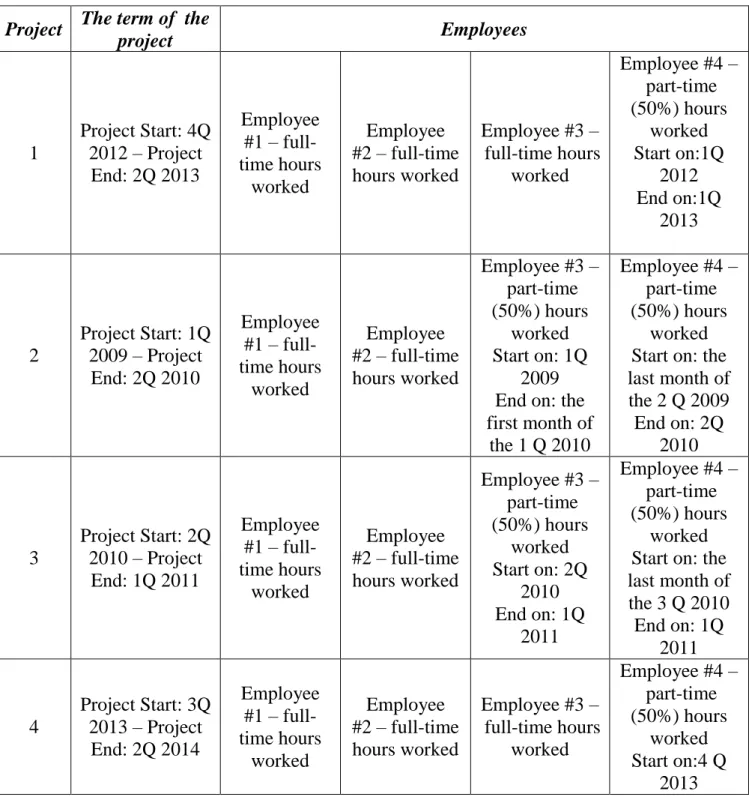
4.2 Calculate FTE: number of jobs created/retained that are based on quarterly hours worked, using the data about the project that is given in the table 4.2 below:
Table 4.2
Project The term of the
project Employees 1 Project Start: 4Q 2012 – Project End: 2Q 2013 Employee #1 – full-time hours worked Employee #2 – full-time hours worked Employee #3 – full-time hours worked Employee #4 – part-time (50%) hours worked Start on:1Q 2012 End on:1Q 2013 2 Project Start: 1Q 2009 – Project End: 2Q 2010 Employee #1 – full-time hours worked Employee #2 – full-time hours worked Employee #3 – part-time (50%) hours worked Start on: 1Q 2009 End on: the first month of the 1 Q 2010 Employee #4 – part-time (50%) hours worked Start on: the last month of the 2 Q 2009 End on: 2Q 2010 3 Project Start: 2Q 2010 – Project End: 1Q 2011 Employee #1 – full-time hours worked Employee #2 – full-time hours worked Employee #3 – part-time (50%) hours worked Start on: 2Q 2010 End on: 1Q 2011 Employee #4 – part-time (50%) hours worked Start on: the last month of the 3 Q 2010 End on: 1Q 2011 4 Project Start: 3Q 2013 – Project End: 2Q 2014 Employee #1 – full-time hours worked Employee #2 – full-time hours worked Employee #3 – full-time hours worked Employee #4 – part-time (50%) hours worked Start on:4 Q 2013
31
Project The term of the
project Employees
End on: the first month of the 2Q 2014 5 Project Start: 3Q 2014 – Project End: project is not finished yet
Employee #1 – full-time hours worked Employee #2 – part-time (50%) hours worked Start on: 3Q 2014 End on: the first month of the 1Q
2015
Employee #3 – part-time (50%)
hours worked Start on: the last month of the 3Q
2014 End on: are working now
–
Example: FTE Calculation Based on Percent of Effort
The new OMB guidance allows colleges and universities to use the percentage of effort funded by ARRA awards as an FTE equivalent. A funded job is defined as one in which the wages or salaries are either paid for or will be reimbursed by ARRA funding. If the percent of effort for each employee working on a project remains the same throughout the quarterly reporting period, the FTE equivalent is straightforward: 100% time = 1.00 FTE; 50% time = 0.50 FTE; etc.
For those projects where the percent of effort fluctuates for any employee throughout the quarterly reporting period, you must calculate an average equivalent FTE for the reporting quarter, as follows:
Assume that a new ARRA funded project requires two staff employees beginning April 1, 2010 — one full-time employee and one half-time employee. In addition, the faculty member leading this project spends 5% of his time during the semester overseeing this project, and devotes 100% of his summer salary on the project.
1. For each ARRA project employee, enter the "FTE equivalent" effort for all three months of the reporting quarter.
2. Total the effort for each month, and add the monthly totals together to get a total for the reporting quarter.
3. Average Equivalent FTE = Total FTE Equivalent for the Quarter divided by 3 (months in the quarter)
32
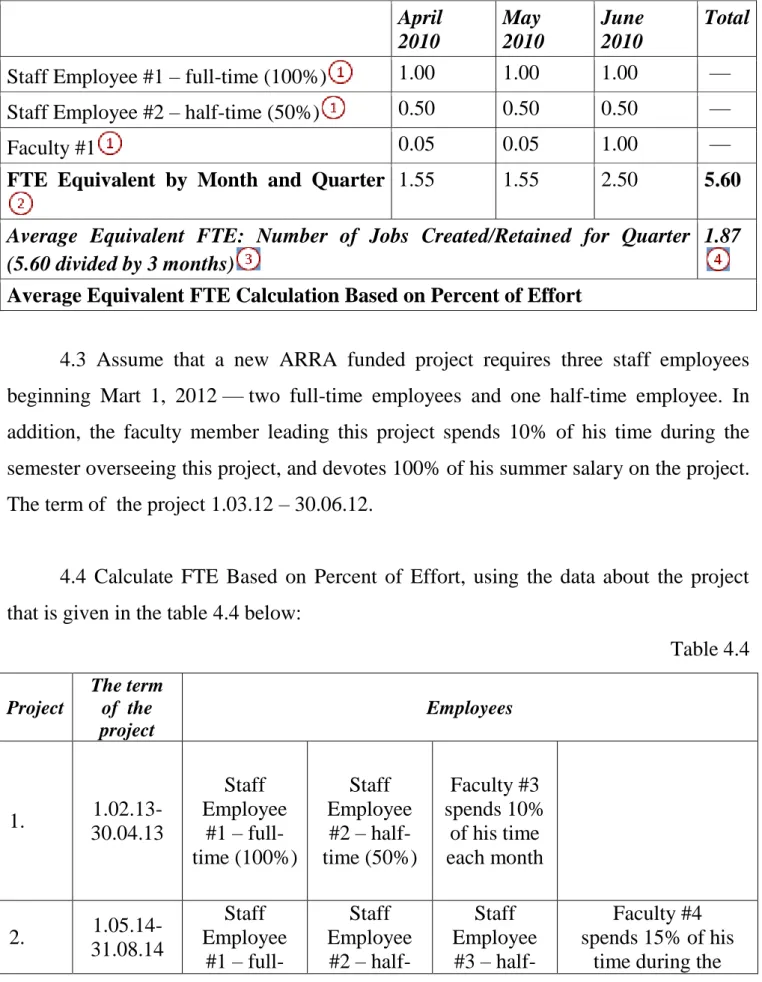
4. For the reporting quarter ending 6/30/10, the project reports 1.87 FTE (5.60 divided by 3) Table 4.3 April 2010 May 2010 June 2010 Total Staff Employee #1 – full-time (100%) 1.00 1.00 1.00 — Staff Employee #2 – half-time (50%) 0.50 0.50 0.50 —
Faculty #1 0.05 0.05 1.00 —
FTE Equivalent by Month and Quarter 1.55 1.55 2.50 5.60
Average Equivalent FTE: Number of Jobs Created/Retained for Quarter (5.60 divided by 3 months)
1.87
Average Equivalent FTE Calculation Based on Percent of Effort
4.3 Assume that a new ARRA funded project requires three staff employees beginning Mart 1, 2012 — two full-time employees and one half-time employee. In addition, the faculty member leading this project spends 10% of his time during the semester overseeing this project, and devotes 100% of his summer salary on the project. The term of the project 1.03.12 – 30.06.12.
4.4 Calculate FTE Based on Percent of Effort, using the data about the project that is given in the table 4.4 below:
Table 4.4 Project The term of the project Employees 1. 1.02.13-30.04.13 Staff Employee #1 – full-time (100%) Staff Employee #2 – half-time (50%) Faculty #3 spends 10% of his time each month 2. 1.05.14-31.08.14 Staff Employee #1 – full-Staff Employee #2 – half-Staff Employee #3 – half-Faculty #4 spends 15% of his
33
time (100%) time (50%) time (50%) semester overseeing this project, and devotes 100% of his
spring salary on the project 3. 1.09.12-30.11.12 Staff Employee #1 – full-time (100%) Staff Employee #2 – full-time (100%) Staff Employee #3 – half-time (50%) Faculty #4 spends 20% of his
time each month 4. 1.11.14- project is not finished yet Staff Employee #1 – full-time (100%) Staff Employee #2 – full-time (100%) Staff Employee #3 – full-time (100%) Staff Employee #4 – half-time (50%)
Lecture 5,6 Foundation Of Selection
Questions for review
1. Describe the eight-step selection process.
2. What is meant by a "reliable and valid" selection process?
3. What is a legal employee selection process? How does that differ from an illegal one?
4. What is a weighted application form? How does it work?
5. Contrast work samples with the assessment center.
6. What are the major problems of the interview as a selection device? What can HRM do to reduce some of these problems?
7. What effect should a realistic job preview have on a new hire's attitude and behavior?
8. Why should HRM conduct a background investigation?
9. Define the concepts of reliability and validity. What are the three types of validity? Why are we concerned about reliability and validity?
34 Key terms validity cut score reliability application form assessment center background investigation behavioral interview comprehensive interview comprehensive selection concurrent validity conditional job offer
construct validity content validity criterion-related impression management initial screening medical/physical exam performance simulation tests predictive validity qualified privilege realistic job preview(RJP) weighted application form work sampling
Linking concepts to practice. Discuss questions.
1. What do you think of realistic job previews? Would you be more likely to choose a position where recruiters emphasized only the positive aspects of the job?
2. "Because of the law regarding employment questions, application forms provide limited information. Accordingly, they should not be used." Do you agree or disagree with this statement? Explain.
3. "Even though interviews have been widely criticized, they are heavily used." Discuss why this selection device still rates highly although we know it can provide unreliable information.
4. "When hiring a member of a team, each team member should have equal say in who is hired." Do you agree or disagree? Explain.
Developing Diagnostic and Analytical Skills
Case IF WE KNEW THEN WHAT WE KNOW NOW
Pinpoint Networks, a promising Internet search engine company located in Durham, North Carolina, had everything going for it. Its two teenage founders, Judson Bowman and Taylor Brockman, had taken the company far since its founding just two years earlier. Together, they had raised more than $5 million in venture capital and had made significant contacts with some big players in the telecommunications industry. But these two entrepreneurs knew they needed help to move the company forward.
35
Although well prepared to perform the work that would take Pinpoint to the next level, they needed an executive running the company—someone who could obtain more venture capital as well as expand and nurture contacts in the telecommunications industry. Bowman and Brockman needed to hire a CEO.
An executive search firm helped identify several potential candidates. One, Anthony Blake, Jr., appeared to be the perfect choice. He had been involved in some of the industry's biggest initiatives. Blake, CEO of ObjectStream in Pleasanton, California, indicated that he desired to leave his company because he was selling it to WorldCom. He had contacts and he had a vision. In quick order, he was hired as Pinpoint's CEO.
But shortly after hiring Blake, the excitement started to wane. Blake wanted no publicity surrounding his hiring as CEO. Several of his "friends in the business" had never heard of Blake. The sale of ObjectStream to WorldCom was never announced, nor would it be from WorldCom's perspective. It appeared Blake had exaggerated his career success, his industry contacts, and even his age!
Just 13 weeks into Blake's tenure with Pinpoint, he and the company parted ways. This short association ran Pinpoint into some difficulty. Cash flow was hurting—they had at best, six to seven months left before the cash ran out. To help ease this situation, the company laid off one-third of its workforce. Two years later, the company has had a remarkable turnaround—with Bowman at the helm!
Interestingly, when the search firm had been contacted about the names they recommended to Pinpoint, a difference of opinion occurred. The search firm claimed they simply presented potential candidates without recommending any one in particular. The search firm claimed that Pinpoint was so excited with Blake's resume that they proceeded too quickly and failed to leave ample time for anyone to verify the information with proper due diligence. The search firm regarded this as an absolute must, as the year earlier, in conducting 70 background checks for people potentially placed in executive level positions, they found that 39 percent had serious problems— from insurance fraud to SEC violations—never revealed on the resume!
36
1. What are the background investigation implications of the Pinpoint Networks case?
2. Do you believe the search firm had a responsibility for checking candidates'
references prior to giving Pinpoint their recommendations? Explain your position.
3. What role does the company play in reference checking-— even if it uses a search firm?
Case: TEAM FUN!
Tony, director of human resources for TEAM FUN!, a sporting goods manufacturer ' and retailer, is meeting with Kenny and Norton, the owners and founders. He is Team Fun ready to go to south Florida to select people for the new store opening there in a few months.
Tony: "We had over a thousand people interested in the newspaper ad: 200 for the sales representatives; 300 for the stockroom people; 200 for the cashiers; 100 for cleanup; and 500 for manager. We need to pre-screen some of these people. I thought I'd go down for only two weeks to hire everyone."
Kenny: "That's a great response! Wonder if they have all heard about us? Bobby (Kenny's son-in-law, who will manage the operation) can go down week after next. I think he should hire the managers. That should take a load off you. And just pick the best few out of the rest to talk to."
Norton: "What about all that EEO stuff that Tony has been telling us about? Do we have to keep records of all these inquiries?"
Tony: "We do need an applicant pool profile. I can do that when I go there for the selection process. Could we agree on a few guidelines for me, to cut the numbers down to size?"
Kenny: "Sure. Put some ideas together. We'll go over it tomorrow."
Tony: "I thought some performance simulation tests would be a good idea, especially for the cashiers and the sales people. Maybe lifting and stacking for the stockroom, too."
Norton: "Sure. Put some tests together. We'll go over them tomorrow." Tony: "What about drug testing and background checks?"
37
Kenny and Norton both glare at him until he walks out of the room. Questions:
You are Tony's intern. Help him prepare for the meeting with Kenny and Norton tomorrow.
1. Devise a screening mechanism for each job category.
2. What kinds of performance simulation tests would be appropriate? 3. Set up an interview protocol for each job category.
4. Should Bobby select the managers himself? Should Bobby select all the other employees?
5. If you want Tony to try again with background checks and drug testing, prepare a carefully worded statement for him to present to Kenny and Norton. If you think these steps are undesirable, explain your position.
Working with the team: Preparing for the interview Using the job description you developed for the benefits manager (Chapter 5) and the ad you wrote (chapter 6), develop a list of interview questions you'd ask of job candidates. In groups of two or three, compare your interview questions and reach consensus on the questions you'd ask. Based on those questions, develop a list of evaluation metrics (how you'll evaluate candidate responses). Share your team's responses with other teams in the class.
What similarities and differences did you note? If time permits, you may want to have a mock interview. One of you play the role of the interviewer, one the job candidate, and one the observer. Ask the candidate your questions and evaluate the information obtained. The observer's job is to critique the interview. When you are finished, change roles and redo the mock interview.
38
About the skill: If you are interviewing prospective job candidates, whether as an HRM recruiter or in any other capacity, we can offer several suggestions for improving interview effectiveness.
Steps in Practicing the Skill:
1. Review the job description and job specification. Reviewing pertinent information about the job provides valuable information about on what you will assess the candidate. Furthermore, relevant job requirements help to eliminate interview bias.
2. Prepare a structured set of questions to ask all applicants for the job. A set of prepared questions ensures that the information you wish to elicit is attainable. Furthermore, if you ask them all similar questions, you can better compare candidates' answers against a common base.
3. Before meeting a candidate, review his or her application form and resume. Doing so helps you to create a complete picture of the candidate in terms of what the resume or application says and what the job requires. You will also begin to identify areas to explore in the interview. That is, areas not clearly defined on the resume or application but essential for the job will become a focal point of your discussion with the candidate.
4. Open the interview by putting the applicant at ease and by providing a brief preview of the topics to be discussed. Interviews are stressful for job candidates. By opening with small talk (for example, the weather) you give the candidate time to adjust to the interview setting. Providing a preview of topics to come gives the candidate an agenda with which to begin framing his or her responses to your questions.
5. Ask your questions and listen carefully to the applicant's answers. Select follow-up questions that naturally flow from the answers given. Focus on the responses as they relate to information you need to ensure that the candidate meets your job requirements. Any uncertainty you may still have requires a follow-up question to probe further for the information.
6. Close the interview by telling the applicant what is going to happen next. Applicants are anxious about the status of your hiring decision. Be honest with the candidate regarding others who will be interviewed and the remaining steps in the hiring
39
process. If you plan to make a decision in two weeks or so, let the candidate know what you intend to do. In addition, tell the applicant how you will let him or her know about your decision.
7. Write your evaluation of the applicant while the interview is still fresh in your mind. Don't wait until the end of your day, after interviewing several candidates, to write your analysis of a candidate. Memory can fail you. The sooner you complete your write-up after an interview, the better chance you have for accurately recording what occurred in the interview.
8. Develop a two- to three-page response to the following statement: "Graphology as a selection criterion is not a valid selection device. Accordingly, it should not be used in determining whether or not to hire a job candidate." Present both sides of the argument and include supporting data. Conclude your paper by defending and supporting one of the two arguments you've presented.
What is the Bradford Factor?
As has already been stated above, the Bradford Factor is a formula employed in calculating a custom score for the employees' absences in a year which in turn determines the amount of disruption caused by those absences to the company. The lower is the Bradford score of a particular staff, the less disruption has his absence caused to your business, and vice versa. The definition of Bradford Factor can be described as a factor equal to the sum of the square of spells of absences multiplied by the total days of absence. The use of Bradford Formula or Bradford scores helps identify staffs with serious absenteeism requiring further investigation. Keeping a Bradford score log book should be a basic and primary step of managing the attendance process of the employees, discourage too much of absenteeism and compare between the overall performances of different departments, branches or offices of a company.
How is Bradford Formula calculated?
The Bradford Score, as we have mentioned, is equal to the sum of the square of spells of absences multiplied by the total days of absence. In figures, we can put it down like this:
B = D * S2, where B – is Bradford Factor Score
S – is spells of absence in last 365 days
40
Example:
Jane has had three periods of sickness totalling 12 days. Therefore her BF score is:
3² × 12 = 108
Bill has had six period of sickness totalling 19 days. Therefore his BF score is: 6² × 19 = 684
Sarah has had one period of sickness totalling 75 days. Her BF score is: 1² × 75 = 75
We can see from these examples that although Sarah has had the most days off in total, her Bradford Factor score is the lowest. The Bradford Factor is only concerned with measuring frequent, short term absences and does not take into account long term ill health.
5.1 Calculate Bradford Factor for the following examples: 1 instance of absence with a duration of ten days
3 instances of absence; one of one and two of two days
3 instances of absence; one of one, one of three and one of six days instances of absence; each of two days
10 instances of absence; each of one day
Lecture 7, 8 Socializing, Orientation And Development Employee
Questions for review
1. How can a socialization process benefit an organization?