State-Mandated Benefit Review Laws
Nicole M. Bellows, Helen Ann Halpin, and Sara B. McMenamin
Objective. To determine which states have laws that require the review of mandated health insurance benefits and describe the various approaches states take in reviewing mandated benefits, as stated in the mandated benefit review (MBR) laws.Data Sources. We queried online databases of the individual state statutes and reviewed the state statutes and state legislative agendas for all 50 states and Washington, DC to identify those states with active MBR laws as of September 2004.
Study Design. We reviewed the identified MBR laws to catalog their various components. The components chosen for this analysis include: general review strategy, designated reviewers, time frame for conducting reviews, criteria used in the review, requirements to use actuaries, sources of funding, and state data collection systems. Two of the authors independently created analysis categories and coded the MBR laws to document details on the major components of the laws.
Principal Findings. We identified 26 state MBR laws active as of September 2004. A majority of the MBR laws specified a prospective review approach and only one law used an exclusively retrospective review approach. A substantial amount of variation was found with regards to the designated reviewers, time frames for conducting reviews, and criteria used in the review. Few states specified the use of actuaries, sources of funding, and state data collection systems.
Conclusions. The number of states that have enacted MBR laws has increased substantially in recent years, however, different states have structured the review of mandated benefits differently, according to the values and perceived needs of the state legislatures. It is important that states increasingly consider a broader scope of review criteria so state decision makers can position themselves to mandate only those benefits that add real value to the state’s health care system.
Key Words. Mandated benefits, health insurance policy, state legislation
A state legislator considers a proposal that would require health plans to cover screening for prostate cancer. While she recognizes that prostate cancer is an important problem and that mandating coverage can help increase access to these services, she is also aware of the controversy among medical experts about the value of general prostate cancer screening tests and is concerned about what effect this mandate will have on the escalating cost of health insurance and the number of uninsured individuals in her state.
The above scenario represents a dilemma facing many state legislators in considering the enactment of new state health insurance benefit mandates. While wanting to make sure that their constituents have access to the health care services they need, in a budget constrained environment the questions they face become: Of what real value are these benefits to the people of the state? Have these benefits been proven to be effective in improving health? And how much will a legislative mandate affect the general affordability of health insurance in the state?
State legislatures have addressed some of these questions by passing mandated benefit review (MBR) laws that inform the decision-making process by requiring a review of existing or proposed health insurance benefit man-dates. This paper examines the rise of state MBR laws and the different ap-proaches states have taken to conduct such reviews.
B
ACKGROUNDState health insurance mandates require that health insurers and/or health insurance products include coverage for a defined group of people (e.g., cov-erage for dependents, covcov-erage for persons with a specific medical condition); types of providers (e.g., podiatrists, ophthalmologists, chiropractors); or cer-tain treatments, services, pharmaceuticals, or durable medical equipment (e.g., mammograms, diabetes testing strips, orthotics). Additionally, state health insurance benefit mandates can dictate how care will be provided (e.g., minimum lengths of stay in a hospital following childbirth or surgery).
Jensen and Morrisey (1999) describe the history of state benefit mandate law adoption starting with the 1956 Massachusetts law that required depend-ent coverage for handicapped children. By the late 1990s, there were report-edly over 1,000 state health insurance benefit mandates in effect in the U.S. with a growing number of proposals being introduced and passed in state legislatures each year ( Jensen and Morrisey 1999). While the National Con-ference of State Legislatures has suggested that the rate of state mandate adoption may have slowed in recent years (NCSL 2003), other organizations Address correspondence to Helen Ann Halpin, Ph.D., Professor of Health Policy, Director Center for Health and Public Policy Studies, University of California Berkeley, School of Public Health, 140 Warren Hall, Berkeley, CA 94720-7360. Nicole M. Bellows, MHSA, Graduate Student Re-searcher, is with the Center for Health and Public Policy Studies, University of California, Be-rkeley. School of Public Health, Berkeley CA. Sara B. McMenamin, Ph.D., Assistant Research Professor and Research Director, is with the Center for Health and Public Policy Studies, Uni-versity of California Berkeley, School of Public Health, Berkeley, CA.
such as the Council for Affordable Health Insurance, which has identified over 1,800 existing state benefit mandates, argue that mandates remain prominent on state legislative agendas (Bunce and Wieske 2004).
The dramatic expansion of state-mandated health insurance benefits in the 1980s and 1990s was likely due to political factors. To begin, those who realized the benefits of health insurance mandates tended to be concentrated interests represented by well-organized groups of health care professionals and persons or parents of persons with a specific medical condition, who have an intense interest in a particular mandate and its outcome. At the same time, the costs of such benefit mandates were usually diffuse and spread over the majority of the population with private health insurance residing in the state, often amounting to only pennies per month on individual health insurance premiums for any one mandate. Consequently, mandated benefit laws were likely to be ‘‘political winners’’ when they had an organized set of interests pushing for them with little resistance from those who would bear the costs (Wilson 1980).
However, since the late 1990s, when health care costs began to increase rapidly again and the number of uninsured began to grow, the above political formula for success changed. Employers began to balk at rising health insur-ance premiums and began pressuring insurinsur-ance companies to look for ways to control costs, while states continued to add new mandated benefits to the coverage offered by health insurers and HMOs. As a result, the health in-surance industry began to take a critical view of mandated benefits and began to argue against them based on their impact on increasing premium costs and the escalating number of uninsured.
There has also been a growing concern about the effect of mandates on the cost of health care premiums for workers and for employers’ decisions to provide health insurance to their employees (Battistella and Burchfield 2000). Additionally, the growth of state regulation on health insurance may have stimulated more employers to switch from offering commercial health plans to offering self-insured plans, because of the protections offered under the Em-ployment Retirement and Income Security Act of 1974 (ERISA), which ex-empts self-funded plans from complying with state health insurance laws and regulations.
In response to concerns about the volume of mandates and their con-sequences and pressure from the insurance industry, several states have adopted MBR laws intended to provide more information on mandates and thus enable legislators to make more informed decisions regarding mandated benefits. While researchers have explored the consequences of mandated
benefits (Gabel and Jenson 1989; Jensen and Gabel 1992; Gruber 1994; Jain, Harlow, and Hornstein 2002; Galbraith et al. 2003; Kotagal et al. 2003), a review of the peer reviewed literature yielded no publications that described in detail the state MBR laws in the U.S. As such, this paper is the first to analyze and discuss the different approaches states take to review mandated benefits, as described in the state MBR laws.
M
ETHODOLOGYThe first step in this analysis was to define what constitutes a state MBR law. We defined MBR laws as those that specifically called for a review of proposed or existing state-mandated health insurance benefits. As the accessibility of prior state statutes varies substantially, we restricted the analysis of MBR laws to those that were active as of September 2004, when we collected the data, and we did not include any MBR legislation that had expired and not been renewed. Also not included as MBR laws are more general state laws that require a fiscal analysis of all proposed legislation and do not specifically target mandated health insurance benefits.
The second major step was to identify which states had MBR laws according to our definition. We queried online databases of the individual state statutes and reviewed the health insurance sections of the state statutes for all 50 states and Washington, DC to identify those states with active MBR laws as of September 2004. We also reviewed state legislative agendas to identify those states that had recently passed MBR legislation that had not yet been incorporated into the compiled state statutes, which resulted in identifying one additional MBR law (New Hampshire). For those states where we did not find any statutory reference to a MBR law, we then con-tacted the state legislative librarian or similar state official to confirm that an active law did not exist during the study period. Next, the list of states with MBR laws were confirmed against other available sources detailing the states that had MBR laws (AAHP 2003; Gitterman 2003; Lee 2003; BCBS 2004). Where there were discrepancies, we found that differences were because of different inclusion criteria such as whether the MBR law was active in September 2004.
Having identified the 26 states with MBR laws to be included in our analysis, the next step was to select the components of the MBR laws on which we would report. To accomplish this, we reviewed the laws to identify and catalog their various components. We chose the specific components on
which to report based on the extent to which they were relevant to the policy-making process as well as their prevalence in the 26 MBR laws. The com-ponents chosen for this analysis include: general review strategy, designated reviewers, time frame for conducting reviews, criteria used in the review, requirements to use actuaries, sources of funding, and state data collection systems. Two of the authors independently created categories and reached consensus on how to best classify the key components of the MBR laws. Two independent coders reviewed the 26 state MBR laws to document inclusion of the major components of the MBR laws with an overall interrater reliability of 95 percent.
F
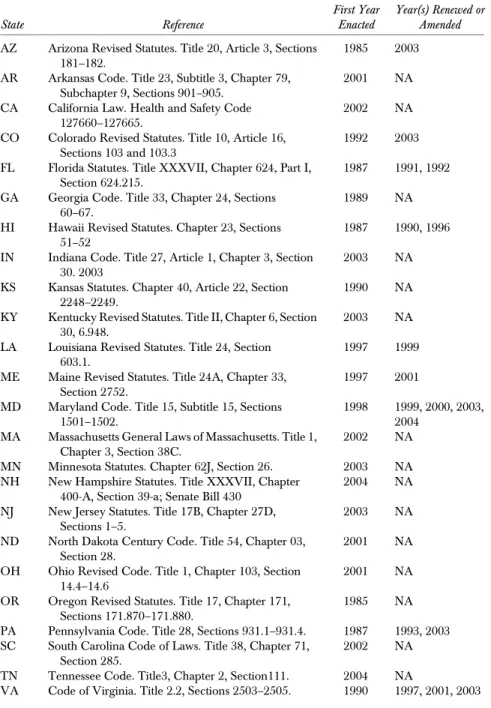
INDINGSTwenty-six states were found to have MBR laws on their books as of Sep-tember 2004. Table 1 presents the year the MBR laws were first enacted in each state ranging from 1985 (Arizona and Oregon) to the most recently passed MBR law in 2004 (New Hampshire). Seven of the 26 states adopted MBR laws during the 1980s, although four of these laws have been amended or renewed as their initial enactment. Another seven states adopted MBR legislation during the 1990s and five have been subsequently renewed or amended. Twelve states have adopted MBR legislation since 2000.
General Review Strategy
There are three general strategies for reviewing health insurance mandates in the MBR laws: (1) a prospective review of proposed mandated benefit leg-islation, (2) a retrospective review of benefit mandates already in the state statutes, and (3) a combination of both prospective and retrospective reviews (Table 2).
The prospective approach dominates in the current statutes, with 18 states using a prospective-only approach. South Carolina is the only state that was conducting an exclusively retrospective analysis in 2004. In the recent past, other states including Texas and Hawaii have also conducted retrospec-tive reviews. At the conclusion of retrospecretrospec-tive analyses, the reviewers typically report back to the legislature regarding their findings and recom-mendations for revising or eliminating specific mandates. Seven states use a combination approach to evaluate both the impact of individual mandates before their enactment as well as the cumulative effect of all enacted mandates in the state.
Table 1: Statutory References of State Benefit Mandate Review Laws, 2004n State Reference First Year Enacted Year(s) Renewed or Amended AZ Arizona Revised Statutes. Title 20, Article 3, Sections
181–182.
1985 2003
AR Arkansas Code. Title 23, Subtitle 3, Chapter 79, Subchapter 9, Sections 901–905.
2001 NA
CA California Law. Health and Safety Code 127660–127665.
2002 NA
CO Colorado Revised Statutes. Title 10, Article 16, Sections 103 and 103.3
1992 2003
FL Florida Statutes. Title XXXVII, Chapter 624, Part I, Section 624.215.
1987 1991, 1992 GA Georgia Code. Title 33, Chapter 24, Sections
60–67.
1989 NA
HI Hawaii Revised Statutes. Chapter 23, Sections 51–52
1987 1990, 1996 IN Indiana Code. Title 27, Article 1, Chapter 3, Section
30. 2003
2003 NA
KS Kansas Statutes. Chapter 40, Article 22, Section 2248–2249.
1990 NA
KY Kentucky Revised Statutes. Title II, Chapter 6, Section 30, 6.948.
2003 NA
LA Louisiana Revised Statutes. Title 24, Section 603.1.
1997 1999
ME Maine Revised Statutes. Title 24A, Chapter 33, Section 2752.
1997 2001
MD Maryland Code. Title 15, Subtitle 15, Sections 1501–1502.
1998 1999, 2000, 2003, 2004
MA Massachusetts General Laws of Massachusetts. Title 1, Chapter 3, Section 38C.
2002 NA
MN Minnesota Statutes. Chapter 62J, Section 26. 2003 NA NH New Hampshire Statutes. Title XXXVII, Chapter
400-A, Section 39-a; Senate Bill 430
2004 NA
NJ New Jersey Statutes. Title 17B, Chapter 27D, Sections 1–5.
2003 NA
ND North Dakota Century Code. Title 54, Chapter 03, Section 28.
2001 NA
OH Ohio Revised Code. Title 1, Chapter 103, Section 14.4–14.6
2001 NA
OR Oregon Revised Statutes. Title 17, Chapter 171, Sections 171.870–171.880.
1985 NA
PA Pennsylvania Code. Title 28, Sections 931.1–931.4. 1987 1993, 2003 SC South Carolina Code of Laws. Title 38, Chapter 71,
Section 285.
2002 NA
TN Tennessee Code. Title3, Chapter 2, Section111. 2004 NA
VA Code of Virginia. Title 2.2, Sections 2503–2505. 1990 1997, 2001, 2003 Continued
Designated Reviewers
Another important distinction between state MBR laws is who is given the primary responsibility for completing the review and submitting it to the intended recipients. Table 2 classifies the 26 states with MBR laws according to five categories of reviewers: (1) the proponents of the legislation, (2) admin-istrative or legislative personnel, (3) a legislative contractor, (4) a legislatively established commission or task force, and (5) a university.
Six states require that the proponents of the legislation conduct the re-view. Typically, this model requires that when a mandated benefit is intro-duced, it must be accompanied by an analysis conducted by the proponents that evaluates the effects the mandate will have on the state according to the criteria specified in the state MBR law before it can be considered for passage. For the second type of reviewer, administrative or legislative personnel have responsibility for conducting the review. Ten states use this approach to review mandated benefits. In these states, it is often the insurance department, bureau or commissioner who is given responsibility for evaluating mandated benefit proposals. Other states rely on legislative staff for the reviews such as the state’s legislative fiscal officer.
North Dakota and Ohio specify that the legislature contract with an external reviewer in evaluating the mandated benefit. North Dakota requires the legislative council to contract with a ‘‘private entity’’ while Ohio specifies Table 1: Continued State Reference First Year Enacted Year(s) Renewed or Amended WA Revised Code of Washington. Title 48, Chapter 48.47,
Sections 005–900.
1997 NA
WI Wisconsin Statutes. Chapter 601, Section 601.423. 1987 NA
nThose states listed here as having MBR laws are different from those listed in Oliver and Singer
(2006). Bellows and colleagues examine the characteristics of state laws that have established MBR programs in the U.S. Oliver and Singer (2006) summarize information gathered by CHBRP through key informants interview with officials in each state. Differences between laws that au-thorize MBR programs and the actual program implementation occur for several reasons. (1) There has not been enough time to develop a program or process in compliance with the new law. (2) The laws do not always explicitly dictate the criteria and steps for mandate reviews and therefore the implementation of such laws and policies are subject to interpretation and can vary from time to time (such as with changes in administrations). (3) State governments and their various departments do not always uniformly implement laws related to MBR programs or proc-esses even when criteria and steps for evaluations may be explicitly defined. This may occur due to several reasons, including limits on data availability, limits on staff and funding resources, or the political climate in the state.
that the legislative service commission must retain independent actuaries to conduct the analysis.
Eight states utilize a fourth category of reviewer, a legislatively estab-lished commission or task force.1This approach may rely on a commission already in existence or may require the creation of a new commission for the Table 2: Components of State MBR Laws
State
Review Strategy
Responsibility for Conducting the Review
Time Frame for Analyses
AZ Prospective Proponents Before consideration
AR Prospective/ Retrospective
Commission/Task Force Yearly
CA Prospective University 60 days
COn Prospective/ Retrospective Proponents; Commission/ Task Force Determined by committee chair FL Prospective/ Retrospective Proponents NS
GA Prospective Admin./Legis. Personnel 20 days
HI Prospective Admin./Legis. Personnel Before consideration IN Prospective/
Retrospective
Commission/Task Force Yearly
KS Prospective Proponents Before consideration
KY Prospective Admin./Legis. Personnel 30 days
LA Prospective Admin./Legis. Personnel Before consideration ME Prospective Admin./Legis. Personnel Before consideration MD Prospective/
Retrospective
Commission/Task Force Twice yearly MA Prospective Admin./Legis. Personnel 90 days MN Prospective Admin./Legis. Personnel 180 days
NH Prospective Admin./Legis. Personnel NS
NJ Prospective Commission/Task Force 60 days
ND Prospective Legislative contract Before consideration
OH Prospective Legislative contract 60 days
OR Prospective Proponents Before consideration
PA Prospective Commission/Task Force 120 days
SC Retrospective Commission/Task Force One-time report TN Prospective/
Retrospective
Admin./Legis. Personnel Yearly VA Prospective/
Retrospective
Commission/Task Force 24 months
WA Prospective Proponents Before consideration
WI Prospective Admin./Legis. Personnel NS
n
Colorado is unique in that the statutes contain two primary reviewers: (1) the proponents of the legislation as specified in the 1992 provision and (2) a commission established in 2003 which must also produce a review.
specific purpose of reviewing benefit mandate proposals. The types of indi-viduals commonly included on commissions or task forces include members or representatives of: state government, medical professionals, the health care industry, the business community, health care recipients, and academics or researchers.
California is the only state to use the final category of reviewer, a uni-versity. In California’s MBR law, the responsibility for reviewing proposed state benefit mandate legislation is granted to the University of California, where health services researchers associated with medical schools and schools of public health review the benefit mandates.
Time Frames for Reporting
Table 2 also details the amount of time reviewers are given to conduct the review, which varies substantially. One approach has been to allot a specific time period to complete the review of each individual mandate. Nine states have adopted this model and the time periods range from 20 days (Georgia) to 24 months (Virginia), with a median of 60 days per review. In four states, there is a specific yearly or twice yearly date on which the reviewers must report their findings for all the mandates they reviewed. Similarly South Carolina, which conducted a retrospective review, specified a one-time report date of January 1, 2005. In seven states, the review must be completed prior to con-sideration by the legislature and in five states, either no mention of a time frame was identified or the time frame was vague such as ‘‘determined by committee chair.’’
Review Criteria
When determining whether a mandated benefit would be in the interest of the citizens of the state, there is a wide range of criteria that states consider. Of the 26 states with MBR laws, 25 identified specific criteria required for consid-eration in assessing the effects of the mandated benefit under review. More than 90 individual evaluation criteria were identified in the MBR laws. Based on the consensus of two independent coders, these criteria were classified into seven major categories: (1) cost impacts, (2) social impacts, (3) medical effi-cacy, (4) public health impacts, (5) political considerations, (6) provider im-pacts, and (7) quality of care impacts (Table 3). Because the cost and social impacts had the greatest number of criteria and were most frequently included the MBR laws, these categories were subdivided further to capture variation within them.
Thecost impactscategory examines the general costs associated with the mandate such as the impact on the total cost of health care in the state, as well as costs for specific stakeholders affected by the mandate including consumers, insurers, employers, and state health insurance programs. Additionally, cost criteria may estimate the costs ofnotpassing the mandate such as whether the lack of coverage results in an unreasonable financial burden for individuals and whether the mandated benefit could act as a substitute for more expensive treatment, thereby saving money. All 25 state MBR laws that specified review criteria included at least one cost impact criterion.
Following cost impacts,social impactcriteria were cited in 20 of the MBR laws. Some of the MBR laws refer more broadly to ‘‘social’’ impacts; however, most laws further define it to include: utilization, insurance coverage, demand, availability, and need. Some criteria in this category assess the current status of the benefit (e.g., the public demand for the service/treatment) while others ask for projections of what impact the passage of the mandate bill will have, such as whether the mandate will increase the use of the service or treatment or encourage the appropriate use of the service or treatment. Other criteria in-cluded in this category are whether the lack of coverage results in individuals being unable to receive care or whether individuals avoid necessary care because of lack of coverage.
Twelve of the MBR laws require an examination of themedical efficacyof the service or treatment to verify that it is effective in the prevention or treat-ment of disease or disability. Included in this category are criteria evaluating whether the service or treatment is recognized by the medical community as being effective and efficacious, as well as whether medical efficacy has been demonstrated in the peer reviewed scientific literature.
Criteria for the remaining four categories are less common in MBR laws. The fourth category, public health impacts, is included in six of the MBR laws and examines how the mandate will affect the health of the state’s population based on reductions in morbidity, mortality, and the effect on the overall health of the community. Next, political considerations
are considered in four MBR laws and include an examination of the extent of opposition to the mandate and the balancing the trade-offs of the findings from the financial, social, and efficacy review criteria. Four MBR laws also include provider impacts and examine criteria such as how the benefit mandate will affect the number and types of providers in the state. Finally, four states also consider quality of care criteria, requiring reviewers to evaluate the impact the mandate will have on the quality of health care in the state.
Ta bl e 3 : R ev ie w Cri te ri a S pe ci fi ed in S ta te MBR La w s n S umA ZA RC AC OF L G A H I K S K YL AM EM DM AM NN H N J N DO HO R P AS CT NV A W AW I Co st im p act s 2 5 ^ ^ ^ ^ ^ ^ ^ ^ ^ ^ ^^^ ^^ ^ ^ ^ ^ ^ ^ ^ ^ ^ ^ Co n su m er s 1 6 ^ ^ ^ ^ ^ ^ ^ ^ ^^^ ^ ^ ^ ^ ^ In su re rs 16 ^^ ^ ^ ^ ^ ^ ^ ^ ^ ^ ^ ^ ^ ^ ^ E m pl oye rs 9 ^ ^ ^^^ ^ ^ ^ ^ St at e p ro gr am s 3 ^^ ^ S o ci al im p act s 2 0 ^ ^ ^ ^ ^ ^ ^ ^ ^^^ ^^ ^ ^ ^ ^ ^ ^ ^ Ut il iz at io n 18 ^ ^ ^ ^ ^ ^ ^ ^ ^^^ ^ ^ ^ ^ ^ ^ ^ Co v er age 16 ^^ ^ ^ ^ ^ ^ ^ ^ ^ ^ ^ ^ ^ ^ ^ De m an d 12 ^^ ^ ^ ^ ^ ^ ^ ^ ^ ^ ^ A v ai la bilit y 6 ^^ ^ ^ ^ ^ Ne ed 3 ^^ ^ Me d ic al ef fi ca cy 12 ^ ^ ^^^ ^^ ^ ^ ^ ^ ^ P u bl ic h ea lth 6 ^^ ^ ^ ^ ^ Pol itic al 4 ^^ ^ ^ Pr o v ide rs 4 ^^ ^ ^ Q u al ity o f ca re 4 ^^ ^ ^ To ta l o u t of al l 1 6 cat eg o ri es 7 1 0 12 7 7 5 9 6 2 1 1 5 1 0 9 6 4 11 5 6 7 1 1 1 2 5 1 0 6 To ta l o u t of se v en m aj o r ca te go rie s 2 3 4 2 2 2 5 2 1 1 7 3 6 4 4 4 2 3 3 4 1 1 3 4 2 nTh e In d ia n a MB R la w d o es n o t sp eci fy an y re v ie w cri te ri a.
Of the 25 MBR laws that include review criteria, the breadth of criteria included in the laws varies substantially. Four states (Kentucky, Louisiana, South Carolina, and Tennessee) specify only cost impacts as the basis for the review. An additional seven states limit the analysis to cost and social impacts. The remaining 14 MBR laws include at least one of the other five categories. Maine’s MBR law specifies the broadest set of criteria, covering all seven major categories and 15 of the 16 subcategories identified.
Other Components of State MBR Laws
The general review strategy, designated reviewer, time frames, and review criteria are aspects of the MBR laws that cut across most of the MBR laws. We also examined three additional characteristics that were less frequently in-cluded in the MBR laws but have interesting implications for the review of mandated benefits.
First, we determined whether MBR laws required the use of an actuary in conducting the reviews. Three states (Arizona, California, and Ohio) re-quire that an actuary prepare the financial analysis. Four other MBR laws state that the reviewer may obtain assistance from an actuary; however, this inclu-sion is not required.
Next, we examined whether the MBR law specified who pays for the reviews. While most of the MBR laws do not make a reference to the source of financing, it is often implied that the designated reviewer will bear the cost of conducting the review. Four states (New Jersey, North Dakota, Tennessee, and Virginia) explicitly identify the part of the state budget that funds reviews. Three states refer to external sources of funding. In California, reviews are funded through a health insurer fee determined by the legislature. Colorado’s funding for reviews may also be supplemented through insurer fees. Minne-sota’s MBR law states that the reviewer ‘‘may seek and accept funding from sources other than the state to pay for evaluations’’ as long as the funding source does not influence the outcome.
In addition, three states (Colorado, New Jersey, and Virginia) included language in their statutes regarding data collection systems to be developed for use in conducting reviews of mandated benefits. These three states specified that a system and program of data collection be established for the purpose of assessing the impact of state mandated benefit laws. Specific data to be col-lected included: costs to employers and insurers, the impact of treatment, the cost savings in the health care system, and the number of providers.
D
ISCUSSIONOne limitation of this analysis is that it is restricted to the legislative language of enacted state MBR laws and does not examine differences in how the laws have been implemented. The issues around implementation are important in further understanding how MBR laws work to incorporate information into the decision-making process of state legislatures. Future research is needed to examine how MBR laws have been implemented, how the reviews are re-ceived by policy makers, and whether the reviews influence decision making around mandated benefit legislation. In spite of this limitation, the MBR laws themselves are useful in gaining insight into how state legislatures intend to address the review of mandated health insurance benefits. The various ap-proaches specified in the MBR laws have important advantages and disad-vantages worth considering.
General Review Strategy
The first distinctive feature of the MBR laws is the review orientation: prospective or retrospective. There are two main advantages to a pros-pective approach. First, a prospros-pective approach establishes a process that can continue indefinitely and therefore is not subject to a one-time anal-ysis and adjustment period, as with most retrospective analyses. A second advantage of the prospective approach is that it allows states to incorpo-rate relevant and timely information into the decision-making process prior to the enactment of a health insurance mandate and therefore hopefully reduces the introduction and passage of mandated benefit proposals that have little merit.
One disadvantage of the prospective approach is that it relies on nu-merous assumptions to estimate what effects a specific mandated benefit would have on costs, utilization, and population health status. A retrospective approach, on the other hand, allows the reviewers to examine administrative data before and after the adoption of the mandate to assess the impact of the mandated benefit. However, the retrospective approach may produce results suggesting the elimination of existing mandates, which may be much more politically difficult to take away, then to have prevented their passage in the first place.
The combination of prospective and retrospective analyses draws on the strengths of both orientations by estimating the impact of proposed mandates while also evaluating the specific and cumulative effects of the existing mandates.
Designated Reviewers
Returning to Table 2, the five different approaches for designating respon-sibility for conducting the reviews each have their strengths and weaknesses. Requiring that the proponents of mandated benefit legislation conduct the review removes any financial or administrative burden associated with con-ducting the review from the state government. This approach may also pre-vent the introduction of some mandates as the burden of the analysis is on the proponents. However, permitting the proponents of a bill to conduct the review of a bill’s impact raises serious questions about the impartiality of the analysis. Additionally, it is likely that the content and format of information received from the various proponent groups evaluating different mandates will be inconsistent across mandates and thus the results may be difficult for legislators to compare. In addition, the quality of the reviews conducted by proponents is likely to vary considerably depending on the analytic skills, resources, and potential biases of the proponents.
State MBR laws that grant responsibility for the reviews to state admin-istrative or legislative personnel are likely to result in a more consistent review process and report format across various mandated benefits, which should help the legislature to interpret the information. This approach, however, may also place challenges on the reviewer in terms of administrative burden and it leaves the reviewer open to internal influences that could bias the review either towards or against adopting mandates, depending on the views of the state administration in which the reviewers work.
For the two states that require the legislature to contract with an external reviewer, there is less of an administrative burden placed on the legislative staff, as they are only required to identify appropriate contractors and assist in collecting the information needed in order to conduct the review. Addition-ally, to the extent that the contractor has no political affiliation or financial interest in the outcome of the review, a contractual approach may result in less bias. The main disadvantage to this approach is the expense associated with having external reviewers, particularly if the expense is paid out of legislative or administrative budgets.
The fourth type of reviewer, a legislatively established commission or task force, allows for competing perspectives to evaluate what effects the mandate will have on the state and therefore may help prevent specific biases from dominating any review. Most of the membership of these commissions or task forces are defined to be broadly representative of consumers, the health care industry, and the business community. While this approach is likely to
result in less reviewer bias because of the multiple interests represented, there is a potential for difficulties in reaching agreement on the basic assumptions necessary to conduct the analysis. For example, patient advocates and small business representatives may differ on estimates of the expected demand for the mandated treatment or service, particularly when there is a range of es-timates available from which to choose.
California’s MBR law is distinctive in that it relies directly on the Uni-versity of California with its five medical schools and two schools of public health and the expertise of its faculty working in medicine, health services research, public policy, economics, and public health. While not every state has the ability to use this approach, 44 states and Washington, DC have at least one accredited medical school and/or school of public health (AAMC 2005; ASPH 2005) and could potentially adopt this approach. The primary disad-vantage of designating responsibility for the reviews to a university system is the potential conflict of interest that the university itself may have as an em-ployer in the state with concerns about increasing health care costs for uni-versity employees. However, to the extent that responsibility for conducting the reviews is delegated to health services research faculty with no direct interests in the outcome of the legislation, such potential conflicts can be minimized. California’s law, for example, explicitly requires a process to examine conflicts of interest.
Time Frames for Reporting
The specified time frame for conducting reviews is another important factor in an analysis of the MBR laws. One advantage of having one-time or periodic reports (e.g., yearly) is that decision makers can compare the findings on multiple man-dates at one point in time instead of viewing them in isolation. However, periodic reporting may not be as useful or timely for mandates as they progress through the legislature. In most state legislatures, there are times during the legislative calendar beyond which new bills may not be introduced and when bills must be referred to the Governor for signature. Thus, states that ensure that reviews are completed prior to their consideration will be most relevant.
For the nine MBR laws that detail a specific time frame (e.g., 60 days), there are substantial differences on the length of time allotted for reporting on a mandate. The shortest specified time frames are found in the MBR laws of Georgia (20 days) and Kentucky (30 days). These time frames ensure a short turnaround, so that information can be quickly incorporated into the legislative process, however, these laws are also limited in the number and
types of review criteria they can examine given the limited time for the review (see Table 3). While one might think that a relatively long-time frame would be associated with requirements for a more thorough examination of the mandate, those with the longest time frames (Minnesota with 180 days, Virginia with 24 months) do not appear to include the most comprehensive set of review criteria. The California and New Jersey MBR laws, on the other hand, require that reviews cover a relatively broad set of review criteria in a 60-day time period.
Review Criteria
The aspect of the MBR laws where there appears to be the most variation is the specific review criteria examined and the breadth of criteria covered (see Table 3). One advantage of looking at a limited number of criteria is that it allows for an easier comparison of results across mandates. For example, if the only consideration of the analysis is the impact on monthly health insurance premiums, as is the case with South Carolina and Tennessee, decision makers can discern the differences between mandates relatively quickly. Additionally, reviews with few criteria may not require as many resources (e.g., professional time and expenses) as reviews that examine many criteria.
While there is no doubt that the cost and social impacts examined by a majority of the MBR laws are important, by analyzing a more comprehensive set of criteria the reviews can provide the state legislature with a greater un-derstanding of a range of implications of a health insurance benefit mandate and prioritize according to costs and medical effectiveness. Of the 26 MBR laws, only 12 utilize an ‘‘evidence-based’’ policy approach by requiring con-sideration of the scientific literature on medical effectiveness. By relying on the medical effectiveness literature, the reviews may reduce the likelihood that mandates will be enacted for services that have not found to be effective and could potentially harm patients, or for which there is not enough evidence available to assess their effectiveness.
The medical effectiveness criteria can also be used in projecting the impact the mandate will have on the public’s health (McMenamin, Halpin, and Ganiats 2006). Examining public health considerations may be partic-ularly important in defining ‘‘value’’ in state health insurance purchasing de-cisions. Value in health care has come to mean the improvement in health realized from an investment in health care, rather than just cost-savings.
Within the political considerations category, the most frequently in-cluded criterion is the balancing of the social, economic, and medical efficacy
considerations. While this criterion is not as concrete as some of the previously discussed criteria, most health policy decisions are based on the examination of these types of trade-offs. Additionally, examining the broader consideration of how mandates could influence the make-up of providers in the state allows decision makers to better anticipate if a mandate could have important con-sequences that other reviews do not capture.
The remaining category, quality of care impacts, attempts to explore an aspect of benefit mandates that is perhaps the most difficult to capture in a review, but its inclusion in the MBR laws of Hawaii, Maine, Massachusetts, and Ohio signals the growing concerns over the quality of medial care and the desire on the part of the legislature to take the quality of health care provided to the residents of a state into consideration.
Other Components of State MBR Laws
Although these three characteristics of the MBR laws are infrequently men-tioned, they are worth examining because they have important implications in how a mandate is reviewed. The use of an actuary in conducting the financial analysis can only yield a more reliable product and the reviews will not be as subject to ‘‘number massaging,’’ particularly for those states that have the proponents of the legislation conduct the review. The use of actuaries, how-ever, is expensive.
As stated previously, a majority of the MBR laws do not specify a fund-ing source for the reviews and many of those that do indicate that fundfund-ing is tied to administrative or legislative budgets. While this funding approach seems reasonable for conducting reviews of state legislation, one drawback is that their funding could be threatened in economically lean years. In three states (Maryland, Tennessee, and Washington), for example, there is mention that supplementary fundingmaybe available.
In contrast, California’s approach of relying on insurer fees to fund the reviews designates a stable, off-budget financing mechanism and enables the reviewers to hire the staff necessary to support them in producing consistent and high-quality reports to serve the information needs of the state legislature. In utilizing this approach, however, it is important that insurers have no in-fluence over either how the review is conducted or the findings. Additionally, one potential disadvantage to this approach is that insurers could pass along the costs of the reviews to consumers. Still, as the costs of conducting the reviews are small in comparison with total health care expenditures, it is unlikely that the costs of conducting these reviews would ever reach a level
where the state population and legislature would need to consider whether the reviews provide enough value to justify this expense.
The final characteristic examined is the establishment of a system for data collection, as specified in the MBR laws of Colorado, New Jersey, and Virginia. These MBR laws have the advantage of being able to view and access information on mandates in one central location so that comparisons can be made across numerous mandates and reviewers can more efficiently access previously collected information when conducting the reviews. In es-tablishing this system, however, the state will need to designate resources towards the data collection process and maintenance of the data, including ensuring the privacy of information when necessary.
C
ONCLUSIONSThe number of states that have enacted MBR laws has increased substantially in recent years. As state legislatures continue to grapple with proposed man-dated health insurance benefits, more than half the states have legislated a strategy to inject more information on proposed mandates into the policy decision-making process. In the past, the only information available to leg-islators and their staffs when considering health insurance benefit mandates has been that provided by the interests that have a stake in the outcome.
Given the number of bills introduced into state legislatures every year, it would be impossible for staff to conduct in-depth analyses of the impacts of every bill. MBR laws provide a formal mechanism that designates respon-sibility for the review and the content of the review to an accountable group. This is not to suggest that political considerations do not also play an important role in the fate of any particular proposed or existing mandate, but it ensures that a minimum set of information about a mandate is available before de-cision making.
When drafting MBR laws, states are faced with important questions like: Are there sufficient funds to support an independent commission to conduct reviews? Is there capacity in the administrative or legislative branch to take on the review function? What aspects of the mandates are most important for analysis and how thorough should the review be? What is a reasonable time frame in which reviews should be conducted? And how will reviews be incorporated into legislative debate and decision making?
Our research has found that different states have come to different con-clusions on these questions and if future MBR laws are established, they will
likely continue to vary depending on the values and perceived needs of the state legislatures. While there will likely be politics embedded in any mandate review process, taking this function out of the hands of the proponents of the legislation, who likely have a direct financial interest in the outcome, is likely to increase the potential for more objective analyses.
With regards to the review criteria, it is important that states will in-creasingly look beyond the basic economic implications and consider a broader scope of criteria, particularly with regards to the examination of the literature on the medical efficacy and the potential implications for the health status of the population. By examining criteria in addition to cost, state de-cision makers position themselves to mandate only those benefits that add real value to the state’s health care system measured by benefits that are relatively cost-effective and contribute to the overall health of the state’s population.
N
OTE1. Colorado’s statutes require two separate reviews. The first review requires the proponents of the review to conduct the review, per the 1992. In 2003, a com-mission was added that may consider the proponent’s reviews but must conduct its own review and that of existing mandates. For this reason, Colorado has two primary reviewers.
R
EFERENCESAmerican Association of Health Plans. 2003. ‘‘Mandate Review Laws (as of June 2003).’’
Association of American Medical Colleges. 2005. ‘‘Member Medical Schools’’ [accessed August 17, 2005]. Available at http://services.aamc.org/memberlist-ings/index.cfm?fuseaction=home.search&search_type=MS&wildcard_criteria= & state_criteria=CNT%3AUSA&image=Search
Association of Schools of Public Health. 2005. ‘‘Full Members’’ [accessed August 17, 2005]. Available at http://www.asph.org/document.cfm?page=200
Battistella, R., and D. Burchfield. 2000. ‘‘The Future of Employment-Based Health Insurance.’’Journal of Healthcare Management45 (1): 46–56.
Blue Cross and Blue Shield Association. 2004. ‘‘State Mandated Benefit Evaluation Laws.’’ State Legislative Health Care and Insurance Issues. 2004 Survey of Plans. Office of Policy.
Bunce, V. C., and J. P. Wieske. 2004. ‘‘Health Insurance Mandates in the States’’ [accessed August 12, 2004]. Council for Affordable Health Insurance. Available at www.cahi.org
Gabel, J. R., and G. A. Jenson. 1989. ‘‘The Price of State Mandated Benefits.’’Inquiry
26: 419–31.
Galbraith, A. A., S. A. Egerter, K. S. Marchi, G. Chavez, and P. A. Braveman. 2003. ‘‘Newborn Early Discharge Revisited: Are California Newborns Receiving Recommended Postnatal Services?’’Pediatrics111 (2): 364–71.
Gitterman, D. P. 2003. ‘‘Applying the Brakes on Mandated Benefits?’’ Presentation at FTC/DOJ Hearings on Health Care and Competition Law and Policy [accessed August 12, 2004]. Available at www.ftc.gov/ogc/healthcarehearings/docs/ 030625gitterman.pdf
Gruber, J. 1994. ‘‘State-Mandated Benefits and Employer-Provided Health Insurance.’’
Journal of Public Economics55 (3): 433–64.
Jain, T., B. L. Harlow, and M. D. Hornstein. 2002. ‘‘Insurance Coverage and Outcomes of In Vitro Fertilization.’’New England Journal of Medicine347 (9): 661–6. Jensen, G. A., and J. R. Gabel. 1992. ‘‘State Mandated Benefits and the Small Firm’s
Decision to Offer Insurance.’’Journal of Regulatory Economics4 (4): 379–404. Jensen, G. A., and M. A. Morrisey. 1999. ‘‘Employer-Sponsored Health Insurance and
Mandated Benefit Laws.’’Milbank Quarterly77 (4): 425–59.
Kotagal, U. R., P. J. Schoettker, H. D. Atherton, and R. W. Hornung. 2003. ‘‘Differ-ential Effect of State Legislation Regarding Hospitalization for Healthy New-borns in a Single Geographic Region.’’American Journal of Public Health93 (4): 575–7.
Lee, K. 2003. ‘‘State Legislatures Wrestle with Health Care Mandates’’ [accessed Au-gust 2, 2004].Employee Benefit News. August 2003. Avaliable at www.benefitnews. com/detail.cfm?id=4829
McMenamin, S. B., H. A. Halpin, and T. G. Ganiats. 2006. ‘‘Assessing the Public Health Impact of State Health Benefit Mandates.’’Health Services ResearchDOI: 10.1111/j. 1475-6773.2006.00519.x. Available at www.blackwell-synergy.com/ loi/hesr
National Conference of State Legislatures. 2003. ‘‘2004 State Health Care Review.’’
Health Policy Tracking ServiceDecember 2003.
Oliver, Thomas R., and Rachel Friedman. Singer. 2006. ‘‘Health Services Research as a Source of Legislative Analysis and Input: The Role of the California Health Benefits Review Program.’’ Health Services Research DOI: 10.1111/j.1475-6773.2006.00523.x. Available at www. blackwell-synergy.com/loi/hesr Wilson, J. Q. 1980.The Politics of Regulation. New York: Basic Books Inc.