4100 FIRE INDICATOR PANEL
OPERATOR MANUAL
(LT0280)
GLOSSARY OF STANDARD TERMS
The following abbreviations are used throughout this manual: ACF: Ancillary control facility.
"Ackd": Display abbreviation for acknowledged condition. AVF: Alarm Verification Facility.
ALM: Display abbreviation for alarm condition.
AS1668: Australian Standard AS1668 specifying the use of mechanical ventilation and air-conditioning in buildings.
FIP: Fire Indicator Panel.
"Isol": Display abbreviation for Isolated condition. LCD: Liquid Crystal Display.
LED: Light Emitting Diode.
MANUFACTURERS DETAILS
APPROVALS: AUSTRALIAN STANDARD AS1603.4 SSL CERTIFICATE OF COMPLIANCE NUMBER 127
The 4100 Fire Indicator Panel is manufactured for: Simplex Fire Products
47 Gilby Road Mt Waverley
VIC 3149 Australia
TABLE OF CONTENTS
COMPATIBLE ACTUATING DEVICES ...vii
SIMPLEXRANGE: ...vii
HOCHIKIRANGE: CONVENTIONAL DETECTORS...vii
OLSENRANGE: CONVENTIONAL DETECTORS... viii
APOLLO: CONVENTIONAL DETECTORS... viii
PANELECT/PANASONIC: CONVENTIONAL DETECTORS... viii
COMPATIBLE BATTERIES ...ix
SPECIFICATION ...x
GENERAL ... x
EXPANSIONMODULES... x
INDICATORS AND DISPLAY ...xi
KEYPADCONTROLS ...xi
SOFTWAREFEATURES ...xii
AMENDMENTS TO 4100 OPERATOR MANUAL ...xiii
RELATEDDOCUMENTATION ...xiii
1 INTRODUCTION ...1
2 SYSTEM OPERATING DESCRIPTION ...3
2.0.1 Handling Abnormal Conditions ... 4
2.1ABNORMALCONDITIONS... 5
3 ALARM CONDITIONS...6
3.1HOWTOOPERATETHEPANELDURINGANALARMCONDITION... 6
3.2ESSENTIALALARMCONDITIONKEYS ... 7
3.2.1 Alarm Ack (acknowledge)... 7
3.2.2 System Reset ... 8
3.3HOWTOISOLATE/DE-ISOLATEAZONE... 9
3.4HOWTOISOLATE/DE-ISOLATEINDIVIDUALDEVICES... 11
3.4.1 Disabling Individual Points/Devices... 11
3.4.2 Enabling Individual Points/Devices... 12
4 FAULT CONDITIONS...14
4.1HOWTOOPERATETHEPANELDURINGFAULTCONDITIONS ... 14
4.3ESSENTIALFAULTCONDITIONKEYS ... 15
4.4FAULTACKNOWLEDGEKEY... 15
4.5SYSTEMRESETTOCLEARFAULTS ... 16
4.6FAULTINDICATIONSFORTRUEALARM™SENSORS... 16
4.6.1 Dirty Fault Indication ... 17
4.6.2 Excessively Dirty Fault Indication ... 17
4.6.3 Self Test Abnormal Fault Indication... 17
5 ADVANCED FUNCTIONS...18
5.1CONTROLKEYS... 18
5.2FUNCTIONKEYS... 19
5.3HOWTOSETTIMEANDDATE... 20
5.4HOWTOESCAPEFROMMENU... 21
5.6DISPLAY/ACTIONKEYS ... 22
5.6.1 Function Key Operation ... 23
5.6.2 MENU Key ... 24
5.6.3 PREVIOUS Key ... 24
5.6.4 NEXT Key ... 24
5.6.5 LAMP TEST Key... 24
5.6.6 Action Keys ... 25
5.6.7 Entry Keypad ... 25
5.7VIEWINGPOWERSUPPLY/CHARGERVOLTAGEANDCURRENTREADINGS ... 26
5.8POINTSELECTION ... 27
5.8.1 Selecting Points Using Lists ... 27
5.8.2 Selecting Points Using the Keyboard ... 27
5.8.3 Selecting Additional Lists... 27
5.9OPERATORACCESSLEVELS ... 28
5.10POWERUPSEQUENCE ... 29
5.11VIEWINGTHEHISTORICALALARMANDFAULTLOGS ... 30
5.12OPERATORLOGIN/LOGOUTPROCEDURES ... 30
5.12.1 Access Level Log-In Procedure ... 30
5.12.2 Access Level Log Out Procedure ... 32
6 DISPLAYING MAPNET DEVICE STATUS ...33
6.1MAPNETDISPLAYINFORMATION ... 33
6.2MAPNETPOINTADDRESSING ... 33
6.2.1 How to Display a MAPNET System Point ... 33
6.2.2 What To Do If a MAPNET Point Will Not Reset ... 33
6.2.3 TrueAlarm Sensor Display Values... 34
7 SYSTEM TEST PROCEDURES...37
7.1LAMPTEST... 37
7.2WALK TEST™... 37
7.3WALK TEST™BY GROUP... 38
7.4ZONECODINGOPTION... 38
7.5SILENTWALK TEST™ ... 39
7.6ENTERINGWALK TEST™MODE ... 39
7.7WALK TEST™OPERATION ... 40
7.8WALK TEST™FEATURES ... 40
7.8.1 Abort Audible and Delay on Reactivation ... 41
7.8.2 Active/Not Active... 41
7.8.3 Auto Abort on Alarm ... 41
7.8.4 Auto Abort on Time-Out... 41
7.8.5 Control List... 41
7.8.6 Delay Before Reset... 42
7.8.7 Logging Option (Log/No Log) ... 42
7.8.8 Monitor Zone List ... 42
7.8.9 Programmer Configuration ... 42
7.8.10 Sig/No Sig (Silent Walk Test™ Selection)... 42
7.8.11 System Fault... 43
7.8.12 Fault Audible... 43
7.8.13 Zone Code/Zero Code... 43
7.9WALK TEST™PROCEDURES ... 43
7.9.1 How to Enter a Walk Test™ Passcode ... 43
7.9.2 How to Enter Walk Test™ Mode ... 44
7.9.3 How to Exit Walk Test™ Mode... 46
7.9.4 How to Turn a Point Off ... 47
8 MAINTENANCE PROCEDURES ...52
8.1WEEKLYTESTS ... 52
8.2MONTHLYTESTS... 53
PANEL DETAILS
panel sticker 4100 Panel supplied by Installation location Contract/Job Number As installed FIP System drawing number
Panel Installation date
Panel Commissioned date Maintenance Company Telephone Service Contact
COMPATIBLE ACTUATING DEVICES
The following detectors have been approved as compatible devices for use with the 4100 FIP.
SIMPLEX RANGE:
1) Analog Addressable Sensors
4098-9701 High / Very High sensitivity Photoelectric smoke 4098-9716 Ionisation smoke
4098-9731 Type A / Type B Heat
4098-9781 Addressable LED Indicating base
4098-9782 Addressable LED Indicating base with Sounder 4098-9783 Addressable LED Indicating base with Relay driver 2) Conventional Detectors
4098-9413 Heat detector Type A 4098-9414 Heat detector Type B 4098-9415 Heat detector Type C 4098-9416 Heat detector Type D
2098-9201 Photoelectric smoke detector 2098-9576 Ionisation smoke detector
2098-9211 Universal base.
TYCO RANGE: Conventional Detectors
Detector Type 4100-5001/2/4 8 Zone Module 2190-9156 Monitor ZAM 4090-9101 Monitor ZAM 614CH CO/Heat Detector 37 25 25
614I Ionisation Detector 40 29 29
614P Photo-electric Detector 28 19 19 614T Heat Detectors – Type A, B, C, D 30 20 20 T614 Heat Detectors – Type A, B, C, D 30 20 20
HOCHIKI RANGE: Conventional Detectors DCA-B-60R MK V Type A heat detector DFE-60B Type B heat detector DCA-B-90R MK 1 Type C heat detector DFE-90D Type D heat detector DFG-60BLKJ Type B heat detector SPA-AB Beam type smoke detector SIH-AM Ionisation smoke detector SLK-A Photoelectric smoke detector
SLG-AM MK 1 Photoelectric smoke detector HF-24A MK 1 Ultraviolet smoke detector YBC-R/3A Plain – non indicating base YBF-RL/4AH4 LED Indicating base
OLSEN RANGE: Conventional Detectors
B111B Beam type smoke detector
C24B Ionisation smoke detector
C29B Ionisation smoke detector
FW81B Heat detector cable
P24B Photoelectric smoke detector P29B Photoelectric smoke detector
R24B Dual spectrum infrared flame detector T54B Probe type heat detector type E
T56B Heat detector types A,B,C,D with Z55B base T56B Heat detector types A,B,C,D with Z54B base V41B/V42B Ultraviolet flame detector
APOLLO: Conventional Detectors Heat detector Type A Heat detector Type B Heat detector Type C Heat detector Type D
Series 20 Photoelectric smoke detector Series 30 Ionisation smoke detector
PANELECT/PANASONIC: Conventional Detectors PFS-A Heat detector Type A
PFS-B Heat detector Type B PFS-C Heat detector Type C PFS-D Heat detector Type D
COMPATIBLE BATTERIES
The following series of batteries are compatible with the 4100 FIP: (1) Power-Sonic PS12 series
(2) Sonnenschien A200 series (3) Sonnenschien A300 series
SPECIFICATION
GENERAL
System Capacity 1,000 points of addressable input / output devices or
conventional zones.
Cabinet Size(mm) Dependent on system configuration Cabinet Material 1.5mm Mild grade steel
Cabinet Finish Powder coated Cabinet Colour Magnolia Ripple
Mounting Wall mount
Mains Input 240V AC, +6%,-10%, 50Hz Internal Power Supply 24V DC @ 6.5A
Standby Battery 24V sealed lead acid up 110Ah Battery Charger 27.6V DC (nominal) @ 3.5A, PSU Supervision Charger high/low, Battery low/fail Temperature -5 C to 45 C
Humidity 10% to 90% RH non-condensing.
EXPANSION MODULES
Maximum Number 119 modules
4100 – 5002 Conventional zone module
Eight zone circuits per module
Supports standard 20V detectors plus normally open contact devices
4100 – 3003 Eight CPU controlled auxiliary relays per module SPDT contacts rated for 3 amps @ 24VDC or 30VAC 4100 – 0113 RS-232 / 2120 Communications Module
Provides two RS-232-C outputs for remote printers and/or CRT
Five RS-232-C ports maximum per 4100 system
Can be configured for communication with a host 2120 system
Can be configured as a Computer Port for communications to a remote system i.e. BMS or BAS Systems
EXPANSION MODULES - Continued
4100 – 6011 4120 Network Interface Module
RS485 Communications
Optional Fiber Optics Media Card
4100 – 0110 MAPNET® TrueALARM™ Addressable Loop Module Up to 127 MAPNET Addressable devices or TrueAlarm Analog Sensors
Up to 10 MAPNET Loop Cards per 4100 system Supports MAPNET Short Circuit Line Isolator Modules 4100 – 0304 Remote Unit Interface Module
Provides a supervised serial communications channel to remotely located distributed Miniplex® Transponders and LCD Annunciators
Up to 32 distributed Miniplex® Transponders and/or LCD Annunciators per 4100 system
4100 – 3024 24 Relay Input / Output Relay Motherboard
24 CPU controlled relays
Each of the 24 relays can be individually configured as either an input or an output
SPST contacts rated for 0.5 amps @ 24VDC or 30VAC 4100 – 0301 64/64 LED / SWITCH Controller
Interfaces up to 64 LEDs and 64 switches to the master controller for front panel annunciation
INDICATORS and DISPLAY
Zone Status 2 line by 80 character backlight Liquid Crystal Display with adjustable contrast control
LED Status Indicators Common Alarm, Fault and Isolate
Bell Isolated, ACF Isolated, Mains Power ON Audible Buzzer Alarm And Fault Indications
Keypress feedback
KEYPAD CONTROLS
Operator Keypad ACKNOWLEDGE, SYSTEM RESET, ISOLATE, Service Technician 20 keys including:- Alarm Test, Fault Test, Keypad Isolate, Battery Test and Lamp test
SOFTWARE FEATURES
* WALK TEST System Test * 4 Operator Access Levels * 600 Event Historical Logging * Zone selectable Alarm Verification * Individual Circuit Disconnect / Disable
AMENDMENTS TO 4100 OPERATOR MANUAL
ISSUE SECTION/PAGES AMENDED DATE AMENDED COMMENTS ECN No. 1.0New Manual May 1997
Original – File: 41M001.doc
1.1 Page vii July 2005
Added Tyco 614 detector table
1.2 Page vii 28 March
2006
Added Tyco 614T Detector
RELATED DOCUMENTATION
This manual is part of a three volume set relating to the 4100/4120 Fire Alarm Panel. The following lists the documentation relating to the 4100/4120 Fire Alarm Panel Volume 1 4100/4120 Fire Indicator Panel - Operator Manual. This manual
describes the operating procedures for a typical 4100/4120 Fire Indicator Panel .
4100 Fire Indicator Panel Operator Manual - Part No/Document No: 4100-M001
4120 Fire Indicator Panel Operator Manual - Part No/Document No: 4100-M004
Volume 2 4100/4120 Fire Indicator Panel - Installation Manual. This manual describes the procedures for installing and commissioning a typical 4100/4120 Fire Indicator Panel .
Part No/Document No: 4100-M002
Volume 3 4100/4120 Fire Indicator Panel - Technical Manual. This manual contains technical descriptions of the various components of a typical 4100/4120 Fire Indicator Panel .
1 INTRODUCTION
This manual describes operating procedures for a typical Simplex 4100+ Fire Indicator Panel. Applications may vary due to custom programming and local code requirements.
The Simplex 4100+ is a microprocessor based Fire Alarm Control Panel which uses the latest in life safety technology and is certified to Australian Standard AS1603.4. The 4100 Fire Indicator Panel has the capacity to monitor and control up 1,000 devices . These devices can either be conventional zones of detectors or analogue addressable devices. In the event of AC mains loss, standby batteries provide a backup 24VDC supply.
The 4100+ system uses a Master Controller Board that is basically a redesign of the 4100 Master Controller Board.. The 4100+ uses a faster and more powerful micro-controller. The CFIG EPROM has been replaced with a Flash EPROM allowing the use of laptop computer to download custom program changes directly into the 4100 for easier on-site job changes . Battery-backed RAM has been added to maintain important historical data, even during a complete power-down of the system.
The 4100+ also uses a switching power supply to provide up to 7 Amps of power at 24 VDC for load devices and system operation, plus up to 3 Amps for battery charging responsibilities. In addition, this power supply can communicate directly with the Master Controller via internal serial communications, reporting such data as system voltage and current usage and battery charging information.
Because the 4100+ uses a faster and more powerful micro-controller, the 4100+ system can control up to 1000 points, depending on system options.
The 4100 FIP has been designed to be a custom, factory configured system and when delivered to the job site, becomes a totally field editable and configurable system in response to unforeseen job changes.
To provide maximum efficiency in performing primary fire alarm functions, the 4100 Operator Interface Panel makes visible only the indication and interaction keys required in an emergency situation .
Alarm, Isolation and Fault conditions are indicated at the operator's panel by dedicated LEDs and a Piezo sounder. Each of these system conditions has a dedicated acknowledge button.
A 2 line, 80 character alphanumeric LCD display is used to annunciate a 40 character custom label message per device or circuit, the device point type (smoke detector, manual call point, etc.), the current status of the device or circuit (alarm, fault etc.) as well as operator prompts for acknowledging status changes or inputting commands. The alphanumeric display will show various prompts and labels which are used to guide the user through a sequenced operation for each abnormal condition.
The 4100 can be programmed to perform a "global acknowledge" where a single key press of the appropriate acknowledge button will silence the piezo for all points in that condition. The 4100 can also be programmed for individual acknowledgment of each point in an abnormal condition as well as its restoration.
After an alarm condition, the system can be restored to normal operating mode by depressing the " System Reset" button. To serve as a "fault reminder" when a fault condition remains in the system and audible fault signal has been silenced, the piezo will resound at a specified time interval to alert the user that the fault condition remains and needs rectification.
The operator's interface door provides easy access to additional operator controls and LED indicators. The depth of the operator's interaction is determined by four Security Access levels.
Level 1 is the lowest level and allows the operator to perform routine actions. Level 4 on the other hand is the highest level and only provides for the most sensitive operations by an authorised service technician. Each of these access levels is governed by a passcode chosen at order entry or as edited by a Simplex service technician.
The "FUNCTION KEYS", "DISPLAY/ACTION" keypad, and the "ENTRY" keypad are the operator interface sections which provide, in a self -directing manner, operations non-essential in a fire emergency situation.
These operations include items such "ISOLATE" or "DE-ISOLATE" a circuit, turn a control point "ON" or "OFF", and menu items such as "SET TIME AND DATE", "DISPLAY HISTORICAL LOGS", etc. Programmable "CONTROL" keys and their associated LEDs can be programmed to perform a variety of functions and can be individually passcode protected. These "CONTROL" keys are typically used for alarm and fault test, ACF Isolate, Brigade test and battery test functions.
2 SYSTEM OPERATING DESCRIPTION
The 4100 Operator Interface Panel, shows the following under normal conditions: * Green "POWER ON" LED ON (indicating that AC power is applied). * All other interface panel indications OFF.
* Alphanumeric display states that the SYSTEM IS NORMAL followed by the time and date as shown below.
SIMPLEX AUSTRALIA SYSTEM IS NORMAL 08:23:43 MON 25 JAN 95
Abnormal conditions are indicated on the 4100 panel by flashing the alarm, isolate, or fault LED and sounding the tone-alert.
The alphanumeric display provides information as to the point status (alarm, isolated, and fault), number of abnormal conditions in the system, and a custom label. Alarm, isolate, and fault conditions each have their respective acknowledge key. Pressing the appropriate acknowledge key will silence the tone-alert, however, the LED indicating the abnormal condition remains illuminated until all initiating devices are restored to normal. If your system is configured with a CRT or printer option, point status is also displayed on these devices. The CRT option controls various system f unctions. It can also acknowledge sysm status changes and interrogate system status.
Figure 1
4100 Operator Interface Panel (Panel Access Door Closed)
When a monitor zone or device senses an Alarm condition (heat, smoke, manual call point), this is relayed to 4100 FIP and displayed on the Operator Interface Panel by the SYSTEM ALARM LED flashing, tone-alert sounding, and zone alarm LED turning on. In addition, depending on the nature of the alarm condition, the fire trip relays will be activated, brigade call relay will turn ON and various programmed events will occur.
When the 4100 FIP senses a malfunction within the system (loss of power, hardware failure, zone fault, etc.) a FAULT condition is annunciated, the tone-alert turns on steady, the fault LED will flash .
All abnormal conditions must be acknowledged by pressing the <ACK> key under the appropriate flashing LED.
The system has "re-sound" capability. If, after silencing the tone-alert, the system detects another abnormal condition, the zone with the abnormal condition will be indicated on the panel's alphanumeric display, the appropriate indicator will again flash and the tone-alert will sound.
To provide maximum efficiency in performing primary fire alarm functions, the front panel access door covers all keys except those required for indication and interaction for emergency situations.
2.0.1 Handling Abnormal Conditions
If an abnormal condition occurs, at least one of the LEDs (alarm, isolate or fault) will start flashing, and the tone-alert will sound. The panel will display the total number of abnormal conditions present in the system. At a glance, the user knows how serious the situation might be by reading the number of abnormal conditions displayed, such as the one alarm shown below.
***ALARM*** Press ACK to review
ALARMS = 1 ISOLATED = 0 FAULT = 0
The system also creates a "List" when abnormal conditions exist. The list contains the number of abnormal conditions present in the system. The user pushes the <ACK> keys to view the abnormal condition list, reviews each condition, silences the alarms, views the alarm list, restores affected devices, and resets the panel, if required.
2.1 ABNORMAL CONDITIONS
When an abnormal condition has been detected by the system, the appropriate LED will be flashing and the tone-alert will be beeping for alarm conditions. The tone-alert will be on steady for isolate and fault conditions.
Pressing the appropriate <ACK> key (under flashing LED) will display the first acknowledged condition in the appropriate list. The <ACK> function may be passcode protected. If the user has insufficient privilege to acknowledge the condition, a message will indicate the problem, but allow the user to view the points without acknowledging them. If the user has sufficient privilege to acknowledge the condition, a message is displayed informing the user that the condition has been acknowledged. (See section 5.8 for Operator Access Levels and Log On Procedures).
The system is configured with Global Change Acknowledge such that one press of an <ACK> key will globally acknowledge every abnormal point in the system. If all the points were acknowledged in this manner, an appropriate message is then displayed . When the fault condition clears, the abnormal condition will automatically clear. Alarm conditions must be acknowledged.
The acknowledge function imposes a delay of at least one second between point acknowledgments. This minimum delay is to prevent the user from pressing the <ACK> key without viewing the information displayed on the alphanumeric display.
After all points have been acknowledged, the LEDs will be on steady and the tone-alert will be silenced. The total number of alarm, isolate, and fault conditions will be shown on the alphanumeric display along with a prompt to press the <ACK> key for point review. Subsequent pressing of an <ACK> key will scroll through the selected list in chronological order.
After 30 seconds of keypad inactivity, the total number of abnormal conditions will again be shown on the alphanumeric display. Pressing the <ACK> key will select a list for review. The first point to be displayed will either be the first acknowledged point in the list, or the first point in the list if all are acknowledged.
Alarm, isolated and fault lists are displayed in chronological order. A message will indicate when the end of a list has been reached. The list message will contain the total number of abnormal conditions, such as the one alarm shown below.
***ALARM*** Press ACK to review.
3 ALARM CONDITIONS
When an alarm condition is detected, it is indicated at the main 4100 FIP by the following:
- Red "ALARM" LED is flashing. - Tone-alert is pulsing.
- LEDs on the local annunciator may illuminate. - Alphanumeric display will show an alarm condition.
***ALARM*** Press ACK to review.
ALARMS = 1 ISOLATED = 0 FAULT = 0
The display has one red LED which is used to indicate an alarm condition. When an alarm occurs, the red LED flashes, the tone-alert pulses, and an alarm message is displayed on the alphanumeric display. The red LED will glow steady and the tone-alert is silenced upon activation of the <ALARM ACK> key. When the alarm condition clears, the red LED will turn off and the alarm will be removed from the alarm list. Once alarm conditions have been cleared, Alarm events can be reviewed by examining the historical alarm log.
3.1 HOW TO OPERATE THE PANEL DURING AN ALARM CONDITION (Red Alarm Light Flashing And Tone Alert Pulsing)
Figure 2
A. Unlock and open the panel door. The Fire Alarm Bell will now stop sounding due to the panel door being opened. However the ISOLate LED will be flashing due to the fact that the door has been opened. Read the alphanumeric display. It shows the number of alarm conditions.
***ALARM*** Press <ACK> to review. ALARMS = 1 ISOLATED = 0 FAULT = 0
B. Press the <ALARM ACK> key. Read the alphanumeric display.
- The tone-alert is silenced and the display will show pertinent report information, such as shown below.
1st Floor East Wing Room 2 AZF1 SMOKE DETECTOR ALARM C. Press the <SUPV ACK> key.
- System Isolate LED will stop flashing and the tone -alert will be silenced to indicate that the panel door has been opened and the Alarm Bell is isolated. When the alarm condition has been cleared, restore or replace all affected devices (MCP's, smoke detectors etc.) in accordance with the instructions provided with each device.
After a delay, the system should show the following:
SIMPLEX AUSTRALIA SYSTEM IS NORMAL 8:23:43 MON 25 JAN 95
3.2 ESSENTIAL ALARM CONDITION KEYS
The essential keys for alarm conditions are the <ALARM ACK>, The remaining keys are concealed by the access door and are associated with advanced functions of the system (See Advanced Functions Section 5.)
3.2.1 Alarm Ack (acknowledge)
The <ALARM ACK> key is located directly under the system alarm LED. Pressing the <ALARM ACK> key will cause the LED to change from flashing to a steady ON condition and silence the tone-alert.
Pressing the <ALARM ACK> key will:
A. Acknowledge the displayed point or acknowledge all points on the list (Global Acknowledge).
B. Scroll the points chronologically after all points have been acknowledged.
3.2.2 System Reset
The <SYSTEM RESET> key is used to return the system to its normal state after an alarm condition has been cleared. When the system reset key is pushed, it will cause the latched circuits to clear automatically. All circuits include initiating devices, relays, , indicating appliances, and all LEDs and indicators which are programmed to reset with the reset key. The message, "SYSTEM RESET IN PROGRESS", will be displayed when the <SYSTEM RESET> key is pressed.
The <ALARM ACK> key is then pressed and the message "SYSTEM IS NORMAL", followed by time and date should be displayed. This process will take about 45 seconds.
If a zone stays in alarm during the reset period, the message, "SYSTEM RESET IN PROGRESS", will be followed by the message:
ALARMS PRESENT SYSTEM RESET ABORTED
OR
***ALARM*** Press <ACK> to review.
ALARMS = 1 ISOLATED = 0 FAULT = 0
When "SYSTEM RESET ABORTED" is displayed, the system will remain in an alarm state. The display will indicate the total number of alarms present in the system along with a prompt to use the <ALARM ACK> key to review the points. These points do not require acknowledgment. The tone-alert and the alarm LED will be on. If the system does not reset, no fire exists, and the display still shows an alarm, read the alphanumeric display to determine type of device and the zone number in alarm. Follow local procedures to investigate the area of the building with the alarm. Look for devices still in alarm (manual call points, smoke detectors, etc.).
3.3 HOW TO ISOLATE / DE-ISOLATE A ZONE
If a device will not reset, the user may elect to perform the ISOLATE procedures listed below.
IMPORTANT
IT IS IMPORTANT TO REMEMBER THAT ONCE A POINT IS ISOLATED, IT WILL NOT PROVIDE FIRE PROTECTION. REPAIR/REPLACE THE DEVICE AS SOON AS POSSIBLE. ONCE REPAIRED, THE POINT SHOULD BE ENABLED AS SOON AS POSSIBLE (See following, How To De-isolate an Isolated Point). If a device does not reset, the user may isolate the device/point causing the abnormal condition. This point must first be identified. This can be accomplished by reading the alphanumeric display while pressing the <ACK> key. The point can then be isolated by using the individual zone ISOLATE toggle switches as described below :
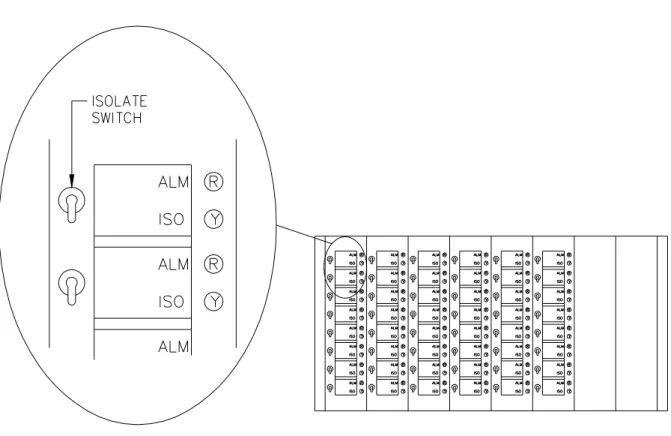
1. Press down the ISOLATE toggle switch next to the zone or point to be isolated - refer figure 3, e.g. ( AZF1 1st Floor East Wing Room 23 ).
Once the toggle switch has been depressed, the yellow ISOLATE LED adjacent to the toggle switch will light ,indicating that the point or zone is now isolated.
HOW TO ISOLATE / DE-ISOLATE A ZONE (continued)
The display will indicate a ISOLATED condition, until the isolated point has been de-isolated.
When a zone is isolated via the zone isolate switches , the condition is indicated on the main 4100 FIP as follows:
- Yellow "SYSTEM ISOLATE" LED is flashing. - Tone-alert is on steady.
- Alphanumeric display shows the following:
**ISOLATIONS** Press ACK to review. ALARMS = 0 ISOLATED = 1 FAULT = 0
1. The panel has a yellow isolate LED which will light whenever an isolation is present in the system. When a zone is isolated, the LED will flash, the tone-alert sounds steady, and a fault message will be displayed on the alphanumeric display. The isolate LED will glow steady and the tone-alert silences when the <ISOLATE ACK> key is pressed.
2. To de-isolate the point or zone, either depress or lift the toggle switch (refer fig 3) , the yellow LED will turn off and the point or zone will be de-isolated.
Once all faults have been removed from the system, the display will read SYSTEM NORMAL.
3. Repeat steps 1 and 2 to isolate the required zones.
Note: Any time a zone is isolated, the event is recorded in the fault log. If an Alarm condition occurs on an isolated zone, the Alarm will still be annunciated on the operator panel, however the brigade relay will not activate nor will any programmed sequence occur.
3.4 HOW TO ISOLATE / DE-ISOLATE INDIVIDUAL DEVICES
As an alternative to isolating a zone of devices, the user may disable individual devices in a zone
3.4.1 Disabling Individual Points/Devices
If a device does not reset, you may disconnect the device/point causing the alarm condition. However this point must first be identified as follows:
1. Press the <ALARM ACK> key and read the alphanumeric display on the interface panel.
2. Open the Operator Panel "Access Door" to expose the additional keys which are available for advanced functions. Then disable the identified alarm point with the <DISABLE> key. If the <DISABLE> key is passcode protected, perform the Log On procedure before performing the Disable procedure (refer section 5.8 Operator Log IN/OUT procedure).
The <DISABLE> key press removes power to any displayed monitor point. Thus disabling a point causes a fault condition to be displayed.
To disable a point, perform the following procedure: 1. Open the Operator Interface Panel access door.
2. Press the <ALARM ACK> key until the point to be disabled is shown on the alphanumeric display, as shown below
M1-1 1st Floor East Wing Room 2 AZF1 SMOKE DETECTOR ALARM
3. Press the <DISABLE> key. The display shows the following message:
Press <ENTER> to DISABLE M1-1
4. Press the <ENTER> key. The display shows the action taken.
NOTE: The system indicates a Fault condition each time a point is disabled. Press the <FAULT ACK> key as required. To clear the alarm condition, follow the System Reset Procedures
5. Repeat steps 2 through 4 above to disable additional points.
3.4.2 Enabling Individual Points/Devices
If a device was disabled for any reason and has been restored, you can enable the point. This point must first be identified to the system. The disabled point causes a system fault condition which is continually shown on the display. This can be viewed by pressing the Fault <ACK> key and reading the display. The point can be enabled by using the <ENABLE> KEY. IF THE <enable> KEY IS PASSCODE PROTECTED, PERFORM "Log On Procedures" then continue.
To enable a disabled point, perform the following steps:
1. Press the <FAULT ACK> key until the point to be enabled is shown on the alphanumeric display, as shown below
M1-1 1st Floor East Wing Room 2 AZF1 SMOKE DETECTOR DISABLE FAULT
2. Press the <ENABLE> key. The display shows the following message:
Press <ENTER> to ENABLE M1-1
NOTE: Read the warning below before performing the following step 3. Press the <ENTER> key. The display shows the following message.
Please stand by...
WARNING
If the zone is still in alarm, a WARNING is displayed which tells you that the system will sound an alarm if the timer (60 seconds) times out. TO ABORT THE ENABLE, PRESS THE <DISABLE> KEY. If an alarm condition exists, the following is shown on the display.
**WARNING** Press <DISABLE> to abort M1-1 will ALARM in 60 seconds
IF THE ABOVE WARNING IS SHOWN ON THE DISPLAY, PRESS THE <DISABLE> OR AN <ACK> KEY. FAILURE TO ABORT THE ENABLE WILL CAUSE AN ALARM CONDITION, CALL THE FIRE BRIGADE AND PUT THE BUILDING INTO FIRE MODE
If the enable process is successful, the following message is shown on the display:
ENABLE COMPLETED
4 FAULT CONDITIONS
When a fault condition is detected by the Fire Monitoring System, the condition is indicated on the main 4100 FIP as follows:
- Yellow "SYSTEM FAULT" LED is flashing. - Tone-alert is on steady.
- Alphanumeric display shows the following:
**FAULT** Press ACK to review.
ALARMS = 0 ISOLATED = 0 FAULT = 1
The panel has a yellow fault LED which will light whenever a fault is present in the system. When a fault occurs, the LED will flash, the tone-alert sounds steady, and a fault message will be displayed on the alphanumeric display. The fault LED will glow steady and the tone-alert silences when the <FAULT ACK> key is pressed.
When Global Acknowledge is used, and the fault clears, the system automatically clears without user intervention. After approximately 30 seconds, the system should display "SYSTEM IS NORMAL followed by time and date".
SIMPLEX AUSTRALIA SYSTEM IS NORMAL
08:23:43 FRI 11 MAR 95
4.1 HOW TO OPERATE THE PANEL DURING FAULT CONDITIONS (Yellow LED Is Flashing And Tone-Alert Is On Steady)
HOW TO OPERATE THE PANEL DURING FAULT CONDITIONS (continued) A. Unlock and open the panel door. The alphanumeric display will show the fault
condition.
**FAULT** Press <ACK> to review points
ALARMS = 0 ISOLATED = 0 FAULT = 1
B. Press the <FAULT ACK> key under the flashing yellow LED. The alphanumeric display will show area and type of fault. The tone alert will silence and the yellow LED will glow steady.
FIRST FLOOR EAST WING AZF1 FIRE MONITOR ZONE OPEN CIRCUIT FAULT
C. Read the alphanumeric display, then investigate the problem to determine its cause.
- Restore or replace the defective device in accordance with device instructions.
- The fault will automatically clear when the problem has been corrected. - After a delay, the alphanumeric display should show:
SIMPLEX AUSTRALIA SYSTEM IS NORMAL
8:23:43 MON 25 JAN 95
4.3 ESSENTIAL FAULT CONDITION KEYS
The essential keys for fault conditions are <FAULT ACK>, and the <SYSTEM RESET> keys. The remaining keys are concealed by the access door and are associated with advanced functions of the system (See Advanced Functions section 5). Use of these keys require advanced user skills.
4.4 FAULT ACKNOWLEDGE KEY
The <FAULT ACK> key is used to scroll through the various displays on the alphanumeric display. It also controls the Fault LEDs and the tone-alert. The <FAULT ACK> key is located directly under the fault LED. Pressing the <FAULT ACK> key will cause the LED to change from flashing to on steady and silence the tone-alert. When the <FAULT ACK> key is pressed, it will:
A. Acknowledge the displayed point or acknowledge all points on the list (Global Acknowledge).
B. Scroll the points chronologically after all points have been acknowledged.
When Global Acknowledge is used on the 4100 system, a single key press will acknowledge all fault changes in the system. If status change information is required, the user may review this data (after a delay) by pressing the <ACK> key and reading the total number of fault changes on the alphanumeric display. If a fault condition has been acknowledged with the <ACK> key and further unacknowledged fault conditions remain in the system, the tone-alert continues to sound and the next status change is shown on the alphanumeric display.
NOTE: Normally, points may not require acknowledgment and do not latch. If the system does not clear, read the display, then check for devices still in fault (manual call points, smoke detectors etc.).
4.5 SYSTEM RESET TO CLEAR FAULTS
Some faults latch until they are reset manually or can be cleared by pressing the <SYSTEM RESET> key once the fault condition has been rectified. This applies to Open Circuit faults on MAPNET and RUI communications lines.
If a monitor point or device intermittently toggles faults or will not reset, the user may elect to ISOLATE the faulty zone or disable the faulty device (refer section 3.3 for isolate procedures).
4.6 FAULT INDICATIONS FOR TrueAlarm™ SENSORS
The devices that are used for TrueAlarm™ operation are considered sensors instead of detectors, because these devices do not determine alarm conditions. The TrueAlarm™ smoke sensor is a measuring device that sends data regarding smoke density to the 4100 control panel. The TrueAlarm™ heat sensor operates in a similar fashion, but sends temperature data instead of smoke density data. The 4100 uses this data to determine whether a fault has occurred. This basic operational difference is the key to TrueAlarm™ operation.
The TrueAlarm™ sensor has two automatic fault conditions: Ê Dirty, and
4.6.1 Dirty Fault Indication
A sensor specific "dirty" fault condition is reported any time the average value on an individual sensor reaches a set threshold. At this point in time the 4100 FIP is still compensating for environmental factors and holding the set sensitivity level. The sensor should be scheduled for cleaning.
LEVEL 2 - ROOM 74
SMOKE DETECTOR DIRTY
The 4100 FIP includes a pre-programmed software point that can be turned on to generate an "almost dirty" indication. This point is useful when maintenance is being scheduled for dirty detectors as it provides a means to see if other sensors are approaching a dirty indicator level.
LEVEL 2 - ROOM 74
SMOKE DETECTOR ALMOST DIRTY
4.6.2 Excessively Dirty Fault Indication
An "excessively dirty" fault indication is reported anytime an individual sensor's average value reaches a slightly higher threshold level. At this point the 4100 FIP can no longer compensate for dirt and dust contamination and the sensitivity level may begin to drift. Because false alarms are possible with this condition, sensors must be cleaned as soon as possible. Although an "excessively dirty" fault condition is reported, the sensor will continue in operation and will report an alarm condition if one is detected.
LEVEL 2 - ROOM 74
SMOKE DETECTOR EXCESSIVELY DIRTY
4.6.3 Self Test Abnormal Fault Indication
In addition to the automatic dirty Fault and excessively dirty indicators, the 4100 FIP automatically tests all TrueAlarm™ sensors once every minute. This test raises the value of each sensor to a value that simulates an alarm. If a value that is not in the alarm range is reported back to the panel a "self test abnormal" fault will be displayed for that specific sensor. Since the sensor is not working properly, it must be replaced immediately.
LEVEL 2 - ROOM 74
5 ADVANCED FUNCTIONS
When more involved functionality/control is required, simply open the "Access Door" to expose the additional keys which are used for advanced functions. Figure 6 below shows the panel with the access door open and the advanced function keys.
5.1 CONTROL KEYS
Five "CONTROL" keys with their individual LED's are located on the far left of the panel Normally, these keys and LEDs will be concealed by the access door. A custom label is used to identify the desired function. Typical functions for these keys will be used for the following functions:
Ê Brigade Test Ê Battery Test Ê Alarm Test Ê Fault Test Ê ACF Isolate Figure 7 Control Keys CAUTION
These keys can be pressed anytime, and the key feedback (beep) may be the only acknowledgment of the action. Typically, the LED will track the function and illuminate each time its respective key is pressed.
5.2 FUNCTION KEYS
Four function keys (<F1>, <F2>, <F3>, and <F4>) are located directly above the alphanumeric display (refer Figure 8). Within the Main Function Menu options, these key definitions will change as required to perform specific actions for selected Main Function Menu options. Some menu options may not require any key operation, while others will require all four. The definitions of each physically activated key will be shown on the top line of the alphanumeric display as an aid to the user. A function key does not require any other key to be pressed to activate its function. Pressing a key immediately performs its defined task. Pressing a key which has no defined action for the current function has no effect, however, the tone-alert will acknowledge the key press with a "beep".
These four keys are associated with advanced functions of the system within the Main Function Menu options, and within point displays. The <F1>, <F2>, <F3>, and <F4> keys have extended actions defined during point displays used in conjunction with the <FUNCTION> key.
Figure 9
5.3 HOW TO SET TIME AND DATE
The following is an example of how to use the function keys to set the time and date. A. Press the <MENU> key. The following will be shown on the alphanumeric
display.
Press <NEXT> or <PREVIOUS> to scroll Change Access Level
B. Press the <NEXT> key. The following is displayed:
Press <NEXT> or <PREVIOUS> to scroll Set Time and Date
C. Press the <ENTER> key. The current time and date information is displayed along with instructions:
Press <FUNC> to change time and date 0:09:23 FRI 01 JAN 88
D. Press the <FUNC> key. The cursor, current time and date along with function key definitions are displayed:
F1=Left F2=Right F3=Inc F4= Dec 0:09:23 FRI 01 JAN 88
NOTE: The cursor is positioned under the hour. Function key F1 will move the cursor left. Function key F2 will move the cursor right. Function key F3 will increase the data above the cursor . Function key F4 will decrease the data above the cursor. Set the time 1 minute ahead of source time. E. Use the required function key to position the cursor under the data to be
changed (hour, minutes, seconds, date of month, month, and year). Day of week is set by the system. Time entered does not start until the <ENTER> key is pressed.
When time and date are correct, press the <ENTER> key. The display will show the updated time and date. The time entered will not start until the <ENTER> key is pressed.
Press <FUNC> to change time and date 22:04:46 SUN 01 MAY 95
5.4 HOW TO ESCAPE FROM MENU
A. Press the <CLR> key. The following will be displayed:
Press <NEXT> or <PREVIOUS> to scroll Select a List of Points
B. Press the <CLR> key again. The following will be shown:
SIMPLEX AUSTRALIA SYSTEM IS NORMAL
22:05:10 SUN 01 MAY 95
5.5 POINT CONTROL WITH THE FUNCTION KEY
Many of the functions performed from the front panel will control point-specific data. The user of the panel can control points using the <FUNC> key.
The <FUNC> key enables the user to view additional status information concerning the point currently displayed on the alphanumeric display. The point selected on the alphanumeric display can be manually entered through the ENTRY keypad, or may be the point displayed because of an abnormal condition. Definitions for a function key or several function keys may be shown in the alphanumeric display. Extended controlling actions are also available with the following:
A. Clear Verification Tallies B. Clear Alarm Tallies. C. Set Control Priorities.
D. Display Analog Timer/Counter Values. E. Flash the Fault LED on the daughter card.
To select an extended controlling action, the user must first select a point, press the <FUNC> key, then press the <ENTER> key. One of the extended actions (see list above) will then appear on the top line of the alphanumeric display as shown below:
MONITOR POINT 1, ZONE 1 AZF1 FIRE MONITOR ZONE 1 NORMAL AFTER <FUNC> KEY PRESS
F1= Clear Verification Tally
FIRE MONITOR ZONE UNVERIFIED=6
The user will then press the <FUNC> key to view the status of the selected point. The tone-alert will beep and a different status is shown on the alphanumeric display each time the <FUNC> key is pressed. In some cases, the user can then take action to change point data. This technique may be used for each of the extended controlling actions.
The extended controlling action shown above is for monitor zones. 5.6 DISPLAY/ACTION KEYS
The "DISPLAY/ACTION" keypad provides eleven keys which allow users with appropriate access level, the ability to perform controlling functions on the system zones, MAPNET devices, signals, and auxiliary control relays. Six keys are associated with Display while five keys are Action keys.
Action key presses require a confirmation <ENTER> key to be pressed before performing the action on the point identifier displayed. These "DISPLAY/ACTION" keys are concealed by the access door.
The following keys are DISPLAY keys: Ê FUNCTION Ê MENU Ê PREVIOUS Ê NEXT Ê LAMP TEST Ê DISPLAY TIME
The purpose of each DISPLAY key is described in the following paragraphs
5.6.1 Function Key Operation
The <FUNCTION> key is used to obtain more information concerning the point in the display. These points can be brought up on the main menu as previously explained. <FUNCTION> key presses will scroll through all the status information. This data will be displayed on the bottom line. The top line will contain the 40 character label of definitions for <F1>, <F2>, <F3> and <F4> keys.
A point will normally be displayed with its forty character custom label on the top line. If no custom label exists for the point, the top line will display the point identifier. The bottom line will contain the device type and its present status. Point types are assigned when the system is configured, and are determined by their card type and the physical devices on its zones.
The following are available for display on the alphanumeric display. A. Point address and Zone number.
B. Card type and Point type.
C. Present Status (Normal, Alarm, Fault). D. Disconnect/Disable Status.
E. McCulloh Fault (Status of Class "A" Cards). F. Relay status for Control or Signal Points. G. Verification Tallies for Verification Zones. H. Coding Status for Coded Zones.
I. Control Priority for Relays.
J. Feedback Point Status for Relays.
In addition to the items above, the following items are for TrueAlarm sensors only: * Present sensitivity selected
* Average value * Alarm value
* Current value (per cent of alarm) * Peak value (per cent of Alarm)
5.6.2 MENU Key
The <MENU> key will call up the Main Function Menu Option List and display the first option on the list. The Main Function Menu provides operations which are separate from those used for fire alarm conditions. These non-critical functions are selected with the <MENU> key.
The <NEXT> and <PREVIOUS> keys are used to scroll through the menu options. The <ENTER> key selects the displayed option. The following are the Main Function Menus:
A. Access Level
B. Set Time and Date?
C. Display Historical Alarm/Fault Log? D. Select a List of Points?
E. Display Software Revision Level? F. Display Card Status?
G. Enable Walk Test?
H. Run Diagnostic Functions? I. Programmer Download? J. Exit Menu List?
5.6.3 PREVIOUS Key
The <PREVIOUS> key is used in Main Function Menu options and in point list displays to scroll to the previous option, item, or point. This key works like the <ACK> keys for Alarm, Supervisory, and Fault conditions. Holding this key in will continuously scroll backward. If the first item in the list or menu has been shown, pushing the <PREVIOUS> key will cause the list to wrap around backwards to the end of the list.
5.6.4 NEXT Key
The <NEXT> key is used in Main Function Menu options and in point list displays to scroll to the next option, item, or point. This key also works like the <ACK> keys for Alarm, Supervisory, and Fault conditions. Holding this key in will continuously scroll forward. Whenever the last item in a list or menu has been shown, pressing the <NEXT> key will again cause the list to wrap around to the start of the list.
5.6.5 LAMP TEST Key
Pressing the <LAMP TEST> key will turn on the five Control Key LED's, Isolate LED, System Alarm LED, System Fault LED, and the LEDs on local LED/switch modules. All segments on the alphanumeric display will be turned on as a test pattern. After a three seconds sustained press, the Tone-alert will be turned on. When the <LAMP TEST> key has been released, all LEDs, alphanumeric display, and tone-alert will be restored to their previous states.
5.6.6 Action Keys
There are six action keys on the display/action keypad: Ê Disable (Isolating a point)
Ê Enable (De-Isolating a point) Ê Off - Turning a point OFF Ê On - Turning a point ON
Ê Auto - Return a point to Auto Control
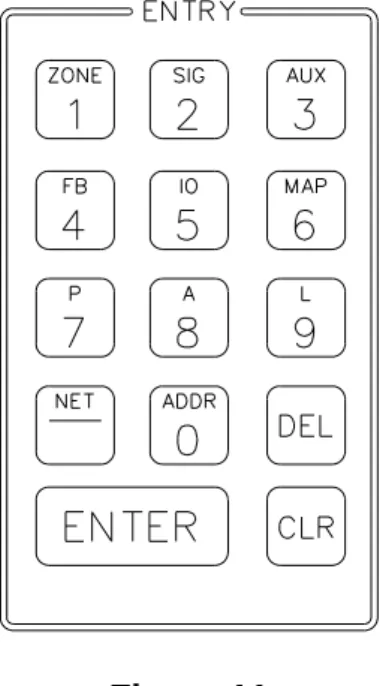
5.6.7 Entry Keypad
The ENTRY keypad is located to the far right on the operator interface panel and is concealed by the access door. There are fourteen keys on this keypad as shown in Figure 11.
Figure 11 ENTRY Keypad
These keys are used to enter passcodes, identifiers, or numeric data for the system. Whenever the system expects numeric data input, the user is notified with a prompt. Numeric data input requires an <ENTER> key press to complete the keypad entry. Numeric keys also double as "prefix" keys. When entering a point, a prefix key must be used to identify how the entry is made. Pressing the zone key (key 1) indicates that the next numeric entry is a zone number. Pressing the address key (key 0) indicates that an address identifier is entered.
5.7 VIEWING POWER SUPPLY/CHARGER VOLTAGE AND CURRENT READINGS
To view power supply voltage and current readings, perform the following procedure. 1. Press the <MENU> key on the DISPLAY/ACTION keypad. Then press the
<NEXT> key six times.
• The alphanumeric display reads:
Press <NEXT> or <PREVIOUS> to scroll Display Card Status?
2. Press the <ENTER> key on the ENTRY keypad. Then press the <NEXT> key once (or until the display reads:)
CARD n, POWER SUPPLY/CHARGER
CARD STATUS NORMAL NOTE: “n” = Card number
3. Press the <ENTER> key. Then, using the <NEXT> or <PREVIOUS> key to scroll, check voltage/current readings on the Power Supply/Charger card.
5.8 POINT SELECTION
5.8.1 Selecting Points Using Lists
Many of the functions performed from the interface panel display point specific data. Every system point is part of the “Select a List of Points” list in the main menu. All points can be displayed sequentially by address order using this list option. To facilitate the search for a particular point, lists may be selected by type groupings (monitors, signals, auxiliary, input/output, pseudo points, etc.). A list of points may be selected, then scrolled through by using the <NEXT> and <PREVIOUS> keys. Selecting a list of points will expedite the search for a specific point with a minimum of scrolling.
The following lists are available for selection with the “Select a List of Points” option from the Main Function Menu:
• All Monitor Zones
• All Signal Points
• All Auxiliary Relay Points
• All Auxiliary Feedback Points
• All Zones of 24-Point I/O Card
• All Digital Pseudo Points
• All Analogue Pseudo Points
• All List Pseudo Points
• All Points by Address List
• All Network Points.
5.8.2 Selecting Points Using the Keyboard
Rather than scrolling through a list, you may use the keypad to select a point. If the input represents a valid point in the system, that point will be shown on the alphanumeric display. After a point has been displayed, you can scroll through all the points in the system from that point, or select another point directly by entering another identifier using the keypad.
You have the choice of entering a point number or an address number. The format for entering a point identifier address requires a hyphen. Only numbers and the hyphen keys are valid entries. The maximum number of digits allowed in an identifier input is eleven (11), including the hyphens, excluding the <ENTER> key. 5.8.3 Selecting Additional Lists
When an abnormal condition occurs, a record of the event is placed in one of two logs generated by the system, depending on the nature of the condition. These logs are:
• Historical Alarm Log
The historical logs contain a time stamp of the events surrounding abnormal conditions in the system. The information displayed with these lists are historical data only and will not contain any current point status. Separate lists are maintained for alarms and for isolates/faults. These lists are displayed by selecting the “Display Historical Log” option from the Main Function Menu.
5.9 OPERATOR ACCESS LEVELS
Operator access levels 1 through 4 are available to support the system. Level 1 is the lowest operator access level and does not require a passcode to be entered to access functions identified at this level. Level 2 through 4 require a passcode of the required level or higher to be entered prior to performing the passcode protected function. Controlling actions may be classified with access levels 2 through 4. Routine actions are assigned to low access levels while access level 4 is reserved for special, highly sensitive operations (normally reserved for Simplex personnel). Entering a level 4 passcode enables you to access all the functions of the system. A valid passcode must contain a minimum of 3 digits and not more than 10 digits. The available digits are 0 through 9. Passcodes are specified during order entry; then, programmed during system configuration. When passcodes are not specified, the following default passcodes are assigned.
LEVEL PASSCODE RANK
1 NONE LOWEST
2 222 SECOND
3 333 THIRD (Highest Operator Access Level)
4 XXX HIGHEST (Normally used by Simplex Personnel) The operator access level defaults to level 1 when power is first applied to the system, after 10 minutes of keypad inactivity, and when the user elects to log out. The <SYSTEM RESET> key press has no effect upon the access level.
The only way to increase the operator access level in the system is to select the “Change Access Level?” option in the Main Function Menu. Decreasing the level resets system access level to 1. Increasing the level requires a valid level 2, 3 or 4 passcode. The user is prompted to enter a passcode. The input is compared to all the valid system codes, and the system operator access level is set accordingly. If an invalid code is input, you will be notified with the message “ERROR. . . INVALID PASSCODE”, and will be allowed up to three chances to enter a valid code. After three unsuccessful tries, the message “ACCESS DENIED” will be displayed for a short time. The access level will not be altered, but you will no longer be in the “Change Access Level” menu option.
If a correct passcode is entered, the message “ACCESS GRANTED” is displayed. The new operator access level will be in effect until the keypad is inactive for 10
While entering a passcode with the keypad, the key presses are acknowledged by a “beep”. The digits entered are not displayed. The cursor moves along, filling the position with an X to indicate that a digit has been entered. The <DEL> key can be used to delete the last digit. The <ENTER> key press is required to enter the passcode into the system.
The Action Keys, ON, OFF, AUTO, ENABLE, DISABLE and the five Panel Control Keys may have operator access levels associated with them. If such a key is pressed with an insufficient access level, a message will inform you that the action was not taken and the key press is ignored. The user will have to select the Main Function Menu option to increase the access level before using the key. (See Log in Procedure for details.)
The Acknowledge Keys may also require passcodes to acknowledge abnormal conditions. If you press an <ACK> key with insufficient access, an error message will be displayed. The points will scroll with <ACK> key pressing to allow you to view the points on the list, but the points will not be acknowledged. (See Log in Procedure for details.)
5.10 POWER UP SEQUENCE
Whenever power is applied to the 4100 panel, or when the 4100 Master Controller microprocessor has been reset, the 4100 self-tests its memory integrity and verifies card configurations. Next, the 4100 displays the system startup in progress messages, followed by a fault condition. Battery fault conditions normally clear automatically.
The green POWER ON LED illuminates immediately after AC power is applied to the 4100. Make sure that the green LED is illuminated before connecting the battery power harness.
IMPORTANT
To power up the 4100, apply 240 VAC to the unit. Wait until the GREEN POWER ON LED has illuminate; then connect the battery power harness.
To power down the 4100, disconnect battery power harness; then, turn the 240 VAC power OFF.
5.11 VIEWING THE HISTORICAL ALARM AND FAULT LOGS
The Historical Alarm and Fault Logs can be viewed either from the 4100 Operator Panel or from the CRT Terminal . This section describes accessing the Historical Logs from the 4100 FIP, refer to CRT Operator Manual for CRT Terminal operation. 1 Press the <MENU> key on the DISPLAY/ACTION keypad.
2. Using the <NEXT> and <PREVIOUS> keys on the DISPLAY/ACTION keypad, scroll through the Main Menu items until the "Display Historical Alarm Log?" or "Display Historical Fault Log?" menu prompt appears on the alphanumeric display.
3. Press the <ENTER> key on the ENTRY keypad.
4. Using the <NEXT> and <PREVIOUS> keys on the DISPLAY/ACTION keypad scroll through the list of logged events, until the desired event is shown on the display.
NOTE: Pressing the <PREVIOUS> key first, causes the most recent event to be displayed.
5. When finished, press the <CLR> key on the ENTRY keypad to escape from the main menu.
5.12 OPERATOR LOG IN/LOG OUT PROCEDURES
Various functions may be passcode protected to prevent access by unauthorised personnel. Passcodes are provided to the user during system installation. To change or receive additional information concerning your passcodes, contact your local Simplex Branch Office.
5.12.1 Access Level Log-In Procedure To Log on, perform the following procedure. 1. Obtain the appropriate passcode information. 2. Open the interface panel access door.
3. Press the <MENU> key on the DISPLAY/ACTION keypad on the right side of the interface panel. The following is displayed.
4. Press the <ENTER> key on the DISPLAY/ACTION keypad the following is displayed.
F1=Login F2=Logout
CURRENT ACCESS LEVEL = 1
5. Press the <F1> key (above the alphanumeric display). The display shows the following.
Enter a Passcode followed by <ENTER>
6. Enter the passcode. Press the <ENTER> key on the Entry keypad. For security reasons, an "X" is displayed for each digit of your passcode, as shown below.
Enter a Passcode followed by <ENTER> XXX
If the passcode is correct, the following is shown.
Enter a Passcode followed by <ENTER> ACCESS GRANTED
After a brief pause, the display shows the granted access level, such as level 3 access message shown below.
F1=Login F2=Logout
CURRENT ACCESS LEVEL = 3
7. Press <CLR> key on the ENTRY keypad twice. The display shows system status, as shown below.
SIMPLEX AUSTRALIA SYSTEM IS NORMAL 8:23:43 MON 25 JAN 93
5.12.2 Access Level Log Out Procedure To Log out, perform the following procedure.
1. Press the <MENU>key on the DISPLAY/ACTION keypad.
2. Press the <NEXT> key until the menu prompt "CHANGE ACCESS LEVEL?" appears on the alphanumeric display.
3. Press <ENTER> on the ENTRY keypad.
4. Press the <F2> key (above the alphanumeric display) to Log Out.
6 DISPLAYING MAPNET DEVICE STATUS
The MAPNET option allows the use of addressable devices and TrueAlarm sensors with the 4100 FIP. Addressable devices communicate the exact location of an alarm to the system operator interface panel, improving recognition of the condition and subsequent response. It also pinpoints the precise location of fault conditions via the device custom label.
6.1 MAPNET DISPLAY INFORMATION
When a MAPNET device changes to an abnormal condition, or the operator enters a MAPNET device address, the LCD display shows the current status of the MAPNET device. After entering a MAPNET device address, press the <FUNCTION> key on the operator interface panel to display additional device information.
6.2 MAPNET POINT ADDRESSING
Each MAPNET device must have a point address in order to communicate with the 4100 FIP. these point addresses along with their custom labels are located in the Programmers Report. The Programmers Report shows the address for each device, separated by hyphens. Hyphens must be used when entering a MAPNET address into the system. An example of a MAPNET device address is "M1-5". The "M1" portion of the address identifies the MAPNET loop or channel , loop 1 or channel 1. The "5" portion of the address, identifies the device number, number 5. MAPNET loop numbers range from 1 through 9, and 0, with MAPNET loop 0 actually being channel 10.
6.2.1 How to Display a MAPNET System Point
See section 5, "How to Use DISPLAY / ACTION Keys to Display System Points" for MAPNET operations.
6.2.2 What To Do If a MAPNET Point Will Not Reset
If a MAPNET device will not reset, you may decide to disable the point with the <DISABLE> key. When the disable procedure is performed, a System Fault occurs to remind you that the point is disabled. The disable procedure is the same for all system points (see section 2, "How to Disable a Point"). Maintenance personnel must be called immediately to repair the malfunction. After the MAPNET point is repaired, you can enable the point again .
6.2.3 TrueAlarm Sensor Display Values
Using the 4100 LCD and the display/action keys, the control panel can display various status conditions for each TrueAlarm sensor, the sensor's present selected sensitivity level as a percent of obscuration per foot. This selected sensitivity level is the value at which the FIP will cause an alarm condition. Seven (7) sensitivity levels are available for the TrueAlarm photo-electric sensor. The most sensitive setting is 0.2% OBS/FT (0.5% OBS/M) with the least sensitive setting being 3.7% OBS/FT (11.5% OBS/M)
Other individual sensor status conditions that can be displayed on the LCD display are shown below. These displays are accessed by either confirming a MAPNET device number for a normal device (Map/6 Key) or by pressing the FAULT ACKnowledge key for an abnormal device. To display each of the categories the function key and the NEXT and PREVious keys are used as shown below.
M1-1 Level 3 - Room 74 AZF1 Smoke Detector Normal
Press the <FUNC> key to obtain the next display:
Device Address: 3-1 Mapnet Device: M1-1
Press the <NEXT> key to obtain the next display:
F1-Force on card LED Type: Mapnet 1 MAPNET CARD
Pressing function key <F1> will turn on the LED indicator on the MAPNET Card in the FIP control rack as long as the function key is depressed. Press the <NEXT> key to move onto the next display.
F1-Force on device LED Type: PVPHOTO Variable Sense PHOTO with Sounder
Pressing function key <F1> will turn on the LED indicator on the selected smoke detector and as long as the function key is depressed. Press the <NEXT> key to move onto the next display.
Level 3 - Room 74
Smoke Detector ON-LINE
Press the <NEXT> key to move onto the next display to verify correct device type:
Level 3 - Room 74
Smoke Detector Correct Device
Press the <NEXT> key to display the current selected sensitivity
Level 3 - Room 74
Present Sensitivity Selected - 3.7% Smoke
To view the average value of samples received from the sensor press the <NEXT> key again
Level 3 - Room 74
Average Value = 75 / Alarm Level - 135
This is the present average of the last 2048 samples received from the sensor. The Alarm Level is the binary value that is used to determine alarm conditions. This value will change over time as the panel compensates for environmental conditions. This value will be different for each of the (7) sensitivity levels.
To view the last binary value that was received from the sensor press the <NEXT> key again
Level 3 - Room 74
Value = 75 / 6% of Alarm / 0.1% Smoke
Press the <NEXT> key again to View the highest binary value that was received and stored from the sensor since power-up .
F1- Clear PEAK Value
PEAK= 106 / 51% of Alarm / 1.0% Smoke
The peak is displayed as a % of alarm an a % of smoke obscuration. Through the use of a system pseudo point all new peak values per sensor can be stored in the history trouble log and printed on the 4100 system printer. Printing of peak values is done at the time the peak value is received at the FIP. This peak value is helpful in determining if a sensor should be made more or less sensitive.