Ex-Post Evaluation of Projects
and Activities Financed under
the LIFE Programme
Final Report
Part 1: Methodology and description of the
LIFE Programme and its policy context
Julyl 2009
Directorate General Environment, Unit E.4.
LIFE
Ex-Post Evaluation of
Projects and Activities
Financed under the LIFE
Programme
Final Report
Part 1: Methodology and description of the
LIFE Programme and its policy context
July 2009
Denmark Tel +45 45 97 22 11 Fax +45 45 97 22 12 www.cowi.com Document no. 7-1 Version 1 Date of issue July 2009Prepared BIM, TVGU, STEH, ROKR Checked NEO, IL, TIH Approved BIM
This report has been prepared as a result of an independ-ent evaluation by COWI being contracted by the Director-ate General Environment
The views expressed are those of the Consultant and do not necessarily reflect those of the European Commission.
Table of Contents
Part 1:
Methodology and description of the LIFE
Programme and its policy context
2
1
Introduction 2
2
Methodology 3
2.1
Evaluation design
3
2.2
Approach to data collection and analysis
5
2.3
The evaluation process - activities, time and
resources 12
3
The LIFE Programme and its policy context
16
3.1
The anatomy of the LIFE Programme
16
3.2
Overview of LIFE projects during the period 1996 to
2006 20
Table of Appendices
Appendix 1
Indicators for assessment of results and impacts
Appendix 2
Detailed questions, success criteria and indicators
Appendix 3
E-survey questionnaire
Appendix 4
E-survey responses and data validity
Appendix 5
Nature and Environment projects selected for in-depth study
Appendix 6
Third country projects selected as case projects
Appendix 7
List of people met
Appendix 8
Bibliography
Part 1: Methodology and description of the LIFE Programme
and its policy context
1 Introduction
This document constitutes Part 1 of the final report in connection with the Ex-post Evaluation of
Projects and Activities under the LIFE Programme.
This first part of the report provides the background for the evaluation, explaining the methodology used
(Chapter 2) and some key characteristics of the LIFE Programme and the projects co-financed under it
(Chapter 3).
2 Methodology
This chapter presents the evaluation methodology applied. The methodology was developed during the
inception phase of the evaluation based on the Terms of Reference (TOR) and the Consultant's proposal
and following the EU Evaluation Guidelines
1, and the standard evaluation criteria as specified in these
guidelines. A comprehensive report on the development of the methodology was given in the Inception
Report.
This chapter provides an overview of the evaluation design in section 2.1, the approach to data
collection and analysis in section 2.2 and, finally, in section 2.3, an overview of the evaluation process
is provided.
2.1 Evaluation
design
2.1.1 Evaluation
criteria
During the inception phase, the evaluation criteria suggested in the TOR were reviewed in light of the
objectives listed in the TOR and the requirements of the EU Evaluation Guidelines. This led to a
revision of the criteria thereby narrowing and focusing the scope of the evaluation. The following
criteria were identified as focus criteria: Effectiveness, efficiency, sustainability and utility. In addition
the criteria of acceptability and consistency were identified as secondary criteria.
2.1.2
Three components and nine evaluation questions
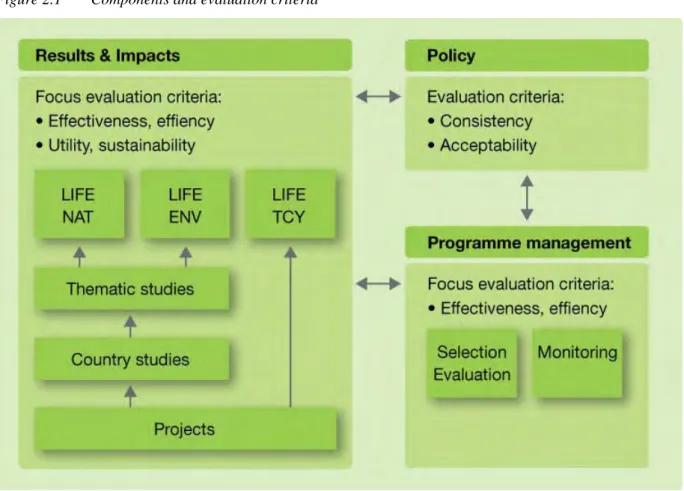
The evaluation is structured into three main components. Figure 2.1 illustrates how the evaluation
criteria apply.
1
Figure 2.1
Components and evaluation criteria
Source: Developed by Consultant
Results and impacts
The first component, comprising the bulk of the evaluation, concerns the evaluation of the results and
impacts generated by the LIFE Programme, i.e. the analysis of the actual LIFE intervention and its
effects, taking point of departure in the LIFE projects. The evaluation of results and impacts comprise
the three LIFE components: NAT, ENV and TCY. The analysis of LIFE NAT and ENV has been
carried out in the form of country studies
2, which feed into thematic studies as illustrated by the left side
of the diagram in Figure 2.1.
Policy
The second component relates to the LIFE Programme as a policy and considers its relations to other
policies and how it is assessed by stakeholders.
Programme management
Finally, the component concerning programme management comprises an evaluation of organisation
and working methods of the LIFE Unit in managing the LIFE Programme, focusing on the effectiveness
and efficiency of the Unit in evaluating and selecting projects and monitoring selected projects.
The nine main evaluation questions which guide this evaluation emerge from the above mentioned
components.
1.
What are the results and impacts of the LIFE Programme?
2
Effectiveness:
2
. To what extent are the results of the LIFE Programme in line with the objectives?
3.
To what extent do the LIFE unit organisational setup, and the modalities for selection/monitoring of
projects, contribute to the effectiveness of the programme/projects?
Efficiency:
4
. To what extent is the cost at which results have been achieved reasonable when considering the
costs of comparative interventions?
5.
To what extent do the LIFE unit organisational setup, and the modalities for selection/monitoring of
projects, contribute to the efficiency of the programme/projects?
6.
Utility:
To what extent do the results and impacts generated by the LIFE Programme address the
environmental issues facing the EU and the stakeholders involved?
7.
Sustainability:
To what extent are the positive results and impacts generated by the LIFE
Programme likely to last after the termination of the projects?
8.
Consistency/coherence:
To what extent has the LIFE Programme been
complementary/supportive/contradictory to other EU policies and programmes?
9.
Acceptability:
To what extent do stakeholders accept the LIFE Programme and LIFE projects?
These nine evaluation questions are supported by a number of sub-questions and a detailed framework
for assessing each question in the form of success criteria, indicators and data sources. Appendix 2
provides an overview of these for each of the components in the evaluation. The framework described in
Appendix 2 is used as the reference guide for data collection and analysis as is further described in the
section below.
2.2
Approach to data collection and analysis
Data collection and analysis was performed in accordance with the framework provided in Appendix 2.
All data collected was used to validate (or negate) the success criteria, which fed into the analysis of the
evaluation questions and the formulation of conclusions and recommendations. The process varied for
the evaluation's three components and is therefore described in separate sections in the following
sections.
2.2.1
The results and impacts component
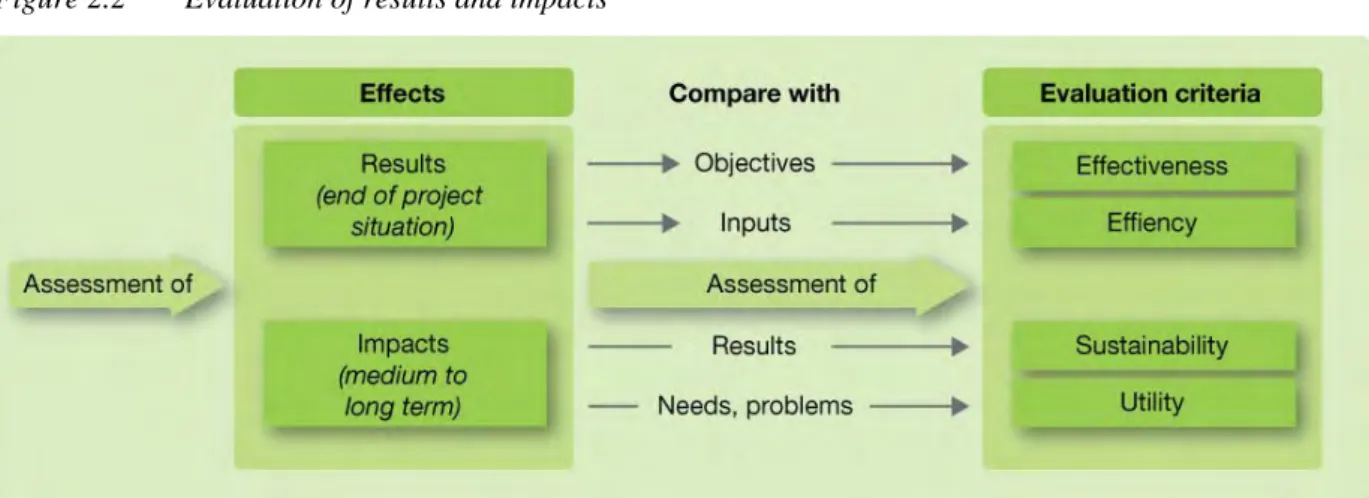
The evaluation of results and impacts implied two major steps, as illustrated in Figure 2.2. The first step
was an assessment of the effects (results and impacts). On the basis of the evaluation on effects, an
assessment on effectiveness, efficiency, utility and sustainability was made.
Figure 2.2
Evaluation of results and impacts
Source: Elaborated by Consultant
Division into two steps emphasises the fact that the assessment on the effects (results and impacts) of
the LIFE Programme is an output in itself and that an assessment is necessary in order to gauge
effectiveness, efficiency sustainability and utility.
Step 1: Assess effects
The assessment of effects requires the identification of indicators which can be used to describe the
effects. For the Nature and Environment components the indicators established are described separately
in Appendix 1. For the Third Countries component, the indicators have been integrated in the
framework described in Appendix 2. The Nature and Environment indicators are divided according to
the following main effect categories:
•
Environmental (improved state, reduced pressure, etc.)
•
Management (improved management, planning, administration)
•
Awareness (increased awareness)
•
Demonstration ("showcase effect")
•
Innovation (development of new technology or improvement of processes)
In the assessment of effects, we distinguished between results and impacts. We defined results as the
end-of-project situation, as reported in final reports and project summaries. For on-going projects,
results were assessed based on expected results as reported on in mid-term reports, etc. Impacts were
defined as the medium to long term effects in the period after finalisation of the project and assessed
primarily on the basis of e-survey responses and in-depth project studies. The completion dates of the
projects obviously vary considerably and some projects are still "on-going" (in progress). In general, the
assessment of impacts has greater validity for older projects. Impacts for recent or on-going projects
were assessed based on expected impacts, taking into account the results and relevant framework
conditions.
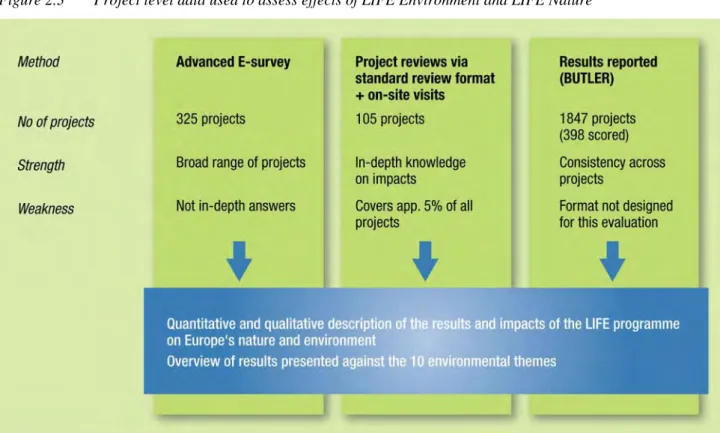
We used three main sources of project level data, as illustrated in Figure 2.3 below. In addition to
amassing the project level data, we have also carried out interviews with national focal points
(key/relevant country representatives), the monitoring team, DG Environment policy units and LIFE
Unit staff. The data collected through these interviews is thematic rather than project-specific and thus
serve as a fourth data/information source on results and impacts of the LIFE Programme.
Figure 2.3
Project level data used to assess effects of LIFE Environment and LIFE Nature
Source: Developed by the Consultant
The primary purpose of the
e-survey
3was to gather data on the results and impacts of as many projects
as possible through targeting the project managers of LIFE projects. The questions in the e-survey were
organised according to the indicators for results and impacts. We had hoped for a response rate of 25%,
however, in total 275 projects managers of LIFE Nature or Environment projects completed the
questionnaire, corresponding to 15% of all Nature and Environment projects implemented during the
evaluation period. In addition, 219 project managers partly completed the questionnaire. We assessed
that 50 of the non-completed responses can be used as data sources, which brought the response rate to
18%.
Originally, the methodology was built on the assumption of a higher response rate. The implications in
using the results from the e-survey were different for the Nature and Environment components due to
the response rate, different characteristics of the portfolio of projects and the number of projects within
the themes. For the Nature component, with 771 projects in total and e-survey responses covering 158
projects the response rate was 20%. Furthermore, the Nature projects were dealt with as one large theme
and the projects within the theme were relatively homogeneous. For this reason the e-survey data was
assessed as representative of the total Nature project population and acceptable as a basis for forming
conclusions at aggregate (EU) level.
3
The e-survey was designed to provide input to all three components and consisted of two sections: One section aimed at project managers of LIFE Nature and Environment projects in the period 1996-2006 while a general section aimed at all stakeholders concerned with the LIFE Programme. The first section aimed to generate data on results and impacts of the projects as well as solicit the opinions and perceptions of the project managers of the management and administration of the LIFE Programme. The general section of the e-questionnaire aimed at obtaining comments and opinions on the LIFE Programme in general from a broad base of stakeholders. The e-survey questionnaire is included as Appendix 3.
LIFE Environment projects constitute a very heterogeneous group by comparison. Even when
considering the projects categorised under the same theme (e.g. air), there is much variance. At the same
time the response rate for Environment projects was also lower with 167 responses for 1076 projects in
total (16%). The response rate was lower for some Environment themes and higher for others.
Considering the variance in projects, the e-survey results were not considered as sufficient basis to form
conclusions. The thematic studies therefore reviewed a number of project summaries within each theme
in order to obtain an extra data source on project effects and ensure validity and authenticity. Appendix
4 provides more background of the analysis of the representativeness of the e-survey data.
The
105 projects selected for in-depth study
were selected according to a range of criteria in order to
attain the highest possible level of representation compared to the overall portfolio of Nature and
Environment projects. The criteria did not incorporate country or thematic specific criteria. In Appendix
5, the selection process, criteria and list of projects is described. The in-depth studies were performed
through review of final reports and monitoring files, interviews with project managers, and site visits
where relevant. A site visit has been made where this was logistically possible and allowed for actual
observation of results and/or impacts of the project. The in-depth project studies were performed as part
of the country studies but fed into the thematic studies as well. No projects were selected for the ENV
themes on forests and chemicals as there are very few projects, which fall under these two themes.
These thematic studies relied to some extent on desk reviews of selected projects instead of in-depth
project studies.
From the
BUTLER database
, we extracted descriptions of project results given in project summaries as
well as the project rating designated by the LIFE Unit in the more recent projects. In total 398 of the
1847 Environment and Nature projects have been scored.
The data collection and analysis related to LIFE Third Countries (TCY) was guided by specific
evaluation questions, success criteria and indicators, as described in Appendix 2. This is because the
LIFE TCY component was implemented with objectives that differ substantially from the LIFE Nature
and LIFE Environment components
4. Consequently, the approach to data collection and analysis also
differs from that used for LIFE Environment and LIFE Nature. Data collection on LIFE TCY included a
desk review, interviews and project case studies. The desk review was based on the information
available on the LIFE Website, BUTLER (progress reports, monitoring reports and evaluation reports)
and information contained in the relevant reports/publications provided by the LIFE Unit. Interviews
were carried out with the key stakeholders in the LIFE Unit in DG Environment and in DG RELEX, and
DG AIDCO. In addition, 17 of the 179 projects co-financed by LIFE TCY in 16 countries, were selected
as case studies, including document review, telephone interviews with the national country coordinators,
the EU delegations and the beneficiaries. The selection procedure and the projects selected are
documented in Appendix 6.
4
During the evaluation period Cyprus, Estonia, Latvia, Lithuania, Malta, Slovenia and Poland were TCY countries and
became part of LIFE NAT and ENV upon their accession to the EU. However, the accession countries had the
possibility to apply for projects under the NAT and ENV components. Most accession countries made use of this option
and, consequently, only Cyprus and Malta have actually implemented TCY projects during the evaluation period. The
country studies in Malta and Cyprus will include TCY related questions and the data collected will feed into the TCY
study. Hence, the country reports (dealing with the implementation of LIFE Nature and Environment) on Malta and
Cyprus will not contain a specific assessment on the TCY projects. This assessment is made in the TCY report.
However, the country reports may make reference to TCY projects and their importance in relation to implementation
of Nature and Environment projects, if any.
Step 2: Assess evaluation criteria
The next step was to use the assessment of results and impacts to assess the LIFE Programme on the
criteria of effectiveness, efficiency, utility and sustainability. This involves comparison on the effects
with various "benchmarks", as illustrated in Figure 2.2 above:
•
Effectiveness compares results with
objectives
•
Efficiency compares results with costs against a benchmark of costs of similar interventions
•
Sustainability compares impacts with results and
also relates this to overall/global objectives
•
Utility compares effects with the
needs, problems and issues to be addressed
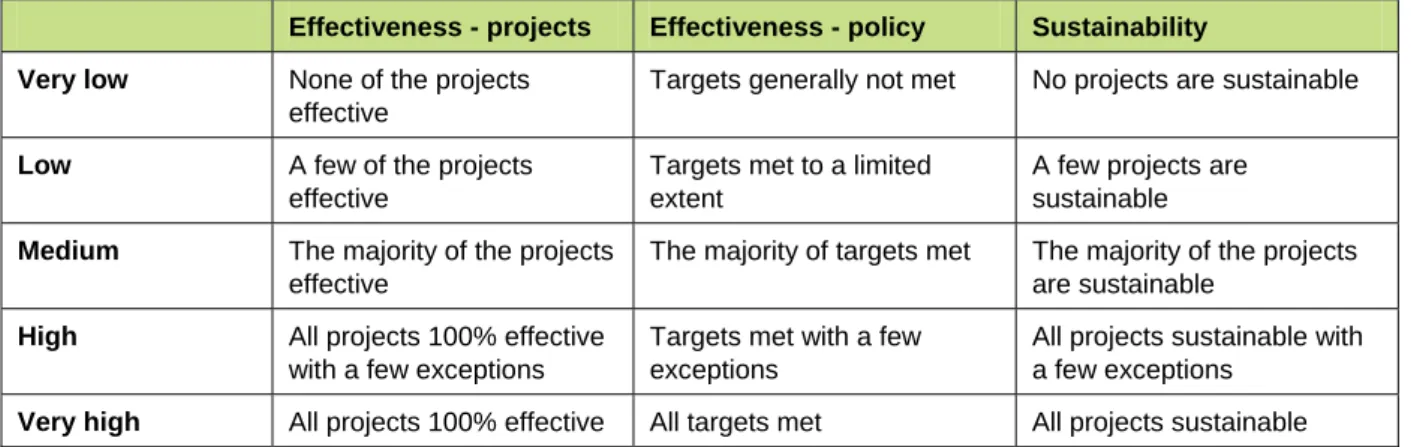
The terminology used in assessing effectiveness and efficiency in the country studies and thematic
studies is shown in Table 2.1.
Table 2.1
Terminology in assessing effectiveness and efficiency
Effectiveness - projects Effectiveness - policy Sustainability Very low None of the projects
effective
Targets generally not met No projects are sustainable
Low A few of the projects
effective
Targets met to a limited extent
A few projects are sustainable
Medium The majority of the projects effective
The majority of targets met The majority of the projects are sustainable
High All projects 100% effective with a few exceptions
Targets met with a few exceptions
All projects sustainable with a few exceptions
Very high All projects 100% effective All targets met All projects sustainable
This implies a need to specify which benchmarks to apply for this particular evaluation. This is reflected
in Appendix 2, which contains the list of evaluation questions together with associated success criteria,
indicators and sources of data. Some general observations with regard to the benchmarks highlighted in
the list above are highlighted below.
Defining the benchmarks relating to
objectives
was a challenge for this evaluation as it covered several
generations of LIFE with corresponding LIFE Regulations, which, in turn, contained similar but
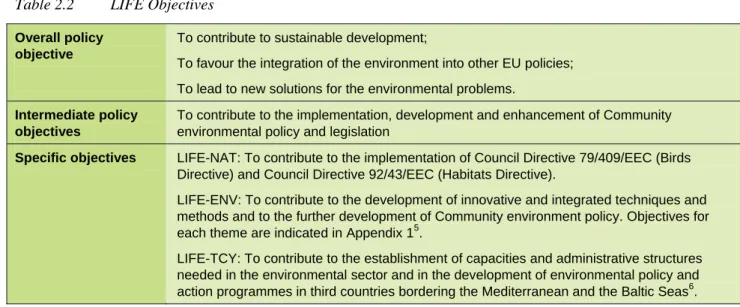
different objectives. Based on the regulations (including the LIFE+ Regulation), we established one
"generic" overview of objectives as illustrated in Table 2.2.
Table 2.2
LIFE Objectives
Overall policy objective
To contribute to sustainable development;
To favour the integration of the environment into other EU policies;
To lead to new solutions for the environmental problems.
Intermediate policy objectives
To contribute to the implementation, development and enhancement of Community environmental policy and legislation
Specific objectives LIFE-NAT: To contribute to the implementation of Council Directive 79/409/EEC (Birds Directive) and Council Directive 92/43/EEC (Habitats Directive).
LIFE-ENV: To contribute to the development of innovative and integrated techniques and methods and to the further development of Community environment policy. Objectives for each theme are indicated in Appendix 15.
LIFE-TCY: To contribute to the establishment of capacities and administrative structures needed in the environmental sector and in the development of environmental policy and action programmes in third countries bordering the Mediterranean and the Baltic Seas6.
Source: Elaborated by the Consultant. Note: None of the LIFE regulations distinguish between overall policy objective
and intermediate policy objectives in the same as illustrated in the table. This distinction has been made by the
Consultant.
In relation to the benchmark for
costs of similar interventions
our intention was to identify standard
unit prices for the various types of results under each theme based on information available in e.g.
impact assessment for Directives, Directive specific financing plans, available sector specific studies,
etc. However, due to insufficient data this was generally not possible. The assessment on efficiency
therefore relied on expert assessments and the perceptions of key stakeholders.
The benchmark relating to
needs, problems and issues
was addressed with a point of departure in the
6th Environmental Action Plan and the associated documents, including thematic strategies. For third
countries, the point of departure was country documents, such as national environmental action plans.
2.2.2
The programme management component
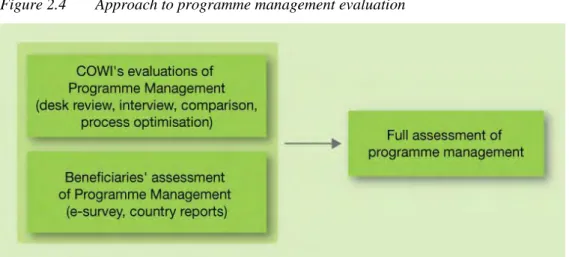
The overall aim of the programme management component was to analyse the extent to which the
organisational set-up of the LIFE Unit and the modalities for selection and monitoring of LIFE projects
contribute to the effectiveness and efficiency of the programme. The programme management was
evaluated via a) our assessment and b) feedback from beneficiaries (e-survey and interviews) cf. below.
The combination of COWI expert assessment and beneficiary assessment allowed for a solid database
with which to evaluate programme management.
5
Further specification and elaboration of thematic objectives is done in connection with thematic studies and reflected
in thematic reports.
6
Other than the countries of Central and Eastern Europe which have concluded Association Agreements with the
Euro-pean Community.
Figure 2.4
Approach to programme management evaluation
Source: Developed by Consultant
COWI assessment of programme management
COWI's expert assessment of programme management was based on desk reviews, interviews and
comparisons to other programmes. On top of that, a LEAN inspired process optimisation analysis of key
processes monitoring processes, was undertaken. The analysis was conducted through two workshops
facilitated by COWI consultants, where LIFE Unit staff analysed work processes in detail and identified
potentials for efficiency gains. The aim of the LEAN analysis was to provide:
•
A measure of how man-power resources are spent in selection and monitoring processes
•
A description of 'the good flows' and 'the bad flows' in the programme management cycle
•
An increased focus on learning and improvement internally in the LIFE Unit
Beneficiary assessments
Through the e-survey and interviews with project managers and national focal points, the beneficiaries'
assessments of programme management were solicited. These data sources are combined and
triangulated in order to answer the evaluation questions related to programme management.
2.2.3 The
policy
component
This section deals with the policy oriented evaluation themes consistency (hereunder coherence) and
acceptability. These themes touch upon how the LIFE programme links and fits in with other policies
and instruments and how they are accepted by the broader public, both locally and nationally.
Coherence and consistency
When assessing consistency, the main issue is how the LIFE programme links to other EU programmes
and policies. The success criterion is for the programme to support and complement other instruments
and policies rather than to be funding exact same objectives (double funding) or on the other hand
contradictory objectives to other programmes and policies. We have checked consistency between the
relevant instruments, hereunder, most notably, the financial instruments under the Structural Funds,
Cohesion Funds and Framework Programmes. In relation to the LIFE Nature component, the
Community Agricultural Policy (CAP) and the Community Fishery Policy (CFP) are policies, which
potentially contradict with environmental policy in general and the LIFE Programme and this was also
analysed.
The data collection has partly been a desk study and partly an analysis of the interviews in relation with
the country studies. However, we have also relied on the programme management analysis of the project
selection and monitoring process. The assessment was based on the following:
•
Examining how the project selection process in a consistent way supports the EU policies
•
Observing project managers and LIFE unit staff perceptions of the level of consistency and
acceptability
•
Beneficiaries' assessment of programme policy consistency and acceptability
•
National focal points' perception of consistency and acceptability
Acceptability
The evaluation term 'acceptability' describes different target groups' attitudes towards the LIFE
Programme both in general and for specific LIFE projects. The main issue is to assess the level of
acceptability of the LIFE Programme among project managers via the e-survey. Acceptability can, for
obvious reasons, be difficult to asses in objective terms and to a large extent we have drawn on the
project managers' perceptions of local and national stakeholders' acceptance of the individual projects.
2.3
The evaluation process - activities, time and resources
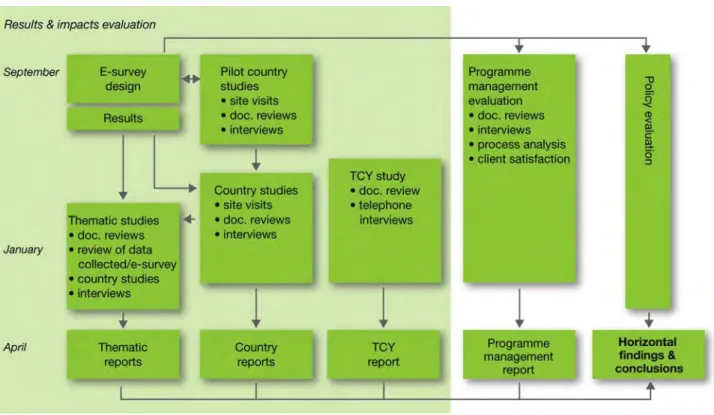
Figure 2.5 shows an overview of the main activities in the evaluation. The evaluation was divided into
three overall phases: The inception phase, the data collection and analysis phase and the reporting phase.
Due to the complexity and size of the evaluation there was some overlap between the phases.
2.3.1 Inception
phase
The inception phase began on 24 July 2008, when the contract was signed, and ended on 6 September
2008 when the first version of the inception report was submitted to the Steering Committee. The main
activities during the inception phase encompassed:
•
Kick-off meeting with the LIFE Unit and informal meetings with LIFE Unit staff
•
Internal kick-off and inception workshops for the evaluation team
•
Collection of material on the LIFE Programme and ensuring access to ESAP and BUTLER
databases (on selection and monitoring of projects, respectively).
•
Preparation of consolidated evaluation methodology including formulation of evaluation questions,
success criteria and indicators for each of the LIFE components and themes to be evaluated
•
Set-up of a project database to store information retrieved from BUTLER to enable overview of
projects per country, theme, etc. as well as statistical analysis of projects and finance data
•
Preparation of inception report describing the methodology and approach
The Steering Committee provided comments to the inception report which was revised and extended to
cover the final version of the questionnaire to be used in the e-survey and reporting on activities in the
data collection phase. The final inception report was submitted 6 November 2008.
Figure 2.5
Main activities in the evaluation
Source: Developed by Consultant
2.3.2
Data collection and analysis phase
This phase of the evaluation formally began on 7 September 2008 and included activities, which
cross-cut all components of the evaluation and activities, specific to each component. These are described
below. This phase, which overlaps with the reporting phase, ended in mid-March when the country and
thematic studies were finalised.
Cross-cutting activities: Project database, e-survey, and selection of projects for in-depth study
The establishment of a project database containing information on all LIFE projects during the period
1996-2006 was initiated during the inception phase. The access to the BUTLER database granted to the
Consultant, unfortunately, did not allow the Consultant to make extractions from BUTLER. The LIFE
Unit was very helpful in supplying tables extracted from BUTLER and the database has been
continuously updated with new data throughout the evaluation process. A raw version of the database
created is submitted to DG Environment along with the final report.
The e-survey was launched 27 October 2008 and closed on 2 December 2008.
Selection of ENV and NAT projects for in-depth study: In the original time schedule for the evaluation
it was foreseen that the projects for in-depth study would be selected by 1 October. Due to data
collection difficulties there was considerable delay. On 19 December, the final list was sent to the LIFE
Unit (see details on selection process, criteria and final list in Appendix 5).
Programme management component
The activities under the programme management component were initiated immediately after the
inception phase and included the following:
•
Desk review of the relevant material (evaluation guide, standard administrative provisions/common
provisions, contract with monitoring teams, Vademecum, description of selection and monitoring
teams, and GHK-study on monitoring teams)
•
Interviews with staff from the LIFE Unit and monitoring team
•
Two LEAN workshops with LIFE Unit staff
•
Beneficiaries' assessment based on input from e-survey and country studies
•
Analysis and report drafting
Results and impacts component
This component included country studies (which encompass in-depth project studies), thematic studies
and the TCY study. The activities are described below.
Country studies
•
Country study guidelines: Guidelines were developed in a final draft version to be used in the
country study workshop on 1 October 2008. The guidelines comprise background on the
evaluation; description of outputs and tasks; templates for country study reports, project sheets
(reporting on in-depth project studies) and interview reports; and interview guides. The guidelines
have been developed continuously during the period and the latest version was issued 2 December
2008.
•
Country study workshop: On 1 October 2008, a country study workshop was held for the
consultants responsible for country studies. During this workshop, the templates and guidelines
were presented and explained and the approach to the country studies discussed.
•
Pilot country studies: In the time schedule developed in the inception phase, it was foreseen that
pilot country studies on Denmark and Sweden would be carried out and submitted by mid-October.
Due to the delays described above and more resources spent on e-survey, project selection, etc. than
originally foreseen, the pilot country studies were delayed. It was decided to focus on Denmark and
the pilot country report was submitted to the LIFE Unit on 17 November 2008.
•
Information package: Each country study consultant received an information package containing
data to be reviewed as part of the country study. In addition to this, the country study consultants
reviewed the latest national environmental action plan or similar document. The package included:
-
Reference to the LIFE web-site
-
Extractions from the database concerning numbers of projects and projects according to year,
theme, etc.
-
Project summaries for all projects in the country
-
CD with monitoring files
-
Project reports for projects selected for in-depth study
-
LIFE Publications concerning the country in question
-
Results from the e-survey relevant to the country in question
-
Names and contact details of relevant interview persons
•
The main country study activities in each study are listed below.
-
initial desk review of project summaries and suggestions for selection of projects for in-depth
study
-
a desk review of the above mentioned documents
-
interviews with national coordinators
-
interviews with LIFE Unit country desk officers and monitoring teams
-
in-depth project studies for selected projects, including interviews with project managers and
site visits to projects with observable results and impacts
-
compiling and assessing data on results and impacts according to indicator framework
-
assessing the effectiveness, utility and sustainability of the LIFE projects in respect to the
country's needs and issues
-
reporting, in the form of a country report (chapter in final evaluation report), and project
sheets, reports from interviews, etc. to be provided to thematic teams for further study.
Thematic studies
For both NAT and ENV themes, a categorisation of all projects (771 NAT and 1076 ENV) into themes
were made and documented to the LIFE Unit (see Part 4 for details).
The thematic studies comprised the following for each theme:
•
Studying relevant EU policy documents
•
Interviews with relevant staff in the LIFE Unit and DG ENV
•
Review of results of e-survey
•
Review of results of country studies, notably in-depth project studies
•
Review of project results as reported in BUTLER
•
Analysis/aggregation of project level data on effects to the thematic level
•
Assessing effectiveness, efficiency, utility, sustainability
•
Reporting
TCY Study
The main activities included desk study, 17 project studies, interviews with DG Environment officers
and EC Delegations, and analysis and report writing.
2.3.3 Reporting
phase
The reporting phase was initiated with the progress report submitted 6 January 2009, which was
structured in accordance with the structure for this draft final report. From January and until submission
of the draft final report 20 April 2009, we worked in a targeted manner within the report structure as
revised by comments received at the Steering Committee meeting concerning the progress report. The
report was subsequently revised again based on comments received resulting in the final report as
presented in this volume.
3
The LIFE Programme and its policy context
This chapter provides a brief overview of the main characteristics of the LIFE Programme and its policy
context. More detailed and targeted descriptions on various parts of the programme are provided where
relevant in sections of this evaluation report. The chapter is structured into two main sections: The first
section provides an overview of the main features of the Programme and the second section describes
the LIFE projects during the evaluation period.
3.1
The anatomy of the LIFE Programme
3.1.1
Generations of LIFE
The LIFE Programme has existed since 1992. Until 2006, it was implemented in four phases or
generations each governed by a separate Council Regulation. The current, fifth generation (LIFE+- not
encompassed by this evaluation), runs from 2007 to 2013. The evaluation period of 1996-2006 covers
three generations of LIFE:
•
LIFE II (1996-2000)
•
LIFE III (2001-2004)
•
LIFE III-extension (2005-2006)
3.1.2
Why LIFE? A description of the objectives
The scope and priorities of the LIFE Programme, as outlined in its governing regulations, have
developed over the three generations. However, the programme has maintained a dual objective of
implementation and development of Community environmental policy and legislation. Over the years,
there has been a trend towards increasing focus on implementation rather than development of policy
and legislation.
Table 3.1
Key developments of the LIFE programme
Phase Regulation Years General Objective of LIFE Key EU developments
LIFE I Council Regulation (EEC)1973/92
1992-1995 Contribution to the development and
implementation of Community environmental policy and legislation by financing:
(a) priority environmental actions in the Community;
(b) (i) technical assistance actions with third countries […] 1995: Austria, Finland and Sweden new MS LIFE II Council Regulation (EC) 1404/96
1996-1999 Contribution to the development and, if appropriate, implementation, of Community environment policy and legislation.
LIFE III Regulation (EC) 1655/2000
2000-2004 Contribution to the implementation, updating and development of Community environment policy and of environmental legislation, in particular as regards the integration of the environment into other policies, and to sustainable development in the Community 2001: Restructuring of DG ENV; and adoption of the EU SDS 2002: the 6th EAP adopted 2004: eastern enlargement with 10 new MS LIFE III extension Regulation (EC) 1682/2004 2005-2006 Unchanged 2006: renewed SDS adopted LIFE + Regulation (EC) 614/2007
2007-2013 Contribution to the implementation, updating and development of Community environmental policy and legislation, including the integration of the environment into other policies, thereby contributing to sustainable development. In particular, LIFE+ shall support the implementation of the 6th EAP, including the thematic strategies, and finance measures and projects with European added value in Member States. 2007: Romania and Bulgaria new MS Programme priorities clearly linked to the 6th EAP
Source: elaborated by consultant
3.1.3
Components in the LIFE Programme
The LIFE Programme was divided into three components during the evaluation period: LIFE
Environment, LIFE Nature and LIFE third countries (TCY).
LIFE Environment (ENV)
The scope of LIFE Environment has been fairly similar during the three generations of LIFE and has
focused on the development of innovative and integrated techniques, demonstration projects, and
development of Community environmental policy. The share of the LIFE Programme budget allocated
for LIFE Environment was 46% under LIFE II and 47 % under LIFE III and LIFE III extension.
LIFE Nature (NAT)
The specific objectives of LIFE NAT have remained fairly constant during the evaluation period and
have focused on the implementation of the Birds and Habitats Directives, as exemplified by art. 3.1 of
the LIFE III Regulation:
"The specific objective of LIFE-nature shall be to contribute to the
implementation of Council Directive 79/409/EEC of 2 April 1979 on the conservation of wild birds,
Council Directive 92/43/EEC of 21 May 1992 on the conservation of natural habitats and of wild fauna
and flora and, in particular, the Natura 2000 European network established by the latter Directive".
Similarly to LIFE Environment, the LIFE Nature budget share was 46% and 47 % under LIFE II and III,
respectively.
LIFE Third countries (TCY)
The focus of LIFE Third Countries was on providing support to capacity building in the environmental
sector and on the development of environmental policy and action programmes in third countries
bordering on the Mediterranean and the Baltic Sea
7. LIFE TCY was allocated 5% of the budget under
LIFE II and 6% under LIFE III and LIFE III extension.
Other
Under LIFE II, a separate budget was set aside for "accompanying measures needed to monitor,
evaluate or promote the actions undertaken during the first stage and under points 1 [environment,
hereunder nature] and 2 [TCY] and dissemination of information on the experience and the results
obtained of such actions." These actions were allocated 3% of the total budget under LIFE II.
3.1.4
The LIFE cycle
The LIFE Programme is basically organised in an annual cycle. Each year project proponents can apply
for LIFE co-financing according to criteria and guidelines announced by the LIFE Unit. The project
applications are submitted to the LIFE Unit by the Member States. The project applications are then
evaluated by the LIFE Unit and projects selected according to a set of criteria. During implementation,
the projects are monitored by the LIFE Unit. This cycle is illustrated in Figure 3.1 below.
7
Other than the countries of central and Eastern Europe which have concluded Association Agreements with the
Euro-pean Community and are referred to in Article 6(1). (LIFE III art 5)
Figure 3.1
The LIFE Cycle
Source: Developed by Consultant
3.1.5
The input: Budget
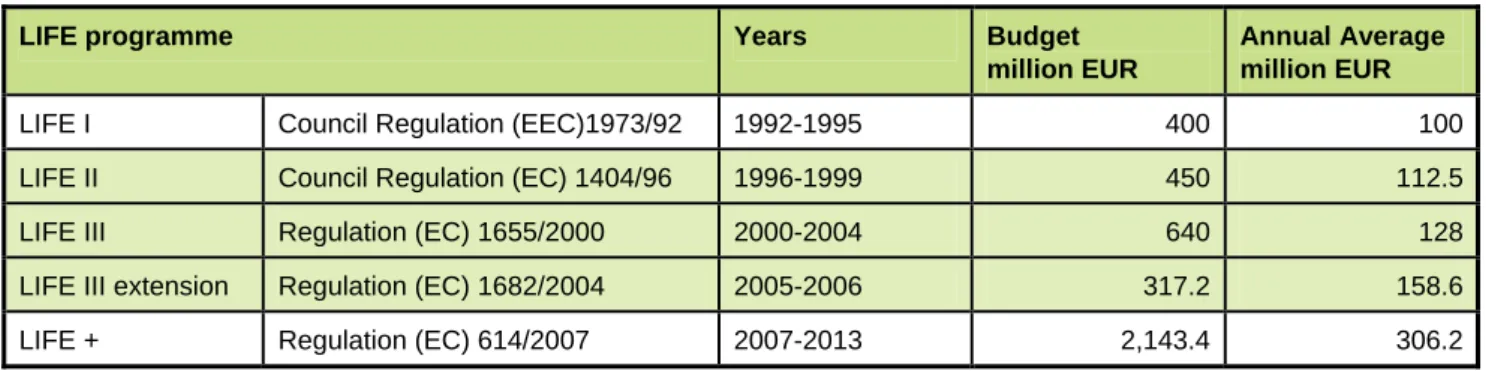
The LIFE regulations stipulate the total budget allocated to the LIFE programme for the phase to which
the regulation applies. The annual average budget of the programme has increased from phase to phase -
from EUR 112.5 million under LIFE II to EUR 158.6 million under LIFE III extension.
Table 3.2
The budget developments of the LIFE Programme
LIFE programme Years Budget
million EUR
Annual Average million EUR
LIFE I Council Regulation (EEC)1973/92 1992-1995 400 100
LIFE II Council Regulation (EC) 1404/96 1996-1999 450 112.5
LIFE III Regulation (EC) 1655/2000 2000-2004 640 128
LIFE III extension Regulation (EC) 1682/2004 2005-2006 317.2 158.6
LIFE + Regulation (EC) 614/2007 2007-2013 2,143.4 306.2
Source: the respective LIFE regulations
3.2
Overview of LIFE projects during the period 1996 to 2006
During the period 1996 to 2006, 2033 projects were approved for LIFE co-financing. These included
771 Nature projects, 1076 Environment projects and 179 Third Country projects. Of these projects, 291
are still on-going
8. This section provides a brief overview of the projects. More specific overviews per
country and theme are provided in the relevant country and thematic reports. The data presented is from
the BUTLER database of the LIFE Unit. It should be noted that there are several uncertainties:
•
The data on commitments in the BUTLER database mostly stems from the original project budgets
and hence, does not reflect the actual payments made (or foreseen) as budgets are often changed
during the projects' lifetime. It was not possible to supply data on payments which could be aligned
with the BUTLER data as this data exists only in the accounting systems from where the necessary
tables could not be created.
•
The BUTLER database also includes the projects closed down. Through accounting data from
2004-2006, it was possible to identify some of these projects and delete them from the database, but
interview data indicates that there are additional projects in BUTLER, which were, in fact, never
fi-nanced.
Table 3.3
LIFE projects and commitments 1996-2006
LIFE Generation LIFE Environment LIFE Nature LIFE TCY Total
Projects Commitm ent (million EUR) Projects Average commitm ent (EUR) Projects Commitm ent (million EUR) Projects Commit ment(mi llion EUR) LIFE II 613 265.51 408 278.56 95 28.93 1116 573.00 LIFE III 325 215.58 247 219.37 53 20.16 625 455.12
LIFE III extension 138 134.78 116 139.28 31 12.84 285 286.90
Total 1076 615.88 771 637.21 179 61.93 2026 1315.01
Source: Data in BUTLER database
8
For the purpose of this evaluation on-going projects are defined as projects with end-year in 2009 or later as registered
in the BUTLER database.
The overall committed amount during this period amounted to EUR 1,315 million. As shown in Table
3.3, the number of projects approved annually decreased during the evaluation period whereas the LIFE
contribution to each project has increased.
Table 3.4
Annual average number of projects and commitment per project, 1996-2006
LIFE Generation LIFE Environment LIFE Nature LIFE TCY Total Projects per year Commitm ent per project (million EUR) Projects per year Commit ment per project (million EUR) Projects per year Commit ment (million EUR) Projects per year Commit ment per project (million EUR) LIFE II 123 0.4 82 0.7 19 0.3 223 0.5 LIFE III 108 0.7 82 0.9 18 0.4 208 0.7
LIFE III extension 69 1.0 58 1.2 16 0.4 143 1.0
Total 108 0.6 77 0.8 18 0.3 203 0.6
Source: Data in BUTLER database
3.2.1 Themes
For the purpose of this evaluation, we have divided Nature and Environment projects according to the
themes listed in Table 3.5. These themes have been inspired by the LIFE+ Regulation and their
categorisation is described in more detail in Part 4 on the thematic studies. Table 3.5 shows that the
Environment themes 'water', 'natural resources and waste' and 'strategic approaches' are the most
prevalent themes in terms of number of projects. Although less so this is also the case when looking at
the LIFE contribution. For the Nature projects, about three quarters are categorised as habitats project
serving to implement the Habitats Directive and one fourth as bird project and thus serving to
implement the Birds Directive. The number of "other" projects
9is very small.
9
Table 3.5
Number of Environment and Nature projects and committed amounts according to themes
Theme Number of projects Number of projects (%) Committed amount (million EUR) Committed amount (%) Environment 1,076 58.3% 615.9 49.2% Climate change 39 2.1% 33.0 2.6% Air 93 5.0% 51.7 4.1% Water 250 13.5% 144.9 11.6% Soil 92 5.0% 48.7 3.9% Forests 15 0.8% 6.1 0.5%Natural resources and waste 312 16.9% 183.7 14.7%
Chemicals 17 0.9% 9.5 0.8% Strategic approaches 189 10.2% 102.9 8.2% Urban environment 69 3.7% 35.4 2.8% Nature 771 41.7% 637.2 50.9% Habitats 580 31.4% 494.6 39.5% Birds 181 9.8% 139.6 11.1% Other 10 0.5% 2.9 0.2% Total
1,847 100% 1253.1 100%
Source: BUTLER database. Note that the total here is smaller than in Table 3.5 above as this table only covers NAT and
ENV projects (not TCY).
3.2.2
Types of beneficiaries
For the purpose of this evaluation, we have distinguished between three main types of beneficiaries:
Public entities; NGOs and research institutions; and public and private enterprises. Table 3.6 shows that
public entities are the most typical beneficiary accounting for 44% of all projects. However, public
entities are particularly important in relation to Nature and Third Country projects and less so in relation
to Environment projects, where the beneficiary is more often a public or private enterprise. More
detailed tables on the specific type of beneficiary can be found in Appendix 7.
Table 3.6
Beneficiaries of LIFE Projects, 1996-2006
Beneficiary type LIFE Environment LIFE Nature LIFE Third Countries
Total
Public entities 360 (33%) 448 (58%) 92 (51%) 900 (44%)
Public and private enterprises
429 (40%) 19 (2%) 14 (8%) 462 (23%)
NGOs and research organisations
194 (18%) 226 (29%) 58 (32%) 478 (24%)
Not specified 93 (9%) 78 (10%) 15 (8%) 186 (9%)
Total 1076 (100%) 771 (100%) 179 (100%) 2026 (100%)
Appendix 1
Indicators for assessment of results and impacts
During the inception phase, we have worked on identifying indicators to measure effects (results and
impacts) at the thematic level, which can be applied to the projects analysed and which can be used as a
basis for aggregation from the project level to the thematic level. We have done this through:
•
Reviewing the definition/objectives for the themes, as set out in the LIFE+ Regulation compared to
the LIFE II and III regulations.
•
Reviewing a number of project summaries to trace type of result and impact for typical projects
under the various themes.
•
Reviewing the 6th EAP, the related thematic strategies and EU regulatory documents
•
Reviewing the GHK Study on the Establishment of Indicators to Assist Monitoring of Measures
Financed by LIFE+
•
Reviewing indicators suggested by the European Environment Agency (Core Set of Indicators, ref.
Technical Report No. 1, 2005 and Halting the Loss of Biodiversity, ref. Technical Report No.
11/2007)
Our primary focus has been on developing indicators, which enable the measurement and subsequent
aggregation of effects from project level to programmatic level. Where relevant, this has been
supplemented by other types of indicators focusing on a more indirect assessment of results and
impacts. I.e. most indicators aim for a quantification of impact, but in the cases where this was deemed
impossible, relative indicators using, for example, a scale from 1 to 5 are suggested.
The indicators developed are divided into two sets - one set pertaining to the results of the projects
under each theme, and one set pertaining to the impacts of the projects. By comparison the GHK study
refers to three types of effect indicators: results, outcome and impact, where result indicators refer to the
immediate effects, outcome indicators refer to intermediate effects and impact indicators refer to longer
term effects
10. For the purpose of this evaluation we do not find it realistic to distinguish between
intermediate and longer term impacts. This may be carried out in an evaluation of individual projects but
not in this programmatic evaluation given the large portfolio of projects analysed and the many different
start and finish dates. Rather, we have sought to develop both (short term) results indicators and (longer
term) impact indicators for five different types of effects which address the types of changes mentioned
under effects in the GHK study (ref. figure 3.2, p. 11).
We have identified five different types of effects as listed below.
•
Environment:
Improved state of or reduced pressure on environment, nature and/or human health
•
Management:
Improved management, planning, administration or regulation
•
Awareness:
Increased awareness among a broader range of stakeholders about the environmental
issue in question
•
Demonstration:
"showcase effect" of demonstrating specific models, methods and/or technologies
to potential users
•
Innovation:
Innovation/development of new technology or improvement of processes e.g. to save
energy or other natural resources, cause less pollution or reduce the generation of waste
10
We have developed theme-specific indicators for environmental and management effects. These are
described below in a separate section on each theme. We have also developed a number of general
indicators which are NOT theme-specific for management, awareness, demonstration and innovation
effects. These are described in the final section at the end of this appendix.
As also stated in the GHK study, environmental effects are likely to occur mostly in the medium to long
term and thus impact indicators seem more relevant than result indicators. Nevertheless, in many cases,
we suggest that the indicators for measuring both results and impacts be used, as some projects may
have generated environmental effects even in the short term and these should be documented by the
evaluation. It will then also be possible to compare short term results with long term impacts and,
hopefully, illustrate extended impact over time and the sustainability of the projects.
Below, we first present theme-specific indicators for the themes in the following order:
•
LIFE NAT (one common set of indicators developed to cover the four types of conservation actions
according to which the analysis of LIFE NAT will be structured)
•
LIFE ENV
-
climate change
-
air
-
water
-
soil
-
forests
-
natural resources and waste
-
chemicals
-
urban environment
-
strategic approaches
Finally, we present general indicators related to management, awareness, demonstration and innovation
effects.
Indicators for results and impacts under LIFE NAT
The NAT component of the LIFE Programme has existed in all the generations of LIFE being evaluated
in this ex-post evaluation. This component's focus has been relatively consistent throughout time period
covering the implementation of the Habitat Directive and the Birds Directive. Indicators have been
developed accordingly. As described in Chapter 3, the guiding principles for categorisation of NAT
projects have not yet been settled. It is assessed that results and impact indicators for the NAT projects,
as a group, will remain applicable no matter which guiding principles for categorisation are applied.
Table 1
Result and impact indicators for LIFE NAT
LIFE Nature
Examples of typical project issues Result indicators Impact indicators
Projects contributing to implementing Community policy and legislation on nature and biodiversity, in particular Directives 79/409/EEC and
92/43/EEC.
Supporting the further development and implementation of the Natura 2000 network.
Environmental:
Habitats restored/managed (area km2; no. of priority habitats)
Favourable conservation status prepared for species / habitats (no. species listed on directive annexes/ no. habitats / no. priority habitats)
Species reintroduced (no. individuals)
Invasive species controlled (area / no. of priority habitats)
Management
Management plans agreed (area coverage / partnerships / funding source identified)
Partnerships established
Land use agreements established Land purchase and land
compensation measures conducted
Enlargement of national Natura 2000-network under preparation Improved species protection measures
Other regional / national initiatives within nature conservation Plan for monitoring system for biodiversity in the managed area Transnational cooperation established
Recreational facilities established in the project area improving visitors' numbers/ awareness of area characteristics. (no of visitors)
Environmental:
Habitat management agreed (area km2)
Favourable conservation status achieved for species / habitats Species surviving (population size / no. individuals)
Invasive species controlled (area / no. of priority habitats) and no. of recurring actions reduced
Species population growth (% / no.)
Management
Management plans in operation Partnership agreements maintained and adhered to in management Habitat management agreed, based on non-LIFE funds
Land use developing according to plan
National policy a nd regulatory change (orders, local/regional conservation initiatives)
Recurring fund-raising needs reduced
Enlargement of national Natura 2000-network achieved
Regularly recurring monitoring on species diversity and number in the protected/managed area
Transnational cooperation under execution
Biodiversity monitoring system in place and under operation
Indicators for results and impacts for LIFE ENV: Climate change theme
Climate change is a new theme which has been included in LIFE + programme, i.e. there are no specific
references to a climate change theme in the preceding LIFE regulations (LIFE II and LIFE III) although
"reduction of emission of gases having a greenhouse effect" is mentioned as an objective under LIFE III
and "tropospheric ozone" as a sub-theme in LIFE II. We have chosen to distinguish between the projects
that fall under the climate change theme from those under the air theme using the general principle that
climate change projects relate to physical or chemical processes and impacts occurring in the upper
atmosphere, while the air theme relates to air pollution exhibiting its effects on or near ground level.
Hence, project types to be categorized as climate change projects include those, which aim to eliminate
or reduce emissions of greenhouse gases from a large variety of sources including energy production,
road, railway, air and water transport, different industrial processes, domestic heating, agricultural
production including husbandry etc. and similar projects regarding ozone depleting substances (ODS).
Furthermore, projects which aim at adaptation to climate changes and mitigation of the negative effects
of such changes (e.g. flooding) are categorized as climate change projects. Finally, projects developing
models and other systems to predict and/or assess climatic changes and their consequences, or
developing/introducing managements systems (e.g. CO2 trading schemes), are considered climate
change projects.
Table 2
Result and impact indicators for climate change theme
LIFE Environment - Climate Change
Examples of typical project issues Result indicators Impact indicators
Reduction of greenhouse gas emissions
Reduction of emissions of ozone depleting substances (ODS)
Adaptation to climate changes including prevention/mitigation of negative impacts such as flooding Prediction of climate changes and their effects by use of models etc. Greenhouse gas emission trading and other climate change management systems
Environmental:
Reduction in emissions of CO2 or other greenhouse gases
(tons/year)
Reduction in emissions of ODS (tons/year)
Size of area(s) (km2) protected against adverse effects of flooding
Number of people protected against adverse effects of flooding
Management:
Climate strategy model used for early warning.
Number of European Emissions Trading Schemes established Monitoring system implemented. (No, yes at national level, yes at international level)
Environmental:
Reduction in emissions of CO2 or other greenhouse gases (tons/year)
Reduction in emissions of ODS (tons/year)
Size of area(s) (km2) protected against adverse effects of flooding
Number of people protected against adverse effects of flooding
Management:
No. of EU indicators on climate change meeting strategy level Number of European Emissions Trading Schemes established Number of EU countries with standardised and compatible monitoring schemes
Indicators for results and impacts for LIFE ENV: Air theme
Air/air pollution has been a recurrent LIFE ENV theme, dealing with bulk air pollutants (SO2, CO, NOX,
VOC etc.) as well as specific hazardous substances (e.g. dioxins) dispersed through the air (lower
atmosphere), their effects on humans and the environment and measures to deal with these issues.
We have chosen to distinguish between projects, which fall under the air theme from those which fall
under climate change using the general principle that the air theme relates to air pollution exhibiting its
effects on or near the ground while climate change projects relate to physical or chemical processes and
impacts occurring in the upper atmosphere. This means that projects on greenhouse gases and ozone
depletion issues are categorized as climate change projects while acidification caused by air pollutants
and ozone as a respiratory irritant are categorized under the air theme.
Air projects include development of technologies/methods to prevent or reduce emissions of general or
specific air pollutants, measures to minimise the negative impacts of air pollution on human health, the
state of the environment or natural resources, and approaches/systems/methods to manage or assess or
monitor air pollution in general or that of specific hazardous substances.
Table 3
Result and impact indicators for air theme
LIFE Environment - Air
Examples of typical project issues Result indicators Impact indicators
Emissions of main gaseous air pollutants ((SO2, NOX, VOC etc.) from industrial sources, power production, traffic etc.
Emissions of specific hazardous air pollutants (e.g. dioxins) from industrial sources
Air pollution from agricultural activities Effects of air pollutants on health
Effects of air pollution on the state of the environment including acidification and eutrofication.
Methods, models etc. for assessment and/or monitoring of air pollution, Management and other regulatory measures to reduce air pollution and its impacts
Environmental:
Number of persons affected by the project's improvement of air quality
Increase in area (km2) with ambient air quality meeting EU air quality standards (or increase in population living in such areas) Reduction (tons/year) in
emissions of noxious gasses (e.g. SO2, NOx, NMVOC an NH3)
Reduction in use of private cars (annual average day traffic)
Improvement of ecosystem negatively affected by acidification
Management:
Monitoring system established
Early warning system established
Environmental:
Number of persons affected by improvement of air quality
Increase in area (km2) with ambient air quality meeting EU air quality standards (or increase in population living in such areas)
Reduction (tons/year) in emissions of noxious gasses (e.g. SO2, NOx, NMVOC and NH3)
Reduction in use of private cars (annual average day traffic) Improvement of ecosystem negatively affected by acidification.