A Distributed Self-learning Approach for Elastic
Provisioning of Virtualized Cloud Resources
Jia Rao, Xiangping Bu, Kun Wang and Cheng-Zhong Xu
Department of Electrical and Computer Engineering
Wayne State University
Detroit, Michigan, USA
{
jrao, xpbu, kwang, czxu
}
@wayne.edu
Abstract—Although cloud computing has gained sufficient popularity recently, there are still some key impediments to enterprise adoption. Cloud management is one of the top challenges. The ability of on-the-fly partitioning hardware re-sources into virtual machine(VM) instances facilitates elastic computing environment to users. But the extra layer of resource virtualization poses challenges on effective cloud management. The factors of time-varying user demand, complicated interplay between co-hosted VMs and the arbitrary deployment of multi-tier applications make it difficult for administrators to plan good VM configurations. In this paper, we propose a distributed learning mechanism that facilitates self-adaptive virtual machines resource provisioning. We treat cloud resource allocation as a distributed learning task, in which each VM being a highly autonomous agent submits resource requests according to its own benefit. The mechanism evaluates the requests and replies with feedbacks. We develop a reinforcement learning algorithm with a highly efficient representation of experiences as the heart of the VM side learning engine. We prototype the mechanism and the distributed learning algorithm in an iBalloon system. Experiment results on an Xen-based cloud testbed demonstrate the effectiveness of iBalloon. The distributed VM agents are able to reach near-optimal configuration decisions in7iteration steps at no more than5%performance cost. Most importantly, iBalloon shows good scalability on resource allocation by scaling to 128
correlated VMs.
I. INTRODUCTION
One important offering of cloud computing is to deliver computing Infrastructure-as-a-Service (IaaS). In this type of cloud, raw hardware infrastructure, such as CPU, memory and storage, is provided to users as an on-demand virtual server. Aside from client-side reduced total cost of ownership due to a usage-based payment scheme, a key benefit of IaaS for cloud providers is the increased resource utilization in data centers. Due to the high flexibility in adjusting virtual machine (VM) capacity, cloud providers can consolidate traditional web applications into a fewer number of physical servers given the fact that the peak loads of individual applications have few overlaps with each other [3].
In the case of IaaS, the performance of hosted applications relies on effective management of VMs’ capacity. However, the additional layer of resource abstraction introduces unique requirements for the management. First, effective cloud man-agement should be able to resize individual VMs in response to the change of application demands. More importantly, besides the objective of satisfying Service Level Agreement (SLA) of individual applications, system-wide resource utilization ought
to be optimized. In addition, real-time requirements of pay-per-use cloud computing for VM resource provisioning make the problem even more challenging.
Although server virtualization helps realize performance isolation to some extent, in practice, VMs still have chances to interfere with each other. It is possible that one rogue application could adversely affect the others [16], [6]. In [5], the authors showed that for VM CPU scheduling alone, it is already too complicated to determine the optimal param-eter settings. Taking memory, I/O and network bandwidth into provisioning will further complicate the problem. Time-varying application demands add one more dimension to the configuration task. Dynamics in incoming traffic can possibly make prior good VM configurations no longer suitable and result in significant performance degradation.
Furthermore, practical issues exist in fine-grained VM re-source provisioning. By setting the management interval to
30seconds, the authors in [20] observed that under sustained resource demands, a VM needs minutes to get its performance stabilize after memory reconfiguration. Similar delayed effect can also be observed in CPU reconfiguration, partially due to the backlog of requests in prior intervals. The difficulty in evaluating the immediate output of management decisions makes the modeling of application performance even harder.
From the standpoint of cloud users, exporting infrastructure as a whole gives them more flexibility to select VM operating systems (OS) and the hosted applications. But this poses new challenges to underlaying VM management as well. Because public IaaS providers assume no knowledge of the hosted applications, VM clusters of different users may overlap on physical servers. The overall VM deployment can show an de-pendent topology with respect to resources on physical hosts. The bottleneck of multi-tier applications can shift between tiers either due to workload dynamics or mis-configurations on one tier. Mis-configured VMs can possibly become rogue ones affecting others. In the worst case, all nodes in the cloud may be correlated and any mistake in the capacity management of one VM may spread onto the entire cloud.
Our previous work [20] demonstrated the efficacy of rein-forcement learning (RL)-based resource allocation in a cloud environment. We applied a centralized RL approach to opti-mize system-wide VM performance in one physical machine. The RL agent operates on state spaces defined on co-running VM configurations and employs neural network-based models
to map global VM configurations to system-wide performance. Although effective on one host, the centralized management can not be extended to a practical scale with a large number of VMs. First, resource allocation is limited to one machine and can not deal with virtual clusters spanning on multiple hosts. Second, the complexity of training and maintaining the models grows exponentially with the number of VMs, which is prohibitively expensive expensive in a practical scale. Finally, the models based on VM configurations are not robust to workload dynamics.
In this paper, we address the issues and present a distributed learning mechanism for cloud management. More specifically, our contributions are as follows:
(1) Distributed learning mechanism. We treat VM re-source allocation as a distributed learning task. Instead of cloud resource providers, cloud users manage individual VM capacity and submit resource requests based on application demands. The host agent evaluates the aggregated requests on one machine and gives feedback to individual VMs. Based on the feedbacks, each VM learns its capacity management policy accordingly. The distributed approach is scalable because the complexity of the management is not affected by the number of VMs and we rely on implicit coordination between VMs belonging to the same virtual cluster.
(2) Self-adaptive capacity management We develop an efficient reinforcement learning approach for the management of individual VM capacity. The learning agent operates on a VM’s running status which is defined on the utilization of mul-tiple resources. We employ a Cerebellar Model Articulation Controller-based Q table for continuous state representation. The resulted RL approach is robust to workload changes because state on low-level statistics accommodate workload dynamics to a certain extent.
(3) Resource efficiency metric. We explicit optimize re-source efficiency by introducing a metric to measure a VM’s capacity settings. The metric synthesizes application perfor-mance and resource utilization. When employed as feedbacks , it effectively punishes decisions that violate applications’ SLA and gives users incentives to release unused resources.
(4) Design and implementation of iBalloon.Our prototype implementation of the distributed learning mechanism, namely iBalloon, demonstrated its effectiveness in a Xen-based cloud testbed. iBalloon was able to find near optimal configurations for a total number of128VMs on a 16-node closely correlated cluster with no more than 5%of performance overhead . We note that, there were reports in literature about the automatic configuration of multiple VMs in a cluster of machines. This is the first work that scales the auto-configuration of VMs to a cluster of correlated nodes under work-conserving mode.
The rest of this paper is organized as follows. Section II discusses the challenges in cloud management. Section III and Section IV elaborate the key designs and implementation of iBalloon, respectively. Section V and Section VI give experiments settings and results. Related work is presented in Section VII. We conclude this paper and discuss future works in Section VIII.
II. CHALLENGES INCLOUDMANAGEMENT
A. Complex Resource to Performance Relationship
In this work, we consider CPU, memory and I/O bandwidth as the building blocks of a VM’s capacity. An accurate resource to performance model is crucial to the design of automatic capacity management. However, the workload and cloud dynamics make the determination of the system model challenging. The CPU(s) can be time-shared in fine-grain using eitherwork-conserving (WC) or non-work-conserving (NWC) mode. The NWC mode ensures better performance isolation but with possible waste of CPU cycles. We show in [19] that NWC mode incurs considerable application performance degradation compared to WC mode. Under NWC mode, there is usually a simple (and often linear) relationship between CPU resource and application performance. In contrast, WC mode introduces uncertainties in modeling due to interferences be-tween VMs. We take the challenge to consider WC mode in the design of our capacity management. The relationship between VM memory size and application performance exhibits consid-erable nonlinearity. The performance drops dramatically when memory size is smaller than an application’s system working set size (WSS). However, WSS can not be accurately estimated without application knowledge or guest OS instrumentation. The impediment of mapping I/O resources to application performance is due to the fact that I/O bandwidth requirement is highly dependent on the characteristics of application and the interference from the co-running VMs.
B. Issues of VM Reconfiguration
VM capacity management relies on precise operations that set resources to desired values assuming the observation of the instant reconfiguration effect. However, in fine-grained cloud management, such as in [17], [20], within the management interval the effect of a reconfiguration can not be correctly perceived. The work in [20] showed up to10minutes delayed time before a memory reconfiguration stabilizes. Similar phe-nomenon was also observed in CPU.
We did tests measuring the dead time between a change in VCPU and the time the performance stabilizes. A single TPC-W DB tier was tested by changing its VCPU. Figure 1 plots the application-level performance over time. Starting from 4
VCPUs, the VM was removed one VCPU every 5 minutes until one was left at the time of the 15th minute. Then the VCPU was added back one by one. At the 20thminute, the number of VCPUs increased from 1 to 2. We observed a delay time of more than 5 minutes before the response time stabilized at the time of the 25th minute. The reason for the delay was due to the resource contention caused by the backlogged requests when there were more CPU available. The VM took a few minutes to digest the congested requests. C. Cluster Wide Correlation
In a public cloud, multi-tier applications spanning multiple physical hosts require all tiers to be configured appropriately. In most multi-tier applications, request processing involves several stages at different tiers. These stages are usually synchronous in the sense that one stage is blocked until the completion of other stages on other tiers. Thus, the change of
0 500 1000 1500 2000 2500 3000 3500 4000 4500 0 5 10 15 20 25 30 35 40 10 100 1000 10000
Throughput (req/s) Response time (ms)
Time (mins)
Throughput Response time
Fig. 1. Delayed effect of VCPU reconfiguration. TABLE I
CONFIGURATION DEPENDENCIES OF MULTI-TIERVMS.
DB VCPU 1VCPU 2VCPU 3VCPU 4VCPU
APP MEM 790MB 600MB 320MB 290MB
APP CPU% 61% 47% 15% 10%
the capacity of one tier may affect the resource requirement on other tiers. In Table I, we list the resource usage on the front-end application tier of TPC-W as the CPU capacity of the back-end tier changed. APP MEM refers to the minimum memory size that prevents the application server from doing significant swapping I/Os; APP CPU% denotes the measured CPU utilization. The table suggests that, as the capacity of the back-end tier increases, the demand for memory and CPU in the front tier decreases considerably. An explanation is that without prompt completion of requests at the back-end tier, the front tier needs to spend resources for unfinished requests. Therefore, any mistake in one VM’s capacity management may spread to other hosts. In the worst case, all nodes in cloud could be correlated by multi-tier applications.
In summary, the aforementioned challenges in cloud com-puting brings unique requirements to VM capacity manage-ment. (1) It should guarantee VM’s application-level perfor-mance in the presence of complicated resource to perforperfor-mance relationships. (2) It should appropriately resize the VMs in response to time-varying resource demands. (3) It should be able to work in an open cloud environment, without any assumptions about VM membership and deployment topology.
III. THEDESIGN OF IBALLOON
A. Overview
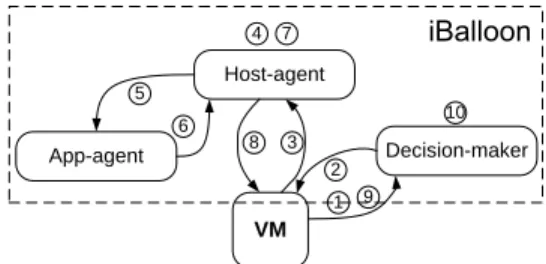
We design iBalloon as a distributed management frame-work, in which individual VMs initialize the capacity manage-ment. iBalloon provides the hosted VMs with capacity direc-tions as well as evaluative feedbacks. Once a VM is registered, iBalloon maintains its application profile and history records that can be analyzed for future capacity management. For bet-ter portability and scalability, we decouple the functionality of iBalloon into three components:Host-agent,App-agent
andDecision-maker.
Figure 2 illustrates the architecture of iBalloon as well as its interactions with a VM. Host-agent, one per physical machine, is responsible for allocating the host’s hardware resource to VMs and gives feedback.App-agentmaintains application SLA profiles and reports run-time application performance. Decision-makerhosts a learning agent for each VM for automatic capacity management. We make two
Decision-maker VM Host-agent App-agent 1 2 3 4 5 6 7 8 9 10
Fig. 2. The architecture and working flow of iBalloon. (1) The VM reports running status. (2)Decision-maker replies with a capacity suggestion. (3) The VM submits the resource request. (4)Host-agentsynchronously collects all VMs’ requests, reconfigures VM resources and sleeps for a management interval. (5)-(6)Host-agentqueriesApp-agentfor VMs’ application-level performance. (7)-(8) Host-agent calculates and sends the feedback. (9) The VM wraps the information about this interaction and reports toDecision-maker. (10)Decision-makerupdates the capacity management policy for this VM accordingly.
assumptions on the self-adaptive VM capacity management. First, capacity decisions are made based on VM running status. Second, a VM relies on the feedback signals, which evaluates previous capacity management decisions, to revise the policy currently employed by its learning agent.
The assumptions together define the VM capacity manage-ment task as an autonomous learning process in an interactive environment. The framework is general in the sense that various learning algorithms can be incorporated. Although the efficacy or the efficiency of the capacity management may be compromised, the complexity of the management task does not grow exponentially with the number of VMs or the number of resources. After a VM submits its SLA profile toApp-agent
and registers with Host-agent and Decision-maker, iBalloon works as illustrated in Figure 2. iBalloon considers the VM capacity to be multidimensional, including CPU, memory and I/O bandwidth. This is one of the earliest works that consider these three types of resources together. A VM’s capacity can be changed by altering the VCPU number, memory size and I/O bandwidth. The management operation to one VM is defined as the combination of three meta operations on each resource:increase,decrease andnop.
B. Key Designs
1) VM Running Status: VM running status has a direct impact on management decisions. A running status should provide insights into the resource usage of the VM, from which constrained or over-provisioned resource can be inferred. We define the VM running status as a vector of four tuples.
(ucpu, uio, umem, uswap),
whereucpu,uio,umem,uswap denote the utilization of CPU,
I/O, memory and disk swap, respectively. As discussed above, memory utilization can not be trivially determined. We turn to guest OS reported metric to calculate umem(See Section IV
for details). Since disk swapping activities are closely related to memory usage, addinguswapto the running status provides
insights into memory idleness and pressure.
2) Feedback Signal: The feedback signal ought to explicitly punish resource allocations that lead to degraded application performance, and meanwhile encouraging a free-up of unused capacity. It also acts as an arbiter when resource are contented.
We define a real-valued reward as the feedback. Whenever there is a conflict in the aggregated resource demand, e.g. the available memory becomes less than the total requested memory, iBalloon set the reward to−1 (penalty) for the VMs that require an increase in the resource and a reward of 0
(neural) to other VMs. In this way, some of the conflicted VMs may back-off leading to contention relaxation. Note that, although conflicted VMs may give up previous requests,
Decision-maker will suggest a second best plan, which may be the best solution to the resource contention.
When there is no conflict on resources, the reward directly reflects application performance and resource efficiency. We define the reward as a ratio of yieldtocost:
reward=yield cost, whereyield=Y(x1, x2, . . . , xm) = Pm i=1y(xi) m , y(xi) =
1 ifxi satisfies its SLA;
e −p∗(|xi−x 0 i x0i | ) −1 otherwise, andcost= 1 + Pn i=1(1−u k i) 1 k
n . Note that the metricyieldis a
summarized gain overmperformance metricsx1, x2,· · ·, xm.
The utility function y(xi)decays when metric xi violates its
performance objective x0i in SLA. cost is calculated as the summarized utility based onnutilization statusu1, u2,· · ·, un.
Both the utility functions decay under the control of the decay factors of pandk, respectively. We consider throughput and response time as the performance metrics anducpu,uio,umem,
uswap as the utilization metrics. The reward punishes any
capacity setting that violates the SLA and gives incentives to high resource efficiency.
3) Self-adaptive Learning Engine: At the heart of iBalloon is a self-adaptive learning agent responsible for each VM’s capacity management. Reinforcement learning is concerned with how an agent ought to take actions in a dynamic environment so as to maximize a long term reward [24]. It fits naturally within iBalloon’s feedback driven, interactive framework. RL offers opportunities for highly autonomous and adaptive capacity management in cloud dynamics. It assumes no priori knowledge about the VM’s running environment. It is able to capture the delayed effect of reconfigurations to a large extent.
A RL problem is usually modeled as a Markov Decision Process (MDP). Formally, for a set of environment states S
and a set of actions A, the MDP is defined by the transition probability Pa(s, s0) = P r(st+1 = s0|st = s, at = a) and
an immediate reward function R = E[rt+1|st = s, at =
a, st+1 =s0]. At each step t, the agent perceives its current
state st ∈ S and the available action set A(st). By taking
actionat∈ A(st), the agent transits to the next statest+1and
receives an immediate rewardrt+1from the environment. The
value function of taking actionain statescan be defined as: Q(s, a) =E{ ∞ X k=0 γkrt+k+1|st=s, at=a}, ) , , ,
(ucpu uio umem uswap
∑
) , (sa Q Memory tableFig. 3. CMAC-basedQtable.
where 0 ≤ γ < 1 is a discount factor helping Q(s, a)’s convergence. The optimal policy is as simple as: always select the action a that maximizes the value function Q(s, a) at state s. Finding the optimal policy is equivalent to obtain an estimation ofQ(s, a)which approximates its actual value. The estimate of Q(s, a) can be updated each time an interaction
(st, at, rt+1)is finished:
Q(st, at) =Q(st, at)+α∗[rt+1+γ∗Q(st+1, at+1)−Q(st, at)],
where α is the learning rate. The interactions consist of exploitations and explorations. Exploitation is to follow the policy obtained so far; in contrast, exploration is the selection of random actions to capture the change of environment so as to refine the existing policy. We follow the-greedy policy to design the RL agent. With a small probability , the agent picks up a random action, and follows the best policy it has found for the rest of the time.
In VM capacity management, the state s corresponds to the VM’s running status and action a is the management operation. For example, the action a can show in the form of (nop, increase, decrease), which indicates an increase in the VM’s memory size and a decrease in I/O bandwidth. Actions in continuous space remains an open research problem in the RL field, we limit the RL agent to discrete actions. The actions are discretized by setting steps on each resource instead. VCPU is incremented or decremented by one at a time and memory is reconfigured in a step of 256MB. I/O bandwidth is changed by a step of 0.5MB.
The requirement of autonomy in VM capacity management poses two key questions on the design of the RL engine. First, how to overcome the scalability and adaptability problems in RL? Second, how would the multiple RL agents, each of which represents a VM, coordinate and optimize system-wide performance. We answer the questions by designing the VM capacity management agent as a distributed RL agent with a highly efficient representation of the Q table. Unlike, multi-agent RL, in which each agent needs to maintain other competing agents’ information, distributed RL does not have explicit coordination scheme. Instead, it relies on the feedback signals for coordination. For example, when resources are contented, negative feedbacks help resolve the contention. VMs belonging to the same application receive the same feedback, which coordinates resource allocations in the vir-tual cluster. An immediate benefit of distributed learning is that the complexity of the learning problem does not grow
Algorithm 1 Update the CMAC-based Qvalue function 1: Inputst,at,st+1,rt; 2: Initializeδ= 0; 3: I[at][0] =get index(st); 4: Q(st, at) =Pj≤num tilings j=1 Q[I[at][j]];
5: at+1=get next action(st+1); 6: I[at+1][0] =get index(st+1); 7: Q(st+1, at+1) =Pj≤num tilings
j=1 Q[I[at+1][j]];
8: δ=rt−Q(st, at+γ∗Q(st+1, at+1)); 9: fori= 0;i < num tilings;i+ +do 10: /*If SLA violated, enable fast adaptation*/ 11: ifrt<0then 12: θ[I[at][i]]+ = (1.0/num tilings)∗δ; 13: else 14: θ[I[at][i]]+ = (α/num tilings)∗δ; 15: end if 16: end for
exponentially with the number of VMs.
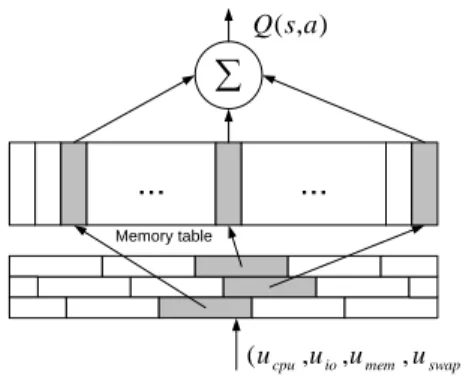
The VM running status is naturally defined in a multi-dimensional continuous space. Although we limit the actions to be discrete operations, the state itself can render the Q value function intractable. Due to its critical impact on the learning performance, there are many studies on the Q function representation [24], [25]. We carefully reviewed these works and decided to borrow the design in the Cerebellar Model Articulation Controller (CMAC) [2] to represent theQ function. It maintains multiple coarse-grainedQtables or so-called tiles, each of which is shifted by a random offset with respect to each other. With CMAC, we can achieve higher resolution in the Qtable with less cost. For example, if each status input (an element in the status vector) is discretized to five intervals (a resolution of 20%), 32 tiles will give a resolution less than 1% (20%/32). The total size of the Q tables is reduced to 32∗54 compared to the size of 1004 if
plain look-up table is used. In CMAC, the actual Q table is stored in a one-dimensional memory table and each cell in the table stores a weight value. Figure 3 illustrates the architecture of a one-dimensional CMAC. The VM running status listed in Figure 3 is only for illustration purpose. The state needs to work with a four-dimensional CMAC. Given a states, CMAC uses a hash function, which takes a pair of state and action as input, to generate indexes for the(s, a)pair. CMAC uses the indexes to access the memory cells and calculates Q(s, a) as the sum of the weights in these cells.
One advantage of CMAC is its efficiency in handling limited data. Similar VM states will generate CMAC indexes with a large overlap. Thus, updates to one state can generalize to the others, leading to accelerated RL learning process. One update of the CMAC-based Q table only needs 6.5
milliseconds in our testbed, in comparison with the 50-second update time in a multi-layer neural network [20]. Once a VM finishes an iteration, it submits the four-tuple (st, at, st+1, rt)
to Decision-maker. Then the corresponding RL agent updates the VM’sQtable using Algorithm 1. In the algorithm, we further enhanced the CMAC-based Q table with fast adaptation when SLA violated. We set the learning rateαto1
whenever receives a negative penalty. This ensures that “bad” news travels faster than good news allowing the learning agent quickly response to the performance violation.
IV. IMPLEMENTATION
iBalloon has been implemented as a set of user-level dae-mons in guest and host OSes. The communication between the host and guest VMs is carried out through an inter-domain channel. In our Xen-based testbed, we usedXenstorefor the host and guest information exchange. Xenstore is a centralized configuration database that is accessible by all domains on the same host. The domains who are involved in the com-munication place ”watches” on a group of pre-defined keys in the database. Whenever sender initializes a communication by writing to the key, the receiver is notified and possibly trigging a callback function. Upon a new VM joining a host,
Host-agent, one per machine, creates a new key under the VM’s path in Xenstore.Host-agentlaunches a worker thread for the VM and the worker ”watches” any change of the key. Whenever a VM submits a resource request via the key, the worker thread retrieves the request details and activates the corresponding handler indom0to handle the request. The VM receives the feedback from Host-agent in a similar way.
We implemented resource allocation in dom0 in a syn-chronous way. VMs send out resource requests in a fixed interval (30 second in our experiments) and Host-agent
waits for all the VMs before satisfying any request. It is often desirable to allow users to submit requests with dif-ferent management intervals for flexibility and reliability in resource allocation. We leave the extension of iBalloon to asynchronous resource allocation in the future work. After VMs and Host-agent agree on the resource allocations,
Host-agent modifies individual VMs’ configurations ac-cordingly. We changed the memory size of the VM by writing the new size to the domain’smemory/targetkey in Xenstore. VCPU number was altered by turning on/off individual CPUs via keycpu/CPUID/availability. For I/O bandwidth control, we used command lsofto correlate VMs’ virtual disks to processes and change the corresponding processes’ bandwidth allocation via the Linux device-mapper driverdm-ioband[27].
App-agent, one per host, maintains the hosted applica-tion SLA profiles. In our experiments, it periodically queries participant machines through standard socket communication and reports application performance, such as throughput and response time, to Host-agent. In a more practical sce-nario, the application performance should be reported by a third-party application monitoring tool instead of the clients. iBalloon can be easily modified to integrate such tools. We implemented theDecision-makeras a process residing in each guest OS. The learning process is local to individual VMs and incurs computation and storage overhead. The distributed implementation of Decision-makerensures that the scal-ability of iBalloon is not limited by the number of VMs. Quantitative comparison of the distributed implementation and a centralized approach will be presented in Section VI-D.
We use xentop utility to report VM CPU utilization.
xentop is instrumented to redirect the utilization of each VM to separate log files in the tmpfs folder /dev/shm
every second. A small utility program parses the logs and calculates the average CPU utilization for every management
interval. The disk I/O utilization is calculated as a ratio of achieved bandwidth to allocated bandwidth. The achieved the bandwidth can be obtained by monitoring the disk activities in /proc/PID/io. PID is the process number of a VM’s virtual disk indom0. The swap rate can also be collected in a similar way. We consider memory utilization to be the guest OS metric Activeover memory size. The Active metric in /proc/meminfo is a coarse estimate of actively used memory size. However, it is lazily updated by guest kernel especially during memory idle periods. We combine the guest reported metric and swap rate for a better estimate of memory usage. With explorations from the learning engine, iBalloon has a better chance to reclaim idle memory without causing significant swapping.
V. EXPERIMENTDESIGN
A. Methodology
To evaluate the efficacy of iBalloon, we attempt to answer the following questions: (1) How well does iBalloon perform in the case of single VM capacity management? Can the learned policy be re-used to control a similar application or on a different platform? (Section VI-B) (2) When there is resource contention, can iBalloon properly distribute the con-strained resource and optimize overall system performance? (Section VI-C) (3) How is iBalloon’s scalability and overhead? (Section VI-D) Before that, we evaluated the effectiveness of the reward metric (Section VI-A). We selected three representative server workloads as the hosted applications. TPC-W [29] is an E-Commerce benchmark that models after an online book store, which is primary CPU-intensive. It consists of two tiers, i.e. the front-end application (APP) tier and the back-end database (DB) tier. SPECweb [28] is a web server benchmark suite that delivers dynamic web contents. It is a CPU and network-intensive server application. TPC-C [29] is an online transaction processing benchmark that contains lightweight disk reads and sporadic heavy writes. Its performance is sensitive to memory size and I/O bandwidth.
To create dynamic variations in resource demand, we in-strumented the workload generators of TPC-W and TPC-C to change client traffic level at run-time. The workload generator reads the traffic level from a trace file, which models after the real Internet traffic pattern [26]. We scaled down the Internet traces to match the capacity of our platform.
B. Testbed Configurations
Two clusters of nodes were used for the experiments. The first cluster (CIC100) is a shared research environment, which consists of a total number of 22 DELL and SUN machines. Each machine in CIC100 is equipped with 8 CPU cores and 8GB memory. The CPU and memory configurations limit the number of VMs that can be consolidated on each machine. Thus, we use CIC100 as a resource constrained cloud testbed to verify iBalloon’s effectiveness for small scale capacity man-agement. Once iBalloon gains enough experiences to make decisions, we applied the learned policies to manage a large number of VMs. CIC200 is a cluster of 16 DELL machines dedicated to the cloud management project. Each node features a configuration of 12 CPU cores (with hyperthreading enabled)
and 32 GB memory. In the scale-out testing, we deployed 64 TPC-W instances, i.e. a total number of 128 VMs on CIC200. To generate sufficient client traffic to these VMs, all the nodes in CIC100 were used to run client generators, with 3 copies running on each node.
We used Xen version 4.0 as our virtualization environment.
dom0and guest VMs were running Linux kernel 2.6.32 and 2.6.18, respectively. To enable on-the-fly reconfiguration of CPU and memory, all the VMs were para-virtualized. The VM disk images were stored locally on a second hard drive on each host. We created thedm-iobanddevice mapper on the partition containing the images to control the disk bandwidth. For the benchmark applications, MySQL, Tomcat and Apache were used for database, application and web servers.
VI. EXPERIMENTALRESULTS
A. Evaluation of the Reward Metric
Thereward metric synthesizes multi-dimensional applica-tion performance and resource utilizaapplica-tions. We are interested in how the reward signal guides the capacity management. The decay rates p and k reflect how important it is for an application to meet the performance objectives in its SLA and how aggressive the user increase resource utilization even at the risk of overload.
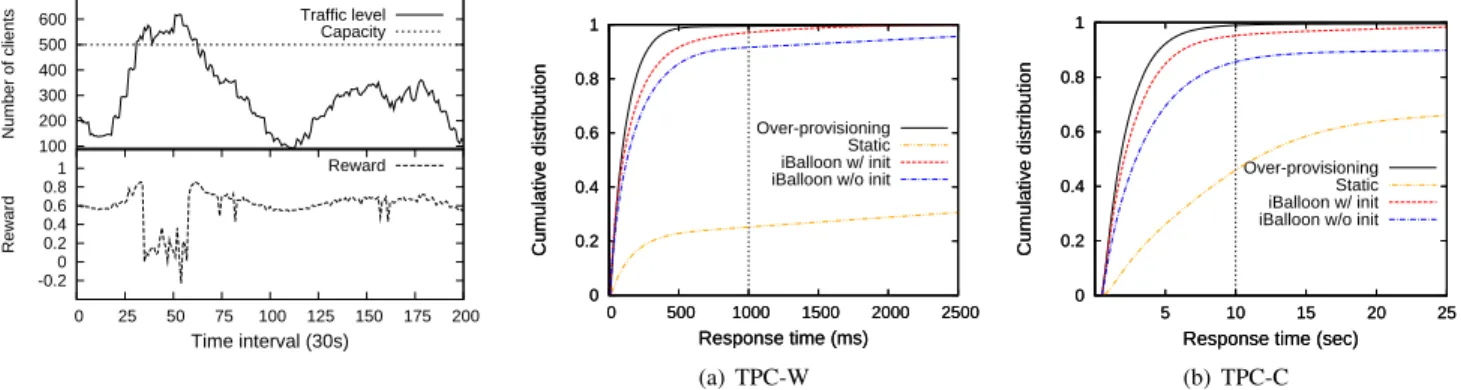
We decided to guarantee user satisfaction and assume risk neutral users, and set p = 10 and k = 1. Figure 4 shows how the reward reflect the status of VM capacity. In this experiment, we varied the client traffic to occasionally exceed the VM’s capacity. rewardis calculated from the DB tier of a TPC-W instance, with a fixed configuration of 3 VCPU, 2GB memory and 2 MB/s disk bandwidth. As shown in Figure 4, when the load is light, performance objectives are met. During this period,yieldis set to 1 andcostdominates the change ofreward. As traffic increases, resource utilization goes up incurring smaller cost. Similarly, reward drops when traffic goes down because of the increase of the cost factor. In contrast, when the VM becomes overloaded with SLA violations, the factor of yield dominates reward by imposing a large penalty. In conclusion, reward effectively punishes performance violations and gives users incentives to release unused resources. We also empirically determined the learning rate and discount factor in [19]. For the rest of this paper, we set the RL parameters to the following values: = 0.1, α= 0.1, γ = 0.9.
B. Single Application Capacity Management
In its simplest form, iBalloon manages a single VM or application’s capacity. In this subsection, we study its ef-fectiveness in managing different types of applications with distinct resource demands. The RL-based auto-configuration can suffer from initial poor performance due to explorations with the environment. To have a better understanding of the performance of RL-based capacity management, we tested two variations of iBalloon, one with an initialization of the man-agement policy and one without. We denote them asiBalloon w/ init and iBalloon w/o init, respectively. The initial policy was obtained by running the application workload for 10
-0.2 0 0.2 0.4 0.6 0.8 1 0 25 50 75 100 125 150 175 200 Reward Time interval (30s) Reward 100 200 300 400 500 600 Number of clients Traffic level Capacity
Fig. 4. Reward with different traffic levels.
0 0.2 0.4 0.6 0.8 1 0 500 1000 1500 2000 2500 Cumulative distribution Response time (ms) 0 0.2 0.4 0.6 0.8 1 0 500 1000 1500 2000 2500 Cumulative distribution Response time (ms) Over-provisioning Static iBalloon w/ init iBalloon w/o init
(a) TPC-W 0 0.2 0.4 0.6 0.8 1 5 10 15 20 25 Cumulative distribution
Response time (sec) 0 0.2 0.4 0.6 0.8 1 5 10 15 20 25 Cumulative distribution
Response time (sec) Over-provisioning
Static iBalloon w/ init iBalloon w/o init
(b) TPC-C Fig. 5. Response time under various reconfiguration strategies.
hours, during which iBalloon interacted with the environment with only exploration actions.
Figure 5(a) and Figure 5(b) plot the performance of iBalloon and its variations in a 5-hour run of the TPC-W and TPC-C workloads. Note that during each experiment, the host was dedicated to TPC-W or TPC-C, thus no resource contention existed. In this simple setting, we can obtain the upper bound and lower bound of iBalloon’s performance. The upper bound is due to resource over-provisioning, which allocates more than enough resource for the applications. The lower bound performance was derived from a VM template whose capacity is not changed during the test. We refer it as static. We configured the VM template with 1 VCPU and 512 MB memory in the experiment. If not otherwise specified, we used the same template for all VM default configuration in the remaining of this paper.
From Figure 5(a), we can see that, iBalloon achieved close performance compared with over-provisioning. iBalloon w/o init managed to keep almost 90% of the request below the SLA response time threshold except that a few percent of requests had wild response times. It suggests that, although started with poor policies, iBalloon was able to quickly adapt to good policies and maintained the performance at a stable level. We attribute the good performance to the highly efficient representation of the Qtable. The CMAC-enhanced Q table was able to generalize to the continuous state space with a limited number of interactions. Not surprisingly, static’s poor result again calls for appropriate VM capacity management.
As shown in Figure 5(b), iBalloon w/ init showed almost optimal performance for TPC-C workload too. But without policy initialization, iBalloon can only prevent around 80% of the requests away from SLA violations; more than 15% requests would have response times larger than 30 seconds. This barely acceptable performance stresses the importance of a good policy in more complicated environments. Unlike CPU, memory sometimes shows unpredictable impact on performance. The dead time due to the factor of memory is much longer than CPU (10 minutes compared to 5 minutes in our experiments). In this case, iBalloon needs a longer time to obtain a good policy. Fortunately, the derived policy, which is embedded in the Qtable, can be possibly re-used to manage similar applications.
Table II lists the application improvement if the learned
TABLE II
PERFORMANCE IMPROVEMENT DUE TO INITIAL POLICY LEARNED FROM DIFFERENT APPLICATIONS AND CLOUD PLATFORMS.
Throughput Response time Trained in TPC-W
Tested in SPECweb 40% 80%
Trained in CIC100
Tested in CIC200 20% 30%
management policies are applied to a different application or to a different platform. The improvement is calculated against the performance of iBalloon without an initial policy. SPECweb [28] is a web server benchmark suite that contains representative web workloads. The E-Commerce workload in SPECweb is similar to TPC-W (CPU-intensive) except that its performance is also sensitive to memory size. Results in Table II suggest that the Q-table learned for TPC-W also worked for SPECweb. An examination of iBalloon’s log revealed that the learned policy was able to successfully match CPU allocation to incoming traffic. A policy learned on cluster CIC100 can also give more than 20% performance improve-ment to the same TPC-W application on cluster CIC200. Given the fact that the nodes in CIC100 and CIC200 have more than 30% difference on CPU speed and disk bandwidth, we conclude that iBalloon policies are applicable to heterogeneous platforms across cloud systems.
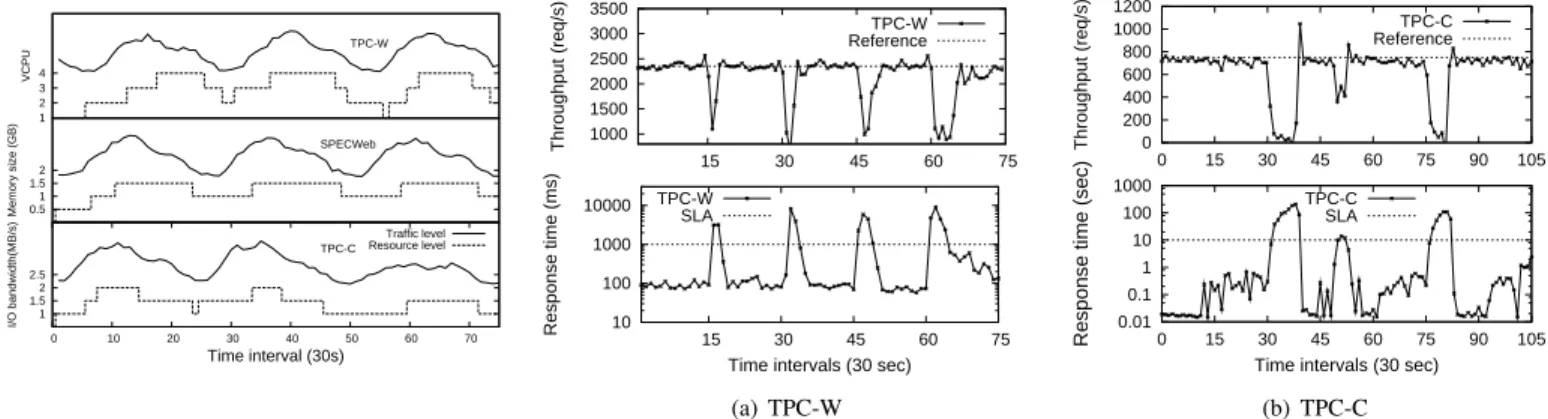
The reward signal provides strong incentives to give up unnecessary resources. In Figure 6, we plot the configuration of VCPU, memory and I/O bandwidth of TPC-W, SPECweb and TPC-C as client workload varied. Recall that we do not have an accurate estimation of memory utilization. We rely on the Active metric in meminfoand the swap rate to infer memory idleness. The Apache web server used in SPECweb periodically free unused httpdprocess thus memory usage information in meminfo is more accurate. As shown in Figure 6, with a 10-hour trained policy, iBalloon was able to expand and shrink CPU and I/O bandwidth resources as workload varied. As for memory, iBalloon was able to quickly respond to memory pressure; it can release part of the unused memory although not completely. The agreement in shapes of each resource verifies the accuracy of therewardmetric.
We note that the above results only show the performance of iBalloon statistically. In practice, service providers concern
1 1.5 2 2.5 0 10 20 30 40 50 60 70 I/O bandwidth(MB/s) Time interval (30s) TPC-C Traffic level Resource level 0.5 1 1.5 2 Memory size (GB) SPECWeb 1 2 3 4 VCPU TPC-W
Fig. 6. Resources allocations changing with workload.
1000 1500 2000 2500 3000 3500 15 30 45 60 75 Throughput (req/s) TPC-W Reference 10 100 1000 10000 15 30 45 60 75 Response time (ms)
Time intervals (30 sec) TPC-W SLA (a) TPC-W 0 200 400 600 800 1000 1200 0 15 30 45 60 75 90 105 Throughput (req/s) TPC-C Reference 0.01 0.1 1 10 100 1000 0 15 30 45 60 75 90 105
Response time (sec)
Time intervals (30 sec) TPC-C
SLA
(b) TPC-C Fig. 7. User-perceived performance under iBalloon.
more about user-perceived performance, because in production systems, mistakes made by autonomous capacity management can be prohibitively expensive. To test iBalloon’s ability of determining the appropriate capacity online, we ran the workload generators at full speed and reduced the VM’s capacity every 15 management intervals. Figure VI-B plots the client-perceived results in TPC-W and TPC-C. In both experiments, iBalloon was configured with initial policies. Each point in the figures represents the average of a30-second management interval. As shown in Figure 7(a), iBalloon is able to promptly detect the mis-configurations and reconfigure the VM to appropriate capacity. On average, throughput and response time can be recovered within7management intervals. Similar results can also be observed in Figure 7(b) except that client-perceived response times have larger fluctuations in TPC-C workload.
C. Coordination in Multiple Applications
iBalloon is designed as a distributed management frame-work that handles multiple applications simultaneously. The VMs rely on the feedback signals to form their capacity management policy. Different from the case of a single ap-plication, in which the feedback signal only depends on the resource allocated to the hosting VM, in multiple application hosting, the feedback signals also reflect possible performance interferences between VMs.
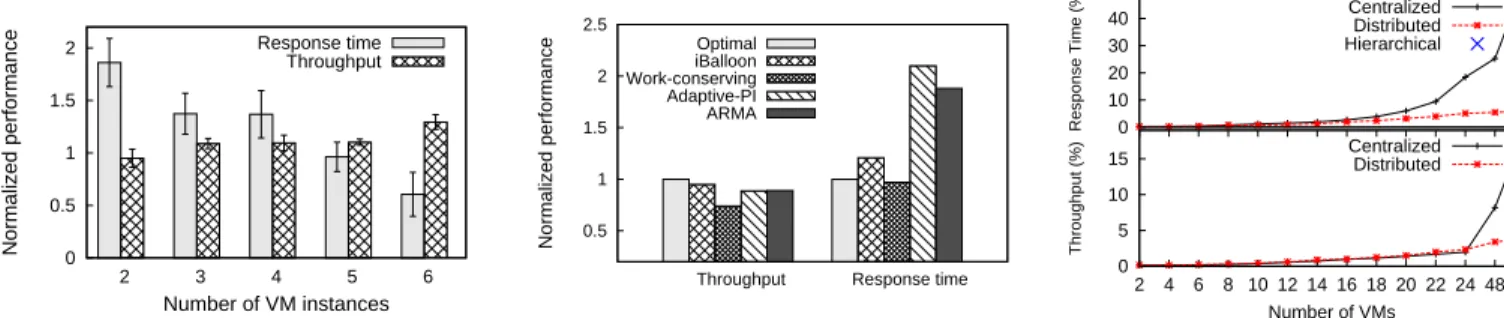
We designed experiments to study iBalloon’s performance in coordinating multiple applications. Same as above, iBalloon was configured to manage only the DB tiers of TPC-W workload. All the DB VMs were homogeneously hosted in one physical host while the APP VMs were over-provisioned on another node. The baseline VM capacity strategy is to statically assign 4VCPU and 1GB memory to all the DB VMs, which is considered to be over-provisioning for one VM. iBalloon starts with a VM template, which has 1VCPU and 512MB memory. Figure 8 draws the performance of iBalloon normalized to the baseline capacity strategy in a 5-hour test. The workload to each TPC-W instances varied dynamically, but the aggregated resource demand is beyond the capacity of the machine that hosts the DB VMs. Figure 8 shows that, as the number of the DB VMs increases, iBalloon gradually beats the baseline in both throughput and response time.
An examination of the iBalloon logs revealed that iBalloon suggested a smaller number of VCPUs for the DB VMs, which possibly alleviated the contention for CPU. The base-line strategy encouraged resource contention and resulted in wasted work. In summary, iBalloon, driven by the feedback, successfully coordinated competing VMs to use the resource more efficiently.
D. Scalability and Overhead Analysis
We scaled iBalloon out to the large dedicated CIC200 cluster. We deployed 64 TPC-W instances, each with two tiers, on the cluster. We randomly deployed the 128 VM on the 16 nodes, assuming no topology information. To avoid possible hotspot and load unbalancing, we make sure that each node hosted8 VMs, 4 APP and 4 DB tiers. We implemented
Decision-maker as distributed decision agents. The de-ployment is challenge to autonomous capacity management for two reasons. First, iBalloon ought to coordinate VMs on different hosts, each of which runs its own resource alloca-tion policy. The dependent relaalloca-tionships makes it harder to orchestrate all the VMs. Second, consolidating APP (network-intensive) tiers with DB (CPU-(network-intensive) tiers onto the same host poses challenges in finding the balanced configuration.
Figure 9 plots the average performance of 64 TPC-W instances for a 10-hour test. In addition to iBalloon, we also experimented with four other strategies. Theoptimalstrategy was obtained by tweaking the cluster manually. It turned out that the setting: DB VM with 3VCPU,1GB memory and APP VM with 1VCPU, 1GB memory delivered the best perfor-mance. work-conserving scheme is similar to the baseline in last subsection; it sets all VMs with fixed 4VCPU and 1GB memory.Adaptive proportional integral (PI)method [18] directly tracks the error of the measured response time and the SLO and adjusts resource allocations to minimize the error. Auto-regressive-moving-average (ARMA) method [17] builds a local linear relationship between allocated resources and response time with recently collected samples, from which the resource reconfiguration is calculated. The performance is normalized to optimal. For throughput, higher is better; for response time, lower is better.
From the figure, iBalloon achieved close throughput as optimal while incurred 20% degradation on request latency.
0 0.5 1 1.5 2 2 3 4 5 6 Normalized performance Number of VM instances Response time Throughput
Fig. 8. Performance of multiple applications due to iBalloon. 0.5 1 1.5 2 2.5
Throughput Response time
Normalized performance Optimal iBalloon Work-conserving Adaptive-PI ARMA
Fig. 9. Performance due to various reconfiguration approaches on a cluster of128correlated VMs.
0 10 20 30 40 50 Response Time (%) Centralized Distributed Hierarchical 0 5 10 15 2 4 6 8 10 12 14 16 18 20 22 24 48 128 Throughput (%) Number of VMs Centralized Distributed
Fig. 10. Runtime overhead of iBalloon.
This is understandable because any change in a VM’s capacity, especially memory reconfigurations, bring in unstable periods. iBalloon outperformedwork-conservingscheme by more than
20% in throughput. Although work-conserving had compro-mised throughput, it achieved similar response time asoptimal because it did not perform any reconfigurations. adaptive-PI and ARMAachieved similar throughput as iBalloon but with more than100%degradations on response time. These control methods which are based either on system identification or local linearization can suffer poor performance under both workload and cloud dynamics. We conclude that iBalloon scales to 128 VMs on a correlated cluster with near-optimal application performance. In the next, we perform tests to narrow down the overhead incurred on request latency.
In previous experiments, iBalloon incurred non-negligible cost in response time. The cost was due to the real overhead of iBalloon as well as the performance degradation caused by the reconfiguration. To study the overhead incurred by iBalloon, we repeated the experiment as in Section 9 except that iBalloon operated on the VMs with optimal configurations and reconfigurations were disabled in Host-agent. In this setting, the overhead only comes from the interactions between VMs and iBalloon. Figure 10 shows the overhead of iBalloon with two different implementations of Decision-maker, namely the centralized and the distributed implementations. In the centralized approach, a designated server performs RL algorithms for all the VMs. Again, the overhead is normalized to the performance in the optimalscheme.
Figure 10 suggests that the centralized decision server becomes the bottleneck with as much as 50% overhead on request latency and 20% on throughput as the number of VMs increases. In contrast, the distributed approach, which computes capacity decisions on local VMs, incurred less than 5% overhead on both response time and throughput. To further confirm the limiting factor of centralized decision server, we split the centralized decision work onto two separate machines(denoted as Hierarchical) in the case of 128 VMs. As shown in Figure 10, the overhead on request latency reduces by more than a half. Additional experiments revealed that computing the capacity management decisions locally in VMs requires no more than 3% CPU resources for Q computation and approximately18MB of memory forQtable storage. The resource overhead is insignificant compared to the capacity of the VM template (1VCPU, 512MB). These results
conclude that iBalloon adds no more than5%overhead to the application performance with a manageable resource cost.
VII. RELATEDWORK
Cloud computing allows cost-efficient server consolidation to increase system utilization and reduce cost. Resource man-agement of virtualized servers is an important and challenging task, especially when dealing with fluctuating workloads and performance interference. Traditional control theory and ma-chine learning have been applied with success to the resource allocation in physical servers; see [1], [14], [22], [11], [12], [21] for examples. Recent work demonstrated the feasibility of these methods to automatic virtualized resource allocation. Early work [18], [23] focused on the tuning of the CPU resource only. Padala, et al. employed a proportional con-troller to allocate CPU shares to VM-based multi-tier applica-tions [18]. This approach assumes non-work-conserving CPU mode and no interference between co-hosted VMs, which can lead to resource under-provisioning. Recent work [10] enhanced traditional control theory with Kalman filters for stability and adaptability. But the work remains under the assumption of CPU allocation. The authors in [23] applied domain knowledge guided regression analysis for CPU allo-cation in database servers. The method is hardly applicable to other applications in which domain knowledge is not available. The allocation of memory is more challenging. The work in [7] dynamically controlled the VM’s memory allocation based on memory utilization. Their approach is application specific, in which the Apache web server optimizes its memory usage by freeing unused httpd processes. For other appli-cations like MySQL database, the program tends to cache data aggressively. The calculation of the memory utilization for VMs hosting these applications is much more difficult. Xen employs Self-Ballooning [15] to do dynamic memory allocation. It estimates the VM’s memory requirement based on OS-reported metric: Commited_AS. It is effective ex-panding a VM under memory pressures, but not being able to shrink the memory appropriately. More accurate estimation of the actively used memory (i.e. the working set size) can be obtained by either monitoring the disk I/O [9] or tracking the memory miss curves [30]. However, these event-driven updates of memory information can not promptly shrink the memory size during memory idleness. Although, we have not found a good way to estimate the VM’s working size, iBalloon relies
on a combination of performance metrics to decide memory allocation. With more information on VMs’ business and past trial-and-error experiences, iBalloon has the potential in more accurate memory allocation.
Automatic allocation of multiple resources [17] or for multiple objectives [13] poses challenges in the design of the management scheme. Complicated relationship between resource and performance makes the modeling of underly-ing systems hard. Padala, et al. applied an auto-regressive-moving-average (ARMA) model with success to represent the allocation to application performance relationship. They used a MIMO controller to automatically allocate CPU share and I/O bandwidth to multiple VMs. However, the ARMA model may not be effective under workload with large variations. Its performance can also be affected by VM inferences.
Different from the above approaches in designing a self-managed system, RL offers tremendous potential benefits in autonomic computing. Recently, RL has been successfully applied to automatic application parameter tuning [4], optimal server allocation [25] and self-optimizing memory controller design [8]. Autonomous resource management in cloud sys-tems introduces unique requirements and challenges in RL-based automation, due to dynamic resource demand, changing topology and frequent VM interference. More importantly, user-perceived quality of service should also be guaranteed. The RL-based methods should be scalable and highly adaptive. The authors in [20] attempted to apply RL in host-wide VM resource management. They addressed the scalability and adaptability issues using model-based RL. However, the com-plexity of training and maintaining the models for the systems under different scenarios becomes prohibitively expensive when the number of VMs increases. In contrast, we design resource allocation in a distributed fashion. In a distributed learning process, iBalloon demonstrated a scalability up to128
correlated VMs on 16 nodes under work-conserving mode. VIII. CONCLUSION
In this work, we presentiBalloon, a generic framework that allows self-adaptive virtual machine resource provisioning. The heart of iBalloon is the distributed reinforcement learning agents that coordinate in dynamic environment. Our prototype implementation of iBalloon, which uses a highly efficient reinforcement learning algorithm as the learning, was able to find the near optimal configurations for a total number of 128
VMs on a closely correlated cluster with no more than 5%
overhead on application throughput and response time. Nevertheless, there are several limitations of this work. First, the management operations are discrete and are in a relatively coarse granularity. Second, the RL-based capacity manage-ment still suffers from initial performance considerably. Future work can extend iBalloon by combining control theory with reinforcement learning. It offers opportunities for the control theory to provide fine grained operations and stable initial performance.
REFERENCES
[1] T. F. Abdelzaher, K. G. Shin, and N. Bhatti. Performance guarantees for web server end-systems: A control-theoretical approach. IEEE Trans. Parallel Distrib. Syst., 13, January 2002.
[2] J. S. Albus. A New Approach to Manipulator Control: the Cerebellar Model Articulation Controller (CMAC). Journal of Dynamic Systems, Measurement, and Control, 1975.
[3] M. Armbrust, A. Fox, R. Griffith, A. D. Joseph, R. H. Katz, A. Konwin-ski, G. Lee, D. A. Patterson, A. Rabkin, I. Stoica, and M. Zaharia. Above the clouds: A berkeley view of cloud computing. Technical report, EECS Department, University of California, Berkeley, Feb 2009.
[4] H. Chen, G. Jiang, H. Zhang, and K. Yoshihira. Boosting the perfor-mance of computing systems through adaptive configuration tuning. In
SAC, 2009.
[5] L. Cherkasova, D. Gupta, and A. Vahdat. When virtual is harder than real: Resource allocation challenges in virtual machine based it environments. Technical report, HP Labs, Feb 2007.
[6] D. Gupta, L. Cherkasova, R. Gardner, and A. Vahdat. Enforcing performance isolation across virtual machines in xen. InMiddleware, 2006.
[7] J. Heo, X. Zhu, P. Padala, and Z. Wang. Memory overbooking and dynamic control of xen virtual machines in consolidated environments. InIM, 2009.
[8] E. Ipek, O. Mutlu, J. F. Martinez, and R. Caruana. Self-optimizing memory controllers: A reinforcement learning approach. InISCA, 2008. [9] S. T. Jones, A. C. Arpaci-Dusseau, and R. H. Arpaci-Dusseau. Geiger: monitoring the buffer cache in a virtual machine environment. In
ASPLOS, 2006.
[10] E. Kalyvianaki, T. Charalambous, and S. Hand. Self-adaptive and self-configured cpu resource provisioning for virtualized servers using kalman filters. InICAC, 2009.
[11] A. Kamra, V. Misra, and E. M. Nahum. Yaksha: a self-tuning controller for managing the performance of 3-tiered web sites. InIWQoS, 2004. [12] M. Karlsson, C. T. Karamanolis, and X. Zhu. Triage: performance
isolation and differentiation for storage systems. InIWQoS, 2004. [13] S. Kumar, V. Talwar, V. Kumar, P. Ranganathan, and K. Schwan.
vmanage: loosely coupled platform and virtualization management in data centers. InICAC, 2009.
[14] C. Lu, T. F. Abdelzaher, J. A. Stankovic, and S. H. Son. A feedback control approach for guaranteeing relative delays in web servers. In
RTAS, 2001.
[15] D. Magenheimer. Memory overcommit...without the commitment. Technical report, Xen Summit, June 2009.
[16] D. Ongaro, A. L. Cox, and S. Rixner. Scheduling i/o in virtual machine monitors. InVEE, 2008.
[17] P. Padala, K.-Y. Hou, K. G. Shin, X. Zhu, M. Uysal, Z. Wang, S. Singhal, and A. Merchant. Automated control of multiple virtualized resources. InEuroSys, 2009.
[18] P. Padala, K. G. Shin, X. Zhu, M. Uysal, Z. Wang, S. Singhal, A. Merchant, and K. Salem. Adaptive control of virtualized resources in utility computing environments. InEuroSys, 2007.
[19] J. Rao, X. Bu, K. Wang, and C.-Z. Xu. Self-adaptive provisioning of virtualized resources in cloud computing. Technical report, ECE Department, Wayne State University, http://www.ece.eng.wayne.edu/ ∼jrao/TechReport11.pdf, Jan 2011.
[20] J. Rao, X. Bu, C.-Z. Xu, L. Wang, and G. Yin. VCONF: a reinforcement learning approach to virtual machines auto-configuration. InICAC, 2009. [21] J. Rao and C.-Z. Xu. Online measurement the capacity of multi-tier
websites using hardware performance counters. InICDCS, 2008. [22] P. P. Renu, P. Pradhan, R. Tewari, S. Sahu, A. Ch, and P. Shenoy.
An observation-based approach towards self-managing web servers. In
IWQoS, 2002.
[23] A. A. Soror, U. F. Minhas, A. Aboulnaga, K. Salem, P. Kokosielis, and S. Kamath. Automatic virtual machine configuration for database workloads. InSIGMOD Conference, 2008.
[24] R. S. Sutton and A. G. Barto.Reinforcement Learning: An Introduction. MIT Press, 1998.
[25] G. Tesauro, N. K. Jong, R. Das, and M. N. Bennani. On the use of hybrid reinforcement learning for autonomic resource allocation.Cluster Computing, 2007.
[26] The ClarkNet Internet traffic trace.
http://ita.ee.lbl.gov/html/contrib/ClarkNet-HTTP.html.
[27] The dm-ioband bandwidth controller.
http://sourceforge.net/apps/trac/ioband/wiki/dm-ioband. [28] The SPECweb benchmark. http://www.spec.org/web2005. [29] The Transaction Processing Council (TPC). http://www.tpc.org. [30] W. Zhao and Z. Wang. Dynamic memory balancing for virtual machines.