U n i v e r s i t ä t A u g s b u r g
Institut für
Mathematik
Christian Br¨
au, Lothar Heinrich
Impressum:
Herausgeber: Institut f¨ur Mathematik Universit¨at Augsburg 86135 Augsburg http://www.math.uni-augsburg.de/de/forschung/preprints.html ViSdP: Lothar Heinrich Institut f¨ur Mathematik Universit¨at Augsburg 86135 AugsburgMultivariate Poisson Distributions Associated
with Boolean Models
Christian Bräu and Lothar Heinrich
1Abstract
We consider ad−dimensional Boolean model Ξ = (Ξ1+X1)∪(Ξ2+X2)∪ · · · generated by a Poisson point process{Xi, i≥1}with intensity measure Λ and a sequence{Ξi, i≥1}
of independent copies of some random compact set Ξ0. Given compact sets K1, ..., K`,
we show that the discrete random vector (N(K1), . . . , N(K`)), where N(Kj) equals the
number of shifted sets Ξi+XihittingKj, obeys a`−variate Poisson distribution with 2`−1
parameters. We obtain explicit formulae for all these parameters which can be estimated consistently from an observation of the union set Ξ in some unboundedly expanding window
Wn (asn→ ∞) provided that the Boolean model is stationary. Some of these results can
be extended to unions of Poissonk−cylinders for 1≤k < d and more general set-valued functionals of independently marked Poisson processes.
Keywords : random closed sets, independently marked Poisson process, gen-erating functional, multivariate probability gengen-erating function, higher-order covariances, empirical volume fraction
AMS 2010 MSC :Primary: 60D05, 60E05; Secondary: 60E10, 62F10
1 Introduction and preliminaries
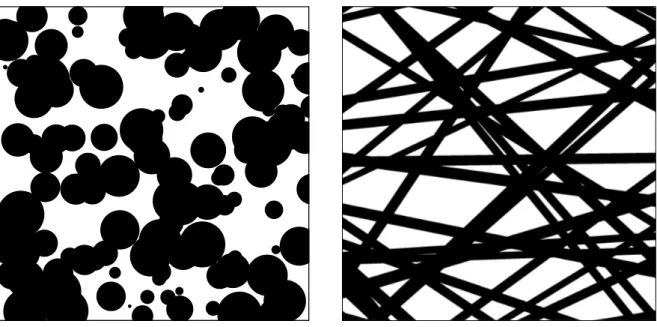
The Boolean model (briefly BM; also known as Poisson grain or Poisson blob model) is one of the best studied and most frequently used models to describe two-phase systems of random sets which decompose thed-dimensional Euclidean space Rd into a vacant region (white) and a region consisting of irregularly shaped clumps (black), see Fig.1. This clumping structure is generated by unions of completely randomly distributed independent random compact sets,
1
Corresponding author: Institute of Mathematics, Augsburg University, 86135 Augsburg, Germany E-mail: [email protected]
Figure 1: Realization of a 2D-Boolean model with discs
Figure 2: Realization of a 2D-Poisson strip process
see e.g. [12], [4], [13],[16],[2] for more details. To be precise, we first recall the definition of a (not necessarily stationary) BM Ξ = ΞΛ,Q as countable union set
ΞΛ,Q= [ i≥1
( Ξi+Xi) (1.1)
of independent copies Ξ1,Ξ2, . . .of a generic random compact set Ξ0 (calledtypical grain) with distributionQ(on the Borelσ-algebraB(Kd), whereKddenotes the metric space of non-empty compact sets in Rd equipped with the Hausdorff metric), where the Ξi’s are independently shifted by the atoms of the Poisson point process ΠΛ =P
i≥1δXi with locally finite intensity
measure Λ on the Borelσ-algebra B(Rd). For notational ease, each atom of the locally finite random counting measure ΠΛ occurs in the sum P
i≥1 resp. in the union
S
i≥1 according to
its multiplicity, where ΠΛ has multiple atoms iff Λ has atoms, see [16], p. 59. By definition of ΠΛ, the random numbers ΠΛ(B1), . . . ,ΠΛ(B`) are mutually independent if the bounded sets
B1, . . . , B` ∈ B(Rd) are pairwise disjoint and ΠΛ(Bj) is Poisson distributed with mean Λ(Bj) forj= 1, . . . , `. The stationarity of ΠΛand thus the stationarity of the BM (1.1) is equivalent with the shift-invariance of the intensity measure Λ and this in turn means that Λ(·) =λ| · |d with some constantλ >0 (called intensity of the BM) and Lebesgue measure | · |d on B(Rd). In what follows, ΞλQ will denote a stationary BM with intensity λ >0.
The random union set ΞΛ,Q defined by (1.1) over some probability space [Ω,F,P] (which always exists) need not to be closed P-a.s., see e.g. [7] for counterexamples. The (P-a.s.)
closedness of the BM (1.1) is guaranteed iff, for anyr >0 ,
0<
Z
Rd
Q({K ∈ Kd: (K+x)∩Brd6=∅}) Λ(dx) =EΛ Bdr⊕(−Ξ0)<∞, (1.2)
where Brd := {x ∈ Rd :kxk ≤ r} and A⊕B := {a+b :a ∈ A, b ∈ B}, see [12] and [5] as special case of closedness conditions for general grain-germ models.
Under condition (1.2) the random variable
N(K) = #{i≥1 :K∩(Ξi+Xi)6=∅}, (1.3)
taking values in Z+ = {0,1,2, . . .} is (as consequence of our model assumptions) Poisson distributed with finite mean EΛ K ⊕(−Ξ0) > 0 for each K ∈ Kd. In this paper we are
interested in the distribution of the Z`+-valued random vector N(K1), . . . , N(K`) for fixed pairwise different, compact sets K1, . . . , K` inRd and any`≥2. Obviously, the components
N(Ki) are correlated random variables unless Ξ0 is bounded and theKi’s are specially chosen. In [1] the special case of two distinct points x, y ∈ Rd has been treated by a rather lengthy explicit computation of the probabilitiesP(N({x}) =i, N({y}) =j) fori, j= 0,1, . . .. In Sect. 2 we extend this result in two ways, namely, we consider more than two pointsx1, . . . , x` and can even replace thexi’s by compact sets Ki. To avoid the awfully long computation of the joint probabilities of {N(Ki) = ni}, i= 1, . . . , `, we derive instead in Theorem 2.1 the shape of the probability generating function (short: PGF)
E zN(K1) 1 · · ·z N(K`) ` = X n1,...,n`≥0 zn1 1 · · ·z n` ` P(N(K1) =n1, . . . , N(K`) =n`) (1.4) forz1, . . . , z` ∈C1 satisfying max1≤i≤`|zi| ≤1.
It turns out that N(K1), . . . , N(K`)
possesses an `-variate Poisson distribution. Since there exist different multivariate extensions of the Poisson distribution, see e.g. [9], we recall the definition of that`-variate Poisson distribution which seems to be most meaningful not only in our situation. A random vector (N1, . . . , N`) with values in Z`+ is said to be`-variate Poisson
distributed if its PGFg(z1, . . . , z`) =E zN1 1 · · ·z N` `
possesses the form
g(z1, . . . , z`) := exp n X ∅6=J⊆L µJ Y j∈J (zj−1) o = expnγ∅+ X ∅6=J⊆L γJ Y j∈J zj o (1.5)
for allz1, . . . , z` ∈C1 with positive expectationsµi =ENi and further 2`−1−` parameters
cumulant of the subvector (Nj)j∈J which have to satisfy the consistency conditions γ∅:= X ∅6=J⊆L (−1)#JµJ <0 and γI:= X I⊆J⊆L (−1)#(J\I)µJ ≥0 for ∅ 6=I ⊆L . (1.6)
The conditions (1.6) are necessary (and sufficient) for a non-degenerate `-variate Poisson distribution since (1.5) implies the relations (∂z∂#I
i)i∈I logg(z1, . . . , z`) ≥ 0 for I ⊆ L and all
z1, . . . , z` ∈ [0,1] and γ∅ = −P∅6=I⊆LγI. Various structural properties of this multivari-ate Poisson distribution are known : (i) its existence as limit of multivarimultivari-ate binomial dis-tributions, see [10], (ii) its characterization by recurrence relations of the density functions
P(N1 =n1, . . . , N` =n`), see [11] and (iii) it is the only infinitely divisible distribution which is marginally Poisson, see [3] and [9]. It is noteworthy to mention thatµij =Cov(Ni, Nj) = 0 for i 6= j implies independence of the components Ni and Nj. On the other hand, µij = 0 for all pairs i, j ∈ L , i6= j ,#L ≥ 3, does not necessarily imply neither µL = 0 nor mutual independence of the components N1, . . . , N`. The rest of this paper is organized as follows: In the next Sect. 2 we formulate and prove the announced main result for BM’s. In Sect. 3 we shall discuss the parameters in case of a stationary BM and derive strongly consistent estimators for all parameters occurring in the PGF (2.7) based on an single observation of the union set (1.1) in an unboundedly increasing sampling window Wn. In the final Sect. 4 we extend Theorem 2.1 to other random set models driven by independently marked Poisson processes.
2 Main result
Theorem 2.1. Let ΞΛ,Q be a BM as defined by (1.1) satisfying (1.2). Then the PGF of the random vector N(K1), . . . , N(K`)with components defined by(1.3)for fixedK1, . . . , K` ∈ Kd
such thatmin1≤i≤`EΛ(Ki⊕(−Ξ0))>0 takes the form
EhzN(K1) 1 · · ·z N(K`) ` i = expn X ∅6=J⊆L EΛ \ j∈J (Kj⊕(−Ξ0) ) Y j∈J (zj −1) o , (2.7)
where the sum P
∅6=J⊆L runs over all 2`−1 non-empty (unordered) subsets J of L. In other
words, N(K1), . . . , N(K`)
possesses an `-variate Poisson distribution with parameters
µJ =µΛ,Q(KJ) :=EΛ \
j∈J
(Kj ⊕(−Ξ0)) for ∅ 6=J ⊆L (2.8)
and the consistency relations (1.6) are fulfilled with γJ =γΛ,Q(KJ) defined by
γΛ,Q(KJ) :=EΛ \ j∈J (Kj⊕(−Ξ0) )−EΛ \ j∈J (Kj⊕(−Ξ0) )∩ [ j∈L\J (Kj⊕(−Ξ0)) (2.9)
for ∅ ⊆J ⊆L
Proof. For each copy Ξi of the typical grain Ξ0 and any compact set K6=∅, it is evident that
K∩(Ξi+Xi)6=∅ iff Xi∈K⊕(−Ξi).
Therefore, using the indicator function1B(x) (= 1 forx∈B and = 0 otherwise) we may write
N(K) as sum N(K) = # i≥1 :K∩(Ξi+Xi)6=∅ = X i≥1 1K⊕(−Ξi)(Xi).
Hence, forz1, . . . , z`∈C1 we may express the PGF of N(K1), . . . , N(K`)as follows:
EhzN(K1) 1 · · ·z N(K`) ` i =Eh Y i≥1 z1K1⊕(−Ξi)(Xi) 1 · · ·z 1K`⊕(−Ξi)(Xi) ` i .
Next, we make use of the probability generating functionalGΛ,Q[v] =E Q
i≥1v(Xi,Ξi)of an independently marked Poisson process ΠΛ,Q=P
i≥1δ[Xi,Ξi]onR
d× Kdwith intensity measure Λ and mark distributionQ. GΛ,Q[v] possesses a comparatively simple shape, see e.g. [16] (p. 65) or [2], namely, GΛ,Q[v] = exp Z Rd Z Kd v(x, K)−1 Q(dK) Λ(dx) (2.10)
for any Borel-measurable function v|Rd× Kd−→C1 satisfying
R Rd
R
Kd|v(x, K)−1|Q(dK) Λ(dx)<∞ .
In the particular case v(x, K) =Q`j=1zj1Kj⊕(−K)(x) the latter condition is an immediate conse-quence of (1.2). By applying the obvious identities z1B(x)= 1 +1B(x)(z−1) and
Y j∈L (1 +aj) = 1 + X ∅6=J⊆L Y j∈J ai (2.11)
for any a1, . . . , a` ∈ C, where the sum P∅6=I⊆L runs over all non-empty index sets I ⊆
{1, . . . , `}, we can express v(x, K)−1 as follows:
v(x, K)−1 = Y j∈L 1 +1Kj⊕(−K)(x)(zj −1) −1 = X ∅6=I⊆L Y i∈I (zi−1)1Ki⊕(−K)(x) .
Fubini’s theorem we arrive at EhzN(K1) 1 · · ·z N(K`) ` i = expn X ∅6=J⊆L Y j∈J (zj−1) Z Rd Z Kd Y j∈J 1Ki⊕(−K)(x)Q(dK) Λ(dx) o = expn X ∅6=J⊆L Y j∈J (zj −1) Z Rd Z Kd 1T j∈J (Kj⊕(−K))(x)Q(dK) Λ(dx) o = expn X ∅6=J⊆L Y j∈J (zj −1)EΛ \ j∈J (Kj⊕(−Ξ0) ) o .
The last line provides the asserted shape of the PGF (2.7).
To accomplish the proof of Theorem 2.1 we check the conditions (1.6) forµJ given in (2.8). For notational ease we putKi0 :=Ki⊕(−Ξ0) for i= 1, . . . , `and ν(·) =EΛ(·). Applying the
inclusion-exclusion formula
ν(A∩ ∪j∈L\IAj) = X
∅6=J⊆L\I
(−1)#J−1ν(A∩ ∩j∈JAj)
(being valid for any additive set-functionν) yields
γΛ,Q(KI) = X I⊆J⊆L (−1)#(J\I)ν(\ j∈J Kj0) =ν \ i∈I Ki0 + X ∅6=J⊆L\I (−1)#Jν \ i∈I Ki0∩ \ j∈J Kj0 =ν \ i∈I Ki0 −ν \ i∈I Ki0∩ [ j∈L\I Kj0 ≥0 for ∅ 6=I ⊆L
and, sinceEΛ(Ki⊕(−Ξ0))>0 fori= 1, . . . , `,
γΛ,Q(K∅) = X ∅6=J⊆L (−1)#Jν(\ j∈J Kj0) =−ν [ j∈L Kj0 <0.
This completes the proof of Theorem 2.1.
In the particular case of a stationary BM ΞλQ with known intensity λ(see e.g. [13] for various methods to estimate the intensity λ) the parameters (2.8) contain quite a lot of information on the distributionQ of the typical grain Ξ0 depending on a clever choice of K1, . . . , K` (e.g. balls, line segments, single points etc.). For example, if Ki = {xi} for i = 1, . . . , `, the 2`−1 parameters µλQ(xJ) := λE|Tj∈J(Ξ0−xj)|d for non-empty subsets J of L determine the joint distribution of the random vector N({x1}), . . . , N({x`})
. The shift-invariance of the Lebesgue measure | · |d causes that µ(xJ) remains unchanged when the points (xj)j∈J is replaced by the shifted points (xj +x)j∈J for any x ∈ Rd. In particular, we have µλQ(xi) :=
EN({xi}) =λE|Ξ0|d and
µλQ(xij) :=Cov N({xi}), N({xj})=λE|(Ξ0−xi)∩(Ξ0−xj)|d=λECΞ0(xi−xj) for i, j = 1, . . . , `, where CB(x) := |B ∩(B +x)|d denotes the set covariance function of the bounded Borel set B ⊂ Rd, see e.g. [12] or [2] (p. 17) for properties and historical background.
Note that the `-point probabilities P(x1 ∈ ΞλQ, . . . , x` ∈ ΞλQ) can be completely expressed in terms of the parametersµλQ(xJ) for ∅ 6=J ⊆L.
Indeed, by a twofold application of the inclusion-exclusion formula and
P(\ j∈J {xj ∈/ Ξ}) =P( \ j∈J {N({xj}) = 0}) = exp{−λE [ j∈J (Ξ0−xj) d} we find that P(x1∈ΞλQ, . . . , x` ∈ΞλQ) =P( \ i∈L {N({xi})≥1}) = 1−P( [ i∈L {N({xi}) = 0}) = 1 + X ∅6=J⊆L (−1)#Jexp{−λE [ j∈J (Ξ0−xj) d} withλE S j∈J(Ξ0−xj) d= P ∅6=I⊆J(−1)#I−1µλQ(xI) .
Especially, thecovarianceof a stationary BM ΞλQ takes the form
P(o∈ΞλQ, x∈ΞQλ) = 1−2 exp{−λE|Ξ0|d}+ exp{−2λE|Ξ0|d+λECΞ0(x)}.
3 Parameter estimation for stationary Boolean models
The estimation of the 2`−1 parameters associated with the `−variate Poisson distribution of N(K1), . . . , N(K`) is possible in case of a stationary BM ΞλQ when an observation in some sufficiently large (expanding) sampling window Wn is available. For Λ(·) = λ| · |d the parameters (2.8) take the form
µλQ(KJ) =λE \ j∈J Ξ0⊕(−Kj) d for ∅ 6=J ⊆L . (3.12) An estimator forµλ
Q(KJ) is constructed from the empirical volume fractions
\ (p(KI))n:= (ΞλQ⊕S i∈I(−Ki))∩Wn d |Wn|d for ∅ 6=I ⊆J . (3.13)
Note that the numerator in (3.13) can be calculated only if ΞλQ is known in the larger window
Wn⊕Si∈IKi. Otherwise, the mere observation of ΞλQ∩Wn means that in (3.13)Wn must be replaced by the smaller minus-window Wn Si∈IKi, where A B := {x :x+A ⊆B}, see [13] (p. 58). In this casep\(KI)n is still unbiased and strongly consistent.
Theorem 3.1. Let Ξλ
Q be a stationary BM in Rd with intensity λ > 0 and typical grain Ξ0
having distributionQsuch thatE|Ξ0⊕Brd|d<∞forr >0. Further, let(Wn)n≥1 be an isotone
sequence of convex and compact sets in Rd such that %(Wn) := sup{r >0 :Brd+x ⊆Wn for
some x∈Wn} −−−→n→∞ ∞. Then, for any compact sets K1, . . . , K` as in Theorem 2.1 and any
non-empty index set J ⊆L, the sequence of estimators
\ (µλQ(KJ))n:= X ∅6=I⊆J (−1)#I log 1−p\(KI)n , (3.14)
is strongly consistent for µλQ(KJ), i.e. (µ\λQ(KJ))n
P−a.s.
−−−−→
n→∞ µ
λ
Q(KJ) for ∅ 6=J ⊆L.
Proof. Obviously, the Minkowski sum of the BM (1.1) with a fixed setK ∈ Kd, expressed by
ΞΛ,Q⊕(−K) = [ x∈K (ΞΛ,Q−x) = [ i≥1 Ξi⊕(−K) +Xi, (3.15)
yields again a BM defined by the same Poisson process ΠΛand the new typical grain Ξ0⊕(−K). The stationarity of the BM ΞλQ (= ΞΛ,Q with Λ(·) =λ| · |d) implies that its volume fraction equals E (ΞλQ⊕(−K))∩[0,1]d d=P(o∈ΞλQ⊕(−K)) = 1−exp{−λE Ξ0⊕(−K)d}, see [12], [4], [13] or [2].
The spatial ergodic theorem of Nguyen & Zessin, see [14] ( and e.g. [13], [7] for its application to BMs ), provides the a.s. limit
(ΞλQ⊕(−K))∩Wn d |Wn|d P−a.s. −−−−→ n→∞ E (ΞλQ⊕(−K))∩[0,1]d d = 1−exp− λE Ξ0⊕(−K) d .
Note that Wn can be replaced by Wn K ={x :x+K ⊆Wn} without changing the limit. Applying the latter relation toK =S
i∈IKi for any index setI ⊆J(⊆L) gives
1−(p\(KI))n P−a.s. −−−−→ n→∞ 1−p(KI) := exp n −λE [ i∈I Ξ0⊕(−Ki) d o ,
which together with the inclusion-exclusion formula X ∅6=I⊆J (−1)#I−1E [ i∈I Ξ0⊕(−Ki) d=E \ j∈J Ξ0⊕(−Kj) d
completes the proof of Theorem 3.1.
Note that the estimators (3.14) are neither asymptotically unbiased nor mean-square consis-tent. This is due to the fact that the BM ΞλQ⊕(−K) may completely cover the windowWnwith positive probabilitypn(−−−→n→∞ 0) ifE|Ξ0⊕K|d>0. On the other hand, the (2`−1)-dimensional vector (µ\λQ(KJ))n indexed by non-empty J ⊆ L is asymptotically normally distributed (as
n→ ∞). More precisely, we are able to prove the multivariate central limit theorem
q |Wn|d (µ\λQ(KJ))n−µλQ(KJ) J⊆L D −−−→ n→∞ N2`−1(o,Σ λ Q(KL)), (3.16)
that is, the left-hand side converges in distribution to a mean zero Gaussian vector in R2`−1
with covariance matrix ΣλQ(KL) provided the conditionE|Ξ0⊕Brd|2d<∞ forr >0 (implying (1.2)) is satisfied. We omit the proof (3.16) and the calculation of the rather complicated form of Σλ
Q(KL). We only mention that the proof of (3.16) relies on the fact (by applying the mean value theorem and Slutsky’s lemma) that the distributional limits ofp|Wn|d
log 1− \ (p(KI))n −log 1−p(KI)
for∅ 6=I ⊆L coincides with the Gaussian limit
q |Wn|d (p\(KI))n−p(KI)/(p(KI)−1) D −−−→ n→∞ N(0, σ λ Q(KI)), (3.17)
where the varianceσλQ(KI) = limn→∞ |Wn|dVar((p\(KI))n)/(1−p(KI))2 is equal to Z Rd exp{λE|(Ξ0⊕(− [ i∈I Ki))∩(Ξ0⊕(− [ i∈I Ki)−x)|d} −1dx ,
see [6] and [1], [15] for similar computations in connection with the proof of asymptotic nor-mality of empirical Boolean model characteristics. Finally, to prove (3.16) we employ the Cramér-Wold technique which means to determine the distributional limits of linear combina-tions of the left-hand side of (3.17).
4 Extensions to Other Poisson-Driven Random Sets
To generalize Theorem 2.1 we make again use of the probability generating functional
GΛs,Q[w] :=E Y i≥1 w(Yi, Mi)= exp Z Rs Z M w(x, m)−1 Q(dm) Λs(dx) (4.18)
of the independently marked Poisson process ΠΛs,Q=P
i≥1δ[Yi,Mi]on R
s×M for somes≥1 with intensity measure Λs on [Rs,B(Rs)] and mark distributionQ on the Borel setsB(M) of a Polish mark space M. Further, let F|Rs×M → Fd be a (B(Rs)⊗ B(M), σ
f)-measurable mapping, where Fd denotes the family of closed subsets in Rd equipped with Matheron’s
σ−algebra, σf being a Borel-σ-algebra with respect to thehit-and-miss (orFell) topology, see [12], [16]. Under the assumption that the number NF(K) := #{i ≥ 1 : K ∩F(Yi, Mi) 6=
∅} of members of the countable family {F(Yi, Mi)}i≥1 (forming a particle process) hitting
K has finite expectation for any K ∈ Kd (which implies the closedness of the union set ΞΛs,Q(F) := F(Y1, M1)∪F(Y2, M2)∪ · · ·), we can show that the random Z`+-valued vector
(NF(K1), . . . , NF(K`)) possesses an`-variate Poisson distribution. To express the correspond-ing 2` −1 parameters we need the Borel sets A(K, m) := {y ∈ Rs : K ∩F(y, m) 6= ∅} for
K∈ Kd and m∈M.
Theorem 4.1. Let the family {F(Yi, Mi)}i≥1 of random closed sets in Rd and the numbers
NF(K)forK∈ Kddefined as before. Then the PGF of the random vector NF(K1), . . . , NF(K`)
with fixedK1, . . . , K` ∈ Kd such that0<EΛs(A(Kj, M0))<∞ fori= 1, . . . , ` takes the form
(1.5)with parameters µJ =EΛs \ j∈J A(Kj, M0) for ∅ 6=J ⊆L . (4.19)
The proof of Theorem 4.1 is omitted since it consists in repeating the arguments used to prove (2.7) up to some obvious changes. On the other hand, Theorem 2.1 is a special case of Theorem 4.1 with Λd = Λ and F(x, m) = m+x for x ∈ Rd, m ∈ Kd so that A(K, m) = K ⊕(−m). By choosing the mapping F(x, m) and the mark space M appropriately we can count, for example, the number of strips of 2D-Poisson strip process, see Fig. 2, hitting a fixed planar compact set K. We close this section by describing this procedure for general (stationary) Poissonk-cylinder (andk-flat) processes inRd, 1≤k≤d−1.
For doing this, some further notation is needed. In stochastic geometry, a k-cylinder in Rd is defined as Minkowski sumL⊕B of a direction space L ∈ G(d, k) (= the Grassmannian of
k-dimensional subspaces ofRd) and a compactbase B in the orthogonal complementL⊥, see
e.g. [16] or [17]. In the following we go along the line suggested in [8] (which slightly differs from that in [12] and [17]) and identifyLwith a unique elementOLof the equivalence classOL of special orthogonal matricesO∈SOd (i.e. O∈Rd×d,OT =O−1 and det(O) = 1) satisfying
OEk = L (and OE⊥k = L
⊥), where
Ek = span{ed−k+1, . . . , ed}, E⊥k = span{e1, . . . , ed−k} fork= 1, . . . , d−1 with the usual orthonormal basis {e1, . . . , ed} of Rd. In other words, two matrices O1, O2 ∈ SOd belong to the compact set OL ⊂ SOd iff OT1 O2 belongs to the set of
orthogonal block matricesS(Od−k×Ok) defined by ( A 0 0 B ! :A∈R(d−k)×(d−k), B∈Rk×k, AT =A−1, BT =B−1,det(A) = det(B) ) .
The elementOLcan be chosen in a canonical way, e.g. as lexicographically smallest element of the set of matricesOL. In this way we get a one-to-one correspondence betweenSOdk={OL:= lexminOL :L∈ G(d, k)} and G(d, k) up to orientation of the subspaces. Note that for k= 1 (and analogously for k = d−1) the orthogonal matrix OL is chosen such that det(OL) = 1 and OLed =u, where u ∈∂B1d can be expressed in terms of spherical coordinates and u and
−u are identified. Thus, ford= 2, k= 1 we representL ={%(cosϑ,sinϑ)T :%∈R1} by the
matrixOL= sinϑ cosϑ
−cosϑ sinϑ
!
for 0≤ϑ < π.
In this way, to each random subspace L ∈ G(d, k) corresponds a (unique) random matrix Θ(L) ∈SOdk and vice versa. Now, we are ready to define aPoisson k-cylinder process in Rd over some probability space [Ω,F,P] as countable family of random k-cylinders
{Θi( ({(x+Yi,ok)T :x∈Ξi})⊕Ek), i≥1}={Θi( (Ξi+Yi)×Rk), i≥1} (4.20) driven by an independently marked Poisson process ΠΛd−k,Qd,k =
P
i≥1δ[Yi,(Θi,Ξi)] on the
prod-uct space ofRd−k and mark spaceSOdk× Kd−k with intensity measure Λ
d−kand typical mark (Θ0,Ξ0) (specifying direction and base of the typicalk-cylinder Θ0( Ξ0×Rk)) with
distribu-tion Qd,k. Note that, in analogy to (1.2), the condition EΛd−k Brd−k⊕(−Ξ0) <∞ for any
r > 0 implies the closedness of thePoisson k-cylinder model (= union set of thek-cylinders (4.20), see also [8]. Furthermore, a Poisson k-cylinder process resp. model is stationary iff Λd−k(·) =λ| · |d−k.
It is easy to see that Poisson k-cylinder processes fit within the framework of Theorem 4.1. Namely, for s = d−k, Q = Qd,k and F(y,(θ, ξ)) := θ (ξ +y)×Rk
for y ∈ Rd−k and (θ, ξ)∈M:=SOdk× Kd−k, we find that
A(K,(θ, ξ)) ={y∈Rd−k:K∩F(y,(θ, ξ))6=∅}
=πd−k(θTK)⊕(−ξ) for K ∈ Kd,
whereπd−k(x) denotes the projection of the vector x∈Rd on its firstd−k components. Hence, the corresponding parameters (4.19) for Poissonk-cylinder processes are as follows:
µJ =EΛd−k \ j∈J (πd−k(ΘT0 Kj)⊕(−Ξ0) ) for ∅ 6=J ⊆L . (4.21)
In the particular case of stationary Poisson k-flat processes in Rd, where Ξ0 = {od−k} and Λd−k(·) =λ| · |d−k, the parameters (4.21) take the form
µJ =λE \ j∈J πd−k(ΘT0 Kj) d−k for ∅ 6=J ⊆L .
References
[1] Böhm, S., Heinrich, L. and Schmidt, V.(2004). Asymptotic properties of estimators for the volume fractions of jointly stationary random sets.Statistica Neerlandica 58, 388– 406.
[2] Chiu, S. N., Stoyan, D., Kendall, W.S. and Mecke, J.(2013).Stochastic Geometry
and Its Applications. 3rd ed., Wiley, Chichester.
[3] Dwass, M., Teicher, H.(1957) On infinitely divisible random vectors.Ann. Math. Stat.
28, No. 2, 461 - 470.
[4] Hall, P. (1988).Introduction to the Theory of Coverage Processes. Wiley, New York. [5] Heinrich, L.(1992). On existence and mixing properties of germ-grain models.Statistics
23, 271–286.
[6] Heinrich, L., Molchanov, I. (1999) Central limit theorem for a class of random mea-sures associated with germ-grain models. Adv. Appl. Prob. 31, No. 2, 283 - 314.
[7] Heinrich, L. (2005). Large deviations of the empirical volume fraction for stationary Poisson grain models. Ann. Appl. Prob.15, No. 1A, 392–420.
[8] Heinrich, L., Spiess, M.(2013) Central limit theorems for volume and surface content of stationary Poisson cylinder processes in expanding domains. Adv. Appl. Prob.45, No. 2, 312 - 331.
[9] Johnson, N. L., Kotz, S. and Balakrishnan, N.(1997). Discrete Multivariate
Dis-tributions. Wiley, Chichester.
[10] Kawamura, K. (1979). The structure of the multivariate Poisson distribution. Kodai Mathematical Journal 2, 337–345.
[11] Kawamura, K. (1987). Calculation of the density for the multivariate Poisson distribu-tion.Kodai Mathematical Journal 10, 231–241.
[13] Molchanov, I.(1997).Statistics of the Boolean Model for Practitioners and Mathemati-cians. Wiley, Chichester.
[14] Nguyen, X.X. and Zessin, H. (1979). Ergodic theorems for spatial processes. Z.
Wahrsch. verw. Gebiete 48, 133–158.
[15] Schmidt, V., Spodarev, E.(2005) Joint estimators for the specific intrinsic volumes of stationary random sets. Stoch. Proc. Appl. 115, 959 - 981.
[16] Schneider, R. and Weil, W. (2008). Stochastic and Integral Geometry. Springer,
Berlin.
[17] Spiess, M. and Spodarev, E. (2011). Anisotropic Poisson processes of cylinders.