In-depth Comparative Evaluation of Supervised Machine Learning
Approaches for Detection of Cybersecurity Threats
Laurens D’hooge, Tim Wauters, Bruno Volckaert and Filip De Turck
Ghent University - imec, IDLab, Department of Information Technology, Technologiepark-Zwijnaarde 126, Gent, Belgium {laurens.dhooge, tim.wauters, bruno.volckaert, filip.deturck}@ugent.be
Keywords: Intrusion Detection, CICIDS2017, Supervised Machine Learning, Binary Classification.
Abstract: This paper describes the process and results of analyzing CICIDS2017, a modern, labeled data set for test-ing intrusion detection systems. The data set is divided into several days, each pertaintest-ing to different attack classes (Dos, DDoS, infiltration, botnet, etc.). A pipeline has been created that includes nine supervised learn-ing algorithms. The goal was binary classification of benign versus attack traffic. Cross-validated parameter optimization, using a voting mechanism that includes five classification metrics, was employed to select opti-mal parameters. These results were interpreted to discover whether certain parameter choices were dominant for most (or all) of the attack classes. Ultimately, every algorithm was retested with optimal parameters to obtain the final classification scores. During the review of these results, execution time, both on consumer-and corporate-grade equipment, was taken into account as an additional requirement. The work detailed in this paper establishes a novel supervised machine learning performance baseline for CICIDS2017. Graphics of the results as well as the raw tables are publicly available at https://gitlab.ilabt.imec.be/lpdhooge/cicids2017-ml-graphics.
1
INTRODUCTION
Intrusion detection is a cornerstone of cybersecurity and an active field of research since the 1980s. Al-though the early research focused more on host intru-sion detection systems (HIDS), the principal aims of an intrusion detection system (IDS) have not changed. A well-functioning IDS should be able to detect a wide range of intrusions, possibly in real-time, with high discriminating power, improving itself through self-learning, while being modifiable in its design and execution (Denning and Neumann, 1985). The advent of computer networking and its ever greater adoption, shifted part of the research away from HIDS to net-work intrusion detection systems (NIDS). This paper details the experiment and results of analyzing a mod-ern intrusion detection dataset (CICIDS2017) and it is structured as follows. First an overview of the re-lated work in intrusion detection and network secu-rity dataset generation is given, then the implementa-tion of the analysis is described (secimplementa-tion 3). Third and most important is the discussion of the results (sec-tion 4), summarized in the conclusion . Key findings in this work are the outstanding performance both in terms of classification and time metrics of tree-based classifiers, especially ensemble learners, the
surpris-ing effectiveness of simple distance-based methods and the classification difficulty for all methods on one attack class.
2
RELATED WORK
2.1
Intrusion Detection
The field of network intrusion detection developed two main visions on solving the problem of deter-mining whether observed traffic is legitimate. The chronologically first approach, is the use of signature-based systems (also called misuse detection systems). Within this category different strategies have been re-searched (Axelsson, 2000), including state modelling, string matching, simple rule based systems and ex-pert systems (emulating human exex-pert knowledge, by making use of a knowledge base and an inference system). All systems in this category, while being great at detecting known signatures, do not general-ize. That’s a violation of the principles for intrusion detection systems, namely the system’s ability to im-prove itself through learning.
been around almost as long, but the methods have changed drastically in the past years. Early systems based their decisions on rules, profiles and heuristics, often derived from relatively simple statistic methods. These systems could be self-learning in the sense that their heuristics could be recomputed and thus become a dynamic part of the system. Advances in the last ten years in terms of distributed computation and storage have enabled more advanced statistical methods to be-come feasible. Work by Buczak et al. (Buczak and Guven, 2016) concluded that making global recom-mendations is impossible and the nature of the data and types of attacks to be classified should be taken into account when designing an IDS. Furthermore they stress the requirement for training data in the field of network intrusion detection and an evaluation approach that considers more than just accuracy. On a final note, the authors included recommendations for machine learning (ML) algorithms for anomaly detec-tion (density based clustering methods and one-class SVMs) and for misuse detection (decision trees, asso-ciation rule mining and Bayesian networks).
Very recent work by Hodo et al. (Hodo et al., 2017) examines the application of shallow and deep neural networks for intrusion detection. Their graph-ical overview of IDS techniques clearly shows the dominant position of anomaly based methods, driven by the adoption of machine learning techniques. Their main contribution is a chapter explaining the algorithm classes of neural networks. The work dif-ferentiates between artificial neural networks (ANN) (shallow) and deep networks (DN), with subdivisions between supervised and unsupervised methods for ANNs and generative versus discriminative methods for DNs. Their conclusion is that deep networks show a significant advantage for DNs in detection. They note that the adoption of either class is still in its early stages, when applied to network intrusion detection.
2.2
Datasets
Self-learning systems require data to train and test their efficacy. All techniques used in this work are supervised, machine learning algorithms. This means that they do not just require data, but that data has to be labeled. The dataset landscape in intrusion detec-tion has a.o. been described by Wu et al. (Wu and Banzhaf, 2010) as part of a review paper on the state of computational intelligence in intrusion detection systems and more succinctly by Shiravi et al. (Shiravi et al., 2012), as prelude to their efforts in generating a new approach for dataset creation.
This work will only offer a very brief overview of the most studied datasets. KDDCUP99 (KDD99), the
subject of ACM’s yearly competition on Data mining and Knowledge Discovery in 1999 is by far the most studied data set for intrusion detection. Its origin is to be found in a DARPA funded project, run by the Lin-coln Lab at MIT, which was tasked with evaluating the state of the art IDSs at the time. Apart from be-ing based on twenty year old data by now, it has also been criticized by McHugh in 2000 (McHugh, 2000), by Brown et al. in 2009 (Brown et al., 2009) and by Tavallaee et al. also in 2009 (Tavallaee et al., 2009).
The persistence of a single dataset for almost two decades and its improved version, which now also is nearly a decade old, called for new research into dataset generation. The Canadian Institute for Cyber-security (CIC), a coalition of academia, government and the public sector, based at the University of New Brunswick is the front runner in this field of research. The analysis by Tavallaee et al. of the dataset resulted in a new dataset, named NSL-KDD, in which struc-tural deficiencies of KDD99 were addressed. NSL-KDD does not have redundant records in the training data, removed duplicates from testing data, reduced the total number of records so that the entire dataset could be used, instead of needing to sample it. Finally, to improve the variability in ability of the learners they tested, items which were hard to classify (a mi-nority of the learners classified them properly), were added to NSL-KDD with a much higher frequency than items which most of the classifiers identified cor-rectly. Because NSL-KDD is a derivation of KDD99, it is not completely free from its origin’s issues.
2.2.1 ISCXIDS2012 & CICIDS2017
After publishing NSL-KKD, the CIC started a new project to create modern, realistic datasets in a scal-able way. The first results from this project are docu-mented in (Shiravi et al., 2012). Their system uses alfa and beta profiles. Alfa profiles are abstracted versions of multi-stage attacks, which would ideally be executed fully automatically, but human execu-tion remains an opexecu-tion. Beta profiles are per proto-col abstractions ranging from statistical distributions to custom user-simulating algorithms. Building on this foundation, published in 2012, a new dataset was published in 2017. The main difference is that CI-CIDS2017 (Sharafaldin et al., 2018) is geared more towards machine learning, with its 80 flow-based fea-tures, whereas, ISCXIDS2012 had 20 packet features. Both datasets give access to the raw pcap files, for fur-ther analysis. The flow features were gafur-thered with CICFlowMeter, an open source flow generator and analyzer. CICIDS2017 added an HTTPS beta pro-file, which was necessary to keep up with the surge in HTTPS adoption on the web (Google transparency
report). This rest of this work will cover an analysis of the newest dataset, CICIDS2017.
3
ARCHITECTURE AND
IMPLEMENTATION
The evaluation of this dataset is a project in Python, supported by the Pandas (McKinney, ), Numpy and Sklearn (Pedregosa et al., 2011) modules. The fol-lowing subsections detail the engineering effort and choices to produce a robust, portable solution to eval-uate any dataset. Google’s guide (Zinkevich, ), Rules of Machine Learning: Best Practices for ML Engi-neering, by Martin Zinkevich, has been influential on the implementation (mainly rules 2, 4, 24, 25, 32 and 40), as well as the detailed guides offered by Scikit-Learn. The current implementation makes use of nine supervised machine learning classifiers. Four tree-based algorithms: a single decision tree (CART) (dtree), a random forest ensemble learner (rforest), a bagging ensemble learner (bag) and an adaboost en-semble learner (ada). Two neighbor-based ones: the K-nearest neighbor classifier (knn) and the N-centroid classifier (ncentroid), two SVM-based methods: lin-earSVC (liblinear subsystem) (linsvc) and RBFSVC (libsvm subsystem) (rbfsvc) and one logistic regres-sion (L-BFGS solver) (binlr).
3.1
Data Loading & Preprocessing
The dataset consists of labeled flows for eight days. A merged version has also been created. Details about the content are listed in table 1. Each day has the same features, 84 in total (label not included), though it should be noted that the ”Fwd Header Length” feature is duplicated, an issue of CICFlowMeter that has been fixed in the source code, but persisted in the dataset. Another caveat when importing this data for analysis, is the presence of the literal value Infinity. String-type data like this results in run time crashes, when mixed with numeric data. This was rectified by replacing the strings with NaN values.
The Label column was binarized. While this does incur information loss, it is justified for an outer de-fense layer to classify first between benign and malign traffic. For each file the distribution over attack -normal traffic is summarized in table 2.
3.2
Cross-validation and Parameter
Optimization
The implementation has two main branches, cross-validated parameter optimization and single execution
Table 1: CICIDS2017 day, attack type, size mapping.
Dataset files
Day Attack type(s) Size (MB)
Mon No attacks 231
Tue FTP / SSH bruteforce 173
Wed Layer 7 DoS and
Heartbleed
283
Thu AM Web attacks 67
Thu PM Infiltration 108
Fri AM Ares botnet 75
Fri PM 1 Nmap port scanning 101 Fri PM 2 Layer 4 DDoS 95
Merged All 1100
Table 2: CICIDS2017 day, benign samples, malign sam-ples.
Dataset attack distribution
Day Benign Malign
Mon 529918 0 Tue 432074 13835 Wed 440031 252672 Thu AM 168186 2180 Thu PM 288566 36 Fri AM 189067 1966 Fri PM 1 97718 128027 Fri PM 2 127537 158930 Merged 2273097 557646
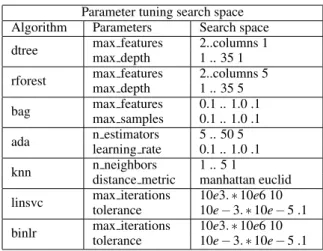
Table 3: CICIDS2017 algorithm, parameters, ranges. Parameter tuning search space
Algorithm Parameters Search space
dtree max features 2..columns 1
max depth 1 .. 35 1
rforest max features 2..columns 5
max depth 1 .. 35 5
bag max features 0.1 .. 1.0 .1
max samples 0.1 .. 1.0 .1
ada n estimators 5 .. 50 5
learning rate 0.1 .. 1.0 .1
knn n neighbors 1 .. 5 1
distance metric manhattan euclid linsvc max iterations 10e3.∗10e6 10
tolerance 10e−3.∗10e−5 .1
binlr max iterations 10e3.∗10e6 10
tolerance 10e−3.∗10e−5 .1
testing. The branches share all code up to the point where the choice of algorithm is done. For parame-ter tuning, K-fold cross-validation is employed, with k = 5. The splits are stratified, taking samples propor-tional to their representation in the class distribution.
Parameter tuning is done with grid search, eval-uating all combinations of a parameter grid. This is multiplicative: e.g. for two parameters, respectively with three and five values, fifteen combinations are tested. An overview of the algorithms and their
pa-rameter search spaces can be seen in table 3.
Special care went into avoiding model contami-nation. The data given for cross-validated parameter tuning is two thirds of that day’s data. Optimal param-eters are derived from only that data. The results from cross-validation are stored. These results include: the total search time, the optimal parameters, the param-eter search space and the means of five metrics (bal-anced accuracy, precision, recall, f1-score and ROC-AUC).
3.3
Metric Evaluation and Model
Selection
The only point of interaction between the cross-validation (cv) code and the single execution is in gathering the optimal model parameters from the re-sult files, written to disk by the cv code. The op-timal parameters are chosen, based on a voting sys-tem. That voting system looks at the ranks each set of tested parameters gets on the following five metrics:
Balanced Accuracy: combined per class accuracy, useful for skewed class distributions. Obtained through evaluating equation 1 for each class, aver-aged, compared to accuracy itself which also uses equation 1 over all classes simultaneously. TP, TN, FP, FN respectively stand for true / false positive / negative.
ACC= T P+T N
T P+T N+FP+FN (1)
Precision:Of the items that were tagged as positive, how many are actually positive (equation 2).
PR= T P
T P+FP (2)
Recall:Of the items that were tagged as positive, how many did we tag compared to all positive items (equa-tion 3).
RC= T P
T P+FN (3)
F1-score: defined as the harmonic mean of preci-sion and recall (equation 4), the F1-score combines these metrics in such a way that the impact of poor scores on either of the metrics, heavily impacts the fi-nal score. In order to achieve a high F1-score, it is not only sufficient to be precise in prediction (discrimina-tive power), but equally high in finding a generalized representation of positive samples.
F1=2∗precision∗recall
precision+recall (4)
ROC-AUC: the receiver operator characteristic (ROC) is a visual metric of the relationship between
the true positive rate (recall) on the y-axis and the false positive rate (equation 5) on the x-axis at differ-ent classifying thresholds. The thresholds are implicit in the curve. In essence it shows how well a classi-fier is able to separate the classes. To avoid having to interpret the plot, the area under the curve (AUC) is calculated. An AUC of 1 would mean that the clas-sifier is able to completely separate the classes from each other. An AUC of 0.5 indicates that the class dis-tributions overlay each other fully, meaning that the classifier isn’t better than random guessing. The AUC reduces the ROC curve to a single number. If special care has to be given to the avoidance of false posi-tives or to maximal true positive rate, then the AUC metric is no longer helpful. For unbalanced data sets, the ROC curve is a great tool, because the imbalance is irrelevant to the outcome.
FPR= FP
FP+T N (5)
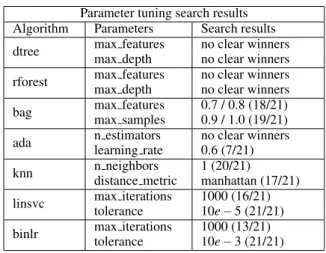
The optimal parameters are decided by a voting mechanism that works as follows: 1: Find the highest ranked set of parameters for each of the five metrics. 2: Aggregate across the found sets. 3: Pick the most prevalent set. Some algorithms showed a high pref-erence for certain parameter values. The results are summarized in table 4.
Table 4: CICIDS2017 algorithm, parameters, results. Parameter tuning search results
Algorithm Parameters Search results
dtree max features no clear winners
max depth no clear winners
rforest max features no clear winners
max depth no clear winners
bag max features 0.7 / 0.8 (18/21)
max samples 0.9 / 1.0 (19/21)
ada n estimators no clear winners
learning rate 0.6 (7/21)
knn n neighbors 1 (20/21)
distance metric manhattan (17/21)
linsvc max iterations 1000 (16/21)
tolerance 10e−5 (21/21)
binlr max iterations 1000 (13/21)
tolerance 10e−3 (21/21)
3.4
Algorithm Retesting with Optimal
Parameters
For each day (each attack scenario), the algorithms were retested with optimal parameters. Execution of the fixed parameter functions, yields a dictionary with the used parameters, the run time, the predicted la-bels on the test set and the actual lala-bels for the test set. Seven metrics are gathered, namely the five
met-rics used to evaluate in the cross-validation phase (de-scribed in paragraph 3.3). In addition the accuracy score is kept as well as the confusion matrix.
4
EVALUATION RESULTS
This section describes the results from the retesting with optimized parameters. In total 9 algorithms were tested. It should be noted that for two of these no cross-validation was done. The N-centroid classifier does not use optimized parameters, due to a limita-tion of Scikit-learn. For the RBF-SVC classifier, pa-rameter optimization was skipped due to the excessive run times of forced single-core execution. The results are described in their respective algorithmic classes in subsection 4.1. All testing was done on two types of infrastructure, roughly reflecting corporate and pri-vate environments. The corporate grade server was equipped with 2X Intel Xeon E5-2650v2 @ 2.6GHz (16 cores) and 48GB of RAM, while the consumer-grade host had 1X Intel Core i5-4690 @ 3.5GHz (4 cores) and 16 GB of RAM.
4.1
Algorithm Comparison
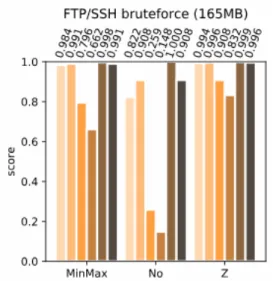
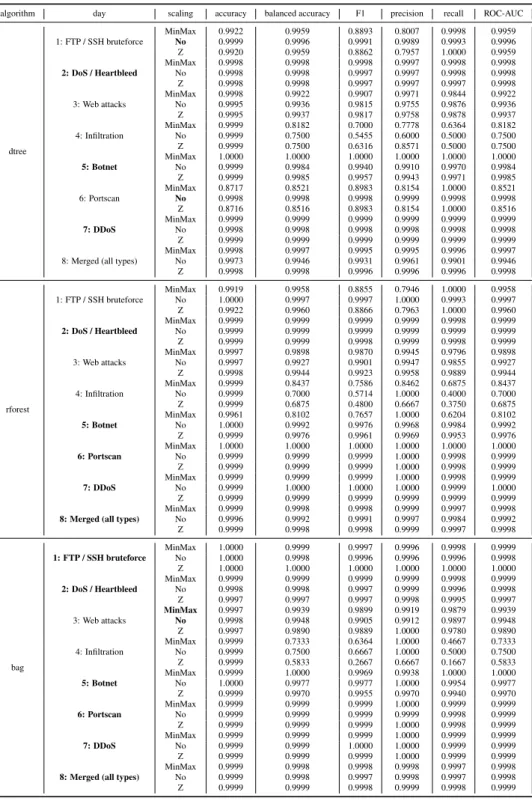
This section details the results of testing the vari-ous classification algorithms. The algorithms are grouped, based on their underlying classifier. Due to page constraints only results of single execution on the consumer-grade hardware are contained in the paper in tabular format in appendix 5.1. It is advised to use this paper with the full collection of tables and derived graphs that are publicly available at https://gitlab.ilabt.imec.be/lpdhooge/cicids2017-ml-graphics. A sample result graphic is shown in figure 1.
4.1.1 Tree-based Classifiers
On the whole, the tree-based classifiers obtained the best results for all attack types, on all metrics. Even a single decision tree is able to achieve 99+% on all metrics for the DoS / DDoS and Botnet attack types. Another interesting finding is that building the tree without scaling the features, improves the perfor-mance on all metrics for detection of the brute force and port scanning traffic, to be near-perfect. Results on the merged dataset reveal that identification across different attack classes works with equally great re-sults to the best-identified classes. It should however be noted that good performance on the merged data set includes the attack classes with the most samples
Figure 1: Sample result, full results available at https://gitlab.ilabt.imec.be/lpdhooge/cicids2017-ml-graphics.
(DoS, port scan & DDoS) and might obfuscate worse performance on the less prevalent attack classes.
When introducing meta-estimators, techniques at a higher level of abstraction that introduce concepts to improve the underlying classifier(s), several bene-fits were discovered. Random forests improved the results on port scanning traffic when applying either of the scaling methods, compared to a decision tree. For the other attack types results are very similar, with a noted reduction on botnet traffic classification, but only when using MinMax scaling. A reduction on multiple classification metrics is observed for the infiltration attacks as well. This attack type consis-tently is the hardest to classify, not least because the dataset only contains 36 of these flows, compared to the 288566 benign samples in the same set (2).A mod-est improvement on all metrics is observed for the merged data set compared to a single decision tree.
The bagging classifier proved itself to be a more potent meta-estimator, reaching near-perfect scores on all metrics for the brute force, Dos, DDoS, botnet and port scanning traffic. The improved performance and stability in the brute force and botnet classes com-pared to plain decision trees and random forests is its main advantage. Scoring on the infiltration attacks did take a big hit. This is believed to be a result of the ad-ditional sampling employed by the bagging classifier, when the number of samples to learn from is already very low. The almost perfect classification on five of the seven attack classes generalized to the evaluation of the entire data set.
The overall best meta-estimator was discovered as adaboost. Adaboost retains the near perfect scores, achieved by the bagging classifier on the previously
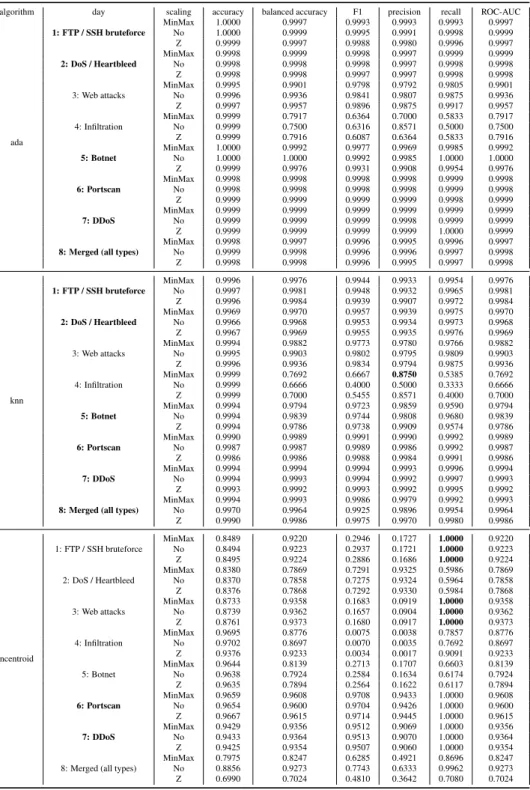
mentioned classes. Thanks to its focus on improv-ing classification for difficult samples, it was the best classifier for infiltration attacks, reaching balanced accuracies between 75% and 79.2%. Unfortunately the recall was never higher than 58.3%, meaning that about half of the infiltration flows were misclassified. Similarly to the bagging classifier, performance was stable and equally high on the merged data set. In total, 5 of the seven attack classes could be discov-ered with very high reliability, irrespective of the em-ployed feature scaling method. On the web attacks (brute force, XSS and SQLi), the random forest and bagging classifiers had a slight, but stable edge com-pared to single decision trees and adaboost. The only class on which classification underperformed on all metrics was infiltration. Results pertaining to execu-tion times are described in subsecexecu-tion 4.2.
4.1.2 SVM-based Classifiers and Logistic Regression
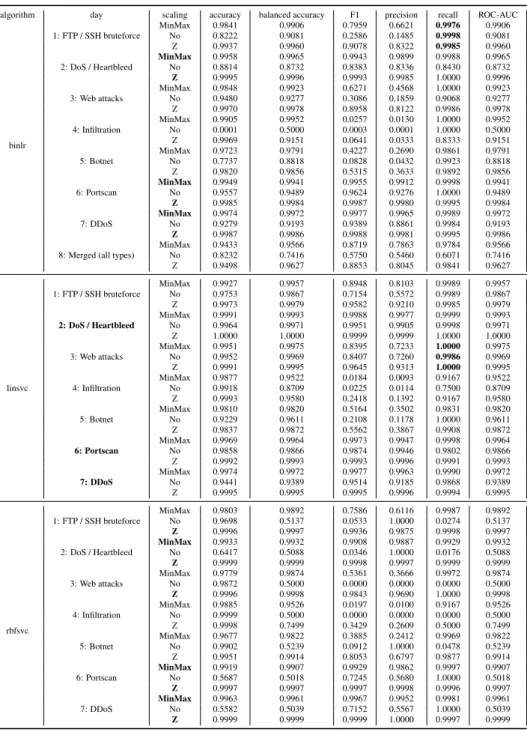
This subsection covers three more algorithms, two support vector machines: one with a linear kernel and one with a radial basis function kernel and a logistic regression classifier. Full results are listed in table 7.
The linear support vector machine consistently has very high scores on all metrics for the DoS, DDoS and port scan attack classes. Recall on the ftp/ssh brute force, web attacks and botnet attack classes is equally high, but gets offset by lower precision scores especially in the absence of feature scaling. The al-gorithm thus succeeds in recognizing most of the at-tacks, but has higher false-positive rates compared to the tree-based methods. Precision on the infiltration attack classes is extremely poor. The logistic regres-sion with binomial output results, tells a similar story. Like the linear support vector classifier (linSVC), it performs best and most stably on the DoS, DDoS and port scanning traffic. Furthermore, recall scores on the brute force, web and botnet traffic classes are high to very high, but paired with worse precision scores compared to the linSVC, the applicability of this model gets reduced. One consistent result is that feature scaling is a necessity for the logistic regres-sion classifier, preferring standardization over min-max scaling. The generalization or lack thereof is clearly visible in the results on the merged data set. Performance is reasonable with standardized features (98.4% recall & 80.4% precision), but not even close to the performance of the tree-based classifiers. This performance reduction does indicate that misclassifi-cation on the less prevalent classes is impactful on the final scores. The last algorithm in this category, a support vector classifier with radial basis function in the kernel demonstrates the importance of proper
method selection for feature scaling. This classifier has dismal performance when features are used as in-put without scaling, not reaching acceptable perfor-mance on any of the seven attack classes. Minmax scaling gives great results on the DoS, port scan and DDoS attacks (the classes with the most samples to learn from 2). Standardizing (Z) scaling improves performance on these classes even further and suc-ceeds much better at recognizing brute force, web and botnet traffic, making the classifier a valid contender for use on five of the seven attack classes.
4.1.3 Neighbor-based Classifiers
Despite its simplicity, the k-nearest neighbors algo-rithm, generally looking at only one neighbor and us-ing the Manhattan (block) distance metric, is a high-performer in 6/7 attack scenarios. In four scenarios, 99.9% on all metrics is almost invariably obtained, with metrics for the other attack classes never be-low 95.7%. The elusive class to recognize remains infiltration attack traffic. Interestingly enough, even though this too is a distance-based algorithm, all fea-ture scaling methods, yielded very similar results. Another conclusion is the loss of perfect classifica-tion, compared to the tree-based classifiers. While the reduction in classification performance is minute, it is observable and stable. Performance on the merged data set shows generalization capability, but this comes at a cost further described in subsection 4.2. The last algorithm, nearest centroid classifier is equally simple and has some interesting properties. Its results resemble the SVM results, with high, sta-ble recognition of DDoS and port scanning traffic, mediocre but stable results in the DoS category and medium to high recall on the ftp/ssh brute force, web attack and botnet traffic, but again paired with low precision scores. Combined with its run time pro-file, it has application potential for the recognition of DDoS and port scanning traffic. The perfect scores on recall, regardless of scaling method for the FTP / SSH brute force and web attacks are also in inter-esting property. On the merged data set results show degraded performance, reflective of the poor classi-fication scores on the other attack classes. Detailed results are available in the appendix in table 6.
4.2
Time Performance Comparison
Real-world intrusion detection systems have straints, when evaluating traffic. Some example con-straints are a.o.: required throughput, minimization of false positives, maximization of true positives, evalu-ation in under x units of time, real-time detection. To
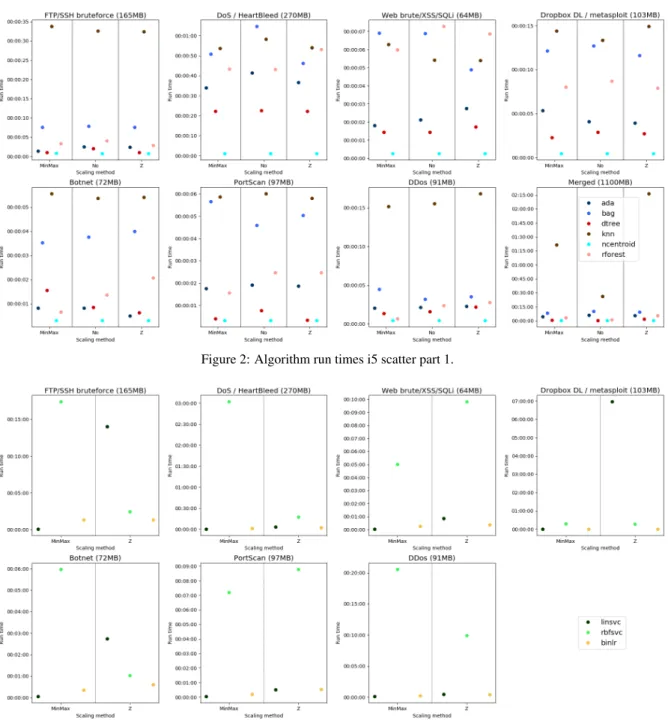
gain insight in the run time requirements of the dif-ferent algorithms, summarizing charts can be seen in figures 2 and 3. Five main takeaways should be noted from these charts. First, as long as the dataset stays under 200 megabytes, evaluation can be done in un-der 20 seconds by most algorithms. To give an idea of the amount of flows in 200 MB, the Tuesday data set, 173 MB in size contains 445909 flows. Second, the algorithms split in two categories when looking at execution times: all tree and neighbor methods keep their execution time under one minute on both types of infrastructure when evaluating data sets under 300 MB. The SVM and regression models take more time to run, with outliers that are caused by not scaling the features. Applying a standardizing scaler to the data, drastically reduces the execution time. Third, the consumer-grade infrastructure holds its own against the corporate server. The reason for this is twofold. Purely on a hardware level, the lower core count, but substantially higher clock speeds (and thermal head-room for aggressive frequency scaling) keep the sys-tems in competition. Another factor is how well an algorithm is suited for parallel execution. For exam-ple knn makes full use of all available cores, because the problem is easily separable, while the implemen-tation of the rbfsvc in LIBSVM locks execution to a single core. Fourth, the nearest centroid classifier is as good as insensitive to data set size. In combination with the classifier’s ability in recognizing DDoS and port scanning traffic, it is conceivable to employ it in real-time on IoT networks to identify compromised devices, taken over to execute DDoS attacks (blog, ). Fifth and finally, execution times on the merged data set influence algorithm choice. Execution time on the consumer-grade hardware stays under ten minutes for the full, 1.1 GB data set for the ada, bag, dtree, ncen-troid and rforest classifiers (around and under five minutes when ignoring the bagging classifier). Knn is very resource intensive and doesn’t scale well into larger data sets. Evaluation on the merged data set took almost 1 hour and 30 minutes. The logistic re-gression completed evaluation of the full dataset in just over 30 minutes. In general using the corporate infrastructure with higher core counts reduces the ex-ecution time, but as mentioned earlier, this potential speedup depends on the implementation.
4.3
Result Comparison to State of the
Art
Because of the recency of CICIDS2017, published re-search is still limited. Nonetheless a comparison to a selection of relevant research is already possible.
Attak et al. (Attak et al., ) focus on the DARE
(data analytics and remediation engine) component of the SHIELD platform, a cybersecurity solution for use in software defined networks (SDN) with network function virtualization (NFV). The machine learn-ing methods that were tested are segmented into two classes: those for anomaly detection and those for threat classification. Comparison to this work is apt for the threat classification portion. The researchers kept only a 10-feature subset of the flow data. This subset was chosen, not produced by a feature selec-tion technique. The threat classificaselec-tion made use of the random forest and multi-layer perceptron classi-fiers. Optimal models from a 10-fold cross-validation were used on 20% of the data that was held out for validation. The random forest classifier obtained the best results on accuracy, precision and recall, often reaching perfect classification. The multi-layer per-ceptron had similar accuracy scores, but much greater variability on precision and recall. Overall their re-search shows favourable results for the random forest, both in terms of performance on the tested classifica-tion metrics, but also on execuclassifica-tion time.
Marir et al. (Marir et al., 2018) propose a sys-tem for intrusion detection with deep learning for fea-ture extraction followed by an ensemble of SVMs for classification, built on top of Spark, the distributed in-memory computation engine. The feature extraction is done by a deep belief network (DBN), a stack of restricted Boltzmann machines. Next, the dimension-reduced sample set is fed to a layer of linear SVMs for classification. Layers further in the stack of SVMs are given samples for which previous layers weren’t con-fident enough. Because both the DBN and the SVMs operate in distributed fashion, the master node decides whether enough data is present to build a new layer. If not, then the ensemble of SVMs are the models pro-duced in the final layer. This approach was tested on four datasets, namely KDD99, NSL-KDD, UNSW-NB15 and CICIDS2017. The results of testing their approach reveal that the combination of deep learn-ing for feature extraction and supervised learnlearn-ing with an emphasis on retraining for difficult samples, yields better performance on the classification metrics, but requires more training time than the application of the individual parts on the classification task.
5
CONCLUSIONS AND FUTURE
WORK
This paper contains a detailed analysis of CI-CIDS2017, a modern data set geared towards the ap-plication of machine learning to network intrusion de-tection systems. The design and implementation have
Figure 2: Algorithm run times i5 scatter part 1.
Figure 3: Algorithm run times i5 scatter part 2.
been laid out in section 3, focusing on the principles and application of solid machine learning engineer-ing. The main section of this paper conveys the results of applying nine supervised learning algorithms with optimized parameters to the data. Results were gath-ered for every individual day, containing traffic from a specific attack class, as well as for a merged ver-sion, containing all attack types. The analysis was run on both consumer- and professional-grade hardware, to confirm stability of the results further and to in-vestigate differences in execution time. In general, it
can be stated that the tree-based classifiers performed best. Single decision trees are capable of recogniz-ing DoS, DDoS and botnet traffic. Meta-estimators based on decision trees improved performance to the point where they are practically applicable for six of the seven attack classes. This was most true for the bagging- and adaboost classifiers. Another improve-ment of meta-estimators over single decision trees is their ability to abstract over the choice of feature scaling. In addition performance generalized to the merged data set, without incurring heavy increases in
execution time. The elusive attack class to classify was infiltration. One reason for this might be the se-vere lack of positive training samples for this cate-gory, a natural consequence of the low network foot-print of infiltration attacks. Only k-nearest neighbors (knn) came close to a decent precision score for this class, but it lacked in recall. Despite its simplicity knn is a potent classifier for five of the seven attack classes. It is held back by its steep increase in exe-cution time for larger data sets, even though it gener-alizes as well as the tree-base meta-estimators. Op-posite to this is the nearest centroid classifier, being nigh insensitive to dataset size, while applicable for the classification of port scan and DDoS traffic and for perfect detection of brute force and DoS traffic. The final algorithms, two support vector machines with different kernels and logistic regression are useful for recognition of port scan, DoS and DDoS traffic, pro-vided the features are scaled (preferably normalized). However, these classifiers are not favoured when pit-ted against the tree-based classifiers, because the at-tack classes on which they perform well are only a subset of the classes for which the tree-based perform equally well.
REFERENCES
Attak, H., Combalia, M., Gardikis, G., Gast´on, B., Jacquin, L., Litke, A., Papadakis, N., Papadopoulos, D., and Pastor, A. Application of distributed computing and machine learning technologies to cybersecurity.
Space, 2:I2CAT.
Axelsson, S. (2000). Intrusion detection systems: A survey and taxonomy.
blog, C. Inside the infamous mirai iot botnet: A retrospec-tive analysis.
Brown, C., Cowperthwaite, A., Hijazi, A., and Somayaji, A. (2009). Analysis of the 1999 darpa/lincoln labora-tory ids evaluation data with netadhict. In Computa-tional Intelligence for Security and Defense Applica-tions, 2009. CISDA 2009. IEEE Symposium on, pages 1–7. IEEE.
Buczak, A. L. and Guven, E. (2016). A survey of data min-ing and machine learnmin-ing methods for cyber security intrusion detection.IEEE Communications Surveys & Tutorials, 18(2):1153–1176.
Denning, D. and Neumann, P. G. (1985).Requirements and model for IDES-a real-time intrusion-detection expert system. SRI International.
Hodo, E., Bellekens, X., Hamilton, A., Tachtatzis, C., and Atkinson, R. (2017). Shallow and deep networks in-trusion detection system: A taxonomy and survey.
arXiv preprint arXiv:1701.02145.
Marir, N., Wang, H., Feng, G., Li, B., and Jia, M. (2018). Distributed abnormal behavior detection ap-proach based on deep belief network and ensemble svm using spark.IEEE Access, 6:59657–59671.
McHugh, J. (2000). The 1998 lincoln laboratory ids eval-uation. In Debar, H., M´e, L., and Wu, S. F., editors,
Recent Advances in Intrusion Detection, pages 145– 161, Berlin, Heidelberg. Springer Berlin Heidelberg. McKinney, W. pandas: a foundational python library for
data analysis and statistics.
Pedregosa, F., Varoquaux, G., Gramfort, A., Michel, V., Thirion, B., Grisel, O., Blondel, M., Prettenhofer, P., Weiss, R., Dubourg, V., Vanderplas, J., Passos, A., Cournapeau, D., Brucher, M., Perrot, M., and Duchesnay, E. (2011). Scikit-learn: Machine learning in Python. Journal of Machine Learning Research, 12:2825–2830.
Sharafaldin, I., Lashkari, A. H., and Ghorbani, A. A. (2018). Toward generating a new intrusion detec-tion dataset and intrusion traffic characterizadetec-tion. In
ICISSP, pages 108–116.
Shiravi, A., Shiravi, H., Tavallaee, M., and Ghorbani, A. A. (2012). Toward developing a systematic approach to generate benchmark datasets for intrusion detection.
computers & security, 31(3):357–374.
Tavallaee, M., Bagheri, E., Lu, W., and Ghorbani, A. A. (2009). A detailed analysis of the kdd cup 99 data set. InComputational Intelligence for Security and Defense Applications, 2009. CISDA 2009. IEEE Sym-posium on, pages 1–6. IEEE.
Wu, S. X. and Banzhaf, W. (2010). The use of computa-tional intelligence in intrusion detection systems: A review. Applied soft computing, 10(1):1–35.
Zinkevich, M. Rules of machine learning: Best practices for ml engineering.
APPENDIX
5.1
Intel Core i5-4960 Full Results
Tables 5, 6 and 7 contain all results. Sim-ilar tables with detailed results for the execution times are available online at https://gitlab.ilabt.imec.be/lpdhooge/cicids2017-ml-graphics. Mirror tables and accompanying graphics of testing on the Intel Xeon E5-2650v2 are also available via the aforementioned link.
Table 5: Intel Core i5-4690 dtree, rforest and bag full results.
algorithm day scaling accuracy balanced accuracy F1 precision recall ROC-AUC
dtree 1: FTP / SSH bruteforce MinMax 0.9922 0.9959 0.8893 0.8007 0.9998 0.9959 No 0.9999 0.9996 0.9991 0.9989 0.9993 0.9996 Z 0.9920 0.9959 0.8862 0.7957 1.0000 0.9959 2: DoS / Heartbleed MinMax 0.9998 0.9998 0.9998 0.9997 0.9998 0.9998 No 0.9998 0.9998 0.9997 0.9997 0.9998 0.9998 Z 0.9998 0.9998 0.9997 0.9997 0.9997 0.9998 3: Web attacks MinMax 0.9998 0.9922 0.9907 0.9971 0.9844 0.9922 No 0.9995 0.9936 0.9815 0.9755 0.9876 0.9936 Z 0.9995 0.9937 0.9817 0.9758 0.9878 0.9937 4: Infiltration MinMax 0.9999 0.8182 0.7000 0.7778 0.6364 0.8182 No 0.9999 0.7500 0.5455 0.6000 0.5000 0.7500 Z 0.9999 0.7500 0.6316 0.8571 0.5000 0.7500 5: Botnet MinMax 1.0000 1.0000 1.0000 1.0000 1.0000 1.0000 No 0.9999 0.9984 0.9940 0.9910 0.9970 0.9984 Z 0.9999 0.9985 0.9957 0.9943 0.9971 0.9985 6: Portscan MinMax 0.8717 0.8521 0.8983 0.8154 1.0000 0.8521 No 0.9998 0.9998 0.9998 0.9999 0.9998 0.9998 Z 0.8716 0.8516 0.8983 0.8154 1.0000 0.8516 7: DDoS MinMax 0.9999 0.9999 0.9999 0.9999 0.9999 0.9999 No 0.9998 0.9998 0.9998 0.9998 0.9998 0.9998 Z 0.9999 0.9999 0.9999 0.9999 0.9999 0.9999
8: Merged (all types)
MinMax 0.9998 0.9997 0.9995 0.9995 0.9996 0.9997 No 0.9973 0.9946 0.9931 0.9961 0.9901 0.9946 Z 0.9998 0.9998 0.9996 0.9996 0.9996 0.9998 rforest 1: FTP / SSH bruteforce MinMax 0.9919 0.9958 0.8855 0.7946 1.0000 0.9958 No 1.0000 0.9997 0.9997 1.0000 0.9993 0.9997 Z 0.9922 0.9960 0.8866 0.7963 1.0000 0.9960 2: DoS / Heartbleed MinMax 0.9999 0.9999 0.9999 0.9999 0.9998 0.9999 No 0.9999 0.9999 0.9999 0.9999 0.9999 0.9999 Z 0.9999 0.9999 0.9998 0.9999 0.9998 0.9999 3: Web attacks MinMax 0.9997 0.9898 0.9870 0.9945 0.9796 0.9898 No 0.9997 0.9927 0.9901 0.9947 0.9855 0.9927 Z 0.9998 0.9944 0.9923 0.9958 0.9889 0.9944 4: Infiltration MinMax 0.9999 0.8437 0.7586 0.8462 0.6875 0.8437 No 0.9999 0.7000 0.5714 1.0000 0.4000 0.7000 Z 0.9999 0.6875 0.4800 0.6667 0.3750 0.6875 5: Botnet MinMax 0.9961 0.8102 0.7657 1.0000 0.6204 0.8102 No 1.0000 0.9992 0.9976 0.9968 0.9984 0.9992 Z 0.9999 0.9976 0.9961 0.9969 0.9953 0.9976 6: Portscan MinMax 1.0000 1.0000 1.0000 1.0000 1.0000 1.0000 No 0.9999 0.9999 0.9999 1.0000 0.9998 0.9999 Z 0.9999 0.9999 0.9999 1.0000 0.9998 0.9999 7: DDoS MinMax 0.9999 0.9999 0.9999 1.0000 0.9998 0.9999 No 0.9999 1.0000 1.0000 1.0000 0.9999 1.0000 Z 0.9999 0.9999 0.9999 0.9999 0.9999 0.9999
8: Merged (all types)
MinMax 0.9999 0.9998 0.9998 0.9999 0.9997 0.9998 No 0.9996 0.9992 0.9991 0.9997 0.9984 0.9992 Z 0.9999 0.9998 0.9998 0.9999 0.9997 0.9998 bag 1: FTP / SSH bruteforce MinMax 1.0000 0.9999 0.9997 0.9996 0.9998 0.9999 No 1.0000 0.9998 0.9996 0.9996 0.9996 0.9998 Z 1.0000 1.0000 1.0000 1.0000 1.0000 1.0000 2: DoS / Heartbleed MinMax 0.9999 0.9999 0.9999 0.9999 0.9998 0.9999 No 0.9998 0.9998 0.9997 0.9999 0.9996 0.9998 Z 0.9997 0.9997 0.9997 0.9998 0.9995 0.9997 3: Web attacks MinMax 0.9997 0.9939 0.9899 0.9919 0.9879 0.9939 No 0.9998 0.9948 0.9905 0.9912 0.9897 0.9948 Z 0.9997 0.9890 0.9889 1.0000 0.9780 0.9890 4: Infiltration MinMax 0.9999 0.7333 0.6364 1.0000 0.4667 0.7333 No 0.9999 0.7500 0.6667 1.0000 0.5000 0.7500 Z 0.9999 0.5833 0.2667 0.6667 0.1667 0.5833 5: Botnet MinMax 0.9999 1.0000 0.9969 0.9938 1.0000 1.0000 No 1.0000 0.9977 0.9977 1.0000 0.9954 0.9977 Z 0.9999 0.9970 0.9955 0.9970 0.9940 0.9970 6: Portscan MinMax 0.9999 0.9999 0.9999 1.0000 0.9999 0.9999 No 0.9999 0.9999 0.9999 0.9999 0.9998 0.9999 Z 0.9999 0.9999 0.9999 1.0000 0.9998 0.9999 7: DDoS MinMax 0.9999 0.9999 0.9999 1.0000 0.9999 0.9999 No 0.9999 0.9999 1.0000 1.0000 0.9999 0.9999 Z 0.9999 0.9999 0.9999 1.0000 0.9999 0.9999
8: Merged (all types)
MinMax 0.9999 0.9998 0.9998 0.9998 0.9997 0.9998
No 0.9999 0.9998 0.9997 0.9998 0.9997 0.9998
Table 6: Intel Core i5-4690 ada, knn, ncentroid, full results.
algorithm day scaling accuracy balanced accuracy F1 precision recall ROC-AUC
ada 1: FTP / SSH bruteforce MinMax 1.0000 0.9997 0.9993 0.9993 0.9993 0.9997 No 1.0000 0.9999 0.9995 0.9991 0.9998 0.9999 Z 0.9999 0.9997 0.9988 0.9980 0.9996 0.9997 2: DoS / Heartbleed MinMax 0.9998 0.9999 0.9998 0.9997 0.9999 0.9999 No 0.9998 0.9998 0.9998 0.9997 0.9998 0.9998 Z 0.9998 0.9998 0.9997 0.9997 0.9998 0.9998 3: Web attacks MinMax 0.9995 0.9901 0.9798 0.9792 0.9805 0.9901 No 0.9996 0.9936 0.9841 0.9807 0.9875 0.9936 Z 0.9997 0.9957 0.9896 0.9875 0.9917 0.9957 4: Infiltration MinMax 0.9999 0.7917 0.6364 0.7000 0.5833 0.7917 No 0.9999 0.7500 0.6316 0.8571 0.5000 0.7500 Z 0.9999 0.7916 0.6087 0.6364 0.5833 0.7916 5: Botnet MinMax 1.0000 0.9992 0.9977 0.9969 0.9985 0.9992 No 1.0000 1.0000 0.9992 0.9985 1.0000 1.0000 Z 0.9999 0.9976 0.9931 0.9908 0.9954 0.9976 6: Portscan MinMax 0.9998 0.9998 0.9998 0.9998 0.9999 0.9998 No 0.9998 0.9998 0.9998 0.9998 0.9999 0.9998 Z 0.9999 0.9999 0.9999 0.9999 0.9998 0.9999 7: DDoS MinMax 0.9999 0.9999 0.9999 0.9999 0.9999 0.9999 No 0.9999 0.9999 0.9999 0.9998 0.9999 0.9999 Z 0.9999 0.9999 0.9999 0.9999 1.0000 0.9999
8: Merged (all types)
MinMax 0.9998 0.9997 0.9996 0.9995 0.9996 0.9997 No 0.9999 0.9998 0.9996 0.9996 0.9997 0.9998 Z 0.9998 0.9998 0.9996 0.9995 0.9997 0.9998 knn 1: FTP / SSH bruteforce MinMax 0.9996 0.9976 0.9944 0.9933 0.9954 0.9976 No 0.9997 0.9981 0.9948 0.9932 0.9965 0.9981 Z 0.9996 0.9984 0.9939 0.9907 0.9972 0.9984 2: DoS / Heartbleed MinMax 0.9969 0.9970 0.9957 0.9939 0.9975 0.9970 No 0.9966 0.9968 0.9953 0.9934 0.9973 0.9968 Z 0.9967 0.9969 0.9955 0.9935 0.9976 0.9969 3: Web attacks MinMax 0.9994 0.9882 0.9773 0.9780 0.9766 0.9882 No 0.9995 0.9903 0.9802 0.9795 0.9809 0.9903 Z 0.9996 0.9936 0.9834 0.9794 0.9875 0.9936 4: Infiltration MinMax 0.9999 0.7692 0.6667 0.8750 0.5385 0.7692 No 0.9999 0.6666 0.4000 0.5000 0.3333 0.6666 Z 0.9999 0.7000 0.5455 0.8571 0.4000 0.7000 5: Botnet MinMax 0.9994 0.9794 0.9723 0.9859 0.9590 0.9794 No 0.9994 0.9839 0.9744 0.9808 0.9680 0.9839 Z 0.9994 0.9786 0.9738 0.9909 0.9574 0.9786 6: Portscan MinMax 0.9990 0.9989 0.9991 0.9990 0.9992 0.9989 No 0.9987 0.9987 0.9989 0.9986 0.9992 0.9987 Z 0.9986 0.9986 0.9988 0.9984 0.9991 0.9986 7: DDoS MinMax 0.9994 0.9994 0.9994 0.9993 0.9996 0.9994 No 0.9994 0.9993 0.9994 0.9992 0.9997 0.9993 Z 0.9993 0.9992 0.9993 0.9992 0.9995 0.9992
8: Merged (all types)
MinMax 0.9994 0.9993 0.9986 0.9979 0.9992 0.9993 No 0.9970 0.9964 0.9925 0.9896 0.9954 0.9964 Z 0.9990 0.9986 0.9975 0.9970 0.9980 0.9986 ncentroid 1: FTP / SSH bruteforce MinMax 0.8489 0.9220 0.2946 0.1727 1.0000 0.9220 No 0.8494 0.9223 0.2937 0.1721 1.0000 0.9223 Z 0.8495 0.9224 0.2886 0.1686 1.0000 0.9224 2: DoS / Heartbleed MinMax 0.8380 0.7869 0.7291 0.9325 0.5986 0.7869 No 0.8370 0.7858 0.7275 0.9324 0.5964 0.7858 Z 0.8376 0.7868 0.7292 0.9330 0.5984 0.7868 3: Web attacks MinMax 0.8733 0.9358 0.1683 0.0919 1.0000 0.9358 No 0.8739 0.9362 0.1657 0.0904 1.0000 0.9362 Z 0.8761 0.9373 0.1680 0.0917 1.0000 0.9373 4: Infiltration MinMax 0.9695 0.8776 0.0075 0.0038 0.7857 0.8776 No 0.9702 0.8697 0.0070 0.0035 0.7692 0.8697 Z 0.9376 0.9233 0.0034 0.0017 0.9091 0.9233 5: Botnet MinMax 0.9644 0.8139 0.2713 0.1707 0.6603 0.8139 No 0.9638 0.7924 0.2584 0.1634 0.6174 0.7924 Z 0.9635 0.7894 0.2564 0.1622 0.6117 0.7894 6: Portscan MinMax 0.9659 0.9608 0.9708 0.9433 1.0000 0.9608 No 0.9654 0.9600 0.9704 0.9426 1.0000 0.9600 Z 0.9667 0.9615 0.9714 0.9445 1.0000 0.9615 7: DDoS MinMax 0.9429 0.9356 0.9512 0.9069 1.0000 0.9356 No 0.9433 0.9364 0.9513 0.9070 1.0000 0.9364 Z 0.9425 0.9354 0.9507 0.9060 1.0000 0.9354
8: Merged (all types)
MinMax 0.7975 0.8247 0.6285 0.4921 0.8696 0.8247
No 0.8856 0.9273 0.7743 0.6333 0.9962 0.9273
Table 7: Intel Core i5-4690 binlr, linsvc and rbfsvc full results.
algorithm day scaling accuracy balanced accuracy F1 precision recall ROC-AUC
binlr 1: FTP / SSH bruteforce MinMax 0.9841 0.9906 0.7959 0.6621 0.9976 0.9906 No 0.8222 0.9081 0.2586 0.1485 0.9998 0.9081 Z 0.9937 0.9960 0.9078 0.8322 0.9985 0.9960 2: DoS / Heartbleed MinMax 0.9958 0.9965 0.9943 0.9899 0.9988 0.9965 No 0.8814 0.8732 0.8383 0.8336 0.8430 0.8732 Z 0.9995 0.9996 0.9993 0.9985 1.0000 0.9996 3: Web attacks MinMax 0.9848 0.9923 0.6271 0.4568 1.0000 0.9923 No 0.9480 0.9277 0.3086 0.1859 0.9068 0.9277 Z 0.9970 0.9978 0.8958 0.8122 0.9986 0.9978 4: Infiltration MinMax 0.9905 0.9952 0.0257 0.0130 1.0000 0.9952 No 0.0001 0.5000 0.0003 0.0001 1.0000 0.5000 Z 0.9969 0.9151 0.0641 0.0333 0.8333 0.9151 5: Botnet MinMax 0.9723 0.9791 0.4227 0.2690 0.9861 0.9791 No 0.7737 0.8818 0.0828 0.0432 0.9923 0.8818 Z 0.9820 0.9856 0.5315 0.3633 0.9892 0.9856 6: Portscan MinMax 0.9949 0.9941 0.9955 0.9912 0.9998 0.9941 No 0.9557 0.9489 0.9624 0.9276 1.0000 0.9489 Z 0.9985 0.9984 0.9987 0.9980 0.9995 0.9984 7: DDoS MinMax 0.9974 0.9972 0.9977 0.9965 0.9989 0.9972 No 0.9279 0.9193 0.9389 0.8861 0.9984 0.9193 Z 0.9987 0.9986 0.9988 0.9981 0.9995 0.9986
8: Merged (all types)
MinMax 0.9433 0.9566 0.8719 0.7863 0.9784 0.9566 No 0.8232 0.7416 0.5750 0.5460 0.6071 0.7416 Z 0.9498 0.9627 0.8853 0.8045 0.9841 0.9627 linsvc 1: FTP / SSH bruteforce MinMax 0.9927 0.9957 0.8948 0.8103 0.9989 0.9957 No 0.9753 0.9867 0.7154 0.5572 0.9989 0.9867 Z 0.9973 0.9979 0.9582 0.9210 0.9985 0.9979 2: DoS / Heartbleed MinMax 0.9991 0.9993 0.9988 0.9977 0.9999 0.9993 No 0.9964 0.9971 0.9951 0.9905 0.9998 0.9971 Z 1.0000 1.0000 0.9999 0.9999 1.0000 1.0000 3: Web attacks MinMax 0.9951 0.9975 0.8395 0.7233 1.0000 0.9975 No 0.9952 0.9969 0.8407 0.7260 0.9986 0.9969 Z 0.9991 0.9995 0.9645 0.9313 1.0000 0.9995 4: Infiltration MinMax 0.9877 0.9522 0.0184 0.0093 0.9167 0.9522 No 0.9918 0.8709 0.0225 0.0114 0.7500 0.8709 Z 0.9993 0.9580 0.2418 0.1392 0.9167 0.9580 5: Botnet MinMax 0.9810 0.9820 0.5164 0.3502 0.9831 0.9820 No 0.9229 0.9611 0.2108 0.1178 1.0000 0.9611 Z 0.9837 0.9872 0.5562 0.3867 0.9908 0.9872 6: Portscan MinMax 0.9969 0.9964 0.9973 0.9947 0.9998 0.9964 No 0.9858 0.9866 0.9874 0.9946 0.9802 0.9866 Z 0.9992 0.9993 0.9993 0.9996 0.9991 0.9993 7: DDoS MinMax 0.9974 0.9972 0.9977 0.9963 0.9990 0.9972 No 0.9441 0.9389 0.9514 0.9185 0.9868 0.9389 Z 0.9995 0.9995 0.9995 0.9996 0.9994 0.9995 rbfsvc 1: FTP / SSH bruteforce MinMax 0.9803 0.9892 0.7586 0.6116 0.9987 0.9892 No 0.9698 0.5137 0.0533 1.0000 0.0274 0.5137 Z 0.9996 0.9997 0.9936 0.9875 0.9998 0.9997 2: DoS / Heartbleed MinMax 0.9933 0.9932 0.9908 0.9887 0.9929 0.9932 No 0.6417 0.5088 0.0346 1.0000 0.0176 0.5088 Z 0.9999 0.9999 0.9998 0.9997 0.9999 0.9999 3: Web attacks MinMax 0.9779 0.9874 0.5361 0.3666 0.9972 0.9874 No 0.9872 0.5000 0.0000 0.0000 0.0000 0.5000 Z 0.9996 0.9998 0.9843 0.9690 1.0000 0.9998 4: Infiltration MinMax 0.9885 0.9526 0.0197 0.0100 0.9167 0.9526 No 0.9999 0.5000 0.0000 0.0000 0.0000 0.5000 Z 0.9998 0.7499 0.3429 0.2609 0.5000 0.7499 5: Botnet MinMax 0.9677 0.9822 0.3885 0.2412 0.9969 0.9822 No 0.9902 0.5239 0.0912 1.0000 0.0478 0.5239 Z 0.9951 0.9914 0.8053 0.6797 0.9877 0.9914 6: Portscan MinMax 0.9919 0.9907 0.9929 0.9862 0.9997 0.9907 No 0.5687 0.5018 0.7245 0.5680 1.0000 0.5018 Z 0.9997 0.9997 0.9997 0.9998 0.9996 0.9997 7: DDoS MinMax 0.9963 0.9961 0.9967 0.9952 0.9981 0.9961 No 0.5582 0.5039 0.7152 0.5567 1.0000 0.5039 Z 0.9999 0.9999 0.9999 1.0000 0.9997 0.9999