Florida International University
FIU Digital Commons
FIU Electronic Theses and Dissertations University Graduate School
6-14-2011
Internal Control Reporting by Non-Accelerated
Filers
Vishal Munsif
Florida International University, [email protected]
Follow this and additional works at:http://digitalcommons.fiu.edu/etd
This work is brought to you for free and open access by the University Graduate School at FIU Digital Commons. It has been accepted for inclusion in FIU Electronic Theses and Dissertations by an authorized administrator of FIU Digital Commons. For more information, please [email protected]. Recommended Citation
Munsif, Vishal, "Internal Control Reporting by Non-Accelerated Filers" (2011).FIU Electronic Theses and Dissertations.Paper 431.
FLORIDA INTERNATIONAL UNIVERSITY Miami, Florida
INTERNAL CONTROL REPORTING BY NON-ACCELERATED FILERS
A dissertation submitted in partial fulfillment of the requirements for the degree of
DOCTOR OF PHILOSOPHY in BUSINESS ADMINISTRATION by Vishal Munsif 2011
ii To: Dean Joyce Elam
College of Business Administration
This dissertation, written by Vishal Munsif, and entitled Internal Control Reporting by Non-Accelerated Filers, having been approved in respect to style and intellectual content, is referred to you for judgment.
We have read this dissertation and recommend that it be approved. _______________________________________ Abhijit Barua _______________________________________ Suchismita Mishra _______________________________________ Kannan Raghunandan,Co-Major Professor _______________________________________ Dasaratha Rama,Co-Major Professor
Date of Defense: June 14, 2011
The dissertation of Vishal Munsif is approved.
_______________________________________
Dean Joyce Elam
College of Business Administration _______________________________________ Dean Lakshmi N. Reddi University Graduate School
iii DEDICATION
I would like to dedicate this dissertation to my family members and friends. Without their continuous support and encouragements, I would not be able to complete this work
iv
ACKNOWLEDGMENTS
I would like to thank the members of my committee for their time, support and guidance: Dr. Abhijit Barua, Dr. Suchismita Mishra, Dr. Kannan Raghunandan and Dr. Dasaratha Rama. I would like to express my gratitude to my co-major professors: Dr. Kannan Raghunandan and Dr. Dasaratha Rama for their gentle support, useful comments and tireless supervision.
v
ABSTRACT OF THE DISSERTATION
INTERNAL CONTROL REPORTING BY NON-ACCELERATED FILERS by
Vishal Munsif
Florida International University, 2011 Miami, Florida
Professor Kannan Raghunandan, Co-Major Professor Professor Dasaratha Rama, Co-Major Professor
I examine three issues related to internal control reporting by non-accelerated filers. Motivation for the three studies comes from the fact that Section 404 of the Sarbanes-Oxley Act (SOX) continues to be controversial, as evidenced by the
permanent exemption from Section 404(b) of SOX granted to non-accelerated filers by the Frank Wall Street Reform and Consumer Protection Act of 2010. The Dodd-Frank Act also requires the SEC to study compliance costs associated with smaller accelerated filers.
In the first part of my dissertation, I document that the audit fee premium for non-accelerated filers disclosing a material weakness in internal controls (a) is significantly lower than the corresponding premium for accelerated filers, and (b) declines significantly over time. I also find that in the case of accelerated filers remediating clients pay lower fees compared to clients continuing to report internal control problems; however, such differences are not observed in the case of non-accelerated filers.
vi
The second essay focuses on audit report lag. The results indicate that presence of material weaknesses are associated with increased audit report lags, for both
accelerated and non-accelerated filers. The results also indicate that the decline in report lag following remediation of problems is greater for accelerated filers than for non-accelerated filers.
The third essay examines early warnings (pursuant to Section 302 disclosures) for firms that subsequently disclosed internal control problems in their 404 reports. The analyses indicate that non-accelerated firms with shorter CFO tenure, presence of accounting experts on the audit committee, and more frequent audit committee
meetings are more likely to provide prior Section 302 warnings.
Overall the results suggest that there are differences in internal control reporting between the accelerated and non-accelerated filers. The results provide empirical grounding for the ongoing debate about internal control reporting by non-accelerated filers.
vii
TABLE OF CONTENTS
CHAPTER PAGE
I. INTRODUCTION... 1
II. INTERNAL CONTROL REPORTING AND AUDIT FEES FOR NON-ACCELERATED FILERS... 10
Background ... 11 Hypotheses Development... 15 Method ... 18 Sample... 20 Results... 22 Summary... 31
II. INTERNAL CONTROL REPORTING AND AUDIT REPORT LAGS FOR NON-ACCELERATED FILERS... 33
Background ... 35
Hypotheses Development... 38
Method ... 39
Results... 41
Summary... 50
IV. EARLY WARNINGS OF INTERNAL CONTROL PROBLEMS BY NON-ACCELERATED FILERS………..…………... 51 Hypotheses Development... 58 Method ... 60 Sample... 62 Results... 65 Summary... 70 V. CONCLUSION ... 72 REFERENCES... 115 VITA... 121
viii
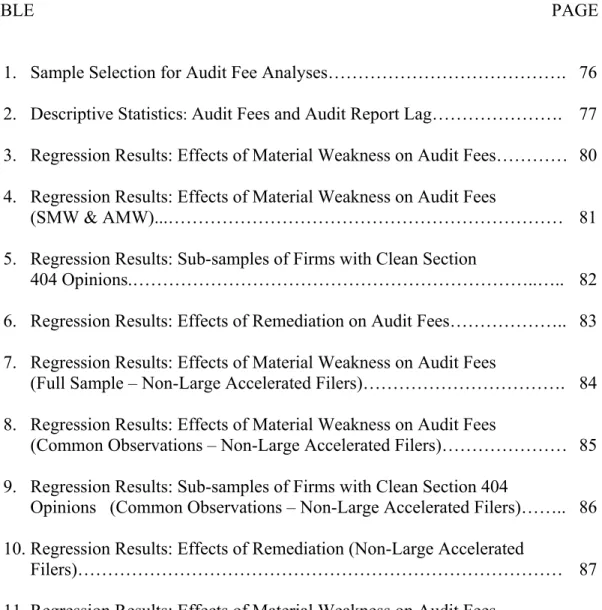
LIST OF TABLES
TABLE PAGE 1. Sample Selection for Audit Fee Analyses………. 76 2. Descriptive Statistics: Audit Fees and Audit Report Lag………. 77 3. Regression Results: Effects of Material Weakness on Audit Fees………… 80 4. Regression Results: Effects of Material Weakness on Audit Fees
(SMW & AMW)...……… 81 5. Regression Results: Sub-samples of Firms with Clean Section
404 Opinions.………..….. 82 6. Regression Results: Effects of Remediation on Audit Fees……….. 83 7. Regression Results: Effects of Material Weakness on Audit Fees
(Full Sample – Non-Large Accelerated Filers)………. 84 8. Regression Results: Effects of Material Weakness on Audit Fees
(Common Observations – Non-Large Accelerated Filers)……… 85 9. Regression Results: Sub-samples of Firms with Clean Section 404
Opinions (Common Observations – Non-Large Accelerated Filers)…….. 86 10. Regression Results: Effects of Remediation (Non-Large Accelerated
Filers)……… 87 11. Regression Results: Effects of Material Weakness on Audit Fees
(Same Filer Status – Non-Large Accelerated Filers)……… 88 12. Regression Results: Sub-samples of Firms with Clean Section 404
Opinions (Same Filer Status – Non-Large Accelerated Filers)………….. 89 13. Regression Results: Effects of Remediation (Same Filer Status
– Non-Large Accelerated Filers)……….. 90 14. Regression Results: Effects of Material Weakness on Audit Report Lag… 91 15. Regression Results: Effects of Material Weakness on Audit Report Lag (SMW & AMW)……… 92
ix
16. Regression Results: Sub-samples of Firms with Clean Section 404
Opinions……….. .. 93
17. Regression Results: Effects of Remediation on Audit Report Lag………… 94
18. Regression Results: Effects of Material Weakness on Audit Report Lag (Full Sample – Non-Large Accelerated Filers)……….. 95
19. Regression Results: Effects of Material Weakness on Audit Report Lag (Common Observations – Non-Large Accelerated Filers)……….... 96
20. Regression Results: Sub-samples of Firms with Clean Section 404 Opinions (Common Observations – Non-Large Accelerated Filers)..…….. 97
21. Regression Results: Effects of Remediation (Non-Large Accelerated Filers)………. 98
22. Regression Results: Effects of Material Weakness on Audit Report Lag (Same Filer Status – Non-Large Accelerated Filers)………. 99
23. Regression Results: Sub-samples of Firms with Clean Section 404 Opinions (Same Filer Status – Non-Large Accelerated Filers)………. 100
24. Regression Results: Effects of Remediation (Same Filer Status)…………. 101
25. Sample Selection for Prior Section 302 Warning Analyses... 102
26. New Problems and Prior Section 302 Disclosures……… 105
27. SEC action (Comment Letters) for firms without Prior Section 302 Disclosures……… 108
28. Sample Composition by Industry ………. 109
29. Descriptive Statistics: Prior Section 302 Disclosures Analyses Sample... 110
1
I. INTRODUCTION
Internal control reporting is an issue that has been of significant interest to regulators, legislators, and the accounting profession in recent years. During the congressional hearing about public accounting profession in 1985, many legislators questioned the SEC about requiring public companies to have a Management Report on internal controls in the audited financial statements (U.S. House of Representatives 1985). The National Commission on Fraudulent Financial Reporting (Treadway Commission 1987) noted that
“The investing public has a legitimate interest in the extent of management’s responsibilities for the company’s financial statements and internal control and the means by which management discharges its responsibilities. Yet these responsibilities are not always communicated to the investing public. Management’s opinion on internal control is important because the internal control system provides basis for the preparation of financial statements and, more broadly, the overall system of accountability.”
The Treadway Commission recommended that all the publicly traded companies should be required to include such management report in the annual report.
Later, there were efforts by some legislators to mandate internal control reporting (U.S. House of Representatives 1991) but the efforts were not successful. The U.S. General Accounting Office (GAO) in 1992 shared support for such internal control reporting by the management and stated that “Public reporting encourages management to be proactive and pay attention to the effectiveness of internal controls….” Despite such support for internal control reporting, the SEC did not require management to include such reporting, nor did it require the auditor to provide opinion on internal controls until the enactment of the Sarbanes Oxley Act (SOX) in July 2002.
2
The fall of corporate giants like Enron and WorldCom and the failure of Arthur Andersen resulted in the enactment of the Sarbanes-Oxley Act (SOX 2002) in July 2002. While SOX contains many provisions related to accounting and auditing, and represents the most comprehensive reform of the accounting profession since the 1930s, Section 404 of SOX has been the most controversial.
Section 404 of SOX is titled “Management Assessment of Internal Controls” and has two parts as follows:
“ (a) Rules Required.--The Commission shall prescribe rules requiring each annual report required by section 13(a) or 15(d) of the Securities Exchange Act of 1934 (15 U.S.C. 78m or 78o(d)) to contain an internal control report, which shall--
(1) state the responsibility of management for establishing and maintaining an adequate internal control structure and procedures for financial reporting; and
(2) contain an assessment, as of the end of the most recent fiscal year of the issuer, of the effectiveness of the internal control structure and procedures of the issuer for financial reporting.
(b) Internal Control Evaluation and Reporting.--With respect to the internal control assessment required by subsection (a), each registered public accounting firm that prepares or issues the audit report for the issuer shall attest to, and report on, the assessment made by the management of the issuer. An attestation made under this subsection shall be made in accordance with standards for attestation engagements issued or adopted by the Board. Any such attestation shall not be the subject of a separate engagement.”
Thus, the first paragraph, Section 404(a), requires management to provide an assessment about the effectiveness of the internal control system over financial reporting, and second paragraph, Section 404(b), requires auditor attestation of internal controls. The SEC implemented Section 404 of SOX through multiple instances of rulemaking. In such rulemaking, the SEC distinguished between
3
accelerated and non-accelerated filers. Non-accelerated filers are SEC registrants with public float of less than $75 million.
The requirements of SOX Section 404 have been met with a lot of criticism from the SEC registrants, with much of the criticism due the high cost of complying with Section 404. On many subsequent occasions, legislators, registrants, and business organizations have called for the SEC to relax its rules related to internal control reporting because of the high costs associated with Section 404(b).
In response to such concerns by registrants and legislators, the SEC granted multiple extensions for non-accelerated filers to comply with Section 404. Initially, when the SEC (2003a) issued rules to implement Section 404 of SOX, non-accelerated filers would have been subject to Sections 404(a) and 404(b) for fiscal years ending on or after April 15, 2005. In February 2004, the deadline for non-accelerated filers was extended to fiscal years ending on or after July 15, 2005. The deadline was further postponed in March 2005, September 2005, December 2006 and October 2009.
Before the final postponement for non-accelerated filers to comply with Section 404(b) ended, the Dodd-Frank Wall Street Reform and Consumer Protection Act (2010) was enacted in July 2010. Section 989G(a) of the Dodd-Frank Act provides permanent exemption from the requirements of Section 404(b) for non-accelerated filers. In addition, Section 989G(b) of the Dodd-Frank Act also requires the SEC to conduct a study to determine how the burden of complying with Section 404(b) can be reduced for registrants with market capitalization up to $250 million. Thus, it is clear that Section 404 continues to be controversial as evidenced by the subsequent actions of legislators and regulators.
4
A primary reason for the numerous postponements, and the eventual
exemption, related to compliance with Section 404(b) for non-accelerated filers is the cost associated with such compliance. Many SEC registrants and business
organizations complained vehemently to the SEC about the high cost associated with Section 404 audits (e.g., ABA 2005; AEA 2005; FEI 2005; Microsoft 2005). In particular, registrants and others have complained about the impact of Section 404(b) on fees paid to auditors (e.g., SEC 2005, 2006). The SEC convened two round-tables, in 2005 and 2006, about implementation issues related to Section 404. Following such dialogue, the PCAOB issued additional guidance and then replaced the
much-criticized AS No.2 with the new AS No. 5 (PCAOB 2007); AS No.5 emphasizes a risk-based or “top-down” approach to risks and the testing of controls and is viewed as the answer to criticism of over-auditing by the auditors in the initial years of
implementing Section 404.1
Auditors have noted that Section 404 audits would become more efficient over time (e.g., Ernst & Young 2005; PricewaterhouseCoopers 2005). The benefits from such streamlined audits would be particularly relevant for clients with internal control problems. In the initial years, clients with material weaknesses in internal control would have been particularly problematic for auditors who already had to contend with manpower shortages and the need to train staff in Section 404 related procedures even while simultaneously conducting Section 404 audits. When auditors are under severe time and resource pressure for all clients it is natural that a client who requires
1 SEC Chairman Cox (U.S. House of Representatives 2007) noted during congressional testimony that “we expect the unduly high costs of implementing section 404 of the Act under the previous auditing standard will come down.”
5
more time and resources would be charged a higher premium. Such a fee premium can be expected to decline in subsequent years, when the resource pressures faced by auditors are lower.
Given such focus on audit fees in the context of Section 404 reporting, and given the differential treatment granted non-accelerated filers, in the first part of my dissertation I examine the audit fee premium associated with material weakness disclosures by different types of filers. Using the sample of 2,839 companies for fiscal year 2008 and 2009, I find that the audit fee premium for non-accelerated filers
disclosing a material weakness in internal controls (a) is significantly lower than the corresponding premium paid by accelerated filers, and (b) declines significantly over time. I also examine subsequent remediation of internal control problems and find that in the case of accelerated filers remediating clients pay lower fees compared to clients continuing to report internal control problems; however, such differences are not observed in the case of non-accelerated filers.
Another issue that has received significant attention from the SEC in recent years is the reporting lag. The SEC has initiated efforts to reduce the reporting lag, which is the number of days from the fiscal year end until the date the audited
financial statements are filed with the SEC (SEC 2005). Such efforts are motivated by concerns related to the timeliness of corporate financial reporting.
The second part of my dissertation deals with the association between material weaknesses in internal controls and audit reporting lag. I measure audit reporting lag as the number of days between fiscal year-end and the date of the audit report. Using the same sample as in part 1 of my dissertation, I find that increase in audit report lag
6
in the presence of material weaknesses in internal control is lower for non-accelerated filers as compared to the corresponding increase for accelerated filers. Additional analysis indicated that the audit report lag falls significantly from fiscal 2008 to 2009 for the accelerated filers as compared to the non-accelerated filers. Further, the results also indicate that for firms that remediate previously disclosed internal control
problems there is a steep decline in audit report lag for accelerated filers; the decline is not significant in the case of non-accelerated filers.
The third essay of my dissertation examines early warnings provided by firms pursuant to Section 302 disclosures. Section 302 of SOX, titled “Corporate
Responsibility for Financial Reports,” states as follows:
“(a) Regulations Required.--The Commission shall, by rule, require, for each company filing periodic reports under section 13(a) or 15(d) of the Securities Exchange Act of 1934 (15 U.S.C. 78m, 78o(d)), that the principal executive officer or officers and the principal financial officer or officers, or persons performing similar functions, certify in each annual or quarterly report filed or submitted under either such section of such Act that--
(1) the signing officer has reviewed the report;
(2) based on the officer's knowledge, the report does not contain any untrue statement of a material fact or omit to state a material fact necessary in order to make the statements made, in light of the circumstances under which such statements were made, not misleading;
(3) based on such officer's knowledge, the financial statements, and other financial information included in the report, fairly present in all material respects the financial condition and results of operations of the issuer as of, and for, the periods presented in the report;
(4) the signing officers--
(A) are responsible for establishing and maintaining internal controls;
(B) have designed such internal controls to ensure that material information relating to the issuer and its consolidated subsidiaries is made known to such officers by others within those entities, particularly during the
7
period in which the periodic reports are being prepared; (C) have evaluated the effectiveness of the issuer's internal controls as of a date within 90 days prior to the report; and
(D) have presented in the report their conclusions about the effectiveness of their internal controls based on their evaluation as of that date;
(5) the signing officers have disclosed to the issuer's auditors and the audit committee of the board of directors (or persons fulfilling the equivalent function)--
(A) all significant deficiencies in the design or operation of internal controls which could adversely affect the issuer's ability to record, process,
summarize, and report financial data and have identified for the issuer's auditors any material weaknesses in internal controls; and
(B) any fraud, whether or not material, that
involves management or other employees who have a significant role in the issuer's internal controls; and (6) the signing officers have indicated in the report whether or not there were significant changes in internal controls or in other factors that could significantly affect internal controls subsequent to the date of their evaluation, including any corrective actions with regard to significant deficiencies and material weaknesses.”
Prior researchers have noted that while there are some differences between Sections 302 and 404, there also are many similarities (Ashbaugh-Skaife et al 2007, Ashbaugh-Skaife et al. 2009, Beneish et al. 2008, Ogneva et al. 2007). One of the primary differences is that Section 302 disclosures are not subject to auditor attestation, unlike Section 404 disclosures. As such, there is significant managerial judgment associated with Section 302 disclosures.
However, given the importance attached by legislators and regulators to internal control disclosures, it is particularly relevant to examine the extent to which adverse Section 404 disclosures are preceded by early warnings in the form of Section
8
302 disclosures. It is reasonable to expect that if management and/or audit committee is diligent and forthcoming, there would be prior warnings in the form of 302
disclosures prior to the disclosure of material weaknesses pursuant to Section 404. Hence, I examine firms that subsequently disclosed material weaknesses in their Section 404 reports to see if they had previously disclosed internal control problems in their Section 302 disclosures. The analysis indicate that for
non-accelerated filers firms with shorter CFO tenure, greater number of audit committee members, higher number of accounting experts, and more audit committee meetings tend to provide prior Section 302 warnings as compared to firms that do not provide such warnings. In the case of accelerated filers, the only significant differences between those with and without early warning are CFO tenure and number of audit committee meetings. As part of my additional analyses, I examine the consequences for firms without prior warnings in the form of Section 302 disclosures. I find that only a small minority of firms without prior 302 disclosures receive a comment letter from the SEC. This finding indicates that the regulatory penalty for non-compliance (in the form of prior 302 disclosures) is not very significant for firms with respect to internal control disclosures.
The remainder of this dissertation is organized as follows: Chapter II discusses the internal control reporting by non-accelerated filers: impact on audit fees. Chapter III provides empirical tests on the association between presence of internal control weaknesses in audit report lag for non-accelerated filers and how they differ for that for accelerated filers. Chapter IV of my dissertation provides a statistical comparison between firms that provide early warnings under Section 302 and firms that do not for
9
both the accelerated and non-accelerated filers. The dissertation concludes with summaries and discussions on the results of the previous sections.
10
II. INTERNAL CONTROL REPORTING AND AUDIT FEES FOR NON-ACCELERATED FILERS
Section 404(a) of SOX requires management to include a report about internal controls over financial reporting in annual financial statements filed with the SEC. Section 404(b) requires auditor attestation of such internal control reports by management.
SEC registrants and others have complained about the significant costs associated with the implementation of SOX Section 404. While audit fees represent only one component of costs associated with Section 404 reporting, such fees
constitute a significant and recurring component of such costs. Complaints about the significant increase in audit fees subsequent to the implementation of SOX Section 404 has been voiced by SEC registrants and others. For example, at the Roundtable on Implementation of Internal Control Reporting Provisions convened by the SEC in April 2005, participants noted that audit fees constituted a significant part of total costs associated with Section 404, and that such fees increased significantly from the pre-SOX period (SEC 2005). Audit firms also have acknowledged the role of Section 404 in the steep increase in fees subsequent to SOX. For example, the CEOs of the Big 4 audit firms acknowledged significant criticism from their clients and others about the substantial increases in audit fees (the CEO of Ernst & Young noted that “much of the debate regarding the high costs of 404 implementation seems to be centered on audit fees” (EY 2005).
11
As discussed in the Introduction, legislators and others have also paid signfiicant attention to the impact of such high costs on non-accelerated filers. Such focus on audit fees and non-accelerated filers provides the motivation to examine the effect of Section 404 on audit fees of non-accelerated filers.
BACKGROUND
Prior Research on Internal Control Disclosures and Audit Fees
Raghunandan and Rama (RR 2006) examine 660 manufacturing firms with a December 31, 2004 fiscal year end that had filed their 10-Ks by May 15, 2005, and find that audit fees are 43 percent higher for clients with a material weakness disclosure compared to clients without such disclosure. By construction, all firms in their sample are accelerated firms. RR (2006) note, that in their sample, there was not a significant difference between systemic and non-systemic weaknesses in terms of the impact on audit fees.
Hoitash et al. (HHB 2008) use a sample of 2,501 accelerated filers with available data for fiscal years from November 2004 through October 2005 (i.e., the first fiscal year of SOX 404) and find that the fee premium varies by problem severity (measured either as material weaknesses versus significant deficiencies, or by general versus account specific); in contrast to RR (2006), HHB (2008) find that systemic weaknesses have a greater impact on audit fees than non-systemic weaknesses. Both of the above papers use data only from the first year of compliance with Section 404.
12
In contrast to the above two studies that examined the effect of material weakness disclosures made pursuant to Section 404(b) of SOX, Hogan and Wilkins (2008) examine audit fees prior to the implementation of SOX Section 404. They find that audit fees are higher for clients that disclosed an internal control weakness
pursuant to Section 302 of SOX after July 2002.
While the above studies examined the effect of internal control weakness disclosures on audit fees, Krishnan et al. (2008) analyze voluntary disclosures by 266 firms about total costs to comply with Section 404. It is important to note that audit fees are only one component of the total fees examined by Krishnan et al. (2008). These authors find that the total SOX compliance costs are higher in the presence of material weaknesses in internal control.
While RR (2006) and HHB (2008) examine the effect of internal control weaknesses on audit fees, both of the above studies focus only on the initial years of SOX 404(b) reporting. As noted earlier, it is likely that the association between
material weaknesses and audit fees would moderate over time. This is the rationale for Munsif et al. (2011), who examine audit fees for accelerated filers from 2004 to 2007; these authors find that firms remediating internal control weaknesses have lower audit fees when compared to firms continuing to report material weaknesses in internal control; however, the remediating firms pay, in the year of remediation as well as one and two years subsequent to remediation, significantly higher audit fees compared to firms that have clean Section 404 reports in each of the first four years.
In summary, almost all of the prior research related to the association between internal control reporting and audit fees has concentrated on accelerated filers. Given
13
the significant interest of legislators and others in internal control reporting by non-accelerated filers, it is important to examine the association between internal control reporting and audit fees by non-accelerated filers.
One prior published study has examined the association between internal control problem disclosures and audit fees for non-accelerated filers. Bedard et al. (2008) in their paper examine the association between audit fees with disclosures regarding the effectiveness of internal control under Section 302 of SOX for non-accelerated filers. Using data from fiscal 2003 and 2004 with the sample size of 4,492 firm years the authors find that firms disclosing Section 302 material weaknesses pay higher audit fees than firms that did not disclose such weaknesses. They also find that firms remediating internal control problems disclosed in fiscal 2003 continue to pay higher fees in 2004.
It is important to note that the sample in Bedard et al. (2008) stops with 2004. In addition, their focus is on internal control reporting pursuant to Section 302 disclosures, not Section 404 disclosures. Much has changed in the market for audit services since 2004 and, as noted previously, there are significant differences between Sections 302 and 404 of SOX. In the first part of my dissertation, I examine the association between material weaknesses in internal control over financial reporting and audit fees, for non-accelerated filers using Section 404(a) disclosures made in 2008 and 2009.
14 Remediation of Internal Control Weaknesses
Internal control systems are dynamic. Problems identified in one period may be remediated after discovery. It is natural for investors and others to be interested in the remediation of problems that are disclosed by companies. For example, Ashbaugh-Skaife et al. (2009) find that firms that had disclosed such internal control weaknesses but later received a clean Section 404 opinion exhibit an average decrease in market-adjusted cost of equity of 151 basis points around the disclosure of the opinion. Given the significant research interest in internal control disclosures, a natural extension of such research relates to the remediation of previously disclosed internal control problems.
In contrast to the extensive literature on internal control weakness disclosures, research related to remediation of previously disclosed problems is sparse. Johnstone et al. (2010) use sample of 3,602 firm-year observations with no material weaknesses disclosure to 733 firm-year observations with material weaknesses disclosure for fiscal years 2004 through 2007. The authors test a conceptual model of the process that firms use to remediate negative events such as fraud, restatements and/or internal control weaknesses (they focus mainly on internal control weaknesses) and the role of governance structure changed. The results suggest a positive association between material weakness disclosures and subsequent turnover of member of boards of directors, audit committee and top management. Johnstone et al. (2010) also find that remediation is associated with improvements in characteristics of audit committees, boards, and top management.
15
Li et al. (2010) examine the interrelationships among material weakness disclosures, the qualification of chief financial officers (CFOs) and their turnover following material weakness disclosures, and the remediation of material weaknesses. Li et al. (2010) show that remediation is more likely following the hiring of a new CFO with better qualifications.
Feng et al. (2010) examine the relationship between internal control quality and the accuracy of management guidance. The authors find that management forecasts become more accurate after firms remediate material weaknesses.
In summary, prior research has examined characteristics of firms that remediate previously disclosed internal control problems and the effects of remediation on some outcomes. It is worthwhile to note that all of the above
referenced studies examining remediation have focused on accelerated filers. No prior published study has examined remediation of internal control weaknesses by non-accelerated filers who had previously disclosed such problems. In the first part of my dissertation, I examine the effect of remediation of previously disclosed internal control problems on audit fees, for both accelerated and non-accelerated filers.
HYPOTHESES DEVELOPMENT
As noted previously, while both Sections 404(a) and 404(b) are applicable for accelerated filers, only Section 404(a) is applicable for non-accelerated filers. Thus, auditor attestation of internal control reporting is not required for non-accelerated filers. Hence, the auditor’s involvement in internal control assessment is significantly lower in the case of non-accelerated filers than in the case of accelerated filers. This in
16
turn suggests that the association between internal control weaknesses and audit fees should be lower for non-accelerated filers than for accelerated filers.
In addition, post-SOX the extent of competition is much greater in the small client segment of the audit market (GAO 2003; Kohlbeck et al. 2008). Increased competition also should mean that the pressures on higher fees should be more muted in the small client segment. Since non-accelerated filers are, by definition, smaller than accelerated filers, I expect that the association between material weaknesses in internal control and audit fees would be smaller for non-accelerated filers than for accelerated filers.
As noted earlier, prior studies related to the association between internal control quality and audit fees focus on accelerated filers or have used data from Section 302 disclosures. I fill this void in the literature, and examine the differential impact of internal control weakness disclosures on audit fees for non-accelerated and accelerated filers. As discussed in the preceding paragraphs, I expect that the
association between material weaknesses in internal control and audit fees would be lower in case of non-accelerated filers. This leads to my first hypothesis:
H1: The audit fee premium associated with material weaknesses in internal
control is lower for non-accelerated filers than for accelerated filers.
As noted previously, research related to remediation of internal control problems is sparse. In the context of audit fees, Bedard et al. (2008) find that even after remediating the non-accelerated filers continued to pay higher audit fees than
17
those firms that had clean internal control report in both years (fiscal 2003 and 2004). However, their analysis is based on Section 302 disclosures, not Section 404
disclosures.
Hammerseley et al. (2009) examine firms with a material internal control weakness in year 1, and show that the remediating firms had a lower audit fee premium in year 2 of SOX 404 reporting compared to firms that did not remediate their internal control problems.
Munsif et al. (2011), also, find that firms remediating internal control weaknesses have lower audit fees when compared to firms continuing to report material weaknesses in internal control. However, these remediating firms continue to pay a premium not only the year of remediation but also one and two years after remediation.
Both Hammerseley et al. (2009) and Munsif et al. (2011) examine the impact of internal control weakness disclosures on audit fees only for the accelerated filers in the early years of SOX Section 404 reporting. Hammerseley et al. (2009) only
investigate the first two years of Section 404 reporting and Munsif et al. (2011) examine the data from fiscal 2004 through 2007. The same arguments about differences between accelerated and non-accelerated filers, noted in the context of hypothesis one above, also are relevant in the context of examining the effects of remediation of previously disclosed internal control weaknesses on audit fees. This leads to my second hypothesis, which is:
18
H2: The effects of remediating previously disclosed internal control weaknesses
on audit fees are lower for non-accelerated filers than for accelerated filers. METHOD
I use the following model to examine the association between audit fees and material weaknesses in internal control:
LAFEE = b0 + b1*LNTA + b2*RECINV + b3*SQSEG + b4*FORGN + b5*LIQ + b6*ROA + b7*DA + b8*BIG4 + b9*GC + b10*INITIAL + b11*MW + b 12-21*(10 Industry Variables) + error
The variables are defined as follows:
LAFEE = natural log of audit fees;
LNTA = natural log of client’s total assets;
RECINV = proportion of total assets in accounts receivable and inventory; SQSEG = square root of the number of segments;
FORGN = 1 if the firm has foreign operations, else 0;
LIQ = ratio of current assets divided by current liabilities;
ROA = return on assets (operating income divided by total assets); DA = total debt divided by total assets;
BIG4 = 1 if Big 4 auditor, else 0;
GC = 1 if audit opinion modified for going concern, else 0; INITIAL = 1 if the audit engagement is in their first year, else 0;
MW = 1 if material weakness in internal control, else 0.
All of the control variables are derived from prior studies (e.g., Raghunandan and Rama 2006) and the variables are measured as of the relevant fiscal year ends. I use LNTA as control variable to proxy for size; for client complexity, I use RECINV,
19
SQSEG, and FORGN. Client financial condition is measured with LIQ, ROA, DA and GC. Following much of prior audit fee research, I use the BIG4 variable for auditor type. Since prior research suggests that initial year audit clients pay a fee discount (e.g., Francis and Simon 1987), I include INITIAL. I winsorize LIQ, ROA and DA at absolute values of 10 and other continuous variables at the 1st and the 99th percentiles.
As part of my additional analyses, I partition internal control weaknesses based on the type of problem. In such analyses, following prior research (e.g., Hoitash et al. 2008, Doyle et al. 2007, Ettredge et al. 2006, Johmstone et al. 2010; Munsif et al. 2011), I distinguish between general and account specific internal control problems. If a firm reported both systemic and account specific internal control problems, then I code that company as having a systemic problem. A firm coded as having only account-specific problems by definition has no systemic problem. Following Munsif et al. (2011), I classify an internal control weakness as systemic if, per Audit
Analytics, the problem was in any one or more of the following categories: senior management competency, tone, reliability issues; accounting personnel resources, competency/training; segregations of duties/ design of controls (personnel); information technology, software, security & access issue; ethical or compliance issues with personnel; ineffective, non-existent or understaffed audit committee; insufficient or non-existent internal audit function; ineffective regulatory compliance issues.
20 SAMPLE
I obtain the data about audit fees and material internal control weakness for fiscal years 2008 and 2009 from the Audit Analytics database.2 The relevant financial data are obtained from the Compustat annual database.
In Panel A of Table 1, I present my data selection process for this analysis. I start with 9,828 observations in fiscal year 2008. First I deleted 1,659 foreign firms; next, following the tradition in audit fee research, I deleted 2,121 observations in the financial sector (SIC 60-67). After deleting 133 duplicate observations, I then deleted 1,613 observations that have fiscal year ends other than between December 15th and February 28th. The December 15th cutoff is used because Section 404(a) became applicable only for fiscal year ends on or after December 15, 2007. Similarly, I use the February 28 cutoff to ensure that the firms are comparable. Without such date cutoffs, for instance, a firm with fiscal year end of December 1, 2009 would be treated on par with a firm having a fiscal year end of March 31, 2009. While both firms would technically still be in the second year of Section 404(a) reporting, the time elapsed is such that both clients and auditors would have obtained substantial learning curve effects in the former case than in the latter. Such learning curve effects could influence the results, hence the need for a tight fiscal year end cutoff restriction.
For the remaining 3,234 observations I obtain financial data from the Compustat database. I delete another 30 observations due to missing financial
information and 98 observations due to missing audit fee information. My final sample
21
size for fiscal 2008 is 3,106. I follow the same process for fiscal 2009; the final sample size for fiscal 2009 is 2,933 observations.
Since my main analysis measures the impact of audit fees over two years, I delete all observations that are not common in both years (fiscal 2008 and 2009). This process yields a final sample size of 2,839 for each fiscal year 2008 and 2009. In Panel B of Table 1 I divide the sample by type of filer status – viz. Accelerated and Non-Accelerated. For fiscal year 2008 (2009) there are 2,003 (1,973) accelerated filers and 836 (866) non-accelerated filers.
I classify any company that had both management and auditor’s report and as accelerated filers and any company that only had management report as
non-accelerated filers. In other words, I classify any company that had both Section 404(a) and 404(b) internal control reports as an accelerated filer and any company that complied only with Section 404(a) as a non-accelerated filer.
Panel C of Table 1 provides information regarding the number of material weaknesses (systemic and account-specific) by filer type. For fiscal 2008 (2009) out of 184 (171) observations, there are 53 (32) accelerated filers and 131 (139)
non-accelerated filers with systemic material weaknesses; there are 35 (26) non-accelerated filers and 24 (30) non-accelerated filers with only account-specific material weaknesses for fiscal year 2008 (2009).
22 RESULTS
Descriptive Analysis
Table 2 provides descriptive data about the sample for fiscal 2008 and 2009, for both accelerated and non-accelerated filers. The data is partitioned by internal control opinion type. For both years, for both accelerated and non-accelerated filers, firms with material weaknesses are significantly smaller in size (measured by LNTA). In both 2008 and 2009 the mean audit fees paid by firms with material weaknesses is lower than the audit fees paid by firms with no material weaknesses for both
accelerated and non-accelerated filers. This can be explained by the fact that the firms that reported material weaknesses are smaller than firms that did not report material weaknesses.
The data also show that firms with material weaknesses are less profitable, as measured by ROA; for the accelerated filers 2008 (2009) the mean ROA is -0.20 (-0.20) for firms with material weaknesses as compared to -0.08 (-0.04) for firms without material weaknesses in internal control. For the non-accelerated filers the mean ROA is -2.47 1.98) for firms with material weaknesses as compared to -0.76 (-0.68) for firms without material weaknesses in internal control. The data also show that firms with material weaknesses are less likely to have Big4, are more likely to have a modified opinion due to going concern, and more likely to switch auditors. Further, in the case of non-accelerated filers, firms with material weaknesses are less likely to have foreign operations and are less liquid, as compared to firms with no such disclosures.
23 Regression Samples
For my regression analysis I use four different sample sizes. First, I run the main analysis for both fiscal year 2008 and 2009 using the full sample of 2,839 observations – divided into accelerated filers and non-accelerated filers. Next, I use a sub-sample of firms by taking only those accelerated filers that are not classified as large-accelerated filers in the Audit Analytics database and compare those results with those for non-accelerated filers. The sample size for this analysis is 1,801 for 2008 and 1,812 for 2009. I then use a restricted sample by using only those observations that are common in both years; this yields a sample size of 1,657 each for 2008 and 2009. Finally, for sensitivity analysis, I restrict the sample to only those observations that have the same filing status in both years – i.e., a firm should have filed as accelerated filer in both years or as non-accelerated filer in both years.
Impact of Material Weakness on Audit fees (H1)
Table 3 shows the results for the first regression for the full sample with MW as the variable of interest. Each of the results for both accelerated and non-accelerated filers are significant and explain between 70 and 74 percent of audit fees of my sample firms. All of the control variables for accelerated and non-accelerated filers in fiscal 2008 and 2009 are significant with the exception of GC for non-accelerated filers and LIQ for both accelerated and non-accelerated filers.
An interesting observation is that the coefficient of INITIAL is negative and significant, indicating that there is a substantial initial year fee discount. Huang et al.
24
(2007) find that there is no initial year fee discounting in the immediate aftermath of SOX; the negative coefficient of INITIAL for my sample suggests that the market for audit services has changed significantly in more recent years, and that the
phenomenon of auditors discounting initial year audit fees is back. One implication of this finding is that the market for audit services has become more competitive in 2008 and 2009. This finding corroborates the evidence in ComplianceWeek (2010) that the median audit fees declined by 5.4 percent from 2008 and 2009 for the Standard & Poor’s 500 firms, with 317 of the firms reporting lower audit fees in 2009 compared to the previous year.
The regression for fiscal year 2008 shows that the coefficient of MW is 0.25 for accelerated filers and 0.13 for the non-accelerated filers; this indicates that firms with material weakness in their internal control reporting face a fee increase of 29 percent and 14 percent for accelerated and non-accelerated filers respectively.3
It is interesting to note that the coefficient for MW declines significantly from fiscal 2008 to 2009 for the non-accelerated filers, but not for the accelerated filers. The coefficient for fiscal 2009 for accelerated filers is 0.26 (p < .01) and non-accelerated filers is 0.06 (p =.10). The decline is statistically significant (p < .05) for
non-accelerated filers, but not for non-accelerated filers.
I further divide material weakness in internal control into the following two types: Systemic internal control weaknesses (SMW) and Account Specific internal
3 The effect of having a material weakness on audit fees is calculated as follows. When a firm has a material weakness in internal control in the first year, MW becomes 1. Thus, the value of the dependent variable in our regression increases by 0.25*1 = 0.25. Since our dependent variable is log transformed, the effect of the dependent variable increasing by 0.25 is given by e0.25 = 1.29, or the fee increases by 29 percent compared to the situation when there is no material weakness in internal controls.
25
control weaknesses (AMW).4 Prior research (e.g., Hoitash et al. 2008; Munsif et al. 2011) shows that systemic problems are more difficult to audit around, so the effect on audit fees should be higher for systemic internal control problems than for account-specific problems.
The results in Table 4 indicate that for the accelerated filers the systemic weaknesses have higher impact on audit fees as compared to account-specific weaknesses; these results are similar to those presented in by Munsif et al. (2011). However, the results indicate that for non-accelerated filers the impact on audit fees is higher in the presence of account-specific weaknesses. The coefficient is 0.34 (p = <.01) for SMW and 0.11 (p = .13) for AMW for accelerated filers, while the
coefficients are 0.10 (p = .10) and 0.34 (p = .01) for SMW and AMW, respectively for the non-accelerated filers in fiscal 2008. Similarly, for fiscal 2009 the coefficient for SMW is 0.47 (p < .01) and AMW is 0.02 (p = .43) for the accelerated filers, indicating higher impact of systemic internal control weaknesses on audit fees. However, the coefficients for non-accelerated filers are 0.01 (p = .41) for SMW and 0.23 (p = .03) for AMW, indicating higher impact on audit fees due to account specific internal control weaknesses. The overall models for all of the regressions are significant with adjusted R-squares ranging from 70 to 74 percent.
In summary, results from the above regressions show that the impact of material weaknesses in internal control on audit fees is lower for the non-accelerated
4 Note that if a firm reported both systemic and account specific internal control problems, then I code that company as having a systemic problem. In only those instances where a firm has no systemic problem but indicates the presence of one or more account specific problems I code that firm as having a account specific problem. In other words, a firm coded as having only account specific problems by definition has no systemic problem.
26
filers than accelerated filers. In addition, the effect of systemic and account specific weaknesses on audit fees differ for accelerated and non-accelerated filers.
Results for sub-sample (non-large accelerated filers)
I run similar regressions as in Table 3 for my sub-sample of non-large accelerated filers. The results are presented in Table 7 and Table 8. As mentioned before for my sub-sample I use firms that are classified as accelerated filers other than large-accelerated filers.5 The overall results are significant with adjusted R-squares between 50 and 70 percent. The results show that audit fee premium for firms with material weaknesses declines over time for both the large accelerated and non-accelerated filers. The coefficient for fiscal 2008 (2009) for non-large non-accelerated filer is 0.29 (0.24) indicating a fee premium of 34 (27) percent for firms disclosing material weaknesses in their internal controls as compared to firms that have no such
disclosures. Both the coefficients are significant at 1 percent. Since the sample of non-accelerated filers is the same as in my main analysis the results remain the same for the non-accelerated filers with coefficient of 0.13 (p = .03) and 0.06 (p = .10) for fiscal 2008 and 2009, respectively.
In Table 8, I further restrict the sample size to those firms that are common in both 2008 and 2009. The results confirm the results presented in the main analysis and the analysis in Table 7. Both the non-large accelerated and non-accelerated filers see a
5 Large-accelerated filers are those with a public float of more than $700 million measured as of the last day of the second quarter. Other accelerated filers are those with public float between $75 million and $700 million measure as of the last day of the second quarter. I classify firms as accelerated and large-accelerated based on the classification provided by the Audit Analytics database.
27
decline in premium charged from fiscal 2008 to fiscal 2009, in fact the coefficient for non-accelerated filers in 2009 is not significant with p-value of 0.18.
All of the results above, including the main analysis and analysis using the sub-samples, also confirm my first hypothesis that the fee premium associated with material weaknesses in internal controls is significantly lower for non-accelerated filers as compared to accelerated filers.
Impact of Remediation on audit fees (H2)
To measure the impact of remediation, it is necessary to look at only those firms that have clean opinion in fiscal 2009. In other words, I examine the effects of remediation by comparing firms that remediated previously disclosed problems against firms without problems. Hoitash et al. (2008) find that accelerated filers with clean Section 404 opinion after disclosing weaknesses under Section 302 continue to pay higher fees; similarly Bedard et al. (2008) show the aforementioned results for the non-accelerated filers. Munsif et al. (2011), using the data from fiscal 2004 through fiscal 2007, confirm these results in their analysis and show that firms that disclose material weaknesses not only pay a premium in the year of disclosure but continue to pay premium in the year of remediation and one and two years after remediation. But none of these studies compare the results between accelerated and non-accelerated filers or compare the results having internal control weaknesses under Section 404 for non-accelerated filers. The comparison is especially interesting for the non-accelerated filers as the auditor’s responsibility for internal controls is much lower for such firms as compared to that for the accelerated filers.
28
Table 5 presents the results of remediation for both accelerated filers and non-accelerated filers, as well as the overall sample. I include the MW_08 variable
(material weakness in 2008) in the 2009 regression to measure the impact of having a material weakness in 2008 in the fiscal year 2009, i.e. measure the impact on audit fees in the year of remediation. The regressions are significant with adjusted R-squares between 70 and 82 percent. The results indicate that the auditors continue to charge a premium in the year of remediation not only for the accelerated filers but also for the non-accelerated filers; the result for the overall sample is also similar. The coefficient for accelerated filers is 0.16 (p = .03) and for non-accelerated filers is 0.14 (p = .05), indicating that firms pay a premium of 17 percent and 15 percent in the year of remediation in the case of accelerated and non-accelerated filers, respectively. The result for non-accelerated filers is especially interesting because, as mentioned before, the auditor’s risk and involvement in internal controls is lower as compared to that for the accelerated filers.
Next, I measure whether remediation in internal controls leads to any reduction in audit fee premium for the accelerated filers and non-accelerated filers.6 I use similar analysis as in Munsif et al. (2011), and hence restrict the analysis to only those firms that have material weaknesses in 2008.
Table 6 presents the results for remediation, with REMEDIATE as the variable of interest. There are 243 firms that had material weaknesses in fiscal 2008, of which 113 remediated in fiscal 2009 and 130 continued to have material weaknesses. The
6 Hammersley et al. (2009) show that firms that remediate internal control weaknesses pay lower premium as firms that continue to have material weaknesses in their internal control .
29
results indicate the remediation of internal control weaknesses does not lead to reduction in audit fee premium for either the accelerated or the non-accelerated filers. The overall regressions are significant with R-squares between 56 and 77 percent. Although the coefficient for accelerated filers is negative (-0.23), it is not significant at conventional levels; in the case of non-accelerated filers, the coefficient of
REMEDIATE is 0.01 (p = .49).
The results in Table 6 in conjunction with those in Table 5 indicate that the firms disclosing a material weakness in internal controls pay a premium not only in the year of disclosure but also in the year of remediation; this is true for both the accelerated filers and non-accelerated filers. The results also show that remediating firms do not see a reduction in audit fee premium in the year of remediation, for both accelerated and non-accelerated filers. However, these results are subject to one important caveat. The remediation variable might not be significant due to limitation of small sample size; for instance the sample of accelerated filers is only 83 as compared to 165 for Munsif et al. (2011).
Next, I run the regressions with the sub-sample of firms that exclude large-accelerated filers. Since I am measuring the impact of remediation over two years I only run regressions for firms that are common in both years.
Table 9 presents the results for regressions similar to those in Table 5. To measure the impact on audit fee premium in the year of remediation I include MW_08 in the 2009 regression for the sub-sample of firms without large-accelerated filers.7 The results in Table 9 are consistent with those in Table 5; the results show that for
30
both the non-large accelerated and non-accelerated filers, the coefficient of MW_08 is positive and significant. The coefficient for non-large accelerated filer is 0.21 (p =.02) and non-accelerated filers is 0.19 (p = .03).
The results in Table 10 are consistent with those in Table 6, indicating that both non-large accelerated and non-accelerated filers do not see a reduction in audit fee premium in the year of remediation. The coefficient of REMEDIATE is -0.19 (p = .28) for non-large accelerated filers and 0.01 (p = .45) for the non-accelerated filers. The coefficient for overall sample is -0.04 (p = .37).
The results for both the full sample and sub-sample indicate that both accelerated and non-accelerated filers continue to pay a premium in the year of remediation and also these remediating firms do not see a reduction in audit fee premium in the year of remediation.
Sensitivity Analysis: Results of Same Filer Status (non-large accelerated filers) I also run regressions for sub-samples of firms that had the same filer status in both fiscal 2008 and 2009. I first restrict the sample to non-large accelerated filers and non-accelerated filers (as discussed in footnote 5). I then delete firms that switched filer status, either from accelerated to non-accelerated or vise-versa.
The results in Table 11 show a similar pattern to the results presented in Table 7. The results indicate that the impact on audit fees due to presence of material
weaknesses in internal controls is higher for non-large accelerated filers as compared to non-accelerated filers, although the fee premium for non-large accelerated filers declines from fiscal 2008 to fiscal 2009. The results indicate that the impact of
31
material internal control weaknesses on audit fees is higher for the accelerated filers as compared to non-accelerated filers.
Tables 12 and 13 confirm the results presented in Tables 9 and 10. The results indicate that both the non-large accelerated filers and non-accelerated filers continue to pay a premium in the year of remediation and that these firms do not see a drop in audit fee premium in the year of remediation.
Taken together, the results are consistent with my main analysis and confirm my hypotheses: (1) the audit fee premium associated with a material weakness in internal controls in lower for the non-accelerated filers as compared to accelerated filers and, (2) non-accelerated filers continue to pay a premium in the year of remediation.
SUMMARY
Legislators and regulators have paid significant attention in recent years to internal control reporting, and such attention is particularly pronounced for non-accelerated filers. Some recent studies (Raghunandan and Rama 2006, Hoitash et al. 2008, Munsif et al. 2011) have examined the association between material weakness in internal controls and audit fees, but these studies examine the impact of material weaknesses in internal control for accelerated filers. One prior published study has examined the association between internal control problem disclosures and audit fees for non-accelerated filers. Bedard et al. (2008) in their paper examine the association between audit fees with disclosures regarding the effectiveness of internal control under Section 302 of SOX for non-accelerated filers. The authors find that firms
32
disclosing Section 302 material weaknesses pay higher audit fees than firms that did not disclose such weaknesses. They also find that firms remediating internal control problems disclosed in fiscal 2003 continue to pay higher fees in 2004.
In this study, I examine (a) the associations between the presence and
remediation of internal control problems and audit fees for non-accelerated filers, and (b) how such associations differ for non-accelerated filers from those for accelerated filers. The results indicate that the association between audit fees and presence of material weaknesses is positive for accelerated as well as for the non-accelerated filers, although I find that the risk premium for non-accelerated filers disclosing a material weakness in internal controls (pursuant to management evaluation of internal controls required by Section 404(a) of SOX) is proportionately significantly lower than the corresponding premium paid by accelerated filers. However, the results also indicate the audit fee premium for both the accelerated and non-accelerated filers continue to persist in the year of remediation and neither of the two filers see a reduction in audit fees. The results suggest that although the auditors price internal control weaknesses for accelerated and non-accelerated filers differently, they treat both filers similarly when it comes to remediation of such internal control problems.
33
III. INTERNAL CONTROL REPORTING AND AUDIT REPORT LAGS FOR NON-ACCELERATED FILERS
Regulators have always been concerned about the need for timely financial information for investors and other financial statement users. Timeliness is recognized as one of the fundamental characteristics of financial information that makes it useful. Prior studies have shown that late disclosure of accounting information can lead to higher degree of information asymmetry, and non-timely information has led to negative market reaction (Bamber et al. 1993; Dopuch et al. 1986; Fields and Wilkins 1991).
The fall of Enron and WorldCom led to the enactment of one the most important acts in the field of accounting and auditing: Sarbanes-Oxley Act (SOX 2002). SOX significantly changed the landscape of accounting and auditing. While SOX has many sections, Section 404 of SOX deals with internal control reporting is arguably the most controversial of the various new requirements mandated by SOX. Section 404(a) of SOX requires management to provide an assessment about the effectiveness of the internal control system over financial reporting, while Section 404(b) requires auditor attestation of internal controls. Section 404 has met with significant opposition from the SEC registrants and the business community; conversely, investors and auditors have been very supportive of the requirements of Section 404 of SOX (Ernst & Young 2005; PricewaterhouseCoopers 2005).
34
SOX also recognized the need for timely financial reporting. Section 409 of SOX authorized the SEC to require its registrants to disclose financial and other important information rapidly. Specifically, Section 409 states:
"(l) Real Time Issuer Disclosures.--Each issuer reporting under section 13(a) or 15(d) shall disclose to the public on a rapid and current basis such additional information concerning material changes in the financial condition or
operations of the issuer, in plain English, which may include trend and qualitative information and graphic presentations, as the Commission
determines, by rule, is necessary or useful for the protection of investors and in the public interest.".
Subsequently, the SEC sought to speed-up the financial reporting process by registrants. Prior to SOX, the SEC required registrants to file their annual and
quarterly reports with the SEC within 90 and 45 days of the end of the fiscal year and quarter, respectively. In a series of actions after SOX, the SEC has speeded up the financial reporting process by reducing the time lag from the end of the fiscal year / quarter within which the relevant annual or quarterly report has to be filed with the Commission. Thus, the SEC now requires all large-accelerated filers (companies with public float of $700 million or more) to file their annual report within 60 days of the fiscal year end on or after December 2006; the corresponding deadline for other accelerated filers (companies with public float between $75 million and $700 million) is 75 days from the fiscal year end. While initially the SEC sought to have a shortened reporting lag for non-accelerated filers also, the SEC later relented and has left
unchanged the deadline for filing by non-accelerated filers. Hence, non-accelerated filers (less than $75 million in public float) continue to have a 90 day deadline to file their annual reports with the SEC (SEC 2005).
35
In the second part of my dissertation, I examine the association between
internal control reporting and audit reporting lag. Consistent with the approach used in prior studies, I use audit reporting lag as a proxy for the overall financial reporting lag. I hypothesize that the audit reporting lag would be greater for firms reporting a
material weakness in internal control. Further, I focus on non-accelerated filer firms and examine the extent to which poor quality internal controls differentially impact the audit reporting lag for such firms when compared to accelerated filer firms. As with the first part of the dissertation, I also examine the consequences of remediating previously disclosed material weaknesses in internal control on audit reporting lag in the year of remediation.
BACKGROUND
Prior research relating to Audit Report Lag
Ashton et al. (1987) use survey data collected from the clients of Peat, Marwick, Mitchell & Co. Using a sample of 488 randomly selected clients in six industries (manufacturing, merchandising, oil & gas, commercial banks, savings and loans and mutual savings banks, and insurance) the authors find, in their univariate analysis, that firms that received qualified audit opinion and had poorer internal
controls (as judged by the auditors) faced longer audit report lags as compared to firms that did not have such issues.
Using a sample of 465 companies listed on Toronto Stock Exchange from 1977 to 1982 Ashton et al. (1989) find that total assets of the client and the size of company’s auditors were inversely related to audit delay. Financial services
36
companies had shorter audit delays than companies in other industries. Companies with negative net incomes had longer audit delays than companies with positive or zero net incomes.
Bamber et al. (1993) investigate the factors that determine audit report lag using data from 972 firms in seven industries. The authors use a model based on (1) the amount of audit work required, (2) incentives to provide timely report, and (3) the extent to which the auditor employs a structured audit approach. The results suggest that audit report lag increases with auditor business risk, audit complexity and other risk related factors such as loss and qualified opinions. The audit report lag decreases as incentives increase to provide the client with timelier audit report. Finally, audit report lag is longer for clients of structured audit firms than for clients of unstructured audit firms.
Schwartz and Soo (1996) examine audit report lags and earnings
announcement lags for firms that switch auditors. The authors investigate whether audit report and earnings announcement lags are associated with the timing of auditor changes in relation to firms’ fiscal year-ends. The results indicate that both audit report and earnings announcement lags decrease (increase) for firms that change their auditor early (late) in the fiscal year. This study contributes to the literature by
demonstrating that the timing of auditor changes can provide insight into causes and consequences of auditor switching.
Knechel and Payne (2001) use a propriety database containing 226 audit engagements, for fiscal year 1991, from international public accounting firms and examine factors that influence audit report lag. Their results indicate that incremental