AIS Electronic Library (AISeL)
AIS Electronic Library (AISeL)
PACIS 2019 Proceedings Pacific Asia Conference on Information Systems (PACIS)
6-15-2019
An Empirical Study of Switching Behavior toward Cloud Storage
An Empirical Study of Switching Behavior toward Cloud Storage
Services
Services
Woon Kwan TseCity University of Hong Kong, [email protected] Yu Wang
City University of Hong Kong, [email protected] Qian Wang
City University of Hong Kong, [email protected] Yunhao Liu
School of Management, Xi'an Jiaotong University & School of Data Science, City University of Hong Kong, [email protected]
Tianning Liao
City University of Hong Kong, [email protected]
Follow this and additional works at: https://aisel.aisnet.org/pacis2019 Recommended Citation
Recommended Citation
Tse, Woon Kwan; Wang, Yu; Wang, Qian; Liu, Yunhao; and Liao, Tianning, "An Empirical Study of Switching Behavior toward Cloud Storage Services" (2019). PACIS 2019 Proceedings. 144.
https://aisel.aisnet.org/pacis2019/144
This material is brought to you by the Pacific Asia Conference on Information Systems (PACIS) at AIS Electronic Library (AISeL). It has been accepted for inclusion in PACIS 2019 Proceedings by an authorized administrator of AIS Electronic Library (AISeL). For more information, please contact [email protected].
An Empirical Study of Switching Behavior toward
Cloud Storage Services
Completed Research Paper
Woon Kwan TSE
City University of Hong Kong
Hong Kong
Yu WANG
City University of Hong Kong
Hong Kong
Tianning LIAO
City University of Hong Kong
Hong Kong
Yunhao LIU
Xi’an Jiaotong University
City University of Hong Kong
Qian WANG
City University of Hong Kong
Hong Kong
Abstract
With the rapid development of cloud storage, it is necessary to determine the mechanism of cloud storage adoption. Based on social exchange theory, technology acceptance model and perceived risk theory, this study attempts to explore the switching factors and to empirically examine the relationship between those and users’ intention to switch to cloud storage services. This study quantitatively analyzes the data to obtain the significance level of each variable and a model of the influence mechanism of cloud storage switching intention is obtained. Our main results suggest that perceived ease of use and perceived usefulness have a significantly positive impact on related benefits. Information loss risk and time risk have a significantly positive impact on related costs while information leakage risk does not influence significantly. Related benefits have a significant positive impact on switching intention while related costs have a significantly negative impact on it.
Keywords: Cloud Storage; Switching Behavior; Technology Acceptance Model;
Social Exchange Theory; Perceived Risk Theory
Introduction
Research Background
Cloud storage is the storage of electronic data on remote infrastructure (Quick, D, Martini, B & Raymond Choo, K, 2014). With the popularization and technology breakthrough of cloud storage, more and more researches have devoted to the study and development of cloud storage. Many IT giants have launched different services based on cloud storage with the continuous development of cloud storage technology. Driven by the development of the overall market, the scale of cloud storage users is growing rapidly. It is expected that personal cloud storage will become more and more common in the future with the trend of big data and the internet of things.
Cloud storage has been proposed for 30 years. However, in the 1990s, cloud storage services have not been effectively developed due to the limitations of network speed and equipment. Since the 2000s, with the improvement of facilities and equipment in the IT industry and the decline in cost, cloud storage has become a fast-developing service and many companies (e.g. Amazon Cloud Storage, Baidu Yun, Ali Cloud) begun to promote cloud storage services on a large scale. Along with cloud computing, big data and other services, cloud storage services become a new wave.
At present, the technology of cloud storage has been fully developed. However, the market is not developed. Most of the consumers still do not use cloud storage services and choose local storage services. Therefore, it is very important to study switching behavior toward cloud storage users. Cloud storage is a very attractive storage technology, powerful and flexible. It allows multiple devices to collaborate to provide the same service to a single person at the same time. Cloud storage capacity allocation is not controlled by physical hard disk and can be expanded in time according to customer needs. Device failure or upgrade will not affect the normal access of users. However, it also has many unavoidable risks. When cloud storage brings convenience, it brings security problems and data ownership problems at the same time. Sharing data in the cloud brings additional privacy and security concerns, including trust among participants and managing access control (Wheeler, A & Michael, W 2015).
Under the influence of various factors, the user's choice of storage platform is worth studying and analyzing. There are some previous studies that analyze the switching behavior from traditional platforms to cloud platforms, but few focuses on the application of cloud computing in the storage aspect.
Research Purposes and Significance
Research Purposes
Nowadays, more and more users are using cloud storage technology and the market scale of the technology is growing up by a wide margin year by year. In view of this phenomenon, the paper studies the switching behavior of user from the traditional platform to cloud storage services.
This study identifies several factors that affect the switching behavior based on several theories. Using the structural equation model, this paper examines how these factors affect people’s switching behavior.
Research Significance
In recent years, as the scale of cloud services has expanded, cloud services have developed rapidly in financial, games, e-commercial organizations and other enterprises, and will have broad prospects in government affairs and industry. Traditional storage exists for a long time with cloud storage services. There is a process of switching from traditional storage to cloud storage for most cloud storage users. For cloud storage vendors, it is meaningful to know what is involved in switching behavior from the traditional platform to cloud storage services. Despite this, researches about cloud services in domestic and foreign mainly focus on the characteristics, risks, development and prospects of cloud services, rather than switching behavior from normal services to cloud services. Therefore, the research gap will be filled by research on switching behavior from the traditional platform to cloud storage services.
Furthermore, cloud storage is regarded as a sub-part of cloud services and accepted by more and more organizations and individuals. However, studies about cloud storage was rare.
According to various theories, this study explores the attitudes of users about switching from local storage to cloud storage and the factors affecting the switches from multiple dimensions based on structural equation models, which is a supplement for the academia in cloud storage to some extent. At the same time, this study integrates the theories and models commonly used in information security management, and explores security application in the emerging field of cloud storage, which has a certain promotion effect on the development of some domains. Finally, this research analyzes
the main influencing factors and gives corresponding improvement methods, so it is useful for cloud storage developers to refer to and apply. This research can help manufacturers understand more aspects of consumer care, design appropriate product design and pricing strategies, and thus promote more users to transfer from traditional storage to cloud storage, which has certain practical significance.
Research Framework
Since this research is an empirical study of behavior aspect in using information technology, our research framework should start from literature review trying to understand the similar work done by other researchers as well as exploring the nature of related information technology. The literature research is the most basic and widely used method for collecting data. Specifically, literature includes the current knowledge including substantive findings, as well as theoretical and methodological contributions to a particular topic, so it can be reviewed as secondary sources. This paper studies the literature about characteristics of cloud storage features and applications and new technologies in information security, establishes reasonable relating hypotheses, models and impact mechanisms, summarizes the factors that affect the transformation of users' storage methods. A survey exercise followed the literature research supporting the hypotheses testing. Finally, the empirical analysis is used to analyze the implication from the survey exercise.
Questionnaire Survey Method
Questionnaire survey is a research method that obtains information from survey samples through the same questionnaire. A questionnaire is a research tool consisting of a series of questions in order to gather information from respondents.
According to the characteristics of hypothetical variables and models proposed, this study designs a variety of questions that affect the common’s willingness to use cloud storage and releases the questionnaire online and offline. After filtering according to the number of valid questionnaires, the remaining information can provide a data foundation for the analysis and results discussion.
Empirical Analysis Method
Empirical research method is a way of obtaining knowledge by means of direct and indirect observations or experiences. According to the above questionnaire surveys and data cleaning, this study uses SPSS to perform standardized dimensionless processing according to certain rules, and test the reliability and credibility of the data. Through the structural equation test, a hypothetical significance test is carried out to analyze the main influencing factors. After that, this study explores whether these factors can significantly affect the user's willingness to switch from local storage to cloud storage and their influence level.
Literature Review
Our study focuses on users’ switching behavior of cloud storage services, during this process, we consider information security an important factor affecting user’s attitude. Therefore, we reviewed literature about information security, cloud storage and switching behaviors and give the summary as follow.
Information Security
Studies towards information security can be generally divided into two aspects: individual information security and information security for firms.
Several articles have talked about the individual perception towards information security. Agata McCormac et al. (2017) established a model to explore the impact of individual differences to information security awareness. They sorted the individual differences as individual factors, organization factors and intervention factors and found that risk-taking, conscientiousness and
agreeableness might have a significant impact to the awareness. While other scholars considered perceived risk as an important variable and got reliable results (Gizem Ögütçü et al. 2016).
As for studies on information security for firms, some scholars established an economic model to analyzes information security investment decisions made by risk taking small and medium enterprises (SMEs) using the expected utility approach (Sanjaya & Sungjune, 2016). While WuYong (2017) pointed out the importance of security externality to the information security decision making of firms.
Some scholars have explored technical research and precautions on information security in the current environment (TANG, 2018; DONG, 2018). While WANG et al. (2018) explored the coping behavior when people facing with information security threat under the context of cloud computing.
Cloud Computing and Cloud Storage
Cloud storage service has been fully developed since its birth. Researchers have developed numerous technologies (Mahajan. et al. 2011; Wu. et al.2010; Yang and Jia, 2013) in terms of convenience, ease of use, and security, etc.
The superiority of cloud storage services has won more and more users and acquired a market scale that can compete with traditional storage technologies. Lin and Chen (2012) took the government as the research object and studied the adoption of cloud computing services from the perspective of the availability of cloud computing. Wang, J. (2016) built a model containing TAM, network externality, trust to analyze the personal adoption of cloud storage. Besides, several researchers expanded the research of predecessors considering more aspects and added various factors such as personalized needs and subjective norm to study the influencing factors of consumers' willingness to pay for cloud storage technology (Wang et al, 2018). Arpaci (2016) focused on the factors which affect students adopting mobile cloud storage services.
In many articles about cloud computing services, some have considered security factors. Gupta et al. (2013) found that in small and medium enterprises, security and privacy is the second factor that influences the usage and adoption of cloud computing, following the ease of use. Buttel (2010) found that security concern is a key factor for adopting the cloud computing. While Chen and Potter (2007) considered information security an important factor for the satisfaction of new technology.
Previously, the papers focused more on the influencing factors of adopting cloud computing services in static state. Since personal cloud storage services are more targeted to storage services, they are more strongly influenced by security factors. Therefore, it is necessary to specifically examine the security of personal cloud storage. In addition, the researches on security factors in the past are more focused on the static state, and the factors affecting the cloud storage technology with learning migration and transfer costs are not explored enough.
Switching Researches
Switching means user who post-adopting a similar or relative product will switch to another products. This factor has been discussed frequently in IS researches recently.
Generally speaking, there are two main aspects affecting switching. The first level is the study of the continuation of past products (technologies). The influencing factors include satisfaction or dissatisfaction, habit, etc. The second level is the sum of switching enablers and switching prohibitors. These two levels have been widely extracted in the past researches (Bhattacherjee, 2001).
Focusing on the impact of past satisfaction and dissatisfaction on the original habits, Limayem et al. (2007) made a thorough examination of the effects of habits. While for switching, the second level also has important effects. For example, Ye et al. (2008) considered user satisfaction from the perspective of switching enablers. Furthermore, the model regularly becomes more standardized, with switching benefits as the switching enabler and switching costs as switching prohibitors (Kim and Kankanhalli, 2009).
For the research of cloud storage, the influence of switching factors has not been considered at present. Therefore, this paper regards security factors and other factors as important factors in switching, analyzes the role of these factors in switching, and applies them to cloud storage applications.
Theoretical Underpinnings
Perceived Risk Theory
Perceived risk comes from the study of user psychology, which refers to the user's perception of risks in behavior or use of products, and emphasizes the influence of user's subjective experience and previous life experience on risk perception. The user's perception of a product or system inevitably affects the user's attitude towards that product or system. Therefore, the user's attitude is also an important factor in the decision making of the development manager.
The academic research on perceived risk is also very intensive. David Sowby (2003) believes that there is a certain relationship between risk and communication, and takes this as the basis to compare various risk levels. Starr (1969) puts the subjective feelings of users into the scope of risk measurement. He thinks the risks perceived by users include not only the objective costs and benefits in the events, but also the personal factors, such as the user's past life experience or personal preferences and so on. Above all, his views have also become the cornerstone of subsequent research on perceived risk theory.
In general, perceived risk is the user's perception of the costs and benefits of an event, product or system in his or her mind, and can ultimately affect the user's attitude and behavior.
Technology Acceptance Model
Davis (1989) proposed the Technology Acceptance Model (TAM) when extending the theoretical connotation of rational behavior. The model exists in the two major factors: perceived usefulness and perceived ease of use. The perceived usefulness reflects the extent to which the user believes that the use of the product or system improves his work efficiency or level; and the perceived ease of use reflects whether the user considers the product or system to be easy to use or easy to operate.
This model believes that behavioral intention can influence users' willingness to use, and the usage attitude and perceived ease of use jointly determine users' behavioral intention. The influencing factors of attitudes can be divided into perceived ease of use and perceived usefulness. Among that, perceived ease of use can indirectly affect attitudes through perceived usefulness. Other external factors can also affect perceived ease of use and usefulness.
Social Exchange Theory
Social Exchange Theory was found by the American sociologist Homans (1958), which widely absorbed the classical political economics, anthropology and behavioral psychology disciplines. Social Exchange Theory believes that the actors are rational profit seekers, emphasizing on human rationality, and measure different purposes and actions between each other's relative interests in the process of interaction. Although the theory draws on social psychology and sociology, it is clear that SET is also fully used in economics and business (Mauss, 1967) because it is similar to economic theory, such as rational choice, expected utility, maximum utility and diminishing marginal utility. In addition, while there are different views on SET, most people agree on a simple premise that people engage in subjective cost-benefit analysis when a choice is presented and weigh the options before making a decision (Emerson, 1976).
In general, the report focuses on the two-factor analysis of cost and benefit and makes double-sided analysis of the problem from the perspective of benefit and cost. According to the analysis, we can obtain the proportion of benefit and cost so as to finalize the final choice.
Research Model and Hypotheses Building
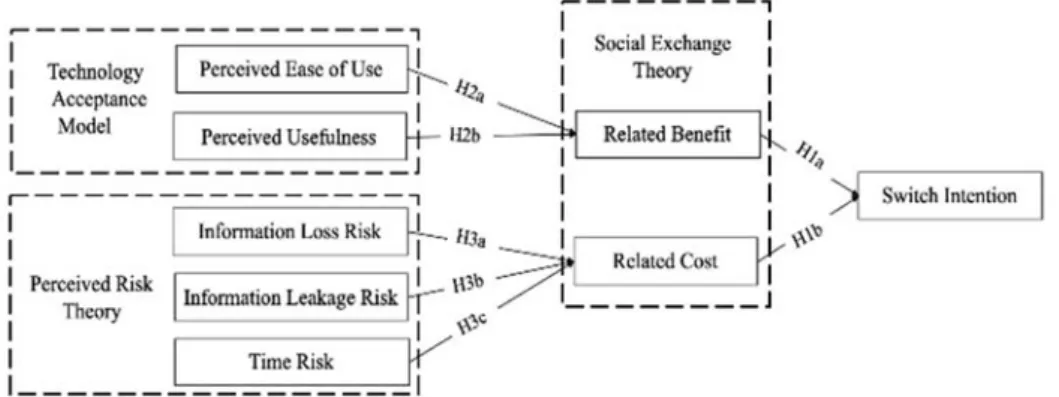
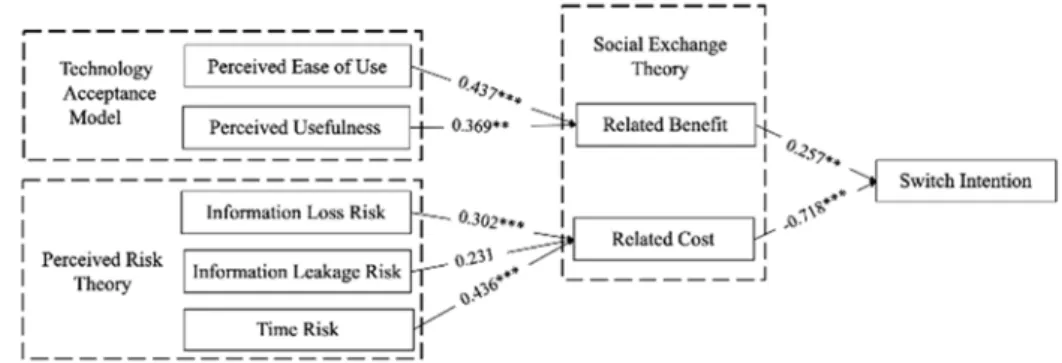
Based on the literature review and theoretical basis of this research, the user's intention to switch to cloud storage platform is mainly influenced by the related benefit and related cost. Therefore, this paper introduces the perceived risk theory and technology acceptance model, and deletes some of the variables according to the characteristics of the research object. In a consequence, we introduce the perceived ease of use, perceived usefulness, information loss risk, information leakage risk, time risk, breadth use of original platform and satisfaction of original platform as our independent variables. The research model that affects the users’ switch intention of cloud storage platform is shown as below.
Figure 1. Research Model
Switch Intention
In the social exchange theory, benefits and costs are two factors that affect the adopt intention of users towards new technology and system. While in our model, we shall test the relationship between related benefit and related cost towards switch intention of users.
In general, switching benefits means an increase in the level of service that users can enjoy during the switching process. In this study, switching benefits mainly include quality improvement and safety improvement. According to common sense, the more powerful switching benefits mean that users have a stronger willingness to switch. In the context of this paper, the following hypothesis is proposed:
H1a. Perceived related benefits has a positive impact on users’ switching intention.
In contrast, switching costs mean the cost and difficulty users face in switching. The switching costs mean the money, time, and risk costs that need to be paid from local storage to cloud storage. The cost of local storage is mostly fixed cost, so the cost is basically sunk when the user has used local storage. When users switch to cloud storage, they need to pay a new transfer cost. In addition, in the switching behavior, we must also consider the risks. The risks are not only the risk of money, but also the risk of information and time, which is also considered by users. In this case, switching costs have become a major obstacle to user switches. Therefore, the following hypothesis is derived:
H1b. Perceived related costs has a negative impact on users’ switching intention.
Switching Benefits
The Technology Acceptance Model (TAM) has been widely used in business research, and a large number of studies have shown that the TAM is a very accurate and robust model in the research of the information system industry (David Gefen, 2003). Adams et al. (1992), Straub et al. (1995) proposed a TAM revision that removed behavioral intentions from TAM and the research result has supported the findings. In the original TAM, the factor perceived ease of use and perceived usefulness determine the attitude toward using and therefore further determine the behavior intention. While some scholar argues that when considering TAM, additional factors need to be taken into account (Chuttur, 2009).
Thus, this paper considers the perceived ease of use and perceived usefulness as the predictor of switching benefit and therefore influence the consumer behavior. In our research, perceived ease of use represents the ease with which users can use cloud storage platform, including its operations and processes. This paper argues that when exposed to a new technology or platform, users may consider it ease of use. If the platform has a clear process and a simple and easy-to-understand interface compared to the old platform, users may consider it as the benefit of using the new platform and further influence the switching intention.
A large number of empirical studies have shown that perceived usefulness is an important variable in the technology acceptance model, and usefulness is a key factor affecting the acceptance of network services (Pedersen, 2002). In our research, perceived usefulness represents whether the cloud storage platform can provide consumers with the product they want, whether the function of the platform meet the need of the users. We believe that platforms that provide users with thoughtful services and address consumer needs may be more likely to be favored by users. Thus, we list this as the factor of the switching benefit as well.
Hence, the following hypotheses are built up:
H2a. Perceived ease of use has a positive impact on users’ perceived related benefits. H2b. Perceived usefulness has a positive impact on users’ perceived related benefits.
Switching Costs
In the paper, switching costs are the main factors that restrict users from switching. As we know, for users, cloud service exists a point of distrust from beginning to end that is information security and risk. Actually, in the field of cloud services, users are not able to obtain real items, which makes users lack trust in products. Therefore, some questions about cloud storage will be usually asked whether private information will be leaked or whether data in cloud storage will be safely stored, etc. All of them are concerns of users. As a result, through the user's use of cloud storage, they can share some personal experiences, which will help to judge the transition from traditional storage to cloud storage. Based on this, we can provide suggestions to help users reduce their perceived risk and achieve platform conversion.
As mentioned before, we include perceived risk theory as one of the important theoretical bases of our study to measure the influence of perceived risk. Gover et al.(2010) established an integrated model of user perceived risk coving the three sources of risk sources, types and perceived risk impact on attitudes and adoption willingness. Here, we extract personal information loss risk as a factor of perceived risk during the process when users using the cloud storage platform. It is worth mentioning that the information loss risk we are discussing here refers to the related risk compared to that of using the traditional storage platform. In the traditional storage context, people may use physical paper or their personal computer to store information, therefore they may face the risk of losing the physical paper or their PC. While in the cloud storage context, users can access to their documents and data simply with their username and password anywhere and anytime. Thus, this research paper assumes that users of cloud storage platform may face a relatively lower risk of information loss risk compared to the traditional platform users. This can be considered as a lower cost of using cloud storage platform. If users perceive lower risk of information loss, they may be willing to use the new technology or platform.
In addition, in the cloud storage platform, information leakage risk is another important risk. The cloud storage platforms are connected via the Internet which is regarded as untrusted network. Since the convenience of cloud storage is higher than that of local storage, according to the equilibrium theory, the security risk of cloud storage will also increase. The login credentials required for the link cloud storage platform has the risk of leaking. The cloud storage platform connection may be hijacked, e.g. man-in-the-middle attack, by hackers or via Trojan viruses, and the cloud storage platform itself may be compromised. Therefore, in the past decade, numerous cloud storage data breach cases have proved that the risk of cloud storage data leakage is relatively high when the
possibility of local storage being compromised is very low, which also affects users' consideration of cloud storage platforms.
Based on the above, the following assumptions can be obtained.
H3a. Perceived information loss risk has a positive impact on users’ perceived related costs. H3b. Perceived information leakage risk has a positive impact on users’ perceived related costs. H3c. Perceived time risk has a positive impact on users’ perceived related costs.
Data Analysis
Descriptive Statistical Analysis
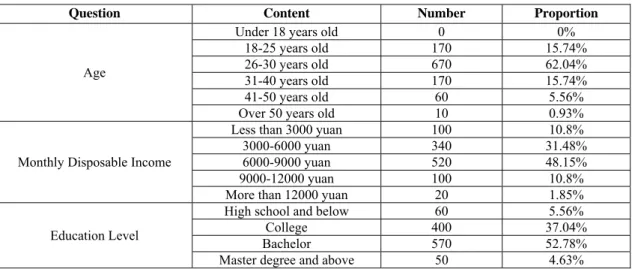
After filtering out the invalid questionnaires supported by low response time and the negative result of one self-detected questionnaire question, a total of 1080 valid samples were collected in this survey questionnaire exercise. The descriptive statistical analysis of the sample is shown below.
Table 1. Descriptive Statistical Analysis Results
Question Content Number Proportion
Age
Under 18 years old 0 0%
18-25 years old 170 15.74% 26-30 years old 670 62.04% 31-40 years old 170 15.74%
41-50 years old 60 5.56%
Over 50 years old 10 0.93%
Monthly Disposable Income
Less than 3000 yuan 100 10.8%
3000-6000 yuan 340 31.48%
6000-9000 yuan 520 48.15%
9000-12000 yuan 100 10.8%
More than 12000 yuan 20 1.85% Education Level
High school and below 60 5.56%
College 400 37.04%
Bachelor 570 52.78%
Master degree and above 50 4.63%
According to the above data analysis, in general, the sample gears towards to the highly educated side, and the monthly disposable income distribution is centered on the range of above 3,000 yuan, which has the ability to provide some support for our research. In addition, we also counted the provinces where the samples were located, and the results were more uniform, indicating that our research results will not be affected by the geographical area, thus it is no need to repeat the same exercise in other areas of China.
Measurement Model Analysis
When using the Shapiro-Wilk method to perform a normal distribution test on the sample data, we find that most of the variables have a p-value less than 0.05. The absolute values of the skewness coefficient of variables are between 1.17-1.64, and the absolute values of the kurtosis coefficient are between 0.01-1.01, indicating that most variables in our model do not conform to the normal distribution. Compared with other structural equation modeling methods, partial least squares (PLS) has no strict requirements on sample size and data distribution, thus it is more suitable for exploratory research. This study is also an exploratory study, so this paper uses the PLS method to analyze the model.
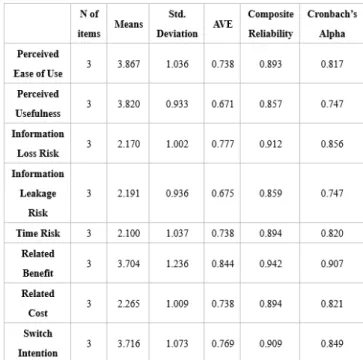
This study uses the Composite Reliability, Cronbach's Alpha Coefficient, and Average Variance Extraction (AVE) to assess of convergence validity. As shown in Table 2, the composite reliability of all structures is around 0.95, all higher than 0.9 while Cronbach's Alpha coefficient is greater than 0.85. Normally, if CR value and Cronbach's Alpha are all higher than 0.7, the measurement model has
a good internal consistency. In addition, the AVE value is between 0.79 and 0.86, indicating that the reliability of the measured model is good.
Table 2. Convergence Validity and Reliability Test
Since the survey questions in the questionnaire were all based on the variables used in the previous study, it can be considered that the model has a good content validity.
In the validity analysis of the questionnaire, due to the existence of many unknown uncertain factors, it may be difficult to select a suitable measurement criterion, so we focus on structural validity analysis. Gefen (2003) believes that when the measured variable's factor load on the corresponding variable is greater than 0.7, the measurement scale has a good degree of polymerization. It can be seen from Table 3 that the load of the corresponding factor of most indicators is above 0.7, only two of them are slightly lower than it. While most loads are basically around 0.9. Fornell (1981) believes that the measurement scale has good aggregation validity if the AVE of each variable is greater than 0.5. From Table 2, we can see that the measurement validity of each variable in our model is ideal.
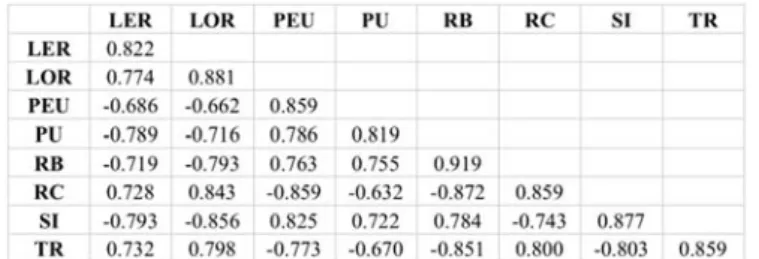
Table 4. Square Root of AVE and Cross Correlation Coefficient
The data in Table 4 shows that the square root value of AVE for each variable is significantly larger than its correlation coefficient with other variables, which indicates that the variables in this model have good discriminant validity. In general, these results confirm the validity of the high convergence of the data.
In summary, the model established in this paper satisfies the reliability and validity test, so it can be considered that the obtained data has a good interpretation of the research model.
Structural Model Analysis
The structural model is used to test whether the variables in the model have an influence on the dependent variable and the significance of the influence. It contains the path coefficients and R2,
where the path coefficients are used to clarify the extent to which the respective variables affect the dependent variable and R2 indicates whether the endogenous variables in the model are well
explained.
First, we can run the linear regression of the switch-intention-part model. The result shows that the significance of this model is Significant= .000, F=611.927, which indicates that the model performs well. The adjusted R2 equals to 0.919, which indicates that the endogenous variables in the model are
interpreted to a higher degree. The results of this part are shown in Table 5 below. Table 5. Test Results of Switch Intention
The results show that the user's perceived related benefit (β=0.181, p<0.05) has a significant positive impact on the switch intention while user’s perceived related cost (β=-0.796, p<0.001) has a significant negative impact on the switch intention, so our hypotheses H1a and H1b are supported. The result of the related-benefit-part shows that the significance of this model is Significant= .000, F=78.934, which indicates that the model performs well. The adjusted R2 equals to 0.593, which
indicates that the endogenous variables in the model are interpreted to a higher degree. The results of this part are shown in Table 6 below.
Table 6. Test Results of Related Benefit
The results show that the user's perceived ease of use (β=0.490, p<0.001) and perceived usefulness (β=0.308, p<0.05) have a significant impact on the related benefit, so our hypotheses H2a and H2b are supported.
Then we can perform the linear regression analysis of the related-cost-part model. The result shows that the significance of this model is Significant= .000, F=202.972, which indicates that the model
performs well. The adjusted R2 equals to 0.850, which indicates that the endogenous variables in the
model are interpreted to a higher degree. The results of this part are shown in Table 7 below. Table 7. Test Results of Related Cost
The results show that the user's perceived time risk (β=0.543, p<0.001) has a significant impact on the related cost, while the perceived information leakage risk (β=0.018, p>0.05) has no significant effect on the user's perceived related cost. It worth noting that although the impact of information loss risk (β=0.401, p<0.001) is significant, the sign of the coefficient is opposite to our hypotheses. Thus, our hypothesis H3c is supported while H3a and H3b do not hold.
The results of the significance test can be summarized as shown in Table 8 below. Table 8. Hypothesis Test Results
Model Analysis Result
Combining the regression results in SPSS with the path coefficients of the estimation model, we can get the standardized path coefficients for the entire model as shown in Figure 2.
Figure 2. Model Analysis Result
Analysis Result Discussion
Social Exchange Theory
The social exchange theory has two factors: related benefit and related cost. As expected, the user’s perceived related benefit (β=0.181, p<0.05) has a significant positive impact on the switch intention while user’s perceived related cost (β=-0.796, p<0.001) has a significant negative impact on the switch intention, so our hypotheses H1a and H1b are supported. In the sample, many users agree that there are certain related benefits and risks in using cloud storage platforms. Related benefits have a
significant positive impact on people’s choice of cloud storage platforms while related costs have an even more significant negative impact on people's choice of cloud storage platforms. The impact of related cost risk is four times greater than that of related benefit.
Technology Acceptance Model
The technology acceptance model has two factors: perceived ease of use and perceived usefulness. As expected, both perceived ease of use (β=0.490, p<0.001) and perceived usefulness (β=0.308, p<0.05) of cloud storage platform users have a significant impact on related benefits. Our hypotheses H2a and H2b are supported.
H2a has been supported, which indicates that the users’ perceived ease of use can positively affect the related benefits of users. We can conclude that users are more likely to choose cloud storage platforms when they think they are easy to operate. The result validates the discussion of perceived ease of use in the technology acceptance model.
H2b has been supported. When users feel that they need a cloud storage platform or that the platform is useful, they may be more satisfied with the platform and the related benefits will be higher. At the same time, our results show that the perceived usefulness of users can directly positively affect their willingness to choose platforms. Therefore, this paper suggests that cloud storage platforms can provide comprehensive application services for different user demands to improve user perceived usefulness.
Perceived Risk Theory
The perceived risk theory in our model has three factors: information loss risk, information leakage risk and time risk. As expected, both information loss risk (β=0.401, p<0.001) and time risk (β=0.543, p<0.001) of cloud storage platform users have a significant impact on related cost. However, contrary to expectations, the assumption of information leakage risk is not verified. Information leakage risk (β=0.018, p>0.05) does not have a significant impact on related cost. So, our hypotheses H3a and H3c are supported except H3b.
H3a and H3c have been supported. In the sample, many users believe that there are certain risk of information loss and time risk in using cloud storage platforms, and they recognize that these two risks will significantly reduce their tendency to choose cloud storage platforms. People using storage platforms want to keep their data intact and are not willing to take any risk of loss. Thus, the information loss risk will definitely have a significantly negative impact on people’s switch intention. When people realize the time cost of learning a new storage platform, they may have doubts about whether the cloud storage platform is the storage method they need, so they are likely not willing to waste time to learn it and continue to use the traditional storage platform.
The H3b hypothesis has not been verified. People are aware of the risk of information leakage, but they still prefer to use cloud storage platforms. The paper believes that the reason for this result may be that users have high demand for cloud storage platforms, so that they can tolerate certain risks. In social exchange theory, people’s behavior mainly depends on two aspects: related cost and related benefit. In the environment of storage platform, we can consider the risk of information leakage as part of the cost. This paper argues that users’ perceived benefits to cloud storage platforms may be high, which may cause them to accept the information leakage risks.
Conclusion
This paper studies the factors that influence the switching behavior toward cloud storage users. Using Social Exchange Theory, we built a model using Social Exchange Theory, Technology Acceptance Model and Perceived Risk Theory to analyze the impact of benefit and cost factors, utility, and risk factors on research issues.
We obtain several results in this study. First, the switching benefit has a significant positive impact on switching behavior toward cloud storage users, while the switching cost has a significant negative
impact. Second, the perceived ease of use and perceived usefulness has a significant positive impact on related benefit. Third, information loss risk and time risk have a significant positive impact on related cost, while information leakage risk does not have a significant impact.
Although the results obtained are not that satisfactory, this paper still have an attempt. This study is based on various theories such as social exchange theory and technology acceptance model. Although predecessors have studied and discussed these theories in depth, no scholars have integrated these theories into the cloud storage environment. The research in this paper fills the gap in this aspect, and further verifies the feasibility of these theories in information system research.
This result provides some implications for cloud storage vendors. Firstly, cloud storage vendors should balance the investment between the utility and risk investment in cloud storage services. Secondly, as result shows, cloud storage vendors should pay enough attention to switching cost concerns, so that the consumer can accept the new cloud storage platform, especially, it is necessary to ensure that the risk control level of the platform is not lower than the risk control level of the current products (local storage). Thirdly, small information leakage risk concern is not in line with the user's costs, so it is recommended that the platform can increase the promotion on information leakage risk concerns to change the user's perception so that the platform can attract more customers through the risk factor reduction.
References
Albrechtsen, E. and Hovden, J. (2010). Improving information security awareness and behaviour through dialogue, participation and collective reflection. An intervention study. Computers & Security, 29(4), pp.432-445.
Arpaci, I. (2016), "Understanding and predicting students' intention to use mobile cloud storage services", Computers in Human Behavior, Vol. 58150-157.
Arpaci, I., Kilicer, K. & Bardakci, S. (2015), Effects of security and privacy concerns on educational use of cloud services, Computers in Human Behavior, Vol. 45 No. C, pp. 93-98.
Bhattacherjee, A. (2001), Understanding information systems continuance: an expectation-confirmation model, Society for Information Management and The Management Information Systems Research Center.
Buttell, A. E. (2010). Reasons to Switch to Cloud Computing, Journal of Financial Planning, 6-7.
Chang, K. C. & Seow, Y. M. (2016), Adoption Intention On Cloud Storage Services: The Role Of Technology Trust, Privacy And Security Concerns.
Chen, Y. & Potter, R. (2007), The Role of Habit in Post-Adoption Switching of Personal Information Technologies: A Push, Pull and Mooring Model.
David Gefen;Elena Karahanna;Detmar W. Straub. TRUST AND TAM IN ONLINE SHOPPING: AN INTEGRATED MODEL. Management Information Systems Quarterly. 2003. Vol.27, 51-90.
David Sowby, J. V., (2003). Forty years on: how radiological protection has evolved internationally.
Journal of Radiological Protection, Volume 23, pp. 157-171.
Davinson, N. and Sillence, E. (2010). It won’t happen to me: Promoting secure behaviour among internet users. Computers in Human Behavior, 26(6), pp.1739-1747.
Davis, F., (1989). Perceived usefulness, perceived ease of use, and user acceptance of information technology. MIS Quarterly, 13(3), pp. 319-340.
Emerson, R. M., (1976). Social exchange theory. Annual Review of Sociology, Issue 2, pp. 335-362.
Fornell, C., Larcker, D.F.. Evaluating Structural Equation Models with Unobservable Variables and Measurement Error. Journal of Marketing Research, 1981, 18(1): 39-50.
Gupta, P., Seetharaman, A. & Raj, J. R. (2013), "The usage and adoption of cloud computing by small and medium businesses", International Journal of Information Management, Vol. 33 No. 5, pp.
861-874.
Homans, G. C., (1958). Social behavior as exchange. American Journal of Sociology, Issue 63, pp.
597-606.
Hu, S. (2014), Data Security: The Challenges of Cloud Computing, International Conference on Measuring Technology & Mechatronics Automation, pp. 203-206.
Kim, H. W. & Kankanhalli, A. (2009), Investigating User Resistance to Information Systems Implementation: A Status Quo Bias Perspective, MIS Quarterly, Vol. 33 No. 3, pp. 567-582.
Kritzinger, E. and von Solms, S. (2010). Cyber security for home users: A new way of protection through awareness enforcement. Computers & Security, 29(8), pp.840-847.
Limayem, M., Hirt, S. G. & Cheung, C. M. K. (2007), How habit limits the predictive power of intention: the case of information systems continuance, MIS Quarterly, Vol. 31 No. 4, pp.
705-737.
Lin, A. & Chen, N. C. (2012), Cloud computing as an innovation: Percepetion, attitude, and adoption,
International Journal of Information Management, Vol. 32 No. 6, pp. 533-540.
Low, C., Chen, Y. & Wu, M. (2011), Understanding the determinants of cloud computing adoption,
Industrial Management & Data Systems, Vol. 111 No. 7, pp. 1006-1023.
Mahajan, P., Setty, S., Lee, S., Clement, A., Alvisi, L., Dahlin, M. & Walfish, M. (2011), Depot:Cloud Storage with Minimal Trust, ACM Transactions on Computer Systems, Vol. 29 No.
4, pp. 1-38.
Mauss, M., (1967). The gift: Forms and functions of exchange in archaic societies, Norton, New York: Mauss Marcel.
Mayadunne, S. and Park, S. (2016). An economic model to evaluate information security investment of risk-taking small and medium enterprises. International Journal of Production Economics,
182, pp.519-530.
Ming, D.(2016) Information security protection measures in cloud computing environment. Electronic Technology & Software Engineering., Vol.17, 206.
Öğütçü, G., Testik, Ö. and Chouseinoglou, O. (2016). Analysis of personal information security behavior and awareness. Computers & Security, 56, pp.83-93.
Quick, D, Martini, B & Raymond Choo, K. (2014). Cloud Storage Forensics, pp.1-11.
Rezgui, Y. and Marks, A. (2008). Information security awareness in higher education: An exploratory study. Computers & Security, 27(7-8), pp.241-253.
Stam, K., Mastrangelo, P. and Jolton, J. (2005). Analysis of end user security behaviors. Computers & Security, 24(2), pp.124-133.
Starr, C., (1969). Social benefit versus technological risk. Science, Issue 165, pp. 1232-1238.
Trček, D., Trobec, R., Pavešić, N. and Tasič, J. (2007). Information systems security and human behaviour. Behaviour & Information Technology, 26(2), pp.113-118.
Wang Nianxin, Shi Hui, Wang Zhiying, Ge Shilun(2018). Coping Behavior of IT Threat: An Empriical Study in Context of Cloud Computing. Journal of Information Systems Management,
Vol.27, No.4, 683-693.
Wang, C., Chow, S. S. M., Wang, Q., Ren, K. & Lou, W. (2013), Privacy-Preserving Public Auditing for Secure Cloud Storage, IEEE Transactions on Computers, Vol. 62 No. 2, pp. 362-375.
Wang, J. (2016), Critical Factors for Personal Cloud Storage Adoption in China, Journal of Data and Information Science, Vol. 1 No. 2, pp. 60-74.
Wang, Y. F., Zhu, X. D. & Management, C. O. (2018), An Empirical Study on the Influencing Factors of User 's Willingness of Personal Cloud Storage Service, China Forestry Economics,.
Wheeler, A & Michael, W 2015, Cloud Storage Security,1st.
Wu Yong. (2017). Information Security Decision-making of Firms under Security Externality. City University of Hong Kong.
Wu, J., Ping, L., Ge, X., Wang, Y. & Fu, J. (2010) Cloud Storage as the Infrastructure of Cloud Computing. International Conference on Intelligent Computing and Cognitive Informatics., IEEE.
Xuening,T.(2018) Discussion on Personal Computer Information Security Protection. Modern Information Technology..
Yang, K. & Jia, X. (2013), DAC-MACS: Effective Data Access Control for Multi-Authority Cloud Storage Systems, INFOCOM, 2013 Proceedings IEEE, pp. 1790-1801.
Zhang, J., Reithel, B. and Li, H. (2009). Impact of perceived technical protection on security behaviors. Information Management & Computer Security, 17(4), pp.330-340.