During his field survey in Vanuatu in 2003, H. Smit (Dept. of Entomology, Zoological Museum, University of Amsterdam) collected some aquatic macrofauna on request of the Department of Natural Resources at Port-Vila. The samples of aquatic bugs were forwarded for identification. In the samples, six families, eight genera and nine species are recognized. Among them, one species is new to science, viz. Microvelia trichota sp. n. (Veliidae).
Most of the waterbugs treated here have previously been reported from Vanuatu when it still went under the name New Hebrides. Apart from the outdated survey of Laird (1956), the records are scattered throughout the specialised literature, which could be the reason that the local people know little about them. Therefore we consider it useful to present all the known species of aquatic bugs from the islands in order to enable an easier identification.
The keys are presented below as an introductory guide, and take into account adults of the known Vanuatuan bugs only. However, as these islands have been sampled superficially only, additional collecting, especially at higher elevations, will probably produce additional species. Thus, some genera which are al-most certainly occurring in the island have been added in the keys. For more complete keys to generic level one is referred to Andersen & Weir (2004) or Chen et al. (in press). Material can be sent to the au-thors for verification.
Measurements are in mm, based on five specimens. Size is given as range with mean underlined and the
value of the holotype between braces {}. Other mea-surements are given as the mean only. Descriptions and measurements follow the formats of Andersen & Weir (2003a). References to family- and genus-group names are omitted; they can be found in Stys & Jans-son (1988) for Nepomorpha and in Andersen (1982) for Gerromorpha. An introduction to the water bugs of Malesia can be found in the forthcoming publica-tion of the authors (Chen et al. 2005).
Most specimens have been deposited in the De-partment of Entomology of the Zoological Museum of the University of Amsterdam (), some refer-ence specimens are in the Nieser collection (). A
The authors sincerely thank H. Smit () for collecting and making the material available for study, W. Hogenes and G. Tweehuizen () for providing important literature, and Dr. H. Zettel (Natural History Museum, Vienna, Austria) for criti-cal reading and suggesting some improvements to the manuscript.
S
Nepomorpha
Nepomorpha are essentially the Heteroptera living in water. A few species live in damp situations at the edge of water. The species which are likely to occur in NNIESER & PCHEN
1
Tiel, The Netherlands. 2
Dept. Entomology, National Museum of Natural History, Naturalis, Leiden
THE WATER BUGS (HEMIPTERA: NEPOMORPHA
AND GERROMORPHA) OF VANUATU
Nieser N. & Chen, P.-p., 2005 The water bugs (Hemiptera: Nepomorpha and Gerromorpha) of Vanuatu – Tijdschrift voor Entomologie 148: 307-327, figs. 1-47. [ 0040-7496]. Published 1 December 2005.
The water bugs of Vanuatu are summarized, based on material collected by H. Smit and liter-ature records. One new species is described from Vanuatu: Microvelia (Pacificovelia) trichota sp.n. Keys to the 14 species known from Vanuata are presented.
Correspondence: N. Nieser, Htg. Eduardstr. 16, 4001 RG Tiel, The Netherlands.
P.-p. Chen (corresponding author), Department of Entomology, National Museum of Natural History, Naturalis, PO Box 9517, 2300RA Leiden, The Netherlands, e-mail: pingping–[email protected]
Vanuatu can all be recognized by having the antennae shorter than the head and not visible from above.
Key to Vanuatuan families and genera of
Nepomorpha
1. Rostrum narrow, tube-shaped, and consisting of 4 well defined segments (fig. 5) ...2 ‒ Rostrum wide, triangular, not segmented but provided with transverse grooves (fig. 7) ...5 2. Fore femur strongly thickened and with a groove, in which tibia and tarsus fit, semiterrestrial species, (fig. 35) (Gelastocoridae) ...Nerthra ‒ Fore femur not strongly thickened, truly aquatic species ...3 3. Small species, length about 1.5 mm (fig. 1)
(Pleidae) ...Paraplea liturata ‒ Larger species, length over 3 mm (figs. 2, 3)
(Notonectidae) ...4 4. Lateral margins of pronotum smooth, hemiely-tral commissure with a hair-lined pit at its base (fig. 2) ...Anisops ‒ Lateral margins of pronotum with large pits (foveae), hemielytral commissure without a pit at
its base (fig. 3) ...Enithares hebridensis 5. Larger species, length over 3 mm, scutellum cov-ered by pronotum, at most its tip visible (fig. 4) (Corixidae) ...Sigara ‒ Small species length about 2 mm, scutellum fully exposed (fig. 12) (Micronectidae) ...Micronecta F G
(fig. 35)
No species of this family has been recorded from Vanuatu so far. A species which could be found is Nerthra macrothorax (Montrouzier, 1855). This species is widespread from Tonga and North Australia through New Guinea and the Malay Archi-pelago to Japan, Taiwan and the Comores. N. macrothorax is an 8-9 mm long bug which can be separated from other species of Nerthra (which is the only genus of Gelastocoridae occurring in Asia) by the combination of the following characteristics: ocel-li absent, hemielytra entirely coriaceous (i.e. mem-brane totally absent), fused together, and with at least one pair of submarginal carinae running from base to at least halfway the hemielytron; front of head with distinct round tufts of scales. As far as known Nerthra species are active at night, several species have been found remote from water. At day time they hide in wet mud or sand or under stones or plant debris (Chen et al. 2005). N. macrothorax has been found on beaches under and burrowing in decaying plant de-bris, notably leaves and logs of Pandanus, e.g. bur-rowing in the sand on a beach in the south of Taiwan Island (personal observation). In view of its inability to fly, its wide distribution is attributed to dispersion by drift on plant debris (Todd 1959, 1960). F C
The only record from Vanuatu is an unidentified species of the genus Sigara Fabricius, 1775 by Laird (1956). It may concern either S. tadeuszi Lundblad, 1933 or S. truncatipala (Hale, 1922) which are both known from Australia and New Caledonia (Polhe-mus & Herring 1970). For identification of Sigara species, see Lansbury (1970) and Andersen & Weir (2004).
F M
This family has not been recorded from Vanuatu yet. Two species of the genus Micronecta Kirkaldy, 1897 are known from the Solomon Islands (Wróblewski 1962). As these small bugs escape easily from the attention of collectors, a species of this genus might still be found in Vanuatu.
T E, 148, 2005
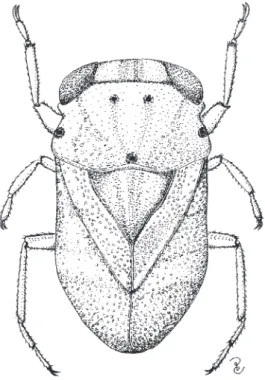
Fig. 1. Paraplea lituralis, male, length 1.6 mm (reproduced from Chen et al. 2005).
F N
Genus AnisopsSpinola, 1837
In Anisops males are recognizable by having one-segmented fore tarsi, whereas females have two-segmented fore tarsi. In addition, the third rostral segment of the male has lateral outgrows, the rostral prongs (fig. 5, p) and the fore tibia has a proximal row of teeth located on an elevation, the stridulatory comb (fig. 8, s).
Key to males of Anisops recorded from Vanuatu
1. In dorsal view head with a distinct projection in front of eyes (fig. 2) ...A. nasutus ‒ In dorsal view head rounded or truncate anteriorly,
not projecting in front of eyes ...2 2. Small species, length 5.1-5.5 mm, tylus laterally compressed to form a median carina which pro-ceeds on the basal two thirds of the frons (fig. 5) ...A. tahitiensis ‒ Larger species, length 5.5-7.5 mm, tylus flat, without carina ...3 3. Length 6.9-7.6 mm, maximum width 1.5-2.3 mm; fore tibia wide, length about four times its width (fig. 8); stridulatory comb with about 25 teeth in an uninterrupted row (fig. 9) ... ...A. leucotheca ‒ Length 5.5-6 mm, maximum width 1.0-1.75 mm; length of fore tibia about five times its width (fig. 10); stridulatory comb with about 25 teeth in a broken row (fig. 11) ...A. cheesmanae
Fig. 2.
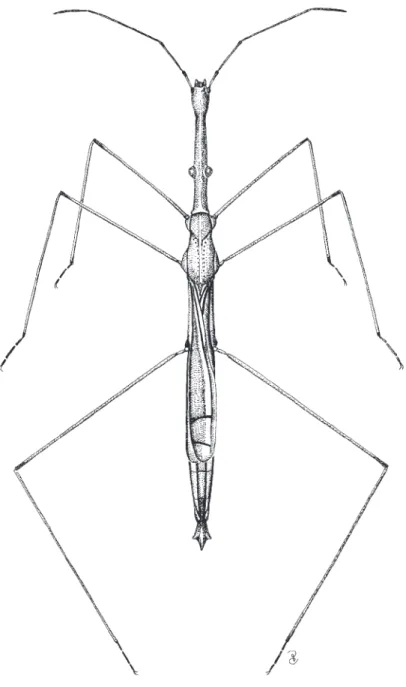
Anisops nasutus, male, length 7.2 mm (reproduced from Chen et al. 2005).
Anisops leucothecaEsaki new record
(figs. 8-9)
Anisops leucotheca Esaki, 1928: 76-80.
Anisops leucotheca; Brooks 1951: 394-395 (redescription). Material examined. – : Efate, cattle pond S of Rentapao Bridge, 17°48.440S, 168°26.917E, 26.x.2003, leg. H. Smit. 1?2/. New record for Vanuatu.
Distribution
Samoa, Vanuatu, Solomon Islands, East New Guinea (Wallis Island) (Brooks 1951, Lansbury 1965, Chen et al. 2005).
Remarks
Lansbury (1965) suggests that A. leucotheca may be the flightless form of A. occipitalis Breddin. The indi-rect flight muscles checked in the studied male were T E, 148, 2005
not developed, whereas the indirect flight muscles of specimens of A. occipitalis from West Malaysia (Nieser 2004) were well developed, which is support-ing Lansbury’s hypothesis.
Anisops tahitiensis Lundblad
(fig. 5)
Anisops tahitiensis Lundblad, 1934: 121-123
Anisops tahitiensis; Brooks 1951: 376-278 (redescription) Anisops tahitiensis; Lansbury 1963: 5-6.
Material examined. – : Efate, lake Enam Lep, 17°48.568S, 168°29.269E, 25.x.2003, leg. H. Smit, 1?;
Efate, pond along the road to White Sands, 17°47.180S, 168°29.921E, 26.x.2003, leg. H. Smit, 1?; Efate, cattle pond S of Rentapao Bridge, 17°48.440S, 168°26.917E, 26.x.2003, leg. H. Smit, 1?1/.
Distribution
Tahiti, Vanuatu, Solomon Islands, Australia, East New Guinea, Philippines (Mindanao), West Malaysia, Vietnam. In Vanuatu the species was recorded by Lansbury (1963) from Espiritu Santo and Malekula, and by Brooks (1951) from ‘New Hebrides: Oman’.
Fig. 4.
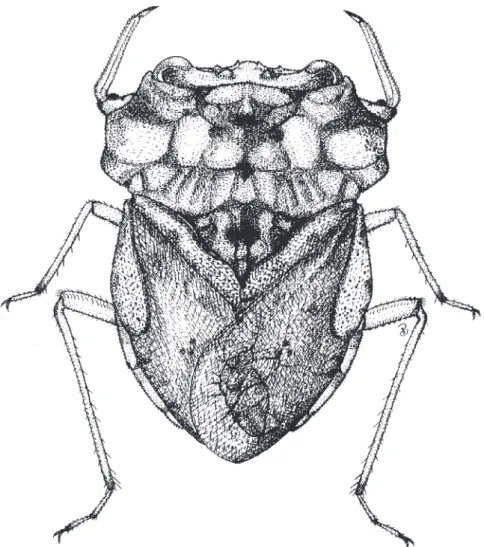
Sigara sp., habitus (repro-duced from Chen et al. 2005).
T E, 148, 2005 5 7 6 8 10 9 11 s r r t
Figs. 5-10. Nepomorpha structure. – 5, Anisops tahitiensis, head in lateral view; p = rostral prong r = rostrum; 6, Limnogonus sp., head and pronotum, lateral view, only first antennal segment shown, t = trichobothria.; 7, Sigara sp., head in frontal view, r = rostrum; 8-9, Anisops leucothecus, male, fore leg, stippled line indicates measurement of width of tibia, s = stridulatory comb (detail in 9); 10-11, A. cheesmanae, male (adapted from Lansbury 1963), fore leg, stippled line indicates measurement of width of tibia; (11 detail of stridulatory comb). (7 reproduced from Chen et al. 2005).
Anisops cheesmanaeLansbury (figs. 10-11)
Anisops cheesmanae Lansbury, 1963: 6-9.
Not represented in the material studied.
Distribution
This species was described from Vanuatu: Erromanga and Malekula, not recorded since its de-scription.
Anisops nasutusFieber
(fig. 2)
Anisops nasuta Fieber, 1851: 60-61. Anisops nasuta; Lansbury 1963: 6.
Not represented in the material studied.
Distribution
E. India through continental SE Asia, China, Philippines and Indonesia to New Guinea and Australia, also widespread in Pacific Islands (Nieser & Chen 1999). In Vanuatu recorded from Dolphin Island near Espiritu Santo and Gaua by Lansbury (1963).
Genus EnitharesSpinola, 1837
Only one species has been recorded from Vanuatu (Lansbury, 1968).
Enithares hebridensis Lansbury
Enithares bergrothi Laird, 1956: 74 (non Montandon). Enithares hebridensis Lansbury, 1968: 383-384.
Material examined. – : Espiritu Santo, Butmas stream, 15°20.605S, 166°58.553E, 29.x.2003, leg. H. Smit, 4 larvae.
Distribution
Endemic in Vanuatu, recorded from Aneityum, Efate, Erromanga, Espititu Santo, Gaua and Tanna (Lansbury 1968).
FP
Only one genus Paraplea Esaki & China, 1928, with one species, has been recorded from Vanuatu.
Paraplea liturata(Fieber)
(fig. 1)
Ploa liturata Fieber, 1844: 297. Plea rufonotata; Laird 1956: 74.
Material examined. – : Efate, lake Enam Lep, 17°48.568S, 168°29.269E, 25.x.2003, leg. H. Smit, 1? 3/; Efate, pond along the road to White Sands, 17°47.180S, 168°29.921E, 26.x.2003, leg. H. Smit, 2?4/; Espiritu Santo, pool in Sakepe village, 15°18.873S, 167°09.996E, 31.x.2003, leg. H. Smit, 1?3/.
Distribution
From India through continental South-East Asia, Indonesia, Philippines (Mindanao) and North Australia to New Caledonia and Vanuatu (Laird 1956, Chen et al. 2005).
G
Gerromorpha are semiaquatic bugs. Their habitat varies from humid margins of water bodies to the sur-face of the water, a few species even living on the open ocean. They can be separated from other Heteroptera by the presence of three or four pairs of trichobothria on the head (fig. 6). Trichobothria are large sensory bristles, distinctly longer and tapering more gradually than the surrounding hairs. The seta or ‘trich’ (from Greek tricha = hair) is placed on a basal dome-like elevation of the cuticula, the bothrium. In adults the bothrium is located at the bottom of a depression, in Fig. 12. Micronecta sp., habitus, s = scutellum (reproduced
from Chen et al. 2005).
T E, 148, 2005
larvae it is on the surface of the cuticula. In most adults of the family Gerridae, there is a fourth pair of trichobothria which has the structure of larval trichobothria.
Key to Vanuatuan families and genera of
Gerromorpha
1. Macropterous (wings fully developed, however, the apical part can be torn off (fig. 14) ...2 – Apterous (wingless) or meiopterous (wings re-duced) ...3 2. Scutellum exposed, forming a subtriangular plate behind the pronotum; ocelli present (fig. 14) (Mesoveliidae) ...Mesovelia vittigera – Scutellum not exposed, covered by the posterior-ly extended pronotal lobe ...3
3. Head very slender, over five times as long as wide; eyes far from posterior margin of head (fig. 13) (Hydrometridae) ...Hydrometra strigosa – Head at most three times as long as wide; eyes close to or at posterior margin of head ...4 4. Pronotum short, exposing both meso- and metanotum ...6 – Pronotum longer, covering at least most of mesonotum ...5 5. Head with distinct longitudinal median im-pressed line on dorsal surface (fig. 23). Hind femora stouter than middle femora. Anterior tib-ia of male with a grasping comb of short spines along inner margin (fig. 20) (Veliidae) ... ...Microvelia trichota sp.n. – Head without a median impressed line on dorsal surface. Hind femora more slender than middle Figs. 14-15. Mesovelia vittigera. – 14, macropterous male, length 2.8 mm, s = scutellum; 15, apterous female, length 3.3 mm (reproduced from Chen et al. 2005).
14 15
femora. Anterior tibia of male without grasping comb (fig. 16, Gerridae) ...6 6. Pronotum dark with a yellow median line... ...Limnogonus – Pronotum yellowish or rufous with a blackish median line ...Limnometra & Tenagogonus 7. Head about as long as wide; meso- and
metan-otum clearly separate (fig. 15). All claws apical (Mesoveliidae) ...Mesovelia vittigera – Head at least about twice as wide as long; meso-and metanotum fused. At least claws of fore legs subapical ...8 8. Head about twice as wide as its median length; posterior margin of pronotum more or less T E, 148, 2005
straight (fig. 26). All claws subapical ...9 – Head three times or more as wide as its median
length; posterior margin of pronotum strongly curved (fig. 17). Claws of fore leg subapical, claws of middle and hind legs apical ... ...Hermatobatidae 9. Body length of male 3.4 mm or more, of female over 4 mm, male genital segments strongly mod-ified (figs. 25-28) (Gerridae) ...Halobates – Body length of male 2 mm or less, of female 2.6 mm or less, male genital segments not strongly modified (fig. 33) (Veliidae) ...Halovelia F M
Only one genus Mesovelia Mulsant & Rey, 1852 and one species recorded from Vanuatu.
Mesovelia vittigeraHorváth, new record
(figs. 14-15)
Mesovelia vittigera Horváth, 1895: 160. ?Mesovelia spp. Laird, 1956: 74.
Mesovelia vittigera; Polhemus & Polhemus 2000: 226-229 (redescription, synonymy).
Material examined. – : Efate, lake Enam Lep, 17°48.568S, 168°29.269E, 25.x.2003, leg. H. Smit, 2/ apterous; Efate, lake Enam Lep, 17°48.568S, 168°29.269E, 25.x.2003, leg. H. Smit, 1/apterous; Efate, lake Enam Lep, 17°48.568S, 168°29.269E, 25.x.2003, leg. H. Smit, 1/dealate; Espiritu Santo, pool in Sakepe village, 15°18.873S, 167°09.996E, 31.x.2003, leg. H. Smit, 2?2/ apterous, 1 larva. First record for Vanuatu.
Distribution
‘Occurring in all warm regions of the Old World except some isolated Pacific Islands’ (Polhemus & Polhemus 2000).
Fig. 17.
Hermatobates sp., male, length 3.5 mm (reproduced from Chen et al. 2005).
F H
Only one genus Hydrometra Latreille, 1796 and one species recorded from Vanuatu.
Hydrometra strigosa (Skuse)
Limnobates strigosa Skuse, 1893: 43.
Hydrometra strigosa; Polhemus & Lansbury 1997: 29-32 (redescription, synonymy, distribution).
Material examined. – : Efate, lake Enam Lep, 17°48.568S, 168°29.269E, 25.x.2003, leg. H. Smit, 2?2/ micropterous; Espiritu Santo, pool in Sakepe village, 15°18.873S, 167°09.996E, 31.x.2003, leg. H. Smit, 1?macropterous, 5?1/micropterous.
Distribution
Australia, New Caledonia, Vanuatu, New Zealand and Tahiti. In Vanuatu recorded from Espiritu Santo and Malekula (Polhemus & Lansbury 1997). F H
This family contains only the genus Hermatobates Carpenter, 1892, which is exclusively marine. So far no species of this family has been collected in Vanuatu. However, H. marchei (Coutière & Martin, 1901, fig. 17) occurs in Japan, Indonesia, Philippines, nortern part of Australia, New Caledonia, Fiji and Tonga (Andersen & Weir 2000), and it may well oc-cur in Vanuatu. Foster (1989) studied this species in Fiji and Tonga, and found that they are a regular T E, 148, 2005 18 19 1mm 1mm 0,5 mm 21 22
Figs. 18-19. Thorax of Limnogonus in lateral view, scale 1 mm, s = metathoracic spiracle. – 18, L. fossarum gilguy; 19, L. luctuosus. Fig 20: see page 319. Figs. 21-22. Seventh abdominal segment of female Limnogonus, lateral view, scale 0.5 mm. – 21, L. fossarum gilguy, 22, L. luctuosus.
component of the intertidal fauna of tropical rocky and coral shores. They are active in the day time, roughly from one hour before to one hour after low tide in a narrow zone of about 20 cm around the mean low tide line. Andersen & Weir (2000) present-ed a revispresent-ed key to all species of Hermatobates. F V
Only one genus Microvelia Westwood, 1834 with one species recorded from Vanuatu.
Microvelia (Pacificovelia) trichota sp. n.
(figs. 23-25)
? Microvelia spp. Laird, 1956: 74.
Type material. – Holotype (): apterous fe-male, : Espiritu Santo, Butmas stream, 15°20.605S, 166°58.553E, 29.x.2003, leg. H. Smit. – Paratypes, same data as holotype, 3/ apterous (2 , 1 ); : Efate, pond along the road to White Sands, 17°47.180S, 168°29.921E, 26.x.2003, leg. H. Smit, 1/apterous ().
Description
Apterous female (fig. 23). Size 1.65 – 1.69 – 1.75 {1.68}; width 0.59 – 0.66 – 0.68 {0.68}.
Colour. Dorsally blackish grey with orange-brown
markings. Head blackish grey with pale bluish grey pruinose stripes along inner margins of eyes. Prono-tum dark brown to blackish grey; anteriorly with a transverse orange-brown band, reaching posteriorly to the transverse row of pits, laterally to inner posteri-or angles of eyes; posteriposteri-or margin posteri-orange-brown. Abdomen dorsally blackish grey, dull, except for shiny spots medially on abdominal tergites 5 and 6. Tergites 2 and 3 with pale bluish grey pruinose marks which vary from covering lateral third to virtually the entire tergites. In addition, a pruinose mark on con-nexivum of segment 6 and in some specimens small pruinose marks on connexiva of segments 2 and 3 and anterolaterally on tergite 4; connexiva both dor-sally and ventrally orange-brown. Antennae brown-ish, basal half of segment 1 lighter than remainder. Legs brownish with coxae, trochanters and basal parts of femora yellow. Venter and sides blackish grey with a pruinose hue.
Structural characteristics. Body elongate suboval, total length 2.5-2.8 times greatest width across thorax. Most of body covered with short, appressed pilosity; sides of thorax and abdomen with longer semi-erect hairs. Width of head across eyes 1.2 times the length of head (0.46/0.39). Antenna almost half as long as body (0.80/1.69); length of antennal segments 1-4: 0.18, 0.14, 0.16, 0.32. length of pronotum 0.27, distinctly shorter than head. Mea-surements of leg segments (femur, tibia, tarsal 1, tarsal 2, fore tarsus one-segmented): fore leg: 0.42, 0.31, 0.20; middle leg: 0.48, 0.40, 0.11, 0.13; hind leg: 0.52, 0.58, 0.12, 0.15. Abdominal dorsum in lateral view curved downwards toward ab-dominal end (fig. 24). Connexiva vertically raised throughout, converging posteriorly but not touching caudally; connexival margins not modified; posterior corners of laterotergites 7 at right angles. Posterior margin of tergite 6 with a small and posterior margin of tergite 7 with a larger tuft of long bristles (figs. 24, 25). Sternum 7 slightly longer than sterna 5 and 6 combined (0.30/0.27), posterior margin straight. In lateral view genital segments concealed; proctiger semicircular, vertical.
Etymology
Trichota (feminine form of Greek adjective tri-chotos, meaning ‘hairy’) refers to the characteristic tufts of bristles caudally on the abdomen of the female.
Comparative notes
This species has tufts of bristles caudally on abdomen in common with M. (Pacificovelia) starmuehlneri Polhemus & Herring, 1970 from New Caledonia and M. (Pacificovelia) macgregori (Kirkaldy, 1899) from New Zealand and Norfolk Fig. 20. Microvelia sp., male, foreleg, scale 0.5 mm.
c = grasping comb.
0,5 mm
Island (Andersen & Weir 2003a). However, in these species the tufts of bristles on the abdomen are placed on the connexivum, not on the tergites. In addition, females of both these species are larger, length over 1.9, and have the connexiva folded over the abdomen, at least posteriorly. In addition, M. starmuehlneri has an additional small tuft of bris-tles on segment 2 of the connexival margins. M. macgregori has an additional small tuft of bristles posteriorly on segment 6 of the connexival margins. M. pacifica Kirkaldy, 1908 from Fiji is larger, length over 2 mm and lacks the abdominal hair tufts in the female.
Genus HaloveliaBergroth, 1893 (fig. 34)
Species of Halovelia or ‘coral bugs’ are small (length up to 2.5 mm, but usually about 2 mm or less) marine Veliidae, living in the tidal zone. They have been found both in open exposed habitats and in
mangroves. No species has so far been recorded from Vanuatu, but several species have been recorded from neighbouring islands. There is little doubt that one or more species will occur in the intertidal zones of the islands of Vanuatu. A reliable prediction which species will occur is, however, not feasible. The genus has been revised by Andersen (1989). A key to the re-lated genera Haloveloides Andersen, 1992 and Xenobates Esaki, 1927 which might also occur in Vanuatu can be found in Andersen (1992). F G
GenusLimnogonusStål, 1868
Key to Vanuatuan species of Limnogonus
(adapted from Andersen & Weir, 1997).
1. Pale stripe on upper part of mesopleuron tapering in width posteriorly (fig. 19), ending in front of and below the metathoracic spiracle. Hind mar-gin of seventh abdominal sternite of female with T E, 148, 2005
0,25 mm
0,1 mm
23 24
25
Figs. 23-25. Microvelia trichota sp. n. female. – 23, habitus of holotype, body length 1.68 mm; 24-25, Posterior part of abdomen; 24, lateral view, scale 0.25 mm; 25, dorsal view. scale 0.1 mm.
a prominent tooth in middle (fig. 21) ... ...L. fossarum gilguy – Pale stripe on upper part of mesopleuron widen-ing posteriorly (fig. 18), endwiden-ing in front of the metathoracic spiracle or encircling the spiracle. Hind margin of seventh abdominal sternum of female produced in middle but without a promi-nent tooth in middle (fig. 22) ...L. luctuosus
Limnogonus fossarum gilguyAndersen & Weir
(fig. 17, 19, 21)
Limnogonus fossarum skusei; Andersen 1975: 36-39 (descrip-tion, synonymy, distribution).
Limnogonus fossarum gilguy Andersen & Weir, 1997: 255-263 (redescription, synonymical note).
Material examined. – : Efate, lake Enam Lep, 17°48.568S, 168°29.269E, 25.x.2003, leg. H. Smit, 1/ macropterous.
T E, 148, 2005
Figs. 27-30.
Halobates proavus, male, scale 0.1 mm. – 27, abdominal seg-ment 8, dorsal view; 28, same as above, ventral view; 29, py-gophore (segment 9), ventral view; 30, proctiger, dorsal view.
0,1 mm
27 29
30
Distribution
From Java, the southern half of Borneo, Sulawesi and the Mariana Islands eastward to Samoa and Cook Islands. In Vanuatu recorded from Espiritu Santo and Malekula (Andersen 1975).
Limnogonus luctuosus(Montrouzier)
(figs. 18, 22)
Gerris luctuosa Montrouzier, 1865: 242.
Limnogonus luctuosus; Andersen 1975: 40-46 (redescription, synonymy, distribution).
Limnogonus luctuosus; Andersen & Weir 1997: (redescrip-tion, synonymy).
Material examined. – : Efate, Ewor River, 17°42.869S, 168°34.132E, 25.x.2003, leg H. Smit,1?2/, 1 larva; Van-3 1/, l larva; Van-6 2/. All apterous.
Distribution
From the northern part of Australia to Samoa and the Society Islands. In Vanuatu recorded from Aneityum, Erromanga, Espiritu Santo, Gaua and Malekula (Andersen 1975).
Figs. 31-33.
Halobates proavus, scale (0.1 mm). – 31, structure of geni-talia, lateral view; 32, sclerites of vesica, ventrolateral view; 33, sclerites of vesica, dorso-lateral view. Abbreviations: ba = basal apparatus of phal-lus, ds = dorsal sclerites of vesica, ls = lateral sclerite of vesica, pt = phallotheca, py = pygophore, v = ventral lobe, vs = ventral sclerite of vesica. 31 32 33 py ds ls vs pt ba vs ds ds v ls pt
GeneraLimnometraMayr, 1965 and Tenagogonus Stal, 1853
These genera have not been recorded from Vanuatu. They are, however, widespread in tropical Asia and New Guinea, including the Solomon Islands. One species of Limnometra and two of Tenagogonus are known from Fiji (Andersen 1995), therefore it is possible that species belonging to this complex may be found in Vanuatu. Limnometra and Tenagogonus are closely related genera and have been regarded as a single genus by several authors. The main difference is that Limnometra species have a well developed abdomen with strongly developed connexival spines, whereas Tenagogonus species have a shorter abdomen and males lack connexival spines. Most species live on quiet parts of streams in forests. For further information see Hungerford & Matsuda (1958, 1961) and Polhemus & Polhemus (1997).
Genus HalobatesEschscholtz, 1822
The genus Halobates or sea-skaters contains ca. 46 species, of which only two are found on fresh water, the remaining species are marine (Andersen & Cheng 2004). Most species live in sheltered coastal waters but five species live on the open oceans, and are usu-ally only found near land or even stranded on beach-es after high winds. Two specibeach-es of this group live on
the ocean around Vanuatu: H. germanus White, 1883 and H. micans Eschscholtz, 1822. For identification see Andersen & Cheng (2004) or Herring (1961). Three coastal species have been recorded from Vanuatu.
Key to Vanuatuan species of Halobates.
1. First segment of fore tarsus subequal or longer than second segment. Lateral margins of proctiger convex, total shape suboval, without lateral projections. Mean length, male 6.5, female 5.0 mm ...H. katherinae – First segment of fore tarsus distinctly shorter than second segment. Proctiger with lateral projec-tions, total shape subtriangular (fig. 29) or rhomboid. Length 5.0 mm or less ...2 2. First segment of fore tarsus very short, about 0.3 times the length of second segment in males, slightly less 0.5 times second segment in females. Ventral side of middle acetabula only narrowly yellow at edges. Male styliform processes of sube-qual length, not widened apically (fig. 26, 27). Length 3.4 – 4.1 mm ...H. proavus – First segment of fore tarsus about 0.8 times the length of second segment in both sexes. Ventral side of middle acetabula with a wide yellow band. Left styliform process of male more than twice as long as right process, apically widened, shoe-shaped. Length 4.2-5.0 mm ...H. flaviventris T E, 148, 2005
Fig. 34.
Halovelia sp., male, length 1.9 mm (reproduced from Chen et al. 2005).
Halobates (Halobates) flaviventris Eschscholtz Halobates flaviventris Eschscholtz, 1822: 109. Halobates flaviventris; Herring 1961: 290-293.
Halobates flaviventris; Andersen & Cheng 2004: 174-175, 177.
This species is not represented in the material stud-ied. It has been recorded from Vanuatu: Aurora, Banks and Santa Maria Islands by Herring (1961).
Distribution
East coast of Africa, southern coast of Asia to Viet-nam, through Indonesia (Java, Moluccas) and Christ-mas island to Vanuatu (Andersen & Cheng, 2004).
Remarks
Its close relative, H. hawaiiensis Usinger, 1938, which has a similar left styliform process in males, oc-curs farther North into the Pacific. H. hawaiiensis dif-feres from H. flaviventris by lacking the yellow band ventrally on middle acetabula and in possesing dense, stiff black bristles on hind acetabula, which are lack-ing in H. flaviventris (Andersen & Cheng 2004).
Halobates (Halobates) katherinae Herring
Halobates katherinae Herring, 1958: 8-10. Halobates katherinae; Herring 1961: 255-257. Halobates katherinae; Andersen 1991: 45, 46.
Halobates katherinae; Andersen & Cheng 2004: 163-164, 178.
We have not seen this species, its occurrence in Vanuatu, without further specification, is cited in the checklist by Andersen & Cheng (2004).
Distribution
New Caledonia, Loyalty Islands and Vanuatu.
Remarks
Herring (1961) included in his H. katherinae group two more species: H. fijiensis Herring, 1958 and H. salotae Herring, 1961. Andersen (1991) after cladistic analysis, combined this group with H. kelleni Herring, 1961 and H. mariannarum Esaki, 1937, naming it the H. mariannarum group. The five species of the H. mariannarum group are apparently restricted to various Pacific Islands groups. Males of H. kelleni from Samoa, H. mariannarum from Caroline Islands and H. salotae from Tonga have the lateral margins of the proctiger straight to slightly concave. H. fijiensis from Fiji is slightly smaller (mean length male 5.8, female 4.5 mm) than H. katherinae (mean length male 6.5, female 5.0 mm). For further details see Andersen & Cheng (2004).
Halobates (Halobates) proavus White
(figs. 26-33)
Halobates proavus White, 1883: 54. Halobates proavus; Herring 1961: 279-280. Halobates proavus; Andersen 1991: 43, 50.
Material examined. – : Espiritu Santo, Palekulo Bay (marine), 15º29.714S, 167º15.102E, 2.xi.2003, leg. H. Smit, 6?4/, 1 larvaV.
Distribution
A widespread species: Nicobars, Thailand (Phuket), Indonesia (Java, Moluccas), Philippines (Mindanao), Solomon Islands and Vanuatu. In Vanuatu recorded from Espiritu Santo (Herring, 1961; Andersen, 1991).
Remarks
Herring (1961) included this species in his H. proavus species group which contained seven species. Andersen (1991) restricted the H. proavus group to two species: H. proavus and H. maculatus Schadow, 1922. Andersen’s (1991) H. proavus group is characterized as follows: ‘Small species (especially males) with short first segment of fore tarsus. Styliform processes of male relatively short and robust, slightly asymmetrical. Vesical armature asym-metrical, with elongate hole in dorsal sclerite and two pairs of lateral sclerites (figs. 30-32).’
H. maculatus, which occurs in New Guinea, Bismarck Archipelago, the Solomon Islands and Rennel Island (Herring 1961), may be found in
Vanuatu. This species differs from H. proavus in hav-ing a smaller size (average length in H. maculatus males 3.0, females 3.8; in H. proavus males 3.4, fe-males 4.1 mm) and lacking the black bristles laterally on thorax (fig. 25). In addition, males can be recog-nized by the styliform processes (figs. 26, 27) which in H. maculatus are distinctly stouter.
R
Andersen, N. M., 1975. The Limnogonus and Neogerris of the Old World. – Entomologica Scandinavica Supple-mentum 7: 1-96.
Andersen, N. M., 1982. The semiaquatic bugs (Hemiptera, Gerromorpha). – Entomonograph 3: 1-455.
Adersen, N. M. 1989. The coral bugs, genus Halovelia Bergroth (Hemiptera, Veliidae) I, II. – Entomologica Scandinavica 20: 75-120, 179-227.
Andersen, N. M. 1991. Marine insects: genital morphology, phylogeny and evolution of sea skaters, genusHalobates (Hemiptera: Gerridae). – Zoological Journal of the Linnean Society 103: 21-60.
Andersen, N. M., 1992. A new genus of marine water strid-ers (Hemiptera, Veliidae) with five new species from Malesia. – Entomologica Scandinavica 20: 389-404. Andersen, N. M. 1995. Cladistics, historical biogeography
and a checklist of gerrine water striders (Hemiptera, Gerridae) of the world. – Steenstrupia 21:93-123. Andersen, N. M. & Cheng, L., 2004. The marine insect
Halobates (Heteroptera: Gerridae): biology, adaptations, distribution and phylogeny. – Oceanography and Marine Biology: An Annual Review 42: 119-180.
Andersen, N. M. & T. A. Weir, 1997. The gerrine water striders of Australia (Hemiptera: Gerridae): taxonomy, distribution and ecology. – Invertebrate Taxonomy 11: 203-299.
Andersen, N. M. & T. A. Weir, 2000. The coral treaders, Hermatobates Carpenter (Hemiptera: Hermatobatidae), of Australia and New Caledonia with notes on biology and ecology. – Invertebrate Taxonomy 14: 327-345. Andersen, N. M. & T. A. Weir, 2003a. The genus
Microvelia in Australia (Hemiptera: Heteroptera: Veliidae). – Invertebrate Taxonomy 17: 261-348. Andersen, N. M. & T. A. Weir, 2003b. A new species of sea
skaters, Halobates Eschscholtz, from Robinson River, Western Australia (Hemiptera:-Heteroptera: Gerridae).
– Aquatic Insects 25: 9-18.
Andersen, N. M. & T. A. Weir, 2004. Australian Water Bugs. – Entomonograph 14: 1-344.
Brooks, G. T., 1951. A revision of the genus Anisops (Notonectidae, Hemiptera). – The University of Kansas Science Bulletin 34: 301-519.
Chen, P.-p., N. Nieser & H. Zettel, 2005. The aquatic and semiaquatic bugs of Malesia and adjacent areas (Insecta-Heteroptera: Nepomorpha & Gerromorpha). – Fauna Malesiana Handbook 5 (in press).
Cheng, L., 1989. Biogeography and Phylogeny of the sea-skater Halobates. – Chinese Journal of Oceanology and Limnology 7: 233-239.
Coutière, H. & J. Martin, 1901. Sur un nouvel Hémiptère halophile, Hermatobatodes marchei n. gen., n. sp. – Bul-letin du Muséum d’Histoire Naturelle, Paris 5: 214-216. Esaki, T., 1928. Aquatic and semi-aquatic Heteroptera. T E, 148, 2005
– Insects of Samoa and other Samoan terrestrial arthro-pods 2 (2): 67-80.
Esaki, T., 1937. Die Gerroidea Mikronesiens (Hemipter-Heteroptera). – Tenthredo 1: 351-362.
Eschscholtz, J. F., 1822. Entomographien 1: 1-28. – Reimer, Berlin.
Fieber, F. X., 1844. Monographie der Gattung Ploa. – Entomologische Monographien, Leipzig & Prague: 16-19. [preprint of Abhandlungen der Böhmischen Gesellschaft der Wissenschaften 5 (1845): 294-297. Fieber, F. X., 1851. Die Gruppe der Notonectae.
– Rhynchotographieen: 45-62. Calve, Prague [preprint of: Abhandlungen der Böhmischen Gesellschaft der Wissenschaften 7(1852): 469-486].
Foster, W. A., 1989. Zonation, behaviour and morphology of the intertidal coral-treader Hermatobates (Hemiptera: Hermatobatidae) in the south-west Pacific. – Zoological Journal of the Linnean Society 96: 87-105.
Hale, H. M., 1922. Studies in Australian aquatic Hemiptera No. 1. – Records of the South Australian Museum 2: 309-330.
Herring, J. L., 1958. The marine water-striders of the ‘Dana’ expeditions (Insecta: Hemiptera). – Dana report 44: 1-14.
Herring, J. L., 1961. The genus Halobates (Hemiptera: Gerridae). – Pacific Insects 3: 223-305.
Horváth, G., 1895. Hémiptères nouveaux d’Europe et des pays limitrophes. – Revue d’Entomologie 14: 152-165. Hungerford, H. B. & R. Matsuda, 1958. The
Tenagogonus-Limnometra complex of the Gerridae. – The University of Kansas Science Bulletin 34: 371-457.
Hungerford, H.B. & R. Matsuda, 1961. A new species of Tenagogonus from the Fiji Islands (Gerridae: Hemiptera). – Journal of the Kansas Entomological Society 34: 173-176. Kirkaldy, G. W., 1899. Sur quelques Hémiptères aquatiques nouveaux ou peu connues. – Revue d’Entomologie 18: 85-96.
Kirkaldy, G. W., 1908. A catalogue of the Hemiptera of Fiji. – Proceedings of the Linnean Society of New South Wales 33: 345-391.
Laird, M., 1956. Studies of mosquitoes and freshwater ecol-ogy in the South Pacific. – Royal Society of New Zealand Bulletin 6: 1-213
Lansbury, I., 1963. Notes on the water-bugs of Solomon Islands and New Hebrides. – Pacific Insects 5: 5-10. Lansbury, I., 1965. Notes on the species of the genus
Anisops Spin. (Hemiptera-Heteroptera, Notonectidae) of Java. – Annales Zoologici 23: 57-68.
Lansbury, I., 1968. The Enithares (Hemiptera-Heteroptera: Notonectidae) of the Oriental Region. – Pacific Insects 10: 353-442.
Lansbury, I., 1970. Revision of the Australian Sigara (Hemiptera-Heteroptera, Corixidae). – Journal of Natur-al History 4: 39-54.
Lundblad, O., 1933. Zur Kenntnis der aquatilen und semi-aquatilen Hemipteren von Sumatra, Java und Bali. – Archiv für Hydrobiologie Supplement 12: 1-195, 263-498.
Lundblad, O., 1934. Aquatic and semiaquatic Heteroptera of Tahiti. – Bernice P. Bishop Museum Bulletin 113: 121-126.
Montrouzier, P., 1855. Essai sur la faune de l’^ile de
Wood-lark ou Mouiou. Annales de la Societé Agricoles de Lyon (2) 7: 1-114.
Montrouzier, P., 1865. In: Perraud, B.-P. & Montrouzier, P. Essai sur la fauna entomologique de Kanala (Nouvelle Calédonie) et description de quelques espèces nouvelles ou peu connues. – Annales de la Société Linnéenne de Lyon (2) 11 [1864]: 46-267.
Nieser, N., 2004. Guide to aquatic Heteroptera of Singa-pore and Peninsular Malaysia. Pleidae and Notonectidae. – The Raffles Bulletin of Zoology 52: 79-96.
Nieser, N. & Chen, P.-p., 1999. Sixteen new species of Nepomorpha (Heteroptera) mainly from Sulawesi (In-donesia). – Tijdschrift voor Entomologie 142: 77-123. Polhemus, D. A. & J. T. Polhemus, 1997. A review of the
genus Limnometra Mayr in New Guinea, with the de-scription of a very large new species (Heteroptera: Gerridae). – Journal of the New York Entomological Society 105: 24-39.
Polhemus, J. T. & J. L. Herring, 1970. Ergebnisse der öster-reichischen neukaledonien Expedition. Aquatic and semiaquatic Hemiptera. – Proceedings of the Entomolog-ical Society of Washington 72: 179-187.
Polhemus, J. T. & I. Lansbury, 1997. Revision of the genus Hydrometra Latreille in Australia, Melanessia, and the Southwest Pacific (Heteroptera: Hydrometridae). – Bishop Museum Occasional Papers 47: 1-67.
Polhemus, J. T. & D. A. Polhemus, 2000. The genus Mesovelia Mulsant & Rey in New Guinea (Heteroptera: Mesoveliidae). – Journal of the New York Entomological Society 108: 205-230.
Polhemus, J. T. & D. A. Polhemus, 2001. An overlooked synonym of Limnogonus luctuosus Montrousier (Heteroptera: Gerridae). – Journal of New York Entomo-logical Society 109(3-4): 416-417.
Schadow, W., 1922. Die Gattung Halobates Esch. und die Beziehung der Meeres- und Süsswasserhydrometriden zueinander: 1-5. Summary of Thesis, University Hamburg. [also unpublished Thesis: 1-125. Universität Hamburg, Fachbereich Mathematik und Naturwis-senschaften (27.II.1922].
Skuse, F. A. A., 1893. Notes on Australian aquatic Hemiptera. – Records of the Australian Museum 2: 42-45.
tys, P. & A. Jansson, 1988. Check-list of recent family-group and genus-family-group names of Nepomorpha (Heteroptera) of the world. – Acta Entomologica Fennica 50: 1-44.Todd, E. L., 1959. The Gelastocoridae of Melanesia (Hemiptera). – Nova Guinea (new ser.) 10: 61-94. Todd, E. L., 1960. Notes on Nerthra macrothorax
(Montrouzier) (Hemiptera: Gelastocoridae). – Proceed-ings of the Entomological Society of Washington 62: 116. Usinger, R. L., 1938. Biological notes on the pelagic water-striders (Halobates) of the Hawaiian Islands with descrip-tion on a new species from Waikiki (Gerridae-Hemiptera). – Hawaii Etomological Society Proceedings 10: 77-84.
White, F. B., 1883. Report on the pelagic Hemiptera. – Voyage of H.M.S. Challenger, in the years 1873-1876, Reports of Scientific Results, Zoology 7: 1-82. Wróblewski, A., 1962. Notes on Micronectinae from
Melanesia (Heteroptera, Corixidae). – Bulletin de l’Academie Polonaise des Sciences Cl.II 10: 319-324. Received: 18 March 2004
Revised version accepted: 26 August 2005BOOK