
Small Power Purchase Agreement
Application for Renewable Energy
Development:
Lessons from Five Asian Countries
Steven Ferrey
January 2004
Asia Alternative Energy Program
The World Bank
Washington, D.C.
USA
Copyright © 2004 The International Bank for Reconstruction and Development/The World Bank 1818 H Street, N.W.
Washington, D.C. 20433, USA All rights reserved
Manufactured in the United States of America
The findings, interpretations, and conclusions expressed in this report are entirely those of the author and should not be attributed in any manner to the World Bank, to its affiliated
organizations, or to members of its Board of Executive Directors or the countries they represent. The World Bank does not guarantee the accuracy of the data included in this publication and accepts no responsibility for any consequence of their use. The boundaries, colors,
denominations, and other information shown on any map in this report do not imply on the part of the World Bank Group any judgment on the legal status of any territory or the endorsement or acceptance of such boundaries.
Small Power Purchase Agreement
Application for Renewable Energy
Development:
Lessons from Five Asian Countries
Steven Ferrey
January 2004
Prepared for the
Asia Alternative Energy Program (ASTAE)
The World Bank
With support from
Contents
Foreword ...viii
Abstract ...ix
Acknowledgments ...xiii
About the Author...xiv
Exchange Rates ... xv
Acronyms, Abbreviations, and Definitions... xv
1. Overview and Summary... 1
Thailand Program Summary ... 4
Indonesia Program Summary ... 5
India Program Summary ... 6
Andhra Pradesh Program Summary... 7
Tamil Nadu Program Summary ... 8
Sri Lanka Program Summary... 8
Vietnam Program Summary... 9
Lessons Learned and Recommended Successful SPP Program Techniques ... 10
2. Analysis of Financing Considerations... 18
3. Thailand... 21
Program Overview ... 21
Program Design and Implementation... 21
1. Solicitation of SPP Participation and Program Mechanism... 21
2. Size and Resource Limitations... 22
3. Power Authority Role... 22
4. Number and Capacity of SPP Interest and Applications... 22
5. Criteria for Award ... 23
6. Award Data ... 23
7. Size and Type of Technologies ... 24
8. Completion Ratio and Reasons for Failure ... 24
9. Process Transparency... 24
10. Stakeholder Concerns... 24
11. Lessons ... 25
Power Purchase Agreements... 25
4. Indonesia ... 29
Program Overview ... 29
Program Design and Implementation... 29
1. Solicitation of SPP Participation Mechanism ... 29
2. Size and Resource Limitations... 30
3. Power Authority Role... 30
4. Number and Capacity of SPP Interest and Applications... 31
5. Criteria for Award ... 31
6. Award Data ... 31
7. Size and Type of Technologies ... 32
8. Completion Ratio and Reasons for Failure ... 32
10. Stakeholder Concerns... 33
11. Lessons ... 34
Power Purchase Agreements... 34
The PPA as Originally Agreed among Stakeholders ... 34
The Subsequent Unilateral Modification of the PPA... 37
5. India... 40
Program Overview ... 40
Subsidies... 40
Financing... 42
Andhra Pradesh ... 45
Program Design and Implementation... 45
1. Solicitation of SPP Participation Mechanism ... 45
2. Size and Resource Limitations... 45
3. Power Authority Role... 45
4. Number and Capacity of SPP Interest and Applications... 46
5. Criteria for Award ... 46
6. Award Data ... 46
7. Size and Type of Technologies ... 46
8. Completion Ratio and Reasons for Failure ... 47
9. Process Transparency... 47
10. Stakeholder Concerns... 47
11. Lessons ... 47
Power Purchase Agreements... 48
Tamil Nadu... 50
Program Design and Implementation... 51
1. Solicitation of SPP Participation Mechanism ... 51
2. Size and Resource Limitations... 51
3. Power Authority Role... 51
4. Number and Capacity of SPP Interest and Applications... 51
5. Criteria for Award ... 51
6. Award Data ... 51
7. Size and Type of Technologies ... 51
8. Completion Ratio and Reasons for Failure ... 51
9. Process Transparency... 52
10. Stakeholder Concerns... 52
11. Lessons ... 52
Power Purchase Agreements... 52
6. Sri Lanka ... 56
Program Overview ... 56
Program Design and Implementation... 56
1. Solicitation of SPP Participation Mechanism ... 56
2. Size and Resource Limitations... 57
3. Power Authority Role... 57
5. Criteria for Award ... 58
6. Award Data ... 58
7. Size and Type of Technologies ... 58
8. Completion Ratio and Reasons for Failure ... 58
9. Process Transparency... 58
10. Stakeholder Concerns... 58
11. Lessons ... 59
Power Purchase Agreements... 59
7. Vietnam ... 64
Program Overview ... 64
Program Design and Implementation... 64
1. Solicitation of SPP Participation ... 64
2. Size and Resource Limitations... 65
3. Power Authority and Government Role... 65
4. Number and Capacity of SPP Interest and Applications... 66
5. Criteria for Award ... 66
6. Award Data ... 66
7. Size and Type of Technologies ... 66
8. Completion Ratio and Reasons for Failure ... 67
9. Process Transparency... 67
10. Stakeholder Concerns... 67
11. Lessons ... 68
Power Purchase Agreements... 68
8. Conclusion... 72
References ... 75
Tables
Table 1: Comparative Program Overview ... 2
Table 2: Comparative PPA Elements... 3
Table 3: Comparative Tariff Elements... 3
Table 4: Primary Elements of the Thai SPP Program... 5
Table 5: Primary Elements of the Indonesia SPP Program... 6
Table 6: Primary Elements of the Sri Lanka SPP Program... 9
Table 7: Primary Elements of the Andhra Pradesh SPP Program... 7
Table 8: Primary Elements of the Tamil Nadu SPP Program ... 8
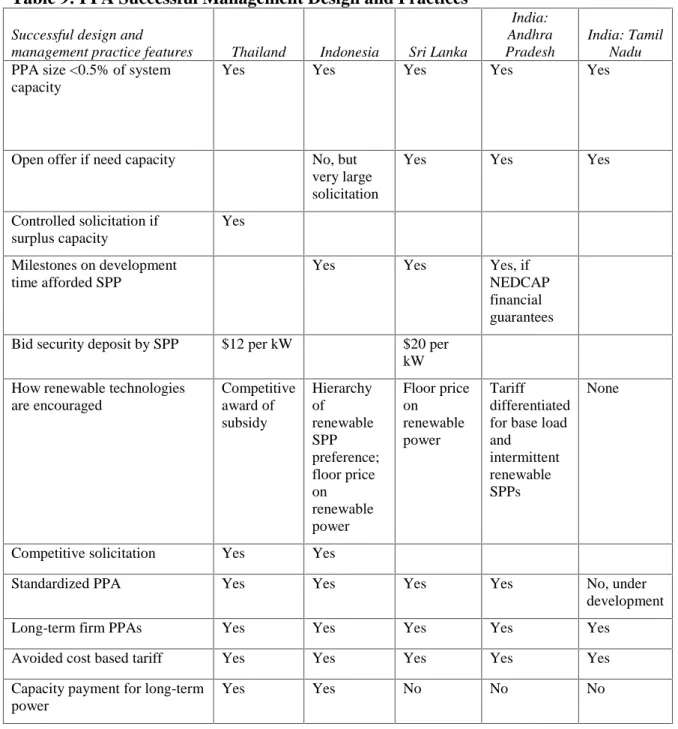
Table 9: PPA Successful Management Design and Practices... 16
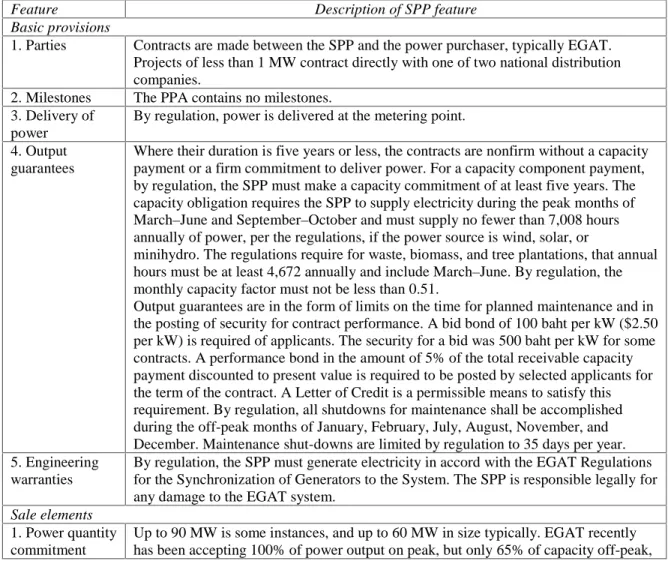
Table 10: Features of Thai SPP PPAs... 25
Table 11: Indonesia SPP Awards by Type of Energy... 32
Table 12: Features of Indonesia SPP PPA before Later Modifications ... 34
Table 13: Realization of Renewable Projects in India, as of 2003 ... 42
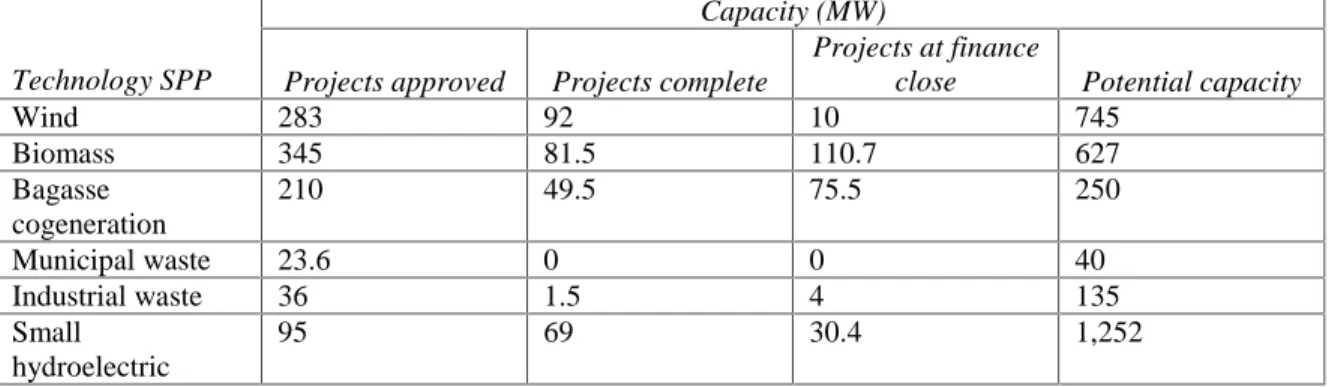
Table 14: Andhra Pradesh Renewable Project Status, 2003 ... 46
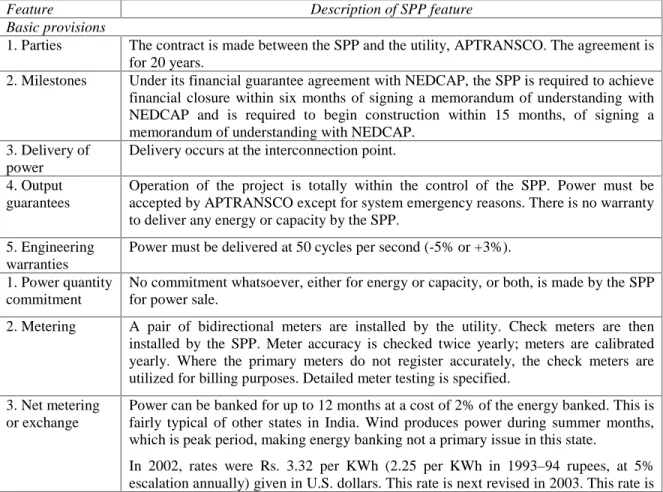
Table 15: Features of Andhra Pradesh SPP PPAs ... 48
Table 16: Features of Tamil Nadu SPP PPAs ... 53
Table 18: Features of Sri Lanka SPP PPAs... 59
Table 19: Annual Season SPP Tariff in Sri Lanka... 63
Foreword
Asia has the largest population and fastest rate of growth of new electricity supply of any continent. How Asian nations elect to provide new electric generation capacity to meet this inevitable growth in electricity demand will have profound implications for their societies, for world energy use, and for environmental quality.
Various renewable energy technologies are particularly appropriate options for developing nations that are evaluating how best to extend electric service and generating capacity. Several Asian nations have pioneered small power programs to encourage independent renewable power generation. The World Bank Group has played a supportive role in some of these programs. There is now a decade of experience in such programs in Asia.
What these programs have demonstrated is that there are certain common elements and characteristics in Asian small power programs. This is because the fundamental legal relationships necessary to establish a power sale relationship and provide credit support for an independent power project follow a predictable legal pattern. Yet, each Asian experience has been tailored to local conditions and requirements. Some have introduced innovative bidding, competitive, or incentive structures. The result is a rich palette of experience with small power project in Asia.
This report analyzes experience in six SPP programs in five nations in Asia. In an easily accessible manner, it compares and contrasts program design, power purchase agreements, and tariff design in these programs. Professor Ferrey critiques what has worked best, what innovative program design has been tried, and successful program design practices. It covers the power purchase agreement, the tariff in that agreement, program design, and innovative options.
This report is an important resource for nations contemplating small power programs, independent power programs, and promotion of renewable energy technologies. It also provides a template for what innovative features have had positive impacts, what elements have caused some programs to hit barriers, and what elements of program design have lasting and transcendent value for other programs. It is a resource for all nations embarking on or augmenting small power or renewable energy projects.
Junhui Wu Sector Manager East Asia and Pacific Region
Abstract
Five innovative nations in Asia have been among the first in developing small power producer (SPP) programs to promote renewable energy development in-country. These programs have been very successful in some of these nations in promoting during just a few years a substantial contribution of renewable small power projects to the national energy supply. Almost 4 percent of power supply in India and Thailand are from SPP renewable energy initiatives.1
In the Overview and in the discussion of each country that follows, this report identifies the most successful program features, innovative elements, and power purchase agreement (PPA) design provisions that have achieved notable success and that could be the basis of programs in other nations. This report evaluates what has worked best and what mistakes are to be avoided. It is designed to transfer the legal “technology” of how to create a PPA and SPP program to most efficiently accomplish renewable energy and small power program goals.
Although each of these nations’ programs has certain elements in common, important distinctions exist between them. Each of these programs involves standardized power purchase agreements (PPAs) or standardized tariffs, or both, which are a material element of program design. Many of these countries advanced their programs with technical and/or financial assistance from the World Bank or other international agencies, although the Thailand program proceeded without such assistance.
The Thai program operates in tranches of formal solicitation by the state utility. Eligible projects mirror the requirements of those of the PURPA program in the United States, with size limitations up to 60 MW, and in some cases, 90 MW.2 State subsidies are provided for some renewable SPPs competitively selected. As in the U.S. experience, the majority of projects are natural gas-fired cogeneration projects. Both firm and nonfirm PPAs are available. The contract was designed to be indexed, but instead is adjusted periodically for foreign exchange risk for capacity and energy payments. For intermittent renewable projects, the capacity factor must be greater than 0.5, without a reduction in capacity payments. Thailand was the first of the Asian SPP programs, and it set a standard for successful program development. A noteworthy feature is its competitively determined renewable SPP subsidy program.
The Indonesian began to develop a program in 1993. It came to involve a standardized PPA and tariff. The SPP program was designed to supply up to one-third of national new power supply from small, renewable sources, organized into four tiers of priority for project of up to 30 MW in size on the primary island, and half that size on smaller island grids. Because Indonesia comprises several separate and not interconnected island grid systems and isolated diesel systems, this program design was nuanced and disaggregated to address avoided cost and power requirements on a regional basis.
The standardized PPA in its original design contemplated either a firm or nonfirm power sale. The incentives for firm power delivery were embodied in the tariff, with indexation of capacity payments for foreign exchange risk, on the theory that most of the value added of generating capacity would be foreign production (this program included cogeneration utilizing fossil fuels as a lower-priority generation source). This provided an innovative approach to structuring the
1 For statistics on the Thai and Sri Lanka programs, see EGAT (2003) and Energy Services Delivery
Project. (2002).
2 For a detailed evaluation of the PURPA program, see Ferrey (2000), chapters 5–6, and Ferrey (2003),
performance obligation, whereby no legal sanctions were imposed for performance failure of the SPP, but rather a substantial economic disincentive for the SPP from such nonperformance was in place. Some innovative fuel price hedging was provided for renewable power projects.
In India, each state makes its own determinations about SPP programs. Two representative Indian states were evaluated. Although some Indian states provided formal SPP solicitations or allowed direct retail third-party sales, or both, neither of the two states evaluated here now allow direct third-party sales or conduct a formal project solicitation.
In the state of Andhra Pradesh, no formally standardized contract is in place, although de facto a set contract form is used by the utility, leaving some case-by-case discretion with the utility. The tariff is escalated at 5 percent annually from a base year. Moreover, the tariff can be reset midcontract after three years by the government. This undercuts long-term certainty. Energy wheeling is allowed, but discouraged economically by a high wheeling charge. No third-party retail sales are allowed.
In Tamil Nadu state, a similar de facto set PPA is employed. An SPP is defined as any project up to 25 MW. Many wind power projects have been developed and grid connected. Wheeling of power to an affiliated location—not to a third-party—is permitted with a 2 percent charge. No third-party retail sales are allowed.
The Sri Lankan program does not utilize a simultaneous solicitation for SPP bids as was deployed in Indonesia and Thailand. Ad hoc offers are entertained by the state utility. Fifteen-year PPAs are available for projects up to 10 MW in size. All but one of the successful SPPs to date are small hydroelectric projects. The PPA is standardized, as is the tariff. The tariff development was assisted by consultants provided by the World Bank. The tariff is revised annually based on a three-year fuel average, with a tariff floor of 90 percent of the original tariff underneath renewable projects.
The tariff as eventually implemented is not indexed for foreign exchange risk. It is paid in local currency on a KWh-delivered basis, which employs economic incentives rather than contract coercion to provide incentives for SPP delivery of power.3 This tariff structure embodies the incentives for performance in the tariff itself, unlike the tariff proposed for Vietnam. Even if the SPP delivers capacity, it is only paid for energy, although at prices that have increased significantly over time in both nominal and real terms. Financing of projects is available with assistance from the World Bank through local banks.
The SPP program in Vietnam is still in the design phase. The proposed PPA employs a concept of “deemed” energy as a means to pay separately the capacity component of power sold. “Deemed” energy output obligates the utility to pay for the capacity component of power whether or not it takes any of that power. The recommended tariff is not structured to induce maximum production and delivery of power, because the financial incentives are not built into the energy component of the obligation. The Vietnam program promises to be of keen interest if it is successfully launched.
These five Asian nations offer different forms of government and have different predominant fuel sources in their generation base (hydro, coal, gas, oil). Some of the national electric systems have
3With significant inflation of the local currency against the U.S. dollar during the program period, there
has been significant deterioration of the value of the energy payments in constant foreign currency equivalent. The SPP projects in Sri Lanka are hydroelectric, and therefore have a significant local component of the cost of capacity development.
an integrated high-voltage transmission system, whereas others have a disintegrated or island system, but there are key similarities:
❖ All are in need of long-term increases in power generation capacity (although Thailand has a short-term current surplus).
❖ All have the potential of small-scale renewable energy options.
❖ Each country is being approached by private developers who seek to develop renewable SPP projects.
❖ Each system employs either deliberately or de facto a standardized PPA, although it is not necessarily a neutral or consensual document in all cases.
❖ Although avoided cost concepts for establishing the SPP tariff are recognized in each nation, avoided cost concepts are applied differently in these nations’ SPP programs.
There are some interesting common elements on tariff design. Indexation to foreign exchange rates was contemplated in most instances, but ultimately not implemented. Most of the programs have elected not to index their tariffs to foreign exchange (Thailand’s capacity payment is an exception). In some Indian states, the tariff is indexed to inflation to keep value in international currency amid local inflation. Other countries unilaterally review and may adjust the tariff at a prescribed time. The purpose of this adjustment is to reflect changes in the energy component of the tariff, which changes both as marginal fuel costs change, as well as when foreign currency rates change and the marginal fuel is an imported commodity for the country. Although important, this periodic adjustment does not provide long-term predictability for project finance or equity investment.
Although these SPP programs are designed to equalize some of the monopsony power and create a more level playing field, the experience in several nations indicates that where the utility is the only legal buyer of SPP power, the overwhelming advantage in bargaining power enjoyed by the utility must be balanced by a carefully designed and faithfully administered SPP program. Several important lessons for SPP program design and policy were revealed by analyzing these programs:
❖ A framework for structured SPP project development is necessary. SPPs do not spring full-borne from the existing electric sector environment. A system of law, regulation, and utility interface that facilitates orderly SPP development must exist.
❖ A transparent process is required to build investor, developer, and lender confidence.
❖ An SPP program can be initiated and sustained either by an open offer to execute PPAs, or by an ordered and time-limited solicitation process.
o An open offer allows a constant rolling development of SPPs, much like the original PURPA design in the United States.
o An ordered solicitation can inject competitive bidding which, if correctly administered, results in bid price reduction and competition for the best projects and sites.
❖ The single state buyer of power in most of the electric sectors can more robustly and efficiently promote renewable SPPs, either by (a) a program for purchase of all SPP power at its full value (avoided cost) to the wholesale system, or (b) the introduction of some combination of third-party retail sales, net metering–energy banking, or third-party wheeling.
❖ In systems experiencing current and projected shortages of grid-connected power resources, payment of long-term full avoided cost (including capacity and energy) for renewable energy and small power development can accelerate the deployment of renewable facilities utilizing “free” fuel (for example, solar, wind, flowing water, or agricultural waste) that otherwise is wasted.
❖ In many systems, additional subsidies, reflecting the fuel diversity and environmental advantages, are utilized to assist higher-cost renewable energy and smaller SPP projects.
❖ Bidding can be employed strategically to minimize the ultimate system cost to the buyer of renewable power resource development.
❖ The SPP PPA tariff in the Indonesian, Thai, and Sri Lankan programs was designed to include capacity payments in the tariff payment for each KWh delivered, paid only if the SPP delivers power. This was designed to provide the maximum incentive to the SPP for dedicated performance and delivery of power at peak periods, while not invoking any coercive penalties against the SPP for failure to perform to a set standard.
None of these five Asian programs currently allows direct third-party retail sales of power by the SPP. Thailand, which led the initial development of Asian PPAs, is considering moving toward an open market for third-party sales. This is allowed in other Indian states. It will likely be reevaluated in many nations as power systems are privatized, operating concessions created, and wholesale competition introduced.
A recent innovation in half the states in the United States is known as “net metering.” Net metering provides an incentive for SPPs by allowing them to “exchange” power they produce and sell with the utility during a billing period with power that they or their affiliates take from the utility.4In the United States, net metering, implemented at the state level, is now regarded as the most significant incentive among several incentives to promote renewable energy distributed generation. Each of the states that have adopted some form of net metering is evaluated in a separate report prepared by the author. Net metering and energy banking have application to these Asian programs that are experimenting with innovative mechanisms to allow SPPs to achieve credit support and attract private capital.
4This buy and sell is netted at the end of the billing period. Because the fully loaded retail price at which a
utility sells power to the SPP typically is much greater than the wholesale avoided cost price at which the utility purchases power, this net metering results in the SPP being able to sell an amount of its power output at a price that exceeds the utility’s avoided cost. This provides a significant subsidy of the SPP operation through the net metering exchange. Most net metering applies exclusively to renewable generation and, in more limited situations, to fuel cells or cogeneration, or both.
Acknowledgments
The author gratefully acknowledges the help of all of those who assisted with the research on these issues, including Messrs. P. R. K. Sobhan Babu, A. Reddy, and S. V. R. Rao at Winrock India, Mr. Robert Vernstrom and his associates in Thailand, and Mr. Romesh Dias Bandaranaike in Sri Lanka, as well as all of those ministry officials, utility personnel, project developers, lenders, and others in each of the five Asian nations studied herein who generously gave their time for interviews with the author and provided information. Mr. Anil Cabraal at the Asia Alternative Energy Program (ASTAE), the World Bank, directed the study. The author also thanks Mr. Jeremy Levin, and the other staff at the World Bank, Ms. Ann Herendeen and the staff at International Resources Group, Ltd., and Mr. Anil Malhotra and Ms. Pham Nguyet Ahn at the World Bank Office in Hanoi, Vietnam. Despite all of the assistance received, any errors or omissions in this evaluation are solely the responsibility of the author.
About the Author
Steven Ferrey is Visiting Professor of Law at Harvard Law School at Harvard University, Professor of Law at Suffolk University Law School, and Professor of Law (Adjunct) at Boston University Law School. He teaches contract law, energy law, and environmental law. He consults with an international energy law firm for private and government clients.
He is the author of five books, including The Law of Independent Power, now in its 20thedition
(Ferrey 2003), a book used throughout the world by energy law firms, governments and regulators involved in the power sector. Also among his books are The New Rules: A Guide to
Electric Market Regulation and Environmental Law, as well as more than 50 articles and book
chapters about energy and environmental policy. He holds a B.A. degree in economics from Pomona College and J.D. and M.A. degrees from the University of California at Berkeley, and was a postdoctoral Fulbright Fellow in energy studies at the University of London.
The author served as a consultant since 1993 on projects sponsored by the World Bank and United Nations to establish the small power project programs and standardized power purchase agreements for Indonesia, Sri Lanka, and Uganda. He has served on advisory committees to the President, the U.S. Congress, the U.S. Department of Energy, and the U.S. Department of Environmental Protection, among other agencies. The author may be reached by E-mail in Boston at [email protected] or by telephone at (617) 573-8103.
Exchange Rates
(as of June 2003) 1 U.S. dollar = 42.77 Thai bhat
1 U.S. dollar = 47.52 Indian rupees; 1 lakh = 100,000 rupees; 1 crore = 10 million rupees
1 U.S. dollar = 96.86 Sri Lankan rupees 1 U.S. dollar = 8,845 Indonesian rupiahs 1 U.S. dollar = 15,426 Vietnamese dong $ is assumed to be U.S. dollars throughout.
Acronyms, Abbreviations, and Definitions
ADB Asian Development Bank
APERC Andhra Pradesh Electricity Regulatory Commission APTRANSCO Andhra Pradesh State Electricity Board
ASTAE Asia Alternative Energy Program
Avoided cost The cost that a purchaser would pay if it generated or purchased power from external sources or at market rates
BOOT Build-own-operate-transfer
Capacity Electric generation capacity firmly committed for a period of time CEB Ceylon Electricity Board (Sri Lanka)
Cogeneration The production of electricity and heat from a common source DANIDA Danish International Development Agency
DGEED Directory General of Electricity and Energy Development (Indonesia) Dispatchable
power
Power from an electric power generator that can be controlled usually by the purchasing utility as to its time or quantity of power output
ENCON Energy Conservation Promotion Fund Committee (Thailand)
Energy Kilowatt-hours of power not firmly committed long-term to a particular use or sale
EGAT Electricity Generation Authority of Thailand EPO Energy Policy Office (Thailand)
EVN Electricity of Viet Nam FDR Fixed deposit receipt
Firm power Power that is contractually committed to a particular use or purpose GEF Global Environment Facility
Gigawatt 1 million kilowatts (KW) GWh Gigawatt-hour
IEC Electro-technical Commission
IPP Independent power producer
IREDA Indian Renewable Energy Development Agency
KfW Kreditanstalt für Wiederaufbau (Bank for Reconstruction) kW Kilowatt
kWh Kilowatt-hour LoI Letter of Intent
Marginal cost The cost of providing the next kilowatt-hour or kilowatt of power, or both MNES Ministry of Non-Conventional Energy Sources (India)
MWh Megawatt-hour
NEDCAP Non-Conventional Energy Development Corporation of Andhra Pradesh (India)
Nonfirm power Power that is not dedicated long-term to a particular buyer and which the seller has no contractual obligation to produce
NGO Nongovernmental organization
O&M Operation and maintenance
OECF Overseas Economic Cooperation Fund (Japan)
Off-peak Periods of relatively low system demand by day or by season PCF Prototype Carbon Fund
Peak Periods of relatively high system demand by day or by season
PLN Pursahan Listrik Negara (Indonesian State Electricity Corporation Ltd., Indonesia)
PPA Power purchase agreement
Prime mover The technology to convert chemical energy to mechanical energy, such as gas turbines or combined cycle units.
PURPA Public Utility Regulatory Policies Act, a U.S. energy statute PV Photovoltaic(s)
Renewables or renewable energy
Renewable energy sources that can be replenished by naturally occurring processes in daily cycles
Retail
competition
A system where more than one electrical provider can sell to retail customers and such customers have choice of their providers
Retail wheeling The ability of a power generator to use the national transmission grid to move power to itself (self-service wheeling) or others at locations remote from the generator
Rp. Indonesia rupiah
Rs. Indian rupee
SL Rs. Sri Lankan rupee SPP Small power producer T&D Transmission and distribution TNEB Tamil Nadu Electricity Board (India) TRANSCO Transmission company
1. Overview and Summary
Important developments in the implementation of renewable power generation projects have occurred in five Asian nations between 1993 and 2003. Five nations in Asia have been among the first in developing small power producer (SPP) programs to promote renewable energy development in their countries. The purpose of each of these SPP programs is to promote renewable electric power development, which often is deployed in the form of distributed generation.
Some programs have been successful and have created important models. These programs have features that are important markers and lessons on how to implement such programs. They have achieved in just a few years a substantial contribution of renewable small power projects to the national energy supply: 2 percent of power supply in Sri Lanka, and almost 4 percent in India and Thailand, are from SPP renewable energy initiatives.5Power development in Asia is an important global environmental and resource laboratory: Approximately 60 percent of all new power generation capacity financed in developing countries is in Asia.6Therefore, how and what energy resources are deployed in Asia have long-term implications for global environmental integrity. Although each of these nations’ programs has certain elements in common, important distinctions exist between them. This report analyzes these programs in five nations: India, Indonesia, Sri Lanka Thailand, and Vietnam. Many of these countries advanced their programs with technical and/or financial assistance from the World Bank or other international agencies, although the Thai program proceeded without such assistance. Many of these programs involve standardized power purchase agreements (PPAs) or standardized tariffs, or both, which are material elements of program design.
This report evaluates the small power supply programs established or in the course of being established in a cross-section of five Asian nations that have advanced such programs (including two different states in India) against the requirements of project finance and equity capital. These different programs do not always reflect differences in native program requirements. Rather, they typically reflect deliberate program policy choices. These programs are at different stages of development. This report reflects the feedback of various stakeholders in the private power process in these countries. This evaluation highlights those program differences and contrasts, which have both augmented the realization of SPP program objectives and which have proven to be missteps for future program success.
In addition, key provisions and legal structure of the standardized PPAs in each of these countries are evaluated. Each of these programs has used a standardized PPA—some have deliberately created it, whereas others have used a utility PPA that has been implemented unilaterally as a standardized contract format. The PPAs are analyzed as to
❖ Basic structure.
❖ The elements of power sale and metering.
❖ Allocation of various risk parameters among the parties to the PPA.
5 For statistics on the Thai and Sri Lanka programs, see EGAT (2003) and Energy Services Delivery
Project (2002), respectively. Alternatively, http://www.boi.lk lists incentive investment details for Sri Lanka. A review of programs, tender notices, and a series of reports on the India program is available at
www.MNES.nic.in.
❖ Interconnection and transmission provisions.
❖ Tariff and price design for the power sale transaction.
❖ Parameters of SPP operation and breadth of obligation.
❖ Dispute resolution.
In each of the countries with a designed rather than de facto standardized PPA, consultants recommended a design and legal draft for the PPA. In each instance, they recommended a structure that relied on prior successful experience in the United States and other Asian countries. The basic conclusions for each of the programs are briefly summarized below.
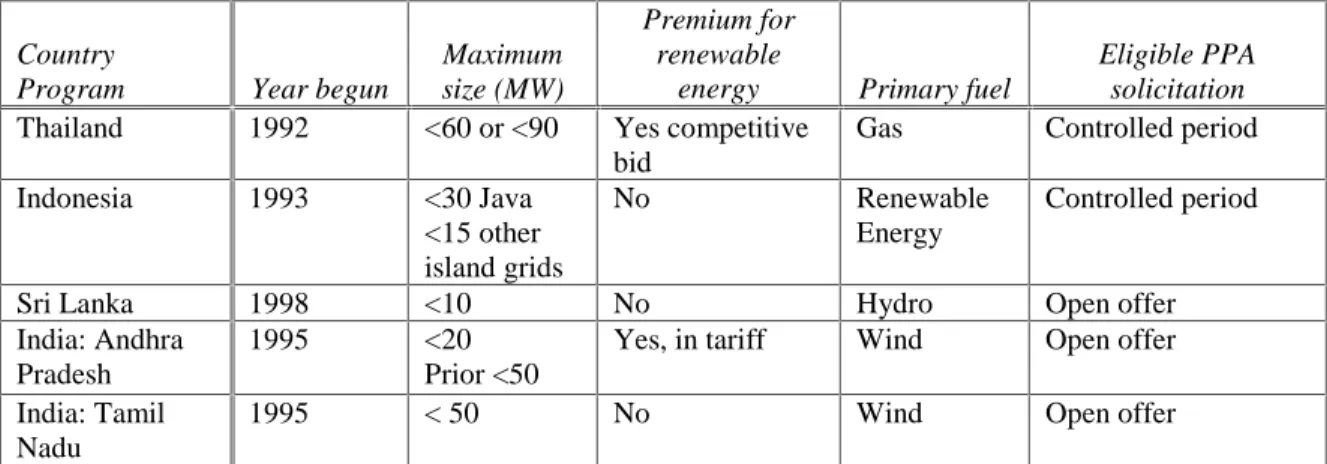
Some of these early programs have elements modeled on PURPA experience in the United States. Some of the recommendations for later programs incorporate ad hoc elements of some earlier programs. The lessons of these various programs have never been catalogued and critiqued for implementation of best practices in program design and structure of the contractual PPA relationship. Table 1 displays salient comparative elements of program design and implementation in five of the programs surveyed. Vietnam is not listed in the table because its program is not yet finalized or implemented.
Two columns in this table are noted. First, two of the five profiled programs subsidize renewable energy SPPs. Thailand does so by providing a project-specific subsidy through a competitive solicitation process. Andhra Pradesh does so by providing a tariff in excess of true avoided cost for renewable energy SPPs. The final column illustrates that some programs have an open offer to enter a PPA that the SPP may accept. There is an outstanding PPA offer for SPPs to accept. Other countries which more carefully ration the PPA opportunities utilize a controlled solicitation of offers from prospective PPAs to award PPAs. In this situation, the SPP makes an offer or bid to the utility, which the utility may or may not accept.
Table 1: Comparative Program Overview
CountryProgram Year begun
Maximum size (MW)
Premium for renewable
energy Primary fuel
Eligible PPA solicitation
Thailand 1992 <60 or <90 Yes competitive bid
Gas Controlled period
Indonesia 1993 <30 Java <15 other island grids No Renewable Energy Controlled period
Sri Lanka 1998 <10 No Hydro Open offer India: Andhra
Pradesh
1995 <20 Prior <50
Yes, in tariff Wind Open offer
India: Tamil Nadu
1995 < 50 No Wind Open offer
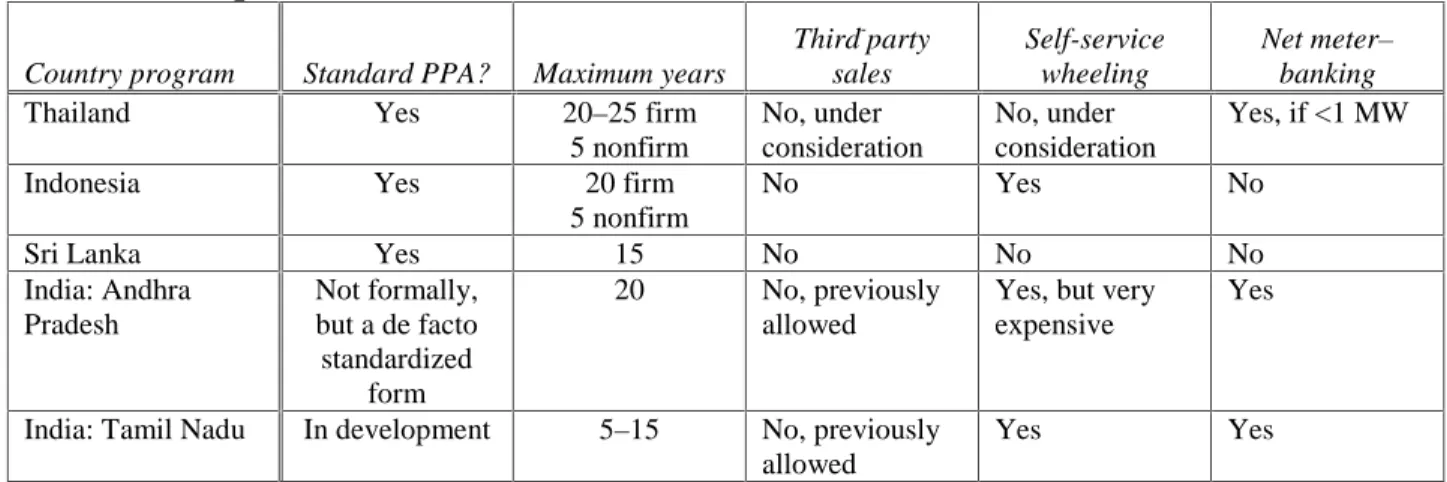
Table 2 displays salient comparative elements of PPA design and contractual entitlement in five of the programs surveyed.
Table 2: Comparative PPA Elements
Country program Standard PPA? Maximum years
Third-party sales Self-service wheeling Net meter– banking
Thailand Yes 20–25 firm 5 nonfirm No, under consideration No, under consideration Yes, if <1 MW
Indonesia Yes 20 firm
5 nonfirm
No Yes No
Sri Lanka Yes 15 No No No
India: Andhra Pradesh Not formally, but a de facto standardized form 20 No, previously allowed
Yes, but very expensive
Yes
India: Tamil Nadu In development 5–15 No, previously allowed
Yes Yes
Note the differing and evolving policies in different programs on direct SPP retail third-party sales, self-wheeling and net metering or energy banking. Table 3 displays salient comparative elements of the PPA tariff in the SPP program.
Table 3: Comparative Tariff Elements
Country program Avoided cost basisIndexed to foreign currency
Periodically
adjusted Design elements
Thailand Yes—energy and capacity payment for
firm contracts only
No Yes Utility purchases
65% of off-peak power
Indonesia Yes—both energy and capacity
Yes Yes, for changes in avoided capacity cost
Steep on-peak incentives; differentiated for each island grid Sri Lanka Yes—energy only;
nondispatchable units receive less than full avoided energy cost
Not directly, but price linked to dollar-denominated imported oil price
Yes, and includes foreign fuel component
Calculated annually, based on three-year moving average imported oil price
Andhra Pradesh Yes, not to exceed 90% of retail tariff
No Yes Reset every three years
Tamil Nadu Exceeds avoided cost
No Yes Higher tariff for biomass than wind
Note that the avoided cost concept and a standardized PPA are generally utilized. This is consistent with the still-in-place PURPA requirements in the United States. Avoided cost is generally deemed the equitable point where the utility system gets power at its opportunity cost of alternative power supply. Retail consumers also are indifferent between utility supply and SPP supply if the avoided cost is paid for this power on a wholesale basis. However, not every program pays the long-term avoided cost for long-term firm power commitments. Although some programs differentiate long- and short-term avoided costs depending on the firm or nonfirm structure of the PPA, some countries only pay short-term energy-only avoided cost regardless of the nature of the PPA obligation.
Some programs have varied or capped the avoided cost concept. The Indian state programs cap the tariff at 90 percent of the industrial retail tariff; the Sri Lankan program caps the tariff paid to nondispatchable providers. All programs periodically adjust the tariff. This is necessary, at the least, to reflect changes in marginal costs of fuel, a significant element of avoided energy cost. Some programs have indexed their tariffs to foreign exchange, such as the Thai program for avoided capacity; most adjust their tariffs periodically, based on different criteria.
There is significant diversity in the tariff design. Indonesia steeply incentivizes on-peak hourly delivery of SPP power, correspondingly decreasing off-peak hourly prices for SPP power deliveries, so that the weighted average tariff equals avoided cost. This promotes market solutions and deemphasizes the necessity for contract remedies and default requirements. Sri Lanka employs a seasonally differentiated tariff to reflect peak system premium requirements. Tamil Nadu provides a higher tariff to base loaded biomass projects than it does to intermittent wind projects.
Each of the programs is briefly summarized below on several primary features. Subsequently, in the sections that follow, each program is analyzed in detail.
Thailand Program Summary
The Thai program operates in tranches of formal solicitation by the state utility. Eligible projects mirror the requirements of those of the PURPA program in the United States, with size limitations up to 60 MW, and in some cases, 90 MW.7 State subsidies are provided on a competitive bidding basis that allows the maximum leverage of renewable SPP resources at the lowest kWh cost to the state. The process operates by an amount of renewable energy subsidy being set aside by the state. Against a maximum subsidy, prospective SPPs bid for the amount of subsidy per kWh that they require to enter a PPA with Energy Generating Authority of Thailand (EGAT), the utility. SPPs are awarded subsidy in the order of the lowest SPP subsidy bid, until the gross subsidy allocation is exhausted. Thus, the competitive bidding process is employed to ration and stretch government subsidies.
This competitive bidding process may be the most important lesson of the Thai program. The ultimate price paid by EGAT for small renewable power is a function of two price components: a fixed energy price plus a competitively bid and set renewable energy subsidy. By having potential renewable energy projects bid for the amount of subsidy they require, the least-cost (subsidy) renewable projects are selected. This rations the projects so that the most cost-effective are selected, and also stretches the available pool of subsidy dollars over the most megawatts of renewable power. Although the general energy price is based on utility avoided cost, the small subsidy for successful renewable energy projects provides a premium above avoided cost in return for the fuel source and supply diversity that these projects provide the supply mix.
As in the U.S. experience, the majority of projects are natural gas–fired IPP cogeneration projects. Both firm and nonfirm PPAs are available. The contract was designed to be indexed, but instead is adjusted periodically, for foreign exchange risk for capacity payments and fuel price changes for energy payments. For intermittent renewable projects, the capacity factor must be greater than 0.5, without a reduction in capacity payments. Thailand was the first of the Asian SPP programs, and it set a standard for successful program development.
7 For a detailed evaluation of the PURPA program, see Ferrey (2000), chapters 5–6, and Ferrey (2003),
Table 4 sets forth in abbreviated format the primary program design, tariff, and contract provisions of the Thai SPP program, including its innovative renewable subsidy incentive.
Table 4: Primary Elements of the Thai SPP Program
1. Process: Controlled solicitation.
2. Maximum Size: 60 MW (90 MW with permission). 3. Tariff: Avoided cost to utility.
For firm 20-year energy and capacity: Coal: $0.04 per KWh.
Gas and Renewables: 2.14 baht per KWh assuming 85% capacity factor [$0.051 per KWh (2003 exchange rates).
4. Third-party retail sales: No. Under consideration. 5. Self wheeling: No. Under consideration.
6. Energy banking: Only for SPPs < 1 MW.
7. Standardized PPA: Yes. After 2001, because of excess capacity, EGAT purchases 100% of capacity rating of kWh on peak and 65% of capacity rating kWh off-peak. Therefore, project cannot supply and be paid for rated capability during off-peak periods.
8. PPA term: Firm—5–25 years Nonfirm—< 5 years.
9. Subsidy or incentives: Competitive bidding for five-year renewable subsidy. Up to $0.009 per KWh based on lowest bids.
Eight-year income tax holiday. Equipment exempt from import tax.
Indonesia Program Summary
The Indonesian program began its development in 1993. It came to involve a standardized PPA and tariff. The SPP program was designed to supply up to one-third of national new power supply capacity additions from small, renewable sources, organized into four tiers of priority for project of up to 30 MW in size on the primary island, and half that size on smaller island grids. Because Indonesia comprises several separate and not interconnected island grid systems and isolated diesel systems, this program design was nuanced and disaggregated to address avoided cost and power requirements on a regional basis.
The standardized PPA in its original design contemplated either a firm or nonfirm power sale. The incentives for firm power delivery were embodied in the tariff, with indexation of capacity payments for foreign exchange risk, on the theory that most of the value added (cost) of generating capacity would be foreign-manufactured turbines and generator sets (this program included cogeneration utilizing fossil fuels as a lower priority generation source). Therefore, conventional industrial cogeneration, as well as renewable resources, were eligible for this program. This provided an innovative approach to structuring the performance obligation, whereby sanctions without a legal basis were imposed for performance failure of the SPP. These sanctions were accompanied by economic shortfalls for the SPP from such nonperformance. Some innovative fuel price hedging was provided for renewable power projects.
Two lasting lessons of the Indonesian program design are (a) that disaggregated PPA provisions and tariffs can be designed to address different regional grids and requirements, and (b) that PPA and tariff incentives can be designed to provide profound financial incentives for SPP delivery of power at peak times. This latter element allows the PPA to avoid typically stringent sanctions and penalties for failure to perform on-peak: Market incentives are substituted for the traditional “command-and-control” legal sanctions.
The 1997 Asian financial crisis ended the chances for program implementation in Indonesia, just as this SPP program was rolling out. Indonesia found itself oversubscribed in IPP power obligated on a noncompetitive basis at above-market prices amid falling demand in the face of economic crisis, and consequently did not follow through on SPP contracts. The Indonesian State Electricity Corporation Ltd. (PLN) became a noncreditworthy party as a long-term power purchaser. Unilateral changes in the PPAs by the utility also resulted in a final PPA that was unfinanceable without modification. Not a single megawatt of power has yet to be brought to market under this program.
Table 5 sets forth in abbreviated format the regulatory system, tariff, and contract characteristics of the Indonesian SPP system, including its tariff differentiation for peak-period power delivery.
Table 5: Primary Elements of the Indonesia SPP Program
1. Process: Controlled solicitation.
Renewables and renewable cogeneration given highest priority. 2. Maximum size: 30 MW on Java-Bali; 15 MW on 7 other island systems. 3. Tariff: Avoided cost for each island system.
For firm renewable energy and capacity:
$ per KWh (1995)
On-peak Off-peak Weighted average
Java-Bali $0.155 $0.04 $0.059 Other islands $0.17 $0.05 $0.07
The dramatic devaluation of the rupiah since these tariffs were calculated caused withdrawal of the tariff during the Asian financial crisis. Because of the drastic devaluation of the rupiah, the above 1995 prices not expressed in rupiahs.
95% (of year 1) floor under renewable SPP energy price in future years (not inflation adjusted), whereas energy price can increase with marginal system fuel prices year to year; capacity price adjusted by the U.S. dollar–to–rupiah exchange rate for five years.
4. Third-party retail sales: No.
5. Self wheeling: Allowed with permission. 6. Energy banking: No.
7. Standardized PPA: Yes.
8. PPA term: Firm—5–20 years Nonfirm—< 5 years. 9. Subsidy or incentives: Steeply incentivized on-peak tariff.
Exemption from import duties and certain income taxes.
Postponement of the value added tax and sales tax on luxury goods.
India Program Summary
In India, each state makes its own determinations about SPP programs, subject to federal incentives and guidance. Two representative Indian states are evaluated. Although some Indian states provided formal SPP solicitations or allow direct retail third-party sales, or both, neither of the two states evaluated here now allows direct third-party sales or conducts a formal project solicitation. What distinguish the Indian SPP programs are their flexible and creative deployment of federal and state renewable energy subsidies and financing programs, which have combined to create a highly successful SPP program.
In mid-2003, the federal Electricity Act of 2003 was enacted.8It consolidates the electricity laws and regulation embodied in federal legislation. It requires a license to generate and distribute electricity, except that in rural areas, no such license is required as long as the distributor follows any pre-established requirements of the Central Electric Authority. Any generating company may construct and operate a generator without obtaining a license, as long as technical grid standards are observed.9 Transmission, distribution, and trading of electricity require a government license.10 State commissions are directed by the Act to facilitate the transmission, wheeling, and interconnection of electricity within the state.11
Andhra Pradesh Program Summary
In Andhra Pradesh state, there is no formally standardized PPA, but the utility employed a similar contract in all SPP transactions, thus making a de facto standardized PPA contract, while still leaving extensive case-by-case discretion with the utility regarding which contracts to enter. The tariff, although among the highest in India, and escalated at 5 percent annually from a base year, does not exceed 90 percent of the high-tension retail tariff. Moreover, the tariff can be reset midcontract after three years by the government. This makes for little project certainty and is a major problem cited by project developers.
Table 7 sets forth in abbreviated format relevant SPP provisions of the SPP program and tariff in Andhra Pradesh, including the significant wheeling fee.
Table 7: Primary Elements of the Andhra Pradesh SPP Program
1. Process: Open offer.
2. Maximum size: < 20 MW (was < 50 MW).
3. Tariff: Above avoided cost to utility not to exceed 90% of industrial retail tariff. Rs. 3.32 per KWh [$0.0698 per KWh] in 2003.
4. Third-party retail sales: No (previously allowed).
5. Self wheeling: Allowed with 28% wheeling fee plus $0.01 per KWh charge. 6. Energy banking: Allowed with 2% energy banking charge.
7. Standardized PPA: Yes. 8. PPA term: 20 years.
9. Subsidy or incentives: Federal loans with 1- to 3-year repayment moratorium. 80% of capital cost can be depreciated against taxes in the first year. Grants for PV systems.
Equipment exempt from sales tax.
8 The Electricity Act of 2003 aimed “to consolidate the laws relating to generation, transmission,
distribution, trading and use of electricity…promoting competition…promotion of efficient and environmentally benign policies….”
9 Electricity Act (2003), Section 7, p. 9. Certain conditions are imposed on the development of
hydroelectric generations to ensure the highest use of water resources for competing uses. Electricity Act (2003), Section 8, p. 9.
10 Electricity Act (2003), Section 12, p. 11. Conditions may be imposed on the license. Electricity Act
(2003), Section 16, p. 13.
11 Electricity Act (2003), Section 30, p. 19. An appellate tribunal also is established to handle appeals of an
order of the regulatory commissions. Electricity Act (2003), Section 110, p. 53. State governments are authorized to constitute special courts to expedite trials of those who steal or divert electricity. Electricity Act (2003), Section 153, p. 68.
Tamil Nadu Program Summary
In Tamil Nadu state, no formal standardized PPA is employed, although the utility has employed the same PPA of its design in every situation, thereby creating a de facto standardized PPA. This again leaves great discretion with the utility. Wheeling of power to an affiliated location—not to a third-party—is permitted. An SPP is defined as any project up to 25 MW. The tariff is higher for biomass projects than for wind. There is no sovereign or currency risk hedge mechanism.
Table 8 sets forth in abbreviated format salient elements of the Tamil Nadu SPP program, including its low wheeling charge.
Table 8: Primary Elements of the Tamil Nadu SPP Program
1. Process: Open offer. 2. Maximum size: < 50 MW.
3. Tariff: Above avoided cost to utility not to exceed 90% of industrial retail tariff. Wind: Rs. 2.7 per KWh [$0.057 per KWh] 2003.
Biomass: Rs. 2.88 per KWh [$0.06 per KWh] 2003. 4. Third-party retail sales: No (previously allowed).
5. Self wheeling: Allowed with 2% wheeling charge for up to 25 km transmission; 10% wheeling charge more than 25 km.
6. Energy banking: Allowed with 2% banking charge. 7. Standardized PPA: Yes, in final development. 8. PPA term: 5–15 years.
9. Subsidy or incentives:
80% of capital cost can be depreciated against taxes in the first year. Grants for PV systems.
Equipment exempt from sales tax.
Sri Lanka Program Summary
The Sri Lanka program has not utilized a simultaneous solicitation for SPP bids as was deployed in Indonesia and Thailand. Ad hoc offers were entertained by the state utility. In 2003 the program was modified to adopt a controlled solicitation process, with application fees and earnest money deposits from PPA recipients. Letters of Intent (LoIs) to successful bidders are now valid for only six months. This prevents award recipients from attempting to prospect for hydroelectric sites for which they have no resources to develop, and once controlling these rights, trying to sell them to other developers.
Fifteen-year PPAs are available for projects up to 10 MW in size. All successful SPPs to date are small hydroelectric projects. The PPA is standardized, as is the tariff. Consultants provided by the World Bank assisted the tariff development. The tariff is revised annually based on a three-year moving average fuel price, with a tariff floor of 90 percent of the original tariff underneath renewable project energy payment adjustments.
The tariff as eventually implemented is not indexed for foreign exchange risk, although it reflects the cost of imported fuel priced in foreign currency. It is paid in local currency on a KWh-delivered basis, which employs economic incentives rather than contract coercion to provide incentives for SPP delivery of power.12 This tariff structure embodies the incentives for
12 With 33 percent inflation of the local currency against the U.S. dollar, during the six-year program
performance in the tariff itself. When the SPP delivers capacity, it is only paid for energy. Financing of projects is available with assistance from the World Bank through local banks, but stakeholders report a financing shortfall for SPPs attributable to the limited availability of long-term financing in the local financial markets.
Table 6 sets forth in abbreviated format principal elements of the Sri Lanka SPP program, including a peak-season tariff differentiation and a rolling SPP award process.
Table 6: Primary Elements of the Sri Lanka SPP Program
1. Process: Open offer. 2. Maximum size: 10 MW.
3. Tariff: Avoided cost for nondispatchable projects de facto capped not to exceed tariff paid to larger IPPs.
Differentiated for wet and dry seasons.
Wet season: SL Rs. 5.85 per kWh [$0.06] Dry season: SL Rs. 6.06 per KWh [$0.062] (2003). 4. Third-party retail sales: No.
5. Self wheeling: No. 6. Energy banking: No. 7. Standardized PPA: Yes. 8. PPA term: < 15 years.
9. Subsidy or incentives: SPP and IPP power equipment generally exempt from import tax and enjoy tax holiday if projects are implemented under Board of Investment rules (http://www.boi.lk).
Vietnam Program Summary
The SPP program in Vietnam is still in its initial phase. Therefore, Vietnam can benefit from the experience of the United States and other Asian SPP programs. Its socialist structure and the public, rather than private, companies that are candidates to develop SPP projects distinguish Vietnam. Nonetheless, the power development issues confronting Vietnam are similar to those in the other Asian nations: the need to develop additional power generation resources, the need to attract additional national and multinational capital to finance such expansion, and significant potential renewable electric generation resources that are available for development on a small scale in dispersed locations.
Three large IPP projects have been undertaken by joint ventures of state companies and private sector partners. A variety of SPP and IPP proposals are in different stages of development and seeking a PPA with the national utility. In December 2002, EVN, the national utility, committed to proceeding with SPP projects based on principles of avoided cost pricing and a standardized PPA. In this sense, it is adapting market concepts into its unique government and societal structure. The SPP program is poised to take off in an evolving formalized structure.
A year 2000 consultant-proposed standardized PPA employs a concept of “deemed” energy as a means to pay separately the capacity component of power sold. “Deemed” energy output obligates the utility to pay for the capacity component of power whether or not it takes any power. This tariff concept is typically associated with large fossil-fueled power plants; it has not
the energy payments in constant foreign currency equivalent. Because of the year-by-year oil price fluctuations and the resulting instability in the avoided cost, a the tariff computation introduced a three year rolling average oil price to buffer some of the swing in fuel commodity prices. The SPP projects in Sri Lanka are hydroelectric, and therefore have a significant local component of the cost of capacity development.
yet been demonstrated in Vietnam or with renewable power projects. The PPA and its incorporated tariff structure are critical elements to graft these mechanisms onto the Vietnamese SPP development effort. This proposed multilevel tariff might not provide maximum incentives for on peak SPP performance to the state entities and peoples’ committees that will be developing future SPP and IPP projects. The tariff is not structured to induce maximum production and delivery of on-peak power, because the payment for capacity value is not built into an on-peak energy component of the PPA tariff. This and other PPA issues are in the process of being discussed as EVN embarks on formal execution of SPP PPAs. The Vietnam program has the advantage of hindsight to incorporate lessons learned from the other Asian nation and international SPP experiences during the past decade as it is initiated.
Lessons Learned and Recommended Successful SPP Program
Techniques
These five Asian nations utilize different forms of government and have different predominant fuel sources in their generation base (hydro, coal, gas, oil). Some of the national electric systems have an integrated high-voltage transmission system, whereas others have a disintegrated or island system. Following are the important similarities:
❖ All are in need of long-term increases in power generation capacity (although Thailand has a short-term current surplus).
❖ All have a mix of small-scale renewable energy options that could be developed.
❖ The installed generation base of each system is either small or disaggregated by island systems or state subsystems.
❖ Each country is being approached by private developers who seek to develop renewable energy SPP projects.
❖ Each system employs either deliberately or de facto a standardized PPA, although it is not necessarily a neutral consensual document in every case.
❖ Although avoided cost concepts for establishing the SPP tariff are recognized in each nation, they are not employed in all cases, or they are not employed to pay long-term avoided cost of capacity where it is provided under the PPA.
There are some interesting common elements on tariff design. Most of the programs have not elected to index their tariffs to foreign exchange (Thailand’s capacity payment is an exception). In some Indian states, the tariff is indexed to inflation to retain value in international currency amid local inflation. Other countries unilaterally review and may adjust the tariff at a prescribed time. This periodic adjustment does not provide long-term predictability for project finance or equity investment. However, the adjustment period or adjustment base varies in each country. Sri Lanka, for example, employs a three-year rolling average to attempt to smooth out volatility in imported oil prices that set the marginal energy price. Other programs have implicitly capped their SPP payments below actual avoided cost so as not to exceed the power purchase rate paid to larger IPPs.
As long as local lending is employed to take out and repay at the time of acquisition of any foreign component of the SPP, indexation or hedging against foreign currency exchange is not critical. Hedging becomes important only where international commercial financing is utilized, repayment is owed to foreign equipment suppliers over time in foreign currency, or a significant imported fuel component is required. With small and renewable projects, more local financing is
used, and there is no foreign fuel component. Therefore, SPP programs can avoid some of the foreign exchange challenges that confront larger fossil fuel–fired IPPs in these same nations. Although these SPP programs are designed to equalize some of the monopsony power that the state utility can exercise in its implementation, the utilities have often been reluctant to create the level playing field that the U.S. SPP PURPA system was designed to create. The experience in several nations indicates that where the utility is the only legal buyer of SPP power, the overwhelming advantage in bargaining power enjoyed by the utility must be mitigated and balanced by a carefully designed and faithfully administered SPP program. Even where neutral rules suggested by consultants have been adopted in principle, they have sometimes been compromised in application.
Several important lessons for SPP program design and policy have been revealed by analysis of these programs, as follows.
Legal Infrastructure
❖ Dispute Adjudication. A framework for structured SPP project development is necessary.
SPPs do not spring full-borne from the existing electric sector environment. There must be a system of law, regulation, and utility interface that facilitates orderly SPP development. For example, stakeholders have reported difficulty in accessing neutral court adjudications in Indonesia regarding disputes involving both renewable and conventional IPP projects. The Indonesian SPP program was never successfully implemented, and access to commercial international capital in that country has been truncated.
❖ Cost-Based Principles. Such a structured program operates best when utility operations are
organized around and operate pursuant to principles of cost-covering design and collection of tariffs. When a utility is self-sustaining financially and organized as a self-sufficient body corporate, its role is not threatened by SPPs, renewable energy projects, or wholesale competition. If not organized on these sound principles, such innovations can threaten the revenue base of the utility.
❖ SPP Project Enhancements. Undercutting the value of the tariff to the SPP over time or the
principles of the PPA causes SPPs to seek to sell power output to third-party buyers to realize the full market value of the power. In all programs, the first customers lost to the utility system when retail competition is introduced are those customers who have the most attractive load profiles and who are the least expensive to serve. Cream-skimming the most attractive customers by private power retailers occurs whenever competitive supply is sanctioned in any system. Those most likely to exit the system are those who pay a tariff that is above their marginal cost of supply. Therefore, if the retail tariff structure in a country is not based on reasonable cost-based and revenue-recovery principles, any form of competition, whether that be net metering, energy banking, or retail sales, will cause those loads cross-subsidizing the system to be the first to utilize and benefit from these innovations. This can further erode system revenues. The system as a whole needs to be on sound economic, financial, and legal footing to make a transition to innovative legal and transactional structures for SPP development.
❖ Scale of Projects. The eligible maximum SPP size should be scaled to system capacity so
that the program applies to smaller projects that will not significantly impact system capacity. Each of the programs surveyed limits eligible PPAs to no more than 0.5 percent of installed system capacity.
❖ Allocation of Risks. A variety of commercial, sovereign, currency, and regulatory risks are
implicitly or expressly allocated in the PPA. A basic risk is how the PPA allocates the risk between buyer and seller for respective nonperformance. Great diversity exists in how the six systems allocate this risk of nonperformance between seller and buyer. Some PPAs adjust the price paid for power to reflect capacity delivered, thus equalizing through price mechanisms any disparities: The Thai program reduces the SPP capacity payment where the SPP does not deliver, but has no equivalent sanction against EGAT for failure to take power. Other programs employ reciprocal legal obligations. The Indonesia and Sri Lanka PPAs, as originally designed, required both a firm SPP and the utility buyer to use best efforts to deliver and take power. However, PLN later unilaterally altered the Indonesia PPA to allow the utility to refuse to take power and not pay for this deficiency. The Andhra Pradesh PPA makes no payment for capacity value of the power, but requires the buyer to accept all power delivered. The ability of the SPP to wheel power has been made economically prohibitive. By contrast, Tamil Nadu facilitates SPP power wheeling, but the SPP is required to back down power if the utility cannot use the power. Nonetheless Tamil Nadu provides a market alternative when it does not accept power. In both Indian states, there is no firm delivery obligation on the SPP—it delivers on a nonfirm basis. In significant contrast, even though the PPA obligates neither party to sell or buy power, the Vietnam program design requires EVN to pay for “deemed energy” even when it does not accept SPP energy. The Vietnam program design shifts the risk to the utility for nonperformance.
❖ Interconnection. Utilities must interconnect with SPPs subject to a straightforward
procedure to accomplish this without significant transaction costs or interconnection risk.
❖ Financial Catalysts. International funding (loans, GEF funding, Prototype Carbon Fund
(PCF) payments for carbon credits) has been used as catalysts for SPP development.
Solicitation of Participation and Competition
❖ Transparent Process. A transparent process is required to build investor, developer, and
lender confidence. The program in Thailand operates by declaring in advance the amount of SPP and IPP resources that are sought, and then allocating entitlements and subsidies in order of the most preferred projects and the least required subsidy for renewable projects. This is an objective and transparent program rubric. It maximizes available subsidy resources and uses the market to identify the most viable projects in need of the least government subsidies.
❖ Open Offers. An SPP program can be initiated and sustained either by an open offer to
execute PPAs or by an ordered and time-limited solicitation process. Thailand and Indonesia employ the latter to control the amount and selection criteria for SPP project development. The Indian states surveyed and Sri Lanka have an open standing offer to purchase, although Sri Lanka is implementing some more thresholds and control in allowing developers to freely accept a Letter of Intent (LoI) vesting development rights at a specific site. The former countries were concerned that they might have sufficient IPP power for the short term, and thus they sought to control the quantity of additional SPP power committed. An open offer allows a constant rolling development of SPPs, much like the original PURPA design in the United States.
❖ Controlled Solicitation. An ordered solicitation can inject competitive bidding, which if
correctly administered, results in bid price reduction and competition for the best projects and sites. This has been well demonstrated in the Thai experience.
❖ Milestones and Bid Security. There has been an issue in Sri Lanka and Indonesia with
companies procuring LoIs or winning a solicitation, respectively, without sufficient experience or resources to actually develop an SPP project at a site. This is particularly a problem with limited hydroelectric sites (the Thai program has not developed many hydro sites). The developer’s objective is to control either fixed hydro sites or SPP PPA entitlements, and in many instances planned to sell that legal entitlement, once procured, to a sufficiently capitalized and experienced third-party developer. This process does not promote the most efficient and direct SPP development, but rather layers additional transaction costs and parties into the SPP development cycle. The Thai program requires a bid security deposit of 500 baht per kW ($12 per kW) of capacity. Sri Lanka in 2003 placed a six-month limit on the validity of LoIs granted for SPP projects and required bid security bonds of SL Rs. 2,000 per kW ($20 per kW). This does not eliminate this hoarding and selling of SPP entitlements, which is particularly vexing where hydroelectric sites are involved, but it does cause a speculator to commit a forfeitable deposit and to deal quickly before the LoI terminates for lack of progress on a project. Although bid security deposits, limits on assignment of rights, and time limits have a constructive role to play, they must be used intelligently so as not to truncate the SPP market. The Thai program also requires a deposit of 100 baht per kW ($2.50 per kW) of applicants, and more for larger sources.
❖ Competitive Solicitations. Organizing standardized SPP power capacity solicitations under a
uniform set of rules provides greater program competition and uniformity of process than entertaining ad hoc applications. With a competitive process, it allows the utility to compare all SPPs simultaneously against a standard set of criteria. In such a format, the utility retains control of the option to accept SPP offers or decline such offers.
❖ The basic PURPA design in the United States does not provide a competitive process, although some states have grafted a competitive process onto their PURPA mechanisms.13 An organized solicitation also allows a competitive process to drive down the bid price for SPP subsidies that may be provided, as demonstrated in the Thai SPP system. Where the system needs additional capacity, an open offer attracts the most SPPs acceptances. Where the system does not have an immediate need for capacity, a controlled solicitation of SPP bids provides the most control as a successful management practice. All the states seem to recognize these appropriate practices.
SPP Power Sale Enhancements
❖ Avoided Cost Principles. The state utility has a monopsony on the purchase of wholesale
power in most of the electric sectors of nations of the world. This single-buyer model becomes a significant issue with the partial deregulation of wholesale power supply. With the encouragement of IPP and SPP supply, they are still dependent on a single state buyer to both purchase and transmit their power. Many of these programs did not introduce a mature utility regulatory authority before they introduced an SPP power program. Therefore, it is absolutely essential that the utility operate in its role as purchaser and transmission entity subject to objective PPA and tariff principles. Such tariff principles included a tariff based on avoided cost principles. To efficiently promote renewable SPPs, either (a) a program for purchase of all power at its full value to the wholesale system, or (b) the introduction of some combination of third-party retail sales, net metering–energy banking, or third-party wheeling, can be implemented to ensure SPP development. As state utility systems consider privatization, allowing retail competition can ameliorate the power of a single state utility
Figure




Related documents