Lecture 3:
Financial Reporting and Analysis
Mark Hendricks University of Chicago September 2012
Outline
Financial Reporting Financial AnalysisFinancial reporting
Financial reporting is important for well-functioning markets. IInvestors need information to properly allocate capital and
hedge risk.
IRegulators need good information to monitor fraudulent activity and systemic risk.
Financial reports are prepared according to accounting practices, which often differ from the methods of finance and economics.
Hendricks, Spring 2012,Financial Markets Financial Reporting 3/66
Financial statements
There are three key financial statements. IThe balance sheet
IThe income statement IThe statement of cash flows We discuss each in turn.
The balance sheet
Thebalance sheetdetails the financial condition of the firm at one moment in time.
IThe balance sheet is a list of the firms assets and liabilities. IThe values are “book” values, not market values. IThe “book” values are based more on historical transaction
prices than current valuations.
Hendricks, Spring 2012,Financial Markets Financial Reporting 5/66
Balance equation
The central idea behind the balance sheet is an accountingidentity: assets = liabilities + shareholders’ equity
INote that this equation is an identity.
IThe “shareholders’ equity” component is not a real market value of equity.
IRather, it is just a plug for the equation.
In finance, the market value of equity—not the (accounting) book value—is typically used.
Current assets/liabilities
The first section of the balance sheet lists the assets of the firm. IThe short-term, orcurrentassets are listed first. IThis is where cash and other liquid securities are listed. IAfter this, longer-term assets are listed.
Liabilities are listed similarly, with current liabilities being listed first.
Hendricks, Spring 2012,Financial Markets Financial Reporting 7/66
Balance sheet for commercial banking
Figure:Balance statement for the banking sector, 2008. Source:Mishkin (2010)
Data: Book value of assets at FDIC commercial banks
2000 2002 2004 2006 2008 2010 2012 4000 6000 8000 10000 12000 14000 Billions $Book Value of Assets at FDIC Commercial Banks
Source: FDIC (CB14)
Hendricks, Spring 2012,Financial Markets Financial Reporting 9/66
Data: Excess reserves of depository institutions
Data: Nonperforming loans for U.S. banks
Source: St. Louis Fed: (USNPTL)
Hendricks, Spring 2012,Financial Markets Financial Reporting 11/66
Accounting rules
“Book values” in the balance sheet differ from market values: IDepreciation. Accountants use fixed rules to calculate
depreciation on assets. This depreciation calculation can differ substantially from the market value.
ICapitalizing expenses. Capital is listed as an asset. However, some potential assets such as R&D are left off the balance sheet but rather treated as simple expenses.
IIntangibles like “goodwill” also show up on the balance sheet, though these intangible assets have no precise measure. ITaxes. The accounting rules for calculating taxes are often
Fair value accounting
Fair-value accountingis an attempt to make “book values” reflective of current conditions rather than just historical transactions.
IMany assets and liabilities held by a firm are not actively traded nor have easily observed values. ie. Inventory, buildings, employee benefits.
IHistorically, accountants list these on the books at historical costs. But the true values fluctuate, of course.
IFair-value, or mark-to-market, accounting attempts to keep the book values at current market values.
Hendricks, Spring 2012,Financial Markets Financial Reporting 13/66
Mark-to model
With mark-to-market accounting, assets are valued according to three categories:
1.Assets with observable market prices, and these are used on the books.
2.Assets are not actively traded, but similarly traded assets can be used for market valuations, perhaps with the aid of a pricing model.
3.Assets without market quotes. Thus, the values depend on pricing models.
These model-based values are known as mark-to-model, and the choice of model may leave room for manipulation.
Criticisms
The role of fair value accounting in the financial crisis is controversial.
ITheoretically, fair value accounting should lead to better information in markets.
IBut in distressed and illiquid markets, current prices may not reflect long-term value.
IIn this case of undervalued assets, the balance sheet may hit a point where firms are forced to recapitalize.
IBut if it is hard to raise equity, a firm may need to liquidate distressed assets, depressing the price even further!
Hendricks, Spring 2012,Financial Markets Financial Reporting 15/66
Income statement
Theincome statementis the second major financial report. IIt gives a summary of the profitability of the firm over a
period of time.
I(Compare this to the balance sheet which gives the firm’s financial conditions at a point in time.)
IThe income statement lists revenues and expenses for the time period, (year, quarter, etc.)
Earnings
Earnings, (ornet income,) are simply revenues minus costs. They are an accounting measure of profits.
IEarnings would not be a good measure ofeconomicprofits given that the financial statements are subject to accounting rules.
IEarnings measure the return to equity holders. The calculation subtracts debt interest payments and taxes owed. IEarnings Before Interest and Taxes (EBIT) is also an
important measure of profit. It includes payments that go to debt holders and the tax authority.
Hendricks, Spring 2012,Financial Markets Financial Reporting 17/66
Retained earnings
Retained earnings are the earnings re-invested into the firm: retained earnings = earnings−dividends
The balance sheet can grow in one of three ways: 1.Internally, through retained earnings. 2.Externally by issuing new equity. 3.Externally by issuing new debt.
Income statement for commercial banking
Income Statement for All Federally Insured Commercial Banks, 2008
Share of Operating Amount Income or ($ billions) Expenses (%) Operating Income Interest income 603.3 74.4 Noninterest income 207.4 25.6
Service charges on deposit accounts 39.5 4.9 Other noninterest income 167.9 _____ 20.7 _____
Total operating income 810.7 100.0 Operating Expenses
Interest expenses 245.6 31.1
Noninterest expenses 367.9 46.6
Salaries and employee benefits 151.9 19.2 Premises and equipment 43.4 5.5
Other 172.6 21.9
Provisions for loan losses 175.9 22.3 Total operating expense 789.4 100.0 Net Operating Income 21.3
Gains (losses) on securities -15.3 Extraordinary items, net 5.3
Income taxes -6.2
Net Income 5.1
Figure:Income statement for the aggregated banking sector, 2008. Source:Mishkin (2010)
Hendricks, Spring 2012,Financial Markets Financial Reporting 19/66
Data: Net income of FDIC commercial banks
2000 2002 2004 2006 2008 2010 2012 −50 0 50 100 150 Billions $
Net Income for FDIC Commercial Banks
Data: Loss provision of FDIC commercial banks
2000 2002 2004 2006 2008 2010 2012 0 50 100 150 200 250 Billions $Loss Provision for FDIC Commercial Banks
Source: FDIC (CB04)
Hendricks, Spring 2012,Financial Markets Financial Reporting 21/66
Cash-flow statement
Thestatement of cash flowsis the third major financial statement.
IDue to accounting rules, earnings are not a proper measure of profits, nor of cash-flow.
IThis statement tracks the actual cash movements associated with transactions.
IDue to its simple nature, this statement is often favored by analysts trying to cut through all the accounting rules and issues.
The statement typically groups transactions into operating, investment, and financing cash flows.
Notes to statements
Aside from the three major financial statements, firms often attach notes.
IThese notes may often be skimmed or ignored, but at times they reveal important clues.
IFor instance, if a firm is manipulating accounting data, the notes may have clues.
IThe notes for AIG explained that their CDS position was not hedged.
Hendricks, Spring 2012,Financial Markets Financial Reporting 23/66
Earnings management
Earnings managementrefers to the practice of taking actions in order to manipulate reported earnings.
INot all reported earnings are of the same quality. IFair value accounting leaves some discretion in the reported
figures.
INonrecurring items, such as the sale of an asset may not be useful in assessing the firm’s future profitability.
IRevenue recognition. Under accounting standards, managers can take actions which recognize income in the present, and push losses to the future.
Off-balance-sheet holdings
The financial crisis has brought much attention to a certain kind of accounting manipulation:off-balance-sheet assets and liabilities.
IFirms may try to leave profitable parts of their business on their books, while spinning losses off into entities that do not show up on the books.
IEnron put losses into subsidiary entities whose holdings did not show up on Enron’s books. Due to keeping their profits and hiding their losses in these shells, 96% of their reported earnings were phony. Source: Berk (2011).
Hendricks, Spring 2012,Financial Markets Financial Reporting 25/66
Capital leases
Another widespread use of off-balance-sheet accounting is capital leases.
ICapital leases are long-term leases which more closely resemble debt financing than a true lease.
IBy calling the transaction an ongoing lease rather than a debt-financed purchase, the company keeps it off the books. IRather, they report only the monthly lease amount, as if they
did not have the (often sizeable) debt for the whole purchase. IRecent regulations have made it harder for firms to reduce
World Com
In fact, the firm World Com was manipulating their financial statements using capital leases, but in a different way.
IWorld Com capitalized expenses which were truly operating expenses. They called these expenses capital leases, and thus the money spent was not deducted from earnings, but rather counted as assets which were slowly depreciated.
IWorld Com, which had a market capitalization of $120 billion in 2002, was exposed and set a record for the largest bankruptcy. Source: Berk (2011).
Hendricks, Spring 2012,Financial Markets Financial Reporting 27/66
Banks use of off-balance-sheet items
The financial sector has also increased its use of off-balance-sheet holdings.
IMany believe this played a large role in causing the financial crisis.
IFor banks, moving things off the balance sheet avoids regulatory scrutiny.
IThe income, (as a percentage of total assets,) generated by banks from these off-balance-sheet activities has doubled since 1970. Source: Mishkin (2010).
Moving mortgages off the balance sheet
Consider the increased off-balance-sheet activities with regard to mortgages.
IHistorically, a savings association would give a mortgage to a homeowner, and then hold it as an asset on the books for 30 years.
IMBS allowed banks to originate a mortgage and then sell a bundle of these mortgages in a special purpose vehicle. IThis removed the asset and liability from the banks’ balance
sheet.
IThe banks would continue to manage the pool of mortgages for a fee.
Hendricks, Spring 2012,Financial Markets Financial Reporting 29/66
Beyond earnings
The lesson is that earnings are not a sufficient statistic for the financial health of a firm.
IWorld Com had suspicious levels of investment due to their use of capital leases.
IEnron’s actual cash flows were not anything close to their stellar earnings.
The Sarbanes-Oxley act
In response to the scandals of the early 2000’s, the U.S. passed the Sarbanes-Oxley act in 2002.
IThe purpose of Sarbanes-Oxley was to improve the integrity of financial statements.
IAuditors were given new rules to reduce conflicts of interest. The law puts restrictions on the non-audit services which a public accounting firm can provide.
IManagement was made personally liable for the accuracy of financial reports.
IIt established a Public Company Accounting Oversight Board which is overseen by the SEC.
IThe budget for the SEC was increased so that it could better supervise securities markets.
Hendricks, Spring 2012,Financial Markets Financial Reporting 31/66
Disclosure requirements
Disclosure requirements are a key element of financial regulation. IBasel 2 puts a particular emphasis on disclosure requirements.
It mandates increased disclosure by banks of their credit exposure, reserves, and capital.
IThe Securities Act of 1933 and the SEC, which was established in 1934 require disclosure on any corporation that issues publicly traded securities.
IMore recently, there have been added rules about reporting off-balance-sheet positions and more information about the pricing models being used in coming up with the financial reports.
Getting regulation right
Increased disclosure requirements have made it more costly for a firm go public, or to issue U.S. securities.
IThe share of new corporate bonds initially sold in the U.S. has fallen below the share sold in European debt markets. IIn 2008, the London and Hong Kong stock exchanges each
handled a larger share of IPO’s than did the NYSE, which had been the dominant market until recently.
ICombined with the increasing ease of obtaining non-public financing, many firms are delaying IPO’s.
ISome have blamed regulation, and Sarbanes-Oxley in particular, for these facts. Of course, there are other possible causes.
The debate about reporting requirements is ongoing.
Hendricks, Spring 2012,Financial Markets Financial Reporting 33/66
Outline
Financial Reporting
Measuring profit
Return on equity (ROE) uses accounting values: earnings divided by book value of equity.
IROE will not be the same as the firms stock return over the period.
IGiven that ROE uses accounting earnings as the profit measure, it is sensitive to the manipulations discussed above. IEarnings are measured over a period of time, (ie. year,)
whereas the book value of equity on the balance sheet is at a specific point of time.
Hendricks, Spring 2012,Financial Markets Financial Reporting 35/66
Return on assets
Return on assets (ROA) is another important measure of profitability.
IAgain, ROA uses earnings to measure profit, but divides by the firm’s book value.
IROA is insensitive to the firm’s financing decision. IThus, it is a measure of operating profitability.
Understanding ROE
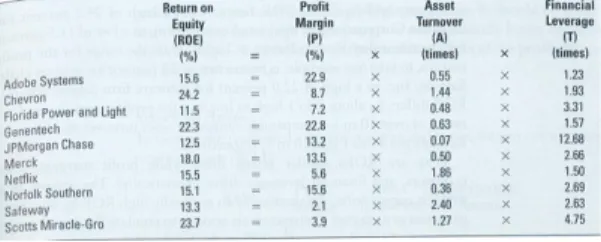
It is useful to analyze ROE by breaking it into factors, something known as theDuPont identity.
ROE = Earnings Sales
| {z }
Net Profit Margin
× Sales Assets | {z} Asset Turnover | {z } ROA × Assets Book Value of Equity
| {z }
Leverage
This shows us three ways to influence ROE.
Hendricks, Spring 2012,Financial Markets Financial Reporting 37/66
Data: Return on equity for commercial banks
1985 1990 1995 2000 2005 2010 2015 −10 −5 0 5 10 15 20 ROE %
Return on Equity for FDIC Commercial Banks
Three factors of ROE
The three factors of ROE correspond closely to the financial statements.
IProfit margin gives a summary of the income statement performance by showing profit per dollar of sales.
IAsset turnover summarizes the asset side of the balance sheet. It indicates the resources required to support sales. ILeverage ratio summarizes the liability and equity side of the
balance sheet by showing how the assets are financed.
Hendricks, Spring 2012,Financial Markets Financial Reporting 39/66
Profit margin
Theprofit marginmeasures the fraction of each dollar of sales that ends up as earnings, adding to the balance sheet.
IIn the decomposition above, we have used thenet profit
margin.
IRecall that earnings, ornet income, has already deducted interest payments on debt and taxes.
IAnother popular measure isgross profit marginwhich instead of using earnings in the numerator, uses EBIT.
net profit margin =earnings
sales , gross profit margin = EBIT
ROE and gross margins
Of course, the above decomposition won’t work with gross profit margin. Rather it must be expanded to
ROE =Earnings EBIT ×
EBIT
Sales
| {z }
Gross Profit Margin
× Sales Assets | {z} Asset Turnover | {z } ROA × × Assets Book Value of Equity
| {z }
Leverage
Hendricks, Spring 2012,Financial Markets Financial Reporting 41/66
Data: Net interest margin for U.S. banks
Asset turnover
Asset turnovermeasures the sales generated per dollar of assets the firm owns.
Asset Turnover =Sales Assets
INotice that assets reduce asset turnover and thus reduce ROA and ROE.
IOne might expect lots of assets are a good thing.
IBut conditional on a certain profit stream, assets just measure the amount of capital needed to generate this income stream.
Hendricks, Spring 2012,Financial Markets Financial Reporting 43/66
ROA
ROA captures the combined effects of margins and asset turnover: ROA =(Net) profit margin×Asset turnover =Earnings
Assets IROA is a basic measure of a firm’s efficiency in how it
transforms assets to profits.
ISome industries achieve high returns by having high margins, while other achieve it with high asset turnover.
A high profit margin and a high asset turnover is ideal, but can be expected to attract considerable competition. Conversely, a low profit margin combined with a low asset turn will attract only
Data: Return on assets for commercial banks
1985 1990 1995 2000 2005 2010 2015 −0.5 0 0.5 1 1.5 ROA %Return on Assets for FDIC Commercial Banks
Source: FRED (USROA)
Hendricks, Spring 2012,Financial Markets Financial Reporting 45/66
Leverage
Leveragerefers to how much of the firm’s capital comes from equity holders versus debt holders.
IUnlike the other two ratios in ROE, more is not necessarily better.
IRather, leverage decisions must take account of the pros and cons of debt financing.
IA firm does not pay taxes on income used for interest payments. Thisdebt tax shieldincentives firms to lever up. IHowever, more debt increases the chances of financial distress
or bankruptcy.
Optimal leverage balances these forces, and varies widely across industries. Not surprisingly, low leverage is used in industries where financial distress is particularly costly.
Leverage - balance-sheet measures
The leverage ratio in the ROE calculation is the asset-to-equity value. This is often rescaled into other popular measures.
Debt-to-assets =Liabilities Assets Debt-to-equity =Liabilities
Equity
Notice that the asset-to-equity ratio used above is just the debt-to-equity-ratio plus 1.
Hendricks, Spring 2012,Financial Markets Financial Reporting 47/66
Data: Leverage of commercial banking sector.
1940 1950 1960 1970 1980 1990 2000 2010 5 10 15 20 book (assets/equity)
Accounting Leverage FDIC Commercial Banks
Leverage - coverage measures
There are many other ways to measure the extent to which a firm is financing with debt.
IMeasures based on income are often preferred, given that bankruptcy is caused by defaulting on payments, not on the share of equity versus debt.
IInterest coverage, or times interest earned, also measures the financial risk of a firm. It shows how much burden interest payments are on the cash flows.
interest coverage = EBIT interest expense
Hendricks, Spring 2012,Financial Markets Financial Reporting 49/66
Rollover risk
There are many other ways to measure the extent to which a firm is financing with debt.
ITimes burden coveredis similar to times interest earned, but takes account of principal repayment.
IRelying on the interest covered measure assumes that one can roll over the debt principal.
IIn the summer of 2007, many investors in MBS found this is not always the case.
ITimes burden covered is conservative in that it calculates as if all principal will be repaid.
Leverage - market measures
Given the problems with accounting values already discussed, many prefer a market measure of leverage.
IMarket measures of leverage are like the balance-sheet measures seen above, but they use the market value of equity rather than the book value.
IThis can make a big difference, especially for growing firms.
Hendricks, Spring 2012,Financial Markets Financial Reporting 51/66
Leverage in the crisis
Leverage played a big role in the recent financial crisis. IFirms such as Lehman and Merril Lynch had 30-to-1 leverage. IThis left them very little flexibility to deal with asset declines. IThe total decline in mortgages was a relatively small amount
of money, but was more than enough to bankrupt highly leveraged institutions.
Capital requirements
Capital requirements are meant to keep financial institutions from taking too much risk.
INote that with high leverage, a firm has more incentive to take very large gambles.
ILosses mean little, while the upside from the gains gets larger. IRegulators want to prevent excess risk which could cause
failure in financial markets.
Hendricks, Spring 2012,Financial Markets Financial Reporting 53/66
Leverage ratio requirements
The capital requirements take two forms: the first is based on the leverage ratio.
IA bank is well capitalized with a leverage ratio below 20. IBut extra regulation kicks in if it goes above 33. IThe FDIC must take steps to close down a bank with a
Basel
The second type of requirements are risk-based.
IUnder regulation known as the Basel Accord, banks were required to hold 8% of their risk-weighted capital.
IThe weighting system for capital leads to regulatory arbitrage. IBasel 2 was very recently rolled out after many years of
planning. However, due to the crisis, Basel 3 is already being studied.
Hendricks, Spring 2012,Financial Markets Financial Reporting 55/66
ROE and ROA
We have seen then, that ROE is just an an adjustment of ROA to account for leverage.
IROA shows the return that comes from the operation of the business
IROE shows both returns from operations and financing IFor which type of returns should management be rewarded? IHigh ROE relative to ROA (relative to the industry,) may
show savy financing, but it could also show excessive risk. Management seeking returns always has the temptation of leveraging to get there.
Table of ROE
Figure:ROE for various firms, 2007.Source:Higgins (2009)
Hendricks, Spring 2012,Financial Markets Financial Reporting 57/66
Problems with ROE
ROE is not necessarily a good measure of financial performance. For as much attention as it gets, one must be careful.
IMarket valuations are forward-looking and consider the long-term prospects of the firm.
IBy contrast, ROE is largely backward-looking and considers only one year’s data.
IWe have already noted that accounting values can easily be manipulated to push earnings to different time periods.
ROE and risk
We mentioned already, that ROE can be increased by taking on more leverage.
IClearly then, a higher ROE is not always better. IImproving ROE while keeping risk exposure level is an
acheivement. Increasing ROE by increasing risk, (leverage or other types,) is not.
IThus, investors must consider whether high ROE is a good deal.
IIf your money market fund returned 10%, would you be happy?
Hendricks, Spring 2012,Financial Markets Financial Reporting 59/66
Banks and ROE
Currently, regulators are considering tougher capital requirements for banks, (lower leverage.)
IBanks argue that this will lower their returns; they are definitely right!
IThey say that this will cause investors to withdraw, which will cause big problems in financial markets.
IIs this true? Will investors need such a high ROE if capital requirements are higher?
Liquidity measures
ICurrent ratio. Current assets and liabilities are those with a maturity of one year or less. Thus, this measures the ability of the firm to pay off short-term debt using its most liquid assets.
current ratio = current assets current liabilities
IQuick ratio. Also known as the acid test ratio. It is like the current ratio, but does not include inventory in the numerator. ICash ratio. Similar to the current ratio, but it does not
include current assets which are not marketable securities, (things like accounts receivables.)
Hendricks, Spring 2012,Financial Markets Financial Reporting 61/66
Book and market values
We have noted that the book value of firm equity may be much different than its market value.
IThemarket-to-bookratio is the market value of equity divided by the book value of equity.
IBook value of equity is considered a very conservative estimate of share value, perhaps a floor.
IRecall that the ratio can be much different than one given that book-values tend to be based on historical transactions while market values look forward to future growth.
Growth and value
Theprice-earnings ratio(P/E) is a popular measure of firm value. IThe P/E ratio takes the market price at a given time, and it
divides by the earnings generated over some period. IOf course, the market price is affected by the future prospects
of the firm, while the periods earnings are a historical fact. IThus, the P/E is a measure of how much future cash flows
the firm will deliver relative to its current earnings.
Hendricks, Spring 2012,Financial Markets Financial Reporting 63/66
Growth and value
Market-book and price-earnings values are both useful measures for a firms future growth prospects.
IStocks with a high market-book or P/E ratio are called
growthstocks.
IA stock with a low market-book or P/E ratio is called avalue
Use of growth and value
The labels “growth” and “value” are widely used.
IHistorically, value stocks have delivered higher average returns. ISo-called “value” investors try to take advantage of this by
looking for stocks with low market-book ratios.
IMuch research has been done to try to explain this difference of returns and whether it is reflective of risk.
IMutual funds are offered for both growth and value stocks and have become very popular.
Hendricks, Spring 2012,Financial Markets Financial Reporting 65/66
References
IBerk, Jonathan and Peter DeMarzo.Corporate Finance.2011. IBodie, Kane, and Marcus.Investments.2011.
ICochrane, John.Understanding Policy in the Great Recession
European Economic Review. 2011.
IHiggins, Robert.Analysis for Financial Management.2009. IHull, John.Options, Futures, and Other Derivatives.2012. IMishkin, Frederic.Money, Banking, and Financial Markets.