Error Corrected Disequilibrium
Ulf Holmberg
Department of Economics
Umeå School of Business and Economics
Umeå University
SE-901 87 Umeå
Abstract
We derive an econometric disequilibrium model for time series data. This is done by error correcting the supply of some good. The model naturally separates between a continuously clearing market and a clearing market in the long-run such that we are able to obtain a novel test of clearing markets. We apply the model to the Swedish market for short-term business loans, and find that this market is characterized by a long-run non-market clearing equilibrium.
Keywords:disequilibrium econometrics, error correction, clearing market, interest rates, credit market
1
Introduction
In economics, the concept of a clearing market is essential. As economists, we build theo-retical models around this concept as well as draw inference from our empirical research while assuming that the supply of the studied good equals its demand; but seldom, if ever, do we explicitly test for this hypothesis. Of course, the idea that some markets may not clear is not new in economics. Previous literature refers to such markets as markets in "disequilibrium" and, consequentially, previous attempts have been made to derive tests for the clearing market hypothesis. Indeed, the literature on disequilibrium econometrics is vast, see Fair and Jaffee (1972), Amemiya (1974), Maddala and Nelson (1974), Goldfelfd and Quandt (1975), Quandt (1978), Bowden (1978), Gourieroux et al. (1980a), Gourieroux et al. (1980b), Maddala (1986) among others. However, in spite of this large bulk of litera-ture on the matter, relatively few empirical papers utilize the disequilibrium framework. In part, this may be due to the fact that estimation under disequilibrium specifications is considered complex and difficult (Srivastava and Rao, 1990). Another cause may be the discovery of spurious regression due to non-stationarity, as first made explicit by Granger and Newbold (1974) in their famous Monte Carlo study. Since many disequilibrium mod-els rely heavily on time series data, spurious regressions may lead to false inference. Com-bining this insight with the importance of prior analysis of time series data as discussed by Granger (1981), and the discovery of methods that deal with the problems caused by non-stationary data, such as the Error Corrected Model (ECM) (Engle and Granger, 1987); it is easy to understand the current relative standstill in the disequilibrium econometrics literature.
Inference made on estimates from ECMs is based on the assumption of a long-run equilibrium. Notably, this equilibrium may be different from the market clearing equilib-rium and it is more generally viewed as a steady state. Clearly, a steady state does not nec-essarily imply a clearing market. It is likely that many markets (e.g., the credit and labour markets) have excess demand (supply) in the long-run equilibrium, clearly violating the clearing market hypothesis. Thus, we acknowledge the need to separate the equilibrium concept from the concept of a clearing market. They need not be the same. Further, we acknowledge that the price mechanism in some markets may be flexible enough to equate supply and demandin every instant(continuously) while some markets may suffer from sticky prices, even though the market clears in the long-run. Armed with this insight, we split the clearing market hypothesis in two parts and provide the reader with the follow-ing two definitions:
Definition 1 The continuously clearing market hypothesis: Prices are flexible enough to equate supply and demand in every time period, i.e. Dt=St,∀t.
Definition 2 The long-run clearing market hypothesis: The market mechanisms work in the di-rection of a clearing market, i.e. supply equates demand in the long-run.
Examining the definitions above, clearly the long-run clearing market hypothesis is nec-essary but insufficient for the continuously clearing market hypothesis to hold true. As such, there is a need to derive methods that can be used to test the hypotheses stated in Definitions 1 and 2. Acknowledging this need, we derive a novel econometric model, capable of tackling the disequilibrium concept while embracing the issues caused by non-stationary data. The model naturally separates between a continuously clearing market and a clearing market in the long-run such that we are able to derive a novel test of the long-run clearing market hypothesis. We apply this test to the Swedish market for short-term business loans and find that this market suffers from a long-run non-market clearing equilibrium. In addition, we find results that indicate the occurrence of a supply side driven credit crunch in the Swedish market for short-term business loans during 2009.
The outline of the paper is as follows. The next section discusses the general idea and derives the disequilibrium model as well as a test for clearing markets. This is followed by a section in which we apply the model to the Swedish market for short-term business loans. The final section concludes.
2
The General Idea
LetDtand St denote the demand and supply of some good, respectively, and letQt =
(Dt,St)be a bivariate quantity system of the latent quantities. It is reasonable to assume that the system is co-integrated, i.e. the supply may not drift too far away from the de-mand and vice versa. Thus, we relax the rather restrictive assumption of a continuously clearing market and consider the case whenDt−St ∼ I(0). Using this, while acknowl-edging the Granger representation theorem (Engle and Granger, 1987), we write a simple Error Corrected Model (ECM) for the supply function as:1
∆St=ψ0+ψ1(St−1−Dt−1) +γ∆St−1+λ∆Dt+ǫt, (1) where E[ǫt] = 0. This model is related to the structural ECM by the inclusion of∆Dt (Engle and Yoo, 1991) and if we examine the ECM above, while recalling that the continu-ously clearing market hypothesis requiresDt=St,∀t; we acknowledge that continuously clearing markets, by definition, are liberated from occasional non-market clearing quanti-ties. Sinceψ1is the speed of adjustment to the long-run equilibrium, a necessary condition
for a continuously clearing market is thatψ1=0. In addition, the ECM in (1) implies that: 0=ψ0+ψ1(S∗−D∗),
which we can rearrange to the long-run equilibrium: D∗=S∗+ψ0
ψ1
. (2)
Hence, the difference between the long-run clearing market and the actual long-run equi-librium is represented by the ratioψ0/ψ1. If this ratio is non-zero, the long-run clearing market hypothesis in Definition 2 can be falsified. We also note that any test of the long-run clearing market hypothesis requiresψ1 #= 0 due to the intangible nature of the two hypotheses.
Given the latent nature ofQt, it is unlikely that we are able to measure the supply and
demand of a good per se. If we are to test for the hypotheses in Definitions 1 and 2, we need to derive some measurable implications. Thus, we give functional forms to the de-mand and supply functions. In many cases economic theory may be of use. Just as often, the researcher may not know the appropriate functional form. Here, we consider the case when the demand and supply functions are linear in prices:
Dt=αC+αPPt+αXXt+ut (3)
St=βC+βPPt+βZZt+vt, (4)
whereXtandZtare exogenous variables on the demand and supply side, respectively,Pt
is the price of the good whileutandvtare random errors with zero means. If we substitute
(3) and (4) into (1) we can rearrange (1) into a reduced form equation of the difference in prices:
∆Pt= θ×[ψ0+ψ1(βC−αC) +ψ1(βP−αP)Pt−1+ψ1βZZt−1 (5)
−ψ1αXXt−1+γβP∆Pt−1−βZ∆Zt+γβZ∆Zt−1+λαX∆Xt
+ψ1(vt−1−ut−1)−∆vt+γ∆vt−1+λ∆ut+ǫt],
whereθ= (βP−λαP)−1. For convenience we rewrite (5) as:
∆Pt=η0+η1Pt−1+µ1Zt−1+µ2Xt−1+µ3∆Pt−1 (6)
+µ4∆Zt+µ5∆Zt−1+µ6∆Xt+ξt,
whereE[ξt] =0, given the assumptions made on the error terms. Since the model in (6) is
In (6) we have an easy way of estimating the combined parameters. Unfortunately, all underlying parameters in (5) can not be uniquely recovered form the parameters of (6). In addition, the error term is serially correlated, i.e.Cov[ξt,ξt−1]"= 0; a notable issue
that needs to be tested for and dealt with in order for the parameters in (6) to be esti-mated consistently and efficiently. For now, however, the ability to estimate the combined parameters is enough and we proceed by deriving the implied long-run equilibrium (sta-tionary) price from the error corrected disequilibrium model in (6):
P∗=η−1
1 (−η0−µ1Z∗−µ2X∗). (7) Thus, by estimating the combined parameters in (6) we can estimate the implied long-run affects in (7). We call this model the equilibrium price model. In addition, if we substitute for the underlying parameters of (5) in (7) while acknowledging that a clearing market in the long-run requires ψ0/ψ1 = 0; we can write the difference between the long-run equilibrium price (P∗) and the long-run clearing market price (PC
) as: P∗−PC= ψ0
ψ1(α
P−βP)−1., (8)
The above clearly highlights the importance of the price elasticity in markets subject to some long-run non-market clearing equilibrium. If the market participants are infinitely elastic, the long-run price difference in (8) is effectively nullified. In addition, the price difference in (8) also shows that the equilibrium price in (7) does not necessarily reflect the clearing market price. Thus, we acknowledge the need for a test of the long-run clearing market hypothesis if we seek to draw inference from the estimates in (7).
The long-run clearing market hypotheses requiresψ0/ψ1=0. If we are to test for this hypothesis, we need some measurable implication of this ratio. Since a clearing market in the long-run is a necessary condition for the continuously clearing market hypothesis, such a test would jointly test the two hypotheses. As it turns out, a simple statistical test on η1 in (6) will suffice. In other words, ifη1 "= 0 it follows that ψ0/ψ1 "= 0 such that we may reject the long-run clearing market hypothesis as well as the continuously clearing market hypothesis. This result holds true regardless of the lag structure in (1) or if we include additional explanatory variables in (3) and (4). The arguments underlying these claims are presented at length in the Appendix. In addition, we acknowledge that such a test is based on the estimated lagged price affect on the difference in prices. Thus, the observant reader may have noticed the resemblance between the test of the long-run clearing market hypothesis and an augmented Dickey-Fuller test of a unit root with drift. Indeed,η1∈[−1, 0]is required in order for the price series to be stationary.
3
An Empirical Application
We apply the error corrected disequilibrium model derived in the previous section to the Swedish credit market. More specifically, we test for the long-run clearing market hy-pothesis on the market for commercial bank loans in Sweden and estimate the implied effects on the equilibrium rate. We restrict the pool of borrowers to Swedish non-financial firms. Since lenders may limit the supply of loans (Stiglitz and Weiss, 1981), credit mar-kets may suffer from some long-run non-market clearing equilibrium. Thus, the credit market is an ideal trial candidate. Indeed, some recent related studies do in fact embrace the disequilibrium framework in studies of credit markets (Pazarbasioglu (1996), Perez (1998), Hurlin and Kierzenkowski (2003), Allain and Oulidi (2009) among others); even though the spurious regression problem caused by non-stationary data is widely ignored. Despite this we find it fruitful to borrow from previous research when selecting suitable determinants of the demand and supply for commercial bank loans. In particular, we are inspired by an early paper by Laffont and Garcia (1977), adjusting their suggested de-mand and supply functions to the Swedish credit market conditions.
The real demand and real supply of commercial bank loans are likely to share the interest rate,r, as a common determinant. Acknowledging that interest rates vary with maturity, we choose to study short-term debt such thatrrepresents an interest rate on the short end of the yield curve. In order to incorporate the effects on real demand related to alternative funding schemes (e.g., commercial papers or long-term debt) we also choose to include an alternative funding rate,ralt, as a determinant of the real demand. By
do-ing so we control for potential substitution effects. In addition, it is likely that the real demand for commercial bank loans is strongly associated with economic activity. Thus, we include the industrial production index as our proxy for current economic activity,
Ind. We acknowledge that an increase in prices may effect firm profits as well as the price of input factors used in banking and include inflation, In f l, as a common determinant of the real demand and the real supply for commercial bank loans. Continuing with the real supply, we include the real value of bank deposits,Dep, as one of its determinants. Since real supply is likely to be affected by regulatory rules, we also include the ratio be-tween equity and invested capital,eic, as a proxy for capital requirements and state the real demand and real supply for short-term business loans as:
Dt=αc+αPrt+αXrtalt+
∑
i a1,iIn f lt−i+∑
i a2,iIndt−i+ut (9) St=βc+βPrt+∑
j b1,jDept−j+∑
j b2,jeict−j+∑
j b3,jIn f lt−j+vt, (10)where we have distributed lags of unspecified lengths andutandvt are subject to the
usual assumptions.
Inspecting the specified demand and supply functions above, one may argue that the the industry production index can be used as a proxy for firms’ ability to repay debt. By this argument, the production index should be included as a determinant on the supply side of short-term business loans. However, such an argument is of little concern. The inclusion of demand specific variables on the supply side, or vice versa, does not alter the reduced form of the error corrected disequilibrium model per se; only the implied form of theµparameters in the studied market’s equivalence of (6). Since we can not uniquely
solve for these parameters and since we primarily seek the equilibrium price effects while testing for the long-run clearing market hypothesis, we safely ignore such issues.
We use aggregate monthly data from November 2005 to July 2011, collected from Statistics Sweden and the Riksbank (Sweden’s central bank). We use the seasonally ad-justed Swedish production index and letrt be the average interest rate on commercial
bank loans. Thus, the price variable is averaged out over the yield curve. However, over 88 percent of all Swedish business loans provided to non-financial firms mature within one year after issue. Thus, it is unlikely that the averaging out effect has a significant impact onrt. As regards the cost of alternative funding, we acknowledge that maturities
on commercial paper are flexible and fixed by the issuer at the time of issue. Typically, maturities will range from one day up to two years where 1-3 months are the most com-mon maturities in Sweden. Following this line of argument, we letralt
t be the average
3-month money market rate (3-month STIBOR).2In addition, since the Riksbank lowered the prime rate with historical proportions during the time period December 2008 to July of 2009, we choose to include an indicator variable,It, for the year 2009.
Implementing the framework derived in the previous section while acknowledging thatCov[ξt,ξt−s]"=0, we estimate a variety of error corrected models, choosing the model
with the lowest Akaike Information Criterion value. Based on this method, the following error corrected disequilibrium model is estimated:
∆rt=η0+η1rt−1+µ1Dept−1+µ2eict−1+µ3rtalt−1+µ4In f lt−1 (11) +µ5Indt−1+µ6It+µ7∆raltt +µ8∆In f lt+µ9∆Indt
+ζt+φ1ζt−1+φ2ζt−2+φ3ζt−3,
where{ζt}is a white noise error sequence. Due to the financial turmoil of the recession of
2008-2009, we split the sample in two, estimating a pre and post recession model using the
2Since the 3-month STIBOR is likely to be highly correlated with the average interest rate on short-term
business loans, we check for the robustness of the results by replacing the 3-month STIBOR with a variety of interest rates higher up on the yield curve.
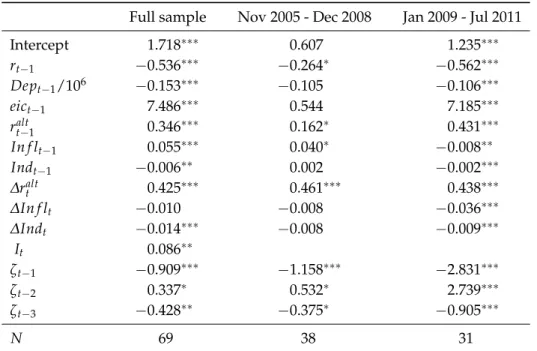
Table 1: Maximum likelihood estimates of the error corrected disequilibrium model ap-plied to the Swedish market of short-term business loans. Conditional least squares esti-mates are used as starting values.
Full sample Nov 2005 - Dec 2008 Jan 2009 - Jul 2011
Intercept 1.718∗∗∗ 0.607 1.235∗∗∗ rt−1 −0.536∗∗∗ −0.264∗ −0.562∗∗∗ Dept−1/106 −0.153∗∗∗ −0.105 −0.106∗∗∗ eict−1 7.486∗∗∗ 0.544 7.185∗∗∗ raltt−1 0.346∗∗∗ 0.162∗ 0.431∗∗∗ In f lt−1 0.055∗∗∗ 0.040∗ −0.008∗∗ Indt−1 −0.006∗∗ 0.002 −0.002∗∗∗ ∆ralt t 0.425∗∗∗ 0.461∗∗∗ 0.438∗∗∗ ∆In f lt −0.010 −0.008 −0.036∗∗∗ ∆Indt −0.014∗∗∗ −0.008 −0.009∗∗∗ It 0.086∗∗ ζt−1 −0.909∗∗∗ −1.158∗∗∗ −2.831∗∗∗ ζt−2 0.337∗ 0.532∗ 2.739∗∗∗ ζt−3 −0.428∗∗ −0.375∗ −0.905∗∗∗ N 69 38 31
Note: Significance codes: 0.001 : "∗∗∗", 0.01 : "∗∗", 0.1 : "∗"
full sample model structure. Notably, exactly when the crises came to affect the market for short-term business loans is hard to determine. However, it is likely that lending rates are affected by the cost of funding. Thus, we use the lowering of the Riksbank’s prime rate as an indicator, splitting the sample at 2009.
Examining the full sample estimates in Table 1, the intercept as well as the lagged interest rate are clearly significant; implying non-zero values on ψ0 and ψ1. Thus, we reject the long-run clearing market hypothesis as well as the continuously clearing market hypothesis. As banks may ration credit, this result implies that the Swedish market for short-term business loans suffers from excess demand. This result is robust to the choice of alternative funding rates and is virtually unaffected by the number of lags in (9), (10) and (6). In addition, since the effect ofrt−1remains significant regardless of sample period,
this result remains true even when the financial turmoil of the recent recession is excluded from the sample. The full sample model has a squared correlation between observed and in-sample forecast level values of 0.88 suggesting a good fit.
Table 2: Implied estimates of the equilibrium price model applied to the Swedish market of short-term business loans.
Variables Estimates
Intercept 3.207∗∗∗
Bank deposits!
Dep∗/10−6"
−0.286∗∗∗ Capital requirements(eic∗) 13.971∗∗∗
3-month STIBOR!
ralt∗"
0.646∗∗∗
Inflation(In f l∗) 0.103
Economic activity(Ind∗)
−0.011∗∗
2009 effect(It) 0.161∗∗
Note: Significance codes: 0.001 :"∗∗∗, 0.01 : "∗∗", 0.1 : "∗"
Based on the structure of the equilibrium price model in (7) and the estimated error corrected disequilibrium model in (11); the long-run equilibrium interest rate is expressed as:
r∗=η−1
1
#
−η0−µ1Dep∗−µ2eic∗−µ3ralt∗−µ4In f l∗−µ5Ind∗−µ6It
$
.
The implied estimated equilibrium effects are presented in Table 2, where the significance tests are performed using the quotient determined standard errors by Fieller’s theorem (Fieller, 1932). As can be seen, the sign of the estimated effects are largely in accordance with what we may expect from economic theory. The interest rate becomes smaller with "supply increasing" variables (Dep) and increases with quantity restrictions on the supply side (eic). In addition, an increase in the 3-month STIBOR, i.e. an increase in the cost of alternative funding (ralt) forces an increase in the equilibrium interest rate. This effect can largely be traced back to the structure of yield curves and the covariance between interest rates. In addition, we note that the equilibrium rate does not fully absorb increases in inflation (In f l). A one percent increase in inflation implies a mere ten basis point increase in the equilibrium rate. However, since this estimate is non-significant, we do not dwell on this matter any further.
There is one variable that at first sight shows an unexpected impact. An increase in economic activity (Ind) reduces the equilibrium interest rate. One rational for this may be that an increase in economic activity increases the ability to repay debt. Possibly, this shifts the supply curve to such an extent that its effect on the equilibrium interest rate outweighs the effect caused by an increase in the demand for credit. Whatever its cause, our results indicate that the equilibrium interest rate is largely driven by the supply side
Year Rat e 2006 2007 2008 2009 2010 2011 2.5 3.5 4.5 5.5
Figure 1: Actual interest rate (solid line) and the estimated equilibrium rate (dashed line). of credit. In addition, we find an increase in the equilibrium interest rate, ceteris paribus, during the historical lowering of the Riksbank’s prime rate during 2009. Since it is fairly unlikely that the lowering of the prime rate coincided with an unexpected increase in the demand for credit, this result implies an unexpected reduction in the supply of credit. Thus, we have found some evidence in support of a supply side driven credit crunch dur-ing 2009.
In Figure 1 we illustrate the equilibrium and actual interest rates for short-term busi-ness loans in Sweden. As can be noted, the actual interest rate moves sluggishly behind the equilibrium rate; possibly due to the stock variable of debt included due to the av-eraging out over the yield curve. As such, when the interest rate dropped in 2009, there was a huge temporary gap between the equilibrium and the actual average interest rate on short-term debt. Recalling the estimated reduction in the supply of credit during 2009 in Table 2; we acknowledge that the supply side driven credit crunch hindered a further drop of interest rates with, at least, 16 basis points.
4
Concluding Remarks
If we embrace the concept of co-integrated demand and supply of some good, there exists an error corrected model that corrects for short-term fluctuations around some long-run
equilibrium supply (demand). Such a model implies a model in price differences, depen-dent on lagged variables of the demand and supply functions. We call this model the error corrected disequilibrium model from which we derive a model of the equilibrium price. Since the error corrected disequilibrium model allows for long-run non-market clearing equilibria, we derive a test of the long-run clearing market hypothesis and the continu-ously clearing market hypothesis. As it turns out, a simple statistical test on the parameter estimates from the error corrected disequilibrium model suffices.
We use the error corrected disequilibrium model on the Swedish market for short-term business loans and find that this market suffers from a long-run non-market clearing equilibrium. Acknowledging that banks may ration credit, this result indicates that the Swedish market for short-term business loans suffers from excess demand for credit. In addition, by including an indicator variable for the year 2009, we are able to capture an unexpected supply shift. By this method, we find evidence in support for a supply side driven credit crunch during 2009.
Acknowledgments
The financial support from Svenska Handelsbanken and the Graduate Industrial Research School at Umeå University is gratefully acknowledged. I am grateful for the comments from Kurt Brännäs, Runar Brännlund and Christian Lundström as well as seminar partic-ipants at the Department of Economics, Umeå School of Business and Economics, Umeå University.
References
ALLAIN, L. AND N. OULIDI(2009): “Credit Market in Morocco: A Disequilibrium Ap-proach,” IMF Working Papers 09/53, International Monetary Fund.
AMEMIYA, T. (1974): “A Note on a Fair and Jaffee Model,”Econometrica, 42, 759–762.
BOWDEN, R. J. (1978): “Specification, Estimation and Inference for Models of Markets in Disequilibrium,”International Economic Review, 19, 711–726.
ENGLE, R. F.ANDC. W. J. GRANGER(1987): “Co-integration and Error Correction: Rep-resentation, Estimation, and Testing,”Econometrica, 55, 251–276.
ENGLE, R. F.ANDB. S. YOO(1991): “Cointegrated Economic Time Series: A Survey with
New Results,” inLong Run Economic Relations: Readings in Cointegration, ed. by C. W. J. Granger and R. F. Engle, Oxford: Oxford University Press, 237–266.
FAIR, R. C.ANDD. M. JAFFEE(1972): “Methods of Estimation for Markets in Disequilib-rium,”Econometrica, 40, 497–514.
FIELLER, E. C. (1932): “The Distribution of the Index in a Bivariate Normal Distribution,”
Biometrika, 24, 428–440.
GOLDFELFD, S. M. AND R. E. QUANDT(1975): “Estimation in a Disequilibrium Model and the Value of Information,”Journal of Econometrics, 3, 325–348.
GOURIEROUX, C., J.-J. LAFFONT,ANDA. MONFORT(1980a): “Disequilibrium Economet-rics in Simultaneous Equations Systems,”Econometrica, 48, 75–96.
——— (1980b): “Tests of the Equilibrium vs. Disequilibrium Hypotheses: A Comment,”
International Economic Review, 21, 245–247.
GRANGER, C. W. J. (1981): “Some Properties of Time Series Data and Their Use in Econo-metric Model Specification,”Journal of Econometrics, 16, 121–130.
GRANGER, C. W. J. ANDP. NEWBOLD (1974): “Spurious Regressions in Econometrics,”
Journal of Econometrics, 2, 111–120.
HURLIN, C.ANDR. KIERZENKOWSKI(2003): “Credit Market Disequilibrium in Poland: Can We Find What We Expect? Non-Stationarity and the "Min" Condition,” William Davidson Institute Working Papers Series 2003-581, William Davidson Institute at the University of Michigan.
LAFFONT, J.-J. AND R. GARCIA (1977): “Disequilibrium Econometrics for Business Loans,”Econometrica, 45, 1187–1204.
MADDALA, G. S. (1986): “Disequilibrium, Self-Selection, and Switching Models,” in
Handbook of Econometrics, ed. by Z. Griliches and M. D. Intriligator, Elsevier, vol. 3, 1633– 1688.
MADDALA, G. S.ANDF. D. NELSON(1974): “Maximum Likelihood Methods for Models of Markets in Disequilibrium,”Econometrica, 42, 1013–1030.
PAZARBASIOGLU, C. (1996): “A Credit Crunch? A Case Study of Finland in the Aftermath of the Banking Crisis,” IMF Working Papers 96/135, International Monetary Fund. PEREZ, S. J. (1998): “Testing for Credit Rationing: An Application of Disequilibrium
QUANDT, R. E. (1978): “Tests of the Equilibrium vs. Disequilibrium Hypotheses,” Inter-national Economic Review, 19, 435–452.
SRIVASTAVA, V. K.ANDB. B. RAO(1990):The Econometrics of Disequilibrium Models, New York: Greenwood Press.
STIGLITZ, J. E.ANDA. WEISS(1981): “Credit Rationing in Markets with Imperfect Infor-mation,”The American Economic Review, 71, 393–410.
Appendix: A Test of Clearing Markets
Consider a test of the long-run clearing market hypothesis of Definition 2. To derive a test that is robust to functional form, we base it on the parametersη0 and η1 from the
error corrected disequilibrium model in (6). These parameters are confined to the same basic structure, regardless of the lag structure in (1) or if we include additional explana-tory variables in (3) and (4).3 When deriving such a test, we first consider the combined
parameterη1from (6): η1 = ψ1 ! βP−αP βP−λαP " . (A.1)
If we assume that the price elasticity differs between the demand and supply side, i.e. that
αP"=βP, it follows from (A.1) that a non-zero value onη1implies a non-zero value onψ1. Thus, ifη1 "=0 we may reject the continuously clearing market hypothesis, as defined in
Definition 1.
Recalling that the long-run clearing market hypothesis of Definition 2 requiresψ0/ψ1 =
0, we acknowledge the need of deriving some measurable implication of this ratio. As it turns out, a non-zero value onη1implies a non-zero value of the ratioψ0/ψ1. To see this,
we first use the intercept in the error corrected disequilibrium model in (6):
η0= ψ0+ψ1(β
C−αC)
βP−λαP
. (A.2)
Now, consider the case whenη0=0 and solve forψ0in (A.2):
ψ0 =ψ1(αC−βC). (A.3) By inspection of the above we see that ifη1 "=0 such thatψ1 "=0 whenη0 =0, the
long-run clearing market hypothesis only holds true whenαC = βC. Clearly, such cases are irrelevant. The same conclusion arrises if we letη0 "=0. To see this assume, for the sake
of argument, thatψ0=0. Solve forψ1in (A.2) and we get:
ψ1=η0 ! βP−λαP βC−αC " . (A.4)
Solve forψ1 in (A.1), recalling that we have assumed that the price elasticity differs
be-tween the demand and supply side (αP"=βP):
ψ1=η1 ! βP−λαP βP−αP " . (A.5)
Substitute for (A.5) in (A.4) and solve forλ:
λ= β P αP
,
which we substitute back to either (A.3) or (A.5) such thatψ1 =0. Returning to (A.1), it
follows thatη1 =0 ifψ0 =0 whenη0 !=0. Thus, ifη1 !=0 andη0!=0 it follows thatψ0is non-zero such that we may reject the long-run clearing market hypothesis.
Given the above, a simple statistical test onη1in (6) is sufficient for testing the long-run clearing market hypothesis as defined in Definition 2. Since a clearing market in the long-run is a necessary condition for the continuously clearing market hypothesis, as defined in Definition 1, such a test jointly tests the two hypotheses.