© Fauzias Mat-Nor, Rasidah Mohd Said, Mohamed Hisham, 2006
FINANCIAL PERFORMANCE AND EFFICIENCY
CHANGES OF MALAYSIAN BANKING INSTITUTIONS
IN MERGERS AND ACQUISITIONS
Fauzias Mat-Nor, Rasidah Mohd Said, Mohamed Hisham
Abstract
The purpose of this paper is twofold. First, it intends to analyse the financial performance changes of commercial banks on stand alone basis and compare it with 'post merger' basis on the consolidation program initiated by the central bank following the recent 1997-1998 Asian financial crisis. This paper also tries to analyse and explore the efficiency of the banks resulted from this consolidation. The findings suggest that based on the actual accounting data of the anchor banks and DEA analysis, the consolidation program initiated by the central bank does not show any significant difference to the level of efficiency and the financial performance of the banking institutions in Malaysia.
The total number of banking institutions as of 20th October 1999 was 55, which consisted of 20 commercial banks, 23 finance companies and 12 merchant banks. They have been given a dateline by end of January 2000 to forward their comprehensive proposal to the Central Bank. Initially the Central Bank, Bank Negara Malaysia (BNM) has approved 6 anchor banks i.e. May-bank, Multi-Purpose, Public, Southern, Perwira Affin and Bumiputra Commerce. Consequently, the number has been increased to 10 with the additional EON, Hong Leong, RHB and Arab Ma-laysian joining the elite group.
Introduction
In Malaysia, the plan to consolidate and rationalize the banking sector was initiated as early as mid 80’s when the industry was badly hit by the 1985-1986 economic recession. The period saw a number of weak commercial banks and finance companies succumb into insolvency and financial distress. One of the banks, United Asian Bank Berhad, was subsequently merged with Bank of Commerce (M) Berhad. The name of UAB was subsequently changed to Bank of Commerce (M) Berhad. Since then, the only market-oriented mergers in banking sector were between Kwong Yik Bank and DCB Bank which became RHB Bank Berhad, and Chung Khiaw Bank and United Overseas Bank (M) Berhad.
The 1997-1998 Asian financial crisis gave the much needed push for the industry to consolidate. The merger programs undertaken by the Malaysian banking system as proposed by the central bank are indeed in tandem with the direction of the global industry. Efficiency, economies of scale coupled with the impending liberalization of the Malaysian banking system make consolidation inevitable. The total number of banking institutions as of 20th October 1999 was 55, which consisted of 20 commercial banks, 23 finance companies and 12 merchant banks. These banks were given a dateline by end of January 2000 to forward their comprehensive pro-posal to Bank Negara Malaysia (BNM) on this merger. Initially, BNM has approved 6 anchor banks i.e. Maybank, Multi-Purpose, Public, Southern, Perwira Affin and Bumiputra Commerce. Consequently, the number has been examine to 10 with the additional EON, Hong Leong, RHB and Arab Malaysian joining the elite group. To date, all fifty five banks have consolidated into ten anchor banks (refer to Appendix 1 for the list of these anchor banks). Following this consolidation, some investigations had been performed to investigate the impact of this consolidation on the Malaysian banking system. Using data for the period of January 1999 to February 2000, Isa and Yap (2003), for example, found that there is a positive market reaction on the announcement of bank mergers with substantial returns recorded mostly on the day before the announcement. This finding is supported by the results produced by Mahmood and Mohamad (2004) who conclude that bank mergers after the 1997 crisis have led to an improvement in performance of these banks.
Studies that show bank mergers result in efficiency gains, however, have produced mixed results. For instance, Krabill (1985), Meehan (1989) and McNamee (1992), Calomiris and Charles (1999) and Bergers et al. (1999) found that bank mergers produce positive efficiency gains. Using a sample of the largest bank mergers between 1985 and 1996, Houston et al. (2001) found that the bulk of the efficiency gain being attributable to estimated cost savings rather than projected revenue enhancements. On the other hand, all 39 studies of bank mergers and performance published between 1980 and 1993 summarized by Rhoades (1994) show no evidence of efficiency gains from bank mergers. Rhoades (1998) further investigates the efficiency effect of bank mergers by using case studies of nine mergers in America. The same basic analytical framework was employed in all of the case studies, such as financial ratios, econometric cost measures and the effect of the merger announcement on the stock of the acquiring and acquired firms. All nine mergers resulted in significant cost cutting in line with pre-mergers projections. Four of the nine mergers were clearly successful in improving cost efficiency but five were not. The most frequent and serious synergies experienced in bank mergers that increase bidder returns relative to non-financial mergers were unexpected difficulty in integrating data processing systems and operations.
Following this, this paper attempts to study the efficiency gains that result from the recent consolidation program for the domestic commercial banks initiated by Malaysian central bank, namely Bank Negara (BNM). Indicators of commercial bank efficiency are first estimated by applying a version of Data Envelopment Analysis (DEA) to bank level data for the period of 1998-2003. Prior to this, using financial ratios, this study also tries to provide a naive analytical framework for the consolidation program. This analysis is done at three stages. The analysis is first performed on the six anchor banks that were initially approved by BNM. Since the final number of anchor banks was later decided at ten, this analysis is then performed on these ten anchor banks. Finally, to gain insight on the financial performance changes that all fifty five banks experienced after the consolidation program, the analysis is performed on these banks. All ratios were analysed to get an indication of the financial performance changes and therefore support the findings using DEA in concluding whether the commercial banks consolidation program results in any efficiency gains.
Data and methodology
In studying the issue of possible gains from this consolidation program, two measures will be looked into: financial performance and efficiency improvements. This is in line with the objective of attaining economies of scale and efficiency gains that was outlined in proposing this merger. For financial performance changes, this study focuses on individual commercial banks on 'stand alone' basis and compares it with 'post merger' based on the consolidation program. A range of financial performance from the merger group that spans different types of performance measures is studied: Share performance, profitability, efficiency, liquidity risk, and credit risk performance (the ratio of non performing loans to total loans). The data are in the form of financial statements that are extracted from either published newspaper or the bank’s website. Financial accounts derived are from the period of 1998-1999. The selected period would allow a better illustration on the performance of the individual banks after the wake of financial crisis. For the purpose of this study, the average number of the two years is derived for benchmark purposes. The financial accounts are grouped in their respective cluster (6 and 10 groups) and headed by their respective anchor banks. The financial accounts derived are then extended to the year 2003 to analyse the impact of consolidation program on banks’ efficiency.
Measuring Financial Performance
The following financial ratios are being utilized to evaluate the performance change:
iShare Performance
Earning Per Share Net Profit of the institutions divided by the number of shares outstanding. Book Value Per Share Shareholder’s fund divided by the number of shares outstanding.
iProfitability
Return on Asset (ROA) Net Income of the Institutions divided by the Total Asset of the company. This ratio evaluates the efficiency of the institution in utilizing its asset in creating income. Return on Capital
Employed (ROCE)
Net Income plus Interest Expenses divided by Total Liability plus Shareholders Fund. This evaluates the efficiency of the institution in capitalizing its capital. Return on Equity (ROE) Net Income of the Institutions divided by Shareholder's fund.
iEfficiency
Overhead Efficiency Gross Income of the Institution divided by Overhead Expenses. This is to evaluate the efficiency of the institution in capitalizing its human resource (productivity).
Cost to Income Total Expenses (interest plus overhead) divided by Gross Income.
iLiquidity
Asset to Liability Total Asset divided by Total Liability of the Institution. This is to evaluate the ability of the company in meeting its financial obligations.
Loan to Deposit Total Loans divided by Total Deposit of the Institution. This is to evaluate the efficiency of the institution in creating income (loans) over liability (deposits). Loan to Asset Total Loans divided by Total Asset of the Institution. This is to evaluate whether
the institution is overly or conservatively taking risk.
iCredit Risk Performance – The ratio of nonperformance assets to total loans.
Measuring Efficiency Using DEA
Data Envelopment Analysis (DEA) was originally developed by Charnes, Cooper and Rhoades (1978). Up to now, DEA has been applied to different fields ranging from education to banking. It is a non-parametric approach methodology in which linear programming is being used to measure the distance of a producer, which is always referred to as a decision making unit or DMU, from the efficient frontier. The common method for measuring efficiency is to take the ratio of output over input. To provide a brief description of the underlying linear method, assume that there are s inputs and m outputs for every DMUs (in our case, banks). Therefore, the model for the DMU is as given below:
¦
¦
m 1 i io i s 1 r ro r mo m 20 2 1o 1 so s 2o 2 1o 1 x v y u x v ... x v x v y u ... y u y u ș : imize max (1)subject to: v1x1o + v2x2o + … + vmxmo = 1/ (2) u1y1j + … + usysj d v1x1j + … + vmxmj (j = 1, …, n) (3)
v1, v2, …, vm t 0 (4)
u1, u2, …, us t 0 (5) where,
T = Objective value (Efficiency score)
ui (i = 1, .., s) = output weights, s = number of inputs yio (i = 1, .., s) = outputs for DMUo
xio (i = 1, .., m) = inputs for DMUo n = number of DMUs
the DMU is CCR-efficient if : i) T*
= 1, and
ii) there exists one optimal v* or u* in which v* > 0 and u* > 0
The choice of our inputs and outputs is based on the intermediation approach which views banks as financial intermediaries whose main business is to borrow funds from depositors to be lent out to others. Our DEA model, therefore, has the following three input variables: total deposit, interest expense and overhead expense. The first input is included since most commercial banks’ activities were funded by this variable (which hovered between 66% to 75% of total liabilities)1.
The next two variables (interest expense and overhead expense) are included as they are the main contribution to banks’ total expenses. Outputs are total loan and total income. Total loans consti-tute the main activities or main assets of commercial banks while total income represents the goal that bank has to achieve in carrying out their activities.
Findings
A. Financial performance changes using financial ratios based on Bank Negara’s consolidation program
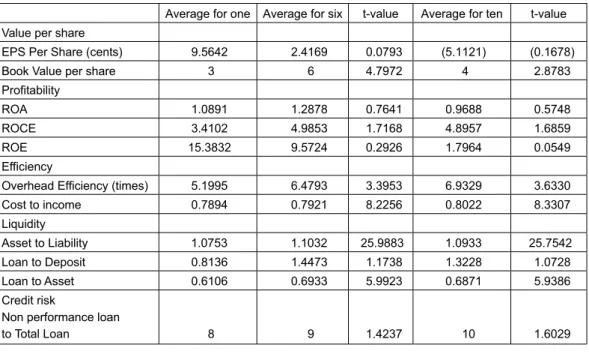
Table 1 shows the essence of the comparison between pre-merger and post-merger ratio effect for six and ten anchor banks. The merged financial accounts using pooling method are compared to individual ratio of group members on stand alone basis. As expected, on average, the six anchor banks have larger asset based, shareholders’ fund and book value per share than stand alone basis and even larger than the ten anchor banks. However, the ten anchor banks tend to show higher performance for overhead efficiency and cost to income than stand alone basis and the six anchor banks. In terms of non-performing loan or credit risk performance, profitability and liquidity, there is no significant difference between the ten anchor banks, the six anchor banks and stand-alone basis.
Table 1 Predicted Financial Results for pre-merger and post-merger ratio effect based on naïve model
Average for one Average for six t-value Average for ten t-value Value per share
EPS Per Share (cents) 9.5642 2.4169 0.0793 (5.1121) (0.1678) Book Value per share 3 6 4.7972 4 2.8783 Profitability
ROA 1.0891 1.2878 0.7641 0.9688 0.5748 ROCE 3.4102 4.9853 1.7168 4.8957 1.6859 ROE 15.3832 9.5724 0.2926 1.7964 0.0549 Efficiency
Overhead Efficiency (times) 5.1995 6.4793 3.3953 6.9329 3.6330 Cost to income 0.7894 0.7921 8.2256 0.8022 8.3307 Liquidity Asset to Liability 1.0753 1.1032 25.9883 1.0933 25.7542 Loan to Deposit 0.8136 1.4473 1.1738 1.3228 1.0728 Loan to Asset 0.6106 0.6933 5.9923 0.6871 5.9386 Credit risk
Non performance loan
to Total Loan 8 9 1.4237 10 1.6029
Table 2 presents result of financial ratios for commercial banks before and after the consolidation of these banks. The results indicate that there is no significant difference in most of these ratios. The only changes that can be seen are on the liquidity ratio (that is, the loan to deposit ratio) and on the credit risk ratio, which improves after the consolidation program has been completed.
Table 2 Financial Results for pre-merger and post-merger based on actual accounting data *
Pre-merger Post-merger t-value
Value per share
EPS Per Share (cents) 21.85 15.73 0.5052
Book Value per share 2.12 2.03 0.9595
Profitability
ROA 0.0300 0.0281 0.7697
ROCE 0.0633 0.0498 0.2412
ROE 1.0734 0.8848 0.5217
Efficiency Overhead Efficiency (times) 0.8134 0.6952 0.3311
Cost to income 8.3314 4.2499 0.1729 Liquidity Asset to Liability 1.0993 1.0918 0.5593 Loan to Deposit 0.7277 0.8137 0.0835 Loan to Asset 0.5861 0.6411 0.1062 Credit risk
*NOTE: The ratios are first calculated based on yearly data for the period of 1998 to 2003 for each bank. These ratios are then classified into two periods (pre- and post-merger periods according to their respective completion date of consolidation) for each bank. Finally, average ratios for pre-merger period and post-merger period of all banks, respectively, are calculated.
B. Results from DEA
The table below lists the results of the DEA analysis.
Table 3 The results of the DEA analysis
DMUs Score (Pre-merger) Score (Post-merger)
Public Bank 0.896635 0.797531
RHB 0.917975 0.951133
Hong Leong Bank 0.929132 0.922415
Alliance Bank 1 1 EON Bank 1 1 Maybank 1 0.980191 BCB 0.900656 0.903683 Southern Bank 0.954932 1 Affin 0.928397 0.879494 AMBank 1 1 Average 0.9527727 0.9434447
The average scores of efficiencies for the DMUs are high for both pre- and post- merger period; more than 0.91. Therefore, we can conclude that there is no difference in efficiency on
these DMUs when DEA analysis is performed. This is consistent with results on efficiency pro-duced earlier.
Conclusions and Implications
This article attempts to shed light on the performance as well as efficiency changes in merger and acquisition of banking institutions in Malaysia. Financial ratios of commercial banks were analysed to get an indication whether mergers and acquisitions following the recent financial crisis in the Asian region result in any efficiency gains. Combined bank simple average ratios are calculated and compared with a simple average of all banks. To confirm the results produced by this naïve approach, a DEA analysis was performed.
Financial performance changes using financial ratios based on Bank Negara’s consolidation program show that on average, the six anchor banks have larger asset based, shareholders’ fund and book value per share than stand alone basis and even larger than the ten anchor banks. However, the ten anchor banks tend to show higher performance for overhead efficiency and cost to income than stand alone basis and the six anchor banks. In terms of non-performing loan or credit risk, profitability and liquidity, there is no significant difference between the ten anchor banks, the six anchor banks and stand alone basis. Consolidation program appears to increase efficiency (overhead efficiency and post acquisition positive reactions) and may have improved the real economies where these consolidations occurred. The market believes that M&A event itself may have awakened or makes the management realise to the need for improvement. The evidence is consistent with increases in market power and improvements in efficiency and potential costs on the financial system. The study, however, shows that there is no significant difference between the pre- and post-merger periods in the level of efficiency and the financial performance for the ten anchor banks. DEA analysis confirmed this result.
References
1. Aly H.Y. et al. 1989. Technical, Scale, and Allocative Efficiencies in U.S. Banking: An Em-pirical Investigation. The Review of Economics and Statistics: 211-218.
2. Avkiran N.K. 2000. Rising Productivity of Australian Trading Banks Under Deregulation 1986-1995, Journal of Economics and Finance 24: No. 2, 122-140.
3. Charnes, W.W. Cooper and E. Rhodes. 1978. Measuring the Efficiency of Decision Making Units. European Journal of Operational Research 2: 429-444.
4. Bank Negara Malaysia Annual Report, 1998-2003.
5. Berger, A.N., Hancock, D. and Humphrey, D.B. 1993. Bank Efficiency Derived from the Profit Function, Journal of Banking and Finance 17: 317-347.
6. Calomiris, C.W., 1999. Gauging the Efficiency of Bank Consolidation During a Merger Wave, Journal of Banking & Finance 23: 615-621.
7. Cornett, M.M. and S. De. 1991. Common Stock Returns to Corporate Takeover Bids: Evidence from Interstate Bank Mergers, Journal of Banking and Finance: 273-296.
8. Cornett, M.M. and H. Tehranian. 1992. Changes in Corporate Performance Associated with Bank Acquisitions, Journal of Financial Economics 31: 211-234.
9. Cooper et al. 2000. Data Envelopment Analysis. Kluwer Academic Publishers
10. Desai, A. and R. Stover. 1985. Bank Holding Company Acquisitions, Stockholder Returns and Regulatory Uncertainty, Journal of Financial Research 8: 145-156.
11. Farrel, M.J. 1957. The Measurement of Productive Efficiency. Journal of the Royal Statistical Society: 253-290.
12. Ferrier G.D. and Lovell C.A.K. 1990. Measuring Cost Efficiency in Banking. Econometric and Linear Programming Evidence. Journal of Econometrics: 229-245.
13. Hawawini, G. and Swary, I. 1990. Mergers and Acquisitions in the U.S. Banking Industry. New York: Elsevier Science Publishers.
14. Houston, J.F. and Ryngaert, M.D. 1994. The Overall Gains From Large Bank Mergers. Journal of Banking and Finance 18: 1155-1176.
15. Isa, Mansor and Chooi-Mei, Yap. 2003. Market Reaction to Merger Announcement: The Case of Consolidation of the Banking Sector in Malaysia. Proceedings of Malaysian Finance Association 5th Annual Symposium: 509-539.
16. James, C. and P. Weir. 1987. Returns to Acquirers and Competition in the Acquisition Market: The Case of Banking, Journal of Political Economy 95: 355-370.
17. Kaparakis et al. 1994. Short-run Cost Inefficiency of Commercial Banks: A Flexible Stochas-tic Frontier Approach. Journal of Money, Credit, and Banking 26: 875-893.
18. Lim and Randhawa. 2002. Competition, Liberalization and Efficiency of Banking Systems: Evidence from Singapore and Hong Kong. Paper presented at the APAFA/PACAP/FMA 2002 Conference, Tokyo, Japan, 14-17 June 2002.
19. Mahmood, Wan Mansor and Mohamad, Rasidah. 2004. Does Operating Performance Really Improve Following Financial Institutions Merger: A Case of Malaysian Banks. Proceedings of Malaysian Finance Association 6th Annual Symposium: 701-719.
20. Neely, E. 1987. Banking Acquisitions: Acquirer and Target Shareholder Returns, Financial Management 16: 66-73.
21. Rangan et al. 1998. Technical Efficiency of US Banks. Economic Letters 28: 169-175. 22. Rhoades, S.A. 1993. Efficiency Effects of Horizontal (in-market) Bank Mergers, Journal of
Banking and Finance 17: 411-422.
23. Rhoades, S.A. 1998. The Efficiency Effects of Bank Mergers: An overview of Case Studies of Nine Mergers, Journal of banking and Finance 22: 273-291.
24. Schmidt, P. and Lovell, C.A. 1979. Estimating Technical and Allocative Inefficiency Relative to Stochastic Production and Cost Frontiers. Journal of Econometrics 9: 343-366.
Appendix 1: Post-Merger Anchor Banks
Anchor Banks Financial Institutions Under The Anchor Bank Malayan Banking Berhad Malayan Banking Berhad
Mayban Finance Berhad Aseambankers Malaysia Berhad PhileoAllied Bank Berhad The Pacific Bank Berhad Sime Finance Berhad Kewangan Bersatu Bhd Bumiputera-Commerce Bank
berhad
Bumiputera-Commerce Bank Bhd Bumiputera-Commerce Finance Bhd
Commerce International Merchant Bankers Bhd RHB Bank Berhad RHB Bank Berhad
RHB Sakura Merchant Bankers Bhd Delta Finance Bhd
Interfinance Bhd Public Bank Berhad Public Bank Berhad
Public Finance Berhad Hock Hua Bank Berhad Advance Finance Berhad Sime Merchant Bankers Bhd Arab-Malaysian Bank Berhad
(AMBank)
Arab-Malaysian Bank Berhad Arab-Malaysian Finance Berhad Arab-Malaysian Merchant Bank Berhad Bank Utama Malaysia Berhad Utama Merchant Bankers Bhd Hong Leong Bank Berhad Hong Leong Bank Berhad
Hong Leong Finance Berhad Wah Tat Bank Berhad
Credit Corporation Malaysia Berhad Perwira Affin Bank Berhad Perwira Affin Bank Berhad
Affin Finance Berhad
Perwira Affin Merchant Bankers Berhad BSN Commercial Bank Berhad BSN Finance Berhad
BSN Merchant Bank Berhad Multi Purpose Bank Berhad Multi Purpose Bank Berhad
International Bank Malaysia Bhd Sabah Bank Berhad
MBf Finance Berhad Bolton Finance Bhd Sabah Finance Berhad
Bumiputera Merchant Bankers Berhad Amanah Merchant Bank Bhd Southern Bank Berhad Southern Bank Berhad
Ban Hin Lee Bank Berhad Cempaka Finance Bhd.
United Merchant Finance Berhad Perdana Finance Bhd
Perdana Merchant Bankers Bhd Eon Bank Berhad Eon Bank Berhad
Eon Finance Berhad Oriental Bank Berhad City Finance Bhd Perkasa Finance Bhd