D7.9 DEMONSTRATION WORKSHOP
SUMMARY (T7.3)
Contractual delivery date: M36 Actual delivery date: M36
DOCUMENT INFORMATION
Version VF Dissemination level Public
Editor Sadok Ben Dkhil and Brice Cruchon – DRACULA TECHNOLOGIES
Other authors Philippe Lenain and Laurence Naiglin – AYMING
Kamel HADDADI - IEMN
PROJECT INFORMATION
Grant Agreement n° 761036
Dates 1st November 2017 – 31 October 2020
DOCUMENT APPROVAL
Name Position in
project Organisation Date Visa
K.HADDADI Coordinator IEMN
DOCUMENT HISTORY
Version Date Modifications Authors
CONTENT
DOCUMENT INFORMATION ...1 PROJECT INFORMATION ...1 DOCUMENT APPROVAL ...1 DOCUMENT HISTORY...1 1. Executive Summary ...31.1. Description of the deliverable content and purpose ...3
1.2. Brief description of the state of the art and the innovation breakthroughs ...3
1.3. Corrective action ...3
2. WORKSHOP OBJECTIVES ...4
3. WORKSHOP ORGANISATION ...4
3.1. Date and location ...4
3.2. Programme ...4
3.3. Promotion ...5
4. Course and feedback ...7
4.1. Content ...7
4.2. Discussion and feedback ... 11
1. EXECUTIVE SUMMARY
1.1.
Description of the deliverable content and purpose
This report describes the activity carried out during the workshop: “Microwave Microscopy for Advanced and Efficient Materials Analysis and Production”, as well as the organizational procedures. The workshop is part of the Grant Agreement of the project. It was organized by Dracula Technologies, with the help of the consortium. The goal of the workshop was to provide the attendants with a broad overview of the state-of-the-art and emerging technologies in the integrated measurement tools.
1.2.
Brief description of the state of the art and the innovation
breakthroughs
This part is not relevant for this deliverable, being it focused on the preparation and implementation of the workshop.
1.3.
Corrective action
The date remained the same, but the format changed from a face to face meeting to an online meeting.
2. WORKSHOP OBJECTIVES
The objective of this workshop was to present the results of MMAMA at the end of the project to a wide audience of academic, industrial and EC participants in order to disseminate them and favour the discussions and collaborations between the attendants. The public show of the demonstration of implementation of SMM would allow to convince our stakeholders and the European manufacturers of coatings, photovoltaic cells, advanced thin film materials and semi-conductor circuits about the importance and necessity to use this European platform for microwave testing and control for nanotechnology materials.
3. WORKSHOP ORGANISATION
3.1.
Date and location
In the proposal, it was foreseen a full day final workshop where the results of MMAMA would be presented and discussed. The workshop was supposed to be hosted by Dracula Technologies, where a public show of the demonstration of implementation of SMM would be given.
Initially, a program was planned with a presentation of the results of MMAMA, a time dedicated to meetings between partners and participants, then a visit of the Dracula Technologies pilot line with a presentation of integrated measurement tools.
Due to the COVID-19 crisis, we had to adapt and carry out this final workshop only remotely.
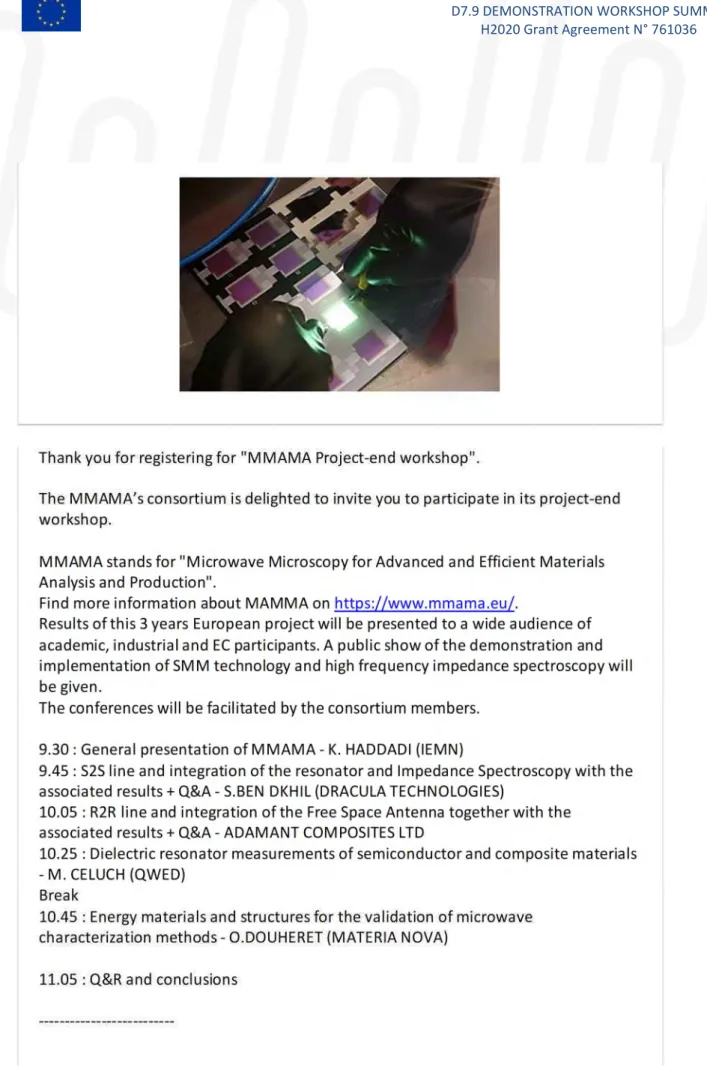
The Final workshop was organized on Thursday, October 1st and its title was "Microwave Microscopy for Advanced and Efficient Materials Analysis and Production".
3.2.
Programme
General presentation of MMAMA K. HADDADI (IEMN) 09:30 00:15 S2S line and integration of the resonator
and Impedance Spectroscopy with the associated results + Q&A
S. BEN DKHIL (DRACULA Technologies)
09:45 00:20
R2R line and integration of the Free Space Antenna together with the associated results + Q&A
A. VAVOULIOTIS
(ADAMANT) 10:05 00:20
Resonators and scanners + Q&A M. CELUCH (QWED) 10:25 00:20
Materials + Q&A O. DOUHERET
(MATERIA NOVA) 10:45 00:20
3.3.
Promotion
The registrations were open on July 23rd through the Eventbrite platform, where a dedicated page was created for the MMAMA event:
https://www.eventbrite.fr/e/mmama-project-end-workshop-registration-108982495578. As the event was changed to an online workshop, it was decided to move the Eventbrite dedicated page to the GoToWebinar platform https://register.gotowebinar.com/register/7059406019549128719 to manage registrations and host the event (see Figure 43 and 44).
Communication of the workshop was also done on MMAMA (https://www.mmama.eu/news/?tx_news_pi1%5Bnews%5D=31&tx_news_pi1%5Bco ntroller%5D=News&tx_news_pi1%5Baction%5D=detail&cHash=799d41f57be82e586 0cfa1db35aad941) and Dracula websites (https://dracula-technologies.com/final-workshop-mmama/), through MMAMA Linkedin account and through MMAMA fourth newsletter (deliverable D7.6). Invitations were also sent by email to our list of stakeholders and to the sister projects CORNET and OYSTER. The consortium widely disseminated the information about this workshop through its networks.
4. COURSE AND FEEDBACK
4.1.
Content
4.1.1 S2S line and integration of the resonator and Impedance Spectroscopy with the associated results
Sheet-to-Sheet pilot-line of Dracula Technologies used for the production of OPV modules
Integration of the Impedance spectroscopy and Dielectric resonator measurement into Dracula Technologies pilot line for the production of OPV modules.
• Dielectric Resonator in Dracula technologies’ S2S pilot line • Impedance Spectroscopy in Dracula technologies’ S2S pilot line
Conclusion
The potential of the Impedance spectroscopy and Dielectric resonator System has been validated showing that they can be used for real-time on-line monitoring and control of the properties of the printed layers in DT S2S pilot line
These two characterization techniques are complementary and provide useful information for understanding the produced OPV modules made by Dracula Technologies.
4.1.2 R2R line and integration of the free space antenna together with the associated results
The presentation of Adamant had for objectives the know-how and skills of Adamant Composites and to show the impact of product development and the philosophy of the MMAMA project in its activity. for Adamant: • CFRP Prepreg samples and associated controls • CFRP composite samples and associated MMAMA controls integrated into the Adamant pilot line In this discussion, we took the option of showing the preview of Adamant's pilot line integrating the results of the MMAMA project and in conclusion the roadmap of the technologies developed in MMAMA.
•Outline of Adamant’s Pilot Line
Conclusion:
4.1.3 Dielectric resonator measurements of semiconductor and composite materials
QWED presentation aimed to present microwave resonator methods for material measurements:
-caries
-modes and natural frequencies - energy considerations
-dielectric resonators -resonator response.
and to focus on dielectric resonators with one or two poles.
The second part focused on the technical advantages of SPDR and the reasons why it is relevant to use SiPDR
The conclusion that is Microwave dielectric resonators are a powerful tool for material characterization.
Appropriate configurations (SPDR and SiPDR) have been proposed and validated for composites and organic semiconductors in the H2020 MMAMA project is the result of organic and composite semiconductor measurements carried out with ADAMANT and Dracula Technologies
4.1.4 Energy materials and structures for the validation of microwave characterization methods
This last presentation proposed by MATERIANOVA aimed to show the The challenge of characterizing the diversity of materials
As part of the MMAMA project, the MATERIANOVA team focused on Organic electronic materials for PV applications and Carbon composites for energy applications.
The conclusion of this work shows that Microwave and broadband probing methods for organic materials and hybrid composites are :
o Efficient mapping of electrical properties
o Complementary to well acknowledged techniques
o Compatible with industrial fabrication processes
o Supporter of innovative research challenges
4.2.
Discussion and feedback
Registrations of participants were managed owing to the “Eventbrite” platform, and the workshop session was organised online with Microsoft Teams.
The audience gathered around 16 registered attendees, which is consistent with other workshops audience and remains positive, given the switch to a digital event.
At the end of each presentation, time was scheduled for questions and answers so that each partner could detail a specific point of their presentation.
4.3.
Workshop results and dissemination
Since the workshop was carried out online, it was not possible to give a public show of the demonstration of implementation of SMM. So it was decided to record the workshop presentations and to create a video presenting the whole project results. Both videos are available on the “MMAMA European project” YouTube channel which