WOUND CARE
Pressure Ulcer Prevention Program
A Journey
Barbara Delmore
䡲
Sarah Lebovits
䡲
Philip Baldock
䡲
Barbara Suggs
䡲
Elizabeth A. Ayello
The Centers for Medicare & Medicaid Services’ regulations regarding nonpayment for hospital-acquired conditions such as pressure ulcers have prompted a marked increase in focus on preventive care. Our hospital also used this change in payment policy as an opportunity to strengthen our pressure ulcer pre-vention practices. We used an 8-spoke prepre-vention wheel to develop and implement practice changes that reduced pressure ulcer incidence from 7.3% to 1.3% in 3 years. Because it is about the journey, we will describe the mechanisms we designed and implemented, and identify strategies that worked or did not work as we promulgated a quality improvement process for pressure ulcer prevention in our large urban hospital center.
■
Introduction
Our hospital, like most institutions, has undertaken es-tablishment of a comprehensive and successful pressure ulcer (PU) prevention program. While the changes in Centers for Medicare & Medicaid Services reimbursement guidelines are an important driver for establishment of a comprehensive prevention program, the more important issue is to provide optimal care for our patients. This arti-cle details our journey in creating a program with the hopes that others can benefit and learn from our process so that they do not have to “reinvent the wheel.”
■
Setting
NYU Langone Medical Center is a tertiary academic medical center located in a large urban community. Our facility is licensed for 879 beds and staffed for 678, which includes hospital and acute rehabilitation beds. Our daily census runs between 500 and 600 patients. Our sister hospital specializes in orthopedic and neurologic disorders and has 155 beds that also include hospital and acute rehabilitation. We are a Magnet facility and our sister hospital is in the process of applying for Magnet designation.
We began our quality improvement project by critically reviewing our prevention program to determine areas of weakness. Initially, we employed only 1 certified wound care nurse (B.D.), who filled the position after an extended
va-cancy. This extended vacancy had unfortunately allowed systems to break down and staff members to lose focus on aspects of PU prevention. Concurrently, we faced changes in regulatory dictums and reimbursement guidelines and updated evidence concerning PU prevention that was not reflected in institutional policies.
After careful review of the literature, we identified evidence supporting key elements of a PU prevention
program.1-3 Despite varying levels of evidence behind
these key elements, they are collectively associated with a
decreased incidence of PU.2These elements formed the
core of our program. We visualized PU prevention as a wheel with the patient at the center and 8 spokes repre-senting key elements of preventive care (Figure 1). The key elements were (1) assessment, including PU risk and regular skin assessment; (2) a defined skin care regimen; (3) mea-sures to control extrinsic factors such as pressure, friction, shear, and moisture; (4) nutrition and hydration assess-ment and intervention; (5) use of appropriate support surfaces; (6) patient and family education; (7) clinician training; and (8) protocols and procedures that provide guidance to staff when providing preventive care.1-3While
the evidence for each of these elements is variable, all are accepted as important elements of a successful PU preven-tion program.3-14
Parts of this manuscript were posters presented at the 2010 WOCN-WCET conference in Phoenix, Arizona.
䡲 Barbara Delmore, PhD, RN, CWCN, AAPWCA,Clinical Nurse Specialist, NYU Langone Medical Center, New York.
䡲 Sarah Lebovits, MSN, RN, ANP-BC, CWOCN, DAPWCA,Nurse Practitioner, NYU Langone Medical Center, New York.
䡲 Philip Baldock, RN,Perioperative Nursing Quality Specialist, NYU Langone Medical Center, New York.
䡲 Barbara Suggs, BSN, RN,Senior Nurse Clinician, Critical Care Center, NYU Langone Medical Center, New York, New York.
䡲 Elizabeth A. Ayello, PhD, RN, ACNS-BC, CWON, MAPWCA, FAAN,
Faculty, Excelsior College School of Nursing, Albany New York, and Senior Advisor, The John A. Hartford Institute for Geriatric Nursing, New York University College of Nursing, New York.
Correspondence:Barbara Delmore, PhD, RN, CWCN, AAPWCA, Clinical Nurse Specialist, NYU Langone Medical Center, 560 1st Ave, Tisch 183, New York, NY 10016 ([email protected]). DOI: 10.1097/WON.0b013e31822ad2ab
Successful PU prevention is a 24-hour process that requires an interdisciplinary team.1Our interdisciplinary
team includes 2 WOC nurses, staff nurses, nurse practi-tioners, educators, managers, directors, patient care tech-nicians (PCTs), physicians, physical therapists (PTs) and occupational therapists (OTs), registered dieticians, logistic managers, members of the facilities department (including cleaners, escort personnel, and electricians), coders, docu-mentation specialists, information technology, infection surveillance, and members of the purchasing and sourcing department. The team is under the direction of the WOC nurses and each team member plays a role in PU preven-tion. Specific roles are conveyed through formal and infor-mal methods. Examples of the more forinfor-mal methods include Skin Care Council meetings and activities, lectures, newsletters, and our Web site. Examples of informal meth-ods include nonstructured networking opportunities and bedside consultations.
When we first embarked on this process in 2007, we evaluated our PU incidence rates and current practices and compared them to national standards. We chose to con-centrate our efforts in select areas so that we could achieve our overarching goal of creating an effective interdiscipli-nary PU prevention program.
We quickly identified facility-wide barriers to creating a successful program that included failure to consistently differentiate community-acquired versus hospital-acquired pressure ulcers (HAPU). We associated this failure with a disconnect in documentation systems between inpatient and outpatient areas and by absence of a skin bundle in our electronic medical record. We also found absence of appropriate support surfaces in certain patient care areas such as our emergency department, operating rooms (ORs), and our cardiac catheterization laboratory. We also identified inconsistent risk assessment and preventive care, inadequate clinician education, lack of adequate practice protocols, inadequate linking between our inpatient and
outpatient wound centers, and poor data collection processes that did not accurately reflect current practices and clinical outcomes.
Once we identified these barriers, we set priorities in order to achieve consistent institutional practice standards and diminish HAPU incidence rates. The first priority was to improve our data collection process using the National Database for Nursing Quality Indicators format. We chose this priority because it addressed staff education and accu-rate identification of community-acquired PU versus HAPU. Our second priority was to engage our perioperative services in order to more accurately differentiate PU pre-sent on admission (POA) to our hospital and to develop strategies for preventing perioperative HAPU. Our third pri-ority was pressure redistribution surfaces especially since we had mattresses that were greater than 10 years old.
Priority 1: Data Collection Processes
Our review of the literature reinforced clinician-held opin-ions that it is not possible to manage what is not accurately measured. Our first goal was to improve our quarterly PU data collection process and to use knowledge gained from this process to provide educational opportunities. Our pre-vious data collection method was judged arduous and its accuracy was questionable. The old process failed to up-hold the definition of prevalence data collection, which mandates determination of the number of patients with a
PU at a given moment in time.15Instead, we found that
data collection often required 2 days. This delay was at-tributed to dual staff assignments; specifically, we found that staff assigned to PU prevalence data collection were also given a patient care assignment. Additionally, staff assigned to that data collection process lacked adequate training, including determining PU staging. We concluded that the resulting poor-quality data may not have reflected current practice or accurately identified areas for improve-ment. We also concluded that the process failed to seize opportunities to educate staff on PU prevention, assess-ment, and staging. We conducted a literature search and surveyed experts to determine the processes used by other institutions to measure PU prevalence and HAPU inci-dence. Based on these consultations, we identified the following strategies to improve our data collection. We adopted a team for data collections and we assured ad-ministrative support for our efforts. We used Skin Care Council members for data collection and we provided them with compensation for their efforts. We also pro-vided staff education and used findings to assess deficien-cies and strengths of our PU prevention efforts.16We then
formed a team comprising different disciplines that was named the Wound Evaluation Skin Team. We found that clinician education was paramount to our success. The data collection/educational day included an opening lec-ture, data collection, lunch leclec-ture, data entry, and process evaluation. Lectures and guest speakers were brought in to address multiple topics such as prevalence/incidence
studies, assessment, staging, prevention, alternative support surfaces, treatment measures, and relevant case studies. To improve accuracy of our data collection, we paired senior clinicians with less-experienced team members. The pro-gram has since evolved to a train-the-trainer format, which helps prevent errors in staging or incorrect decisions re-garding support surface selection. This paired team is responsible for training the staff at large as needed during the data collection process. Additionally, the new process has helped us creatively educate various staff including other disciplines such as PCTs, registered dieticians, PTs, and OTs about their role in PU prevention. As the experi-ence of the team evolved, we occasionally use the process evaluation portion to rewrite protocols or work on special projects such as staging pocket guides. Recently, we have introduced this format to our sister hospital and each agency’s prevalence day is conducted on sequential days.
Priority 2: Engaging Perioperative Services
Our next priority was to involve the preoperative services as key players since they play a pivotal role in this process. This initiative became our second priority because of the ramification of Centers for Medicare & Medicaid Services reimbursement penalties for HAPUs and concern for the wellness of our patients. Specifically, our hospital serves many critically ill patients transferred to us from our in-stitutions for surgery; therefore, we questioned whether our patient population might be at higher risk for PU de-velopment. Historically, perioperative services had not engaged in skin care or PU prevention because they sidered this aspect of care to be more of a nursing unit con-cern. However, evidence now suggests that HAPU may
occur within 48 to 72 hours after surgery17,18 and may
account for 23% of all HAPU.18Our perioperative services
represent a principal portal of entry into our hospital. We recognized that perioperative staff are essential in PU iden-tification that are POA. We, therefore, sought to provide education to the perioperative staff to increase their knowledge of the relevance of identifying POA ulcers and their role in PU prevention in the surgical suite and peri-operative area.17,19The staff member in charge of quality
for perioperative services (P.B.) created a conceptual model that typified the lack of understanding by the OR staff (Figure 2) and identified strategies for increasing the in-volvement and commitment of their staff to our facility-wide PU prevention program.
Although perioperative staff were initially resistant, they became intrigued after several educational presenta-tions by our WOC nurses (B.D., S.L.). Once their engage-ment in the clinical relevance of the process was clearly communicated, they formed an ad hoc committee to ad-dress intraoperative and perioperative PUs; this committee continues to meet on a monthly basis. One of the first initiatives implemented by this committee was implemen-tation of a process to document skin changes during the pe-rioperative period. Initially, the electronic health record
EHR used by perioperative staff and that used by the rest of the institution did not communicate with each other. As a result, the perioperative staff had difficulty documenting their skin assessments and Braden Scale scores. In addition, their assessment and documentation did not include skin status at key junctures, such as when the patient is transi-tioned from the preoperative to the operative and then to the postoperative phase. The committee addressed these problems by creating a paper documentation tool that al-lows staff to document their skin assessments and Braden Scale scores preoperatively. The form also allows perioper-ative staff to document skin assessments during the imme-diate postoperative period and a skin assessment on admission to the postanesthesia care unit. For all patients not discharged the same day, this form will travel with the patient until discharge when it becomes part of the per-manent medical record. A verbal report also outlines spe-cific concerns or changes in the skin assessment. This initiative has been so successful that it has been adopted by other services in the hospital such as interventional radiology.
The quality staff member (P.B.) for perioperative ser-vices believed that a venue for communicating education blurbs, projects, and care standards would be beneficial. He developed a newsletter that was initially published monthly and now has moved to a quarterly format. This newsletter is now available to the entire institution via the Skin and Wound Care Web site (Figure 3).
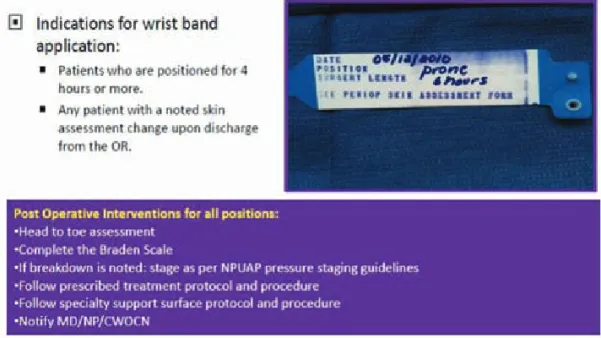
The perioperative service staff have also implemented a color-coded wristband for all patients considered to be at high risk for PU development. Patients identified as at increased risk include persons whose surgical procedures required them to be in 1 position for 4 hours or more and any patient with changes in skin status noted upon dis-charge from the OR. The wristband allows us to more accurately differentiate and identify perioperative-related skin injuries from POA ulcers before transfer to an inpa-tient nursing unit. Over the past 2 years, we have identi-fied more than 50 POA PU and our sister hospital just adopted this same wristband initiative. The guidelines for wristband use, a teaching guide detailing various operative positions, and associated risks associated with those posi-tions are posted on our internal Skin and Wound Care Web site (Figure 4).
Our perioperative services recently hosted a Skin Fair day during Nurses’ Week and exhibited posters highlighting their various projects and accomplishments. Operating room ta-bles were brought in to demonstrate how they can play a part in PU formation. We also invited a specialty bed vendor, who reviewed the use of support surfaces for postoperative patients. Today, our perioperative staff has become one of our biggest champions in our PU prevention program.
Priority 3: Support Surfaces
Our third priority was to procure appropriate support surfaces throughout the facility, including replacement of
some surfaces that were greater than 10 years old. We began with a literature search and consulted several list-servs such as the WOCN forum, University HealthSystems Consortium, and Magnet. We also sought advice from experts in other facilities, and we consulted Food and Drug Administration industry standards and vendor literature.20,21
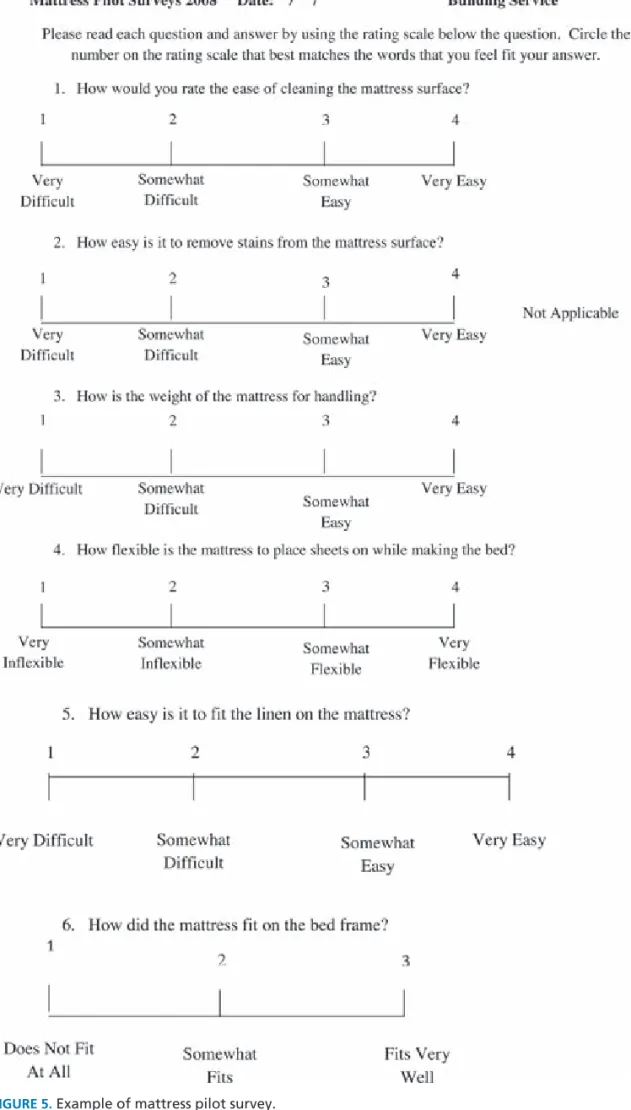
Based on this information, we pilot tested 3 support surfaces with self-adjusting technology. Specifically, we evaluated each mattress over a 2-week period on a single medical unit
that volunteered during a skin care council meeting. The pilot study involved nursing, PCTs, a logistic manager, building services, PT, our purchasing and sourcing depart-ments, our chief safety officer, fire safety, and patients. A sur-vey tool was created to gather data regarding the various surfaces (Figure 5). Instructions were provided regarding survey completion and we coordinated with vendors to ensure that evaluations were completed quickly and effi-ciently. Evaluation criteria included (1) ease of moving the
patient on the mattress and out of the bed, (2) making the bed, (3) ease and effectiveness in cleaning the surface, (4) overall ease of handling the mattress, (5) fit onto current bed frames, (6) skin injuries that developed while on surface, and (7) the comfort level reported by the patient.
The surface selected during the process was also placed on our emergency department stretchers. Building services is actively involved in this process that they have imple-mented a plan to replace mattresses every 5 years based on
the warranty. A large percentage of the old mattresses were donated to a third world country, further lowering inci-dental costs because this process allowed us to post a large charitable donation as well as avoiding the high cost of removal and disposal of the used mattresses.
We are in process of conducting a research project that will guide selection of the most appropriate seating cush-ion, using an algorithm approach. The algorithm is de-signed to be used by staff nurses and will provide prompts
that allow the clinician to determine whether a patient re-quires a low-level seating cushion, a high-level seating cushion, or no cushion at all. The research team comprises of WOC nurses, PT, OT, and a seating specialist.
Another project that addressed our third priority was initiated by the Critical Care Centers when their staff no-ticed an increase in HAPU that they attributed to inappro-priate use of specialty rental beds versus standard critical care
beds. Factors leading to this observation included a delay in ordering the appropriate surface for the high-risk patient that was corrected by educating critical care unit staff. They also observed that not all staff were using rental surfaces cor-rectly. For example, some staff placed too many layers of linen on low air-loss surfaces, impeding airflow distribution, which was found to be especially detrimental for patients with incontinence or significant diaphoresis. Efforts to
rectify this problem not only addressed improper surface use but also created a cascade of events geared toward PU prevention including education about proper positioning and use of turning clocks to ensure regular repositioning.
We also evaluated a new support surface for use on our operating suite tables. We selected a nonpowered mattress replacement that is radiolucent and incorporates a patient contact layer that is antifriction and antishear. Our cardiac catheterization staff initiated this project because they believed that some of their patients, and especially their pediatric patients, were at increased risk for developing PU on the surface used prior to the update.
■
Outcomes
We measured multiple outcomes to assess the effects of our PU prevention program. For example, our HAPU rate decreased from 7.3% to 1.3% in 3 years (Figure 6). At the beginning of this quality improvement process, our target benchmark for HAPUs was 5%. In 2010, we lowered our in-ternal target benchmark to 3.5%. We also reduced PU preva-lence and incidence data collection time from 8 to 2.5 hours.
■
Discussion
At the onset of this process, we recognized deficiencies in our existing program for PU prevention. Our initial goal was to incorporate consistent practice standards through-out all nursing services and other team disciplines, thus improving patient care. Although we addressed only 3 pri-orities, this effort led to other important initiatives such as creation of an internal Web site and clinician and other staff training through innovative venues.
We need to address additional spokes on the preven-tion wheel with the same tenacity used to address our
ini-tial 3 priorities. Critical care service members and medical staff continue to take the lead on choosing appropriate topical treatments that are available for use as formulary in the medical center. We regularly monitor the literature for new evidence about PU prevention and new products. We have not yet adequately addressed patient and family education. In addition, creating and revising standards and guidelines remain an ongoing challenge.
■
Conclusion
We achieved success by using a systems approach and a critical analysis of existing practice to identify areas of de-ficiency, followed by a comprehensive approach to iden-tify priorities and address deficiencies. Specific success strategies included creative approaches to clinician train-ing and involvement of multiple disciplines for effective PU prevention. We acknowledge that this process requires constant attention. Research has shown that when pre-vention programs are ignored, HAPU incidence is likely to rise again.22-24Therefore, we will continue to incorporate
the 8 spokes of our prevention wheel to serve as our guide in maintaining the lowest possible HAPU incidence.
✔
We identified barriers to effective PU prevention program and articulated 3 priorities in order to achieve consistent practices throughout our institution.✔
We found that our institution’s previous data collection method for measuring the incidence of HAPU was arduous and probably yielded inaccurate results.KEY POINTS
✔
We found that we were not taking advantage of opportuni-ties for educating staff about PU prevention, assessment, and staging based on facility needs.✔
Because many new patients enter our health care system for surgery, we engaged our institution’s perioperative services in our prevention efforts.✔
Our efforts have led to more accurate differentiation of POA versus hospital-acquired PU, a clinically relevant reduction in FAPU incidence, and significant reduction in PU prevalence and incidence data collection times.■ ACKNOWLEDGMENTS
We thank Dr Mikel Gray for inspiring the authors to ex-pand their posters into a manuscript after hearing his lec-ture concerning publishing your efforts.
■
References
1. Armstrong DG, Ayello EA, Capitulo KL, et al. New opportuni-ties to improve pressure ulcer prevention and treatment. J Wound Ostomy Continence Nurs. 2008;35:485-492.
2. Lyder C, Ayello E. Pressure ulcers and patient safety. In: AHPQR, Patient Safety and Quality: An Evidence-Based Handbook for Nurses. http://www.ahrq.gov/qual/nurseshdbk/docs/LyderC_ PUPSI.pdf. Published 2008. Accessed January 27, 2011. 3. Wound, Ostomy and Continence Nurses Society. Guideline
for Prevention and Management of Pressure Ulcers. Mount Laurel, NJ: Wound, Ostomy and Continence Nurses Society; 2010.
4. Gibbions W, Shanks HT, Kleinhelter P, Jones P. Eliminating facility-acquired pressure ulcers at Ascension Health. Jt Comm J Qual Patient Saf. 2006;32:488-496.
5. Holmes A, Edelstein T. Envisioning a world without pressure ulcers: The New Jersey Hospital Association’s Pressure Ulcer Collaborative. Extended Care Product News. 2007;122:24-29. 6. Stewart S, Box-Parksepp JS. Preventing hospital acquired
pres-sure ulcers: a point of prevalence study. Ostomy Wound Manage. 2004;50:46-51.
7. Hiser B, Rochette J, Philbin S, et al. Implementing a pressure ulcer prevention program and enhancing the role of the CWOCN: impact on outcomes. Ostomy Wound Manage. 2006;52:48-59. 8. Catania K, Huang CH, James P, Madison M, Moran M, Ohr M.
PUPPI: the pressure ulcer prevention protocol interventions.
Am J Nurs. 2007;107:44-52.
9. Griffin B, Cooper H, Horack C, Klyber M, Schimmekpfenning D. Best practice protocols: Reducing harm from pressure ulcers.
Nurs Manage. 2007;38(9):29-31,69.
10. Chicano SG, Drolshagen C. Reducing hospital-acquired pres-sure ulcers. J Wound Ostomy Continence Nurs. 2009;36:45-50. 11. McInerney JA. Reducing hospital-acquired pressure ulcer
prevalence through a focused prevention program. Adv Skin Wound Care. 2008;21:75-78.
12. Walsh NS, Blanck AW, Barrett, KL. Pressure ulcer management in the acute care setting. A response to regulatory mandates. J Wound Ostomy Continence Nurs. 2009;36:385-388.
13. Lyder CH, Ayello EA. Annual checkup: the CMS pressure ulcer present-on-admission indicator. Adv Skin Wound Care. 2009; 22:476-484; quiz 485-486.
14. National Pressure Ulcer Advisory Panel and European Pressure Ulcer Advisory Panel. Prevention and Treatment of Pressure Ulcers: Clinical Practice Guideline. Washington, DC: National Pressure Ulcer Advisory Panel; 2009.
15. Jenkins ML, O’Neal E. Pressure ulcer prevalence and incidence in acute care. Adv Skin Wound Care. 2010;23:556-559. 16. Kottner J, Tannen A, Halfens R, Dassen T. Does the number of
raters influence the pressure ulcer prevalence rate? Appl Nurs Res. 2009;22:68-72.
17. Aronovitch SA. Intraoperatively acquired pressure ulcers: are there common risk factors? Ostomy Wound Manage. 2007;53:57-69. 18. Schoonhoven L, Defloor T, Grypdonck M. Incidence of
pres-sure ulcers due to surgery. J Clin Nurs. 2002;111:479-487. 19. Mathias JM. Save our skin: periop teams rally to prevent
pres-sure ulcer in OR. OR Manager. 2008;24:11-13.
20. University HealthSystem Consortium. Use of Specialty Beds and Therapeutic Surfaces. UHC Supply Chain Brief. Oak Brook, IL: University HealthSystem Consortium; 2006.
21. US Food and Drug Administration. Hospital Bed System Dimensional and Assessment Guidance to Reduce Entrapment-Guidance for industry and FDA Staff; 2006. http://www.fda. gov/MedicalDevices/DeviceRegulationandGuidance/Guidance Documents/ucm072662.htm. Accessed July 12, 2010.
22. Vose A, Murphy RX, Burmeister DB, et al. Establishing a com-prehensive networkwide pressure ulcer identification process.
Jt Comm J Qual Patient Saf. 2011;37:131-137.
23. Dahlstrom M, Best T, Baker C, et al. Improving identification and documentation of pressure ulcers at an urban academic hospital. Jt Comm J Qual Patient Saf. 2011;37:123-130. 24. Ayello EA. Changing systems, changing cultures: reducing pressure
ulcers in hospitals. Jt Comm J Qual Patient Saf. 2011;37:120-122. FIGURE 6.NYU Langone Medical Center HAPU trend.