Selection of procedures for air conditioning audit and definition of
the associated training package
Main author: Daniela BORY
Jérôme ADNOT, Daniela BORY, Maxime DUPONT Center for Energy and Processes –Mines de Paris
60 boulevard Saint Michel – 75272 Paris Cedex 06 - France [email protected] Fax: +33 (0) 1 46 34 24 91
Marco MASOERO, Chiara SILVI
Politecnico di torino – dipartimento di energetica Corso duca degli abruzzi, 24 – 10129 torino – italia [email protected], [email protected] Simon MUHIC, Vincenc BUTALA, Matjaz PREK
UL-FME, University of Ljubljana Faculty of Mechanical Engineering Askerceva 6 - Si-1000 Ljubljana -Slovenia
A
BSTRACTIn the current transformation of the air conditioning (AC) market, important efforts should be achieved to improve the energy efficiency of these systems all along their life cycle. To detect and define the performance degradation of these facilities, a global approach has to be developed and the complexity of the systems implies the creation of reliable and efficient audit procedures and methods. In the AUDITAC project, we will describe the features of the two levels audit methods; pre-audit (or walk-through) and (detailed) audit.
In order to support the harmonisation of the implementation of the AC systems inspection, starting from the inspection schemes already on the market, we assessed their effectiveness and establish a link with the operation and maintenance practices. The decision for renovation will be developed in its aspects of energy savings and economic feasibility.
In order to disseminate and involve easily the AC actors in the audit methods, we have developed a basic training package (TP) about auditing AC facilities.
This tool has been created to prepare and introduce air conditioning actors (energy managers, facilities owners, technicians related to AC etc…) to the compulsory inspection and to disseminate the advantages and opportunities that the subsequent audit can give.
The audit approach is globally explained in the TP from cooling production to distribution, operation and maintenance and finally control strategies. Quantitative indicators for best practices and improvement examples are showed to support decision of renovation.
Basically, the TP has been designed for a public with an educational level of post-high school and can be used in different scenarios (students with HVAC class, inspection technicians, energy managers’ information etc…).
The audit in the life of air conditioning facilities
An AC system is a complex system of which the optimal management requires a deep knowledge of the system coupled with other aspects such as the building structure and use. The European Community (EC) promotes the energy improvement of these systems through the compulsory inspection of these facilities in the frame of the Energy Performance of Buildings Directive (EPBD, 2002). Inspection itself is just a motivating mean for the AC actors to improve the energy efficiency of the systems and reduce energy consumption. To reach these objectives the subsequent, necessary step is the audit.
So, while the aim of the inspection is to follow periodically the correct management of the facility through a quick visit of the plant and a study of the available documentation, the aim of the audit is the research of any possible efficiency improvement that goes beyond superficial assessment and it requires further investigations to evaluate the possibilities of improvement and quantify the savings. Audit differ also from the simple maintenance of the facilities, the aim of which is limited to guarantee the basic operation of the plant, and takes care for the efficient operation of the system and the comfort of the occupant: waste of energy may be avoided and maintenance and operation activities oriented in order to reduce system consumptions, keeping the comfort level of the occupants satisfactory or even improving it.
In this paper we consider the audit in a larger perspective of the plant life. The life of a system can be very complex following the life of the building and different cases can exist. About the design of the system, we can consider three main possibilities: an existing building needs for a new plant, in an
existing building a new plant is required instead of the existing plant, a new plant is designed for a
new building.
In the first case, a new plant has been designed in order to improve the comfort level of the existing building adapting its structure to the construction which hasn’t be designed to include it.
In the second case, the renovation can follow a decision of entire building renovation of only for the plant for reasons of discomfort, failure or obsolescence of the system or accidents (fire or flood). In the third case, the system is born with the building and their designs have been conceived to match.
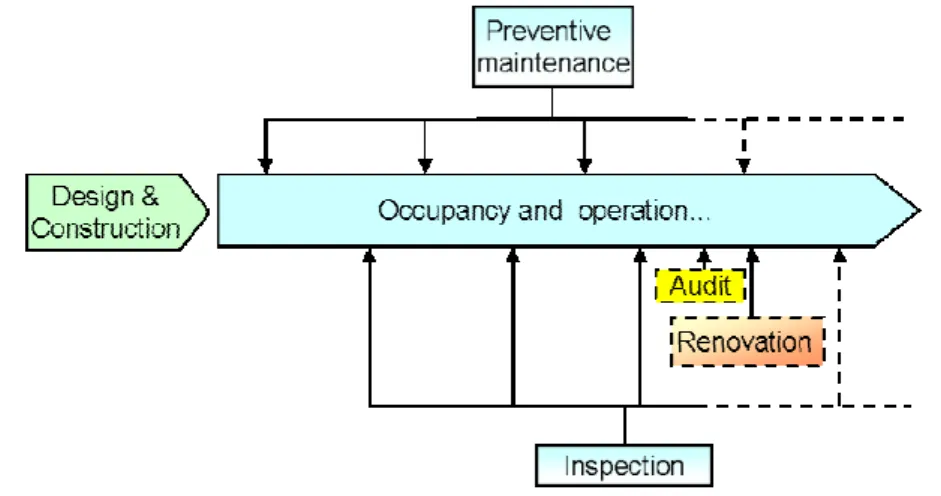
After this phase (design and construction) the normal life of the plant begins with operation and building occupancy. During its life many events can require the intervention of the audit which should constitute a constant aspect as O&M. Audit can intervene in decision of renovation (total or partial), it can be subsequent to the modification of the use of the building, it can be in parallel with repair and corrective maintenance in case of failure, it can derive from the wish of the owner of O&M improvement for energy savings or it can be developed on the basis of the advices released after an inspection. Therefore audit can be performed many times all along the life plant until the stop of its operation for definitive failure or renovation.
An example of the life of a system and of one of these events is represented in Figure 1.
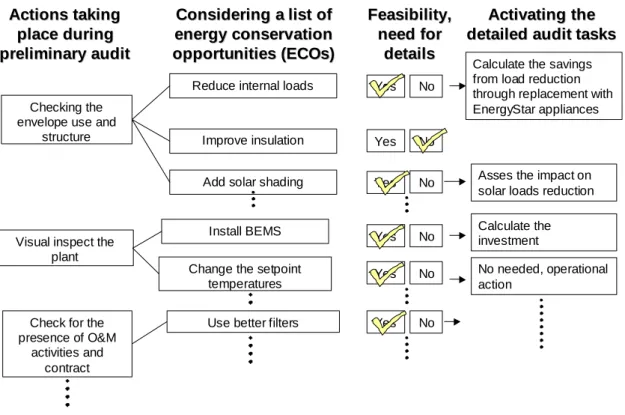
In the AUDITAC project (AUDITAC 2005), we distinguish between two levels of audit: a pre-audit with simplified procedures that is used to first individuate the point of energy waste and to find out the energy conservation opportunities (ECOs). Some improvement and low cost action can be undertaken directly after the pre audit when they are easy to implement and their impacts are easy to assess. An example of this type of easy to implement action is the change of the temperature setpoints.
In order to implement more complex procedures and quantify the savings from the ECOs, another procedure is needed: the audit or detailed audit. At this level, complex calculations, measurements and simulations can be performed in order to obtain quantitative indicators of the possible savings and to evaluate economical parameters that allow to the owner to compare different solutions, to advise his decision and face the investment required.
These steps are represented in the scheme of Figure 2 with some example of action and opportunity.
Figure 2. Main steps of the audit: from pre audit to detailed audit actions.
Aspects of the incoming inspection for air conditioning facilities
There is still much uncertainty about the effects expected from the implementation of the inspection of AC facilities (Article 9 of Energy Performance of Buildings Directive (EPBD 2002)). The Member States are exploring the weight to give to the various aspects: things seem so simple for the heating side! The basic difference between heating and air-conditioning is the following: in air conditioning it is enough to check frequently the state of the main equipment (the boiler for heating, in our case the
Checking the envelope use and
structure
Visual inspect the plant
Check for the presence of O&M activities and contract Activating the Activating the d
detailedetailedauditaudittaskstasks Considering
Consideringa a list list of of e
energynergyconservation conservation opportunities (ECOs) opportunities (ECOs) A
Actionsctionstaking taking place
place during during p
preliminaryreliminaryauditaudit
Reduce internal loads
Improve insulation
Add solar shading
Install BEMS
Change the setpoint temperatures
Calculate the savings from load reduction through replacement with EnergyStar appliances
Use better filters
Feasibility Feasibility, ,
need needfor for
details details Yes No Yes No Yes No Yes No Yes No Yes No Calculate the investment No needed, operational action
Asses the impact on solar loads reduction
compressor) and to think about the system at the end of its lifetime. For air conditioning, the system is the problem! We could even say that the compressor is the less sensitive part of the system.
Due to accumulated knowledge about heating efficiency, the Member States introduced a reasonable level of flexibility in the heating inspection section (Article 8 of the EPBD). As a result the difference between heating and cooling systems inspection is in the other direction that one could expect: while flexibility has been decided for heating due to accumulated knowledge, at the same time we have very ambitious and wide inspection for air conditioning, leaving the Member states the responsibility to introduce their own AC inspection scheme in spite of fact that the AC systems are very complex. So the Member states are working for the national implementation of inspection in a challenging context. Nobody has solved yet the problems of creating and maintaining a file of installation to be inspected at low cost. The Member States still have to decide.
We can expect many things from an inspection, but it will not be the same inspection depending on the expectations:
• Objective of safety (see Italian inspection of boilers)
• Objective of reliability and cleanness: one seems to seek to check maintenance, not the performance.
• Objective of energy efficiency assessment
In the regulatory impact assessment we cannot compare the price of a checking maintenance and the benefit of an energy audit. It is this distorted comparison which is likely to be often made.
In many countries the standard prepared by the CEN will be taken into account for the methodology of inspection scheme (CEN 2005).
The compulsory inspection of AC systems of more than 12 kW makes sense if we consider the energy savings that can be achieved. The potential benefits can be important if we target them correctly in the definition of the inspection. The CEN standard is an important part of this effort, because it can indicate better than the short Directive article the objectives of inspection, show possible ways of achieving the goal, while leaving freedom for technical progress.
The real purpose of the article 9 is to initiate a continuous improvement process that will set up higher quality standards in air conditioning: either diagnosis and correction of existing systems operation (on short term) or audits followed by investments and improvement works (on a longer term). It should provide sound bases on which professionals will then work: operators, auditors, and contractors. A question that still remain open is what will be the real skills necessary of the audit or inspector to full benefit from the inspection and audit? The cost effectiveness of the measure will be dependent on the experience required for the inspection and the subsequent energy savings. In our experience, the diagnosis of air-conditioning problems seems to be beyond the ability of many, even in the presence of training because of the complexity of the systems and the variety of competences required for a complete evaluation of the energy conservation opportunities. The need for expert auditors would increase the cost of the inspection itself and reduce the availability of professionals able to do it to face the important workload. It would be interesting to introduce expert systems and tools from the design of air conditioning systems until the installation to make the inspection and audit feasible from a master craftsman or similar. A double effort would be required: in the training development of inspectors and auditors and through interactions with manufacturers and installers devoted to define the main characteristics to introduce in the systems to reduce the inspection last and make more visible all the information required from the inspector.
Moreover, in the case of EPBD one could desire a consistency between energy performance certification and inspection: consistent advice, possibility of improving actually the grading by doing what the inspection recommends. In that case the inspection has to be tailored to the methods used to certify performance.
Forward a better management of the AC facilities: pre-audit techniques
In a pre-audit procedure one detects the errors in the AC systems with visual detection and with measurements. Pre-audit involves minimal interviews with site operating personnel, a review of facility utility bills and other operating data, and a walk-through of the facility to become familiar with the
building operation and identify glaring areas of energy waste or inefficiency. Typically, only major problem areas will be uncovered during this type of audit. This level of detail, while not sufficient for reaching a final decision on implementing proposed measures, is adequate to prioritize energy efficiency projects and determine the need for a more detailed audit. Pre-Audit activities, in general order, should include:
• Identify HVAC (all energy) system
• Evaluate the condition of the system
• Find out and describe the possible impact of improvements to those system
• Write up a pre-audit report
Pre-audit is the less costly audit, but a pre-audit can yield a preliminary estimate of savings potential and a list of low-cost savings opportunities through improvements in operational and maintenance practices. The pre-audit information should be used for a more detailed audit later if the preliminary savings potential appears to warrant further auditing activity.
The Pre-audit Process
The first step should be a collection of information. The information may be collected on the structural and mechanical components that affect building energy use and the operational characteristics of the facility. Much of this information can be collected prior to the site visit. Evaluating energy use and systems before going site helps identify potential savings and makes best use of time spent on-site.
The pre-audit consists of three distinct steps:
• preliminary data collection and evaluation,
• site visit,
• analysis and reporting.
Preliminary Data Collection
A pre-site review of building systems and their operation should generate a list of specific questions and issues to be discussed during the actual visit to the facility. This preparation will help ensure the most effective use of on-site time and minimize disruptions to building personnel. A thorough pre-site review will also reduce the time required to complete the on-site portion of the audit. The first task is to collect and review two years worth of utility energy data for electricity. The HVAC system consumption data should be provided if the system is measured separately. This information is used to analyze operational characteristics, calculate some energy benchmarks for comparison to averages, estimate savings potential, set an energy reduction target, and establish a baseline to monitor the effectiveness of implemented measures. The building manager should provide occupancy schedules, operation and maintenance practices, and plans that may have an impact on energy consumption. This kind of information can help identify times when building systems such as lighting, recirculating pumps or outside air ventilation can be turned off and temperatures set back. The building manager should provide also all plans documentation. If the data are not available and if they don't correspond to the reality then the first action should be to help to collect the data.
Analyzing Energy Data (Cooling Energy Benchmark)
The Cooling Energy Benchmark (CEB) could be calculated to compare energy consumption to similar building types or to track consumption from year to year in the same building. The CEB is calculated ratios based on the annual consumption and the area (gross square) of the building. CEB is a good indicator of the relative potential for energy savings. A comparatively low CEB indicates less potential for large energy savings. By tracking the CEB using a rolling 12-month block, building performance can be evaluated based on increasing or decreasing energy use trends. This method requires a minimum of two years of energy consumption data to establish the trend line and values including weather correction.
Caution has to be used in benchmarking in order to compare comparable values between different buildings. The best benchmark method would take into account different parameters (weather, sector,
air control factors etc.). Actually, there are few air conditioning benchmark references and often general benchmarks are most commonly used and available.
Looking at Loads for cooling
Cooling loads include lighting, office equipment, appliances, solar gains and specific processes. High loads are in general easy to detect and the energy management efforts should be focused in these areas. High loads may reveal opportunities to reduce consumption by making improvements to the air conditioning equipment, temperature controls, the building envelope, or to other systems which are affected by operation. After utility use has been allocated, the pre-auditor should prepare a list of the major energy-using systems in the building and estimate the time when each system is in operation throughout the year. The list will help identify how each system uses energy and potential savings. Building systems can then be targeted for more detailed data collection. One of the easiest ways to evaluate energy data is to watch for the trends in use, demand, or costs over time. Either graphing two or more years of monthly data on one graph or graphing only the annual totals for several years can help.
Building Profile
Obtaining mechanical, architectural, and electrical drawings and specifications for the original building as well as for any additions or remodeling work that may have been done is the first step to creating a building profile. Any past energy audits or studies should be reviewed. The auditor can use this information to develop a building profile narrative that includes age, occupancy, description, and existing conditions of architectural, mechanical, and electrical systems. The profile should note the major energy-consuming equipment or systems and identify systems and components that are inherently inefficient. A site sketch of the building should also be made. The sketch should show the relative location and outline of each building; name and building number of each building; year of construction of each building and additions; dimensions of each building and additions; location and identification numbers of utility meters; central plants; and orientation of the complex.
While completing the pre-site review, the auditor should note areas of particular interest and write down any questions about the lighting systems and controls, HVAC zone controls, or setback operation. Other questions may regard equipment maintenance practices. At this point the auditor should discuss preliminary observations with the building manager or operator. The building manager or operator should be asked about their interest in particular conservation projects or planned changes to the building or its systems. The audit should be scheduled when key systems are in operation and when the building operator can take part.
The Site Visit
The site visit will be spent inspecting actual systems and answering specific questions released from the preliminary review. The amount of time required will vary depending on the completeness of the preliminary information collected, the complexity of the building and systems, and the need for testing equipment.
Having several copies of a simple floor plan of the building will be useful for notes during the site visit. A separate copy should be made for noting information on locations of HVAC equipment and controls, heating zones, light levels, and other energy-related systems. If architectural drawings are not available, emergency fire exit plans are usually posted on each floor; these plans are a good alternative for a basic floor plan.
Prior to touring the facility, the auditor and building manager should review the auditor's energy consumption profiles.
Analysis and Reporting
Post-site work is a necessary and important step to ensure the pre-audit will be useful. The auditor needs to evaluate the information gathered during the site visit, research possible energy
conservation opportunities (ECOs), organize the audit into a comprehensive report, and make recommendations on improvements. Report from pre-audit with possible ECOs should be used as input for other audit types.
Deciding improvements and renovation: the opportunities from detailed audit
Following the pre-audit advises and results, the audit procedure allow to go deeper in the research for energy efficiency through the following actions (adapted from Portland 1997, Thurmann and Younger 2003, Hansen and Brown 2004).Verification of system performance
Maintenance departments can use the energy conservation opportunities (ECOs) in order to enhance the energy efficiency of HVAC systems; verification of system performance testing is a total system approach, as in a HVAC each component might work fine by itself, but unless the entire system has been performance tested there is no assurance that the HVAC system is functioning in an energy efficient manner.
Before making a final go – ahead decision to upgrade, change or retrofit any HVAC system it is important to know exactly the system performance data and to predict the effectiveness of costly changes.
O&M for energy efficiency
Building Operation and Maintenance (O&M) is the ongoing process of sustaining the performance of building systems according to design intent, the owner’s or occupants’ changing needs, and optimum efficiency levels. The O&M process helps sustain a building’s overall profitability by addressing tenant comfort, equipment reliability, and efficient operation. Efficient operation, in the context of O&M, refers to activities such as scheduling equipment and optimizing energy and comfort-control strategies so that equipment operates only to the degree needed to fulfill its intended function. Maintenance activities involve physically inspecting and caring for equipment. These O&M tasks, when performed systematically, increase reliability, reduce equipment degradation, and sustain energy efficiency. Building operation and maintenance programs specifically designed to enhance operating efficiency of HVAC can save 5 to 20 percent of the energy bills without significant capital investment, utilizing strategies that facility managers, energy managers and property managers can use to integrate energy-efficient operation into their organizations O&M programs and to obtain support from senior management.
An O&M site audit is a systematic method for identifying ways to optimize the performance of an existing building. It involves gathering, analyzing, and presenting information based on the building owner or manager’s requirements. The goal of the assessment is to gain an understanding of how building systems and equipment are currently operated and maintained, why these O&M strategies were chosen, and what the most significant problems are for building staff and occupants. Most projects require the development of a formal assessment instrument in order to obtain all the necessary O&M information. This instrument includes a detailed interview with the facility manager, building operators and maintenance service contractors who are responsible for the administration and implementation of the O&M program. Depending on the scope of the project it may also include an in-depth site survey of equipment condition and gathering of nameplate information. An O&M assessment can take from a few days to several weeks to complete depending on the objectives and scope of the project.
The audit identifies the best opportunities for optimizing the energy-using systems and improving O&M practices. It provides the starting point for evaluating the present O&M program and a basis for understanding which O&M improvements are most cost effective to implement.
The O&M assessment may be performed first of all as part of a detailed energy audit because it offers ways to optimize the existing building systems, reducing the need for potentially expensive retrofit
solutions, besides because implementing the low-cost savings identified in the assessment can improve the payback schedule for capital improvements resulting from the energy audit.
The greatest benefit of performing a building O&M assessment is informational. The information resulting from an O&M assessment can be used to help prioritize both financial and policy issues regarding the management and budget for the facility. It presents a clear picture of where and what improvements may be most cost effective to implement first. The assessment process, depending on the owner’s or manager’s requirements, can also provide direct training and documentation benefits for O&M staff.
Depending on the goals for performing the assessment, typical benefits may include:
• Identifying operational improvements that capture energy and demand savings
• Identifying operational improvements that positively affect comfort and IAQ
• Improving building control
• Developing a baseline report on the condition of major HVAC equipment
• Identifying issues contributing to premature equipment failure
• Identifying ways to reduce staff time spent on emergencies
• Increasing O&M staff capabilities and expertise
• Determining whether staff require additional training
• Developing a complete set of sequences of operation for the major HVAC systems
• Evaluating the BEMS for opportunities to optimize control strategies
• Determining original design intent and the cost to bring the building back to original design
• Providing a cost/benefit analysis of implementing the recommended O&M improvements
• Developing an operating plan and policy to maintain optimal building performance over time. The best benefits keep on giving long after the process is completed. For example, the final master log of recommended improvements along with the estimated savings allows an owner or building manager to prioritize and budget accurately for the implementation process. Also, minor problems that could be solved during the assessment may begin to reduce energy costs and improve comfort immediately; equipment life may be extended for equipment that may have failed prematurely due to hidden problems, short-cycling, or excessive run time.
How much auditing the O&M costs is influenced by several factors:
• The number and complexity of the buildings, systems, and equipment involved
• The number and type of assessment objectives
• The availability and completeness of building documentation
• The availability and expertise of the O&M staff.
A project with several objectives will naturally cost more than a project with fewer objectives. Also, a project with complicated controls and numerous pieces of equipment will cost more than a simple building with only a few pieces of equipment. The owner must have a clear vision for what the assessment needs to accomplish and impart that vision to the O&M consultant.
Retrofit
The central cooling plant is a critical component of any building of facility. As with all mechanical equipment there is a finite useful life for the equipment. While an extensive maintenance program can extend this useful life, there comes a time when replacement of the equipment is necessary. In addition, retrofit projects can be undertaken as part of an efficiency enhancement strategy or as a result of changes in the use or needs of the facility.
The first consideration in undertaking a central plant retrofit project is that the scope of the project should not be limited to simple replacement of the components. Because this project is usually taking place at least 20 years after the facility was originally constructed, the system would be re – engineered based on the actual loads and usage of the facility. This will help to promote the goals of increasing efficiency and reliability.
There are a number of reasons for this re – engineering. The first involves the original equipment selection. In general, engineers are conservative in their load calculations and equipment selection:
this can lead to inefficient operation. A second reason for re – engineering is due to changes in the peak load or load profile for the facility which affect equipment selection.
Technology changes are another big reason for re – engineering the central plant. One major advance is in the area of control systems. Today’s control systems have much greater capacity that the systems that were available when the plant was first constructed, and the limitations in the control strategies sometimes played a significant role in the design of the central plant. An offshoot of this is the inclusion of digital control panels in the equipment. This greatly improves the operation of the equipment as well as providing availability of better information on the operation of the equipment. Strategies like variable flow in chillers were difficult to achieve with analog control panels. Another big change is the availability of variable speed drives and the efficiency improvements that can be gained from their proper application. Potential uses are for secondary pumping systems, chilled water and condenser water pumps for variable flow chillers, chillers and cooling tower fans.
As in many cases, there are multiple solutions to any problem and different ways to design a system that will produce the desired result, cooling for people or equipment. The basic process of a retrofit project is similar to a new construction project, but in most cases the facility will continue to operate during the retrofit project. Another important consideration is the opinion of probable costs. It is necessary to have a good idea of the first cost of each option to provide a good base for the analysis. The major factor in the evaluation will be the estimates of operating costs. Since there will be a significant investment in the retrofit project, it may be easier to justify efficiency improvements based on incremental costs and savings instead of having to justify the entire cost of a project solely by the anticipated efficiency gains. There are several levels of estimates of operating costs that can be utilized: the simplest methods can be used as a screening tool to reduce the amount of simulation work that may be required. The ultimate analysis tool is a full energy simulation, using one of the available programs.
Investment audit
The foremost limitation of the traditional energy audit is that it is based on a “snap shot” approach. Auditors assumed conditions observed during the audit would remain the same for the life of the equipment or the project. An audit today must support a multi – year energy efficiency project and provide quality investment guidance. As the energy efficiency industry matured, projects became more complex and risk analysis became more sophisticated, the need for information grew too. An important aspect of the investment grade audit is the Measurement and savings Verification (M&V) protocol. M&V requires an established and clearly defined historical base year as well as the necessary procedures to create an annually adjusted baseline.
At the same time, energy efficiency project financing was getting easier to find, but financiers were asking more sophisticated questions about risk. The risk assessment should be done for an energy efficient project, either an “in house” effort, or a comprehensive project to be accomplished by an ESCO; it can be expressed as a series of steps leading to the realistic calculations of the payback periods for the proposed measures.
Improvements through BEMS
Once a Building Energy Management System (BEMS) is in place and fully operational, the facility manager who will supervise its operation may look toward optimisation. Before trying to optimise a system, it is important to understand basic BEMS capabilities. Features may vary widely from model to model, but some basic capabilities are almost universal.
The standard BEMS capabilities are:
• Scheduling
• Set-points
• Alarms
• Safeties
With each of these features, there are opportunities to move beyond minimal utilization without significant effort or complexity.
Selected control strategies that can save energy or reduce demand are in the following table.
Scheduling Lockouts Miscellaneous
• Holiday scheduling • Zonal scheduling
• Override control and tenant billing • Night setup/setback • Optimum start • Optimum stop • Morning warm-up/cool-down • Boiler system • Chiller system
• Direct expansion compressor cooling
• Resistance heat
• Simultaneous heating/cooling control
• Zone-based HVAC control • Dual duct deck control • Chiller staging
• Boiler control
• Building space pressure • Variable speed drive control • Heat recovery
Ventilation Control Energy Monitoring Lighting
• Carbon dioxide • Occupancy sensors
• Supply air volume/OSA damper compensation routines
• Exhaust fans
• Whole building or end-use • kWh or demand
• Lighting sweep • Occupancy sensors • Daylight dimming • Zonal lighting control
Air-Side Economizers Resets Demand Control
• Typical air-side • Night ventilation purge
• Supply air/discharge air temperature
• Hot deck and cold deck temperature
• Mixed air temperature • Heating water temperature • Entering condenser water temperature
• Chilled water supply temperature
• VAV fan duct pressure and flow • Chilled water pressure
• Demand limiting or load shedding
• Sequential startup of equipment • Duty cycling
A training package about auditing AC
In the frame of the AUDITAC project, we have developed a basic training package (TP) that resumes the results showed in the previous paragraphs and include some other analysis and important conclusions of the project.
Hence the main objectives of the training package are:
- To create a common core of knowledge and information from the different competences, necessary to describe an exhaustive audit of AC facilities
- To show the (economic and energy) best practices and best solutions
- To rise awareness in the audience about the stakes of the AC energy use at international and individual level
- To motivate the AC actors to go through audit in order to improve the energy efficiency of AC facilities
- To prepare the public to the compulsory AC inspection and combine it with audit.
Who may benefit from this training package
The impulse to audit expected from the new configuration of the energy market makes necessary the dissemination of the knowledge about the AC systems efficiency improvements to the actors. More than maintainers and AC experts, a large new public is now involved in the improvement of the AC
systems as facilities owners, energy managers, energy advisors, technical staff of public buildings, technicians with skills related to AC etc.
The TP is supposed to increase the awareness of these actors about the energy savings opportunities in AC plant, from the easiest to implement energy conservation opportunity (ECOs), of which the energy impact can be assessed just by simple observation, to more complex actions that can be lead only after a specific study of feasibility in a detailed audit.
The educational level of the audience is supposed to be of post-high school at least. It is expected that the audience level of knowledge of AC is not very technical, they already know the basic principle of operation, but skills or competences possessed can be very different from an audience to another and their skills can be focused in a single aspect of the system (control, maintenance or use etc.). The TP is so devoted to this public but can be at the same time used in different scenarios: students with HVAC class (where rarely efficiency is related to already existing systems) or initiation of inspection technicians or auditors for example.
Scopes and structure of the TP
The aim is to give a large view on the AC systems and market to non expert public, who will be conscious through this package of the stakes of the AC energy use at international and individual
level. Moreover, the TP illustrates to the public the content of the inspection procedures and can be used to initiate to audit methods.
Different modules realized with PowerPoint slideshows constitute the AUDITAC training package. The main discourse is developed around the audit but different annexed modules exist.
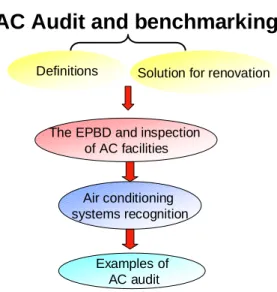
Thank to its modular structure, the content of the training can be adapted in function of the type of audience but a default path is suggested. This starts from the main module on audit, follows with the module on the European Energy Performance of Building Directive (EPBD) and inspection, continues through the module on systems recognition and classification and ends with the illustration of some examples and cases of AC auditing, as shown in Figure 3.
Figure 3: Structure of the training package with the main modules and the education path represented
The core of the TP: the audit module
The main module is divided in two parts. In the first part AC audit and benchmarking are defined.
AC Audit and benchmarking
Examples of AC audit Air conditioning systems recognition The EPBD and inspection
of AC facilities
Solution for renovation Definitions
Firstly, the aim of the audit is defined in relation with the life of an AC plant: when it can happen and why, in relation and in parallel with O&M activities and in relation with commissioning. This part mean to mark the difference between audit and other activities such O&M activities in which the main function of the system is maintained but not it’s efficiency.
The auditor has to preliminary understand and take into account the requirements of the building in terms of Air Indoor Quality (AIQ) and occupancy scheduling. The main audited aspects of the system linked with the building in the AC audit are: equipment defects, cooling loads, actuators and sensors, control strategies, operation and maintenance activities.
Therefore, the air conditioning benchmarking method is detailed. Benchmark is a useful tool for first find out the most energy consumption system but care is needed to use it. The best way of benchmark energy consumption or capacity installed is to parameter the benchmark following several criterions: sector, type of system, IAQ required.
Audit shouldn’t be anymore a black unknown box to the AC facilities owner: after dissipating the mystery of the audit content and make highlight on its objectives and advantages, they will be aware of the opportunities and profitable actions in a transparent procedure.
In the second part a typical procedure for audit is described and the attention is on the solutions that audit can propose. Energy conservation measures are listed for different systems with some example that allows to quantify the effectiveness of a solution in some detailed case.
Opportunities for replacement of obsolete equipment by present equipment are evaluated through the evolution of the average system performances (performances benchmarking) on the last two decennials in order to help for decision of punctual improvements or a whole replacement.
At the end of the module the public is aware of the complexity of the AC facilities audit and about all the aspects more or less obvious that have to be included in the audit. He has been softly introduced to the audit techniques, starting from the benchmark tool then, increasing the complexity, into a typical complete audit procedure.
Finally, the public is lead in the more delicate phase of the audit: the decisional process for the more common and profitable energy conservation opportunities. In this process he is guided and supported by examples and quantitative indicators that allows to understand the global approach in economic and energy terms.
Auxiliary modules
Once, acquired the main definitions and the global approach of the audit explained in the first module, on one side, auxiliaries modules are added with notions that can be missing for some audience as a complement of the main modules, on the other side, a more applicative module immerses the audience in real situation, guides them into the audit on field and put them in front of a variety of cases with their successful audit results.
The first annexed module is on the European panorama of AC. A survey of the AC market in Europe actual and forecasted is showed. Through this information, the auditor is pushed to think about the energy stakes in the AC market, focusing on the most used technologies in general and in different sectors. The data are mainly extracted from the EECCAC study [EECCAC, 2001].
Then the new articles introduced by the EPBD that concern AC are listed: mainly the article 3 about building energy performance certification and article 9 on inspection of the air conditioning facilities. For the last measure, a CEN standard has been developed. The details of the text of the standard are listed and commented, in order to rise the awareness of the audience on the characteristic of the inspection they will pass through, and compare the aspect considered in the inspection with the detailed action of the audit procedure. The main message is how to best profit from these two procedures that cant’ be exchangeable but can be profitably complementary and subsequent.
A second complementary module is developed including a part of the air conditioning technical module of the GreenBuilding programme [GreenBuilding Programme]. In this section of the training package the large variety of AC system types is described and it includes a simple method to help in
the system recognition when information is missed. The method is based on easy visual observations of the system components and fluid networks.
A third module tests the notions acquired in the first module through simple example and exercises where common situations are showed with the more adapted energy conservation actions implemented. Some time the case is presented as an interactive exercise where the audience can use the knowledge developed through the other modules to choose the more adapted solutions. Emphasis is put on the energy aspects for each exercise and sometime conversion in money savings can be performed.
Conclusions
In this paper we showed some results from the AUDITAC project. The AC audit is showed to be an important and necessary step in a plant lifetime.
The features of the AC audit methods have been described through two levels of complexity: the pre-audit and the pre-audit methods.
For pre-audit, the elements of the procedure are listed with accent on the scope and the limits of each task. These steps are:
- Preliminary Data Collection
- Analyzing energy data
- Looking at loads fir cooling
- Building profile
- The site visit
- Analysis and reporting
From the pre-audit conclusions more detailed actions can be undertaken in audit to quantitatively determine the energy savings. Four main aspects have to be considered in the decision of renovation and have be considered in detailed audit:
- Verification of system performance
- O&M for energy efficiency
- Retrofit
- Improvements through BEMS.
Finally, a training package about air-conditioning audit has been presented. This tool has been created to prepare and introduce air conditioning actors (energy managers, facilities owners, technicians related to AC etc…) to the compulsory inspection and to disseminate the advantages and opportunities that the subsequent audit can give.
The TP structure is modular and can be adapted to the audience. The default path of education starts from general definition of audit and benchmark then presents a typical audit procedure and the more profitable energy conservation opportunities in AC facilities with quantitative indicators.
Auxiliary modules are added. The first is about the Energy Performance of Buildings Directive (EPBD) articles concerning air conditioning and the AC inspection. Another module shows the large variety of AC systems and a simple method for system recognition. The last module is an interactive module with exercise and example in order to test and set up the knowledge developed in the previous modules.
Basically, the TP has been designed for a public with an educational level of post-high school and can be used in different scenarios (students with HVAC class, inspection technicians, energy managers’ information etc…).
References
AUDITAC 2005: a IEE project: http://www.eva.ac.at/projekte/auditac.htm. Newsletter freely available on the site. The AUDITAC Interim report will be available in April 2006.
EPBD 2002: DIRECTIVE 2002/91/EC OF THE EUROPEAN PARLIAMENT AND OF THE COUNCIL of 16th December 2002 on the energy performance of buildings.
CEN 2005. TC 156 Ventilation for buildings — Energy performance of buildings —Guidelines for inspection of air-conditioning systems, Draft Version 2.1.
Fifteen Best Practices for Energy Efficient Buildings. Portland Energy Conservation Inc., 1999. Portland 1997: Energy Management Systems: A Practical Guide. Portland Energy Conservation Inc.. Thurmann A., W. Younger, 2003, Handbook of Energy Audits. 6th edition. Fairmont Press, Georgia,. S. Hansen, J.W. Brown, 2004, Investment Grade Energy Audit: Making Smart Energy Choices. Fairmont Press, Georgia.
EECCAC, 2001: Energy Efficiency and Certification of Central Air Conditioners study, a SAVE Project, final report.
GreenBuilding Programme: documents freely to http://energyefficiency.jrc.cec.eu.int/greenbuilding/
With the support of
The sole responsibility for the content of this document lies with the authors. It does not represent the opinion of the Community. The European Commission is not responsible for any use that may be