Horizon 2020 Mediterranean report
Toward shared environmental information systems
EEA-UNEP/MAP joint report
ISSN 1725-2237Horizon 2020 Mediterranean report
Toward shared environmental information systems
EEA-UNEP/MAP joint report
European Environment Agency Kongens Nytorv 6 1050 Copenhagen K Denmark Tel.: +45 33 36 71 00 Fax: +45 33 36 71 99 Web: eea.europa.eu Enquiries: eea.europa.eu/enquiries Legal notice
The contents of this publication do not necessarily reflect the official opinions of the European Commission or other institutions of the European Union. Neither the European Environment Agency nor any person or company acting on behalf of the Agency is responsible for the use that may be made of the information contained in this report.
Copyright notice
© European Environment Agency, 2014
Reproduction is authorised, provided the source is acknowledged, save where otherwise stated.
Information about the European Union is available on the Internet. It can be accessed through the Europa server (www.europa.eu).
Luxembourg: Publications Office of the European Union, 2014 ISBN 978-92-9213-430-3
ISSN 1725-2237 doi:10.2800/13326
REG.NO. DK-000244
Disclaimer
The designations employed and the presentation of the material in this document do not imply the expression of any opinion whatsoever on the part of EEA and UNEP/MAP concerning the legal status of any State, Territory, city or area, or if its authorities, or concerning the delimitation of their frontiers or boundaries.
Content
Foreword ... 5 Acknowledgements ... 6 Executive summary ... 7PART 1 SYNTHESIS ...10
I Background... 11I.1 Horizon 2020 Initiative — process ... 11
I.2 Producing the H2020 MEDITERRANEAN report ... 13
II Dataflows and infrastructure development ... 21
III Developing country assessments ... 23
IV Achievements and lessons learned ... 25
IV.1 Inter-institutional cooperation at national and regional level... 25
IV.2 Establishment of thematic network ... 25
IV.3 Choice of H2020 indicators ... 26
IV.4 Data availability ... 26
IV.5 Data delivery ... 26
IV.6 Data sharing ... 27
IV.7 Geographical focus ... 27
IV.8 Evaluation of progress ... 27
V Main recommendations towards the establishment of a regular review and monitoring process ...29
V.1 Geographical focus ... 29
V.2 Infrastructure/dataflow ... 29
V.3 Cooperation/governance ... 30
PART 2 REGIONAL THEMATIC ASSESSMENT ...31
1 What makes the Mediterranean Sea and its basin unique? ... 32
1.1 Climate and climate change ... 32
1.2 Water and nutrient dynamics ... 39
1.3 Ecoregions with high biodiversity ... 40
1.4 Civilisation and historical developments ... 40
2 What are the main socio-economic factors impacting the environment? 42 2.1 Population growth ... 42
2.3 Growth and development ...46
2.4 Tourism ...47
3 Why is municipal solid waste a priority issue in the Mediterranean region? ...50
3.1 What is the status of municipal solid waste generation and management in ENP-South countries? ... 51
3.2 What are the trends in municipal solid waste generation? ...51
3.3 What is the composition of municipal solid waste? ...54
3.4 How much municipal solid waste is collected? ...54
3.5 How much of municipal solid waste is treated? ...57
4 Why is water a priority issue in the Mediterranean region? ... 63
4.1 What is the progress in access to improved sanitation systems? ...64
4.2 What is the difference between urban and rural areas? ...69
4.3 What is the progress in municipal wastewater management? ...71
4.4 Which are the main wastewater treatment types? ...83
4.5 Coastal and marine waters: are elevated nutrient concentrations in coastal waters decreasing? ... 88
5 Why are industrial emissions a H2020 priority issue? ... 101
5.1 Which are the main sources of industrial pollution in the ENP-South countries? ... 106
5.2 Which are the main substances in industrial emissions in the ENP-South countries? .. 110
5.3 Which are the substances emitted by the most important sectors? ...110
5.4 What are the main changes and trends in industrial emissions? ...124
6 Response: actions to combat environmental degradation ... 127
6.1 Mediterranean pollution reduction regulatory framework...127
6.2 Mediterranean Marine Pollution Assessment and Control Programme (MED POL) and Cleaner Production/Sustainable Consumption and Production Regional Activity Centre (SCP/RAC) ...128
6.3 Implementing National Action Plans (NAPs) to combat pollution from land-based sources ...130
6.4 National responses ...131
6.5 H2020 components and related initiatives ...135
References ... 140 Annexes 1-6 available in separate files (http://www.eea.europa.eu/publications/ horizon-2020-mediterranean-report) Annex 1: Egypt Annex 2: Jordan Annex 3: Israel Annex 4: Morocco Annex 5: Palestine Annex 6: Tunisia
Foreword
Over the last eight years, since the Cairo Declaration, the Mediterranean Region has been facing emerging environmental challenges, whilst the environmental status of the Mediterranean Sea has remained a high priority on the political agenda. To meet the goal of the Horizon 2020 Initiative to de-pollute the Mediterranean Sea by 2020 would require enhanced efforts, among which further and better implementation of policies supported by reliable, targeted and, above all, shared environmental information.
The current report, which we are glad to hereby present, provides relevant evidence of such developments. This report is a joint effort by the European Environment Agency (EEA) and the United Nations Environmental Programme — Mediterranean Action Plan (UNEP/MAP), and builds on previous joint EEA and UNEP/MAP reports. The work undertaken by the review and monitoring subgroup of the Horizon 2020 Initiative was
instrumental in its preparation, with financial support from the European Commission.
We are pleased to recognise that the Shared
Environmental Information System (SEIS) principles served as a vehicle to implement the review process. Gradually extending SEIS across the whole region can contribute to better management and easier sharing of environmental data and information which would have a positive effect on achieving the de-pollution of the Mediterranean Sea.
We acknowledge the engagement and work carried out by national partners and authorities, which were instrumental in drawing the key finding and recommendations of the current report. At this time these represent an important tool which we hope will be used by all stakeholders in the region.
The present report is very timely! It informs about the status of the three H2020 priority issues in the region and takes stock of the advancements made at regional and national levels in de-polluting measures. The report confirms the importance of the three thematic priority areas (municipal waste, urban waste water and industrial pollution), and points out the relevance
of addressing them together with other linked areas in a more integrated and systemic manner.
One of the findings of the report calls for the enhancement of the inter-institutional cooperation between relevant partners at national level to ensure the sustainability of a regular H2020 review and monitoring process. There is a huge potential for meeting the objectives through a stronger cooperation, coordination and involvement of different actors within national context and across the region.
The report demonstrates significant improvements in national monitoring and reporting tools. One of the recommendations points to the use of national good practices and promotes replication as a way of ensuring data sharing and the building up of a solid knowledge base that is readily up-to-date and accessible to support the decision-making process. The country contributions have proved to be an efficient capacity building approach and a useful tool to assess main environmental drivers and pressures at national level.
Taking into consideration all the efforts invested so far, we should continue working together to create strong leadership, provide further support to this process and ensure continuity in implementing the agreed commitment.
We encourage you to thoroughly read this report, openly discuss it with your colleagues and let us know of your ideas how to best respond to the ultimate goal of de-polluting the Mediterranean Sea by year 2020.
Hans Bruyninckx Executive Director European Environment Agency
Maria Luisa Silva Mejias, Executive Secretary and Coordinator
UNEP/MAP
Acknowledgements
Authors and acknowledgements
This joint EEA-UNEP/MAP report was prepared by the European Environment Agency (EEA), the EEA's European Topic Centre for Inland and Marine Water (ETC/ICM) and the United Nations Environment Programme/Mediterranean Action Plan (UNEP/MAP).
The chief editors were Cecile Roddier-Quefelec from EEA and Claudette Spiteri from ETC/ICM-Deltares. The main contributors in alphabetical order were: Susanna Casanovas (UNEP/MAP-MED POL expert), Jean-Pierre Giraud (UNEP/MAP-Plan Bleu), Tatjana Hema (UNEP/MAP-MED POL), Alex Lascaratos (UNEP/MAP-MED POL expert), Cecile Roddier-Quefelec (EEA), Claudette Spiteri (ETC/ICM-Deltares).
With additional contributions received from: Georges Akl (H2020 MeHSIP-PPIF); Françoise
Breton (Universitat Autònoma de Barcelona); Antonio Cruzado (UNEP/MAP-MED POL expert) François Guerber (UfM Secretariat), Dimitris Poursanidis (GIS Analyst).
The EEA and UNEP/MAP acknowledges the comments received to the draft report from the ENPI-SEIS national coordinators. The comments have been included in the final version of the report as far as appropriate. EEA and UNEP/MAP wish to thank the ENPI-SEIS national coordinators and all other contributors who were involved in the preparation of the country level assessments. Thanks also to Patrick Mac Mullan (EEA) for the editing and to by Pia Schmidt and Carsten Iversen for the production. Additional EEA support and guidance was received from Galina Georgieva Hristova, Habib El Habr, Peder Jensen, Ines Podgaiska, David Stanners, Ronan Uhel.
Executive summary
Over the last 40 years countries bordering the Mediterranean region have been cooperating to protect the fragile and vulnerable marine environment ecosystem of the Mediterranean Sea. Eight years ago in Cairo, the Euro-Mediterranean Ministerial Conference on the Environment
endorsed the 'Horizon 2020 Initiative' (H2020). This aimed to de-pollute the Mediterranean by 2020. As part of the review and monitoring component of the Horizon 2020 Initiative (H2020) and the setting-up of a regular H2020 reporting mechanism, the European Environment Agency (EEA), in cooperation with United Nations Environment Programme (UNEP)/Mediterranean Action Plan (MAP) and together with the
European Neighbourhood Policy (ENP) South partner countries, developed a first regional assessment report. This H2020 Mediterranean assessment Report, as called for by the H2020 Cairo road-map (1), is the first of its kind based on
data and information reported by the ENP-South partner countries (2). This process leading to this
report was supported by the EU funded European Neighbourhood Policy Instrument (ENPI) Shared Environmental Information System (3) (SEIS) —
known as the ENPI-SEIS project (4). SEIS operates
on the basis of three pillars: content, infrastructure and governance. The SEIS pillars have guided the review process and have been useful in engaging stakeholders in this first H2020 reporting exercise. The H2020 Mediterranean Report is a joint effort of the EEA and UNEP/MAP resulting from the creation of a regular review mechanism of environmental progress in the three H2020 policy priorities. These are municipal waste, urban waste water and industrial pollution. The report also serves as a contribution to the mid-term review of the H2020 initiative.
(1) Cairo Declaration of the Euro-Mediterranean Ministerial Conference in the Environment, Cairo, 20 November 2006 http://ec.europa. eu/environment/enlarg/med/pdf/2020_timetable_phase1_en.pdf.
(2) Algeria, Egypt, Israel, Jordan, Lebanon, Libya, Morocco, Palestine and Tunisia. (3) http://ec.europa.eu/environment/seis/
(4) The European Neighbourhood Policy Instrument (ENPI) Shared Environmental Information System (SEIS) (ENPI-SEIS) project is being implemented by the EEA together with the partner countries in the period 2010–2014.
The H2020 Mediterranean Report is structured in three parts;
• The first part provides a synthesis of the process which created a regular review mechanism. It also lists key recommendations.
• The second part develops a regional analysis based on the key indicators agreed in the framework of the H2020 review and monitoring section. This part highlights the major drivers of environmental changes in the Mediterranean region and their implications on the protection of the marine environment. It also provides thematic assessments of the three H2020 priority areas (waste water and sanitation; solid municipal waste; and industrial emissions) developed on the basis of data and information reported by the countries themselves.
• The third part gathers analyses written by the countries on the three H2020 priority areas, addresses specific country situations, reviews national actions being taken and their associated problems and solutions.
Analysis of the three parts stresses the need for further mainstreaming and streamlining of information requirements as well as improved data collection and exchange between the countries. The report provides recommendations to cover some existing shortcomings. These are structured around the three SEIS pillars and are presented in the first part of the report.
The H2020 review process was instrumental for drawing up key messages from the selected H2020 indicators, shared data and information by countries and expressed expert's views. The following key insights (touching upon major trends; building the
knowledge base; and capacities and governance) are considered as an important contribution to the mid-term review discussions.
Major trends
Steady progress in access to improved sanitation services has been achieved since 2003 in all the ENP-South partner countries. In 2011, 92 % of the population in the ENP Southern region had access to improved sanitation as compared to 87.5 % in 2003, in large part made possible by investments from regional and international cooperation. It is estimated that 11.5 million out of the 17.6 million inhabitants without access to sanitation systems are concentrated in coastal areas. Therefore, access to sanitation systems still deserves attention in certain areas. The access to improved sanitation in ENP South partner countries is generally above the world average.
Due to the migration from rural to urban areas, the
emergence of urban poverty 'pockets' and inequities between urban and rural areas are still significant. The gap between urban and rural coverage is striking: more than 5.5 million people living in urban areas and no less than 12 million rural dwellers were deprived of access to improved sanitation systems in 2011. Over the period 2003 to 2011 the number of urban dwellers without such access has significantly increased.
The progress in municipal wastewater management is more difficult to assess as the data available do not provide sound evidence or trends at the regional level. In general terms, an increase in the volume of wastewater collected and treated is observed in those countries for which data is available. This increase does not only cover the concurrent population growth but also contributes to the relative improvement of the wastewater management practices in the region. However, it is not possible to confirm whether these trends are the result of increased data coverage or the result of heavy investments in wastewater treatment contributing towards social and economic development or a combination of both. There is strong indication that inhabitants and environment in coastal watersheds draining into the marine environment are the most severely impacted by the lack of appropriate sanitation systems. Although local improvements have been observed, it is difficult to assess the progress at the regional scale. Nevertheless, the extent of reuse of both treated and untreated wastewater is limited to 1 % in the ENP-South partner countries.
Municipal solid waste generation (MSW) in the ENP-South partner countries continues to grow: (+15 % over the last 10 years) mostly due to population and economic growth. Twice as much municipal solid waste is currently generated in Europe as in ENP-South partner countries. Whilst the situation varies widely between countries and more particularly from one local area to the next, it appears that average municipal solid waste production stands at around 270 kg/per capita/year for the ENP-South partner countries compared to 520 kg/per capita/year in the EU-27. The organic waste represents the biggest share of the MSW. However, following changes in consumption patterns, largely as a result of the importation of manufactured goods, the proportion of biodegradable waste decreases as the share of plastics and other synthetic material has increased. Despite important improvements in the last decade, the collection and treatment of MSW is a significant issue in most ENP South partner
countries. Few of them succeed in reaching full
waste collection coverage, especially in rural areas (national collection rate is around 76 %). Important efforts took place in the last decade to close
unregulated dumps and open controlled landfills; nevertheless the management of MSW in most of the ENP-South partner countries relies almost exclusively on dumps. 58 % of the collected waste is disposed in open dumps and 31 % in sanitary landfills. The share of recycling and composting represents less than 10 % of the total collected amount. However, with the development of more integrated waste management policies, countries have reported increasing number of waste sorting initiatives promoting recycling and reuse.
Industrial emissions and nutrients have been assessed using data already reported by the countries to the marine pollution assessment and control component (the MEDPOL programme) of MAP. The analysis confirmed that pressures
from land-based sources remain high, and that
attention needs to be given to the following key sectors: the production of energy, manufacture of refined petroleum products, treatment of urban wastewater, food packing, manufacture of cement and metals. The existence of only two reporting years (2003 and 2008) does not allow for precise conclusions. This highlights the importance of yearly pollutant reporting. Yearly reporting of pollutants to MEDPOL and the establishment of a Pollutant Release and Transfer Register (PRTR) would be worthwhile investments. This would make a significant difference in establishing a sustainable dataflow for reporting purposes, for following up
the trends in pollution reduction and for measuring the effectiveness of measures taken. Most national laws and legislations support monitoring; however, there is a lack of systematic implementation of monitoring activities.
Building the knowledge base
Knowledge on water resource management is increasing in the region but reporting and
monitoring still needs to be improved, in particular for wastewater management. Data on access to sanitation systems and wastewater management is generally available at the national level, but not at the coastal river basin level due to the lack of integrated water information systems. Wastewater that remains uncollected (and therefore untreated) is currently not accounted for. Reliable data on the type and efficiency of wastewater treatment at the regional scale is largely missing. This, combined with the important proportion of wastewater treatment plants which are not running effectively, hampered efforts to assess the efficiency of the infrastructure in place.
Knowledge of the complexity of the processes related to the waste management cycle has been strongly improved in the ENP South partner countries. The production of reliable data and regular monitoring of waste streams is still necessary to support informed decision-making. The adoption and use of international standards for the production of statistics still requires additional capacity building efforts and coordination
among national institutions to ensure an effective improvement in the data production. For most of the countries there is a lack of access to data and information which is a constraint when producing indicators on waste generation and management. All Mediterranean countries have put in place a marine pollution monitoring and reporting system from industrial sources in the framework of UNEP/ MAP and other EU policy frameworks. A pollutant inventory takes place every two and five years to the UNEP/MAP Secretariat. Although the preparation of such inventories and reporting capabilities of the Mediterranean countries improved between 2003
and 2008, establishing a coherent and sustainable system requires further efforts at regional and national levels, in particular for the eastern and southern part of the Mediterranean.
Capacities and governance
Reporting capacities have greatly improved particularly on sanitation, possibly as a result of political support and processes that are already in place to improve and monitor access to sanitation (i.e. through the Millennium Development Goals (MDG) process). In most of the ENP-South partner countries, access to sanitation is now over 90 %, implying that the efforts needed to reach 100 % have to be more targeted. In recent decades, the ENP-South partner countries have responded to water scarcity by investing heavily in infrastructure and water resource management, and by engaging in public private partnerships (PPP). Targets and compliance objectives need to be defined throughout the wastewater management chain, which considers the link between sanitation, municipal wastewater collection, treatment and disposal in a holistic way. The creation of more systemic approaches, such as attempts to provide economic and environmental values on water (known as water accounting), could support the assessment of progress in the area of wastewater and sanitation.
All countries have put in place policies, programmes and/or strategies to support their wastewater and municipal solid waste management. However, effective monitoring of the enforcement of those strategies remains low. Further
strengthening of the institutional set-up at national and regional levels to cope with the challenges of pollution control and prevention remains a high priority for the Mediterranean region. Enhancing the capacities of public authorities, in particular, their capacity to monitor and enforce the implementation of environmental legislation is regarded as crucial. The implementation of reliable environmental information systems is essential to identify main pollution sources to be addressed on a priority basis and the establishment and implementation of the appropriate measures or action plans.
I Background
I.1 Horizon 2020 Initiative — process
Despite measures taken to improve the marine environment and ecosystems in the Mediterranean region over the last five decades, there is little evidence of progress.
The need for cooperation and coordination amongst all the countries bordering the Mediterranean has long been recognised. This has resulted in close to 40 years of international efforts to protect this fragile and vulnerable ecosystem including the Mediterranean Action Plan (MAP); the Barcelona Convention for the Protection of the Marine Environment and the Coastal Region of the Mediterranean and its Protocols, the Euro-Mediterranean Partnership (EUROMED) referred as the Barcelona Process and re-launched in 2008 as the Union for the Mediterranean (UfM) (1) .
In 2005 at the 10th anniversary summit of the Barcelona Process, the Euro-Mediterranean Partners committed themselves to substantially reduce pollution in the Mediterranean region by 2020. This became known as the 'Horizon 2020 Initiative' (H2020). H2020 was endorsed during the
The Cairo Declaration of the Euro-Mediterranean Ministerial Conference on the Environment, Cairo, 20 November 2006
…the Euro-Mediterranean Ministers of Environment and other heads of delegation at the Cairo Ministerial Conference …Endorse the timetable for the Horizon 2020 initiative for de-pollution of the Mediterranean Sea by 2020 attached to this declaration. … Undertake to…take steps to develop national integrated environmental information systems to produce reliable, comparable and timely statistical data and information to support Horizon 2020 aims.'
'Source: http://ec.europa.eu/environment/enlarg/med.
3rd Environment Ministerial Conference in Cairo in November 2006 and is now one of the key initiatives endorsed by the Union for the Mediterranean (UfM) at its launch in Paris in 2008.
Horizon 2020 builds on the work carried out by institutions as well as existing attempts on the same topic, and aims to bring added value in the areas where gaps have been identified. It operates within the framework of existing and developing environmental policy instruments and supports the implementation of the pollution reduction commitments undertaken in the framework of MAP and its Barcelona Convention.
A number of concrete actions, as well as a feasible timetable on how to depollute the Mediterranean by 2020, were suggested during the 2006 ministerial conference. Following this a road map for the first phase of implementation (2007–2013) was adopted by ministers. This marked an important milestone for regional environmental cooperation and commitment. The road map focused on the: • identification of projects to reduce the most
significant sources of pollution;
(1) Formerly known as the Barcelona Process, cooperation agreements with euro-Mediterranean partners countries were re-launched in 2008 as the Union for the Mediterranean (UfM). With the 28 EU member states, 15 southern Mediterranean, African and Middle Eastern countries are members of the UfM: Albania, Algeria, Bosnia and Herzegovina, Egypt, Israel, Jordan, Lebanon, Mauritania, Monaco, Montenegro, Morocco, Palestine, Syria (suspended), Tunisia and Turkey.
• identification of capacity building measures to help neighbouring countries to create national environmental administrations that are able to develop and police environmental laws; • use of the European Union (EU) research
budget to develop and share knowledge of environmental issues relevant to the Mediterranean;
• development of indicators to monitor the success of H2020.
In the first phase of implementation (2007–2013), H2020 focused on three policy priority areas, namely municipal waste, urban waste water and industrial emissions. Collectively, these are recognised to be responsible for up to 80 % of pollution in the Mediterranean Sea. Other topics, including desertification, climate change, biodiversity and air quality are considered on a longer-term perspective. These issues are addressed either in full or in part through other processes such including the UNEP/MAP
ecosystem approach, the Mediterranean Strategy on Sustainable Development, the Strategic Partnership for the Mediterranean Sea Large Marine Ecosystem (MedPartnership).
The implementation of the H2020 initiative is overseen by a Steering Group, the members of which participate on an equal footing and include focal points of European Neighbourhood Policy
(ENP) Mediterranean partner countries, focal points of EU member states, EU Institutions (the European Commission, the European Investment Bank (EIB), the European Environment Agency (EEA)) and other stakeholders, such as Inter-Governmental Organisations (IGOs), International Financial Institutions (IFIs), Non-Governmental Organisations (NGOs), local authorities, the private sector etc. The H2020 Steering Group is supported by three thematic subgroups, established to oversee its implementation:
1. Pollution reduction (PR), with the objective to support the identification, prioritisation and implementation of the most significant pollution reduction projects tackling major priority sources of pollution (chaired by the EIB);
2. Capacity building (CB), to support to the
implementation of H2020 by identifying key gaps and promoting capacity building actions at the regional, national and local level (chaired by the Mediterranean Information Office for Environment, Culture and Sustainable Development (MIO- ECSDE)), that represents a forum of more than 100 Mediterranean NGOs);
3. Review, Monitoring and Research (RMR), to
monitor the progress of the implementation of H2020, through the development of common indicators and shared information systems that support a mechanism for regular reporting on environmental issues (chaired by the EEA). Figure I.1 H2020 components and corresponding projects
Horizon 2020 Steering Group
Review, monitoring and research Chair: EEA
Capacity building Chair: MIO-ECSDE Pollution reduction
Chair: EIB
Mediterranean Hot Spot Investment Programme —
Project Preperation and Implementation Facility (MeHSIP — PPIF) H2020 Capacity Building/ Mediterranean Environment Programme (H2020 CB/MEP) Elaboration of a Hot
Spot inventory for the Western Blakans and Turkey as complimentory to the MeHSIP (WeB&T HSIS) Shared Environmental Information System (ENPI SEIS)
Each subgroup is supported by EU-funded projects which leads and support the process (Figure I.1): • The project for the PR subgroup is entitled
the 'Mediterranean Hot Spots Investment Programme- Project Preparation and Implementation Facility' (MeHSIP-PPIF); • For the CB subgroup the project is the 'H2020
Capacity Building/Mediterranean Environment Programme' (H2020 CB/MEP); and
• Under the RMR subgroup the project is entitled European Neighbourhood Policy Instrument (ENPI) Shared Environmental Information System (SEIS), known as the ENPI-SEIS project (2). The H2020 Mediterranean report
is one of the key outcomes of the ENPI-SEIS project.
The implementation of H2020 started in 2007 with the identification of priority projects for pollution reduction, as well as initial efforts on the priority capacity building measures in partner countries. Under ENPI-SEIS, the activities related to the review and monitoring process started in 2010. The three pillars of the Shared Environment Information System (SEIS) (content, infrastructure and governance) have been stepping stones for the review process and for engaging the stakeholders in data sharing.
I.2 Producing the H2020 Mediterranean report
The current H2020 Mediterranean report is a joint effort of the EEA and the UNEP/MAP. It summarises the work carried out in the RMR subgroup, and led by the ENPI-SEIS project, to set-up a regular review mechanism of the environmental progress in municipal waste, urban waste water and industrial. This was called for by the Ministers in the Cairo Conference in 2006. It is the first of its kind produced within the H2020 process, and builds on previous joint EEA and UNEP/MAP reports (3).
Based on the data and indicators reported by Mediterranean partner countries and country analyses, the objective of the H2020 Mediterranean report is twofold: first to inform on the pollution levels in the region; and, second to take stock of progress made at regional and national levels in monitoring and reporting on this progress. The H2020 Mediterranean Report is structured in three parts:
• The first part provides a synthesis describing the process in setting-up a regular review mechanism and listing key recommendations. • The second part develops a regional analysis
based on the key indicators agreed in the
framework of the H2020 Review and Monitoring subgroup. This part highlights the major
drivers of environmental changes in the Mediterranean region and their implications on the protection of the marine environment and puts emphasis on thematic assessments of the three H2020 priority areas (waste water and sanitation; solid municipal waste; and industrial emissions) developed on the basis of the data and information reported by the South Mediterranean Partners countries.
• The third part gathers analyses written by the countries themselves on the three H2020 priority areas, addresses specific country situations, existing national actions being taken and their associated problems and solutions.
I.2.1 Review process
Inspired by the EEA/Eionet (4) experience in
providing indicator-based assessments on the state of environment, the RMR subgroup puts in place a review process by developing pilots for each H2020 thematic area. The review process is based on the different level of aggregation and analysis of environmental information: monitoring, data, indicators, assessment and knowledge (MDIAK). This MDIAK reporting chain has been developed by the EEA to support the provision of observations,
(2) The ENPI-SEIS project is being implemented by the European Environment Agency (EEA) together with the European
Neighbourhood Policy (ENP) South partner countries (Algeria, Egypt, Israel, Jordan, Lebanon, Libya, Morocco, Palestine and Tunisia) in the period 2010–2014.
(3) State and pressure of the marine and coastal Mediterranean environment. Report No5/2000 European Environment Agency; Priority issues in the Mediterranean environment. Report No 5/2005 European Environment Agency, Copenhagen
(4) Eionet is a partnership network of the EEA and its member and cooperating countries. It consists of the EEA itself, six European Topic Centres (ETCs) and a network of around 1 000 experts from 39 countries in over 350 national environment agencies and other bodies dealing with environmental information. These are the National Focal Points (NFPs) and the National Reference Centres (NRCs).
data processing and the production of indicators that underpin assessments that can later support policy-making, based on acquired knowledge and its use.
The pilots were initiated to provide assessments of the current situation, associated problems and solutions to be identified at country, regional or sub-regional levels, tackling one thematic area or all three in parallel. The aim of the pilots was to create a common understanding about the synergies between various actors at different levels, contributing with their knowledge, expertise and information at different parts of the review process. The review process steered by the RMR subgroup was built into three interlinked phases (Figure I.2): Since 2011 the concrete implementation of the proposed review process has been fully embedded into the activities of the ENPI-SEIS project (5),
which aims at progressively developed the SEIS principles (6) in the European Neighbourhood Policy partner countries. The conceptual framework of SEIS, built on three pillars —
content, infrastructure and governance, has
been used to design and implement of a coherent indicator process for regular indicator-based analyses, fulfilling the mandate of the RMR subgroup. Within the Mediterranean context, among the seven SEIS principles, the principles 'managed information as close as possible to its source' or 'collect once and share with other for many purposes' are of particular relevance.
(5) http://enpi-seis.ew.eea.europa.eu/workplan/south.
(6) European Commission Communication entitled 'Towards a Shared Environmental Information System (SEIS)' http://eur-lex.europa. eu/LexUriServ/LexUriServ.do?uri=COM:2008:0046:FIN:EN:PDF.
The work on the content pillar has been organised around thepriority areas identified under H2020: municipal waste, urban waste water and industrial emissions. Following initial consultation with the ENP-South partner countries, the scope of the H2020 thematic areas has been enlarged for the water theme to also include fresh and marine water, both in terms of quality and quantity. Data on the priority areas is processed and aggregated based on common definitions, harmonised methods and standards, to produce regionally-coherent indicators and indicator-based assessments. The ultimate goal is to increase the knowledge on the environment, as a way to support the implementation of the right policies for its protection.
Under the cooperation pillar, focus has been given to set-up and maintain strong and long-term (human) networks between providers and users of data ensuring that the necessary data, information and knowledge are exchanged at every level; local, national and regional. This strong inter-institutional cooperation is essential for streamlining dataflows and network infrastructures.
Under the infrastructure pillar, efforts have focused onthe application of modern web-based information and communication technologies to improve and facilitate the open and public access to information. Currently, the exchange of data between institutes is mainly through paper reports and information posted on websites. Such shared technical Figure I.2 The activities and output involved in the step-wise implementation of a regular
review mechanism of H2020
Set of agreed questions
Framing scientific/ policy questions
Dataflows in place
Information development Making assessment Assessment ready 1B 2B 3B 1A 2A 3A Output Activities Process Content Content
infrastructures rely on the use of compatible and freely available exchange tools for the generation of policy-relevant and comparable content.
Throughout the implementation of the pilot of the review mechanism, a distinction is made between generating the 'Content' required to address progress on H2020 issues and setting up the 'Process' for regular reporting. The Process is based on the establishment and maintenance of the infrastructure and cooperation needed to allow for the exchange of data and information. The main steps involved in the setting-up of the review mechanism are best described by Figure I.2. Steps 1A and 1B are primarily steered by the objectives of H2020; steps 2A and (part of) 2B are mainly related to the establishment of the process through setting up the infrastructure (infrastructure, tools, common standards, data specifications, nomination of national data reporter) that allows for the exchange and access of data within and across countries following the principles of SEIS. The provision of the harmonised datasets is the core of the regional indicator-based assessment described in steps 3A and 3B and in Part 2 of this report.
I.2.2 Developing information to generate H2020 content
The design of a coherent regional indicator process is the basis of regular and indicator-based reviews on progress with H2020. This process is comprised of the following steps:
• selection of a set of priority indicators that best capture the state and trends of the issue to be monitored;
• development of detailed guidelines, specifying the methodological aspects, definitions, all capture is detailed in the Indicator Specification Factsheets (see footnote 10);
• establishment of the necessary dataflows and common infrastructure for the delivery of data; • use of the underlying datasets to populate
the selected indicators, aimed at providing a quantitative and comparable measurement in the evaluation and communication of the state as well as trends over time.
(7) http://coordination.h2020.net/rmr/documents/mer_med_01_06_2007.pdf.
(8) http://circa.europa.eu/Public/irc/env/marine/library?l=/workingsgroups/europeansmarinesmonitori&vm=detailed&sb=Title. (9) http://enpi-seis.ew.eea.europa.eu/data-and-indicators/working-group-environmental-indicators-south.
The selection of H2020 indicators is based on the indicator work of the main regional actors mainly the marine pollution assessment and control component of MAP (MED POL programme), the Plan Bleu Regional Activity Centre, the 2007 Mediterranean Environment Reporting Mechanism overview MERM-MED (7), the European Marine Strategy
Framework Directive and former European Marine Monitoring and Assessment process (EMMA) (8),
the EEA indicators, the work of the Center for Environment and Development for the Arab Region and Europe (CEDARE) and the Arab league as well as international initiatives, such as the Millennium Development Goals. A number of criteria guided the selection of the H2020 priority indicators:
• be simple, straight-forward, concise, easy to interpret;
• be issue-specific yet relevant to allcountries; • build on previous activities and initiatives in
the region to ensure the full use of the existing information and data;
• provide a realistic and representative baseline of the current situation;
• bive a comprehensive, yet non-exhaustive coverage of the priority areas;
• allow for the periodic review and update in line with future developments.
The indicator development process steered by the RMR subgroup has been undertaken with the ENPI-SEIS Working Group on Environmental Indicators (9), composed of two members nominated by the national focal points from each ENP-South partner country. The nominated officials, representing environmental and statistical organisations, respectively, led to the selection of six main H2020 indicators, each associated with a specific policy question.
The H2020 indicators selected for monitoring the progress are:
Waste:
1. Municipal waste generation
− Additional information: Municipal waste composition
2. Collected and treated municipal waste
− Additional information: Number, type and location of landfills
Water:
3. Share of total, urban and rural population with access to an improved sanitation system 4. Volume of wastewater collected, of which
volume of wastewater treated, including type of treatment.
5. Nutrient concentrations in transitional, coastal and marine waters
Industrial emissions:
6. Release of toxic substances and nutrients from industrial sectors
The second step of the indicator development process concerns the preparation of Indicator Specification Factsheets (10), in which the
methodological aspects, such as definition, units, geographical and temporal coverage, methods for gap filling and uncertainties are clearly documented. Lastly, the mapping and establishment of the
national dataflows are required to deliver the data according the indicator specification factsheets. This
(10) http://enpi-seis.ew.eea.europa.eu/project-activities/data-and-indicators/factsheet-consultation.
mapping exercise requires bringing together all national actors that are involved in the production of the agreed datasets and outlining the necessary steps for mobilising this data. Most of these steps include an agreement on common content, cooperation and common infrastructure.
I.2.3 Structuring questions
In order to monitor effectively the progress with H2020, a number of policy objectives and questions have been formulated. These structuring questions have been used as a guidance framework throughout the implementation of the ENPI-SEIS project and H2020 reporting process, including the identification of indicators.
The Cairo Ministerial declaration and H2020 timetable expound on the overarching objective to depollute the Mediterranean by 2020. Therefore, the primary question is: What is the progress in depolluting the Mediterranean? To evaluate the progress at the level of the three identified priority areas, the overall policy question is further broken down into the following problem-oriented questions illustrated in Figure I.3.
Figure I.3 Set of structuring questions
What is the progress in depolluting the Mediterranean?
1. What is the problem?
• What are the main pollution sources? • What are the levels and trends?
2. What has been done?
• Which actions, projects have been carried out to tackle these
pollution sources? 3. Did it work?
• Can we measure the
• Were these actions successful? • What is the comparative
performance of these actions? 4. What are the next steps?
• What are lessons learnt? • What can we do better? • How much would that cost? • Which other sources of pollution
I.2.4 Geographical context of H2020 — regions and groups of countries
The 22 Mediterranean bordering countries and Jordan provide the geographical context to H2020. The assessment presented in Part 2 of this report focusses primarily on the eight ENP-South partner countries (Algeria, Egypt, Israel, Jordan Lebanon, Morocco, Palestine and Tunisia). However, in order to provide an overall Mediterranean perspective, reference to the nine European countries bordering the Mediterranean Sea (Cyprus, Spain, France, Greece, Croatia, Italia, Monaco, Malta and Slovenia) grouped as EU Med countries, is made whenever possible. A third group of countries with Albania, Bosnia-Herzegovina, Montenegro and Turkey referred to as West Balkans and Turkey is also considered (Figure I.4).
The cooperation with Syria is currently suspended. Syria did not take part in the reporting exercise.
When figures are provided for this country they come from international sources.
Geographical levels
Three major geographical levels are considered in the indicator-based assessment: national, coastal regions and coastal hydrological basins (Figure I.5). For each priority area, reference to different
geographical levels is made as follows:
• national and coastal regions for municipal waste; • national and coastal hydrological basins for
water (sanitation and wastewater) and specific hotspots for nutrients;
• industrial Emissions — the geographical scope covers all emissions reaching directly and indirectly the Mediterranean Sea as specified in the MED POL Strategic Action Programme (SAP).
Figure I.4 Mediterranean countries covered by H2020
Note: EU Mediterranean: Croatia, Cyprus, France, Greece, Italy, Malta, Monaco, Slovenia and Spain.
ENP-South: Algeria, Egypt, Israel, Jordan, Lebanon, Morocco, Palestine and Tunisia. West Balkans and Turkey: Albania, Bosnia-Herzegovina, Montenegro, Turkey Source: Plan Bleu, 2014.
0 500 Km
EU Mediterranean West Balkans and Turkey ENP-South
Estimates of the share of the population in the Mediterranean coastal regions and hydrological basins in relation to the national population are given in Table I.1. Approximately one third of the Mediterranean population is concentrated along in its coastal regions, whereas more than half of the population resides in the coastal hydrological basins. Jordan is not included in this table, it's coasts are bordering the Red Sea. Although Jordan has no Mediterranean coastal region and contains no part of the Mediterranean hydrological basin, it was decided with the national focal points to consider the whole territory of Jordan for the assessment regarding the H2020 issues.
Coastal regions and coastal cities
Among the 739 Mediterranean regions (11)
(except Jordan), 224 are considered as coastal. The population in these coastal regions is about 150 million, implying that one third of
Figure I.5 Map of the Mediterranean regions delineating the coastal regions and coastal hydrological basins
Source: Plan Bleu, 2014.
0 500 Km
EU non Mediterranean countries EU Mediterranean countries West Balkan countries and Turkey ENP south countries
Coastal Mediterranean regions Mediterranean hydrological basins Mediterranean bioclimatic boundary
the population of the countries resides in 15 % of the area. Moreover, about 1 600 cities with around 100 million inhabitants are located in the Mediterranean coastal regions (Figure I.6). Coastal hydrological basins
Seventy five hydrological basins in the
Mediterranean bordering countries are considered as coastal (Figure I.7). Their population consists of about 250 million of inhabitants (55 % of the total population). In theENP-South region, 65 % of the population (i.e. around 120 million inhabitants) is concentrated in the Mediterranean coastal hydrological basins.
For some countries, such as, Israel, Lebanon and Palestine, it was decided to consider the national territories (i.e. not only the Mediterranean hydrological basins) as the coastal hydrological basins.
(11) These regions are statistical entities equivalent to the smallest level of the European Nomenclature of territorial units for statistics (NUTS 3); http://epp.eurostat.ec.europa.eu/portal/page/portal/nuts_nomenclature/introduction.
Table I.1 Population of the countries an percentage of the population in the Mediterranean coastal regions and in the Mediterranean hydrological basins (period 2001–2008)
Countries ISO2 code National Population
(1 000 inhabitants) Mediterranean coastal Population in the
regions (% of the national population)
Population in the Mediterranean hydrological basins (% of the
national population) Cyprus CY 766 100 100 Spain ES 40 847 39 45 France FR 63 202 11 23 Greece GR 10 786 59 88 Croatia HR 4 437 50 15 Italy IT 60 045 55 97 Monaco MC 32 100 100 Malta MT 404 100 100 Slovenia SI 1 964 5 13 EU Med Countries 182 484 36 56 Albania AL 3 170 68 100 Bosnia-Herzegovina BA 3 799 6 18 Montenegro ME 673 67 54 Turkey TR 70 586 20 27
West Balkans and
Turkey 78 228 22 30 Algeria DZ 34 460 39 70 Egypt EG 72 579 35 93 Israel IL 6 991 84 80 Lebanon LB 3 755 72 90 Libya LY 5 324 83 85 Morocco MA 29 892 11 12 Palestine PS 3 762 68 38 Syria SY 19 880 9 10 Tunisia TN 10 126 69 84 ENP‑South Countries 186 768 36 65 Total Mediterranean 447 480 33 55
Figure I.6 Mediterranean coastal regions and main cities close to the coast
Source: Plan Bleu, 2013. ! ( ! ( ! ( ! ( ! ( !(!( ! ( ! ( !( ! ( ! ( ! ( ! ( ! ( ! ( ! ( ! ( ! ( ! ( ! ( ! ( ! ( ! ( ! ( ! ( ! ( ! ( ! ( ! ( ! ( ! ( ! ( ! ( ! ( !(!( ! ( ! (!( ! ( ! ( ! ( ! ( ! ( ! ( ! ( ! ( ! ( ! ( ! ( ! ( ! ( ! ( ! ( ! ( ! ( ! ( ! ( ! ( ! (!( ! ( ! (!( ! ( ! ( ! ( !( ! ( ! ( ! ( ! ( ! ( ! ( ! ( ! ( ! ( !( ! ( ! ( ! ( ! ( ! ( ! ( ! ( ! ( ! ( ! ( ! ( ! ( ! ( ! ( ! ( ! ( ! ( ! ( ! ( ! ( ! ( ! ( ! ( ! ( ! ( ! ( ! ( ! ( ! ( ! ( ! ( ! ( ! ( ! (!( ! ( ! ( ! (!(!(!(!(!( ! ( ! ( ! ( ! ( ! ( ! ( ! ( ! ( ! ( ! ( ! ( ! ( ! ( ! ( ! ( ! ( ! ( ! ( ! ( !( ! ( ! ( ! ( ! ( ! (!( !( ! ( ! (!( ! ( ! ( ! (!( ! ( ! ( ! ( ! ( ! ( ! ( ! ( ! (!( ! ( ! ( ! ( ! ( ! ( ! ( !( ! ( ! ( ! (!( ! ( ! ( ! ( ! ( !( ! ( ! ( ! ( ! ( ! ( ! ( ! ( ! ( ! ( ! ( ! ( ! ( ! ( ! ( ! ( ! ( ! ( ! ( ! ( ! ( ! ( ! ( ! ( ! ( ! ( ! ( ! ( ! ( ! ( ! ( ! ( ! ( ! ( ! ( ! ( ! ( ! ( ! ( ! ( ! ( ! ( ! ( ! ( ! ( ! ( ! ( ! ( ! ( ! ( ! ( ! ( ! ( !( ! ( ! (!(!( ! ( ! ( ! ( ! ( ! ( ! ( ! ( ! ( ! ( ! ( ! ( ! ( ! ( ! ( ! ( !( ! ( ! ( ! ( !(!( ! ( ! ( ! ( ! ( ! ( ! ( ! ( ! ( ! ( ! ( ! ( ! ( ! ( !( ! ( ! ( ! ( ! ( ! ( ! ( ! ( ! ( ! ( ! ( ! ( ! ( ! ( ! ( ! ( ! ( ! ( ! ( ! ( ! ( ! ( ! ( ! ( ! ( ! ( ! ( ! ( ! ( ! ( ! ( ! ( ! ( ! ( ! ( ! ( ! ( ! ( ! ( ! ( ! ( ! ( ! ( ! ( ! ( ! ( ! ( ! ( ! ( ! ( ! ( ! ( ! ( ! ( ! ( ! ( ! ( ! ( ! ( ! ( ! ( ! ( ! ( ! ( ! ( ! ( ! ( ! ( ! ( ! ( ! ( ! ( ! ( ! ( !( ! ( ! ( ! ( ! ( ! ( ! ( ! ( ! ( ! ( ! ( ! ( ! (!( ! ( ! ( ! ( ! ( ! ( ! ( ! ( ! ( ! ( ! ( ! ( ! ( ! ( ! ( ! ( ! ( ! ( ! ( ! ( ! ( ! ( ! ( ! ( ! (!( ! ( ! ( ! ( ! ( ! ( ! ( ! ( ! ( ! ( ! ( ! ( ! ( ! ( ! ( ! ( !( ! ( ! ( ! ( ! ( !(!( ! ( ! ( ! ( ! ( ! ( ! ( ! ( ! ( ! ( ! ( ! ( ! ( ! ( ! ( ! ( !(!( ! ( ! ( ! ( ! ( ! ( ! ( ! ( ! ( ! ( ! ( ! ( ! ( ! ( ! ( ! ( ! ( ! ( ! ( ! ( ! ( ! ( ! ( ! ( ! ( ! ( ! ( ! ( ! ( ! ( ! ( ! ( ! ( !( ! ( ! ( ! ( ! ( ! ( ! ( ! ( ! ( ! ( ! ( ! ( ! ( ! ( ! ( ! ( ! ( ! ( ! ( ! ( ! ( ! ( ! ( ! ( ! ( ! ( ! ( ! ( ! ( ! ( ! ( ! ( ! ( ! ( ! ( ! ( ! ( ! ( ! ( ! ( ! ( ! ( ! ( ! ( ! ( ! ( ! ( ! ( ! ( ! ( ! ( ! ( ! ( ! ( ! ( ! ( ! ( ! ( ! ( ! ( ! ( ! ( ! ( !( ! ( ! ( ! ( ! ( ! ( ! ( ! ( ! ( ! ( ! ( ! ( ! ( ! ( ! ( ! ( ! ( ! ( ! ( ! ( ! ( ! ( ! ( ! ( ! ( ! ( ! ( ! ( ! ( ! ( ! ( ! ( ! ( ! ( ! ( ! ( ! ( ! ( ! ( ! ( ! ( !( !( ! ( ! ( ! (!( ! ( ! ( ! ( ! ( ! ( ! ( ! ( ! ( ! ( ! ( ! ( !( ! ( ! ( ! ( ! ( ! ( ! ( ! ( ! ( ! ( ! ( ! ( ! ( ! ( ! ( ! ( ! ( ! ( ! ( ! ( ! ( ! ( ! ( ! ( !( ! ( ! ( ! ( ! ( ! ( ! (!( ! ( ! ( ! ( ! ( ! ( ! ( ! ( ! ( ! ( ! ( ! ( ! ( ! ( ! ( ! ( ! ( ! ( ! ( ! ( !( ! ( ! ( ! ( ! ( ! ( ! ( ! ( ! ( ! ( ! ( ! ( ! (!( ! ( ! ( ! ( ! ( ! ( ! ( ! ( ! ( ! ( ! ( ! ( ! ( ! ( ! ( ! ( ! ( ! ( ! ( ! ( ! ( ! ( ! ( ! ( ! ( ! ( !( ! ( ! ( ! ( ! ( ! ( ! ( ! ( ! ( ! ( ! ( ! ( ! ( ! ( ! ( ! ( ! ( ! ( ! ( ! ( ! ( ! ( ! ( ! ( ! ( ! ( ! ( ! ( ! ( ! ( ! ( ! ( ! ( ! ( ! ( ! ( ! ( ! ( ! ( ! ( ! ( ! ( ! ( ! ( ! ( ! ( ! ( ! ( ! ( ! ( ! ( ! ( ! ( ! (!(!( ! ( ! ( ! ( ! ( ! ( ! ( ! ( ! ( ! ( ! ( !(!( ! ( ! ( ! ( ! ( ! ( ! ( ! ( ! ( ! ( !( !( !( ! ( !( ! ( ! ( ! ( ! ( !( ! ( ! ( ! ( ! ( ! ( ! ( ! ( ! ( ! ( ! ( ! ( ! ( ! ( ! ( ! ( ! ( ! ( ! ( ! ( ! ( ! ( ! ( ! ( ! ( ! ( ! ( ! ( ! ( ! ( ! ( ! ( ! ( ! ( ! ( ! ( ! ( ! ( ! ( ! ( !( ! ( ! ( ! ( ! ( !( ! ( ! ( ! ( ! ( ! ( ! ( ! ( ! ( ! ( ! ( ! ( ! ( ! ( ! ( ! ( ! ( ! ( ! ( ! ( ! ( ! ( ! ( ! ( ! ( ! ( ! ( ! ( ! ( ! ( ! ( ! ( !( ! ( ! ( !( ! ( ! ( ! ( ! ( ! ( ! ( ! ( ! ( ! ( ! ( ! ( ! ( ! ( ! (!( ! ( ! (!( ! ( ! ( ! ( ! ( ! ( ! ( ! ( ! ( ! ( ! ( ! ( ! ( ! ( ! ( ! ( ! ( ! ( ! ( ! ( ! ( ! ( ! ( ! ( ! ( ! ( ! ( ! ( ! ( ! ( ! ( ! ( ! ( ! ( ! ( ! ( ! ( ! (!( ! ( ! ( ! ( ! ( ! ( ! ( ! ( ! ( ! ( ! ( ! ( ! ( ! ( ! ( ! ( ! ( ! ( ! ( ! ( ! ( ! (!( ! ( ! ( ! ( ! ( ! ( ! ( ! ( ! ( ! ( !( ! ( ! ( ! ( ! ( ! ( ! ( !( ! ( ! ( ! ( ! ( ! ( ! ( !( ! ( ! ( ! ( ! ( ! ( ! ( ! ( ! ( ! ( ! ( ! ( ! ( !( ! ( ! ( ! ( ! (!( ! ( ! ( ! ( ! ( ! ( ! ( ! ( ! ( ! ( ! ( ! ( ! ( ! ( ! ( ! ( ! ( ! ( ! ( ! ( ! ( ! ( ! ( ! ( ! ( ! ( ! ( ! ( ! ( ! ( ! ( ! ( ! ( ! ( ! ( ! ( ! ( ! ( ! ( ! ( ! ( ! ( ! ( ! ( ! ( ! ( ! ( ! (!( ! ( ! ( !( ! ( ! ( ! ( ! ( ! ( ! ( ! ( ! ( ! ( ! ( ! ( ! ( ! ( ! ( ! ( ! ( ! ( ! ( ! ( ! ( ! ( ! ( ! ( ! ( ! ( ! ( ! ( ! ( ! ( ! ( ! ( ! ( ! ( ! ( !(!( ! ( ! ( ! ( ! ( ! ( ! ( ! ( ! ( ! ( ! ( ! ( ! ( ! ( ! ( ! ( ! ( ! ( ! ( ! ( ! ( ! ( ! ( ! ( ! ( ! ( ! ( ! ( ! ( ! ( ! ( ! ( ! ( ! ( ! ( ! ( ! ( !( ! ( ! ( ! ( ! ( ! ( ! ( ! ( ! ( ! ( ! ( ! ( ! ( ! ( ! ( ! ( ! ( ! ( ! ( ! ( ! ( ! ( ! (!( !( !( ! ( ! ( ! ( ! ( ! ( ! ( ! ( ! ( ! ( ! ( ! ( ! ( ! ( !( ! ( ! ( ! ( ! ( ! ( ! ( ! ( ! ( ! ( ! ( ! ( ! ( ! ( ! ( ! ( ! ( ! ( ! ( ! ( ! ( ! ( ! ( ! ( ! ( ! ( ! ( ! ( ! ( ! ( ! ( ! ( ! ( ! ( ! ( ! ( ! ( ! ( ! ( ! ( ! ( ! ( ! ( ! ( ! ( ! ( ! ( ! (!( ! ( ! ( !( !( ! ( ! ( ! ( ! ( ! (!( ! ( ! ( ! ( ! ( ! ( ! ( ! ( ! ( ! ( ! ( ! ( ! ( ! ( ! ( ! ( ! ( ! ( ! ( ! ( ! ( ! ( ! ( ! ( ! ( ! ( ! ( ! ( ! ( ! ( ! ( ! ( ! ( ! ( ! ( ! ( !( ! ( ! ( ! ( ! ( ! ( ! ( ! ( ! ( !( ! ( ! ( ! ( ! ( ! ( ! ( ! ( ! ( ! ( ! ( !(!( ! ( ! ( ! ( ! ( ! ( ! ( ! (!( ! ( ! ( ! ( ! ( ! ( ! ( ! ( ! ( ! ( ! ( ! ( ! ( ! ( ! ( ! ( ! ( ! ( ! ( ! ( ! ( ! ( ! ( ! ( ! ( ! ( ! ( ! ( ! ( ! ( ! ( ! ( ! (!( ! ( ! ( ! ( ! ( ! ( ! ( ! ( ! ( ! ( ! ( ! (!( ! ( ! ( ! ( ! ( ! ( ! (!( ! ( ! ( ! ( ! ( ! ( ! ( ! ( ! ( ! ( ! ( ! ( ! ( ! ( ! ( ! ( ! ( ! ( ! ( ! ( ! ( ! ( ! ( ! ( ! ( ! ( ! ( ! ( ! ( ! ( ! ( ! ( ! ( ! ( ! ( ! ( ! ( ! ( ! ( ! (!( ! ( ! ( ! ( !( ! ( ! ( ! ( ! ( ! ( ! ( ! ( ! ( ! (!(!(!( ! ( ! ( ! ( ! ( ! ( ! ( ! ( ! ( ! ( ! ( ! ( ! ( ! ( ! ( !( ! ( ! ( ! ( ! ( !( ! ( ! ( !( ! ( ! ( ! ( ! ( ! ( ! ( ! ( ! ( ! ( ! ( ! ( ! ( !( ! ( ! ( ! ( ! ( ! ( ! ( ! ( ! ( ! ( ! ( ! ( ! ( ! ( ! ( ! ( ! ( ! ( ! ( ! ( ! ( ! ( ! ( ! ( ! ( ! ( ! ( ! ( ! (!( ! ( ! ( !( ! ( ! ( ! ( ! ( ! ( ! ( ! ( ! ( ! ( ! ( ! ( ! ( ! ( ! ( ! ( ! ( ! ( ! ( ! ( ! ( ! ( ! ( ! ( ! ( ! ( ! ( ! ( ! ( ! ( ! ( ! ( ! ( ! ( ! ( ! ( ! ( ! ( ! ( ! ( ! ( ! ( ! ( ! ( ! ( ! ( ! ( ! ( ! ( ! ( ! (!( ! ( ! ( ! ( ! ( ! ( ! ( ! ( ! ( ! ( ! ( ! ( ! ( ! ( ! ( ! ( ! ( ! ( ! ( ! ( ! ( ! ( ! ( ! ( ! ( ! ( ! ( ! ( ! ( ! ( ! ( ! ( ! ( ! ( ! ( ! ( ! ( ! ( ! (!( ! ( ! ( ! ( !( ! ( ! ( ! ( ! ( !( ! ( ! ( ! ( ! ( ! ( ! ( ! ( ! ( ! ( ! ( ! ( ! ( ! ( ! ( ! ( ! ( ! ( ! ( ! ( ! ( ! ( ! ( ! ( ! ( ! ( ! ( ! ( ! ( ! ( ! ( ! ( ! ( ! (!( ! ( ! ( ! ( ! ( ! ( ! ( ! ( ! ( ! ( ! ( ! ( ! ( ! ( ! ( ! ( ! ( ! ( ! ( ! ( !( ! ( ! ( ! ( ! ( 0 500 Km ! ( Mediterranean cities
Coastal Mediterranean regions
Figure I.7 Mediterranean coastal hydrological basins
Source: UNEP/MAP RAC-Plan Bleu, 2013.
0 500 Km
EU Mediterranean West Balkans and Turkey ENP-South
Putting in place a review mechanism necessitates the establishment of regular dataflows and the setting-up of the appropriate supporting infrastructure (e.g. information system, report tools, etc.). The developments of this infrastructure are content driven. The support of dataflows for the H2020 indicators selected for monitoring progress is carried out by the ENPI-SEIS IT Working Group (12), composed of two IT experts
representing the environmental and statistical organisations nominated by the NFPs from each ENP-South country. This builds upon the work done on indicators and data by the ENPI-SEIS Working Group on Environmental Indicators. For this first H2020 reporting exercise, it has been agreed by the IT working group to use EEA tools to deliver data for the selected H2020 indicators.
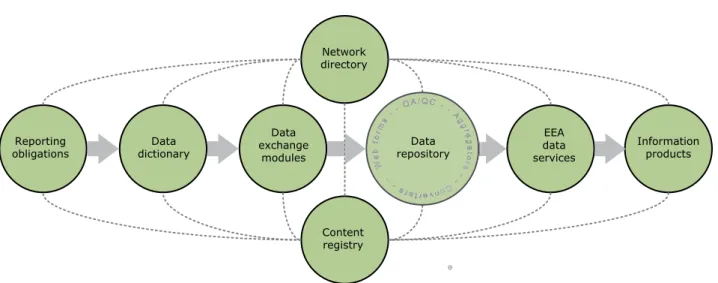
The EEA's own infrastructure and the related suite of web-based tools and applications for supporting and improving the environmental data and information flows was made available to the ENP-South partner countries. Referred to as
II Dataflows and infrastructure
development
(12) http://enpi-seis.ew.eea.europa.eu/seis-infrastructure/working-groups-information-technology/south.
Figure I.8 Reportnet tools for streamlining flows of environmental information in Europe
Information products Content registry Data dictionary Reporting obligations EEA data services Data exchange modules Network directory Data repository
Reportnet, this system of tools assists countries to report data and information into a formal reporting process, to keep track of all obligations, including the quality assurance of delivered data (Figure I.8). The reporting process is comprised of the following steps:
• setting up the Reporting Obligation Database (ROD) — the module of the reporting system that connects data to policy requirements; • building a national network for reporting
which comprises of identifying and nominating responsible persons in each country and of creating a directory in the system as well as setting up permissions;
• creating harmonised data specifications; • creating the necessary folder structure in the
Mediterranean Data Repository (MDR), thus preparing the system to receive deliveries;
• retrieving data from national databases and delivering it in the harmonised structure • checking and validating deliveries;
• building a database for the Mediterranean region.
Setting up the ROD
There are numerous reporting obligations, involving a great variety of national, regional and international institutions. The related reporting procedures are usually complex, making it difficult for both countries and institutions to know exactly what the obligations are, when the deadlines fall and in which formats the data and information should be submitted. The backbone of the reporting system is an up-to-date overview of the requirements and the deliveries. ROD is available for everyone and is now updated to include the obligation to deliver data in support of the H2020 process.
Nomination of data reporters
Data uploaded in the reporting system are official data provided by the country. This means it is important for the countries to nominate responsible persons who will upload or provide links to the required data in the required format and can ensure that the data provided are the official ones. The data reporters are also the key contact for any questions or clarifications related to the reported data. This nomination is in important step in the process to guarantee that data are shared and delivered in a transparent and coherent manner. Seven out of nine ENPI-South partner countries officially nominated data reporters. The ENPI-SEIS project team compiled the network directory of the data reporters and provided the necessary permissions in the system. Harmonised data specifications
The Indicator Specification Factsheets (ISF) are used to clarify data needs and support the long process of data specification. The data specifications cover all aspects related to harmonised data such as: • title, definition and size of fields;
• different code lists to be used (country codes, regional codes, codes for data collection methods etc);
• expected value of fields; • expected data type;
• expected measurement units;
• methodology to be used for collecting the data.
These specifications help the countries to match the required elements in their national databases to the required fields in the regional harmonised structure and prepare data for delivery.
Setting up the Mediterranean Data Repository The reporting system is equipped with a module that serves as a storage place for the data to be delivered, all Mediterranean countries are grouped under the Mediterranean Data Repository (MDR). The system enables simple automated quality checks to be made. The MDR module is also used to provide feedback on data delivered. The module contains envelopes for each requestor and folders for each obligation. The ENPI-SEIS team set up the necessary envelopes and folders to have the system ready for receiving data under H2020. Each country is responsible of the management of its own envelope to allow a management of the information as close as possible to its source.
Providing data from national databases At national level data necessary for the regional indicators are stored in several databases which sit in different ministries or institutes. The national focal points ensure coordination at national level for these data to be collected and prepared according to the required format, then thedata reporter makes the delivery. To ease this process and support effective coordination among the national institutions and partners involved, countries have set-up national teams or committees to oversee this, like in Palestine, Tunisia.
Validation and quality check
The system is enabled to make automated quality assessments and provide feedback, however it is not yet set up to do so for the first round of H2020 data deliveries. The validation and quality checking of data is currently carried out manually and if needed data reporters are contacted individually to clarify discrepancies.
Building the regional database
The selected H2020 regional indicators are built using several datasets. Each country provides each dataset in a different folder. This makes the system transparent and with a clear division of responsibilities, but makes the use of data for regional assessments difficult. To ease the process, the ENPI-SEIS team is compiling a regional database by merging the different deliveries into one large database, called the Mediterranean database.
At discussions held during the 3rd RMR meeting (June 2012, Copenhagen) and the 2nd Working Group (WG) meeting on Environmental Indicators (October 2012, Copenhagen), the project team and working group members confirmed their interest in the development of country assessments as part of the H2020 reporting process.
The country level assessment section of the H2020 report is the opportunity to present national situations and responses. Such country analyses can simultaneously support national State of the Environment activities and other major regional assessments (e.g. UNEP/MAP State of the Marine and Coastal Environment, Mediterranean Strategy on Sustainable Development, African Environment Outlook, Arab Region Outlook), as well as global demands (e.g. UNEP-Live and the GEO process). These national narratives also provide information about the unique circumstances that influence national and local policy implementation. The aim of the country level assessment (Part 3 of this report) is to provide a concerted view of the national environmental efforts in the
ENP-South partner countries. This set of assessment complements the regional indicator-based
assessment presented in Part 2 of this report, enabling countries to focus on the priority issues from a national perspective, contextualizing the diversity of country realities and highlighting country-specific issues. The country level
assessments are also an opportunity to communicate issues of particular national concern.
The country level assessments have been prepared by the countries themselves, guided by the EEA and the project team. A guidance document and templates (13) have been developed for this
purpose. It is hoped that regular, rather than ad-hoc, development of country assessments will be produced.
III Developing country assessments
Six assessments, from Egypt, Israel, Jordan, Morocco, Palestine and Tunisia, are included with Part 3. The other countries were not in a position to produce or deliver such an assessment for reasons such as lacking in technical and/or financial means or facing long national validation process of their assessment of H2020. Nevertheless, they have been all actively involved in the process.
The country level assessment has four objectives. The first is to analyse the environmental situation and prospects in countries with respect to the three H2020 priority areas.
The second is to provide better understanding of the diversity and complexity of the national situation. As no single country can be held responsible for the deterioration of the Mediterranean environment, no single country can protect it by acting alone. The analysis of existing country realities will contribute towards more coordinated actions that promote regional collaboration.
The third objective, therefore, is to provide the space within which countries can highlight additional issues of particular interest to themselves.
The final objective is to look beyond the specificities of the regional report and to consider how the review and monitoring process and the H2020 initiative can be seen as the 'single vehicle' for putting in place a streamlined approach to country analysis.
The country assessments are organised around a set of structured guiding questions for all three H2020 priority areas so that each national situation is assessed and described in a comparable way. For each priority area, the questions follow the DPSIR (Driving Forces-Pressures-State-Impacts-Responses) framework used to assess and manage environmental problems as depicted in the diagram below.
The current country assessments are available online at: http://www.eea.europa.eu/publications/horizon-2020-mediterranean-report.
IV Achievements and lessons learned
While supporting the RMR mandate, ENPI-SEIS provides guidance in setting up a process for a sustainable and continuous reporting mechanism of H2020. This mechanism allows for the improved sharing of environmental data, which will support content generation required to evaluate progress on H2020 issues. There have been a number of achievements and lessons learned both in terms of the process itself and the progressive implementation of SEIS than in terms of the production and
development of the selected indicators.
IV.1 Inter-institutional cooperation at national and regional level
One key factor in the overall successful implementation is the establishment and maintenance of strong inter-institutional
cooperation and coordination at the national level. This cooperation goes beyond the institutions that are directly involved in H202 and the ENPI-SEIS project. It includes all other stakeholders such as the data producers, data owners and data users of each indicator. The group of stakeholders varies from country to country but may include the Ministries of Interior, Industry, Water and Irrigation, as well as external holding companies. In some countries, inter-institutional cooperation remains very weak and is still based on ad hoc requests such as in Egypt, Lebanon and Palestine. In other countries, committees and national working groups representing different institutions have been established to work on the implementation of SEIS e.g. Coordination committees for each sectors in Jordan, National team for developing the Palestinian Environmental Information System; SEIS team in Tunisia. In some cases, such agreements have been formalised through Memoranda of Understanding on data exchange, case of Palestine. This is a major achievement in the implementation of SEIS. In order to support the establishment of
inter-institutional cooperation, a number of national workshops have been organised in all eight
ENP-South partner countries during March–June 2013. The aims of these workshops were to bring
together the national stakeholders, map the national actors involved in populating the H2020 indicators, get insight into the extent of development of SEIS in each country and achieve a common understanding on the overall process. The national workshops proved to be an effective way to achieve these objectives.
To ensure proper coordination with UNEP/MAP activities and network, particularly on pollution reduction and indicators activities, the project itself, and development of the H2020 review mechanism, have been carried out in close cooperation between the EEA and UNEP/MAP.
Coordination with other appointed thematic contact points took place, in particular with Horizon 2020, MED POL focal points, and the Sustainable Water Integrated Management (SWIM) Regional Technical Assistance Programme and the Regional Solid Waste Exchange of Information and Expertise Network SWEEP-Net networks. This coordination has allowed for the streamlining of activities, in particular as regards capacity building.
IV.2 Establishment of thematic network
The establishment of a network of focal points on SEIS — bringing together one representative of statistics and one representative of environmental institutions, IT and national thematic experts from the ENP-South partner countries serves as a platform for sharing country experiences, successes or
challenges and as a mechanism for national-regional exchange. In some Mediterranean countries these networking structures are already well in place (e.g. Eionet, MED POL); for others such networks are under consolidation, however they have contributed towards remarkable advances in countries where the stability and continuity of national focal points, and of the people working in the SEIS project team, could be ensured and sustained.
This continuity contributes towards strengthened national capacities, which forms the basis of successful regional initiatives.