Call for Champions:
1
st
CalPlug Set‐Top‐Box workshop
Feb 1
st
, 2012
California Plug Load Research Center
4100 Calit2 Building UC Irvine Irvine, CA 92697‐2800
Office: 949.824.6900 www.calplug.org
CONTENTS
Overview ... 3
Workshop Summary ... 4
Technical Innovations ... 4
Soft Barriers ... 6
Alternative Business Models ... 7
CalPlug STB Research: Call for Champions ... 8
Future plan for Workshop followup ... 9
Figure 1. Workshop attendee statistics (not including UC Irvine participants) ... 3
Figure 2. Example of multi‐room solutions: DirecTV with RVU Technology ... 4
Figure 3. Broadcom 4‐state STB DISPLAY ... 5
OVERVIEW
February 1st 2012, the California Plug Load Research Center (CalPlug) attracted nearly 60 industry, government and academic experts to its inaugural set‐top‐box (STB) workshop in Irvine, California. The wide range of attendees included television service providers, set‐top box‐ and microelectronics manufacturers, utilities, public agencies and academic researchers. More than half of the invited guests contributed as speakers or panelists on current technology, markets, standards, test procedures and service trends for energy efficient STBs. Technical innovations, barriers to implementation and alternative business models were also addressed.
Workshop participants toured the CalPlug facility on the fourth floor of the Calit2 Building, where CalPlug researchers and students demonstrated current and future technologies for energy efficient electronics. Research demos included the CalPlug engineering laboratory showcasing STB testing procedures and results, simulated residential and business environments for field testing of appliances and devices, IT driven energy management systems with latest metering and wireless technologies.
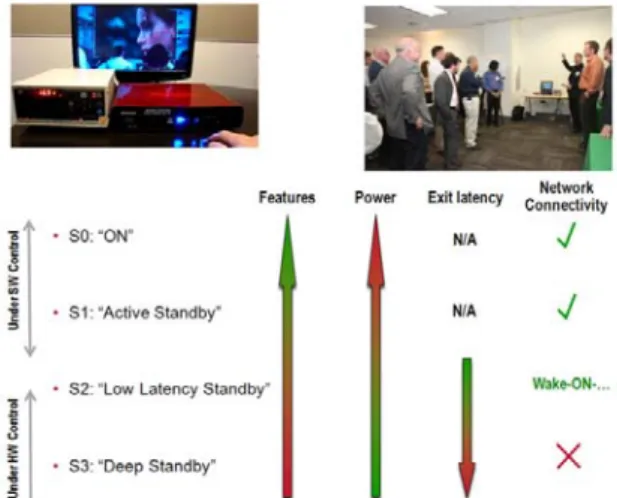
CalPlug also serves as a channel to promote energy efficient technologies. At lunch break, several workshop participating companies also showcased their recent advancements in energy efficiency solutions. A major Satellite TV service provider, DirectTV, displayed seven generations of STBs running live programs, demonstrating the great potential in system‐level power savings. A major STB chip manufacturer, Broadcom, presented a four‐state 5‐sec‐recovery STB sleep solution. An Orange County startup company based on cloud‐based energy management systems, FutureDash, showcased an integrated gateway device capable of home energy monitoring at individual plug load device level.
Accomplishments:
Through this event, CalPlug has:
Established a neutral, collaborative forum for all STB stake‐holders to stay informed on latest technology and policy developments, and to make concerted efforts in the near future. Identified top‐priority research directions that CalPlug can best focus on. CalPlug is currently seeking Champions from the STB community to join force in energy efficient STB research.
Received support from a number of participants to engage separate research areas.
Figure 1. Workshop attendee statistics (not including UC Irvine participants)
WORKSHOP SUMMARY
Since the Version 2.0 release of the Energy Star STB program in 2008, STB service providers and manufacturers have made significant improvements in reducing energy consumption. Recently, over 52% of the current STB sales (15 million units) are qualified by Energy Star 2.0 standard, and more than 48 models now meet Energy Star 3.0. Many service providers and manufacturers have been actively involved with R&D and deployment plans for more efficient STBs, as well as participating in a variety of industry or government recommended energy standards. More efficient integrated chips and circuit designs continue to reduce the overall power consumption during active operation; scalable operating power at chip and system level prevents unnecessary energy loss; technologies for peripheral components, such as hard drive and tuner, improve over each development cycle. This trend, if it continues, can potentially save America up to five Rosenfeld of electricity (15,000 GWhrs) annually. The California Energy Commission believes up to 3,000 GWhr/yr saving is reachable for the Golden State. However, as unit power usage goes down, older units remain in the stock and the number of STBs in use continues to climb, the intricacy of making projections continues to be a concern.
Undoubtedly, STBs are still among the largest energy users in the plug load category, and there are technical and non‐technical issues that may impede further power reductions. The most popular pay TV service infrastructures, including cable and satellite, must maintain high quality and security of the content delivered through the network. To introduce effective energy saving solutions, such as various sleep mode(s), one needs to consider any potential interference with user experience and upstream communication. To establish a widely accepted power standard for STB design houses and testing facilities, top‐down energy programs and industry‐led initiatives need to converge based on actual power saving data and manufacturing feasibilities. And to subsidize the cost of upgrading and retrofitting existing systems, a holistic incentive program is needed to combine split interests among utilities, manufacturers, service providers, and consumers.
The one‐day workshop at CalPlug covered this involved topic in details. We sumarized the most relevant points in the following three categories, which coincides with the topics of the afternoon sessions:
TECHNICAL INNOVATIONS
“The forest and the trees”: Set‐top‐boxes are
networked devices. Cable, satellite, terrestrial and IP based service providers have established complex wired and wireless network infrastructure to securely deliver TV program content to paid customers. Any energy efficient solution needs to consider the distributed energy consumption within the network while maintaining security, content rights, and up‐to‐the‐minute program information. Traditional per unit energy quotas are becoming less
effective as average American households start to FIGURE 2. Example of multi‐room solutions: DirecTV with RVU Technology
demand more STBs of different kinds, to support multiple TVs and mobile viewing devices. If strict energy consumption caps are applied per unit, manufacturers may be forced to produce more discrete devices that collectively consume even more energy. Thus “whole‐home” TV viewing energy reduction should become one of the main objectives for energy efficiency studies.
Multi‐room solutions with a server device and multiple clients are highly scalable to future energy efficiency needs. Alliances such as MoCA (Multimedia over Coax Alliance) and DLNA (Digital Living Network Alliance) have made significant advancements in digital content sharing among consumer devices in multiple locations. The latest RVU protocol allows cross platform viewing experience through a RVU server. DirecTV’s RVU HD‐DVR architecture is projected to save 70% of energy for a three‐room configuration, compared against a 2006 typical installation (Figure 2). Thin‐clients, RVU TVs and personal mobile devices are replacing power‐hungry HD‐DVR boxes. System level power saving is achieved. Motorola’s “gateway+clients” setup also promotes a similar concept of “whole‐home” energy reduction.
The “Crying baby”: The latest STB power survey data from NRDC (Natural Resources Defense
Council) and EPA (the U.S. Environmental Protection Agency) showed very little difference between active and idle modes. Future power saving modes, including various implementations of “sleep modes”, could be frustrated by the “crying baby” symptom, where low duty‐cycle features, such as the programming guide and software updates, keep the whole system awake and consuming energy. On the bright side, as multi‐core processors and scalable power SoCs (System on a chip) are being introduced to the next‐gen STB lines, power saving standby modes and concepts are demonstrated by several manufacturers.
At the workshop, Broadcom displayed a BCM 7425 SoC powered STB that Broadcom reports is capable of four power states with 5 second recovery from a extremely low‐power deep sleep. Although conditional access and live TV programming are not included in this design, it is still very encouraging to see how low the baseline power consumption can be. Motorola Mobility’s latest DCX3501 DVR and DCX700‐M Client STBs are reported to have over 32% of power reduction with MMI’s proprietary sleep mode design. DirecTV also has implemented for all its customers a software enabled power saving mode that turns the box to sleep after 4 hours of no user activity.
While many participants shared their knowledge on hibernating STBs, with high hopes for potential savings, concerns were also raised around unavailable communication for program guide/software update, authorization keys, remote access and scheduled recording during hibernation. Suggestions were made such as integrating an always‐on “watch‐dog” module and following a common power mode protocol, for instance, the Advanced Configuration and Power Interface (ACPI).
Connected STB standards and testing procedures: Several organizations and agencies, including the International Electrotechnical Commission (IEC), the Canadian Standards Association (CSA), Energy Star and the Consumer Electronics Association (CEA), have established STB power standards and measurement procedures. The US Department of Energy has begun formal
proceedings to eventually apply energy conservation standards for STBs by 2018, which is roughly one average STB life‐time away. The California Energy Commission’s Public Interest Energy Research Program (PIER) has invested in research projects at CalPlug in order to demonstrate feasibility of energy efficient STBs.
Standards and testing procedures from different organizations are gradually converging, with exceptions in power mode definitions, feature allowances and STB classes. Industry‐led standards from the Consumer Electronics Association (CEA 2013, 2022) and the voluntary Energy Star program (V3.0) have set complementing energy standards and testing procedures, referencing IEC and CSA standards. The proposed DOE test procedure and standard, for example, will not adopt allowances for varying STB features.
One dilemma facing new STB designers is between the increasing demand for richer features and more stringent energy requirements. The current and future STBs need to handle far more advanced networking and graphic computing tasks with much less power. It is thus natural to see definitions of STB classes and their energy allowances emerging in many energy standards. While energy allowances for variable features do limit additional energy usage, the question of whether a “hard cap” is needed to define the absolute maximum will be debated.
Innovating Around the STB: Several attendees argued that the traditional STB may soon be
history. Video and television channels can be obtained on a television set by other means, such as the Internet or Wi‐Fi; television can be watched on mobile devices; other devices can have the STB functions embedded in them. Alternatively, since the STB is already established as the center of the home entertainment system, it could take on added functions, such as a general gateway for all residential networking.
SOFT BARRIERS
STB energy efficiency is a topic that connects several industries. A STB is designed by manufacturers per service providers’ specifications, balanced by the current market demand for features. The boxes’ delivery to pay‐TV subscribers largely depends on the coverage of service and/or switching cost. The actual energy usage and final electricity bill, even for the future “green” STBs, will be determined by individual user behavior. Innovative products to watch traditional TV program almost “everywhere” further complicate the estimation of overall power consumption. Consumers’ annoyance will increase unless energy efficiency designs are implemented carefully. Long waits before device restart, interruptions to viewing and recording, or poor visual quality will make consumers reject energy efficiency designs. Since consumer usage defines the opportunities and the acceptance of new technologies, systematic consumer behavior studies are essential to future energy saving designs. The mobile industry, born with the natural power limit from the batteries for mobile devices, has evolved well by balancing power and performance through technologies adapted to the user behaviors. The next generation STB design can certainly borrow good design practices from mobile devices.
True savings data from actual users are needed as conventional calculations of “deemed savings” become less accurate, and as more power saving modes are introduced with variable duty cycles. We have seen STB power consumption reports from environmental groups, energy programs and testing facilities, based on data collection with a limited number of DUTs (device‐under‐test) in a
laboratory setting. STBs of different classes and feature groups are assumed to have standard duty cycles in order to extrapolate annual TEC (total energy consumption). Once more effective “sleep modes” are introduced, “Live” field testing data by sampling real households are going to be more convincing than mere estimations.
ALTERNATIVE BUSINESS MODELS
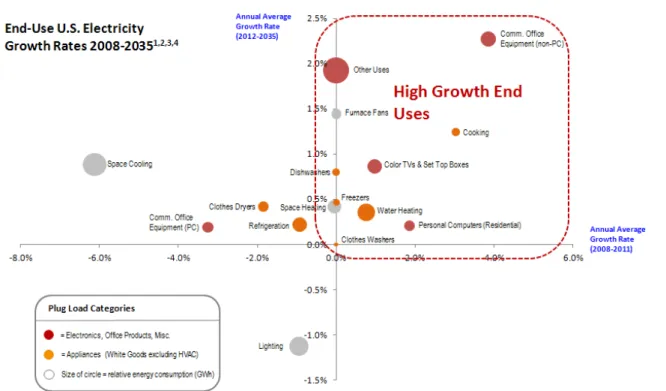
FIGURE 4. Continuous high growth consumer electronics, including STBs (1. U.S. Energy Information Administration, Annual Energy Outlook 2011, Residential and Commercial Sector Key Indicators and Consumptions; 2. Size of bubble indicates relative magnitude of end‐use electricity; 3. Other Uses includes home audio equipment, DVDs/VCRs, Imaging Equipment, and other small electric devices (i.e., “miscellaneous” equipment); 4. All end‐uses are residential with the exception of commercial office equipment)
“A slippery frog”: We are chasing a fast evolving category of products with hard to define
boundaries and subcategories. Every year, new models of STBs are released and new energy standards are formulated. As one speaker indicated, trying to control this progress is like trying to catch a slippery frog. Traditional per‐device incentive programs based on deemed savings cannot respond rapidly to the new technologies and new installations. And since the average life time of a STB is around seven years, multiple generations of STBs coexist to make utilities’ projection work convoluted. On the other hands, once a new incentive program is out, it quickly devolves into “free ridership” which doesn’t reward the best solution. A “winner‐take‐it‐all” incentive for better designs and implementations might be the way to bring about the best solutions originated within the industry.
Among all stakeholders, utilities are probably the best motivated and the most effective to incent less energy consumption at regional scope. Companies such as Southern California Edison are devoted to implement strategies for STBs and other appliances through: consumer education and
motivation; idle power reduction; demand‐response programs; and active industry event participation. The incentives from utilities can go directly to consumers, service providers and/or manufacturers. Collaborations such as testing procedures and facilities, usage/installation data sharing and co‐marketing opportunities can further strength the relationships.
Replacing all existing STBs across the nation is not likely to be accomplished by any government or utility incentive programs; one speaker estimated the price tag at $18 billion. “Cash for Clunkers” won’t work in this case. A gradual phasing‐out plan for less efficient STBs is more likely to happen across the next five to ten years.
CALPLUG STB RESEARCH: CALL FOR CHAMPIONS
CalPlug will continue to work with all interested stakeholders. The best solution can only come from the best intelligence from all parties. In an ideal world, we want to work with silicon chip manufacturers and device manufacturers on fundamental designs for adaptive power STBs; we want to work with service providers on live‐feed system testing and actual usage/upgrade/replacement data collection; we want to work with utility companies on designing rapid adaptive incentive programs to ease transitions; we want to work with government and industry alliances to set energy standards based on realistic technology and market data; and we want to work with environmental groups to monitor the overall impact on our already burdened environment.
In the real world, CalPlug will focus on a few concentrated areas over a year and a half to generate results most effectively. One important function for this summary is to call out for industry, government and institution champions to coordinate with CalPlug on the following action items:
1. Standard terminologies, labeling and testing recommendations for STB power modes
CalPlug wants to propose a standard set of power modes to facilitate technical communications. It is recommended to have no more than four standard alternative operational levels for an STB, instead of current mixture of terms, including “active”, “idle”, “light sleep”, “deep sleep”, “hibernation”, “shut‐down”, “scalable power modes”, etc. The defined modes might have to be varied for satellite, terrestrial, cable, or IP implementations. The recommended definitions may be based on specified levels of energy reduction or on specified functional reductions, whichever is deemed more feasible for manufacturers. A complete consensus on terminology, however, is neither practical nor required.
2. STB power testing and analysis
To acquire the first hand data, CalPlug seeks to generate a power consumption report for available STB systems. The CalPlug team would like to work with service providers from different categories to measure actual energy consumption in operational settings, using one or more of the recognized test methods. User volunteers may be introduced into the study of usage patterns. Under mutual agreements and permissions, CalPlug may conduct open box investigation on certain STBs from collaborating manufacturers, in order to perform preliminary design assessment.
3. Sleep function with fast recovery and conditional access
CalPlug plans to demonstrate “light sleep” enabled STB platform in a laboratory environment, after investigating its power saving potentials. We will also explore software solutions to retrofit deployed STBs for the recommended “light sleep” function. Since restart/refresh time from sleep is critical to user experience, we will examine potential triggers from occupancy information and scheduled activities. Finally, we will compare commercially available after‐ market devices for power control with built‐in solutions.
4. STB user feedback study
CalPlug will study consumer adoption of energy efficient technologies through user data collection and analysis, in collaboration with utilities and service providers. Latest power saving modes will be tested with actual users first in a simulated then in a field study environment. Volunteers ranging from students and researchers to California STB users will participate in this study. How to guide consumer towards better awareness of energy efficient products and how to educate them of available energy efficient technologies are both important.
5. Beyond STBs: additional functions
CalPlug will work with the champions to investigate value‐added features that can indirectly assist the big‐picture power savings. These functionalities may include using STBs as home energy management systems, home security systems and home telemedicine systems. Peripheral wired and wireless demand‐response and power pattern recognition devices are also potential candidates for research. On the other hand, some STB functions can be added to other devices, allowing STBs to appear more efficient.
FUTURE PLAN FOR WORKSHOP FOLLOWUP
To continue the synergy we started at the first workshop, here is the plan for future interactions and collaborations:
A by‐invitation‐only online forum on CalPlug website (www.calplug.org) is designed to exchange information among champions for research areas and registered participants to Feb 1st and future workshops;
CalPlug will host quarterly telecom meetings for interested participants to receive information and update progress;
CalPlug will continue to host the STB workshop series every six months for official progress reports and re‐evaluation of mile stones.
Please don’t hesitate to contact us for any suggestions and comments. We will do our best to include voices from all.