THE EFFECTS OF E-COMMERCE ON SUPPLY CHAIN IN TURKEY Gülsüm AYDIN
İstanbul University Engineering Faculty Department of Maritime Transportation Management Engineering
I.U. Eng. Fac. Department of Maritime Transportation Management Engineering Avcilar Campus/Avcilar/Istanbul/Turkey
E-mail: [email protected]
Sibel BAYAR ÇAĞLAK
İstanbul University Engineering Faculty Department of Maritime Transportation Management Engineering
I.U. Eng. Fac. Department of Maritime Transportation Management Engineering Avcilar Campus/Avcilar/Istanbul/Turkey
E-mail: [email protected]
Güler ALKAN
İstanbul University Engineering Faculty Department of Maritime Transportation Management Engineering
I.U. Eng. Fac. Department of Maritime Transportation Management Engineering Avcilar Campus/Avcilar/Istanbul/Turkey
E-mail: [email protected]
─Abstract ─
Electronic commerce (e-commerce) and the internet are fundamentally changing the nature of supply chains, and redefining consumer reaction in supply chain era. In addition to standard forms for business-to-business transactions, e-commerce encompasses much wider activity. A new form of cooperation known as a virtual company, performing some of the processes needed to manufacture a product or deliver a service, has flourished. Nowadays, promoting the development of electronic commerce is one of the key factors in the most competitive and dynamic knowledge-based on business economy. In this paper, the general information about e-commerce will explain. The economical affects of E-commerce both consumer and producer side will highlight. Then, the
application and indicators of using E-Commerce in Turkey and recent developments in e-commerce such as security will emphasize.
Key Words: E-Commerce, Supply Chain, Business Commerce, Turkey.
JEL Classification: M Business Administration and Business Economics; Marketing; Accounting
1. INTRODUCTION
The term “commercial” include the following transactions: any trade transaction for the supply or exchange of goods or services; distribution agreement; commercial representation or agency; factoring; leasing; construction of works; consulting; engineering; licensing; investment; financing; banking; insurance; exploitation agreement or concession; joint venture and other forms of industrial or business cooperation; carriage of goods or passengers by air, sea, rail or road (UNCITRAL Report,1996).The Internet technologies have tremendously changed the way of doing business in general, and commerce in particular. Being able to buy and sell goods or services over internet is an important step towards achieving an anywhere, anytime by e-commerce. Location and time will no longer constrain for consumer from completing their transactions (Maamar, 2003). On the other hand, the purpose of these technologies is to attract more consumers and encourage them to participate in online commerce. At the same time users have more opportunities to be informed about the current trend of the market dynamics such as price, on line catalog etc. before making any decision. The number of online shoppers in Europe is predicted to increase from 100 million to 174 million by 2011, according to a Forrester Research study. In total, this would lead to an E-Commerce market in Europe worth 263 billion EUR. It is important to recognize that e-commerce is going to be the driving force of economic development in countries, especially Turkey.
2. DEFINITION OF E-COMMERCE
Electronic commerce is more than ordering goods from an on-line catalog. It involves all aspects of an organization's electronic interactions with its stakeholders, the people who determine the future of the organization. Electronic
commerce is the use of computer networks to improve organizational performance. Increasing profitability, gaining market share, improving customer service, and delivering products faster are some of the organizational performance gains possible with electronic commerce. (Watson,2008)
Three primary processes are enhanced in e-commerce:
• Production processes, which include procurement, ordering and replenishment of stocks; processing of payments; electronic links with suppliers; and production control processes, among others;
• Customer-focused processes, which include promotional and marketing efforts, selling over the Internet, processing of customers’ purchase orders and payments, and customer support, among others; and
• Internal management processes, which include employee services, training, internal information-sharing, video-conferencing, and recruiting. Electronic applications enhance information flow between production and sales forces to improve sales force productivity. Workgroup communications and electronic publishing of internal business information are likewise made more efficient.
2.1Types of E-Commerce
The major different types of e-commerce are: business-to-business (B2B); businessto-consumer (B2C); business-to-government (B2G); consumer-to-consumer (C2C); and mobile commerce (m-commerce) (Andam, 2003).
• B2B e-commerce is simply defined as e-commerce between companies. This is the type of e-commerce that deals with relationships between and among businesses. The B2B market has two primary components: e-frastructure and e-markets.
• Business-to-consumer e-commerce, or commerce between companies and consumers, involves customers gathering information; purchasing physical goods (i.e., tangibles such as books or consumer products) or information goods (or goods of electronic material or digitized content, such as software, or e-books); and, for information goods, receiving products over an electronic network.
• Business-to-government e-commerce or B2G is generally defined as commerce between companies and the public sector. It refers to the use of the Internet for public procurement, licensing procedures, and other government-related operations. This kind of e-commerce has two features: first, the public sector assumes a pilot/leading role in establishing e-commerce; and second, it is assumed that the public sector has the greatest need for making its procurement system more effective
• Consumer-to-consumer e-commerce or C2C is simply commerce between private individuals or consumers.
• Consumer-to-business (C2B) transactions involve reverse auctions, which empower the consumer to drive transactions.
• Mobile commerce (M-commerce) is the buying and selling of goods and services through wireless technology-i.e., handheld devices such as cellular telephones and personal digital assistants (PDAs).
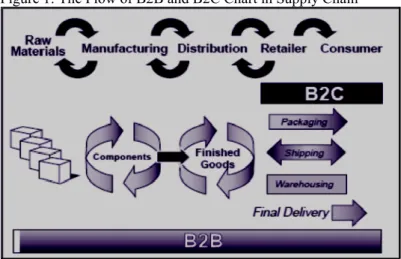
As figure 1 shows, one of the key elements will be the ability to manage end-to-end business transactions throughout the supply chain. This is becoming even more critical as the trend toward outsourcing in supply chain. The key players such as consumer, manufacturer and retailer will need to be linked together in order to success on ecommerce.
Electronic commerce (e-commerce) is the set of products and processes facilitating the secure purchase of goods and services over the Web, including such functions as: advertising, marketing, shopping, purchasing, paying, shipping/delivery. E-commerce applications can be listed as follows;
• retail stores (books, music, auction sites),
• cooperating businesses (placing orders, paying invoices etc.), • electronic banking,
• booking tickets - trains, cinema, airlines, electronic publishing, • government application (filling tax returns)
Figure 1: The Flow of B2B and B2C Chart in Supply Chain
Source: IPC White Paper Report, 2000;5
Over the last years, though, a digital infrastructure became imperative for broad sectors of businesses in all highly developed countries. In addition to this, companies such as Amazon, eBay or Google certainly make money out of something, and are so inherently. E-Commerce becomes more and more integrated in daily life. In 2008, Amazon was by far the leading Internet retailer in the US with a sales volume of USD 19 billion, followed by Staples with 8 billion. The Brazilian B2C E-Commerce market is dominated by consumer electronics retailers such as Americanas.com and Magazineluiza.com. Multichannel retailer Tesco reached online sales of GBP 1.9 billion in 2009, up by 20% compared to the previous year. La Redoute is the leading retail clothing site in France, with 6.8 million unique visitors in July 2009. The major E-Commerce players in South Korea are GS Homeshopping, CJ Homeshopping and Hyundai Homeshopping (www.ystats.com).
2.2 E-Commerce in Turkey
Turkey's economy is increasingly driven by its industry and service sectors, although its traditional agriculture sector still accounts for about 30% of employment. Turkey's traditional textiles and clothing sectors still account for one-third of industrial employment, despite stiff competition in international markets that resulted from the end of the global quota system. Other sectors,
importance and have surpassed textiles within Turkey's export mix (www.cia.gov).
With a deep-ingrained Internet usage shaping many people’s daily life, it is obvious that different spheres of live are affected through the Net. One of these spheres is shopping. An Internet host is a computer connected directly to the Internet; normally an Internet Service Provider's (ISP) computer is a host. Internet users may use either a hard-wired terminal, at an institution with a mainframe computer connected directly to the Internet, or may connect remotely by way of a modem via telephone line, cable, or satellite to the Internet Service Provider's host computer. The number of hosts is one indicator of the extent of Internet connectivity (www.cia.gov). SL is the predominant broadband access technology although cable and mobile broadband are also available. Fixed-line incumbent Turk Telekom is focusing on broadband to generate new revenue streams to offset falling fixed-line voice revenue (www.budde.com.au).
The number of Internet users totaled 35 million in 2010, accounting for 45% of total population in Turkey (www.itu.int). Internet users in Turkey were among the most engaged users in Europe, representing the 7th largest online audience. The number of domestic E-Commerce transactions with domestic and international cards in Turkey reached nearly 92 million in 2010 and volume of transaction reached 15 million TL (www.bkm.com.tr). The number of domestic and international E-Commerce transactions with domestic cards in Turkey reached nearly 96.1 million in 2010 and volume of transaction reached 14.1 million TL. (www.bkm.com.tr).
Sahibinden.com, hesiburada.com, araba.com, cimri.com, Elookat Seri ilanlar, vatancomputer.com, Markofoni.com, Teknosa.com, Biletix.com and Gittigidiyor.com are among the leading players in the Turkish B2C E-Commerce market. The multi-category retailer Hepsiburada.com reached sales of EUR 112 million in 2008. Market place Sahibinden.com, auction house Gittigidiyor.com and online multi-category retailer Hepsiburada.com are the three leading E-Commerce players in Turkey. Markafoni.com, an online private shopping site founded in 2008, reached 430 thousand unique visitors from Turkey in April 2010. Biletix.com, an online shop selling event tickets, had more than 1 million registered customers in 2008 and sell approximately 3.5 million tickets per year.
Online food delivery Yemeksepeti.com currently works together with 3,500 member restaurants and gets more than 15 thousand daily orders from over 610 thousand registered customers (www.reportlinker.com).
E-government services are designed to increase the efficient flow of information between government institutions and businesses. It may include information exchange between government bodies of different nations. These services may utilize some of the components of G2C and G2B services but generally require more direct access to databases and applications (www.cdt.org, 2006).
E-Commerce has emerged as governments look at moving procurement online. The government market is strikingly similar to B2B. Government-to-consumer business has done well. For example, paying for a speeding ticket and a renewing driver’s licence online have paid dividends to governments agencies as well as customers (Awad, 2004).
2.3. New Trends in E-Commerce
E-Commerce is the sales channel of the future. However, even the brightest prospects will not materialize, unless providers keep track of trends, consumer demands and competitors in this challenging market environment. The key to entrepreneurial success in the E-Commerce market is access to objective, reliable and up-to-date inforation that provides an insight into the dynamics of the market. There are many opportunities in e-business for the creation and exploitation of market power. Competition on the internet today is different than we have seen before. The barrier to entry for websites is low. These websites are worldwide that has access to the internet. The absence of boundaries on the internet means that there are many more competitors. The internet eliminates many of the inefficiencies in the marketplace. These inefficiencies are reduced by giving buyers and sellers in e-markets immediate access to endless information about products, services and prices and by enabling an unlimited number of buyers and sellers to transact business, through these virtual marketplaces (Rudnick, 2004).
2.4 Benefits of E−Commerce
The benefits of e-commerce for all related parties such as customers, suppliers and competitors in supply chain can be listed as follows:
• Buying/selling a variety of goods and services from one's home or business anywhere, anytime transaction
• Businesses can reach out to worldwide clients- can establish business partnerships
• Electronic funds transfer faster
• supply chain management is simpler, faster, and cheaper using ecommerce • Reduced cost of doing business for all parties involved i.e. distribution
costs.
• Better visibility in the supply chain.
• Better control and plan over the available resources.
• Online decision support tools coupled with online data availability about the products; reduce the cost and time to select the right product.
• Value-add functions instead of chasing paperwork.
• Available online rating systems that are used or purchased the product or services before.
• To better gather and compile market intelligence
• Business moves to “build-to-order” processing and just-in-time inventories.
• Access to international markets more easily by eliminating traditional barriers such as distance, time-zone differences, eliminates many of the (Kuwayama, 2001), ( Dai ,2001),(Rudnick, 2004)
3. CONCLUSION
E-commerce continues to grow in all sectors. E-Commerce is the sales channel of the future. However, even the brightest prospects will not materialize, unless providers keep track of trends, consumer demands and competitors in this challenging market environment. The key to entrepreneurial success in the E-Commerce market is access to objective, reliable and up-to-date information that provides an insight into the dynamics of the market. In particular, new information technologies and ecommerce are expected to be instrumental in increasing transparency in trading and reducing overall transaction costs.
With e-commerce several people in different locations and with different hardware and software resources may simultaneously initiate purchase requests for the same either different product but with different selection criteria. In e-commerce processes; Reliability, efficiency, scalability, and fault-tolerance are among the features that should be embedded. This processes also allow suppliers to make customers aware of their products.
BIBLIOGRAPHY
Andam, Zorayda Ruth.UNDP “E-Commerce and e-Business, -APDIP The e-ASEAN Task Force and the UNDP Asia Pacific Development Information
Programme (UNDP-APDIP), e-Asean Task Force, 2003
Awad, E., (2003) “Electronic Commerce”, 2nd edition, Pearson Education, USA. Center for Democracy and Technology Database (2006), “E-government” www.cdt.org/legislation/107th/egov/ accessed on 6/3/2010.
Dai, Qizhi (2001), “B2B E-Commerce Revisited: Leading Perspectives on the Key issues and Research Direction, Carlson School of Management University of Minnesota Minneapolis, Doctoral Program MIS Research Center , Minnesota.
Ecommerce Statistics Database (2010)
www.ystats.com/uploads/report_abstracts/765.pdf?PHPSESSID=723056e2f5eb47509dd2 cf28697bcc56.
Kuwayama, Mikio (2001) “E-Commerce and export promotion policies for Small and Medium-Sized Enterprises: East Asian and Latin American Experiences” International Trade and Integration Division- Santiago, Chile.
Maamar Zakaria (2003), “Commerce, E-Commerce, and M-Commerce: What Comes Next?” Communication of the ACM, Vol. 46, No. 12 pp.257
Rudnick, Piper (2004) “E-Business: The E-Business Legal Survival Kit” J.T. Westermeier Lee J. Plave LLP,,2004
www.bbbonline.org/eexport [Accessed 17.03.2011]
IPC E-Business and Supply Chain Committee (2000) The Myths of E-commerce, (2000) http://www.ipc.org/4.0_Knowledge/4.1_Standards/E- [Accessed 8.02.2011]
IPC White Paper (2000) www.ipc.org/4.0_Knowledge/4.1_Standards/E-CommerceWhitePaper.pdf [Accessed 7.03.2011]
The Interbank Card Center -BKM (2011) Database www.bkm.com.tr/bkm-en/istatistik/sanal_kart_ile_yapilan_eticaret_islemleri.asp [Accessed 7.03.2011] Turkey Key Statistics Telecommunication Market (2011)
www.budde.com.au/Page-Not- Found.aspx?404;http://www.budde.com.au/Reports/Contents/Turkey-Key-Statistics-Telecommunications-Market-Overview-and-Internet-2411.html [Accessed 3.02.2011] Turkey-Top-100-E-Commerce-Players Database (2011), www.reportlinker.com/p0209283/Turkey-Top-100-E-Commerce- Players.html#ixzz1IGKX1nRl [Accessed 7.03.2011]
United Nations Conference on Trade and Development (2005) “E-Commerce and Development Report”, United Nations, New York and Geneva, UNCTAD./doc/PlavePiperEComEBusLegalKit.pdf [Accessed 5.03.2011]
UNCITRAL Report (1998) “Model Law on Electronic Commerce with Guide to Enactment 1996 with additional article 5 bis as adopted in 1998”, United Nations, www.uncitral.org/pdf/english/texts/electcom/05-89450_Ebook.pdf [Accessed 2.02.2011] Turkey Internet Indicators (2010) www.cia.gov/library/publications/the-world-factbook/rankorder/2184rank.html?countryName=Turkey&countryCode=tu®ionCode =me&rank=26#tu [Accessed 15.03.2011]
International Telecomunication Union Facts and Figures Database (2011) http://www.itu.int/ITU-D/ict/material/FactsFigures2010.pdf [Accessed 7.03.2011]