ENVIRONMENTAL
PROTECTION
Acknowledgements
Environmental Protection Code Task Force 07
Saeed A. Al-Garni TF Leader SAHARA
Naved Khan Member QAPCO
Sudhir Sivarajan Member BOROUGE
Adil Majid Member NATPET
Abdulrasheed Jaffar Member SABIC Original Issue: June 15, 2011
Re-issue Date: ___ / ___/ _____ Approval: Dr. Abdul Wahab Al-Sadoun Revision Number: 00
Prepared / Reviewed by: Task Force 01
Ownership: Tahir J Qadir, Director Responsible Care® GPCA
Table of Contents
Chapter One ... 4
Introduction
Chapter Two ... 7
Management Practices, Guidance, Suggested
Activities / Examples and Self-assessment
Leadership Planning and Prioritisation ... 7
Management Practice: EP-1 ... 7
Management Practice: EP-2 ... 9
Management Practice: EP-3 ... 10
Management Practice: EP-4 ...11
Management Practice: EP-5 ... 12
Training, Communication and Community Engagement ...14
Management Practice: EP-6 ... 14
Management Practice: EP-7 ... 14
Management Practice: EP-8 ... 16
Implementation, Assessment and Improvement ... 17
Management Practice: EP-9 ... 17
Management Practice: EP-10 ... 18
Management Practice: EP-11 ... 19
Management Practice: EP-12 ... 20
Management Practice: EP-13 ... 21
CHAPTER ONE
Introduction
In December 2009, the Gulf Petrochemicals and Chemicals Association (GPCA) Board of Directors formally adopted the Chemical Industry’s initiative called ‘Responsible Care®’.
Responsible Care® was created in 1984 by the Canadian Chemical Producers’ Association, with the
clear intent of establishing the following goals: • Improved chemical processes.
• Enhanced practices and procedures.
• Reduction of every kind of waste, accident, incident, and emission. • Reliable communication and dialogue.
• Heightened public scrutiny and input.
Responsible Care® has become an obligation of membership in GPCA Member Companies. A
central idea behind Responsible Care® is that implementing it will never be complete. It is not
a program that provides a checklist of activities for member companies to implement. It will be improved continually in light of new information, new technology, new expectations, and a constant reassessment of performance and objectives. Responsible Care® is a way of doing business.
Management Codes
Responsible Care® is underpinned by GPCA through the implementation of a number of
Management Codes as indicated below:
Management Code Document Number
Community Awareness and Emergency Response (CAER) GPCA-RC-C01
Distribution GPCA-RC-C02
Product Stewardship GPCA-RC-C03
Security GPCA-RC-C04
Health & Safety GPCA-RC-C05
Process Safety GPCA-RC-C06
Environmental Protection GPCA-RC-C07
Each of the above Codes includes technical processes called Management Practices. The Management Practices provide specific technical requirements and guidance for Companies to fulfil their responsibilities in terms of Responsible Care® and can be used as a self-assessment tool.
Objective – Environmental Protection Code
This Code is designed to achieve ongoing reductions in the amount of all contaminants and pollutants released to the air, water, and land from GPCA member company facilities. These reductions are intended to respond to public concerns with the existence of such releases, and to further increase the margin of safety for public health and the environment.
The Code is also designed to achieve ongoing reductions in the amount of wastes generated at facilities. These reductions are intended to help relieve the burden on industry and society of managing such wastes in future years.
In implementing the Code, each company should strive for annual reductions, recognizing that production rates, new operations, and other factors may result in increases. Despite these fluctuations, however, the goal is to establish a long-term, substantial downward trend in the amount of wastes generated and contaminants and pollutants released. Quantitative reduction goals will be established for giving priority to those pollutants, contaminants and wastes of highest health and environmental concern.
This code also includes practices that address the broader waste management issues beyond source reduction and other waste and release reduction efforts. Each GPCA member company must manage remaining wastes and releases in a manner that protects the environment and the health and safety of employees and the public.
This Code is divided into the following three categories / elements: 1. Leadership, Planning and Prioritisation.
2. Training, Communication and Community Engagement. 3. Implementation, Assessment and Improvement.
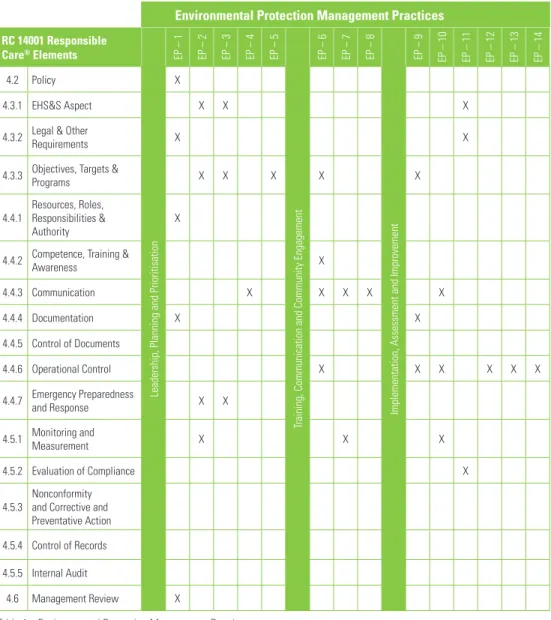
Each category / element is composed of Management Practices as indicated in Table 1 – Environmental Protection Management Practices. Individually, each Practice describes an activity or approach to implementing the requirements of this Code
The implementation of the Environmental Protection Code will help in fulfilling the requirements of the Responsible Care® management system specification RC 14001. Notably, the implementation
will help in closing gaps related to environmental protection requirements of the specification, particularly those requiring the reduction of contaminants and pollutants released from GPCA member company facilities.
Environmental Protection Management Practices
RC 14001 Responsible Care® Elements
Leadership, Planning and Prioritisation
EP – 1 EP – 2 EP – 3 EP – 4 EP – 5
Training, Communication and Community Engag
ement
EP – 6 EP – 7 EP – 8
Implementation, Assessment and Improvement
EP – 9 EP – 10 EP – 11 EP – 12 EP – 13 EP – 14
4.2 Policy X
4.3.1 EHS&S Aspect X X X
4.3.2 Legal & Other Requirements X X
4.3.3 Objectives, Targets & Programs X X X X X
4.4.1 Resources, Roles, Responsibilities &
Authority X
4.4.2 Competence, Training & Awareness X
4.4.3 Communication X X X X X
4.4.4 Documentation X X
4.4.5 Control of Documents
4.4.6 Operational Control X X X X X X
4.4.7 Emergency Preparedness and Response X X
4.5.1 Monitoring and Measurement X X X
4.5.2 Evaluation of Compliance X
4.5.3 Nonconformity and Corrective and Preventative Action 4.5.4 Control of Records 4.5.5 Internal Audit
4.6 Management Review X
Table 1 – Environmental Protection Management Practices
Wherever possible these management practices should be included in the member company’s existing environmental management systems or programs which address Environmental Protection related requirements. More so, these practices should be incorporated into the existing management systems and programs in such a way that these are part of the regular management review cycle.
Chapter 2 includes the Management Practices along with guidance, suggested activities / examples and self-assessment notes which can be used as a self-assessment tool to assist member companies identify gaps and an effective implementation plan to address those gaps.
CHAPTER TWO
Management Practices, Guidance, Suggested
Activities / Examples and Self-assessment
Leadership, Planning and Prioritisation
Management Practice: EP-1
A clear commitment by senior management through policy, communications, and resources, to comply with relevant environmental laws and regulations, and with other requirements, continual improvement and prevention of pollution through ongoing reductions at each of the company’s facilities, in releases to the air, water, and land and in the generation of wastes
1.0 Guidance
A well-defined, comprehensive policy is the driver for implementing and improving an organization’s environmental management system to maintain and potentially improve its environmental performance. The policy should reflect the commitment of top management to comply with applicable legal requirements and other requirements, to prevent pollution and continuously improve. The policy should form the basis upon which the organization sets its objectives and targets. The policy should be communicated to all persons who work for, or on behalf of, the organization, including contractors working at the organization’s facility(s).
The organization’s policy should be defined and documented by its top management. The top management usually consists of a person or group of people who direct and control an organization at the highest level.
1.1 Suggested Activities / Examples
Example No. 1
Typical examples for this management practice are Corporate Sustainability Policy or Corporate Policy on Environment and Waste Minimization / Reduction Goals of the company signed by top management. Policies must have clear statements of recognition and compliance with relevant environmental laws and regulations. Environmental goals are established for the company and expressed to employees and to the public.
Integrate corporate goals into facility and department goals, or vice-versa.
Environmental responsibilities are assigned to personnel at all levels within the Company.
Example No. 2
Each company must tailor its own program of communications demonstrating company commitment to policy objectives and goals. Policies should be published and shared with employees and the public as applicable. Communication can be through mailings or discussions conducted through meetings. Employees must know and understand what top management expects in environmental performance. Each Business unit should communicate that environmental expectations are high and are periodically stated by each Facility Manager. Senior business unit management should periodically visit facilities and communicate to employees their commitment to environmental performance.
Each company should ensure that there is a plan for implementation of the Environmental Protection Code adopted by Senior Management with goals defined for achievement, and effectively communicated to all employees.
Example No. 3
Companies must assign adequate resources to implement the policies and goals. Environmental budgets and staffing levels must be adequate to achieve goals.
Annual training on environmental issues is required at facilities for all employees and evidence of environmental training is available.
There should be environmental expertise on the board of directors and environmental training is required for line managers.
The environmental professional at each facility who has the best knowledge of the operation’s environmental condition is no more than one reporting level from the facility manager
Example No. 4
Environmental planning is integrated with business planning so that acquisitions, divestitures, research and development (R&D) initiatives, capital projects, new products and future actions with environmental ramifications can be appropriately addressed.
Environmental performance and reporting is given as much importance as production, quality and financial performance and reporting. Environmental reporting is included at business meetings. Senior management requires, by facility, periodic reports on environmental plans, goals, performance and prevention of incidents.
Procedures should be in place for environmental incident reporting. Senior management requires written reports on reportable environmental incidents, including their causes and plans to try to prevent recurrences.
Environmental audits are required at all facilities on a periodic basis and corrective action reports are required by senior management.
1.2 Self-assessment
• Is there a published company policy for the environment displayed prominently at Company Facilities?
• Does Senior Management regularly state the importance of the environment in employee meetings or forums?
• Are there defined accountabilities and adequate resources at various levels in the company for meeting the environment programs?
Management Practice: EP-2
Establishment of priorities, goals and plans for waste and release reduction, taking into account community concerns and the potential health, safety, and environmental impacts as determined under Management Practices 3 and 4
1.0 Guidance
This Management Practice deals with setting priorities and goals, developing plans, and communicating them. When establishing priorities, the organization should consider goals, plans, the potential health, safety, and environmental impacts as well as community concerns. Understanding community concerns involves ongoing dialogue with employees and members of the community.
1.1 Suggested Activities / Examples
Example No. 1
Facilities have a list of environmental improvement projects prioritized based on community concerns, environmental impacts and regulations. Resource needs are identified. Waste and release reduction goals are part of the facility’s business plans or performance balance score card and are incorporate into budget and planning cycle.
Example No. 2
Activities to comply with this Management Practice include the identification of resources and specialists needed to assess facility processes. Processes should be analysed to identify reduction opportunities, alternatives for source reduction, recycle/reuse, or treatment of wastes and releases. Results from potential impact assessments and employee and public concern surveys should be integrated with the results from process analysis.
Perform economic and non-economic benefit analysis of alternatives and include ranking of potential alternatives.
Develop implementation schedules wit resource requirements and present recommendations to management.
1.2 Self-assessment
• Is there a documented list of environmental legal compliance with an overall demonstration of compliance, including specific company owned facilities as appropriate?
• Does the environmental improvement plan for wastes and releases include a list of prioritized waste and releases for reduction?
Management Practice: EP-3
Evaluation, sufficient to assist in establishing reduction priorities, of the potential impact of releases on the environment from past, current and future activities, and the health and safety of employees and the public
1.0 Guidance
This Management Practice calls for each company to perform an evaluation of the potential impacts on human health and the environment of the releases and wastes identified in Management Practice 2. This analysis will vary in complexity from facility to facility.
The purpose of evaluating impacts is threefold. First, it can serve as an aid to the company in prioritizing environment projects. Second, it can aid company representatives when discussing the facility’s potential impacts and environment program with neighbours. Third, it can provide a basis for communicating the environment program and its priorities to employees.
Each facility is responsible for developing priorities for controlling atmospheric releases. Each facility should evaluate specific conditions including evaluation of proximity to population and existence of sensitive receptors.
1.1 Suggested Activities / Examples
Example No. 1
The organization develops and implements procedures to identify its environmental aspects and impacts.
Typical activity is evaluation of the impact on the environment due to atmospheric releases to air, water body and releases to land from solid wastes. The facility evaluates the specific spill control measures and waste disposal practices and establishes priorities, taking into account volumes and toxicity. Possible considerations for evaluation are:
• Regulations.
• Odours and visible releases. • Employee and public sensitivities. • Population distance and density. • Volume and toxicity.
• Release pathways. • Modelling and monitoring.
Example No. 2
Each facility needs to develop and implement an Emergency Response Plan that addresses credible environmental incidents.
1.2 Self-assessment
• Have evaluations been carried out for environmental releases in the company including a list of key releases with their legal limits and risk levels?
• Are relevant procedures and controls for environmental releases regularly reviewed? • Are appropriate actions prioritized for the reduction of releases?
Management Practice: EP-4
Inclusion of waste and release prevention objectives in research and in design of new or modified facilities, processes, and products
1.0 Guidance
It is known that environmental protection is beneficial, particularly if the appropriate measures are taken at an early stage.
Consider integrating the concept of environmental protection throughout the lifecycle of products starting from the research and development, engineering design of new or modified facilities, manufacturing, storage, distribution, usage and disposal. Internal integration of comprehensive environmental programs throughout the cycle of the product can help reduce wastes and releases. While integrating environmental programs into strategic planning, product development and cycle, consider issues such as:
• Compliance to current and future regulations. • Quantity of waste.
• Cost of waste management. • Environmental and safety liability. • Potential for minimization and utilization. • Potential recovery of valuable by-products.
• Emerging process technologies that may improve performance. • Finding new markets, etc.
Integration of environmental management practices throughout the cycle of products could benefit the quality of products, minimize material loss, improve health and environment performance, stakeholder confidence and result in higher returns.
1.1 Suggested Activities / Examples
Example No. 1
Conduct workshops / awareness sessions, and have dialogue with operations staff, process and design engineers and environmental specialists who may help to develop ways to reduce the generation of wastes and/or releases.
Example No. 2
Evaluate technological options and new markets for recycle / reuse / reclaim of by-products and wastes to minimize the material loss and reduce waste disposal costs.
Example No. 3
Conduct periodic reviews based on self and internal evaluation to track and measure the actual performance of implemented environment programs, ensuring the learning’s are fed back to Research and Development.
Example No. 4
1.2 Self-assessment
• Are environmental implications considered at an appropriate stage of a new facility, process or product?
• Are the identified aspects and impacts formally assessed and where applicable followed through during future development phases?
• Is there evidence of the outcome of this assessment resulting in alternative solutions being selected?
Management Practice: EP-5
Ongoing reduction of wastes and releases, giving preference to: 1. Source reduction.
2. Recycle / reuse. 3. Treatment.
These techniques may be used separately or in combination with one another.
1.0 Guidance
Being a Responsible Care® organization, the management is focused on the ongoing waste and
releases reduction programs by adopting the ‘3Rs’ principle to sustain environmental performance and ensure continuous improvement. The ‘3Rs’ programs followed in the order of preference are:
1. Reduce.
Minimizing the wastes and releases at source.
2. Reuse.
Recovered material used by the outside customers.
3. Recycle.
Utilizing the waste and releases within the process.
Several techniques can be adopted that will help in reducing the waste and releases, which include:
• Process modifications.
Evaluating the entire manufacturing process and modifying the process parameters to obtain high yields and reduced wastes and releases.
• Materials substitution
Substitution of process chemicals, as appropriate with high efficiency and high selectivity materials and modification of equipment to reduce generation of wastes and releases.
• Housekeeping
Improved housekeeping including material stock control, segregation of wastes, preventive maintenance, spills and leak prevention to assist in improved material utilization and reduced disposable wastes.
• Recycle and reuse.
Recycling and reuse of waste and releases to generate valuable by-products and reduce material loss.
Pollution reduction programs will help in managing environmental responsibilities, compliance with the applicable local / international legislation, improved material utilization and reduced wastes and releases. The engineering and technical experts of the organization can contribute by proposing new materials, equipment modification, recycle / reuse of waste.
1.1 Suggested Activities / Examples
Example No. 1
Conduct meetings, discussions, and have dialogue with engineering and technical experts to review the sources / causes of generating waste and releases and the potential solutions to minimize and recycle / reuse wastes and releases.
Example No. 2
Re-evaluating the entire operations and operating parameters, and modification / fine tuning of these parameters could result in effective reduction of waste and releases. For example, adjusting the combustion temperatures and excess air supply could result in reduced carbon monoxide (CO) and nitrous oxide (NOx) emissions. Regular monitoring and preventive maintenance of steam traps and pressure relief valves could result in energy savings, water conservation and minimized flaring.
Example No. 3
Material substitution, such as the use of high efficiency / selectivity catalysts can give higher productivity and reduced waste and releases. Equipment modifications such as combustion zone modifications and use of low NOx burners could help in reducing air emissions.
Example No. 4
Good operating practices and housekeeping is a basic environmental practice. An efficient material inventory system is supported by acquiring only the material that is needed, combined with storing materials in labelled containers with clearly marked expiry dates ensures the use of the material within the shelf life thereby reducing the generation of wastes from unused materials.
Example No. 5
Segregate different types of wastes to increase opportunities for waste recycling, reuse and reduction of disposable wastes. Evaluate technological options for recycling and reuse of wastes and releases. Spent catalyst regeneration, waste oil reuse as fuel, use of process gases and hydrocarbon waste for energy recovery, lead recovery from used batteries, reuse of treated wastewater and recovered condensate, are some of the potential reuse / recycle areas that help reduce waste and releases. The use of secondary containments, dip trays, splash guards are other examples to contain and recover material during spills and leaks.
Example No. 6
Sharing of waste and release reduction programs with customers, suppliers and business partners to help reduce wastes and releases throughout the product cycle.
1.2 Self-assessment
• Is there an appropriate accountable person(s) appointed for the environmental reduction plan? • Is there data demonstrating the progression of ongoing reduction for the prioritized wastes and
releases?
• Does the plan show preference of reduction hierarchy? Source > recycle / reuse > treatment.
Training, Communication and Community Engagement
Management Practice: EP-6
Education of, and dialogue with, employees and members of the public about the inventory, impact evaluation, and risks to the community
1.0 Guidance
Effective education of employees is the key for the environment and shall not be limited to newsletters, mails, posters, bulletins, etc. Employee technical empowerment programs should involve interactive hands-on process, classroom training, higher education programs, workshops, meetings, etc. The education efforts shall provide an opportunity for both managers and employees to function effectively in a team.
Nearby communities are also important stakeholders in the successful operation of the business. It is very important to win the confidence of the community and to convince them about the environmental risks from the organization’s activities, and the plans and programs being implemented to prevent pollution and make the environment safe. Environmental awareness sessions tailored specifically to the community at pre-arranged meetings are a means of educating the community. The effective education of employees and community awareness could be implemented by establishing a training needs assessment and awareness requirements based on the risk assessment studies. It is important to establish a mechanism to receive and act on employee and public feedback relating to environmental practices to enhance the effectiveness of education and community awareness.
1.1 Suggested Activities / Examples
Example No. 1
Identify the activities that have potential significant environmental risks. Develop standard operating procedures (SOPs) and provide hands on training to the employees associated with these activities and brief them on the impacts of deviating from the SOPs. Conduct regular meetings, training or workshops with employees to refresh their knowledge and track concerns.
Example No. 2
The use of audio-visual aids used during a presentation will drive and focus dialogue, particularly when carrying out community information awareness sessions.
Example No. 3
Conduct surveys, interviews, tests to measure the effectiveness of education, awareness and dialogue, and the perception of employees and community about the organization’s environment efforts.
1.2 Self-assessment
• Is there provision of environmental awareness and refresher training for employees?
• Is there a schedule of awareness sessions targeting the local community associated with a company facility(s)
Management Practice: EP-7
Ongoing dialogue with employees and members of the public regarding waste and release information, progress in achieving reductions and future plans. This dialogue should be at a personal, face-to-face level, where possible, and should emphasize listening to others and discussing their concerns and ideas
1.0 Guidance
Employees are the assets of the organization and play a key role in the environment. Discussing the environment with employees is challenging and requires continual enhancement of the technical knowledge of the employees in developing and evaluating the emissions inventories, estimating the release / spill quantities, assessing the impacts, developing and implementing plans to achieve emission reductions, and risks from the releases.
Nearby communities are also important stakeholders in the successful operation of the business. It is very important to win the confidence of the community and to convince them about the environmental risks from the organization’s activities, the plans and programs being implemented to prevent pollution and make the environment safe.
Identify the spokesperson(s) (internal and external) for the facility and the effective methodologies to facilitate effective education and dialogue.
1.1 Suggested Activities / Examples
Example No. 1
Prepare newsletters, brochures, hand-outs, audio-visual aids and presentations to convey environment information and programs. Simplify and provide the information to be appropriate to the competency of the employee and in a language they can easily absorb.
Example No. 2
Emissions release and waste generation data provides an accepted method for highlighting ongoing results associated with the environment. The data reported in tons is generally not clear to employees and the general public unless accompanied with local regulatory standards.
Example No. 3
The community is not knowledgeable about the organizations activities, releases, discharges, and chemicals handled. Therefore the dialogue should begin with a brief introduction about facility operations and environmental release obligations. This introduction can be supported by brochures and other appropriate hand-out materials. After the introduction, the audience will have a basic understanding of the organization and will be ready to learn about a facility’s environmental efforts.
For this portion of the presentation, data should be updated and presented annually. The format should be simple, clear and easy to revise from year to year. Histograms (bar charts) may be the easiest way to show comparisons and differences. An improving trend in emissions from year to year is an impressive and effective message about reduction efforts.
Example No. 4
Consider dialogue about the way in which the facility is making progress toward reducing wastes and releases. Declare the ongoing costs for environment improvement programs and activities. Highlight voluntary efforts and describe specific reduction programs, or innovative strategies that are underway or planned for implementation.
1.2 Self-assessment
• Is regular dialogue carried out with employees, contractors, neighbours and the community on environmental issues?
• Is there evidence to demonstrate that feedback received during dialogue is utilized when developing future environment improvement plans?
Management Practice: EP-8
An ongoing program for promotion and support of waste and release reduction by others which may include:
1. Sharing of technical information and experience with customers and suppliers. 2. Support of efforts to develop improved waste and release reduction techniques. 3. Assisting in establishment of regional ambient air monitoring networks.
4. Participation in efforts to develop consensus approaches to the evaluation of environmental, health and safety impacts of releases.
5. Providing educational workshops and training material.
6. Assisting local governments and others establishing waste reduction programs benefiting the general public.
1.0 Guidance
The implementation of integrated environmental programs helps in managing environmental responsibilities and acts as a means to guide business organization compliance with applicable local and/or international legislation.
Being a responsible member of the society and a Responsible Care® organization, promote
Responsible Care® by sharing internal integrated environmental programs and experiences and
offering assistance to others involved throughout the product lifecycle. The Environmental Protection Code requires an active waste and release reduction program, and reduced environmental impacts that include an ongoing effort by others for promotion and support of these environment efforts throughout the lifecycle of products.
An ongoing dialogue, communication, information sharing and feedback mechanism with employees and the stakeholders will help in meeting the outreach obligations.
1.1 Suggested Activities / Examples
Example No. 1
Host meetings / workshops / seminars to promote dialogue and awareness with employees and stakeholders and to demonstrate environment programs implemented along with the performance data. Discuss the importance of employee and stakeholder contribution and support for environment programs, resource conservation, household hazardous waste collection / segregation / recycle / disposal, etc.
Example No. 2
Develop newsletters and posters; use the media and organization magazines to publish data related to waste and release reduction, material utilization, reduction in environmental impacts, environment programs and associated costs, and recycling programs.
Example No. 3
Provide environmental information to customers related to product usage, emissions, storage, loading and unloading, waste handling and disposal.
Example No. 4
Share organization’s Responsible Care® experiences and environment programs with customers
and suppliers, business partners, industry committees and government agencies.
1.2 Self-assessment
• Is there information relating to the progress of wastes and release reduction detailed in official company media, i.e., annual reports, newsletters, and website?
• Do representatives from the company participate in industry committees or government agencies to promote exchange of environmental information?
• Does the company provide environmental training or awareness material for external use?
Implementation, Assessment and Improvement
Management Practice: EP-9
A quantitative inventory at each facility of chemicals stored, wastes generated and releases to the air, water and land, measured or estimated at the point of generation or release
1.0 Guidance
A major task in environment efforts is to develop a quantitative inventory of chemicals, wastes and releases. This involves an evaluation of production processes with particular emphasis on identifying, quantifying, and characterizing wastes and release reduction streams. The results of these activities can provide a quantitative inventory of wastes and releases, and form the basis for making informed decisions in setting priorities, plans, and goals.
An organization will need to prepare inventory of the quantities of routine and accidental releases, and releases resulting from catastrophic or other one-time events of hazardous chemicals as well as the maximum amount of hazardous chemical used, i.e., manufactured or processed on the facility during the year and the wastes managed on the facility or transferred off the facility.
1.1 Suggested Activities / Examples
Example No. 1
Possible activities to comply with this Management Practice could be: • Develop and maintain an inventory using existing information and data. • Identify sources of multimedia wastes and releases.
Example No. 2
Appoint a competent person(s) to manage the quantitative inventory of chemicals, ensuring that all waste streams are identified, recorded and updated periodically, based on risk.
1.2 Self-Assessment
• Is there a system to identify and maintain inventory records of wastes and releases? • Do the inventory records show up-to-date and accurate data of all generated waste streams? • Do the inventory records show up-to-date and accurate data of the various types of environmental
releases?
Management Practice: EP-10
Measurement of progress at each facility in reducing the generation of wastes and in reducing releases to the air, water and land, by updating the quantitative inventory at least annually
1.0 Guidance
Tracking and measuring the progress of environment efforts are important for the success of any improvement program.
Effective tracking and measuring can help to:
• Develop effective plans and establish credible goals. • Measure progress against goals.
• Document the program’s effectiveness.
• Assure employees and the public that there is progress. • Satisfy regulatory requirements.
• Track material loss.
1.1 Suggested Activities / Examples
Example No. 1
A company should regularly analyse the annual inventory records for an agreed number of years and identify opportunities for future improvement.
1.2 Self-assessment
• Are the latest planned environmental performance targets monitored?
• Are management informed on the progress of reduction trend and inventory records? • Are historic performances used as a comparison to identify key areas for improvement? • Do operating instructions include early detection of abnormal environment parameters and
Management Practice: EP-11
Periodic evaluation of waste management practices associated with operations and equipment at each company facility, taking into account community concerns and environmental impacts and implementation of ongoing improvements
1.0 Guidance
This Management Practice deals with evaluating waste management practices of company facilities that extend beyond regulatory compliance. Activities that enhance a facility’s ability to cope with change, to advance, and to reduce health and environmental impacts on the community, employees, and surrounding area should be encouraged. Given the ever changing regulatory and legislative climate, heightened public expectations, and increased financial liabilities, improvements in a facility’s overall environmental program should be promoted.
This practice requires that each company has a mechanism in place to ensure a systematic and periodic review of the facility’s operations that enables companies to:
• Determine the facility’s compliance with existing environmental regulatory requirements – the environmental compliance component.
• Further reduce or eliminate the facility’s wastes and releases - the waste management component.
• Review those aspects of a facility’s environmental program that go beyond regulatory compliance, and implement improvements - the continuous improvement component. Implementation of this practice can utilize on-facility personnel, contractors, and/or other off-facility personnel.
1.1 Suggested Activities / Examples
Example No. 1
Establish frequency for conducting facility assessments of current waste management standards and practices.
Example No. 2
Prepare for an on-facility review, which may include: • Selecting a review team and assigning responsibilities. • Assembling and reviewing background information. • Preparing a checklist for on-facility review.
Example No. 3
Conduct an on-facility visit, which may include:
• Participation in a meeting with facility management. • Performing facility assessments and observing operations.
• Assessing and reporting on environmental findings and recommendations. • Evaluating progress with respect to the waste management practices.
1.2 Self-assessment
• Are there sufficient resources and expertise allocated to evaluate employee feedback and neighbours’ concerns?
• Is an evaluation of waste management practices carried out at regular intervals?
Management Practice: EP-12
Implementation of a process for selecting, retaining and reviewing contractors and sub-contractors. Take into account good waste management practices that protect the environment and the health and safety of employees and the public
1.0 Guidance
The purpose of conducting these reviews of contractors and sub-contractors is to encourage the responsible handling of wastes and help improve the performance of external contractors and sub-contractors, while at the same time helping to minimize company’s potential environmental liabilities.
Given the variety of commercial relationships and circumstances involved, companies are to exercise their own judgment as to how to conduct reviews. The following areas can be considered while developing a review mechanism:
1. Management.
Structure, procedures, financial conditions, employee training, industrial hygiene and safety and community relations.
2. Regulatory considerations.
Regulatory compliance, permit status, enforcement actions, past practices / litigation, agency relations.
3. Operations.
Operation and maintenance, general appearance, types of wastes and management, record keeping, security and emergency response capability.
4. Physical setting.
Geology and hydrogeology, potential impact from or to adjacent property and history / past use.
1.1 Suggested Activities / Examples
Example No. 1
Establish waste management requirements and capabilities into the technical tender selection criteria of the procurement process.
Example No. 2
The tender review process should include a review of evidence provided by tenderers with respect to waste management knowledge and previous practices.
Example No. 3
A process should be established to educate contractors on the company waste management practices and to align both company and contractor practices.
1.2 Self-assessment
• Is there documented assessment criteria for selecting contractors involved in the environmental aspects of company activities?
• Do selection processes include contractor’s awareness on regulatory environmental requirements?
• Is past performance in similar work activities considered during the assessment?
Management Practice: EP-13
Implementation of engineering and operating controls at each member company facility to improve prevention and early detection of releases that may contaminate groundwater
1.0 Guidance
Groundwater protection has become an increasingly important issue. The public is concerned about incidents of groundwater contamination, the potential risks posed by groundwater contamination, and avoidance of future contamination. The objective of a groundwater protection program is to protect the groundwater resource. Prevention of contamination is emphasized since it is more practical in the long term to prevent the contamination of groundwater than it is to remediate or clean-up a groundwater resource. Prevention of groundwater contamination is in a company’s interest due to potentially adverse legal, financial, and public relations impacts from incidents of contamination.
Generally, groundwater protection programs are usually facility specific, and tailored to the unique characteristics of each location as well as to the facility’s potential to impact groundwater quality, be it from manufacturing, formulating, storage, disposal, distribution, or terminal operations and activities.
1.1 Suggested Activities / Examples
Implementation of a groundwater protection program is usually a stepwise process that involves the following examples.
Example No. 1 Facility assessment
Facility assessment serves as a guide to planning groundwater protection activities. An assessment can provide an understanding of a facility. Groundwater monitoring may be used to help compile some of the physical and chemical characteristics data and to enable a facility to identify sensitive areas that may warrant collection of additional data.
Example No. 2
Selection of priority alternatives
Determination of priorities for addressing potential sources of groundwater contamination. Protection planning should focus on the detection and prevention of releases from sources that have the greatest potential to adversely impact beneficial uses of groundwater.
Example No. 3
Implementation of groundwater protection measures
The basis of groundwater protection is good engineering design and proper operating controls and evaluation of the effectiveness of these protection measures.
Example No. 4
Ongoing management of the program
Ongoing management helps manage risks over the long term and helps maintain a company’s ability to prevent and respond to releases.
1.2 Self-Assessment
• Is there a list of potential sources of ground contamination? • Is there a recovery plan should ground contamination occur?
Management Practice: EP-14
Implementation of an ongoing program for addressing past operating and waste management practices and for working with others to resolve identified problems at each active or inactive facility owned by a member company taking into account community concerns regarding environmental impacts
1.0 Guidance
The first step is to obtain sufficient knowledge about the given facility to make a decision regarding what, if any, actions need to be taken to address potential health, safety and environmental concerns resulting from waste. This includes properties that are still owned but no longer have ongoing operations. Inactive facility(s) no longer owned by a company, where the company has potential involvement, should be addressed to the extent the member company determines feasible. If remedial action is needed, define performance objectives based on various factors that may include: deadlines (regulatory, corporate, public), cost versus benefit, cost versus time, permit requirements, corporate requirements and risk reduction considerations.
Consult with legal counsel regarding liability and insurance issues and take appropriate steps to secure insurance cover if available.
Select preferred remediation option after consideration of such factors as: performance objectives, relative risks, long-term liability, community concerns, regulatory requirements, costs and technology availability.
Communicate issues, plans and progress to the regulatory agencies and the community, as appropriate, throughout the above process of investigation and remediation to inform them and to resolve their concerns.
Periodically monitor and evaluate effectiveness of remediation projects to assure resolution of regulatory and community concerns and health, safety and environmental impacts, relating to waste management. Carry out additional remediation as needed.
1.1 Suggested Activities / Examples
Example No. 1
Maintain a list of facilities which have potential environment impacts that could lead to community concerns.
Example No. 2
Prioritize facilities based on results of the facility review, community concerns, government requirements and potential HSE risks.
Example No. 3
Identify projects for highest priority facilities / locations including funding commitments, defined project objectives, and timetables.
Example No. 4
Periodically review the priority list and remedial project performance against project objectives. As projects are resolved, it may be necessary to reprioritize remaining projects.
1.2 Self-Assessment
• Has the company conducted an assessment of past operation(s) including any previously used company owned disposal facilities, and documented the potential impact formally?
• Has the company identified a remediation strategy(s) based on the assessment?
• Does the remedial plan show willingness to assist regulatory agencies to assess non-company operated disposal facilities, which the company has used in the past; with a view to co-operating as appropriate in future actions?
For clarifications: Email: [email protected] Mob: +971 56 7799281
Tower D (Aspect), Floor 7, Offices 705, 706 Tel: +971 4 451 0666, Fax: +971 4 451 0777
email [email protected] website www.gpca.org.ae