POLICY
RESEARCH WORKING PAPER1841
Patterns of Metropolitan
Urban development patternsin both industrial and
Development
deveioping countries withmarket-oriented economites show strong requiarit;es
What
Have We Learned)
hwsrn rqirteconsistent with urbani locatior theory, Urban population arid
Gregory K. Ingram employmrent exhibit co-mmon
patterns of decentralization across large cities.
The World Bank
-Research Advisory Staff November 1997
Public Disclosure Authorized
Public Disclosure Authorized
Public Disclosure Authorized
Summary findings
Much of our knowledge about metropolitan Decentralization of population and employment
development is still imperfect, but in the past 35 years a increases reliance on road-based transport for both
great deal of theoretical and empirical work has been passengers and freight. Industrial countries have
carried out in cities and metropolitan areas in both experienced decreases in transit use as auto ownership
industrial and developing countries with market-oriented levels have risen. Many developing countries show early
economies. This woric has produced empirical findings signs of a similar pattern, although their transit ridership
with remarkably strong regularities across countries and levels are still high and their transit systems often offer a
cities. Moreover, many of these empirical regularities are rich mix of options in terms of vehicle size and level of
quite consistent with urban location theory and suggest service.
the broad applicability of our basic theory to market- Land markets are strong determinants of
based cities. decentralization. Cities without land markets exhibit
These regularities offer insights about development quite different development patterns from cities with
and growth pressures in many cities and indicate the even poorly functioning land markets. In market-based
directions future development is likely to take. cities, land rents are closely related to development
The development pattern of cities in industrial and densities, although empirical work on land rents and
developing countries with market-based economies values is relatively rare, for lack of data.
exhibit similar patterns of decentralization of both Demand patterns in urban housing markets are similar
population and employment, with the largest across cities in developing and industrial countries but
metropolitan areas converging to similarly decentralized supply-side impediments vary widely - resulting in a
structures with wide range of ratios of housing prices to income.
* Multiple subcenters. Similarly, the efficiency with which public
l Highly decentralized manufacturing employment. infrastructure is provided varies widely across cities and
* The central business districts' emerging across sectors within cities.
specialization in service employment. In the coming decades global urbanization will
Cities in developing countries typically have higher increase, mostly in low-income countries (which in 1995
population densities than those in industrial countries contained nearly 60 percent of the world's people).
but the differences have been narrowing over time in the Many of those low-income countries already have large
largest metropolitan areas. metropolitan areas, whose populations will continue to
grow.
An earlier version of this paper - a product of the Research Advisory Staff - was presented at the Taxation, Resources,
and Economic Development Conference held in October 1996. Copies of this paper are available free from the World Bank, 1818 H Street NW, Washington, DC 20433. Please contactJean Ponchamni, room N7-043, telephone 202-473-1052, fax 202-522-0304, Internet address [email protected]. November 1997. (32 pages)
The Policy Research Working Paper Series disseminates the findings of work in progress to encourage the exchange of ideas about development issues. An objective of the series is to get the findings out quickly, even if the presentations are less than fully polished. The papers carry the names of the authors and should be cited accordingly. The findings, interpretations, and conclusions expressed in this paper are entirely those of the authors. They do not necessarily represent the view of the World Bank, its Executive Directors, or the countries they represent.
Gregory K. Ingram World Bank
This paper was originally prepared for the TRED Conference held in Cambridge, Mass. in October, 1996. It was extensively revised in August, 1997. I thank Ezra Bennathan, Douglas Keare, Kyu Sik Lee, and Slobodan Mitric for useful comrnments on this paper. I also thank for their discussion, comments, and suggestions the participants at the TRED Conference, particularly Alex Anas and Anita Summers.
Although much of our knowledge about metropolitan development is still imperfect, in the past 35 years a great deal of theoretical and empirical work has been carried out on cities and metropolitan areas in both developed and developing countries with market-oriented economies. This work has produced a set of empirical findings with remarkably strong regularities across countries and cities. Moreover, many of these empirical regularities are quite consistent with urban location theory and tend to indicate the broad applicability of our basic theory to market based cities. This paper attempts to summarize many of these empirical regularities about
metropolitan development and its determinants. These regularities offer insights about the development and growth pressures that exist in many cities and indicate what directions future development is likely to take. It would be tempting to argue that all of the empirical regularities discovered are consistent with theory, have normative content, or reflect underlying outcomes that are efficient. In many cases this may be true, but care must be taken in drawing such
conclusions because some of these stylized facts may be based on technological or demographic factors as much as they are theory or market outcomes.
II. Urbanization and Economic Development
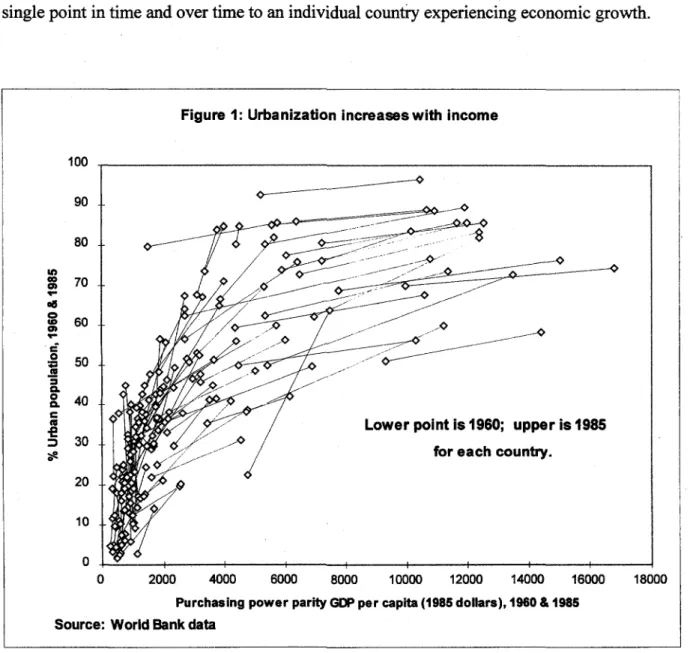
Across countries, there is a strong relation between the level of economic development and the degree of urbanization. Figure 1 shows the relation between GDP per capita (in 1985 purchasing power parity dollars) and percent of the population living in urban areas for 101 countries in both 1960 and 1985. In Figure 1, a line segment connects each country's position in
1960 with its position in 1985. For every country, the percent urban in 1985 exceeded the percent urban in 1960. Figure 1 shows that the percent of the population living in urban areas
increases rapidly with GDP per capita at low income levels (below $2000) and then much more slowly with income growth at middle and high income levels. The most rapid growth in urban populations thus occurs as countries move from low income to middle income levels. Moreover, the increase in urbanization with income, as illustrated in Figure 1, applies across countries at a single point in time and over time to an individual countiy experiencing economic growth.
Figure 1: Urbanization increaseswith income 100
90
80 70 60
° Lower point is 1960; upper is 1985 .
30
S Lf < -- ' ~~~~~~~~for each countr.
0.
0 2000 4000 6000 8000 10000 12000 14000 16000 18040
Purchasing power parity GDP per capita (1985 dollars), 1960 & 1985
Source: World Bank data
Urbanization levels rise with income as resources are moved from the primarily rural agricultural sector to the more urbanized industry and service sectors. The attractiveness of urban areas for the location of industry and services stems from scale economies in production
(efficient plant sizes are large), lower transport costs (reduced by clustering activities together), the modest use of land by industry and services as an input to production (allowing high
densities), externalities among firms (sharing of information), linkages across firms (providing intermediate inputs to each other), and potential agglomeration economies (because large clusters of activities use specialized inputs more efficiently).'
If this relation between development and urbanization continues to hold, global levels of urbanization will increase markedly [World Bank, 1991; United Nations, 1993]. In 1995, low income countries (GNP per capita less than $765 in 1995) had 56 percent of the world's population [World Bank, 1997, p. 36], and low income countries as a group have been
experiencing high rates of economic growth. From 1980 to 1990, GNP per capita in low income countries increased 4.1 percent per year, compared to a global average of 1.5 percent [World Bank, 1997, pp. 36 and 132]. Projections indicate that in 2010, of the 59 cities in the world with populations over five million, 47 will be in developing countries [Berghall, 1995, p. 12].
China and India contain nearly two thirds of the population in all low income countries, and both already have large cities and above average rates of economic growth. If the urban population of China or India doubles, will their large cities also double in size? Evidence
indicates that existing large cities in large developing countries grow at roughly the same, or a bit lower, rate as the overall urban population. In addition to country size, the type of government also influences the growth of large cities. In countries with unitary governments, large cities have tended to grow faster than the urbanization level, while large city growth has been slower in countries with federal governments [Mills and Becker, 1986, p. 59]. This suggests that large Chinese and Indian cities are likely to grow less than in proportion to their countries' overall urban population, but they will grow in size.
III. The Distribution of Population within Cities
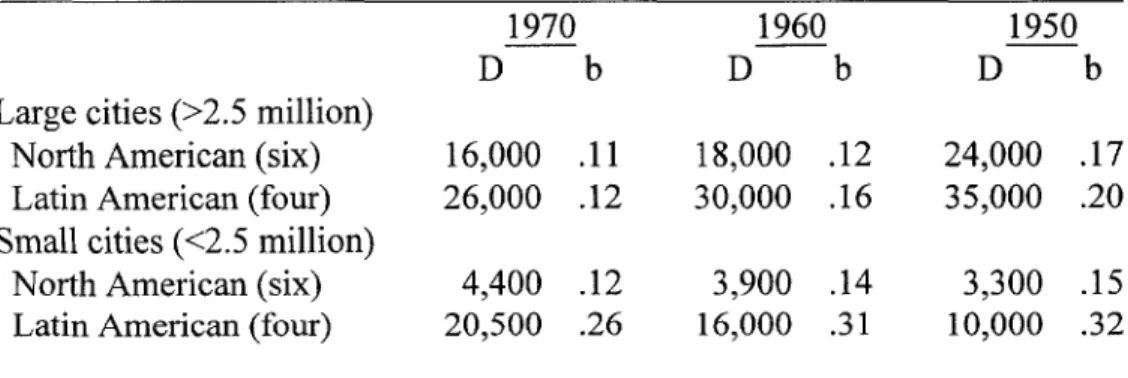
Any analysis of the physical development of a metropolitan area requires an understanding of how the residential population is distributed within the area and how this distribution changes over time. A great deal is known about this both for individual cities over time and across cities at the same point in time [Ingram and Carroll, 1981; Y.J. Lee, 1985; Mills and Tan, 1980; Zhang, 1991]. In industrial countries large cities (over 2.5 million inhabitants) have higher densities than small cities and both large and small cities tend to be decentralized--with population densities that decline slowly as distance from the city center increases. In developing countries, the population densities of large cities also decline slowly as distance from the center increases, whereas the population densities of small cities drop off rapidly. In terms of overall density patterns, large cities in industrial and developing countries are quite similar with high densities and flat density gradients. These patterns are illustrated by Table 1 which shows for selected North American and Latin American cities average intercepts (D) and gradients (b)
from the standard density gradient equation, D(x) = D exp(-bx).
Table 1. Average density intercepts and gradients, selected North and Latin American cities.
1970 1960 1950
D b D b D b
Large cities (>2.5 million)
North American (six) 16,000 .11 18,000 .12 24,000 .17 Latin American (four) 26,000 .12 30,000 .16 35,000 .20 Small cities (<2.5 million)
North American (six) 4,400 .12 3,900 .14 3,300 .15 Latin American (four) 20,500 .26 16,000 .31 10,000 .32 Note: Densities are persons per square kilometer.
Over time, a universal finding is that metropolitan populations have become more decentralized (population density gradients become flatter)--due to the effects of increases in income (promoting housing consumption) and improvements in transport performance (higher speeds and lower costs relative to incomes) [Meyer and Meyer, 1987]. Population growth in large cities usually does not increase the population density of high density areas, but promotes densification of less developed areas and expansion at the urban fringe. In particular, population densities in the most central zones frequently decline as households are displaced by the
expansion of other activities. This is a very robust finding in both industrial and developing countries and has been observed in cities as diverse as Bangkok, Bogota, Mexico City, Shanghai, and Tokyo.2 In the U.S., from a third to a half of large central cities have lost population over the past 25 years [Downs, 1994, Ch. 5; Meyer and Gomez-Ibanez, 1981, Ch. 2].
The preference for large lot single family housing exhibited in the U.S. does not seem to be ubiquitous. It is not readily observed in Europe, and the few analyses of this issue based on household data from developing countries have not found evidence of a preference for large lots
[Dowall and Treffeisen, 1991; Ingram, 1984]. Although gross residential densities toward the periphery of large metropolitan areas in developing and industrial countries are similar, the net residential densities in developing countries are typically higher than those in the U.S. [Mohan,
1994].
Development toward the periphery is driven by lower land prices and lower development costs [Meyer and Gomez-Ibanez, 1981]. It is less costly to build on vacant land than to
redevelop encumbered sites which requires the expenditure of resources to destroy existing physical assets and the loss of the assets as well. This is economically feasible when
comrnercial or industrial use, but it is rare. Even in the U.S. where redevelopment is thought to be endemic, only about half of one percent of existing dwelling units are demolished each year [U.S. Census of Housing]. Peripheral development is also permitted by the wide availability of motorized modes of passenger transport in the cities of both industrial and developing countries. The shift from walking to motorbuses traveling on streets, the most common transit mode in developing countries, typically triples travel speeds from 5 km. per hour to 15 to 20 km. per hour [World Bank, 1986, p. 53]. The shift from motorbus to motorcar (both on common rights of way) typically only doubles speeds--the average door to door speed for work trips by car in the U.S. in 1980 was 38 km. per hour [Downs, 1992, p. 11].
In addition to being more decentralized, the population distribution in large cities is more variegated than in small cities. Large cities in both industrial and developing countries usually have an original center or central business district (CBD), but they also have a number of
subcenters which combine to form a polycentric development pattern [Dowall and Treffeisen, 1991]. Small cities, especially in developing countries, are more likely to have a single well-defined center [Ingram and Carroll, 1981]. In addition, households often sort themselves among locations in cities in particular ways. For example, larger households typically prefer larger dwelling units. Since housing prices and rents are lower at the periphery of cities than at the center, large households are often more decentralized than small households. In Bogota, Colombia, for example, the average household size at the center in 1978 was roughly two persons and household size increased regularly with distance from the center, reaching five persons at the periphery [Mohan, 1994]. This pattern is consistent with urban location theory. However, the relation between household income and distance from the center does not have a
consistent pattern in cities in developing countries, although high income households are clearly decentralizing in many large cities in developing countries (Ingram and Carroll, 1981).
IV. The Distribution of Employment within Cities
Because of data unavailability, fewer studies have examined the spatial distribution of employment than the spatial distribution of population in cities. Nevertheless, a highly regular set of findings have emerged. Studies within cities over time indicate that there is a marked tendency for employment to decentralize--the proportion ofjobs in the center falls over time and most new growth in employment is located out of the center of large cities [Meyer and Gomez-Ibanez, 1981]. Suburbs in the U.S. contain more than half of all urban jobs and are the site for three quarters of the new office space [Downs, 1992; Diamond and Noonan, 1996
1.
Analysis of U.S. data indicates that industry is attracted by freeways and special facilities such as airports, but not by central locations [Shukla and Waddell, 1991]. In developing countries, urban industrial employment exhibits strong patterns of decentralization [K.S. Lee, 1989; Lee and Choe, 1989; Y.J. Lee, 1985; Hamer, 1985a]. In Shanghai, for example, decentralization stems from the development of both specialized satellite industrial towns and rural industry. A third of Shanghai's industrial workers were rural in 1991 [Ning and Yan, 1995]. In Bogota, employment decentralization seems to be driven mainly by market forces, whereas in Sao Paulo and Seoul, government policies also encouraged it [K.S. Lee, 1989]. The first study of employment location in Africa documents a strong pattern of decentralization of manufacturing employment in the Johannesburg metropolitan area [Rogerson and Rogerson, 1996].At the same time, employment is typically more centralized in an urban area than is the population. That is, if a cordon line is drawn at an arbitrary distance from the city center, the specified area will contain a larger proportion of all urban jobs than of all urban population
[Hamilton, 1982]. This means that the typical commuter in an urban area commutes from a residence more distant from the center to a work place less distant from the center. However,
employment is not heavily concentrated in the central business districts of large cities [Meyer and Gomez-Ibanez, 1981]. In the U.S. it is rare to have more than 8 percent of a metropolitan area's jobs located in the central business district. New York City and Washington, D.C. top the list with fourteen and twelve percent respectively; Philadelphia is more typical with seven percent [U.S. Dept. of Transportation, 1975]. In developing countries, the central business districts in large cities are likely to have between ten and twenty percent of all metropolitan employment, but the percentages are falling rapidly as most job growth is located outside of the central business district [K.S. Lee, 1989; Lee and Choe, 1989, Y.J. Lee, 1985].
There are also similar job location patterns within cities by type of industry.
Manufacturing employment is more decentralized than service employment [Y.J. Lee, 1985]. Firms have literally changed locations over time, and the annual mobility rates of manufacturing firms in developing and industrial countries are similar at around three to five percent per year
[K.S. Lee, 1989]. Printing is the only centralized manufacturing activity in both industrial and developing countries. Moreover, there is a tendency for large manufacturing plants to be more decentralized than small plants, and for areas close to the center to specialize in the location of new, small manufacturing enterprises in so-called "incubator areas" [World Bank, 1991; K.S.
Lee, 1989]. The movement of manufacturing firms is often stimulated by the need for more space, better infrastructure services, and improved freight transport by truck [Hamer, 1985a; K.S. Lee, 1989]. The relocation of manufacturing activity also reduces the demand for freight
As manufacturing jobs move out of the center, they are replaced by service sector jobs. The evolution of service sector jobs in the center is less regular, but in many large cities in developing countries retail activities remain concentrated in the center for some time. Eventually retail activity disperses and is replaced by employment in finance, law and other activities which is less oriented to households but require good communication and face to face contact. In the U.S., retail employment is now widely decentralized [Diamond and Noonan, 1996], whereas such employment is still centralized in many developing countries where large retail
establishments are still located centrally [Y.J. Lee, 1985]. The strong decentralization of retail establishments may not occur until auto ownership reaches fairly high levels.
V. Location Patterns and Transportation
There are many reasons why people take trips in urban areas, but trips to work and school are major components of travel. In developing countries the journey to work typically accounts for 40 to 50 percent of urban trips, and trips to school account for another 20 to 35 percent
[Mohan, 1994]. Moreover, travel problems are most acute during peak hours, and work trips alone may account for three fourths of peak travel. Accordingly, the work trip travel pattern in cities in developing countries is a key determinant of transport demand and the overall need for
added transport capacity. Industrial countries have experienced much growth in non-work travel, so that their work trips may now be less than a third of all trips and half or less of peak hour trips [Meyer and Gomez-Ibanez, 1981; Small, 1992]. However, for both industrial and developing countries, the patterns of population and employment decentralization, summarized above, obviously have profound implications for transport because they are important determinants of the work trip travel pattern.
Decentralization of both jobs and residences spreads work trip travel flows over a broader area. If all jobs were in the center, there would be high traffic flows on radial routes into the center and high corridor volumes because the transport system would have many origins for work trips but a concentrated destination. As employment disperses from the center, the
transport system has to serve many additional destinations. This reduces traffic volumes between origins and the central destination, raises volumes to other destinations, and lowers radial
corridor volumes. These changes make serving transport demand with transit systems more costly because transit costs are higher and/or transit service levels are lower at lower levels of corridor passenger flows [Meyer, Kain, and Wohl, 1965]. The increasing costs and decreasing service levels of transit that accompany decentralization lead more travelers in middle and high income countries to use private autos, which further lowers transit passenger volume and further degrades transit performance.
Decentralization of jobs and residences typically reduces transit performance but
improves auto perfornance by reducing average work trip lengths and lowering traffic volumes on radial corridors. Distributing traffic flows more widely across the transport network and reducing radial corridor volumes may reduce congestion. In addition, the decentralization of employment and residences has the potential for reducing the travel distances of commuters [Downs, 1992]. Employment decentralization, in particular, can be envisaged as moving job locations closer to residential locations and improving the jobs/housing balance. The potential for this is illustrated by average travel times from residence to workplace, such as those shown in Table 2, which almost always indicate that work trip travel times are longest for trips from suburban residences to central business district (CBD) work places, and shortest from suburban residences to suburban work places.
Table 2: Average minutes of one-way commuting by location of residence and workplace, U.S., 1980.
Workplace
Residence CBD Rest of City Suburb
City 24.9 20.0 26.4
Suburb 35.1 27.2 18.8
Source: Downs, 1992, p. 20.
Regression analyses of average commuting times across 82 metropolitan areas in the U.S. demonstrate that greater centralization of employment (measured as the proportion of
metropolitan employment in the largest city) increases average work trip commute times [Gordon, Kumar, and Richardson, 1989]. An analysis of Bogota, Colombia indicated that the average distance from home to work remained constant while the city's population grew by 40 percent because of the decentralization of employment [Pineda, 1981] . A comparison of London and Paris, inquiring why residents of the two cities travel nearly identical amounts even though London has 20 percent more people and is much more spread out than Paris, concluded that the greater dispersion of London's population and employment is the key reason [Mogridge, 1986].
The changed traffic volumes that occur as decentralization proceeds, noted above, may require that a wider range of transit modes and service levels be made available. Large cities in developing countries often utilize a variety of on-street transit vehicles ranging from group taxis, jitneys, and vans; through full size buses; to articulated buses [World Bank, 1986; Kain, 1991]. The optimal vehicle size is a function of passenger route volumes and desired headways (time elapsed between vehicles) [Walters, 1979]. In peripheral areas and on the routes with low passenger volumes, it is often economical to use smaller vehicles. This is often observed in developing countries whereas industrial countries typically have less variety in the size and types
of transit vehicles. In the U.S., this is largely due to regulations put in place to protect transit franchises that were granted to private firms [Meyer, Kain, and Wohl, 1965]. More recently, smaller vehicles are used in the U.S. to serve suburban areas and especially the handicapped through dial-a-ride programs [Meyer and Gomez-Ibanez, 1981].
The typical direction of causation in historical studies of metropolitan development has been to view transport as a determinant of land use. Large transit systems built in the late 19th and early 20th century had a major impact on their cities' development patterns, improving access to the central business district and promoting relatively high density development along well defined transit corridors.3 However, now that job growth in the central business district is low (or negative), particular care must be taken when analyzing transport investments that are strongly oriented to serve the central business district. Transport projects, such as subways and freeways, that increase transport capacity to the central business district are often very expensive because of their separate rights of way and high costs of construction--running to US$100
million per kilometer for an installed subway system and close to that for an urban limited access highway [Kain, 1991; World Bank, 1986, p. 52].
If transport is a determinant of land use development, what impact will the construction of a large transit system have on the development pattern of an existing metropolitan area? Will it increase residential densities or centralize employment? A review of experience with new subways in Montreal, San Francisco, Toronto, and Washington, D.C. found very modest effects on metropolitan development patterns, with some evidence of development around stations in Toronto and Washington, and some evidence of CBD development in Montreal and San Francisco [Meyer and Gomez-Ibanez, 1981]. More recent analyses of experience with new subway systems in the U.S. show that costs have been well above, and ridership levels well
below, forecasts or projections made when the projects were reviewed and approved [Pickrell, 1989]. This has also been the experience of many rail rapid transit systems in developing countries [Fouracre, et al., 1990]. The construction costs of metros in developing countries are so high that they crowd out many other investments and can even have consequences for macroeconomic management. Most systems have operating deficits that severely strain local budgets, as in Pusan and Mexico City [World Bank, 1996; Kain, 1991]. Perhaps the strongest financial performance from a recently constructed subway is in Hong Kong, where fare box revenues cover operating costs and contribute to capital costs [Fouracre, et al., 1990]. Incorrect cost and travel forecasts are also common in new toll road projects, such as those in Mexico, and revenue shortfalls have had severe financial consequences for investors [World Bank, 1994].
As noted above, the pattern of decentralization in older metropolitan areas and the low densities of newer auto-oriented cities make it more costly to serve urban travelers by transit. Moreover, superimposing transit systems on existing cities has had minimal effects on land use patterns. These two facts have led many analysts to argue that land use controls should be used as an instrument to affect urban travel demand. This view is often embodied in reports that recommend more and better land use planning as a solution to urban transport and environmental problems [Diamond and Noonan, 1996]. Sometimes the proposal is explicit, as in an analysis of transport policy for Canberra and Asian cities:
"Unlike.. .most cities worldwide, all of Canberra's land is in public ownership. This leasehold land tenure system makes possible a much more interventionist style of government in which the approach should be that of the benign and prudent landlord managing a large and complex estate in stewardship for the benefit of present and future generations." [Black, 1992, p. 8]
The notion of using land use controls as an instrument to affect transport demand also stems from cross sectional studies that indicate that low density cities are more auto oriented than high
density cities [Newman and Kenworthy, 1991], and from the debate about wasteful commuting in the U.S. [Hamilton, 1982; Small and Song, 1992].
The most noteworthy attempt to use land use to affect transport has been the development of planned communities that contain a rough balance of both residences and jobs. The
hypothesis has been that workers would prefer to live and work in the same community, minimizing their commuting travel. Results have not fulfilled expectations. Studies of British New Towns in 1990 found them to be only 5.4 percent more self contained than comparable towns [Bae and Richardson, 1993, p. 6]. Analysis of planned communities in the U.S. found their residents' commuting patterns to be no different from those in unplanned communities
[Downs, 1992, p. 104]. These results should not be surprising. Residential location theory predicts that commuters will commute down the rent gradient, trading off transport costs to gain
location rent savings; it does not predict that commuters minimize travel time. The fact that residents of British New Towns commute out (mainly by train) from these towns to their jobs in nearby large cities, and that workers in those towns drive away from their jobs to homes in the
surrounding countryside is what residential location theory predicts.
The commuting patterns in planned communities indicate that balancing the spatial distribution of jobs and workers within communities, or focusing only on residential densities or on employment densities, may have little effect on travel patterns that are driven by tradeoffs between travel costs and location rents. Directly controlling household location choices is not very popular where it has been tried. Some local governments require municipal workers to live within the municipality, a requirement that often makes the workers worse off. In addition, the focus on residential densities may omit other aspects of residential choice that strongly affect household welfare. For example, the analysis by Newman and Kenworthy relates gasoline use in
metropolitan areas to their average densities, and finds that low density areas consume more gasoline. However, the high density metropolitan areas with low gasoline use also typically have high housing prices and low consumption of residential floor space per person. High gasoline consumption is associated with high housing space consumption (see Figure 2).
Figure 2: Gasoline Consumption and Residential Floor Area per Person
Gasoline use (megajoules per capita) 60,000 Washington, D.C. A 50,000 40,000 Toronto A 30,000 /A Melboume 20,000 Pans A vStockholm London2s ~~~~Munich 10,000 Tokyo A msterdam inngapore A Hong Kong 0 : l l l l 0 10 20 30 40 50 60 70 80
Residential floor area per capita (square meters)
Note: Low gasoline use is associated with residential crowding: 89 percent of the variation in per capita gasoline use is explained by the square of floor area per person.
Source: Calculated from data on gasoline use derived from Newman and Kenworthy 1991, and data on floor area from World Bank, 1996, p. 61.
Using land use controls as an instrument to affect transport demand in developing countries would not likely succeed. Many of these countries have elaborate systems of zoning and land use controls on the books, but very little enforcement capacity [Hayashi, et al., 1992; Miyamoto and Udomsri, 1992]. In many cities in developing countries, up to half of the dwellings that are constructed each year are illegal [World Bank, 1993]. Roughly 60 percent of the houses now existing in Bogota were originally illegal [Mohan, 1994; Hamer, 1985b]. Land use changes have also been analyzed as a means of improving air quality in urban areas. The
conclusion: changing spatial structure is an inefficient way to improve urban air quality, and raising densities may increase exposure to high pollutant concentrations [Bae and Richardson,
1993].
VI. Land Markets
Many of the empirical generalizations or stylized facts summarized above come from cities that have land markets which function more or less well. The outcomes obtained result from the actions of decentralized decision makers in a market setting as well as the influence of other factors such as technical change and the durability of structures. Location theory shows that the declining density gradients are systematically related to underlying land rent gradients. It predicts that the land rent gradients will be less steep than the density gradients because capital is substituted for land in the production of housing [Mills, 1972, pp. 79-84]. The strong
empirical regularities found with population densities suggest that there are similar regularities in land rent patterns. However, land rent data are rare. The relatively few empirical studies dealing directly with land rents tend to obtain results consistent with theory [e.g., Ingram, 1982; Mills and Song, 1977; Mohan and Villamizar, 1982].
An indirect test of the relation between population densities and land rents is illustrated by "the exception that proves the rule." At least one city, Moscow, developed over a period of 70 years with no underlying land market, and its population density pattern differs dramatically from that in other cities [Bertaud and Renaud, 1995]. Figure 3, comparing density patterns in Moscow and Paris, shows that Moscow has a density gradient that actually increases from the center. The reduction in population density in Moscow from 4 to 8 kilometers from the center reflects a ring of industrial land use in that area. The lack of a land market to allocate land or
promote its redevelopment. and the presence of administrative procedures that promoted the hoarding of inputs, produced a startling industrial land use pattern. Not only is industry located close to the center, industrial land use occupies 31.5 percent of the total built-up land in Moscow. This compares with 5 to 6 percent in most large cities. This land was used for plants and to
"warehouse" industrial inputs and outputs, and it seems that industrial land was being
warehoused as well. The relative regularity of population density patterns in other cities--which have land markets of widely varying efficiency--suggests that even poorly functioning land markets have a strong effect on metropolitan spatial structure relative to no land market at all.
Figure 3: Residential Densities in Moscow and Paris
COMPARATIVE POPULATION DENSITY GRADIENT
00 Between Moscow and Paris Built-up Area
250 - - --
-8! 200
--100
1 3 5 7 9 1t 13 t5 17 19 21 23
o.tw,4. tram Ci ty c0r4tw Our
Source: Insmu¶e of Master Plan of Moscow 1992
Source: Bertaud and Renaud, 1995, p 8.
Like other prices in an economy, land prices perform two roles: they have an allocative function and a distributive function. In their allocative role, land prices indicate the value of land to producers and signal how land should be used. In their distributive role, land rents and
that the land should be developed intensively and/or be occupied by an activity that highly values the site. In residential use, for example, high land values signal that land be developed at high residential densities. At some sites, the value of land in non-residential use may exceed its value in residential use, and only non-residential uses can afford the site. Objections to the income to land owners produced by rising land prices have led some countries to intervene directly in the land market in ways that have proven to be counter productive, with India's Urban Land Ceiling Act a noteworthy example [World Bank, 1993, p.29]. Rather than intervening in the land market directly, it is possible to gain the advantages of the allocative role of land prices and moderate the impact of the distributive role of land prices by taxing incomes earned from land rent or land sale.
In developing countries, the observation often made that land rents are "too high," but a diagnosis of pathology requires a theory of health. How high should land rents be? Relative land rents in urban areas vary by location. High rents are observed at locations that are easily accessible and have high concentrations of economic activity, and land rents and densities are closely related, as noted earlier. Often the center of an urban area is the most accessible location and has the highest land rents and densities. This common sense (and theoretically sound) approach explains relative land rents in a city, but what explains the total value of land rent in a city or its average level? Empirical work on this topic is not extensive, but there is suggestive evidence that land rents at the national level absorb a roughly constant share of output4, and that
the total value of land rents in a city varies directly with the value of the economic product produced in the city [Ingram, 1982]. Economic growth in a metropolitan area will therefore raise
VII. Housing, Residential Location, and Labor Markets
Urban housing and residential location have been the subject of much theorizing and empirical work. Both theory and empirics indicate that household residential locations are systematically determined relative to the household's workplaces. The direction of causation is not clear. We do not know if households choose their work place and their residence
simultaneously or in a particular order [Waddell, 1993]. However, there are strong regularities. As noted in section V above, the distance from home to work is usually greater for workers employed at the city center than for those employed elsewhere in the metropolitan area, and the average distance from home to work is shorter, the fturther from the center is the workplace. In addition, workers tend to live and work in the same radial corridor of the city [Meyer, Kain, and Wohl, 1965; Mohan, 1994]. These patterns, which exist in both industrial and developing countries, provide some guidance for planners (and developers) who are trying to locate new residential developments or industrial parks in expanding metropolitan areas.
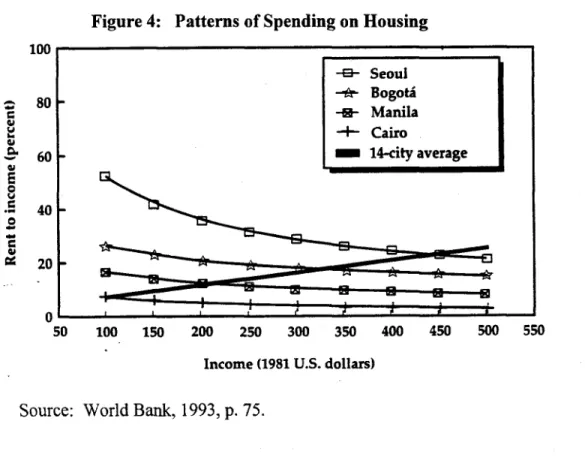
Much empirical work has been done on housing demand and the expenditures that households make on housing in urban housing markets. A major and very robust result in both industrial and developing countries is that the proportion of income spent on housing by households within a particular city is higher for low income households than for high income households [Mayo, et al, 1986; Malpezzi and Mayo, 1987]. This is illustrated by Figure 4, which
also shows that the city-wide average share of income spent on housing rises with overall average city income levels.
In the jargon of economics, the demand for housing is inelastic with respect to income at a fixed point in time, but may be elastic over time as incomes grow. It is noteworthy that the average city-wide share of income spent on housing peaks for middle income developing
countries and is lower in industrial countries. This pattern is similar to that displayed by the share of GDP invested in housing [Burns and Grebler, 1976; Annez and Wheaton, 1984; World Bank, 1993, p.102]. In addition, housing expenditures increase somewhat with family size because larger families buy larger units than smaller families [Malpezzi and Mayo, 1987]. These empirical regularities allow us to predict how much different households would be willing to pay for housing or what the distributional impact would be of a housing or property tax, but it is less useful for predicting the income level of households living in dwelling units with particular rents. In particular, we often find relatively high income households living in housing units in areas where rents are low. This means that low rent neighborhoods are often not necessarily effective
location proxies for low income households [Ingram, 1984].
Figure 4: Patterns of Spending on Housing
100 -E- Seoul 80 -A- Bogoti -f-Manila I- Cairo S 60 - 14-city average 40 -: 20 0 50 100 150 200 250 300 350 400 450 500 550
Income (1981 U.s. dollars)
Relative to the work done on housing demand, there are few analyses of housing supply. The work that has been done indicates that housing construction is typically a very competitive industry that uses simple technologies and has few barriers to entry [Mohan, 1994], although distortions in the land market can concentrate market power in a few firns [World Bank, 1993]. In many cases households can help construct their own units and many do [Hamer, 1985b]. Industry studies indicate that the largest construction firms have a small proportion of the market [Ingram, 1982]. This is not always true of the construction materials industry which can be non-competitive, particularly for materials such as cement and plumbing fixtures in developing countries [Berghall, 1995, p. 64; World Bank, 1993, p. 139]. Analyses of the cost of building a standard housing unit across developing countries indicate that construction costs vary much less than incomes. For example, construction costs only double across countries whose percapita income levels differ by a factor of five [World Bank, 1993, p. 80].
Impediments to efficient housing supply involve much more than construction
inefficiencies. In many developing countries infrastructure provision is carried out by the public sector and is not responsive to demand [World Bank, 1994, pp. 30-31]. Serviced land ready for development often commands a scarcity premium well above the cost of providing infrastructure [Green, et al., 1994; World Bank, 1993, p. 81]. Unreasonably high construction standards and restrictive land use and zoning regulations can raise housing costs dramatically [Angel and Mayo, 1996]. Regulatory hurdles and procedures can take vast amounts of time--subdivision and titling of lots were estimated to take between five and seven years in Malaysia in the mid-1 980s [World Bank, 1993, p. 85]. Across varying regulatory regimes, average ratios of housing prices to household incomes vary from a low of 2.5 in Bangkok to a high of from five to seven in Seoul or Kuala Lumpur [ibid.].
It has long been evident to urban analysts that an urban labor market can be viewed as the dual of an urban housing market. Housing analysts often take the location of the workplace as fixed and study residential location and housing choice in terms of the travel cost-location rent tradeoff. A similar approach can be taken to urban labor markets: assume that residential location is fixed and study employment location and job choice in terms of tradeoffs between travel cost and wage differences across work places. After all, individuals change their jobs roughly twice as often as they change their residence [Simpson, 1992, Ch. 2].
Very little empirical work has been done using this approach to urban labor markets. This is partly because the urban wage gradient is much flatter than the land price gradient, and partly because of the heterogeneity of both workers and jobs [Moses, 1962]. Recent work on urban labor markets based on search theory has yielded testable predictions--such as that more skilled workers will search more broadly across the urban labor market and therefore have longer commutes [Simpson, 1992]. The predictions of these search models have reasonable empirical support, but additional work is needed to gain insights about what can be done at the
metropolitan level to improve urban labor market outcomes.
VIII. Infrastructure and Basic Services
Cities in industrial and developing countries vary greatly with respect to the efficiency of their infrastructure provision [World Bank, 1994]. Infrastructure investment, maintenance funds, and the services themselves have been provided by the public sector in most countries until recently. This is now changing in both industrial and developing countries, and private sector
involvement in infrastructure provision is increasing. Latin American countries are privatizing infrastructure services such as telecommunications, electric power, and transport services, while in East Asia private investment is financing a greater share of infrastructure investment needs
through a variety of concessions and contracts [Ingram and Kessides, 1995]. Case studies indicate that privatizing firms and using private contractors for infrastructure construction, operation, or maintenance is less costly and more efficient than having such work done by public employees [Galal, et al., 1994; Gyamfi, et al., 1992; Heseltine and Silcock, 1990; Newbery and Pollitt, 1996].
The financial arrangements to pay for infrastructure vary from user fees to general tax revenues. Infrastructure agencies which utilize user fees and which can alter the fees to cover the costs of service have fewer financial problems, are more likely to extend service, and are more efficient than agencies that have to rely on general tax revenues for support [World Bank, 1994]. In some cases, revenue from user fees covers investment costs as well as operating costs.
Some infrastructure agencies have had success using betterment fees to pay for infrastructure investments. Experience indicates that households are willing to pay such fees only for infrastructure investments that directly benefit them such as connecting their house to a water main, paving the sidewalk in front of their house, or installing local street lights.
Households are not willing to pay betterment fees for infrastructure investments that are near them but which have many beneficiaries, such as the improvement of nearby arterial streets
[Mohan, 1994; World Bank, 1988]].
Particular attention must be paid to the infrastructure needs of industry in order to increase economic productivity. Infrastructure services such as electricity and transport are important intermediate inputs to enterprises, and the quality and reliability of infrastructure services can be an important determinant of a firm's location [K.S. Lee, 1989; Lee and Anas, 1992 ]. The efficiency of infrastructure service provision varies across countries but is not related to per capita GDP, and within a country the efficiency of service production in one
infrastructure sector tells us virtually nothing about the efficiency of service production in another [World Bank, 1994]. These two findings suggest that the organization and incentives within infrastructure sectors are primary determinants of the quality of infrastructure services that are produced.
Recent macro-level studies indicate that infrastructure services contribute significantly to economic growth in the U.S. [Aschauer, 1989; Munnell, 1992], and the results from other
countries are mixed [Canning and Fay, 1993; Ford and Poret, 1991]. The returns estimated in some of these studies are often surprisingly (and unbelievably) large, but they are very sensitive to specification and the level of aggregation of the data [Holtz-Eakin, 1992; Gramlich, 1994]. There is still substantial disagreement among analysts about why this is the case. The results from these macro-level studies are not solid enough to provide guidance for designing infrastructure investment policies or programs. The best estimate of the return of an
infrastructure investment in a metropolitan area continues to be a comprehensive benefit-cost analysis at the investment project level.
IX. Potential Sources of Regularities
The findings summarized here are based mainly on studies that have been carried out in market based or mixed economies. There are many common behavioral patterns exhibited by households and firms in urban areas across industrial and developing countries. In many cases even the behavioral parameter estimates--such as the elasticities in housing demand or mode
choice equations--are very similar across countries with very different income levels. These similarities are often so striking that they demand an explanation. One obvious explanation is that across countries households are fundamentally similar; in economic terms, they have similar utility functions.
A second possible explanation for the empirical regularities across urban areas is
embodied in the analysis underlying purchasing power parity estimates of GDP across countries which focuses on the determinants of the prices of tradable versus non-tradable goods [Kravis, et al., 1978]. Most urban services are non-tradables. The prices of tradables are set internationally whereas the prices of non-tradables are mainly a function of domestic income levels. This implies that the ratio of the prices of many urban services to each other and to local incomes will not vary greatly across countries. Given the underlying similarities of households (and of
household utility functions) across countries, the similarities of urban service relative price ratios and price/income ratios are likely to produce similar behavior in economic explanations
involving urban goods and services.
X. Conclusion
The development pattern of cities in developing and industrial countries with market-based economies exhibit similar patterns of decentralization of both population and employment, with the largest metropolitan areas converging to similarly decentralized structures with multiple subcenters, highly decentralized manufacturing employment, and emerging specialization of the central business district in service employment. Cities in developing countries typically have somewhat higher population densities than those in industrial countries, but the differences have been narrowing over time in the largest metropolitan areas.
Decentralization of population and employment increases reliance on road-based transport for both passengers and freight. Industrial countries have experienced decreases in transit use as auto ownership levels have risen. Many developing countries show early signs of a similar pattern, although their transit ridership levels are still high and their transit systems often offer a rich mix of options in terms of vehicle sizes and levels of service.
Land markets are strong determinants of decentralization, and cities without land markets exhibit quite different development patterns from cities with even poorly functioning land
markets. In market based cities, land rents are closely related to development densities, although empirical work on land rents and values is relatively rare because of a lack of data. Analyses of urban housing markets indicate that demand patterns are very similar across cities in developing
and industrial countries, but that supply side impediments vary widely--resulting in a wide range of ratios of housing prices to incomes. Similarly, the efficiency of public sector infrastructure provision varies widely across cities, and across sectors within cities.
The coming decades will see an increase in global urbanization with most of the increase taking place in low income countries which contain in 1995 nearly 60 percent of the world's population. Many of these countries already have large metropolitan areas whose populations will continue to grow as urbanization increases.
REFERENCES
Angel, Shlomo, and Stephen Mayo, 1996, "Enabling Policies and Their Effects on Housing Sector Performance: A Global Comparison," Paper presented at Habitat II Conference, Istanbul, Turkey.
Annez, Philippe, and William Wheaton, 1984, "Economic Development and the Housing Sector: A Cross-National Model," Economic Development and Cultural Change, Vol. 32, No. 4, pp. 749-766.
Aschauer, David A., 1989, "Is Public Expenditure Productive?," Journal of Monetary Economics, Vol. 23, pp. 177-200.
Bae, Chang-Hee Christine, and H.W. Richardson, 1993, "Automobiles, the Environment and Metropolitan Spatial Structure," Lincoln Institute of Land Policy Working Paper, Cambridge, Mass.
Berghall, Pii Elina, 1995, "Habitat II and the Urban Economy: A Review of Recent Developments and Literature," U.N. University/World Institute for Development Economics Research, Helsinki.
Bertaud, Alain, and Bertrand Renaud, 1995, "Cities without Land Markets: Location and Land Use in the Socialist City," World Bank Policy Research Working Paper No. 1477, Washington. Black, John A., 1992, "Policy Measures for Land Use and Transport Demand Management and
Their Implications in Managing Growing Asian Metropolises," Regional Development Dialogue, 13, 3 (Autumn), pp. 3-26.
Bums, Leland, and Leo Grebler, 1976, "Resource Allocation to Housing Investment: A Comparative International Study," Economic Development and Cultural Change, Vol. 25, No. 1, pp. 95-121.
Canning, David, and Marianne Fay, 1993, "The Effect of Transportation Networks on Economic Growth," Columbia University Working Paper, New York.
Diamond, Henry L. and Patrick F. Noonan, 1996, Land Use in America, Lincoln Institute of Land Policy, Washington, D.C., Island Press.
Dowall, David E. and P. Alan Treffeisen, 1991, "Spatial Transformation in Cities of the Developing World," Regional Science and Urban Economics, 21, pp. 201-224.
Downs, Anthony, 1992, Stuck in Traffic, Brookings Institution and Lincoln Institute of Land Policy. Downs, Anthony, 1994, New Visions for Metropolitan America, Brookings Institution and Lincoln
Ford, Robert, and Pierre Poret, 1991, "Infrastructure and Private Sector Productivity," OECD Economic Studies 17, pp. 63-89.
Fouracre, P., R. Allport, and J.M. Thomson, 1990, "The Performance and Impact of Rail Mass Transit in Developing Countries," Research Report 278, Transport Research Laboratory, Crowthorne, U.K.
Galal, A., L. Jones, P. Tandon, and I. Vogelsang, 1994, Welfare Consequences of Selling Public Enterprises, Oxford University Press, New York.
Gordon, Peter, Ajay Kumar, and Harry W. Richardson, 1989, "The Influence of Metropolitan Spatial Structure on Commuting Time," Journal of Urban Economics, 26, pp. 138-151.
Gramlich, Edward M., 1994, "Infrastructure Investment: A Review Essay," Journal of Economic Literature, Vol. 32 (Sept., 1994), pp. 1176-1196.
Green, Richard K., Stephen Malpezzi, and Kerry Vandell, 1994, "Urban Regulations and the Price of Land and Housing in Korea," Joural of Housing Economics, Vol. 4, pp. 330-356.
Gyamfi, Peter, L. Gutierrez, and G. Yepes, 1992, "Infrastructure Maintenance in LAC: The Costs of Neglect and Options for Improvement," 3 vols., Regional Studies Program Report 17, World Bank, Washington, D.C.
Hamer, Andrew, 1985a, "Decentralized Urban Devleopment and Industrial Location Behavior in Sao Paulo," World Bank Staff Working Paper 732, Washington, D.C.
Hamer, Andrew, 1985b, "Bogota's Unregulated Subdivisions: the Myth and Reality of Incremental Housing Construction," World Bank Staff Working Paper 734, Washington, D.C.
Hamilton, Bruce, 1982, "Wasteful Commuting," Journal of Political Economy, Vol. 90, No. 5, pp. 1035-1053.
Hayashi, Y., M. Wegener, K. Doi, and R. Suparat, 1992, "An International Comparative Study on Land Use Transport Planning Policies as Control Measures of Urban Environment," Paper presented to the sixth World Conference on Transport Research, Lyon, June, processed. Henderson, J. Vernon, 1985, Urban Development--Theory, Fact and Illusion, Oxford University
Press, New York.
Heseltine, P.M., and D.T. Silcock, 1990, "The Effects of Bus Deregulation on Costs," Journal of Transport Economics and Policy, Vol. 24, No. 3, pp. 239-254.
Holtz-Eakin, Douglas, 1992, "Public-Sector Capital and the Productivity Puzzle," Working Paper 4122, National Bureau of Economic Research, Cambridge, Mass.
Ingram, Gregory K., 1982, "Land in Perspective: Its Role in the Structure of Cities," in M. Cullen and S. Woolery, eds. World Congress on Land Policy, Lexington, Mass., Lexington Books. Ingram, Gregory K., 1984, "Housing Demand in the Developing Metropolis," World Bank Staff
Working Paper No. 663, Washington, D.C.
Ingram, Gregory K. and Alan Carroll, 1981, "The Spatial Structure of Latin American Cities," Journal of Urban Economics, Vol. 9, No. 2 (March), pp. 257-273.
Ingram, Gregory K., and Christine Kessides, 1995, "The Financing of Infrastructure in Developing Countries," Development Issues, Presentations to the 50th Meeting of the Development Committee, World Bank, Washington, D.C.
Kain, John F., 1991, "A Critical Assessment of Public Transport Investments in Latin America," Inter-American Development Bank, Washington, D.C.
Kravis, I.B., A. Heston, and R. Summers, 1978, International Comparisons of Real Product and Purchasing Power, Baltimore, Johns Hopkins University Press.
Lee, Kyu Sik, 1989, The Location of Jobs in a Developing Metropolis, New York, Oxford University Press.
Lee, Kyu Sik, and Alex Anas, 1992, "Costs of Deficient Infrastructure: the Case of Nigerian Manufacturing," Urban Studies, Vol. 29, No. 7, pp. 1071-1092.
Lee, Kyu Sik, and Sang-Chuel Choe, 1989, "Changing Location Patterns of Industries and Urban Decentralization Policies in Korea," in J. Kwon, ed., Korea Economic Development, Greenwood Press.
Lee, Yoon Joo, 1985, "The Spatial Structure of the Metropolitan Regions of Brazil," Staff Working Paper 722, Washington, D.C., World Bank.
Malpezzi, Stephen, and S. Mayo, 1987, "The Demand for Housing in Developing Countries," Economic Development and Cultural Change, Vol. 35, No. 4, pp. 687-72 1.
Mayo, Stephen, Stephen Malpezzi, and David Gross, 1986, "Shelter Strategies for the Urban Poor in Developing Countries," World Bank Research Observer, Vol. 1, No. 2 (July), pp. 183-203. Meyer, John R. and J.A. Gomez-Ibanez, 1981, Autos, Transit, and Cities, Cambridge, Harvard
University Press.
Meyer, John R., J.F. Kain, and M. Wohl, 1965, The Urban Transportation Problem, Harvard University Press.
Transportation Problem," Harvard Institute for International Development Discussion Paper 258, Cambridge, Mass.
Mills, Edwin S., 1972, Urban Economics, Glenview, Ill., Scott-Foreman.
Mills, Edwin S. and Charles M. Becker, 1986, Studies in Indian Urban Development, (New York, Oxford University Press).
Mills, Edwin S., and Byung Nak Song, 1977, "Korea's Urbanization and Urban Problems 1945-1975," Working Paper 7701, Korea Development Institute.
Mills, Edwin S. and Jee Peng Tan, 1980, "A Comparison of Urban Population Density Functions in Developed and Developing Countries," Urban Studies.
Miyamoto, K., and R. Udomsri, 1992, "Present Situations and Issues of Transport Planning and Plan Implementation in Developing Metropolises from the Viewpoint of Integration with Land-Use Policies," Paper presented to the sixth World Conference on Transport Research, Lyon, processed.
Mogridge, M.J.H., 1986, "If London is more spread out than Paris, why don't Londoners travel more than Parisians?" Transportation, 13, pp. 85-104.
Mohan, Rakesh, 1994, Understanding the Developing Metropolis: Lessons from the City Study of Bogota and Cali, Colombia, New York, Oxford University Press.
Mohan, Rakesh, and Rodrigo Villamizar, 1982, "The Evolution of Land Values inthe Context of Rapid Urban Growth: A Case Study of Bogota and Cali, Colombia," in M. Cullen and S. Woolery, eds. World Congress on Land Policy, Lexington, Mass., Lexington Books. Moses, Leon, 1962, "Towards a Theory of Intra-Urban Wage Differentials and their Influence on
Travel Patterns," Papers and Proceedings of the Regional Science Association, Vol. 9, pp. 53-63.
Munnell, Alicia H., 1992, "Infrastructure Investment and Economic Growth," Journal of Economic Perspectives, Vol. 6, No. 4, pp. 189-198.
Newbery, D.M., and M.G. Pollitt, 1996, "The Restructuring and Privatisation of the
CEGB--Was it Worth it?," DAE Working Paper 9607, Cambridge University Department of Applied Economics, Cambridge, U.K.
Newman, P.W.G, and J.R. Kenworthy, 1991, Cities and Automobile Dependence: An International Sourcebook, Aldershot, U.K., Avebury Technical Publishing.
Ning, Yuemin and Zhongmin Yan, 1995, "The Changing Industrial and Spatial Structure in Shanghai," Urban Geography, 16, 7, pp. 577-594.
Pickrell, Donald H., 1989, "Urban Rail Transit Projects: Forecast Versus Actual Ridership and Costs," U.S. Dept. of Transportation, Transport Systems Center, Cambridge, Mass.
Pineda, Jose Fernando, "Residential Location Decisions of Multiple Worker Households in Bogota, Colombia," Revista Camara de Comercio de Bogota, No. 43 (June, 1981).
Rogerson, Christian M. and Jayne M. Rogerson, 1996, "Manufacturing Location in the Developing Metropolis: The Case of Greater Johannesburg," processed, World Bank.
Shukla, Vibhooti and Paul Waddell, 1991, "Firm Location and Land Use in Discrete Urban Space," Regional Science and Urban Economics, 21, pp. 225-253.
Simpson, Wayne, 1992, Urban Structure and the Labour Market, Oxford, Clarendon Press. Small, Kenneth, 1992, Urban Transportation Economics, Harwood Academic Publishers,
Philadelphia, Pa.
Small, Kenneth, and Shunfeng Song, 1992, "Wasteful Commuting: A Resolution," Journal of Political Economy, Vol. 100, No. 4, pp. 888-898.
United Nations, 1992, Building Materials for Housing, Commission on Human Settlements, Report of the Executive Director HS/C/14/7.
United Nations, 1993, World Urbanization Prospects, 1992 Revision, New York.
U.S. Census of Housing, various years, Components of Inventory Change: U.S. and Regions, U.S. Bureau of the Census, Washington, D.C.
U.S. Department of Transportation, 1975, Urban Data Book, Report No. DOT-TSC-OST-75-45, Washington D.C.
Waddell, P., 1993, "Exogenous Workplace Choice in Residential Location Models: Is the Assumption Valid?," Geographical Analysis, Vol. 25, pp. 65-84.
Walters, Alan A., 1979, "Cost and Scale of Bus Services," World Bank Staff Working Paper No. 325, Washington, D.C.
Warner, Sam Bass, Jr., 1970, Streetcar Suburbs; The Process of Growth in Boston 1870-1900, Atheneum, New York.
White, Michelle, 1994, "Housing and the Journey to Work in U.S. Cities," in Y. Noguchi and J. Poterba, eds., Housing Markets in the United States and Japan, University of Chicago Press, Chicago.
World Bank, 1988, World Development Report 1988, Oxford University Press, New York. World Bank, 1991, Urban Policy and Economic Development: An Agenda for the 1990s,
Washington, D.C.
World Bank, 1993, Housing--Enabling Markets to Work, Washington, D.C.
World Bank, 1994, World Development Report 1994: Infrastructure for Development, Oxford University Press, New York.
World Bank, 1996, Sustainable Transport: Priorities for Policy Reform, Washington, D.C. World Bank, 1997, World Development Indicators, Oxford University Press, New York.
Zhang, Xiao Ping, 1991, "Metropolitan Spatial Structure and Its Determinants--A Case Study of Tokyo," Urban Studies, 28,1, pp. 87-104.
Endnotes
1 For a detailed description of the causes of urbanization, see Henderson, 1985.
2 Results for Bangkok and Mexico are from the author's own analysis. Other sources are Bogota [Mohan, 1994], Shanghai [Ning and Yan, 1995], and Tokyo [Zhang, 1991].
3 A classic study of the impact of transport on urban development analyzes Boston [Warner, 1970]. 4 In the U.S. land rents absorbed 7.7 percent of national income in 1850 and 6.4 percent in 1956 [Mills, 1972, p. 49].
Contact
Title Author Date for paper
WPS1815 Unfair Trade? Empirical Evidence in Jacques Morisset August 1997 N. Busjeet
World Commodity Markets Over 33997
the Past 25 Years
WPS1816 Returns to Regionalism: An Raquel Fernandez August 1997 J. Ngaine
Evaluation of Nontraditional Gains 37947
from Regional Trade Agreements
WPS1817 Should Core Labor Standards Be Keith E. Maskus August 1997 J. Ngaine
Imposed through International Trade 37947
Policy?
WPS1818 What Affects the Russian Regional Lev Freinkman August 1997 N. Campos
Governments' Propensity to Michael Haney 38541
Subsidize?
WPS1819 The Argentine Pension Reform and Dimitri Vittas August 1997 P. Infante
Its Relevance for Eastern Europe 37642
WPS1820 Private Pension Funds in Argentina's Dimitri Vittas August 1997 P. Infante
New Integrated Pension System 37642
WPS1821 The'IPO-Plus": A New Approach to ltzhak Goldberg August 1997 I. Goldberg
Privatization Gregory Jedrzeiczak 36289
Michael Fuchs
WPS1822 Intergovernmental Fiscal Transfers Jun Ma September 1997 C. Ima
in Nine Countries: Lessons for 35856
Developing Countries
WPS1823 Antidumping in Law and Practice Raj Krishna September 1997 A. Bobbio 81518 WPS1824 Winners and Losers from Utility Omar Chisari September 1997 T. Malone
Privatization in Argentina: Lessons Antonio Estache 37198 from a General Equilibrium Model Carlos Romero
WPS1825 Current Accounts in Debtor and Aart Kraay September 1997 R. Martin
Creditor Countries Jaume Ventura 39026
WPS1826 Standards and Conformity Sherry M. Stephenson September 1997 M. Patena
Assessment as Nontariff 39515
Barriers to Trade
WPS1827 The Determinants of Agricultural Yair Mundlak September 1997 P. Kokila
Production: A Cross-Country Don Larson 33716
Contact
Title Author Date for paper
WPS1828 The Determinants of Banking Crises: Asli DemirgOu-Kunt September 1997 P. Sintim-Aboagye Evidence from Developed and Enrica Detragiache 38526
Developing Countries
WPS1829 Economic Reform and progress in Norman Loayza September 1997 E. Khine Latin America and the Caribbean Luisa Palacios 37471 WPS1830 Private Ownership and Corporate Roman Frydman September 1997 B. Moore
Performance: Some Lessons from Cheryl W. Gray 38526 Transition Economies Marek Hessel
Andrzej Rapaczynski
WPS1831 How Trade Patterns and Technology Wolfgang Keller September 1997 J. Ngaine
Flows Affect Productivity Growth 37947
WPS1832 Pension Reform in Bolivia: Innovative Hermann von Gersdorff September 1997 C. Pavlak
Solutions to C,ommon Problems 82099
WPS1 833 Cost Recovery and Pricing of David B. Humphrey October 1997 T. Ishibe
Payment Services Robert H. Keppler 38968
Fernando Montes-Negret
WPS1834 The Comparative Advantage of Pedro Belli October 1997 L. Schunk
Government: A Review 31779
WPS1835 Cost-Benefit Analysis of the Global Aehyung Kim October 1997 A. Kim Dracunculiasis Eradication Campaign Ajay Tandon 35029
Ernesto Ruiz-Tiben
WPS1836 Health and Labor Productivity: The Aehyung Kim October 1997 A. Kim
Economic Impact of Onchocercal Ajay Tandon 35029
Skin Disease Asrat Hairu and Others
WPS1 837 How Estonia's Economic Transition Rivo Noorkoiv October 1997 S. Fallon
Affected Employment and Wages Peter F. Orazem 38009
(1989-95) Allan Puur
Milan Vodopivec
WPS1838 The Limits and Merits of Participation Paulo Vieira da Cunha October 1997 E. Thomas
Maria Valeria Junho Pena 31019
WPS1839 The Effects of Financial Liberalization Cevdet Denizer November 1997 E. Khine
and New Bank Entry on Market 37471
Structure and Competition in Turkey
WPS1840 Efficient Public Sector Downsizing Martin Rama November 1997 S. Fallon 38009