International Journal of Applied Arts Studies
IJAPAS 4(3) (2019) 21–34Evaluating the Relationship between Emotional Intelligence and
Interactive Thinking in Improving Architectural Design Process
Omid Azari
a, Iraj Etessam
b*, Farah Habib
c aPh.D. Researcher in Architecure, Karaj Branch, Islamic Azad University, Karaj, IranbAssistant Professor, Department of Architecture, Science and Research Branch, Islamic Azad University, Tehran, Iran cAssistant Professor, Department of Architecture, Science and Research Branch, Islamic Azad University, Tehran, Iran
Received 22 November 2019; revised 20 December 2019; accepted 13 January 2020
Abstract
The idea of thinking in architectural design has long been one of the hallmarks of this process. On the other hand, according to the new definitions of emotional intelligence in the field of psychology, it can be concluded that if the parameters of this phenomenon are used positively and effectively, it is possible to promote the architectural design process among architecture students. Thus, identifying the related areas between emotional intelligence and interactive thinking in the architectural design process can play a significant role in promoting the creativity of future architects. For this purpose, the present study investigates the mutual relationship between emotional intelligence and interactive thinking in order to promote creativity in the architectural design process. To this end, after identifying the necessary infrastructures to develop either of these two phenomena, a mutual relationship between these two phenomena is discussed. It should be noted that the present study is descriptive and analytical and the evaluation is done through a questionnaire among some students of architecture at Damavand University. The results indicate that there is a significant relationship between emotional intelligence parameters and interactive thinking prerequisites for developing creative skills in architectural design process.
Keywords: Interactive; Thinking; Emotional Intelligence; Mutual Relationship; Architectural Design;
Creativity
* Corresponding author. Tel: +989121256344.
1.
Introduction
In architectural education, we cannot depend on general rules in anytime and anywhere. In architecture education, anything that happened or happens anywhere or anytime should not be modeled. In many Western countries, the basic lessons of architectural education have been omitted; it may be that in the pre-university era, nurturing creativity and talent is the most important purpose of the educational system (Hojjat, 2014: 239). But innovation in art is a dialectical product. In our era and in our eastern world, the spirit emerges and develops new art and thought which is the result of the inevitable collision of traditional society and modern times. Synthesis does not occur in the absence of each side and remains sterile (Ardalan and Bakhtiar, 2013). Art, as the manifestation of truth, goodness and beauty, conveys the concept of human truth and the path of good and aesthetic tendencies in the field of humanities (Noghrekar, 2015: 13). Creative and great people have talents, but the inferior people lack, and we see that the power of creating a strange building pregnant with life depends only on that talent. However, many agree that the creative power of every great architect and his ability to beautify relies on true and profound observation (Alexander, 2011: 189). Gestalt psychology has valuable research in the area of perception that has left much about how visual patterns are recognized, as well as how human beings view and organize incoming visual data and visualize the output of visual data. Abstract elements or psychological elements of visual grammar can be defined by their properties (Dandis, 2010: 42).
Now, each design program, which proposes a solution to a particular problem, has a specific purpose; and after presenting specific program (problem design), it is emerged by the designer (Sabahieh et al., 2008: 58). A complex and multifaceted process leads to problem solving via investigating the problem. There are two issues of creativity and criticism, such that the original design is based on a thematic design and needs criticism to be approved (Mirriahi, 2006: 87). Here the problem of creative thinking and criticism arises in the field of design; in this way, creative thinking, while engaging directly with the subject, steps up to raise awareness of itself and presents issues, ideas, and theories. To achieve better and more practical results, it needs a critical perspective to evaluate and rethink ideas to become a final design. The alternation between these two activities of creation and critique in the process of questioning to the answer in the design process must be repeated until the best design is selected (Razjoyan and Sheikh Taheri, 2003: 25); The above periodic trend is clearly evident in all design issues, including the design process in architecture which is a complex issue for the ultimate architectural design (Lawson, 2005: 111). Given that the process of architectural designing is an artistic-scientific activity and that some of these issues are rooted in art and another part in science, they cannot be solved by specific methods and equations, so thinking is required (Elias, 2005). In the design process, one can look for ways that, unlike the usual methods, help to flourish the hidden talents of architect to be more creative in designing and inventing. The areas of thought and the power of thinking design during the design process are among the topics which can have a direct role in improving the formation of architectural design patterns (Nadimi, 1999: 95). Throughout a design process in architecture, creative thinking attempts to search and focus on possibilities and pathways to find a design idea, while critical thinking attempts to search or select the most important or hopeful choice. (Yazdanfar, 2004: 146). Many philosophers and scientists have introduced different views on how to think and acquire knowledge. First Attitudes of Plato and Socrates and in the course of these currents, the views of others such as Descartes, Kant, Berkeley, Hume, and others were presented. In the field of thinking in architecture, Brian Lawson and Alexander also discussed. Mahmoudi has also done several researches on the way of thinking and patterns of architectural education and introduces a variety of modes of thinking in general and in particular .He finally introduced an
interactive pattern and the importance of its utilization in the architectural education (Mahmoudi, 2003: 40).
For many years it was thought that IQ was a measure of success. In schools, benchmarking awards to students was intelligence testing, and even some companies were using intelligence testing for rewards. In the last decade, researchers have found that IQ is not the only measure of a person's success rating (Utaberta et al., 2010). Hvargardner's research abolished the mere notion of a single intelligence. He argued that there are at least eight forms of intelligence for each person. Each of them is bred to a greater or lesser degree. Education, experience, information, cognitive intelligence cannot determine why one person succeeds but the other fails, so there is another feature that society seems to have no explanation for (Mozaffar et al., 2009).
Explaining the anonymous aspects of public intelligence, emotional intelligence backgrounds can be searched in Wexler ideas. Wexler sought to evaluate the non-cognitive and cognitive aspects of public intelligence. His effort was to understand social adjustment and to adapt images of cognition and distinguish social situations. In 1968, Cattell and Butcher were psychologists who sought to predict both school achievement and creativity through the ability, personality, and motivation of individuals. They were able to demonstrate the importance of this issue even in academic development (Samari and Tahmasebi, 2007). Other psychologists, such as Salovey and Mayer, have also focused on the emotional aspects of intelligence in their research (Salvo and Meyer, 1990), and in addition, the idea of emotional intelligence on human thinking was pursued again after 50 years by Gardner Professor of Psychology at Harvard.
According to the theories about emotional intelligence and interactive thinking, although there seems to be a relationship between these two phenomena, there has been little research to investigate this relationship, and various articles have been studied each of these two phenomena separately. For example, Batastin (2001) achieved a strong positive relationship between Emotional intelligence and creativity among the three groups of students. In this review, he suggested that emotional intelligence can facilitate the process of creative thinking to create new thoughts and actions. Zenasni and Lubart (2009) also examined the relationship between emotional intelligence and creativity in two studies. The results showed that there is a negative relationship between the facets of identifying emotions in face and image and the ability to generate new thoughts. Ghiabi and Besharat examined the relationship between emotional intelligence and interpersonal problems among students and their findings showed that the relationship between emotional intelligence was negative depending on the gender of the students as well as various aspects of interpersonal problems such as self-esteem, sociality, intimacy and responsibility. Therefore, emotional intelligence is essential to achieve team goals for interpersonal problem solving (Ghiabi and Besharat, 2011). Nazidizaji et al. in the research examined the relationship between emotional intelligence and architectural design competence. They examined an indicator of student design progress with evaluation of the five courses of the Architectural Design Studio. The findings of this study showed that there is no significant relationship between emotional intelligence and any of its promotional factors in architectural design (Nazidizaji et al., 2014).
Although identifying and nurturing student creativity with reliance on emotional intelligence isn’t noted a lot in the architectural education system, it is necessary to identify the processes of emotional intelligence accurately and interactive thinking to promote the creativity of future architects, and to investigate the factors affecting them. Therefore, the present study is based on the study of the issue of emotional intelligence and the emergence of interactive thinking in the process of architectural design to utilize the high mental capacity of architecture students as a suitable tool for promoting creativity. To this end, this study investigated the necessary infrastructure to develop
interactive thinking and utilized emotional intelligence effectively to find a mutual relationship between these two phenomena. It should be noted that the present study is descriptive and analytical and evaluation is done through some questionnaires among some architecture students. The main question posed in the research is: “parameters such as self-awareness, self-control, and self-motivation can promote interactive thinking in the architectural design process?"
2.
Theoretical Foundation of Research
2.1. Emotional Intelligence
In the Oxford English Dictionary, the meaning of emotion is as follows: (any irritation or disturbance in the mind, feeling, and any powerful or stimulated state of mind). Emotion is a psychological construct that includes evaluating cognition, motivation, and situations. The discussion of emotion and the development of its related concepts as a research topic were first addressed in psychology and then in other areas such as cognition, anthropology and sociology (Tran, 1998). In the early 1980s, a different concept of emotion was introduced and began to grow. In a general classification of these years, emotions fall into two opposing dimensions, including positive or pleasant emotions, and negative or unpleasant emotions (Martinko and Gardner, 1987). The new idea is that an emotion does not interfere only in thought and behavior but also they are considered as a contributing factor to cognitive intelligence with meaningful advancement (Salovey et al., 2002). In fact, one of the important ideas that emerged over the years was that emotion is a kind of information that is people use their emotions, just like familiar types of information, to judge the world and their surroundings. According to this theory, emotions are abbreviations which evaluate and judge a phenomenon in the human surroundings positively or negatively. This notion that emotions are some kind of information helped to emerge the concept of emotional intelligence. In fact, emotional intelligence is needed to manage emotions.
Gotbesal (1986) holds that emotional creativity is an important structure both theoretically and practically that brings the discussion of the two areas of creativity and emotion together which was traditionally separated.
April (1991) defines three basic criteria for creativity according to his social structuralism view, including innovation, efficiency, and originality. From his point of view, to create a response or emotional change, these three criteria must be combined in different combinations depending on the person and the situation. He argues that in addition to the existence for three criteria of innovation, efficiency and originality, the aspect of preparedness as a descriptive factor should be added to the above factors.
So far three main approaches to emotional intelligence have been identified and this issue is addressed based on these three approaches. In the first approach, Goleman (1998) defines emotional intelligence as traits such as motivation, optimism, adaptation, and resistance to failures, delaying happiness, empathy, and hope. He considers the affective dimensions of emotional intelligence as increased self-efficacy, job success, nurturing and creativity, increasing group performance, motivation, and reducing psychological stress (Goleman, 2000).
In the second approach, other psychologists such as Salovey and Mayer (1997) have also focused their research on various aspects of emotional intelligence and have published articles in this field. These articles, entitled emotional intelligence, provided the first review of potential areas of emotional intelligence and emphasized the existence of emotional intelligence as real intelligence in people's thinking. These researchers have identified emotional intelligence as a set of abilities to perceive, absorb, and direct emotions to improve thinking development.
In the third approach also Bar-on (1997) presented a model of emotional intelligence in which there has been a lot of emphasis on coping with anxiety. He defined emotional intelligence as a set of emotional, personal, and social skills and abilities to cope with environmental pressures and demands. In this approach, the five components of emotional intelligence include interpersonal skills, intrapersonal skills, adaptation, and anxiety control strategies (Bar-On and Parker, 2000).
As can be seen, all the approaches using to define emotional intelligence have emphasized the importance of interpersonal and intrapersonal skills. In fact, emotional intelligence comprises a set of emotions, social knowledge, and abilities that directs and reinforces a person's overall ability to respond appropriately to environmental factors and pressures, and results in optimal performance in the four domains of self-awareness, social awareness, relationship management, and Self-management (Goleman et al., 2002).
Simply put, emotional intelligence indicates that what is appropriate and inappropriate in social relationships and psychological and emotional interactions in particular situations, it means that one can always keep hope alive in different situations, have empathy with others, listen to the feelings of others and ignore small rewards to obtain greater rewards (Higgs and Hender, 2006).
2.2. Interactive Thinking in Architectural Design
In human attitudes, both his psycho-mental dimensions, his behavioral dimensions, and his relationship to cultural and intercultural social systems are all important and complementary, Dac Kopeck emphasizes in environmental psychology, none of the attitudes is more important than the other and all are considered together (Shahcharaghi, Bandarabad, 2016: 32). In the interactive attitude, man and the environment are considered always on Interactions and to understand human behavior, the environment and the individual, as well as the interaction between these two are emphasized. In the meantime, some scholars have examined the mutual effects of human and environment on one another, while others view human and the environment as a single set, and they sometimes discuss the link between human and environment to the extent that they consider them as one phenomenon. Based on the Altman‘s theory, if there is a proper interaction between humans and the environment, a single set will be identified (Shahcharaghi, Bandarabad, 2016: 40).
DiBuno (2006), on the other hand, believed that design, in fact, is rooted in what he calls "design thinking". In his book ‘New Thought for the New Millennium’, he wrote: "Relationship of value to design is like truth to logic. Logic is in search of evolution from truth to truth, and design is in search of value evolution to value". Psychologists have classified the types of thinking into three groups according to their goals and the characteristics: "direct thinking", “non-directed thinking ", "creative thinking" (Anderson, 1995). Direct thinking is often used to solve problems that are defined "well", such as solving a puzzle. Direct thinking usually uses two techniques for problem solving. In the first technique, a variety of solutions are proposed, in which the trial and error process is used and the problem is solved. In the second technique, by breaking the general problem into minor problems, minor problems are solved first, and by combining the answers of minor problems, the final answer will be found. In contrast to direct thinking, there is non-directional thinking in which the human mind activates without any foreground and does not seek a specific purpose; one of the characteristics of this type of thinking is its free-floating nature. Such thinking in architectural design can be searched in concept formation by design techniques which were created without any specific purpose. The third type of thinking that is used in complex issues such as the design process in architecture is called creative thinking. This type of thinking is purposeful and needs creative ways to reach the correct answer (Stenberg, 2002). The source of all ideas is human experience and understanding. Ideas come from knowledge and knowledge also comes from
external environment observation and our inner consciousness to the observations. In fact, our knowledge interprets our observations (Luke, 1690). The most appropriate way to apply thinking in a complex activity such as architectural design is to utilize a variety of thinking interactively. This feature in thinking enables the simultaneous approach to various issues during design and enables the use of different types of thinking simultaneously.
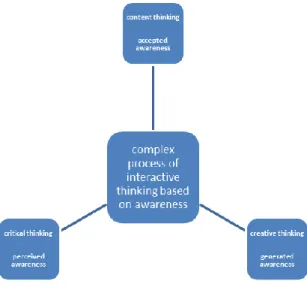
As discussed, in the design process some of the discussions require critical thinking and the other require creative thinking; hence the need to use both types of thinking in an architectural design process requires the use of a thinking model, which allows simultaneous use of any kind of thinking. According to the results of studies by the University of Iowa, College of Education and Arts and Design, the appropriate pattern of thinking in complex processes is the use of the interaction of the three types of "content", "critical" and "creative" thinking. In this model, the interaction between the three types of thinking is influenced by three types of consciousness, so that content thinking is influenced by accepted awareness, critical thinking is influenced by perceived awareness, and creative thinking is influenced by generated awareness (Fig 1).
Fig 1 Pattern of Interactive thinking provided in University of Iowa (Cadwell and Dake, 2004: 11)
Content thinking is introduced actually based on the mentality which is formed in the person and “accepted awareness". In this thinking, collected information from the environment during the time in the mind allows one to use the information archive in the mind. For example, the roles and colors that are valuable to a designer are certainly influenced by his or her ethnic, racial, social, and cultural values, and this person unconsciously uses them in his design work. Critical thinking is discussed with logical thinking and with information analysis and the use of "accepted awareness". For example, in the design process, all activities related to gathering information, analyzing information, and targeting are shaped by this type of thinking. Creative thinking is coupled with "generated awareness" and innovative solutions to problem solving. The designer uses creative thinking in the design process to create ideas and concept of design. Many people describe design as one of the most creative human quests (Lawson, 2011: 171). Creative work is full of contradictions and the creative thinker needs to be immersed in the problem at once while freeing his or her mind. Having a full vision of the problem and constantly thinking about it, a creative
thinker should relax his or her own conscious mind so that his / her desire to solve the problem is not an obstacle to creativity and finding a new answer (Azami, Khajeh Yian, Tholai, 2008).
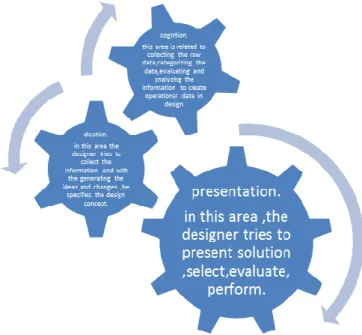
By using an interactive pattern of thinking which is introduced by University of Iowa, The following pattern can be used as prerequisites for its adaptation to the architectural design process. In the proposed design pattern, given the activities involved in the design process in architecture based on thinking of architecture, the titles in design arena include three areas of "cognition," ideation, and "presentation" (Fig 2) (Tzamir and Churchman, 2004).
In the model proposed in Fig 2, the relationships between the design prerequisites are not linear and it is necessary to look at them interactively in a chained cycle. In other words, instead of looking at the process as a step, that is, first complete the "cognition" phase in order to enter the "idea" phase, practically we should consider the process of designing as a set of activities which come from three realms and the simultaneous interaction between these three prerequisites leads to the optimal and comprehensive response to a design in architecture.
Fig 4 Design Prerequisites on the basis of interactive thinking in architecture
2.3. Relationship between Emotional Intelligence and Interactive Thinking in Architectural
Design
Researchers' achievements have confirmed that there are at least two distinct intelligences, including emotional intelligence and cognitive intelligence in humans. Many theories, including Gardner's theory of intelligence (1983), Bar-on's theory of emotional intelligence (2001), and Salovoy and Meyer's (1990), state that success does not depend solely on cognitive intelligence and that cognitive intelligence is not a measure of one's success and it depends on another factor called emotional intelligence (Castilloz et al., 2013). About the difference between cognitive intelligence and emotional intelligence. It can be said that cognitive intelligence allows one to understand how
information is processed. Cognitions, similarities, differences, inferences are all clearly within the cognitive and intellectual realms. Recognizing feelings of self and using them to make appropriate decisions in the design process, the ability to manage optimally mood, and mental status and impulse control are measured by emotional intelligence. Emotional intelligence is genetically acquired and also it is modifiable and during the life it improves with education and it requires thinking (Cavazotte et al., 2012). The existence of emotion is important for wise thinking, and in the relation between emotions and thoughts, emotions guide the decision-making moment by moment and work closely with the rational mind and enable or disable thought. Emotional intelligence evaluates the person emotionally, that is, how much the individual is aware of his or her emotions and feelings and how he or she can control them through thought (Salovy et al., 2002). Likewise, the master-mind plays an essential role in generating emotions (Goleman, 1995). People with high emotional intelligence skills calm and clear their minds quickly and easily, and open the way to access inner insights and creative ideas in thinking (Nordin, 2012).
People with stronger emotional intelligence use creative, innovative ways to express their ideas and they show creativity in design and are able to perform better (Batastin, 2001). This is also evident in the complex design process for architects. The more the architect uses his emotional intelligence to create a new design, the more creativity and patience will emerge in that design (Mahmoudi, 2004).
Some researchers believe that only part of the properties of an engineer is related to his or her cognitive intelligence and the other important part is related to emotional intelligence (Sam, 2009). In the process of architectural design, the types of thinking and adopted approaches by the designer have a direct role in the process of answering the question and the result is evident in the design of product (Carmichael, 2006). Architects need to be aware of the characteristics of different types of thinking as well as how to utilize related talents to emotional intelligence and to work out on solutions.
Since the creation of human environments takes place in interplay between reason, emotion and intuition, and on the other hand, in addition to logic, emotions and feelings play an essential role in emotional intelligence, the most important research hypothesis is the relationship between emotional intelligence criteria and interactive thinking skills in the architectural design process. the relationship between two variables of emotional intelligence and interactive thinking to create new ideas in the architectural design process has not been researched and also the necessity for creative and innovative thinking by the architect is emotional intelligence, this paper examines the relationship between these two variables focusing on the thoughts and emotions of architecture students as well as the different prerequisites of design in architecture based on the interactive thinking model. Accordingly, the four parameters of self-awareness, self-control, self-motivation and social skills are identified as the most important emotional intelligence criteria in executing complex processes, as well as three factors of cognition, ideation, and presentation are identified as key prerequisites for implementing an interactive thinking pattern in the architectural design process. Target has been evaluated among the population and statistical sample to identify the correlations and the mutual relationship between these variables.
3.
Research Methodology
Architectural design needs extensive knowledge, from the physical properties of building materials to the principles of visual perception. Research’s subdivisions with the astonishing figure are done with different and varied mental patterns (Grout and Wang, 2013: 24). The research method in this study is "logical reasoning" and uses "analytical-descriptive" methods with a
quantitative and statistical approach. The present study has assessed these two variables in order to achieve appropriate hypotheses for examining the role and mutual relationship of Interactive thinking in using the high mental capacity of architecture students as a suitable tool for promoting creativity and to examine suitable prerequisite for increasing their emotional intelligence. The studied variables in this study included emotional Intelligence parameters and the interactive thinking prerequisites in the architectural design process and mutual relationship between these variables which are based on the architectural students' views. To this end, first, through documentary and library studies, the theoretical foundations of emotional intelligence and interactive thinking and the variables of these two phenomena were identified to increase student understanding of the design process. Then to test the parameters of emotional intelligence and prerequisites of using interactive thinking and determining the mutual relationship between these variables, first descriptive statistics results were determined by using analytical questionnaires with Likert spectrum method. Then correlation and preference between variables were tested by using SPSS software, Pearson and Friedman statistical tests.
The statistical population of this study was all male and female BA students in Architecture at Damavand University and for lack of access to all individuals of the society, a total of 40 students were selected as the statistical society. Since the statistical population of this study is a limited population, Cochran's finite population sampling formula was used to estimate the sample size.
(1)
In this respect, n is volume of Statistical sample, N is population of statistical society, is normal distribution value, q is ratio of non-trait in statistical population, p is ratio of trait in statistical population and is error level. In the above formula, the maximum permissible error
( )
is usually 0.05, the confidence coefficient is 95% and 0.95, the parameter is 1.96, and the values of p and q are both 0.5 and N is considered as a volume of society. According to the above relationship and values, in the present study the population of the statistical society is 40, the number of statistical population is 36.
4.
Findings
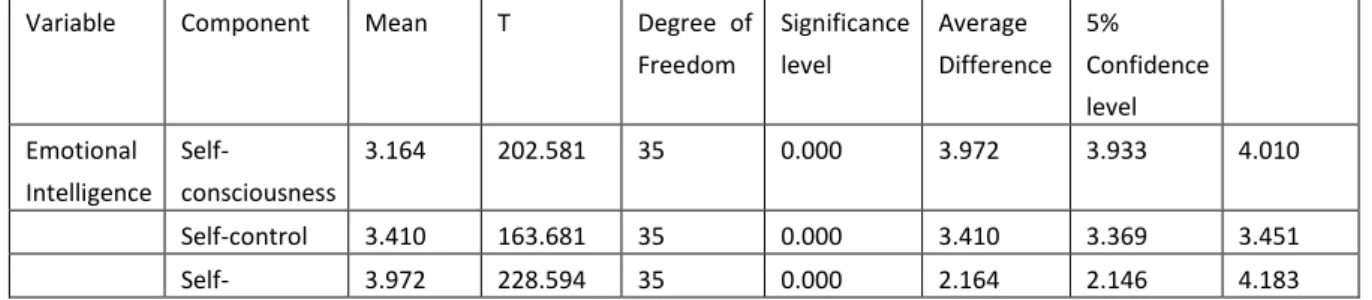
In this section, questions related to each components are combined together and has been discussed the amount of significance from the students' point of view through a one-sample t-test. Considering that the theoretical mean of the respondents is 3, the mean of each component is compared with 3 and a significant or non-significant difference is shown. The results are presented in Table 1.
Table 1 Descriptive Indicators for Emotional Intelligence and Interactive Thinking Prerequisites in Architectural Design Process
Variable Component Mean T Degree of
Freedom Significance level Average Difference 5% Confidence level Emotional Intelligence Self-consciousness 3.164 202.581 35 0.000 3.972 3.933 4.010 Self-control 3.410 163.681 35 0.000 3.410 3.369 3.451 Self- 3.972 228.594 35 0.000 2.164 2.146 4.183
motivation Social skills 1.917 180.989 35 0.000 1.917 1.896 1.938 Interactive Thinking Cognition 3.040 149.324 35 0.000 2.844 3.011 3.944 Ideation 3.491 186.641 35 0.000 3.080 3.026 4.054 Presentation 3.178 211.321 35 0.000 3.122 2.842 4.0197
The parameters utilizing emotional intelligence in the architectural design process were examined by t-test, self-awareness (3.164), self-control (3.410), self-motivation (3.972) with a significant level of (0.000) in comparison to the theoretical mean of responses namely 3 showed a higher level and these parameters show the emotional intelligence effect on the design process. It should be noted that based on the presented answers and the results analysis, it can be concluded that the social skills parameter (1.917) has a lower average than theoretical mean of responses, indicating that there is no significant relationship between these parameters. Also from the t-test results on the prerequisites of using interactive thinking in the process of architectural design, cognition factors (3.040), ideation (3.491) and presentation (3.178) with the average above mean responses (3), show steady state and impact as the main factors. Considering the significance level of less than 5% in all parameters and affective prerequisites of interactive thinking by using emotional intelligence parameters in architectural design process whose significance level is less than 5%, there is a significant similarity between respondents' attitude towards these two variables.
After reviewing the data related to the questionnaires, the research hypotheses are analyzed. Therefore, the research hypotheses are first expressed as follows:
Hypothesis 1: Applying parameters such as self-awareness, self-control, and self-motivation leads to promote interactive thinking in the architectural design process.
Hypothesis 2: Adherence to prerequisites such as cognition, ideation, and presentation leads to effective intelligence use in the architecture design process.
To investigate these hypotheses, we examine the mutual relationship between three emotional intelligence parameters and promoted interactive thinking and also the relationship between the three prerequisites of interactive thinking and the impact of emotional intelligence on the architectural design process. As stated earlier, Pearson's correlation coefficient was used to analyze the hypotheses.
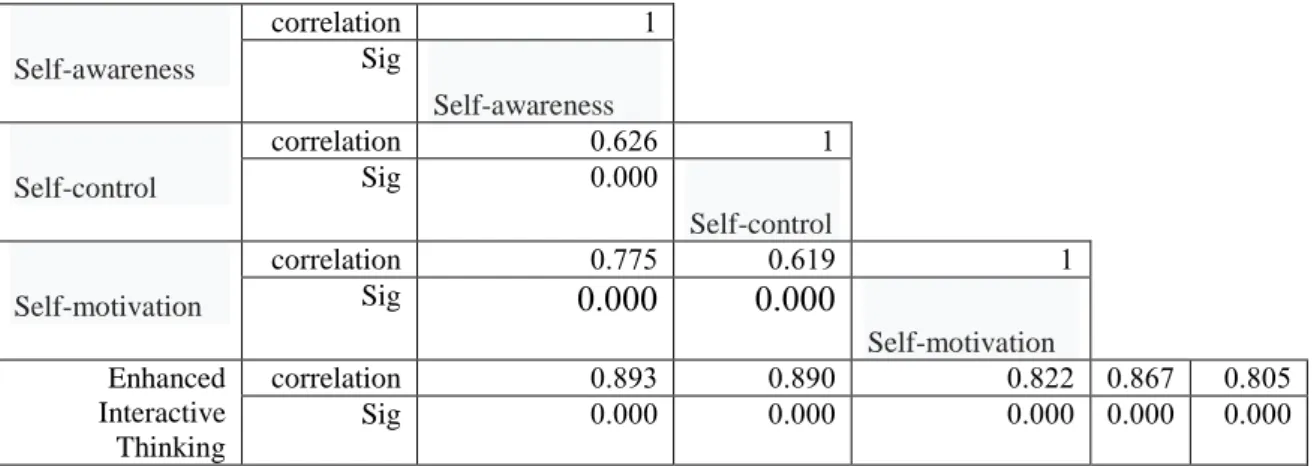
Pearson's coefficient indicates the degree of linear relationship between the quantitative variables (Maser et al., 2012:152). To interpret the severity of the relationship and the variable, various classifications are presented in terms of Pearson's correlation coefficient. The variation of this coefficient between 0.8 and 1 indicates a very strong relationship and in the range of 0 to 0.2 indicates a lack of relationship or insignificant relationship between two variables. Tables 2 and 3 present the results of inferential analysis based on Pearson's correlation test for the first hypothesis and the second hypothesis, respectively.
The results of Table 2 show that there is a high correlation between factors such as self-awareness, self-control, self-motivation in architectural design process to promote interactive thinking. This high correlation indicates that if these factors are observed and applied, they can contribute to promote the use of interactive thinking, so the first hypothesis is confirmed. It can also be seen from the results of Table 3 that there is a high correlation between the prerequisites of cognition, ideation, and effective use of emotional intelligence in the design process, and therefore the second hypothesis is confirmed.
Table 2 Correlation Status between Emotional Intelligence Parameters and Interactive Thinking promotion in Architectural Design Process
1 correlation Self-awareness Self-awareness Sig 1 0.626 correlation Self-control Self-control 0.000 Sig 1 0.619 0.775 correlation Self-motivation Self-motivation
0.000
0.000
Sig 0.805 0.867 0.822 0.890 0.893 correlation Enhanced Interactive Thinking 0.000 0.000 0.000 0.000 0.000 SigTable 3 Status of Correlation between the Prerequisites of Interactive Thinking and Emotional Intelligence Promotion in Architectural Design Process
1 correlation Cognition cognition Sig 1 0.626 correlation ideation ideation 0.000 Sig 1 0.619 0.775 correlation presentation presentation 0.000 0.000 Sig 0.805 0.867 0.822 0.890 0.893 correlation promoted emotional intelligence 0.000 0.000 0.000 0.000 0.000 Sig
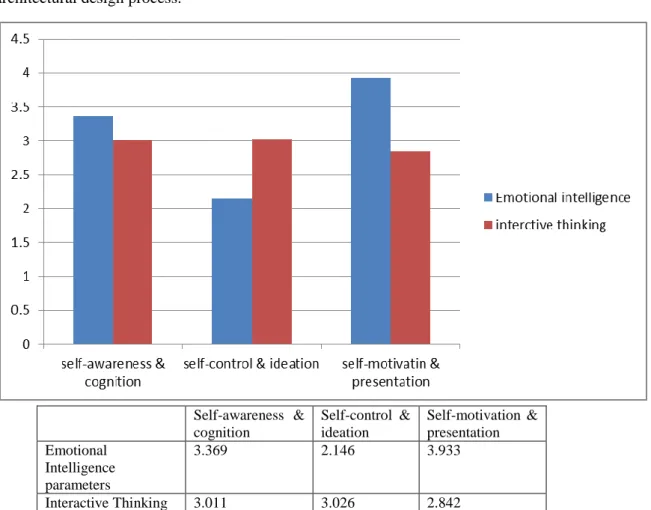
The significance of each of the identified indices and their ratings were analyzed by using the Friedman test. Using the respondents' opinions and the importance of their allocation, Friedman's ranking test prioritizes the different variables based on the mean of their ratings. It should be noted that the purpose of the present study was to determine the importance of emotional intelligence parameters in promoting interactive thinking as well as the prerequisites of interactive thinking in the effective application of intelligence in the architectural design process based on each of the variables, so any variable that has a higher average rank, will get a higher ranking. The results of descriptive information and ranking of emotional intelligence parameters and interactive thinking prerequisites for promoting the architectural design process are shown in Table 4 and Figure 3, respectively.
Table 4 Descriptive information of emotional intelligence parameters and interactive thinking prerequisites for promoting the architectural design process
Variable Component n Mean Standard
Deviation
Mean (min) Mean (max) Test statistic Average rate Emotional Intelligence Self-awareness 35 3.164 0.2888 2.150 4.595 3.933 1 Self-control 35 3.410 0.4129 2.094 3.983 3.369 2 Self-motivation 35 3.972 0.3934 3.0.1 4.879 2.146 3
Interactive Thinking
Cognition 35 3.040 0.332 2.441 3.784 3.011 2
Ideation 35 3.491 0.2894 2.187 3.891 3.026 1
Presentation 35 3.178 0.4392 2.994 4.011 2.842 3
As shown in Table 4 and Fig 3, the parameters self-motivation, self-awareness and self-control with mean scores, 3.933, 3.369 and 2.146 respectively as well as ideation, cognitive and presentation prerequisites, with mean scores of 3.026, 3.011, and 2.842, respectively, are ranked first to third in the two variables of emotional intelligence and interactive thinking in the architectural design process.
Self-awareness & cognition Self-control & ideation Self-motivation & presentation Emotional Intelligence parameters 3.369 2.146 3.933 Interactive Thinking 3.011 3.026 2.842
Fig 3 Friedman test rating results for ranking emotional intelligence parameters and prerequisites of Interactive thinking to enhance the architectural design process
5.
Conclusion and Discussion
In all educational societies, it is essential to define new patterns to strengthen thinking and thinking prerequisites use for ideation and presenting creative solutions to complex design processes such as architectural design. On the other hand, with the new definitions of intelligence in the field of psychology, identifying areas and prerequisites related to emotional intelligence to promote the ability of architecture students is also very important. This requires that by studying and examining these two issues, we evaluate the mutual relationship between them to determine the effective factors on the growth and excellence of architecture students. For this purpose, in this paper, the role of interactive thinking in using high-capacity intellectual students as an appropriate tool in enhancing creativity and exploring appropriate infrastructures to enhance their emotional
intelligence is discussed to achieve a mutual relationship between emotional intelligence and interactive thinking in the design of the case study. In other words, this research aims to investigate the mutual relationship between emotional intelligence and interactive thinking among architecture students of Damavand University .This study has been discussed the coefficient and effects by taking into account the major and influential variables in these two phenomena and with reference to the stated objectives of the project and the logical relationship between the components of this project. Given the purpose of the research, the mutual relationship between interactive thinking and emotional intelligence was identified with information from interviews with architecture students for promoting the architectural design process by using statistical and inferential analysis. Based on the analysis of data from inferential and statistical analyzes between Students, it was found that by confirming the first hypothesis ,there is a significant relationship between three parameters of emotional intelligence, namely self-awareness, self-control and self-motivation, and the promotion of interactive thinking in the architectural design process. The second hypothesis was also confirmed and showed that observing prerequisites such as cognition, ideation and presentation leads to the effective application of emotional intelligence in the architectural design process.
As a preliminary result it can be said that although based on correlational studies, the mechanisms underlying the relationship between interactive thinking and emotional intelligence in the architectural design process cannot be clarified, each of the emotional intelligence parameters seems to influence on the promotion of interactive thinking. On the other hand, the prerequisites for interactive thinking also emerge the ability of the effective use of emotional intelligence to facilitate creative thinking in the field of architectural design. In describing this mutual relationship, it should be noted that some architects perform activities better under certain emotional conditions. So emotion affects their thinking system and changes it. These changes force the architect to look at matters from different aspects and think about them deeper and more creative. The aspect of emotion regulation also demonstrates the architect's ability to reduce negative emotions and maintain positive emotions, and thus, positive emotional intelligence can create more flexibility in the development of interactive thinking, which in turn leads to increased creativity in the architectural design process.
In fact, in interpreting the existence of a mutual relationship between the parameters of emotional intelligence and the prerequisites of interactive thinking, it can be said that self-motivation, self-awareness, and self-control, with consideration of the positive emotions of the architect in the process of architectural design, lead to increased awareness and flexibility in the field of thinking. This will lead to improved cognition, creative ideation and ultimately an innovative outline in the architectural design process. There are, however, obstacles to lack of creativity in the research process including strategic barriers - value barriers - conceptual barriers - personal imagination - perceptual barriers - sensitivity barriers - cultural barriers - environmental barriers - expressive barriers) in understanding their interaction with the environment.
References
Ardalan, N., & Bakhtiar, L. (2013). Sense of Unity: (The Role of Tradition in Iranian Architecture). Royal Architectural Publications, Tehran, Fourth Edition.
Azami, A., Khajeh Yian, D., & Tholai, R. (2008). Creativity and the Ways of Cultivation. Police Human Development Quarterly, 16, 66- 69.
Alexander, C., (2011). Architecture and the Mystery of Eternity (The Timeless Way of Making)
Hojat, I. (2014). Tradition and Innovation in Architectural Education. University of Tehran Publications, Second Edition.
Dondis, D. A. (2010). The Basics of Visual Literacy. Parham Naghsh Publications (Aghaie, S. Trans.). Tehran, First Edition.
DiBuno, A. (2006). Six Hats of Thinking - A New Look at Thought Management (Izadifar, A. Trans.). Peik bahar Publications, Sixth Edition.
Grout, L., & Wang, D. (2013). Research Methods in Architecture (Einifar, A. Trans.). University of Tehran Publications, Seventh Edition.
Goleman, D. (2000). Emotional intelligence and its reason for superiority to intelligence. Translated by: Parichehr Farjadi (2004). Tehran: The Rite of Understanding, first edition. Lawson, B. (2011). How Designers Think: Dismantling the Design Process (Nadimi, H. Trans.).
Shahid Beheshti University Press, Tehran, Fourth Edition.
Mahmoodi, S. A. S. (2003). A Review of Research and Its Common Methods in Architecture. Abadi, 1, 39-45.
Mirriahi, S. (2006). Architectural Design Arbitration and its Consequences. Safeh, Journal of Shahid Beheshti University of Architecture and Urban Development, 15(42), 86-97.
Nadimi, H. (1999). A Look at the Design Process, Safeh, 29, 94-103.
Nezbit, K. (2012). Postmodern Theories in Architecture (Kit of Relativity) (Shirazi, M. R. Trans.). Ney Publishing, Tehran, Fourth Edition.
Noghrekar, A. (2015). Human Perceptual Interaction with Spatial-Geometric Ideas in Architecture, Amir Kabir Publications, Tehran, Second Edition.
Razjouyan, M., & Sheikh Taheri, H. (2003). Speculation on Students' Mental Growth in Architecture Workshop. Safeh, Journal of Shahid Beheshti University School of Architecture and Urban Development, 13(36), 25-35.
Shahcharaghi, A., & Bandarabad, A. (2016). Inscription in the Environment: Application of Environmental Psychology in Architecture and Urban Planning, Tehran University Jahad Publications, Second Edition.
Sabhieh, M. H., Bemaniyan, M. R., & Keshtiban, Y. (2008). Creativity in Architectural Engineering Students (Investigating Three Models for Knowledge Transfer from the Students' Perspective). IranianJournal of Engineering Education, 10(37), 49-67.
Yazdanfar, S. A. (2004). A Review of Students' Schema and its Growth in Design Education Process (Architecture Workshop I). Safeh, Journal of Shahid Beheshti University of Architecture and Urban Development, 14(38), 145-170.