2.2
Targeted malware attacks are typically not discrete events. Rather, they
are a part of systematic campaigns that use common malware, C2
infra-structure and social engineering tactics to target groups repeatedly over
long periods of time. Threat actors using common tools and techniques
may target multiple groups within a community.
To cluster attacks into campaigns, we analyze technical and contextual indicators to identify patterns. Where possible we draw connections between these clusters and previously reported campaigns and threat actors.
Malware attacks are clustered into campaigns by commonalities and patterns across the following indicators:
Email headers: Originating-IP or common email addresses seen in Reply-To, Sender or
Envelope-From email headers.
Shared C2 infrastructure: Domain names and IP addresses to which malware beacons
and/or from which it downloads additional modules.
Static analysis: Commonalities between unusual strings or data structures seen in the
malware samples or the files they drop.
Malware development: Observable changes made to specific malware families over time.
Social engineering tactics: Contextual patterns in targeted organizations, spoofed
senders, and content of messages.
Based on the attributes described above, we identify 10 distinct campaigns, which we present in detail in the following sections.
IEXPL0RE Campaigns
First Seen August 3, 2010Last Seen May 21, 2012
Exploits Windows: CVE-2010-0188; CVE-2010-3333 Malware Families Windows: IEXPLORE RAT (aka C0d0s0) Infrastructure C2 domains: sixday.wikaba.com msupdate02.selfip.com msupdate02.selfip.info xinxin20080628.gicp.net humanbeing2009.gicp.net saveworld.gicp.net xinxin20080628.gicp.net 204.134.116.229 60.167.78.229 116.226.49.148 123.147.81.121 204.134.116.229
Targeted Groups Tibet Group 1, Tibet Group 2, China Group 1, China Group 2 TTI range 2.5 - 5.0
BACKGROUND
The IEXPL0RE campaigns involved custom-developed Windows malware target-ing four of the study groups with a unique email and delivery method used for each attempt. Each email was tailored specifically for the target in terms of subject, content, and the way the malware was attached and hidden. In addition, there was evidence that the malware was under active development during the campaign. The IEXPL0RE campaigns serves as a typical example of “APT”- style operations.
CAMPAIGN TIMELINE
Attacks in this campaign are linked by the use of IEXPL0RE RAT, which provides standard RAT functionality, including keylogging, file extraction, and control of mi-crophone and webcam peripherals.5
We identified the IEXPL0RE campaign through analysis of three separate attacks using this malware that were sent to China Group 1, China Group 2, and Tibet Group 1. This first series of attacks clearly shows how the attackers carefully customized social engineering tactics to the interests of the three different groups.
Evidence of this campaign first emerged in an August 3, 2010 email to Tibet Group 1 that referenced a protest against the Shanghai Expo in Japan. The malicious attach-ment was a PDF using CVE-2010-0188 to deploy IEXPL0RE RAT.
Social engineering 2
Technical 1.25
TTI 2.5
MD5 6b04821ad588b0f918318064a07dd5d6
C2 msupdate02.selfip.com
5 For a detailed technical analysis of the IEXPL0RE RAT including a full enumeration of its commands and C2 communication protocol see Hardy, S. “IEXPL0RE RAT,” The Citizen Lab, August 2012, https://citizenlab.org/wp-content/uploads/2012/09/IEX-PL0RE_RAT.pdf
On November 11, 2010, China Group 1 received multiple emails addressed to the organization’s director claiming to be from personal friends. The emails included an executable attachment in a password-protected archive, with the password provided in the body of the email. Packaging attachments in a RAR file makes them less likely to be discovered by an AV scanner. Password protecting the archive reduces the chances of AV detection even further. When executed, the malware connected to softwareup-date.8866.org (119.75.218.45). The level of personalization used in the message gives it a social engineering score of 4 and a total TTI of 5.0.
On November 19, 2010, China Group 2 received an email containing a story about a high-profile, high-rise apartment building fire in Shanghai. The message was written in Chinese and repurposed text from a news article on the event.
Attached to the email were four images and two executable files (.scr extensions) designed to look like images using the Unicode right-to-left override character. When each executable file is run, it will install and launch the malware, drop an image, open the image, and delete itself. The malware connects to xinxin20080628.gicp.net (114.60.106.156). The attack has a social engineering score of 3 and a total TTI of 3.75.
The remaining attacks we analyzed targeted Tibetan groups exclusively.
On December 2, 2010, Tibet Group 1 received an email that included an Excel spread-sheet attached to an email that appeared to be from organizers of a conference on climate change.
Social engineering 3
Technical 1.25
TTI 3.75
MD5 8d4e42982060d884e2b7bd257727fd7c
C2 60.167.78.229
On January 11, 2011, Tibet Group 1 received an email about an annual review of Tibetan human rights issues that contained an executable file designed to appear to be a video of a speech by HHDL. Social engineering 2 Technical 1.25 TTI 2.5 MD5 21a1ee58e4b543d7f2fa3b4022506029 C2 61.132.74.68
In July 2011, IEXPL0RE was sent to Tibet Group 1 again. This time it used a .rar archive file containing a malicious .hlp file.
Tibet Group 1 received two more emails with IEXPL0RE in late December 2011 and early January 2012. On December 22, an email referencing Uyghur refugees
was received; on January 6, an email in Chinese about Taiwan issues copied from a blog post was received. Both had .rar at-tachments with the same file, which used CVE-2010-3333. Each of these emails score a social engineering base value of 2.0, and a technical score of 1.25 for an overall TTI of 2.5.
On May 21, 2012, a newer version of the RAT payload was distributed via email in multiple RTF documents to Tibet Group 2. This attack was coupled with a higher degree of social engineering. Separate emails with the same payload and content were sent to both the Executive Director and Program Coordinator, addressing them by name. The email contained an invitation to a legitimate event and included the email signature of a real person, with an attached file purporting to contain information about the event. The sender notes that the recipients were identified as contacts for HHDL, and asks them for help contacting His Holiness in order to invite him to the event. This level of personalization gives the attack a social engineering score of 4 (total TTI 5.0) The attached RTF file drops a DLL along-side a legitimate program vulnerable to DLL hijacking, allowing the malware to run without a warning to the victim that it is not digitally signed. StrokeIt, a program for using mouse gestures, uses a file named config.dll without verifying the authenticity of the file. By replacing config.dll with the RAT downloader, the malicious code is run
while appearing legitimate to the operating system (see Figure 9).
FIGURE 9: Valid digital signature for StrokeIt pro-gram, which is used to launch malicious config.dll file
OBSERVATIONS
This series of attacks represents a typical ‘APT’-style campaign. Multiple groups were targeted, with each attack custom developed for each group, including tailored social engineering. The evolution of the RAT payload, as seen in the series of samples targeting Tibet Groups, sug-gests that the malware was under active development. The social engineering
tactics and development cycles observed in this campaign demonstrates the organized and persistent nature of the attackers.
Mobile Malware
BACKGROUND
The use of malware targeting mobile platforms in espionage campaigns is relatively rare, but is likely a vector that will become more common due to the increasing ubiq-uity of mobile computing.
During investigations of C2 servers associated with the Luckycat campaign, Trend Micro found two malicious Android APKs in early stages of development that could collect device information, as well as download and upload files by remote command. Based on the available information, it was unclear how the attackers intended to deliver the mobile malware to targets.
In 2013, researchers at Kaspersky reported the compromise of an email account of a high-profile Tibetan activist that was then used by attackers to send targeted malware to the activist’s contacts. The emails referenced the World Uyghur Congress and included a malicious APK file that appeared to be an application with information on the event. The malware allowed attackers to collect data from infected devices includ-ing contacts, call logs, SMS messages, geolocation, and phone data (phone number, OS version, phone model, and SDK version).
Researchers in our group have also found evidence of commercial surveillance prod-ucts that target multiple mobile platforms (e.g., Android, IOS, BlackBerry, Symbian) developed by Hacking Team and FinFisher.
In other recent work, researchers found that participants in the Occupy Central pro-tests in Hong Kong received links through WhatsApp to an Android application that appeared to be associated with the protest organizers, but was actually malware that could send a variety of information back to attackers.
In our study, we identified the use of compromised Android applications sent as part of a targeted attack against a prominent figure in the Tibetan community. This attack
lever-aged a genuine email that was likely exfiltrated by attackers, and attached compromised versions of the chat application KakaoTalk and mobile radio application TuneIn.6
VECTOR OF ATTACK
On December 4, 2012, an information security expert who works within the Tibetan community sent a private email to a member of the Tibetan Parliament in Exile,
based in Dharamsala, India. That email attached genuine versions of Kakao Talk7 and
TuneIn8 as APK files.
On January 16, 2013, an email purporting to be from this same information security expert was sent to a high profile political figure in the Tibetan community. The email contained the same text as the message from December 4, but attached compromised versions of the Kakao Talk and TuneIn Android APKs.
In order for the malware to be installed, the user must permit applications to be in-stalled from sources other than the Google Play store. This permission is not enabled by default in Android. However, as many members of the Tibetan community (partic-ularly those living in Tibetan areas in China) have restricted access to the Google Play service, they are required to permit applications to be installed from outside sources. It is common for APKs to be circulated outside of Google Play. In addition to permitting the “allow from unknown sources” option, the user must also approve the additional permissions requested by the application. Users may be duped into accepting these permissions by assuming they are required for the regular functionality of the applica-tion or by not reviewing them carefully before approving. Once these permissions are approved, they are used to authorize the additional data-gathering capabilities of the malware, which is configured to autostart on device boot.
We later confirmed that the original recipient of the legitimate email had his email account compromised. Therefore, it appears likely that the attackers harvested the
6 We previously reported this attack in a blog post, Citizen Lab, “Permission to Spy: An Analysis of Android Malware Targeting Tibetans,” April 18, 2013, https://citizenlab.org/2013/04/permission-to-spy-an-analysis-of-android-malware-targeting-tibetans. See a Tibetan translation of this post here: https://citizenlab.org/2013/04/android-malware-in-tibetan.
7 KakaoTalk is a chat app that is developed by a South Korean company (Kakao Corporation). Members of the Tibetan community have used KakaoTalk and other applications as alternatives to WeChat (another chat app popular in Asia) after concerns were raised regarding that application’s general security and the potential for Tencent (the China-based developer of WeChat) to moni-tor users at the behest of the Chinese government.
8 TuneIn is a media player application for listening to Internet Radio. TuneIn is used by Tibetans to listen to streams such as Voice of America’s Tibetan service, to engage with their culture, and to stay on top of world news.
original email from the compromised account, and over the course of a few weeks developed malicious versions of the attached APKs. The use of private information in this attack gives it a social engineering score of 5. The technical score of the malware is 1.25 (see the section below for details on the malware’s functionality). The total TTI is 6.25.
MALWARE ANALYSIS
The functionality and certificates used for the malicious versions of the KakaoTalk and TuneIn APKs are identical. Both applications were repackaged into modified APKs and signed with an illegitimate certificate (KakaoTalk malware MD5 cbc474e34f26b4afd-02932d8cae9e401 Tunein Malware MD5 ba760392f171e2f05d0352cc1e00190c). Below, we reproduce the original and fake certificates used for KakaoTalk. Notice that fields in the illegitimate certificate have been populated with what appears to be an assortment of nonsensical characters from a QWERTY keyboard:
Original legitimate certificate:
The following permissions are added by the malware that do not exist in the legitimate version:
Note that two of the additional permissions requested by the malware are misspelled, rendering these permissions unusable:
The malicious versions of both applications have the same functionality enumerated below:
On a periodic basis the user’s contacts, call history, SMS messages, and cellular
network configuration are written to an encrypted file called info.txt.
The malware periodically contacts the C2 server “android.uyghur.dnsd.me” to retrieve
updated configuration information, such as URLs and login credentials. This configura-tion informaconfigura-tion directs the malware to an upload locaconfigura-tion for the info.txt file. The site hosting the C2 appears to emulate the appearance of the Baidu website (a Chinese search engine), but includes encrypted configuration data hidden in the comments. By masking the C2 as a seemingly innocuous website, requests would appear to be legiti-mate on casual inspection. The configuration data contained in the comments directs the malware to upload captured data from the device to an FTP server and contain a pointer to a new C2 that would allow the attackers to change the C2 should that need arise.
The malware intercepts SMS messages and searches for a special code sent by the
attacker, which, if detected, responds to the sender with the base station ID, tower ID, mobile network code and mobile area code of the infected phone in question. This message is not displayed to the user, and they are never made aware of it.
OBSERVATIONS
The compromised Android applications that we detected as part of our study, as well as mobile malware described by other security researchers, show that mobile devices are indeed targets for espionage attackers. These attacks serve as early examples of a trend that seems likely to grow alongside the rapid spread of mobile computing. As described above, there are particular security risks for users residing in locations where access to standard secure channels for installing mobile applications is re-stricted. As users are required to distribute and install APKs of unknown provenance, they are at increased risk of malicious applications, particularly if those applications use fake certificates (as was the case in this attack).
OS X Campaigns
First Seen May 2011Last Seen Early 2013
Exploits CVE-2009-0563; CVE-2011-3544; CVE-2012-0507 ; CVE-2009-3129 Malware Families Revir/IMuler, Olyx / Lamadai / PubSab, MacControl
Infrastructure C2 domains: freeavg.sytes.com (Olyx.C), mail.hiserviceusa.com (Olyx.C), yahoo.xxuz.com (Olyx.C), coremail.info (SabPab.A), rtx556.onedumb.com (SabPab.A), www.teklimakan.org (iMuler), IPs: 112.213.126.118 (Olyx.C), 100.42.217.91 (Olyx.C), 198.74.124.3 (SabPab.A), 199.192.152.100 (SabPab.A), 61.178.77.158 (MacControl)
Targeted Groups Tibet Group 1, Tibet Group 2, Tibet Group 3, Tibet Group 4 TTI Range 2.0 - 3.75
BACKGROUND
While Windows was the most commonly targeted operating system in our study, it was not the only platform targeted. Malware targeting OS X is increasingly paired with Windows malware, giving attackers a better chance of compromising the machine, whatever the operating system. This approach can take the form of code that determines the target’s operating system, such as a web page that uses JavaScript to detect the operating system and then download a cross-platform exploit with ap-propriate payload.
Four of the Tibet Groups in the study9 received targeted malware specifically designed
for OS X. Tibet Groups 1, 2, and 4 received emails with malware in an attachment or link. Malware was detected on the network of Tibet Group 3 by a NIDS on their office network.
The OS X malware seen in our study ranges in sophistication from simple programs
that rely entirely on social engineering, paired with targeted emails that are not customized for the target (TTI: 2.0), to moderately customized emails with malware that has minor code protection (TTI: 3.75). While the technical sophistication of the malware does not vary widely, all of the malware families observed show active and consistent development over the course of the study.
MALWARE ANALYSIS
The malicious emails used a combination of social engineering, and exploits against a variety of vulnerabilities, to install malware on the victim’s computer.
The vectors we observed include:
An attached .zip file containing an executable
An attached Word document using CVE-2009-0563
A link to a Java .jar file using CVE-2011-3544
A link to a Java .jar file using CVE-2012-0507
The subject and body text of all of the emails targeting the Tibet Groups contained information relating to Tibetan news and activities (e.g., current world events, upcom-ing rallies, and self-immolations).
We see Word document vectors first being sent in early 2013. Interestingly, these attacks use a vulnerability made public back in 2009. The use of this vulnerability may be due to the Java vulnerabilities having a higher chance of being patched by the Tibetan community, after they received substantial media attention. However, as the Word documents were all part of one campaign, it is likely just coincidence, as an email carrying the later Java vulnerability was received while the Word campaign was still underway.
We observed three malware families targeting OS X, all of which are simple RATs with low technical sophistication scores:
Revir/IMuler (technical score: 1.0)
Olyx/Lamadai/PubSab (technical score: 1.0)
Revir / IMuler
Revir and IMuler are names for individual components of one particular targeted attack for OS X, and are often used interchangeably. Revir is the name for the “dropper” or shell program that deploys the embedded malicious payload (in this case, IMuler), as well as a clean payload that is then opened to distract the user. The clean payload that is used can dif-ferentiate the early variants of Revir that we have seen. Using the F-Secure naming scheme Revir.A carries a PDF and Revir.B carries a JPG. Later variants Revir.C and Revir.D allow for any type of clean decoy file, and also encrypt the payload.
IMuler acts as a simple remote access trojan, providing the attacker with the ability to upload and delete the victim’s files, download and run additional malware, and take screenshots. The
variants we observed have no reverse engineering protection in the code, although later versions starting with
IMuler.B will look for the Wireshark network analyzer and stop running to evade analysis if it is found.
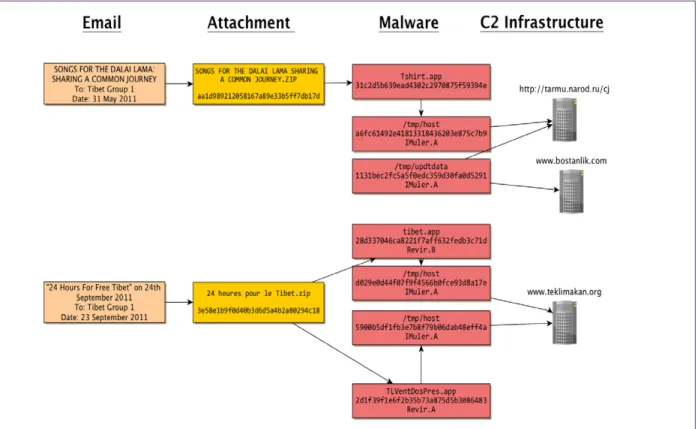
We observed two attacks against Tibet Group 1 using the Revir/IMuler combi-nation. The first, an email sent in May 2011, was a combination of Revir.B and IMuler.A and was the earliest Mac malware attack seen in the study. This email’s contents were about a legitimate event featuring HHDL. The second email, sent in September 2011, stepped up the attack by containing both Revir.A/ IMuler.A and Revir.B/IMuler.A combina-tions. This email purported to be from a legitimate Tibetan rights organization and referred to an upcoming event.
FIGURE 10: Revir/IMuler attacks
The attack in September 2011 is particularly interesting because the Revir/IMuler
components show very clear development progress compared to the version sent in May. The May version is a two-stage program. The initial program dropped as /tmp/host downloads a second program as /tmp/updtdata, which is then used for communication with the C2 server. The September version integrates the second program into the first, merging functionality. This change means that the download of a second executable is not required, eliminating a more suspicious component of the infection process.
The malware version sent in September 2011 was also used in another campaign reported by Eset in March 2012, using photos of a topless model as the lure to run the attachment.
MacControl
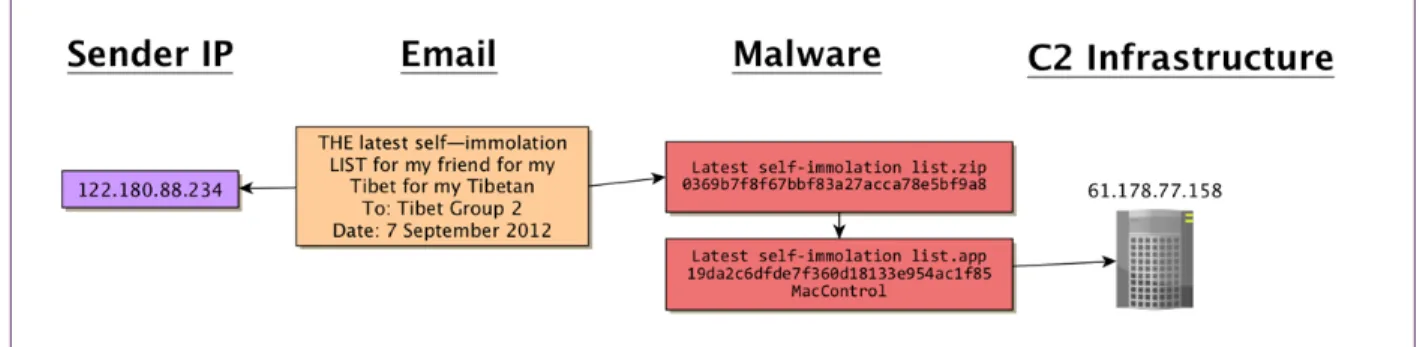
On September 7, 2012, we identified an attack targeting Tibet Group 2 using another malware family, MacControl. The samples seen from this family have a technical score of 1.25
This email repurposed content from Radio Free Asia and claimed to contain a list of self-immolations giving it a social engineering score of 3 (TTI 3.75). The attached ex-ecutable connects to a C2 server at 61.178.77.158:80 and functions as a standard RAT.
FIGURE 11: MacControl attacks
Another email received by the same organization three weeks later contained a mali-cious Excel file that installed Gh0st RAT with the variant-identifying text LURK0. This RAT shared the same C2 as the MacControl, connecting back to 61.178.77.158 on port 8080.
This paring of MacControl with Gh0st RAT has been used in attacks against Uyghur users, as reported by Kaspersky and AlienVault.
Outside of our study participants, we have also seen MacControl campaigns similar to those reported by Kaspersky and AlienVault, targeting Tibetan and Uyghur communi-ties. These differ slightly than those described above in that they use different flag text in the Gh0st RAT component, and connect to a nearby IP (61.178.77.169). They are also delivered using a Word vulnerability, while the email sent to the in-study recipient contained an executable inside a .zip file.
Olyx / Lamadai / PubSab
Olyx, Lamadai, and PubSab (or SabPub) are variants of the same malware that are differentiated by the C2 server used and the location where the malware hides on a compromised system. These names are often used interchangeably by different antivirus or security companies. Further complicating matters, there is often overlap between names: for example, Olyx.C is the same as Lamadai.B.
Olyx.A
» Threat location: /Library/Application Support/google/startp
» Launcher: ~/Library/LaunchAgents/www.google.com.tstart.plist
Olyx.B (Lamadai.A)
» Threat location: /Library/Audio/Plug-Ins/AudioServer
» Launcher: ~/Library/LaunchAgents/com.apple.DockActions.plist
Olyx.C (Lamadai.B)
» Threat location: Applications/Automator.app/Contents/MacOS/DockLight
» Launcher: ~/Library/LaunchAgents/com.apple.DockActions.plist
PubSab.A
» Threat location: ~/Library/Preferences/com.apple.PubSabAgent.pfile
» Launcher: ~/Library/LaunchAgents/com.apple.PubSabAgent.plist
Olyx.C was observed in emails sent to Tibet Group 1, and via a NIDS on the network of Tibet Group 3.
The campaign against Tibet Group 1 consisted of five emails that contained links to malicious .jar files that exploited Java vulnerabilities (CVE-2011-2544 or CVE-2012-0507). All of these emails appeared to come from real people or organizations, and referenced Tibetan themes giving them a social engineering score of 3. The malware is basic with a technical score of 1. The total TTI is 3.
FIGURE 12: Olyx/Lamadai/PubSab attacks
On January 29, 2013, the NIDS on the network of Tibet Group 3 detected evidence of a Java vulnerability being used to serve multi-platform malware pretending to be Adobe Flash Player. This sample was distributed through a web page that does web browser user agent detection. Tibet Group 3 did not submit any emails containing this link, so the specific attack vector used is unclear.
The website hosting the malware was hxxp://services.addons.mozilla.publicvm.com, and had an .xpi file for Firefox and a .jar containing Olyx.C for Mac. The way the malware was served was different than other similar attacks in that it checked both browser and OS, not just OS, to determine which malware program would be used. On February 5, 2013, we received additional alerts that showed similar malicious pages were visited by Tibet Group 3, again without indication of the original attack vector. A web page was flagged by the NIDS due to a suspicious encoded string that decoded to a tinyurl.com redirector. This link led to a page on hxxp://adobeupdate. publicvm.com, which had attacks for IE, Firefox, Java (Windows, but not OS X), and
a standard Windows binary. There may also have been an OS X attack, but we were unable to locate it from the information recorded by the NIDS.
The original page that served up the attack also had a distinctive comment in the script that identified it as a legitimate script from the website of the US State Depart-ment (www.state.gov). At the time of our analysis the server was hosting 100 other domains. The www.state.gov script we found on the page suggests the IP was hosting a fake US State Department website that included the malicious link.
OBSERVATIONS
Mac OS X was once commonly seen as a more secure alternative to Windows. Tar-geted groups in the Tibetan community shared this assumption. For example, in a 2008 Washington Post article on targeted attacks against Tibetan groups, a volunteer providing technical assistance to a Tibetan NGO noted that the group had attempted to mitigate attacks by using “more secure platforms such as Apple computers.” While the number of malware vectors targeting OS X is small compared to the many vulner-abilities used against Windows targets, it is clear that OS X malware is becoming an important tool for attackers targeting human rights organizations. All of the malware families described here are under active development and we will likely see more attacks targeting OS X at greater levels of technical sophistication.
DNF Campaigns
First Seen November 26, 2010Last Seen March 4, 2013
Attack Vectors Targeted malicious emails
Exploits Windows: CVE-2009-3129, CVE-2011-3544, CVE-2012-0158
Mac: CVE-2011-3544
Malware Families cxgid, FAKEM (HTML variant), Olyx, Scar.hikn
Infrastructure C2 domains: www.usciro.com, server.universityexp.com, mail.miyaza-kihousou.com, forum.livetldownload.com, forum.mercifulland.com, www.snowhataj.com, www.holyplateau.com, mail.hiserviceusa.com, www.hiserviceusa.com, mail.loveargon.com
Targeted Groups China Group 1, Tibet Group 1, Tibet Group 2, Tibet Group 4
TTI Range 2.5 - 5.0
BACKGROUND
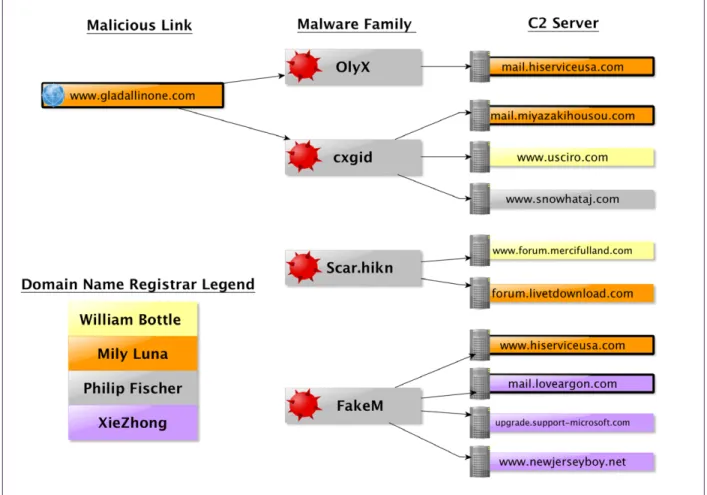
We identified the Domain Name Family (DNF) campaign by clustering attacks togeth-er on the basis of a set of malware families that communicate with domains registtogeth-ered under a series of suspicious names.
Analysis of attacks using Olyx Scar.hikn, cxgid, and FakeM malware families re-vealed that these samples connect to a set of domains that are registered to series of names: Mily Luna, Philip Fischer ([email protected]), William Bottle (john. [email protected]), and XieZhong Customer. Searching through domain registra-tion informaregistra-tion revealed a large number of domains registered under these names in a short time frame that were related to Tibet, Japan, education and business. All of these domains used a common hosting company called XinNet. Most of these domains have since expired, but historical registration data can be retrieved using services such as DomainTools.
The registration information provided by “Mily Luna” includes conflicting fields (i.e., address in Nepal, but city and province as Hong Kong SAR), which further demon-strates that this information does not reflect a real user:
Domain Name : miyazakihousou.com PunnyCode : miyazakihousou.com Creation Date : 2009-02-01 10:53:24 Updated Date : 2012-02-11 10:51:20 Expiration Date : 2013-02-01 10:47:33 Registrant:
Organization : mily luna Name : mily luna
Address : No.358,dapho road,Kathmandu, Nepal City : xianggangtebiexingzhengqu
Province/State : xianggangtebiexingzhengqu Country : china
Postal Code : 2000000
Some of these C2 domains are registered using email addresses at xiezhong.com. Through domain registration records, we were able to find more than 25 additional domains connected to this cluster, including many registered to “John Smith” ([email protected]). While we did not see any malicious activity related to these domains, some of the domains are suspiciously named (ru.org, kaspersky-us.org, thetibetpost.net). In the case of kaspersky-us.org in particular, VirusTotal
shows that only 1/51 antivirus products detect the site as malicious, but the one that does is made by Kaspersky. VirusTotal also includes a URL query report showing thetibetpost.net as malicious.
Figure 13 illustrates the connections between malware families, C2 domains, and the domain registrants in the DNF campaign. One FakeM sample used one of the Mily Luna and Xie Zhong domains as C2s. FakeM has been observed being used in con-junction with cxgid by other researchers, but we have not seen other reports identify-ing the infrastucture found in this cluster.
FIGURE 13: Relationship between domain hosting malicious link, malware family, C2, and name used to register domains
ADAPTIVE ATTACKERS
We observed DNF Campaign attacks between November 2010 and March 4, 2013 that targeted Tibet Group 1, Tibet Group 2, and Tibet Group 4. The social engineer-ing scores of these emails were between 2-3 and the technical scores of the malware were 1.25 (TTI 2.5 – 3.75). In June 2011, we were sent an automated AV detection notice from China Group 1. The alert identified a sample that was also sent in emails to Tibet Group 1, and which connected to the DNF-related domain upgrade. support-microsoft.com. This link suggests a staff member of China Group 1 likely received a malicious email from the DNF campaign and opened the payload, trigger-ing the AV detection.
Initially, attacks in this campaign exclusively used Windows malware. However, the attackers demonstrated their ability to quickly adapt tactics to meet new requirements. On February 23, 2012, an email was sent to the director of Tibet Group 1. It addressed the director personally and appeared to come from Mr. Cheng Li, a prominent China scholar based at the Brookings Institution. The email requests the assistance of Tibet Group 1 in verifying information on Tibetan self-immolations. The name and title provided in the email all match real details for Mr. Cheng Li provided on his Brookings Institute staff page.
The director of Tibet Group 1 noted to us that at first it was flattering to be asked to consult a well-known China expert on Tibetan issues. However, the director quickly noticed that the email was sent from a suspicious AOL account (chengli.brookings@ aol.com). This account appears to have been registered by the attackers for this specific attack. Attached to this email was an Excel spreadsheet that used CVE-2009-3129 to install cxgid malware. The malware connects to mail.miyazakihousou.com (112.213.126.18), which is a domain registered under the name Mily Luna.
Social engineering 4
Technical 1.25
TTI 5.0
MD5 64e2d3b91977bb0c293cac3e97669f03
The director of Tibet Group 1 flagged this message to us as one of the most targeted messages they had ever received. After consultations with Tibet Group 1, we decided to run an experiment on the attackers to test how responsive they would be to in-teraction from a target. Working with the director, we crafted a reply to “Cheng Li” and sent it on March 2:
“Thank you for your inquiry. I’d be happy to help out–I’m having trouble opening the document on my mac though, I think there may be an issue with the Chinese character font? I think if you sent me a Word version that might be easiest, as it would also allow me to make comments in the document.”
On March 6 “Cheng Li” replied, apologizing for his late response due to work-related travel. He encouraged the director to review information on Tibet issues on a website. The link provided pointed to a website containing a Java vulnerability that had pay-loads for both Windows and OSX systems. The payload for Windows was the same cxgid sample sent in the original email. The payload for OSX was Olyx and connected to mail.hiserviceusa.com (112.213.126.118). Both the malicious website and C2 were domains registered under the name Mily Luna.
Social engineering 4
Technical 1.25 - cxgid sample 1.0 - Olyx sample
TTI 5.0 - cxgid sample
4.0 - Olyx sample
MD5 f9beda8a6eef73f60d3911e890fb11fe - cxgid sample 7f016da6d8fafd03b5bb536ce4106f53 -Olyx sample C2 mail.hiserviceusa.com (112.213.126.118)
OBSERVATIONS
While other malware campaigns we identified typically use free subdomains, this cluster primarily relied on registered domains. The use of registered domains provided a useful variable around which to cluster attacks. Registered domains can also be blacklisted more easily than free services providing subdomains.
The DNF Campaign also demonstrates the adaptability of the attackers. Upon receiv-ing a message from Tibet Group 1 indicatreceiv-ing the targeted user was usreceiv-ing a Mac, the attackers quickly responded with malware targeting OS X.
APT 1 Campaigns
First Seen April 2010
Last Seen August 16, 2012
Exploits N/A
Malware Families Bangat, GLASSES, WARP, WEBC2-QBP
Infrastructure C2 domains: ash22ld.compress.to, ewplus.com (compromised site), johnbell.longmusic.com, 66.228.132.8 (hard coded ip)
Targeted Groups Tibet Group 1, Rights Group 1
TTI Range 5.0
BACKGROUND
On February 19, 2013, Mandiant released a report that shed light on a prolific cyber espionage group they call APT1 (also referred to as “Comment Crew” or “Byzantine Candor), which had targeted a large number of organizations in a wide range of industries, stealing terabytes of data. Mandiant’s report traced APT1 operations to China and claims that the group may in fact be the Second Bureau of the People’s Liberation Army General Staff Department’s Third Department, also known as Unit 61398.
APT1 has been active since at least 2006. Mandiant has observed the group breaching 141 organizations from 20 major industry sectors. Within Mandiant’s report there is no mention of CSOs as targets among these compromised organizations. However, in previous reports and released datasets, there are indications that civil society is targeted by APT1. Both Mandiant and Shadowserver have included a Tibetan-themed domain (tibethome.org) in their APT1-related domain lists, which suggests that Tibet-related organizations may have been targeted, but no further details on Tibet-Tibet-related operations were included. In 2012, a Bloomberg article listed the nonprofit organiza-tion Internaorganiza-tional Republican Institute among target organizaorganiza-tions compromised by APT1 in June 2011, but no technical details of the attack were released.
In the course of our study, we found evidence that APT1 targeted Tibet Group 1,10 and
successfully compromised the networks of Rights Group 1.
TARGETING TIBET GROUP 1
On April 28, 2010, the director of Tibet Group 1 was sent an email from a Yahoo! webmail address. The sender makes a personal plea to Tibet Group 1 to help find his Tibetan wife who he claimswent missing since after visiting Tibet.
Social engineering 4
Technical 1.25
TTI 5.0
MD5 6fb3ecc3db624a4912ddbd2d565c4995
C2 ewplus.com (204.14.88.45)
Some details of the email immediately flag it as suspicious: the name in the email address is “Nate Herman” although the email body is signed “Martin Lee.” The for-warded email included full headers, so we were able to obtain more information about its origin (Yahoo! includes the sender’s source IP in the headers when an email is sent over the webmail interface). In this case, the originating IP was 69.95.255.26, which
10 We originally published analysis of the APT1 related attack against Tibet Group 1 in a blog post, Hardy, S. APT1’s GLASSES – Watching a Human Rights Organization, February 25, 2013, https://citizenlab.org/2013/02/apt1s-glasses-watching-a-human-rights-organization
is registered to One Communications, Inc. / EarthLink Business, and is very close to IPs used in a similar attack —demonstrat-ing that this attack is not isolated, and the IPs are likely being reused for other malware campaigns.
This email contains a link to a ZIP file located at hxxp://tcw.homier.com/attchments/ details.zip (MD5: 6fb3ecc3db624a4912d-dbd2d565c4995). The “homier.com” domain belongs to Homier Distributing Company, Inc. and appears to have been compromised. A search for this subdo-main shows other instances of malware hosted there, including a case detailed in a ThreatExpert report describing a mali-cious file stored in /images/update.bin, and
another malicious program getting the file /attachments/SalaryAdjustment.zip.
Analysis of the files revealed malware that shares a number of similarities to malware described in Mandiant’s APT1 report that they call “GOGGLES” —a simple downloader that is controlled via encoded markers in files accessed over HTTP. The malware sent to Tibet Group 1 shares both a large percentage of code and the same C2 infrastructure as the program described in the APT1 report, which sug-gests the two pieces of malware are both used by APT1.
We call this malware GLASSES because it is related to GOGGLES, and used a com-promised eyeglasses storefront website as its C2 server. The GOGGLES code is more
sophisticated than the GLASSES code. In addition to a more effective method of hiding the command data, it also has more countermeasures to protect against reverse engineering and hide itself on the infected system. For this reason, it is very likely that GOGGLES is a later version of GLASSES.
COMPROMISING
RIGHTS GROUP 1
In August 2012, Rights Group 1 was made aware of a serious compromise of their network infrastructure. Following in-cident response from a third party, Rights Group 1 shared workstation hard drives with the Citizen Lab that were suspected to have been compromised as part of the intrusion. The attackers had access to the network infrastructure of Rights Group 1 from January 2011 to August 2012. During this time the attackers were able to move laterally through the network, install RATs, extract sensitive data and passwords, and impersonate staff identi-ties. The incident affected computers beyond the ones to which we had access, but these hard drives provide enough data to reveal malware and C2 infrastructure that is linked to APT1.
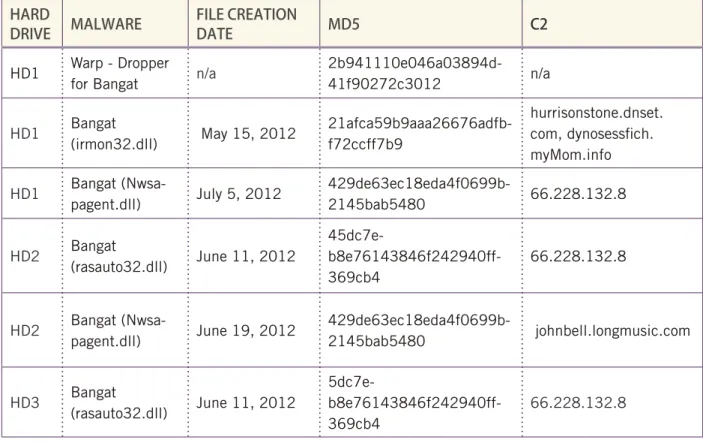
We conducted forensic analysis of six Windows workstation hard drives used by Rights Group 1 staff members. This analysis found that three of the drives were compromised by multiple versions of malware that matched a tool used by APT1 called Bangat, which is used to
establish footholds in a network and maintain persistence. Bangat has standard back-door functionality, including features to start keyloggers, gather system information, and take screenshots.
Comparing the samples retrieved from the compromised hard drives to Bangat samples available from the Contagio APT1 malware collection reveals close similari-ties. Rights Group 1 samples included the same functionality and important strings as the APT1 contagio samples. These included temporary file names (~MC_[#]~, where # are numbers) and DES key (!b=z&7?cc,MQ>) used for encryption. Binary comparison between the two samples reveals an approximate 97% match.
One of the compromised hard drives included a variant of an HTTP backdoor used by APT1 that Mandiant calls WARP. This malware has no RAT functionality and is primarily used to gather system information and download stage two malware. Therefore, we believe that WARP was used as a dropper to install Bangat onto the compromised system.
Binary comparison between the WARP sample from Rights Group 1 and a WARP sample from the Contagio APT1 malware collection (md5 C0134285A276AB933E-2A2B9B33B103CD) revealed a 90% similarity. The main differences between samples is that the Rights Group 1 sample does not have functions from wininet.dll in the import table, and uses LoadLibrary and GetProcAddress to import them.
All three of the compromised hard drives included samples that communicated to 66.228.132.8 as a C2. This IP address also had an HTML comment on its default webpage that indicated it also served as a C2 for WEBC2-QBP, another malware family described by Mandiant in their APT1 report. The same C2 (66.228.132.8) was also used by two Bangat samples in the Contagio APT1 collection (MD5s BD8B082B7 711BC980252F988BB0CA936, E1B6940985A23E5639450F8391820655).
TABLE 10: Overview of malware retrieved from compromised hard drives
HARD
DRIVE MALWARE FILE CREATION DATE MD5 C2
HD1 Warp - Dropper for Bangat n/a
2b941110e046a03894d-41f90272c3012 n/a HD1 Bangat (irmon32.dll) May 15, 2012 21afca59b9aaa26676adfb-f72ccff7b9 hurrisonstone.dnset. com, dynosessfich. myMom.info HD1 Bangat (Nwsa-pagent.dll) July 5, 2012 429de63ec18eda4f0699b-2145bab5480 66.228.132.8 HD2 Bangat (rasauto32.dll) June 11, 2012 45dc7e- b8e76143846f242940ff-369cb4 66.228.132.8 HD2 Bangat (Nwsa-pagent.dll) June 19, 2012 429de63ec18eda4f0699b-2145bab5480 johnbell.longmusic.com HD3 Bangat (rasauto32.dll) June 11, 2012 5dc7e- b8e76143846f242940ff-369cb4 66.228.132.8
OBSERVATIONS
The APT1 campaigns illustrate one of the broader findings of this report. While large,
resourceful threat actors like the APT1 group are frequently documented targeting government and industry, the same actors use similar tools, techniques, and proce-dures to target CSOs as well. While government and industry have the resources and
expertise to respond to such threats, in many cases CSOs do not. Even large CSOs are vulnerable to this problem. While Rights Group 1 is a large and well-resourced orga-nization relative to others in our study it was compromised for over a year-and-a-half before the threat was identified.
NetTraveler Campaigns
First Seen April 30, 2010
Last Seen September 12, 2012
Attack Vectors Targeted malicious emails, Watering hole attacks
Exploits Windows: CVE-2009-3129; CVE-2010-0188; CVE-2012-3333; CVE-2012-0158
Mac: CVE-2012-0507
Malware Families Windows: Conime, Gh0st RAT, RegSubDat, Netpass Mac: Dockster
Infrastructure Email Sender IPs: 209.11.241.144
C2 domains: 209.11.241.144, akashok.w63.1860host. com:80 (69.43.161.162), ww2.akashok.w63.1860host.com:80 (204.13.161.108), gen2012.eicp.net:1080 (61.178.77.98), 61.178.77.98:8080, 61.178.77.98:1080, 61.178.77.98:80, itsec. eicp.net:443 (1.203.31.195), www.eaglesey.com (120.50.35.46), itsec.eicp.net:8088 (209.11.241.144)
Targeted Groups Tibet Group 1, Tibet Group 2, Tibet Group 3, Tibet Group 4, Tibet Group 5, China Group 3
TTI Range 2.5 - 4.0
BACKGROUND
In June 2013, Kaspersky released a report detailing the operations of a threat actor that compromised over 350 victims in 40 different countries. Kaspersky called the main malware used in these campaigns “NetTraveler” after an internal string found in the tool, “NetTraveler is Running!” Targets identified in this report included Tibetan and Uyghur groups, the energy industry, military contractors, scientific research centres, universities, government institutions, and embassies.
used as a VPN and a C2 in the campaigns. We see 209.11.241.144 as a sender IP for 19 emails in our study. Searching for other emails that share the same malware we find a total of 34 emails, which we can split into seven campaigns based on how the common C2 infrastructure is used. Additionally, there was one email from this sender that we were not able to cluster, as the attachment was a password-protected ZIP file and the password was not evident. Attacks using infrastructure related to NetTraveler targeted all five of the Tibet Groups in our study as well as China Group 3.
NetTraveler operators are also known to use watering hole attacks against Tibetan websites. In December 2012, F-Secure reported on malware that relied on an entirely different method of attack and compromise but used the same infrastructure. A website related to HHDL at www.gyalwarinpoche.com was compromised and served the CVE-2012-0507 Java exploit (the same as used in the Flashback malware) to compromise computers running OS X. This malware, which F-Secure calls Dockster, connects back to the same IP that sent many of the malicious emails we observed, itsec.eicp.net:8088 (209.11.241.144). Kaspersky has documented similar watering hole attacks against Uyghur-related websites.
CAMPAIGN 1
The first appearance of an attack that used infrastructure related to NetTraveler was sent to China Group 3 on April 30, 2010. The email attached a PDF that used CVE-2010-0188, and connected to C2 servers at akashok.w63.1860host.com:80 (69.43.161.162) and ww2.akashok.w63.1860host.com:80 (204.13.161.108). The sender IP matches the mothership server identified by Kaspersky (209.11.241.144). C2 traffic from this malware appears as follows:
GET /wl/netpass.asp?action=gettext HTTP/1.0
GET /wl/netpass.asp?hostid=...&hostname=...&hostip=...^filename=18155523-sys.log&filestart=0& filetext=begin::...
Social engineering 2 Technical 1.25 TTI 2.5 MD5 00403a09dbc87103e2efe060aec07566 C2 akashok.w63.1860host.com (69.43.161.162) ww2.akashok. w63.1860host.com (204.13.161.108)
CAMPAIGN 2
The first of three campaigns using the Conime malware family involved seven emails, five of which were distinct, mostly concerning March 10th Tibetan Uprising demon-strations. Coinme samples used in these attacks have a technical score of 1.25. These emails were sent between February 13 and March 7, 2012 and were all targeted at Tibet Group 1. The campaign used a combination of malicious XLS and RTF docu-ments exploiting CVE-2010-3333. The majority of these attacks score a TTI of 3.75. One email only scores 2.0 on social engineering sophistication and a 2.5 overall TTI. We see the mothership server (209.11.241.1440) and 120.50.35.60 used as a mail sender. All of the attacks in this campaign used 61.178.77.98 (without an associated DNS name) as a C2.
CAMPAIGN 3
The second of three campaigns using the Conime malware family involved seven emails, three of which were distinct, sent to Tibet Groups 1, 2, and 4. These emails all scored a social engineering sophistication value of 3.0, for a combined TTI of 3.75. Two of the distinct emails had an attached XLS document; one was encrypted, the other was not. The third email used a malicious RTF document exploiting CVE-2010-3333. The encrypted XLS was sent on July 25, 2012, and the other emails were sent between September 10 and 12, 2012. We again see 209.11.241.1440 as an email sender IP. All of these exploits dropped the same variant of Conime, which connected to gen2012.eicp.net:1080 (61.178.77.98) as a C2.
CAMPAIGN 4
The third campaign using Conime was more varied than the other two, and was tar-geted at Tibet Groups 1, 2, and 4. Fifteen emails were received, eleven of which were distinct (although one showed only minor changes), ranging from 2.0 to 4.0 on the
social engineering sophistication score. These emails were sent over a longer timeframe than the other campaigns, extending between June 14, 2012 and September 12, 2012. Vulnerabilities used included both major RTF (CVE-2010-3333, CVE-2012-0158) and XLS (CVE-2009-3129) versions. One email, received by Tibet Group 2, received a social engineering sophistication score of 4.0. This email was highlighted to us by the recipient as highly targeted, and referenced an upcoming confer-ence call about grant funding. Like the previous two NetTraveler campaigns, the malware connected directly to 61.178.77.98.
CAMPAIGN 5
This campaign used a variant of Gh0st RAT, with a flag text of “Snow.” Identi-cal emails, concerning a visit of HHDL to Portland, were sent to Tibet Groups 2 and 4 on January 28, 2013. The emails have a social engineering score of 2, with an overall TTI score of 2.5. The attackers again used 209.11.241.144 as a mail sender and 61.178.77.98 as a C2.
CAMPAIGN 6
This campaign used a different malware family, RegSubDat, which was contained in an RTF using CVE-2012-0158,
attached to an email sent to Tibet Group 1. Again we see mail sent from 209.11.241.144, but in this case the malware connected to a different C2
server: itsec.eicp.net:443 (1.203.31.195). This attack scored 3.0 on the social engineering sophistication value for an overall TTI of 3.75.
CAMPAIGN 7
The final sample from the NetTraveler group was observed in an email message sent to Tibet Group 1 on March 15, 2012. This malware was sent from the same mother-ship server (209.11.241.144) described above, but rather than attaching the ma-licious file, as had been done for all prior attacks, this email contained a link to an infected XLS file. The file was hosted at www.eaglessey.com (120.50.35.46), but was no longer present when we attempted to access it.
OBSERVATIONS
The NetTraveler campaign serves as another example of a campaign that targets CSOs alongside industry and government targets. These campaigns are conducted by a prolific threat actor that has targeted a variety of differ-ent sectors. Our findings confirm the targeting of Tibetan groups identified by Kaspersky, as all five of our Tibet Groups were targeted. This campaign demonstrates an adaptive attacker that uses a variety of vulnerabilities for dif-ferent applications, including targeting of both Mac and Windows platforms.
PlugX Campaigns
First Seen February 10, 2011Last Seen January 15, 2013 Attack Vectors Targeted malicious emails
Exploits CVE-2012-0158 (RTF, DOC, and XLS), CVE-2012-1889 (Internet Explorer), 2012-5054 (Flash), 2009-4324 (PDF), CVE-2007-5659 (PDF)
Malware Families PlugX, Poison Ivy
Infrastructure C2 domains: sociapub.flower-show.org:8080 (14.102.252.142), 114.142.147.51:8080, systen.windowsdeupdate.com:8080 (174.139.12.84, 98.126.14.13), web.windowsdeupdate.com:7070 UDP (74.139.12.84, 98.126.14.13), , new.edamobile.com:443 (58.64.200.114), jinyuan2011.zapto.org:443 (123.129.19.145) Targeted Groups Tibet Group 1, Tibet Group 2, China Group 1, China Group 2
TTI Range 1.5 - 7.5
BACKGROUND
PlugX is a well-known family of malware that researchers have observed being used in targeted attacks against Tibetan organizations, NGOs, government institutions, and private companies.
Trend Micro has published a report on PlugX, describing a long-standing campaign that previously used Poison Ivy, another malware family. Jaime Blasco at Alien Vault
claims to have tracked down the author of PlugX, who is allegedly based at a Chinese security company.
The PlugX samples seen in our study can be clustered into four campaigns, based on email sender IP and C2 infrastructure. Examining email topics, vulnerabilities used, and compile paths (as described in the Alien Vault blog post) suggests that the four
campaigns are from the same source. We have also seen a Poison Ivy sample used in this campaign.
The attack vectors and vulnerabilities used in PlugX are more varied than other
attacks in our dataset. The vulnerabilities used include instances of CVE-2012-0158 in three separate file formats, an Internet Explorer vulnerability (CVE-2012-1889) that will install PlugX as a drive-by download, and a Flash vulnerability (CVE-2012-5054) hosted on an external website. The earlier Poison Ivy attack used two older PDF vulnerabilities. The Flash vulnerability was particularly notable; it was a zero-day at the time of the attack, leaving any user who clicked the malicious link it was hosted on vulnerable to compromise.
CAMPAIGN 1
The first set of attacks consists of fifteen emails, five of which were unique, sent from May 11, 2012 to June 1, 2012. Tibet Group 1 and Tibet Group 2 were both targeted with at least four out of the five emails. These emails show many signs of coming from the same source, including a common return address of [email protected], a sender IP of 98.126.14.13, and common C2 infrastructure.
Two different C2 domain names were used: systen.windowsdeupdate.com (TCP port 8080) and web.windowsdeupdate.com (UDP port 7070). These DNS names both pointed to the same IPs, which include 174.139.12.84 and 98.126.14.13.
All of these emails have a social engineering score of 3.0 and an overall TTI of 4.5. One example, sent to Tibet Group 2, spoofed a legitimate Tibetan official and contains a Word document that outlines the schedule of an actual European tour taken by the Dalai Lama.
Social engineering 3 Technical 1.5 TTI 4.5 MD5 1aa5dde570575d0b001a48e62a412f14 C2 systen.windowsdeupdate.com (174.139.12.84)
CAMPAIGN 2
On May 22, 2012, an email was sent from the IP address 69.46.75.74 to Tibet Group 2, which claimed to be from an individual named Tsering Dolma, with an email sig-nature belonging to the Central Tibetan Administration, and with the return address of ‘[email protected].’ This email contained an attached RTF with CVE-2012-0158 that was used to install PlugX.
Social engineering 2 Technical 1.5 TTI 3.0 MD5 74de1701d68d7e0a9f86bb6297246ebd C2 new.edamobile.com (58.64.200.114)
CAMPAIGN 3
Three emails were sent to Tibet Group 2 and China Group 1 between June 15 and August 30, 2012. Each email had unique content, attack vectors, sender email address and IP, and vulnerability used. The vulnerabilities included a Word variant of CVE-2012-0158, the Flash vulnerability CVE-2012-5054, and Internet Explorer vulnerabil-ity CVE-2012-1889.
Social engineering 3
Technical 1.5
TTI 4.5
MD5 81f3a6e7a73a9845c6eb9a3d46597223
C2 114.142.147.51:8080
The Flash vulnerability CVE-2012-5054 was a zero-day at the time it was used in an attack against China Group 1. The attack was delivered in an email that was highly customized for the recipient and used a malicious link in the message as the vector. It referred to a group of individuals who had recently been involved in internal private meetings and appeared to be a forwarded message from the director of the organization. The highly targeted nature of this attack, combined with the technical sophistication of the PlugX malware family, resulted in a TTI score of 7.5, the highest seen in the study.
CAMPAIGN 4
The last campaign consisted of four unique emails sent to Tibet Groups 1 and 2 between December 22, 2012 and January 15, 2013. These emails all included at-tachments that used CVE-2012-0158. The C2 domain used was jinyuan2011.zapto. org:443, which resolved to 123.129.19.145 at the time of the attack. Three of these four emails scored 2.0 on the social engineering sophistication score (and 3.0 TTI overall), and one scored 3.0 on social engineering for an overall TTI of 4.5.
One of these four emails repurposed legitimate text about a Tibetan monk who had been detained:
Social engineering 2
Technical 1.5
TTI 3.0
MD5 61af83d594c0e69b201d1ad20d3fd28d
C2 jinyuan2011.zapto.org (123.129.19.145)
This campaign was interesting in that it did not use the encrypted BOOT.LDR files, instead using NvSmartMax.dll.url, and logging keyboard data to NvSmart.hlp. This functionally corresponds to observations made by Kaspersky researchers that PlugX was becoming more mature. In particular, we observed that the identifying strings and logging data were removed in this campaign. It is particularly interesting that while the malware itself is being improved, potentially in response to published reports from threat researchers, the quality of the targeting in this campaign has gone down.
POISON IVY
In September 2012, Trend Micro described the use of PlugX in a campaign that had previously used the Poison Ivy RAT and targeted government and private companies in Japan. We also saw evidence in our study of Poison Ivy being used in conjunction with PlugX in an attack sent to China Group 2 on February 10, 2011, over a year
before our first observed PlugX attack. This email included a PDF with two vulner-abilities, CVE-2009-4324 and CVE-2007-5659.
Social engineering 1
Technical 1.5
TTI 1.5
MD5 49c9cf000fa1d789f3df8d739f997eb8
C2 sociapub.flower-show.org (14.102.252.142)
The Poison Ivy RAT connects to a C2 at sociapub.flower-show.org:8080
(14.102.252.142), the same Poison Ivy C2 domain observed by Trend Micro on July 11, 2012. This attack has also been seen elsewhere in the wild, as noted in a Threat Expert report describing the same malware seen with a different file size and MD5 hash (9ADFC6DD86D5FF36F2CAB781663E1075).
OBSERVATIONS
The PlugX campaign provides yet another example of a campaign that targets civil society organizations alongside government and industry groups, using the same infrastructure and malware to compromise targets. Aside from these similarities, the campaign otherwise had a number of unique characteristics that separated it from others in our research. Most notably, it was the only instance of a zero-day vulner-ability seen in our study. Given that zero-days are highly effective, as software devel-opers have yet to patch the vulnerability, they are highly lucrative and sought after. It is notable that the malicious attacks would use this zero-day to target a CSO, as once such an exploit is exposed it runs the risk of being identified and having the vulnerability fixed. The PlugX campaign also included a broader variety of attack vectors than what was seen in most campaigns. The attached files included the zero-day Flash vulnerability, an exploit for Internet Explorer, as well as the standard Microsoft Office exploits seen elsewhere.
TseringKanyaq Campaigns
First Seen May 4, 2012Last Seen July 26, 2013
Attack Vectors Targeted malicious emails Exploits Windows: CVE-2012-0158,
Mac: CVE-2009-0563, CVE-2012-0507, CVE-2013-1331 Malware Families Windows: Shadownet, Duojeen
Mac: PubSab
Infrastructure Email sender: 163.com, myopera.com, gmx.com
C2 domains: newwolfs29.zxq.net, newwolfs21.blog.163.com, dplcoopsociety. us.dwyu.com, laraider2.he1.ifreeurl.com, pomehra.typepad.com, tbtsociety. info, nedfortibt.info, duojeen.info, appleboy1111.blogspot.com, coremail.info Targeted Groups Tibet Group 1, Tibet Group 2, Tibet Group 4
TTI Range 3.0 - 3.75
BACKGROUND
Unlike the previous campaigns that were grouped by shared infrastructure or con-nections to previously reported threat actors, the “TseringKanyaq” cluster was first identified through contextual analysis.
This cluster consists of a series of attacks targeting Tibet Groups, which had either ‘[email protected]’ or ‘[email protected]’ in the reply-to address field of the malicious emails. Following the identification of this pattern, further attacks that shared common infrastructure were linked.
The addresses ‘[email protected]’ and ‘[email protected]’ do not match known email addresses or names of persons in the Tibetan community. However, “tseringKanyaq” may be a misspelling of Kanyag Tsering, a Tibetan monk from the Kirti Monastery in the Ngaba region of Tibet. This region has been the scene
of a number of Tibetan self-immolations, and Kanyag Tsering has provided reports of the incidents to international media. He is a well known and respected member of the Tibetan community who, due to his work in getting information from inside Tibet to journalists, has developed a significant media presence. We met with Kanyag Tsering and showed him our analysis of this cluster. He confirmed that the address ‘[email protected]’ does not belong to him. Despite the possible intentional similarity of ‘[email protected]’ to the name of a notable Tibetan monk, the purpose behind the consistent use of these addresses in the reply-to field is unknown. We identified three malware families in this cluster, which were used to target
Windows (ShadowNet and Duojeen) and OS X (PubSab). The ShadowNet malware family is associated with the ShadowNet espionage group, which was discovered by the Information Warfare Monitor and the ShadowServer Foundation in 2009 and was revealed to be targeting Tibetan organizations and Indian military and government institutions. The malware we found did not connect to infrastructure related to the previous ShadowNet campaign.
All three malware families used in the TseringKanyaq campaign were also used by the LuckyCat campaign, which was discovered by Trend Micro in 2012. LuckyCat is notable for targeting companies based in India and Japan working in aerospace, energy, engineering, shipping, and military research in addition to Tibetan activists. We find infrastructure connections between the TseringKanyaq and LuckyCat cam-paigns, which suggests some level of coordination.
EMAIL PROVIDER INFRASTRUCTURE
This campaign is marked by a period of gaps in which attacks stop and later re-emerge with similar identifying features (most notably the consistent use of the Reply-To ad-dresses), some level of improvements to the malware C2 infrastructure, and/or changes to the social engineering tactics.
We divide these gaps into three distinct periods in which the attackers utilize different email providers to send attacks.
163.com: May 4, 2012 - July 9, 2012
myopera.com: July 24, 2012 - September 5, 2012
Between these three periods there is no overlap in the use of these mail providers. We clearly observe the attackers moving from one provider to the next. The use of these different providers could be due to a number of possibilities: the domain provider may have shut down the accounts due to notifications or detection of abuse, changes to provider infrastructure may have created difficulties in maintaining the accounts, or the attackers may have moved on to the next domain infrastructure once the advan-tages of an alternate provider became apparent.
163.COM CAMPAIGNS
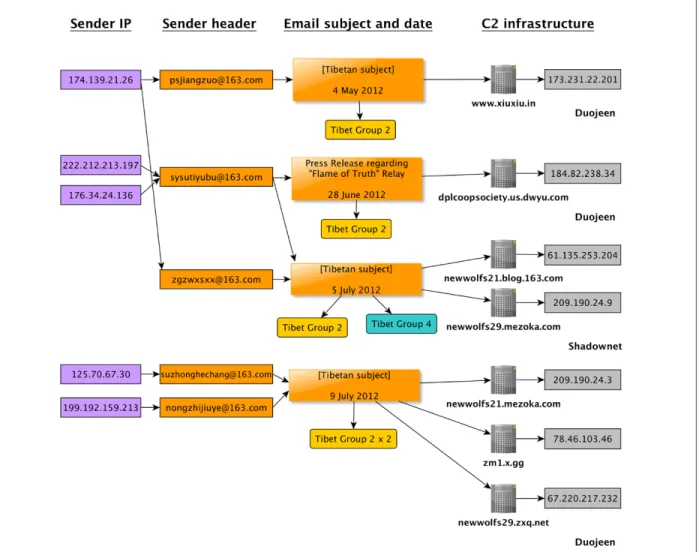
The first wave of attacks occurred between May 4 and July 9, 2012. Four email attacks were sent during this period targeting Tibet Groups 2 and 4. All of these attacks spoof prominent organizations in the Tibetan community and repurpose legitimate content, which gives them a social engineering sophistication base value of 3. All of the malware samples in this cluster have a technical score of 1.25, for a total TTI of 3.75.
The first attack on May 4, 2012, was sent to Tibet Group 2 with an email that repur-posed content concerning a petition campaign. The actual email sender was
[email protected] (174.139.21.26). The attached file dropped Duojeen malware that connects to www.xiuxiu.in (173.231.22.201).
The second attack on June 28, 2012, sent to Tibet Group 2, purported to come from Karma Yeshi, a member of the Tibetan Parliament in Exile (TPiE), and provided information (in Tibetan) on the Flame of Truth Rally, a campaign launched by the TPiE to express solidarity with Tibetans who have self-immolated. The actual sender of the mail is [email protected] (222.212.213.197). The attachment also drops Duojeen malware.
Social engineering 3
Technical 1.25
TTI 3.75
MD5 e9b9c09002197882ed1140054d20623a
C2 dplcoopsociety.us.dwyu.com (184.82.238.34)
On July 5, 2012, Tibet Groups 2 and 4 both received identical emails with content related to a recent self-immolation. The malware used was ShadowNet, which leverages
Windows Management Instrumentation (WMI), a system tool meant for administrators. Its intended usage as a tool for collecting system information and automation makes it an ideal mechanism for gathering and exfiltrating data. Use of legitimate Windows features can make it more difficult for administrators to identify activity as malicious. The ShadowNet attacks used a WMI Script that contained links to one of three blogs to which the malware attempts to connect. The blog then has a string with encoded C2 information as shown in Figure 14 below.
Once a connection to the C2 is made, system information and data can be sent to the attackers. In the case of the July 5 attacks, the malware first connects to newwolfs21. blog.163.com, after which it retrieves the C2 newwolfs29.mezoka.com.
On July 9, 2012, Tibet Group 2 received two identical emails sent to two separate or-ganizational accounts. The emails contained content regarding self-immolations. The malware used, Duojeen, retrieves system information, establishes a connection with zml.x.gg, and sends the collected information. It then retrieves second stage malware from http://newwolfs29.zxq.net/winxp.rar. As with the previous attack, the two emails were sent from different accounts: [email protected] (125.70.67.30) and [email protected] (199.192.159.213).
MYOPERA.COM CAMPAIGNS
From July 24 to September 5, 2012, the attackers moved their mail provider to myopera.com. The attacks continued to use ShadowNet and Duojeen malware and the same common C2 infrastructure as the previous campaign. During this period, we ob-served three attacks sent to Tibet Groups 1, 2, and 4, in some cases to multiple accounts within the organizations. All of these attacks spoofed prominent groups in the Tibetan community and repurposed legitimate content, which gives them a social engineering score of 3. All of the malware samples in this cluster have a technical score of 1.25, for a total TTI of 3.75. Interestingly, in this campaign we observed some emails being sent from Tor exit nodes, which shows the attackers making a new effort to hide their location.
Between July 24 and 25, Tibet Groups 1, 2, and 4 received identical emails that ap-peared to be from the Tibet Office in Brussels, with content regarding an upcoming rally.
Social engineering 3
Technical 1.25
TTI 3.75
MD5 cc0b8b8e42fdd59cc4b32b3a06e57281
The attached malware was ShadowNet, and it connected to newwolfs21.blog.163.com to retrieve C2 instructions. In each instance, the email was sent from a different account ([email protected], [email protected], [email protected], [email protected], and [email protected]); however, the sender IP was the same for each account (184.82.49.114). We later discovered that this sender IP was also used as a C2.
During an investigation of one of the C2s used in the campaign (newwolfs20.x.gg/ mits/) we found open directories that included a sample from the Sparksrv malware family, which we presume was intended to act as stage two malware. This sample used 184.82.49.114 as a C2.
Between July 25 and 26 Tibet Groups 1, 2, and 4 received identical emails that spoofed Karma Yeshi, a member of the TPiE, with an update on the Flame of Truth rally campaign. The malware in this case was Duojeen.
Social engineering 3
Technical 1.25
TTI 3.75
MD5 f208137dfb3271b5cd3c67492e2522dc
C2 dplcoopsociety.us.dwyu.com (184.82.238.34)
In three of the attacks, the sender IP traced back to a Tor exit node maintained by the Chaos Computer Club in Germany. The timing of this shift in tactics is interesting, as it comes after a series of attacks that used a C2 as the mail sender. Using Tor to mask the real location of the mail sender may therefore have been an effort to improve operational security. However, the attackers use of Tor is inconsistent and following this series of attacks was observed only one other time.
TABLE 11: IP address of email senders used during MyOpera campaign
SENDER IP LOCATION
[email protected] 31.172.30.4 Germany - Tor exit node [email protected] 62.113.219.3 Germany - Tor exit node [email protected] 31.172.30.3 Germany - Tor exit node [email protected] 50.136.226.40 US - Comcast
The final attack in this campaign was sent to Tibet Group 2 on September 5, 2012. It contains information regarding a hunger strike initiative undertaken by the Tibetan Youth Congress. The attachment contained Duojeen malware that connected to dplcoopsociety.us.dwyu.com (184.82.238.34).
FIGURE 16: Email sender, IP, and C2 infrastructure for myopera.com tseringKanyaq emails
GMX.COM CAMPAIGNS
From October 14, 2012 to July 26, 2013, the attackers switched to gmx.com as their mail provider. The use of gmx.com is interesting, because the email headers from this provider include a unique user ID number, which can be used to track malicious ac-counts using this service. However, we see no overlap in user IDs from the gmx.com accounts used in the attacks, which suggests that the attackers used a script to gener-ate new accounts, and as a result the user ID number is always different.
Within this period we observe the attackers using reply-to ‘tseringKanyaq@yahoo. com’ and also beginning to use reply-to ‘[email protected]’ in messages. We cluster attacks by these two accounts in the subsections below.
gmx.com ‘tseringKanyaq’ campaigns
From October 14, 2012 to July 26, 2013, we observed 11 attacks targeting Tibet Groups 1, 2, and 4, using the gmx.com mail provider and a reply-to address of ‘[email protected].’