Politics and Governance (ISSN: 2183–2463) 2019, Volume 7, Issue 2, Pages 127–154 DOI: 10.17645/pag.v7i2.1837 Article
Do Countries Use Foreign Aid to Buy Geopolitical Influence? Evidence
from Donor Campaigns for Temporary UN Security Council Seats
Bernhard Reinsberg
School of Social and Political Sciences, University of Glasgow, Glasgow, G12 8RT, UK; E-Mail: [email protected]
Submitted: 21 November 2018 | Accepted: 18 January 2019 | Published: 5 June 2019 Abstract
In recent years, donor countries have increasingly used different aid allocation channels to boost aid effectiveness. One delivery channel that has grown tremendously is ‘multi-bi aid’—contributions to multilateral organizations earmarked for specific development purposes. This article examines whether donors use multi-bi aid to further their selfish goals— specifically, to garner political support for their ambition to become a temporary member of the UN Security Council. In this context, multi-bi aid is particularly beneficial to countries with limited experience as foreign aid donors; whose gover-nance quality is weak; and which are more internationalized. Using a sample of OECD/DAC donor countries in 1995–2016, time-series cross-section analysis corroborates these arguments. The analysis draws on a new dataset of media reports proxying for donor interest in winning a temporary seat in the UN Security Council and extended data on multi-bi aid flows. The findings demonstrate that multi-bi aid may be a tool for geopolitical influence, with yet unexplored consequences for aid effectiveness.
Keywords
donor interest; earmarked funding; foreign aid; multi-bi aid; UN Security Council Issue
This article is part of the issue “Aid Impact and Effectiveness”, edited by Rachel M. Gisselquist and Finn Tarp (UNU-WIDER, Finland).
© 2019 by UNU-WIDER; licensee Cogitatio (Lisbon, Portugal). This article is licensed under a Creative Commons Attribu-tion 4.0 InternaAttribu-tional License (CC BY).
1. Introduction
A growing body of work demonstrates that donor mo-tivations matter for aid effectiveness (Dreher & Kilby, 2010; Dreher, Klasen, Vreeland, & Werker, 2013; Headey, 2008). Many observers infer donor motivations from dif-ferent aid channels, arguing that bilateral aid advances selfish goals, while multilateral aid promotes collective goals by helping donors coordinate aid efforts, enhanc-ing the credibility of aid commitments, and exploitenhanc-ing the expertise of multilateral bureaucracies (Hawkins, Lake, Nielson, & Tierney, 2006).
The traditional distinction between bilateral aid and multilateral aid, however, is no longer tenable. Multi-bi aid—donor contributions to multilateral organizations earmarked for specific purposes—has emerged as a ‘third way’ of allocating foreign aid beside traditional
channels (Reinsberg, 2017; Reinsberg, Michaelowa, & Eichenauer, 2015; Reinsberg, Michaelowa, & Knack, 2017). Inferring donor motivations is difficult for multi-bi aid because it commulti-bines motivational elements of both traditional modalities—the quest for control and the preference for cooperation.
Therefore, the motivations underlying multi-bi aid likely depend on additional circumstances. In some cases, multi-bi aid is purely developmental as donors use it to push multilaterals toward interventions yielding tangi-ble results and efficiency-enhancing reforms (Reinsberg, 2017; Reinsberg et al., 2015; Sridhar & Woods, 2013). In other cases—which are relatively underappreciated in the current literature—multi-bi aid may further the for-eign policy goals of the donors.
As a test case for foreign-policy uses of multi-bi aid, I examine aid growth in the context of donor campaigns
for a temporary seat in the United Nations Security Coun-cil (UNSC)—the only global institution to authorize the use of force and as such an important venue for wielding policy influence. Donor countries may therefore use for-eign aid to win support for their UNSC campaign among UN member states. However, not all aid types are equally beneficial and uniformly available to all donors. In par-ticular, donor countries with less experienced aid agen-cies are unable to muster capacities for short-term aid increases and should therefore be particularly likely to increase multi-bi funding, as a sufficiently targeted and quickly disbursable aid channel. Furthermore, donors with weak governance should use multi-bi aid to ad-vance their UNSC campaign, as bilateral assistance would raise public concerns about non-development uses of aid. Finally, multi-bi aid provides internationally-oriented donors with an instrument to undergird their preference for international cooperation while creating the regional co-benefits that multilateral aid is unlikely to provide.
I test my theoretical arguments using data for up to 35 Organization for Economic Cooperation and De-velopment (OECD)/Donor Assistance Committee (DAC) donor countries over 1995–2016. I analyze whether the campaign activity of a donor for a temporary UNSC seat predicts contemporaneous aid increases. I proceed with fixed-effect linear panel regressions. In further analysis, I also take potential endogeneity of campaigning with re-spect to aid growth into account. In both cases, I find that donors support UNSC campaigns with multi-bi aid specifically when their own aid agencies are less expe-rienced, when their governance frameworks are weak, and when they are more internationalized. To demon-strate the plausibility of these findings, I provide quotes from interviews with government officials.
My study contributes to the literature on the polit-ical economy of international organizations and aid al-location. Within the broad literature on the UNSC (e.g., Malone, 2000; Mikulaschek, 2018; Prantl, 2005; Voeten, 2001; Vreeland & Dreher, 2014a), some research focuses on who gets elected to the institution (Dreher, Gould, Rablen, & Vreeland, 2014; Schmitz & Schwarze, 2012; Vreeland & Dreher, 2014b), whereas other research ex-plicitly links aid allocation and multilateral lending de-cisions to temporary UNSC membership of recipient countries (Dreher, Lang, Rosendorff, & Vreeland, 2018; Dreher, Sturm, & Vreeland, 2009; Kuziemko & Werker, 2006; Lim & Vreeland, 2013; Vreeland & Dreher, 2014a). In contrast to these studies, I focus on the strategies that donors use to enhance their chances of getting them-selves elected to the institution.
In addition, I complement existing research on the determinants of multi-bi aid (Eichenauer & Reinsberg, 2017). My analysis establishes conditions under which multi-bi aid is attractive for geopolitical purposes, as the posited effect is only present for small donors without entrenched aid bureaucracies. By focusing on one spe-cific aspect of geostrategic use of aid, I extend previous
aid allocation research, which often uses broad proxies for donor interest (Alesina & Dollar, 2000; Berthélemy, 2006; Hoeffler & Outram, 2011). Indeed, the rise of multi-bi aid has created new avenues for donor influence— with yet unknown consequences for aid effectiveness. Previous research suggests that geopolitically motivated aid is less effective, for instance due to sloppier project preparation under time pressure, the approval of lower-quality projects, and lower compliance with condition-ality (Dreher et al., 2013; Kilby, 2013; Stone, 2009). Whether this holds also for multi-bi aid is an open ques-tion though, given that donor motivaques-tions cannot easily be inferred for this type of aid.
2. Argument
Countries vie for UNSC membership for three main reasons: gaining international prestige and reputation for being a responsible nation in the pursuit of global peace; advancing the national position on an upcoming issue; and promoting broader objectives and collective norms (Malone, 2000, pp. 6–7). Official statements re-flect that developed countries consider UNSC member-ship to be valuable to them. For instance, a Canadian rep-resentative, leading his country toward a bid for a non-permanent seat in 2011–12, argued, “[g]enerally speak-ing, you can see that the big issues do get discussed at the UN Security Council…[w]hen you take yourself out of that game, you lose one of the vehicles you have for having some influence” (The Canadian Press, 2014). In an earlier bid, Canada had announced to use the influ-ence afforded by a UNSC seat to promote “human se-curity,” following up on its earlier success in pushing for an anti-personnel landmine convention and the Interna-tional Criminal Court (Malone, 2000, p. 7).
The UNSC consists of the five permanent members (P5)—China, France, Russia, the United Kingdom, and the United States—and ten non-permanent members which are elected in periodic ballots at the UN Gen-eral Assembly (UNGA) to serve two-year tenures. Be-sides “contributions to the maintenance of international peace” (United Nations, 1945, art. 23), the UN Charter requires equitable geographical representation of non-permanent members, which is ensured by allotting the temporary seats to five regional groups in the follow-ing manner: three seats for the African group, two seats for the Asia-Pacific group (APG), two seats for the Latin American and Caribbean states group (GRULAC), one seat for the Eastern European group (EEG), and two seats for the Western European and Others Group (WEOG).1 Half of the temporary seats are up for grabs each year, which implies different schedules of UNGA elections across caucus groups. Every even year, two seats for WEOG, one for the APG, one for GRULAC, and one for the African Group come up for election, whereas every odd year, states vie for two seats for the African Group, one for the APG, one for the EEG, and one for GRULAC. 1According to a gentlemen agreement, Africa and Asia make available one seat for an Arab country in alternating order.
The selection of the non-permanent UNSC mem-bers follows a two-stage process. First, countries self-nominate for candidacy in their respective regional group. They simply declare their candidacy to their re-gional chair in New York, which then adds the coun-try to the list of candidates (Security Council Report, 2009, p. 9). Most candidates inform UN members of their candidacy afterwards. While some regional groups have established informal practice of rotation-based nomi-nations, other groups have no established procedures to coordinate the nomination process. In the former groups, the sole candidate for an open seat typically has regional endorsement. In the latter groups, how-ever, competition for seats is intense, as the number of candidates exceeds the number of available seats. For example, WEOG follows an “open-market practice” (Malone, 2000, p. 5) in which members compete over seats freely. For example, the current WEOG seats are split among three countries—Sweden for a full tenure and Italy and the Netherlands serving subsequent one-year terms (United Nations, 2016). As a result, countries aspiring for UNSC membership have come to announce their candidature far in advance, in the hope to remain uncontested. For example, Switzerland has announced its candidature for 2023–24 in 2011 (Federal Department of Foreign Affairs, 2018). Competition for the Eastern European seat is similarly high. Contested ballots are not uncommon: 9 out of the 12 elections in 1990–2015 were initially contested. For example, four countries— Armenia, Azerbaijan, Hungary, and Slovenia—declared interest to represent the region in 2012–13, but given regional pressures to avoid contested elections, several countries dropped their aspirations later in the process.
Following the nomination phase, the UN member states vote for candidates in the UNGA. The election is a secret ballot and a candidate requires two-third majority approval of all countries participating in the ballot in or-der to be elected as temporary UNSC member. If no can-didate obtains the required majority, run-off votes con-tinue until one of the candidates is elected. UNGA elec-tions typically take place in the last quarter of a year, with new tenures beginning in the first month of the subse-quent year. After a country has served its two-year term in the UNSC, it cannot immediately re-apply for candida-ture for two years (United Nations, 1945, art. 23).
To further their chances of election for a temporary UNSC seat, states recur to several tools of foreign pol-icy. Based on an inductive analysis of media reports of UNSC candidates, I have identified at least four such tools. First, states can win over other UN members by rhetorically supporting policy positions that are impor-tant to them. For example, the Czech Republic, vying for the 2008–09 Eastern European seat, also claimed by Croatia, attempted to win the votes of Morocco by shunning the cartoons of the prophet Mohammed (CTK Daily News, 2006). Second, states can mutually support candidatures for lucrative posts in international bodies.
Support for a UNSC bid may be reciprocated by later support for candidature in another international orga-nization. Australia provides an example, which secured support for its 2013–14 bid from Rwanda in exchange for supporting Rwanda in its membership application to the Commonwealth (BBC Monitoring Africa, 2009). Third, states can curry favor by promising an expansion of bi-lateral trade and foreign direct investment. For instance, Japan committed to have its businesses invest USD 5.7 billion in infrastructure projects in Bangladesh, while win-ning support for its bid for a temporary seat on the UNSC (Reuters, 2014).
Fourth, states can use foreign aid to persuade other countries to vote for them in a UNGA ballot. Although aid-giving—in contrast to the previous tools—is limited to less developed countries, it is relatively more com-mon. Descriptive analysis of media reports on UNSC cam-paigns over the past 20 years—available from Factiva— yields 15 news reports that explicitly mention pledges of aid in the context of UNSC candidatures—either gener-ally to specific causes, or (more commonly) to specific countries. Ten pledges were from WEOG states, 4 from Asian-Pacific states, and one from the EEG. Obviously, this is merely a lower bound of the true extent of the phe-nomenon, given that some aid may be given privately in an expectation for votes in return. In contrast, the data entail only 12 new reports in which deeper economic co-operation was offered (explicitly)—six by WEOG donors, three by the APG, one from EEG, and two from GRULAC. 2.1. Can Aid Buy Support for UNSC Candidatures?
Donors can further their chances of winning a temporary seat by increasing foreign aid, especially to poorer coun-tries, which depend on foreign aid for economic devel-opment and which may be willing to support a donor vying for a seat in return for aid—an important exam-ple of an “aid-for-policy deal” (Bueno de Mesquita & Smith, 2009).2Some donors are open about how aid sup-ports their foreign policy goals, especially in contested races. For example, the foreign affairs minister of a small donor said:
The main thing is: Do we get a return on that invest-ment? Given what we spend on the Commonwealth, and campaigning for a seat on the Security Council, this is just one more opportunity to engage with lead-ers of other countries and convince them to support New Zealand.
The country paid almost USD 1 million to the Common-wealth secretariat in 2011–12 and provided technical as-sistance over USD 4 million to Commonwealth countries, while seeking support for its bid for temporary UNSC membership (Dominion Post, 2003).
Whereas more aid can increase the chances of win-ning, less aid can decrease them—an unpleasant lesson 2These deals occur because developing countries are assumed to care more about material benefits than (most) policy issues given their low income.
learnt by Australia, Iceland, Spain, and Sweden. For in-stance, when Iceland was hit by the Global Financial Crisis in 2008, its chances for the 2009–10 spot for which it had vied were hurt according to Western diplomats (CNN, 2008). Concerns were also growing in Spain that the stagnating aid budget—a result of the Global Finan-cial Crisis—would adversely affect the chances of win-ning a UNSC seat in 2015–16. In Sweden, where pres-sures on aid budgets mounted due to refugee costs, simi-lar concerns were raised (Jacobsen, 2015). The above dis-cussion implies the following hypothesis:
Hypothesis 1: Donors will increase foreign aid to ad-vance their campaigns for a temporary UNSC seat. 2.2. Choice of Aid Channels
Donors face a decision of which aid channel to use for advancing their UNSC campaign. The decision to alter the distribution of aid across delivery channels may be particularly important if the donor is unable to increase total aid. First, a donor can usebilateral aid, which is typically given to a recipient government. It is attractive to both sides as it furthers the foreign policy goal of the donor while being valuable to the recipient govern-ment, especially if provided as general budget support. In contrast,multilateral aid involves the pooling of re-sources among several donors and delegation to a mul-tilateral aid agency that uses the funds at its own dis-cretion. By diluting the influence of any individual donor and due to its long commitment cycles, multilateral aid is unlikely to be used for buying support for UNSC can-didatures. Finally,multi-bi aid—donor contributions to multilateral organizations earmarked for specific devel-opment purposes—affords donors a third channel of aid delivery. It is a flexible mechanism whereby donors can support specific regions, countries, themes, or sectors through special funds, whose aid allocation decisions are not generally overseen by the formal governing bodies of the host multilaterals. For instance, Australia took advan-tage of this flexibility and provided multi-bi aid through a UN organization to garner support for its UNSC campaign in Ethiopia (Australian Associated Press, 2008).
Not all aid channels are equally attractive to all donors and under all circumstances given that donors vie for a temporary UNSC seat. Focusing on multi-bi aid, I derive three hypotheses on when this channel is par-ticularly attractive. First and foremost, I expect donors with limited experience and thus capacity to stem short-term aid increases to be particularly likely to increase multi-bi aid to support their UNSC campaign. To these donors, multi-bi aid is the only way to direct funding that is sufficiently targeted and quickly disbursable. Alterna-tive channels are not appropriate: While multilateral aid cannot be targeted, bilateral aid is not a feasible option due to capacity limitations that these donors face. An ob-servable implication is that experienced donors are more likely to use bilateral aid in support of a UNSC campaign.
Hypothesis 2: As donor experience increases, a donor will increase bilateral aid but decrease multi-bi aid in the context of a UNSC campaign.
Second, donors with relatively higher levels of domes-tic corruption are more likely to use multi-bi aid. A size-able literature argues that donor characteristics not only matter for aid effectiveness (Bourguignon & Sundberg, 2007; Dreher & Kilby, 2010; Wright & Winters, 2010) but also affect aid channel choices (Dietrich, 2013; Dietrich & Wright, 2015; Reinsberg et al., 2017). Public opin-ion can constrain donor choices in that a more skepti-cal public forces donor governments to re-route larger shares of their aid budget through multilateral organiza-tions which publics generally trust more to act as pro-development actors (Milner, 2006). Similarly, publics are easily alienated by aid fraud—whether in recipient coun-tries (Bauhr, Charron, & Nasiritousi, 2013) or in their own government, which implies that donor governments with weak governance may need to channel aid mul-tilaterally to reassure domestic audiences of aid being well spent. An observable implication is that donors with “good governance” are more likely to use bilateral aid to
support their campaigns.
Hypothesis 3: As governance quality increases, a donor will increase bilateral aid but decrease multi-bi aid in the context of a UNSC campaign.
Third, donor preferences for international cooperation matter. Some donors traditionally use aid more to ad-vance narrow foreign policy goals (Bueno de Mesquita & Smith, 2009), while others conceive aid as a vehicle to build partnerships and to demonstrate international solidarity (Lumsdaine, 1993). Sweden is an example of a country that embraces the latter view. Having faced sky-rocketing domestic expenses due to the refugee crisis, the Swedish government needed to consider significant cuts to the aid budget in recent years. The Swedish for-eign ministry wrote that in such an event Sweden would damage its reputation and that it “would also have to give up its candidacy for a seat in the United Nations Security Council, as [its] high development aid contribu-tion is seen as its most important trump card” (Jacobsen, 2015). Hence, specifically donors with an ideological commitment to aid will use multi-bi aid if prompted by the opportunity to win a UNSC seat to increase over-all aid. An observable implication is that less outward-oriented donors should prefer bilateral aid to advance their campaigns.
Hypothesis 4: As a donor becomes more international-ized, it will increase multi-bi aid but decrease bilateral aid in the context of a UNSC campaign.
In the empirical analysis, I also consider heterogeneous effects with respect to constituency. As sufficient time-series information on aid flows is available only for states
that report to the OECD, specifically its DAC, I consider three constituencies—WEOG, EEG, and APG.
3. Data and Methods
I construct a panel dataset of initially 40 donors over the 1995–2016 period in the Northern hemisphere—23 WEOG donors, 12 EEG donors, and the two APG donors, Japan and Korea. Due to missing data, the panel is un-balanced. For three permanent UNSC members (France, United Kingdom, and the United States), the posited mechanism does not apply and I thus exclude these donors from the sample. The results are unchanged when including them nonetheless, as shown in a robust-ness test.3I chose the sample period to allow for suffi-cient time after the dissolution of the Soviet Union and in view of concerns over data quality as some donors only then joined the OECD/DAC and began reporting their aid flows.
3.1. Dependent Variables
I disaggregate total aid into its three main channels— bilateral aid, multilateral aid, and multi-bi aid. I rely primarily on OECD/DAC data for that purpose (OECD, 2018). For multi-bi aid, OECD/DAC data only cover the 2006–16 period; to extend the time series to prior sam-ple years, I rely on the multi-bi aid data (Eichenauer & Reinsberg, 2017). The multi-bi aid data are available for 23 OECD/DAC donors and are based on the Creditor Re-porting System, which ensures that both data sources are consistent.4For each aid flow, I apply a logarithmic transformation to mitigate outliers.5Using aid changes (rather than levels) helps de-trending the time series. This is also suggested by diagnostic tests.6Furthermore, aid changes correspond closely to my theoretical inter-est in short-term effects. Following the aid allocation lit-erature, I use aid commitments in constant USD in the main analysis (e.g., Dietrich & Wright, 2015; Dreher, Lan-glotz, & Marchesi, 2017; Hoeffler & Outram, 2011), while using disbursements for robustness tests. Finally, in ac-cordance with OECD/DAC definitions, aid flows do not in-clude military aid, although military assistance was given once to support a UNSC campaign.7
3.2. Predictors
The key predictor of this study is the campaign activity for a temporary UNSC seat of a given donor in a given year. As no such indicator—to the best of my knowledge—was
available, I sourced newspaper articles covering UNSC candidacies during 1994–2016 from Factiva. Appendix B explains the selection of media reports and the cod-ing procedure in detail. The typical news article in my database is a statement of support by one country for the UNSC candidature of another country. I discarded duplicates (covering the same event) and campaigns for permanent memberships and UNSC reform. I then aggre-gated the data to the country-year format.
My main predictor—Campaign—is a binary indicator of whether there is at least one media report in which a donor is reported to bid for a temporary UNSC seat in a given year. The measure is not ideal, given that some donors may lobby non-publicly for seats and data sources are biased toward English-speaking outlets, but it suc-cessfully addresses the challenge that both the willing-ness to run for a seat and the timing of a campaign are otherwise unobservable. I also verify that donors release statements in close temporal proximity to their aspired tenure (Figure B1), with the mode of that distribution be-ing one year prior.
To examine effect heterogeneity, I include multi-plicative interaction terms between campaign activity and donor characteristics. To capture Donor Experi-ence, I compute the natural logarithm of the difference (t+1) −f, wherefis the founding year of the (first) bilat-eral aid agency of a donor, andtis the current year. For all sample years prior to foundation, I set its value to zero. For robustness tests, I use an alternative data source of the aid agency founding year (Fuchs & Müller, 2018, p. 41). To measure donor governance, I use the ICRG Index of quality of government (The PRS Group, 2015), while using the VDem Corruption Index (Coppedge et al., 2016) for robustness. To measure preferences for coop-eration, I use the Political Globalization index of the KOF institute (Dreher, 2006), which includes information on the number of embassies globally, active (I)NGOs, mem-bership in international organizations, participation in peacekeeping missions, and treaties signed. In further analyses, I consider interactions of campaigns with bi-nary indicators of three regional UN constituencies. 3.3. Control Variables
To mitigate the impact of potential confounders, I in-clude several time-varying control variables. Without a mainstay model of donor-year aid growth at hand, I choose control variables with a view to maximize ob-servations and thus the power of my statistical tests. First, macroeconomic shocks may affect the opportu-3Excluding the P5 is consistent with the ‘possibility principle’ (Mahoney & Goertz, 2004), because the purported mechanism is not applicable for
these donors.
4Eichenauer and Reinsberg (2017) show that both datasets yield virtually identical aggregate multi-bi aid flows in 2006–12 and that the OECD/DAC data
severely underreport multi-bi aid in earlier years. Any remaining discrepancies in aid levels are mitigated due to differencing.
5Specifically, ln(y)ify≥0 and−ln(−y)ify<0.
6Specifically, I conduct a Dickey-Fuller tests for stationarity for all transformed aid variables, rejecting the null hypothesis of unit roots in all panels
(p<1E-4). A Wooldridge test indicates mild autocorrelation (p<0.05), which can be remedied by including lagged levels of the dependent variable.
7Based on publicly available media reports, Australia announced military assistance over approximately USD 4 million to the Philippines in 2009–10
nity cost of aid provision and the willingness to cam-paign for a UNSC seat. I therefore include a binary indi-cator of financial crisis in the donor country (Laeven & Valencia, 2013), as well as the percentage rate of GDP Growth. Second, domestic politics may affect aid poli-cies and UNSC campaign decisions. For example, the Aus-tralian opposition leader Tony Abbott (Liberal party) chal-lenged Kevin Rudd (Labor party) for his decision to run for a UNSC seat. Skeptical of foreign aid increases in gen-eral, Abbott promised to abandon the UNSC campaign and cut aid if elected prime minister (The Age, 2010). In other cases, governments may have avoided pursuing certain foreign policies as those policies were controver-sial among coalition parties. I therefore include binary indicators for Executive Elections, Left-wing government ideology, as well as a continuous measure of Govern-ment Fractionalization—all available from the Database of Political Institutions (Beck, Clarke, Groff, Keefer, & Walsh, 2001).
All regressions further include country-fixed effects (accounting for unobserved heterogeneity) and year-fixed effects (accounting for common shocks). To control for donor size and mean reversion—the tendency of (sta-tionary) variables to fluctuate around their average—I in-clude the log-transformed lagged value of the respective aid flow.
In robustness tests, I consider additional controls re-lating to events in the neighborhood of a donor country— financial crises, armed conflicts, and natural disasters— which may prompt donors to reconsider aid policies and UNSC campaign decisions. For example, a donor may re-spond to emergent conflicts by providing more aid to ad-dress emergent needs while at the same time vying for more influence in the UNSC to help resolve these con-flicts. I count the respective number of these types of events in all contiguous countries and neighboring coun-tries no farther away than 1,500 kilometers and normal-ize by the total number of countries in the neighborhood to eliminate scaling effects.
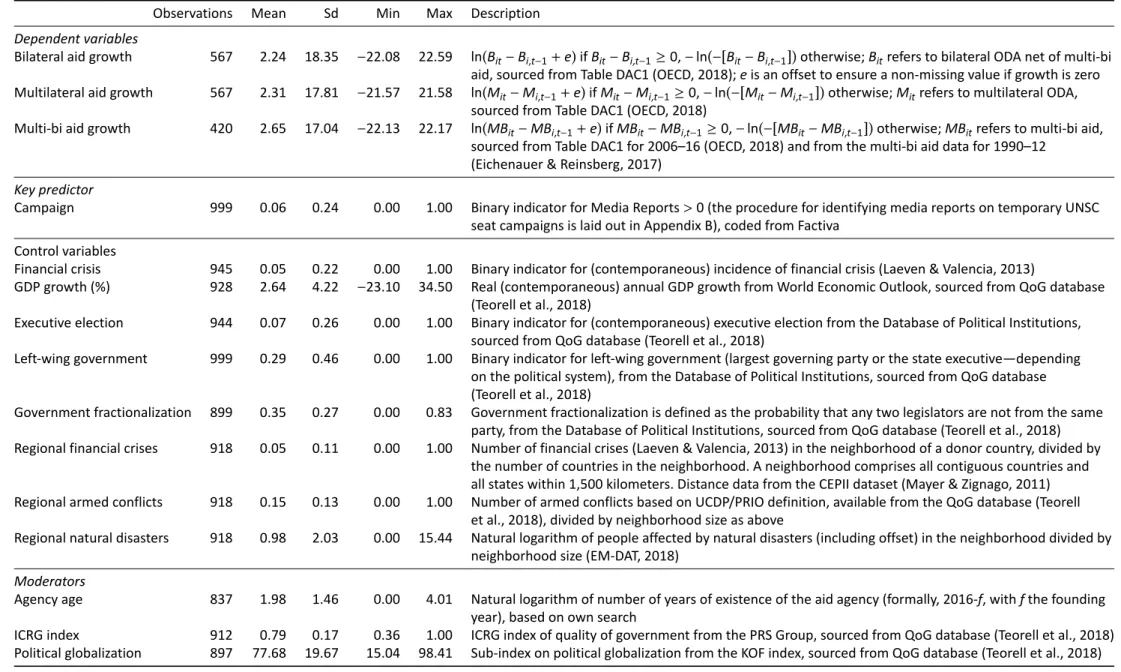
Table 1 presents descriptive statistics and data sources for all variables. It shows that (non-P5) donors campaign for a temporary UNSC seat in around 6.4% of all years and 7.0% when excluding years of tenure and the two years following it. In addition, campaigning is widespread. The media reports identify 24 donors with at least one campaign in 1995–2016.8This represents 65% of all eligible donors. This ensures that results are unlikely to be driven by individual countries with fre-quent campaigns.
3.4. Methods
To adequately capture interdependencies across aid channels, I conduct seemingly unrelated regression (SUR) analysis. The SUR model controls for factors jointly affecting all aid channels by allowing for cross-equation
correlations that appear as parameters in the cross-equation variance-covariance matrix (Roodman, 2012). The model is especially suitable under the assumption of a fixed aid budget, implying that donors which want to boost one type of aid must decrease another type of aid to not overspend the budget. Even if aid bud-gets are freely determined, SUR estimates are consis-tent (albeit not necessarily efficient). Finally, I cluster standard errors by country, thereby mitigating temporal auto-correlation.
4. Results
4.1. Correlational Analysis
I examine the unconditional relationship between UNSC campaigning and aid growth graphically. The full regres-sion results are available in the supplemental appendix but I do not show them here as I do not find a statistically significant unconditional relationship for various sets of control variables and measures of campaigning.
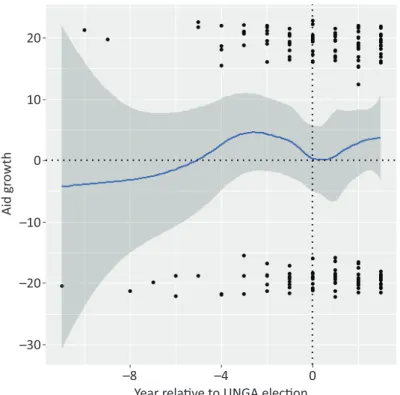
Figure 1 shows for all donors vying for a temporary UNSC seat the evolution of their total aid in a time win-dow around the respective UNGA election. Each point shows for a given campaign for each year relative to the UNGA election (x-axis) the logged absolute amount of aid dollars by which a donor has increased (or decreased) aid with respect to the previous year (y-axis). The solid line is the average aid change across all campaigning donors, along with the 95%-CI. I find no statistically sig-nificant change in aid growth, as the confidence intervals include zero.
Figure 2 tracks aid growth around UNGA elections separately for different aid channels. Multi-bi aid growth accelerates in the year before the UNGA election, but this finding does not hold in multivariate analysis, as shown in the appendix. For the remaining aid channels, there is no statistically significant growth effect in the context of UNSC campaigning. A possible interpretation is that donors are heterogeneous in the ways they use the various aid channels to support their UNSC candida-ture, which I will explore now.
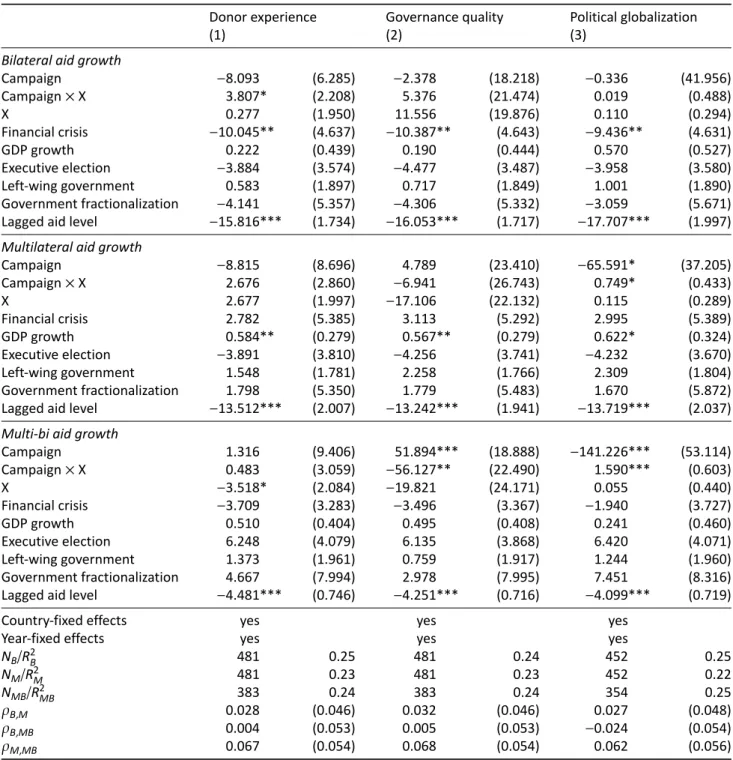
Table 2 presents estimation results for the relation-ship between campaigning for a temporary UNSC seat and aid growth under different donor characteristics. I present results for all three estimating equations as a stacked vector, using a baseline set of control variables and referring to the supplemental appendix for robust-ness to other controls.
In Model 1, I find a marginally significant effect in the difference of campaign effects between experienced donors and inexperienced donors. For multi-bi aid, I find the effect to be in the expected direction, but not statis-tically significant. For bilateral aid, everything else equal, 25 years of donor experience are related to an increase in bilateral aid growth by about USD 200,000—compared 8These donors include: Australia, Azerbaijan, Bulgaria, Canada, Croatia, Czech Republic, Denmark, Finland, Greece, Iceland, Israel, Ireland, Italy, Japan,
Table 1.Descriptive statistics and variable definitions.
Observations Mean Sd Min Max Description Dependent variables
Bilateral aid growth 567 2.24 18.35 −22.08 22.59 ln(Bit−Bi,t−1+e)ifBit−Bi,t−1≥0,−ln(−[Bit−Bi,t−1])otherwise;Bitrefers to bilateral ODA net of multi-bi
aid, sourced from Table DAC1 (OECD, 2018);eis an offset to ensure a non-missing value if growth is zero Multilateral aid growth 567 2.31 17.81 −21.57 21.58 ln(Mit−Mi,t−1+e)ifMit−Mi,t−1≥0,−ln(−[Mit−Mi,t−1])otherwise;Mitrefers to multilateral ODA,
sourced from Table DAC1 (OECD, 2018)
Multi-bi aid growth 420 2.65 17.04 −22.13 22.17 ln(MBit−MBi,t−1+e)ifMBit−MBi,t−1≥0,−ln(−[MBit−MBi,t−1])otherwise;MBitrefers to multi-bi aid,
sourced from Table DAC1 for 2006–16 (OECD, 2018) and from the multi-bi aid data for 1990–12 (Eichenauer & Reinsberg, 2017)
Key predictor
Campaign 999 0.06 0.24 0.00 1.00 Binary indicator for Media Reports>0 (the procedure for identifying media reports on temporary UNSC seat campaigns is laid out in Appendix B), coded from Factiva
Control variables
Financial crisis 945 0.05 0.22 0.00 1.00 Binary indicator for (contemporaneous) incidence of financial crisis (Laeven & Valencia, 2013)
GDP growth (%) 928 2.64 4.22 −23.10 34.50 Real (contemporaneous) annual GDP growth from World Economic Outlook, sourced from QoG database (Teorell et al., 2018)
Executive election 944 0.07 0.26 0.00 1.00 Binary indicator for (contemporaneous) executive election from the Database of Political Institutions, sourced from QoG database (Teorell et al., 2018)
Left-wing government 999 0.29 0.46 0.00 1.00 Binary indicator for left-wing government (largest governing party or the state executive—depending on the political system), from the Database of Political Institutions, sourced from QoG database (Teorell et al., 2018)
Government fractionalization 899 0.35 0.27 0.00 0.83 Government fractionalization is defined as the probability that any two legislators are not from the same party, from the Database of Political Institutions, sourced from QoG database (Teorell et al., 2018) Regional financial crises 918 0.05 0.11 0.00 1.00 Number of financial crises (Laeven & Valencia, 2013) in the neighborhood of a donor country, divided by
the number of countries in the neighborhood. A neighborhood comprises all contiguous countries and all states within 1,500 kilometers. Distance data from the CEPII dataset (Mayer & Zignago, 2011) Regional armed conflicts 918 0.15 0.13 0.00 1.00 Number of armed conflicts based on UCDP/PRIO definition, available from the QoG database (Teorell
et al., 2018), divided by neighborhood size as above
Regional natural disasters 918 0.98 2.03 0.00 15.44 Natural logarithm of people affected by natural disasters (including offset) in the neighborhood divided by neighborhood size (EM-DAT, 2018)
Moderators
Agency age 837 1.98 1.46 0.00 4.01 Natural logarithm of number of years of existence of the aid agency (formally, 2016-f, withfthe founding year), based on own search
ICRG index 912 0.79 0.17 0.36 1.00 ICRG index of quality of government from the PRS Group, sourced from QoG database (Teorell et al., 2018) Political globalization 897 77.68 19.67 15.04 98.41 Sub-index on political globalization from the KOF index, sourced from QoG database (Teorell et al., 2018)
20
10
–10
–8 –4
Year relave to UNGA elecon 0 Aid gr owth –20 –30 0
Figure 1.Absolute aid growth in the context of UNSC campaigns. Note: UNSC campaign start year is endogenously deter-mined by the first media report, whereas the figure tracks aid growth up to three years after the UNGA election year.
Bilateral aid Mullateral aid Mul-bi aid
–8 –4 0 0 –10 10 20 –30 –20
Year relave to UNGA elecon
–8 –4 0
Year relave to UNGA elecon
–8 –4
Year relave to UNGA elecon
Mulla te ra l aid gr owth 0 20 –20 Bila te ra l aid gr owth 0 –10 10 20 –30 –20 Mul-bi aid gr owth
Figure 2.Absolute aid growth in the context of UNSC campaigns for different aid channels. Note: UNSC campaign start year is endogenously determined by the first media report, whereas the figure tracks aid growth up to three years after the UNGA election year.
to a fully inexperienced donor—in the context of a UNSC campaign (p<0.1).9Figure 3 plots the marginal effect of campaigning on bilateral aid growth conditional on logged years of donor experience. Consistent with theo-retical expectations, the marginal effect of campaigning on bilateral aid growth increases with donor experience and becomes positively significant only for the most ex-perienced donor.
Model 2 explores the moderating impact of donor governance. Specifically, decreases in governance qual-ity let donors increase their multi-bi aid growth to sup-port a UNSC campaign. Above the mean of governance
quality, the effect of UNSC campaigning on multi-bi aid growth is not statistically significant, but the effect in-creases and becomes positively significant at lower gov-ernance values. For example, multi-bi aid growth in-creases by about USD 15,000 when reducing governance quality by one standard deviation (𝜎 = 0.17). Figure 4 shows the conditional marginal effect across the entire range of governance quality.
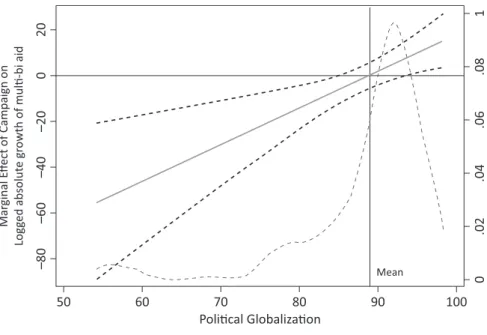
In Model 3, I find that political globalization is signif-icantly related to an acceleration of campaign-induced multi-bi aid growth. As the globalization index is never zero for any donor, the effect is best illustrated in an in-9Multiply ln(25)with𝛽 =3.807 and exponentiate the result.
Table 2.UNSC campaign and aid growth with basic control variables.
Donor experience Governance quality Political globalization
(1) (2) (3)
Bilateral aid growth
Campaign −8.093 (6.285) −2.378 (18.218) −0.336 (41.956) Campaign×X 3.807* (2.208) 5.376 (21.474) 0.019 (0.488) X 0.277 (1.950) 11.556 (19.876) 0.110 (0.294) Financial crisis −10.045** (4.637) −10.387** (4.643) −9.436** (4.631) GDP growth 0.222 (0.439) 0.190 (0.444) 0.570 (0.527) Executive election −3.884 (3.574) −4.477 (3.487) −3.958 (3.580) Left-wing government 0.583 (1.897) 0.717 (1.849) 1.001 (1.890) Government fractionalization −4.141 (5.357) −4.306 (5.332) −3.059 (5.671)
Lagged aid level −15.816*** (1.734) −16.053*** (1.717) −17.707*** (1.997)
Multilateral aid growth
Campaign −8.815 (8.696) 4.789 (23.410) −65.591* (37.205) Campaign×X 2.676 (2.860) −6.941 (26.743) 0.749* (0.433) X 2.677 (1.997) −17.106 (22.132) 0.115 (0.289) Financial crisis 2.782 (5.385) 3.113 (5.292) 2.995 (5.389) GDP growth 0.584** (0.279) 0.567** (0.279) 0.622* (0.324) Executive election −3.891 (3.810) −4.256 (3.741) −4.232 (3.670) Left-wing government 1.548 (1.781) 2.258 (1.766) 2.309 (1.804) Government fractionalization 1.798 (5.350) 1.779 (5.483) 1.670 (5.872)
Lagged aid level −13.512*** (2.007) −13.242*** (1.941) −13.719*** (2.037)
Multi-bi aid growth
Campaign 1.316 (9.406) 51.894*** (18.888) −141.226*** (53.114) Campaign×X 0.483 (3.059) −56.127** (22.490) 1.590*** (0.603) X −3.518* (2.084) −19.821 (24.171) 0.055 (0.440) Financial crisis −3.709 (3.283) −3.496 (3.367) −1.940 (3.727) GDP growth 0.510 (0.404) 0.495 (0.408) 0.241 (0.460) Executive election 6.248 (4.079) 6.135 (3.868) 6.420 (4.071) Left-wing government 1.373 (1.961) 0.759 (1.917) 1.244 (1.960) Government fractionalization 4.667 (7.994) 2.978 (7.995) 7.451 (8.316)
Lagged aid level −4.481*** (0.746) −4.251*** (0.716) −4.099*** (0.719)
Country-fixed effects yes yes yes
Year-fixed effects yes yes yes
NB/R2B 481 0.25 481 0.24 452 0.25 NM/R2M 481 0.23 481 0.23 452 0.22 NMB/R2MB 383 0.24 383 0.24 354 0.25 𝜌B,M 0.028 (0.046) 0.032 (0.046) 0.027 (0.048) 𝜌B,MB 0.004 (0.053) 0.005 (0.053) −0.024 (0.054) 𝜌M,MB 0.067 (0.054) 0.068 (0.054) 0.062 (0.056)
Notes: System of equations estimated simultaneously with dependent variables shown in row heads. Campaign is a binary indicator, X is the moderator in the respective column header, and Campaign×X the multiplicative interaction term. Abbreviations in the diagnos-tics section refer to the number of observations across bilateral aid (NB), multilateral aid (NM), and multi-bi aid (NMB), R-squared, and
cross-equation correlations, respectively. Significance levels: * p<.1 ** p<.05 *** p<.01.
teraction plot. Figure 5 shows that the campaign effect is positively significant only for the most globalized donors, insignificant for the average donor, and negatively sig-nificant for inward-oriented donors. Substantively, if po-litical globalization is increased by one standard devia-tion (𝜎 =9.02), multi-bi aid growth accelerates by more than USD 1.7 million (p<0.01), while multilateral aid in-creases by a meager USD 867 (p<0.1) in the context of a UNSC campaign.
While the effects of most control variables remain statistically insignificant, they point into the expected di-rection. Among the statistically significant controls, I find that financial crises negatively affect bilateral aid growth (p<0.05) and that more experienced donors tend to mo-bilize larger increases of bilateral aid (p<0.1). For mul-tilateral aid, I find a significantly positive relationship be-tween GDP growth and multilateral aid growth (p<0.1). For multi-bi aid, none of the controls has a significant
ef-0 01 0 –10 2 0 –20 1 Donor experience Mean 2 3 4
Thick dashed lines give 90% confidence interval.
Thin dashed line is a kernel density esmate of donor experience.
Mar ginal E ff ect of Campaign on Log g ed absolut e gr owth of bila te ra l aid 0 1 2 3 4 5
Figure 3.Marginal effect of campaigns on multi-bi aid growth conditional on donor experience.
.4 01 0 –10 2 0 .6 Government quality Mean .8 1
Thick dashed lines give 90% confidence interval.
Thin dashed line is a kernel density esmate of government quality.
Mar ginal E ff ect of Campaign on Log g ed absolut e gr
owth of mul-bi aid
30 40 0 1 2 3 4
Figure 4.Marginal effect of campaigns on multi-bi aid growth conditional on governance quality.
fect. In all equations, lagged aid levels have a statistically significant effect, indicating mean-reverting time series (p<0.01). Overall, model specifications are plausible as the models explain more than 20% of the variation in all aid types. Thanks to joint estimation, I can assess the ex-tent to which aid growth across different channels is cor-related. The cross-equation correlations are insignificant in most regressions.
4.2. Instrumental-Variable Design
The results thus far are based on correlations. In the re-mainder, I consider potential endogeneity of
campaign-ing with respect to aid growth. For example, donor pref-erences for aid provision and running for a seat may be affected simultaneously by unobserved factors. There-fore, I introduce an instrumental variable—the number of donors in the same constituency that are reported to vie for the same temporary UNSC seat as a given donor. This instrument fulfills the relevance criterion be-cause a donor will need to do more campaigning if many other donors vie for the same spot. In addition, to the extent that peer campaigning affects donor-specific aid growth only through donor campaigning, the instrument fulfills excludability, conditional on control variables and fixed effects.
50 02 0 –20 60 Polical Globalizaon Mean 70 90 100
Thick dashed lines give 90% confidence interval.
Thin dashed line is a kernel density esmate of polical globalizaon.
Mar ginal E ff ect of Campaign on Log g ed absolut e gr
owth of mul-bi aid
–40 –60 –80 80 0 .02 .04 .06 .08 1
Figure 5.Marginal effect of campaigns on multi-bi aid growth conditional on political globalization.
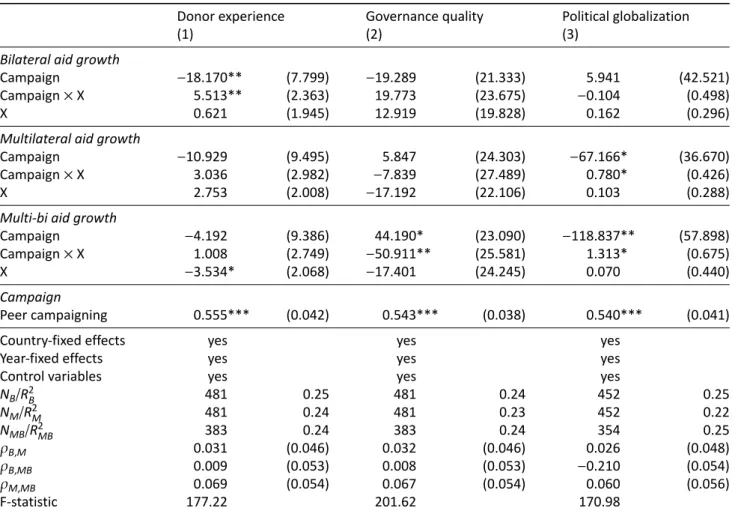
Table 3 presents the results, indicating that most pre-vious findings hold, some being more significant. Donor experience is a significantly positive predictor of bilateral aid growth in the context of UNSC campaigns. 25 years of additional experience now are related to bilateral aid growth of around USD 50 million (p < 0.05). To the extent that a donor becomes more internationalized by a standard deviation, it accelerates its multilateral aid growth by USD 1,100 (p<0.1) and its multi-bi aid growth by about USD 140,000 (p<0.1) during UNSC cam-paigns. Finally, campaigning significantly increases multi-bi aid growth if governance quality decreases (p<0.05). As regards instrument strength, I find that peer cam-paigning is a positively significant predictor of individ-ual campaigning, with the Kleibergen-Paap F-statistics being well above the conventional threshold (F> 10). The estimated sign implies that competition for a sin-gle UNSC seat drives donors toward intensifying their own campaigning.
4.3. Robustness Checks
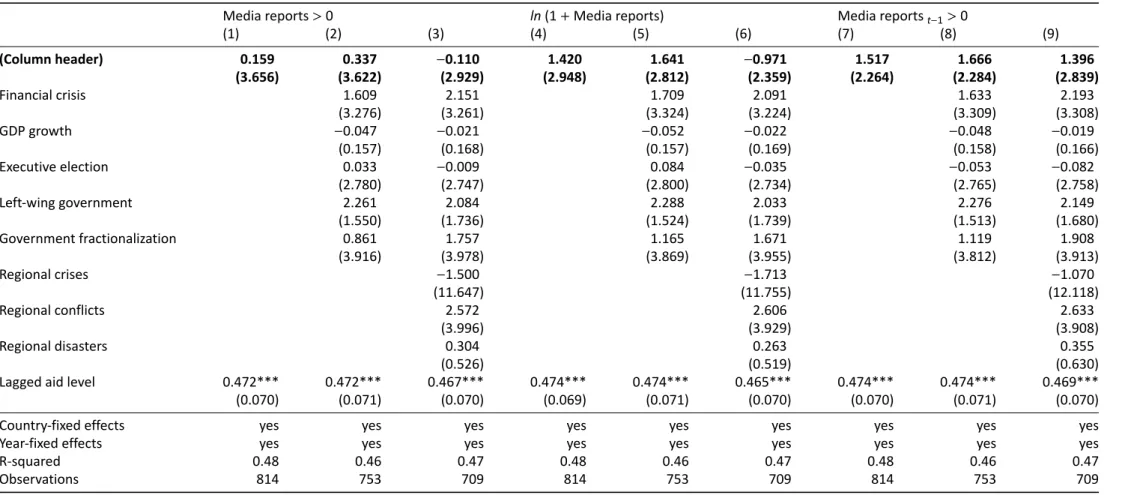
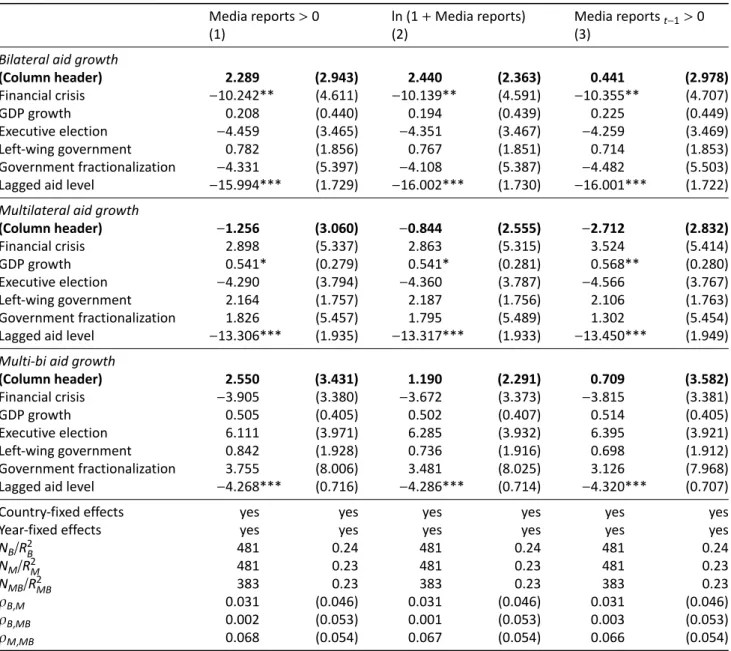
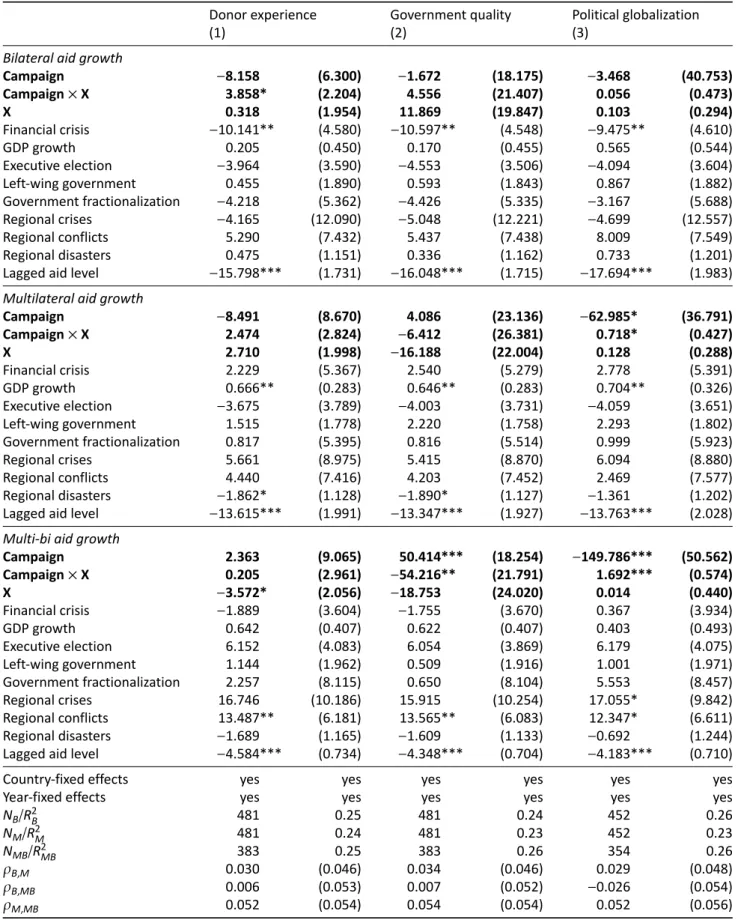
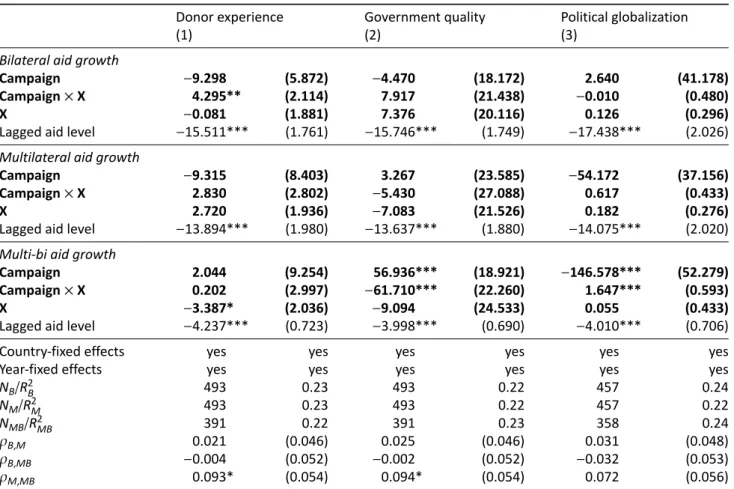
In the appendix, I present the full results for the uncondi-tional relationship between UNSC campaigning and aid growth for total aid (Table A1) and different aid chan-nels (Table A2), before probing the robustness of my find-ings in several ways. First, I extend the set of controls to also include ‘neighborhood variables,’ which yields the additional finding that multi-bi aid growth is significantly positively related to the incidence of regional conflicts, but has otherwise no effect on the results (Table A3). My results also are qualitatively unchanged when drop-ping all control variables from the model, except for the
country-fixed effects and year dummies (Table A4). Fur-thermore, I successfully replicate all findings using alter-native measures of the moderator variables (Table A5). In another robustness test, I explore an alternative lag struc-ture. When using the one-year lagged campaign mea-sure, I find that less experienced donors significantly in-crease multi-bi aid growth to support their UNSC cam-paigns (p<0.05). Conversely, political globalization loses its significant conditioning effect on campaign-induced multi-bi aid, but now significantly accelerates campaign-induced multilateral aid (p<0.05). The interaction effect of UNSC campaigning and governance quality is robust (Table A6). In another robustness test, I add the three P5 donors to the sample. This does not affect the re-sults (Table A7). Except for donor experience, all rere-sults are significant when using aid disbursements rather than aid commitments (Table A8).10The relative consistency of the results implies that donors generally keep their promises to reward support for their UNSC bids with ad-ditional aid.
Yet another robustness test conducts all regressions without country-fixed effects. This alters the interpreta-tion of the findings because estimated effects also refer to differences across donors, rather than inter-temporal differences within the same donors. For slow-moving variables, effects generally refer to cross-donor differ-ences. Replicating the main analysis using pooled regres-sions, I find the main results to be remarkably robust (Table A9).
Finally, again using pooled regressions, I explore po-tential effect heterogeneity across three regional con-stituencies, notably EEG, WEOG, and APG (Table A10). I find that Asian donors increase bilateral aid to support 10When lagging the campaign indicator, I obtain a significant conditional effect of donor experience on multi-bi aid growth, which may be due to delays
Table 3.Instrumental variable analysis.
Donor experience Governance quality Political globalization
(1) (2) (3)
Bilateral aid growth
Campaign −18.170** (7.799) −19.289 (21.333) 5.941 (42.521)
Campaign×X 5.513** (2.363) 19.773 (23.675) −0.104 (0.498)
X 0.621 (1.945) 12.919 (19.828) 0.162 (0.296)
Multilateral aid growth
Campaign −10.929 (9.495) 5.847 (24.303) −67.166* (36.670)
Campaign×X 3.036 (2.982) −7.839 (27.489) 0.780* (0.426)
X 2.753 (2.008) −17.192 (22.106) 0.103 (0.288)
Multi-bi aid growth
Campaign −4.192 (9.386) 44.190* (23.090) −118.837** (57.898)
Campaign×X 1.008 (2.749) −50.911** (25.581) 1.313* (0.675)
X −3.534* (2.068) −17.401 (24.245) 0.070 (0.440)
Campaign
Peer campaigning 0.555*** (0.042) 0.543*** (0.038) 0.540*** (0.041)
Country-fixed effects yes yes yes
Year-fixed effects yes yes yes
Control variables yes yes yes
NB/R2 B 481 0.25 481 0.24 452 0.25 NM/R2 M 481 0.24 481 0.23 452 0.22 NMB/R2 MB 383 0.24 383 0.24 354 0.25 𝜌B,M 0.031 (0.046) 0.032 (0.046) 0.026 (0.048) 𝜌B,MB 0.009 (0.053) 0.008 (0.053) −0.210 (0.054) 𝜌M,MB 0.069 (0.054) 0.067 (0.054) 0.060 (0.056) F-statistic 177.22 201.62 170.98
Notes: System of equations estimated simultaneously with dependent variables shown in row heads. Campaign is a binary indicator, X is the moderator in the respective column header, and Campaign×X the multiplicative interaction term. Baseline set of controls included in all equations. The instrument—peer campaigning—is defined as the number of other donors in the same constituency vying for the same seat. Abbreviations in the diagnostics section refer to the number of observations across bilateral aid (NB), multilateral aid (NM), and multi-bi aid (NMB), R-squared, and cross-equation correlations, respectively. Significance levels: * p<.1 ** p<.05 *** p<.01.
a UNSC campaign (p<0.05), while WEOG donors tend to reduce it (p<0.1). I find no significant conditional ef-fects for EEG donors, which likely is the result of under-powered tests.
5. Conclusion
Do countries use foreign aid to support their campaigns for a temporary seat in the UN Security Council? I found some robust evidence of campaign-induced aid growth for some aid channels and under some circumstances. In particular, as donor experience increases, bilateral aid growth increases, whereas multi-bi aid growth tends to decline. Conversely, multi-bi aid growth increases with declining quality of governance and with the level of in-ternationalization of a given donor.
A noteworthy limitation of this research is that some findings can still be interpreted in various ways. For exam-ple, while internationalization boosts multi-bi aid growth, it does not seem to affect bilateral aid growth. One in-terpretation is that there really is no effect on bilateral aid growth, but another one is that bilateral aid declines
but the analysis fails to produce a statistically signifi-cant effect, for example due to measurement error. De-spite best efforts, the data collection might be incom-plete, which would generate measurement error. Other sources of insignificant effects include under-powered tests due to short time series as well as donor het-erogeneity. These are common challenges of quantita-tive analysis that also this article cannot defy. Nonethe-less, the above analysis produced results that are re-markably robust against several modifications, including instrumental-variable estimation.
Albeit necessarily preliminary, these findings suggest interesting avenues for future research. They demon-strate that donors care about UNSC membership. Ex-isting studies emphasize the aid rewards for recipient countries during their temporary UNSC tenure. Future research could examine how aid flows evolve over the lifetime of a UNSC campaign, given that donors (includ-ing the ones that do not get elected) are likely to lessen aid effort once uncertainty is resolved after the out-come of a UNGA election. Studying how aid evolves during UNSC tenure would also hint to donor
motiva-tions in this context and specifically which donors use aid for private gain versus fostering international soli-darity. In this context, further research into donors of specific UN constituencies would be promising. For EEG donors, qualitative research would be necessary given the lack of long time-series data (Szent-Iványi, Reinsberg, & Lightfoot, 2018). Capturing the donor perspective, fu-ture research could also examine the choice of instru-ments other than aid for supporting UNSC campaigns. Research could also explore which recipients stand to gain most from donor campaigns for UNSC seats. Ul-timately, researchers should examine the effectiveness of campaign-induced aid. Although previous research finds that aid extended to developing countries during their temporary UNSC tenure is less effective (Dreher, Eichenauer, & Gehring, 2016), this does not need to be the case for campaign-induced aid for which donor mo-tives are less clear.
Acknowledgments
I am grateful to Patrick Bayer, Michael Heaney, Marcin Kaczmarski, and participants of the Glasgow Quantitative Methods Colloquium for comments on an earlier draft. Conflict of Interests
The author declares no conflict of interests. References
Alesina, A., & Dollar, D. (2000). Who gives foreign aid to whom and why?Journal of Economic Growth,5(1), 33–63.
Australian Associated Press. (2008, September 23). Aus-tralia discusses UN bid with African nations. Aus-tralian Associated Press.
Bauhr, M., Charron, N., & Nasiritousi, N. (2013). Does cor-ruption cause aid fatigue? Public opinion and the aid-corruption paradox.International Studies Quarterly, 57(3), 568–579.https://doi.org/10.1111/isqu.12025
BBC Monitoring Africa. (2009, June 16). Australia to sup-port Rwanda’s commonwealth bid.BBC Monitoring Africa.
Beck, T., Clarke, G., Groff, A., Keefer, P., & Walsh, P. (2001). New tools in comparative political economy: The database of political institutions.World Bank Eco-nomic Review,15(1), 165–176.
Berthélemy, J.-C. (2006). Aid allocation: Comparing donors’ behaviours.Swedish Economic Policy Review, 13(2), 75–109.
Bourguignon, F., & Sundberg, M. (2007). Aid effective-ness: Opening the black box. The American Eco-nomic Review,97(2005), 316–321.https://doi.org/ 10.1257/aer.97.2.316
Bueno de Mesquita, B., & Smith, A. (2009). A political economy of aid. International Organization, 63(2), 309–340.
BusinessWorld. (2011, June 17). Military cooperation deals needed? BusinessWorld. Retrieved from
http://www.bworldonline.com/content.php?section =TopStory&title=mining-issues-to-be-addressed----gov&8217t&id=33302
CNN. (2008, October 16). Iceland, Iran eye U.N. Security Council. Retrieved from https://web.archive.org/ web/20081018204805/http://www.cnn.com/2008/ US/10/16/unsecurity.council.ap/index.html
Coppedge, M., Gerring, J., Lindberg, S. I., Skaaning, S.-E., Teorell, J., Altman, D., . . . Miri, F. (2016).V-Dem codebook v6. Varieties of democracy (VDem) project. Gothenburg: VDem-Institute.
CTK Daily News. (2006, February 14). Moroccan Prime Minister denounces Prophet Mohammad’s cartoons. CTK Daily News.
Dietrich, S. (2013). Bypass or engage? Explaining donor delivery tactics in foreign aid allocation.International Studies Quarterly, 57(4), 698–712. https://doi.org/ 10.1111/isqu.12041
Dietrich, S., & Wright, J. (2015). Foreign aid allocation tac-tics and democratic change in Africa.Journal of Poli-tics,77(1), 216–234.
Dominion Post. (2003, November 14). Spit and Polish can-not hide Sri Lanka’s shame.Dominion Post.
Dreher, A. (2006). Does globalization affect growth? Evi-dence from a new index of globalization.Applied Eco-nomics,38(10), 1091–1110.
Dreher, A., Eichenauer, V. Z., & Gehring, K. (2016). Geopolitics, aid, and growth: The impact of UN Secu-rity Council membership on the effectiveness of aid. World Bank Economic Review,32(2), 268–286. Dreher, A., Gould, M., Rablen, M. D., & Vreeland, J. R.
(2014). The determinants of election to the United Nations Security Council. Public Choice, 158(1/2), 51–83.https://doi.org/10.1007/s11127-013-0096-4
Dreher, A., & Kilby, C. (2010). The impact of aid on growth revisited: Do donor motives matter? Economic Let-ters,107(3), 338–340.
Dreher, A., Klasen, S., Vreeland, J. R., & Werker, E. (2013). The costs of favoritism: Is politically driven aid less ef-fective?Economic Development and Cultural Change, 62(1), 157–191.https://doi.org/10.1086/671711
Dreher, A., Lang, V. F., Rosendorff, B. P., & Vreeland, J. R. (2018).Buying votes and international organizations: The dirty work hypothesis(CESifo Working Paper no. 7329). Munich: CESifo.
Dreher, A., Langlotz, S., & Marchesi, S. (2017). Infor-mation transmission and ownership consolidation in aid programs. Economic Inquiry, 55(4), 1671–1688.
https://doi.org/10.1111/ecin.12450
Dreher, A., Sturm, J.-E., & Vreeland, J. R. (2009). Devel-opment aid and international politics: Does member-ship on the UN Security Council influence World Bank decisions?Journal of Development Economics,88(1), 1–18.
Eichenauer, V. Z., & Reinsberg, B. (2017). What termines earmarked funding to international
de-velopment organizations? Evidence from the new multi-bi aid data. Review of International Orga-nizations, 12(2), 171–197.https://doi.org/10.1007/ s11558-017-9267-2
EM-DAT. (2018). The Emergency Events Database. Re-trieved fromwww.emdat.be
Federal Department of Foreign Affairs. (2018). Switzer-land registers its candidature for the UN Security Council for 2023–24.Federal Department of Foreign Affairs. Retrieved from https://www.admin.ch/gov/ en/start/dokumentation/medienmitteilungen.msg-id-37154.html
Fuchs, A., & Müller, A. (2018).Democracy and aid donor-ship(Kiel Working Paper No. 2113). Kiel: Kiel Institute for the World Economy.
Hawkins, D. G., Lake, D. A., Nielson, D. L., & Tierney, M. J. (2006). Delegation under anarchy: states, interna-tional organizations, and principal-agent theory. In Delegation and agency in international organizations (pp. 3–38). Cambridge: Cambridge University Press. Headey, D. (2008). Geopolitics and the effect of foreign
aid on economic growth: 1970–2001.Journal of Inter-national Development,20(2), 161–180.
Hoeffler, A., & Outram, V. (2011). Need, merit, or self-interest-what determines the allocation of aid? Re-view of Development Economics, 15(2), 237–250.
https://doi.org/10.1111/j.1467-9361.2011.00605.x
Jacobsen, H. (2015, November 5). Sweden considers cutting development aid budget by 60% due to refugee crisis.Euractiv. Retrieved fromhttps://www. euractiv.com/section/development-policy/news/ sweden-considers-cutting-development-aid-budget-by-60-due-to-refugee-crisis
Kilby, C. (2013). The political economy of project prepa-ration: An empirical analysis of World Bank projects. Journal of Development Economics, 105, 211–225.
https://doi.org/10.1016/j.jdeveco.2013.07.011
Kuziemko, I., & Werker, E. (2006). How much is a seat on the Security Council worth? Foreign aid and bribery at the United Nations.Journal of Political Economy, 114(5), 905–930.
Laeven, L., & Valencia, F. (2013). Systemic banking crises database.IMF Economic Review,61(2), 225–270. Lim, D. Y. M., & Vreeland, J. R. (2013). Regional
organi-zations and international politics: Japanese influence over the Asian Development Bank and the UN Secu-rity Council.Journal of Politics,65(1), 34–72. Lumsdaine, D. H. (1993).Moral vision in international
pol-itics: The foreign aid regime, 1949–1989. Princeton, NJ: Princeton University Press.
Mahoney, J., & Goertz, G. (2004). The possibility prin-ciple: Choosing negative cases in comparative re-search. American Political Science Review, 98(4), 653–669.
Malone, D. M. (2000). Eyes on the prize: The quest for nonpermanent seats on the UN Security Coun-cil. Global Governance,6(1), 3–23.https://doi.org/ 10.2307/27800251
Mayer, T., & Zignago, S. (2011). Notes on CEPII’s dis-tances measures: The GeoDist database(CEPII Work-ing Paper, No. 2011-25). Paris: CEPII. Retrieved from
https://ssrn.com/abstract=1994531
Mikulaschek, C. (2018). Issue linkage across international organizations: Does European countries’ temporary membership in the UN Security Council increase their receipts from the EU budget?Review of International Organizations,13(4), 491–518.
Milner, H. V. (2006). Why multilateralism? Foreign aid and domestic principal-agent problems. In D. G. Hawkins, D. A. Lake, D. L. Nielson, & M. J. Tierney (Eds.), Delegation and agency in interna-tional organizations(pp. 107–139). Cambridge: Cam-bridge University Press. https://doi.org/10.1017/ CBO9780511491368.005
Organization for Economic Cooperation and Devel-opment. (2018). Creditor reporting system: Aid activities. Organization for Economic Cooperation and Development. Retrieved from http://www.oecd- ilibrary.org/development/data/creditor-reporting-system/aid-activities_data-00061-en
Prantl, J. (2005). Informal groups of states and the UN Security Council. International Organiza-tion, 59(3), 559–592. https://doi.org/10.1017/ S0020818305050204
Reinsberg, B. (2017). Trust funds as a lever of influence at international development organizations.Global Pol-icy,8(5), 85–95.https://doi.org/10.1111/1758-5899. 12464
Reinsberg, B., Michaelowa, K., & Eichenauer, V. Z. (2015). The rise of multi-bi aid and the proliferation of trust funds. In M. Arvin & B. L. Lew (Eds.),Handbook on the economics of foreign aid(pp. 527–554). Northhamp-ton: Edward Elgar.
Reinsberg, B., Michaelowa, K., & Knack, S. (2017). Which donors, which funds? Bilateral donors’ choice of mul-tilateral funds at the World Bank. International Or-ganization,71(4), 767–802.https://doi.org/10.1017/ S0020818317000340
Reuters. (2014, September 7). Abe becomes first Japanese PM to visit Sri Lanka in 24 years.Reuters. Retrieved from https://www.reuters.com/article/us-southasia-japan-idUSKBN0H20HW20140907
Roodman, D. (2012). Fitting fully observed recursive mixed-process models with cmp.Stata Journal,11(2), 159–206. Retrieved fromhttp://www.stata-journal. com/article.html?article=st0224
Schmitz, J., & Schwarze, J. (2012). Determinants of the election of non-permanent members to the United Nations Security Council: An empirical analysis. In 5th Annual Conference on the Political Economy of International Organizations. Retrieved from
http://147.142.190.246/joomla/peio/files2012/ papers/Schmitz30.09.11.pdf
Security Council Report. (2009).Special research report. New York: Security Council Report.
multilateral-ism: Global cooperation in health.Global Policy,4(4), 325–335.
Stone, R. W. (2009).Institutions, power and interdepen-dence. New York: Cambridge University Press. Szent-Iványi, B., Reinsberg, B., & Lightfoot, S. (2018).
Small states in world politics: The role of trust funds in the foreign aid policies of Central and Eastern Eu-ropean donors.European Journal of Development Re-search.https://doi.org/10.1057/s41287-018-0175-y
Teorell, J., Dahlberg, S., Holmberg, S., Rothstein, B., Al-varado, N. P., & Svensson, R. (2018). The quality of government standard dataset, version Jan18. Re-trieved fromhttps://qog.pol.gu.se/data
The Age. (2010, July 21). Running up white flag on world stage.The Age.
The Canadian Press. (2014, March 3). Ottawa reduced to “gestures” on Ukraine response, say former top
en-voys.The Canadian Press.
The PRS Group. (2015).International Country Risk Guide (ICRG). Retrieved fromhttps://www.prsgroup.com/ about-us/our-two-methodologies/icrg
United Nations. (1945).UN charter. New York, NY: United
Nations.
United Nations. (2016). General Assembly elects 4 new non-permanent members to Security Council, as Western and others group fails to fill final vacancy. United Nations. Retrieved fromhttps://www.un.org/ press/en/2016/ga11796.doc.htm
Voeten, E. (2001). Outside options and the logic of Security Council action. American Political Science Review, 95(4), 845–858. https://doi.org/10.1017/ S000305540101005X
Vreeland, J. R., & Dreher, A. (2014a).The political econ-omy of the United Nations Security Council. Cam-bridge: Cambridge University Press.
Vreeland, J. R., & Dreher, A. (2014b). Who wins election to represent the world? In J. R. Vreeland & A. Dreher (Eds.),The political economy of the United Nations Security Council: Money and influence(pp. 94–136). Cambridge: Cambridge University Press.
Wright, J., & Winters, M. S. (2010). The politics of effec-tive foreign aid.Annual Review of Political Science,13, 61–80.
About the Author
Bernhard Reinsbergis Lecturer in International Relations at the University of Glasgow. He also is affil-iated to the Centre for Business Research at the University of Cambridge. He holds a PhD in Political Science from the University of Zurich, an MA in Comparative and International Studies at ETH Zurich and BA degrees in Political Science (Freie Universität Berlin) and Mathematics (University in Hagen). His research broadly covers the political economy of development and international organisations.
Appendix A. Robustness tests.
Table A1.Unconditional effect of UNSC campaigning on total aid growth.
Media reports>0 ln(1+Media reports) Media reportst−1>0
(1) (2) (3) (4) (5) (6) (7) (8) (9) (Column header) 0.159 0.337 −0.110 1.420 1.641 −0.971 1.517 1.666 1.396 (3.656) (3.622) (2.929) (2.948) (2.812) (2.359) (2.264) (2.284) (2.839) Financial crisis 1.609 2.151 1.709 2.091 1.633 2.193 (3.276) (3.261) (3.324) (3.224) (3.309) (3.308) GDP growth −0.047 −0.021 −0.052 −0.022 −0.048 −0.019 (0.157) (0.168) (0.157) (0.169) (0.158) (0.166) Executive election 0.033 −0.009 0.084 −0.035 −0.053 −0.082 (2.780) (2.747) (2.800) (2.734) (2.765) (2.758) Left-wing government 2.261 2.084 2.288 2.033 2.276 2.149 (1.550) (1.736) (1.524) (1.739) (1.513) (1.680) Government fractionalization 0.861 1.757 1.165 1.671 1.119 1.908 (3.916) (3.978) (3.869) (3.955) (3.812) (3.913) Regional crises −1.500 −1.713 −1.070 (11.647) (11.755) (12.118) Regional conflicts 2.572 2.606 2.633 (3.996) (3.929) (3.908) Regional disasters 0.304 0.263 0.355 (0.526) (0.519) (0.630)
Lagged aid level 0.472*** 0.472*** 0.467*** 0.474*** 0.474*** 0.465*** 0.474*** 0.474*** 0.469***
(0.070) (0.071) (0.070) (0.069) (0.071) (0.070) (0.070) (0.071) (0.070)
Country-fixed effects yes yes yes yes yes yes yes yes yes
Year-fixed effects yes yes yes yes yes yes yes yes yes
R-squared 0.48 0.46 0.47 0.48 0.46 0.47 0.48 0.46 0.47
Observations 814 753 709 814 753 709 814 753 709
Table A2.Unconditional effect of UNSC campaigning on aid growth for different aid channels.
Media reports>0 ln (1+Media reports) Media reportst−1>0
(1) (2) (3)
Bilateral aid growth
(Column header) 2.289 (2.943) 2.440 (2.363) 0.441 (2.978) Financial crisis −10.242** (4.611) −10.139** (4.591) −10.355** (4.707) GDP growth 0.208 (0.440) 0.194 (0.439) 0.225 (0.449) Executive election −4.459 (3.465) −4.351 (3.467) −4.259 (3.469) Left-wing government 0.782 (1.856) 0.767 (1.851) 0.714 (1.853) Government fractionalization −4.331 (5.397) −4.108 (5.387) −4.482 (5.503)
Lagged aid level −15.994*** (1.729) −16.002*** (1.730) −16.001*** (1.722)
Multilateral aid growth
(Column header) −1.256 (3.060) −0.844 (2.555) −2.712 (2.832) Financial crisis 2.898 (5.337) 2.863 (5.315) 3.524 (5.414) GDP growth 0.541* (0.279) 0.541* (0.281) 0.568** (0.280) Executive election −4.290 (3.794) −4.360 (3.787) −4.566 (3.767) Left-wing government 2.164 (1.757) 2.187 (1.756) 2.106 (1.763) Government fractionalization 1.826 (5.457) 1.795 (5.489) 1.302 (5.454)
Lagged aid level −13.306*** (1.935) −13.317*** (1.933) −13.450*** (1.949)
Multi-bi aid growth
(Column header) 2.550 (3.431) 1.190 (2.291) 0.709 (3.582) Financial crisis −3.905 (3.380) −3.672 (3.373) −3.815 (3.381) GDP growth 0.505 (0.405) 0.502 (0.407) 0.514 (0.405) Executive election 6.111 (3.971) 6.285 (3.932) 6.395 (3.921) Left-wing government 0.842 (1.928) 0.736 (1.916) 0.698 (1.912) Government fractionalization 3.755 (8.006) 3.481 (8.025) 3.126 (7.968)
Lagged aid level −4.268*** (0.716) −4.286*** (0.714) −4.320*** (0.707)
Country-fixed effects yes yes yes yes yes yes
Year-fixed effects yes yes yes yes yes yes
NB/R2 B 481 0.24 481 0.24 481 0.24 NM/R2 M 481 0.23 481 0.23 481 0.23 NMB/R2 MB 383 0.23 383 0.23 383 0.23 𝜌B,M 0.031 (0.046) 0.031 (0.046) 0.031 (0.046) 𝜌B,MB 0.002 (0.053) 0.001 (0.053) 0.003 (0.053) 𝜌M,MB 0.068 (0.054) 0.067 (0.054) 0.066 (0.054)
Notes: System of equations estimated simultaneously with dependent variables shown in row heads. Campaign is either a binary indica-tor of media reports (column 1), the logged number of media reports (column 2), or the lagged binary indicaindica-tor (column 3). Significance levels: * p<.1 ** p<.05 *** p<.01.