SEVENTH FRAMEWORK PROGRAMME
Research Infrastructure
FP7-INFRASTRUCTURES-2010-2 – INFRA-2010-1.2.3:
Virtual Research Communities
Combination of Collaborative Project and Coordination and Support
Actions
(CP-CSA)LinkSCEEM-2
Linking Scientific Computing in Europe and the Eastern
Mediterranean – Phase 2
Grant Agreement Number: RI-261600
D8.1
Report on implemented data management software environment
installation
Final
Version: 1.1
Author(s): Terry McLaren, NCSA
Nick J. Sinanis, Cyprus Institute Date: 09/09/2011
Project and Deliverable Information Sheet
Project Ref. №: RI-261600 Project Title: LinkSCEEM-2Project Web Site: http://www.linksceem.eu
Deliverable ID: <D8.1>
Deliverable Nature: <DOC_TYPE: Report / Other>
Contractual Date of Delivery:
30 / 08 / 2011
Deliverable Level:
PU *
Actual Date of Delivery:
09 / 09 / 2011
LinkSCEEM Project
EC Project Officer: Leonardo Flores Anover
* - The dissemination level are indicated as follows: PU – Public, PP – Restricted to other participants (including the Commission Services), RE – Restricted to a group specified by the consortium (including the Commission Services). CO – Confidential, only for members of the consortium (including the Commission Services).
Document Control Sheet
Title: Report on implemented data management software environment installation
ID: <D8.1>
Version: <1.1 > Status: Final
Available at: http://eniac.cyi.ac.cy
Software Tool: Microsoft Word 2007
Document
File(s): LinkSCEEM-2-D8 1.docx
Written by: Terry McLaren, NCSA
Nick J. Sinanis, CyI - CaSToRC
Contributors: Mostafa Zoubi, SESAME
Basman Elhadidi, NARSS
Mohammed Abd El-Monem Gaafar, BA
Reviewed by: Christos Nicolaou, CaSToRC
Authorship
Approved by: PMO
Document Status Sheet
Version Date Status Comments
0.1 12/8/2011 Draft
0.2 19/8/2011 Final Forwarded for review
1.0 29/8/2011 Final
Document Keywords
Keywords: LinkSCEEM-2, Computational Science, HPC, e-Infrastructure, Eastern Mediterranean
Table of Contents
PROJECT AND DELIVERABLE INFORMATION SHEET... II
DOCUMENT CONTROL SHEET ... II DOCUMENT STATUS SHEET ... II DOCUMENT KEYWORDS... III TABLE OF CONTENTS ... IV LIST OF FIGURES ... IV LIST OF TABLES... IV REFERENCES AND APPLICABLE DOCUMENTS ... IV LIST OF ACRONYMS AND ABBREVIATIONS... V
EXECUTIVE SUMMARY... 7
1 INTRODUCTION... 7
2 THE COMMUNITY SOFTWARE LANDSCAPE... 8
2.1 DATA MANAGEMENT... 8
2.2 COMPUTATIONAL MANAGEMENT... 9
3 DATA MANAGEMENT SOFTWARE... 10
3.1 NCSA CYBERENVIRONMENT TECHNOLOGIES... 10
3.2 INSTALLATIONS AT PARTNER SITES... 11
3.2.1 CYPRUS INSTITUTE... 12
3.2.2 SESAME... 12
3.3 SCIENTIFIC COMMUNITIES AND DR ECOSYSTEMS... 12
4 COVERAGE AND PLANS... 12
5 ANNEX... 14
5.1 SURVEY QUESTIONNAIRE... 14
List of Figures
Figure 1: NCSA Medici Web Application ...10Figure 2: NCSA Cyberintegrator Workflow Editor ...11
List of Tables
Table 1 Data Management at Partner Sites ...8Table 2 Computational Management at Partner Sites ...9
References and Applicable Documents
[1] http://repox.ist.utl.pt
[2] http://medici.ncsa.illinois.edu
[3] http://gridengine.org
[4] http://www.pbsworks.com
[6] http://openprovenance.org [7] https://opensource.ncsa.illinois.edu/. [8] https://opensource.ncsa.illinois.edu/confluence/display/MMDB/Home [9] https://opensource.ncsa.illinois.edu/confluence/display/CBI/Cyberintegrator+Home [10] http://www.kisti.re.kr [11] http://www.youtube.com/watch?v=kM806eZhoig [12] http://eewrc.cyi.ac.cy/DARECLIMED [13] http://www.3dcoform.eu
List of Acronyms and Abbreviations
API Application Programming Interface BA Bibliotheca Alexandrina
CaSToRC Computation-based Science and Technology Research Centre of the CyI CPU Central Processing Unit
CUDA Compute Unified Device Architecture (NVIDIA) CyI The Cyprus Institute
DM Data Management DR Data Repository EC European Community
EEWRC Energy, Environment and Water Research Center of the CyI GB Giga (= 230 ~ 109) Bytes (= 8 bits), also GByte
Gb/s Giga (= 109) bits per second, also Gbit/s
GB/s Giga (= 109) Bytes (= 8 bits) per second, also GByte/s
GFlop/s Giga (= 109) Floating point operations (usually in 64-bit, i.e. DP) per second, also GF/s GHz Giga (= 109) Hertz, frequency =109 periods or clock cycles per second
GigE Gigabit Ethernet, also GbE GNU GNU’s not Unix, a free OS GPGPU General Purpose GPU GPU Graphic Processing Unit HDD Hard Disk Drive
HPC High Performance Computing; Computing at a high performance level at any given time; often used synonym with Supercomputing
HPCC HPC Challenge benchmark, http://icl.cs.utk.edu/hpcc/
HPL High Performance LINPACK HWA HardWare accelerator IB InfiniBand
IBA IB Architecture I/O Input/Output
JSC Jülich Supercomputing Centre (FZJ, Germany) KB Kilo (= 210 ~103) Bytes (= 8 bits), also KByte LQCD Lattice QCD
LinkSCEEM Linking Scientific Computing in Europe and the Eastern Mediterranean
LinkSCEEM-2 Linking Scientific Computing in Europe and the Eastern Mediterranean – Phase 2 MB Mega (= 220 ~ 106) Bytes (= 8 bits), also MByte
MB/s Mega (= 106) Bytes (= 8 bits) per second, also MByte/s
MFlop/s Mega (= 106) Floating point operations (usually in 64-bit, i.e. DP) per second, also MF/s
MHz Mega (= 106) Hertz, frequency =106 periods or clock cycles per second MPI Message Passing Interface
MPP Massively Parallel Processing (or Processor)
NARSS National Authority for Remote Sensing And Space Sciences
STARC Science and Technology in Archaeology Research Center of the CyI TB Tera (= 240 ~ 1012) Bytes (= 8 bits), also TByte
TFlop/s Tera (= 1012) Floating-point operations (usually in 64-bit, i.e. DP) per second, also TF/s
Executive Summary
The first aim of the tasks addressed by the present deliverable is to build an understanding about existing community resources and needs with the goal of defining the specific tools and systems being used to address HPC, data management and visualization tools. With this information we can identify the common tools and services and define opportunities to integrate resources in an effort to build a holistic environment that meets the needs of the communities. The second goal is to develop an appropriate data management software environment to be commonly used by Eastern Mediterranean data storage provider partners. During Year-1 the partners identified the existing community resources and data management needs through a survey implemented within the framework of WP8. Partner NCSA provided information about technologies being developed and used at NCSA to enable semantic web data management and meta-workflows. The Cyprus Institute and SESAME have installed pilot repositories based on NCSA technology. Synergies and exchanges in the areas of Data Management (DM) and Data Repository (DR) are established with scientific communities in climate research and in archeology that participate in related EU-funded projects to facilitate the identification of user communities needs and the adoption of the tools developed by regional scientists.
It is expected that the Data Management Software Environment will evolve for the duration of the LinkSCEEM-2 project in line with new, updated software releases and related developments. It is therefore recognized that regular (yearly) updates of this document will be required to reflect the requirements evolution as well as the technological progress.
1 Introduction
This first deliverable of WP8 aims to stimulate, record and further develop the data management infrastructure of the partner sites and their corresponding research communities. Related to this work, the objectives described in Task 8.1 and partly those in Task 8.2 have been the main focus of the effort.
The selected methodology involved a two-prong approach:
• Identification of resources among the partner sites to help understand potential integration points for the computational, data storage and visualization resources. • Installation of specific DM prototypes at partner sites in order to test and evaluate
the functionality of the tools.
In an effort to understand this heterogeneous environment and its current and future needs, representatives of the scientific communities targeted have been engaged through partner sites and contributed to the identification of the tools that are currently being used. In a parallel effort, NCSA created user and tutorial materials for the NCSA software packages that include the Cyberintegrator meta-workflow tool and the Medici semantic content repository.
The present report initially describes the existing community software landscape (section 2) and specifically the data management and the computational management tools. Section 3 focuses on the activities performed by partners on data management software development and deployment, and, briefly reviews the plans of the regional scientific communities with
respect to DR and DM tools. The last section outlines the strategy of the project partners to meet the future goals of the LinkSCEEM-2 WP8: ‘Integration of Resources’.
2 The Community Software Landscape
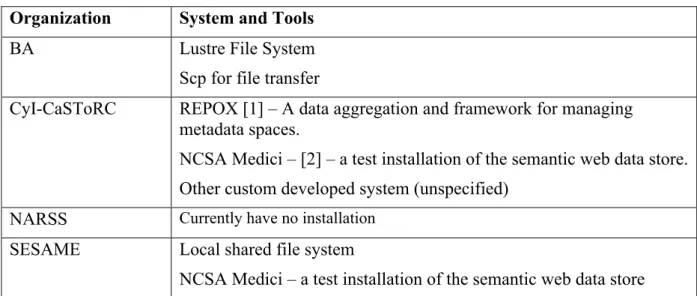
This section summarizes the list of current data management tools and systems being used at the various partner sites. To obtain and record this information, beginning of 2011 a survey was performed using an online questionnaire – Annex 5.1. As part of this exercise we also asked each community to comment on the features each liked or disliked and define desirable system characteristics. The tables below outline the current tools in use or being evaluated at the partner sites.
2.1 Data Management
This section defines the current software tools and systems that are deployed in the respective partner sites.
Organization System and Tools
BA Lustre File System Scp for file transfer
CyI-CaSToRC REPOX [1] – A data aggregation and framework for managing metadata spaces.
NCSA Medici – [2] – a test installation of the semantic web data store. Other custom developed system (unspecified)
NARSS Currently have no installation
SESAME Local shared file system
NCSA Medici – a test installation of the semantic web data store Table 1 Data Management at Partner Sites
The desirable data management system characteristics identified by the community include: • Linked repositories
• Access control • Sharing options
• Visualization and preview options (3D objects, images, etc...) • Metadata options (Add, Edit)
• Data classification and categorization
• Capturing and integrating high-throughput data
• Integrating distributed software and hardware systems into a single application • Data compression techniques
The DM software landscape as of today consists mainly of basic file-systems, distributed when possible, and occasionally a few semantic repositories. The user needs, as outlined through the desirable data management system characteristics shown above, clearly reflect the need for DR dedicated to DM purposes. Taking into account the partner involvement into activities such as the LinkSCEEM-2 WP11: ‘Cultural Heritage Research’, the deployment of common DR tools in partner sites will be enabling for their successful participation e.g., for the planned online digital library for cultural heritage purposes.
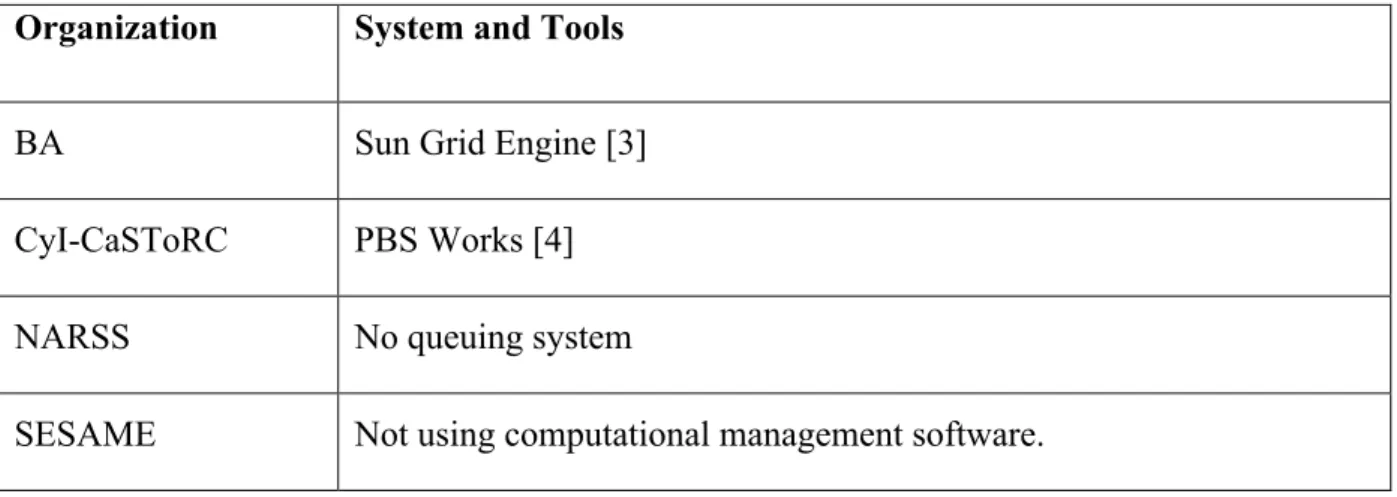
2.2 Computational Management
The following results define the currently deployed computational management system at each of the partner sites.
Organization System and Tools
BA Sun Grid Engine [3] CyI-CaSToRC PBS Works [4] NARSS No queuing system
SESAME Not using computational management software. Table 2 Computational Management at Partner Sites
The desirable computational management system characteristics identified by the community include:
• Compatibility with current computation and visualization packages • Intuitive and user-friendly interfaces
• Access control for both authentication and authorization
• Status and monitoring (system utilization before and during jobs, current allocation, & job status)
• Provision of a graphic interface to view system status, e.g. myJam [5] • Ability to pre-empt jobs (hold, cancel)
• Ability to prioritize jobs (LIFO, FIFO, RR, etc...) • Ability to exploit idle processors
• Availability of the myJam tool on the Sun Grid Engine (SGE)
The partner sites currently employ only basic job queuing and scheduling (Table 2).
Moreover, there are no workflow management tools used into production. Nonetheless, there is a clearly expressed need for installing such tools. It is evident to the community and all partners that workflow tools like Cyberintegrator will seamlessly provide access to DR.
3 Data Management Software
A major goal of WP8 is to develop an appropriate data management software environment to be commonly used by Eastern Mediterranean data storage provider partners. The presence of this infrastructure software will facilitate subsequent integration and access of data resources via common applications designed specifically for this service. In accordance to original planning, the existing knowhow and technology of NCSA has been exploited through the adoption of software previously developed there and shared with LinkSCEEM-2 partners. Following is a description of NCSA software used by the project and an account of implementations at regional LinkSCEEM-2 partner sites.
3.1 NCSA Cyberenvironment Technologies
NCSA is developing a suite of technologies that could be useful to the LinkSCEEM scientific community. These technologies include the Cyberintegrator meta workflow environment and the Medici semantic content store. Both of these technologies use a semantic web middleware (Tupelo) and implement a version of the Open Provenance Model (OPM - [6]). Both projects are in active development and are hosted at NCSA’s open source web site [7].
The current release of Medici is v1.1 and the installation guide, user documentation and training materials are available at [8]. The development team is close to releasing v1.2 which includes the following new features:
The Medici Server now supports https, the ability to upload an ontology, the ability to apply a taxonomy to the data, the ability to create multiple component data sets, a RESTful interface for other clients and tools to interact with the server. New features for the Medici Web application include anonymous access, HTML 5 drag-n-drop upload, bulk download, the ability to embed data into other sites using an <iframe> data link and improved 3D data (HTML 5, Java 3D & OpenGL) previewers. Since this is an ongoing project, documentation activities continue and all updates will be available from the NCSA open source server [7].
The current version of the Cyberintegrator workflow system is v2.0 beta 5. Installation instructions, user documentation and source code for Cyberintegrator is available at [9]. This project is under development and updates to documentation are an ongoing process.
Cyberintegrator provides an editor to create workflows and a server side service for executing workflows. The editor lets the user work in a natural step-by-step manner (data input > tool > data output) while it records the workflow in the background. When the user has the step-by-step flows completed they can save it as a workflow definition and run it as a local execution or on a dedicated server that has the execution service installed.
Figure 2: NCSA Cyberintegrator Workflow Editor
The development team is currently working with the Korean Institute of Science and Technology Information (KISTI - [10]) to update the workflow tool to allow users to submit a job to HPC resources and monitor it via a middleware called, PTPflow, a job submission and monitoring system. Other potentially synergistic activities with KISTI include:
• Developing a cyberinfrastructure with web application for academic courses in higher education such as courses for teaching CFD (Computational Fluid Dynamics) by using HPC resources
• Developing and improving a job submission and monitoring system that supports various HPC queue systems such as PBS, SGE, and LoadLeveler.
• Developing and enhancing publishing active workflow via Digital System Explorer (DSE) that allows students having user-friendly application to execute the workflow over HPC resources
3.2 Installations at Partner Sites
NCSA worked closely with colleagues from CyI and SESAME and both centers have successfully installed Medici v1.1 and validated the provided installation instructions. The CyI/CaSToRC implementation will serve as a case study and model for later implementation at additional partner sites planned to happen early in Year-2 of the project.
3.2.1 Cyprus Institute
A Medici system was installed at CyI in February 2011. A Virtual Machine was used to run the repository mainly for demonstration purposes to the local community. A more permanent instance targeting the communities interested in repositories is currently under installation. An internal CyI seminar was given by Dr. N. Sinanis on March 2, 2011. Its main purpose was to demonstrate to the CyI research communities the Medici and Cyberintegrator toolset provided by NCSA and identify prospective users. Since then, an exchange of requirements and feature requests has started with the communities of the EEWRC and STARC research centers of CyI.
3.2.2 SESAME
A Medici installation has been made available by Mostafa Zoubi at SESAME in April 2011. The installation steps have been recorded in a YouTube video [11] that provides a step-by-step reference to the installation process for other members in the community. The installation is based on the supported Ubuntu system, while a Scientific Linux installation is under preparation.
3.3 Scientific Communities and DR Ecosystems
The CyI partner has identified the EU-funded project DARECLIMED [12] that aims to use specific DR for regional climate models and related simulation results. The project is coordinated by the EEWRC research center of the CyI and therefore presents an ideal opportunity for joint activities leading to the better understanding of the needs of the regional climate/weather scientific community. Similarly, the STARC centre of CyI is collaborating in the FP7 3D-COFORM project [13] that considers specific DR for 3D data representation and metadata description. Activities for the development of these local and regional repositories are expected to play a major role in further refining the toolset palet used for DR and DM purposes within the framework of LinkSCEEM WP8. Further efforts to identify and engage regional scientific communities that traditionally are in need of DM/DR services are ongoing in coordination with networking activities and training events organized by WP2 and WP4 of the project respectively.
4 Coverage and Plans
Additional discussion, use-case definition and requirements need to be clearly articulated before a technology can be selected to meet the above mentioned needs. With NCSA Medici and/or Cyberintegrator being part of the solution, features to support a federated data model and other customizations will need to be sponsored with the design driven by community requirements. The community partners also need to determine which distributed file system
will be installed at each of the sites or what data sharing strategy will be employed to keep the sites synchronized. Once these inputs are well understood then a smaller technical team of system administrators and software developers will engage to review available options and make a recommendation about which technologies will best serve the community. Additionally, training sessions for trainers and users shall be organized as satellite activities to workshops that target specific communities (climate, archeology, etc.) organized by LinkSCEEM-2 WP2 and WP4.
Throughout the lifetime of the project, community needs and technologies will evolve to a level that a refresh of this document will be required. Anticipating this, updates on the DM needs and systems installed in partner sites will be carried out on a yearly basis.
5 Annex
5.1 Survey Questionnaire
A. What software/system do you use for data management?
B. What software/system do you use for computation management? - What is the name of the tool or system you use?
- What do you like and dislike about the tool/system? - What capability would you like to see in this system?
For example, the tools do you use to manage your data (file systems, ftp, gridftp, scp, web, databases, etc...) and what tools do you use to manage your computational environment (HPC (globus, condor, specific job managers, etc.), virtual machines? (vmware, virtual box,
microsoft virtual PC, etc..), cloud services (azure, ec2, etc...).
- Request and collect information from community about current tools, likes, dislikes limitations and wishlists.
<PARTNER> Data Management Software Computational Management
What is the name of the tool or system
you use?
What do you like and dislike about the
tool/system?
What capability would you like to see in