CWE-GAM WORKING PAPER SERIES
www.careworkeconomy.org
Photograph by Konstantin BörnerÖzlem Onaran*, University of Greenwich, Greenwich Political Economy
Research Centre (GPERC)
Cem Oyvat, University of Greenwich, GPERC
Eurydice Fotopoulou, Goldsmiths, University of London
CWE-GAM Working Paper Series: 19-04
Program on Gender Analysis in Economics (PGAE)
American University, Washington, DC
DOI:
April, 2019
CWE-GAM WORKING PAPER SERIES 19-03
The Care Work and the Economy (CWE-GAM) Project strives to reduce gender gaps in economic outcomes and enhance gender equality by illuminating and properly valuing the broader economic and social contributions of caregivers and integrating care in macroeconomic policymaking toolkits. We work to provide policymakers, scholars, researchers and advocacy groups with gender-aware data, empirical evidence, and analytical tools needed to promote creative, gender-sensitive
macroeconomic and social policy solutions. In this era of demographic shifts and economic change, innovative policy solutions to chronic public underinvestment in care provisioning and
infrastructures and the constraints that care work places on women’s life and employment choices
are needed more than ever. Sustainable development requires gender-sensitive policy tools that integrate emerging understandings of care work and its connection with labor supply, and economic and welfare outcomes.
Find out more about the project at www.careworkeconomy.org.
ÖZLEM ONARAN
Özlem Onaran is Professor of Economics at the University of Greenwich and the director of the Greenwich Political Economy Research Centre. She is currently directing a project for the ESRC Rebuilding Macroeconomics Network on
inequalities in income, wealth and gender and macroeconomic performance. She has directed research projects for the UN International Labour Organisation, UNCTAD, the Institute for New Economic Thinking, the Foundation of European Progressive Studies, New Economics Foundation and Unions21. She is a member of the Scientific Committee of the Foundation of European Progressive Studies, of the Scientific Advisory Board of the Hans Boeckler Foundation, of the Policy
Advisory Group of the Women’s Budget Group and of the Coordinating
Committee of the Research Network Macroeconomics and Macroeconomic Policies. She has more than 70 articles in books and leading peer-reviewed journals on issues of inequality, wage-led growth, employment, fiscal policy and gender.
CEM OYVAT Cem Oyvat is Lecturer in Economics at the University of Greenwich. Cem Oyvat received his Phd in Economics from University of Massachusetts – Amherst in
2014 with dissertation titled “Essays on the Evolution of Inequality”. His research
interests include development economics, macroeconomics, international economics, income distribution and political economy.
EURYDICE FOTOPOULOU
Eurydice Fotopoulou is a lecturer at Goldsmiths, University of London. Eurydice’s
research focuses on gender and macroeconomics, and in particular structural models that investigate income and wealth distribution inequality. She also works on the impact of labour market and fiscal policies. Her research is interdisciplinary, drawing from economics, sociology and gender studies. Recent collaborative research projects look into the effects of income, gender and wealth inequality, and economic policies on macroeconomic performance. Eurydice has a PhD in Economics by the University of Greenwich, an MSc in the Political Economy of Development and a BSc in Development Economics from SOAS, University of London.
CWE-GAM WORKING PAPER SERIES 19-03
1. INTRODUCTION ... 1
2. LITERATURE ... 2
2.1. FEMINIST POST-KEYNESIAN/POST-KALECKIAN MACROECONOMIC ANALYSIS ... 5
3. A FEMINIST POST-KALECKIAN THEORETICAL MODEL WITH PUBLIC EXPENDITURE, WAGES, PAID EMPLOYMENT AND UNPAID LABOUR ... 7
3.1. THE IMPACT OF THE PUBLIC SOCIAL EXPENDITURES ON OUTPUT, EMPLOYMENT AND PUBLIC DEBT ... 19
3.1.1 THE SHORT-RUN EFFECT OF A CHANGE IN THE SHARE OF PUBLIC SOCIAL INFRASTRUCTURE INVESTMENT IN GDP... 19
3.1.2 The effect of a change in the share of public social infrastructure investment in GDP in the next period ... 24
3.1.3 THE EFFECT OF A CHANGE IN THE SHARE OF PUBLIC SOCIAL INFRASTRUCTURE INVESTMENT IN GDP ON EMPLOYMENT AND PUBLIC DEBT ... 29
4. CONCLUSION AND POLICY IMPLICATIONS ... 34
REFERENCES ... 37
LIST OF FIGURES
FIGURE 1 ... 21 FIGURE 2 ... 25 FIGURE 3 ... 27 FIGURE 4 ... 31 FIGURE 5 ... 33Page | 1 CWE-GAM WORKING PAPER SERIES 19-04
The aim of this paper is to develop a feminist post-Keynesian/post-Kaleckian demand-led growth model to theoretically analyse the role of labour market policies and fiscal policies on growth and employment.
We develop a three-sector gendered macroeconomic model with physical and social sectors (health, social care, education, child care) in the public and private market
economy, and an unpaid reproductive sector providing domestic care. The production in the market economy is performed by male and female paid labour and capital.
On the demand side, we model behavioural equations for household consumption as a function of male and female wage income and profits. Consumption by the households can be on social services and the rest of the economy. We model private investment as a function of the profit share, GDP, and public debt to GDP ratio, which in turn affects the interest rate. Exports are a function of real unit labour costs (wage/productivity) and the GDP of the rest of the world. Imports are a function of real unit labour costs and the GDP. Real unit labour costs are the inverse of the profit share. Taxes are collected on wage and profit income. We model three types of government spending are modelled: In addition to physical infrastructure, which is traditionally recognized as public investment, we define current public spending in health, social care, education, and child care as public social infrastructure investment. The rest of the current government spending is defined as government consumption expenditure.
On the supply side, productivity in the physical sector is exogenous in the short run and endogenously changes in the long-run, and is a function of public physical and social infrastructure and current spending, household spending in the social sector, unpaid domestic care labour, wages of men and women, and growth.
Employment (in hours) is determined by output and labour productivity. Female and male labour supplies depend on wages, benefits and social infrastructure.
Demand has an effect on growth both in the short and the long run, as the model builds on realistic structural features of a capitalist market economy operating with excess capacity and involuntary unemployment. Gendered structural features regarding both the paid and reproductive unpaid labour such as gendered sectoral composition of
employment, occupational segregation, institutions, and social norms regarding gendered consumption behaviour as well as the distribution of unpaid domestic care labour affect growth, productivity and employment.
The model aims to provide a theoretical basis to analyse the impact of gender equality and public spending. We provide a theoretical analysis of the effects on GDP, productivity (GDP per employee) and employment of men and women in both the short run and long run as a consequence of i) the impact of fiscal policies, in particular public spending in social infrastructure, and ii) decreasing gender wage gaps, in particular in the female
Page | 2 CWE-GAM WORKING PAPER SERIES 19-04
dominated social sector. This theoretical analysis provides a basis to further analyse the impacts of i) particular paths to closing gender wage gaps, e.g. via an upward convergence in wages, i.e. an increase in both male and female wages with a faster increase in the latter; ii) other types of fiscal spending, and iii) taxes on labour and capital income. Crucially, a change in gender pay gap or the functional distribution of income between wages and profits or public spending in social vs. physical infrastructure will have both demand side effects in short- and long-run and supply side effects in the long run and affect output, productivity and the employment and income of men and women.
We develop our model by bringing together two traditions, namely Post-Kaleckian economics and feminist economics.
There is a large body of research on the impact of gender inequality on growth and human development in developing countries, The existing literature concurs that
women’s bargaining power within the household is enhanced when they command
resources and this translates into improved human development (Duflo, 2003; Duflo and Udry, 2004; Himmelweit et al., 2013; Phipps and Burton, 1998; Quisumbing and
Maluccio, 2003; Thomas, 1990; Hashemi et al., 1996; Kabeer, 2001; Littlefield, 2003; Morrison, 2007; Pitt et al., 2006). Hoddinott and Haddad (1995) and Thomas (1997) showed that a rise in women´s share of cash income in Ivory Coast and Brazil leads to an increase in spending on nutritional, health, and education expenditures as well, whereas the share of spending on private goods for men is decreasing. Similar results are found by Doss (2005), Duflo and Udry (2004), Morrison (2007), Phipps and Burton (1998)
Rubalcava et al. (2004), Lundberg et al. (1997). An increase in assets controlled by women is positively associated with children´s educational attainment and with their nutritional status– especially of girls (Doepke and Tertilt, 2011; Duflo, 2003; Engle, 1993; Gitter and Barham, 2008; Thomas, 1990).
Braunstein (2013) argues that the impact of income on human capacities depends not only on how much is earned and spent, but on what is purchased, and whether these commodities provide good substitutes or complements for unpaid care time. At first glance, women need to spend more of their income on social services to replace their unpaid reproductive labour, assuming these services are not freely provided by the public sector. More income in the hands of women or the presence of an employed mother in the household increases household spending on children (Lundberg et al, 1997; Pahl, 2000; Cappellini et al, 2014). Microeconomic studies across the board to a great extend
attest that a larger share of women’s income compared to that of men’s, is spend to
satisfy the needs of the household (Blumberg, 1991; Antonopoulos et al, 2010; Pahl,
2000) and a possible increase in their income leads to increased spending on children’s
education and wellbeing (Vogler and Pahl, 1994; Lundeberg et al. 1997; Cappellini et al 2014), with further implications for the distribution of power within the household too
Page | 3 CWE-GAM WORKING PAPER SERIES 19-04
intensive and luxury goods. Seguino (2010; 2012) and Kabeer (1997) suggested that in developing countries women are more likely to consume domestically produced goods, while men are more likely to consume a higher proportion of luxury and/or imported goods (such as cell phones, automobiles and televisions). These studies highlight the positive effect that higher incomes for women can have for an economy, by shifting the consumption towards goods that have long-term impacts in the quality of life and workforce.
An area where this becomes more pronounced is unpaid caring labour where women carry unevenly more burden than men, with implications for growth (Seguino, 2010; 2012; Antonopoulos et al., 2010, Braunstein et al., 2011). Similarly, the increase and intensification of unpaid household labour compensate for the continuous shrinking of public services provision in health, social care and education, due to budget cuts, leading to higher intergenerational costs. Folbre (1995), Himmelweit et al. (2014), Pahl (1997), and Nelson (1996) stress the importance of including the unpaid care work largely done by women for the smooth running of society and the economy in economic analysis. The
term “reproductive labour” used to describe this includes all the activities that in general
ensure that the workforce is fed, healthy, and able to work. However, it will be wrong to claim that all of this caring activity takes part in the unpaid economy; the state is
responsible to a large extend for the provision of services such as healthcare, childcare and education, in most countries of the world. Care is also increasingly commodified, provided by the private sector subject to the dynamics of markets.
Dissecting the household is fundamental in understanding how the inclusion of gender in a demand-led growth model would bring new insights. Households are understood as sources both of consumption and labour supply. The relations of power within a
household as an outcome of the participation of women in paid employment have been well documented (Agarwal, 1997; and for a more extensive review see Himmelweit et al. 2013; De Henau and Himmelweit, 2013). Households provide unpaid work for the reproduction of the labour force (van Staveren 2010; De Henau and Himmelweit 2013b; Hamner and Akram-Lodhi 1998; Nelson 1996). The household is also a key source of demand for the economy. Consequently, another important empirical question to explore is how a higher degree of gender equality in wages or employment could change the composition of consumption. There is limited empirical research on the differences in propensities to consume by men and women, as well as the composition of consumption with respect to types of goods and services and their import content.
The provision of social welfare is usually undertaken by the state, by means of public
spending in the social care sector, which not only has the potential to reduce women’s
care burden, but is also a sector where employment creation tends to be predominantly female (Antonopoulos et al., 2010; Braunstein et al. 2011; Seguino, 2012; Onaran, 2016). The degree by which these needs of the population are met determines the types of welfare regime of a country, and would influence how growth can improve gender equality. The manner a state can nurture or obstruct equality is explored in Braunstein et
Page | 4 CWE-GAM WORKING PAPER SERIES 19-04
welfare support can be formed by means of kinship or solidarity networks. These
networks however have evolved not only as an outcome of cultural norms, but to replace the scarcity of formal social welfare provision. In the exactly opposite side, we find
countries which have an efficient formal social welfare provision system, provided by the state that nurtures equality (Braunstein et al, 2011).
Women do the majority of the unpaid reproductive labour, therefore the development of the social sector in the market economy with services provided by paid labour in the public sector, as well as the private sector, will have profound effects on women as well as on aggregate macroeconomic outcomes (Onaran, 2016; Folbre, 1995). First, on the supply side, this will reduce the need for unpaid labour to provide care, education and health, and improve the chances of women to participate in the paid economy. Secondly, on the demand side, given the current rates of occupational segregation the new jobs generated in the social sector will be traditionally female jobs, and thereby increase the employment chances of women (Tzannatos, 1995). Thirdly, both the public supply of social services and increased paid employment opportunities could transform gender norms concerning divisions of labour both within the household and paid versus unpaid work (Folbre and Nelson, 2000).
Furthermore, public investment in times of underemployment/ unemployment can compensate for the lack of effective demand in the economy, which can deter private investment (De Henau et al, 2016). A large body of research differentiates between two types of public spending, as productive (government capital spending), and unproductive expenditure (government current spending). Palley (2013) and Seguino (2012) for example consider public investment in technology and infrastructure productive expenditure and argue that it is leading to positive crowding in effects on private investment. Seguino (2012) however further distinguishes between public investment in physical and social infrastructure pointing out that both enhance the business environment and hence private
investment. Elson (2016, 2017) and Women’s Budget Group make the case for labelling
public social expenditures as social infrastructure due to their effects on productivity and benefits which accrue to the society as a whole. Most of the post-Keynesian/Kaleckian literature does not model the public sector, with the notable exceptions of Blecker (2002), Seguino (2012), and Obst, Onaran and Nikolaidi (2017).
Recent research highlights the beneficial effect of public social infrastructure spending on employment generation and economic growth. De Henau et al (2016) using input-output analysis find for seven OECD countries that investment in social infrastructure would create roughly double the amount of new jobs as investment in physical infrastructure (directly and through a strong multiplier effect). Their findings also note a decrease in the gender gap in employment with more investment in social infrastructure, reflecting in part the concentration of women in the social sector. In a similar vein, Bargawi and Cozzi (2014) using the Cambridge Alphametrics Model (CAM), compare and contrast three scenarios for Europe: continued austerity, gender-neutral expansionary scenario and gendered expansionary scenario. Projections for their gendered expansionary scenario suggest that an additional 7.3 million jobs for women could be created in the Eurozone
Page | 5 CWE-GAM WORKING PAPER SERIES 19-04
and the United Kingdom by government expenditure in social infrastructure (as opposed to reduction of public spending). Additionally, they find that higher growth rates under the gendered scenario can lead to significant reductions of debt-to-GDP ratios and lower budget deficits. Antonopoulos et al (2010) for the USA using micro-simulation find that for the same amount of investment in the social sector and physical infrastructure
investment the number of jobs created from investment in social care is more than double (1.2 million vs 550,000 jobs) than in the alternative scenario of physical infrastructure investment, reducing significantly the gender employment gap. Antonopoulos and Kim (2008) examining South Africa make similar observations to the study for the USA for an increase in public spending in social infrastructure. Finally, Ilkkaracan et al (2015)
investigating the impact of public investment in social care services on employment, gender equality and poverty in Turkey, find that fiscal prioritization of early childhood care and preschool education as a subsector of social infrastructure compared to investment in
physical infrastructure and cash transfers “presents an enormous potential for decent job
creation, particularly in the female-dominated occupations and sectors” (p. 7).
Antonopoulos et al. (2010) and Ilkkaracan et al. (2015) use micro household data to match the macro labour demand with personal characteristics of the working age population to model employment effects on women and men. Ilkkaracan and Kim (2018, also in ILO 2018) extend the input-output analysis regarding impact of public spending in early childhood care, education, health and long-term careto 45 countries.
To summarize, the literature in the nexus of gender equality- public spending- human development in developing countries underlines the fact that greater public spending in services that reduce the care burden of women empower them in many levels: increased financial independence, higher literacy and better health outcomes for them and their children, thus ensuring not only short term effects (higher labour force participation), but significant long run effects (higher productivity, better quality of workforce and shifting gender stereotypes).
2.1. FEMINIST POST-KEYNESIAN/POST-KALECKIAN MACROECONOMIC ANALYSIS
The discussion above shows that there is a multilevel positive correlation between gender equality and macroeconomic growth; however most Kaleckian models (e.g. Bhaduri and Marglin, 1990; Blecker 2002; Stockhammer et al. 2009; Onaran et al., 2011; Onaran and Galanis 2014; Onaran and Obst, 2016; Obst, Onaran, Nikolaidi, 2017; Hein and Vogel, 2008; Naastepad and Storm, 2006/7; Stockhammer and Onaran, 2004; Onaran and Stockhammer, 2005; Hein and Tarassow, 2010; Naastepad, 2006) have not integrated these linkages with the notable exceptions Ertürk and Çağatay (1995); Blecker and Seguino, (2002); Braunstein et al, (2011); Seguino (2010, 2012), Braunstein et al., (2018) and Onaran, Oyvat, Fotopoulou (2018).
Ertürk and Çağatay’s landmark 1995 paper was the first attempt to analyse empirically the relationship between women’s share of the workforce and long-term economic growth and short-term macroeconomic changes, with reference to structural adjustment policies.
Page | 6 CWE-GAM WORKING PAPER SERIES 19-04
Using cross-country data for 1985 and 1990, they conclude that structural adjustment policies lead to the feminization of the labour force, through changes in income
distribution, reflected in decreasing wage shares in manufacturing, and through shifts in the outward orientation of the economy as measured by the increase in the ratio of exports to GNP.
Blecker and Seguino (2002) analyse the impact of a rise in women’s wages relative to men’s on export competitiveness and growth. They argue that under certain parameters, gender equity may not be compatible with growth in export-oriented semi-industrialised economies. Their analysis is informed by the fact that in the labour markets of many developing countries female workers in the export sector face employment constraints that result in their segregation in export sector jobs at lower wages than male workers receive in the non-export industries.
Braunstein et al. (2011), incorporate reproduction in a structuralist/post-Keynesian model and introduce notions from the behavioural science explaining attitudes according to
“altruist” or “selfish” types of economies, linking care with the gender-wage gap and gendered job segregation. Based on this analytical framework, Braunstein et al., (2018) analyse how care models, globalization and macroeconomic policy stance shape the macroeconomic structure and development trajectories of different economies using a principle component analysis.
Seguino (2012), develops a two-sector model (human development sector vs. the rest) and argue that greater equality can either be a drag on or a stimulus to growth, depending on the type of inequality and macro-level policies regulating trade and investment. Under the right conditions, a more equitable distribution of income and opportunities (in the form of human development) can be a self-sustaining stimulus to growth, with significant trans- generational effects.
Our model synthesizes gendered post-Kaleckian models (Braunstein et al, 2011; Seguino, 2010; 2012), post-Kaleckian models which explicitly incorporate the public sector (Obst, Onaran, Nikolaidi, 2017; Seguino, 2012) and post- Kaleckian models which integrate both the demand and supply side and short and long-run analysis (Hein and Tarassow 2010, Naastepad, 2006, Seguino, 2010; 2012). Furthermore, we explicitly model employment and not just output. The importance of post-Keynesian/Kaleckian macroeconomic models for our purposes is that it puts inequality at the heart of the determination of demand and output, as they integrate the dual role of wages as cost and as source of demand. These models accept the direct positive effects of higher profits on private investment and net exports as emphasised in mainstream models, contrasting these positive effects with the negative effects on consumption. Demand plays a central role in determining output and employment, and the distribution of income between workers and capitalists (wages and profits) have a crucial effect on demand. These models allow for involuntary
unemployment, underemployment, and excess capacity (Onaran, 2016). This approach is different from the neoclassical macroeconomic models based on microeconomic decisions of optimizing agents. Components of aggregate demand are determined by behavioural
Page | 7 CWE-GAM WORKING PAPER SERIES 19-04
equations. Wages are an outcome of a bargaining process between employers and workers as opposed to the neoclassical theory, where they are determined by the marginal product of labour. Neoclassical labour supply is based on the choice between leisure and consumption. The difference of the demand-led models of output and employment is that unemployment is involuntary. Labour supply is inelastic and
employment is demand-constrained, not supply-determined. In this respect, the upwards convergence of wages, coupled with public social and physical investment can lead to higher human development and growth (Seguino, 2012). Public investment can partially be self-financing in the sense that it creates the conditions for crowding in of private investment, stimulating labour productivity, and growth thus generating tax revenues (Seguino, 2016).
The gender pay gap in this analysis translates social norms and prejudice into economic behaviour, assuming a preference by employers for a particular type of workers
(black/white, or by extension, male/female) as well as endogenously determined education outcomes and labour supply behaviour. From a feminist political economy approach
gender wage gap is determined by the relative bargaining power of men and women vis-a-vis capital, which for the purpose of this paper is considered as exogenously determined.
In this section, we develop a feminist post-Kaleckian model that considers gender
inequalities and social infrastructure investment. In this paper, we introduce a model with two workers, female and male, which are respectively demonstrated by scripts F and M in the equations. We disaggregate profit share into its components: output, female and male wage rates, and female and male paid employment. This would allow us to examine the impact of changing wage-gaps and different policies on output and paid employment of female and male workers. The profits are earned by the capitalists, which are genderless for simplicity in our model.
The model has two sectors, public social sector, which consists of the expenditures of the government in education, childcare, healthcare, and social care (demonstrated with script H), and the rest of the economy or N sector (demonstrated with script N). The public spending in this social sector is defined as investment in social infrastructure in line with the feminist economics literature (Elson, 2016, 2017; Women’s Budget Group, 2015). We also introduce household’s spending in marketized social services. Both public and
household’s social expenditures have short-run demand effects and influence labour productivity in the long-run. Appendix 1 presents list of the variables in the model. In line with Braunstein et al, (2011)and Braunstein et al., (2018), we also model unpaid care labour within the household, and its effects on productivity.
Page | 8 CWE-GAM WORKING PAPER SERIES 19-04
Aggregate output (𝑌𝑡) is the sum of total male wage bill (𝑊𝐵𝑡𝑀), total female wage
bill (𝑊𝐵𝑡𝐹) and profits (𝑅 𝑡).
𝑌𝑡 = 𝑊𝐵𝑡𝑀+ 𝑊𝐵𝑡𝐹+ 𝑅𝑡 (1)
The total wage bill for female workers (𝑊𝐵𝑡𝐹) is a function of female wages in the
social sector (𝑤𝑡𝐻𝐹), female employment in the social sector (𝐸
𝑡𝐻𝐹), female wages in the rest
of the economy (𝑤𝑡𝑁𝐹), and female employment in the rest of the economy (𝐸𝑡𝑁𝐹):
𝑊𝐵𝑡𝐹= 𝑤
𝑡𝐻𝐹 𝐸𝑡𝐻𝐹+ 𝑤𝑡𝑁𝐹𝐸𝑡𝑁𝐹 (2)
Similarly the total wage bill for male workers (𝑊𝐵𝑡𝑀) is a function of male wages in
the social sector (𝑤𝑡𝐻𝑀), male employment in the social sector (𝐸
𝑡𝐻𝑀), male wages in the
rest of the economy (𝑤𝑡𝑁𝑀), and male employment in the rest of the economy (𝐸𝑡𝑁𝑀):
𝑊𝐵𝑡𝑀= 𝑤𝑡𝐻𝑀 𝐸𝑡𝐻𝑀+ 𝑤𝑡𝑁𝑀𝐸𝑡𝑁𝑀 (3)
The data for selected emerging economies in Table 1 below show that average hourly male wages are significantly higher than average hourly female wages for most of the developing economies. There is also significant occupational/sectoral segregation with women constituting the majority in the social sector and are substantially
Page | 9 CWE-GAM WORKING PAPER SERIES 19-04
Table 1: The gender wage ratio and share of female employment in selected emerging economies Country Year Average male wage / Average female wage (total economy, hourly wages) Women’s share of employment in the total economy, (hours worked) Women’s share of employment in the social sector (no of persons) Women’s share of employment in the rest of the economy) no of persons Argentina 2014 0.965 0.413 0.738 0.378 Bolivia 2014 1.066 Brazil 2014 1.190 0.428 0.737 0.403 Chile 2013 1.259 0.403 0.676 0.402 Colombia 2016 1.003 Costa Rica 2016 0.960 0.367 Dominican R. 2015 1.080 0.383 0.762 0.365 Ecuador 2014 1.148 0.392 0.638 0.378 El Salvador 2014 0.950 0.425 0.679 0.414 Guatemala 2014 1.007 0.345 0.644 0.335 Honduras 2014 0.869 Malaysia 2015 0.978 0.382 0.706 0.360 Mexico 2014 1.072 0.380 0.612 0.366 Nicaragua 2014 1.027 Pakistan 2016 1.121 0.232 0.397 0.225 Paraguay 2015 0.982 0.413 Peru 2014 1.258 0.452 0.534 0.448
Page | 10 CWE-GAM WORKING PAPER SERIES 19-04
Russia 2015 1.323 0.487 South Korea 2016 1.506 0.424 Thailand 2016 0.822 0.456 0.734 0.445 Ukraine 2016 1.255 0.481 Uruguay 2014 1.094 0.445 0.738 0.421 Venezuela 2006 1.068 Vietnam 2016 1.120 0.485 AVERAGE 1.088 0.410 0.661 0.380
Notes: Authors’ own calculations from ILO (2018)’s Global Wage Database. We report the latest
observations for the emerging economies, which have data on average male and female wages for 2000s. Employees in healthcare, social care and education activities are considered as part of the social sector and employees in other activities are considered as part of the rest of the economy.
The data for selected emerging economies (Table 1) show that average hourly male wages are significantly higher than average hourly female wages for most of the developing economies. Therefore, we define gender wage gaps (𝛼𝑡) for wages in H and N sectors as
below: 𝛼𝑡𝑁 = 𝑤𝑡𝑁𝑀 𝑤𝑡𝑁𝐹, 𝛼𝑡𝐻 = 𝑤𝑡𝐻𝑀 𝑤𝑡𝐻𝐹 (4)
N sector produces the majority of the economic market activities output; therefore, following Table 1 we consider that 𝛼𝑡𝑁> 1 is more likely for most of the developing
economies. It is also likely that 𝛼𝑡𝐻 > 1 based on evidence from the UK, where 𝛼𝑡𝐻 is 1.8
and 𝛼𝑡𝑁is 1.2 in 2013 (own calculations based on EU KLEMS data).
The aggregate output in the market economy (GDP, excluding unpaid activities) is
Page | 11 CWE-GAM WORKING PAPER SERIES 19-04
where 𝐶𝑡𝐻 is households’ social expenditures1, 𝐶
𝑡𝑁 is consumption in the rest of the
economy, 𝐼𝑡 is private investment expenditures, 𝐺𝑡𝐻 is government’s social infrastructure
expenditures , 𝐺𝑡𝐶 is government’s consumption expenditures, 𝐼𝑡𝐺 is public investments
other than investments in the social sector2, 𝑋
𝑡 is exports of goods and services and 𝑀𝑡 is
imports of goods and services. The public social expenditures is a fiscal policy decision targeted as a share of aggregate output (𝜅𝑡𝐻), and constitutes the public social sector
output (𝑌𝑡𝐻)3. The rest of the GDP is the market output in the rest of economy (𝑌𝑡𝑁):
𝑌𝑡𝐻= 𝐺𝑡𝐻 = 𝜅𝑡𝐻𝑌𝑡 (6)
𝑌𝑡𝑁= 𝑌𝑡− 𝐺𝑡𝐻= 𝑌𝑡(1 − 𝜅𝑡𝐻) (7)
The share of government’s consumption expenditures (𝐺𝑡𝐶) and public investments other
than social infrastructure investment in the social sector (𝐼𝑡𝐺) are also determined by
government as a share of aggregate output and are respectively 𝜅𝑡𝐶 and 𝜅𝑡𝐺:
𝐺𝑡𝐶 = 𝜅𝑡𝐶𝑌𝑡 (8)
𝐼𝑡𝐺 = 𝜅𝑡𝐺𝑌𝑡 (9)
1 While theoretically household consumption of social services amount to investment in human
infrastructure as well and affects productivity in our model, as discussed below, we preserved the term
“consumption” for this category consistent with the definitions in national accounts.
2Government’s social infrastructure expenditures are classified as current spending on labour services in the
national accounts. The physical infrastructure associated with providing social infrastructure such as schools and hospitals are counted as physical infrastructure. Hence part of 𝐼𝑡𝐺 also contributes to social
infrastructure. However, our classification is important for a gendered analysis of the employment impact of different fiscal policy decisions as 𝐺𝑡𝐻is very female labour intensive while construction, just as most other
parts of 𝐼𝑡𝐺 is male labour intensive.
3 For simplicity, we assume that H sector only consists of the public social sector. The employment and supply in this sector is entirely financed by public social expenditures. The households’ private social
consumption (see equation 22) is supplied by the private market output in the rest of economy (𝑌𝑡𝑁). Hence,
private social consumption do not directly contribute to the generation of employment in H sector; however, they affect labour productivity in the next period positively as discussed below.
Page | 12 CWE-GAM WORKING PAPER SERIES 19-04
The employment in the N sector is output over labour productivity in the N sector (𝑇𝑡𝑁): 𝐸𝑡𝑁 = 𝑌𝑡𝑁 𝑇𝑡𝑁 =(1 − 𝜅𝑡 𝐻) 𝑌 𝑡 𝑇𝑡𝑁 (10)
In our model, the share of female employment in N sector is exogenous and institutionally and socially determined leading to occupational segregation, and is demonstrated by 𝛽𝑡𝑁.
The male workers in N sector constitute (1 − 𝛽𝑡𝑁) of the sector4: 𝐸𝑡𝑁𝐹= (1 − 𝜅𝑡𝐻) 𝑌𝑡 𝑇𝑡𝑁 𝛽𝑡 𝑁 = 𝑌𝑡 𝑁 𝑇𝑡𝑁𝛽𝑡 𝑁 (11) 𝐸𝑡𝑁𝑀=(1 − 𝜅𝑡 𝐻) 𝑌 𝑡 𝑇𝑡𝑁 (1 − 𝛽𝑡𝑁) = 𝑌𝑡𝑁 𝑇𝑡𝑁(1 − 𝛽𝑡𝑁) (12)
Table 1 shows that the number of male workers is greater than the number of female workers in N sector for all the emerging economies reported. Hence, 𝛽𝑡𝑁< 0.50 is a likely
outcome for an emerging economy. In the UK, 𝛽𝑡𝑁 is 0.42 and 𝛽𝑡𝐻 is 0.76 in 2013 (own
calculations based on EU KLEMS data).
We assume that the wage bill paid to male and female workers in the social sector constitutes the public social expenditures and the social sector is not making profits. Any non-labour inputs used constitute part of government consumption (𝐺𝐶). Following this,
the public social expenditure can be written as a function of employment (𝐸𝑡𝐻), average
female wage (𝑤𝑡𝐹𝐻), average male wage (𝑤
𝑡𝑀𝐻), female employment share (𝛽𝑡𝐻) and male
employment share (1 − 𝛽𝑡𝐻) in the social sector.
𝐺𝑡𝐻 = 𝜅𝑡𝐻𝑌𝑡= 𝛽𝑡𝐻𝐸𝑡𝐻𝑤𝑡𝐹𝐻+ (1 − 𝛽𝑡𝐻)𝐸𝑡𝐻𝑤𝑡𝑀𝐻 (13)
Using equations (13) and (4), we can write the total employment (𝐸𝑡𝐻), female employment
(𝐸𝑡𝐻𝐹) and male employment (𝐸𝑡𝐻𝑀) in the social sector as a function of public social
expenditures and female wages in the social sector.
4 For simplicity, we abstract from the presence of trans workers and classify them as
Page | 13 CWE-GAM WORKING PAPER SERIES 19-04
𝐸𝑡𝐻= 𝐺𝑡 𝐻 𝑤𝑡𝐹𝐻(𝛽 𝑡𝐻+ 𝛼𝑡𝐻− 𝛽𝑡𝐻𝛼𝑡𝐻) = 𝜅𝑡 𝐻𝑌 𝑡 𝑤𝑡𝐹𝐻(𝛽 𝑡𝐻+ 𝛼𝑡𝐻− 𝛽𝑡𝐻𝛼𝑡𝐻) (14) 𝐸𝑡𝐻𝐹 = 𝛽𝑡𝐻𝜅𝑡𝐻𝑌𝑡 𝑤𝑡𝐹𝐻(𝛽 𝑡𝐻+ 𝛼𝑡𝐻− 𝛽𝑡𝐻𝛼𝑡𝐻) , 𝐸𝑡𝐻𝑀= (1 − 𝛽𝑡𝐻)𝜅𝑡𝐻𝑌𝑡 𝑤𝑡𝐹𝐻(𝛽 𝑡𝐻+ 𝛼𝑡𝐻− 𝛽𝑡𝐻𝛼𝑡𝐻) (15a,b)
In Table 1, we observe that the share of female workers in social sector is larger than the share of female workers in N for all countries. Moreover, in all emerging economies
except Pakistan, the share of female workers in the social sector are over 50%. Therefore, we can expect that a rise in the share of social sector in aggregate output would also pull the share of female workers in total employment to higher levels.
We model the unpaid domestic care labour (𝑈𝑡) within the households as
log 𝑈𝑡 = 𝑞0+ 𝑞𝐺log 𝐺𝑡𝐻+ 𝑞𝐹log 𝐸𝑡𝑁𝐹+ 𝑞𝑀log 𝐸𝑡𝑁𝑀 (16)
For a given demographic structure defining care needs of a society, (𝑞0) the higher male
and female paid employment is expected to have some negative impact on the supply of unpaid labour, since it would decrease the time that could be allocated for care or
housework (𝑞𝐹 < 0, 𝑞𝑀 < 0). Higher government expenditures in the social sector are also
expected to reduce the need in households for care; therefore, it would lead to lower unpaid labour (𝑞𝐺 < 0). We specify the equation in logs, since the impact of employment
in N and public social expenditures on the time spent on unpaid domestic care might be non-linear (the negative impact might be decreasing in absolute values as it gets
increasingly more difficult to decrease unpaid care at lower levels of unpaid care). Next, we define the profits (R) in the N sector. We consider that the income in the N sector are distributed between workers and capitalists as wages and profits. The profits are earned by the capitalists and is their income in the N sector after wage payments.
𝑅𝑡 = 𝑌𝑡𝑁− 𝑤𝑡𝑁𝐹𝐸𝑡𝑁𝐹 − 𝑤𝑡𝑁𝑀 𝐸𝑡𝑁𝑀= 𝑌𝑡𝑁− 𝐸𝑡𝑁(𝛽𝑡𝑁+ 𝛼𝑡𝑁− 𝛽𝑡𝑁𝛼𝑡𝑁)𝑤𝑡𝑁𝐹
= ((1 − 𝜅𝑡𝐻)𝑌𝑡− 𝐸𝑡𝑁(𝛽𝑡𝑁+ 𝛼𝑡𝑁− 𝛽𝑡𝑁𝛼𝑡𝑁)𝑤𝑡𝑁𝐹) (17)
The profit share in the N sector is the share of profits in the output in the N sector.
Therefore, the profit share could also be written as a function of female wages and labour productivity in the N sector:
Page | 14 CWE-GAM WORKING PAPER SERIES 19-04
𝜋𝑡=
𝑌𝑡𝑁− 𝑤𝑡𝑁𝐹𝐸𝑡𝑁𝐹 − 𝑤𝑡𝑁𝑀 𝐸𝑡𝑁𝑀
𝑌𝑡𝑁 = 1 −
(𝛽𝑡𝑁+ 𝛼𝑡𝑁− 𝛽𝑡𝑁𝛼𝑡𝑁)𝑤𝑡𝑁𝐹
𝑇𝑡𝑁 (18)
The next set of equations present the behavioural equations defining the demand side of the model. Consumption of households in goods and services other than social
expenditures is a function of total wage income (wage bills) of female and male workers in H and N sectors and profit income of capitalists after taxes. 𝑡𝑡𝑊 is the rate of tax on wages
and 𝑡𝑡𝑅 is the rate of tax on profits. Following previous empirical literature (e.g. Hein and
Vogel, 2009; Molero-Simarro, 2011; Onaran and Galanis, 2014; Onaran and Obst, 2016) in the post-Kaleckian literature that estimates the relationship between consumption, wages, and profits in logarithms; we define the logarithm of non-social consumption as functions of logarithms of after tax profits, and female and male wage bills in H and N sectors. The non-linearities in the relationship between sources of incomes and
consumption might be an outcome of changing propensities to consume with changing incomes.
log 𝐶𝑡𝑁= 𝑐0+ 𝑐𝑅log[𝑅𝑡(1 − 𝑡𝑡𝑅)]
+ 𝑐𝑁𝐹log[𝑤𝑡𝑁𝐹𝐸𝑡𝑁𝐹(1 − 𝑡𝑡𝑊)] + 𝑐𝐻𝐹log[𝑤𝑡𝐻𝐹𝐸𝑡𝐻𝐹(1 − 𝑡𝑡𝑊)] + 𝑐𝑁𝑀log[𝑤𝑡𝑁𝑀𝐸𝑡𝑁𝑀(1 − 𝑡𝑡𝑊)]
+ 𝑐𝐻𝑀log[𝑤𝑡𝐻𝑀𝐸𝑡𝐻𝑀(1 − 𝑡𝑡𝑊)] (19)
The marginal propensity to consume in N is assumed to be different for male and female workers in the N sector, reflecting the gender pay gaps as well as differences in
behaviour. We discuss this in more detail below while presenting the analysis of the model.
The households’ social expenditures (𝐶𝑡𝐻) is also a function of after tax profits and wage
bills of female and male workers in N and H sectors, and governments’ social
expenditures:
log 𝐶𝑡𝐻 = 𝑧0+ 𝑧𝐺log 𝐺𝑡𝐻
+ 𝑧𝑅log[𝑅𝑡(1 − 𝑡𝑡𝑅)]
+ 𝑧𝐹log[𝑤𝑡𝑁𝐹𝐸𝑡𝑁𝐹(1 − 𝑡𝑡𝑊)] + 𝑧𝑀(log[𝑤𝑡𝑁𝑀𝐸𝑡𝑁𝑀(1 − 𝑡𝑡𝑊)])
(20)
The marginal propensity to consume social goods is different for male and female workers in the N sector. We assume that the marginal propensity to consume social goods is the same for male and female workers working in the social sector in an attempt to simplify the model.5. Following this assumption, governments’ social expenditures (𝐺
𝑡𝐻) can i)
5 As the majority of the workers in H are women, the impact of this simplification is not
Page | 15 CWE-GAM WORKING PAPER SERIES 19-04
increase households’ social expenditures by providing wage income in the social sector, ii)
decrease households’ social expenditures by reducing the need for these expenditures. We assume that the demand for 𝐶𝑡𝐻is provided by the private sector in the market
economy as part of the output in the N sector, as mentioned above. Next, private investment (𝐼𝑡) is
𝑙𝑜𝑔𝐼𝑡= 𝑖0+ 𝑖1log 𝑌𝑡+ 𝑖2𝑙𝑜𝑔 [𝜋𝑡(1 − 𝑡𝑡𝑅)] + 𝑖3log (
𝐷 𝑌)𝑡
(21)
where 𝐷 is the public debt. The private investment is expected to increase as a result of
higher aggregate output (𝑖1 > 0). 𝜋𝑡(1 − 𝑡𝑡𝑅) is the after tax share of disposable profits in
the N sector. Following Bhaduri and Marglin (1990) and Blecker (1989), we expect the profit share to have a positive direct impact on private investment (𝑖2 > 0). Last, we use
the ratio of public debt to GDP, (𝐷/𝑌)𝑡, to consider the possible negative crowding out
effects of rising public debt on the interest rate and thereby, private investment (𝑖3 < 0),
as in Obst, Onaran, Nikolaidi (2017).
The public debt at time t (𝐷𝑡) is the public debt accumulated from the public debt in the
previous period (𝐷𝑡−1) with an interest rate of 𝑟𝑡−1, plus the total government expenditures
at t, minus the taxes collected from profits and wages at time t.
𝐷𝑡 = (1 + 𝑟𝑡−1) 𝐷𝑡−1+ 𝐺𝑡𝐻+ 𝐺𝑡𝐶+ 𝐼𝑡𝐺− 𝑡𝑡𝑊(𝑊𝐵𝑡𝐹+ 𝑊𝐵𝑡𝑀) − 𝑡𝑡𝑅𝑅𝑡 (22) 𝐷𝑡 = (1 + 𝑟𝑡−1) 𝐷𝑡−1+ 𝑌𝑡𝑁(𝜅𝑡𝐻+ 𝜅𝑡𝐶 + 𝜅𝑡𝐺) 1 − 𝜅𝑡𝐻 − 𝑤𝑡𝑁𝐹(𝛼𝑡𝑁𝐸𝑡𝑁𝑀+ 𝐸𝑡𝑁𝐹)𝑡𝑡𝑊 − 𝑤𝑡𝐻𝐹(𝛼 𝑡𝐻𝐸𝑡𝐻𝑀+ 𝐸𝑡𝐻𝐹 )𝑡𝑡𝑊− 𝑡𝑡𝑅(𝑌𝑡𝑁− 𝑤𝑡𝑁𝐹(𝐸𝑡𝑁𝐹+ 𝛼𝑡𝑁𝐸𝑡𝑁𝑀)) (22’)
Exports are shown by 𝑋:
𝑙𝑜𝑔𝑋𝑡 = 𝑥0+ 𝑥1𝑙𝑜𝑔𝑌𝑡𝑊𝑜𝑟𝑙𝑑+ 𝑥2𝑙𝑜𝑔𝜋𝑡+ 𝑥3𝑙𝑜𝑔𝜀𝑡 (23)
The income of the trading partners (𝑌𝑡𝑊𝑜𝑟𝑙𝑑) and the real deprecation in currency (𝑥3)
increases the exports (𝑥1, 𝑥3 > 0). A rise in the profit share is equivalent to a fall in real
demand effect while at the same time capturing the substitution effect of public social infrastructure provision on private demand for social expenditure.
Page | 16 CWE-GAM WORKING PAPER SERIES 19-04
unit labour costs, and hence would increase the export competitiveness and hence exports of an economy (𝑥2 > 0). Imports are shown by 𝑀:
𝑙𝑜𝑔𝑀𝑡 = 𝑛0+ 𝑛1𝑙𝑜𝑔𝑌𝑡𝑁+ 𝑛2𝑙𝑜𝑔𝜋𝑡+ 𝑛3𝑙𝑜𝑔𝜀𝑡 (24)
Higher domestic demand in the N sector would stimulate the demand on imported goods and services (𝑛1 > 0) and the real deprecation in currency (𝑥3) reduces the imports (𝑛3 <
0). A rise in the profit share would decrease imports, because it would increase the
competitiveness of domestic goods against imported products.
This is a reduced form modelling of the relative price effects on exports and imports. Domestic prices and export prices are functions of nominal unit labour costs, based on a
mark-up pricing model in an imperfectly competitive economy. Exports are a function of relative prices of exports to imports, and imports are a function of domestic prices relative to import prices. As nominal unit labour costs are real unit labour costs multiplied by domestic prices, and the wage share is identical to real unit labour costs, a fall in the wage share, i.e. a rise in the profit share, leads to a fall in relative prices and improves net
exports, depending on the labour intensity of exports, the pass through from labour costs to export prices and domestic prices and the price elasticity of exports and imports. To simplify the model we do not present the price equations and relative price effects on net exports. Our claim on the impact of profit share on net exports is also supported by the previous empirical literature. For 7 large emerging economies (Turkey, South Korea, Mexico, China, India, Argentina, South Africa), Onaran and Galanis (2014) find that an increase in profit share increases exports and reduces imports6. Similarly, Yilmaz (2015)
and Jetin and Kurt (2016) also respectively find a strong positive impact of profit shares on net exports in Turkey and Thailand. Alarco (2016) finds negative impact of wage share on net exports in 16 Latin American countries, although the impact for some of the countries is insignificant.
Finally, on the supply side of the model, labour productivity is constant in the short run and changes endogenously in the long run in the rest of the economy, as we assume technological change or adoption of new techniques take time. We assume productivity in the social sector is given and simply equal to output per hour of employment in both the short and the long run.7 Labour productivity in the N sector (𝑇
𝑡𝑁) is
6The effects of profit share were significant for all except profit share’s impact on South
Africa’s exports.
7 Output in H is simply equal to the wage bill in H, as there is no profit in H. Increasing
Page | 17 CWE-GAM WORKING PAPER SERIES 19-04
log 𝑇𝑡𝑁= ℎ0+ ℎ1log 𝐺𝑡−1𝐻 + ℎ2log 𝐼𝑡−1𝐺 + ℎ3log 𝐺𝑡−1𝐶
+ ℎ4log 𝑌𝑡−1+ ℎ5log 𝑤𝑡−1𝑁𝐹 + ℎ6log(𝛼𝑡−1𝑁 𝑤𝑡−1𝑁𝐹) + ℎ7log 𝐶𝑡−1𝐻
+ ℎ8log 𝑈𝑡−1+ ℎ9log 𝑇𝑡−1𝑁
(25)
In the long run, the labour productivity is likely to be positively influenced by lagged
values of government’s social infrastructure investment as well as government’s
consumption expenditures and other public investment (ℎ1, ℎ2, ℎ3 > 0). We also expect
households’ consumption expenditures in marketized social services (CH) and domestic
unpaid care labour to affect labour productivity positively (ℎ7, ℎ8 > 0). Nevertheless, we
expect the effects of these to be realised over the longer-run, namely in the next period. Higher output would also lead to higher labour productivity due to Verdoorn effect (Naastepad, 2006; Hein and Tarassow, 2010), as greater scale can lead to more efficient allocation of sources (ℎ4 > 0). Moreover, following Marx (1867) and later the theoretical
contributions and empirical findings of Naastepad (2006) and Hein and Tarassow (2010),
we consider that higher female and male wages in N leads to capitalists’ preference
towards labour-saving technologies, which would increase the labour productivity (ℎ5, ℎ6 > 0). This is also consistent with the new Keynesian efficiency wage theories
(Shapiro and Stiglitz, 1984). Higher output and higher wages have also a lagged effect, since the change in technology and/or techniques pushed by these factors would require time. This is also consistent with Hein and Tarassow (2010) that estimates lagged positive effects of wages and output on labour productivity. Last, the labour productivity in the previous period is also positively related with the productivity in the current period, since part of the technology from the last period would be transferred to the following period (ℎ9> 0). The next period is a sufficiently long time period for these effects to be realised,
e.g. five years or more; furthermore the time required for these different factors to affect productivity is an empirical question; e.g. the impact of public investment in childcare may take longer than the impact of other types of government spending or higher wages. In the theoretical model, we abstract from differences in the lag structure of the effects. Appendix 2 presents a further simplification of the productivity for the purposes of the analytical solution in the next section. Unpaid domestic care labour, U is shared between women (UF) and men (UM), where βd is the share of UF in U, and is exogenous and
institutionally and socially determined:
𝑈𝑡𝐹 = 𝛽𝑑𝑈𝑡 (26)
quality of these services is more important and is in many cases requires more hours of nurses, care workers, teachers per patient or student.
Page | 18 CWE-GAM WORKING PAPER SERIES 19-04
𝑈𝑡𝑀 = (1 − 𝛽𝑑 )𝑈𝑡 (27)
In case of extreme gender inequality 𝛽𝑑 = 1.
Female and male labour force participation rates (labour force as a ratio to population, NtF
and NtM) are positive functions of average wages, benefits and social infrastructure and
negative functions of Ut. Hence female and male labour force is
𝐿𝐹𝑡 = (𝑙1𝐹(𝑤𝑡𝐹𝐻+ 𝑤𝑡𝐹𝑁) + 𝑙2𝐹𝐺𝑡𝐻+ 𝑙3𝐹𝑈𝑡𝐹)𝑁𝑡𝐹 (28)
𝐿𝑡𝑀= (𝑙1𝑀(𝑤𝑡𝑀𝐻+ 𝑤𝑡𝑀𝑁) + 𝑙2𝑀𝐺𝑡𝐻+ 𝑙3𝑀𝑈𝑡𝑀)𝑁𝑡𝑀 (29)
For simplicity we consider benefits as part of 𝐺𝑡𝐻.
Population, NtF and NtM are equal to past population plus net migration (NMt) plus the
number of new born minus the number of deaths, where fertility (death rate) is a positive (negative) function of social infrastructure and unpaid care:
𝑁𝑡𝐹= 𝑁𝑡−1𝐹 + 𝑁𝑀𝑡𝐹+ 𝑛1𝐹𝐺𝑡𝐻+ 𝑛2𝐹𝑈𝑡𝐹 (30)
𝑁𝑡𝑀= 𝑁𝑡−1𝑀 + 𝑁𝑀𝑡𝑀+ 𝑛1𝐹𝐺𝑡𝐻+ 𝑛2𝐹𝑈𝑡𝐹 (31)
If employment grows faster than the labour force for a particular type of worker, unemployment rate will decrease, and vice versa. If demand for employment, E, for a particular type of worker is not met by an increase in labour supply due to constraints in supply, e.g. a low female labour supply due to lack of provision of public social
infrastructure for care, either there will be an exogenous increase in labour supply due to migration, or gender norms and occupational segregation coefficients will change or wages will adjust. While in our model for simplicity we ignore the feedback effects of changes in labour supply and consequently unemployment on wages, it is realistic to assume that in the long run changes in labour demand vs labour supply can lead to changes in wages. Changes in population via increased migration, to relax labour supply
Page | 19 CWE-GAM WORKING PAPER SERIES 19-04
constraints in the care economy due to rising need for care work along with rising female employment is also not analysed in this model, and is assumed to be exogenous.
Similarly a rise in wages in a particular sector, e.g. H as an outcome of higher public social infrastructure, or a faster increase in wages in the social sector compared to wages in the rest of the economy is likely to lead to higher labour supply of both men and women, leading to also changes in the sectoral segregation ratios in the social sector and the rest of the economy, as well as a change in social gender norms and the distribution of unpaid domestic labour.
While these are interesting extensions, they are outside the scope of this theoretical model, where our primary aim is to analyse the impact of public spending and exogenous changes in wages and gender pay gap on employment of women and men.
3.1. THE IMPACT OF THE PUBLIC SOCIAL EXPENDITURES ON OUTPUT, EMPLOYMENT AND PUBLIC DEBT
In this section, we examine the short-run and long-run effects of an increase in the share of social expenditures in GDP on aggregate output, employment and public debt/GDP. In this section, we analyse the case where public social expenditure increases through new public sector employment in the social sector (𝑤𝑡𝐻𝑀 = 𝑤𝑡𝐻𝑀∗, 𝑤𝑡𝐻𝐹 = 𝑤𝑡𝐻𝐹∗). We first
examine the effect of social expenditures on aggregate output through direct stimulus by rising government expenditures and employment. Next, we will examine the impact of public social investment in the long-run, which will in turn effect labour productivity and public debt/GDP. We will also discuss the overall impact on female and male employment and public debt/GDP. Finally, we will examine and discuss how our results would change when public social expenditure rise through closing the gender wage gap in H (i.e.
increasing female wages with a constant male wage) rather than generating new employment in H.
3.1.1 THE SHORT-RUN EFFECT OF A CHANGE IN THE SHARE OF PUBLIC SOCIAL INFRASTRUCTURE INVESTMENT IN GDP
We start our analysis with the short-run impact of the share of public social infrastructure investment (𝑡𝐻) in GDP on output. The overall impact (Ψ𝑡𝑡𝑘) is the sum of public social
infrastructure investment’s partial effect on each component of demand multiplied by the
Page | 20 CWE-GAM WORKING PAPER SERIES 19-04
Ψ𝑡𝑡𝑘 = 𝑑𝑌𝑡 𝑑𝑡𝐻 = 𝑑𝑌𝑡 𝑑𝑌𝑡𝑁 𝑑𝑌𝑡𝑁 𝑑𝑡𝐻 = |𝜕𝐶𝑡 𝑁 𝜕𝑡𝐻| 𝑌𝑡𝑁 + |𝜕𝐶𝑡 𝐻 𝜕𝑡𝐻| 𝑌𝑡𝑁 + |𝜕𝐼𝑡 𝜕𝑡𝐻| 𝑌𝑡𝑁 + |𝜕𝑋𝑡 𝜕𝑡𝐻| 𝑌𝑡𝑁 − |𝜕𝑀𝑡 𝜕𝑡𝐻| 𝑌𝑡𝑁 + |𝜕𝐺𝑡 𝐻 𝜕𝑡𝐻| 𝑌𝑡𝑁 + |𝜕𝐺𝑡 𝐶 𝜕𝑡𝐻| 𝑌𝑡𝑁 + |𝜕𝐼𝑡 𝐺 𝜕𝑡𝐻| 𝑌𝑡𝑁 1 − |𝜕𝐶𝑡𝑁 𝜕𝑌𝑡𝑁| 𝑡 𝐻 − |𝜕𝐶𝑡𝐻 𝜕𝑌𝑡𝑁| 𝑡 𝐻 − |𝜕𝐼𝑡 𝜕𝑌𝑡𝑁| 𝑡 𝐻 − |𝜕𝑋𝑡 𝜕𝑌𝑡𝑁| 𝑡 𝐻 + |𝜕𝑀𝑡 𝜕𝑌𝑡𝑁| 𝑡 𝐻 − |𝜕𝐺𝑡𝐻 𝜕𝑌𝑡𝑁| 𝑡 𝐻 − |𝜕𝐺𝑡 𝐶 𝜕𝑌𝑡𝑁| 𝑡 𝐻 − |𝜕𝐼𝑡 𝐺 𝜕𝑌𝑡𝑁| 𝑡 𝐻 ∗ 1 (1 −𝑡𝐻) (32) where 𝜑𝑘 = | 𝜕𝐶𝑡𝑁 𝜕𝑌𝑡𝑁| 𝑡 𝐻 + |𝜕𝐶𝑡 𝐻 𝜕𝑌𝑡𝑁| 𝑡 𝐻 + |𝜕𝐼𝑡 𝜕𝑌𝑡𝑁| 𝑡 𝐻 + |𝜕𝑋𝑡 𝜕𝑌𝑡𝑁| 𝑡 𝐻 − |𝜕𝑀𝑡 𝜕𝑌𝑡𝑁| 𝑡 𝐻 + |𝜕𝐺𝑡 𝐻 𝜕𝑌𝑡𝑁| 𝑡 𝐻 + |𝜕𝐺𝑡 𝐶 𝜕𝑌𝑡𝑁| 𝑡 𝐻 + |𝜕𝐼𝑡 𝐺 𝜕𝑌𝑡𝑁 | 𝑡𝐻 (33)
The multiplier term is ( 1
1−𝜑𝑘) (
1 1−𝑡𝐻)
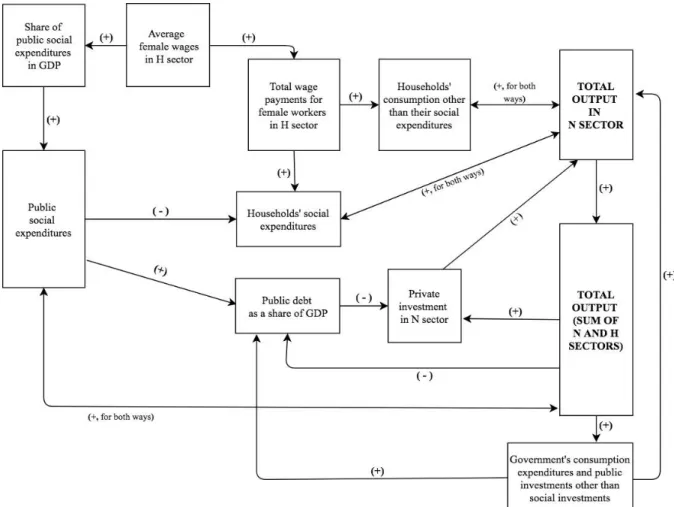
which is derived in Appendix 3. The outcomes of equation (32) is summarised in Figure 1.
The partial effect of the public social expenditures on female and male employment is positive in the short-run as it generates new employment in the social sector and pushes total output to an upper level (See Appendix 4). Based on the female employment shares in Table 1 and as in the literature (e.g. Ilkkaracan et al, 2015), we expect the partial impact of public social expenditures on female employment relative to male employment in the social sector to be larger than the partial effects of all shocks in N sector (e.g. share of
government’s consumption expenditures in GDP (𝜅𝑡𝐶), share of public investments other
than social infrastructure investment in GDP (𝜅𝑡𝐺), autonomous private investment (𝑖 0)) as
Page | 21 CWE-GAM WORKING PAPER SERIES 19-04
Figure 1: The short-run impact of an increase in the share of public social expenditure in GDP on total output
Figure 1
* Based on Table 1, the positive partial impact of public expenditures is expected to be relatively larger for female employment compared to the partial impact from expenditures in N sector (𝑒𝑘𝑡𝐻𝐹/𝑒𝑘𝑡𝐻𝑀) > | 𝜕𝐸𝑡𝑁𝐹 𝜕𝑡𝐶 | 𝑌𝑡𝑁 |𝜕𝐸𝑡 𝑁𝑀 𝜕𝑡𝐶 | 𝑌𝑡𝑁 ⁄ (33) (𝑒𝑘𝑡𝐻𝐹/𝑒𝑘𝑡𝐻𝑀) > | 𝜕𝐸𝑡𝑁𝐹 𝜕𝑡𝐺 |𝑌 𝑡𝑁 |𝜕𝐸𝑡 𝑁𝑀 𝜕𝑡𝐺 |𝑌 𝑡𝑁 ⁄ (34)
Page | 22 CWE-GAM WORKING PAPER SERIES 19-04
(𝑒𝑘𝑡𝐻𝐹/𝑒𝑘𝑡𝐻𝑀) > |𝜕𝐸𝑡 𝑁𝐹 𝜕𝑖0 | 𝑌𝑡𝑁 |𝜕𝐸𝑡 𝑁𝑀 𝜕𝑖0 | 𝑌𝑡𝑁 ⁄ (35)
Moreover, the partial effect of public social expenditures on female employment in N (𝑒𝑘𝑡𝑁𝐹) and male employment in N is zero (𝑒𝑘𝑡𝑁𝑀), as the impact of social expenditures on
productivity will be realised only in the next period.
The short-run partial impact of public social expenditures (𝑡𝐻) on consumption in N is
given below for a given level of output in N sector (𝑌𝑡𝑁=𝑌𝑡𝑁∗).
|𝜕𝐶𝑡 𝑁 𝜕𝑡𝐻|𝑌 𝑡𝑁 =𝐶𝑡𝑁(𝑐𝐻𝐹 𝑒𝑘𝑡𝐻𝐹𝑤𝑡𝐻𝐹 𝑊𝐵𝑡𝐻𝐹 + 𝑐𝐻𝑀 𝑒𝑘𝑡𝐻𝑀𝑤𝑡𝐻𝐹𝛼𝑡𝐻 𝑊𝐵𝑡𝐻𝑀 ) > 0 (36)
Higher public social expenditures will stimulate the consumption in N, since it will
generate new employment and income in H. The magnitude of public social expenditures on consumption in N depends on the marginal propensities to consume in H for the female and male workers.
The short-run partial impact of public social expenditure (𝑡𝐻) on consumption in H is
|𝜕𝐶𝑡 𝐻 𝜕𝑡𝐻 | 𝑌𝑡𝑁 =𝐶𝑡𝐻(𝑧𝐺 1 (1 −𝑡𝐻)𝑡𝐻 ) (37)
As discussed above, the sign of 𝑧𝐺 and hence equation (37) is ambiguous, but it’s likely to
be negative. This is because a rise in public social expenditures could reduce the
households’ need for social expenditures, although it generates new employment, hence income in the social sector.
Page | 23 CWE-GAM WORKING PAPER SERIES 19-04
|𝜕𝐼𝑡 𝜕𝑡𝐻| 𝑌𝑡𝑁 = 𝐼𝑡 ( 𝑖1 1 1 −𝑡𝐻+ 𝑖2 |𝜕𝜋𝑡 𝜕𝑡𝐻| 𝑌𝑡𝑁 𝜋𝑡 + 𝑖3 𝑑𝑡𝑡𝑘 (𝐷𝑌) 𝑡 ) (38)
where the impact through higher public debt is shown by 𝑑𝑡𝑡𝑘 The first term in (38) shows
the direct impact of rising public social expenditures on private investments. The short-run effect of public social expenditures on the profit share is zero for a constant output in the rest of economy, since public social expenditures do not affect labour productivity in the short-run.
|𝜕𝜋𝑡 𝜕𝑡𝐻|
𝑌𝑡𝑁
=0 (39)
However, for a constant output in N, the rising public social expenditures leads to a negative effect on private investment due to rising public debt/GDP (𝑖3 < 0) in the
short-run due to the crowding out effect. (See Appendix 4). However, this negative effect will be slightly moderated as tax revenues increase. Rising public social expenditures/GDP also increases the denominator of the public debt/GDP ratio.
The short-run partial impact of public social expenditures on exports and imports is zero for a constant output in N, because its partial impact on the profit share is zero in the short-run. |𝜕𝑋𝑡 𝜕𝑡𝐻| 𝑌𝑡𝑁 =𝑋𝑡 ( 𝑥2 |𝜕𝜋𝑡 𝜕𝑡𝐻| 𝑌𝑡𝑁 𝜋𝑡 ) = 0 (40) |𝜕𝑀𝑡 𝜕𝑡𝐻|𝑌 𝑡𝑁 =𝑀𝑡 ( 𝑛2 |𝜕𝜋𝑡 𝜕𝑡𝐻|𝑌 𝑡𝑁 𝜋𝑡 ) = 0 (41)
Page | 24 CWE-GAM WORKING PAPER SERIES 19-04
Finally, a rising share of public social expenditures has a positive effect on all types of public investment is positive as shown in equations (42)-(44).
|𝜕𝐺𝑡 𝐻 𝜕𝑡𝐻|𝑌 𝑡𝑁 = 𝑌𝑡 𝑁 (1 −𝑡𝐻)2> 0 (42) |𝜕𝐺𝑡 𝐶 𝜕𝑡𝐻| 𝑌𝑡𝑁 = 𝑡 𝐶𝑌 𝑡𝑁 (1 −𝑡𝐻)2 > 0 (43) |𝜕𝐼𝑡 𝐺 𝜕𝑡𝐻 | 𝑌𝑡𝑁 = 𝑡 𝐺𝑌 𝑡𝑁 (1 −𝑡𝐻)2> 0 (44)
3.1.2 THE EFFECT OF A CHANGE IN THE SHARE OF PUBLIC SOCIAL INFRASTRUCTURE INVESTMENT IN GDP IN THE NEXT PERIOD
The effect of a rising share of social expenditures in GDP on aggregate output in the next period is the sum of its partial impact on each component of GDP multiplied by the multiplier term, 1 (1−𝜑𝑘)(1−𝑡𝐻) . Ψ𝑡(𝑡−1)𝑘 = 𝑑𝑌𝑡 𝑑𝑡−1𝐻 = 𝑑𝑌𝑡 𝑑𝑌𝑡𝑁 𝑑𝑌𝑡𝑁 𝑑𝑡−1𝐻 = | 𝜕𝐶𝑡𝑁 𝜕𝑡−1𝐻 | 𝑌𝑡𝑁 + |𝜕𝐶𝑡𝐻 𝜕𝑡−1𝐻 | 𝑌𝑡𝑁 + | 𝜕𝐼𝑡 𝜕𝑡−1𝐻 | 𝑌𝑡𝑁 + | 𝜕𝑋𝑡 𝜕𝑡−1𝐻 | 𝑌𝑡𝑁 − | 𝜕𝑀𝑡 𝜕𝑡−1𝐻 | 𝑌𝑡𝑁 (1 − 𝜑𝑘)(1 −𝑡𝐻) + | 𝜕𝐺𝑡 𝐻 𝜕𝑡−1𝐻 |𝑌 𝑡𝑁 + | 𝜕𝐺𝑡𝐶 𝜕𝑡−1𝐻 |𝑌 𝑡𝑁 + | 𝜕𝐼𝑡𝐺 𝜕𝑡−1𝐻 |𝑌 𝑡𝑁 (1 − 𝜑𝑘)(1 −𝑡𝐻) (45)
Page | 25 CWE-GAM WORKING PAPER SERIES 19-04
Figure 2: The long-run impact of an increase in the share of public social expenditure in GDP on total output
Figure 2
Notes: All variables without time represent the current period.
*The impact of total output on imports is positive and the impact of imports on total output is negative.
To derive the partial effect of 𝑡−1𝐻 on each component of GDP, we first exhibit its
influence on labour productivity as the public social investments affect the profit share and employment in the next period through labour productivity.
Page | 26 CWE-GAM WORKING PAPER SERIES 19-04
| 𝜕𝑇𝑡 𝑁 𝜕𝑡−1𝐻 | 𝑌𝑡𝑁 =𝑇𝑡𝑁( ℎ1 𝑡−1𝐻 + ℎ7𝑧𝐺+ ℎ8𝑞𝐺 𝑡−1𝐻 + (ℎ1+ ℎ2+ ℎ3+ ℎ4) 𝑌𝑡−1 Ψ𝑡𝑡𝑘 +((𝑧𝐺+ 𝑧𝑅+ 𝑧𝐹+ 𝑧𝑀)ℎ7+ (𝑞𝐺+ 𝑞𝐹+ 𝑞𝑀)ℎ8) 𝑌𝑡−1 Ψ𝑡𝑡𝑘 −ℎ7(𝑧𝐹+ 𝑧𝑀− 𝑧𝑅) + ℎ8(𝑞𝐹+ 𝑞𝑀) 1 −𝑡−1𝐻 ) (46)
The first term in parenthesis reflects the direct effect of public social investment on labour
productivity. The second term is public social investment’s direct impact on labour productivity through households’ social expenditures and unpaid labour within the household as higher social expenditures would reduce the need for both. The third term shows the effect through rising output with higher public social expenditures, which will have an impact on labour productivity in the next term through output as well as the effects of other government expenditures which increase together with the rising
aggregate output. The combination of last two terms is public social investment’s impact through changing unpaid labour and households’ social expenditures in parallel to the rising aggregate output.
Figure 3 summarises the impact of the share of social expenditures in GDP on labour productivity in the next period. Overall, the total effect on productivity is ambiguous, and is likely to be positive. This is due to two reasons. First, for constant total income in N sector and without significant changes in the private funding of social spending, decline in
public social expenditures is very unlikely to lead to a similar increase in households’ social
expenditures that would reverse the negative effects of lower public social expenditures on labour productivity. Second, the unpaid care work that is expected to increase due to lower social expenditures is unlikely to compensate the positive effects of public social expenditures on labour productivity.
Page | 27 CWE-GAM WORKING PAPER SERIES 19-04
Figure 3: The summary of the impact of the share of public social expenditures in GDP on labour productivity in the next period
Figure 3
Next, we demonstrate the partial long-run impact of public social investment on each component of aggregate output. First, higher public social investment changes total wage bills and profits through employment, which in turn affect 𝐶𝑡𝑁and 𝐶𝑡𝐻:
| 𝜕𝐶𝑡 𝑁 𝜕𝑡−1𝐻 |𝑌 𝑡𝑁 =𝐶𝑡𝑁(𝑐𝑁𝐹 (𝑒𝑘(𝑡−1)𝑁𝐹 𝑤𝑡𝑁𝐹) 𝑊𝐵𝑡𝑁𝐹 + 𝑐𝑁𝑀 𝛼𝑡𝑁(𝑒𝑘(𝑡−1)𝑁𝑀 𝑤𝑡𝑁𝐹) 𝑊𝐵𝑡𝑁𝑀 − 𝑐𝑅 (𝑒𝑘(𝑡−1)𝑁𝑀 𝛼𝑡𝑁+ 𝑒𝑘(𝑡−1)𝑁𝐹 )𝑤𝑡𝑁𝐹 𝑅𝑡 ) (47) | 𝜕𝐶𝑡 𝐻 𝜕𝑡−1𝐻 | 𝑌𝑡𝑁 =𝐶𝑡𝐻(𝑧𝐹 (𝑒𝑘(𝑡−1)𝑁𝐹 𝑤𝑡𝑁𝐹) 𝑊𝐵𝑡𝑁𝐹 + 𝑧𝑀 𝛼𝑡𝑁(𝑒𝑘(𝑡−1)𝑁𝑀 𝑤𝑡𝑁𝐹) 𝑊𝐵𝑡𝑁𝑀 − 𝑧𝑅 (𝑒𝑘(𝑡−1)𝑁𝑀 𝛼𝑡𝑁+ 𝑒𝑘(𝑡−1)𝑁𝐹 )𝑤𝑡𝑁𝐹 𝑅𝑡 ) (48)
𝑒𝑘(𝑡−1)𝑁𝐹 and 𝑒𝑘(𝑡−1)𝑁𝑀 are respectively the partial effect of the share of public social
expenditures in GDP on female and male employment in N sector in the next period. The partial impact of 𝑡−1𝐻 on employment in N will be through labour productivity as shown in
Page | 28 CWE-GAM WORKING PAPER SERIES 19-04
The share of public social expenditures affects private investment through the effects on the profit share and public debt/GDP in the long-run:
| 𝜕𝐼𝑡 𝜕𝑡−1𝐻 | 𝑌𝑡𝑁 = 𝐼𝑡 ( 𝑖2 | 𝜕𝜋𝑡 𝜕𝑡−1𝐻 | 𝑌𝑡𝑁 𝜋𝑡 + 𝑖3 𝑑𝑡(𝑡−1)𝑘 (𝐷𝑌) 𝑡 ) (49)
where 𝑑𝑡(𝑡−1)𝑘 is the partial effect of rising public social expenditures on public debt/GDP.
The public social expenditures lead to accumulation of public debt that might become an impediment on the private investments in the next period. The public social expenditures also influence the labour productivity in the next period, which would change the
denominator of public debt-to-GDP ratio. Moreover, public social expenditures change the distribution between wages and profits, which in turn affect public debt as the tax rates on different types of income are different. These effects are more in detail shown in Appendix 5.
Higher public social expenditures affect the profit share in the next period through labour productivity: | 𝜕𝜋𝑡 𝜕𝑡−1𝐻 | 𝑌𝑡𝑁 = ((𝛼𝑡 𝑁− 𝛼 𝑡𝑁𝛽𝑡𝑁+ 𝛽𝑡𝑁)𝑤𝑡𝑁𝐹 (𝑇𝑡𝑁)2 ) | 𝜕𝑇𝑡𝑁 𝜕𝑡−1𝐻 | 𝑌𝑡𝑁 (50)
Finally, the share of public social expenditures in aggregate output affects exports and imports through the changes in the profit share, which is in turn affected through labour productivity: | 𝜕𝑋𝑡 𝜕𝑡−1𝐻 | 𝑌𝑡𝑁 = 𝑋𝑡 ( 𝑥2 | 𝜕𝜋𝑡 𝜕𝑡−1𝐻 | 𝑌𝑡𝑁 𝜋𝑡 ) (51) | 𝜕𝑀𝑡 𝜕𝑡−1𝐻 | 𝑌𝑡𝑁 = 𝑀𝑡 ( 𝑛2 | 𝜕𝜋𝑡 𝜕𝑡−1𝐻 | 𝑌𝑡𝑁 𝜋𝑡 ) (52)