
Asset evaluation methods for intellectual property
113
0
0
Full text
(2) SUMMARY With the introduction of "International Financial Reporting Standards" (IFRS) through out Europe in April 2001, there is a requirement to accurately report the value of all company assets. This will include by implication all intangible assets and Intellectual Property, such as patents, trademarks, copyrights, and know-how. Items that have not been recorded before are much more visible under IFRS and will need to be carefully interpreted by investors and analysts. In order to meet the future needs of their business, companies will require stringent measures to determine and report the true value of their assets, including intangible assets like patents, trademarks,. copyrights, and know-how. Currently there is a lack in methodology which can accurately and reliably determine the value of Intellectual Property for the European business community.. Research is being performed by the Max Planck institute in Munich (home of the European Patent Office) to develop a comprehensive model to uniformly evaluate different types of intangible assets. There are several different quantitative models which are which are being used currently to value patents. The existing methods can not be used to objectively compare patents with one another. It is necessary to build a method that can be applied systematically to different patents in various contexts to achieve symetrical evaluations.. This dissertation project will be focused on building a model to produce a score for European Patents indicative of their statistical survivability. The model will predict which patents will be maintained based on objective criteria that correlate with historical maintenance of previous patents. The model will examine different factors that have a statistically significant correlation to either higher or lower survivability or abandonment rates. Examples of the factors to be considered include: prior art citations, disclosure, claims, prosecutions, forward citing, ownership and others.. This project will produce a model which indicates the statistically survivability of European Patents in terms of a qualitative score which gives an indication of how valuable a patent will be in terms of it's survivability in a legal landscape. This model will then be extended by research currently underway at the Max Planck Institute, to a more comprehensive model that takes additional variables into account, but this is. 2.
(3) outside the scope of this project. The extension of this system is to encompass the technological, financial and business strategic and legal landscapes.. This project contributes towards a system that will help determine the value of a company's Intellectual Property, allowing these intangible assets to be disclosed to shareholders as required by the new International Financial Reporting Standards in Europe.. 3.
(4) TABLE OF CONTENTS 1 INTRODUCTION TO VALUATION OF INTELLECTUAL PROPERTY 7 RIGHTS 1.1 BACKGROUND TO THE PROBLEM 7 10 1.2 THE PROBLEM 1.3 RATIONALE FOR THE STUDy 11 1.4 RESEARCH OBJECTIVE AND QUESTIONS 12 1.5 LIMITATIONS " 12 1.6 DISSERTATION COMPOSITION 13. 2 IINTELLECTUAL PROPERTY RIGHTS VALUATION RESEARCH CONTEXT 2.1 PATENTS, INVENTIONS, APPLICATIONS AND CLAIMS 2.2 VALUING PATENTS AND APPLICATIONS 2.3 PATENT VALUATION CONTEXTS 2.4 CURRENT PATENT VALUATION METHODS 2.4.1 COST BASED METHODS 2.4.2 'MARKET BASED METHODS 2.4.3 'INCOME BASED METHODS 2.4.4 DISCOUNTED CASH FLOW BASED METHODS 2.4.5 DECISION TREE ANALYSIS BASED METHODS 2.4.6 OPTION PRICING THEORY BASED METHODS 2.4.6.1 DISCRETE TIME - BINOMIAL METHODS 2.4.6.2 CONTINUOUS TIME - BLACK & SCHOLES METHODS 2.4.6.3 BLACK SCHOLES FOR FINANCIAL OPTIONS 2.4.6.4 BLACK SCHOLES FOR REAL OPTIONS 2.4.6.5 TREATMENT OF PATENTS AS OPTIONS 2.4.7 ECONOMETRIC METHODS 2.4.7.1 STOCK MARKET BASED METHODS 2.4.7.2 PATENT RENEWAL DATA BASED METHODS 2.5 SUMMARY OF CURRENT PATENT VALUATION PRACTICES. 24 24 27 27 30 31 31 35 .40 .44 .44 .45 .48. 3 INTELLECTUAL PROPERTY RIGHTS SURVIVABILITY QUOTIENT RESEARCH 3.1 CONTEXT OF SURVIVABILITY QUOTIENT RESEARCH 3.2 MEASURES OF PATENT SURVIVABILlTY 3.2.1 PATENT AGE 3.2.2 PREVIOUS LEGAL OPPOSITIONS 3.2.3 TECHNOLOGY CLASSIFICATION 3.2.4 PRIOR ART CITATIONS 3.2.5 DiSCLOSURE 3.2.6 CLAIMS 3.2.7 OWNERSHIP 3.2.8 FAMILY SIZE " 3.3 BENCHMARKING OF DATA 3.4 SUMMARY. 49 .49 51 52 56 59 62 69 70 72 73 74 77. 4. 14 14 17 18 20 21 21.
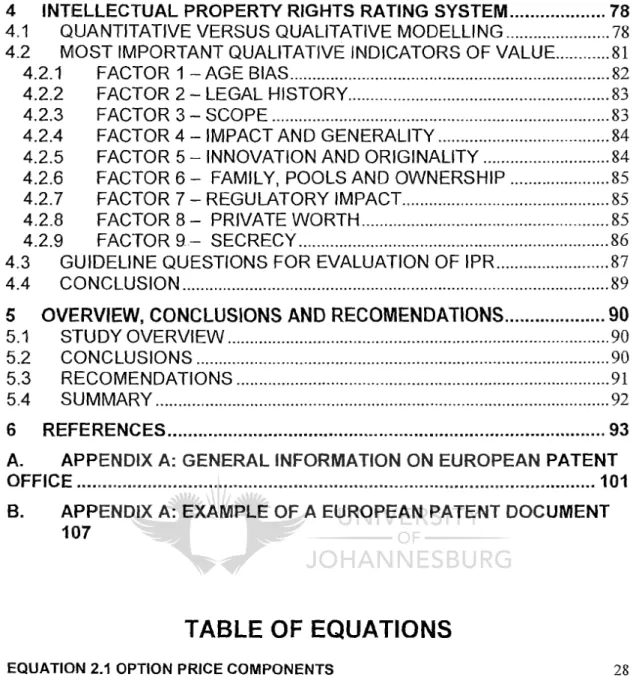
(5) 4 INTELLECTUAL PROPERTY RIGHTS RATING SySTEM 4.1 QUANTITATIVE VERSUS QUALITATIVE MODELLlNG 4.2 MOST IMPORTANT QUALITATIVE INDICATORS OF VALUE. 4.2.1 FACTOR 1 -AGE BIAS 4.2.2 FACTOR 2 - LEGAL HISTORY. 4.2.3 FACTOR 3 - SCOPE 4.2.4 FACTOR 4 -IMPACT AND GENERALITY 4.2.5 FACTOR 5 -INNOVATION AND ORIGINALITY 4.2.6 FACTOR 6 - FAMILY, POOLS AND OWNERSHIP 4.2.7 FACTOR 7 - REGULATORY IMPACT. 4.2.8 FACTOR 8 - PRIVATE WORTH 4.2.9 FACTOR 9- SECRECY 4.3 GUIDELINE QUESTIONS FOR EVALUATION OF IPR 4.4 CONCLUSION. 78 78 81 82 83 83 84 84 85 85 85 86 87 89. 5 OVERVIEW, CONCLUSIONS AND RECOMENDATIONS 5.1 STUDY OVERVIEW 5.2 CONCLUSIONS 5.3 RECOMENDATIONS 5.4 SUMMARY. 90 90 90 91 92. 6. 93. REFERENCES. A. APPENDIX A: GENERAL INFORMATION ON EUROPEAN PATENT OFFICE 101 B.. APPENDIX A: EXAMPLE OF A EUROPEAN PATENT DOCUMENT 107. TABLE OF EQUATIONS EQUATION EQUATION EQUATION EQUATION EQUATION EQUATION. 2.1 2.2 2.3 2.4 3.1 3.2. OPTION PRICE COMPONENTS PRICE FOR CALL OPTION PRICE FOR PUT OPTION CALL AND PUT OPTION EQUIVALENCY CITATION BASED MEASURE ON PATENT GENERALITY CITATION BASED MEASURE ON PATENT ORIGINALITY. 28 32 33 41 65 65. TABLE OF TABLES FIGURE 4.1 GUIDELINE QUESTIONS FOR EVALUATION OF IPR. 5. 88.
(6) ABBREVIATIONS CCA DCF DTA ECLA EPO EU GAAP lAS lASS IASC IFRIC (FRS IP IPC IPR OPT PCT. PIE R&D ROI SIC SME VC WIPO. Contingent Claim Analysis Discounted Cash Flow Decision Tree Analysis European Classification system European Patent Office European Union Generally Accepted Accounting Procedures International Accounting Standards International Accounting Standards Soard International Accounting Standards Committee International Financial Reporting Interpretations Committee International Financial Reporting Standards Intellectual Property International Patent Classification Intellectual Property Rights Option Pricing Methods Patent Cooperation Treaty Price to Earnings [Ratio] Research and Development Return On Investment Standing Interpretations Committee Small Medium Enterprise Venture Capital World Intellectwal Property Organization. 6.
(7) CHAPTER 1 INTRODUCTION TO VALUATION OF INTELLECTUAL PROPERTY RIGHTS. 1. INTRODUCTION TO VALUATION OF INTELLECTUAL PROPERTY RIGHTS. 1.1. BACKGROUND TO THE PROBLEM. In April 2001 the International Accounting Standards Soard (lASS) announced that its accounting· standards would be designated "International Financial Reporting Standards" (IFRS). Also in April 2001, the lASS announced that it would adopt all of the International Accounting Standards issued by the IASC. Statements of International Accounting Standards issued by the Soard of the International Accounting Standards Committee (IASC) between 1973 and 2001 are designated "International Accounting Standards" (lAS). The Interpretations of International Accounting Standards issued by the International Financial Reporting Interpretations Committee (IFRIC) (formerly, the "Standing Interpretations Committee" (SIC» do not have the same status as lAS, but, in accordance with lAS 1, Presentation of Financial Statements, paragraph 11, "financial statements should not be described as complying with International Accounting Standards unless they comply with all the requirements of each applicable Standard and each applicable interpretation of the Standing Interpretations Committee". rwww.deloitte.com & www.pwc.com]. Effectively what this means is that International Financial Reporting Standards (I FRS) are now mandatory in Europe. The introduction of International Financial Reporting Standards (IFRS) has changed the primary reporting method for companies who issue shares. All EU listed companies now have to comply with IFRS for their year end 2005 accounts, as these standards have replaced the local Generally Accepted Accounting Practices (GAAP). With companies clamouring for overseas capital and investors rushing to access foreign markets, the demand for financial reporting standards that transcend national borders has never been stronger. International. 7.
(8) Financial Reporting Standards (IFRS) look set to fulfil this global role and are already being adopted by other countries. [Arthur Andersen & Co, 1992]. More importantly items that have not been recorded before are much more visible under IFRS and will need to be carefully interpreted by investors and analysts. In order to meet the future needs of their business, companies will require rigorous methods to determine and report the true value of all their assets, including intangible assets like patents, trademarks, copyrights, and know-how (according the websites of Deloittes, PWC and KPMG). Currently there is a lack of methodology which can accurately determine the value of intellectual property for the European business community.. Additionally small and medium sized enterprises (SME) face restrictive loan conditions from the financial sector. One issue is the general economic situation and the corresponding risk involved in lending capital to companies; a second restrictive issue is the banks base guidelines. Many banks are rejecting loan requests from innovative and future oriented companies and entrepreneurs because of missing securities due to the banks' internal rating systems. Several studies indicate that intangible assets are the real value drivers in business, and "classical" assets such as machinery, real estates etc. are contributing less than 30% to the economic results of industrial companies [Townsend, Townsend & Co., 2004] [Pitkethly, 1997]. Nevertheless intangible assets like patents are not included with a positive impact on the companies rating in most banking systems. Intangible assets of SME are very often not realized as assets. Almost 40% of all patents are lying idle even though they could be licensed without rival. Apart from the chances of additional revenues, patents can offer the option to reduce the company's costs of financing in raising funds for future projects.. The relative importance of intangible assets in a company's value is definitely on the rise. Market value to book value ratios have risen from 1: 1 in 1970's to 6: 1 in the year 2000 (83.3% of the company value). According to Coopers & Lybrand (1997) - two thirds of the 7 trillion USD market value of all pUblic companies is attributable to intangible assets. Examples include. (2000 figures): Merck - 93.5%, Microsoft . 97.8%, Yahoo - 98.9%. Although the difference between market value and book value of a company is by no means a useful valuation method for its Intangible assets, it certainly indicates the general trend [Townsend, Townsend & Co., 2004].. 8.
(9) There are many types of intangible assets including [www.iam-magazine.com]: •. Intellectual. Capital. undocumented. know-how,. customer. loyalty,. management expertise, inter-company relationships, etc. •. And Intellectual Property - Legally enforceable rights in patents, copyrights, trademarks, trade secrets, mask works, databases, domain names, etc.. The scope of this dissertation, however, will be limited only to intellectual property rights protected by patents. A patent gives its owners the exclusive right to make, use and sell an invention for a set period, in exchange for disclosure of the design [www.european-patent-office.orgl.. There are various reasons why patents can be considered excellent collaterals and are in fact very similar to classical assets. Patents are legal claims, which guarantee their owners monopoly status for the claimed area. The exclusive right excludes competitors, who are only allowed to use the claimed technology if the patent owner licenses this, and the licensees pay the agreed royalty. Patents have the great advantage of being highly negotiable and interchangeable which allows for easy international transfer of intellectual property rights (lPR's). Many companies are now much more aware of their intangible assets. The R&D departments in many companies are no longer treated as cost-centres but as profit-centres, which contribute their income share by earning royalties. IBM and Dow Chemical are leaders in the licensing of Intellectual Property. IBM alone earned over 1 billion USD royalties by commercialization their technologies [Meyer & Tang, 2005].. A patent's value constantly needs assessing throughout its lifespan, during the application process, on renewal and for raising capital, licensing, purchase and sale negotiations. The different purposes of valuation demand different approaches to valuation but in this dissertation emphasis will be given to the context of raising capital using a patent as security.. 9.
(10) 1.2. THE PROBLEM. Although many different Patent Valuation Methodologies exist [Pitkethly, 1999], there is a lack of convincingly comprehensive models for valuing patents under conditions of uncertainty about their future prospects.. It should be noted that any valuation requires an acceptance that absolute certainty is an impossibility inherent in the valuation subject. Valuation involves using skill, experience, judgement and the highest quality of available information to approach an agreeable value.. There does not seem to be consensus among experts about how good current evaluation techniques really are [Pitkethly, 1999]. Creating an evaluation toolset that better reflects the value of the exclusivity domain protected by intellectual property rights is the subject of much ongoing work amongst patent lawyers and economists [Hall, Jaffe & Trajtenberg, 2002].. Intellectual property (IP) assets are more difficult to value than classical assets since historically there have been no public markets trading IP (although this is changing now). IPR are inherently dissimilar and granted under widely varying terms and conditions. Additionally IPR transfers are often motivated by unique strategic considerations, the details of which are not usually made public.. Present quantitative valuation methods are basically actuarial in nature. They deal with individual patents, and patent portfolios, on a semi-statistical basis, estimating value based on comparison with past transactions involving similar patents, or using analogies to other kinds of intangible rights like stock options [Pitkethly, 1997].. This dissertation project will be focused on building a model to produce a rating system for European patents based on their statistical survivability. There are several eXisting quantitative models that determine a score, which is representative of the value of the patent based on its expected survivability [Hall, Jaffe & Trajtenberg,. 2002J [Harhoff, Scherer &. Vopel, 1999] [Parr & Smith, 1994] [Pitkethly, 1999]. This type of statistical survivability model will give an indication of how valuable a patent will be. Similar to the IQ Score on a human being, this score does not determine the value of a patent directly, and does not predict its future success or failure. Certain. 10.
(11) value correlations can, however, be made using such a score in conjunction with other estimation and valuation techniques.. This survivability model will be extended by future research to form a more comprehensive model that will take additional variables into account. This will form part of a multivariate systematic integrated methodology to approach a solution to the patent valuation problem. Such a systematic integrated methodology would be a process of data evaluation through a systematic procedure, allowing for abstract information, unknown facts and owner specific data. This would allow those in the market to build in a premium or discount based on their own interpretation of spread or business risk. This is however not the specific domain that this dissertation addresses.. 1.3. RATIONALE FOR THE STUDY. At the beginning of a patent's life there is a large degree of uncertainty about its future prospects. As such it is difficult to assign a value and consider the patent as an asset against which capital can be raised. Valuation should be thought of as a process of approaching an agreeable value for the valuation subject. The most significant part of a patent's value at the beginning its life can be attributed to its expected future success, and the relative risk involved in investing in the invention. As such a model for predicting a patent's value based on its probable future success, will be very useful as part of a comprehensive method to estimate a patent's value.. This dissertation project will be focused on building a model to produce a score for patents based on their statistical survivability. The basic premise assumed is that patent owners are more likely to pay renewal fees to the patent office for a patent that is valuable. The model will predict which patents will be maintained based on objective criteria that correlate with historical maintenance of other patents. The model will examine different factors that have a statistically significant correlation to either higher or lower survivability or abandonment rates. Examples of the factors to be considered include: technology, prior art, disclosure, claims, prosecutions, forward citing, ownership, continuation data, size of patent family, foreign counterpart patents, prior litigation filings and others.. 11.
(12) This score will form part of the qualitative side of the evaluation, which will make a comprehensive quantitative evaluation possible.. 1.4. RESEARCH OBJECTIVE AND QUESTIONS. The goal of this dissertation will be to determine factors that will produce a survivability score to model patent value for the european patent community. This only answers part of the question but certain value correlations can then be made using a survivability score in conjunction with other estimation and valuation techniques.. Since a definitive empirical outcome is not possible by extracting data directly from the subject. Some type of systematic information methodology taking into account financial, technological, business strategic and legal implications for the patent. Although this is outside of the scope of this dissertation it will be important for this project to comment on how the intellectual property survivability score should fit into a more comprehensive method.. In order to identify the most important contributing factors and determine their relationship to patent value we will employ multivariate dependence analysis. Multivariate methods allow the effects of more than one variable to be considered at one time. The analysis of dependence allows a dependent variable to be forecast on the basis of numerous independent variables. We examine numerous previous quantitative studies in order to identify consistent and reliable trends between various patent characteristics and their known survivability and value.. We then use the. identified dependence relationships to build up a qualitative rating score for patent survivability.. 1.5. LIMITATIONS. This statistical survivability model will give an indication of how valuable a patent will be during its validity period. It will not determine directly the value of a patent, or predict its success or failure. It will be necessary to use this scoring method in conjunction with other estimation and valuation techniques.. 12.
(13) The development of a comprehensive multivariate combination of quantitative and qualitative methods to approach a solution to the patent valuation problem will be the subject of future research.. 1.6. DISSERTATION COMPOSITION. Chapter 2 of this dissertation will analyse various valuation and estimation techniques in terms of their strengths and weaknesses when applied to intellectual property rights.. Chapter 3 analyses methodology based on patent renewal data and differnet patent survivability models. It also interprets these methods in the context of an objective and more comprehensive methodology.. Chapter 4 will be used to present the results of the study, and describe the scoring method developed. The most important and unambiguous factors contributing to increased value and lower risk are interpreted as a series of questions that can be used to rate a patent qualitatively. Qualitative analysis focuses on studying the quality characteristics of patents, rather than measurable numerical statistical values.. Chapter 5 will summarise the issues around patent evaluation and highlight the role of the this systematic rating method in objectively evaluating a patent.. 13.
(14) CHAPTER 2 i. IPR VALUATION RESEARCH CONTEXT. 2. IINTELLECTUAL PROPERTY RIGHTS VALUATION RESEARCH CONTEXT. This chapter reviews current patent valuations practices. Methods from a number of different fields including accounting methods, discounted cashflow, decision tree analysis, option pricing methods and econometric methods (based on patent renewal and stock market data) are discussed. Special attention is paid to option pricing methods, and valuation methods based on patent renewal data. Concerns over valuation methods for IPR have been based largely on an accounting perspective, for the purposes of reporting, or for deals involving intellectual property. Attempts to assess the value of patents in order to make management and investment decisions about them earlier in their life have received far less attention.. The problem of patent valuation is a complex one. This is due in part to the complexity of the application process, which takes place under conditions of uncertainty about the technical, and commercial success of the invention in competitive markets. There are also uncertainties about the legal challenges, which can occur during the patent application process, and during the subsequent enforcement period.. This chapter reviews the most important of the many different models available for IPR valuation as well as the relevant valuation contexts and surrounding issues. The following chapter addresses in more detail valuation methods based on patent renewal data.. 2.1. PATENTS, INVENTIONS, APPLICATIONS AND CLAIMS. Using patents as indicators requires some understanding of what they mean; how and why they are taken out; how they are administered; how they are enforced and how all this changes over time.. 14.
(15) A patent for an invention is a limited duration property right granted to the inventor by the government of the relevant country [www.european-patent-office.org] [www.iam magazine. com]. Patents are granted for any new, non-obvious and useful invention capable of industrial application. This could be an industrial or technical process, machine, manufacture, or chemical composition of matter, or any new useful improvement thereof. The patent is granted upon the invention, that is the new machine, manufacture, etc., and not upon the idea or suggestion of the new machine. A complete description of the actual invention for which a patent is sought is required.. The maximum term of a patent is usually 20 years (in Europe and the UK) from the date on which the application for the patent was filed (or in special cases, from the date an earlier related application was filed) subject to the payment of maintenance fees [www.european-patent-office.org]. The patent gives the inventor the right to exclude others from making, using, offering for sale, selling or importing the invention. What is granted is not the right to make, use, offer for sale, sell or import, but the right to exclude others from making, using, offering for sale, selling or importing the invention. The right to sue others for infringement is granted in return for pUblication of the invention.. There is a distinction between the underlying invention, which might be called the underlying intellectual asset and the intellectual property right (IPR), which confers exclusive rights over that invention as defined in the claims of the relevant patent [Pitkethly, 1999]. The distinction is important in order to clearly define what is being valued. The direct financial value of a patent (or patent application) is the value of the potential extra profits obtainable from fully exploiting the invention (defined by the patent's claims) in the presence of the patent compared with those profits obtainable without the protection of a patent.. A project involving the commercialisation of an invention, and patent protecting the invention are two different, but very closely linked, concepts. Practically, splitting the value of the patent from the value of a project (commercialisation of an invention) can be very difficult or may even be unnecessary in some cases. The distinction becomes clearer in the case when one of the two becomes worthless, whilst the other remains valuable [Hodder & Riggs, 1985J [Kulatilaka & Marcus, 1992]. For example, the ability to commercialise an invention may be valuable even if any. 15.
(16) associated IPR's are unavailable, have lapsed, been found invalid or of limited use. IPR's are not essential to the profitability of an invention. Other non-IPR based means of appropriation can exist such as speed to market, control of complementary assets etc. On the other hand, if improvements to an invention and it's applications, devised by others are commercially successful, the revenue from the sale or licensing of the IPR's remains valuable even if the inventor no longer has any direct interests in the commercialisation of the invention [Pitkethly, 1999].. A patent is not just a right to protect one embodiment of an invention but includes the possibility of protecting anything falling within the scope of the claims [Schankerman, 1998) [Pitkethly, 1999). Another complication with patents is that they do not come into existence instantaneously like some other IPR's, such as copyright. Some form of patent application process has to be followed in which an application is made to a patent office. Following an examination of and perhaps even negotiation as to the scope of the claims allowable, the patent is granted.. This patent application procedure differs from country to country. For example some countries allow examination to be deferred for several years whilst most others do not [Schankerman, 1998]. Patent application costs can vary considerably in practice and distribution over the various stages of the application procedure, professional fees for patent lawyers and consultants will add to this considerably. However, most systems have four major decision types confronting patent applicants: •. Whether to file a patent application. •. Whether to continue the application (at a number of decision points in the process). •. Whether to keep any patent granted in force or let it lapse. •. How to exploit the patent once granted (direct commercialisation, licensing, a combination or outright sale).. A patent is not a simple investment project involving initial costs and near certain future returns. At each stage of the application procedure potential future benefits of extra profits or licensing revenues due to holding a patent must be weighed against the cost of proceeding to the next stage of the application process. Thereafter, the decision to maintain the patent, by continuing to pay maintenance fees must be made annually. There are may reasons for valuing a patent throughout its life as mentioned before (sale, M&A, reporting etc.). But more particularly, at the beginning. 16.
(17) of a patent's life an estimation of its value is essential to making sound strategic and investment decisions.. 2.2. VALUING PATENTS AND APPLICATIONS. For any trade to take place there should be an agreement on price and a disagreement on value. The seller thinks the price is high whilst the buyer thinks it is low. No market operates in a vacuum. Random forces and great unknowns combine with the laws of supply and demand, and the cyclical nature of business itself, to shape the peaks and valleys of a dynamically shifting market. The bottom line is that if there are more buyers than sellers the price of an asset will rise. There will be more buyers if the asset's future is perceived as rosy and more sellers if that future is deemed as gloomy [Pateman Brown, 2004J Prices are not linked only to the value of the asset concerned. The market price also reflects the perceived future value of the asset; this issue is a crucial one when considering IPR.. Of course when considering intellectual property rights there is no established market from which prices can be gauged, and this adds to the difficulty inherent in IPR valuation [Pitkethly, 1999]. Still in order to make investment decisions the market requires a flexible methodology, which can be used to estimate a value outlook for the patent, based on personal perceptions of market conditions, acceptable risk levels and other data that is perceived to be relevant. Price is set by what a person is prepared to pay. Potential investors require an analysis tool to help estimate a future value based on their personal perceptions of conditions.. As mentioned earlier, valuation is not an exact science. Valuation involves using skill, experience, judgement and the highest quality of available information to approach an agreeable value. Valuation of a patent either explicitly or implicitly includes the jUdgements of the investors or patent owners about the future. Although the uncertainty that valuation tries to account for cannot be avoided completely, any insight, which help put decisions on a more rational basis, and removes some of the guess work, should be welcomed.. The purpose of this dissertation is to investigate methods relevant to the European Union and their application within an objective valuation methodology. Objective methods are needed to decide how much should be spent on a patent application or. 17.
(18) paid for a patent when compared with returns available from other similarly risky investments.. 2.3. PATENT VALUATION CONTEXTS. Patents require valuation for a range of different reasons throughout their lifespan. The valuation purpose, as well as who is doing the valuation should be taken into account by any objective valuation methodology. Contexts for valuation may be transaction based or non-deal based [Townsend, Townsend & Co., 2004].. Examples of transaction based valuation contexts include: •. Merger and acquisition - allocation of price, exchange ratio, premium. •. Technology divestiture - spin-out (new company) vs. spin-off (sale. •. Joint venture or strategic alliance - contribution value. •. Investment decisions on new ventures - angels, vcs, private equity. •. Patent brokerage - purchase/sale of ip only (vs. technology). •. License fees - upfront payments & royalty rates. •. Collateralization and securitization of IP for a loan. •. inter-affiliate transfers - transfer pricing issues. Examples of Non-Deal Based valuation contexts include: •. Accounting transparency - history of resource allocation. •. Management responsibility - Sarbanes Oxley rule 404 and IFRS. •. Strategic IP management - renewal or abandonment; position enhancement of patent pools. •. Purchase vs. exclusive license vs. non-exclusive license. •. IP defence litigation - settlement value for damages - greater of infringers profits or reasonable royalty. •. R&D investment - make vs. bUy decisions, determination of ROI. •. Investment decisions in company or IP owner. •. Portfolio management - foreign filing and prosecution costs, maintenance fees. •. Charitable donations - tax benefit. 18.
(19) Early on in the life of a new invention, information concerning the potential value of the patent is understandably scarce. The inventor will usually know how significant an advance it is compared to other technologies. The patent agent (responsible for drafting or prosecuting the application) will have an idea of the scope and quality of patent protection. Those responsible for marketing the underlying invention will have some idea of the potential sales that could benefit from the protection of a patent or through licensing, and should understand the effects of competition in the absence of patent protection. The expertise of these parties should be enough to enable sound decision making with the help of an objective valuation methodology.. There is however, at this point in time there is not a commonly accepted objective valuation method to process this information also, the decision processes are subject to a strong bias towards conservative filing and renewal decisions. Nobody wants to make the mistake of missing the opportunity to patent the "next big thing". So in most cases currently it would seem that the advice is "When in doubt, file an application!". This appears in most cases to be an acceptable practice. It should however be possible to quantify and account for the doubt, which makes this seem the correct course of action.. In many cases the application decision is simplified by other factors. For example when application costs are negligible compared to overall development costs, deciding to develop the invention further may effectively decide most of the issues relating to patent's and other intellectual property rights. In some cases the decisions are simplified by the legal position dictating the course of action. Similar considerations apply to decisions about other stages of the application procedure and to decisions concerning annual renewal fees for patents. However when this is not the case, a decision must be made as to whether the potential future benefits are worth the costs of the next stage in the application procedure or the next renewal fee. In these cases there does not appear to be commonly accepted methods for valuation in order to make such decisions. Only in the case of products where the income stream is well established and reasonably predictable is it relatively easy to use conventional project valuation methods. So in real life practice all but the most obviously worthless inventions will be patented and little consideration given to objective valuation of the IPR.. But what of the case where it is desirable to use the exclusivity granted by the patent to raise capital for the project? An objective evaluation methodology that is agreeable. 19.
(20) to the banks as well as investors and venture capital companies, may have serious implications for entrepreneurs and small or medium sized companies. A credible evaluation method would also have implications for more common valuation decisions in licensing, sale and litigation and so forth. After a thorough examination of existing valuation methods shortcomings can be explored and a methodology may be suggested to overcome these. Suggestions can be made to approach an objective methodology, which is sufficiently sophisticated as to be credible, and not overly complicated as to be impractical. Once such methods have been explored further there may be scope to influence current practice.. 2.4. CURRENT PATENT VALUATION METHODS. When valuing a patent the goal is to determine by how much the returns from all possible means of exploitation of the patented invention are greater than the returns that would be obtained in the absence of patent protection. Even when the returns from the invention are well defined making the distinction is still challenging. Early in the patent's life there are other types of uncertainty about both the technical and commercial success of the underlying invention in competitive markets, and about the legal challenges the patent may have to face. There are many possible paths a patent may follow from its initial filing through to expiry up to twenty years later. The patent may be abandoned at any stage of the application process or be allowed to lapse after grant, when annual renewal fees are payable. Also, from one year after the initial application the patent owner may decide to file corresponding applications in other countries, considerably expanding the application [Parr & Smith, 1994] [Pitkethly, 1997J.. There are a number of ways in which valuators attempt to calculate and quantify the value represented by a patent and take into account the different possible future outcomes which may occur. These quantitative valuation methods usually act as tools in a qualitative method based on the experience and judgement of the valuators. Possible valuation methods for individual patents can be divided into cost based, market based and income based or economic methods. It is perhaps more useful to review these existing methods in increasing order of sophistication. These methods can be summarised as follows according to the extra factors they account for over and above less complex methods [Arthur Andersen & Co., 1992] [Parr & Smith, 1994] [Pitkethly, 1997J:. 20.
(21) •. Historical costs - cost based methods. •. Market conditions - market based methods. •. Income - methods based on projected cash flows. •. Time - discounted cash flow methods allowing for the time value of money. •. Uncertainty - discounted cash flow methods allowing for the cash flow risk. •. Flexibility - discounted cash flow based and decision tree analysis methods. •. Changing risk - option pricing theory based methods. discrete time (binomial model) and continuous time (Black-Scholes option pricing model). Even the most sophisticated methods cannot take into account all factors. Any valuation method is just a starting point towards better decision-making, and should be used as part of a comprehensive and objective valuation system. The methods below are reviewed only in the interest of defining a present value for an individual patent, rather than defining strategic policy (whether a patent should be bought, sold or licensed and how it should be paid for).. 2.4.1 COST BASED METHODS. Cost based valuation methods account for historical costs of developing IPRs. Essentially the value is based on the cost to replicate or independently develop the patent. Although easy to calculate it has no relationship to the market value or usefulness of the invention. Also independent development is not a defence to patent Infringement. The main shortcoming of these methods is that they make no allowance for the future benefits that might arise from the patent [Townsend, Townsend & Co., 2004] [Pitkethly, 1997J. These methods are of no use for the current purpose and are only used in historical cost based accounting systems or where taxation methods dictate their use.. 2.4.2 MARKET BASED METHODS. These methods are based on market transactions involving comparable assets with adjustment for differences. This requires an active market with a sufficient number of similar exchanges and publicly available price information. There is an obvious case where this may work and the only case where the cost of an IPR could be useful. 21.
(22) guide to its value. This IS when the very same patent is being resold after being bought recently in a similar transaction, the cost in this case is the original price paid.. In other cases, comparability with other patents whose value is known from market transactions poses a problem. It is a problem because one needs to know the value of a comparable IPR that has been sold previously. This begs the obvious question: what is comparable intellectual property? Answering this question may be as difficult as valuing the IPR outright.. There is a risk that the comparisons made may be unjustified and be no more than convenient measures of value. Another risk is that the transaction used may relate to an IPR whose use may not represent the best use of the IPR to be valued (it could even be the same IPR that has not been used optimally). For an IPR to be exploited to the maximum extent possible requires that 100% of the potential protected market for the underlying invention should be accessed. Some sale or licensing agreements may prevent this and values derived from them will then be suboptimal [Townsend, Townsend & Co., 2004] [Pitkethly, 1997].. Market based valuation methods may also be based on comparable royalty rates. When deciding royalty rates there are of course numerous surveys, which examine at industry averages. Such averages are often used as a basis for setting royalty rates in licensing agreements or in establishing damages in litigation. However this method is likely to exclude rational consideration of all factors other than what people think is the market rate. The risk is that for a particular IPR it may be a serious misevaluation, and this practice may perpetuate sub-optimal decisions throughout an industry. Royalty rates selected on some other basis than an industry average rate can also have problems. Royalty rates set using return on R&D costs or sales figures for the company or industry for example run the risk of valuing costs or other factors rather than value.. One possible market based alternative involves the valuation of the patented product of a firm with only one product by calculating the residual value after deducting all the value of all other known assets from the market value of the company [Parr, 1988]. This is similar to the Premium Price-to-Earnings (PIE) method, which ascribes the additional price and thus PIE ratio paid for a business with significant IPR's to the value of those IPR's [Arthur Andersen & Co. 1992].. 22.
(23) The return on the intellectual property is determined by calculating the proportion of the actual total return, which can be accounted for by standard rates of return on the tangible assets and certain defined intangible assets leaving the return on the intellectual property as the residual. The percentage that this represents of the total revenue is then used as a base for a rate of return to the IP in licensing negotiations.. By referring to the intellectual property and not the patented product, the return is attributed solely to the presence of the patent enabling above average profits. This gives a value for the invention plus the patent, and a value for the return on the patent but not a value for the patent as such, unless the notional return is used to calculate a net present value over the remaining life of the patent. However, whilst such a method may be a valid way of discovering the implicit market valuation of a patented product, it is difficult to be certain that it provides an objective valuation.. It can be argued that accurate use of a residual valuation method is impossible since one cannot be Sure that the residual amount is really ascribable to the patent alone and not some other intangible assets (for example a brand). Finally there are few companies with only a single product, so using this method will require an evaluation of every product and intangible asset that the company owns in order to determine a single patent's value. A more fundamental problem is that one is using a stock market valuation of the company as a basis for estimating the value of its intellectual property and intellectual property rights.. Thus one makes the impossible assumption that the market is perfectly informed about the IPR's of the company and can calculate their value. At best this type of valuation is based on what is no more the best guess of outsiders. Internal evaluators, who should have more information than the external market, and should be able to do better at appraising the value if given an objective valuation method to follow.. The process of calcUlating a market value for an asset is called marking-to-market. For less actively traded assets, the process can be quite subjective. Models may be used to project what market values mjght be, assuming an active market did exist. Reliance on such models has been referred to as marking-to-model. In many circumstances this is poor practice as it leaves financial reporting and valuation quite open to manipulation. For example the Enron Corporation used this valuation model. 23.
(24) extensively during the late 1990s and early 2000s. [Hall, Jaffe & Trajtenberg, 2004] [Townsend, Townsend & Co., 2004] [pitkethly, 1997].. 2.4.3 INCOME BASED METHODS Improvements upon cost and market based methods of valuation include some forecast of future income from a patent and thus some appreciation of the value of the patent as opposed to just its estimated market price or its cost. This inevitably involves some element of forecasting future cashflows. However it is only by taking into account the elements of time and uncertainty in future cashflows that valuation methods begin to have some sound theoretical foundations [Townsend, Townsend & Co., 2004] [Pitkethly, 1997].. Conventional discounted cashflow (DC F) methods take this future uncertainty into account. The key issue in these methods is how to forecast the expected cashflow for the IPR It may be possible to identify and or forecast particular cashflows, which are associated with a particular IPR through licensing or through direct exploitation. Alternatively it may be possible to use ideas similar to those used in brand contribution methods to calculate the contribution of a given patent to the business [Arthur Andersen & Co., 1992]. This may involve the study of the costs of unpatented goods, of the return on capital of unpatented goods, of the return on assets of unpatented goods or of the price commanded by unpatented goods with the actual financial data for the IPR related business.. A further and very common method based on industry average royalty rates assumes that the income due to a patent per se is the royalty which would have to be paid by a licensee. Such methods are in some senses market based methods since they rely on market based averages [Pitkethly, 1997].. 2.4.4 DISCOUNTED CASH FLOW BASED METHODS. Discounted cashflow (DCF) methods of valuation take into account two key factors these are: the time value of money, and to some extent the risk inherent to the forecasted cashflows. This capital asset pricing model is used to determine a. 24.
(25) theoretically appropriate required rate of return, and thus the price of an asset if expected cashflows can be estimated. This is done either by using a risk adjusted discount rate to discount the forecast cashflow, thus accounting for both factors at once, or using certainty equivalent cashflows, in which forecast cash-Flows are adjusted to account for their riskiness and changing risk over time. These are then discounted at the risk free rate to account for the time value of money. The latter method separates the two issues of risk and time and can help avoid problems when the risk adjustment varies over time as it will with patents [Townsend, Townsend & Co., 2004] [Pitkethly, 1997].. When using DCF methods to value a patent one is not faced with the problem of estimating residual values for the cashffow beyond the forecast period since patents have limited lifetimes. However since there are many possible paths a patent could follow before expiry there is a wide range of possible cashflow outcomes. Assuming that the probabilities of the various outcomes are known the simplest DCF analysis would be to simply work out all the possible cashflow outcomes and their probabilities, obtain the total expected cashflow and discount this using whatever discount rate the company currently used.. As noted by Pitkethly (1997) this approach ignores several factors. Firstly the discount rate used should always be one that reflects the risk of the cashflow concerned. For example if the project is not an average project for the company this will not be the same as the company's normal cost of capital. In practice using the assumptions of the capital asset pricing model, and by finding quoted companies with cashflows of equivalent risk, suitable discount rates can be obtained. Secondly, with a multi-stage cashflow such as with a patent or patent application the risk associated with the cashflow will vary considerably over the lifetime concerned. For a newly granted patent which is about to be litigated for the first time will be much riskier than for a 15 year old patent which has survived many attempts at invalidation. Use of a single constant discount rate actually makes the opposite assumption that the risk adjustment increases as the patent ages.. The idea of a risk premium component varying over time can be compensated for by using sequences of distinct risk phases [Hodder & Riggs, 1985] [Brealey & Myers, 1984]. In practice this would mean splitting the valuation of the patent into several distinct phases, for example, from application to receipt of search results, from the decision to continue to commencement of substantive examination, from acceptance. 25.
(26) to the end of the first year after grant, from grant to the first year of commercialisation and so on until the product becomes well established and the patent eventually expires. However, most research concerning the use of discounted cashflow methods for patent evaluation do not consider possible variation in risk through out the patent's lifespan. The variation of risk over a project's life is taken to be small compared with any possible errors from the forecast cashflow method. As Pitkethly (1997) points out this assumption may cause serious misvaluations when applied to patents.. Another approach to uncertainty, which uses DCF involves simulation methods [Stacey, 1989]. The simplest type involves sensitivity analysis where variables are each adjusted in turn to see the effect they have on final DCF values. One more example is the so called Monte Carlo analysis, which is a probabilistic DCF approach. Stacey (1989) advocates that since all the information involved in making a decision about Intellectual Property is highly uncertain the best that can be done is to consider the costs and revenues probabilistically, the end result being a frequency distribution of net present values [Stacey, 1989].. In these simulations all the variables in a model are adjusted at once according to individual probability distributions to produce an overall distribution of possible valuations. This method involves time-consuming and costly calculations, although modern computing makes short work of the actual calculations, gathering the required inputs to determine discount rates for the project is not a simple task. The task is constrained further by the difficulties in establishing the probability distributions needed. As pointed out by Stacey (1989) another question that bears answering is what the net present value (NPV) frequency distributions mean. If the probability distributions of NPV's are produced using a risk free discount rate instead of the opportunity cost of capital the NPV distributions cannot represent actual net present values since only time is accounted for. If they do use an opportunity cost of capital the risk is so to speak double counted] first in the discount rate an secondly in the NPV frequency distribution [Stacey, 1989] [Pitkethly, 1997]. The real role of such simulations is to understand the way in which the values vary with the parameters of the model constructed [Trigeorgis, 1996]. These methods are therefore more helpful to us for the trends and principles they reveal about the correlations between patent characteristics and value, rather than as an objective symmetrical valuation system that can apply uniformly to all patents.. 26.
(27) 2.4.5 DECISION TREE ANALYSIS BASED METHODS In addition to the problems of selecting appropriate discount rates for the various stages in a patent's life and calculating the possible cashflows which might occur conventional OCF methods take no account of the various possible decisions open to the managers of a patent. For example at various stages in the life of a patent or application it could be abandoned or allowed to lapse, or following the initial application the patent family may be expanded by making corresponding foreign applications [Stacey, 1989].. Although the Monte Carlo simulations can be used to try and account for the possible outcomes of management decisions there are certain limitations as discussed previously.. However where the number of management decision possibilities is limited and occur at defined times they may be accounted for by using a decision tree analysis. A decision tree can be set up with a separate branch representing the outcome of each possible managerial decision. Then a OCF analysis is performed for each branch, starting with the final cash flow of each branch and discounting back to give a present value for each possibility.. As noted in Pitkethly's study a big advantage of the OTA method over simple OCF analysis is that it builds in the value of flexibility encountered in a project or patent. This allows at least some account to be taken of the ability to abandon the patent though it does not solve the discount rate problem. The rates used ought to be appropriate to the risk involved at each stage and following each type of decision; however, in practice a constant rate is usually used [Pitkethly, 1997].. 2.4.6 OPTION PRICING THEORY BASED METHODS The theory behind option pricing was primarily developed for use in pricing financial options. The use of these methods on financial options markets has allowed extensive usage and testing of the underlying theories. As such option pricing methods have become well known and well trusted for determining the value of investments involving managerial flexibility [Pitkethly, 1997].. 27.
(28) An option can be defined as the right, but not the obligation, to buy (call option) or sell (put option) a pre-determined asset (the underlying), at a pre-determined price (strike price), on or before a pre-determined date (expiry) while the assets price is subject to some form of random variation [www.sawarrants.co.za].. A patent is a grant made by a government that confers upon the creator of an invention the sole right to make, use, and sell that invention for a set period of time. The patent owner does not actually own the idea or invention protected by such a grant, only the rights to use it exclusively for a time [Townsend, Townsend & Co., 2004]. As such patents can be considered as an option to generate profits from the rights to commercialise an invention.. The price of an option is determined using binomial, Monte-Carlo or Black & Scholes equations for the following variables [www.sawarrants.co.za] [Black & Scholes, 1973] [Cox & Ross, 1979]: •. Price of underlying asset. •. Time to expiry. •. Strike price (price at which option holder can buy/sell the underlying asset). •. Dividends expected (profit share received by a stockholders). •. Interest rates expected. •. Volatility of the underlying asset during life of option. The price calculated for an option has an intrinsic component and a time component.. Option price = intrinsic value + time value. Equation 2.1 Option price components Intrinsic value: is the amount by which the option is "in-the-money". That is the amount by which the underlying asset price is above the strike price. The intrinsic value of an option follows the value of the market for the underlying invention [www.sawarrants.co.za].. Time value: an option that has no intrinsic value will still have a positive value prior to expiry. Essentially this is the value attached to the possibility that the option will expire "in-the-money". Each day that passes the time value portion erodes slightly until. it. reaches. zero. (usually. tracing. [www.sawarrants.co.za].. 28. an. exponential. curve). at. expiry.
(29) ITM - "In-the-money" options are characterised by: •. Delta> 50% (the probability that the option will reach its strike price by expiry). •. Less risky. •. Lower gearing. •. Possess both intrinsic and time value. •. Cost more than ATM or OTM options and generally. •. Behave more like shares in the market. ATM - "At-the-money" options are characterised by: •. Delta:::: 50% (the probability that the option will reach its strike price by expiry). •. More risky. •. Have no intrinsic value. •. Very sensitive to price moves especially close to expiry. •. Less expensive than ITM options. OTM - "Out-the-money" options are characterised by: •. Delta < 50% (the probability that the option will reach its strike price by expiry). •. Most risky. •. Have no intrinsic value. •. Less expensive than ITM and ATM options. Issuers of options keep the markets running efficiently by continuously quoting both bid and offer prices for the options. As the price of the underlying asset (share) fluctuates the bid and offer prices for the option are continuously recalculated as described above.. With options the variation over time of the underlying asset price (usually a share in a company) is usually assumed to be Brownian motion type of Markov process [Cox & Ross, 1979]. Options pricing methods also have the possibility of different outcomes each with different cashflows and each having a different risk which varies over time.. Similar to DTA option methods discussed earlier are able to calculate different outcomes based on different cashflows of varying risk. When the DTA method is used each stage in the patent's life uses a discount rate appropriate to the risk involved in that stage. This is because some means of accounting for continuously. 29.
(30) changing risk is required since in the limit the variations involved are made up of an infinite number of discrete DTA stages and each would need an appropriate discount rate to take account of the differing risks. Wherever there is the possibility of decisions being made there is a possible change of risk. Where the possible decisions keep changing the risk involved will also keep changing and in many cases the problem can become unmanageable if one attempts to handle the changing risk by identifying all of the discrete stages.. Another way of looking at the changing risk involved in an option is that as the time to expiry decreas~s, for an option presently "in the money", the risk of the exercise price exceeding (for call options) or being less than (for put option) the market price of the asset decreases and thus the risk of the option ending up "out of the money" and not being exercised decreases. The key point in accounting for this changing risk of future cashflows is to find some means of risk neutral valuation. The certainty equivalent approach mentioned earlier in the context of basic OCF analysis is one possible approach. However options methods offer a more powerful means of risk neutral valuation, namely, contingent claims analysis which is the underlying idea used in both discrete time period type analysis and continuous time option valuation models [Pitkethly, 1997].. 2.4.6.1. DISCRETE TIME - BINOMIAL METHODS. Contingent claim analysis (CCA) helps to solve the problem of changing discount rates, which conventional DCF and. 01A methods cannot easily solve. CCA uses the. basic assumption that the returns on a call option over a share, is equivalent to those of a portfolio or synthetic option consisting of borrowing some money and buying some of the underlying shares [Copeland, Koller et aI., 1990] [Trigeorgis & Mason, 1987]. If it is assumed that there are no arbitrage opportunities the price of the option on an underlying share will be given by the price of this synthetic option. This allows the construction of equivalent risk neutral decision tree probabilities so that the expected payouts can be discounted atthe risk free rate [Pitkethly, 1997].. There are a number of situations in which non-financial real options occur and in which a contingent claim analysis (CCA) valuation method can be used involving a portfolio of borrowing and shares being set up to replicate the returns of the project involving an option [Copeland, Koller et aI., 1990] [Trigeorgis & Mason, 1987]. This. 30.
(31) avoids the need to set an appropriate risk adjusted discount rate for each branch in the tree. Pitkethly notes that CCA applied to a decision tree in the absence of any flexibility (for management decisions etc.) provides the same answers as a conventional DCF analysis since the use of a single discount rate does not then matter. For simple decision trees involving flexibility CCA is thus preferable to conventional DCF and DTA methods.. For the purpose of this project, modelling of a real patent's lifecycles as a series of discrete periods may be an oversimplification in may cases and so does not lend itself to our criteria of an objective method which can be applied uniformly to all patents.. 2.4.6.2. CONTINUOUS TIME - BLACK & SCHOLES METHODS. DTA methods can become overly complex and impractical, whilst choices between courses of action with only a few discrete outcomes may occur; in most cases a range of values is possible. In the case of share prices for example the range of values may be modelled as a log-normally distributed process [Trigeorgis, 1996] [pakes, 1986]. A further problem is that decisions about the underlying asset or project may have to be taken continuously or the price of the underlying asset may evolve continuously and not just at discrete stages. As mentioned above discrete stages involving different risks require different discount rates. Once one involves continuous decisions one has a multiplicity of stages and the discount rate then changes continuously too, varying with the underlying asset value and time. Unlike DCF based DTA analysis using a single risk adjusted discount rate option pricing method which account for continuous time provide a solution to these problems [Pitkethly, 1997]. The most popular example of such a method is the equation derived by Fischer Black and Myron Scholes in 1973.. 2.4.6.3. BLACK SCHOLES FOR FINANCIAL OPTIONS. The idea of options is certainly not new. Ancient Romans, Grecians, and Phoenicians traded options against outgoing cargoes from their local seaports. The option pricing. 31.
(32) model used today dates back to the work of Castelli in 1877 and has been improved upon by many other researchers throughout the years. However, Myron Black and Fischer Scholes published the key paper in 1973 describing the valuation of options on financial assets in 1973 [www.investopedia.com] [www.wikipedia.com].. Fisher Black started out working to create a valuation model for stock warrants. This work involved calculating a derivative to measure how the discount rate of a warrant varies with time and stock price. The result of this calculation held a striking resemblance to a well-known heat transfer equation. Soon after this discovery, Myron Scholes joined Black and the result of their work is a startlingly accurate option pricing model. Black and Scholes' improvements come in the form of a proof that the risk-free interest rate is the correct discount factor in the absence of assumptions regarding investor's risk preferences [www.investopedia.com] [www.wikipedia.com].. Many financial scholars have expanded upon the original work. In 1973, Robert Merton relaxed the assumption of no dividends. In 1976, Jonathan Ingerson went one step further and relaxed the the assumption of no taxes or transaction costs. In 1976, Merton responded by removing the restriction of constant interest rates. As a result today we have an alarmingly accurate valuation models for stock options [www.investopedia.com] [www.wikipedia.com].. As with discrete time CCA the Black Scholes equation was based on the assumption that the returns on a call option over a share are equivalent to those of a portfolio or 'synthetic option' consisting of borrowing some money and buying some of the underlying shares. The Black and Scholes equation can in fact be derived from a discrete time based CCA analysis by letting the length of period studied for each stage in the tree tend to zero [Cox, Ross et aI., 1979]. For the case of continuous time if it is assumed that there are no arbitrage opportunities the price of a European call option on an underlying share is given by the following equations [Black & Scholes, 1973].. Price for call option:. c = s<P(dl ) - xe -I't<:f>( d 2) Equation 2.2 Price for call option. Price for put option:. p = xe -I·tq)( -d2 ) - s<P(-d1). 32.
(33) Equation 2.3 Price for put option. Here, log denotes the natural logarithm, and: 1. J. _log{slx)+(r+a /2)f r. l{l -. ('hit. c. = the price for the call option. s. =the price of the underlying stock. x. r. =the strike price or exercise price =the continuously compounded risk free interest rate. t. =the time in years until the expiration of the option. (J. =the implied volatility for the underlying stock. ifJ. =distribution function for the asset. The equation that Black and Scholes provided was based on several key assumptions namely [Black & Scholes, 1973] [www.riskglossary.com]:. 1) The stock pays no dividends during the option's life Most companies pay dividends to their shareholders, so this might seem a serious limitation to the model considering the observation that higher dividend yields elicit lower call premiums. A common way of adjusting the model for this situation is to subtract the discounted. value of a future. dividend from the stock price. [www.riskglossary.com).. 2) European exercise terms are used European exercise terms dictate that the option can only be exercised on the expiration date. American exercise term allow the option to be exercised at any time during the life of the option, making American options more valuable due to their greater flexibility. This limitation is not a major concern because very few calls are ever exercised before the last few days of their life. This is so because when one exercises a call early, one forfeit the remaining time value on the call and. collect~. the. intrinsic value. Towards the end of the life of a call, the remaining time value is very small, but the intrinsic value remains linked to the value of the under lying asset [www.riskglossary.com].. 3) Markets are efficient. 33.
(34) This assumption suggests that people cannot consistently predict the direction of the market or an individual stock. This would mean that the market operates continuously with share prices following a Markov process in continuous time. A Markov process is "one where the observation in time period t depends only on the preceding observation" [www.riskglossary.com].. 4) No commissions are charged. Usually market participants do have to pay a commission to buy or sell options. Even floor traders pay some kind of fee, but this is usually very small. The fees that Individual investor's pay are more substantial and can often distort the output of the model [www.riskglossary.com].. 5) Interest rates remain constant and known. The Black and Scholes model uses the risk-free rate to represent this constant and known rate. In reality there is no such thing as the risk-free rate, but the discount rate on U.S. Government Treasury Bills with 30 days left until maturity is usually used to represent it. During periods of rapidly changing interest rates, these 30 day rates are often subject to change, thereby violating one of the assumptions of the model [www.riskglossary.com].. 6) Returns are lognormally distributed. This assumption suggests, returns on the underlying stock are lognormally distributed,. which. is. reasonable. for. most. assets. that. offer. options. [www.riskglossary.com].. Additionally option pricing theory (concerning share options for example) assumes that competition will abolish arbitrage opportunities and yet whilst substantially correct, small differences in transaction costs, trading practices and information flows may nonetheless give rise to apparent arbitrage opportunities when prices are compared with their theoretical values [Cox & RUbinstein, 1985].. Applications of the Black Scholes method need not be a particularly complicated operation. Tables can be made to calculate the value of puts or calls given values of s/(xe- rt) and a..Jt. The value of an option can be seen to increase with:. •. Higher underlying asset value. •. Longer time to expiry. 34.
(35) •. Lower exercise price. •. Higher variance (or volatility) of the underlying asset returns. •. Higher risk free interest rate.. The varying risk involved in an option over time is accounted for by the inclusion of the time remaining to expiry and the variance of the asset returns. The longer the time to expiry and the greater variance in the underlying asset value the greater the chance that the option will expire "in the money". This varying risk problem is overcome by using risk-neutral CCA valuation that depends on using knowledge about the value of the underlying asset.. These points are important when it comes to considering the application of option pricing methods (OPT) to patent valuation. As pointed out by Pitkethly (1997) the most important statement in Black and Scholes original paper was that option pricing methods could be applied to other financial assets. This realisation that almost any financial asset could be valued using some form of OPT based method resulted in a flood of work by many different researchers dealing with a wide variety of financial assets. Cox and Rubinstein for example describe a wide range of financial OPT applications (1985).. How then can option pricing methods be applied to patent valuation, and do these methods constitute an objective and symmetrical valuation methodology applicable to all patents?. 2.4.6.4. BLACK SCHOLES FOR REAL OPTIONS. The basic definition of an. option (a right but not an obligation, at or before some specified time, to purchase or sell an underlying asset whose price is subject to some form of random variation) can be applied to a number of other situations other than directly financial assets. Such non-financial options have become known as real options and a substantial literature has been built up around the application of OPT methods to their valuation [Trigeorgis, 1996] [Dixit & Pindyck, 1994].. One possible example is the treatment of an R&D project as a series of options [Copeland, Koller et aI., 1990]. The cost of an R&D project can be likened to the price of a call option on the future commercialisation of the project; and the future. 35.
(36) investment needed to capitalise on the R&D programme likened to the exercise price of the option. The net present value of the returns the company will receive from the investment is then likened to the value of the share subject to the call option [Mitchell & Hamilton, 1988].. The field of real options developed principally from the realisation that conventional valuation methods do not or cannot cope very well with managerial flexibility. That is, the ability of management to inteNene in the project once it has begun, perhaps by deciding to abandon the project early, or invest more capitol than originally planned. Because traditional valuation methods do not handle this flexibility well option methods are used today in many capital budgeting decisions [Pitkethly, 1997]. How valuable growth options are depends on: •. The time over which projects can be deferred. •. The project risk. •. The level of interest rates. •. The exclusivity of the project, shared or proprietary growth options. Examples of. p~oprietary. growth options would be those resulting from patents or the. company's unique knowledge of a market or a technology that competitors cannot duplicate [Kester, 1984]. Needless to say proprietary options are more valuable than shared options. Shared options are growth opportunities, which are shared with all other industry members and competitors.. There are many examples of the failings of conventional DCF (discounted cash flow) techniques in the calculation of real asset investment choices due to the value contributed by management flexibility (Investment timing options, Abandonment options, Shutdown options, Growth options, Input and Output Flexibility and Expansion options) [Kulatilaka & Marcus 1992]. There is thus equivalence between the inputs required to value financial options and those involved in valuing real options [Pitkethly, 1999]:. Financial Option on Share. Real Option. c. =Price for the cali option. = Cost of project. s. = Spot price of the underlying share. = Net present value of project returns. x. = Strike price of the option. =Future investment Cost of Project. t. = Time to expiry. =Time left to invest in 36.
(37) (J. :=. Standard deviation of underlying share returns. :=. Standard deviation of the Project value. r. :=. Risk free interest rate. :=. Risk free interest rate. Real options may be categorised into options, which are: proprietary or shared; simple or compound (the latter involving a number of successive options); and expiring or deferrable (the latter allowing an investment or decision to be deferred). On this basis most patent related options are likely to be identified as proprietary, compound and deferrable real options, since they are by definition exclusive to the patentee (or exclusive licensee), involve a number of successive stages and involve decisions which can often be postponed, at least until the next application process deadline, renewal fee deadline, sale or licensing decision is due. This of course ignores the possible competitive effect of non-infringing subsitute goods [Trigeorgis, 1996] [Kester, 1984].. So what problems and solutions do real option valuation methods bring to the patent valuation exercise? Whilst it has been proven that option based methods may apply to a wide range of real options the applicability of financial option valuation methods to non-financial assets has raised a number of questions which are relevant to any consideration of applying option valuation methods to patents [Trigeorgis, 1996] [Kester, 1984] [Pitkethly, 1999]. There are a number of potential areas for concern that are still under debate by researchers.. There are differences between traditional capital budgeting methods and option pricing methods for real investments, particularly in the way the OPT treats the probability distribution of returns, the relationship to interest rates and time to exercise date of the option. This mayor may not result in illogical decisions being made when applied to real options [Emery, Parr et aI., 1978] [Rao & Martin, 1981].. With shared real options, unlike proprietary call options on shares, the option holder also has to account for the effects of competition. Patents are however by definition proprietary so this should be of minor concern, except for the possible effects of competition due to non-infringing sUbstitute products [Trigeorgis, 1996] [Kester, 1993]. The assumptions of the Black and Scholes method also require that the underlying asset not produce any interim cashflows, for most patents this is not true [Emery, Parr et aI., 1978] [Rao & Martin, 1981].. 37.
Figure
Related documents