Michigan Technological University Michigan Technological University
Digital Commons @ Michigan Tech
Digital Commons @ Michigan Tech
Dissertations, Master's Theses and Master's Reports2017
Feature and Decision Level Fusion Using Multiple Kernel Learning
Feature and Decision Level Fusion Using Multiple Kernel Learning
and Fuzzy Integrals
and Fuzzy Integrals
Tony Pinar
Michigan Technological University, [email protected]
Copyright 2017 Tony Pinar Recommended Citation Recommended Citation
Pinar, Tony, "Feature and Decision Level Fusion Using Multiple Kernel Learning and Fuzzy Integrals", Open Access Dissertation, Michigan Technological University, 2017.
FEATURE AND DECISION LEVEL FUSION USING MULTIPLE KERNEL LEARNING AND FUZZY INTEGRALS
By
Anthony J. Pinar
A DISSERTATION
Submitted in partial fulfillment of the requirements for the degree of DOCTOR OF PHILOSOPHY
In Electrical Engineering
MICHIGAN TECHNOLOGICAL UNIVERSITY 2017
This dissertation has been approved in partial fulfillment of the requirements for the Degree of DOCTOR OF PHILOSOPHY in Electrical Engineering.
Department of Electrical and Computer Engineering
Dissertation Advisor: Dr. Timothy C. Havens
Committee Member: Dr. Jeremy Bos
Committee Member: Dr. Timothy Schulz
Committee Member: Dr. Thomas Oommen
Dedication
To Noelle and Malcolm
Contents
List of Figures . . . xv
List of Tables . . . xxiii
Preface . . . xxvii
Abstract . . . xxxi
1 Introduction . . . 1
1.1 Problem Context . . . 3
1.1.1 SVMs and Kernels . . . 5
1.1.2 The Choquet Fuzzy Integral . . . 7
1.2 Dissertation Outline and Contributions . . . 8
1.3 List of Relevant Publications . . . 10
2 Efficient Multiple Kernel Classification using Feature and Decision Level Fusion . . . 13
2.1 Introduction . . . 14
2.2.1 Feature In—Feature Out Fusion . . . 18
2.2.2 Decision In—Decision Out Fusion . . . 19
2.3 Fuzzy Measures and Fuzzy Integrals . . . 20
2.3.1 Fuzzy measure . . . 20
2.3.2 Fuzzy integral . . . 22
2.4 Multiple Kernel Learning . . . 23
2.4.1 The GAMKLp algorithm . . . 25
2.4.2 The DeFIMKL algorithm . . . 29
2.4.3 The DeLSMKL Algorithm . . . 34
2.4.4 The DeGAMKLp Algorithm . . . 36
2.5 The Nystr¨om Approximation for Gram Matrices . . . 37
2.5.1 Background . . . 37
2.5.2 Error Bounds and Other Development . . . 38
2.5.3 Efficient MKL using the Nystr¨om Approximation . . . 40
2.6 Preliminary Experiments and Results . . . 42
2.6.1 Datasets and Algorithm Parameters . . . 43
2.6.2 Results . . . 44
2.7 Experiments with the Nystr¨om Approximation . . . 47
2.7.1 Results . . . 48
2.9 Conclusion . . . 55
3 Visualization and Learning of the Choquet Integral With Limited Training Data . . . 61
3.1 Introduction . . . 62
3.2 Fuzzy Measures and Fuzzy Integrals . . . 64
3.2.1 Fuzzy measures . . . 65
3.2.2 Fuzzy integrals . . . 66
3.2.3 Common Aggregations via the Choquet Integral . . . 67
3.2.4 Visualizing the Fuzzy Integral . . . 67
3.3 The DeFIMKL Algorithm . . . 70
3.3.1 FM Learning Behavior with Insufficient Training Data . . . 76
3.4 FM Learning with a Specified Goal . . . 77
3.4.1 2− Goal Regularization . . . 79
3.4.2 1− Goal Regularization . . . 80
3.4.3 Specific Aggregation Examples with Goal Regularization . . 82
3.4.3.1 Minimum Aggregation . . . 83
3.4.3.2 Maximum Aggregation . . . 83
3.4.3.3 Mean Aggregation . . . 84
3.5 Learning the Goal . . . 85
3.5.1 Defining a FM from a LOS . . . 85
3.5.3 1−LOS Regularization . . . 88
3.5.3.1 LOS Aggregation . . . 90
3.6 Experiments . . . 91
3.6.1 Results . . . 91
3.7 Conclusion . . . 93
4 Measures of the Shapley Index for Learning Lower Complexity Fuzzy Integrals . . . 95
4.1 Introduction . . . 96
4.2 Fuzzy Measure and Integral . . . 100
4.2.1 Shapley and Interaction Indices . . . 102
4.2.2 Existing Indices for Capacity Complexity . . . 105
4.2.3 New Indices of Complexity Based on the Shapley Values . . 113
4.3 Sum of Squared Error and Quadratic Programming . . . 118
4.4 Gini-Simpson Index-Based Regularization of the Shapley Values . . 122
4.5 0-Norm Based Regularization of the Shapley Values . . . 125
4.6 Experiments . . . 127
4.6.1 Experiment 1: Important, Relevant and Irrelevant Inputs . . 128
4.6.2 Experiment 2: Random AWGN Noise . . . 132
4.6.3 Experiment 3: Iteratively Reweighted1-Norm . . . 132
5 Applications to Explosive Hazard Detection with Ground
Pene-trating Radar . . . 141
5.1 Introduction . . . 142
I
A Comparison of Robust Principal Component
Analy-sis Techniques for Buried Object Detection in Downward
Looking GPR Sensor Data
144
5.2 Classical Principal Component Analysis (PCA) and Robust Principal Component Analysis (RPCA) . . . 1455.2.1 Robust Principal Component Analysis (RPCA) . . . 146
5.3 Ground Penetrating Radar . . . 152
5.3.1 Data Format and Visualization . . . 153
5.3.2 RPCA Decomposition of GPR Data . . . 154
5.3.3 Returned Energy and Signal to Clutter Ratio . . . 156
5.4 RPCA Experiments . . . 158
5.4.1 Overall Results . . . 159
5.4.2 Results Based on Target Type . . . 160
5.4.3 Decomposition Time . . . 163
5.4.4 Effect of Parameter Selection on Select Algorithms . . . 164
II
Approach to Explosive Hazard Detection Using
Sen-sor Fusion and Multiple Kernel Learning with
Downward-Looking GPR and EMI Sensor Data
170
5.5 Image Formation . . . 171 5.5.1 Clutter Removal . . . 173 5.5.2 Image Ensemble . . . 174 5.6 CFAR Prescreener . . . 175 5.7 Sensor Fusion . . . 177 5.7.1 Run Packing . . . 177
5.7.2 Composite Confidence Maps . . . 178
5.7.2.1 CCM via Summation Method . . . 179
5.7.2.2 CCM via Maximum Method . . . 179
5.7.2.3 Blurring Functions . . . 180
5.8 Features . . . 181
5.8.1 Local Statistics . . . 181
5.8.2 Histogram of Oriented Gradients . . . 182
5.8.3 Local Binary Patterns . . . 183
5.8.4 Fast Finite Shearlet Transform . . . 186
5.9 Results . . . 188
5.9.2.1 Prescreener with RP . . . 191
5.9.2.2 Prescreener with CCM . . . 193
5.9.3 Prescreener with RP and CCM . . . 193
5.9.4 SKSVM . . . 194
5.9.4.1 SKSVM using Prescreener Hits . . . 194
5.9.4.2 SKSVM using CCM . . . 195
5.9.4.3 SKSVM using RP + CCM . . . 196
5.9.5 MKLSVM . . . 197
5.9.5.1 MKLSVM using Prescreener Hits . . . 197
5.9.5.2 MKLSVM using CCM . . . 198
5.9.5.3 MKLSVM using RP + CCM . . . 199
5.9.5.4 Results Summary . . . 199
5.10 Conclusion . . . 201
III
Explosive Hazard Detection with Feature and
Deci-sion Level FuDeci-sion, Multiple Kernel Learning, and Fuzzy
Integrals
203
5.11 Explosive Hazard Detection Dataset . . . 2045.11.1 Prescreener and Feature Extraction . . . 204
5.12 Experiments and Results . . . 205
5.12.2 Experiment 2 . . . 208
5.13 Conclusion . . . 209
6 Conclusion . . . 211
6.1 Future Work . . . 213
References . . . 217
A Support Vector Machines and MKLGL . . . 241
A.0.1 Linear Support Vector Machines . . . 241
A.0.2 Single Kernel Support Vector Machines . . . 243
A.0.3 Multiple Kernel Learning Support Vector Machines . . . 244
B Tibshirani’s Lasso Algorithm . . . 247
B.0.1 Summary of Algorithm . . . 248
List of Figures
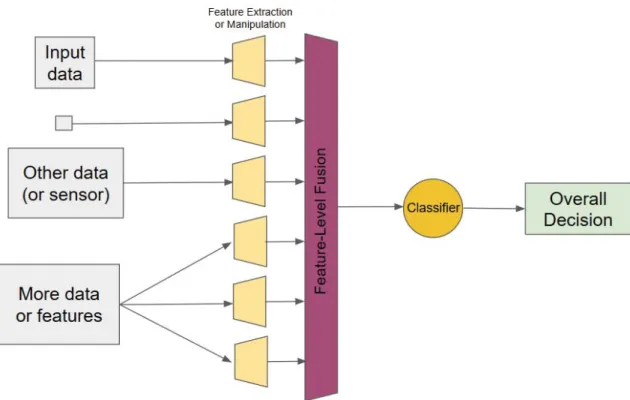
1.1 High-level block diagram of feature-level fusion. . . 4
1.2 High-level block diagram of decision-level fusion. . . 5
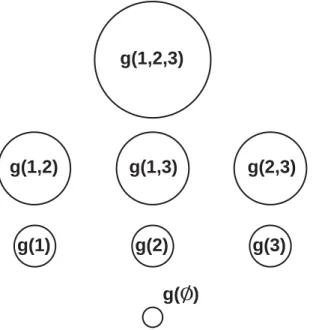
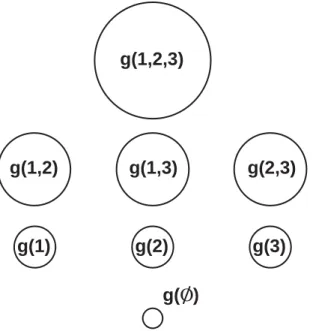
2.1 Lattice of FM elements for n= 3. Monotonicity (P5) is illustrated by the size of each circle, i.e., g({x1})≤g({x1, x2}) as {x1} ⊂ {x1, x2}. 22
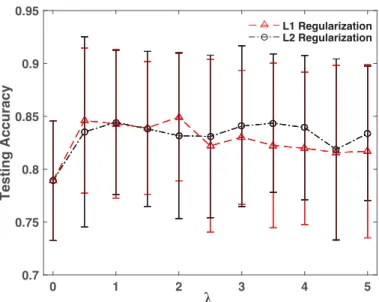
2.2 DeFIMKL performance using regularization on Sonar data. Error bars indicate ± one standard deviation. . . 46
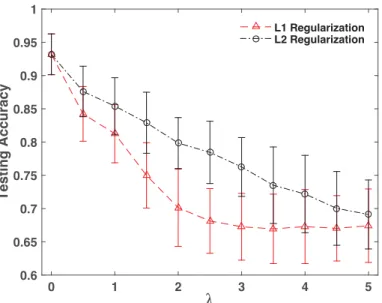
2.3 DeFIMKL performance using regularization on Dermatology data— classes {1,2,3} versus {4,5,6}. Error bars indicate ± one standard deviation. . . 47
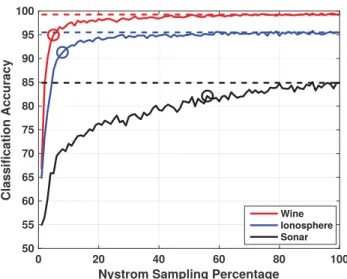
2.4 Results of using GAMKL1on the Wine, Ionosphere, and Sonar datasets with the Nystr¨om approximation. Dashed line indicates full sample performance; circle indicates sample percentage at which performance drops 5%. . . 50
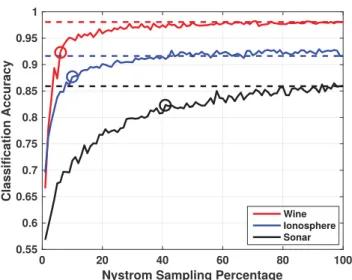
2.5 Results of using GAMKL2on the Wine, Ionosphere, and Sonar datasets with the Nystr¨om approximation. Dashed line indicates full sample performance; circle indicates sample percentage at which performance drops 5%. . . 50
2.6 Results of using DeFIMKL1 on the Wine, Ionosphere, and Sonar datasets with the Nystr¨om approximation. Dashed line indicates full sample performance; circle indicates sample percentage at which per-formance drops 5%. . . 51
2.7 Results of using DeFIMKL2 on the Wine, Ionosphere, and Sonar datasets with the Nystr¨om approximation. Dashed line indicates full sample performance; circle indicates sample percentage at which per-formance drops 5%. . . 51
2.8 Average speed-up percentages of classifiers using the Nystr¨om approx-imation. . . 52
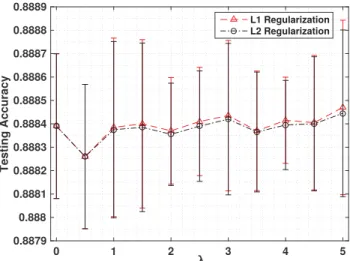
2.9 DeFIMKL performance using regularization on MNIST data. Error bars indicate± one standard deviation. . . 54
3.1 Lattice of FM elements for n= 3. Monotonicity (P5) is illustrated by the size of each node, i.e., g({x1}) ≤ g({x1, x2}) as {x1} ⊂ {x1, x2}. Note that shorthand notation is used where g(1,3) is equivalent to
3.2 The path taken by the Choquet integral due to a single input induc-ing the permutation π = {2,1,3}. Note that the FM was arbitrarily defined in this example, and their distribution (ordering) follows that
of Figure 3.1. . . 69
3.3 Lattice of learned FM and paths for random training data from the Ionosphere data set usingm= 10. Note there are numerous untouched nodes and their learned values are driven by the constraints in (3.9). 69 4.1 Experiment 1 results. (a,b) Learned FM values in lexicographical order for λ = 0 to 50. Bin 1 is u(1) = g(x1), bin N + 1 is u(N + 1) = g({x1, x2}), etc. Height of bar indicates FM value; color indicates λ value. (c,d) Plots showing performance of each regularization method in terms of SSE and Gini-Simpson index of the learned FM at each regularization parameter λ. . . 130
(a) Learned FM values using Gini-Simpson regularization . . . 130
(b) Learned FM values using 1 regularization . . . 130
(c) Gini-Simpson regularization performance plots . . . 130
4.2 Experiment 2 results. (a,b) Learned FM values in lexicographical or-der. Bin 1 is u(1) = g(x1), bin N + 1 is u(N + 1) = g({x1, x2}), etc. Height of the bar indicates FM value; color indicates λ value. (c,d) Plots showing performance of each regularization method in terms of SSE and Gini-Simpson index values of the learned FM at each
regu-larization parameter λ. . . 133
(a) Learned FM values using Gini-Simpson regularization . . . 133
(b) Learned FM values using 1 regularization . . . 133
(c) Gini-Simpson regularization performance plots . . . 133
(d) 1 regularization performance plots . . . 133
4.3 Experiment 3 results. Learned FM values in lexicographical order for Experiment 1. Bin 1 is u(1) = g(x1), bin N + 1 is u(N + 1) = g({x1, x2}), etc. Height of the bar indicates FM value; color indicates iteration number. Plot of the Shapley values of the learned FM for Experiment 1 at each iteration. . . 134
(a) Learned FM values using iteratively reweighted1 regularization for Experiment 1 . . . 134
(b) Shapley values for (a) . . . 134
5.2 An image contaminated with a large amount of noise and its low-rank and sparse decomposition. . . 148 5.3 The low-rank and sparse decomposition of an image with only one pixel
contaminated with a large amount of noise. . . 149 5.4 NAUC . . . 153 5.5 Examples of typical GPR data visualization . . . 154 5.6 Sparse component of GPR B-scan from Figure 5.5(b), computed using
RPCA . . . 155 5.7 Returned energy for a single sweep across a lane, over a target. Vertical
lines indicate the region in which the target is buried. . . 157 5.8 Example calculation of the peak SCR . . . 158 5.9 Unprocessed target B-scan used in Figures 5.10 and 5.12 . . . 165 5.10 A single B-scan processed with PCP-AD using multiple values for λ
along with the integrated energies. Note that image is labeled either
time orfrequency, corresponding to the domain in which the PCP-AD
algorithm was implemented. Dashed vertical lines denote the target region. . . 166 5.11 Effect of the tuning parameter on the SCR when using PCP-AD. Note
that the frequency domain trace is clamped to zero for situations where computing the SCR is numerically limited, i.e., in cases where 0/0 is approached. . . 167
5.12 A single B-scan processed with OP-RPCA in the time domain using multiple values forλ along with the integrated energies. Dashed
verti-cal lines denote the target region. . . 168
5.13 Effect of the tuning parameter on the SCR when using OP-RPCA. 169 5.14 Scattered plot of integrated A-scan energy for Lane A, GPR Channel 1. . . 171
5.15 Linear interpolation of scatter plot in Figure 5.14. . . 172
5.16 Results of applying clutter removal with m = 0.85 to Figure 5.14. . 172
5.17 Ascan . . . 175
5.18 Ascan . . . 177
5.19 CCMExample . . . 180
5.20 Sub-image at hit candidate location. . . 182
5.21 Gradient calculation with 3×3 cell arrangement. . . 183
5.22 Cell based 9-bin HOG feature. . . 184
5.23 freqPartition . . . 187
5.24 FFSTfilters . . . 187
5.25 NAUC . . . 190
5.26 prelanes . . . 192 5.27 Integrated energy ground map and an example queue point with 10,
5.28 DeFIMKL performance using regularization. Error bars indicate±one standard deviation. . . 208
List of Tables
2.1 Acronyms and Select Notation . . . 16 2.2 UCI Benchmark Data Sets . . . 29 2.3 RBF Kernel Parameter Ranges . . . 43 2.4 Classification Accuracy Results on Benchmark Data Sets* . . . 58 2.5 Additional Data Sets for Nystr¨om Verification . . . 59 2.6 Nystr¨om Sampling Percentage Required to Achieve Equivalent
Classi-fication Results as Full Sample . . . 59
3.1 Underlying and learned FMs (excludingg({∅}) andg(X) whose values are 0 and 1, respectively, due to the boundary conditions). The learned FM terms marked with an asterisk are not addressed by the training data. Regularization labels indicate the type of norm employed and the aggregation goal. For example, “1-min” indicates a goal of that for minimum aggregation (g=0) and1-regularization (u−g1). 78 3.2 Classification Accuracy of Various Regularization Functions* . . . . 92
4.1 Numeric Examples, for N = 3, Illustrating 0 and Gini-Simpson Dif-ferences. . . 117
4.2 RBF Kernel Parameter Ranges and Data Set Properties . . . 137 4.3 Classifier Performances—Means and Standard Deviations . . . 137
5.1 Average SCR over all targets* . . . 160 5.2 Average SCR over all wire targets* . . . 161 5.3 Average SCR over all landmine targets* . . . 161 5.4 Average SCR over all pressure plate targets* . . . 162 5.5 Average SCR over all main charge targets* . . . 163 5.6 Average RPCA decomposition time per sweep in seconds* . . . 164 5.7 Length of Features and Full Feature Set. . . 181 5.8 Results of CFAR Prescreener on each Channel and Lane. . . 191 5.9 NAUCs for the ROCs. . . 193 5.10 Results of SKSVM Classifier on each Channel and Lane using Different
Features—Prescreener Hits. . . 195 5.11 Results of SKSVM Classifier on each Channel and Lane using Different
Features—CCM Hits. . . 196 5.12 Results of SKSVM Classifier on each Channel and Lane using Different
Features—RP + CCM Hits. . . 197 5.13 Results of MKLSVM Classifier on each Channel and Lane using
Dif-ferent Features—Prescreener Hits. . . 198 5.14 Results of MKLSVM Classifier on each Channel and Lane using
5.15 Results of MKLSVM Classifier on each Channel and Lane using Dif-ferent Features—RP + CCM Hits. . . 200 5.16 Summary of Best Results. . . 201 5.17 NAUCs and percentage improvement compared to the prescreener*. 207
Preface
Some chapters of this dissertation contain published material. The following list indicates which publications were used along with notes on author contributions.
Chapter 2
A. Pinar, T.C. Havens, D.T. Anderson, and L. Hu (2015). “Feature and decision level fusion using multiple kernel learning and fuzzy integrals,” Proc. FUZZ-IEEE, Aug 2015, pp. 1–7. (See [1].)
A.J. Pinar is the leading researcher in this work and is the corresponding author. The research was performed under the guidance of T.C. Havens, and the ideas proposed in the paper stemmed from conversations with D.T. Anderson and L. Hu.
A.J. Pinar, J. Rice, L. Hu, D.T. Anderson, and T.C. Havens (2016). “Efficient multiple kernel classification using feature and decision level fusion,” IEEE Trans.
Fuzzy Systems, Vol. PP. (See [2].)
A.J. Pinar is the leading researcher in this work and is the corresponding author. The research was performed under the guidance of T.C. Havens, and the ideas proposed
in the paper stemmed from conversations with D.T. Anderson and L. Hu. J. Rice contributed ideas to improve the implementation of the various algorithms discussed in the paper.
Chapter 3
A.J. Pinar, T.C. Havens, M.A. Islam, and D.T. Anderson (2017). “Visualization and learning of the Choquet integral with limited training data,” To appear, Proc.
FUZZ-IEEE.
A.J. Pinar is the leading researcher in this work and is the corresponding author. The research was performed under the guidance of T.C. Havens, and the ideas proposed in the paper stemmed from conversations with D.T. Anderson and M.A. Islam.
A.J. Pinar, T.C. Havens, M.A. Islam, and D.T. Anderson (2017). “Learning the Choquet Integral with a goal,” In preparation, IEEE Trans. Fuzzy Systems.
A.J. Pinar is the leading researcher in this work and is the corresponding author. The research was performed under the guidance of T.C. Havens, and the ideas proposed in the paper stemmed from conversations with D.T. Anderson and M.A. Islam.
Chapter 4
A.J. Pinar, D.T. Anderson, A. Zare, T.C. Havens, and T. Adeyeba (2017). “Measures of the Shapley Index for Learning Lower Complexity Fuzzy Integrals,” In review,
Springer Granular Computing.
The ideas presented in this paper are the result of discussions between all listed au-thors. A.J. Pinar is the corresponding author for this paper and generated the ex-perimental results. D.T. Anderson and T.C. Havens contributed the theoretical back-ground.
Chapter 5
A. Pinar, T.C. Havens, J. Rice, M. Masarik, J. Burns, and B. Thelen (2016). “A comparison of robust principal component analysis techniques for buried object de-tection in downward looking GPR and EMI sensor data,” Proc. SPIE, pp. 98230T. (See [3].)
A.J. Pinar is the leading researcher in this work and is the corresponding author. The research was performed under the guidance of T.C. Havens, and J. Rice assisted with the code written for the experiments. M. Masarik, J. Burns, and B. Thelen provided
data for use in the experiments.
A.J. Pinar, J. Rice, T.C. Havens, M. Masarik, J. Burns, and D.T. Anderson (2016). “Explosive hazard detection with feature and decision level fusion, multiple kernel learning, and fuzzy integrals,” Proc. IEEE CISDA, pp. 1–8. (See [4].)
A.J. Pinar is the leading researcher in this work and is the corresponding author. The research was performed under the guidance of T.C. Havens, and J. Rice assisted with the code written for the experiments. M. Masarik and J. Burns provided data for use in the experiments, and D.T. Anderson provided guidance with the theoretical components of the paper.
A. Pinar, M. Masarik, T.C. Havens, J. Burns, B. Thelen, and J. Becker (2015). “Ap-proach to explosive hazard detection using sensor fusion and multiple kernel learning with downward-looking GPR and EMI sensor data,” Proc. SPIE, pp. 94540B. (See [5].)
A.J. Pinar is the leading researcher in this work and is the corresponding author. The research was performed under the guidance of T.C. Havens, and M. Masarik, J. Burns, and B. Thelen provided data and algorithms for use in the experiments. Some ideas in this work originated in conversations with J. Becker.
Abstract
The work collected in this dissertation addresses the problem ofdata fusion. In other words, this is the problem of making decisions (also known as the problem of
classifi-cation in the machine learning and statistics communities) when data from multiple
sources are available, or when decisions/confidence levels from a panel of decision-makers are accessible. This problem has become increasingly important in recent years, especially with the ever-increasing popularity of autonomous systems outfitted with suites of sensors and the dawn of the “age of big data.” While data fusion is a very broad topic, the work in this dissertation considers two very specific techniques:
feature-level fusion and decision-level fusion. In general, the fusion methods
pro-posed throughout this dissertation rely on kernel methods and fuzzy integrals. Both are very powerful tools, however, they also come with challenges, some of which are summarized below. I address these challenges in this dissertation.
Kernel methods for classification is a well-studied area in which data are implicitly mapped from a lower-dimensional space to a higher-dimensional space to improve classification accuracy. However, for most kernel methods, one must still choose a kernel to use for the problem. Since there is, in general, no way of knowing which kernel is the best, multiple kernel learning (MKL) is a technique used to learn the
aggregation of a set of valid kernels into a single (ideally) superior kernel. The aggre-gation can be done using weighted sums of the pre-computed kernels, but determining the summation weights is not a trivial task. Furthermore, MKL does not work well with large datasets because of limited storage space and prediction speed. These challenges are tackled by the introduction of many new algorithms in the following chapters. I also address MKL’s storage and speed drawbacks, allowing MKL-based techniques to be applied to big data efficiently.
Some algorithms in this work are based on theChoquet fuzzy integral, a powerful non-linear aggregation operator parameterized by thefuzzy measure(FM). These decision-level fusion algorithms learn a fuzzy measure by minimizing a sum of squared error
(SSE) criterion based on a set of training data. The flexibility of the Choquet integral comes with a cost, however—given a set ofN decision makers, the size of the FM the algorithm must learn is 2N. This means that the training data must be diverse enough to include 2N independent observations, though this is rarely encountered in practice.
I address this in the following chapters via many different regularization functions, a popular technique in machine learning and statistics used to prevent overfitting and increase model generalization. Finally, it is worth noting that the aggregation behav-ior of the Choquet integral is not intuitive. I tackle this by proposing a quantitative visualization strategy allowing the FM and Choquet integral behavior to be shown simultaneously.
Chapter 1
Introduction
Information fusion is a broad multi-disciplinary topic with many applications. Gen-erally, it refers to the process of aggregating multiple sets of data (or other type of information) all explaining a common “thing”. For example, in the case of an au-tonomous robot, the “thing” might be its environment and the data will likely be collected from a suite of heterogeneous sensors outfitted on the vehicle. The robot can gain full autonomy if there are algorithms present that can effectively fuse the various data it collects, and make decisions based on their aggregation. Another example more related to the autonomous agents of our species is the discrimination of edible food versus inedible food. When presented with a nutritional candidate, humans use their inborn sensor suites to extract informative features regarding its edibility. For example, its smell may contain information regarding the candidate’s
freshness—if the candidate smells rotten, it is likely inedible. Sight allows humans to categorize the candidate which also helps the decision process—if it looks like other foods known to be edible, it may also be edible. Ultimately, humans combine the information gathered by these senses (and others) to make the decision to eat or not to eat.
The above examples are examples of data-level or feature-level fusion, where the de-cision maker essentially combined the data before any dede-cisions were made. Another flavor of information fusion is decision-level fusion, where there exists a panel of de-cision makers, each making his or her own dede-cision based on the data at hand, and an overall decision is then determined through some process, e.g., voting. It is im-portant to note that in this context the decision can be a “confidence” or “rating.” A popular example of this type of fusion is the judging process in gymnastic or figure skating competitions—a panel of judges each rate the performance of a competitor by casting grades based on their own observations, and an overall score is assigned to the competitor by aggregating the judges’ ratings.
These high-level examples illuminate the two types of information fusion addressed in this dissertation: data-level fusion and feature-level fusion. The remainder of this chapter provides some context on how the low-level tools comprising the bulk of this dissertation fall under the roof of information fusion, and it will conclude with an outline of contributions. Furthermore, salient terminology is introduced and
explained throughout the chapter.
1.1
Problem Context
It is no coincidence that the high-level examples of the previous section ultimately ended with a decision; essentially all of the algorithms discussed in this disserta-tion are binary decision makers, i.e., binary classifiers.1 Hence, following the typical workflow for many machine learning or statistical prediction methods, the algorithms discussed later will betrained on a set of training data—data accurately labeled with known classes (labels) and is representative of the problem at hand, then tested on
testing data—data with unknown labels. The training process allows the classifier to
learn the underlying model so that accurate predictions can be made on the testing data.
An example of a high-level feature-level fusion pipeline is shown in Figure 1.1. The input data, which can be from various sources or even a single source, is shown on the left and is fed into the first processing blocks that process the data in some way2. Next, the features are fused in some manner before a single classifier gives an overall decision. In the work that follows, I use an “off the shelf” classifier known as asupport
1While the classifier I use in these algorithms is the support vector machine (SVM), generally any
classifier can be used in its place.
Figure 1.1: High-level block diagram of feature-level fusion.
vector machine (SVM), and the feature-level fusion algorithms I propose focus on the
feature fusion block just before classification.
Figure 1.2 shows a similar block diagram for a decision-level fusion pipeline. Just as with feature-level fusion, the input data is on the left and is fed to some processing blocks. The difference here is that classification is performed before the fusion block; each processing block gets its very own classifier. The decisions generated by the different classifiers are then aggregated to form an overall decision by the fusion block. Again, the classifiers I use are SVMs and the decision-level fusion methods discussed later are included in the decision fusion block.
Figure 1.2: High-level block diagram of decision-level fusion.
The following sections briefly explain the tools used for fusion in the following chap-ters. Specifically, kernel SVMs and multiple kernel learning are discussed as the tools chosen for classification and feature-level fusion, respectively, and the Choquet fuzzy integral is introduced as the tool of choice for decision-level fusion.
1.1.1
SVMs and Kernels
A support vector machine is a type of binary classifier that finds a hyperplane in some space that discriminates between two classes of data; for linearly separable data, the SVM will work perfectly. This is not to say, however, that the SVM cannot be applied to more “complex” data—data that are not linearly separable can be accurately classified with a kernel SVM, i.e., a SVM that has been extended using
The kernel trick allows data to be nonlinearly mapped to a new higher-dimensional space termed the reproducing kernel Hilbert space (RKHS), where the data are (po-tentially) linearly separable. A linear classifier implemented in the RKHS can then perfectly discriminate the two classes. The SVM is one of the most popular classifiers to utilize the kernel trick since its formulation turns out to be very efficient—the nonlinear mapping can be performed implicitly through the use of kernel matrices, Hermitian matrices whose elements represent all pairwise inner products of the train-ing data. The elements of a kernel matrix are computed ustrain-ing a kernel function, which represents the inner product of two vectors in a RKHS defined by the kernel function chosen. There are many kernel functions to choose from, e.g., various radial
basis function kernels,polynomial kernels,sigmoidal kernels, etc., and they each have
at least one free parameter that must be chosen. This abundance of choice leads to the problem of determining which kernel (and parameter) to employ with the SVM. Recall that the goal of using a kernel is to project the data to a space where the data
are linearly separable, something not all kernels can achieve. This is the challenge
that multiple kernel learning (MKL) addresses.
MKL assumes that the kernel used as described in the previous paragraph is actually a linear combination of pre-selected base kernels. One must still choose the vari-ous base kernels with this MKL approach, but the process of learning the mixing coefficients generally minimizes the influence of kernels that do not work well and
maximizes the contribution of kernels that do separate the data well. In a mathe-matical nutshell, given m base kernel matrices, Kk, MKL is the process of learning
the mixing coefficients, σk, that form an “optimal” kernel as
K=
m
k=1
σkKk. (1.1)
The MKL algorithms in this dissertation all assume the formulation in (1.1), and many address the problem of learning a suitable set of mixing coefficients. Appendix A provides a more quantitative discussion of SVMs including their kernel extension.
1.1.2
The Choquet Fuzzy Integral
Most of the decision-level fusion work in this dissertation uses the Choquet fuzzy
integral to combine the outputs of an ensemble of decision makers into a single overall
decision. This integral is extremely flexible and is parametrized by thefuzzy measure
(FM), a function that maps the power set of all decision makers to the unit interval and can be thought of as the “worth” of a set. Therefore, we can say the Choquet fuzzy integral is “uber-parametrized,” since aggregating the decisions from a set of
m decision-makers using the integral requires 2m terms in its FM3. Similar to MKL’s
goal of learning the “optimal” mixing coefficients based on training data, techniques
3Note that due to some properties of the FM, the number of required terms is actually 2m−2. This will be explained in later chapters.
using the Choquet integral learn the FM that fits the training data.
The number of required terms of the FM explodes as 2m, so learning the FM quickly
becomes an underdetermined problem since sets of training data will rarely have the diversity to include 2m independent observations. This manifests as a learned FM
that is only partially accurate—values of the FM driven by the training data are very accurately learned, but the remaining values are driven only by constraints; their values are essentially erroneous. Thus, when faced with testing data that utilizes the incorrectly learned FM values the classification accuracy will generally suffer.
Much of the work in the following chapters addresses this problem through the use of
regularization, a technique commonly used in machine learning to prevent overfitting.
Doing so reduces the influence of the constraints on the learned FM and rather reas-signs the influence to the regularization function; the choice of regularization function defines how the values of the FM not driven by training data are learned.
1.2
Dissertation Outline and Contributions
The following chapters summarize my work on the data fusion problem along with some application-specific contributions to ground penetrating radar (GPR). The re-mainder of this section describes each chapter more concretely and explains the novel
contributions of each chapter.
Chapter 2 proposes multiple feature-level and decision-level fusion algorithms,
demonstrates their performance when used with support vector machine classifiers, and proposes a general method for extending multiple kernel learning-based algo-rithms to large datasets through the use of the Nystr¨om approximation. Experimental results demonstrate the algorithms’ utility as well as validate their extension to “big data”. A decision-level fusion algorithm proposed in this paper, namely
decision-level fuzzy integral multiple kernel learning (DeFIMKL), is a common thread also
appearing in the chapters that follow.
Chapters 3 and 4 further extend the fuzzy integrbased decision-level fusion
al-gorithm introduced in Chapter 2 in many ways. The novelty in Chapter 3 allows
the algorithm’s behavior to be more finely “tuned” towards various aggregation op-erators, and that of Chapter 4 aims to improve the algorithm’s generalization by
penalizing its complexity during the learning process.
Chapter 5 applies some of the fusion techniques presented in this dissertation to
the problem of explosive hazard detection using ground penetrating radar (GPR). The chapter is broken into three parts—Part I presents an exploration of various robust
step. Next, Part II summarizes an approach to the detection process using
state-of-the-art fusion methods and providing a picture of the entire detection pipeline including prescreening, feature extraction, and classification. Finally, Part III
ap-plies the fusion techniques from Chapter 2 to the GPR data.
Finally, Chapter 6 concludes the dissertation and discusses future work.
1.3
List of Relevant Publications
The research summarized in this dissertation is based on the following publications:
1. A. Pinar, T.C. Havens, D.T. Anderson, and L. Hu (2015). “Feature and decision level fusion using multiple kernel learning and fuzzy integrals,” Proc. FUZZ-IEEE, Aug 2015, pp. 1–7. (See [1].)
2. A.J. Pinar, J. Rice, L. Hu, D.T. Anderson, and T.C. Havens (2016). “Ef-ficient multiple kernel classification using feature and decision level fusion,”
IEEE Trans. Fuzzy Systems, Vol. PP. (See [2].)
3. A.J. Pinar, T.C. Havens, M.A. Islam, and D.T. Anderson (2017). “Visualization and learning of the Choquet integral with limited training data,” To appear,
4. A.J. Pinar, T.C. Havens, M.A. Islam, and D.T. Anderson (2017). “Learning the Choquet Integral with a goal,”In preparation, IEEE Trans. Fuzzy Systems.
5. A.J. Pinar, D.T. Anderson, A. Zare, T.C. Havens, and T. Adeyeba (2017). “Measures of the Shapley Index for Learning Lower Complexity Fuzzy Inte-grals,” In review, Springer Granular Computing.
6. A. Pinar, T.C. Havens, J. Rice, M. Masarik, J. Burns, and B. Thelen (2016). “A comparison of robust principal component analysis techniques for buried object detection in downward looking GPR and EMI sensor data,”Proc. SPIE, pp. 98230T. (See [3].)
7. A.J. Pinar, J. Rice, T.C. Havens, M. Masarik, J. Burns, and D.T. Anderson (2016). “Explosive hazard detection with feature and decision level fusion, multiple kernel learning, and fuzzy integrals,” Proc. IEEE CISDA, pp. 1–8. (See [4].)
8. A. Pinar, M. Masarik, T.C. Havens, J. Burns, B. Thelen, and J. Becker (2015). “Approach to explosive hazard detection using sensor fusion and multiple kernel learning with downward-looking GPR and EMI sensor data,” Proc. SPIE, pp. 94540B. (See [5].)
1. M.A. Islam, D.T. Anderson, A.J. Pinar, and T.C. Havens (2016).
“Data-driven compression and efficient learning of the Choquet integral,” In review, IEEE Trans. Fuzzy Systems.
2. T.C. Havens, J. Becker,A. Pinar, and T.J. Schulz (2014). “Multi-band
sensor-fused explosive hazard detection in forward-looking ground-penetrating radar,”
Proc. SPIE, vol. 9072. (See [6].)
3. T.C. Havens, D.T. Anderson, K. Stone, J. Becker, and A.J. Pinar (2016).
“Computational Intelligence in Forward Looking Explosive Hazard Detection,” Chapter in Recent Advances in Computational Intelligence in Defense and
Se-curity. Berlin: Springer. (See [7].)
Proof of copyright permission for the necessary publications used in this dissertation are provided in Appendix C.
Chapter 2
Efficient Multiple Kernel
Classification using Feature and
Decision Level Fusion
The material in this chapter was previously published in IEEE Transactions on Fuzzy Systems, Vol. PP, no. 99, 2016.
2.1
Introduction
Consider a set of numericalfeature-vector data that has the formX ={x1, . . . ,xn} ⊂
Rd, where the coordinates of x
i provide feature values (e.g., bits per second, speed,
volts, etc.) describing some object (e.g., a wireless sensor network node, traffic cam-era, or radar). We are also given a set of training labels for each feature vector, such that we have the pair (y, X), wherey= (y1, . . . , yn)T andyi is the label ofith object.
Each yi is associated with a respective feature vector xi. The classifier learning task
is thus to learn some prediction function f, such that we can predict the label of the feature-vectors, i.e., y=f(x).
Most classifiers delineate the classes by finding some “best” decision boundary in the feature space. Perceptrons and linear support vector machines (SVMs) find hyper-planes1. These classifiers are easy to train, often can be effective, and are compu-tationally very efficient (the operational decision is just a single dot-product in the feature space). However, they are ineffective for classes that are not linearly separa-ble, i.e., by a hyperplane. Hence, we will use kernel classifiers to non-linearly project the features into a high-dimensional space, where hyperplanes may be more easily found that serve as good decision boundaries.
its name implies, MKL combines multiple kernels together to form a new kernel, and thus a new classification space. Furthermore, since kernels known to exploit the data’s various features can be used as building blocks for MKL, it can do very well with heterogeneous data. There are many works that discuss MKL [8, 9, 10, 11, 12, 13, 14], and nearly all of them rely on operations that aggregate kernels in ways that preserve symmetry and positive semi-definiteness, such as element-wise addition and multiplication. Most MKL algorithms learn a “best” kernel space in which to classify by learning respective weights on each component kernel. Details are contained in Section 2.4.
Two MKL formulations explored in this chapter focus on aggregation using the
Cho-quet fuzzy integral (FI) with respect to a fuzzy measure (FM) [15]. First, we
inves-tigate our previously proposed fuzzy integral: genetic algorithm (FIGA) approach to MKL [11, 12], proving that it reduces to a special kind of linear convex sum (LCS) kernel aggregation. This leads to the proposition of the p-norm genetic algorithm
MKL (GAMKLp) approach, which learns an MKL classifier using a genetic algorithm
and generalizedp-norm weight domain. These algorithms perform a feature-level ag-gregation of the kernel matrices, producing a new feature representation. We also propose a decision-level MKL called DeFIMKL, which learns a FM with respect to the Choquet FI to fuse decisions from individual kernel classifiers. The FM is learned from training data with a regularized quadratic program (QP) approach [16]. We
Table 2.1
Acronyms and Select Notation SVM support vector machine
MKL multiple kernel learning FM fuzzy measure
FI fuzzy integral
FIGA fuzzy integral: genetic algorithm LCS linear convex sum
GAMKLp p-norm genetic algorithm MKL
DeFIMKL decision-level fuzzy integral MKL
DeGAMKLp p-norm decision-level genetic algorithm MKL
DeLSMKL decision-level least squares MKL QP quadratic program
MKLGL MKL group lasso
MKLGLp MKLGL with p-norm regularization
RBF radial basis function
X feature-vector data, X ={x1, . . . ,xn} ⊂Rd y data labels, y= (y1, . . . , yn)T
f(x) prediction function
g fuzzy measure
π(i) sorting index in Choquet integral
φ(x) non-linear mapping of x
κ(xi,xj) kernel function, κ(xi,xj) = φ(xi)Tφ(xj) K kernel matrix K = [Kij =κ(xi,xj)] fk(x) decision function using kth kernel, Kk
fg(x) decision function using Choquet integral, wrt FM g
further explore two additional decision-level methods based on a least-squares for-mulation. We start with decision-level least-squares MKL (DeLSMKL) where we compute the weights for decision values from an ensemble of classifiers using a closed form expression. We then extend this method using a nonlinear cost function and use a genetic algorithm to compute the weights in decision-level genetic algorithm MKL
(DeGAMKL).
Since the size of these kernels is directly related to the number of feature-vectors in the dataset, large datasets lead to large kernels. Thus, approximations to the kernel matrices that reduce the required number of values to store could allow MKL methods to be used for these large datasets. We explore the use of the Nystr¨om approximation for this task, and show the effects of the approximation on classifier accuracy.
The FI-based MKL approaches are first compared with a leading machine learning MKL method, called MKL group lasso (MKLGL)2 [9] on several benchmark data sets. We also investigate the behavior of regularization on the results of DeFIMKL. In Section 2.2 we briefly review data fusion, and Section 2.3 introduces FMs and FIs, specifically the fuzzy Choquet integral. Section 2.4 details the MKL methods. A review of the preliminary experimental results generated in [17] are presented in Section 2.6, Section 2.7 presents the details and results of our Nystr¨om experiments, and Section 2.8 discusses our final experiment with a large data set. Table 2.1 contains acronyms and selected notation used in this chapter.
2.2
Data Fusion
Data fusion is a broad term for methods that use multiple sets of data, perhaps data
from different sensors or the output of multiple processes applied to the same data
set, to improve some performance metric from a baseline established using only one
set [18]. It is a very broad area of study, and there exists a vast pool literature relating to it; for a review of data fusion methods see [19] and [20]. Because of the breadth of the topic, we restrict this brief overview to the types of fusion techniques most related to the methods we employ.
Data fusion can be classified in many ways [21, 22, 23]. The taxonomy in [22] is most appropriate to apply to our approach, describing five categories of data fusion. The categories that encompass our fusion methods are termedfeature in—feature out
(FEI-FEO) anddecision in—decision out (DEI-DEO) and are briefly discussed in the following sections.
2.2.1
Feature In—Feature Out Fusion
FEI-FEO fusion is also known as feature fusion, on which many computer vision meth-ods rely [24, 25, 26, 27]. A popular and powerful method of feature fusion combines the features in a multidimensional feature space using kernel methods [28, 29, 30, 31]. This allows the use of multiple kernels with classification, giving the advantage that particular kernels can exploit certain features better than other kernels. The SVM is a popular classifier for MKL classification, however comparable results have been shown using a logistic regression-based classifier [32].
2.2.2
Decision In—Decision Out Fusion
DEI-DIO fusion is commonly referred to as decision fusion. This approach is very closely related to concept of ensemble learning, where the decisions from multiple classifiers are combined to determine the overall decision. Indeed, this is precisely what the DeFIMKL algorithm discussed in Section 2.4.2 does. Due to the use of multiple classifiers, decision fusion is generally slower than feature fusion, which only requires one classifier [33].
Decision fusion can be done in two general ways: hard or soft. Hard decision fusion is done using the class labels from the ensemble of classifiers. A straightforward method of hard decision fusion is the majority vote approach. Soft decision fusion is performed using other outputs from the classifier ensemble such as the posterior probabilities, evidences, hypotheses, etc. A simple example in this case is to linearly combine the posterior probabilities [34]. Alternatively, for ensembles of fuzzy classifiers, the soft decision fusion approach could be used by aggregating the fuzzy class memberships determined by the classifiers [35].
2.3
Fuzzy Measures and Fuzzy Integrals
FIs and FMs have been proposed for many applications and for many types of data, from simple numeric data to intervals and type-2 fuzzy sets [36, 37, 38, 39, 40, 41, 42, 43, 44, 45, 46]. While manual specification of the FM works for small sets of sources (there are already 16 possible combinations of sources in the power set of 4 sources), manually specifying the values of the FM for large collections of sources is virtually impossible. Thus, automatic methods have been proposed, such as the Sugeno λ -measure [39] and the S-decomposable measure [47], which build the measure from the densities (the worth of individual sources), and genetic algorithm [11, 12, 38, 48], Gibbs sampling [49] and other learning methods [16, 50, 51], which build the measure by using training data. Other works [52, 53, 54] have proposed learning FMs that reflect trends in the data and have been specifically applied to crowd-sourcing, where the worth of individuals is not known, but extracted from the data.
2.3.1
Fuzzy measure
A measurable space is the tuple (X,Ω), where X is a set and Ω is a Ω-algebra or set of subsets of X such that
P1. X ∈Ω;
P2. ForA⊆X, if A∈Ω, then Ac ∈Ω;
P3. If∀Ai ∈Ω, then
∞
i=1Ai ∈Ω.
A FM is a function, g : Ω→[0,1], with the following properties:
P4. (Boundary conditions) g(∅) = 0 and g(X) = 1;
P5. (Monotonicity) IfA, B ∈Ω and A⊆B, then g(A)≤g(B).
If Ω is an infinite set, then there is also a third property guaranteeing continuity; in practice and in this chapter, Ω is finite and thus this property is unnecessary. The FM values of the singletons, g({xi}) = gi are commonly called the densities. Figure
2.1 illustrates the lattice of a FM for the case of n= 3.
The arguably most popular FM is the Sugeno λ-measure, which has the attractive property of being able to be defined completely by the values of the densities. The
λ-measure has the following additional property. For A, B ∈Ω andA∩B =∅,
g(1) g(4) g(1,2) g(1,3) g(1,2,3) g(2,3) g(2) g(3)
Figure 2.1: Lattice of FM elements for n = 3. Monotonicity (P5) is
illustrated by the size of each circle, i.e., g({x1}) ≤ g({x1, x2}) as {x1} ⊂
{x1, x2}.
where it can be shown that λ can be found by solving [39]
λ+ 1 = n i=1 1 +λgi, λ >−1. (2.1b)
2.3.2
Fuzzy integral
There are many forms of the FI; see [39] for detailed discussion. In general, they are parametric aggregation operators based on the fuzzy measure, hence the selection of measure leads to a specific aggregation operators. In practice, FIs are frequently used for evidence fusion [48, 55, 56, 57, 58]. They combine sources of information
by accounting for both the support of the question (the evidence) and the expected worth of each subset of sources (as supplied by the FM g). Here, we focus on the fuzzy Choquet integral, proposed by Murofushi and Sugeno [59, 60]. Let h :X →R
be a real-valued function that represents the evidence or support of a particular hypothesis.3 The discrete (finite Ω) fuzzy Choquet integral is defined as
C h◦g =Cg(h) = n i=1 h(xπ(i)) [g(Ai)−g(Ai−1)], (2.2)
where π is a permutation of X, such that h(xπ(1)) ≥ h(xπ(2)) ≥ . . . ≥ h(xπ(n)), Ai ={xπ(1), . . . , xπ(i)}, and g(A0) = 0 [15, 42]. Detailed treatments of the properties
of FIs can be found in [15, 42, 61]. We now move on to showing how MKL can be achieved using the FM and FI.
2.4
Multiple Kernel Learning
Consider some non-linear mapping function φ: xi →φ(xi)∈ RDK, where DK is the
dimensionality of the transformed feature vector φ(xi). For brevity, we will denote
φ(xi) as φi. With kernel algorithms, one does not need to explicitly transform xi,
one simply needs to represent the dot product φ(xi)·φ(xj) =κ(xi,xj). The kernel
function κ can take many forms, with the polynomial κ(xi,xj) = (xTi xj + 1)p and
3Generally, when dealing with information fusion problems it is convenient to haveh:X →[0,1],
radial-basis-function (RBF) κ(xi,xj) = exp(σ||xi−xj||2) being two of the most well
known. Given a set of n feature-vectors X, one can thus construct an n×n kernel matrix K = [Kij = κ(xi,xj)]n×n. This kernel matrix K represents all pairwise dot
products of the feature vectors in the transformed high-dimensional spaceHK—called
the Reproducing Kernel Hilbert Space (RKHS).
There are many algorithms that use kernels to transform the input data to an appro-priate and useful space; in this chapter, we focus on kernel-based classification, such as the SVM [62, 63]. Multiple kernel algorithms, such as MKLGL [9] and FIGA [11], take single kernel algorithms a step further by representing the feature-vector with multiple kernels and then combining them to produce a single decision output. The kernel combination can be computed in many ways, as long as the combination results in a Mercer kernel [64]. For the feature-level fusion algorithms in this chapter, we will assume that the kernel K is composed by a weighted combination of pre-computed kernel matrices, i.e.,
K=
m
k=1
σkKk, (2.3)
where there aremkernels andσk is the weight applied to thekth kernel. The domain
ofσis very important and many MKL implementations only work for a single domain. For example, Δ2 = {σ ∈ Rm : σ
2 = 1, σk ≥ 0} is the 2-norm MKL [8, 10, 13].
MKLGL [9] uses a generalized MKL instantiation that allows for an p-norm domain
an SVM on the resultant kernel K. FIGA [11] generalizes (2.3) by representing the computation ofK by the Choquet FI,
K=
m
k=1
[g(Ak)−g(Ak−1)]Kπ(k), (2.4)
where Ak = {Kπ(1), . . . , Kπ(k)} is a set of kernel matrices sorted by a base-learner
quality measure and the FM g is learned by a genetic algorithm (GA); in essence, the entries of K are each the result of a Choquet FI. In Section 2.4.1 we show that the FIGA algorithm is actually learning an LCS MKL and is equivalent to (2.3) with
σ ∈Δ1; we will use this new discovery to propose the GAMKLp algorithm.
2.4.1
The GAMKL
palgorithm
The FIGA algorithm produces an MKL classifier by learning one on the composite kernel K with the Choquet FI as shown in (2.4). The final classification function is learned on the kernel K, and, in past works [11, 12, 17], we have used the SVM for this final learner. The basic steps of FIGA are as follows:
1. Compute kernel matrices Kk = [κk(xi,xj)]n×n, k = 1, . . . , m;
2. Train a base-learner (e.g., SVM) on each kernelKk and record the classification
3. Collect sorting indices π, such that ηπ(1) ≥ηπ(2) ≥. . .≥ηπ(k);
4. Use a GA to learn the FM g, such that the classification accuracy of a learner (e.g., SVM) on K at (2.4) is maximized.
The fitness of each chromosome in step 4) of FIGA is the classification accuracy of the learner on K, while the genes are (m−1) distinct values of the FM.4 Because FIGA only learns the sorting π once, in step 2), the GA only needs to learn (m−1) FM values, g({Kπ(1)}), g({Kπ(1), Kπ(2)}), . . ., g({Kπ(1), . . . , Kπ(m−1)}); by property
P4,g(A0) = 0 and g(Am) = 1. This leads to Proposition 1
Proposition 1. Since the sorting order π is only found once in step 2) of FIGA, the
Choquet integral at (2.4) can be rewritten as
K= m k=1 σπ(k)Kπ(k), (2.5) where σπ(k) =g(Ak)−g(Ak−1).
Proof. Because the sorting is not updated, the setsAk also remain unchanged; hence,
the summation weight on Kπ(k) is the subtraction of the FM values of the same sets
(no matter their values). Hence, we can attach a single weightσπ(k)to eachKπ(k). 4In [12], an additional gene was added to indicate different types of FMs and a slightly better
Remark 1. Proposition 1 shows that the FIGA kernel composition at (2.4) is
inde-pendent of the initial sorting byπbecause the summation at (2.5) can be performed in any arbitrary order and give the same result. Hence, step 3) of FIGA is unnecessary.
Proposition 2. In FIGA, the domain of σπ(k) is Δ1.
Proof. The 1 norm of σ is
m k=1 σπ(k) = m k=1 g(Ak)−g(Ak−1) =g(Am)−g(A0) = 1. (2.6)
Furthermore, due to the monotonicity property (P5) of g,σπ(k) =g(Ak)−g(Ak−1)≥
0.
Remark 2. Proposition 2 shows the domain of σ upon which FIGA learns. Taking
Propositions 1 and 2 together shows that FIGA is equivalent to using a GA to learn the weights σ∈Δ1 in the kernel combination at (2.3).
In light of this discovery, we propose a GAMKLpalgorithm that uses a GA to learn the
weightsσ∈Δp of (2.3). Whenp= 1, we have shown that this is equivalent to FIGA.
However, because of our discoveries in Propositions 1 and 2, we can simplify and generalize FIGA to allow for learning σ in the generalized domain Δp. The genes of
To ensure the GAMKLp genes lie in the p-norm domain Δp, all candidate genes ˜σ
are p-norm normalized to formσ as
σ = σ˜ p m i=1 |σ˜i|p . (2.7)
The fitness of each chromosome in GAMKLp is the 5-fold cross-validation
classifica-tion accuracy of the learning algorithm—in this chapter, an SVM—trained on each chromosome’s aggregated K.
Remark 3. While Propositions 1 and 2 show that FIGA is equivalent to GAMKL1,
the GAMKLpalgorithm has the additional benefit that the genes of each chromosome
are not constrained to be monotonically increasing (as in FIGA). Hence, GAMKLp
is algorithmically more simple.
In Section 2.6, we will further investigate the performance of GAMKLp for real-world
Table 2.2
UCI Benchmark Data Sets
Data Set
Sonar Dermatology Wine
No. of Objects 208 366 178
No. of Features 60 33 13
Binary Classes {1} vs. {2} {1–3}vs. {4–6} {1} vs. {2,3}
Ionosphere Ecoli Glass
No. of Objects 351 336 214
No. of Features 34 7 9
Binary Classes {0} vs. {1} {1–4}vs. {5–8} {1–3} vs. {4–6}
2.4.2
The DeFIMKL algorithm
Let fk(xi) be the decision-value on feature-vector xi produced by the kth classifier
in an ensemble. The overall decision of the ensemble is computed by the Choquet integral, where the evidenceh is the set of decisions by the classifier ensemble and g
encodes the relative worth of each classifier in the ensemble. So, mathematically, the ensemble decision fg(x
i) on feature-vector xi with respect to the FM g is produced
by fg(xi) = m k=1 fπ(k)(xi) [g(Ak)−g(Ak−1)], (2.8) where Ak = {fπ(1)(xi), . . . , fπ(k)(xi)}, such that fπ(1)(xi) ≥ fπ(2)(xi) ≥ . . . ≥ fπ(m)(xi). This is a generalized classifier fusion method that has been explored in
many previous works [45, 57, 58, 65].
sum-of-squared error (SSE) optimization, which we now briefly describe. Let the SSE be defined as E2 = n i=1 (fg(xi)−yi)2, (2.9)
where yi is the class label for xi. It can be shown that (2.8), as a Choquet integral,
can be reformulated as fg(xi) = m k=1 fπ(k)(xi)−fπ(k+1)(xi) g(Ak), (2.10)
where fπ(m+1) = 0 [15]. The SSE can thus be expanded as
E2 = n i=1 HxT iu−yi 2 , (2.11a)
whereuis the lexicographically ordered FMg, i.e.,u = (g({x1}), g({x2}), . . . , g({x1∪ x2}), g({x1∪x3}), . . . , g({x1∪x2∪. . .∪xm}), and Hxi = ⎛ ⎜ ⎜ ⎜ ⎜ ⎜ ⎜ ⎜ ⎜ ⎜ ⎜ ⎜ ⎜ ⎜ ⎜ ⎜ ⎜ ⎜ ⎜ ⎝ .. . fπ(1)(xi)−fπ(2)(xi) .. . 0 .. . fπ(m)(xi)−0 ⎞ ⎟ ⎟ ⎟ ⎟ ⎟ ⎟ ⎟ ⎟ ⎟ ⎟ ⎟ ⎟ ⎟ ⎟ ⎟ ⎟ ⎟ ⎟ ⎠ , (2.11b)
where Hxi is of size (2m −1)×1 and contains all the difference terms f
π(k)(xi)− fπ(k+1)(xi) at the corresponding locations of Ak in u. We can now fold out the
squared term in (2.11a), producing
E2 = n i=1 uTHxiHxT iu−2yiH T xiu+y 2 i =uTDu+fTu+ n i=1 y2i, (2.12) D= n i=1 HxiH T xi, f =− n i=1 2yiHxi.
Note that (2.12) is a quadratic function; hence, we can add in the constraints on
u, such that it represents a FM, producing a constrained QP. We can write the
monotonicity constraint on u, according to properties P4 and P5, as Cu≤0, where
C = ⎛ ⎜ ⎜ ⎜ ⎜ ⎜ ⎜ ⎜ ⎜ ⎜ ⎜ ⎜ ⎜ ⎜ ⎜ ⎜ ⎜ ⎜ ⎜ ⎝ ΨT 1 ΨT 2 .. . ΨT n+1 .. . ΨT m(2m−1−1) ⎞ ⎟ ⎟ ⎟ ⎟ ⎟ ⎟ ⎟ ⎟ ⎟ ⎟ ⎟ ⎟ ⎟ ⎟ ⎟ ⎟ ⎟ ⎟ ⎠ (2.13) and ΨT
1 is a vector representation of the monotonicity constraint, g({x1})−g({x1∪
x2}) ≤ 0. Hence, C is simply a matrix of {0,1,−1} values of size (m(2m−1 −1))×
the FM u is
min u 0.5u
TDˆu+fTu, Cu≤0, (0,1)T ≤u≤1, (2.14)
where ˆD= 2D. We will also test the performance of 2 and 1 regularization on the optimization at (2.14), i.e.,
min u 0.5u
TDˆu+fTu+λu
p, (2.15)
wherep= 1 for1 regularization and p= 2 for2. Again, see [16] for more discussion on this topic. The QPs at (2.14) and (2.15) provide a method to learn the FMu(i.e.,
g) from training data. We now propose a method for using this learning method for ensemble learning with kernel SVMs.
We propose that each learner fk(xi) is a kernel classifier, each trained on a separate
kernel Kk; here, we will use the SVM. The SVM classifier decision value is
ηk(x) = n
i=1
αikyiκk(xi,x)−bk, (2.16)
which is the distance of x from the hyperplane defined by the learned SVM model
parameters, αik and bk [62, 63]. Typically, the class label is then computed as
sgn{ηk(x)}. One could use fk(x) = sgn{ηk(x)} as the training input to the FM
learning at (2.12), but this eliminates information about which kernel produces the largest class separation—essentially, the difference between ηk(x) for classes labeled