Totally Corrective Boosting Algorithms
and Application to Face Recognition
Hanxi Li
June 2011
A thesis s u b m i t t e d f o r the degree of D o c t o r of P h i l o s o p h y of the Australian National University
Declaration
The work in this thesis is my own except where otherwise stated.
Hanxi Li
' J , r • . ' " ' y / ' - . J It V < * • , Ml • 4,! J . ; « ' V -. V ' - ^ ' i • B h a S a ^ ' s f e f i f M ; j i j ^ g j i ^ ftv-. v ' l x i « ; d r t b « t W v J - , t i J , fa.- . f ^mmfl^m V J -.1 M'. • - W ' ' JIft » ^ * t 4 • . v v ^ -M i >> , r , " - » > ! --> . ' . ' a i f S ' ' ' , , t., rfm^m » '.'•"Am ' r - 4 I • . V / •jf. I , A 4 M r ^ t * ^ 4 -\ - - - r ' ' - ' : ' - " - i • J ie * " J - V . . ' V ^ J
«
* ii .1 > • i . • • • • V •s >' i . t 'Acknowledgements
I am profoundly grateful to my principal supervisor Chunhua Shen for his invaluable support and encouragement. It is fair to say that I wouldn't be who I am without him. Chunhua is an excellent and dedicated researcher. From him I have learnt not only research techniques, but also the devoted spirit required. I hope we can maintain this cooperation in the future. Many thanks to Hongdong Li and Lei Wang, who are my co-supervisors. I have gained lots of benefits from their great learning. I also appreciate the kind helps from Yi Li and Xumin He.
Thanks to Richard Hartley, who encouraged me to improve my academic presen-tation skill. Thanks to Nick Barnes and Paulette Lieby, who taught me much about doing experiments for the practical project. Thanks to Yongsheng Gao. who offered me great support and inspiration when I was writing this thesis.
I would like to express my appreciation and gratitude to my three collaborators, Qinfeng Shi, Peng Wang and Anton van den Hengel. for their excellent ideas and dedication. Qinfeng showed a solid foundation in mathematics and machine learning theory: I learned such a lot from him. Peng is a role-model for me with respect to dili-gence. Anton helped us all with writing English and we all appreciated his charming leadership.
I would also like to thank to my lab friends for their hard work and friendships: Junae Kim, Yongbin Zheng, Kyoungup Park, Zhihui Hao. Yiran Xie, Jun Sun. Lin Gu, Adnan Shah, Cong Phuoc Huynh . . . I will never forget the days we worked together in our laboratory and every "foosball" match we played in the dining room.
Many thanks to my other friends, outside my academic life. I will not list all of you here, but my gratitude to you is immense.
Abstract
Boosting is one of the most well-icnown learning methods for building highly accurate classifiers or regressors from a set of weak classifiers. Much effort has been devoted to the understanding of boosting algorithms. However, questions remain unclear about the success of boosting.
In this thesis, we study boosting algorithms from a new perspective. We started our research by empirically comparing the LPBoost and AdaBoost algorithms. The result and the corresponding analysis show that, besides the minimum margin, which is directly and globally optimized in LPBoost, the margin distribution plays a more important role. Inspired by this observation, we theoretically prove that the Lagrange dual problems of AdaBoost, LogitBoost and soft-margin LPBoost with generalized hinge loss are all entropy maximization problems. By looking at the dual problems of these boosting algorithms, we show that the success of boosting algorithms can be understood in terms of maintaining a better margin distribution by maximizing margins and at the same time controlling the margin variance. We further point out that AdaBoost approximately maximizes the average margin, instead of the minimum margin. The duality formulation also enables us to develop column-generation based optimization algorithms, which are totally corrective. The new algorithm, which is termed AdaBoost-CG, exhibits almost identical classification results to those of stan-dard stage-wise additive boosting algorithms, but with much faster convergence rates. Therefore, fewer weak classifiers are needed to build the ensemble using our proposed optimization technique.
The significance of margin distribution motivates us to design a new column-generation based algorithm that directly maximizes the average margin while mini-mizes the margin variance at the same time. We term this novel method MDBoost and show its superiority over other boosting-like algorithms. Moreover, consideration of the primal and dual problems together leads to important new insights into the char-acteristics of boosting algorithms. We then propose a general framework that can be used to design new boosting algorithms. A wide variety of machine learning problems
essentially minimize a regularized risk functional. We show that the proposed boosting framework, termed AnyBoostxc, can accommodate various loss functions and differ-ent regularizers in a totally corrective optimization way. A large body of totally correc-tive boosting algorithms can actually be solved very efficiently, and no sophisticated convex optimization solvers are needed, by solving the primal rather than the dual. We also demonstrate that some boosting algorithms like AdaBoost can be interpreted in our framework, even their optimization is not totally corrective, .
We conclude our study by applying the totally corrective boosting algorithm to a long-standing computer vision problem—face recognition. Linear regression face rec-ognizers, constrained by two categories of locality, are selected and combined within both the traditional and totally corrective boosting framework. To our knowledge, it is the first time that linear-representation classifiers are boosted for face recognition. The instance-based weak classifiers bring some advantages, which are theoretically or empirically proved in our work. Benefiting from the robust weak learner and the ad-vanced learning framework, our algorithms achieve the best reported recognition rates on face recognition benchmark datasets.
Publications
The following papers are finished based on the work presented in this thesis
1. Chunhua Shen and Hanxi Li, On the dual formulation of boosting algorithms,
IEEE Transactions on Pattern Analysis and Machine Intelligence, 32:2216—2231.
2010.
2. Hanxi Li and Chunhua Shen, Boosting the minimum margin: LPBoost vs.AdaBoost,
International Conference on Digital Image Computing - Techniques and
Appli-cations (DICTA2008), Canberra. Australia. Dec. 2008.
3. Chunhua Shen and Hanxi Li, Boosting through optimization of margin
distri-butions, IEEE Transactions on Neural Networks. 21:659-666, 2010.
4. Hanxi Li. Chunhua Shen and Yongsheng Gao. Face Recognition Using
Op-timal Representation Ensembles, submitted to IEEE Transactions on Image
Processing, 201 1.
5. Chunhua Shen. Hanxi Li and Anton van den Hengel. Totally Corrective
Boost-ing for Regularized Risk Minimization, submitted to Pattern Recognition.
2012.
Besides the above papers, we have also been paying attention to other topics such
as face recognition, compressive sensing and visual tracking. The yielded publications
are listed below
1. Hanxi Li, Chunhua Shen and Qinfeng Shi, Real-time visual tracking using
compressive sensing. IEEE Conference on Computer Vision and Pattern
Recog-nition (CVPR'II). Colorado Springs, USA. June 201 1.
2. Qinfeng Shi, Hanxi Li, and Chunhua Shen, Rapid face recognition using
hash-ing ', IEEE Conference on Computer Vision cmdPattern Recognition (CVPR'IO).
2753-2760, San Francisco, USA, June 2010.
3. Hanxi Li, Peng Wang and Chunhua Shen, Robust face recognition via accu-rate face alignment and sparse representation. International Conference on Digital Image Computing - Techniques and Applications (DICTA20I0), Sydney, Australia, Dec. 2010.
4. Chunhua Shen, Peng Wang, and Hanxi Li, Lacboost and fisherboost: opti-mally building cascade classifiers, European Conference on Computer Vision (ECCV'IO), 2:608-621, Crete Island, Greece, Sep. 2010.
5. Hanxi Li, Chunhua Shen, Qinfeng Shi and Anton van den Hengel, Real-time Vi-sual Tracking Using Sparse Representation, submitted to IEEE Transactions on Image Processing, 2012.
6. Hanxi Li, Yongsheng Gao and Jun Sun, Fast Kernel Sparse Representation, submitted to International Conference on Digital Image Computing - Techniques and Applications (DICTA20II), 201 1.
7. Hanxi Li, Yongsheng Gao, Chunhua Shen and Lingqiao Liu, Sparse Hough Representation for Subclass-level Object Recognition, submitted to European Conference on Computer Vision (ECCV'12), 2012.
Contents
Acknowledgements vii
Abstract ix Publications xi List of Figures xvii List of Tables xix Preliminaries, Notation, Terminology xxi
1 Introduction 1
1.1 Ensemble learning 1
1.2 AdaBoost 2 1.3 The interpretations and variations of AdaBoost 3
1.4 Novel totally corrective boosting algorithms and the application . . . 4
2 Boosting the minimum margin: LPBoost vs. AdaBoost 7
2.1 Introduction 7 2.2 Boosting Algorithms 8
2.2.1 AdaBoost 8 2.2.2 LP-AdaBoost 10 2.2.3 Column Generation and LPBoost 10
2.2.4 Connection between AdaBoost and LPBoost 12
2.3 Experiments '-3 2.3.1 Experimental setting ' 3
2.3.2 Experimental results ' 3
2.4 Discussion ' 5 2.5 Conclusion ' 7
3 On the Dual Formulation of Boosting Algorithms 21
3.1 Introduction 21 3.2 The Loss Functions of Boosting Algorithms 23
3.3 Lagrange Dual of Boosting Algorithms 25 3.3.1 Connection between AdaBoost and Gibbs free energy . . . . 28
3.3.2 Connection between AdaBoost and LPBoost: a primal-dual
interpretation 28 3.3.3 AdaBoost controls the margin variance via maximizing the
en-tropy of the weights on the training examples 30
3.3.4 Lagrange dual of LogitBoost 34 3.3.5 AdaBoost approximately maximizes the average margin and
minimizes the margin variance 35 3.3.6 AdaBoost-QP: Direct optimization of the margin mean and
variance using quadratic programming 39 3.3.7 AdaBoost-CG: Totally corrective AdaBoost using column-generation 41
3.4 Experiments 42 3.4.1 AdaBoost-QP 42
3.4.2 AdaBoost-CG 44 3.5 Discussion and Conclusion 47
4 Boosting through Optimization of Margin Distributions 53
4.1 Introduction 53 4.2 Algorithm 54 4.3 The Dual of MDBoost 56
4.3.1 The dual formulation 56 4.3.2 Column-generation based optimization 58
4.4 Experiments 58 4.5 Conclusion 63
5 Unified Framework for Regularized Risk Minimization 69
5.1 Introduction 69 5.2 Preliminaries 72 5.3 11 Norm Regularized AnyBoostxc 73
5.4 A More General Formulation 81 5.4.1 Arbitrary Regularization 85 5.4.2 How the Fenchel Dual of the Primal Loss Regularizes the Dual
5.4.3 Confidence-rated Predictions 89 5.4.4 AnyBoostxc for Regression 89
5.5 Experiments 91 5.6 Conclusion and Discussion 94
6 Boosting the Locality for Robust Face Recognition 101
6.1 Introduction 101 6.2 Preliminaries 104
6.2.1 Linear regression classification 104 6.2.2 Multi-class boosting: S A M M E 105 6.2.3 S A M M E with column-generation 106
6.3 Boosting Local Patches for LRC 107 6.3.1 Basic framework 107 6.3.2 Leave-one-out training 109 6.3.3 Random face patches 109 6.3.4 Accelerating the BLRC algorithm 110
6.4 LRC Constrained by Local Neighborhoods 112 6.4.1 Boosting LRC with neighborhoods 114 6.4.2 Customizing S A M M E for aggregating NLRC's 115
6.5 Totally Corrective BLRC 118 6.5.1 BLRC with S A M M E - C G 118
6.5.2 BLRC with single-step 118 6.5.3 Faster model selection 119
6.6 Experiments 121 6.6.1 Experiment setting 121
6.6.2 Experiments on well-aligned faces with no occlusion 122
6.6.3 Experiments on faces with occlusion 126 6.6.4 Experiments with severe pose variations 128
6.6.5 Efficiency comparison 130
6.7 Conclusion 131
7 Summary and Future Directions 133
List of Figures
2.1 The margin distributions of AdaBoost and soft-margin LPBoost . . . 16
2.2 The three margin distributions on dataset "hver disorder" 17
3.1 Negative entropy of m 32 3.2 Various loss functions used in classification 36
3.3 Gaussianity test for the margin distribution 37 3.4 Relations between boosting algorithms 42
3.5 Cumulative margins 44 3.6 Test error and training error curves 46
4.1 Toy data and the training result 65 4.2 The frequencies of different features being selected 66
5.1 Loss functions 76 5.2 Cumulative training time 93
5.3 Test error curves of AdaBoost and AnyBoostxc 94
6.1 Demonstration of B L R C - P algorithm 109 6.2 Face manifolds in the Principle-Component feature space 113
6.3 Demonstration of N L R C 115 6.4 Demonstration of the BLRC-N algorithm 118
6.5 The demonstration of Yale-B dataset 122
6.6 Accuracy curves of Yale-B 124 6.7 Plots of the boosting procedure of Yale-B 124
6.8 The patches selected by BLRC-PD, B L R C - C G and BLRC-batch. . . . 125
6.9 The incorrectly classified faces by BLRC-batch 125
6.10 Images with occlusion in AR dataset 126
6.11 Accuracy curves of AR 127 6.12 Plots of the boosting procedure of AR 128
6.14 Images with severe pose variations in F E R E T dataset 129
6.15 Plots of the boosting procedure of F E R E T 130 6.16 Comparison of running time for face recognition algorithms 131
7.1 Summary Diagram 134
List of Tables
2.1 Description of used datasets 13 2.2 Experimental results of AdaBoost and soft-margin LPBoost 14
2.3 Experimental results of AdaBoost and hard-margin LPBoost 14
2.4 Margin comparison between AdaBoost and LPBoost 16
3.1 Dual problems of boosting algorithms are entropy regularized LPBoost. 34
3.2 Description of the datasets 43 3.3 Test results of AdaBoost and AdaBoost-QP 50
3.4 Test results of AdaBoost-QP on full sets of decision stumps 50 3.5 Test and training errors of AdaBoost and AdaBoost-CG 51 3.6 Testerror of AdaBoost-CG with decision stumps, using cross-validation
to select the optimal T. All tests are run 5 times 51
3.7 Test error of AdaBoost and AdaBoost-CG with LDA 51 3.8 AdaBoost-CG on banana dataset with decision stumps 51
4.1 Most differendy selected features between AdaBoost and MDBoost . 60
4.2 Test and training errors of boosting-like algorithms 67
4.3 Result of Wilcoxon Signed-Ranks Test 68 4.4 Result of Bonferroni-Dunn Test 68
5.1 Loss functions and their derivatives 74 5.2 The primal and dual problems 86
5.3 The candidates for n 91 5.4 Training and test errors of AdaBoost, AnyBoostxc with various loss
functions 96 5.5 Training and test errors of AdaBoost, AnyBoostxc with various loss
functions 97 5.6 R e s u l t s o f t h e Wilcoxon Signed-Ranks Test 98
5.8 Test and training errors on noisy data 99
6.1 The comparison of accuracy on YaieB 123 6.2 The comparison of accuracy on AR dataset 127 6.3 Comparison of recognition results on F E R E T dataset 130
Preliminaries, Notation, Terminology
Preliminaries
Typically, we use bold letters u, v to denote vectors, as opposed to scalars u, v in lower case letters. We use capital letters U, V to denote matrices. All vectors are col-umn vectors unless otherwise specified. The inner product of two colcol-umn vectors u and V is ti^v = Yli'^kVi- Component-wise inequalities are expressed using symbols
-<\ e.g., u)^ V means for all the entries Ui > v^. 0 and 1 are column vectors with each entry being 0 and 1 respectively. The length will be clear from the context. The abbreviation s.t. means "subject to". We denote that the diag(y) G M'"^'" is a diagonal matrix, with its {i, i) entry being label jji, and the domain of a function / ( • ) as dom / .
Notation for Chapter 2 to Chapter 5 N, M natural, real numbers
Xi the ?'th training data
Yi the label corresponding to /th training data
/).(•) a weak classifier
F{-) a strong classifier, i.e. the ensemble of several /?.(-)s
w the weight vector of weak classifiers
u the weight (distribution) vector of a training set
H a set of weak classifiers
H the matrix where its (i, j ) entry is H^j = hj{Xi), i.e. the output of weak classifier h j with respect to data Xi
H.J the j t h column of H , corresponding to the j t h weak classifier
Hi, the ith row of H, corresponding to the ith training sample m. or M number of training examples
n or N number of the potential weak classifiers, might be infinite t the iteration index of the boosting procedure
7i the margin associated to the ith training sample
d the edge of a weak classifier Notation for Chapter 6
Xj the ith face image
N the number of face images
Nk the number of face images belonging to the kth individual
K the number of individuals/classes in face recognition
XA; the set of faces belonging to the A th individual
xf the a h face image for the kth individual
y the inquiry/test face image
Tfc the reconstruction residual of the LRC algorithm with respect to class/individual k
/(y) the label of the test face
7j the Jth LRC weak classifier
Af the neighborhood area of a given face image
Wj the weight of the zth face in boosting procedure
"^I'(x) the output of the uncertain weak classifier with respect to face x
S V M LPBoost LogitBoost MadaBoost C G AdaBoost-QP AdaBoost-CG MDBoost AnyBoostxc S A M M E SAMME-U SAMME-CG FR NFL NFS S R C L R C BLRC-P BLRC-CG BLRC-batch
Support Vector Machine Linear Programming Boost
modified AdaBoost with logistic loss function
modified AdaBoost with generaHzed exponential loss Column Generation
the boosting-like algorithm which directly optimize the margin distribution
totally-corrective AdaBoost using column generation totally-corrective AdaBoost-QP using column generation totally-corrective framework for arbitrary loss functions and regularization terms
Stagewise Additive Modeling using a Multi-class Expo-nential loss function, a recently proposed multiple-class boosting algorithm
S A M M E with uncertain weak classifiers
totally-corrective S A M M E using column geneartion Face Recognition
Nearest Feature Line algorithm Nearest Feature Subspace algorithm Sparse Representation Classification Linear Regression Classification Boosted L R C based on random patches
Boosted L R C based on random patches and using SAMME-C G
Boosted L R C based on random patches and using single-step training
BLRC-PD Boosted L R C based on random patches, with dimension-reductions for all the patches
N L R C Neighborhood-constrained L R C
Chapter 1
Introduction
1.1 Ensemble learning
Machine learning has been playing a very important role in both scientific and indus-trial areas. The goal of machine learning is to give accurate predictions, usually either quantitative or categorical, based upon some existing observations [311. As an exam-ple. consider the task of automatically identifying the risk for a certain kind of cancer. One can employ the machine learning algorithms to analyze the previously obtained clinical and demographic data and then build the associated mathematical model. Af-ter an examination is conducted on a patient, the cancer risk for him or her can be calculated based on the examining result and the mathematical model. In other words, machine learning studies how to learn a abstract model from the real-life observations and how to use this model to infer the unknown properties of the new samples.
In practice, given a set of observations, usually one can obtain a number of ba-sic predicting models, which may generate different predictions for the same sample. Intuitively, to combine the basic predictions in some way can lead to a better result, and the combining method governs the final performance. In the literature of machine learning, the methods that build a (better) predicting model by combining the strengths of some basic models are categorized as ensemble learning algorithms.
There are several well-known ensemble learning algorithms. For example, the Bootstrap aggregating (Bagging) algorithm [5] combines the tree classifiers learned from randomly-selected subsets of the original training data. The final prediction of the Bagging algorithm is simply the average value of all the basic predictions. As an enhanced version of Bagging. Random Forests improve the prediction's accuracy by reducing the correlation between the tree classifiers [9].
con-ventional voting strategy e m p l o y e d by B a g g i n g a n d r a n d o m f o r e s t s , b o o s t i n g c o n d u c t s a w e i g h t e d voting p r o c e d u r e o v e r ail the basic m o d e l s . T h e b o o s t i n g a l g o r i t h m w a s originally p r o p o s e d f o r s o l v i n g classification p r o b l e m s , w h e r e the m o d e l p r e d i c t i o n s are categorical a n d usually indicate the s a m p l e s ' identities. Typically, in b o o s t i n g a l g o -r i t h m s , e a c h basic m o d e l (usually -r e f e -r -r e d to as base classifie-r o-r w e a k classifie-rs in t h e literature) * g e n e r a t e d by a w e a k l e a r n i n g a l g o r i t h m (usually called w e a k learner) h a s a misclassification error that is slightly better than a r a n d o m g u e s s . T h e n the w e a k clas-sifiers are a s s i g n e d with d i f f e r e n t w e i g h t s w h i c h stand f o r t h e d i f f e r e n t s i g n i f i c a n c e s in the voting p r o c e d u r e . T h e w e i g h t e d c o m b i n a t i o n of t h e w e a k classifier, u s u a l l y re-f e r r e d to as the strong classire-fier, h a s a m u c h l o w e r test error. In this sense, b o o s t i n g a l g o r i t h m s can " b o o s t " the w e a k l e a r n i n g a l g o r i t h m to obtain a m u c h s t r o n g e r classi-fier. W i t h the p r o p e r l y learned w e i g h t s , b o o s t i n g a l g o r i t h m s usually illustrate h i g h e r a c c u r a c i e s than B a g g i n g .
1.2 AdaBoost
B o o s t i n g has attracted a lot of r e s e a r c h interests since t h e first practical b o o s t i n g a l g o -r i t h m , A d a B o o s t ( A d a p t i v e B o o s t i n g ) , w a s i n t -r o d u c e d by F -r e u n d a n d S c h a p i -r e [28]. A s indicated by its n a m e , A d a B o o s t a d j u s t s itself adaptively to the e r r o r s of the w e a k classifiers [281. In specific, A d a B o o s t trains the classifier in a iterative style. At e a c h step, o n e w e a k c l a s s i h e r is learned by using the w e a k learner, e.g. d e c i s i o n trees or Principle C o m p o n e n t A n a l y s i s ( P C A ) , o v e r a w e i g h t e d data d i s t r i b u t i o n . A f t e r o b -tained the current w e a k classiher, the data distribution is u p d a t e d so that h i g h e r w e i g h t s are given to the m i s c l a s s i h e d s a m p l e s . In this way, the n e w l y a d d e d w e a k classifier will a l w a y s f o c u s on the " h a r d s a m p l e s " and the c o m b i n e d s t r o n g classifier usually has m u c h h i g h e r d i s c r i m i n a t i v e power. T h e A d a B o o s t a l g o r i t h m w a s p r o p o s e d f o r e f -fectively r e d u c i n g the training errors | 7 3 | . N o n e t h e l e s s , it also d e m o n s t r a t e s low test errors in m o s t scenarios. Actually, A d a B o o s t with trees w a s r e g a r d e d as the " b e s t o f f - t h e - s h e l f c l a s s i h e r in the w o r l d " [7|.
A n o t h e r interesting p r o p e r t y of A d a B o o s t is the high r e s i s t a n c e to o v e r h t t i n g s . F o r m o s t m a c h i n e learning a l g o r i t h m s , if t h e r e is no c o n s t r a i n t s on m o d e l ' s c o m p l e x i t y , usually the learned m o d e l will " o v e r h f the t r a i n i n g data. T h a t is to say, the m o d e l s c a r i h e s the g e n e r a l i z a t i o n c a p a b i l i t y f o r the low training error. In c o n t r a s t , t h e test error of A d a B o o s t .seems to c o n s i s t e n t l y d e c r e a s e w h e n m o r e a n d m o r e w e a k classifiers are a d d e d into the m o d e l .
1.3 The interpretations and variations of AdaBoost
After AdaBoost was proposed, the machine learning community has demonstrated great interests in its desirable properties. Much work has been done to analyze Ad-aBoost and to interpret its success. The first generalization error bound of AdAd-aBoost was introduced in the same paper where the AdaBoost algorithm was proposed |28J. The bound is determined by the training error, the size of the training set, the VC-dimension [89J of the base classifier space and the number of the boosting rounds. However, it can not explain AdaBoost's resistance to overfitting, as many early exper-iments [6, 601 suggested. Later, inspired by the theoretical analysis made by Bartlett [11, Schapire et al. introduced a new generalization error bound for AdaBoost. This bound is entirely independent of the boosfing round number and shows an explicit link to the margin distribution of training samples. They also proved that AdaBoost is able to achieve a good margin distribution. However. Breiman | 8 | cast serious doubts on this explanation. He designed a boosting-like algorithms called Arc-Gv, which usually generates larger minimum margins than AdaBoost. A sharper upper bound of generalization error was built in terms of minimum margin, the training set size and the number of base classifiers. Breiman assumed that his Arc-Gv would achieve higher performance than AdaBoost according to the new bound, while the experimen-tal result didn't support this assumption. During the past decade, more sophisticated margin-based explanations have been proposed [64, 71, 92].
From the perspective of opfimization, also much research has been dedicated to interpret AdaBoost. The behavior of AdaBoost was originally understood in a game-theoretic setfing as explored by Freund and Schapire [28]. The zero-sum game is well-known to be solvable using linear programming. Therefore AdaBoost has been linked to linear or more general convex programming procedures [35, 63, 16|. Fried-man et al. [29] theoretically established the strong connection between AdaBoost and logistic regression. In addition, Breiman [8] and Friedman et al. [30] observed that many boosting algorithms can be viewed as gradient descent optimization in func-tional space. Rosset and his colleagues proved that some boosting algorithms can be viewed as £i-norm regularized model fitting [68].
According to the different interpretations, different variations of AdaBoost are also designed. Arc-Gv was derived to maximize the minimum margin based on Breiman's explanation [8]; Friedman etal. [29] proposed LogitBoost by replacing AdaBoost's ex-ponential cost function with the loss function of logistic regression. MadaBoost [20] instead uses a modified exponential loss. Motivated by the success of the margin theory associated with support vector machines (SVMs), Demiriz et al. [35, 16] invented
LP-B o o s t with the intuition of m a x i m i z i n g t h e m i n i m u m m a r g i n of all t r a i n i n g e x a m p l e s . 5 - B o o s t i n g a l g o r i t h m w a s d e v e l o p e d by i n t r o d u c i n g t h e c o n n e c t i o n b e t w e e n A d a B o o s t a n d the barrier o p t i m i z a t i o n [63]. T h e c o o r d i n a t e a s c e n t b o o s t i n g a l g o r i t h m s [70, 71] w a s p r o p o s e d b a s e d on t h e a n a l y s i s of the d y n a m i c p r o p e r t y of A d a B o o s t .
A l t h o u g h m u c h e f f o r t h a s been spent on u n d e r s t a n d i n g h o w A d a B o o s t w o r k s , q u e s -tions r e m a i n a b o u t the s u c c e s s of b o o s t i n g that are left u n a n s w e r e d [54]. H o w e v e r , on the o t h e r h a n d , the m y s t e r y of A d a B o o s t a l s o i m p l i e s t h e r o o m t o interpret A d a B o o s t in a m o r e elegant w a y a n d s o m e novel b o o t i n g - l i k e a l g o r i t h m s c o u l d a c c o r d i n g l y be derived f r o m the n e w i n t e r p r e t a t i o n .
1.4 Novel totally corrective boosting algorithms and the
application
In this thesis, w e interpret the s u c c e s s of A d a B o o s t f r o m the p e r s p e c t i v e of p r i m a l - d u a l o p t i m i z a t i o n p r o c e d u r e . T h e novel interpretation a l s o l e a d s to several new b o o s t i n g a l g o r i t h m s .
Firstly, w e p r o v i d e a insight into the relation b e t w e e n the m a r g i n distribution a n d the g e n e r a l i z a t i o n capability. In particular, the s t a n d a r d A d a B o o s t a n d L P B o o s t with hard or s o f t m a r g i n s are c o m p a r e d in t e r m s of m a r g i n distribution a n d p e r f o r m a n c e . W e e m p i r i c a l l y p r o v e that, f o r the b o o s t i n g - l i k e a l g o r i t h m s , the m a r g i n distribution p l a y s a m o r e significant role than that of the m i n i m u m m a r g i n . T h i s o b s e r v a t i o n m o t i v a t e s us to a n a l y z e A d a B o o s t as an o p t i m i z a t i o n p r o c e d u r e o v e r t h e m a r g i n d i s t r i b u t i o n .
T h e n , f r o m the p e r s p e c t i v e of c o n v e x o p t i m i z a t i o n , w e p r o v e that the L a g r a n g e dual p r o b l e m s of A d a B o o s t , L o g i t B o o s t a n d s o f t - m a r g i n L P B o o s t with g e n e r a l i z e d h i n g e loss are all e n t r o p y r e g u l a r i z e d L P B o o s t . By e m p l o y i n g a g e n e r a l c o l u m n - g e n e r a t i o n m e t h o d , w e p r o p o s e a novel b o o s t i n g l i k e a l g o r i t h m t e r m e d A d a B o o s t C G . T h e p r o f f e r e d a l g o r i t h m m i n i m i z e s the dual p r o b l e m of A d a B o o s t in a c o l u m n g e n e r a t i o n f a s h -ion and a c h i e v e s better p e r f o r m a n c e than its p r o t o t y p e . F u r t h e r m o r e , with s o m e m i n o r a s s u m p t i o n s , w e derive a n o t h e r new loss f u n c t i o n of b o o s t i n g a l g o r i t h m that is e x p l i c -itly related to the m a r g i n s ' distribution. By directly o p t i m i z i n g the d i s t r i b u t i o n , the M a r g i n Distribution B o o s t i n g ( M D B o o s t ) o u t p e r f o r m s o t h e r b o o s t i n g a l g o r i t h m s on m o s t datasets.
T h e s u c c e s s of the p r o p o s e d a l g o r i t h m s inspires us to e x t e n d the p r i m a l d u a l c o n ception a n d the c o l u m n g e n e r a t i o n a l g o r i t h m to m o r e general c a s e s . A universal f r a m e -w o r k is d e s i g n e d f o r m i n i m i z i n g an a r b i t r a r y e m p i r i c a l risk f u n c t i o n -with d i f f e r e n t reg-ularizations. U n d e r the universal b o o s t i n g f r a m e w o r k , w e a l s o d e v e l o p a f a s t e r totally
corrective boosting algorithm by solving the primal problem at each iteration. Various loss functions and regularizations are empirically compared under the framework.
Finally, we apply the totally corrective boosting algorithm to a long-standing prob-lem in computer vision—the face recognition probprob-lem. In the past decade, much at-tention has been paid to an emerging algorithm family, linear representation based face recognition. Lots of important face recognition approaches, such as Nearest Fea-ture Line (NFL) [44], Nearest FeaFea-ture Subspace (NFS) [13], Sparse Representation Classification (SRC) [98] and Linear Regression Classification (LRC) [57] could be viewed as members of this family, with different prior assumpfions. In this thesis, the L R C algorithm is boosted for higher accuracy and robustness. Both the multiple-class boosting algorithm and its totally corrective variation are employed and a remarkable performance improvement is observed. In particular, the totally corrective version il-lustrate better performance because of its global optimum and higher efficiency thanks to the fewer weak classifiers selected.
We make five m a j o r contributions in this thesis, they are:
1. In Chapter 2, we empirically prove that the margin distribution is significant to the explanation of AdaBoost's success. In contrast, too much effort to maximize the minimum margin usually leads to the decline in performance.
2. In Chapter 3, we derive the Lagrangian duals of boosting algorithms and show that most of them are entropy maximization problems. Furthermore, based on the duals we derive, we design column-generation based optimization tech-niques for boosting learning. We show that the new algorithm, which is termed AdaBoost-CG, has almost identical results to those of standard iterative additive boosting algorithms but with much faster convergence rates. Therefore fewer weak classifiers are needed to build the ensemble.
3. In Chapter 4, we propose another new totally corrective boosting algorithm, MD-Boost, that optimizes the margin distribution direcdy. The optimization proce-dure of M D B o o s t is based on the idea of column-generation, which has been widely used in large-scale linear programming. We empirically demonstrate that M D B o o s t outperforms AdaBoost on most UCI data sets used in our experiments. The success of M D B o o s t verifies the conjecture in [65].
4. In Chapter 5, we propose a very general framework that can accommodate ar-bitrary convex regularization terms other than i i norm. By explicitly deriving the Lagrange dual formulations, we demonstrate that totally corrective boosting
based on column-generation can be designed to facilitate boosting. In particu-lar, we focus on analyzing the £2, and £00 norm regularization. Besides, we observe that the totally corrective boosting's primal problems are much simpler than the counterpart dual problems. So it is much faster to solve the primal prob-lem, at each iteration of a column-generation based boosting algorithm. In the proposed A n y B o o s t x c , generally we do not require sophisticated convex solvers and only gradient descent methods like L - B F G S - B 1104] are needed. Previous totally corrective boosting algorithms 116, 80, 971 all solve the dual problems using convex optimization solvers.
5. In Chapter 6, we successfully boost the L R C algorithm for face recognition. To our best knowledge, this is the first time that the instance-based algorithm have been boosted to solve the computer vision tasks. In addition, the totally corrective boosting algorithm is also applied to face recognition, achieving even better performance.
Chapter 2
Boosting the minimum margin:
LPBoost vs. AdaBoost
2.1 Introduction
AdaBoost can be viewed as a gradient descent procedure that minimizes the exponen-tial classification error function. Meanwhile, |281 has proved that the sample margin distribution as well as the minimum margin are reduced aggressively. However, it is not theoretically perfect from the viewpoint of optimization since the training is an it-erative gradient-descent procedure. Some alternative optimization strategies have been proposed. The linear programming (LP) based boosting, or LPBoost, is one of them. Grove and Schuurmans 135] formulated ensemble learning as an LP to improve the p e r f o r m a n c e of AdaBoost. This approach being theoretically elegant, the authors have observed poorer classification accuracy on test data than AdaBoost. Later, inspired by Grove and Schuurmans' LP formulation and the success of soft-margin support vec-tor machines (SVMs), Demiriz et al. [16] introduced soft-margin L P boosting. The column-generation technique is used to solve the L P with a possibly infinite number of weak classifiers. Different from the AdaBoost, the linear coefficients of LPBoost are totally corrective, which in theory results in faster convergence.
Intuitively, LPBoost should have better generalization capability (smaller test error) than AdaBoost, according to the margin theory [74]. LPBoost optimizes the minimum margin directly, while it is not yet clear how the training procedure of AdaBoost max-imizes the margin. To date, however, there is no empirical comparison or theoretical explanation of LPBoost against AdaBoost.
In this chapter, we attempt to answer this question. Our results seem counter-intuitive at first glance: generally AdaBoost has better generation capability than
LP-Boost. We also give an explanation showing tiiat this observation is in fact consistent with the observation of [65]: maximizing the minimum margin may not be an optimal choice. We also show the connection between LPBoost's cost function and AdaBoost's cost function.
To our knowledge, this is the first work that presents a systematic comparison be-tween LPBoost and AdaBoost. Our analysis also opens the possibility of finding better ways to improve AdaBoost or even of inventing new boosting algorithms.
The closest related work to ours might be |65]. In |65| the authors compared the performance of AdaBoost and Arc-Gv [8]. By comparing the minimum margins and test error of AdaBoost and Arc-Gv, it is empirically shown that larger minimum margins do not necessarily generalize better. Our work confirms this conjecture. In the machine learning community, most work on boosting has been focused on giving new interpretations |29, 53] and exploring new applications [91, 45].
The rest of the chapter is organized as follows. In Section 2.2, we briefly review the concepts of AdaBoost and LPBoost. We then test the two algorithms on various datasets in Section 2.3. After experiments, in Section 2.4, we explain the results by considering the margin distributions. Finally, concluding remarks are given.
2.2 Boosting Algorithms
In this section, we briefly review some boosting-like algorithms, namely AdaBoost, LP-AdaBoost and LPBoost.
2.2.1 AdaBoost
AdaBoost is the first practical and efficient algorithm for ensemble learning [74]. The training procedure of AdaBoost is a greedy algorithm, which constructs an additive combination of weak classifiers such that the exponential loss is minimized:
LiyJ\x)) = exp{-yF{x)). (2.1) Here x is the labeled training sample and y e { + 1 , - 1 } is its label; F{x) is the
final decision function which outputs the predicted class label. AdaBoost combines iteratively a number of weak classifiers to form a strong classifier. A weak classifier is defined as a classifier with greater than average accuracy on the training set. The final strong classifier F{-) can be defined as
where Wj is a weight coefficient; /?_,(•) is a weaic learner with output { + 1, - 1 } and N
is the number of weak classifiers. At each iteration, AdaBoost selects a new hypoth-esis h{-) that best classifies training samples with minimal classification error. Each training sample receives a weight that determines its probability of being selected for a training set. If a training sample is correctly classified, then its probability of being used again in a subsequent component classifier is reduced. Conversely, if the pattern is misclassified, then its probability of being used again is increased. In this way, the algorithm focuses more on the misclassified samples after each round of boosting. The AdaBoost algorithm is summarized as follows.
• Given a training set {x-[. yi}, . . . , { x j \ i, y i \ j } ; and initialize D\ = j j , {i indexes training samples).
• For j = 1, • • •
1. Train weak classifier hj{-) using distribution D,;. 2. Calculate Wj = 0.5 log
3. Update Dj^^ oc D ] exp{-tVjyihj{xi)) and normalize Dj+i to be a proba-bility distribution.
• Output the strong classifier as in (2.2).
Schapire et al. |74] proved that the larger margins on the training set translate into a superior upper bound on the generalization error. Specifically, using the margins, a bound is shown that does not dependent on the number of boosfing rounds, i.e., the generalization error is at most
P r ( m a r g i n ( x , y ) < 9 ) -h O /
\ M e 2
(2.3)
for any 0 . Here P r ( ) denotes the empirical probability on the training samples, M is the size of training samples, and d is the VC-dimension of the space of all possible weak classifiers. The margin of an example is defined as
m a r g i n ( a ; , y ) = . (2.4) E j
Wj
This result is important because it not only indicates the AdaBoost is somewhat "im-m u n e " to overfitting, but also i"im-mplies that the "im-margin is an i"im-mportant factor affecting the algorithm's classification performance.
2.2.2 LP-AdaBoost
T h e first c o n t r i b u t i o n o n t h e a p p H c a t i o n o f L P t o b o o s t i n g w a s m a d e b y G r o v e a n d S c h u u r m a n s [ 3 5 ] , w h o d e r i v e d a n L P o p t i m i z a t i o n p r o b l e m b a s e d o n m a x i m i z i n g t h e m i n i m u m m a r g i n o f t h e c o m b i n e d c l a s s i f i e r g e n e r a t e d b y A d a B o o s t . I n c r e m e n t a l w o r k [62] b o r r o w e d t h e i d e a f r o m s o f t - m a r g i n S V M s t o f o r m a s o f t - m a r g i n L P - A d a B o o s t . T h e g o a l o f t h e L P - A d a B o o s t is t o f i n d t h e o p t i m a l l i n e a r w e i g h t c o e f f i c i e n t s t h a t m a x i m i z e t h e m i n i m u m m a r g i n a m o n g all t h e t r a i n i n g s a m p l e s . M a t h e m a t i c a l l y , L P -A d a B o o s t s o l v e s t h e f o l l o w i n g L P : M m a x p — D y^ i=l s u b j e c t t o t j i h . w + £ , i > p , ( 2 . 5 ) > 0, i = 1, • • • , M . w > 0 , 1 ^ = L H e r e t h e v a r i a b l e o f i n t e r e s t t o b e o p t i m i z e d is t h e m i n i m u m m a r g i n p. T h i s L P f o r -m u l a t i o n is s i -m i l a r t o t h e £ i - n o r -m S V M . w = [w^,- • • ,wn] is a c o l u m n v e c t o r . is t h e s l a c k v a r i a b l e f o r e a c h t r a i n i n g e x a m p l e . 1 is a c o l u m n v e c t o r , w i t h all e n t r i e s b e -i n g L E a c h e n t r y o f t h e v e c t o r h , = [ h -i { x -i ) , • • • , h N { x -i ) ] -is t h e w e a k c l a s s -i f -i e r l-ij{-) r e s p o n s e o n t r a i n i n g e x a m p l e s , . In L P - A d a B o o s t , t h e w e a k c l a s s i f i e r set is o b t a i n e d b y a p r e - r u n o f A d a B o o s t . C l e a r l y t h e t r a d e - o f f p a r a m e t e r D b a l a n c e s t h e m a r g i n a n d t r a i n i n g e r r o r . W h e n D = 0, E q u a t i o n ( 2 . 5 ) is t h e h a r d - m a r g i n L P - A d a B o o s t o f | 3 5 ] . In e x p e r i m e n t s , D is s e l e c t e d b y s u b - s a m p l i n g v a l i d a t i o n .2.2.3 Column Generation and LPBoost
In m a n y c i r c u m s t a n c e s t h e c a r d i n a l i t y o f t h e F,, i.e. t h e s i z e o f t h e set o f w e a k c l a s -s i f i e r -s , i-s t o o l a r g e t o c o p e w i t h b y u -s i n g -s t a n d a r d L P -s o l v e r -s . I d e a l l y t h e -set o f w e a k c l a s s i f i e r s s h o u l d n o t b e c o n f i n e d t o t h o s e g e n e r a t e d b y A d a B o o s t . If all t h e p o s s i b l e w e a k c l a s s i f i e r s a r e c o n s i d e r e d , u s u a l l y o n e h a s a n i n f i n i t e l y n u m b e r o f w e a k c l a s s i -f i e r s . D e m i r i z et at. | I6J s o l v e d t h i s p r o b l e m b y u s i n g t h e C o l u m n - G e n e r a t i o n ( C G ) t e c h n i q u e | 4 9 , 16], T h e y t e r m e d t h e i r n e w c o l u m n - g e n e r a t i o n b a s e d b o o s t i n g L P B o o s t . T h e e s s e n t i a l i d e a of L P B o o s t is i d e n t i c a l w i t h L P - A d a B o o s t w h i l e t h e i r o p t i m i z a t i o n s t r a t e g i e s a r e d i f f e r e n t . C o l u m n g e n e r a t i o n is a s t a t e o f t h e a r t m e t h o d f o r o p t i m a l l y s o l v i n g d i f f i c u l t l a r g e -s c a l e o p t i m i z a t i o n p r o b l e m -s . It i-s a m e t h o d t h a t a v o i d -s c o n -s i d e r i n g all v a r i a b l e -s o f a p r o b l e m e x p l i c i t l y . If an L P h a s g r e a t m a n y v a r i a b l e s ( c o l u m n s ) b u t m u c h f e w e r c o n
-straints, the column-generation idea can be very beneficial. The crucial insight behind CG is that the number of non-zero variables of the optimal solution is equal to the number of linear constraints, hence although the number of possible variables may be large, we need only a small subset of these in the optimal solution. It works by con-sidering only a small subset of the entire variable set. Once it is solved, we ask the question: "Are there any other variables that can be included to improve the solution?" So we must be able to solve the subproblem: given a set of dual values, one either identifies a variable that has a favorable reduced cost, or indicates that such a variable does not exist. In essence, CG finds the variables with negative reduced costs without explicitly enumerating all variables.
In practice, CG mainly works on the Lagrange dual problem [4j. In the primal space, the CG method solves the problem on a subset of variables, which corresponds to a subset of constraints in the dual. When a column is not included in the primal, the corresponding constraint does not appear in the dual. That is to say, a relaxed version of the dual problem is solved. If a constraint absent from the dual problem is violated by the solution to the restricted problem, this constraint needs to be included in the dual problem to further restrict its feasible region. In other word, instead of adding the "columns" in the primal problem, we augment the constrains one by one to the dual problem.
In the case of LPBoost, Demiriz et al. had derived the dual formulation of (2.5) as:
mm r
r.u
s-t. < r (Vj = 1 , . . . , iV), (2.6) Dlh=u)^0. l^u = 1.
To apply the idea of column-generation, one needs to put the constraints succes-sively to the dual problem. Therefore at step t, the associated "sub-problems", i.e. the dual problem of the restricted master problem |49], writes
m m r
r,u
S-t. < r (Vj = 1, • • • ,t), (2.7)
> M 0, i ^ u = 1,
where hj{xi) indicates the output of the j t h selected weak classifier, w.r.t. the ?th train-ing sample. This process stops when no such violated constraint could be found, i.e., the optimality is achieved. Algorithm 1 illustrates the optimization process.
2.2.4 Connection between AdaBoost and LPBoost
As mentioned above, LPBoost is mainly inspired by SVMs, Particularly, £i-norm SVMs. Is there any connection between LPBoost and AdaBoost? We show that LP-Boost is actually minimizing a bound of AdaLP-Boost's cost function. We know that AdaBoost sequentially solves
M min ^ e x p ( - y i F ( £ c , ) ) (2.8) i=l i.e., M mill exp ( - m a r g i n ( a ; , , ?;,)). (2.9) i=\
The equivalence holds when ^ . wj = L This problem is the same as
mill log '3 / A/ \ ^ e x p ( - m c u - g i n ( a ; , , , y , ) ) \ i = i / (2.10)
because log(-) is strictly monotonically increasing. Therefore we can see that Ad-aBoost minimizes a log-sum-exp | 4 | cost function. It is well know that log-sum-exp is a soft differentiable approximation of the min(-) (and max(-)) function. The following inequality holds:
/ M \
m a x{ 7 j} < l o g V e x p ( 7 i ) < iiiax{7i} +
log
(7'\/),
(2.11) \ i J 'for all 7i. The second inequality is tight when all components of 7 are equal. Applying this inequality to (2.10), if we want to minimize the upper bound of the AdaBoost's cost function in (2.10) we have
mill m a x { - m a r g i i i ( a ; . „ iji)} + l o g ( M )
i
—f m a x miii{margiii(a;j, yj)}.
This is exactly what the hard -margin LP-AdaBoost minimizes.
We have shown that LPBoost actually minimizes the upper bound of AdaBoost's cost function. Considering that the cost function of AdaBoost is already convex, it may not be necessary to minimize an approximation. This may partially explain why LPBoost performs worse than AdaBoost, as shown in our experiments.
2.3 Experiments
2.3.1 Experimental setting
In this section, we perform some experiments to compare the performance between the AdaBoost and the LPBoost. In the experiments, similar to the tests in [16|, the LPBoost optimizes the soft-margin cost function, over all the weak hypotheses candidates. Here, we use the standard LP algorithm, rather than the CG version, for the following three reasons. Firstly, according to [65], the complexity of the weak classifier also affects the ensemble's generalization capability. We then employ the decision stump classifier, whose complexity is constant, as the weak learner. Thus in this scenario, the number of the weak classifier candidates is finite. If the dimensionality and the number of training samples are not extremely large, standard LP solvers can solve it without difficulties. Secondly, we have compared the CG based LPBoost and the direct LPBoost, the final generated classifiers are very similar. Finally, directly solving the LP optimization guarantees the global optimum.
As to the experimental data, we choose eight datasets from the UCI machine learn-ing repository. Some of them are also used in [65]. See Table 2.1 for details. Data used for training, validation and test are randomly drawn from the original set. The param-eter D in the LPBoost is chosen by using a 10-time repeated sub-sampling validation.
austraiian breast-cancer fourclass german ion liver splice ocr28
number of training data 345 35(1 431 14G 170 173 370 359
number of validation data 173 175 21G 73 88 80 250 318
number of test data 172 174 215 72 87 80 250 318
Table 2.1: A d e s c r i p t i o n of the U C I d a t a s e t s used in o u r e x p e r i m e n t s .
Both AdaBoost and LPBoost are performed five times on each dataset and we report the average error rates. The experiments are run on a PC with 4G RAM and Intel 2.4G Quad-Core CPU. The software circumstance is Matlab 7.1. We employ the GLPK (GNU Linear Programming Kit) |50] as the LP solver.
2.3.2 Experimental results
We report the experimental results in this section. As is shown in Table 2.2, the com-petition between AdaBoost and LPBoost seems to end in a draw. Overall. AdaBoost is slighdy better. AdaBoost beats LPBoost for the 5 data sets tested in [651. But LP-Boost performs slightly better for the other 3 cases. Thus far, clearly, in terms of the classification performance, LPBoost is not better than AdaBoost.
au.stralian brea.si-cancer fourciass german ion liver splice ocr28 test error (Ada) 0.1051 0 . 0 4 7 2 0.0808 0.3142 0 . 1 3 1 9 0 . 2 9 3 4 0 . 1 7 6 1 0 . 0 4 9 7
test error (LP) 0 . 1 4 4 3 0.0671 0.0C89 0.303G 0.1470 0.2955 0.2123 0.0528 minimum margin (Ada) 0 0.0019 -0.017.5 0.0020 0.0043 0.0011 0.0011 0.0365 minimum margin (LP) -(1.2409 O.OIO.'} -0.0985 -0.3194 0.1308 -0.1069 0.0705 0.2724 average margin (Ada) 0.0868 0.2900 0.0700 0.1156 0.2020 0.0761 0.1585 ()..5009 average margin (LP) 0.1819 0.2.582 0.0792 0.3079 0.1637 0.1088 0.1027 0.3554
D for LP 0.0080 0.1002 0.1200 0.0040 0.1200 0.0242 0.0920 0.2(100
Table 2.2: Test results for AdaBoost and soft-magin LPBoost. The last row lists the value of trade-off parameter D for LPBoost. Ada means AdaBoost and LP refers to soft-margin LPBoost.
However, the question is whether LPBoost really benefits from the larger m i n i m u m margin? We notice that in the cases AdaBoost fails, its m i n i m u m margins are still larger than LPBoost. This observation inspires us to pay a special attention to the soft-margin strategy in LPBoost.
As a result, we conduct the LPBoost again, but with hard margins instead. The results are illustrated in Table 2.3.
australian breast-cancer fourciass german ion liver splice ocr28 test error (Ada) 0 . 1 6 1 6 0 . 0 4 7 1 0 . 1 0 4 2 0 . 3 0 0 0 0 . 1 5 6 3 0 . 2 7 6 7 0 . 1 7 5 7 0 . 0 4 9 7
test error (LP) 0.2105 ().()0()9 0.2735 0.3222 0.1586 0.3250 1).210() 0.0541 minimum margin (Ada) 0 0.0015 -0.02.34 0.0013 0.0129 0 0.0011 0.0305 minimum margin (LP) 0.0251 0.0.577 ().()(i85 0.08.59 0.1406 0.0263 0.0705 0.2742 average margin (Ada) l).()891 0.2702 0.0771 l).ll)71 0.3050 0.1)705 0.1572 0..5()69 average margin (LP) 0.0518 0.2014 0.0409 0.07.54 0.1924 0.0485 0.0987 0.3005
Table 2.3: Test results for AdaBoost and hard-magin LPBoost. Note that here LP is hard-margin LP-Boost.
Now AdaBoost outperforms LPBoost in all the cases, even though the m i n i m u m margins for the LPBoost are consistently larger than for AdaBoost. Therefore, we can draw at least two empirical conclusions. Firstly, the m i n i m u m margin is not the key fact affecting the performance in an boosting algorithm. Under some conditions, it does not directly decrease the generalization error. Secondly, it is the soft margin that improves the performance of LPBoost. Without soft margins, the LPBoost is inferior to AdaBoost. In addition, this improvement is based on the price of heavier computation of validation.
We have also reported the average margins here, it seems that the average margin makes more sense for its correlation with the tinal generalization capability. We will give an explanation for this phenomenon in the next section.
2.4 Discussion
T h e connection between AdaBoost and LPBoost is derived from the z e r o - s u m game [26, 251, which is used to understand the AdaBoost in a new way*. Since the problem of solving a z e r o - s u m game is well known to be solvable use LP, with the novel under-standing of AdaBoost, many attempts like (35| and 116] try to using LP to improve or even replace AdaBoost. They hope the globally optimal solution would lead to better performance. However, no statistically better results have been observed.
Our second experiment (hard-margin LPBoost) proves that the larger minimum margin does not necessarily indicate a better performance. W h y does the performance sometimes deteriorate with our attempts to optimize the minimum margin globally? Let us recall the loss functions of AdaBoost and LPBoost. As pointed out in Sec-tion 2.2.4, AdaBoost is a procedure for finding a linear combinaSec-tion of base classifiers that attempts to minimize the log-sum-exp cost function. The cost function of Ad-aBoost is a non-linear convex function. LPBoost actually optimizes the upper bound of AdaBoost's cost function. This replacement of the loss function leads to the perfor-mance difference.
LPBoost, especially the hard-margin LPBoost. aims to maximize the minimum margin a m o n g all the training samples. This is also proved empirically in the last sec-tion. However, AdaBoost, which aims to minimize an sum of the samples' exponential (minus) margins, pays more attention to the margin distribution rather than to the min-imum margin. We rerun the experiment again and this time we record the margins for all training data both in AdaBoost and LPBoost.
Figures 2.1 show the cumulative margins of AdaBoost and LPBoost (soft margin) for the 4 cases that AdaBoost wins. We can see that the margin distributions of Ad-aBoost are all better than LPBoost's distributions, although in terms of the minimum margin, LPBoost is larger than AdaBoost in all 4 cases. This shows that the mini-m u mini-m mini-margin is not as imini-mportant as we expected. What mini-matters is the entire mini-margin distribution.
During the test, we also compare the margins obtained by the three methods (Ad-aBoost, hard margin LPBoost and soft-margin LPBoost) for each example and com-pute the percentage that LPBoost's margin is larger than AdaBoost's margin among all the examples. Let us write this percentage as Fmargin- The larger Pmargin indicates a better margin distribution over AdaBoost's margin distributions and generally
im-*In t h e g a m e - t h e o r e t i c setting, the A d a B o o s t a l g o r i t h m and the w e a k learner play as t w o c o m p e t i t o r s . O n e tries to m i n i m i z e the e x p e c t e d loss w h i l e t h e o t h e r o n e tries to m a x i m i z e it. P l e a s e r e f e r to | 2 6 . 25] f o r details.
AdaBoost Soft-margin LPBoost
Figure 2.1: The margin distributions of AdaBoost and soft-margin LPBoost on the datasets "breast can-cer","sphce","ion" and "ocr28". The margin distributions o f AdaBoost are all "better" than LPBoost's. Although in terms o f the m i n i m u m margin, LPBoost is larger than AdaBoost in all the cases.
plies the better performance, as is shown in Table 2.4. From Table 2.4, we can see that for the 3 cases that LPBoost performs better than AdaBoost, their Pnuugin value is larger than half. That means, over half of the margins are larger than AdaBoost's corresponding margins: the overall distribution is better.
auslralian breast-cancer fourclass german ion liver splice ocr28 ^iiiirBiri sol'l-niargin L P 85.8G''X 52.25'/r U l . l O ' X 17.73% 59.31% 19.C8% 17.38%> perfomiace compared to AdaBoost better worse belter belter worse worse worse worse f'iiii.rBiii hard-margin 11.42'X 9AV/, 12.25% 25.3-1% 17.1G% 19.88% 15.25% 17.80% perfomiace cojnpared to AdaBoosi worse worse worse worse worse worse worse worse
Table 2.4: The Pmargin (percentage of samples with larger margins in LPBoost than those in AdaBoost) and the comparison outcomes (with respect to test error) between LPBoost and AdaBoost.
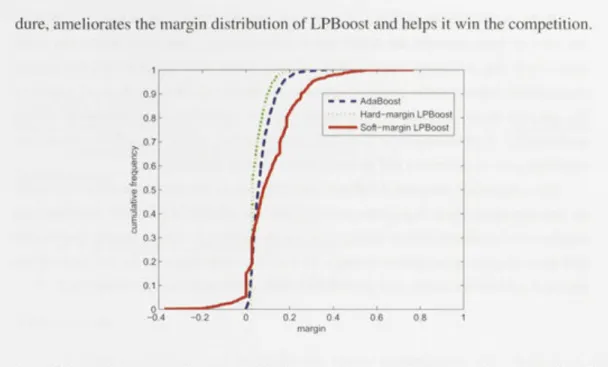
We show one more example. Figure 2.2 illustrates the cumulative distribution of the margins of AdaBoost, hard-margin LPBoost and soft-margin LPBoost on the dataset liver disorder. The soft-margin LPBoost shows the best inargin distribution as
proce-dure, ameliorates the margin distribution of LPBoost and helps it win the competition.
1
0,9 0.8g
S 0.6I
g 0.5I
I 0.43
0.3 0.2 0.1 - 0 . 4 - 0 . 2 - - - AdaBoost Hard-margin LPBoost Soft-margin LPBoost 0.6Figure 2.2: The three margin distributions (AdaBoost, hard-margin LPBoost and soft-margin LPBoost)
on dataset "liver disorder". In this case, soft-margin LPBoost has the best margin distribution and hence
best classification performance.
Here, we summarize the discussion in this section. The margin distribution plays a
more important role than the minimum margin in terms of the classification accuracy
for boosting algorithms. Using LP to approximate the AdaBoost's loss function will
make the new algorithm (LPBoost) neglect to optimize the margin distribution and
pay too much attention to the minimum margin, which almost always deteriorates the
performance. The soft-margin strategy helps LPBoost to some extend because it can
"shift" the attention from the minimum margin to the training error and may lead to
a better margin distribution than hard-margin LPBoost has. But still it is hard to beat
AdaBoost.
2.5 Conclusion
The margin distribution is significant to the explanation of AdaBoost's success. Many
researchers have noticed this phenomenon. AdaBoost's loss function ensures that the
margin distribution will be better and better iteratively, while LPBoost scarifies most
instances' margins to increase the minimum one. The gradient-based feature is a
draw-back of AdaBoost. The LPBoost amends this drawdraw-back but at the same time, it brings a
new and even bigger drawback. Our analysis shows that using LPBoost to approximate
AdaBoost is irnproper and inefficient.
Many researchers are still focusing on ameliorating AdaBoost as well as LPBoost, but most of them consider the AdaBoost as a simple max-min game or pay too much attention to the minimum margin [64]. If they move their interest into the margin distribution, better results might be produced. However, the direction of replacing the gradient-based approach with a more efficient optimization technique is correct undoubtedly. A promising topic is to find a cost function, which would better be convex (and thus easy to optimize) and produce better margin distributions.
The comparison between AdaBoost and LPBoost is the starting point of our work on boosting algorithms. It provides a insight into the success of boosting algorithm and implies two important factors to improve the performance: better margin distribution and more elegant optimization strategy. In the following chapters, we will extend this idea and achieve the above two goals under the convex optimization framework.
A l g o r i t h m 1 LPBoost
I n p u t : Training set {xi, y i ) , i = 1 • • • M ; termination threshold e > 0; regularization parameter D; (optional) m a x i m u m iteration
A'^niax-I n i t i a l i z a t i o n :
1. A^ = 0 (no weak classifiers selected);
2. IT = 0 (all primal coefficients are zeros);
3. iLi = i = I • • • M (uniform dual weights), while t r u e d o
1. Find a new base /?'(•) which has the lowest training error w.r.t. the current data distribution u = [ui,u2, • • • , um],
2. Check for optimal solution:
if Y l f i i Uiyih'{xi) < ? ' + £, t h e n break (problem solved);
3. Add /?/(•) to the restricted master problem, which corresponds to a new constraint in the dual;
4. Solve the dual problem (2.7) to obtain updated r and Ui{i = 1, - •• , M ) ;
5. A^ = TV + 1 (weak classifier count);
6. (optional) if A^ > A'max^ t h e n break (maximum iteration reached),
e n d O u t p u t :
1. Calculate the primal variable w from the optimality conditions and the last solved dual problem;
• - C
^ i ^ f V - '
i
'S <• ' f ' . -SKL' J . - I KS
• - • - ^ X r' • fitA ' ' ' . • ' 'FIR,Chapter 3
On the Dual Formulation of Boosting
Algorithms
3.1 Introduction
As introduced in Chapter 2, LPBoost was invented by [35, 16] with the intuition of maximizing the minimum margin of all training examples. The final optimization problem can be formulated as a linear program (LP). We also observed that the hard-margin LPBoost does not perform well in most cases although it usually produces larger minimum margins. In other words, a higher minimum margin would not nec-essarily imply a lower test error. Breiman [8] also noticed the same phenomenon: his Arc-Gv algorithm has a minimum margin that provably converges to the optimal, but Arc-Gv is inferior in terms of generalization capability. Experiments on LPBoost and Arc-Gv have put the margin theory into serious doubt. Until recendy, Reyzin and Schapire [651 re-ran Breiman's experiments by controlling weak classifiers' complex-ity. They found that the minimum margin is indeed larger for Arc-Gv, but the overall margin distribution is typically better for AdaBoost. The conclusion is that the min-imum margin is important, but not always at the expense of other factors. They also conjectured that maximizing the average margin, instead of the minimum margin, may result in better boosting algorithms.
As the soft-margin S V M usually has a better classification accuracy than the hard-margin SVM, the soft-hard-margin LPBoost also performs better by relaxing the constraints that all training examples must be correcdy classified. Cross-validation is required to determine an optimal value for the soft-margin trade-off parameter. The equiva-lence between S V M s and boosting-like algorithms is shown in [611. Comprehensive overviews on boosting are given by [55] and [75].
We show in this chapter that the Lagrange duals of AdaBoost, LogitBoost and LP-Boost with generalized hinge loss are all entropy maximization problems. Previous work like [14, 41, 42] noticed the connection between boosting techniques and en-tropy maximization based on Bregman distances. They did not show that the duals of boosting algorithms are actually entropy regularized LPBoost as we show in (3.1 1), (3.29) and (3.32). In addition, no column-generation based optimization algorithms for AdaBoost or LogitBoost were derived in the literature. By knowing this duality equiv-alence, we derive a general column-generation based optimization framework that can be used to optimize arbitrary convex loss functions. In other words, we can easily de-sign totally corrective AdaBoost, LogitBoost and boosting with generalized hinge loss,
etc.
Our major contributions are the following:
1. We derive the Lagrangian duals of boosting algorithms and show that most of them are entropy maximization problems.
2. The authors of [65] conjectured that "it may be fruitful to consider boosting al-gorithms that greedily maximize the average or median margin rather than the minimum one". We theoretically prove that, actually, AdaBoost approximately maximizes the average margin, instead of the m i n i m u m margin. This is an im-portant result, in the sense that it provides an alternative theoretical explanation that is both consistent with the margins theory and that agrees with the empirical observations made by [65|.
3. We propose A d a B o o s t - Q P that directly optimizes the asymptotic cost function of AdaBoost. The experiments confirm our theoretical analysis.
4. Furthermore, based on the duals we derive, we design column-generation based optimization techniques for boosting learning. We show that the new algorithms have almost identical results to those of standard stage-wise additive boosting algorithms but with much faster convergence rates. Therefore fewer weak clas-sihers are needed to build the ensemble.
The chapter is organized as follows. Section 3.2 briefly reviews several boosting algorithms for self-completeness. Their corresponding duals are derived in Section 3.3. Our main results are also pre.sented in Section 3.3. In Section 3.4, we then present numerical experiments to illustrate various aspects of our new algorithms obtained in Section 3.3. We conclude the chapter in the last section.
3.2 The Loss Functions of Boosting Algorithms
We first review some basic ideas, and the corresponding optimization problems of AdaBoost, LPBoost and LogitBoost, wiiich are of interest in tiiis present work.
Let W be a class of base classifier H = {/?j (-) : ;f ^ R, j = 1 • • • A^}. A boosting algorithm seeks for a convex linear combination
where w is the weak classifier weights to be optimized. AdaBoost calls an oracle that selects a weak classifier hj{-) at each iteration j and then calculates the weight Wj associated with hj{-). It is shown in [29, 52] that AdaBoost (and many others such as LogitBoost) performs coordinate gradient descent in function space, at each iteration choosing a weak classifier to include in the combination, such that the cost function is maximally reduced. It is well known that coordinate descent has a slow convergence in many cases. From an optimization point of view, there is no particular reason to keep the weights Wi, - • • , wj^i fixed at iteration j . Here we focus on the underlying mathematical programs that boosting algorithms minimize.
AdaBoost has been proved to minimize the exponential loss function [ 14|:
M
mill y^ c x p ( — y i F ( x i ) ) , s.t. w ^ 0. (3.2) w ^—'
Because the logarithmic function log(-) is a strictly monotonically increasing func-tion, AdaBoost equivalendy solves
/ M \
mill log y ^ e x p ( - y i - F ( a ; , ) ) , s.t. it; 0, = (3.3) \l=l J
Note that in the AdaBoost algorithm, the constraint ^ J w = ^ is not explicitly en-forced. However, without this regularization constraint, one can always make the cost function approach zero via enlarging the solution w by an arbitrarily large factor. Here what matters is the sign of the classification evaluation function. AdaBoost selects the value of r by selecting how many iterations it runs. We can also use a relaxed version l^w
We will show that it is very important to introduce this new cost function. All of our main results on AdaBoost are obtained by analyzing this logarithmic cost function,
not AdaBoost's original cost function. Let us define the matrix H G which



![Table 3.2: Description of the datasets. Except mushrooms, svmguidel, svmguideJ and wla, all the other datasets have been scaled to [—1,1],](https://thumb-us.123doks.com/thumbv2/123dok_us/9950675.2487775/67.765.51.725.89.863/table-description-datasets-mushrooms-svmguidel-svmguidej-datasets-scaled.webp)