University of Zurich Main Library Strickhofstrasse 39 CH-8057 Zurich www.zora.uzh.ch Year: 2010
Employee fraud detection under real world conditions
Luell, JAbstract: Employee fraud in financial institutions is a considerable monetary and reputational risk. Stud-ies state that this type of fraud is typically detected by a tip, in the worst case from affected customers, which is fatal in terms of reputation. Consequently, there is a high motivation to improve analytic de-tection. We analyze the problem of client advisor fraud in a major financial institution and find that it differs substantially from other types of fraud. However, internal fraud at the employee level receives little attention in research. In this thesis, we provide an overview of fraud detection research with the focus on implicit assumptions and applicability. We propose a decision framework to find adequate fraud detection approaches for real world problems based on a number of defined characteristics. By applying the decision framework to the problem setting we met at Alphafin the chosen approach is motivated. The proposed system consists of a detection component and a visualization component. A number of imple-mentations for the detection component with a focus on tempo-relational pattern matching is discussed. The visualization component, which was converted to productive software at Alphafin in the course of the collaboration, is introduced. On the basis of three case studies we demonstrate the potential of the proposed system and discuss findings and possible extensions for further refinements.
Posted at the Zurich Open Repository and Archive, University of Zurich ZORA URL: https://doi.org/10.5167/uzh-44863
Dissertation
Originally published at:
Luell, J. Employee fraud detection under real world conditions. 2010, University of Zurich, Faculty of Economics.
Em ploy ee Fraud Detection
under Real World Conditions
DOCTORAL THESIS
FOR THE DEGREE OF A
DOCTOR OF INFORMATICS
AT THE FACULTY OF ECONOMICS,
BUSINESS ADMINISTRATION AND
INFORMATION TECHNOLOGY
OF THE
UNIVERSITY OF ZURICH
by
JONAS LUELL
from
SWITZERLAND
Accepted on the recommendation of
Prof. Dr. A. Bernstein
Prof. Dr. H. Geiger
aforementioned dissertation without expressing any opinion on the views
contained therein.
Zurich, April 14. 2010
Acknowledgements
As no one reads the acknowledgements unless they are very short: Thanks to everyone who supported me, at the university, at the collaborating financial institute, and last but not least at home. Avi, Jiwen (and everyone else in the research group), Eva, Ueli, Susi, Claudia.... : Thank you for giving me this opportunity!
Abstract
Employee fraud in financial institutions is a considerable monetary and reputational risk. Studies state that this type of fraud is typically detected by a tip, in the worst case from affected customers, which is fatal in terms of reputation. Consequently, there is a high motivation to improve analytic detection. We analyze the problem of client advisor fraud in a major financial institution and find that it differs substantially from other types of fraud. However, internal fraud at the employee level receives little attention in research. In this thesis, we provide an overview of fraud detection research with the focus on implicit assumptions and applicability. We propose a decision frame-work to find adequate fraud detection approaches for real world problems based on a number of defined characteristics. By applying the decision framework to the problem setting we met at Alphafin the chosen approach is motivated. The proposed system consists of a detection compo-nent and a visualization compocompo-nent. A number of implementations for the detection compocompo-nent with a focus on tempo-relational pattern matching is discussed. The visualization component, which was converted to productive software at Alphafin in the course of the collaboration, is in-troduced. On the basis of three case studies we demonstrate the potential of the proposed system and discuss findings and possible extensions for further refinements.
Contents
Contents iii 1 Introduction 1 1.1 Motivation . . . 3 1.2 Problem Definition . . . 5 1.3 Hypothesis. . . 7 1.4 Approach Overview . . . 8 1.5 Contributions . . . 9 1.6 Organization. . . 102 Fundamentals, Premises and Related Work 11 2.1 Fundamentals in Risk and Compliance. . . 11
2.1.1 Internal Fraud. . . 15
2.1.2 Internal Fraud at Alphafin . . . 20
2.1.3 Compliance . . . 27
2.1.4 Money Laundering . . . 27
2.1.5 Other Types of External Fraud . . . 28
2.1.6 Countermeasures . . . 28
2.2 Fundamentals of Data Mining. . . 29
2.3 Related Work . . . 32
2.3.1 Classifying Related Work: Prior Knowledge Levels . . . 32
2.3.3 Fraud Detection Based on Prior Identification Knowledge . . . 39
2.3.4 Excursus: Relation Based Approaches . . . 42
2.3.5 Fraud Detection Based on Prior Model Knowledge . . . 48
2.3.6 Visual Data Mining. . . 55
2.4 Fraud Detection Approaches — A Unifying Framework. . . 56
2.4.1 Basic Preconditions. . . 57
2.4.2 Company Factors . . . 58
2.4.3 Fraud factors . . . 61
2.4.4 Population Factors . . . 63
2.4.5 Conclusion . . . 64
2.4.6 Applying The Framework To Our Project . . . 67
3 Solution Approaches 71 3.1 The Visualization Component . . . 71
3.1.1 Justification . . . 71
3.1.2 Main Requirements. . . 72
3.1.3 System Description . . . 73
3.1.4 The Network View . . . 73
3.1.5 The Timeline View . . . 76
3.1.6 The Tabular View . . . 76
3.1.7 View Editing and Consistency . . . 76
3.1.8 Pattern Annotation . . . 79
3.2 The Detection Component . . . 81
3.2.1 The ChainFinder . . . 81
3.2.2 Excursus: An Alternative Idea - The GraphSlider . . . 90
3.2.3 The Transaction Matcher (TMatch) . . . 92
4 Application and Evaluation 101 4.1 Application Considerations . . . 101
4.2 The Data Set . . . 104
4.3.1 Evaluation Goals . . . 106
4.3.2 Data Basis and Configuration . . . 107
4.3.3 Commonness of Chain Structures . . . 108
4.3.4 Identification of a Reference Fraud Case . . . 112
4.3.5 Evaluation Efficiency . . . 112
4.3.6 Example Investigation . . . 113
4.4 Case Studies II and III: AML/ Compliance Analysis . . . 116
4.4.1 Case Study II . . . 118
4.4.2 Case Study III . . . 124
4.4.3 Discussion . . . 128
4.5 Synthetic data evaluation . . . 133
4.5.1 Criticism . . . 133
4.5.2 ChainFinder Runtime Evaluation. . . 135
4.5.3 TMatch Runtime Evaluation . . . 135
5 Future Work 139 5.1 Extended TVIS User Group Customization . . . 139
5.2 Automated Exclusivity Scoring . . . 139
5.3 Structural Peer Group Analysis . . . 140
5.4 Connection Probability . . . 141
6 Limitations and Conclusions 143 6.1 Limitations. . . 143
6.2 Conclusions . . . 144
A Implementation 145 A.1 TVIS Implementation . . . 145
A.2 ChainFinder Implementation . . . 145
A.2.1 Java Implementation . . . 145
A.2.2 SQL Implementation . . . 148
A.3 TMatch Implementation . . . 148
A.5 Example TMatch Score Results . . . 153
List of Figures 157
List of Tables 159
Bibliography 161
1
Introduction
This thesis studies the application of data mining and graph pattern matching techniques in com-pliance and risk related topics within a financial institution. The main focus lies on internal or employee fraud. Based on the findings, solutions to practical challenges in this problem field are proposed. A detection system, which has shown its potential under real world conditions, is introduced.
The research background originates from a collaboration with a major financial institution. To simplify matters, the collaborating company is calledAlphafin within this thesis. Alphafin’s fraud specialists, based on their expertise and prior tests, doubted common analytic fraud detection methods (like profiling) to be effective for the special case of internal fraud. A research project was started to further investigate the subject and to propose feasible solutions.
After concentrating on internal fraud, the focus was shifted to anti-money laundering related topics in a second stage, where the developed solutions were adapted and extended for the new application area. The findings of both stages are presented in this work.
Considering the common dichotomy ofITandBusinessin the financial sector, this thesis resides on the interface between the two positions. The design process is heavily influenced by both worlds on all abstraction levels. In particular, the developed algorithms are specialized to meet the practical requirements in a straightforward way.
In the course of this thesis, we tried to combine the perspectives of academia and industry on the one hand, and of informatics and business on the other hand. While being a computer science thesis, this work also intends to address the technically interested business expert. Although a very short introduction is given, basic knowledge of data mining and graph theory is assumed.
Relevant business information is given to the possible extent in the presence of non-disclosure agreements with Alphafin.
1.1
Motivation
The main background of this thesis is the mitigation of financial and reputational risk. Direct financial risk arises from losses caused by internal fraud. If a customer notices unjustified irregu-larities in his/her assets or if a bank is associated with internal fraud cases in the media, the effect can be a substantial loss in reputation. Losing reputation is losing trust, which is the foundation of banking business per se [Geiger, 2008]. Customers losing trust in their bank will withdraw their assets and terminate the business relation. It is therefore crucial for a financial institute to get employee fraud under control and, at best, give the impression that there is no such thing as internal fraud.
Improving a fraud detection system is typically about reducing a very high false positive rate1.
False positives, which have to be investigated before being identified as what they are cause costs without direct benefit. Additionally, false alerts can upset the persons concerned. Nobody likes to be suspected. In the special case of internal fraud, these people are employees. Violating the mutual trust is dangerous for a company, as it can lead to a reduction in employee morale and loy-alty. Minimizing this risk can be accomplished by identifying false positives before the involved person has to be informed or interrogated, e.g., by using a system which allows a holistic view on suspicious transactions. On the other hand, fraud detection systems may help to increase the expected risk for committing fraud. In ”Crime and Punishment: An Economic Approach”, the au-thor suggests that the decision to commit a crime is based on a conventional cost-benefit analysis [Becker, 1968]. Knowledge or assumptions about sophisticated fraud detection systems and/or uncovered cases may therefore raise the inhibition threshold. However, at least at Alphafin, an analysis of known fraud cases questions the assumption of a rational cost-benefit decision as il-legal behavior often seems to emerge from frivolity — and subsequent desperation (see section
2.1.2). Disclosure or concealment of the existence of fraud detection systems and uncovered cases is a classical tradeoff between deterrence and divulgement of informational advantage (see Figure
1.1).
The setup and configuration of detection systems in a company like Alphafin is a non-trivial
1= a very high number of ”false alerts”,i.e. instances which are reported by the system as suspicious but turn out to be
undertaking with high complexity. For example, new work flows have to be built and integrated, accounting for the highly confidential nature of the data. Adjusting and tuning system param-eters requires comprehensive knowledge about the business and data. A common way to keep complexity and costs as low as possible is the limitation to — from an academic point of view — basic and well-known detection approaches, as e.g. plain threshold monitoring. This motivates the search for more expressive solutions which still meet the demands in terms of straightfor-wardness and feasibility.
For a profit-oriented company, evaluation of numerous novel approaches is typically out of scope. On the other hand, specialized commercial vendors may have the resources to do experi-mentation, but normally do not have access to the real data of their customers, which complicates the process. Academic research is a possible way to fill the gap and propose expressive but feasi-ble approaches.
1.2
Problem Definition
Fraud detectionsuggests itself to be defined as an information-retrieval (IR) orprecision/recall prob-lem2. This requires the definition of the class ofrelevant items. One obvious possibility is to define
relevant items as “fraud”. At Alphafin, there is a number of reasons why this is problematic: • Relevant activities may not be limited to explicit fraud, and a clear boundary between fraud
and non-fraud may be hard to define. A certain behavior may be, for example, legal, but not compliant to company policies or, in an even weaker form, noneconomic and therefore undesirable. What is of interest for investigators may be fuzzy and may change over time or depend on variables which cannot be observed.
• Only a subset of the information which is necessary to clearly identify fraud is available in machine-readable format. This may be due to missing access authorization or to incompat-ible media formats. Investigators may proceed outside of the system as soon as a suspicion substantiates, for example in the form of interrogations and the review of free-text docu-ments.
• As mentioned above, the human factor is crucial in the fraud finding process. The definition of “fraud” as relevant items mingles user experience with system accuracy.
An alternative is therefore the definition of a relevant itemas ”data of sufficient interest for the user” (hot spots) . Although this definition is less formal and quantification is difficult, it is more convenient for the actual problem. However, identification of precision and recall remains a challenge:
• The true recall is, by definition, unknown. To calculate recall, all fraud (or “interesting”) data has to be known without exception, which is only possible if the problem we try to solve is already sorted out.
• Precision may be assessable, but its optimal value is not necessarily ”one” as in typical IR-Systems. Users may want to see the “border” between interesting and uninteresting behavior. Even more, this border may become only clear in the process of analyzing the retrieved data. The system may be used not only forhot spotdetection, but also (and at the
same time) for learning about previously unknown structures in the data. Precision may not be an adequate quality measure in this case.
We therefore redefine the problem at hand more generally ascomputer-assisted hot spot identifi-cation for domain experts. The quality measure is the work efficiency and effectiveness when using the system based on expert assessment.
1.3
Hypothesis
Our main hypothesis is the following: “It is possible to combine and extend available data mining or pattern matching techniques to build a novel, feasible and valuable internal fraud detection system complementing existing solutions”. In the process of this thesis, design decisions led to a number of sub-hypotheses which will be mentioned in the appropriate passages.
1.4
Approach Overview
Our approach consists of two main components: a detection component and a result evaluation component.
Thedetection componentprovides the functionality to detect and retrieve hot spots in the data. This component is not a black box — the user is able to configure and adapt the detection algo-rithms. Different specialized implementations for this component are proposed in this thesis. The implementations vary in complexity and strategy for handling huge amounts of data, represent-ing different points on the classical memory/runtime tradeoff .
The relational and temporal nature of the data and the properties of suspicious transaction pat-terns implicates that detected hot spots are extremely hard to investigate in the usual tabular data view. Therefore, anevaluation component, which relies heavily on visualization, was developed. It is tailored to the needs of internal fraud investigators, accounting for the special characteristics of internal fraud, which is described in closer detail in the following chapter. The insights from evaluation can be used to reconfigure the detection component, allowing a refining and learning process.
Figure 1.2:A very high level system overview
The evaluation component can be used without the detection component. In this case, hot spots are not identified automatically, but user-driven, for instance based on customer complaints or other hints. This mode is calledad-hocsearch. The first stage of the collaboration with Alphafin focused exclusively on the design and development of the visualization component as it was required to get access to the data.
1.5
Contributions
This thesis is application oriented. Therefore the main contributions result from finding the best way to solve a real-world problem. We provide an answer to the following question: “How can existing work be adapted and applied to deliver a detection approach for the special case of employee fraud under real world conditions?”
Related contributions are:
• We analyze the potential of data mining and pattern matching techniques for internal fraud detection within a financial institution.
• We elaborate on the assumptions on which existing data mining solutions build and propose a framework to support the choice of a fraud detection approach in various settings. • We discuss crucial issues of introducing fraud detection systems in financial institutes.
• We provide a fraud detection approach which stands the test of applicability under con-straining conditions.
• We propose a number of potential paths building on this work and justify why preliminary steps were necessary.
1.6
Organization
This thesis is organized as follows.First, we introduce the problem field and the attendant circumstances. We analyze the char-acteristics of internal fraud and related topics. The real world constraints, which played a major role in this work, are described. We then refer to related work with a focus on data mining and pattern matching approaches and discuss their applicability.
Second, we present our solution approach. We describe the system design and introduce different implementations for the detection component with their advantages and disadvantages. Third, we discuss application aspects. The findings when evaluating on real data are given. For the sake of completeness, evaluation on synthetic data is delivered.
To conclude, we discuss the limitations of our approaches. Part of those limitations is sup-posed to be conquerable with future work. We introduce ideas for future research which in our opinion possess potential but were out of scope for this thesis.
2
Fundamentals, Premises and
Related Work
2.1
Fundamentals in Risk and Compliance
Needless to state: fraud is a huge and very diverse area, which can be looked at from numerous possible views (e.g. from the social, legal, economic, or analytical perspective). We will keep the general information on fraud very short and focus on aspects which are of particular interest for this thesis. Consider the following possible definitions for the general term of fraud found in literature:
• “Intentional deception resulting in injury to another, as when a person makes false state-ments, conceals or omits material facts.”[Fitch, 2006]
• “The abuse of a profit organizations system without that abuse leading necessarily to legal consequences”[Phua et al., 2005]
• “Criminal deception; the use of false representations to gain an unjust advantage”[Bolton
and Hand, 2002]
• “In law, the deliberate misrepresentation of fact for the purpose of depriving someone of a valuable possession or legal right”[Encyclopedia Britannica, 2006]
• “A false representation of a matter of fact whether by words or by conduct, by false or misleading allegations, or by concealment of what should have been disclosed that deceives
and is intended to deceive another so that the individual will act upon it to her or his legal injury.”[Jeffery Lehman, 2004]
The concepts ofdeceptionandmisrepresentationat the damage of another individual are com-mon terms for defining fraud — which is not surprising. As mentioned above, the term fraud denotes a wide and heterogeneous scope of activities. Prominent examples of fraud areas are
• Insurance fraud (e.g. fraudulent car or health insurance claims)
• Telecommunications fraud (phone cloning, subscription fraud)
• Investment fraud (pyramid schemes, insider trading)
• Employee fraud (falsification of balance sheets, embezzlement)
• Credit Card fraud (stolen or cloned credit cards)
• Retail fraud (forgeries, fake sales)
• Advance fee fraud (Nigerian money offer, lottery scam)
• Computer and internet fraud (Phishing, Spoofing,. . . )
As for example in computer and internet fraud, a clear differentiation between fraud areas and fraud instruments is not always straightforward. Instead of undertaking the definition of an exhaustive taxonomy of this broad field, we narrow our focus to known fraud schemes in the field of banking.
• Cheque fraud
Cheques can be stolen, altered to an illegitimate payment recipient and higher transaction amount (adding a few digits) and/or provided with a forged signature or even be com-pletely forged. The area of cheque fraud alone is a complex field, where, to our knowledge, detection is typically a highly manual process. Suspicious properties of hand- or machine-written cheques are recognized by trained human experts.
• Trading fraud
An employee may trade sizeable assets on behalf of a customer or the bank without cus-tomer order. If invested money is lost, trading can become even more intense and
aggres-sive in the hope to cover the loss. This behavior led to some of the largest bank frauds ever detected [Clark and Jolly, 2008]
• Loan fraud
Fraudulent loan applications as a form of external fraud can contain false information to hide financial problems. Also, employees may knowingly approve loans to accomplices who declare bankruptcy or vanish after receiving the money.
• Forged documents
Forged documents (not only cheques and credit slips) can be used to trigger or cover illicit transactions.
• Bill discounting fraud
This type of external fraud is on hand when a customer builds up confidence with a bank. Accomplices will readily and repeatedly pay bills issued by the customer (and raised by the bank). After successfully simulating reliable behavior, the customer requests that the bank settles its balance with the company before billing the customer. As soon as the outstanding balance between the bank and the company is large enough, the customer disappears with the money and his/her accomplices.
• Payment card fraud
Payment cards can be stolen, duplicated or skimmed by various means. Obtaining the re-quired information can for example be accomplished by manipulating ATMs.
• Identity theft
This type of fraud works by obtaining information about an individual and using this infor-mation to apply for identity cards, accounts and credit in that persons name. Various ways of obtaining the required information are possible (e.g. indiscreet insiders or phishing).
• Trick fraud
This summarizes fraud which is based on tricking legitimate account owners into paying money to the fraudster. Variants are simulating a “prime bank” with promising conditions, impersonating officials, forged emails and other pishing attacks.
• Computer fraud
Technical attacks, in particular aimed at the identification and authentication mechanisms of e-banking solutions, is a type of relatively new bank fraud.
• Money laundering
can also be seen as a special kind of bank fraud which aims at hiding the true (illicit) origin of funds.
Categories (Level 2) Activities Examples (Level 3)
Unauthorized activity Transactions not reported (intentional)
Transaction type unauthorized (with monetary loss) Mismarking of position (intentional)
Theft and fraud Fraud/ credit fraud/ worthless deposits Theft/extortion/embezzlement/robbery Misappropriation of assets
Forgery Check kiting Smuggling
Account take-over / impersonation etc Tax non-compliance/ evasion (willful) Bribes/ kickbacks
Insider trading (not on firms account)
Table 2.1:Basel IIcategories and activities for event type categoryInternal Fraud
2.1.1
Internal Fraud
In theBasel IIaccord1 [Basel Commitee on Banking Supervision, 2006], loss events from
opera-tional risk are broken down into seven general categories, of which one is Internal Fraud. The committee defines it as
“Loss due to acts of a type intended to defraud, misappropriate property or circumvent regulations, the law or company policy, excluding diversity / discrimination events, which
involves at least one internal party ”
The categories and activities examples for the event type categoryInternal Frauddefined inBasel IIare listed in table2.1.
Another definition is given by theAssociation of Certified Fraud Examiners(ACFE):
“The use of ones occupation for personal enrichment through the deliberate misuse or misapplication of the employing organizations resource or assets.”
Extensive analysis in the field of occupational fraud from a business-oriented view has been done and published in particular byACFE, whose annuallyReports to the Nation on Occupational Fraud and Abuseare freely available [Association of Certified Fraud Examiners, 2008]. The authors propose an extensive occupational fraud and abuse classification system (see Figure2.1). Another
1The Basel II accord forms recommendations on banking laws and regulations issued by the Basel Committee on
valuable information source is the series of papers in internal fraud management by theSanta Fe Group2. In our thesis, we will therefore just point out the most important findings in a nutshell
before focusing on the characteristics of the internal fraud cases we analyzed at Alphafin.
The2008 Report to the Nation [Association of Certified Fraud Examiners, 2008]based on data com-piled from 959 cases of occupational fraud between January 2006 and February 2008 found that
• Participants of the study estimated that U.S. organizations lose 7% of their annual revenues to fraud, translating to approximately 994 billion dollars in fraud losses.
• The median loss in the analyzed cased is 175’000 dollars and one quarter of the cases in-volved losses of at least one million dollars.
• The typical fraud case lasted two years from starting the fraudulent behavior until its detec-tion.
• The most common fraud schemes were corruption (27%) and fraudulent billing schemes (24%), while financial statement fraud was the most costly category with a median loss of two million dollars.
• Despite increased focus on anti-fraud controls in the wake of Sarbanes-Oxley [Sarbanes and
Oxley, 2002]and mandated consideration of fraud in financial statement audits due toSAS 99[Jeffery Lehman, 2002], the data shows that occupational frauds are much more likely to be detected by a tip (46%) or by accident (20%) than by audits (28.5%), controls (23.3%) or any other means.
• Implementations of anti-fraud controls appear to have measurable impact on an organiza-tions exposure to fraud.
• Banking ranges as the industry with the second largest median losses (250000 dollars) only exceeded by the manufacturing industry (441000 dollars).
• Occupational fraudsters are generally first-time offenders and work in the accounting de-parture or upper management.
• Fraud perpetrators often display behavioral traits that serve as indicators of possible illegal behavior (e.g. living beyond their apparent means or experiencing financial difficulties at the time of fraud).
An article in Bankers Hotline[Bankersonline, 1992] states that “money laundering gets all the publicity, but there are numerous areas where fraud and theft take place in a financial institution”.
Figure 2.1: Occupational Fraud and Abuse Classification System as proposed in ACFE’s 2008 Report to the Nation [Association of Certified Fraud Examiners, 2008]
The authors furthermore state that employees steal because they “truly believe they won‘t get caught”and “feel overworked and underpaid and are out to ”get back” the financial institution”. This may gain brisance in times of a financial crisis with reputational challenges and job insecu-rities. In their initial paper on the current landscape of internal fraud, theSanta Fe Groupwarns that criminal activity occurring inside financial institutions extends far beyond material gain for the individual employee, but may feed activities of fraud rings and other criminal groups around the globe. In theirForensic Fraud Barometer 2009 [Osborne, 2009]KPMG reports that “fraud nears record levels in 2008 and worse to come” in the UK with ”over£1.1bn of fraud nationwide, the second highest level in 21 years”.3 Summarizing these insights, we can state that even when
ig-noring reputational losses (which seems to be the case in the reports cited above), internal fraud causes considerable damage. The high level of fraud cases revealed by hints indicates that applied monitoring solutions may have room for improvement. A fraud which is only revealed after the deceived customer complains is a worst case scenario concerning reputation in particular for the banking business, which relies highly on customer trust.
2.1.2
Internal Fraud at Alphafin
We conducted extensive discussions with fraud experts and an analysis of available fraud case reports to gain knowledge about internal fraud cases at Alphafin. As we are not allowed to communicate details of fraud cases due to non disclosure agreements, we present our findings in a summarized form which nevertheless can be used to explain our design decisions in the later parts of this thesis.
Introduction
As mentioned above, a wide variety of internal fraud exists both at the management and em-ployee level. The focus we were given at Alphafin is customer advisor fraud.
A customer advisor manages the accounts of the assigned clients4. Client types can range from
small private savers to huge corporate customers. As customers are extremely heterogeneous (not only in the size of their assets) customer contact may range from barely existent to good personal relationships. Customer advisors are authorized to trigger transactions concerning their clients assets, under certain conditions without explicit and written customer order. For simplicity, we assign theManual Transaction Type (MTT)to all such transactions. MTT transactions are needed to allow for flexibility in customer service. This entails the augmented necessity of appropriate control mechanisms. If the amount of aMTTtransaction exceeds a defined threshold, operational control measures kick in. Below this threshold, monitoring solutions are needed to handle the large amount of daily processed data.
It is worth noting that whileMTTis assumed to be more prone to fraudulent activities, a cus-tomer advisor may avail himself of other transaction types in combination with counterfeiting required documents and other instruments which are also used by external fraudsters. However, the internal fraudster may have a superior knowledge in comparison to his/her external counter-part. In [Luell, 2005], we listed the premises a client advisor potentially has to commit fraud:
• Detailed knowledge of internal processes and systems (and maybe security flaws)
• Required authorizations to trigger transactions
4Customers can have several accounts. Legal bodies in turn may be represented by more than one “customers”. As
this does not affect our explanations (but is, however, crucial at a more detailed level which is confidential), we treat the termscustomerandaccountinterchangeably in this thesis.
• Knowledge of (usual) behavior and alertness of managed customers
• Fundamental confidence from co-workers and subordinates.
Prominent Elements of Fraud Cases
In the following we list elements which repeatedly occurred in analyzed fraud cases:
Illegitimate speculative trading An important element and often the motivation for further il-legal behavior is illegitimate speculative trading. Consider a customer advisor which persuades his clients to approve highly speculative trading transactions promising high profits without suf-ficiently exposing the connected risks. At the loss of the money the employee tries to minimize the customers financial damage to avoid a customer complaint uncovering the fallible behavior. A more blatant variant is the trading without any customer knowledge, let alone order. The in-tention is typically to generate profit for personal enrichment without the customer ever learning about the transactions. If the trading does not result in profit, but in loss, the disappearance of assets needs to be covered to avoid exposure.
Extensive asset shifting No matter if money is lost in trading or withdrawn to an unjust benefi-ciary, numerous transactions are necessary to conceal and obscure the transfers. One purpose for rearranging and shifting money in complex patterns is the temporary balance of missing amounts in the wake of examinations. Another goal is the concealment of the true origin (or destination) of monetary shifts. Doing so, a fraudster will typically act with caution and try to hide such trans-fers in the mass of legal transactions. The comparatively low amounts of fraudulent transactions (see below) ease the concealment. Similar behavior — but typically at a much bigger scale — is known from the field of money laundering where it is calledLayering[Altenkirch, 2006].
Exploitation of weakly supervised accounts Not every account is regularly checked by the owner. A fallible customer advisor will know about the accounts which are largely unattended. An attentive customer which regularly receives and checks his/her financial asset documents will soon spot irregularities. More suitable victims do not have a clear overview regarding their as-sets and barely receive or read documentation. Illustrative examples are highly aged customers
without any affinity for financial affairs and little assistance from their environment. A customer advisor we were allowed to interview stated that a notable number of customers show only min-imal interest in their assets. However, we were not able to verify if this is generally true.
Exploitation of diverse vulnerabilities in processes and systems As the information may be highly specific to our industry partner, details are both confidential and of very limited gener-alizability. It is, however worth stating that, while some of the weaknesses can be eliminated after being revealed, this is not true for all. Some soft spots may be intrinsically tied to process efficiency and flexibility. Processes and systems cannot be always optimized for maximal security.
Gradual increase of fraudulent transactions Fraudsters will typically start with very cautious, scarce transactions and gradually intensify the activity as the confidence not to be caught increases over time. It is tempting to try again what worked once.
Single perpetrators, no organized crime While it may be attractive for organized crime to in-filtrate companies with the goal to steal data, doing the same to steal money may not be the best choice (at least in the situation at hand). The (expected) level of supervision, identifiability and non-repudiability is too high. As stated before, we are concerned with opportunity crime and acts of desperation after minor or major offenses. We didn’t meet a single case where a collaboration of several fraudulent employees was observed or an employee was involved in organized crime. Experts repeatedly affirmed that organized external or internal accomplices are highly unlikely. However, it is imaginable that a fraudster incorporates unsuspecting subordinates or customers to a certain level.
Relatively static, recurrent fraudulent behavior As a consequence of low professionalism, in-ternal fraud as we met it is typically less sophisticated than elaborate exin-ternal fraud or anti-money laundering methods where fraudsters quickly adapt to new situations and circumvent new de-tection systems. As perpetrators are not able, nor trying to learn from each other, observed fraud-ulent behavior is relatively static over time, apart of course from subsequently closed flaws.
Extremely rare occurrence We found very rare occurrence of internal fraud. Of course, this observation is solely based on revealed cases. A rough estimate of fraudulent transactions in the
given data set with a time window of the two most recent years lies in the range of1×10−7%to
5×10⁻⁷%of all transactions5. This value is considerably lower than the ones reported in [Phua et al., 2005], giving an overview of fraud vs. legal ratios in the data sets used in related work. While most of the data sets exhibit fraud proportions between 10% and 25%, the lowest ratio declared is 0.1% in [Kim et al., 2003b;Cahill et al., 2002].
No generalizable delinquent profile Fraud experts at Alphafin reported that an extensive project was conducted with the goal to describe “the typical fraudster”in terms of age, duration of em-ployment and so on in order to identify periled employees. The findings were that a profile could not be defined due to the small number of examples and the considerable heterogeneity which was much higher than expected.
Low transaction amounts Basically, additional control mechanisms kick in if a defined thresh-old is exceeded which complicates covering. Beyond this, fraudsters are well aware that the higher transactions are, the higher is the risk that they cause a stir. So amounts of fraudulent transactions are kept as low as possible. Needless to say, on the other hand the expected profit has to be worth the risk so trifle amounts will also not occur in fraudulent transactions.
Recurring patterns (Chain Transactions, Smurfing) This characteristic is closely connected to the extensive asset shifting. As these patterns are central for the design of our approach, we will discuss them in greater detail in the following section.
On Recurring Fraud Patterns
In the visual analysis of known cases we encountered a number of patterns which were confirmed by fraud experts to recurrently serve as indicators for fraudulent behavior in manual investiga-tion. Those patterns can be summarized under the termsTransaction ChainsandSmurfing activ-ities. Transaction Chains and Smurfing are well-known instruments for concealing actions in a wide variety of illegal activities.
We define aTransaction Chainas follows:
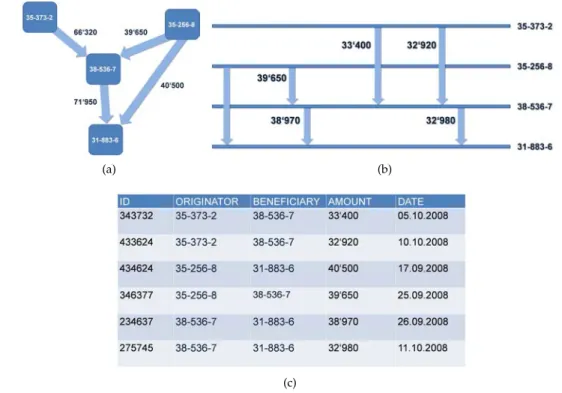
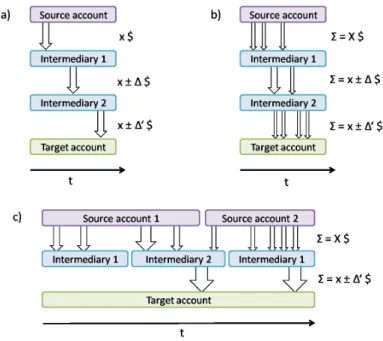
Definition 1 A transaction chain is the transfer of money from a source to a target via 1-n intermediary points (e.g. accounts) within a short time period (typically one to a few days) where the amount of money leaving the source approximately equals the amount of money arriving at the target.
Each of the three roles (source, intermediary, or target) has its unique characteristics and impli-cations for suitable accounts taking this role. The detour over one or more intermediary nodes is typically necessary to avoid the obvious transfer from a basically suspicious constellation of source to target accounts. Money is typically only kept for a short time at intermediary accounts because they are no safe harbors. Chains can also emerge from efforts to balance discrepancies on victim accounts on a short-term basis. In this case, a loop chain where the source and target node are identical is also possible.StructuringorSmurfingdenotes the splitting of money transfers into numerous smaller transactions for further concealment. Figure 2.2shows examples of different complexity. In its most simple form, a chain consists of single, approximately equal transactions (a). In a more elaborate version, the transferred money is broken into several smaller transactions from one station to the other (b). Another possibility is the distribution of the amount to several intermediaries (and/or targets ) (c) . While complex pattern incorporating structuring may seem “more promising”for a fraudster at first sight, this technique requires more triggered transactions and is more laborious. A fraudster may want to avoid this because he/she feels (i) safer initiat-ing as few transactions as possible as additional transactions increase the possibility of random discovery, or (ii) so safe that he/she avoids the additional work and delay in setting up elaborate Structuring. Interestingly, even though these patterns may be well known they seem to play a relevant role in internal fraud.
Figure 2.2:Transaction Chains andSmurfing
Why the Focus on Transaction Chains and Smurfing?
While our approach allows to define and retrieve a wide variety of patterns where the relation of attribute values between nodes and/or edges in the graph6are of special interest, we focus on
Transaction Chains and Smurfing patterns. The reasons for this decision are the following: • These patterns have repeatedly been observed in connection with fraud cases. However,
none of these cases has been revealed on the basis of these patterns as adequate monitors do not exist.
• The assumption seems reasonable that these patterns occur independently from the ex-ploitation of specific flaws. They may therefore have a higher general discriminative power than vulnerability specific patterns as the according weaknesses may be closed by opera-tional measures.
• Although chains and smurfing are denoted as typical of fraud by experts, we encountered
6Accounts (or customers) and transactions between them can be interpreted as a graph, where accounts represent
nodes and transactions represent edges in the graph. This perspective is common for structural analysis, for example in Social Network Analysis [Wasserman and Faust, 1994].
comparatively low knowledge about their discriminative power. How common these pat-terns are in legal behavior and under what circumstances they may occur is largely un-known. To evaluate this and provide the knowledge to human experts has become one of the goals of this thesis. This implies that we do not solely want to find fraud, but find pat-terns of interest and learn about their general occurrence, which helps to refine the experts model of fraud.
• It has never been our goal to develop an all-in-one-solution but to complement applied approaches. We tried to classify analyzed cases roughly into three categories.
– Cases in the first category require information beyond the available data, (e.g. personal relationships, general financial status) for detection.
– The second category contains cases that can be detected with technically straightfor-ward threshold filters over the stream of transactions (for example implemented in SQL).
– Fraudsters in the last group more or less successfully conceal their activities by com-bining groups of inconspicuous transactions that disappear in the mass of similar legal movements. The use ofChain TransactionsandSmurfingwas intense in this group.
For the above reasons, it is the members of the last group that we decided to focus on. It has to be stated that we do not argue or expect that almost all internal fraud will contain transaction chains and structuring. But we argue that it is worth examining those structures as they are helpful means to circumvent existing fraud detection solutions.
2.1.3
Compliance
Compliance can be defined as “acting according to certain accepted standards” . Compliance violations according to company regulations may occur due to (possibly willful) ignorance or negligence. Customer advisors may not follow mandatory processes, make use of a system in other than the intended way or act uneconomically. Internal fraud can be seen as severe non-compliant behavior with criminal intention. The detection of non-non-compliant behavior is therefore related to internal fraud detection.
Without delving into the topic it turned out that our approach may have considerable potential in this area (see section4.3).
2.1.4
Money Laundering
One of the most prominent forms of fraud is money laundering. Countermeasures, or anti money laundering (AML) is of particular but not exclusive interest for the financial industry. Legal reg-ulations commit financial and non-financial institutions to identify and report suspicious money transactions to financial intelligence units in most countries [Moll, 2009]. Legal regulations are for example defined by the Bank Secrecy Act of 1970 and the USA PATRIOT Act in the U.S. and by the Swiss Anti Money Laundering Act of 1998 (SAMLA). Since 2009, the Swiss Financial Market Supervisory Authority (FINMA) is in charge of the governmental supervision in Switzerland. The Financial Action Taks Force (FATF) is an inter-governmental organization founded in 1989 by the G7 forum. TheFATFcurrently comprises 32 member jurisdictions and 2 regional organizations, representing most major financial centers in all parts of the globe [FATF, 2009].
Due to organizational changes during the course of this thesis, the focus on internal fraud detec-tion was switched to certain aspects ofAML, in particular theKnow Your Customer(KYC) princi-ple. The approach developed for internal fraud detection was therefore extended and adapted to evaluate its potential in the area of AMLas well (see section4.4.1). However, in contrast to internal fraud, we did not have the possibility to analyze the characteristics of money launder-ing in Alphafin extensively, but relied onAMLexpert input. Therefore we refer to the numerous publications available in this domain, e.g. [Altenkirch, 2006].
2.1.5
Other Types of External Fraud
The issue of external fraud was not broached in this thesis—with the exception of a quick glance at money laundering. Potential of the proposed solutions in detecting external fraud in Alphafin remains future work.
2.1.6
Countermeasures
Countermeasures can have two basically different goals: • Fraud prevention
• Fraud detection
Avoiding fraud is preferable to detecting it when it already happened, but is not always possible. Safeguarding and keeping business processes flexible and efficient may antagonize each other. Preventive countermeasures can be implemented at two different levels:
• Organizational
Qualified structures and competence orders can avoid or complicate illicit acts and close organizational flaws. Training and company culture may be used to raise fraud awareness. • Operational
measures adapt business processes and applications to hinder violations and misuse. Exten-sive control measures come at the risk of upsetting employees and to cumber daily business. An example is the two-person integrity for sensitive processes.
Detection requires analytical countermeasures. In [Luell, 2005], we distinguished four possible procedures for analytical fraud detection:
• Day-to-day inspection of the total data by fraud experts
All the data is searched for conspicuous patterns which are investigated in detail. Due to the high manpower requirements, this approach is only feasible for a very limited amount of data and if fraud has to be detected at any cost.
• Samples are drawn from the total data and inspected.
a more or less random process. Sample size might be chosen on the basis of disposable manpower. This approach is a possible choice if investigation of the total data is infeasible. Its relatively undirected nature calls for more effective approaches. In particular if fraud is extremely rare, the chance of a “lucky strike” is far too low.
• Based on concrete hints and complaints an explicit, a constricted subset of the data is in-vestigated. A customer may notice discrepancies in asset documentation and informs the company. A case-based investigation is the consequence. Case-based detection might be a widespread and accurate approach, but it is, basically, “locking the stable door after the horse has bolted”. At this point, at least reputational loss has already happened, and the goal is damage limitation. Detecting fraud before the cheated customer realizes it is defi-nitely preferable.
• The total data is automatically searched for potentially critical subsets which are presented to human experts for closer investigation. Depending on the accuracy of the identification and retrieval of critical subsets, this approach may allow for a significant improvement of efficiency and effectiveness in comparison to the procedures mentioned above. Different strategies for identifying adequate concepts and retrieving patterns of interest are discussed in the section2.3.
As expected, our approach falls into the last category of possible procedures.
2.2
Fundamentals of Data Mining
What is data mining7? This term denotes the computer-aided discovery of patterns of interest in
data bases and therewith revelation of valuable information previously hidden in the potentially massive amount of data. Consider the data of purchases in a supermarket. Hundred thousands of shopping baskets may be recorded every day for a large supermarket chain. Data mining algo-rithms may search the data and find patterns like “Customers which buy red wine and French cheese will, with very high probability, also buy baguette”or “In rural regions, female customers at the age of 40 to
7This section is intended for the reader not familiar with data mining and related topics. Others can safely skip it.
The goal is to provide a very short high level description of the concepts required to understand the assessment of related work and the derivation of our approach decisions.
50 can be classified as high-value customers.”Data mining is the core of theKDD-Process (Knowledge Discovery in Databases), which is concerned with the selection, preprocessing, transformation and mining of data, including the evaluation and interpretation of the results. Data mining is just a tool, human (business) experts evaluating and considering the value of identified patterns is typically indispensable. Data mining algorithms generally aim for prediction or description. Pre-diction makes use of some attributes in the database to predict unknown or future values of other variables of interest. Description focuses on finding human-interpretable patterns describing the data [Fayyad et al., 1996]. At a slightly more detailed level, data mining can be divided into the following tasks (description is based on [Fayyad et al., 1996]):
• Classification is a learning function that maps (classifies) a data item into one of several predefined classes (e.g. the classification of a customer into “defrauded”or “not defrauded”) • Regression is a learning function that maps a data item to a real-valued prediction variable
(e.g. the prediction of a customers lifecycle value in dollars)
• Clustering is a common descriptive task where one seeks to identify a finite set of categories or clusters to describe the data (e.g. identifying relevant target groups of customers) • Dependency modeling focuses on describing dependencies and associations between data
items (e.g. finding products which are commonly purchased altogether)
• Change and deviation detection focuses on discovering the most significant changes in the data from previously measured or normative values (e.g. finding phones with uncommon usage patterns for fraud detection)
Another crucial concept is the distinction betweensupervisedandunsupervised methods. Su-pervised methods learn predictive models from training examples. Training examples belong to one of the classes used later for prediction. The attribute denoting class membership is called target variable or label. For example, if a sufficient amount of accounts known to be defrauded is available (and not defrauded accounts likewise) a model can be calculated which finds signifi-cant differences (based on the available attributes) in the two classes. The model is then applied to future data, predicting class membership (if a account may be defrauded or not). Supervised methods require the availability of target variables (labels), which is not always given in a real world problem. Classification and regression are typical exponents of supervised methods.
Unsupervised methods do not require (class membership) labels and focus on a compact de-scription of the data items. In comparison to supervised methods, they often have a more ex-plorative character. A particular significance relating to fraud detection has deviation or outlier detection, based on the assumption that uncommon behavior is a good indicator for fraudulent behavior. Other methods try to identify common behavior or behavior that slightly deviates from common one.
2.3
Related Work
A considerable amount of research work has been published in the field of data-mining-assisted fraud detection. Existing survey papers give an overview of publications [Maes et al., 2000;Phua et al., 2005;Kou et al., 2004;Bolton and Hand, 2002]. However, a systematic analysis with ref-erence to crucial diffref-erences of the approaches and their premises to be effective has never been conducted.
In the following, we organize existing work based on the according prior knowledge levelas it provides a crucial differentiator. First, the three levels of prior knowledge are defined and described. After this, research in all three categories is described.
Concluding, we consider the field of visualization and visual data mining in a nutshell. Com-plementing explicit fraud detection papers, we include some research from other areas that is relevant for the project at hand.
Fraud detection is a wide area. Specific detection problems can differ from each other in nu-merous aspects, which, in turn, leads to a wide variety of adequate solutions. After giving an overview of the existing research, we identify those aspects and provide a framework to support assessments of future fraud detection problems and possible approaches based on related work. Furthermore, we will motivate the design decisions for our approach by applying this framework to the situation we met at Alphafin.
2.3.1
Classifying Related Work: Prior Knowledge Levels
When considering different approaches for application to a real world problem, the available prior knowledge on fraud is a crucial factor. While in one case, fraud is known to be a problem but otherwise a largely unknown concept, there may be extensive knowledge of revealed fraud in another case. Basically, three levels can be identified:
No or very low prior knowledge If a business is considered under the aspect of fraud pre-vention or detection only for a short time, knowledge based on experience is lacking. The fact that fraud detection is considered at all suggests however that a certain amount of fraud cases has been discovered and minimal knowledge is available. Only one paper mentions that the
in-troduced data-mining-assisted system constitutes the initial countermeasure and therefore prior knowledge is very limited [Major and Riedinger, 2002]. Such a system has completely different premises than a solution which can be based upon extensive expertise. A common approach to this problem is not to have a system identify “fraud” (as this is a widely unknown concept for the time being) but to search for “uncommon behavior” which, of course, has to be defined in an appropriate way. The identified behavior is subsequently delivered to human experts for closer investigation and evaluation. This approach assumes that there is an adequate concept of “un-common behavior” which is able to discriminate between fraudulent and normal behavior. Such a system requires extensive efforts by a human expert, which learns the concept “fraud”while working with the system. Ideally, the expert may feed the gained knowledge back to the system to gradually improve its discriminative power. Typically, the number of “false positives”(false alarms) is very high at the beginning and reduces as the human and the system refine their knowl-edge about the mechanisms of fraud.
Existing identification knowledge (”labels”) We define identification knowledge as follows: Identification knowledgeis knowing if an instance is fraudulent or not. In this case, the data is typically ”labelled”8 For example, phone fraud experts may know which of the calls logged in the past are fraudulent. They may, however, not have an extensive knowledge about the mecha-nisms and properties of the fraud cases, what we call model knowledge (see below). This situa-tion is ideal for an approach which Fawcett and colleagues describe as “discriminating method” [Fawcett et al., 1997]: based on known fraudulent examples a model is calculated which describes the discriminating factors between fraudulent and normal behavior. This approach can also be valuable in the presence of prior (human) knowledge about fraud mechanisms. Being able to consider more data than a human expert, calculated models can display previously unknown interrelations or can be used to support informal hypotheses. As the presence of a sufficient num-ber of identified fraud cases (used for model calculation) typically implies a certain prior model knowledge which lead to the discovery of those cases, this approach is assumed to offer model knowledge refinements rather than completely new knowledge. In other words, the models are, naturally, only calculated on the basis of previously identified examples and therefore will not have the ability to find completely new fraud tactics. Completely new, innovative fraud brings
the human experts back to the “no or very low prior knowledge” situation and the appropriate methods mentioned above.
Another crucial consideration when using calculated models is the interpretability. The active substantiation of a suspicion (for example by interrogating the suspect) is only possible if the investigator is able to reconstruct the reason for the initial suspicion. No suspect will be reported without a human expert knowing why (but only based on a score based on a black-box-model). If the calculated model is human-interpretable (e.g. a decision tree), suspicion validation can be accomplished directly. If the model is not human interpretable (e.g. a neural network), its output has to be validated by a human expert e.g. directly based on the data, where it is, to some extent, replaced by a human model. Some research work appears to completely disregard this aspect.
Existing model knowledge This type of prior knowledge is more elaborate than identification knowledge. Fraud experts may know exactly what they are looking for from experience, but they lack the appropriate tools for an efficient and effective search. In contrast to the approach mentioned above, the models are not calculated by an algorithm, but defined by human experts. These models can, e.g., be intentionally fuzzy to allow for an extension of knowledge about fraud when evaluating the results (“seeing the borders between fraud and normal behavior”), which again points back to the “low prior knowledge setting”. An advantage of this approach is that the model is not constrained by the model calculation method, but only by the richer expressivity of the human brain and the mechanisms built to retrieve the patterns defined by the model. A dis-advantage is the possible discrepancy in the identification knowledge and the model knowledge of the human expert (e.g. because the model is too complex to be captured by a human expert — or the amount of data is too big to consider exhaustively). Prior model knowledge motivates the use of pattern matchers to retrieve interesting data.
Another relevant categorization can be made concerning the available format of prior knowl-edge:
• Machine readable
Machine readable identification knowledge corresponds to “labels”or “targets” in Data Min-ing, which is a requirement for the model calculation with supervised Data Mining algo-rithms. Machine readable model knowledge is a typical result of Data Mining and other knowledge engineering techniques.
• Informal, not machine readable
Informal identification knowledge requires manual effort. The transfer to a machine read-able format suggests itself, but is not always possible (as in our case). Informal model knowledge is the typical example for human model construction, e.g. if model calculation is infeasible or not considered valuable.
2.3.2
Fraud Detection Based on Very Low Prior Knowledge
The detection of abusive use of a retail transaction processing system by employees is the goal in [Kim et al., 2003b]. It is therewith one of — to our knowledge — only two academic publica-tions concerning analytic internal fraud detection at the employee level. The authors argue that as the retail sector often does not possess sufficient expertise about potential and actual frauds, an anomaly detection approach to fraud has to be employed. The idea is to find temporal association rules between transactions which are uncommon but still not extremely rare. These association rules are then used to create detectors. Experts should then be able to decide which detectors are valuable. Valuable detectors are then cloned and mutated to broaden the scope and make the search more “fuzzy” . This approach is inspired by the human immune system, using positive and negative selection [Kim et al., 2003b]. Although the vision was to build a ready-to-use prod-uct, the project turned out to be too ambitious and stopped at the prototype level as mentioned in the final report [Kim et al., 2003a]. However, extensive expert evaluation resources seemed to be available, which is desirable in the case of an anomaly detection approach. Evaluation results were not as expected as the detected and fully investigated anomalies turned out to be legal be-havior.
A solution which is occasionally used in anti-money-laundering is the Peer Group Analysis[ We-ston et al., 2008]. The idea is to define a peer group which contains the objects most similar to the target object. Peer groups can for instance be defined based on clustering algorithms or based on business knowledge. The objects and peer group summaries (which describe the “average” behavior within a peer group) are monitored over time. If an object starts to exhibit behavior which is substantially different from the average behavior of its peer group, it is considered sus-picious. Changes which affect the whole peer group (e.g. due to changes in the market situation) are masked, which avoids the generation of false alerts. The authors argue that the distinguish-ing feature of the peer group analysis lies in its focus on local patterns rather than global mod-els. The unusualness of an object is not measured on the basis of the whole population but on “similar”objects. The choice of an adequate similarity definition is crucial for this method. This approach makes prominent assumptions, which are not mentioned explicitly in the publication. In particular, the authors assume that behavior change is a valuable indicator for fraudulent be-havior, which may not always be true. We will discuss this in greater detail when introducing
our unifying framework in section2.4. In a recent publication [Weston et al., 2008], an in-depth discussion of credit card fraud detection using peer group analysis is provided.
A similar solution for the problem of low prior knowledge9 in a topic where fraud detection
has not been done before is proposed in [Major and Riedinger, 2002]. This approach makes use of an “operations cycle” and a “development cycle” to detect fraud in health care claims. First, a Peer Group Analysis variant is used to find health care providers which “stand out from the mainstream”, which are then presented to a security unit. In the development cycle, rules should be induced based on the expert analysis of the outliers. As in [Kim et al., 2003b], these rules are proposed to be cloned and mutated. Details about the development cycle process are not given. This system is supposed to “address a class of identification problems that are more likely to be encountered in business than in science or engineering” and is therefore mostly application-oriented. The question arises if outlier detection is a sensible discriminator for fraud identifica-tion. We will get back to this issue when we discuss applicability issues below.
An alternative approach to the problem of missing identification knowledge is proposed in [ Brock-ett et al., 2002]. It is not based on outlier detection as most of the related work, but tries to achieve a classification (or at least a fraud suspiciousness ranking) without given class labels. Instead, experts are required to look at each attribute used for prediction and rank the corresponding at-tribute values in terms of likelihood of suspicion. Atat-tributes are assumed to be ordinal. Based on this ranking, the attribute values are transferred to numerical RIDIT-Scores10 [Brockett et al., 2002]. In contrast to the obvious solution of just assigning integers as for example, the rank -to the possible attribute values, RIDIT-Scores do not presuppose equal interval spacing and, in addition, are able to reflect “abnormality”of an attribute value (which reflects the concept of en-tropy used e.g. in decision tree algorithms). Summation of the RIDIT-Scores of each attribute values of a given instance leads to an overall score which can be used for classification or ranking. Apparently, this approach requires a certain amount of model knowledge from experts to do the attribute value ranking. It could be argued that it therefore falls into the category of approaches with given model knowledge.
9The authors Major and Riedinger use the term ”fragmentary, microlevel knowledge”.
10This term was introduced by [Bross, 1958] and denotes a scoring model for ranking attribute values according to an
underlying latent variable (in this case fraud likelihood). In contrast to the obvious solution of just assigning integers -as for example, the rank - to the possible attribute values, RIDIT-Scores do not presuppose equal interval spacing and, in addition, are able to reflect “abnormality”of an attribute value (which reflects the concept of entropy used e.g. in decision tree algorithms)
An approach based on a first-order markov chain for phone fraud detection is discussed in [Hollm´en and Tresp, 1998]. The generative model used exists of two hidden binary variables, representing if an account is currently victimized by a fraudster and if the fraudster in question currently performs fraud, respectively. The observed binary variable is representing if a mobile phone is currently being used. The experiment was started in an entirely unsupervised exper-iment, but due to poor performance, available information which accounts were victimized by fraud was used for parameter estimation. Further examples which make use of outlier detection and behavior change analysis are [Yamanishi et al., 2000] and [Burge and Shawe-Taylor, 2001]. In [Xu et al., 2006], a method for monitoring behavior to detect online attacks is proposed. As in many other approaches, a behavior profiling is followed by a behavior monitoring. This is done on both the individual and the system level. The authors argue that system level monitoring may help to detect system flaws which are exploited by many users (for example, obtaining game points without playing in an online game), but may not be detected at the individual level as the impact is too low.

![Figure 2.1: Occupational Fraud and Abuse Classification System as proposed in ACFE’s 2008 Report to the Nation [Association of Certified Fraud Examiners, 2008]](https://thumb-us.123doks.com/thumbv2/123dok_us/9845206.2477555/27.892.210.648.292.951/figure-occupational-classification-proposed-report-association-certified-examiners.webp)
![Figure 2.4: WireVis screenshot from [Chang et al., 2008]](https://thumb-us.123doks.com/thumbv2/123dok_us/9845206.2477555/65.892.199.648.186.465/figure-wirevis-screenshot-chang-et-al.webp)