
On Supporting Containment Queries in Relational
Database Management Systems
Chun Zhang, Jeffrey Naughton, David DeWitt, Qiong Luo
Department of Computer Sciences
University of Wisconsin, Madison
czhang,naughton,dewitt,[email protected]
Guy Lohman
IBM Almaden Research Center
San Jose, California
[email protected]
ABSTRACT
Virtually all proposals for querying XML include a class of query we term “containment queries”. It is also clear that in the foreseeable future, a substantial amount of XML data will be stored in relational database systems. This raises the question of how to support these containment queries. The inverted list technology that underlies much of Informa-tion Retrieval is well-suited to these queries, but should we implement this technology (a) in a separate loosely-coupled IR engine, or (b) using the native tables and query execu-tion machinery of the RDBMS? With opexecu-tion (b), more than twenty years of work on RDBMS query optimization, query execution, scalability, and concurrency control and recov-ery immediately extend to the queries and structures that implement these new operations. But all this will be irrel-evant if the performance of option (b) lags that of (a) by too much. In this paper, we explore some performance im-plications of both options using native implementations in two commercial relational database systems and in a spe-cial purpose inverted list engine. Our performance study shows that while RDBMSs are generally poorly suited for such queries, under certain conditions they can outperform an inverted list engine. Our analysis further identifies two significant causes that differentiate the performance of the IR and RDBMS implementations: the join algorithms em-ployed and the hardware cache utilization. Our results sug-gest that contrary to most expectations, with some modifi-cations, a native implementation in an RDBMS can support this class of query much more efficiently.
1.
INTRODUCTION
In query languages proposed for XML, and even more generic SGML query languages, containment queries play a prominent role. By “containment query” we mean queries that are based on the containment and proximity relation-ships among elements, attributes, and their contents.
While there is a great deal of work being done on how to support such query languages in special purpose query
Permission to make digital or hard copies of all or part of this work for personal or classroom use is granted without fee provided that copies are not made or distributed for profit or commercial advantage and that copies bear this notice and the full citation on the first page. To copy otherwise, to republish, to post on servers or to redistribute to lists, requires prior specific permission and/or a fee.
ACM SIGMOD 2001 May 21-24, Santa Barbara, California, USA Copyright 2001 ACM 1-58113-332-4/01/05 ...$5.00.
engines [14, 17, 27, 20, 22, 21], it is clear that in the fore-seeable future a great deal of XML data will be stored in relational database systems. (As evidence for this, notice that major DBMS vendors including IBM, Microsoft, and Oracle are investing substantial resources toward improving their system support for XML data.)
Since containment queries are an important aspect of query-ing XML data, and RDBMSs must support the storage and querying of XML data, the question arises: how should we support containment queries in RDBMS? The inverted list technology that underlies much of Information Retrieval is well-suited to containment queries, but should we implement this technology (a) in a loosely-coupled IR engine, or (b) us-ing the native tables and query machinery of the RDBMS? Commercial products such as DB2 Text Extender and SQL Server Full-Text Search Service take option (a), where a special purpose IR engine is coupled with the database en-gine. Users employ certain operators (e.g.,“contains”, “form-sof”, “synonym form of”) to tell the system to route parts of the query to the IR engine. Query results from both en-gines are then combined before returning to the user. In this type of system, a “glue” module must be used between the IR engine and the main database engine to handle locking, concurrency control and recovery. In addition, the optimizer has no choice as to which engine should execute which part of a query, since the use of the “IR” engine is dictated by the use of special predicates when the query was framed.
Option (b) directly utilizes the database storage and pro-cessing power to process containment queries. More than twenty years of work on query optimization, query execu-tion, scalability, and concurrency control and recovery im-mediately extend to the queries and structures that imple-ment the new operations. In addition, this approach has the advantage of one unified optimization and execution frame-work for all queries. However, all this will be irrelevant if the performance of the native implementation lags that of the “coupled” implementation by too much.
In this paper we take a first step in exploring the two options. We compare the implementation of containment queries using native support in two commercial relational database systems and in a special purpose inverted list en-gine. We transform the inverted index into relational tables and convert containment queries into SQL queries. It turns out that a native implementation using an RDBMS can pro-cess queries that are either difficult or impossible to propro-cess by an inverted list engine.
Our performance study shows that while RDBMSs are generally poorly suited for containment queries, under
cer-tain conditions they can outperform the inverted list engine. Also, our experiments point to two significant causes that differentiate the performance of the IR and RDBMS imple-mentations: (1) the join algorithms employed, and (2) the hardware cache utilization achieved.
The inverted list engine uses a merge join that we term Multi-Predicate Merge Join (MPMGJN), as its workhorse join operator. This algorithm is different from the standard merge join and the index nested-loop join algorithms, and the difference has a significant impact on performance. To isolate algorithmic differences from other factors, we imple-mented the standard merge join and the index nested-loop join ourselves. We compare the join algorithms in great de-tail and our experimental results show that MPMGJN could out-perform the standard RDBMS join algorithms by more than an order of magnitude on containment queries.
Additionally, with main memory sizes getting larger and the memory hierarchy getting deeper, many researchers have recognized the importance of hardware cache utilization on performance [2, 31, 25]. We conducted experiments to see whether there is a significant difference between the inverted list engine and the RDBMS. The answer is yes. To the best of our knowledge, this is the first paper that studies and compares a merge join using multiple predicates with stan-dard join algorithms and shows their impact on hardware cache utilization.
The rest of the paper is organized as follows: Section 2 describes containment queries, their processing using the in-verted index, and the translation of the inin-verted index into relations and containment queries into SQL queries. Sec-tion 3 details our performance study and analysis compar-ing the two types of systems: an inverted list engine and the RDBMS. Section 4 discusses related work, and Section 5 concludes.
2.
CONTAINMENT QUERY PROCESSING
Containment queries are a class of queries based on con-tainment relationships among elements, attributes, and their contents. This class subsumes database path expressions (including regular path expressions) and Information Re-trieval Boolean and proximity queries. In this section we first use examples to illustrate these queries and establish their importance, we then show how to use the inverted index and the relational database system to process basic containment queries. Since complex containment queries can be reduced to a sequence of more basic ones, and ba-sic containment queries shed more light on the fundamen-tal determinants of performance, we mostly focus on simple containment queries such as “titlecontains‘galaxy’ ”.
2.1
Containment Queries
Descriptions of path expressions can be found in Lorel [1] and XQuery [5]. Since XQuery is a query language proposed by W3C, the XQuery style of path expressions is likely to be widely used. Thus we adopt its syntax to describe the containment queries.
The following is a containment query:
Q1. /doc[author=‘John Smith’]//section/title
It selects titles of sections contained in the document au-thored by “John Smith”. In this query, the leading “/” in-dicates that “doc” must be a root element. “[author=‘John Smith’]” is a predicate restricting “doc” elements to those that contain “author” elements, whose content is “John
Smith”. The symbols “/” and “//” represent containment, with “/” indicating direct containment (i.e., parent-child re-lationship), and “//” indicating indirect containment (i.e., predecessor-descendent relationship).
The following is an IR Boolean and proximity query:
Q2. /doc[author/(‘Smith’ NOT ‘Adams’) AND distance(‘UNIX’, ‘DOS’)≤5 ]
It selects all documents whose authors include “Smith” but not “Adams”, and this document must also have the two words “UNIX” and “DOS” within a distance of five words. LoreL [1] defines a class of useful regular path expressions, which can use wildcards ‘?’, ‘+’, and ‘*’ to mean repetitions of zero or one, one or more, and zero or more, respectively. For example the expression
Q3. chapter[1]/section*/title
selects the titles of the first chapter, as well as the titles of sections and subsections in the chapter. Note that this ex-pression differs from chapter[1]/section/*/title, which selects the titles of anything contained in a section of the first chapter, including the titles of captions or figures. Note that since there is no leading “/”, “chapter” can be anywhere in-side a document.
At the heart of these queries is a simple containment query: does one specified element or word appear within another specified element?
2.2
Containment Query Processing Using the
Inverted Index
The inverted index [28] is very popular in information re-trieval systems as it supports Boolean, proximity, and rank-ing queries efficiently. The classic inverted index data struc-ture maps a text word (or a phrase) to a list, which enumer-ates documents containing the word and its position within each document.
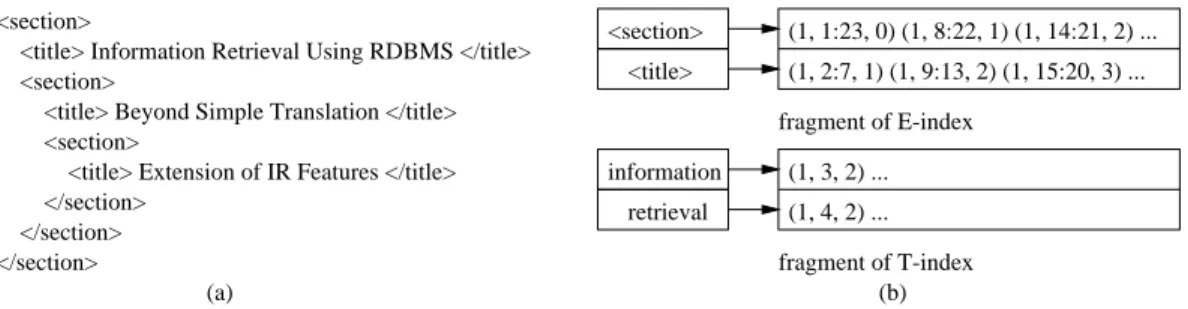
In order to process structured documents such as XML, the inverted index can be extended in a simple way: text words are indexed in a T-index similar to that used in a tra-ditional IR system, and elements are indexed in an E-index, which mapselements to inverted lists. Figure 1 illustrates the structure of the two indexes for a sample XML file.
Each inverted list records the occurrences of a word or an element—here we use “term” to refer to both of them. Each occurrence is indexed by its document number, its position and its nesting depth within the document. This is denoted in Figure 1 as (docno, begin:end, level) for an element and (docno, wordno, level) for a text word. The position,begin:
endorwordno, in a document can be generated by counting word numbers. Alternatively, if the document is in a parsed tree format, the position can be generated by doing a depth-first traversal of the tree and sequentially assigning a number at each visit. Since each non-leaf node is always traversed twice, once before visiting all its children and once after, it has two numbers assigned, while leaf nodes have only one number. An inverted list is sorted in the increasing order of
docno, and then in the increasing order ofbeginandend1
. Term occurrences indexed in this way have the following properties:
1. Containment Property. An occurrence of a term
T1, encoded as (D1, P1, L1),containsan occurrence of
a termT2, encoded as (D2, P2, L2), if and only if: (1) 1
Since XML documents are strictly nested, sorting in the order of (docno, begin) suffices.
(b) <section>
<title> Information Retrieval Using RDBMS </title> <section>
<title> Beyond Simple Translation </title> <section>
<title> Extension of IR Features </title> </section> </section> </section> (a) information retrieval (1, 3, 2) ... (1, 4, 2) ... <title> <section> (1, 1:23, 0) (1, 8:22, 1) (1, 14:21, 2) ... (1, 2:7, 1) (1, 9:13, 2) (1, 15:20, 3) ... fragment of T-index fragment of E-index
Figure 1: (a) A sample XML document, (b) its inverted lists in T-index and E-index.
D1 =D2, and (2)P1 nests P2. For example, (1,1 :
23,0) contains (1,9 : 13,2).
2. Direct Containment Property. An occurrence of a term T1 (D1, P1, L1) direct contains T2 (D2, P2, L2)
if and only if: (1)D1 =D2, (2)P1 nestsP2, and (3)
L1+ 1 =L2. For example, (1,1 : 23,0) direct contains
(1,2 : 7,1).
3. Tight Containment Property. An occurrence of a term T1 (D1, P1, L1) tight contains T2 (D2, P2, L2)
if and only if: (1)D1=D2, and (2)P1 nestsP2 and
nothing else. For example, (1,14 : 21,2) tight contains (1,15 : 20,3). Because of the nesting structure of XML, tight containment implies direct containment but not vice versa.
4. Proximity Property. An occurrence of a term T1
(D1,P1,L1), is within distancekof a termT2(D2,P2,
L2), if and only if: (1)D1=D2, and (2)|P1−P2| ≤k.
For example, (1,3,2) and (1,4,2) are within distance of 1 (appear next to each other). The exact definition of proximity on elements and attributes depend on the application supported.
The above properties allow us to have a variety of oper-ations on inverted lists. To process the expression “a//b”, the inverted lists of “a” and “b” are retrieved. Occurrences from the two lists are merged if they satisfy the Contain-ment Property. The expression “a/b” can be similarly processed by merging the inverted lists using the Direct Containment Property. TheProximity Propertycan be used to process string queries such as “query process-ing” with distance k = 1. Finally the Tight Contain-ment Property can be used to process expressions such as “ <month>=‘january’ ” (element ‘<month>’ has only ‘january’ in it and nothing else).
A framework using inverted lists to process containment queries can be constructed using these operations as basic building blocks, and we have implemented a prototype sys-tem. Central to the framework is the merging of two inverted lists. If we view an inverted list as an ordered relation, the merging of two inverted lists is effectively a join and the properties used for merging are essentially join predicates. Since this type of join is used extensively, its efficiency has paramount importance. In Section 3, we compare the per-formance of this type of join in a special-purpose inverted list engine and in two commercial RDBMSs.
2.3
Containment Query Processing Using an
RDBMS
In this section, we first introduce the relational schema used to store the inverted index and the mapping from con-tainment queries to SQL queries, we then illustrate two ad-ditional types of queries that can be processed as a result of utilizing a powerful and extensible RDBMS.
2.3.1
Schema and Processing of Containment Queries
in the RDBMS
The E-index and T-index can be mapped into the follow-ing two relations:
ELEMENTS(term, docno, begin, end, level)
TEXTS(term, docno, wordno, level)
The ELEMENTS table stores occurrences of XML elements, while theTEXTStable stores occurrences of text words. Each occurrence is stored as a table row.
Figures 2(a)-(d) show the translations of inverted lists merging operations into SQL. A merge of two inverted lists is translated into a join, and the property applied when merg-ing is translated into join predicates. Here we only show the containment between an element and a text word. It involves joins between the ELEMENTS table and the TEXTS
table. Containment between elements is the same except involving a self-join on theELEMENTStable.
2.3.2
Leveraging the Power of the RDBMS
By implementing containment queries using an RDBMS, we are able to process queries that are difficult or impossible to process using only an inverted list engine. We show two examples.
Type 1. Joined Searching.
By joined searching, we mean a query that binds multiple path expressions by a common variable. Such a query can be expressed in languages such as XML-QL and XQuery, but is difficult or impossible to express as a containment query, be-cause it involves searching for terms that are not constants, but are specified by other search conditions. However it is not difficult to express in SQL.
For example, suppose we want to ask the query: “Find those bib entries that cite Smith’s paper”. This query im-plies two path expressions: “bib[author/‘Smith’]/key” and “bib/cite”, with the additional requirement that the “key” element have the same content as the “cite” element. The SQL expression of this query can be found in the full version of this paper [36].
Type 2. Queries on Mixed Data.
Since we now store the inverted index in a database system, the index is accessed the same way as other relational data. This makes it convenient to use the inverted index to
aug-from TEXTS t1, TEXTS t2, where t1.term = ’T1’ and t2.term = ’T2’ and t1.docno = t2.docno and t2.wordno > t1.wordno
(b)
(d) select *
select *
and t2.wordno <= t1.wordno + n from ELEMENTS e, TEXTS t where e.term = ’E’ and t.term = ’T’ and e.docno = t.docno
and e.level = t.level -1 and e.begin < t.wordno and t.wordno < e.end -- E / "T"
-- distance ("T1", "T2") <= n from ELEMENTS e, TEXTS t
and t.term = ’T’ and e.docno = t.docno
from ELEMENTS e, TEXTS t and t.term = ’T’
and e.docno = t.docno (a)
(c) select *
where e.term = ’E’
select *
where e.term = ’E’ and e.begin < t.wordno and t.wordno < e.end
and t.wordno = e.begin + 1 and e.end = t.wordno + 1 -- E//"T"
-- E="T"
Figure 2: Translations of basic containments to SQL.
ment the searches of other relational data and vice versa. These kinds of queries are called “Web-Supported Database Queries” and “Database-Supported Web Queries” in [15].
Suppose we have in our database an inverted index of the DBLP XML files, and aGRADUATES table holding data about graduate students. We can find all students who have a DBLP entry using a SQL query (see [36]).
The query would not be so straightforward if the DBLP files are indexed in a separate system while theGRADUATES
table is kept in a database. In that case, a natural way would be to build an additional module on top of both sys-tems to pullGRADUATESrows and the DBLP inverted index entries out and join them in that module. In fact, [15] is mainly concerned with the construction of this module. A join algorithm has to be implemented in it, and this dupli-cates features already present in the RDBMS. Furthermore, the processing in the module would be costly if there are large number of GRADUATESrows and inverted index entries satisfying the query. It is much more efficient to have a more tightly integrated system, because (a) it allows an optimizer to potentially push selections down in order to avoid gener-ating a large number of intermediate results, and (b) there is no need to cross the boundary of multiple systems, therefore saving the messaging and copying overheads.
3.
PERFORMANCE AND ANALYSIS
We now turn to our performance study comparing the implementations of containment queries in a special-purpose inverted list engine and in a relational database system. The goal of our study is to explore the performance differences, seek reasons for the differences, and provide insights into the strengths and weaknesses of the RDBMS on containment queries.
3.1
Experimental Settings and Methodology
3.1.1
The Hardware and the Software Platforms
Shakespeare DBLP Synthetic
text size 8 MB 53 MB 200 MB
inverted index size 11 MB 78 MB 285 MB
relational table size 15 MB 121 MB 566 MB
# distinct elements 22 598 715
# distinct text words 22,825 250,657 100,000
# total elements 179,726 1,595,010 4,999,500
# total text words 474,057 3,655,148 19,952,000
Table 1: The three datasets.
We could not find a commercial system that supported containment queries on XML data, so we built our own in-verted list engine. It was written in C++ and used the BerkeleyDB library [32] to store the inverted lists. Berkeley DB is a toolkit that provides access methods such as B+tree, Extended Linear Hashing, Fixed and Variable-length records, and Queues. We used its B+-tree and each inverted list was stored as a record.
We experimented with two commercial database systems, DB2 UDB v7.1 and SQLServer v7.0. In the interest of space, we only report the results on DB2. Experimental results on SQLServer were similar and confirm that our observations are not specific to a particular system. We experimented with numerous combination of settings on the RDBMSs. The results reported here were obtained using default set-tings, except that the buffer pool size in DB2 was set to 128 MB, and hash join was enabled. Experimenting with other settings did not alter any of the conclusions.
We experimented with RDBMS indexes using different combinations of columns as the indexing key. In the interest of space, we only report two representatives. One is the clustered index on (term, docno) columns, the other is a clustered index on all columns in a table. We call the former the two-column(2col) index and the latter thecover index (as the indexing key covers all columns). Note that the term “index” is overloaded in this paper. There is the IR inverted index, and there are indexes in the RDBMS. To make it clear, the term “index” without any qualification refers to the RDBMS index.
Our inverted list engine and DB2 were run on a 800 MHZ PIII machine running Linux Redhat v6.2, and SQLServer was run on a 500 MHZ PIII machine running Microsoft NTServer v4.0. The main memory sizes on the machines are 256 MB.
3.1.2
The Datasets and the Queries
Three XML datasets were used in our study. The first was a set of Shakespeare plays [8], the second was a set of DBLP bibliography files2
, and the third was a set of syn-thetic XML documents. The synsyn-thetic data generator first produced a random element tree. This tree was used as a template and the number of occurrences of elements and their text contents were varied to generate a document. In the synthetic data set, the numbers of occurrences of text words followed the Zipfian distribution [37] with constant 1.0, and the numbers of occurrences of elements followed the Zipfian distribution with constant 1.5.
2
The original archive consists of 141,023 small files averaging 374 bytes each. We combined these files into bigger ones to obtain a dataset averaging 93 KB per document.
number of term1 number of term2 result rows QS1 90 277 2 QS2 107,833 277 36 QS3 107,833 3,231 1,543 QS4 107,833 1 1 QD1 654 55 13 QD2 4,188 712 672 QD3 287,513 6,363 6,315 QD4 287,513 3 3 QG1 50 1,000 809 QG2 134,900 55,142 1,470 QG3 701,000 165,424 21,936 QG4 50 82,712 12 QG5 701,000 17 4
Table 2: Number of occurrences of terms and num-ber of result rows.
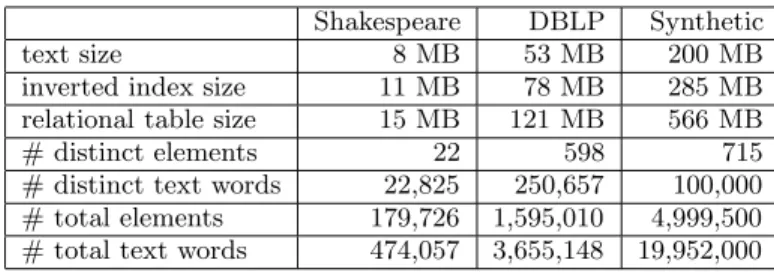
Statistics for the three datasets are listed in Table 1. This table shows the raw sizes of the datasets, the sizes of the inverted listes stored in BerkeleyDB B+-tree, and the DB2 relational table sizes (not including DB2 indexes). It also shows the distinct and total number of elements and text words. Note that the total number of elements and text words are the cardinalities of theELEMENTStable andTEXTS
table, respectively.
We focused on using simple queries for our performance study, as these “micro benchmark” queries allow us to study the core performance issues better than complex ones. This methodology of using simple queries rather than full work-loads was indicated to be advantageous in [2]. We also ex-perimented with complex queries, the discussion of which can be found in the full version of the paper [36]. We report results on thirteen simple containment queries of the form “term1 contains term2”, where “term1” is an XML ele-ment and “term2” is a text word. Note that the discussion throughout this paper applies to the case where both terms are elements. In fact, the containment between elements can be processed almost identically to the containment between element and text word. This is because, since XML elements are strictly nested, whether an element is contained in an-other element can be checked using only thebeginposition of the nested term (term2).
Each query is coded “QXN”, where ‘X’ is one of ‘S’ (Shake-speare), ‘D’ (DBLP), or ‘G’ (generated data), and ‘N’ is the query number within the respective dataset. Each of the two terms in a query can have a small, medium, or large number of occurrences, and we selected queries to cover most com-binations. This allows us to determine how sensitive the performance is to the selectivity of terms. Table 2 shows the number of term occurrences and the number of results for each query.
The SQL version of the queries is shown in Figure 2(a). Note that each of these queries requires merging of two lists in the inverted list engine, and a join between theELEMENTS
table and theTEXTS table in the RDBMSs. Take QG3 for example. It requires merging two inverted lists of about 10 MB and 2 MB, and a join between 701,000 rows and 165,424 rows in the RDBMSs.
Queries Inv. List DB2 (2col ndx) DB2 (cover ndx)
QS1 0.1 4 2 QS2 52.9 5963 259 QS3 68.4 5219 6089 QS4 53.7 23 2 QD1 0.2 7 2 QD2 3.3 545 518 QD3 202.1 76130 3907 QD4 177.6 28 2 QG1 1.5 24 21 QG2 125.1 182997 56956 QG3 542.3 1516743 21463 QG4 50.2 931 782 QG5 369.2 4292 56
Table 3: Raw timings [msec].
QS1 QS2 QS3 QS4 QD1 QD2 QD3 QD4 QG1 QG2 QG3 QG4 QG5 0.01 0.1 1 10 100 1000 2col index cover index
Figure 3: DB2/Inverted List performance ratios [log scale].
3.2
Results Comparing the Inverted List
En-gine and DB2
Table 3 shows the raw timings of the thirteen queries on the inverted list engine and DB2, all from hot runs. Figure 3 shows the performance ratios. It shows that:
1. DB2 outperforms the inverted list engine for some of the queries;
2. DB2 performs worse than the inverted list engine for most of the queries;
3. The performance using the cover index is better than using the 2col index.
The last point is easy to see as the cover index is sufficient for answering queries, whereas when the 2col index is used, rows must be fetched from the tables after the index is scanned. Unless otherwise indicated, hereafter we use the cover index performance to compare with the inverted list engine. We next investigate: (1) Why does the RDBMS sometimes per-form better, and (2) Why does the RDBMS usually perper-form worse?
3.3
Why Does the RDBMS Sometimes
Per-form Better?
Recall that in the inverted list engine, each list is stored as a record, and there is no further index on it, thus there is
Nested-loop
Index
: rows actually retrieved : all rows of a term Index
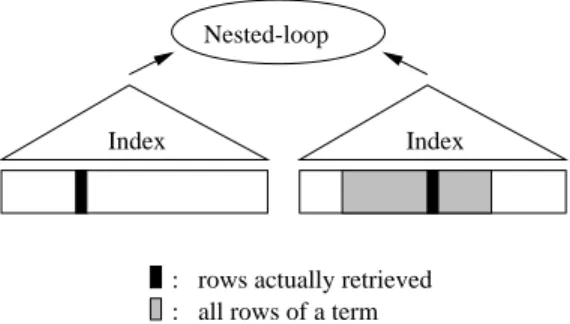
Figure 4: Index nested-loop join is used to avoid retrieving all rows of the inner term.
t.term = ’T’
Index Scan Index Scan e.term = ’<E>’ Nested Loop Join
Index Scan Index Scan e.term = ’<E>’
Sort Merge Join e.docno = t.docno
t.term = ’T’
Index Index Index Index and e.docno = t.docno
and e.begin < t.wordno and t.wordno < e.end
and e.begin < t.wordno and t.wordno < e.end
(a) (b)
Figure 5: (a) A query plan using index nested-loop join. (b) A query plan using merge join.
no easy way to extract a portion of it other than retriving the entire list. Further, even if only a small portion of a list turns out to join with another list, all entries in the list must be examined. In the RDBMS implementation, with indexes built on the tables, rows of a term can be selectively retrieved, thus saving both I/O and CPU time.
The queries for which DB2 performs better have a com-mon characteristic: one term in the query is highly selective, while the other term is not selective. The RDBMS optimizer is able to discern such a case, and choose the index nested-loop join between theELEMENTStable and the TEXTStable, putting the table containing the more selective term as the outer, and the table containing the less selective term as the inner. The result is that only the inner rows satisfying the pushed-down join predicates are retrieved and joined with the outer rows. Figure 4 illustrates this situation, and Fig-ure 5(a) shows the query plan.
There are two important points to note. First, the savings on CPU and I/O must be large enough to compensate for the overheads incurred by the RDBMS. DB2 also chose the index nested-loop join for some other queries, but it was not able to out-perform the inverted list engine for those queries. Second, we expect that, in practice, this case in which the RDBMS out-performs the inverted list engine will not be rare. It will arise whenever one predicate (or a combina-tion of multiple predicates) in a query is highly selective; in those cases a further join on the two tables will be very effi-cient and an RDBMS is likely to perform better. A concrete
QS1 QS2 QS3 QS4 QD1 QD2 QD3 QD4 QG1 QG2 QG3 QG4 QG5 0%
50% 100%
Figure 6: Percentages of CPU cost.
example is shown in [36].
3.4
Why Does the RDBMS Usually Perform
Worse?
We considered a long list of possible answers to this ques-tion, including:
• The cost of binding results out of the database engine to the application might be very high, while the actual processing may be efficient;
• The optimizer may not be producing good plans;
• I/O in the RDBMS might be more expensive;
• The CPU cost might be high, due to code path, in-terpretive execution, overheads of locking, buffer pool management, etc..
We briefly examine each possibility in turn, and then get to our main findings.
• While the bind-out cost probably plays some role, it can be rejected as being the dominant cost because bindout is apparently a small fraction of the total ex-ecution time. To see this, note that on Query QG1 DB2 returns 809 result rows in 21 msec, whereas Query QS2 takes 259 msec to return only 36 rows. Assum-ing thatallthe time for QG1 is due to result bindout (clearly an overestimate), DB2 can bind out a row in 21/809 =.026 msec. Then in QS2, returning 36 rows should take DB2 about 36∗.026 = 0.9 msec, which is less than one percent of QS2’s total execution time (259 msec.)
• Figure 5 shows two DB2 plans using the cover index and two standard joins. In general, we found that the optimizer’s pick matched our own intuition of what constitute a good plan.
• Figure 6 shows the percentage of CPU cost for the thirteen queries as reported by the DB2 performance monitor. Clearly the queries are CPU-bound, and DB2 can almost fully operate out of the buffer pool with little I/O overhead.
So, if none of bind-out cost, query plan, and I/O is the dom-inant reason, what is causing the performance differential? To begin to answer this question we performed a deeper analysis of the algorithms used by the inverted list engine and the DBMSs.
procedurecontainment merge (list1, list2) begin
1. set cursor1 at beginning of list1 2. set cursor2 at beginning of list2 3. while(cursor16= end of list1and
4. cursor26= end of list2)do
5. if(cursor1.docno<cursor2.docno)then
6. cursor1++
7. else if(cursor2.docno<cursor1.docno)then
8. cursor2++
9. else
10. mark = cursor2
11. while(cursor2.position<cursor1.positionand
12. cursor26= end of list2)do
13. cursor2++
14. if(cursor2 == end of list2)then
15. cursor1++
16. cursor2 = mark
17. else if(cursor1.val (directly)contains cursor2.val)then
18. mark = cursor2
19. do
20. merge cursor1 and cursor2 values
21. cursor2++
22. while(cursor1 value (directly)contains cursor2 value
23. andcursor26= end of list2)
24. cursor1++ 25. cursor2 = mark 26. endif 27. endwhile 28. endif 29.endwhile end
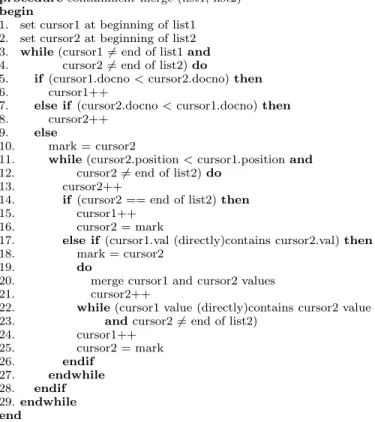
Figure 7: The inverted list containment merging al-gorithm.
3.5
MPMGJN: The Join Method of the
In-verted List Engine
3.5.1
MPMGJN and the Standard Merge Join
Figure 7 presents the basic algorithm that does contain-ment merging in the inverted list engine. Our actual imple-mentation uses a slightly more optimized version. This is in fact a merge join algorithm, but is different from the standard merge join implemented in the two commercial database systems. Recall that in the SQL version of the benchmark query (Figure 2(a)), there are multiple join pred-icates: t1.docno = t2.docno AN D t1.begin < t2.wordno AN D t2.wordno < t1.end. The standard merge join al-gorithm only uses the equality join predicate on docno to merge two sets of rows, the inequality predicates are ap-plied on each pair of rows with matchingdocnovalues. One can view this join process as twological steps. In the first step, the equality predicate on docno is used to produce pairs of rows whosedocnovalues match. In the second step, the inequality predicates are then applied on these matching rows.
On the other hand, the merge join algorithm used in the inverted list engine uses all join columns (on docno, begin, end, wordno) to guide merging. By doing so it is able to avoid some row comparisons done by the standard merge join. We call this merge join “Multi-predicate Merge Join”(MPMGJN). Figure 8 illustrates with an example that joins two lists. A line connecting two rows indicates an
at-tempt to join them by doing some comparisons3
Clearly, MPMGJN does fewer comparisons than the standard merge join.
However, the standard merge join is only one of the choices of an RDBMS. Two other algorithms can be used to pro-cess a join: hash join and index nested-loop join. Since a hash join cannot be used for inequality predicates, only the predicate on docnocan be used, and the inequality predi-cates must be applied on each pair of rows with matching
docno just like the standard merge join. Therefore, hash join has the same disadvantage. Next we look at the index nested-loop join.
3.5.2
MPMGJN and the Standard Index Nested-Loop
Join
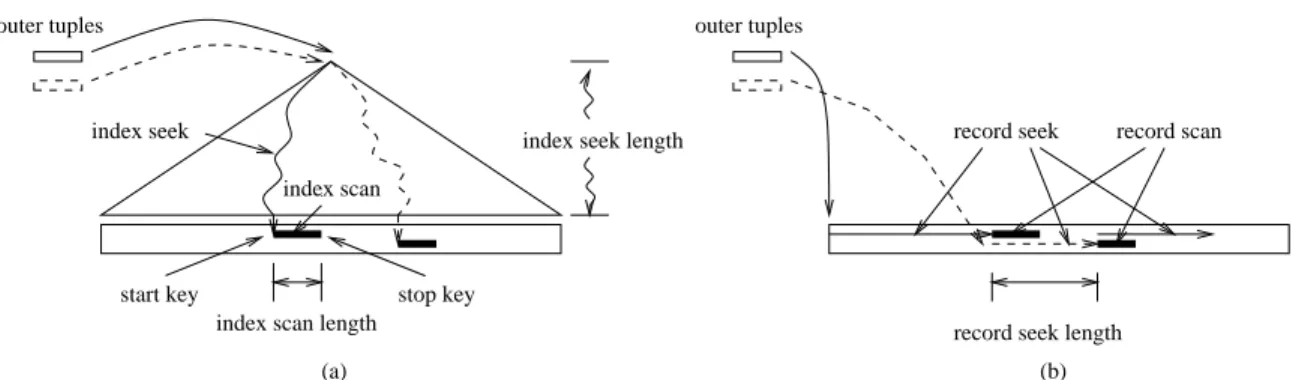
The DB2 query plan using the index nested-loop join and the cover index was shown in Figure 5(a). All three join predicates are pushed down to the inner. Figure 9(a) illus-trates this join operation. For each outer row, its values (other than that on thetermcolumn) are used to seek the index on the inner table, starting from the root of the B+-tree and reaching a record with thestart keyat the bottom of the index. An index scan is then conducted across the index records until one with a stop key is reached. Then each record along the scan is attempted to be joined with the outer row. The seeking and scanning are repeated for all outer rows.
Here we use “start key” and “stop key” to refer to points where the index scan can start and stop. An RDBMS uses “start key predicates” (or “sargable predicates”) and “stop key predicates” to find these points. For our containment queries, the start and stop key predicates are as follows. When the outer table is ELEMENTS, inner table is TEXTS, the start key predicates are: term = value AND docno = outer.docno AND wordno<outer.begin; the stop key pred-icates are: term = value AND docno = outer.docno AND wordno<outer.end. When the outer table isTEXTS, the in-ner table isELEMENTS: the start key predicates are: term = value AND docno = outer.docno AND end>outer.wordno; the stop key predicates are: term = value AND docno = outer.docno AND begin<outer.wordno.
Using the start and stop keys, an RDBMS is able to se-lectively retrieve and examine inner rows to join with outer rows. Figure 8(c) illustrates with the same example. Again, a line between two rows indicates an attempt to join them by doing comparisons4
. It appears from this example that the standard index nested-loop join does fewer comparisons than MPMGJN, and therefore should perform better. This is not always true.
In order to selectively examine inner rows, an index must be used, and comparisons must be done on index records. We call the process of going through the index to retrieve the inner rowsindex seek, and the process of joining inner and outer rowsindex scan. We call the number of comparisons done during the index seek the index seek length, and the number of comparisons done during the index scan theindex scan length.
To see the index seek overhead, let us do a simple
calcula-3
In the inverted list engine, the predicates are implemented as “short-circuit” conditions. That is, if one predicate fails, the other predicates will not be applied.
4
For each outer, one more comparison is done to determine when to stop.
doc begin end 5 7 20 5 14 19 5 21 28 5 22 27 5 29 31 5 32 40 doc wdno 5 42 5 37 5 33 5 24 5 23 5 2
doc begin end 5 7 20 5 14 19 5 21 28 5 22 27 5 29 31 5 32 40 doc wdno 5 42 5 37 5 33 5 24 5 23 5 2
doc begin end 5 7 20 5 14 19 5 21 28 5 22 27 5 29 31 5 32 40 doc wdno 5 42 5 37 5 33 5 24 5 23 5 2
(a) Standard merge join. (b) MPMGJN. (c) Standard index nested-Loop join.
Figure 8: Workout of an example.
outer tuples
record scan record seek
(b) record seek length index seek
start key
index scan
(a)
stop key index scan length
index seek length
outer tuples
Figure 9: The operation on the inner of: (a)index nested-loop join, (b) merge join, as a form of nested-loop join.
tion. Assume that the index has 4 levels5
, each index page holds 256 keys, and binary search is used to find the pointer to follow to a next level index page. The index seek length in the worst case is 4×log 256 = 32, and in the average case is 32/2 = 16. This means that each outer row must pay 16 more comparisons to get some inner rows to join with it.
Further, these additional comparisons are costly due to their poor hardware cache utilization. Let us review the memory hierarchy in a modern computer system. Data and instructions higher in the memory hierarchy can be accessed much faster than those in a lower hierarchy. In our machine, the first level cache can be accessed in one cycle, but a miss costs many cycles and thus is much more costly. If the sec-ond level cache is missed, the penalty is even higher. A cache consists of multiple cache lines, each of which can hold mul-tiple instructions or data. When a datum is missing in a cache, it is fetched from the lower memory hierarchy, and data residing in the same cache line are also brought in. If there is prefetching, subsequent data may also be brought in to fill other cache lines. Thus the access to the nearby or subsequent data is likely to result in a hit and be fast. However, this benefit only exists when data is accessed se-quentially or when the access pattern can be detected by the processor. Random access is likely to result in more cache misses than sequential access.
Binary search is very efficient in reducing the number of comparisons during index seek, however it guarantees almost no access of contiguous records. Therefore an index record comparison almost always incur a cache miss.
A merge join (MPMGJN is no exception) is essentially a form of nested-loop join, except that seeking is not done on
5
This is the height of some of our DB2 indexes.
an index, but rather directly on data records. This “nested-loop” join is performed in the following way: for each outer row, a seek is done on the inner rows until a “start record” is found, then a record scan is conducted and each row during the scan is attempted to join with the outer row; the record scan ends at a “stop record”. The next seek does not need to start from the first record, but instead can start from the beginning of last record scan. A merge join can be done this way because both the inner rows and the outer rows are sorted. Figure 9(b) illustrates the operation on the join inner. A record seek is analogous to an index seek, and a record scanis analogous to an index scan.
For the same query on the same data, record scans (note that each outer row requires a seek and a scan) cost the same number of comparisons as index scans, but the record seek costs are different from the index seek costs. A merge join has better cache utilization as both the outer and the inner rows are, by and large, retrieved and examined sequentially. In fact, it is not 100% straight sequential because some in-ner rows may need to be looped over multiple times. This looping increases the possibility of cache hits. There is a disadvantage on record seeks however, a record seek may take more comparisons than an alternative index seek.
3.5.3
Experimental Comparisons of Join Algorithms
To see the performance impact of the join algorithms, we implemented the standard merge join and index nested-loop join ourselves and compare them with MPMGJN. As de-scribed in Section 3.5.1 the standard merge join implemen-tation applies the inequality join predicates on every pair of rows whosedocnovalues match.
con-QS1 QS2 QS3 QS4 QD1 QD2 QD3 QD4 QG1 QG2 QG3 QG4 QG5 0.01 0.1 1 10 100
standard merge / MPMGJN ratios nested-loop / MPMGJN ratios
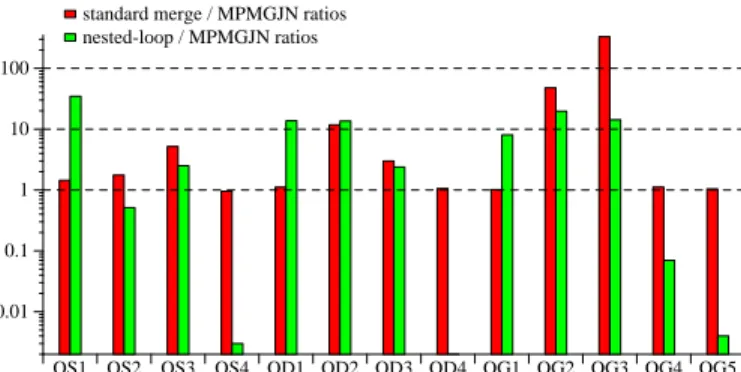
Figure 10: Ratios of standard joins to MPMGJN [log scale].
Queries MPMGJN standard merge join
QS1 5 1,653 QS2 7,131 984,948 QS3 89,716 10,175,904 QS4 2,366 3,475 QD1 503 555 QD2 4,723 1,315,662 QD3 263,458 14,082,080 QD4 1,766 4,950 QG1 1,000 1,000 QG2 103,994 148,773,116 QG3 610,816 2,319,244,480 QG4 12 82,712 QG5 56,084 238,340
Table 4: Number of row pairs compared by MP-MGJN and the standard merge join.
verted our inverted lists into relational rows according to the schema presented in Section 2.3 and stored them in a BerkeleyDB B+-tree, making it equivalent to the DB2 cover index. Our index nested-loop join implementation simulates the optimizer by choosing the table containing the shorter list as the outer. Start and stop key predicates were used.
In our experiments, the running times of each of the three algorithms include (a) the parsing cost to extract individual column values from records, and (b) the cost to generate results, although the printing cost is not included. We as-sume that data are cached in the buffer pool (thus no I/O). This is a reasonable assumption as we have shown that the queries are CPU-bound and the I/O cost is minimal.
Figure 10 shows the performance ratios of the two stan-dard join algorithms to MPMGJN. Note that the Y-axis is again in log-scale. These results confirm that the MPMGJN performs at least as well as the standard merge join, and bet-ter than the index nested-loop join for most queries. The index nested-loop join performs better than the MPMGJN for queries QS2, QS4, QD4, QG4, and QG5. DB2 used the index nested-loop join for these queries except QG4, and did perform better than the inverted list engine for QS4, QD4 and QG5 (see Figure 3).
To better understand why MPMGJN can perform better than the standard merge join, Table 4 shows the number of row pairs compared by the two merge algorithms.
QS1 QS2 QS3 QS4 QD1 QD2 QD3 QD4 QG1 QG2 QG3 QG4 QG5 0 10 20 30 40 50
number of key/record comparisons
avg index scan length avg index seek length avg record seek length
281 17064 86599 1653 28040
Figure 11: Seek lengths and scan lengths, averaged per outer.
Figure 11 compares index/record seek lengths, and in-dex/record scan of the queries. Since different outer rows may require different seek and scan lengths, for each query we obtained the averages over all outer rows. Figure 11 shows that long seeks are performed for short scans for all
queries. For six of them, QS1, QD1, QD2, QG1, QG2,
and QG3, record seek lengths are shorter than index seek lengths. These are precisely the queries that the MPMGJN out-performs the index nested-loop join by a wide margin (Figure 10). For the rest seven queries, record seek lengths are longer than index seek lengths, and the difference for five of them are dramatic. These five queries, QS2, QS4, QD4, QG4, and QG5, are precisely those for which the in-dex nested-loop join out-performs the MPMGJN. For the rest two queries with record seek lengths longer than in-dex seek lengths, MPMGJN still performs better because of sequential scan. This demonstrates that sequential scan is better than random access, but only until the amount of extra work done exceeds a certain point.
3.6
Hardware Cache Utilization
With main memory sizes getting larger and the memory hierarchy getting deeper, many researchers (e.g., [2, 31, 25]) have recognized the effect of good hardware cache utilization on performance. We conducted experiments to see whether there exists significant difference between the inverted list engine and the RDBMS on containment queries. We show the results in this section.
This set of experiments were conducted on a machine with a 800 MHZ Intel PIII processor running a v.2.2.16 Linux ker-nel. The machine has a 16 KB first level instruction cache (L1-I cache), a 16 KB first level data cache (L1-D cache), and a 256 KB second level (L2) unified cache. The data and instruction accesses to the second level cache can be mea-sured separately. The PIII processor supports prefetching and out-of-order instruction execution. The latter implies that instruction/data fetches can be overlapped. The de-tailed description of the hardware parameters can be found in [18]. We measured the number of cache accesses and misses using the PIII hardware counters.
In the interest of space, we discuss the hardware cache utilization of three of the queries (QD3, QD4 and QG1). Figures 12-14 show the number of accesses and misses in thousands. Overall, the number of L1 cache accesses is sig-nificantly (up to 30,000 times) larger than the L2 cache
ac-L1-access L1-miss L2-access L2-miss 1 10 100 1000 10000 100000 1000000 I-Cache (thousands)
inv. list engine DB2
L1-access L1-miss L2-access L2-miss
1 10 100 1000 10000 100000 1000000 D-Cache (thousands)
inv. list engine DB2
Figure 12: Query QD3 [log scale]
L1-access L1-miss L2-access L2-miss
1 10 100 1000 10000 100000 I-Cache (thousands)
inv. list engine DB2
L1-access L1-miss L2-access L2-miss
1 10 100 1000 10000 100000 D-Cache (thousands)
inv. list engine DB2
Figure 13: Query QD4 [log scale]
L1-access L1-miss L2-access L2-miss 1 10 100 1000 10000 I-Cache (thousands)
inv. list engine DB2
L1-access L1-miss L2-access L2-miss 1 10 100 1000 10000 D-Cache (thousands)
inv. list engine DB2
Figure 14: Query QG1 [log scale]
cesses. This is because the L2 cache is accessed only when the L1 caches are missed. Notice that for data caches, the number of L1 misses is the same as the number of L2 ac-cesses, while for instruction caches, the number of L1 misses is less than the number of L2 accesses. This reveals instruc-tion prefetching but not data prefetching. Next we examine each query in turn.
QD3 is a query on which DB2 chooses index nested-loop join, and performs much worse than the inverted list engine (Figure 3). The inverted list engine has about 19 times fewer accesses to the L1-I cache and about 84 times fewer accesses to the L1-D cache compared to DB2. Further, the inverted list engine has over 4,000 times fewer misses in the L1-I cache, and about 9 times fewer misses in the L1-D cache (thus DB2 actually achieves better data cache miss ratio).
QD4 is a query on which DB2 chooses the index nested-loop join as well, and this is one of the queries on which DB2 out-performs the inverted list engine. It is clear from Fig-ure 13 that DB2 wins in most aspects: it accesses the caches less often and also misses less (with some exceptions in the instruction cache). From Figure 11 we see that the record seek length is dramatically larger than the index seek length for this query. This means that the inverted list engine has to seek through a large number of inner rows to find some that join with the outer rows. DB2 on the other hand, uses the index to find those rows and does much less work.
QG1 is a query on which DB2 chooses the standard merge join. Both join algorithms happen to do the same number of comparisons for this query (Table 4), and our own im-plementation also indicates that the two algorithms should perform the same (Figure 10). However, the inverted list en-gine performs more than an order of magnitude faster than DB2. Figure 14 gives us insight into the cause of the dif-ference. As we can see, DB2 has about five times as many accesses to both the L1-I cache and the L1-D cache. Further, it has about 240 times as many misses in the L1-I cache and about 6 times as many misses in the L1-D cache. For the L2 cache, DB2 has over 5 times more misses.
For query QG1, DB2 has better data cache miss ratio, but much worse instruction cache miss ratio. In addition, even though the algorithm indicates the same amount of work, the cache utilization of the two systems are different, therefore cache is a distinct factor that affects performance.
4.
RELATED WORK
A substantial amount of work has been done on inte-grating information retrieval, especially text searching, with database systems. Examples of integrating text search with relational, object-relational, or object-oriented databases in-clude [4, 35, 10]. Commercial examples inin-clude the DB2 Text Extender [16], SQL Server Full-Text Search Service [34] and Oracle InterMedia Text [23]. An example of integrating text search with semi-structured databases is Lore [20], in which a simplified version of an IR-style text index is used to locate strings containing specific text words or groups of text words [19]. None of this previous work explores the performance implications of a special purpose vs. native implementation of this functionality in an RDBMS.
The advent of SGML [13] has triggered much research on integrating content and structure in text retrieval, in-cluding [3, 33, 4, 26]. Work on containment queries can be found in [6, 7, 9]. Our work on containment queries differs from the previous work in that, since we target XML rather
than SGML data retrieval, and XML elements are strictly nested, we are not concerned with overlapped extents, nor with reduction functions on overlapped extents. Most sig-nificantly, our work does not focus on the development of containment algorithms; rather, it focuses on how to imple-ment the algorithms in an RDBMS.
There is also work that considers using an RDBMS to store and retrieve XML documents, including [29, 30, 11]. These papers focus on techniques for converting XML doc-uments to and from relations and are complementary to our work, which focuses on the performance of implementation options for a class of query over XML data.
Putz [24] describes using a relational database system for information retrieval. His work differs from ours in the re-lational schema for, and hence the retrieval of, the inverted index. In [24], multiple encoded occurrences of a term are stored in one relational row, therefore the storage is more compact. The flip side is that the application program has to do quite a bit of work, such as encoding/decoding and pack-ing/unpacking table rows, and doing operation on postings retrieved. Thus the power and flexibility of the RDBMS is not fully utilized, as the IR and “normal” query processing is not really integrated. Also, [24] does not consider struc-tured text retrieval, and does not compare the RDBMS with the IR approach.
Florescu et al. [12] use a different schema to store the inverted index, where the postings of each distinct XML el-ement and text word is stored in its own table. Thus we would have a LINE table for “<line>”, a CLEOPATRA table for “cleopatra”. The implementation options we discuss ap-ply equally well to this model; needless to say, using this model many tables would be required to store the inverted index. Also, [12] does not compare the implementation on the RDBMS with the IR alternative.
5.
CONCLUSION
While the dust has not yet settled on the debate over which XML query language will win, or what role RDBMSs will eventually play in XML query systems, two things are clear. First, containment queries will be an important part of XML query workloads. Second, at least in the foreseeable future, a great deal of XML data will be stored in relational systems. Currently in the commercial world the approach in which an IR indexing system is “glued” to a relational system, dominates.
However, as we have argued in the introduction, there are compelling reasons to consider a more tightly coupled approach, in which queries involving containment are sup-ported by native RDBMS data structures, query optimiz-ers, and query processors. This tightly coupled approach will not be viable unless its performance is satisfactory. Our experiments show that with current commercial RDBMS technology, in general a native RDBMS implementation of containment query support is substantially slower than that of a special purpose IR engine. We sought to quantify this performance differential, and to gain insights as to whether the situation could be remedied.
There appears to be no single factor that accounts for the entire performance difference between the two types of sys-tems, and modifying an RDBMS so that its performance matches that of the special-purpose inverted list engine will be non-trivial. However, we have discovered two important contributing factors to the performance difference, these are
the join algorithm used by the inverted list system, which we call multi-predicate merge join (MPMGJN), and the hard-ware cache utilization achieved.
As we have demonstrated, for joins generated by contain-ment queries, the MPMGJN algorithm can be more than an order of magnitude faster than standard RDBMS join algorithms. It appears that the addition of this new join al-gorithm will be a critical part of any successful effort to make an RDBMS competitive with a special purpose IR engine on XML containment queries. In addition, in our experiments the RDBMS had much lower cache utilizations than the IR systems. The on-going research on main memory and cache aware database systems is likely to produce a new genera-tion of RDBMSs that have much better cache utilizagenera-tion. While it is premature to make concrete predictions, we are optimistic that by combining better join algorithms with better cache utilization, an RDBMS will be able to natively support containment queries efficiently.
6.
ACKNOWLEDGMENTS
The authors would like to thank Anastassia Ailamaki for her help in measuring hardware cache utilization. Funding for this work was provided by NSF through grants CDA-9623632 and ITR 0086002, and DARPA through NAVY/ SPAWAR Contract No. N66001-99-1-8908.
7.
REFERENCES
[1] S. Abiteboul, D. Quass, J. McHuge, J. Widom, and J. Wiener. The lorel query language for
semistructured data. International Journal on Digital Libraries, 1(1):68–88, April 1997.
[2] A. Ailamaki, D.J.DeWitt, M.D.Hill, and D.A.Wood. Dbmss on a modern processor: Where does time go? InProceedings of the 25th International Conference on Very Large Data Bases, pages 266–277, September 1999.
[3] Ricardo Baeza-Yates and Gonzalo Navarro. Integrating contents and structure in text retrieval. SIGMOD Record, 25(1):67–69, March 1996. [4] G. E. Blake, M. P. Consens, P. Kilpelainen, P.-A.
Larson, T. Snider, and F. W. Tompa. Text/relational database management systems: Harmonizing sql and sgml. InProceedings of the International Conference on Applications of Databases, pages 267–280, June 1994.
[5] D. Chamberlin, D. Florescu, J. Robie, J. Simeon, and M. Stefanescu.XQuery: A Query Language for XML. W3C Working Draft, February 2001.
http://www.w3.org/TR/xquery.
[6] C. L. Clarke, G. V. Cormack, and F. J. Burkowski. An algebra for structured text search and a framework for its implementation.The Computer Journal,
38(1):43–56, 1995.
[7] C.L.Clarke, G.V.Cormack, and F.J.Burkowski. Schema-independent retrieval from heterogeneous structured text. InFourth Annual Symposium on Document Analysis and Information Retrieval, pages 279–289, 1995.
[8] Robin Cover. The xml cover pages. In
http://www.oasis-open.org/cover/xml.html, July 2000. [9] Tuong Dao, Ron Sacks-Davis, and James A. Thom.
relationships. InProceedings of the 7th Australasian Database Conference, 1996.
[10] Stefan Dessloch and Nelson Mattos. Integrating sql databases with content-specific search engines. In Proceedings of the 23rd VLDB Conference, 1997. [11] Daniela Florescu and Donald Kossman. Storing and
querying xml data using an rdbms.IEEE Data Engineering Bulletin, 22(3):27–34, 1999. [12] Daniela Florescu, Donald Kossmann, and Ioana
Manolescu. Integrating keyword search into xml query processing.WWW9/Computer Networks,
33(1-6):119–135, 2000.
[13] International Organization for Standardization. Information processing–text and office
systems–standard generalised markup language (sgml), iso/iec 8879, 1986.
[14] GMD. Gmd-ipsi xql engine.
http://xml.darmstadt.gmd.de/xql/index.html, August 1999.
[15] Roy Goldman and Jennifer Widom. Wsq/dsq: A practical approach for combined querying of databases and the web. InProceedings of the 2000 Sigmod Conference, pages 285–296, 2000.
[16] IBM. Db2 text extender.
http://www-4.ibm.com/software/data/db2/extenders/text.htm, July 2000.
[17] INRIA. Minixyleme project.
http://www-rocq.inria.fr/∼aguilera/xoql/minixyleme/readme.html. [18] Intel. Intel architecture software developer’s manual,
volume 1: Basic architecture, 1999.
[19] J.McHugh, J.Widom, S.Abiteboul, Q.Luo, and A.Rajaraman. Indexing semistructured data. In Stanford Technical Report, January 1998.
[20] J.McHugh, S.Abiteboul, R.Goldman, D.Quass, and J.Widom. Lore: A database management system for semistructured data.SIGMOD Record, 26(3):54–66, 1997.
[21] University of Washington. The tukwila data integration system.
http://data.cs.washington.edu/integration/tukwila/. [22] University of Wisconsin. The niagara system.
http://www.cs.wisc.edu/niagara/.
[23] Oracle. Oracle8i intermedia text reference, release 8.1.5.
http://oradoc.photo.net/ora81/DOC/inter.815/a67843/toc.htm. [24] Steve Putz. Using a relational database for an
inverted text index. InXerox Palo Alto Research Center Technical Report SSL-91-20, Xerox PARC, January 1991.
[25] Jun Rao and Kenneth A. Ross. Making b+-trees cache conscious in main memory. InSIGMOD Conference, pages 475–486, 2000.
[26] Ron Sacks-Davis, Timothy Arnold-Moore, and Justin Zobel. Database systems for structured documents. In Proceedings of the International Symposium on Advanced Database Technologies and Their Integration (ADTI’94), pages 272–283, October 1994.
[27] Arnaud Sahuguet. Kweelt. http://db.cis.upenn.edu/Kweelt/.
[28] G. Salton and M.J. McGill.Introduction to Modern Information Retrieval. McGraw-Hill, New York, 1983. [29] Jayavel Shanmugasundaram, He Gang, Kristin Tufte,
Chun Zhang, David DeWitt, and Jeffrey Naughton. Relational databases for querying xml documents: Limitations and opportunities. InProceedings of the 1999 VLDB Conference, September 1999.
[30] Jayavel Shanmugasundaram, E. Shekita, R.Barr, Michael J. Carey, Bruce G. Lindsay, Hamid Pirahesh, and Berthold Reinwald. Efficiently publishing relational data as xml documents. InVLDB Conference, September 2000.
[31] A. Shatdal, C. Kant, and J.F.Naughton. Cache conscious algorithms for relational query processing. InProceedings of the 20th VLDB Conference, 1994. [32] Sleepycat Software. The berkeley database.
http://www.sleepycat.com.
[33] T.Arnold-Moore, M.Fuller, B.Lowe, J.Thom, and R.Wilkinson. The elf data model and sgql query language for structured document databases. In Proceedings of the Australasian Database Conference, Adelaide, Australia, pages 17–26, 1995.
[34] Rozanne Whalen. Implementing the full-text search service in sql server.
http://msdn.microsoft.com/library/periodic/period00/ ewn0092.htm, September 2000.
[35] Tak W. Yan and Jurgen Annevelink. Integrating a structured-text retrieval system with an
object-oriented database system. InVLDB Conference, September 1994.
[36] Chun Zhang, Jeffrey Naughton, David DeWitt, Qiong Luo, and Guy Lohman. On supporting containment queries in relational database management systems. full version.
http://www.cs.wisc.edu/niagara/papers/ZND+01full.pdf, 2001.
[37] G. K. Zipf.Human Behavior and the Principle of Least Effort. Addison-Wesley, Reading MA, 1949.
![Figure 3: DB2/Inverted List performance ratios [log scale].](https://thumb-us.123doks.com/thumbv2/123dok_us/9847904.2477811/5.918.472.846.90.472/figure-db-inverted-list-performance-ratios-log-scale.webp)
![Figure 13: Query QD4 [log scale]](https://thumb-us.123doks.com/thumbv2/123dok_us/9847904.2477811/10.918.79.468.96.992/figure-query-qd-log-scale.webp)
